I. INTRODUCTION
Ni–W alloys are a promising substrate material for YBa2Cu3O7-δ (YBCO) -coated conductors using a rolling-assisted biaxially textured substrate (RABiTS) process. Reference Goyal, Norton, Budai, Paranthaman, Specht, Kroeger, Christen, He, Saffian, List, Lee, Martin, Klabunde, Hartfield and Sikka1–Reference Liang, Tian, Suo, Wang, Meng, Ma and Liu5 The Ni5W alloy has been widely used as a substrate for YBCO-coated conductors and the formation of cube {001}〈100〉 texture has been investigated systematically. Reference Bhattacharjee, Ray and Tsuji6,Reference Tian, Suo, Qiu, Ma, Liu, Wang, Wang and Wang7 The primary drawback of this material is its relatively high Curie temperature of approximately 330 K. Reference Subramanya, Eickemeyer, Schulz and Holzapfel8 Compared with the Ni5W alloy, the Ni9W alloy has superior mechanical properties and suppressed ferromagnetism. Ni9W would be an ideal substrate if the strong cube texture could be obtained. Reference Tian, Suo, Zhou, Gao, Ma, Qiu, Wang, Liu, Yuan and Wang9–Reference Gaitzsch, Jens, Hühne, Rodig, Freudenberger, Holzapfel and Schultz12 The formation of a strong cube texture is related to deformation and recrystallization textures. The classical Copper-type rolling texture is obtained in heavily deformed face-centered cubic (FCC) metals with large stacking fault energies (SFEs) and a Brass-type rolling texture can be obtained in heavily deformed FCC metals with relatively low SFEs. Reference Donadille, Valle and Dervin13–Reference Leffers and Ray15 The main components in both Copper- and Brass-type rolling textures are the S {123}〈634〉, Brass {110}〈112〉, Copper {112}〈111〉 and Goss {110}〈001〉 orientations, and the rolling texture depends on the volume fraction of each rolling texture component, especially the Brass orientation. Reference Leffers and Ray15,Reference Tian, Suo, Mishin, Zhang, Jensen and Grivel16 As a material with a relatively high SFE, the deformation texture of the Ni5W alloy has a typical Copper-type rolling texture, which forms a strong cube texture after recrystallization. The Ni9W alloy has a typical Brass-type rolling texture, and does not easily form a strong cube texture after annealing. Reference Tian, Suo, Qiu, Ma, Liu, Wang, Wang and Wang7,Reference Tian, Suo, Zhou, Gao, Ma, Qiu, Wang, Liu, Yuan and Wang9,Reference Donadille, Valle and Dervin13–Reference Tian, Suo, Mishin, Zhang, Jensen and Grivel16 The cube texture formation depends on recrystallization and cube grain growth, and the fraction of the cube texture after high-temperature annealing is strongly related to the recrystallization cube texture. The high fraction of recrystallized cube texture promotes the formation of a strong cube texture after high-temperature annealing, as confirmed in Ni, Ni5W, Cu, and Cu–Ni alloys. Reference Bhattacharjee, Ray and Tsuji6,Reference Tian, Suo, Mishin, Zhang, Jensen and Grivel16–Reference Li, Liu, Godfrey, Jensen and Liu18 Cube texture formation is primarily determined by the recrystallization behavior; the cube grains grow faster than noncube grains in Cu and Ni metals during recrystallization. Reference Bhattacharjee, Ray and Tsuji6,Reference Tian, Suo, Mishin, Zhang, Jensen and Grivel16–Reference Li, Liu, Godfrey, Jensen and Liu18 Previous studies of the RABiTS-processed Ni9W alloy substrates focused on the microstructure and texture produced using an optimized rolling and high-temperature annealing processes, with little attention paid to the evolution of recrystallization in the Ni9W alloy. Reference Tian, Suo, Zhou, Gao, Ma, Qiu, Wang, Liu, Yuan and Wang9–Reference Gaitzsch, Jens, Hühne, Rodig, Freudenberger, Holzapfel and Schultz12 In the present study, the texture and microstructure evolution during recrystallization annealing of the heavily cold-rolled Ni9W alloy were thoroughly investigated. The results can be used to optimize the recrystallization process and increase the fraction of the cube texture of the Ni9W alloy.
II. EXPERIMENTAL
A Ni9W alloy was melted from high-purity (99.95%) nickel and tungsten metals using a high-frequency induction furnace. The ingot was obtained by hot forging and hot rolling. Severe plastic deformation was induced by cold rolling with a 5% reduction per pass until a total reduction of 99% and a final thickness of approximately 80 µm were achieved. The deformed Ni9W samples were annealed in a furnace with flowing Ar–5%H2 gas. One series of samples was annealed at temperatures of 200, 400, 600, 650, 700, 750, and 800 °C for 1 h. The second series of samples was annealed at 750 °C for 15, 30, and 60 min. In these annealing experiments, the quartz tube containing the sample was inserted into a preheated furnace and was retracted from the furnace after annealing. The heating rate is approximately 200 °C/min, and the cooling rate is approximately 400 °C/min.
The textures of the heavily deformed and isochronally annealed samples were measured using x-ray diffraction (XRD) performed with a Bruker D8 x-ray goniometer (Bruker Corporation, Karlsruhe, Germany). The microstructure and texture of the isothermal-annealed samples were investigated using electron back-scattered diffraction (EBSD) performed with a Zeiss Supra 35 scanning electron microscope (Carl Zeiss AG, Oberkochen, Germany) equipped with a field emission gun and channel five system. The microstructure and texture of the partially recrystallized samples were measured with a step size of 50 nm in the longitudinal section containing the rolling and normal directions (RD–ND). Low- and high-angle grain boundaries (LABs and HABs) were defined as those having the misorientations of 2–15° and >15°, respectively. Σ3 boundaries were defined as all boundaries within a deviation of 3° from the exact 60°〈111〉 relationship. The fraction of the different texture components was calculated using the XRD and EBSD data within 15° of the ideal orientations.
III. RESULTS
A. Deformation texture
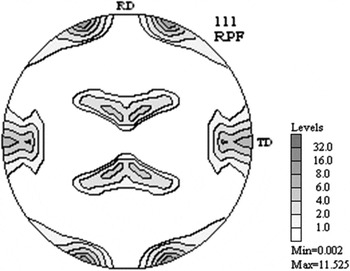
A typical Brass-type rolling texture is obtained in the as-deformed Ni9W alloy (see Fig. 1). Comparing with the classical Copper-type rolling texture, Reference Tian, Suo, Zhou, Gao, Ma, Qiu, Wang, Liu, Yuan and Wang9,Reference Tian, Suo, Mishin, Zhang, Jensen and Grivel16 the fraction of the Brass orientation is relatively large. A small fraction of the Copper orientation is detected in the Brass-type rolling texture of the heavily deformed Ni9W alloy sample. The main rolling texture components are the Brass (34%), S (32%), Copper (7%), and Goss (7%) orientations. The rolling texture fraction, which is calculated by summing the fractions of the four main rolling texture components, is 80% and the fractions of cube orientation and other random orientations (excluding the rolling texture components and cube orientation) are 2 and 18%, respectively.
{111} pole figure of the heavily cold-rolled Ni9W alloy sample.

B. Texture evolution during annealing
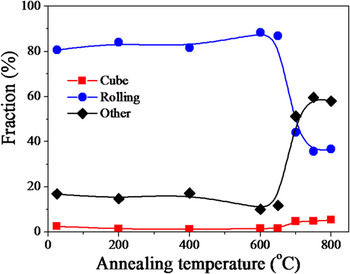
Texture evolution during annealing of the deformed FCC metals is observed as a transition from the rolling texture to the recrystallization texture. Fractions of rolling texture components, cube, and other random orientations of the cold-rolled and isochronally annealed Ni9W alloy samples are presented in Fig. 2. The results indicate the texture evolution during annealing: the fractions of rolling texture and cube orientation increase slightly during recovery when the annealing temperature is less than 600 °C, and the fraction of rolling texture of the Ni9W alloy sample annealed at 600 °C for 1 h increases by approximately 6% with respect to the deformed sample. The recrystallization takes place between 600 and 750 °C, and the rolling texture fraction decreases from 86% after annealing at 600 °C for 1 h to 36% after annealing at 750 °C for 1 h. The fraction of cube orientation is 5% when the primary recrystallization finished (after annealing at 750 °C for 1 h), which indicates that the cube texture is not formed during recrystallization process. The fraction of other random orientations increases from 12% after annealing at 600 °C for 1 h to 60% after annealing at 750 °C for 1 h. The recrystallization process of the Ni9W alloy shows that the rolling texture fraction decreases significantly without formation of a recrystallized cube texture during recrystallization and a large number of recrystallized grains with other random orientation is formed.
Fractions of rolling texture components, cube, and other random orientations in the cold-rolled and isochronally annealed Ni9W alloy samples.

C. Microstructure evolution during the isothermal annealing
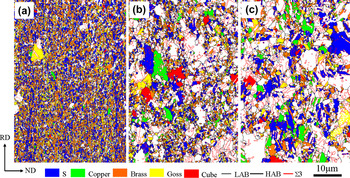
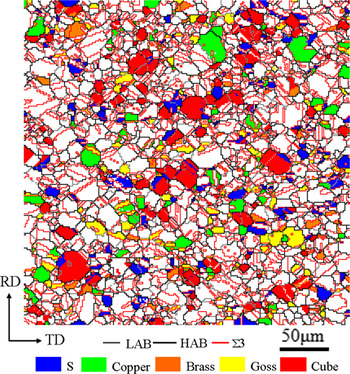
Figure 3 shows the EBSD maps of the longitudinal section of the Ni9W alloy samples annealed at 750 °C for 15, 30, and 60 min. The microstructure coarsens significantly after annealing at 750 °C for 15 min [Fig. 3(a)]; at this annealing condition, the recrystallized nuclei developed from the rolling components and other random orientations. The number of recrystallized grains increases after annealing at 750 °C for 30 min, and most of grains are recrystallized when the primary recrystallization finished after annealing at 750 °C for 60 min. In addition, a large number of the Σ3 boundaries are detected during the recrystallization process because of the twinning of the recrystallized grains [Figs. 3(b) and 3(c)].
EBSD maps of the recrystallization evolution of the Ni9W samples annealed at 750 °C for 15 (a), 30 (b) and 60 min (c). The color codes for different texture components and boundaries are given in the legend.

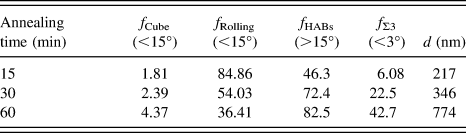
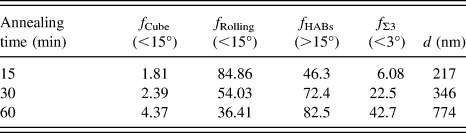
The texture and microstructure parameters of the isothermal-annealed Ni9W alloy samples are presented in Table I. The fractions of rolling components of the annealed samples decrease from approximately 85% in the as-nucleated sample to approximately 36% when the primary recrystallization finished. The fraction of the cube orientation increases from 1.8% after annealing at 750 °C for 15 min to 4.4% annealed at 750 °C for 60 min, and a large fraction (approximately 60%) of the recrystallized grains has random orientation. The texture parameters obtained by EBSD data agree with the results obtained from XRD. The average boundary spacing, d increases from 217 nm after annealing at 750 °C for 15 min to 774 nm after annealing at 750 °C for 60 min. This indicates that the recrystallized grains grow via HABs migration. The fraction of HABs increases significantly after annealing at 750 °C for 60 min; and the fraction of Σ3 boundaries is 42.7% after annealing at 750 °C for 60 min.
Fractions of cube orientation, rolling texture, HABs and Σ3 boundaries and the average boundary spacing of the Ni9W alloy samples during recrystallization.
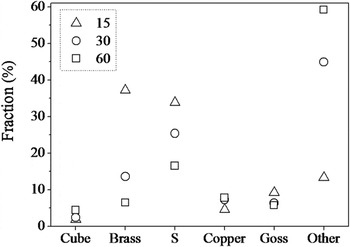
The fractions of each of the rolling texture components, cube, and other random orientations of the isothermal-annealed Ni9W alloy samples are presented in Fig. 4. During recrystallization, the fractions of the Brass, S, and Goss orientations decrease and the fractions of cube, Copper, and other random orientations increase. The recrystallization texture evolution of the Ni9W alloy is dominated by the Brass, S, and other random orientations because the fractions of cube, Copper, and Goss orientations are quite low. The fractions of Brass, S, and other random orientations are 37.2, 33.8, and 13.3%, respectively, after annealing at 750 °C for 15 min. The fractions of Brass, S, and other random orientations are 6.4, 16.5 and 59.2%, respectively, when the primary recrystallization is finished.
Fractions of each rolling texture components, cube, and other random orientations of the isothermal-annealed Ni9W alloy samples.

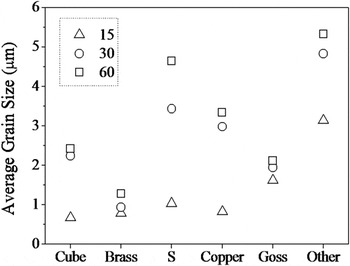
The average grain size of each orientation in the annealed Ni9W alloy samples is presented in Fig. 5. When the sample is annealed at 750 °C for 15 min, the nuclei are detected, and the grain sizes of the Goss and other random orientations are larger than the size of the Brass, S, Copper, and cube grains. After nucleation, the grains with cube, S, Copper, and other random orientations grew as the annealing time increased, but the cube grain is the smallest after any given annealing time. The size of the grains with Brass and Goss orientations increase slowly, which can be considered as the grain coarsening, and also indicates that the Brass and Goss orientations are the deformed matrix during the recrystallization. The fraction of the S orientation decreases and the average grain size of the S orientation increases during recrystallization, which indicates that part of the S orientation is recrystallized grains that grew via HAB migration, and another part of the S orientation is the deformed matrix that is consumed during recrystallization.
Average grain size of the recrystallized grains with different orientations of the isothermal-annealed Ni9W alloy samples.

Based on the relative fractions and the average grain sizes of each different orientation present in the isothermal-annealed Ni9W alloy samples (Figs. 4 and 5), the Brass, S and other random orientations dominate the recrystallization process. Consuming the Brass and S orientations leads to the formation of a large amount of other random orientation without formation of a traditional cube texture formed because the cube grains do not have a size advantage and the fraction is quite low.
D. Microstructure and texture annealed at high temperature
After the primary recrystallization, the cube texture is enhanced via high-temperature annealing, which has been demonstrated in nickel and copper alloys. Reference Zhao, Suo, Zhu, Grivel, Gao, Ma, Fan, Liu, Ji and Zhou3,Reference Liang, Tian, Suo, Wang, Meng, Ma and Liu5,Reference Gao, Suo, Grive, Zhao, Gao, Liu and Ma10,Reference Tian, Suo, Mishin, Zhang, Jensen and Grivel16,Reference Tian, Suo, Wulff, Grivel, Mishin and Jensen19 A rough cube texture with a fraction of 4.4% formed after annealing at 750 °C for 1 h in the Ni9W alloy sample; the texture is improved after annealing at high temperature. Figure 6 shows the EBSD map of the Ni9W alloy sample annealed at 1000 °C for 1 h. The fractions of cube, S, Copper, Brass, and Goss orientations are 8.7, 5.7, 6.1, 2.3, and 4.9%, respectively. The average grain size of the cube, S, Copper, Brass, and Goss orientations are 11.0, 10.4, 10.9, 10.8, and 9.8 µm, respectively. The results indicate that the cube grains have small fraction and size advantages compared with the primary recrystallization state after high-temperature annealing. To some extent, this advantage can increase the fraction of the cube texture, but it is not high enough to yield a strong cube texture in the Ni9W alloy sample.
EBSD map of the Ni9W alloy sample annealed at 1000 °C for 1 h.

IV. DISCUSSION
Typically, the deformation texture normally has two kinds of classical rolling textures, Copper-type and Brass-type, which depends on the SFE of the FCC metals or alloys and lead to the different deformation mechanisms. Reference Liang, Tian, Suo, Wang, Meng, Ma and Liu5,Reference Leffers and Ray15 The development of the Copper-type texture can be explained by the straight-forward {111}〈110〉 slip; deformation twinning is the most common explanation for the formation of the Brass-type texture via the overshooting/latent hardening introduced by the closely spaced twin lamellae. Reference Leffers and Ray15,Reference Kalidindi20 The main deformation components are S, Copper, and Brass, and the volume fractions of the deformation components are the main elements for the deformation texture. In the Ni–W alloys, the SFE decreases significantly as the tungsten content increases, and the deformation texture transforms from a Copper-type rolling texture to a Brass-type rolling texture. The Brass-type rolling texture has been obtained in the heavily deformed Ni9W alloy because of the large fraction of the Brass orientation, which has been confirmed previously. Reference Tian, Suo, Qiu, Ma, Liu, Wang, Wang and Wang7–Reference Eickemeyer, Hühne, Güth, Rodig, Gaitzsch, Freudenberger, Schultz and Holzapfel11
Recrystallization takes place between 600 and 750 °C (Fig. 2) in the Ni9W alloy. The fraction of rolling texture decreases during recrystallization without the formation of a normal cube texture, which is in contrast to the recrystallization process in FCC metals with high SFE. The fraction of cube texture increases significantly during recrystallization in the Cu–Ni and Ni5W alloys. Reference Bhattacharjee, Ray and Tsuji6,Reference Tian, Suo, Mishin, Zhang, Jensen and Grivel16,Reference Tian, Suo, Wulff, Grivel, Mishin and Jensen19 In addition, a large number of the other random orientations (60%) are observed after recrystallization in Ni9W alloy.
The microstructure of the Ni9W alloy sample annealed at 750 °C for 15 min results in recovery and structural coarsening, as shown in Fig. 3(a). Importantly, after coarsening, the lamellae morphology disappeared as the recrystallization nucleation occurred. The microstructure and texture evolution during recovery of the heavily deformed Cu–Ni and Al alloys have demonstrated that the fraction of the rolling texture increases, and the microstructure coarsens without the development of boundary curvature, which is made possible by triple-junction motion. Reference Tian, Suo, Mishin, Zhang, Jensen and Grivel16,Reference Yu, Hansen and Huang21
Pronouncedly, the recrystallization and the grain growth of the Ni9W alloy sample occur for annealing times longer than 15 min (Fig. 3). Recrystallization in the Ni9W alloy is accompanied by the emergence of a large number of annealing twins. Because of the presence of many narrow twins within small recrystallized grains, the boundary spacing measured in the sample annealed at 750 °C for 30 min is 346 nm. When the annealing time increases to 60 min, the boundary spacing increases significantly. During recrystallization, the fraction of HABs increases and reaches 82.5% in the sample annealed at 750 °C for 60 min [Fig. 3(c)], which indicates that the grain growth of the recrystallization in the Ni9W alloy was facilitated by HAB migration.
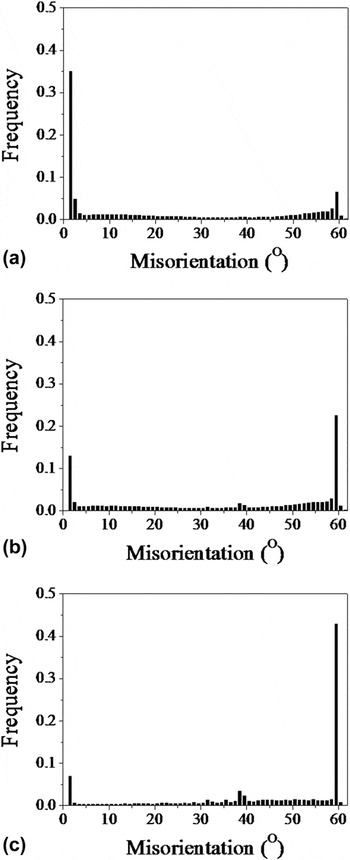
Figure 7 shows the distributions of misorientation angles (considering only misorientation angles >2°) for the samples annealed for 15, 30, and 60 min. After annealing for 15 min, there is a large number of low-angle misorientations; the fraction of LABs is 53.7%. There is a small peak present at a 60° misorientation angle (fraction of 6.1%), which corresponds to the nucleation of the Ni9W alloy. After annealing for 30 min, the fraction of LABs decreases and a strong peak appears at a 60° misorientation angle. When recrystallization is complete, the 60° peak remains along with only a few LABs. The peak at 60° is owing to the presence of Σ3 (60°〈111〉) boundaries in the microstructure, as illustrated in Fig. 3. In addition, the 40°〈111〉 boundaries are observable in Fig. 7; the rate of growth of the small grains varied greatly, depending on their relative orientation with respect to the matrix crystal. Grains with an orientation corresponding to a [111] rotation of about 40° showed by far the highest rate of growth in the lightly rolled high-purity aluminum crystals. Reference Beck, Sperry and Hu22 This possibility was investigated by marking all boundaries having 40°〈111〉 misorientations in EBSD orientation maps of the partly recrystallized samples. The fraction of 40°〈111〉 boundaries was confirmed to be extremely low (<1.5%). Reference Jensen17,Reference Li, Liu, Godfrey, Jensen and Liu18 The fractions of the 40°〈111〉 boundaries are 0.1, 0.8 and 1.0% for the Ni9W alloy samples annealed at 750 °C for 15, 30, and 60 min, respectively.
Misorientation distributions (data combined for both deformed and recrystallized regions) after annealing at 750 °C: (a) 15 min; (b) 30 min and (c) 60 min.

Previous studies of the recrystallization process of the cube texture formation of the Ni and Cu alloys indicate that the cube grains grow faster compared with the noncube grains during recrystallization. Reference Jensen17,Reference Li, Liu, Godfrey, Jensen and Liu18 The recrystallization texture evolution of the Ni9W alloy indicates that the fraction of rolling texture components decreases because of the fraction of other random orientations increases without the formation of a traditional cube texture. The Ni9W alloy sample has a rough cube texture after recrystallization annealing. This texture is related to the Brass-type rolling texture in the deformed sample and the annealing behavior of the recrystallization process. The microstructure and texture evolutions of the annealed Ni9W alloy are presented in Figs. 3–5. The recrystallized grains of the Ni9W alloy are not only the normal cube grains, but also contain the grains with S, Copper, Goss, and other random orientations (Fig. 3). Because the fractions of the cube, Copper, and Goss orientations are quite low, the Brass, S, and other random orientations dominate the recrystallization process (Figs. 3 and 4). The fractions of the Brass and S orientations decrease as the annealing time increases. The fraction of Brass orientation decreases significantly because most of the Brass orientation is presented as the deformed matrix and is consumed quickly during recrystallization (Fig. 3). EBSD maps [Figs. 3(b) and 3(c)] show that the S orientation contains the recrystallized grains and deformed matrix. The recrystallized S grains growth and the S orientation of the deformed matrix is consumed during the recrystallization process, which resulted in the fraction of the S orientation decreasing slowly compared with the Brass orientation. The S orientation is retained as the recrystallized grains after annealing at 750 °C for 60 min [Fig. 3(c)].
Studies of heavily deformed Cu, Ni, Cu–Ni and Ni5W alloy samples have shown that, during conventional discontinuous recrystallization, the Copper-type rolling texture can be consumed by the cube grain growth via HAG migration during recrystallization, and a recrystallized cube texture can form. Reference Bhattacharjee, Ray and Tsuji6,Reference Jensen17,Reference Li, Liu, Godfrey, Jensen and Liu18,Reference Mishin and Gottstein23 The cube grains always have a size advantage compared with the noncube grains (i.e., the grains with rolling and other random orientations) when the discontinuous recrystallization takes place. Reference Jensen17 The fraction of the other random orientation grains increases significantly because the grains with other random orientations have a size advantage. The cube grains have neither a size and nor a fraction advantage during recrystallization in the Ni9W alloy (Fig. 5). After annealing at 750 °C for 60 min, the fraction and the average grain size of the grains having other random orientations are 13.6 and 2.3 times that of the cube grains, respectively. The results demonstrate that recrystallization of the Ni9W alloy proceeds in a nonconventional discontinuous manner. In addition, the formation of a large number of grains having other random orientations can be explained as the twinning during the recrystallization. Because the cube grains have either fraction and nor a size advantage during recrystallization, a rough cube texture formed in the Ni9W alloy sample. The fraction of the cube texture remains low even in the sample annealed at 1000 °C for 60 min. However, the cube grains have a size and fraction advantage after annealing at high temperatures, which indicates that the cube texture can be enhanced at high temperatures. Therefore, improved rolling process, warm rolling or several intermediate annealing steps during cold rolling, are proposed as strategies to improve the rolling texture components and the recrystallization behavior of the Ni9W alloy. An improved annealing process is the necessary to obtain an expectant recrystallization cube texture in the Ni9W alloy sample. Reference Tian, Suo, Zhou, Gao, Ma, Qiu, Wang, Liu, Yuan and Wang9–Reference Gaitzsch, Jens, Hühne, Rodig, Freudenberger, Holzapfel and Schultz12
V. CONCLUSIONS
The recrystallization behavior of heavily cold-rolled Ni9W alloy was investigated systematically. The Brass-type rolling texture was obtained after heavy cold rolling, and was consumed during the recrystallization process. The annealing behavior of Ni9W alloy indicated that the recrystallization process was dominated by the Brass, S, and other random orientations because the fractions of the cube, Copper, and Goss orientations were low. A nonconventional discontinuous recrystallization took place and resulted in a large amount of the other random orientations (approximately 60% fraction) forming after annealing at 750 °C for 60 min because these orientations had a significant size advantage during recrystallization. When the primary recrystallization finished, the fraction and the average grain size of the other random orientations were 13.6 and 2.3 times that of the cube grains, respectively. The fraction of cube texture was low even though the cube grains had a weak size and fraction advantage compared with the other noncube grains after annealing at 1000 °C for 1 h.
ACKNOWLEDGMENTS
The authors gratefully acknowledge the support from the National Science Foundation of China (51571002 and 51401003), Doctoral Program of Higher Education of Special Research Fund (20121103110012), China Postdoctoral Science Foundation project (2014M560030) as well as the Project Supported by Beijing Postdoctoral Research Foundation (2014ZZ-38).