The emergence and global spread of extended-spectrum β-lactamase–producing Enterobacteriaceae (ESBL-E) is a major threat to human health.Reference Paterson and Bonomo 1 – 5 Infections with ESBL-E are difficult to treat and are associated with increased morbidity, mortality, and healthcare costs.Reference Ammerlaan, Troelstra, Kruitwagen, Kluytmans and Bonten 6 – Reference Stewardson, Fankhauser and De Angelis 8 Estimates for the prevalence of ESBL-E rectal carriage at hospital admission range from 4% to 12% in Europe.Reference Esposito, Capuano and Noviello 9 – Reference Huizinga, Kluytmans-van den Bergh, Rijen, Willemsen, van ‘t Veer and Kluytmans 17 Nosocomial transmission of ESBL-E is known to occur, and infection control guidelines, therefore, recommend several measures to control the spread of ESBL-E in healthcare settings.Reference Kluytmans-VandenBergh, Kluytmans and Voss 18 , Reference Tacconelli, Cataldo and Dancer 19 In the Netherlands, contact precautions are recommended for all patients known to be colonized or infected with ESBL-E.Reference Kluytmans-VandenBergh, Kluytmans and Voss 18 The risk of acquisition of ESBL-E during hospitalization while applying contact precautions in addition to standard precautions for known ESBL-E carriers is unknown. The present study is based on data from 2 cluster-randomized studies comparing isolation strategies for ESBL-E. We aimed to provide estimates for the acquisition of ESBL-E rectal carriage amongst patients in Dutch hospitals, given the application of contact precautions for known ESBL-E carriers.
METHODS
Contributing Studies
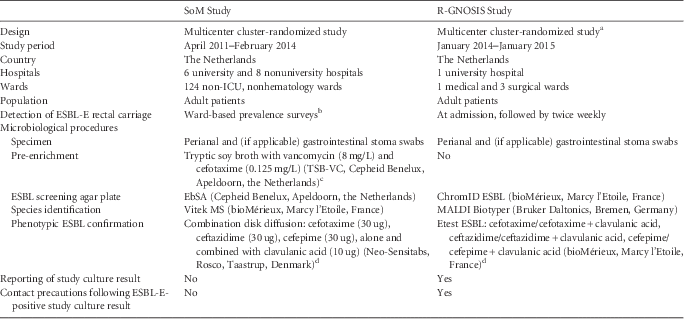
The analyses were performed on data collected in 2 multicenter cluster-randomized studies comparing different isolation strategies for known ESBL-E carriers: (1) the SoM study (Single- or Multiple-occupancy room isolation of patients colonized with ESBL-E)Reference Kluytmans 20 and (2) the R-GNOSIS study (Resistance in Gram-Negative Organisms: Studying Intervention Strategies), Work Package 5.Reference Gastmeier 21 The methods differed slightly between these studies and are presented in Table 1.
Study Methods

NOTE. ESBL-E, extended-spectrum β-lactamase-producing Enterobacteriaceae; ICU, intensive care unit.
a The R-GNOSIS study was performed on medical and surgical wards of 4 university hospitals in the Netherlands, Germany, Switzerland and Spain. The present analysis was limited to the data that were collected in 1 Dutch university hospital during the study period in which contact precautions were applied.
b 5–9 days after institution of contact precautions for a patient known to be colonized or infected with ESBL-E.
c As described previously.Reference Kluytmans-van den Bergh, Verhulst, Willemsen, Verkade, MJM and Kluytmans 22
Contact Precautions
In both studies, contact precautions were applied in addition to standard precautions for all patients known to be colonized or infected with ESBL-E. In accordance with the national guidelines, standard precautions included the performance of hand hygiene and the use of personal protective equipment (gloves and gown) when anticipating contact with blood or body fluids. 25 – 27 Contact precautions additionally included the wearing of gloves at all direct contacts with the patient or the patient’s immediate environment or belongings. 28
Acquisition of ESBL-E Rectal Carriage During Hospitalization
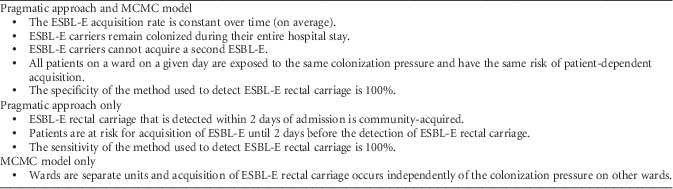
We used 2 approaches to produce estimates for hospital-acquisition of ESBL-E rectal carriage: (1) a pragmatic approach, using the results of admission and discharge cultures from patients hospitalized for more than 2 days (both studies) and (2) a Markov chain Monte Carlo (MCMC) model, applied to all patients hospitalized on the participating wards, including those without cultures taken (R-GNOSIS study). The assumptions for each of the approaches are listed in Table 2.
Assumptions

NOTE. ESBL-E, extended-spectrum β-lactamase-producing Enterobacteriaceae; MCMC, Markov chain Monte Carlo.
Pragmatic approach
Hospital-acquired ESBL-E rectal carriage was assumed not to be detectable within 2 days of hospital admission. 29 Consequently, ESBL-E rectal carriage that was detected within 2 days of hospital admission was considered community-acquired. In addition, patients who were discharged within 2 days of hospital admission were considered not to be at risk for (detectable) hospital-acquired ESBL-E rectal carriage and were excluded from the pragmatic analysis. Admission cultures comprised all cultures taken within 2 days of hospital admission; discharge cultures were all cultures taken on the day of discharge. The prevalence of ESBL-E rectal carriage at hospital admission and hospital discharge were calculated and were used to estimate (1) the prevalence of hospital-acquired ESBL-E rectal carriage at discharge, (2) the cumulative incidence of ESBL-E rectal carriage during hospitalization, and (3) the ESBL-E acquisition rate. For the SoM study, a Markov chain Monte Carlo (MCMC) random-effects analysis was performed to estimate the mean prevalence of ESBL-E rectal carriage at hospital admission and hospital discharge across hospitals, considering within-hospital dependency of the data collected in the 14 participating hospitals. Leave-one-out sensitivity analyses were conducted to evaluate the robustness of the overall estimates.Reference Higgins 30 By iteratively removing 1 hospital at a time and recalculating parameter estimates, the impact of each hospital on the overall estimates was assessed. Details on the calculations performed can be found in Appendix B online.
Markov chain Monte Carlo model
A previously developed MCMC model was used to quantify hospital-acquisition of ESBL-E rectal carriage in the R-GNOSIS study.Reference Worby, Jeyaratnam and Robotham 31 , Reference Haverkate, Bootsma and Weiner 32 This model distinguishes between patient-dependent acquisition and background acquisition. Patient-dependent acquisitions comprise all ESBL-E acquisitions that are dependent on the colonization pressure on the wardReference Bonten, Slaughter and Ambergen 33 and include the transmission of ESBL-E from colonized to noncolonized patients, either directly or indirectly (through the contaminated hands of healthcare workers or the contaminated environment). Background acquisitions cover all other ESBL-E acquisitions, including acquisition from visitors or healthcare workers moving between wards, acquisition from the environment independent of the colonization pressure on the ward, and acquisition through the endogenous route. The latter represents the situation where bacteria are already present in the host at undetectable levels and reach detectable levels under antibiotic pressure. The model accounts for false-negative and missing cultures and, thus, allows estimation of the sensitivity of the method used to detect ESBL-E rectal carriage and the most likely time of ESBL-E acquisition for each patient. A detailed description of the model is provided in Appendix B online. Model parameter estimates were used to obtain estimates for (1) the prevalence of ESBL-E rectal carriage at admission and discharge, (2) the prevalence of hospital-acquired ESBL-E at discharge, (3) the cumulative incidence of ESBL-E rectal carriage during hospitalization, (4) the ESBL-E acquisition rate, (5) the relative contribution of patient-dependent acquisition to the total ESBL-E acquisition rate, and (6) the average number of ESBL-E acquisitions caused by 1 ESBL-E carrier during a single admission, that is, the per-admission reproduction number (RA).Reference Haverkate, Bootsma and Weiner 32 , Reference Cooper, Kypraios, Batra, Wyncoll, Tosas and Edgeworth 34
Ethical Considerations
The SoM study and the R-GNOSIS study were reviewed by the medical research and ethics committees of the Elisabeth-TweeSteden Hospital (Tilburg, the Netherlands) and the University Medical Center Utrecht (Utrecht, the Netherlands), respectively. Both studies were judged to be beyond the scope of the Medical Research Involving Human Subjects Act (WMO), and a waiver of written informed consent was granted (SoM: METC/jv/2010.034; R-GNOSIS: WAG/om/13/069083). Patients provided verbal consent for the use of demographic, clinical, and culture data.
RESULTS
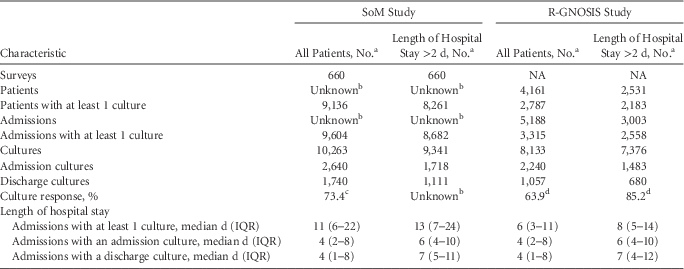
In total, 660 prevalence surveys were performed in the SoM study. During these surveys, 10,263 cultures were obtained from 9,136 patients, including 1,718 admission cultures and 1,111 discharge cultures from patients hospitalized for more than 2 days (Table 3). In the R-GNOSIS study, 8,133 cultures were available for 2,787 patients and included 1,483 admission cultures and 680 discharge cultures from patients hospitalized for >2 days.
Study Population Characteristics

NOTE. IQR, interquartile range; NA, not applicable.
a Unless otherwise specified.
b No data were available for nonresponding patients, except for the number of patients per survey.
c Culture response is calculated as the number of cultures obtained divided by the number of potential cultures.
d Culture response is calculated as the number of admissions with at least 1 culture divided by the number of admissions.
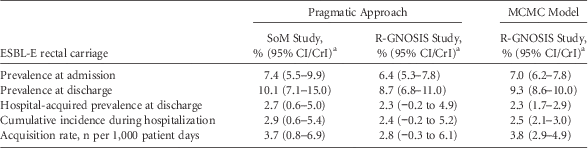
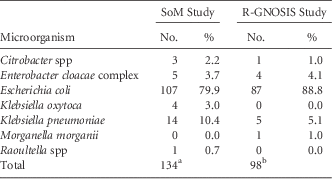
Table 4 lists the ESBL-E rectal carriage estimates per study and per analytic approach. The prevalence of ESBL-E rectal carriage at admission and discharge was comparable between studies and approaches and varied from 6.4% to 7.4% at admission and from 8.7% to 10.1% at discharge. In both studies, Escherichia coli was the most prevalent ESBL-E identified at admission (SoM study 79.9%; R-GNOSIS study 88.8%) (Table 5). The absolute risk of acquisition (cumulative incidence) of ESBL-E rectal carriage during hospitalization varied from 2.4% to 2.9%, and estimates for the ESBL-E acquisition rate ranged from 2.8 to 3.8 acquisitions per 1,000 patient days, with largely overlapping confidence or credible intervals. With the MCMC model, the median background acquisition rate was estimated to be 0.0028 (95% credible interval [CrI], 0.00088–0.0045) acquisitions per patient day, and the median patient-dependent acquisition rate was 0.010 (95% CrI, 0.00055–0.030) acquisitions per colonized patient day. Based on these estimates and an estimated mean daily prevalence of ESBL-E rectal carriage of 10.6% (95% CrI, 9.0%–12.2%), it was calculated that 28.0% (95% CrI, 1.5%–74.5%) of acquisitions in the R-GNOSIS study were attributable to patient-dependent transmission and the remaining 72.0% (95% CrI, 25.5%–98.5%) resulted from background transmission. Multiplying the patient-dependent acquisition rate by the mean length of hospital stay (6 days) yielded a per-admission reproduction number (RA) of 0.06. Finally, the MCMC model provided an estimate of 77% (95% CrI, 73%–81%) for the median sensitivity of the method used to detect ESBL-E rectal carriage in the R-GNOSIS study.
Rectal Carriage of Extended-Spectrum β-Lactamase-Producing Enterobacteriaceae (ESBL-E)

NOTE.CI, confidence interval; CrI, credible interval; ESBL-E, extended-spectrum β-lactamase-producing Enterobacteriaceae; MCMC, Markov chain Monte Carlo.
a Intervals are either 95% confidence intervals (R-GNOSIS study, pragmatic approach) or 95% credible intervals (SoM study, pragmatic approach and R-GNOSIS study, MCMC model).
Distribution of Extended-Spectrum β-Lactamase-Producing Enterobacteriaceae in Admission Cultures

a In 118 admission cultures, 1 ESBL-E isolate was identified; in 8 admission cultures, 2 ESBL-E isolates were identified.
b In 92 admission cultures, 1 ESBL-E isolate was identified; in 3 admission cultures, 2 ESBL-E isolates were identified.
In the leave-one-out sensitivity analyses of the SoM study data, all parameter estimates were within the 95% credible intervals of the overall estimates for acquisition of ESBL-E rectal carriage, indicating that the results were not driven by any single hospital (Appendix C online, Figures S1–S5).
DISCUSSION
In this study, performed in the low-endemic setting of Dutch hospitals, where contact precautions are applied for known ESBL-E carriers, the absolute risk of acquisition of ESBL-E rectal carriage was 2.4% to 2.9% with an ESBL-E acquisition rate of 2.8 to 3.8 acquisitions per 1,000 patient days. Estimates for the acquisition of ESBL-E rectal carriage were similar across studies and analytic approaches.
The estimates for the prevalence of ESBL-E rectal carriage at admission and discharge in the present analyses were consistent with those reported for other European hospital-based studies, despite differences in setting, study population, and microbiological methods (Online Appendix A, Table S1).Reference Esposito, Capuano and Noviello 9 – Reference Huizinga, Kluytmans-van den Bergh, Rijen, Willemsen, van ‘t Veer and Kluytmans 17
Although ESBL-E are known to spread within hospitals, quantitative data on the acquisition of ESBL-E rectal carriage during hospitalization in low-endemic settings are limited.Reference Tacconelli, Cataldo and Dancer 19 In 2 European studies that performed active surveillance cultures at admission and during hospitalization, the cumulative incidence of ESBL-E rectal carriage on non-ICU wards without contact precautions for known ESBL-E carriers was ~4.5%,Reference Schoevaerdts, Verroken and Huang 12 , Reference Pasricha, Koessler and Harbarth 13 with an ESBL-E acquisition rate of 1.8 acquisitions per 1,000 patient days.Reference Schoevaerdts, Verroken and Huang 12 The limited availability of paired samples in both studies may have biased the results; the acquisition of EBSL-E as well as the availability of a second culture are dependent on the length of hospital stay.
Three Swiss studies assessed the acquisition of ESBL-E rectal carriage in roommates of patients with ESBL-E-positive clinical cultures.Reference Hilty, Betsch and Bögli-Stuber 35 – Reference Tschudin-Sutter, Frei and Schwahn 37 In 1 study, the acquisition of clonally related ESBL-E was identified in 5.4% of roommates during hospitalization at a rate of 7.0 acquisitions per 1,000 patient days.Reference Hilty, Betsch and Bögli-Stuber 35 In the other 2 studies, a single culture was obtained from roommates shortly after the detection of ESBL-E in the index patient. Acquisition of clonally related ESBL-E was identified in 1.5% and 2.6% of roommates, respectively.Reference Tschudin-Sutter, Frei, Dangel, Stranden and Widmer 36 , Reference Tschudin-Sutter, Frei and Schwahn 37 The ESBL-E acquisition rate, assessed in 1 of these studies, was 3.5 acquisitions per 1,000 patient days.Reference Tschudin-Sutter, Frei, Dangel, Stranden and Widmer 36 The estimates for acquisition of ESBL-E in the Swiss studies were comparable to those in the present analyses, even though the assessment of acquisition of ESBL-E in the Swiss studies was limited to roommates of known ESBL-E carriers, contact precautions were either not applied or only for patients at high risk for ESBL-E carriage, and the possibility of horizontal transfer of resistance genes was not taken into account.
To the best of our knowledge, this is the first study to include an MCMC model approach to provide quantitative data on the acquisition of ESBL-E rectal carriage in hospitals. Other MCMC model-based studies on the acquisition of antimicrobial-resistant Enterobacteriaceae were performed in nonhospital settings or were aimed at other resistance mechanisms.Reference Haverkate, Bootsma and Weiner 32 , Reference Haverkate, Platteel and Fluit 38 The per-admission reproduction number estimated in the current study was far below 1, indicating that patient-to-patient transmission of ESBL-E during a single admission of an ESBL-E carrier is not sufficient to maintain endemicity of ESBL-E in Dutch hospitals that use contact precautions for known ESBL-E carriers. The estimate for the sensitivity of the method used to detect rectal carriage of antimicrobial-resistant Enterobacteriaceae was comparable to those reported in the other studies, which supports the robustness of the MCMC model.Reference Haverkate, Bootsma and Weiner 32 , Reference Haverkate, Platteel and Fluit 38
One of the benefits of the MCMC algorithm used in this study is that it allows estimation of the most likely time of ESBL-E acquisition for each patient, including patients with missing or false-negative cultures. In addition, separate estimates are provided for patient-dependent acquisition and background acquisition. In the present study, the relative contribution of patient-dependent acquisition to the total number of hospital acquisitions was estimated to be 28.0% (95% confidence interval [CI], 1.5%–74.5%). The rather high level of uncertainty around this estimate may be due to a relatively high percentage (36%) of admissions with no cultures taken. The relative contribution of patient-dependent acquisition might be interpreted as the maximum achievable reduction in hospital acquisition of ESBL-E rectal carriage when infection control measures would be optimized. It is obvious that the relative importance of patient-dependent acquisition is dependent on the number of colonized patients present on the ward and the effectiveness of infection control measures. The low estimate for patient-dependent acquisition in the present study can, therefore, not be generalized to settings with a high-endemic level of ESBL-E rectal carriage or settings with less effective infection control policies.
The analysis in the pragmatic approach was restricted to cultures taken at hospital admission and hospital discharge. Estimates for hospital-acquisition of ESBL-E rectal carriage that are based on cultures taken during hospitalization may be biased, as ESBL-E rectal carriage is associated with a prolonged length of hospital stay, leading to overrepresentation of ESBL-E carriers in prevalence surveys, and thus overestimation of hospital-acquired ESBL-E carriage. This finding is clearly illustrated by the MCMC model estimates for the R-GNOSIS study, where the mean daily prevalence was estimated to be 10.6% with a prevalence of 7.0% at admission and 9.3% at discharge.
Both studies and analytic approaches were based on phenotypic ESBL confirmation methods. The use of phenotypic data, without species identification and molecular typing, allows for the detection of transmission of the ESBL phenotype due to horizontal gene transfer and, herewith, increases the sensitivity to detect transmission of ESBL-encoding genes between patients.
Several assumptions were made for quantifying hospital-acquired ESBL-E rectal carriage, which may all have resulted in underestimating the risk and rate of acquisition.
In both studies, contact precautions were applied in addition to standard precautions for all known ESBL-E carriers, according to the national guideline 28 . Nevertheless, some acquisition of ESBL-E rectal carriage was observed, partly due to patient-to-patient transmission. For the SoM study, the results of study cultures were blinded, and identification of ESBL-E carriers was based on clinical cultures only. Asymptomatic ESBL-E carriers who were not detected by clinical cultures might, thus, have contributed to the observed acquisition of ESBL-E. In the R-GNOSIS study, the results of all study cultures were reported to the treating physicians and contact precautions were applied for all ESBL-E carriers, including those detected in study cultures. However, as not all patients were sampled, and some culture results might have been falsely negative, the acquisition of ESBL-E from undetected ESBL-E carriers cannot be excluded in the R-GNOSIS study either. Finally, noncompliance with recommended infection control measures may have contributed to the observed spread of ESBL-E in both studies.
Recent studies suggest that E. coli has a lower intrinsic transmission capacity than K. pneumoniae.Reference Hilty, Betsch and Bögli-Stuber 35 , Reference Tschudin-Sutter, Frei, Dangel, Stranden and Widmer 36 Hence, estimates for hospital-acquisition of ESBL-E rectal carriage will be dependent on the distribution of ESBL-producing bacterial species in ESBL-E carriers. The high relative prevalence of ESBL-producing E. coli in the present study may well have contributed to the low estimates for acquisition.
This study provides quantitative data on the prevalence and acquisition of ESBL-E rectal carriage amongst patients in Dutch hospitals. The hospital acquisition rate of ESBL-E rectal carriage was low and the per-admission reproduction rate far below 1. This demonstrates that it is possible to control the nosocomial transmission of ESBL in a low-endemic, non-ICU setting where E. coli is the most prevalent ESBL-E and standard and contact precautions are applied for known ESBL-E carriers, which is promising considering the global emergence of Enterobacteriaceae with plasmid-mediated resistance.
ACKNOWLEDGMENTS
We are grateful to the infection control practitioners, research nurses, and microbiology technicians in the participating hospitals for their contributions to the collection of epidemiological and microbiological data.
Financial support: The SoM study was supported by the Netherlands Organisation for Health Research and Development (ZonMw, project no. 205100010). The R-GNOSIS study was supported by the European Community’s Seventh Framework Programme (FP7/2007-2013, grant agreement no. 282512).
Potential conflicts of interest: All authors report no conflicts of interest relevant to this article.
SUPPLEMENTARY MATERIAL
To view supplementary material for this article, please visit https://doi.org/10.1017/ice.2017.241