Introduction
At three o'clock in the morning on 15 August 1935, Harry and Ethel Ebdon, the occupiers of 6 Malden Way, a new house on the Kingston Bypass, were woken by an almighty crash followed, a few minutes later, by a thump on their front door. On opening the door, in staggered Edward Southwell Russell, twenty-sixth Lord de Clifford carrying Douglas Hopkins who had been seriously injured in a car crash outside their home. Here, in embodied form, was a collision between the exploratory, speeding, patrician world that defined early motoring and the world of the ordinary residents and motorists of a suburbanizing Greater London.Footnote 1
In the 1920s and 1930s, central and local government built 270 miles of arterial roads, such as the Kingston Bypass, in Greater London. These well-engineered roads enabled high-speed motoring and became the site for new factories, cinemas, garages and roadhouses that transformed motoring in London, introducing new leisure and work destinations. In a contemporaneous development, the building of new houses was in full sway alongside these roads, producing a new ring of largely middle-class suburbia.Footnote 2
The article considers the impact of these new roads on the mobilities of the wealthier Londoner and argues that they occasioned an emergent form of automobility that was modern, sensational and exciting for the metropolitan driver, but was also highly dangerous. This danger fell disproportionately on the shoulders of the poorer and less privileged suburbanite, who found that riding a bicycle or crossing the road had now become a very hazardous event. In effect, the arterial road had become a contested space between the drivers of fast cars and suburban residents and between modern engineering and chaotic suburban housing.
The article builds on three scholarly contributions: first from Sean O'Connell who has persuasively described the social impact of the car on inter-war Britain, secondly Joe Moran's work on controlling the inter-war road and on the cultural impact of roads more generally and, finally, the article also relies on sociological enquiries into automobility from John Urry, Mimi Sheller and others that emphasize the car's capacity for harm whilst simultaneously providing its users with an emotionally charged driving experience.Footnote 3
The rise of the car
During the inter-war period, the car changed from being a plaything for the very wealthy into an important form of private mobility for business and pleasure for the middle classes and for some working-class drivers. The historiography of the rise of inter-war motoring is well developed in work that deals with both its technological and social implications.Footnote 4 In summary, the ownership of cars grew rapidly in this period with the growth in the driving habit being slowed but not stalled by the impact of the depression. The number of cars in Britain rose from 110,000 in 1919 to a total of 2 million 20 years later. There was a strong regional bias in the uptake of the car reflecting the contrasting fortunes of various parts of the country in the face of a global economic crisis. For example, in 1931, there was one car for every five households in Surrey compared to one for every 23 households in County Durham. Footnote 5
In the early years of the inter-war period, car ownership was expensive and was largely confined to the highest income groups. As might be expected, the wealthy residents of central London led the way in adopting the motoring habit in the early twentieth century, with the car quickly replacing the carriage.Footnote 6 During the inter-war period, this concentration of ownership was accompanied by a highly sophisticated network of motor showrooms, garages and car rental firms in the West End. For example, many manufacturers had retail headquarters and showrooms in areas such as Piccadilly, Berkeley Square and Great Portland Street. In 1933, The Autocar declared that ‘Great Portland Street, famous street celebrates its 40th anniversary as the centre of motordom.’Footnote 7
The acquisition of cars was much slower in the Victorian ring of inner suburbia within the County of London boundaries. This was a reflection of the dramatic differences in wealth in London as a whole, with many inner suburbs being poor and deprived. London was also well provided with cheap public transport, which meant that the need for a car was much lower than it would be in less urban areas. As will be shown later in this article, in contrast, the residents of some outer suburban boroughs experienced strikingly high levels of car use for the time, although this varied greatly from borough to borough.
The purpose of and destination for car outings also changed during the inter-war period. In the early years after World War I, the novelty of motoring was often directed at the exploration of the countryside, perhaps attempting to forge a connection with the ‘deep’ England that had been occluded by the death and modernity of the recent war.Footnote 8The Autocar, for example, featured a regular article on potential pastoral outings for new motorists.Footnote 9 Trips to the seaside were also popular with new motorists, which soon promoted bank holiday traffic jams that were regularly reported in the newspapers. With the introduction of fast arterial roads from 1925 onwards and particularly after 1930, when a general, 20 mph speed limit was abolished, there was the opportunity, when coupled with the accommodating surfaces of these new roads, for Londoners also to enjoy a more reckless and high-speed form of driving. The nature and consequences of this type of driving are to be explored by this article.
As the 1920s and 1930s wore on, car ownership spread steadily down to middle-class and middle-income families, powered by three key factors, which were, first, a dramatic fall in the real cost of owning a car, secondly, an increase in the availability of very small cars, reducing the barriers to ownership even further, and, finally, a steady rise in the real level of incomes of middle-class families.Footnote 10 This change in the demographics of car use was, in London, largely confined to the outer suburbs.
Suburban spaces
In 1919, London's outer reaches, beyond the ring of tightly packed Victorian and Edwardian suburban houses, was an undistinguished area of open countryside, small farms, market gardens, hospitals, asylums, reservoirs and waterworks that surrounded small and still independent towns such as Kingston, Croydon and Harrow.
In the 20 years between the wars, a combination of factors led to the development of a new ring of suburbia. First, after World War I, falling land prices, cheap labour and mass-production techniques reduced the cost of house construction allowing both local government and private companies to build large numbers of houses quickly and cheaply. In all, approximately 750,000 houses were constructed in Greater London between 1920 and 1937.Footnote 11 These houses became the homes of around 2.2 million people in this period who moved to the area from inner London and from the provinces.Footnote 12 They were attracted by London's new light industrial and service sector jobs and by the low cost of housing, with repayments aided by mortgages that had low interest rates and long repayment terms. These new suburbanites were also attracted to outer London by the actuality or promise of fast public transport links to central London. Overground and underground train operators promoted suburban lifestyles to increase passenger volumes into their expanded rail networks.
These new suburban citizens formed a new middle class in London's outer fringes. In the early years of suburbanization, they were highly reliant on public transport for their journeys into central London. Private mobility was catered for by the ubiquitous bicycle and, employing skills learned in World War I, the motorcycle. As the 1930s progressed, the car became much more affordable and by the end of the decade, people in ordinary white-collar jobs, such as a junior teacher or a bank clerk, could afford to drive, taking advantage of the availability of both instalment credit and second-hand cars.Footnote 13 The adoption of the car in London's new suburbia was highly heterogeneous and varied greatly from one suburban borough to another. For example, in 1934, residents of Esher were buying seven times as many new cars per capita as those in nearby, but much poorer, Merton. New outer suburbs such as Ruislip also took to the car ahead of other parts of London. By the end of the decade, there were approximately 200,000 cars in suburban London. This counters the received view that the new London suburbs were largely empty of cars.Footnote 14 New car purchases per 1,000 capita are shown by borough in Figure 1.
Relative suburban purchases of new cars.

In these same suburban spaces, other longer-laid plans were being realized. London's road network to major provincial towns was seen as needing replacement as early as 1903. Before the advent of the car, the independent towns of London's outer fringes were often at a standstill with private horse-drawn vehicles, bicycles, trams and buses all jockeying for position in their inadequate narrow streets. As the impact of the car intensified the problem, plans for new bypasses and arterial roads around the clock face of London were drawn up. Squabbles over jurisdiction and responsibility and the prosecution of World War I led to years of delay and the construction of London's new arterial roads did not start in earnest until 1925.Footnote 15
These new roads were a marked contrast with the roads that preceded them. In 1919, a typical main road out of London, such as the old Bath Road, running out through Brentford and Hounslow, was narrow with houses and shops along its margins. It would have had sharp bends around ancient field boundaries, unusual cambers, would have run over narrow bridges and have had a variety of surfaces ranging from wooden setts to tarmac and asphalt; drivers would have had to negotiate carefully their way around potholes. The new arterial roads were distinguished by wide carriageways, engineered cambers, gentle curves, full-width bridges and reliable and fast concrete and asphalt surfaces. This was a modernist project that reflected the influence of American suburban parkways and prefigured later autobahn and motorway plans. In short, they provided, between 1925 and the beginning of World War II, the opportunity for high-speed motoring in a suburban setting.Footnote 16
The relationship between these new roads and the ever-encroaching suburban houses was a complex one. For the occupants of the original outer London villages, the road was an alien element in a familiar world. Jim Richards noted this disconnection in his paean to suburbia The Castles on the Ground: ‘It was also, of course, before the days when shops sprang up along the new by-pass . . . Old residents, in fact, still do not acknowledge these shops as part of the suburb; they really belong to the world of by-pass roads where motorists only halt for petrol as they chase each other to the sea.’Footnote 17
Travel writer Cicely Hamilton saw this relationship from the perspective of the elite urban motorist: ‘Then speed in itself produces an indifference alike to beauty and its lack. The suburbs we drive through are pretentious unimaginative but we pass them at so many miles an hour – as we pass a cornfield bowing to the wind or a park that has not yet fallen to the bid of the speculative builder.’Footnote 18
This indifference to the new suburbia was only maintainable where the road and the house were separated. Increasingly in the 1930s, the two elements touched each other in the form of ribbon housing development alongside the arterial roads, which compromised the speed and independence of the arterial road, and, as will be shown, resulted in the deaths of many pedestrians in road accidents.
Speed, pleasure and danger on the arterial road
The most direct type of fun on the arterial road was speed itself. Here for the first time, and specifically after the general speed limit was abolished in 1930, high-speed driving on public roads became possible. Large cars with powerful engines and smaller lighter sports cars could both attain 70 mph. One passenger recalled his enjoyment of road racing in the 1930s on the Kingston Bypass: ‘A fast road in the pre war days, I was driven in 1935 from the Ace of Spades roundabout to Hinchley Wood in a big Bentley sports car driven by my father's apprentice. The speed we attained then was 72 mph, fast then on the road. So road racing was even carried out then eh?’Footnote 19
The developments in technology and societal changes of World War I had an impact on speed and the popular imagination in the inter-war period. This urge was displayed in forms of popular music, dance and in a restlessness and agitation for excitement and speed. John Urry identified that, in this period, ‘Many motorists described their experience of speed in mystical terms as though this was an experience not so much opposed to the natural worlds, but one which expressed the inner forces of the universe.’Footnote 20
This change in driving style was also reflected in the English popular novel of the period. The car can be frequently seen in inter-war novels as a signifier of sophistication, wealth, adventure and modernity. In popular works, such as Gilbert Frankau's Christopher Strong, the author places the car at the centre of modern metropolitan London life, where the romantic leads pursue each other in cars along the new arterial roads.Footnote 21 In a more sinister vein, Patrick Hamilton imagined a race on an arterial road ending in the death of a cyclist: ‘And now they had passed Gunnersbury, and had turned up to the right, and were ripping up the wide, smooth, deserted spaces of the Great West Road . . . Gee! it was like a racing track - no wonder he put on speed. It was like being in an aeroplane!’.Footnote 22
This faster motoring produced new feelings for drivers and passengers. The car afforded through its combination of speed, wind, noise and view of the landscape an unusual set of sensual and embodied experiences.Footnote 23 This was particularly true in the period of the ‘open’ car that lasted from motoring's inception up to the late 1920s.Footnote 24 In novels and in memoirs, driving was recorded in sensational terms. Osbert Sitwell recalled ‘They would sit together, the two of them, the man at the wheel, the girl beside him, their hair blown back from their temples, their features sculptured by the wind, . . . here the element was speed.’Footnote 25 This strongly affective experience contributed to the enjoyment of speed, allowing the privileged owners of cars to engage in a very personal demonstration of modernity on these roads. These sensations were modified by the introduction of the ‘closed’ car, which, with its fixed roof and windows, is in much the same form as the majority of cars that we drive today. This form of car directed the driver's attention away from the landscape and towards the interior of the car and increased the sense of insulation and isolation of the driver from other road users, which some see as provoking driving arrogance and road rage.Footnote 26
As the popularity of driving on the new roads increased, either because of its high-speed effect or because it provided a convenient and quicker route to the seaside or countryside, new businesses sprang up on the roadside to provide services to these motorized customers. Foremost of these for gathering newsreel publicity, for its use as a location for criminal or immoral conduct in popular novels and for receiving criticism in the newspapers was the roadhouse.Footnote 27
The roadhouse was an inter-war phenomenon that provided the facilities of a transplanted American country club to wealthy motorists on London's arterial roads. A famous example was the Ace of Spades, which was sited on the Kingston Bypass. This extraordinary building offered a 24-hour restaurant, dancing, music from West End orchestras, a huge swimming pool and other outdoor fun and games, all placed alongside the original filling station and garage from which the roadhouse grew. Other important roadhouses could be found on the Great West Road and on the Barnet and Watford Bypasses.
Later on in the 1930s, as the arterial roads became more commercialized, motorists could also choose from huge roadside pubs designed to attract the mobile, large super-cinemas, and glamorous car showrooms. These all provided further incentive to see these roads as sites of pleasure, leisure and consumption.
Motoring in England was, in its early years, largely a male pursuit, and this masculinity was demonstrated through endurance runs or speeding, or ‘scorching’ as it was known at the time. The scorching motor car became a cause for concern due to its propensity to cause accidents, frighten horses and raise plumes of dust on the unmetalled roads. Local magistrates and police forces took a dim view of fast driving, putting them into conflict with citizens who would, in any other circumstances, be seen as pillars of the community.Footnote 28 As early as 1903, a 20 mph speed limit was introduced, which in turn provoked the foundation of the, at the time, radical Automobile Association which aimed to insure its members against the costs of prosecution and provided scouts to warn members of police traps.Footnote 29
At Brooklands in Surrey, sports car racing became a spectator sport, although this too resulted in disapproval from the authorities, as it involved regular accidents and deaths due to early cars being both unstable and having little in the way of safety equipment. As early as 1908, the local coroner referred to the passion for high-speed driving as a ‘degenerate taste’.Footnote 30 After a halt due to World War I, attendances grew to as much as 20,000 for one event in 1925.Footnote 31 The new Kingston Bypass provided fast access to Brooklands, connecting motor racing to the roadhouse.
In the inter-war period, driving on public roads was also an extremely dangerous activity, not only for motorists, but disproportionately so for cyclists and pedestrians and particularly the young and the elderly. Paul Vaughan, an observer of London's new arterial roads, recalled how ‘accidents would regularly occur’.Footnote 32 The normality of accidents is also apparent in the literature of the period. In one example, the hero of a 1930s detective story is interesting in his acceptance of accidents as part of modern life, and the road as constantly dangerous.Footnote 33 A number of factors made motoring deaths likely at this time, and from a long list one can pick out: bad roads, failure to separate cars from pedestrians, little or no street lighting, inefficient drum brakes, lack of seat belts, unforgiving car interiors and poor standards of driving. The experience of accidents would be not only more frequent but more unexceptionally primitive and bloody than we are used to.
The new arterial roads prompted a large number of fatal crashes. One can construct a typical fatal inter-war road accident. The driver, although experienced in handling the car, has not taken formal instruction or a driving test.Footnote 34 The light sports car, although slow to accelerate by present-day standards, was easily capable of 70 mph. Driving onto an arterial road at night, the car's dim headlights presented the driver with a poor view of the road. No road lighting was available; no reflective white lines or cats-eyes guided the journey. If the road was wet, the new concrete surface of the road was shiny and slippery. Every few seconds, the car was jolted as it hit a bitumen joint in the concrete blocks that formed the road. An error of judgment preceded the seemingly inevitable accident. Hitting another car or a roadside tree, the driver and the passengers, sitting unconstrained in their open-top car, were thrown onto the road into the line of approaching traffic or were thrown against the steering wheel, windscreen or windscreen support. The windscreen was toughened but not laminated and laceration or a fractured skull were likely outcomes. Paul Vaughan remembered ‘the screaming of brakes, a sharp bang, a reverberating skitter of metal fragments, followed by even more sinister noises: the moans of the victims, the screams of women bystanders’.Footnote 35 Help would not come quickly, other drivers might, after driving some distance, find a house with a telephone that could call for an ambulance.
The raw statistics show that in the 1930s, motoring accidents killed approximately 75,000 people and injured approximately 2 million. At its peak in 1934, 7,343 people were killed in motoring accidents, which amounted to 3.1 deaths per thousand motor vehicles on the road, which compares to a rate of 0.1 deaths per thousand today.Footnote 36
An official analysis of road accidents undertaken in 1933 shows that there was a wide disparity in the age of those involved in these accidents depending on whether they were motorized or not. The average age for car drivers involved in fatal accidents was 36, and for motorcyclists 27. Pedestrians caught up in the same accidents were most likely to be pensioners or small children. Of the cyclists, a third of the victims were children.Footnote 37 This is confirmed by a more specific analysis of road deaths on West London arterial roads between the wars, which shows an average age for drivers of 31 years and motorcyclists at 27 years old.Footnote 38
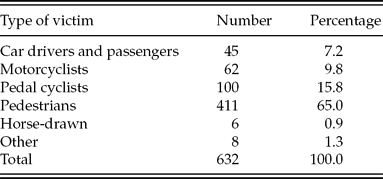
A very striking statistic is the likelihood of death in a road accident. Table 1 shows that car drivers and passengers in road accidents only accounted for just over 7 per cent of all deaths in the survey. Pedestrians and cyclists were particularly vulnerable.Footnote 39 This reveals a terrifying emergent culture of automobility where wealthy young drivers killed and injured older, poorer pedestrians and cyclists. This historical analysis reinforces James Kunstler's conclusion that automobility ‘disables those who are not car drivers by making their everyday habitats non-navigable’.Footnote 40 Peter Freund concurs, ‘The young and the elderly, people with disabilities, women and poor people are disproportionately excluded.’Footnote 41
Deaths in road accidents in the Metropolitan Police area of London in Jan.–Jun. 1933
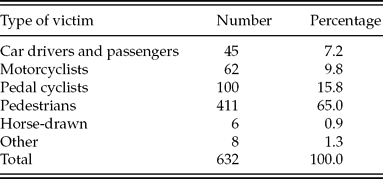
Note: No drivers of vans or lorries died in the London area in the period surveyed, only 19 van or lorry drivers died in England out of a total of 470 drivers.
Newspapers made motoring accidents a kind of weekly spectator sport and regularly reported their details. For example, The Times titled its weekly statistics ‘Road deaths of the week’.Footnote 42 Powerful interests ranged themselves on either side of the debate over road accidents. On the side of increased regulation were intellectual commentators, who saw motoring as vulgar, degrading and a despoiler of the countryside, and the most vociferous anti-motoring lobby group, the Pedestrians’ Association. This organisation was founded in 1929, just as road deaths were reaching their peak. Its chairman, Lord Cecil of Chelwood, claimed the association was needed ‘to deal with a very serious and crying evil’ which was ‘comparable with any of the most serious evils against which human society had struggled’. Footnote 43 Cecil's reputation as a peace campaigner allowed him hyperbolically to conflate motoring deaths with the evils of warfare.Footnote 44
On the side of deregulation were prominent and wealthy drivers and the AA and the RAC representing the interests of their members. It became commonplace for pro-motoring campaigners, who generally took a libertarian and somewhat elitist view of driving, to place the blame for motor accidents involving pedestrians onto the stupidity of the pedestrian rather than the speed of the driver. Newspapers and articles in motoring journals positioned pedestrian deaths as suicides rather than accidents. One writer to The Manchester Guardian wrote ‘Cars are bound to kill if people deliberately run in front of them and the motorist, whatever his speed, is no more to blame than the tide’ (for drowning a man).Footnote 45 In a similar vein, future minister of transport, John Moore-Brabazon, complained that ‘over 6,000 people commit suicide every year and no-one makes a fuss about that’.Footnote 46
Broken windscreens – accidents on the arterial road
This article now turns its attention to three examples of accidents on the new suburban arterial roads of the inter-war period. The task here is to use the details of each accident to provide insights into the nature of London's automobility at this time; the physical crash between cars is expanded through a consideration of the crashing together of wealthy and poor, modern and traditional, old and young. Each example shows a mapping of the crossing trajectories, and contrasting social, cultural and geographical milieu of those involved. Together they reveal a fragmentary, uneven automobility that privileged the wealthy and penalized poorer or slower travellers.Footnote 47
Lord Castlereagh and Arthur Howell on the Great West Road
In the early morning of 21 June 1926, returning from an evening of entertainment that followed a day's racing at Royal Ascot, a car joined the recently opened Great West Road. The driver was Charles Vane-Tempest-Stewart, seventh marquess of Londonderry, Lord Castlereagh, who was, at the time, minister for education in Northern Ireland and had previously held office at the Air Ministry. He was a famous and wealthy aristocrat, a Knight of the Garter and an owner of vast tracts of land in Ireland. He was 48 years old at the time of the accident and had been driving for about 5 years. It is interesting, and a feature of the increasing democratisation of motoring, that he was driving himself rather than using the services of one of his four chauffeurs.Footnote 48
Mr Torben de Bille, who was secretary to the Danish legation and a well-known member of London society, accompanied Castlereagh on this journey back from Ascot to Mayfair. It was a dark, rainy night and the surface of the new road was slippery and dangerous. The pair of friends had reached Osterley when a fatal accident terminated their journey. Despite his car having, for the period, powerful headlights, Castlereagh drove his car into the back of a horse-drawn cart plodding incongruously down the modern highway. The Great West Road was, in those early years, unlit and the only light visible would have been the dim red gas lamp on the back of the cart. The impact threw the cart driver onto the grass verge, who was unscathed. It broke the shafts connecting the cart to the horse, which then bolted down the road. The crash threw Castlereagh and de Bille onto the windscreen. Castlereagh was injured and hospitalized; de Bille fractured his skull and died two days after the accident.Footnote 49
The driver of the horse and cart was Arthur Howell, from Harlington in Middlesex. This little village is now a scattering of houses adjacent to the M4 link road at Heathrow. At the time of the accident, Harlington was part of a network of market gardens that provided food for London's tables. Howell's cart was on the way to Covent Garden market in central London. Leaving at midnight, he would usually reach the market at dawn to deliver his consignment of, in this instance, gooseberries and cabbages.
Arthur Howell's journey was one that horses and carts had made continuously to Covent Garden for the previous 250 years, using West Middlesex's fertile soil to provide food for the growing metropolis.
This accident demonstrates a number of features of an emergent inter-war metropolitan automobility. First, it shows the changes that the car brought to Castlereagh's ability to travel in Greater London at night. Castlereagh would have not considered the possibility of a late night return from Ascot 20 years earlier, and would have had to rely on the railway to get him home the following morning. The car had liberated him from the constraint of the railway timetable, allowing him to travel whenever and wherever he wanted, changing the way that the city could be encountered and managed. He was, at this early stage in the development of motoring in 1926, in effect, enjoying a fully private mobility that was only available to the wealthy.
Secondly, Castlereagh's occupation of the driver's seat provided him with a full automobility, that is he was in direct control of the car, rather than conducting it at a distance by issuing instructions to one of his chauffeurs. This was for a very wealthy man like Castlereagh an unusual choice for the time, and prefigures a future where almost everybody is a driver.
Finally, Castlereagh's collision with Howell demonstrates a crash and a tipping-point between ancient and modern mobilities. Howell is an example of an outer-London market gardener who was making a horse-drawn journey to Covent Garden market in the very early hours of the morning in the same way as generations of his forebears. That Howell chose to use the convenient new Great West Road to shorten his journey to town makes a poignant juxtaposition between a rural constant and modernity. The plodding pace of the horse was in marked contrast to the fast speeds attained by expensive cars on these new roads, but, in fact, small numbers of horse-drawn vehicles used London's new arterial roads well into the 1930s.Footnote 50
Lord de Clifford and Douglas Hopkins on the Kingston Bypass
The participants in the car crash described at the beginning of this article, Lord de Clifford, Douglas Hopkins and Mr and Mrs Ebdon, were representatives from at least three of the highly nuanced strata of metropolitan classes from the inter-war period. Lord de Clifford was a member of the House of Lords and undisputedly upper class. The unfortunate Douglas Hopkins was from a solid middle-class background, lived in Finchley and had a girlfriend from Hampstead Garden Suburb. The Ebdons are not so easily recoverable but based on their geographical positioning in London's new suburbia were likely to be representatives of the emerging new lower-middle classes. It required the events of 15 August 1935 to bring them together in such an unlikely way.
Edward Russell, Lord de Clifford, an Irish peer of diminished fortune, was 28 years old at the time of the accident and was married at 19 to a ‘dance hostess daughter of the shady nightclub hostess Kate Meyrick’.Footnote 51 He narrowly escaped jail for falsifying details on his marriage licence. Recovering from this early disgrace, Lord de Clifford, who despite his father's death in an early motoring accident, became a successful racing driver and also, ironically, an interventionist legislator on motoring topics in the House of Lords. His racing was undertaken domestically at Brooklands and with some success abroad as a regular participant in Monte Carlo rallies. Here then is an unusual example of the inter-war man-about-town, aristocratic, daring and with associations with London's underworld of illegal nightclubs.
De Clifford dined with friends in Windsor, and then drove them back to town and stayed for drinks and conversation. At 2.30 am, de Clifford then drove his Lancia Augusta Lusso back to a roadhouse on the Kingston Bypass. The Augusta was the favoured road car of many leading Brooklands drivers and was a sophisticated and expensive car.Footnote 52
Coming in the opposite direction was 26-year-old Douglas Hopkins accompanied by his sister, Sheila, and his girlfriend Rosemary Reynolds. Hopkins, who lived with his parents in Finchley was, coincidentally, also a driver at Brooklands although not as well known as Lord de Clifford. His father described him as a ‘motor expert but not a racer’.Footnote 53 He was an engineer by profession and he had modified the car he was driving, a Frazer Nash. His father told the inquest that he only took part in hill-climbs and performance testing.
The three friends were driving back to Hampstead from a party held at Banstead in Surrey. They sat three abreast in the front of the car; it was more sociable as it allowed them to have a conversation about the latest books they had read. At 3.30 am on the unlit road they saw the headlights of a car coming towards them, at speed, on the wrong side of the road. They crashed into de Clifford's car, the impact throwing Douglas Hopkins onto the upright of his windscreen, fracturing his skull. His fellow passengers were shocked but unhurt. Lord de Clifford carried Hopkins in to 6 Malden Way where they awaited the arrival of the police and the ambulance. Hopkins died shortly after arriving at Kingston Hospital.
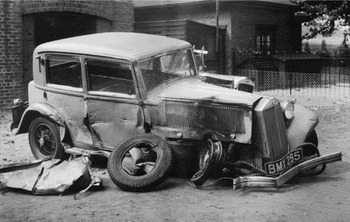
6 Malden Way was one of a group of six houses built on the Kingston Bypass. The house typified a standard-plan 1930s small detached home with Tudor referencing in the tile roof and the weather-boarded elevation. At the trial, the house was described by the defence barrister as being ‘of the character of a villa and of no great size’.Footnote 54 This could have been the home of a senior clerk, a teacher or perhaps a successful artisan. Figures 2 and 3 show photographs of the two cars after the collision. With the evidence of the crash pointed against him, the police arrested Lord de Clifford and charged him with manslaughter. After a hearing at a magistrate's court, it was realized that, as a peer, only the House of Lords could try him. His peers acquitted him despite damning evidence and his refusing to make any statement in his defence. He gradually withdrew from public life and became increasingly impoverished, ending his working life owning a kennels and selling dog food door-to-door.
Lord de Clifford's Lancia, courtesy of Parliamentary Archives, HL/PO/DC/CP/33/7.

Douglas Hopkins’ Frazer Nash, courtesy of Parliamentary Archives, HL/PO/DC/CP/33/7.

Douglas Hopkins’ and Lord de Clifford's journeys show two examples of changed automobility that would not have been possible a decade earlier. Even taking into account that both protagonists were experienced drivers, it is remarkable to consider how easily they undertook journeys of 40 km or more in the early hours of the morning.
These journeys present a casual culture of automobility. Young wealthy men in their twenties purchased and drove powerful sports cars at speed and at night, transforming the traditional geographies of London. From its development in the early seventeenth century, the West End of London, specifically Mayfair, St James and Piccadilly, was the natural home for gentlemen, with its clubs, theatres, dancing and drinking. Before World War I, a young, wealthy man would travel between a house in the country, the City and the West End. As motoring compressed time and space, the West End was no longer the centripetal locus of entertainment but became one of several potential destinations that now might lie in the suburbs or in small towns like Maidenhead.
Douglas Hopkins and Lord de Clifford became the unexpected houseguests of a much-maligned group, the residents of a house on the arterial road.Footnote 55 These new houses provided an obscure but definite enjoyment of modern life. By purchasing a house on the arterial road, it was possible to have a new home that had, perhaps temporarily, a rural outlook over fields, and also to enjoy a modern clean house. For an increasing number of suburbanites, their house would come with an Austin 7 or similar newly available cheap light car, providing them with their own automobility and direct access to the fast road.
The case of Hopkins and Lord de Clifford is particularly interesting in its demonstrations of the transitions of this period. This crash was a collision between an aristocrat and man about town and an engineer, a representative of modern managerial Britain; the past connecting with the future. Both drivers were participants at Brooklands, scene of death crashes for drivers and spectators. The arterial road network brought them together in a, quite probably, drink fuelled accident. Speed, masculinity and mobile entertainment came together in an evocative mixture of class, wealth and modernity.
R.J. Reynolds and Arthur Graham on the Bath Road
On 14 May 1929, Arthur Graham borrowed his friend's motorcycle for the day. He rode it to Maidenhead and on the way home was killed in an accident with a car driven by Richard Joshua Reynolds, the heir to a vast American tobacco fortune.
Graham who was 21 years old and was married, was not racing his friend's motorcycle for fun. He was, in fact, using it to attend the inquest for his stepfather who had been killed the previous week in an accident on the Great West Road when he hitched a lift on a lorry that then had a collision.Footnote 56 Graham's journey back was a straight run along the Bath Road from Maidenhead to Slough, and he was almost home when he was hit by a green Buick car.
Richard Reynolds was 23 years old at the time of the accident and a very wealthy young, man living a life of leisure in London with a trust income of $100,000 per year that he used to finance a hedonistic lifestyle.Footnote 57 On this particular Tuesday morning, his friend, 22-year-old Ronald Bargate, joined Reynolds at his flat in St John's Wood. Reynolds hired a six-cylinder green Buick car for the day from Godfrey Davis, a West End rental company.Footnote 58 Their plan was to drive down to Hurley, a small village between Henley and Maidenhead, to play golf for the day. It started raining, so they decided to spend the day at a hotel rather than get wet at the golf club. While they were there, Reynolds admitted to drinking five Pimms No. 1 during the afternoon and evening without having anything to eat.Footnote 59 His friend Bargate had, for his part, drunk himself senseless, and was put in the back of the car for the journey home.
Reynolds drove as far as Burnham; it was dark now and, as has been seen, illumination was always a problem on the inter-war road. Here, Reynolds crashed into the back of Graham's motorcycle, fatally injuring him. Reynolds drove on; later saying that he thought that he had hit the kerb. Another driver spotted Reynolds driving badly on the Great West Road and eventually the police pulled him up in Chiswick where they arrested him. On being pulled out of the car, covered in his own vomit, Reynolds protested ‘Do you think I am drunk? You have made a big mistake.’Footnote 60 After two trials where Reynolds employed Britain's most famous barrister, Sir Norman Birkett, in his defence, and after compensating Graham's widow with an income for life, Reynolds was convicted of manslaughter and given five months in jail. He was sent, wearing a convict's outfit covered in the traditional arrows, in a Black Maria to Brixton Jail.Footnote 61
In the histories of inter-war motoring, many writers position the car centrally within inter-war automobility. This accident presents a more extended picture of automobility, recognizing that, in the 1920s, the motorcycle had far greater impact on working-class mobilities than the car. Many riders had been introduced to the motorcycle during the Great War and were ready to adopt it as a new form of transport on their return to civilian life.Footnote 62 In 1928, the year before this accident, there were 731,000 motorcycles on the road and 998,000 cars. The motorcycle was also appealing because of its price. The introduction of the Austin 7 baby car had transformed car pricing and made it more accessible to the many, but the 7 was still twice the price of a powerful motorcycle.Footnote 63
The motorcycle was, throughout the inter-war period, the primary means of motorized transport for the working-class and lower-middle-class man. Steve Koerner, motorcycle historian, noted the visit of an American automotive engineer who observed that ‘the class of people who possess Fords in America have motor-cycles in England’.Footnote 64 Arthur Graham, who was a driver for the local gas company, was such a working-class motorcyclist.Footnote 65 Some car owners looked on motorcyclists with disdain; one writer remembered that: ‘Nobody loved the motorcyclist with or without a sidecar, . . . leather-helmeted, goggled, gauntleted, crouched demoniacally over his handlebars, noisy oily, smelly, dirty, he was a figure of scorn to his financial superiors, who imagined that his sole purpose in life was to terrify them.’Footnote 66
Reynolds was an example of the many wealthy Americans who made London their home in the 1920s. Reynolds’ day could have not been dreamt up better to typify the lifestyle of a wealthy and idle socialite. Get up late, meet a friend, take a taxi to Albemarle Street and hire a powerful six cylinder Buick for the day. Drive to a golf course in the Home Counties, get put off by the rain, drink yourself insensible on cocktails in a country pub, then drive home.
The accident between Reynolds and Graham presents a further illustration of the link between metropolitan automobility and entertainment in this period and also shows the continuing association between drinking and driving. Graham's ride demonstrates the importance of the motorcycle to inter-war motoring for the working-class male and also, in a week in which his stepfather also died on the London to Bath Road, how extremely dangerous it was to travel on the arterial road.
Emergent automobilities
The accident statistics and examples presented in this article show London's inter-war automobility in an emergent and highly differentiated state. Its automobility developed in a fractured and uneven manner with the wealthy using the arterial roads for high-speed driving, and the poorer classes crossing and travelling along these roads as best as they could.
Wealthy metropolitan drivers such as De Clifford, Hopkins, Castlereagh and Reynolds were able to use their cars to drive long distances in outer London to enjoy new places of entertainment that could only be easily reached by car. Their use of fast cars provided them with autonomous motility free from timetabled constraints and gave them a new way to explore the city. Although arterial roads were built to reduce journey times to aid commerce, their use by the young and wealthy suggested that they thought that the road was built for their pleasure. There was a strongly sensational aspect to this pleasure that is recorded in memoirs of the period and in fictional accounts of the time that contributed to a popular culture that worshipped speed and modernity. In an open car, wind, noise and the scents of the outdoors combined with fast driving to make for an evocative driving experience. In a closed car, speed combined with isolation from the driver's surroundings to increase the likelihood of accidents.
These high-speed journeys along the arterial road created a new space for metropolitan drivers. Within a few years, this space had become contested. Others, living in new suburban housing near to London's major highways, also started to drive or ride motorcycles in increasing numbers. The pedestrians and cyclists from these houses crossed these roads at their peril.
Although London's arterial roads have been shown as dangerous for the wealthy driver and passenger, they disproportionably presented dangers to other road users. The poorer classes using the arterial road or crossing it in a familiar journey that pre-existed the road's construction were much more likely to die. The relationship is a simple one; the poor were on foot or on bicycle, or, in Howell's case, on a horse and cart. They had no protection from fast cars when they were driven recklessly and drunkenly along the road. There was a strong association between the type of transport and the age of its user. It is not an oversimplification to suggest that young drivers were killing large numbers of very young and elderly cyclists and pedestrians.
By the close of the inter-war period, public concern over the level of accidents provoked the introduction of traffic controls on to the new roads, which in their turn had become unglamorous and fully suburban with housing estates ribboning their margins. In this way, the arterial roads became slower, were populated by suburban as well as urban drivers, to become the often unpleasant experience of driving that we are familiar with today.