

Introduction
Animal breeding and the conservation of animal genetic resources are mainly managed at the scale of the populations, which are generally described in terms of breeds. Some of these breeds are raised all around the world, with a genetic management more or less organized at the international level (e.g. the Thoroughbred horse breed, the Holstein dairy cattle breed, the Meishan pig breed, etc.). Such breeds are highly specialized in one function (for the above breeds, horse races, dairy production and reproduction and maternal abilities, respectively). A much larger number of breeds, generally less specialized, are called “local breeds”, “native breeds”, “heritage breeds”, “traditional breeds”, “rare breeds”, etc. The definition of these terms may depend on the point of view: for instance, according to FAO (Reference Rischkowsky and Pilling2007a), at the world level, a local breed is a breed raised in a single country, whereas the word “local” generally refers to an area smaller than a whole country.
The present paper deals with local breeds, according to the definition provided by the French Ministry of Agriculture: “a local breed is a breed predominantly bound to a given territory, by its origin, location and farming system”. To decide if a breed can be considered as local, some rules have been defined on the basis of the distribution of animals across administrative departmental districts (Order by the French Ministry of Agriculture, dated 26 July 2007). As an example, there are a total of 46 recognized cattle breeds in France, including 29 local breeds. According to their actual population size, breeders of these local breeds manage a selection programme (the main purpose is to improve genetic value of the animal population for characteristics considered of interest by the stakeholders) or a conservation programme (the main purpose is to maintain or develop the animal population number); in both cases, more or less simple methods to monitor the within-population genetic variability are implemented.
There are many reasons to maintain local breeds (see, e.g. FAO, 2007b; Gandini et al., Reference Gandini, Avon, Bothe-Wilhelmus, Bay, Colinet, Choroszy, Diaz, Duclos, Fernandez, Gengler, Hoving-Bolink, Kearney, Lilja, Mäki-Tanila, Martin-Collado, Maurice-Van Eijndhoven, Musella, Pizzi, Soini, Toro, Turri, Viinalas and Hiemstra2010) and the best way is to develop initiatives that make these breeds self-sustaining (e.g. Gandini and Oldenbroeck, Reference Gandini, Oldenbroeck and Oldenbroeck2007; Hiemstra, Reference Hiemstra, Hiemstra, de Haas, Maki-Tanila and Gandini2010). Among these initiatives, efforts are generally made to develop one or some market chain(s) allowing farmers to benefit from a substantial income from their animals (that we will denote as ‘valorization’ in the following). Many examples of valorizations of local breeds have been reported, from both developed (e.g. Verrier et al., Reference Verrier, Tixier-Boichard, Bernigaud and Naves2005) or developing (e.g. Mathias, Mundy and Köhler-Rollefson, Reference Mathias, Mundy and Köhler-Rollefson2010) countries. Such a valorization contributes generally (but not systematically) to the stabilization or the increase of the population size of the breed and the increase of the number of farmers using the breed (Verrier et al., Reference Verrier, Tixier-Boichard, Bernigaud and Naves2005; Quéméré, Reference Quéméré2006; Lambert-Derkimba, Reference Lambert-Derkimba2007). However, this process can introduce new stakes concerning the future of the breed and the involvement of new stakeholders. Then, the question addressed in this paper is if valorization can question the genetic strategies developed for local breeds, as hypothesized by Audiot et al. (Reference Audiot, Bouche, Brives, Casabianca, Gaillard, Roche, Trift and Steyaert2005). More specifically, we will analyse the consequences of the valorization of local breeds on the definition of the breeding goals, considering both the breeding goals themselves and the process for their definition. This issue will be addressed through the cases of six French local cattle breeds that were the object of our former studies or studies by other authors (see references hereafter in the text).
The case studies
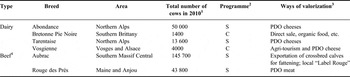
General information about the cattle breeds studied is shown in Table 1. Four breeds are dairy breeds. The last two used to be multi-purpose breeds (milk, beef and draught), but were specialized in beef production during the 1970s and the 1980s. Four breeds are raised in mountain areas, the farming system including transhumance, the other two being raised in the West of France. Among these six breeds, only the Aubrac breed accounts for more than 100 000 cows. The two breeds with the smallest actual population size, namely the Vosgienne and Bretonne Pie Noire breeds, are considered as rare breeds: their breeders' associations benefit from a public financial support for managing a conservation programme and their breeders benefit from the European subsidies for the in situ preservation of animal genetic resources.
General information about the breeds under study.

1 Source: “France Génétique Elevage” and “OS des races bovines en conservation”.
2S = selection; C = conservation.
3PDO = protected designation of origin; “Label rouge” = official label for a product of higher quality.
4Up to the 1970s, the two beef breeds considered here were multi-purpose breeds, the cows being milked.
The ways of valorizing local breeds are diverse (Table 1). They can be either collective actions or individual initiatives. Collective actions involve farmers grouped in cooperatives or associations, as well as companies in charge of processing the products. These actions often focus on labelled products such as geographical indications (community regulation no. 510-2006), namely Protected Designation of Origin (PDO) and Protected Geographical Indications (PGI), or “Label Rouge”, an official label for a product of higher quality. Individual initiatives are mainly based on direct sale, organic farming, or both, etc. Among the six breeds under study, the Bretonne Pie Noire breed is the only one to be valorized only by individual initiatives (Quéméré, Reference Quéméré2006). Collective actions contribute to a small extent to valorize the Vosgienne breed. The other four breeds are mainly valorized by collective actions.
PDOs are of special importance for the valorization of local breeds and the specifications of animal products under PDO pay an increasing attention to the breed(s) allowed to be used for a given product (Lambert-Derkimba, Casabianca and Verrier, Reference Lambert-Derkimba, Casabianca and Verrier2006). Among the six breeds under study, five are concerned by at least one PDO, the Bretonne Pie Noire breed being the only exception. The two beef breeds under study show singular and opposite figures. On the one hand, the Rouge des Prés breed is the only breed allowed to be used to produce the meat “Boeuf Maine-Anjou”, the PDO project being an initiative of the breeders association (Noury, De Fontguyon and Sans, Reference Noury, De Fontguyon and Sans2005). On the other hand, the Aubrac breed (in addition to the French Simmental breed) is allowed to produce milk for a PDO cheese called Laguiole but, currently, this possibility mainly refers to history (Béranger and Valadier, Reference Béranger, Valadier and Hubert2010) and is almost virtual: one can estimate that about 40 Aubrac cows are milked, which represents less than 1 percent of the milk production required for the production of the Laguiole cheese (Lambert-Derkimba, Casabianca and Verrier, Reference Lambert-Derkimba, Casabianca and Verrier2006).
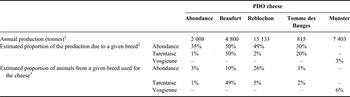
Let us consider in more detail the cases of the three dairy breeds under study concerned by a PDO, namely the Abondance, Tarentaise and Vosgienne breeds. It is possible to estimate the proportion of the production of a given PDO cheese because of a given breed, on the one hand, and the proportion of animals from a given breed used for a given PDO cheese, on the other hand (Lambert-Derkimba, Casabianca and Verrier, Reference Lambert-Derkimba, Casabianca and Verrier2006). Such an approach requires knowledge about the racial composition of the stock devoted to a given PDO, about the productivity of animals according to their breed and about some technical parameters of the process (e.g. the quantity of milk required for producing 1 kg of maturated cheese). Table 2 shows the results of this approach for the three breeds considered in this paper to be valorized by a PDO cheese. The Tarentaise breed and the Beaufort cheese show atypical case of a tight connection between a local breed and a PDO product, the Beaufort cheese representing about half the use of the Tarentaise cows and this breed accounting for half the production of this cheese. This connection is also revealed by the fact that several farmers simultaneously belong to the staff of the Tarentaise breeders association and to the staff of the inter-professional committee for the PDO Beaufort (Lambert-Derkimba, Reference Lambert-Derkimba2007). The Abondance breed is raised in an area which overlaps that of the Tarentaise breed, but its contribution is more balanced among a series of products and there are only a few cases of simultaneous participation to the staffs of the breeders association and an inter-professional PDO committee. Finally, there is a weak connection between the Vosgienne breed and the PDO cheese produced in the area where this breed is raised.
Cross-analysis of the contribution of three of the local breeds under study to the production of some PDO cheeses and of the contribution of these cheeses to the use of these breeds. Note that the name “Abondance” was simultaneously given to a cattle breed and a PDO cheese. From Lambert-Derkimba et al. (Reference Lambert-Derkimba, Casabianca and Verrier2006).

1Figures for year 2010 (Source: INAO).
2Figures for a given cheese may not sum up to 100%: in such a case, other breeds are allowed to be used.
3Figures for a given breed do not sum up to 100%, because each breed is used for other kinds of product.
When the new stakeholders bring changes in the definition of breeding goals
Valorization may bring new stakes about the orientation of the breed characteristics and most of the time new stakeholders concerned by the future of the breed. It can be illustrated by the case of the Bretonne Pie Noire breed (Quéméré, Reference Quéméré2006). This rare breed is raised in Brittany, the main French region for dairy production, with intensive farming systems. In a census performed in 1976, only 277 Bretonne Pie Noire cows were found, these cows being mainly raised by rather old and traditional farmers. The conservation programme started in 1977 on the basis of the results of the census. It mainly focused on the search for new bulls for artificial insemination and the management of the genetic variability. As the programme became known, new breeders were interested by the breed. Many of them were hobby breeders: in 2005, among a total of 338 breeders, there were 183 hobby breeders (Quéméré, Reference Quéméré2006). Other new breeders were professional breeders wanting to switch from an intensive farming system to a more extensive one. The new breeders were interested in new types of valorization and choose the local breed to be a medium for those valorization dynamics: on farm processing and direct sale of dairy products, organic farming, using the cows as suckling cows for meat production, etc. Moreover, some institutional “breeders”, such as a natural park or some associations choose the Bretonne Pie Noire breed for their activity, representing a total of 21 “breeders” in 2005 (Quéméré, Reference Quéméré2006). One can wonder if the current dual-purpose of this breed, i.e. the use of the cows as dairy cows for on-farm processing or as suckling cows, will have consequences on the breed orientation. In other words, knowing that in this rare breed the selection pressure can only be weak, is there really room for selection towards a so large diversity of goals? Finally, the diversity of breeders represents a huge diversity of points of view about what the breed is and what it should be, even if a shared point of view is that the breed is well suited to less demanding and more autonomous farming systems.
The case of the Abondance breed is also illustrative. In a previous study (Lambert-Derkimba, Reference Lambert-Derkimba2007), we found several characteristics of the breeds that the stakeholders wanted to promote through the selection programme, according to their farming system. Some characteristics did not concern performances of production, but coat color, size of cows, aptitudes to walk in mountains pastures and, more generally, robustness. Especially, in mountainous areas, farmers looked for small cows, able to walk in high pastures and having good ability in sloping areas. On the contrary, farmers in plains looked for taller cows. Other characteristics concerned the performance of the animals, mainly the milk yield and the protein and/or fat contents. Farmers engaged in PDO rules of production looked for high protein content of the milk. For two PDOs, namely Beaufort and Tome des Bauges, farmers must also cope with the limit of milk yield (averaged at the herd level): this limit is equal to 5000 and 5500 kg per cow for the Beaufort and the Tome des Bauges, respectively. In such a case, farmers said that they put little emphasis on milk yield as a selection criterion for both bulls used for artificial insemination and dams of their new young cows. Accordingly, the analysis of the national database revealed that, the average estimated breeding value (EBV) for milk yield of Abondance cows raised in the area of a PDO implying a milk yield limit was significantly lower than the average EBV of Abondance cows raised in other areas (Lambert-Derkimba et al., Reference Lambert-Derkimba, Minéry, Barbat, Casabianca and Verrier2010). On the contrary, some farmers produce milk for industrial processors and with no limit on milk yield. Those farmers indicated that they put less emphasis on protein or fat content and they showed the highest average cows' EBV for milk yield (Lambert-Derkimba et al., Reference Lambert-Derkimba, Minéry, Barbat, Casabianca and Verrier2010). With such a high diversity of points of view among farmers, to define a breeding goal through a Total Merit Index (TMI) is a real challenge of the Abondance breeders association.
In the case of the Vosgienne breed too, there are different points of views on the breed orientation. Lauvie et al. (Reference Lauvie, Audiot, Couix, Casabianca, Brives and Verrier2011) identified a potential conflict between different development objectives: general milk quantity is an important criterion for a part of the breeders (selling milk to milk industry), while specific milk quality is important for breeders practicing on-farm cheese processing. This could be considered as a problem for a breed with a small population size as it is difficult to imagine several different selection programmes simultaneously.
When the evolution of the breeding goals results from a strong consensus
In the French Northern Alps, the tight connection between the Beaufort PDO cheese and the Tarentaise breed (see above) facilitated, among other factors, the definition of the breeding goals of the breed, especially the choice of the weights of the different traits in a TMI (Lambert-Derkimba, Reference Lambert-Derkimba2007). The breeders, mainly involved in the PDO production, have a clear point of view on what the breed has to become in the future: a mountainous breed, able to valorize a harsh environment areas and producing milk for high-quality cheese, with little emphasis on milk yield. This is consistent with the specifications of the Beaufort PDO cheese, which imply specific farming practices and fix a higher limit to the average productivity of each herd (see above). Our analysis of the national dairy performances database confirmed that, as today, the Tarentaise breed can be considered as a specialized breed for such a farming system (Lambert-Derkimba et al., Reference Lambert-Derkimba, Minéry, Barbat, Casabianca and Verrier2010).
The case of the Aubrac breed is also interesting. Owing to the cessation of the use of animal power and the very low milk yield of the cows (cows must be milked with their calf, which start and end the process), the breeders oriented their farming system towards beef production only. Then, during the 1960s, the Aubrac breed was endangered by non-monitored cross-breeding with the Charolais beef breed, with no attention paid to maintain the pure breed stock (Béranger et al., Reference Béranger, Hedin, Kerguelen, Petit and Teissier1970). However, the F1 cows were not as adapted to the harsh environment of the Aubrac mountains as the pure Aubrac cows. As a consequence, during the late 1970s and the 1980s, farmers came back with the use of pure Aubrac cows and a new breeding programme for the Aubrac breed was developed (Calvani Abbo, Reference Calvani Abbo2005; Béranger and Valadier, Reference Béranger, Valadier and Hubert2010). Cross-breeding with the Charolais breed is still practised with about 65 percent of the Aubrac cows, to produce F1 calves whose destination was the Italian fattening industry. The strong maternal characteristics of the Aubrac (calving facilities, milk production and strong motherhood instinct) were developed by the breeders managing the pure breed. The Charolais breed transmits high growing and muscle development characteristics to the calves, allowing higher weight at suckling and higher performances during the fattening period. The Aubrac cows rapidly became valuable “moules à veaux” (cows were able to easily give birth and suckle crossbred calves despite their small size) and were able to be raised in the extensive farming systems of the Aubrac countryside and to valorize a harsh environment (Vissac, Reference Vissac2002). To valorize the female calves born from cross-breeding (only male are fattened in Italy), breeders built the label “Fleur d'Aubrac” (Certificate of Product Conformity) in 1991. To valorize older animals such as culled old cows, another label has been built in 1999: the label “Boeuf Fermier d'Aubrac” (Red Label). Those labels open the way of a better price for the meat and as a consequence, allow keeping breeders in isolated areas of Aubrac countryside. From the 1980s, the Aubrac breed is genetically oriented only for meat purpose and this consensus between stakeholders allowed saving the Aubrac breed in a period of strong decline of the population. However, the question of the conservation of milking abilities in a specific line of the breed still exists.
Conclusion
This paper illustrates the fact that valorization questions genetic strategies, especially the definition of breeding goals: new stakeholders have diverse interests concerning the breed evolution and interact with the breeding goals definition. Thanks to six French cattle breed cases, we can see several types of interactions and how breeders and association manage those situations. Arenas where the different points of views on the breed can be discussed are as a consequence of first importance. The example of the new organization for animal breeding in France shows that breeding organization can have as an official mission to be those places of debates. The French juridical framework for animal breeding (“Dispositif Génétique Français”) considers the fact that breeding organization must associate not only with breeders but also with different stakeholders interested in the local breed management, including stakeholders from both the market chains and the corresponding territory. From a larger point of view, these places of debate are of first interest in decision-making processes for local breeds' management and allow the expression of the diversity of existing points of view. However, one should keep in mind that gathering a wide diversity of stakeholders and facilitating debates is not an assurance that a compromise will be found on the orientation of a breed. The alliances and political strategies influence the decision-making inside those management bodies which then become more complex. Moreover, at any time, a new valorization process could emerge and bring new point of views in the debates.