Introduction
Deep brain stimulation (DBS) has been shown to be effective in the treatment of movement disorders, such as Parkinson's disease and tremor (Kleiner-Fisman et al. Reference Kleiner-Fisman, Herzog, Fisman, Tamma, Lyons, Pahwa, Lang and Deuschl2006; Perlmutter & Mink, Reference Perlmutter and Mink2006). It has also been used in conditions as diverse as chronic pain and Tourette's syndrome (Bittar et al. Reference Bittar, Kar-Purkayastha, Owen, Bear, Green, Wang and Aziz2005; Steeves et al. 2012). High-frequency stimulating electrodes are placed in one of several target areas, including the ventrolateral thalamus, subthalamic nucleus, internal segment of the globus pallidus and periaqueductal grey matter.
The original idea behind DBS as an alternative for ablative neurosurgery was that high-frequency DBS served as a ‘reversible lesion’ by inhibiting activity in the targeted grey matter (Benabid et al. Reference Benabid, Pollak, Gervason, Hoffmann, Gao, Hommel, Perret and de Rougemont1991; Benazzouz et al. Reference Benazzouz, Piallat, Pollak and Benabid1995). However, further research suggests that the mechanism of action is more complicated and includes elements of both excitation and inhibition (McIntyre et al. Reference McIntyre, Savasta, Kerkerian-Le and Vitek2004; Iremonger et al. Reference Iremonger, Anderson, Hu and Kiss2006).
An emerging field is the use of DBS for psychiatric disorders, including obsessive–compulsive disorder (OCD) (Greenberg et al. Reference Greenberg, Gabriels, Malone, Rezai, Friehs, Okun, Shapira, Foote, Cosyns, Kubu, Malloy, Salloway, Giftakis, Rise, Machado, Baker, Stypulkowski, Goodman, Rasmussen and Nuttin2010), depression (Schlaepfer & Lieb, Reference Schlaepfer and Lieb2005; Lozano et al. Reference Lozano, Mayberg, Giacobbe, Hamani, Craddock and Kennedy2008) and anorexia nervosa (Wu et al. Reference Wu, Van Dyck-Lippens, Santegoeds, van Kuyck, Gabriels, Lin, Pan, Li, Li, Zhan, Sun and Nuttin2013). Central to this approach is the notion that psychiatric disorders result from deregulation of limbic-cortical connections (Schlaepfer & Bewernick, Reference Schlaepfer and Bewernick2013). DBS is thought to inhibit or functionally override hyperactivity in, for example, the subgenual cingulate cortex (Cg25) in the case of depression, or the cortical-striatal-pallidal-thalamic-cortical network in OCD. The nucleus accumbens (NAcc) also plays a role, possibly as the motivation gateway between limbic systems involved in emotion and motor control. Targets for DBS have therefore included the Cg25, ventral capsule/ventral striatum (VC/VS) and median forebrain bundle for major depression (Kubu et al. Reference Kubu, Malone, Chelune, Malloy, Rezai, Frazier, Machado, Rasmussen, Friehs and Greenberg2013; Schlaepfer & Bewernick, Reference Schlaepfer and Bewernick2013), and the VC/VS, NAcc and anterior limb of the capsula interna for OCD (Greenberg et al. Reference Greenberg, Gabriels, Malone, Rezai, Friehs, Okun, Shapira, Foote, Cosyns, Kubu, Malloy, Salloway, Giftakis, Rise, Machado, Baker, Stypulkowski, Goodman, Rasmussen and Nuttin2010; D'Astous et al. Reference D'Astous, Cottin, Roy, Picard and Cantin2013; Kubu et al. Reference Kubu, Malone, Chelune, Malloy, Rezai, Frazier, Machado, Rasmussen, Friehs and Greenberg2013; Schlaepfer & Bewernick, Reference Schlaepfer and Bewernick2013).
Most of the literature on effectiveness of DBS consists of uncontrolled case reports, series or trials, but in the case of OCD, there have been several double-blind, randomized controlled evaluations (Nuttin et al. Reference Nuttin, Gabriels, Cosyns, Meyerson, Andreewitch, Sunaert, Maes, Dupont, Gybels, Gielen and Demeulemeester2003; Abelson et al. Reference Abelson, Curtis, Sagher, Albucher, Harrigan, Taylor, Martis and Giordani2005; Mallet et al. Reference Mallet, Polosan, Jaafari, Baup, Welter, Fontaine, du Montcel, Yelnik, Chereau, Arbus, Raoul, Aouizerate, Damier, Chabardes, Czernecki, Ardouin, Krebs, Bardinet, Chaynes, Burbaud, Cornu, Derost, Bougerol, Bataille, Mattei, Dormont, Devaux, Verin, Houeto, Pollak, Benabid, Agid, Krack, Millet and Pelissolo2008; Denys et al. Reference Denys, Mantione, Figee, van den Munckhof, Koerselman, Westenberg, Bosch and Schuurman2010; Goodman et al. Reference Goodman, Foote, Greenberg, Ricciuti, Bauer, Ward, Shapira, Wu, Hill, Rasmussen and Okun2010). These studies randomly assigned patients to real or sham stimulation for several weeks on the basis that, as with motor disorders, DBS only works with concurrent stimulation. Importantly, they are double blinded to control for the information bias, and consequent placebo effect, for both the patient and rater of knowing who has had surgery. This approach also addresses ethical objections to randomizing patients to insertion or non-insertion of the device itself.
OCD has a lifetime prevalence of 2–3% of the general population (Kessler et al. Reference Kessler, Berglund, Demler, Jin, Merikangas and Walters2005). It is characterized by intrusive and persistent thoughts, impulses or images, and the resulting excessive repetitive behaviours or mental acts, according to rigid rules or unrealistically aimed at reducing distress (APA, 2000). At least 50% of people with OCD have co-morbid anxiety or depression (Torres et al. Reference Torres, Prince, Bebbington, Bhugra, Brugha, Farrell, Jenkins, Lewis, Meltzer and Singleton2006). OCD has been linked to disturbances in the brain's serotonin and glutamate systems, with disruption of pathways in the frontal orbitostriatal area and dorsolateral prefrontal cortex, although these models do not fully account for symptom heterogeneity (Abramowitz et al. Reference Abramowitz, Taylor and McKay2009).
The mainstays of treatment are cognitive behavioural therapy (CBT) and pharmacotherapy with serotonin selective reuptake inhibitors (SSRIs) or clomipramine (Abramowitz et al. Reference Abramowitz, Taylor and McKay2009). Unfortunately, approximately 25% of patients drop out of CBT and 40–60% do not respond adequately to SSRIs or clomipramine (Bloch et al. Reference Bloch, Landeros-Weisenberger, Kelmendi, Coric, Bracken and Leckman2006). Although one-third of these may improve with antipsychotic augmentation, this leaves up to 30% who fail to respond adequately to any first- and second-line pharmacological or psychological treatments (Aouizerate et al. Reference Aouizerate, Rotgé, Martin-Guehl, Cuny, Rougier, Guehl, Burbaud, Bioulac and Tignol2006). In the past, surgical techniques have been used in such treatment-refractory cases, including anterior capsulotomy, anterior cingulotomy, subcaudate tractotomy and limbic leucotomy. Outcomes for these procedures have improved with better patient selection and refinement of techniques including stereotaxis (Shah et al. Reference Shah, Pesiridou, Baltuch, Malone and O'Reardon2008). For instance, a 7-year follow-up of 16 patients with intractable major affective disorders who underwent a limbic leucotomy reported significant halving in mean scores on the Hamilton Depression Rating Scale (HAMD; Cho et al. Reference Cho, Lee and Chen2008). There was no surgical mortality, and only three patients experienced temporary minor complications. In the case of treatment-refractory OCD, a study of 17 patients following bilateral stereotactic cingulotomy reported a mean reduction of 48% in their baseline Yale–Brown Obsessive Compulsive Scale (YBOCS) scores over a period of 24 months (Jung et al. Reference Jung, Kim, Chang, Park, Chung and Chang2006). However, the nature of these procedures means that data are restricted to uncontrolled open-label studies (Hariz & Hariz, Reference Hariz and Hariz2013). As a result, the safety and efficacy of irreversible surgical interventions remain controversial (Abramowitz et al. Reference Abramowitz, Taylor and McKay2009), with consequent increasing interest in DBS as an alternative (Aouizerate et al. Reference Aouizerate, Rotgé, Martin-Guehl, Cuny, Rougier, Guehl, Burbaud, Bioulac and Tignol2006). Availability of this intervention varies by jurisdiction. For example, in the USA, DBS is approved by the Federal Drugs Administration under a Humanitarian Device Exemption (HDE) for the treatment of chronic, severe, treatment-resistant OCD as an alternative to anterior capsulotomy (Medtronic, 2014). Surgery can only be performed in a medical centre following Institutional Review Board (IRB) approval. In most Australian states, surgery has generally to be approved by the Mental Health or Psychosurgery Review Board (Loo et al. Reference Loo, Trollor, Alonzo, Rendina and Kavess2010). However, DBS is not permitted at all in New South Wales (Loo et al. Reference Loo, Trollor, Alonzo, Rendina and Kavess2010).
To date, there has been one narrative review of OCD but it did not include any meta-analyses (de Koning et al. Reference de Koning, Figee, van den Munckhof, Schuurman and Denys2011). There have been no reviews of other psychiatric disorders. We therefore undertook a systematic review of the effectiveness of DBS in psychiatric conditions. We focused on OCD but also included all double-blind sham-controlled studies of both depression and anorexia nervosa.
Method
Search strategy
We conducted a comprehensive search using PubMed/Medline and EMBASE in April 2013 for all studies up to that date, using various combinations of the following free text and MeSH terms: deep brain stimulation; DBS; obsessive compulsive disorder; OCD; depression; anorexia. We inspected titles and abstracts of all papers identified in the electronic searches. The full text of all randomized controlled trials (RCTs) was obtained for examination for relevance and for snowball searches of reference lists. We selected only double-blind, placebo-controlled, cross-over and parallel-group RCTs for the purpose of this review. Narrative and systematic reviews, posters, conference abstracts, case reports, letters to editors and other articles that did not meet the inclusion criteria were cross-referenced for additional potential sources of RCTs.
Inclusion and exclusion criteria
We included all relevant double-blind RCTs in which DBS was compared with sham treatment for at least 2 weeks. The primary outcome was the effect of DBS on the psychiatric diagnosis that was the main focus of the study as assessed by validated scales. Secondary outcomes included co-morbid psychiatric symptoms, global functioning, cognition and adverse effects.
Both cross-over and parallel-group RCTs trials with contemporary cases and controls were eligible for inclusion. Cross-over trials were included on the basis that there were unlikely to be long-term carry-over effects of turning stimulation on or off. To further minimize this possibility, we used results of the first phase of treatment where possible. This was to minimize the bias of study designs where participants experience both active and sham treatment and, in the context of informed consent, know that what they are allocated to in the second phase of a study will be the opposite of what they have already experienced in the first (Elbourne et al. 2002; Higgins & Green, Reference Higgins and Green2011). This can potentially introduce complex problems of either positive or negative placebo effects. In addition, we undertook sensitivity analyses of the effect of excluding cross-over trials to further minimize any carry-over effects on the primary outcome variable (Grimley Evans et al. Reference Grimley Evans, Malouf, Huppert and van Niekerk2006).
Studies of transcranial magnetic stimulation, transcranial direct current stimulation and magnetic seizure therapy were excluded, as were articles addressing only physical measurements such as cerebral blood flow.
We assessed the quality of included studies using the following four criteria of the risk of bias assessment tool, developed by the Cochrane Collaboration to assess possible sources of bias in RCTs (Higgins & Green, Reference Higgins and Green2011): (1) adequate generation of allocation sequence; (2) concealment of allocation to conditions; (3) prevention of knowledge of the allocated intervention to assessors of outcome; and (4) dealing with incomplete outcome data.
Data extraction was conducted by two independent researchers (J.H. and J.F.). All discrepancies during all stages of study selection, data extraction and quality assessment were resolved by re-checking source papers and further discussion among two other authors (S.K. and D.S.) to reach consensus.
Statistical analysis
We used Review Manager version 5.2 for Windows, a statistical software package for analysing Cochrane Collaboration systematic reviews. We calculated the mean differences (MDs) for continuous data where studies used the same scale for each outcome, and the standardized mean differences (SMDs) for data that used different scales. For studies using a parallel-groups design, we assessed differences in final values between the active and sham treatments. In studies using a cross-over design, we compared the results of paired analyses in changes from baseline score (Elbourne et al. 2002; Grimley Evans et al. Reference Grimley Evans, Malouf, Huppert and van Niekerk2006; Higgins & Green, Reference Higgins and Green2011). We gave preference to data from the first treatment period only where such data were available, but undertook sensitivity analyses of the effect of using the second treatment period instead. Even though the two types of outcome can be legitimately pooled using the (unstandardized) MD, we placed them in separate subgroups to avoid confusion (Higgins & Green, Reference Higgins and Green2011). We did not combine final value and change scores in any analysis of SMDs. We also undertook subgroup analyses by site of electrode insertion. We reported the relative risk (RR) for any dichotomous outcome. Intention-to-treat (ITT) analyses were used in all cases.
We assessed heterogeneity using the I 2 statistic, a measure that does not depend on the number of studies in the meta-analysis and hence has greater power to detect heterogeneity when the number of studies is small. I 2 provides an estimate of the percentage of variability due to heterogeneity rather than chance alone. An estimate of 50% or greater indicates possible heterogeneity, and scores of 75–100% indicate considerable heterogeneity. The I 2 estimate is calculated using the χ 2 statistic (Q) and its degrees of freedom.
We used the random effects model for all the analyses as we could not definitely exclude between-study variation even in the absence of statistical heterogeneity, given the range of DBS interventions.
For any outcomes where there were at least 10 studies, we tested for publication bias using funnel plot asymmetry, where low p values suggest publication bias (Higgins & Green, Reference Higgins and Green2011).
Results
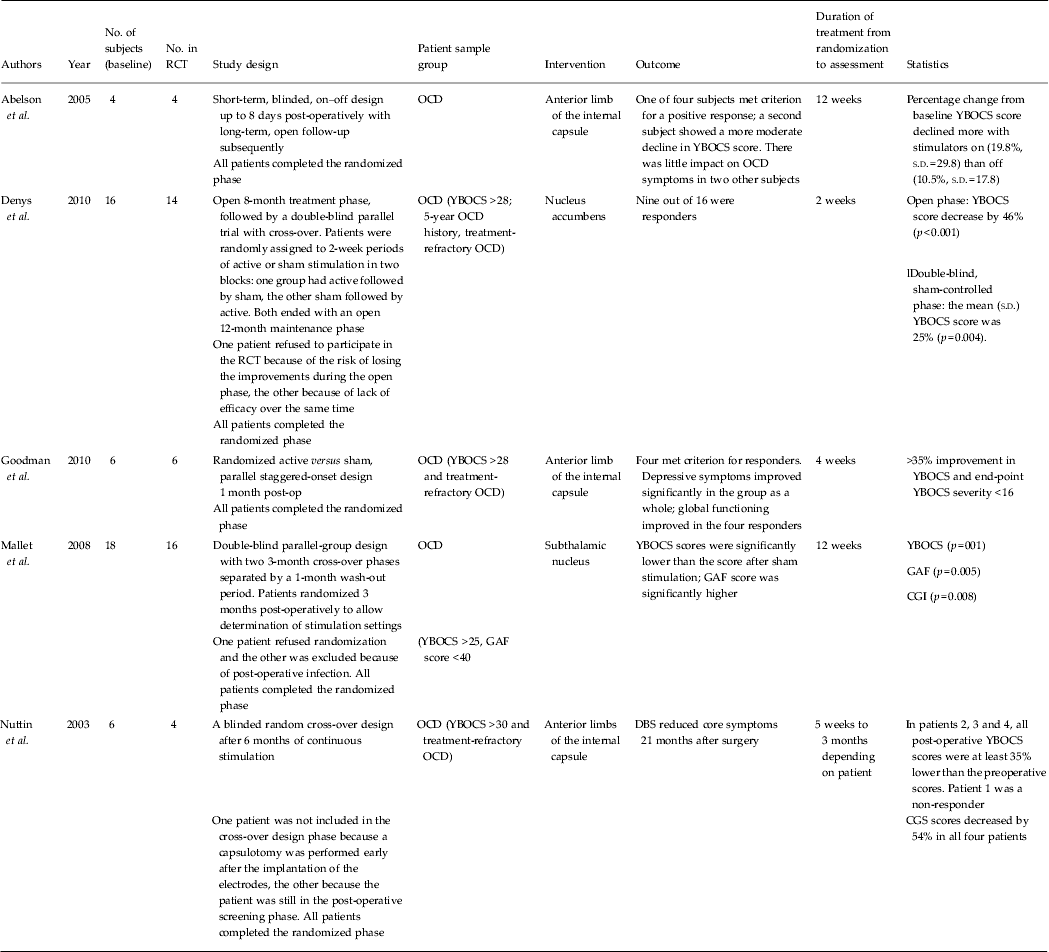
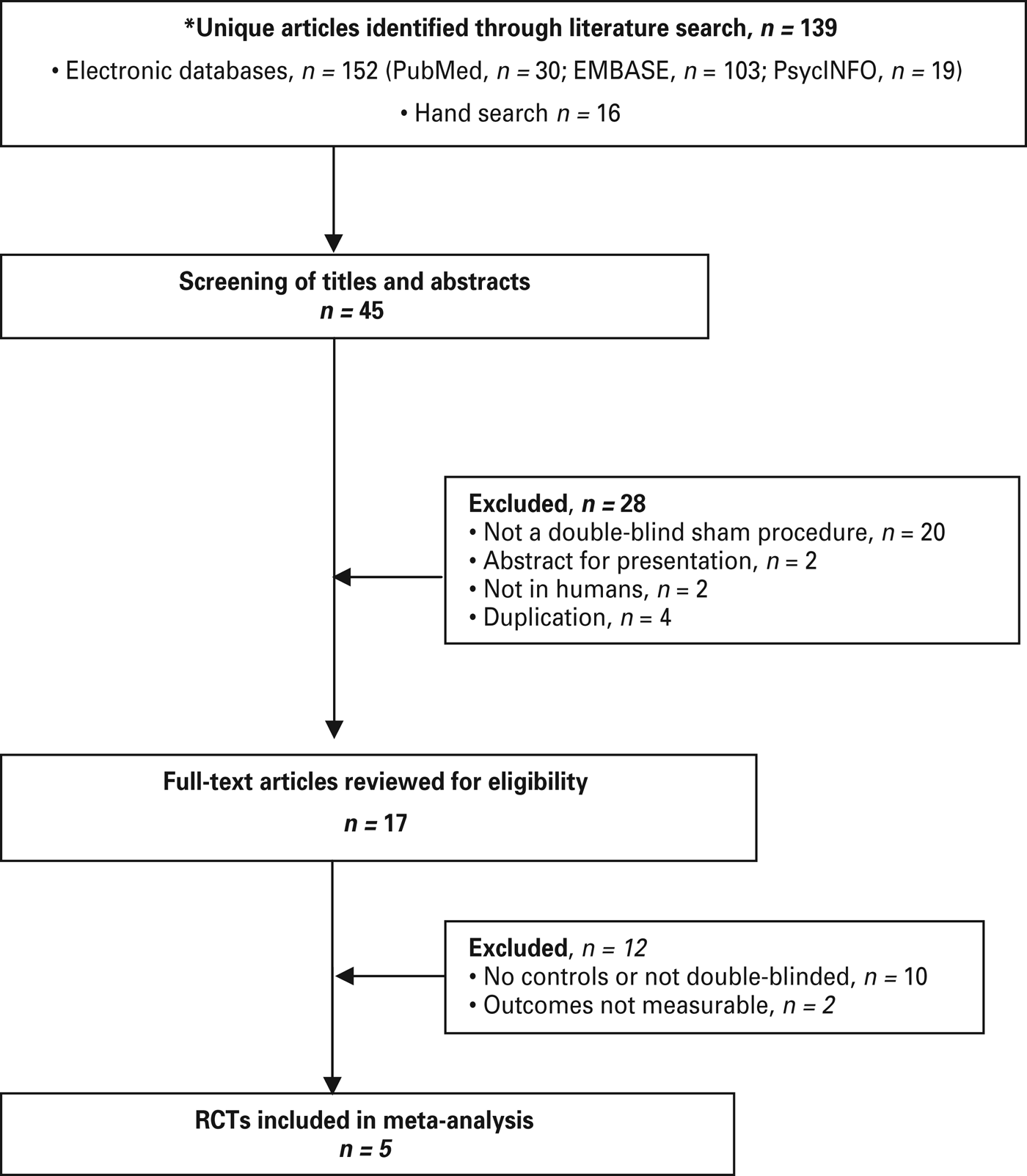
We found 139 studies of interest in the initial electronic searches, of which 45 abstracts were screened (Fig. 1). Of these, 17 full-text papers were potentially relevant and assessed for eligibility. In 10 of these, there were no controls, and in another two, data were not presented in a way that could be incorporated into a meta-analysis. One of the excluded studies (of major depression) reported the results of single-blind sham stimulation prior to, and following, active stimulation for 24 weeks (Holtzheimer et al. Reference Holtzheimer, Kelley, Gross, Filkowski, Garlow, Barrocas, Wint, Craighead, Kozarsky, Chismar, Moreines, Mewes, Posse, Gutman and Mayberg2012). Patients in the study were told that they were being randomized to receive either active stimulation or sham stimulation, but in fact all patients received sham stimulation. The five included studies were all of OCD (Nuttin et al. Reference Nuttin, Gabriels, Cosyns, Meyerson, Andreewitch, Sunaert, Maes, Dupont, Gybels, Gielen and Demeulemeester2003; Abelson et al. Reference Abelson, Curtis, Sagher, Albucher, Harrigan, Taylor, Martis and Giordani2005; Mallet et al. Reference Mallet, Polosan, Jaafari, Baup, Welter, Fontaine, du Montcel, Yelnik, Chereau, Arbus, Raoul, Aouizerate, Damier, Chabardes, Czernecki, Ardouin, Krebs, Bardinet, Chaynes, Burbaud, Cornu, Derost, Bougerol, Bataille, Mattei, Dormont, Devaux, Verin, Houeto, Pollak, Benabid, Agid, Krack, Millet and Pelissolo2008; Denys et al. Reference Denys, Mantione, Figee, van den Munckhof, Koerselman, Westenberg, Bosch and Schuurman2010; Goodman et al. Reference Goodman, Foote, Greenberg, Ricciuti, Bauer, Ward, Shapira, Wu, Hill, Rasmussen and Okun2010). In three of these studies the most common intervention site was the anterior limb of the internal capsule (Table 1) (Nuttin et al. Reference Nuttin, Gabriels, Cosyns, Meyerson, Andreewitch, Sunaert, Maes, Dupont, Gybels, Gielen and Demeulemeester2003; Abelson et al. Reference Abelson, Curtis, Sagher, Albucher, Harrigan, Taylor, Martis and Giordani2005; Goodman et al. Reference Goodman, Foote, Greenberg, Ricciuti, Bauer, Ward, Shapira, Wu, Hill, Rasmussen and Okun2010). In the other two, it was the nucleus accumbens (Denys et al. Reference Denys, Mantione, Figee, van den Munckhof, Koerselman, Westenberg, Bosch and Schuurman2010) or the subthalamic nucleus (Mallet et al. Reference Mallet, Polosan, Jaafari, Baup, Welter, Fontaine, du Montcel, Yelnik, Chereau, Arbus, Raoul, Aouizerate, Damier, Chabardes, Czernecki, Ardouin, Krebs, Bardinet, Chaynes, Burbaud, Cornu, Derost, Bougerol, Bataille, Mattei, Dormont, Devaux, Verin, Houeto, Pollak, Benabid, Agid, Krack, Millet and Pelissolo2008). Three were parallel trials (Mallet et al. Reference Mallet, Polosan, Jaafari, Baup, Welter, Fontaine, du Montcel, Yelnik, Chereau, Arbus, Raoul, Aouizerate, Damier, Chabardes, Czernecki, Ardouin, Krebs, Bardinet, Chaynes, Burbaud, Cornu, Derost, Bougerol, Bataille, Mattei, Dormont, Devaux, Verin, Houeto, Pollak, Benabid, Agid, Krack, Millet and Pelissolo2008; Denys et al. Reference Denys, Mantione, Figee, van den Munckhof, Koerselman, Westenberg, Bosch and Schuurman2010; Goodman et al. Reference Goodman, Foote, Greenberg, Ricciuti, Bauer, Ward, Shapira, Wu, Hill, Rasmussen and Okun2010), with or without cross-over phases, and the remainder were solely cross-over trials (Nuttin et al. Reference Nuttin, Gabriels, Cosyns, Meyerson, Andreewitch, Sunaert, Maes, Dupont, Gybels, Gielen and Demeulemeester2003; Abelson et al. Reference Abelson, Curtis, Sagher, Albucher, Harrigan, Taylor, Martis and Giordani2005). Four had a period of open treatment (Nuttin et al. Reference Nuttin, Gabriels, Cosyns, Meyerson, Andreewitch, Sunaert, Maes, Dupont, Gybels, Gielen and Demeulemeester2003; Abelson et al. Reference Abelson, Curtis, Sagher, Albucher, Harrigan, Taylor, Martis and Giordani2005; Mallet et al. Reference Mallet, Polosan, Jaafari, Baup, Welter, Fontaine, du Montcel, Yelnik, Chereau, Arbus, Raoul, Aouizerate, Damier, Chabardes, Czernecki, Ardouin, Krebs, Bardinet, Chaynes, Burbaud, Cornu, Derost, Bougerol, Bataille, Mattei, Dormont, Devaux, Verin, Houeto, Pollak, Benabid, Agid, Krack, Millet and Pelissolo2008; Denys et al. Reference Denys, Mantione, Figee, van den Munckhof, Koerselman, Westenberg, Bosch and Schuurman2010) where all subjects had active treatment followed by entry into the randomized sham-controlled phase. The duration of open treatment to randomization ranged from 3 days (Abelson et al. Reference Abelson, Curtis, Sagher, Albucher, Harrigan, Taylor, Martis and Giordani2005) to 8 months (Denys et al. Reference Denys, Mantione, Figee, van den Munckhof, Koerselman, Westenberg, Bosch and Schuurman2010). The allocation and staging or timing of active and sham treatment were determined by randomization in all the studies.
Characteristics of randomized controlled trials (RCTs) included in the meta-analysis

OCD, Obsessive–compulsive disorder; YBOCS, Yale–Brown Obsessive Compulsive Scale; GAF, Global Assessment of Functioning; CGI, Clinical Global Impression; CGS, Clinical Global Severity; DBS, deep brain stimulation; s.d., standard deviation.
Two studies used an adequate method to generate the random allocation sequence, including allocation concealment (Mallet et al. Reference Mallet, Polosan, Jaafari, Baup, Welter, Fontaine, du Montcel, Yelnik, Chereau, Arbus, Raoul, Aouizerate, Damier, Chabardes, Czernecki, Ardouin, Krebs, Bardinet, Chaynes, Burbaud, Cornu, Derost, Bougerol, Bataille, Mattei, Dormont, Devaux, Verin, Houeto, Pollak, Benabid, Agid, Krack, Millet and Pelissolo2008; Denys et al. Reference Denys, Mantione, Figee, van den Munckhof, Koerselman, Westenberg, Bosch and Schuurman2010); in all studies assessors were blind to the treatment condition; there was no loss to follow-up after randomization and ITT analyses were reported for at least some of the outcomes in all of the studies. However, only one study reported all outcomes following randomization (Mallet et al. Reference Mallet, Polosan, Jaafari, Baup, Welter, Fontaine, du Montcel, Yelnik, Chereau, Arbus, Raoul, Aouizerate, Damier, Chabardes, Czernecki, Ardouin, Krebs, Bardinet, Chaynes, Burbaud, Cornu, Derost, Bougerol, Bataille, Mattei, Dormont, Devaux, Verin, Houeto, Pollak, Benabid, Agid, Krack, Millet and Pelissolo2008). Accordingly, this was the only study to meet all four of the quality criteria.
Table 1 summarizes the characteristics of the five included studies that provided data for a total of 50 patients with OCD. Of these, 44 subjects provided data for the meta-analysis. The remainder dropped out for a variety of reasons. The duration of treatment from initial randomization ranged from 2 to 12 weeks. All of the included studies used the YBOCS score as the primary outcome measure. The scale is a clinician-rated, 10-item scale, in which each item is rated from 0 (no symptoms) to 4 (extreme symptoms), yielding a total possible score range from 0 to 40. Full treatment response is generally considered to be a reduction of at least 35% of the YBOCS score whereas partial response is defined as a 25–35% reduction in score. One study also compared the proportion of patients following active and sham treatment as a dichotomous variable (Mallet et al. Reference Mallet, Polosan, Jaafari, Baup, Welter, Fontaine, du Montcel, Yelnik, Chereau, Arbus, Raoul, Aouizerate, Damier, Chabardes, Czernecki, Ardouin, Krebs, Bardinet, Chaynes, Burbaud, Cornu, Derost, Bougerol, Bataille, Mattei, Dormont, Devaux, Verin, Houeto, Pollak, Benabid, Agid, Krack, Millet and Pelissolo2008).
With regard to other outcomes, two studies also reported scores from the HAMD that we were able to incorporate into a meta-analysis (Abelson et al. Reference Abelson, Curtis, Sagher, Albucher, Harrigan, Taylor, Martis and Giordani2005; Denys et al. Reference Denys, Mantione, Figee, van den Munckhof, Koerselman, Westenberg, Bosch and Schuurman2010). As all the studies used the same outcome measure for either OCD or depressive symptoms, we calculated (unstandardized) MDs for each outcome. Lastly, two studies reported the results of anxiety scales, the Hamilton Rating Scale for Anxiety (HAMA; Denys et al. Reference Denys, Mantione, Figee, van den Munckhof, Koerselman, Westenberg, Bosch and Schuurman2010) and the Brief Anxiety Scale (BAS; Mallet et al. Reference Mallet, Polosan, Jaafari, Baup, Welter, Fontaine, du Montcel, Yelnik, Chereau, Arbus, Raoul, Aouizerate, Damier, Chabardes, Czernecki, Ardouin, Krebs, Bardinet, Chaynes, Burbaud, Cornu, Derost, Bougerol, Bataille, Mattei, Dormont, Devaux, Verin, Houeto, Pollak, Benabid, Agid, Krack, Millet and Pelissolo2008). We combined these results using SMDs.
Obsessive–compulsive symptoms (YBOCS scores)
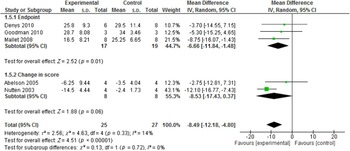
The average YBOCS score at baseline across the five studies was 31.98 (s.d. = 4.47). Two studies presented separate data for the first and second study periods (Mallet et al. Reference Mallet, Polosan, Jaafari, Baup, Welter, Fontaine, du Montcel, Yelnik, Chereau, Arbus, Raoul, Aouizerate, Damier, Chabardes, Czernecki, Ardouin, Krebs, Bardinet, Chaynes, Burbaud, Cornu, Derost, Bougerol, Bataille, Mattei, Dormont, Devaux, Verin, Houeto, Pollak, Benabid, Agid, Krack, Millet and Pelissolo2008; Denys et al. Reference Denys, Mantione, Figee, van den Munckhof, Koerselman, Westenberg, Bosch and Schuurman2010) and we used the data from the first study period for our primary analysis (Fig. 2). This showed a statistically significant mean reduction in score of 8.49. We also found similar results when we used data from the second phase of the same trials instead (Mallet et al. Reference Mallet, Polosan, Jaafari, Baup, Welter, Fontaine, du Montcel, Yelnik, Chereau, Arbus, Raoul, Aouizerate, Damier, Chabardes, Czernecki, Ardouin, Krebs, Bardinet, Chaynes, Burbaud, Cornu, Derost, Bougerol, Bataille, Mattei, Dormont, Devaux, Verin, Houeto, Pollak, Benabid, Agid, Krack, Millet and Pelissolo2008; Denys et al. Reference Denys, Mantione, Figee, van den Munckhof, Koerselman, Westenberg, Bosch and Schuurman2010) [MD −9.05, 95% confidence interval (CI) −12.65 to −5.45, p < 0.001]. Restricting the analyses to the three parallel-group RCTs with end-point data gave similar results (Fig. 2).
Selection of double-blind, parallel and cross-over group, placebo-controlled randomized controlled trials (RCTs) for inclusion in the systematic review and meta-analysis.

Obsessive symptoms: Yale–Brown Obsessive Compulsive Scale (YBOCS) total scores. CI, Confidence interval; s.d., standard deviation; df, degrees of freedom.

Because of the small number of studies, we were only able to undertake subgroup analyses of the effect of the operation site for one procedure: the anterior limb of the internal capsule. This showed similar results to the overall meta-analyses (MD −8.13, 95% CI −14.24 to −2.02, p = 0.009). No other sensitivity analyses were possible because of the small number of studies.
Only one study reported the randomized results of clinically significant improvement on the YBOCS as a clinically significant dichotomous variable. At the end of the first phase, six out of eight patients (75%) had at least a partial response as shown by a 25% reduction in the YBOCS score, compared with only three of eight (38%) after sham stimulation. However, this did not reach statistical significance (RR 2.0, 95% CI 0.75–5.33).
Depression and anxiety in patients with OCD
Two studies reported outcomes using the HAMD (Abelson et al. Reference Abelson, Curtis, Sagher, Albucher, Harrigan, Taylor, Martis and Giordani2005; Denys et al. Reference Denys, Mantione, Figee, van den Munckhof, Koerselman, Westenberg, Bosch and Schuurman2010). There was no statistically significant difference between active and sham treatments (MD −7.69, 95% CI −16.29 to 0.90, p = 0.08). Another two studies reported symptoms of anxiety using the HAMA and BAS (Mallet et al. Reference Mallet, Polosan, Jaafari, Baup, Welter, Fontaine, du Montcel, Yelnik, Chereau, Arbus, Raoul, Aouizerate, Damier, Chabardes, Czernecki, Ardouin, Krebs, Bardinet, Chaynes, Burbaud, Cornu, Derost, Bougerol, Bataille, Mattei, Dormont, Devaux, Verin, Houeto, Pollak, Benabid, Agid, Krack, Millet and Pelissolo2008; Denys et al. Reference Denys, Mantione, Figee, van den Munckhof, Koerselman, Westenberg, Bosch and Schuurman2010). As both were parallel-group trials, it was appropriate to calculate the SMD, which, as for depression, was not significant (SMD −0.67, 95% CI −1.43 to 0.10, p = 0.09).
Other therapeutic effects
Two studies reported global measures of outcome such as the Global Assessment of Functioning (GAF) and Clinical Global Impression (CGI) (Nuttin et al. Reference Nuttin, Gabriels, Cosyns, Meyerson, Andreewitch, Sunaert, Maes, Dupont, Gybels, Gielen and Demeulemeester2003; Mallet et al. Reference Mallet, Polosan, Jaafari, Baup, Welter, Fontaine, du Montcel, Yelnik, Chereau, Arbus, Raoul, Aouizerate, Damier, Chabardes, Czernecki, Ardouin, Krebs, Bardinet, Chaynes, Burbaud, Cornu, Derost, Bougerol, Bataille, Mattei, Dormont, Devaux, Verin, Houeto, Pollak, Benabid, Agid, Krack, Millet and Pelissolo2008). Although we could not combine the data, patients on active treatment showed significantly greater improvement than those on sham treatment. Mallet et al. (Reference Mallet, Polosan, Jaafari, Baup, Welter, Fontaine, du Montcel, Yelnik, Chereau, Arbus, Raoul, Aouizerate, Damier, Chabardes, Czernecki, Ardouin, Krebs, Bardinet, Chaynes, Burbaud, Cornu, Derost, Bougerol, Bataille, Mattei, Dormont, Devaux, Verin, Houeto, Pollak, Benabid, Agid, Krack, Millet and Pelissolo2008) also compared active and sham treatment groups using the Montgomery–Åsberg Depression Rating Scale (MADRS) and the Social Disability Schedule (SDS), but found no difference in outcome.
Adverse events
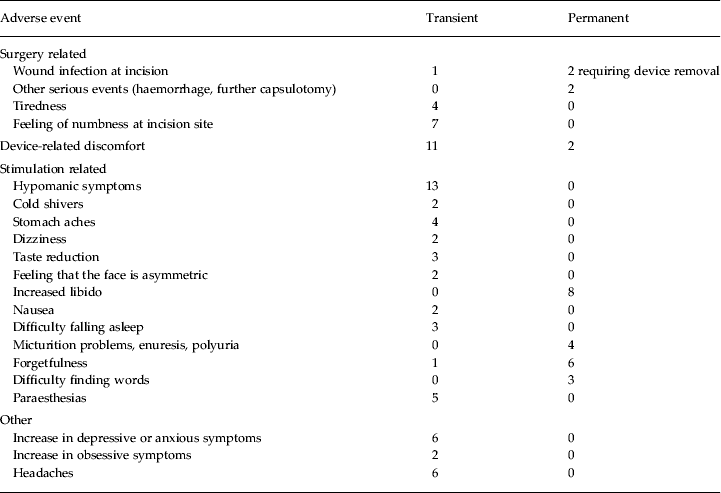
Table 2 illustrates the main adverse events, defined as any adverse effect that was reported more than once. Of these, 16 were classed by study authors as serious. The most serious of these were one intracerebral haemorrhage and two infections requiring removal of the electrode (Mallet et al. Reference Mallet, Polosan, Jaafari, Baup, Welter, Fontaine, du Montcel, Yelnik, Chereau, Arbus, Raoul, Aouizerate, Damier, Chabardes, Czernecki, Ardouin, Krebs, Bardinet, Chaynes, Burbaud, Cornu, Derost, Bougerol, Bataille, Mattei, Dormont, Devaux, Verin, Houeto, Pollak, Benabid, Agid, Krack, Millet and Pelissolo2008). A further patient required a capsulotomy because the electrical stimulation consumed so much energy (Nuttin et al. Reference Nuttin, Gabriels, Cosyns, Meyerson, Andreewitch, Sunaert, Maes, Dupont, Gybels, Gielen and Demeulemeester2003). Other adverse events were divided into those related to the surgical procedure and those secondary to stimulation, and in a third group it was difficult to assign the exact cause (Table 2). These in turn were divided into permanent and transient. Most side-effects were transient and related to the stimulation. These included hypomania, anxiety, paraesthesias, dyskinesias, impulsivity, facial asymmetry, dysarthria, dysphagia and walking difficulties.
Main adverse effects

In terms of cognition, some patients reported mild forgetfulness and word-finding problems but formal neuropsychological tests showed no consistent patterns of change in performance scores with stimulation across subjects (Mallet et al. Reference Mallet, Polosan, Jaafari, Baup, Welter, Fontaine, du Montcel, Yelnik, Chereau, Arbus, Raoul, Aouizerate, Damier, Chabardes, Czernecki, Ardouin, Krebs, Bardinet, Chaynes, Burbaud, Cornu, Derost, Bougerol, Bataille, Mattei, Dormont, Devaux, Verin, Houeto, Pollak, Benabid, Agid, Krack, Millet and Pelissolo2008; Denys et al. Reference Denys, Mantione, Figee, van den Munckhof, Koerselman, Westenberg, Bosch and Schuurman2010).
Publication bias
We were unable to test for publication bias as there were insufficient studies for any of the outcomes.
Discussion
There have been previous meta-analyses of the effect of DBS on disorders such as Parkinson's disease (Kleiner-Fisman et al. Reference Kleiner-Fisman, Herzog, Fisman, Tamma, Lyons, Pahwa, Lang and Deuschl2006), dystonia (Holloway et al. Reference Holloway, Baron, Brown, Cifu, Carne and Ramakrishnan2006) and chronic pain (Bittar et al. Reference Bittar, Kar-Purkayastha, Owen, Bear, Green, Wang and Aziz2005). This is the first meta-analysis of the procedure in psychiatric conditions. By combining the effects of small and possibly underpowered studies, such an approach can help to establish the true efficacy of an intervention such as DBS, where large studies may be impractical. In addition, given the logistical and ethical difficulties of undertaking RCTs in this area, it is important to maximize the use of existing RCT evidence. The controversy that surrounds DBS in some quarters makes it all the more important to establish a firm evidence base for the procedure. Although we were only able to combine results from five studies on OCD, we did demonstrate a statistically significant mean reduction in the YBOCS score of around 9. However, this finding has to be tempered by the fact that, in terms of clinical significance, this represents partial, rather than full, remission. The patients included in these studies all had severe treatment-resistant OCD and these results may therefore not be generalizable to patients with mild to moderate symptoms even if this were ever contemplated. In addition, there were no significant effects on co-morbid depression and anxiety in the small number of studies where this was measured.
Furthermore, the procedure was associated with significant adverse effects. Although many events were transient, in over a third of patients (16 out of a total of 44 patients included in the studies) they were classed by study authors as serious. In 15 patients, adverse effects were permanent, irrespective of whether these were minor or significant.
One area of concern when DBS has been applied to Parkinson's disease has been a post-operative decline in cognitive function including verbal learning and memory (Parsons et al. Reference Parsons, Rogers, Braaten, Woods and Tröster2006). We were unable to demonstrate a similar effect in performance scores with stimulation across subjects with OCD, but this may have been due to the small study numbers, especially as we could not combine these results in a meta-analysis (Mallet et al. Reference Mallet, Polosan, Jaafari, Baup, Welter, Fontaine, du Montcel, Yelnik, Chereau, Arbus, Raoul, Aouizerate, Damier, Chabardes, Czernecki, Ardouin, Krebs, Bardinet, Chaynes, Burbaud, Cornu, Derost, Bougerol, Bataille, Mattei, Dormont, Devaux, Verin, Houeto, Pollak, Benabid, Agid, Krack, Millet and Pelissolo2008; Denys et al. Reference Denys, Mantione, Figee, van den Munckhof, Koerselman, Westenberg, Bosch and Schuurman2010).
There are several limitations to this study. The most obvious is that we were only able to find and combine data from studies on OCD and were not able to include other conditions such as major depression or anorexia nervosa. Although all the included studies were described as being double-blinded, it is possible that patients may have been aware of their treatment allocation as many report that they can feel the stimulation. Support for this concern comes from the frequency of adverse side-effects by patients on active treatment. There was no loss to follow-up after randomization in any of the studies. However, in several trials, not all patients were included in the randomized phase because of participant refusal, or for clinical reasons (Table 1). This may limit the generalizability of the findings. Some of the cross-over studies did not specify whether the results came from the first or subsequent phases of the study (Nuttin et al. Reference Nuttin, Gabriels, Cosyns, Meyerson, Andreewitch, Sunaert, Maes, Dupont, Gybels, Gielen and Demeulemeester2003; Abelson et al. Reference Abelson, Curtis, Sagher, Albucher, Harrigan, Taylor, Martis and Giordani2005). However, we found similar results when we restricted analyses to the first phase of parallel-group RCTs with a cross-over design, where this was not an issue (Mallet et al. Reference Mallet, Polosan, Jaafari, Baup, Welter, Fontaine, du Montcel, Yelnik, Chereau, Arbus, Raoul, Aouizerate, Damier, Chabardes, Czernecki, Ardouin, Krebs, Bardinet, Chaynes, Burbaud, Cornu, Derost, Bougerol, Bataille, Mattei, Dormont, Devaux, Verin, Houeto, Pollak, Benabid, Agid, Krack, Millet and Pelissolo2008; Denys et al. Reference Denys, Mantione, Figee, van den Munckhof, Koerselman, Westenberg, Bosch and Schuurman2010; Goodman et al. Reference Goodman, Foote, Greenberg, Ricciuti, Bauer, Ward, Shapira, Wu, Hill, Rasmussen and Okun2010). In addition, sensitivity analyses of the effect of substituting second-phase results for those of the first phase, when these were available, made no difference to the results. There were insufficient studies to investigate the effect of different intervention sites. Several studies reported the proportion of responders after treatment but only one compared the response rates between active and sham treatment (Mallet et al. Reference Mallet, Polosan, Jaafari, Baup, Welter, Fontaine, du Montcel, Yelnik, Chereau, Arbus, Raoul, Aouizerate, Damier, Chabardes, Czernecki, Ardouin, Krebs, Bardinet, Chaynes, Burbaud, Cornu, Derost, Bougerol, Bataille, Mattei, Dormont, Devaux, Verin, Houeto, Pollak, Benabid, Agid, Krack, Millet and Pelissolo2008). This gave a non-significant result although it is possible that this may be explained by the small number of subjects. The limited data on co-morbid depression and anxiety in people with OCD may have meant our meta-analyses were also underpowered to detect a significant difference between sham and active treatments for these outcomes. Finally, DBS has probably been performed in many more patients than the numbers reported to date, with the consequent additional possibility of reporting bias.
In conclusion, DBS may show promise for severe treatment-resistant OCD but there are insufficient randomized controlled data in the case of other psychiatric conditions. Even in the case of OCD, the risks and burdens of the procedure are finely balanced with the perceived benefits. In addition, not all participants consented to randomization, thereby potentially limiting the generalizability of any benefit. This intervention should therefore be considered as an experimental treatment in adults for severe, medically refractory conditions (Kringelbach & Aziz, Reference Kringelbach and Aziz2009). Further research is indicated with respect to psychiatric conditions other than OCD, along with research on patient selection and management, target location and mechanisms of action (de Koning et al. Reference de Koning, Figee, van den Munckhof, Schuurman and Denys2011). This should include double-blind trials with a longer sham stimulation period, the determination of demographic and clinical predictors of response and remission, and the role of adjunctive medication and psychotherapies in improving recovery (Holtzheimer et al. Reference Holtzheimer, Kelley, Gross, Filkowski, Garlow, Barrocas, Wint, Craighead, Kozarsky, Chismar, Moreines, Mewes, Posse, Gutman and Mayberg2012).
Declaration of Interest
None.