INTRODUCTION
Among the most vibrant issues for the boardrooms of listed companies in Malaysia are board structure and the characteristics of members of the board of directors (BODs) including gender, racial, ethnicity, cognitive skills and cultural values. Corporate boards of listed companies are facing the dilemma of the imbalanced distributions of factors such as the demographic backgrounds and the social values of their directors. One reason for concern is because a balanced distribution of board members of a firm seems to lead to better performance in terms of profits. Corporate boardrooms are considered balanced if board members originate from different backgrounds, experience and training, which helps a firm perform more proficiently. Evolving political, cultural and societal views of corporate directors are part of cognitive and demographic diversity. Globally, companies have a universal desire for better corporate governance and higher firm performance (Monks & Minow, Reference Monks and Minow2004).
Historically speaking, firms have faced heavy losses due to high-profile scandals like those of Enron in 2001, and Worldcom and Adelphia in 2002 and the worldwide economic meltdown of 2007–2008. As a result, many major companies were shuttered, and numerous policy-makers and the government have been investigating corporate governance among listed companies (Co-Operation, O. F. E., & Development, 2004).
In the past, the Malaysian economy also had been severely impacted, including the financial crisis of 1997, the Perwaja Steel and the Technology Resources Industries Berhad (TRI) scandals of 2002, and the Transmile and the Megan Media scandals of 2007. A major cause of these corporate catastrophes was the poor practices of corporate governance among the listed companies (Mitton, Reference Mitton2002).
Organisational diversity and corporate governance have a strong connection in the context of top-level management. That is because the BODs provides leadership for firms and is accountable for making strategic decisions and setting strategic goals that enhance firm performance. Diverse corporate boards may monitor top management teams and managers in a better and more holistic way, and corporate board diversity has been found to increase board independence in listed organisations (Carter, Simkins, & Simpson, Reference Carter, Simkins and Simpson2003). Consequently, diversified corporate boards can have a significant impact on firm value creation and firm financial performance. Therefore, in turn, wealth is maximised, and this increases the confidence of stakeholders. Based on the findings of Erhardt, Werbel, and Shrader (Reference Erhardt, Werbel and Shrader2003), developing a solid theoretical framework for diversity among board members is essential and will help companies to understand the positive outcomes of diversity and organisational performance.
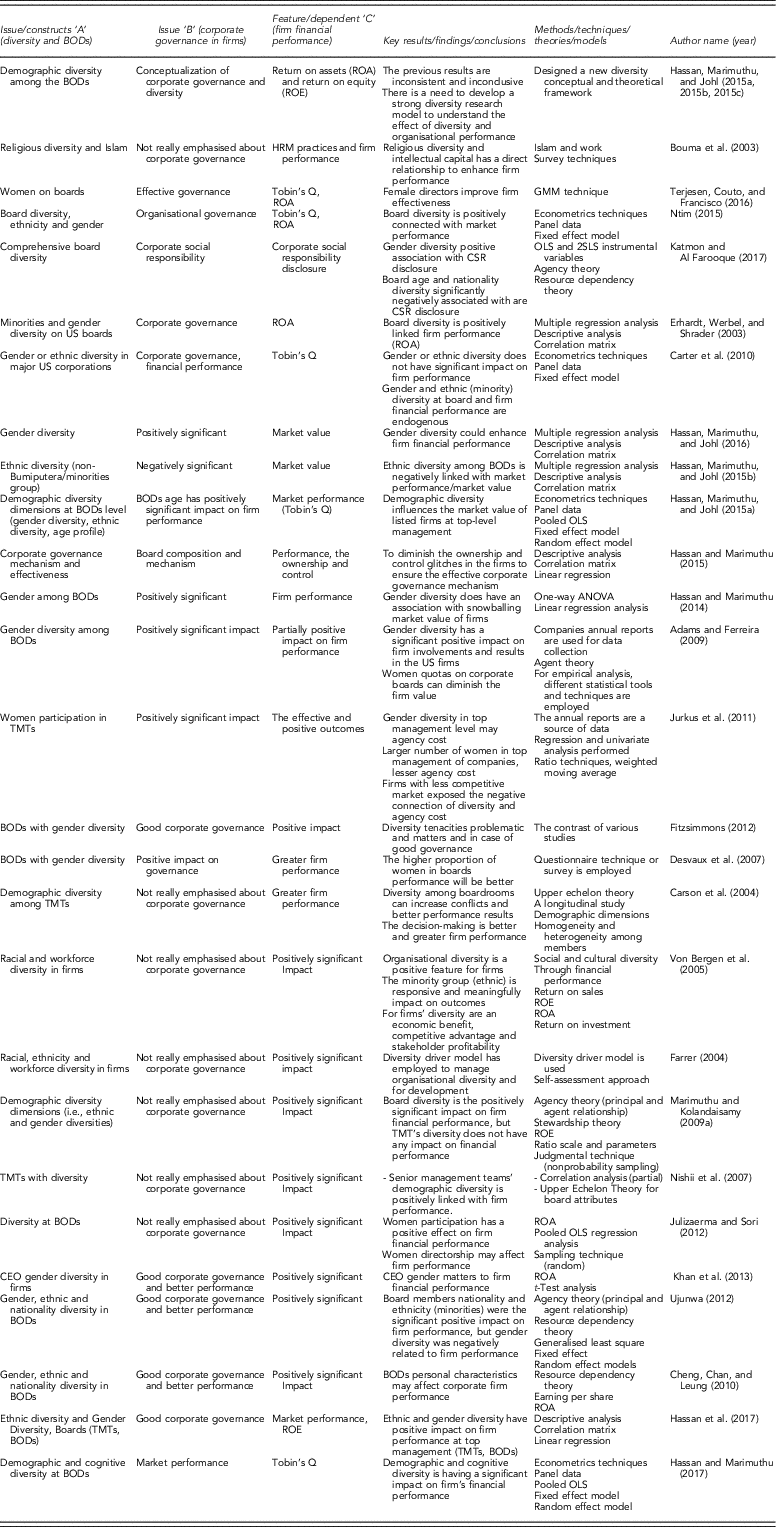
Several scholars have studied the impact of demographic diversity on firm financial performance, examining factors such as gender. The results have been mixed. Hassan and Marimuthu (Reference Hassan and Marimuthu2014, Reference Hassan and Marimuthu2016) found a positive and significant impact for women’s participation on the board and firm performance, but other researchers have pointed out that gender diversity among the BODs could result in bad financial performance of firms (Adams & Ferreira, Reference Adams and Ferreira2009). Still, others have found that women’s participation at the board level did not have any significant impact on firm performance as measured by Tobin’s Q (Smith, Smith, & Verner, Reference Smith, Smith and Verner2006; Rose, Reference Rose2007; Adams & Ferreira, Reference Adams and Ferreira2009; Nguyen, Locke, & Reddy, Reference Nguyen, Locke and Reddy2015; Hassan, Marimuthu, & Johl, Reference Hassan, Marimuthu and Johl2016; Hassan, Marimuthu, Tariq, & Aqeel, Reference Hassan, Marimuthu, Tariq and Aqeel2017).
Islam is another element of board diversity that should be considered in the context of Malaysia. Often, Islam is seen as a monolithic religion, and, in management literature, the debate and an investigation about internal diversity within Islam or heterogeneity are either rarely studied or totally ignored, which means that religious practices or sects and beliefs such as Sunni and Shia are not studied. However, according to Moghadam (Reference Moghadam1994) and Warde (Reference Warde2000), internal diversity does exist within Islam and various different explanations, backgrounds, opinions of scholars and different schools of thoughts in Islam outline these. This diversity is embodied in various school of thoughts about veil/hijab practices for women, the Islamic banking system, trade, business laws, Islamic taxes, Muslim leadership and religious ethnic groups. Given these factors, a need exists to design research to study internal diversity present within Islamic perspectives and at different organisational levels (Härtel & O’Connor, Reference Härtel and O’Connor2014). Thus, this current study contextualises Islamic diversity among top-level management (BODs), which is often ignored and less explored in previous studies.
Several reasons exist for the need for additional study. One is that ambiguity and inconclusive results are present amongst earlier studies regarding diversity issues at the corporate board level (Hassan & Marimuthu, Reference Hassan and Marimuthu2016; Hassan, Marimuthu, & Johl, 2015c, Reference Hassan, Marimuthu, Tariq and Aqeel2017). A second is that the cognitive diversity of BODs, that is, educational, tenure diversity and experience diversity, is rarely discussed or debated (Hassan, Marimuthu, & Johl, 2015c). A third is that past studies have employed simple techniques and statistical tools to investigate the corporate board diversity issue. Several researchers have proposed that it is essential to examine the board diversity issue more holistically by employing different sample sizes and sampling techniques (Hassan, Marimuthu, & Johl, Reference Hassan, Marimuthu and Johl2015c).
Empirical studies have confirmed a strong association between demographic, cognitive diversity and firm financial performance (Hassan, Marimuthu, & Johl, Reference Hassan, Marimuthu and Johl2016). Furthermore, many researchers have been keenly interested in investigating the relationship between demographic and cognitive diversity at the board level and firm financial performance.
This study examines diversity dimensions at the top-level management (BODs) of large companies and firm performance utilising Tobin’s Q, return on assets (ROA), and return on equity (ROE). Additionally, this study seeks to fill research gaps in diversity literature associated with the BODs and is unique in nature because it investigates demographic, cognitive diversity, internal diversity within Islam with a variety of diversity dimensions using three performance indicators simultaneously (Tobin’s Q, ROA and ROE).
The purpose of this study is fourfold. First, this study investigates the effects of demographic diversity dimensions (gender diversity, ethnic diversity, age profile and foreign participation) at the top-level management (BODs) on firm financial performance. Second, this study investigates the effect of cognitive diversity dimensions (educational diversity, experience diversity and tenure diversity) at the top level of management (BODs) on firm financial performance. Third, this study investigates empirically diverse corporate boards with the interaction approach and its impact on the firm financial performance. Finally, this study investigates the effect of internal Islamic diversity dimensions (Islamic gender diversity, Islamic age diversity and Islamic ethnic diversity) at the top level of management (BODs) on firm financial performance.
This study employs only companies listed on the Bursa Malaysia to retain a aspect of homogeneity, as Malaysia is considered a highly diverse country (Marimuthu & Kolandaisamy, Reference Marimuthu and Kolandaisamy2009a). This empirical research contributes to the existing literature in several ways including an interactive approach, a comprehensive diversity effect and internal diversity within Islam. First, this study shows cognitive diversity at the board level and its impacts on firm financial performance. Second, this study employs an interaction approach to investigate diversity issues more holistically. Third, this study employs a combination of different perspectives, which are not well explored in the literature. Fourth, this study extends previous research, mainly focusing on the participation of women on corporate boards from the perspective of Muslim versus non-Muslim women. Finally, this study is unique with respect to comprehensive diversity constructs and the use of three financial performance indicators simultaneously (Tobin’s Q, ROA and ROE).
The findings with respect to the demographic, cognitive and internal diversity within Islam among board members regarding firm financial performance had both positive and negative significant results. Similarly, the interaction among independent constructs was strongly positive and significant with respect firm financial performance. More importantly, when foreign participation diversity interacted with gender diversity, this interaction had a significant and positive impact on firm performance. To conclude, foreign participants on the board can improve internal operations and perhaps enhance the profits of their companies. Thus, the combination of women and foreigners on a board can produce better performance for listed companies. In the same way, Islamic gender diversity and Islamic ethnic diversity had a positive impact on firm performance. Overall, the more diversified a board was, the higher the firm performance was.
The outline of the paper is as followings. Second section covers the state-of-art for the literature and hypothesis development. Next, third and fourth sections focus on the empirical design and empirical results. In fifth section, a concise discussion based on the findings is presented. Finally, the concluding remarks are listed in sixth section.
THEORETICAL BACKGROUND AND HYPOTHESIS DEVELOPMENT
This study investigates the relationship among the demographic diversity, cognitive diversity, internal diversity within Islam of members of the BODs and firm performance by drawing on the upper echelons theory. The upper echelons theory posits that the demographic characteristics of the top management influence organisational outcomes (Hambrick & Mason, Reference Hambrick and Mason1984), which include firm performance. Hambrick and Mason (Reference Hambrick and Mason1984) argued that firm performance is based on the demographic and cognitive composition of boards because such characteristics serve as surrogates for their cognitive orientations, perceptions, knowledge and skill bases that affect firm performance. Another essential point is that organisations must see the impact of top-level management diversity and firm value in this dynamic environment. Corporate boards may comprise different members with different attributes and backgrounds, for example, ethnicity, age, sexual orientation, majority groups, gender, nationality, minority groups, Muslim women, non-Muslim women and cognitive attributes, which may add value to help achieve success for companies. Board diversity and firm performance have a strong association. Diversity in an organisation could lead to a competitive advantage for a company, and diverse corporate boards have been positively linked with market value in some studies (Lückerath-Rovers & De Bos, Reference Lückerath-Rovers and De Bos2011; Abdullah, Reference Abdullah2014; Ntim, Reference Ntim2015).
No specific theory predicts the nature of the relationship between corporate board diversity and firm financial performance (Harrison & Klein, Reference Harrison and Klein2007). In this investigation, distinctive social theories from different perspectives are discussed. Agency theory identifies the board functions of monitoring and controlling managers. When these two parties have differing goals, this difference creates an ‘agency problem’ in the organisation. The principal and agent relationship is defined as an agreement whereby the principal engages an agent in duties performed for the principal. Furthermore, board composition is essential for monitoring the agency relationship, and the agency relationship plays a dominant role in firm performance (Jensen & Meckling, Reference Jensen and Meckling1976a).
The upper echelons theory depends on behavioural decision-making theories and ideas of organisational demography. In a dynamic environment, the diversity of corporate boards can be used to achieve organisational outcomes, for example, firm financial performance and strategic accomplishments. The upper echelon theory examines the impact of demographic and cognitive diversity in the context of firm financial performance. Researchers have expressed the opinion that diversified boards can make more effective decisions as compared to homogenous boards (Hambrick & Mason, Reference Hambrick and Mason1984). The central theme is that if companies begin increasing the diversity of top management teams, then firms may attract and retain diverse and talented teams and take advantage of them to achieve a competitive edge (Gelfeld, Nishii, Raver, & Schneider, Reference Gelfeld, Nishii, Raver and Schneider2007).
This study emphasises the characteristics of board members and their effects on firm performance; hence, the upper echelon theory is focussed on. In brief, board diversity increases board independence, and, for that reason, diverse corporate boards provide better monitoring of managers and top management teams. In contrast, the agency theory does not envisage a vibrant association between board diversity and firm financial performance (Carter, Simkins, & Simpson, Reference Carter, Simkins and Simpson2003). More comprehensive findings, discussions and research focussing on board diversity are referred to in Appendix A.
Gender diversity and firm performance
The upper echelon theory suggests that top-level management (board members characteristics) has an impact on firm performance (Hambrick & Mason, Reference Hambrick and Mason1984). Indeed, prior literature has shown a real association between demographic, cognitive diversity in the boardroom and its impact on firm financial performance (Hassan & Marimuthu, Reference Hassan and Marimuthu2014; Al-Musali & Ku Ismail, Reference Al-Musali and Ku Ismail2015; Hassan, Marimuthu, & Johl, Reference Hassan, Marimuthu and Johl2015c, Reference Hassan, Marimuthu and Johl2016). Importantly, gender diversity remains a problem in the corporate world and the literature. In the past, numerous studies have shown that gender diversity is associated with firm financial performance positively. Boards with gender diversity have more been shown to offer more alternatives for supporting their decisions, a finding that Hassan and Marimuthu (Reference Hassan and Marimuthu2017) and Singh and Vinnicombe (Reference Singh and Vinnicombe2004) strongly support. Additionally, gender diverse boards have been shown to improve company image, to affect customer perceptions positively and to lead to better firm performance. Additionally, a more gender diverse group of possible candidates for the board may prompt an expansion in quality (Smith, Smith, & Verner, Reference Smith, Smith and Verner2006).
Agency and resource dependency theories posit that having the participation of women on boards is valuable because women exhibit more diverse behaviour than their male counterparts and can change the conduct of the entire board. Moreover, women may provide better monitoring and advisory services (Ismail, Abdullah, & Nachum, Reference Ismail, Abdullah and Nachum2013; Hassan and Marimuthu, Reference Hassan and Marimuthu2017). Besides, women on boards may lead to a superior reputation for an organisation (Lückerath-Rovers & De Bos, Reference Lückerath-Rovers and De Bos2011). Adams and Ferreira (Reference Adams and Ferreira2009) pointed out that the more prominent the gender diversity on a board, the higher a firm’s financial performance.
To elaborate, having gender diversity at the board level may enhance firm performance (Adams & Ferreira, Reference Adams and Ferreira2009; Nguyen, Locke, & Reddy, Reference Nguyen, Locke and Reddy2015; Hassan, Marimuthu, & Johl, Reference Hassan, Marimuthu and Johl2016; Hassan and Marimuthu, Reference Hassan and Marimuthu2017). Ismail, Abdullah, and Nachum (Reference Ismail, Abdullah and Nachum2013) and Terjesen, Couto, and Francisco (Reference Terjesen, Couto and Francisco2016) stated that the presence of women on corporate boards has a positive and significant association as measured by ROA. Lückerath-Rovers and De Bos (Reference Lückerath-Rovers and De Bos2011) demonstrated that organisations with women on the board performed better in terms of ROE than firms without women on their boards in the Netherlands. In a study of Fortune 500 firms, Carter, Simkins, and Simpson (Reference Carter, Simkins and Simpson2003) found that having women on the corporate board has a significant and positive impact on firm performance. Based on the critical discussion, the following hypotheses ware developed:
Hypothesis 1a: Corporate boards in the form of gender diversity (Muslim and non-Muslim women) will have a significant and positive impact on firm financial performance (Tobin’s Q).
Hypothesis 1b: Corporate boards in the form of gender diversity (Muslim and non-Muslim women) will have a significant and positive impact on firm financial performance (ROA).
Hypothesis 1c: Corporate boards in the form of gender diversity (Muslim and non-Muslim women) will have a significant and positive impact on firm financial performance (ROE).
Ethnic diversity, ethnic women and firm performance
According to Yusoff (Reference Yusoff2010), any organisation adopting diversity on its board will enhance the process of decision-making and policy development. However, the result of prior research studies associated with the relationship between ethnic diversity on boards and firm financial performance have been mixed. In some studies, ethnic women and minorities have been seen as more effective decision-makers on the BODs (Erhardt, Werbel, & Shrader, Reference Erhardt, Werbel and Shrader2003). Conversely, some studies have determined that ethnic diversity had no significant impact on organisational performance. For example, Carter, D’Souza, Simkins, and Simpson (Reference Carter, D’Souza, Simkins and Simpson2010) found this in the case of major US corporations. Several studies have found the same in Malaysia. For example, Ismail, Abdullah, and Nachum (Reference Ismail, Abdullah and Nachum2013) and Shukeri, Shin, and Shaari (Reference Shukeri, Shin and Shaari2012) found that ethnic diversity had no impact on firm financial performance in the Malaysian context. Malaysia is being considered as diverse with respect to religious convictions, traditions, ceremonies and languages because Malaysia has three primary ethnic groups including Bumiputera Malay, Chinese and Indians.
However, board members with different ethnic backgrounds can express ideas rationally and with clarity, which adds value to firms. In the same way, ethnic boards must act productively and originally to maintain a positive association with the stakeholders of the company (Marimuthu & Kolandaisamy, Reference Marimuthu and Kolandaisamy2009b; Hassan, Marimuthu, & Johl, Reference Hassan, Marimuthu and Johl2015a; Khan, Hassan, & Marimuthu, Reference Khan, Hassan and Marimuthu2017). Thus, the following hypotheses are derived from the arguments presented:
Hypothesis 2a: Corporate boards in the form of ethnic diversity will have a significant and positive impact on firm financial performance (Tobin’s Q).
Hypothesis 2b: Corporate boards in the form of ethnic diversity will have a significant and positive impact on firm financial performance (ROA).
Hypothesis 2c: Corporate boards in the form of ethnic diversity will have a significant and positive impact on firm financial performance (ROE).
Hypothesis 3a: Corporate boards in the form of ethnic women participation will have a significant and positive impact on firm financial performance (Tobin’s Q).
Hypothesis 3b: Corporate boards in the form of ethnic women participation will have a significant and positive impact on firm financial performance (ROA).
Hypothesis 3c: Corporate boards in the form of ethnic women participation will have a significant and positive impact on firm financial performance (ROE).
Age profile diversity and firm performance
Views on the age of board members are linked to firm financial performance in the present literature. According to Hambrick and Mason (Reference Hambrick and Mason1984) and Wiersema and Bantel (Reference Wiersema and Bantel1992), younger top-level management team tend to become more fervent for endorsing transformation and development within organisations. Certain characteristics of board members such as flexibility may be diminished with age, wherein resistance and rigidity to change may increase with age (Wiersema & Bantel, Reference Wiersema and Bantel1992), older board members are often more conservative and more resistant to change. Thus, age diversity seems to link directly to firm performance. Hence, the following hypotheses were developed:
Hypothesis 4a: BODs’ age will have a significant and positive impact on firm financial performance (Tobin’s Q).
Hypothesis 4b: BODs’ age will have a significant and positive impact on firm financial performance (ROA).
Hypothesis 4c: BODs’ age will have a significant and positive impact on firm financial performance (ROE).
Foreign participation and firm performance
Foreign participation among board members has received extensive attention among researchers. Corporate board diversity is impacted by a country’s social, political and economic structures (Terjesen & Singh, Reference Terjesen and Singh2008). In a multicounty study of three nations, Van Veen and Elbertsen (Reference Van Veen and Elbertsen2008) revealed that the Netherlands had the highest number of foreign participants on corporate boards, followed by the United Kingdom, while the lowest number of foreigner directors was in Germany. Some have determined that foreign participation brings real innovation and a positive change, and several recent studies have shown that foreign participation is positively linked with firm performance (Van Veen & Elbertsen, Reference Van Veen and Elbertsen2008; Zainal, Zulkifli, & Saleh, Reference Zainal, Zulkifli and Saleh2013; Hassan & Marimuthu, Reference Hassan and Marimuthu2016; Hassan, Marimuthu, & Johl, Reference Hassan, Marimuthu and Johl2017). Conversely, others have found negative effects. For example, Zainal, Zulkifli, and Saleh (Reference Zainal, Zulkifli and Saleh2013) found that foreign diversity on corporate boards led to little growth and bad performance in Malaysia. Therefore, the following hypotheses were developed:
Hypothesis 5a: Corporate boards in the form of foreign participation will have a significant and positive impact on firm financial performance (Tobin’s Q).
Hypothesis 5b: Corporate boards in the form of foreign participation will have a significant and positive impact on firm financial performance (ROA).
Hypothesis 5c: Corporate boards in the form of foreign participation will have a significant and positive impact on firm financial performance (ROE).
Interaction effect and firm performance
According to the present work on corporate governance, strategic management and diversity management, the evidence suggests that it is conceivable to use an interaction approach among independent variables and examine their combined impacts on dependent variables. Therefore, interactive variables were incorporated in this study for a further holistic investigation of the diversity issue. The issue focussed on gender diversity on corporate board enhancing firm financial performance and the interaction effect between two groups (men and women), gender and ethnic diversity. For that reason, the interaction effect may produce better results and enhance firm performance (Erkut, Kramer, & Konrad, Reference Erkut, Kramer and Konrad2008; Hassan, Marimuthu, & Johl, Reference Hassan, Marimuthu and Johl2017). In this study, gender diversity with ethnic diversity and gender diversity with foreign participation were incorporated. Based on the critical discussion, the following hypotheses were developed:
Hypothesis 6a: The combination of gender diversity with ethnic diversity among the BODs will have a significant and positive impact on firm financial performance (Tobin’s Q).
Hypothesis 6b: The combination of gender diversity with ethnic diversity among the BODs will have a significant and positive impact on firm financial performance (ROA).
Hypothesis 6c: The combination of gender diversity with ethnic diversity among the BODs will have a significant and positive impact on firm financial performance (ROE).
Hypothesis 7a: The combination of gender diversity with foreign participation among the BODs will have a significant and positive impact on firm financial performance (Tobin’s Q).
Hypothesis 7b: The combination of gender diversity with foreign participation among the BODs will have a significant and positive impact on firm financial performance (ROA).
Hypothesis 7c: The combination of gender diversity with foreign participation among the BODs will have a significant and positive impact on firm financial performance (ROE).
The educational diversity of the board and firm performance
The level of educational diversity is defined in the management literature by the level of educational qualifications from different disciplines and measurements of an individual’s knowledge, skill base and cognitive abilities (Hambrick & Mason, Reference Hambrick and Mason1984). According to the upper echelon theory, a BODs with members having tertiary training and a better learning background has excellent attributes in terms of intellectual competence (Hambrick & Mason, Reference Hambrick and Mason1984). Payne, Benson, and Finegold (Reference Payne, Benson and Finegold2009) stated that a BODs must have the knowledge, skills and cognitive capacities to identify organisational opportunities and threats and to compare organisational strengths and weaknesses to craft a corporate strategy. An individual’s educational level can be utilised to measure a BODs’ propensity for good performance and is considered to be an indicator for assessing the ability to seize new opportunities and best alternatives, the amount of invention and firm financial performance (Hambrick & Mason, Reference Hambrick and Mason1984; Wiersema & Bantel, Reference Wiersema and Bantel1992). As the education levels of members of the BODs increase, cognitive models and perspectives become more apparent, and firm performance becomes more results oriented (Joskow, Rose, Shepard, Meyer, & Peltzman, Reference Joskow, Rose, Shepard, Meyer and Peltzman1993). Previously, empirical studies have provided evidence that the educational disciplines of upper echelons and the level of education are positively related to firm financial performance (Hambrick, Cho, & Chen, Reference Hambrick, Cho and Chen1996; Darmadi, Reference Darmadi2013). Therefore, the following hypotheses were developed:
Hypothesis 8a: Corporate boards in the form of technical educational diversity will have a significant and positive impact on firm financial performance (Tobin’s Q).
Hypothesis 8b: Corporate boards in the form of technical educational diversity will have a significant and positive impact on firm financial performance (ROA).
Hypothesis 8c: Corporate boards in the form of technical educational diversity will have a significant and positive impact on firm financial performance (ROE).
The experience diversity of the board and firm performance
In recent management research literature, diverse experience and its effect on firm performance have received extensive attention. Researchers have attempted to establish whether top decision-makers exhibit biases in policy-making that reflect their functional backgrounds, which, in turn, affect firm performance (Tihanyi, Ellstrand, Daily, & Dalton, Reference Tihanyi, Ellstrand, Daily and Dalton2000; Barker & Mueller, Reference Barker and Mueller2002; Tarus & Aime, Reference Tarus and Aime2014). According to Hambrick and Mason (Reference Hambrick and Mason1984), the past research on CEO and top management has demonstrated that top managers with accumulated knowledge and experience in a specific functional area develop unique skills and abilities in that discipline of strategic value to the firm. Experience diversity is a significant indicator of the knowledge base, abilities and skills that decision-makers convey to their specific jobs.
In the past, experience diversity with regard to firm performance has been rarely investigated (Hassan, Marimuthu, & Johl, 2015c). Barker and Mueller (Reference Barker and Mueller2002) found that the more experience directors have in science fields, the more likely they are to undertake strategic change. This effect could be associated with an argument advanced by Patzelt, zu Knyphausen-Aufseß, and Fischer (Reference Patzelt, zu Knyphausen-Aufseß and Fischer2009) that members of the BODs with training in science and engineering provide decisions with a complete understanding of technology and innovations. In addition, speculation exists that members of the BODs with management or social sciences functional backgrounds are more likely to pursue short-term performance goals at the expense of innovation and change (Hassan, Marimuthu, & Johl, Reference Hassan, Marimuthu and Johl2017). Corporate board members with the same functional backgrounds are more likely to think and act in a way that is typical of that functional area, whereas highly diverse corporate boards look for more alternatives in decision-making (Hambrick & Mason, Reference Hambrick and Mason1984). Therefore, the following hypotheses were developed:
Hypothesis 9a: Corporate boards in the form of technical experience diversity will have a significant and positive impact on firm financial performance (Tobin’s Q).
Hypothesis 9b: Corporate boards in the form of technical experience diversity will have a significant and positive impact on firm financial performance (ROA).
Hypothesis 9c: Corporate boards in the form of technical experience diversity will have a significant and positive impact on firm financial performance (ROE).
Board tenure diversity and firm performance
In recent literature, the tenure of members of the BODs has received significant attention with respect to firm financial performance. In the past, researchers have focused the tenure of top-level management or CEO and its impact on firm financial performance (Zajac & Westphal, Reference Zajac and Westphal1996; Tihanyi et al., Reference Tihanyi, Ellstrand, Daily and Dalton2000). According to Hambrick and Mason (Reference Hambrick and Mason1984), members of BODs use their experiences to shape the lenses that help to identify strategic opportunities and address organisational problems with effective solutions. However, corporate board members with a short tenure have been seen to increase board independence and reduce the manipulation of company managers, which is considered critical to firm performance (Jensen & Meckling, Reference Jensen and Meckling1976b). Thus, the argument has been made that members of the BODs with a short tenure may not perform effectively and actively for firm financial performance because of their lack of experience in practices, procedures and policies.
In short, tenure diversity is expected to enhance firm financial performance. Other researchers have supported this view. For instance, Hambrick, Cho, and Chen (Reference Hambrick, Cho and Chen1996) argued that corporate boards based on a combination of both long and short-term tenures are more effective with respect to firm performance. Similarly, Wiersema and Bantel (Reference Wiersema and Bantel1992) argued that diverse boards bring a greater diversity of information backgrounds as well as experiences and perspectives that are necessary for organisational performance. This current study investigates the effect of tenure diversity and its impact on firm’s financial performance. In accordance with the arguments above, the following hypotheses were developed:
Hypothesis 10a: BODs’ tenure will have a significant and positive impact on firm financial performance (Tobin’s Q).
Hypothesis 10b: BODs’ tenure will have a significant and positive impact on firm financial performance (ROA).
Hypothesis 10c: BODs’ tenure will have a significant and positive impact on firm financial performance (ROE).
Internal diversity within Islam
In the past, the concept of globalisation has changed the nature of organisations in many ways that have evolved into a new pattern of working styles, new technologies and new structures. Thus, organisations have to reinforce new developments and contextualise new perspectives and new phenomena to bring about positive change to organisational behaviour (Härtel & O’Connor, Reference Härtel and O’Connor2014). In the light of religious diversity, top-level management, employers, top managers, employees, stakeholders and shareholders possibly may not realise the major differences within the belief systems of the Muslim workforce, culture and Islamic practices properly. To sum up, an organisation must understand the internal diversity within Islam to survive in this competitive and dynamic environment.
Therefore, this study considered Islamic diversity among board members and its impact on firm performance. More importantly, Malaysia is a role model for Islamic countries as Malaysia has a strong economy, progressive and peaceful cohabitation between Malay (Muslim majority) and other ethnic groups including Chinese and Indian minorities. Malaysia is a multireligious country in which Islam and the Muslim population comprise 19.5 million and 61.3% of the total population. Islam is the official religion of Malaysia, and, by default, all Muslims in Malaysia follow Sunni theology (Shafi’ school of thought) and jurisprudence (Pew Forum, 2013). To avoid conflicts and violence between two Islamic sects, the Malaysia government has a strict policy about sects, and Malay Muslims are followers of the Sunni sect. However, many foreigner workers who belong to Shia sect reside in Malaysia (Islam online, 2007).
Islamic gender diversity
Until now, the concept of Islamic diversity in boardrooms has not been well explored in the recent literature of management and corporate governance. In the light of upper echelon theory, the characteristics of board members have a direct influence on firm performance while designing policy and decision-making process (Hambrick, Cho, & Chen, Reference Hambrick, Cho and Chen1996). Islamic gender diversity refers to Muslim women serving on boards. Some past studies have demonstrated that gender participation at the board level has a significant and positive impact on firm financial performance (Moghadam, Reference Moghadam1994; Julizaerma & Sori, Reference Julizaerma and Sori2012; Nguyen, Locke, & Reddy, Reference Nguyen, Locke and Reddy2015). Conversely, some other studies have found that the participation of women does not affect firm performance (Bouma, Haidar, Nyland, & Smith, Reference Bouma, Haidar, Nyland and Smith2003; Carter et al., Reference Carter, D’Souza, Simkins and Simpson2010). Thus, in line with the prior literature, the following hypotheses were developed:
Hypothesis 11a: Corporate boards in the form of Islamic gender diversity (Muslim women) will have a significant and positive impact on firm financial performance (Tobin’s Q).
Hypothesis 11b: Corporate boards in the form of Islamic gender diversity (Muslim women) will have a significant and positive impact on firm financial performance (ROA).
Hypothesis 11c: Corporate boards in the form of Islamic gender diversity (Muslim women) will have a significant and positive impact on firm financial performance (ROE).
Islamic age profile diversity
From the lens of upper echelon theory, age diversity of board members is essential for helping companies to have the creativity that generates a competitive advantage (Ali, Ng, & Kulik, Reference Ali, Ng and Kulik2014; Ntim, Reference Ntim2015). Studies have determined that the age of board members will lead to a disparity in values and organisational perspectives because each category of age and generation has unique and special skills in viewing different scenarios in different ways on the basis of their different experiences, economic environments, demographic characteristics, social, and political views (Ali, Ng, & Kulik, Reference Ali, Ng and Kulik2014). The ages of members of the BODs might lead to better performance, increased board efficiency or inefficiency in policy design and decision-making processes. Additionally, exploring the ages of board members with respect to religious beliefs is important to determine if real differences exist with respect to one specific religion, which in this case is Islam. Therefore, the following hypotheses were developed:
Hypothesis 12a: Muslim BODs’ age will have a significant and positive impact on firm financial performance (Tobin’s Q).
Hypothesis 12b: Muslim BODs’ age will have a significant and positive impact on firm financial performance (ROA).
Hypothesis 12c: Muslim BODs’ age will have a significant and positive impact on firm financial performance (ROE).
Islamic ethnic diversity
In the past, ethnic diversity among board members has been discussed from the perspective of majority and minority groups. Considering, that the upper echelon theory has focused on board attributes and firm performance, ethnic diversity in the boardroom can be defined as an essential attribute of board composition that has the potential to achieve a competitive edge (Fitzsimmons, Reference Fitzsimmons2012). However, every ethnic group people carries its own set of ‘ideals, customs, views or behaviour’ that help to shape its worldview and their presence on boards may influence strategic directions and decisions (Fitzsimmons, Reference Fitzsimmons2012). Previous studies have found mixed results of ethnic participation in the boardroom and firm performance (Marimuthu & Kolandaisamy, Reference Marimuthu and Kolandaisamy2009b; Mohamed Yunos, Ismail, & Smith, Reference Mohamed Yunos, Ismail and Smith2012; Hassan, Marimuthu, & Johl, Reference Hassan, Marimuthu and Johl2015c; Hassan and Marimuthu, 2017). As this study aims to examine Islamic ethnic diversity on boards and its impact on firm performance, and, in accordance with the arguments made, the following hypotheses were developed:
Hypothesis 13a: Corporate boards in the form of Islamic ethnic diversity (non-Sunni) will have a significant and positive impact on firm financial performance (Tobin’s Q).
Hypothesis 13b: Corporate boards in the form of Islamic ethnic diversity (non-Sunni) will have a significant and positive impact on firm financial performance (ROA).
Hypothesis 13c: Corporate boards in the form of Islamic ethnic diversity (non-Sunni) will have a significant and positive impact on firm financial performance (ROE).
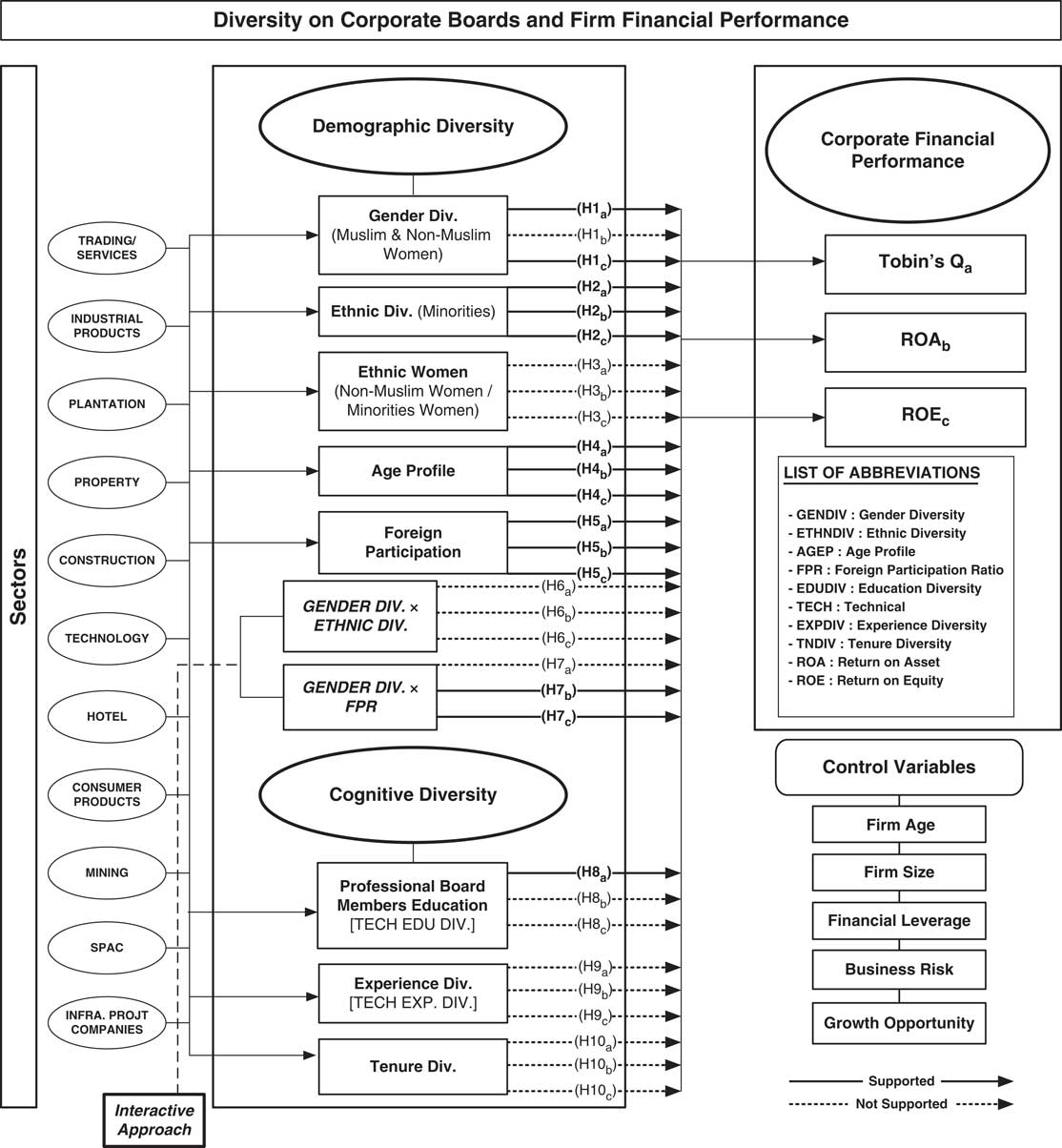
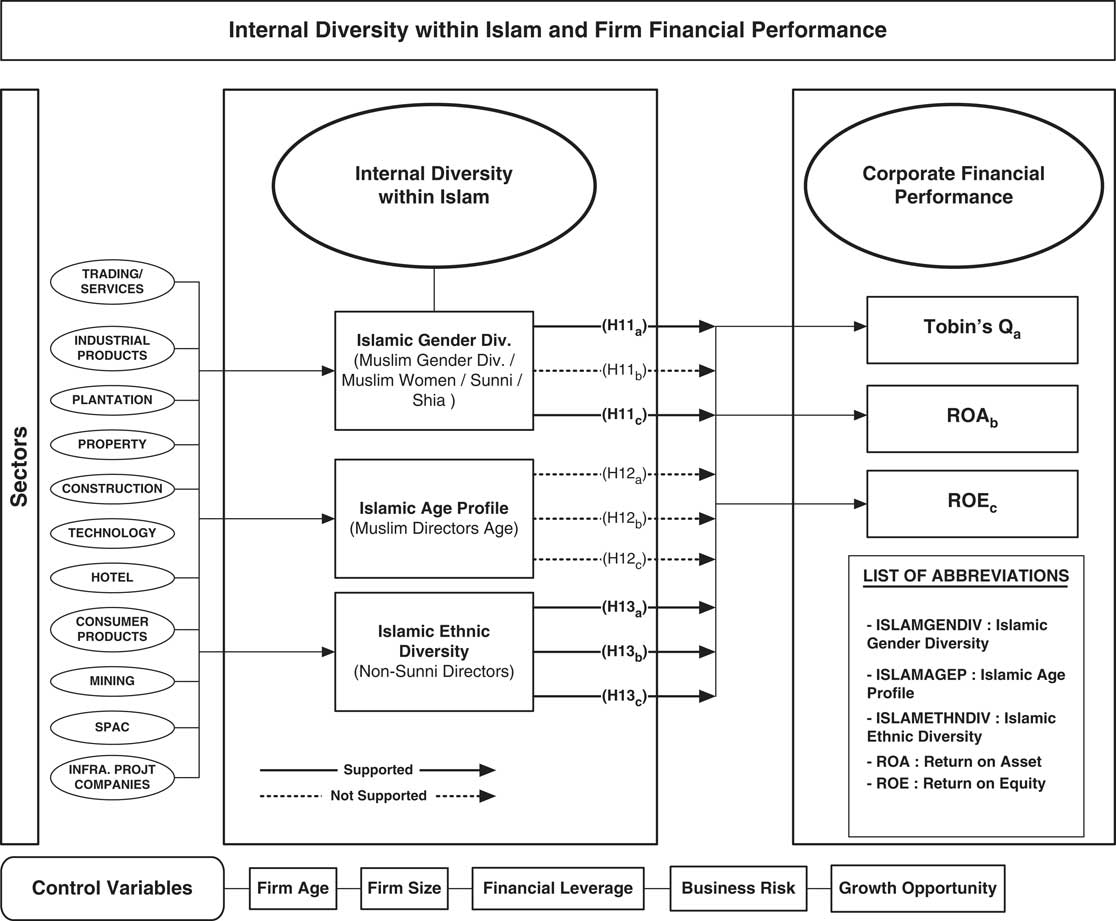
Based on above arguments and discussions, the proposed research models are presented in Figures 1 and 2. The models suggest that demographic and cognitive diversity among board members has an association with firm financial performance (Tobin’s Q, ROA, ROE). In addition, internal diversity within Islam among boards members and firm performance is investigated. In this study, the main constructs for investigation were demographic, cognitive diversity and Islamic diversity. Additionally, demographic, cognitive diversity and Islamic diversity comprising gender diversity, ethnic diversity, ethnic women diversity, age profile diversity, foreign participation, educational diversity, experience diversity, tenure diversity, Islamic gender diversity, Islamic age diversity, Islamic ethnic diversity and interactive variables were also considered. The dependent variable was firm financial performance, which was measured by the firm financial performance indicators including Tobin’s Q, ROA and ROE. This study employed control variables, which were firm age (FAGE), firm size (FSIZE), financial leverage (FINLEV), business risk (BR) and growth opportunity (GROWTHOPPT). This study has revealed the actual relationship between diversity at the board level and firm financial performance.
Research model I (corporate board diversity and firm financial performance)

Research model II (internal diversity within Islam among board members and firm financial performance)

EMPIRICAL DESIGN
The study was conducted on 330 companies listed on the Bursa Malaysia, and 11 sectors of the Bursa were considered for selection of companies (refer to Figure 1). For this empirical study, secondary data were collected from Datastream (Thomson Reuters) and manually from the company’s annual reports over the period of 2009–2013 (5 years) to understand the effectiveness of the new MCCG (Malaysian Code of Corporate Governance 2012) on listed firms, which will help companies to design their corporate boards. The justification for the selecting listed companies of Malaysia was to uphold the homogeneity factor in the secondary data. In addition, Malaysian companies were selected because this study tried to fill the gaps in diversity literature related to board directors in Malaysia, which lacks gender diversity in boardrooms as compared to developed countries, and because no solid research exists on Islamic diversity in Malaysia specifically. For the sample selection, the judgemental sampling technique was used based on the 5-year average market capitalisation of the firms. Finally, the period of 2009–2013 for data analysis was selected.
Variables measurement
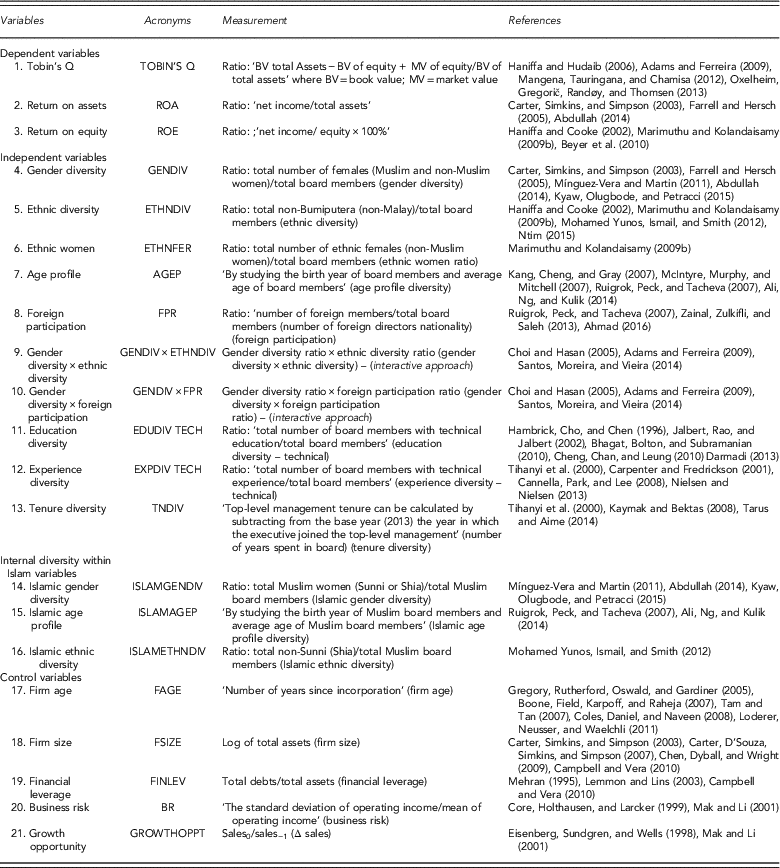
The numerous variables were operationalised in the framework of demographic, cognitive diversity, Islamic diversity and firm performance. This study used a ratio scale and is considered as a parametric study. Table 1 offers all the selected constructs and their operationalisations.
Operationalization of Variables

Selection of variables and empirical models
In selecting the most appropriate variables, this study enlarged prior research by integrating new knowledge and research directions for corporate board diversity dimensions and firm performance of listed firms in Malaysia.
Dependent variables
Tobin’s Q (market perspective)
This study used Tobin’s Q as the dependent variable to measure firm financial performance from the market perspective (market performance). In recent literature, gender diversity on corporate boards has been linked positively to the equity market. In addition, researchers have found that women on boards are associated positively with Tobin’s Q as a metric for a firm’s market performance (Campbell & Vera, Reference Campbell and Vera2010).
ROA (management perspective)
The upper echelon literature has used the ROA to express firm financial performance (Certo, Lester, Dalton, & Dalton, Reference Certo, Lester, Dalton and Dalton2006). The rationale behind using this ratio was because it indicated how efficiently firms utilised assets to make a profit (Dunning, Reference Dunning1988). Joskow et al. (Reference Joskow, Rose, Shepard, Meyer and Peltzman1993) suggested that to measure the relationship of BODs and top management teams with firm performance, accounting measures are more suitable measures. Kim and Lim (Reference Kim and Lim2010) argued that the ROA measures how fast a multinational firm has achieved its economies of scale. To measure firm performance, ROA has been employed in many prior studies (Zajac & Westphal, Reference Zajac and Westphal1996; Shrader, Blackburn, & Iles, Reference Shrader, Blackburn and Iles1997; Kiel & Nicholson, Reference Kiel and Nicholson2003). The ROA is a ratio of what company management has accomplished with the given assets (resources) (Investopedia, 2017). The ROA is directly related to management efficiency. If this efficiency is high, the ultimate benefit is to the shareholders. However, if efficiency is low, this results in lower profit margins. The ROA is a healthy measure of firm financial performance.
ROE (shareholder’s perspective)
Beyer, Cohen, Lys, and Walther (Reference Beyer, Cohen, Lys and Walther2010) argued that the ROA and ROE best measure company performance and through the ROE, which measures how quickly a firm utilises capital; therefore, a firm’s effectiveness can be portrayed. According to Lin, Liu, and Chu (Reference Lin, Liu and Chu2005), the ROE resolves the inconsistency of the goal of maximising shareholders’ capital and firm financial performance. The ROE is considered as a profitability ratio whereby the formula is ‘net profit after tax divided by equity (NPAT/Equity)’ (Leckson-Leckey, Osei, & Harvey, Reference Leckson-Leckey, Osei and Harvey2011).
Control variables
Possible confounding factors that affect firm performance were controlled. For example, this study employed ‘FAGE’, ‘FSIZE’, ‘FINLEV’, ‘BR’ and ‘GROWTHOPPT’ as the control variables. These selected control variables might have affected the mathematical models of this study. In strategic management and corporate governance literature, these variables have been used widely (see Table 1) (Torchia, Calabrò, & Huse, Reference Torchia, Calabrò and Huse2011; Hassan, Marimuthu, & Johl, Reference Hassan, Marimuthu and Johl2015b, Reference Hassan, Marimuthu and Johl2017).
Data collection and data analysis strategy
The key source of the data was from financial database Datastream and the annual reports of companies. The financial data of control variables and dependent variables (Tobin’s Q, ROA and ROE) data were extracted from Datastream. Content analysis collected the explanatory variables data, and these data were extracted from the annual reports of companies. For secondary data recording and extraction, this study used the Microsoft Excel sheets. To analyse the data, Stata 13 software was used. Several diagnostic checks were applied to determine the consistency and the validity of the data. This included Cook’s distance outlier test, multicollinearity, heteroskedasticity, serial correlation, Kolmogorov–Smirnova, Shapiro–Wilk and skewness and kurtosis tests.
Models applied
The modelling equations below show the association between the demographic and cognitive diversities (Figure 1), that is, gender diversity (GENDIV), ethnic diversity (ETHNDIV), age profile diversity (AGEP), foreign participation (FPR), gender diversity×ethnic diversity (GENDIV×ETHNDIV), gender diversity×foreign participation (GENDIV×FPR), educational diversity (EDUDIV TECH), experience diversity (EXPDIV TECH) and tenure diversity (TNDIV) and firm financial performance. Additionally, internal diversity within Islamic includes (Figure 2) Islamic gender diversity (ISLAMGENDIV), Islamic age profile (ISLAMAGEP) and Islamic ethnic diversity (ISLAMETHNDIV). To measure firm performance, this study used three different measures, which were TOBIN’S Q, ROA and ROE. To investigate the effects of demographic, cognitive diversity dimensions and internal diversity within Islam among corporate board members on firm financial performance, the subsequent models were used.
Demographic and cognitive diversity
 $$\eqalignno{ & '{\bf Model\; I}{\bf \,\colon\,}\,TOBINQ_{{it}} \,{\equals}\,{\rm \alpha }{\plus}\beta _{1} GENDIV_{{it}} {\plus}\beta _{2} ETHNDIV_{{it}} {\plus}\beta _{3} ETHNFER_{{it{\rm }}} {\plus}\beta _{4} AGEP_{{it}} {\plus}\beta _{5} FPR_{{it}} \cr & {\plus}\beta _{6} GENDIV{\times}ETHNDIV_{{it}} {\plus}\beta _{7} GENDIV{\times}FPR_{{it}} {\plus}\beta _{8} EDUDIVTECH_{{it}} {\plus}\beta _{9} EXPDIVTECH_{{it}} \cr & {\plus}\beta _{{10}} TNDIV_{{it}} {\plus}\beta _{{11}} FAGEcv_{{it}} {\plus}\beta _{{12}} FSIZEcv_{{it}} {\plus}\beta _{{13}} FINLEVcv_{{it}} {\plus}\beta _{{14}} BRcv_{{it}} {\plus}\beta _{{15}} GROWTHOPPTcv_{{it}} {\plus}{\epsilon}' $$
 $$\eqalignno{ & '{\bf Model \;II}\,{\bf \colon\,}\,ROA_{{it}} \,{\equals}\,{\rm \alpha }{\plus}\beta _{1} GENDIV_{{it}} {\plus}\beta _{2} ETHNDIV_{{it}} {\plus}\beta _{3} ETHNFER_{{it}} {\plus}\beta _{4} AGEP_{{it}} {\plus}\beta _{5} FPR_{{it}} \cr & {\plus}\beta _{6} GENDIV{\times}ETHNDIV_{{it}} {\plus}\beta _{7} GENDIV{\times}FPR_{{it}} {\plus}\beta _{8} EDUDIVTECH_{{it}} {\plus}\beta _{9} EXPDIVTECH_{{it}} \cr & {\plus}\beta _{{10}} TNDIV_{{it}} {\plus}\beta _{{11}} FAGEcv_{{it}} {\plus}\beta _{{12}} FSIZEcv_{{it}} {\plus}\beta _{{13}} FINLEVcv_{{it}} {\plus}\beta _{{14}} BRcv_{{it}} {\plus}\beta _{{15}} GROWTHOPPTcv_{{it}} {\plus}{\epsilon}' $$
 $$\eqalignno{ & '{\bf Model \;III}{\bf \,\colon\,}\,ROE_{{it}} \,{\equals}\,{\rm \alpha }{\plus}\beta _{1} GENDIV_{{it}} {\plus}\beta _{2} ETHNDIV_{{it}} {\plus}\beta _{3} ETHNFER_{{it{\rm }}} {\plus}\beta _{4} AGEP_{{it}} {\plus}\beta _{5} FPR_{{it}} \cr & {\plus}\beta _{6} GENDIV{\times}ETHNDIV_{{it}} {\plus}\beta _{7} GENDIV{\times}FPR_{{it}} {\plus}\beta _{8} EDUDIVTECH_{{it}} {\plus}\beta _{9} EXPDIVTECH_{{it}} \cr & {\plus}\beta _{{10}} TNDIV_{{it}} {\plus}\beta _{{11}} FAGEcv_{{it}} {\plus}\beta _{{12}} FSIZEcv_{{it}} {\plus}\beta _{{13}} FINLEVcv_{{it}} {\plus}\beta _{{14}} BRcv_{{it}} {\plus}\beta _{{15}} GROWTHOPPTcv_{{it}} {\plus}{\epsilon}'. $$
Internal diversity within Islam
 $$\eqalignno { & '{\bf Model}\,{\bf IV}{\bf \,\colon\,}\,TOBINQ_{{it}} \,{\equals}\,{\rm \alpha }{\plus}\beta _{1} ISLAMGENDIV_{{it}} {\plus}\beta _{2} ISLAMAGEP_{{it}} {\plus}\beta _{3} ISLAMETHNDIV_{{it}} \cr & {\plus}\beta _{4} FAGEcv_{{it}} {\plus}\beta _{5} FSIZEcv_{{it}} {\plus}\beta _{6} FINLEVcv_{{it}} {\plus}\beta _{7} BRcv_{{it}} {\plus}\beta _{8} GROWTHOPPTcv_{{it}} {\plus}{\epsilon}' $$
 $$\eqalignno{ & '{\bf Model}\,{\bf V}{\bf \,\colon\,}\,ROA_{{it}} \,{\equals}\,{\rm \alpha }{\plus}\beta _{1} ISLAMGENDIV_{{it}} {\plus}\beta _{2} ISLAMAGEP_{{it}} {\plus}\beta _{3} ISLAMETHNDIV_{{it}} \cr & {\plus}\beta _{4} FAGEcv_{{it}} {\plus}\beta _{5} FSIZEcv_{{it}} {\plus}\beta _{6} FINLEVcv_{{it}} {\plus}\beta _{7} BRcv_{{it}} {\plus}\beta _{8} GROWTHOPPTcv_{{it}} {\plus}{\epsilon}' $$
 $$\eqalignno{ & '{\bf Model}\,{\bf VI}{\bf \,\colon\,}\,ROE_{{it}} \,{\equals}\,{\rm \alpha }{\plus}\beta _{1} ISLAMGENDIV_{{it}} {\plus}\beta _{2} ISLAMAGEP_{{it}} {\plus}\beta _{3} ISLAMETHNDIV_{{it}} \cr & {\plus}\beta _{4} FAGEcv_{{it}} {\plus}\beta _{5} FSIZEcv_{{it}} {\plus}\beta _{6} FINLEVcv_{{it}} {\plus}\beta _{7} BRcv_{{it}} {\plus}\beta _{8} GROWTHOPPTcv_{{it}} {\plus}{\epsilon}'. $$
Empirical results
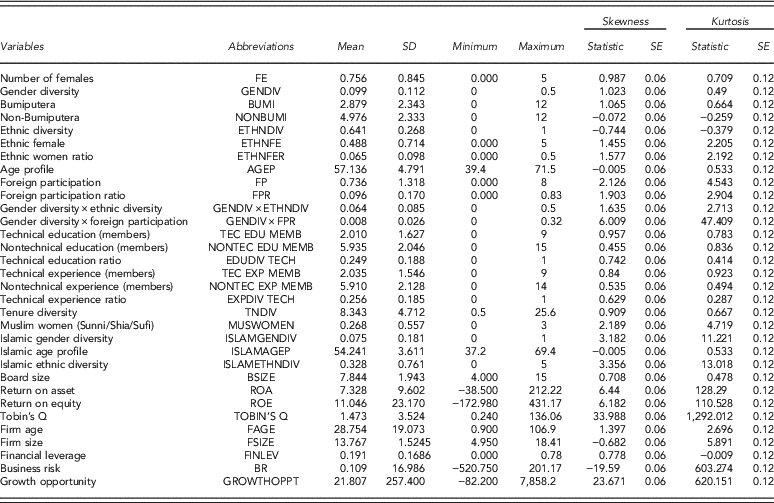
Descriptive statistics
Table 2 offers the mean value, the standard deviation, and the skewness and kurtosis values. The descriptive results offer meaningful information about the parametric data of this study. There were no multicollinearity issues amongst variables. The Tobin’s Q of the firms, on average, was 1.473. The ROA and ROE of the firms, on average, were 7.328 and 11.046, respectively. The maximum of women’s participation on corporate boards was five, and the maximum corporate board size was 15 members. The proportion of foreign participation and ethnic women was, on average, 0.096 and 0.065, respectively; the age profile of directors was, on average, 57.136, and ethnic women (non-Muslim) was, on average, 0.488. The level of FINLEV was, on average, 0.191 and FSIZE was 13.767. The age of the firm, on average, was 28.754, while the technical experience of members on boards was 5.910. Moreover, Muslim women on corporate boards were, on average. 0.268 and the maximum number of Muslim women was three. The age of Muslim BODs and Islamic ethnic participation (non-Sunni) were, on average, 54.241 and 0.328, respectively.
Descriptive statistics

Note. N=1,650, n=330, T=5 years.
Correlation matrix
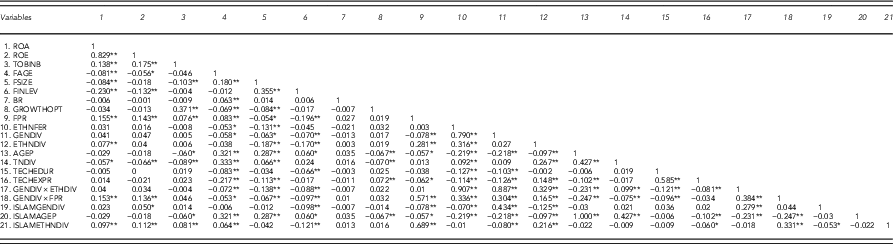
Pearson’s correlation matrix was employed to determine the direction of relationships among the selected variables and to check whether a multicollinearity problem was present in the data (see Table 3). The correlation matrix showed that all selected variables had statistically significant correlations. The interaction variables, that is, (GENDIV×ETHNDIV) and (GENDIV×FPR), were strongly and positively correlated with firm financial performance. However, tenure diversity and FINLEV were negatively connected with firm financial performance. That aside, Islamic ethnic diversity (ISLAMETHNDIV) was positively and strongly correlated with firm financial performance. The variables values were strongly correlated and close to 1.
Correlation matrix (330 firms)

Note: AGEP=age profile; BR=business risk; ETHNDIV=ethnic diversity; ETHNFER=ethnic women; FAGE=firm age; FINLEV=financial leverage; FPR=foreign participation ratio; FSIZE=firm size; GENDIV=gender diversity; GROWTHOPT=growth opportunity; ISLAMAGEP=Islamic age profile; ISLAMETHNDIV=Islamic ethnic diversity; ISLAMGENDIV=Islamic gender diversity; ROA=return on assets; ROE=return on equity; TECHEDUR=technical education; TECHEXPR=technical experience; TNDIV=tenure diversity; TOBINB=Tobin’s Q.
**, *Correlation is significant at .01 and .05 level, respectively (two-tailed).
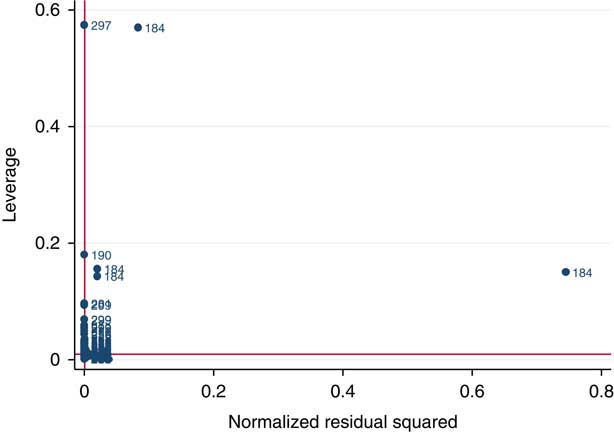
Cook’s distance outliers test
Cook’s D (Cook’s distance outlier test) was employed to determine if influential outliers were present in the data set of the predictor variables. More specifically, the higher the residuals and leverage, the higher the Cook’s distance. The graph below presented Figure 3 shows the outliers in the data that were not reliable with selected data. Some cases had large residuals, which meant that the difference between the predicted and observed values were extremely large and, in some cases, did not have large leverage. Hence, this study removed some problematic firms having large residuals. For that reason, this study’s panel data were smooth in form after removing these cases (number of observations=1,650 m, F(15, 1,634)=2,011, Prob>F=0.0000).
Cook’s distance outliers test

Pooled ordinary least squares (PEM), random effect model (REM) and fixed effect model (FEM)
The important characteristics of demographic and cognitive diversity and firm performance are debated in the literature review. In this study, demographic, cognitive diversity dimensions in the boardrooms and firm financial performance of listed companies are described and appropriate statistical tests were applied. In addition, internal diversity within Islam among corporate boards was also investigated in this study (see Figure 2). For the analyses, this study used panel data sets, which comprised cross-sectional time series data, and panel data techniques were involved utilising the PEM, the REM, the FEM, the fixed effects with robust SE, the pooled effects with robust SE and the panel-corrected the SE (PCSE) methods.
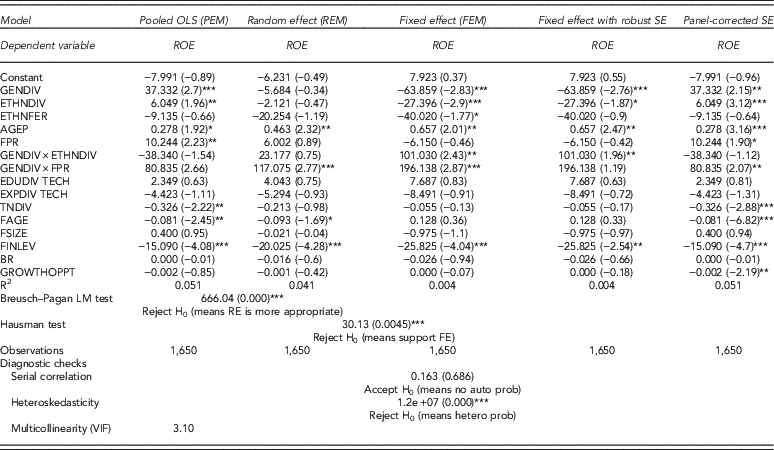
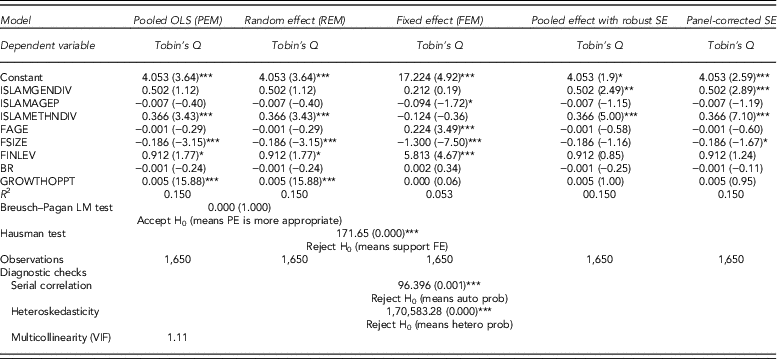
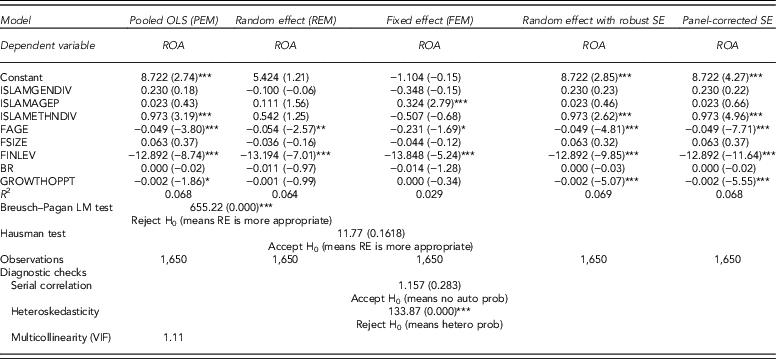
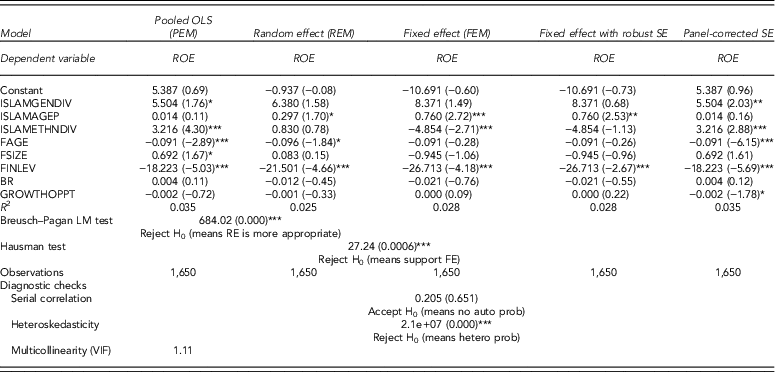
The regression results summary of all models are shown in Tables 4–9, which represent Panel A (Model I – Tobin’s Q), Panel B (Model II – ROA), Panel C (Model III – ROE), Panel D (Model IV – Tobin’s Q), Panel E (Model V – Tobin’s Q) and Panel F (Model VI – Tobin’s Q), respectively. The Tobin’s Q, ROA and ROE were regressands, and the demographic diversity and cognitive diversity were employed as regressors.
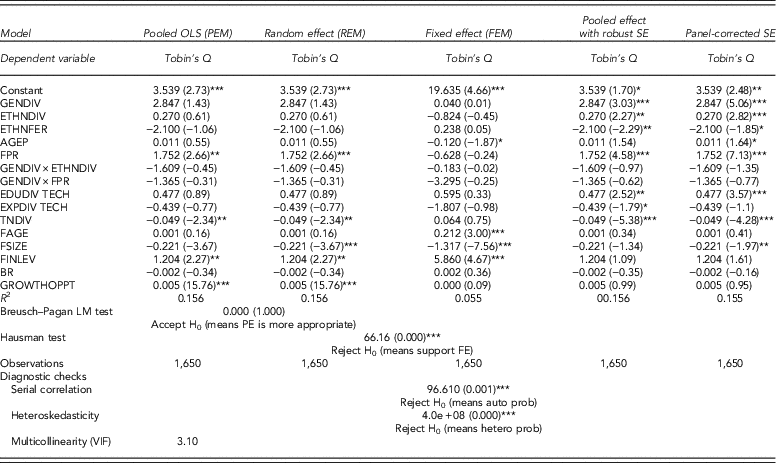
Regression analyses (Panel A – Model I: 330 firms)

Note. Dependent variable Tobin’s Q. t-Values are in parentheses.
AGEP=age profile; BR=business risk; EDUDIV TECH=technical education ratio; ETHNDIV=ethnic diversity; ETHNFER=ethnic women; EXPDIV TECH=technical experience ratio; FAGE=firm age; FINLEV=financial leverage; FPR=foreign participation ratio; FSIZE=firm size; GENDIV=gender diversity; GROWTHOPT=growth opportunity; LM=Lagrange multiplier; OLS=ordinary least squares; PE=pooled effect; TNDIV=tenure diversity; VIF=variance inflation factor.
Significance levels are *p<.10; **p<.05; ***p<.01 except Breusch–Pagan LM test, Hausman test, heteroskedasticity and serial correlation, which are p-values in parentheses.
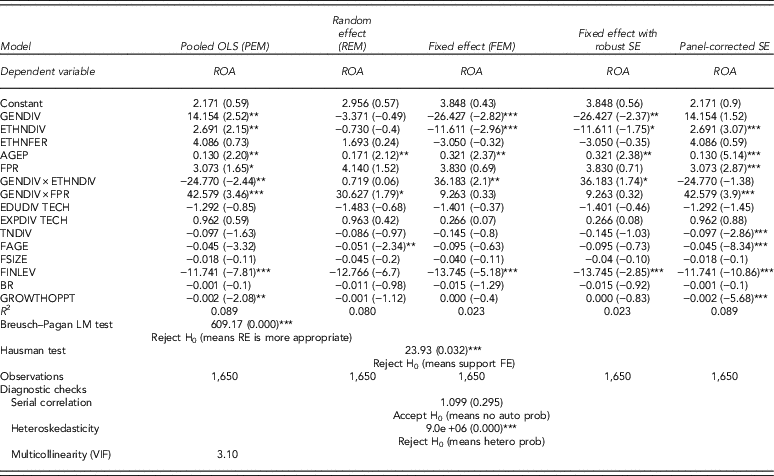
Regression analyses (Panel B – Model II: 330 firms)

Note. Dependent variable ‘return on assets (ROA)’. t-Values are in parentheses.
GEP=age profile; BR=business risk; EDUDIV TECH=technical education ratio; ETHNDIV=ethnic diversity; ETHNFER=ethnic women; EXPDIV TECH=technical experience ratio; FAGE=firm age; FINLEV=financial leverage; FPR=foreign participation ratio; FSIZE=firm size; GENDIV=gender diversity; GROWTHOPT=growth opportunity; LM=Lagrange multiplier; OLS=ordinary least squares; PE=pooled effect; RE=random effects; TNDIV=tenure diversity; VIF=variance inflation factor.
Significance levels are *p<.10; **p<.05; and ***p<0.01 except Breusch–Pagan LM test, Hausman test, heteroskedasticity and serial correlation, which are p-values in parentheses.
Regression analyses (Panel C – Model III: 330 firms)

Note. Dependent variable return on equity (ROE). t-Values are in parentheses.
GEP=age profile; BR=business risk; EDUDIV TECH=technical education ratio; ETHNDIV=ethnic diversity; ETHNFER=ethnic women; EXPDIV TECH=technical experience ratio; FAGE=firm age; FINLEV=financial leverage; FPR=foreign participation ratio; FSIZE=firm size; GENDIV=gender diversity; GROWTHOPT=growth opportunity; LM=Lagrange multiplier; OLS=ordinary least squares; RE=random effects; TNDIV=tenure diversity; VIF=variance inflation factor.
Significance levels are *p<.10; **p<.05; and ***p<.01 except Breusch–Pagan Lagrange Multiplier test, Hausman test, heteroskedasticity and serial correlation, which are p-values in parentheses.
Regression analyses (Panel D – Model IV: 330 firms)

Note. Dependent variable Tobin’s Q. t-Values are in parentheses.
BR=business risk; FAGE=firm age; FINLEV=financial leverage; FPR=foreign participation ratio; FSIZE=firm size; GROWTHOPT=growth opportunity; ISLAMAGEP=Islamic age profile; ISLAMETHNDIV=Islamic ethnic diversity; ISLAMGENDIV=Islamic gender diversity; LM=Lagrange multiplier; OLS=ordinary least squares; PE=pooled effect; VIF=variance inflation factor.
Significance levels are *p<.10; **p<.05; and ***p<.01 except Breusch–Pagan Lagrange Multiplier test, Hausman test, heteroskedasticity and serial correlation, which are p-values in parentheses.
Regression analyses (Panel E – Model V: 330 firms)

Note. Dependent variable return on assets (ROA). t-Values are in parentheses.
BR=business risk; FAGE=firm age; FINLEV=financial leverage; FPR=foreign participation ratio; FSIZE=firm size; GROWTHOPT=growth opportunity; ISLAMAGEP=Islamic age profile; ISLAMETHNDIV=Islamic ethnic diversity; ISLAMGENDIV=Islamic gender diversity; LM=Lagrange multiplier; OLS=ordinary least squares; RE=random effects; VIF=variance inflation factor.
Significance levels are *p<.10; **p<.05; and ***p<.01 except Breusch–Pagan Lagrange Multiplier test, Hausman test, heteroskedasticity and serial correlation, which are p-values in parentheses.
Regression analyses (Panel F – Model VI: 330 firms)

Note. Dependent variable return on equity (ROE). t-Values are in parentheses.
BR=business risk; FAGE=firm age; FINLEV=financial leverage; FPR=foreign participation ratio; FSIZE=firm size; GROWTHOPT=growth opportunity; ISLAMAGEP=Islamic age profile; ISLAMETHNDIV=Islamic ethnic diversity; ISLAMGENDIV=Islamic gender diversity; LM=Lagrange multiplier; OLS=ordinary least squares; RE=random effects; VIF=variance inflation factor.
Significance levels are *p<.10; **p<.05; and ***p<.01 except Breusch–Pagan Lagrange Multiplier test, Hausman test, heteroskedasticity and serial correlation, which are p-values in parentheses.
First, the study looked at Panel A (Tobin’s Q), and the Breusch–Pagan Lagrange Multiplier (BP-LM) test was accepted H0, 0.000 (1.0, p>.05), which means that the pooled OLS effect (PEM) was a more appropriate model as compared to random effect model (REM). Besides, Hausman Test was rejected H0, 66.16 (0.000, p<.05), which means that the random effect model (REM) was inappropriate as compared to the fixed effect model (FEM) for top-listed companies. To determine the reliability of the panel data, diagnostic checks of the panel were applied, that is, (1) multicollinearity, (2) heteroskedasticity and (3) serial correlation.
The multicollinearity check of Panel A data found no multicollinearity issue as (variance inflation factor [VIF]=3.10<10). With respect to heteroskedasticity, H0, was rejected 4.0e+08 (0.000, p<.05), which means that the variances were not constant. A serial correlation problem was found as H0 was rejected 96.610 (0.001, p<.05) as the p-value was highly significant. This study employed the robust standard error, and the PCSE techniques to address the heteroskedasticity and serial correlation problems, and the study results are based on PCSE technique.
Second, the study looked at Panel B (ROA), and the BP-LM test was rejected H0, 609.17 (0.000, p<.05) for the pooled OLS effect (PEM). This means that REM was more appropriate, and the Hausman Test was rejected as H0, 23.93 (0.032, p<.05), which means that REM was inappropriate as compared to the FEM for the top-listed companies as (VIF=3.10)<10, which means that no multicollinearity problem was present. There was a heteroskedasticity problem as H0 was rejected 9.0e+06 (0.000, p<.05), but there was no serial correlation problem.
Third, the study looked at Panel C (ROE), and the BP-LM test rejected H0, 666.04 (0.000, p<.05), which means PEM was not an appropriate model as compared to REM, and the Hausman Test rejected H0, 30.13 (0.004, p<.05), which means REM was not appropriate as compared to the FEM for top-listed companies. As (VIF=3.10)<10, no multicollinearity problem existed. There was a heteroskedasticity problem as H0 was rejected 1.2e+07 (0.000, p<.05), but no serial correlation problem was present.
This study also considered internal diversity within Islam in the boardroom and its impact on firm financial performance. To elaborate, in Panel D (Tobin’s Q), the BP-LM test was accepted as H0, 0.000 (1.0, p>.05), which means that PEM was a more appropriate model as compared to REM. Besides, the Hausman Test was rejected as H0, 171.65 (0.000, p<.05), which means REM was not suitable as compared to FEM for top-listed companies regarding Islamic diversity. However, there was no multicollinearity issue as (VIF=1.11<10). With respect to heteroskedasticity, H0, was rejected 1,70,583.28 (0.000, p<.05), which means that the variances were not constant. Besides, there is a serial correlation problem as H0, was rejected 96.396 (0.001, p<.05) as the p-value was highly significant.
Furthermore, in Panel E (ROA), the BP-LM Test was rejected as H0, 655.22 (0.000, p<.05), which means PEM was not an appropriate model as compared to REM, and the Hausman test was not rejected as H0, 11.77 (0.162, p>.05), which means that REM was appropriate as compared to the FEM for top-listed companies. As (VIF=1.11)<10 means no multicollinearity problem. There is a heteroskedasticity problem as H0, was rejected 133.87 (0.000, p<.05), but there was no serial correlation problem.
Finally, the study looked at Panel F (ROE). The BP-LM test was rejected H0, 684.02 (0.000, p<.05), which means PEM was not an appropriate model as compared to REM, and the Hausman test was rejected H0, 27.24 (0.004, p<.05), which means REM was not appropriate as compared to the FEM for top-listed companies. As (VIF=1.11) <10 means that no multicollinearity problem existed. There was heteroskedasticity problem as H0 was rejected 2.1e+07 (0.000, p<.05), but no serial correlation problem was present. This study employed the robust standard error and the PCSE techniques to address the heteroskedasticity problem in all selected panels of this study. The hypotheses outcomes of this study are grounded on the PCSE technique in all Models (I, II, III, IV, V and VI).
Panel A – Tobin’s Q (see Table 4) contains all main constructs, control variables and interactive terms. First, the results of independent variables that had a significant and positive impact on Tobin’s Q were considered. The results were the following: GENDIV (β=2.847, p<.01), ETHNDIV (β=2.847, p<.01), AGEP (β=0.011, p<.10), FPR (β=1.752, p<.01) and EDUDIV TECH (β=0.477, p<.01). Thus, Hypotheses 1a, 2a, 4a, 5a and 8a of this study were supported. Conversely, ETHNFER (β=−2.100, p<.10), GENDIV×ETHNDIV (β=−1.609, p>.10), GENDIV×FPR (β=−1.365, p>.10), EXPDIV TECH (β=−0.439, p>.10), TNDIV (β=−0.049, p<.01). Hence, Hypotheses 3a, 6a, 7a, 9a and 10a were not supported. Additionally, the control variable FSIZE (β=−0.221, p<0.05) was negative and significant, which means that FSIZE also prejudiced firm performance. The other control variables FAGE, FINLEV, BR and GROWTHOPPT were insignificant.
Panel B – ROA (see Table 5) contains the outcomes of independent variables that have a significant and positive impact on ROA. The results were: ETHNDIV (β=2.691, p<.01), AGEP (β=0.130, p<.01), FPR (β=3.073, p<.01) and GENDIV×FPR (β=42.579, p<.01). Thus, Hypotheses 2b, 4b, 5b and 7b of this study were supported. Additionally, other results were: GENDIV (β=14.154, p>.10), ETHNFER (β=4.086, p>.10), GENDIV×ETHNDIV (β=−24.770, p>.10), EDUDIV TECH (β=−1.292, p>.10), EXPDIV TECH (β=0.962, p>.10), TNDIV (β=−0.097, p<.01). Hence, Hypotheses 1b, 3b, 6b, 8b, 9b and 10b of this study were supported. Another essential point, is that control variables FAGE (β=−0.045, p<.01), FINLEV (β=−11.741, p<.01) and GROWTHOPPT (β=−0.002, p<.01) were negative and significant. This means that these control variables also affected firm performance. The other control variables FSIZE and BR were insignificant.
Panel C – ROE (see Table 6) shows that demographic and cognitive diversity dimensions had a significant and positive impact on ROE. The outcomes were: GENDIV (β=37.332, p<.05), ETHNDIV (β=6.049, p<.01), AGEP (β=0.278, p<.01), FPR (β=10.244, p<.10) and GENDIV×FPR (β=80.835, p<.05). Hence, Hypotheses 1c, 2c, 4c, 5c and 7c of this study were supported. These results were aligned with prior study (Hassan & Marimuthu, Reference Hassan and Marimuthu2014). Subsequently, the following results were: ETHNFER (β=−9.135, p>.10), GENDIV×ETHNDIV (β=−38.340, p>.10), EDUDIV TECH (β=2.349, p>.10), EXPDIV TECH (β=−4.423, p>.10) and TNDIV (β=−0.326, p<.01). Hence, Hypotheses 3c, 6c, 8c, 9c and 10c were not supported. Additionally, the control variables FAGE (β=−0.081, p<.01), FINLEV (β=−15.090, p<.01) and GROWTHOPPT (β=−0.002, p<.05) were negative and significant, which showed that these control variables also influenced firm performance. The other control variables FSIZE and BR were insignificant. The result of Hypotheses 3a, 10a, 10b and 10c were negative and significant on firm performance. The R 2s of Model I, Model II and Model III were 0.155, 0.089 and 0.051, respectively.
Panel D – Tobin’s Q (see Table 7) comprises the findings of internal diversity within Islam with respect to all constructs and control variables. First, the results of independent variables, which had a significant and positive impact on Tobin’s Q, were given. Thus, ISLAMGENDIV (β=0.502, p<.01) and ISLAMETHNDIV (β=0.366, p<.01). Thus, Hypotheses 11a and 13a of this study were supported while, ISLAMAGEP (β=−0.007, p>.10). Hence, Hypothesis 12a was not supported. Moreover, the control variable FSIZE (β=−0.186, p<.10) was negative and significant. Thus, FSIZE also prejudiced firm financial performance. The other control variables FAGE, FINLEV, BR and GROWTHOPPT were insignificant.
Panel E – ROA (see Table 8) shows the outcomes of internal diversity within Islam variables that had a significant and positive impact on ROA. ISLAMETHNDIV (β=0.973, p<.01) had a positive and significant impact on firm performance. Thus, Hypothesis 13b of this study was supported. Besides, the results showed that ISLAMGENDIV was (β=0.230, p>.10) and ISLAMAGEP was (β=0.023, p>.10). Hence, Hypotheses 11b and 12b of this study were supported. Another essential point was the that control variables FAGE (β=−0.049, p<.01), FINLEV (β=−12.892, p<.01) and GROWTHOPPT (β=−0.002, p<.01) were negative and significant. Therefore, these control variables also affected firm performance. The other control variables FSIZE and BR were insignificant.
Panel F – ROE (see Table 9) shows that the internal diversity within Islam dimensions had a significant and positive impact on ROE. The outcomes were: ISLAMGENDIV (β=5.504, p<.05) and ISLAMETHNDIV (β=3.216, p<.01). Hence, Hypotheses 11c and 13c, of this study were supported. Subsequently, ISLAMGENDIV (β=0.014, p>.10) had no impact on firm performance. Hence, Hypothesis 12c was not supported. Additionally, the control variables FAGE (β=−0.091, p<.01), FINLEV (β=−18.223, p<.01) and GROWTHOPPT (β=−0.002, p<.05) were significant and negative; thus, these control variables also prejudiced firm performance. The other control variables FSIZE and BR were insignificant. The R 2s of Model I, Model II and Model III were 0.150, 0.068 and 0.035, respectively.
Interaction effect of diversity
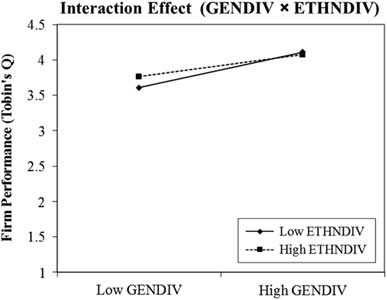
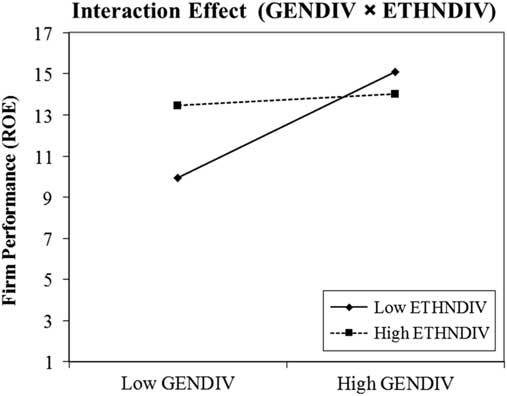
The interaction effect between diversity dimensions, that is, ethnic diversity, foreign board members and gender diversity, is presented in Figures 4–9. First, when gender diversity (GENDIV) on corporate boards interacted with ethnic diversity (ETHNDIV), firm performance (Tobin’s Q) was not influenced by the interaction approach but was negatively correlated. The outcome is that having a low combination of gender diversity and ethnic diversity on corporate board means that firm performance is improved. Consequently, when there is a combination of high gender diversity and ethnic diversity on corporate boards, this combination will reduce firm performance (see Figure 4).
Interaction effect (GENDIV×ETHNDIV) (Tobin’s Q). ETHNDIV=ethnic diversity; GENDIV=gender diversity

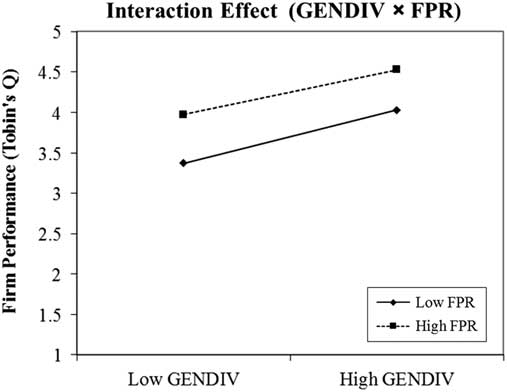
Interaction effect (GENDIV×FPR) (Tobin’s Q). FPR=foreign participation ratio; GENDIV=gender diversity

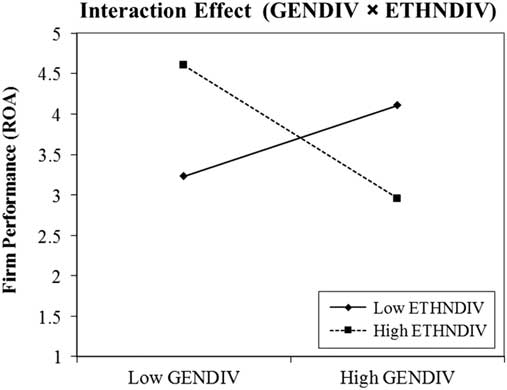
Interaction effect (GENDIV×ETHNDIV) (return on assets [ROA]). ETHNDIV=ethnic diversity; GENDIV=gender diversity

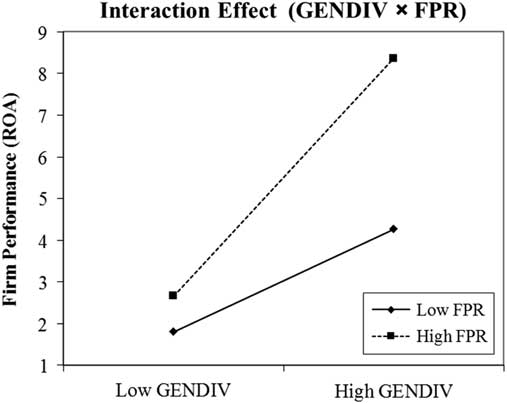
Interaction effect (GENDIV×FPR) (return on assets [ROA]). FPR=foreign participation ratio; GENDIV=gender diversity

Interaction effect (GENDIV×ETHNDIV) (return on equity [ROE]). ETHNDIV=ethnic diversity; GENDIV=gender diversity

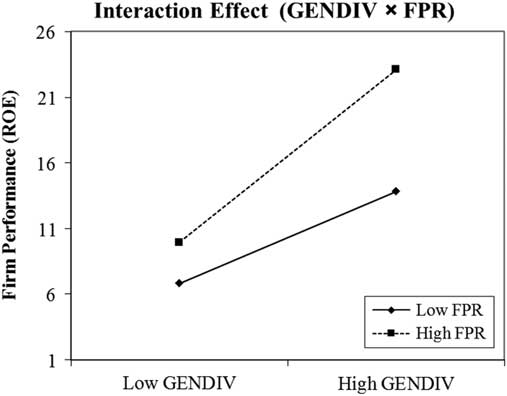
Interaction effect (GENDIV×FPR) (return on equity [ROE]). FPR=foreign participation ratio; GENDIV=gender diversity

Second, the interaction term between gender diversity (GENDIV) with foreign participation (FPR) diversity had no association regarding firm performance (Tobin’s Q) and was negatively correlated with performance. This means that if corporate boards have low gender diversity and low foreign participation, then firm performance will change in a minor way toward the positive side. Besides, the combination of high gender diversity and high foreign participation on boards will increase firm performance (see Figure 5). In terms of ROA, the interaction between gender diversity with ethnic diversity was negatively correlated, and no significant link existed with firm performance (ROA). Hence, corporate boards having low gender diversity and low ethnic diversity will experience increased firm performance (ROA). In contrast, if there is a combination of high gender diversity and high ethnic diversity on boards, then firm performance (ROA) will decrease. Nevertheless, a combination of low gender diversity and low foreign participation on corporate boards will reduce firm performance. Besides more gender diversity and more foreign participation will change firm performance in a significant and positive way (see Figures 6 and 7). By looking at the ROE, low gender diversity and low ethnic diversity will increase performance and vice versa. However, when low gender diversity interacts with low foreign participation on the board, this interaction will reduce firm performance and vice versa (see Figures 8 and 9).
Summary of the results
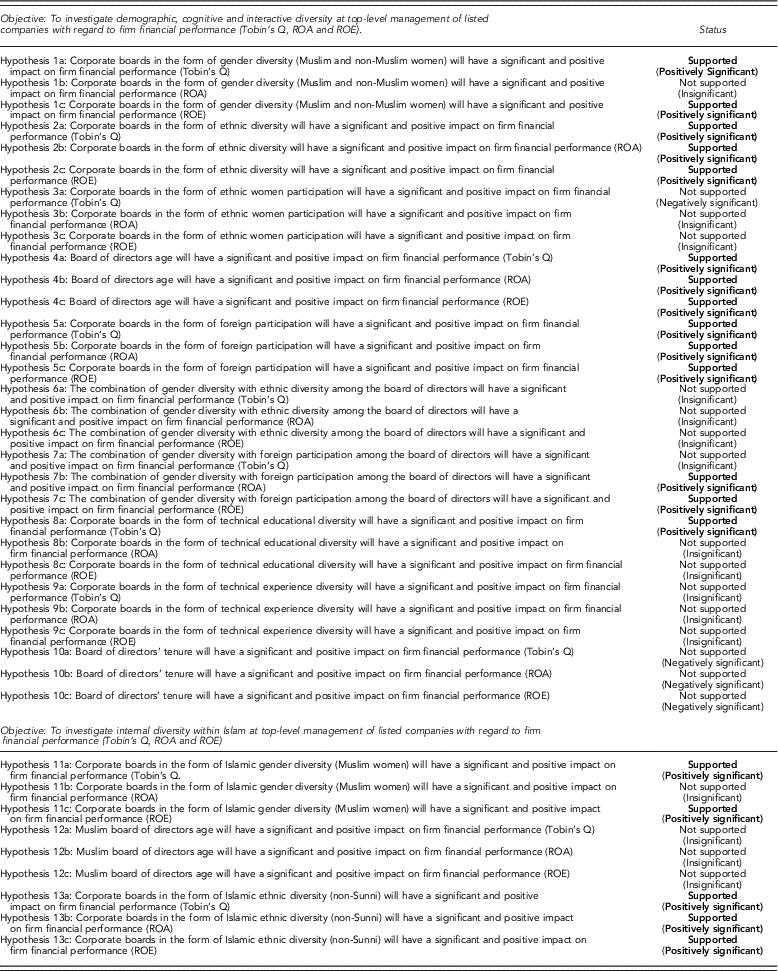
In summary, the hypothesis testing, and the outcomes are presented in Table 10. Overall, the outcomes of this study are in favour of the proposed research models. Therefore, gender diversity at the corporate board level contributes to better firm performance. Additionally, the results are different and meaningful with the amalgamation of additional diversity dimensions at the board level. In brief, women who belong to minority or majority groups contribute to firm performance. In contrast, ethnic women (non-Muslim/minorities) on boards do not affect firm performance with respect to all perspectives of financial performance. However, foreign participation on corporate boards in the presence of women’s participation also affects firm financial performance. In the light of Islamic diversity, Islamic gender diversity (Muslim women/Sunni/Shia) and Islamic ethnic diversity (non-Sunni) have a positive and significant impacts on firm financial performance. Thus, the results show a solid indication of the relationship between board diversity and firm performance.
Summary results of the hypotheses tested

Note. ROA=return on assets; ROE=return on equity.
DISCUSSIONS AND FINDINGS
The purpose of this study was to extend the understanding on the effect of demographic and cognitive diversity measures on firm performance. In addition, Islamic diversity on boards is also investigated. The study analysis suggests three types of findings with respect to market, management and shareholder’s perspectives.
1. Muslim and non-Muslim women (gender diversity) serving on corporate boards enhances firm financial performance (Tobin’s Q and ROE).
2. Minority group participation (ethnic diversity) on corporate boards has a significant and positive impact on firm financial performance (Tobin’s Q, ROA and ROE).
3. The participation of ethnic women’s (non-Muslim women) on corporate boards has a significant and negative impact on performance (Tobin’s Q). Hence, non-Muslim (minority group) women on the of board directors diminishes firm performance.
4. The age profile and foreign participation on corporate boards have significant and positive impacts on performance (Tobin’s Q, ROA and ROE).
5. Technical educational diversity does not affect firm financial performance (Tobin’s Q, ROA and ROE).
6. Tenure diversity has a significant and negative impact on firm financial performance (Tobin’s Q, ROA and ROE).
7. Islamic gender diversity (Muslim women/Shia/Sunni) on corporate boards has a significant and positive impact on firm financial performance (Tobin’s Q and ROE).
8. Islamic ethnic diversity (non-Sunni) in the boardroom has a significant and positive impact on firm financial performance (Tobin’s Q, ROA and ROE).
In the light of upper echelon theory and its implications for corporate boards, the outcomes suggest that gender diversity on corporate boards has a significant and positive impact on firm financial performance (Tobin’s Q and ROE). From the management perspective, gender diversity on boards has no significant impact on firm financial performance (ROA). The outcomes validate that Muslim and non-Muslim women (gender diversity) serving on boards contributes towards firm performance equally, and the participation of women is important for enhancing firm performance. The outcome of gender diversity and its impact on firm performance is consistent with the prior research results. However, this study combined both majority and minority class women participation at the board level, and the outcomes are consistent and positive. Based on the findings, gender diversity should be encouraged for top-level management. Thus, these findings contribute substantially the importance of strengthening gender diversity on corporate boards.
Another essential point is that the outcome of this study help shifts the debate direction regarding gender diversity on boards from both majority and minority groups women. The majority (Muslim women) and minorities (non-Muslim women) cannot produce better performance if these women groups perform separately from each other on boards; thus, it is essential for companies to have a mixture of women on boards. However, ethnic women (non-Muslim women) have a significant and negative impact on firm performance (Tobin’s Q) because having ethnic women (non-Muslim) on corporate boards diminishes firm performance.
This study also shows that age diversity increases firm performance because age has a key role in decision-making. Likewise, previous studies have pointed to age diversity as a vital ingredient in enhancing corporate decision-making in terms of innovation, information search, flexibility and information processing. More specifically, corporate boards containing both young and old members are adequately engaged in improving firm performance.
Furthermore, foreign participation on the boards of companies has a significant and positive impact on firm performance (Tobin’s Q, ROA and ROE). Hence, the inclusion of foreign directors on corporate boards will enhance firm performance. In some measure that is because foreign board members carry a different levels of education, culture and intellectual capacity, which brings about a positive changes to an organisation. Thus, listed firms should put foreigners on corporate boards to enhance firm financial performance (Tobin’s Q, ROA and ROE).
In terms of cognitive diversity, tenure diversity has a significant and negative impact on firm performance (Tobin’s Q, ROA and ROE). The rationale is that if a member of the BODs stays longer as a board member, this will reduce firm performance. Because of the same team and similar ideas, this will hinder innovation and R&D in firms. In addition, technical educational diversity and technical experience diversity offer no significant contribution towards performance.
By considering the interaction approach, when Muslims and non-Muslims (gender diversity) are work with the only ethnic group, they will not have an impact on firm financial performance. So, listed firms should encourage corporate board diversity with a variety of directors. However, when gender diversity interacts with foreign directors, a significant and positive impact exists on firm financial performance (ROA and ROE).
With respect to internal diversity of Islam among board members, Islamic gender diversity has positive outcomes on boards; this means that women who belong to Islamic sects (Sunni and Shia) are contributing equally towards firm financial performance (Tobin’s Q and ROE). Islamic age diversity (Muslin BODs ages) has no significant impact on firm performance while Islamic ethnic diversity has a direct significant and positive impact on firm financial performance (Tobin’s Q, ROA and ROE). Hence, companies should promote Islamic ethnic diversity on boards to enhance firm performance. Specifically, countries that have different Islamic sects in their populations must consider board composition from all Islamic sects (Sunni and Shia). However, the results of both theoretical models show quite interesting findings; the gender and ethnic diversity results are consistent with both proposed model. Hence, internal diversity within Islam and demographic diversity are in favour of diverse corporate boards with all possible diversity dimensions. In summary, religious diversity is also essential with demographic and cognitive diversity.
To sum up, women’s participation of boards that leads to a diverse board composition helps the performance of listed companies. The corporate boards of companies must have a diverse combination of members drawn from both majority and minority clusters. Countries with diverse ethnic groups such as Malaysia, India, Indonesia and the United States should include women from all ethnic origins. Hence, the representation of women is important for achieving better firm performance. Additionally, corporate boards should have all Islamic sects of women serving on their boards. By looking at the results, the conclusion can be made that countries like Indonesia, Pakistan, India and Iran should consider all sects of women and ethnicities within Islam because these countries are highly populated with Islamic ethnic groups.
Practical contributions and theoretical implications
This study found that demographic diversity (i.e., ethnic women diversity) among board members has no significant impact on firm financial performance. Thus, results of some hypotheses testing failed to support the upper echelon theory, specifically ethnic women’s (non-Muslim women) participation on boards and their influence on the performance of listed firms. Nevertheless, the results appear to back the conceptual, theoretical and empirically expectations by scholars like Hassan and Marimuthu (Reference Hassan and Marimuthu2015) and Marimuthu and Kolandaisamy (Reference Marimuthu and Kolandaisamy2009a) that demographic diversity on boards of listed companies produces inconsistent results. Researchers have advised that the relationship between diversity on boards and firm performance should be investigated holistically and by considering different variables. This interpretation aligns with preceding empirical conclusions (Hambrick & Mason, Reference Hambrick and Mason1984; Booth, Cornett, & Tehranian, Reference Booth, Cornett and Tehranian2002; Marimuthu & Kolandaisamy, Reference Marimuthu and Kolandaisamy2009b; Zainal, Zulkifli, & Saleh, Reference Zainal, Zulkifli and Saleh2013; Hassan et al., Reference Hassan, Marimuthu, Tariq and Aqeel2017).
In the past years, diversity issues for top-level management have been examined in listed companies from the perspective of firm financial performance. Although extensive exists literature on demographic and cognitive diversity in the boardroom, this topic is still under discussion and still produces inconsistent outcomes. More importantly, internal diversity within Islam is not well investigated among organisations, and, this study also provides a holistic view of Islamic diversity and contributes to board diversity issues. Moreover, this study tries to plug the board diversity gap in the current literature including the discourse on the interaction approach among diverse corporate boards, and effects on firm financial performance. As well, this study contributes to the knowledge about the combination of foreign diversity with gender diversity at the board level and its implications for corporate financial performance.
However, this study shifts the discussion from the ratio of women or the mere presence of women on corporate boards to a different combination of diversity dimensions. Subsequently, this study opens a new window for the study of Islamic diversity (religious diversity) on corporate boards and firm performance for future researchers. The findings of Islamic diversity contribute towards the upper echelon theory in that religious diversity is also essential attribute for board composition. The findings about diversity provide holistic and insightful evidence for listed firms with the message that the diverse boards can boost firm financial performance. These results are pertinent to past researchers (Kiel & Nicholson, Reference Kiel and Nicholson2003; Darmadi, Reference Darmadi2013; Hassan, Marimuthu, & Johl, Reference Hassan, Marimuthu and Johl2015c). Finally, this study has significant implications for policy-makers, regulators and government institutions, signifying that diversity on the corporate boards produces positive outcomes and is essential for the growth of companies. The results of this study will benefit the top-level management of companies, policy-makers, and regulatory and governing bodies to develop better strategies and policies for increased firm performance.
Limitations of the study and the pathway for researchers
This study, as do all others, has some important limitations addressed. First, the sample is drawn from top 330 listed companies of the Bursa Malaysia from a total population of 959 companies and the results may not be generalisable to smaller companies. Regarding Islamic diversity data, Malaysian Muslims are mostly by default Sunni and the ratio of non-Sunni (Shia) is less as compared to other Muslim countries. Hence, Islamic ethnic diversity outcomes could possibly vary along with the population of a country. Besides, the sample comprised Malaysian-listed companies from 11 sectors (nonfinancial sectors) to retain the homogeneity of the parametric data by excluding financial sector companies. Despite this, the variables employed were operationalised by different measures and definitions as specified by the literature. Hence, it could be possible to have inconsistent results and interpretations. As an example, FSIZE is measured by total sales, total assets and total market capitalisation, etc. Second, a discrete firm possibly might have different accounting practices and policies and diverse records of financial data and, accordingly, might have different consequences. Likewise, the source of dependent variables data is financial databases. There is a probability that the figures are marginally not the same as the real organisational figures revealed in yearly records. The theoretical models and hypotheses do not have the exact information with the formulae as offered specifically in these financial databases.
In brief, future studies might incorporate additional variables, for example, structural diversity, corporate diversity including: functional diversity, corporate diversity, structural diversity and detailed religious diversity; incorporate corporate board size, CEO duality, directorship type, and director ownership, internal and external Islamic diversity. Subsequently, future researchers could employ content analysis and ratio scales to measure these constructs. Furthermore, another conceivable extension might be an examination of board diversity between low-profit and high-profit firms or small-scale and large-scale firms. Regarding methodology, advanced econometrics methods like ordinary least squares, two-stage least squares, generalized method of moments, generalized least squares and three-stage least squares might be employed as means of investigation.
CONCLUDING REMARKS
In conclusion, this paper has provided significant evidence relating to the demographic, cognitive diversity and internal diversity within Islam on boards and their impacts on firm financial performance. From a pragmatic perspective, diversity on corporate boards can have significant and positive and negative impacts on firm performance. In contrast, the interactive diversity approach is significantly and positively linked to firm financial performance. On the other hand, the participation of ethnic women (minority group) as board members had no association with firm financial performance, and this outcome is inconsistent with some prior research. The interaction relationship of foreign board members with women’s participation has a significant and positive impact on firm financial performance. In brief, Muslim and non-Muslim women’s participation at the board level can increase profits, create positive change in profits and conceivably improve the internal operations of companies. However, the participation of ethnic women (non-Muslim women) does not make a contribution to firm financial performance. In the same way, the ethnic diversity outcome of this research is consistent with prior studies, and there might be numerous motives for this. Additionally, the outcomes illustrate an interesting depiction of board diversity and firm financial performance. In a certain business climate, having the participation of Muslim and non-Muslim women on corporate boards might enhance firm financial performance. In short, gender diversity in the boardroom from both majority and minority groups is necessary for countries having a diverse population, which will affect firm performance. It has been shown that internal diversity within Islam contributes to firm financial performance. Islamic gender and ethnic diversity significantly contribute to firm performance. Thus, in countries having Islamic sects (Sunni and Shia), the representation of women on boards should come from all sects, and this representation will add greater value to firm performance.
In conclusion, demographic, cognitive diversity and Islamic diversity are essential for firms to have better market, management and shareholder performance. Diverse boardrooms are found to align with enhanced firm financial performance (Tobin’s Q, ROA and ROE). Hence, companies ought to genuinely consider the potential for diversity, and greater representation of this diversity might generate better performance. In conclusion, the more diversified a boardroom, the higher firm financial performance will be in the case of listed companies.
Appendix A
Review of research related to demographic, cognitive diversity, internal diversity within Islam in corporate boards and firm financial performance

About the Authors
Figure 1

Rohail Hassan is currently pursuing PhD in Management Sciences and working as Graduate Research Assistant at Universiti Teknologi PETRONAS (UTP), Malaysia. He obtained his Masters of Philosophy (TQM) in 2012 and BS (HONS) in Business & Management Sciences from University of the Punjab, Pakistan in 2010 consecutively. He is also working as freelancer academic trainer. To date, he has published more than 30 international refereed journals and conference proceedings (local and overseas). His research interests fall in the areas of Corporate Governance, Strategic Management, Women Empowerment, Gender and Diversity issues, Diversity Management, Financial Management, TQM, SCM and Firm Performance.
Figure 1

Dr. Maran Marimuthu is an Associate Professor in the Department of Management and Humanities, Universiti Teknologi PETRONAS (UTP), Malaysia. To date, he has published more than 50 international refereed journals and conference proceedings (local and overseas). He has coauthored books on Financial Management, International Finance and contributed articles for both local and international magazines. He also has a special interest in the multidisciplinary work. Dr. Maran Marimuthu has corporate experience of 4 years, 15 years of academic career.