





Around nine p.m. on 12 September 1952, ʿAziz Jurji, a government employee in Maghagha, witnessed a strange scene.Footnote 1 ʿAdli Lamlum, one of the province’s largest landowners, led six or seven armed men on horseback to the Maghagha police station. Jurji was shocked by ʿAdli’s men and their show of force, especially under the Free Officers’ new regime. Jurji looked on as ʿAdli pulled his friend Muhammad Surur aside. Earlier that week, the Revolutionary Command Council had initiated the Agrarian Reform Law. The law addressed some of the most blatant inequalities under the old regime, fixing the ceiling of landownership at 200 feddans per person and promising to distribute the expropriated land among fellahin (cultivators) within five years.Footnote 2 ʿAdli held at least 1800 feddans and, as he made clear to Surur, no one was going to enter his private estate (ʿizba); he would “distribute the land among the fellahin” himself.Footnote 3 He was asserting his power over land. ʿAdli and his entourage fired at the Maghagha police station. As the police returned fire, they retreated into the nearby Saʿdi Club. ʿAdli was quickly arrested, but his men continued to fire demanding their leader’s release. About three hundred shots were fired that night and two people were seriously injured.Footnote 4 A military court sentenced ʿAdli to life imprisonment on 6 October 1952. He died a few years later, shortly after his release for medical reasons.
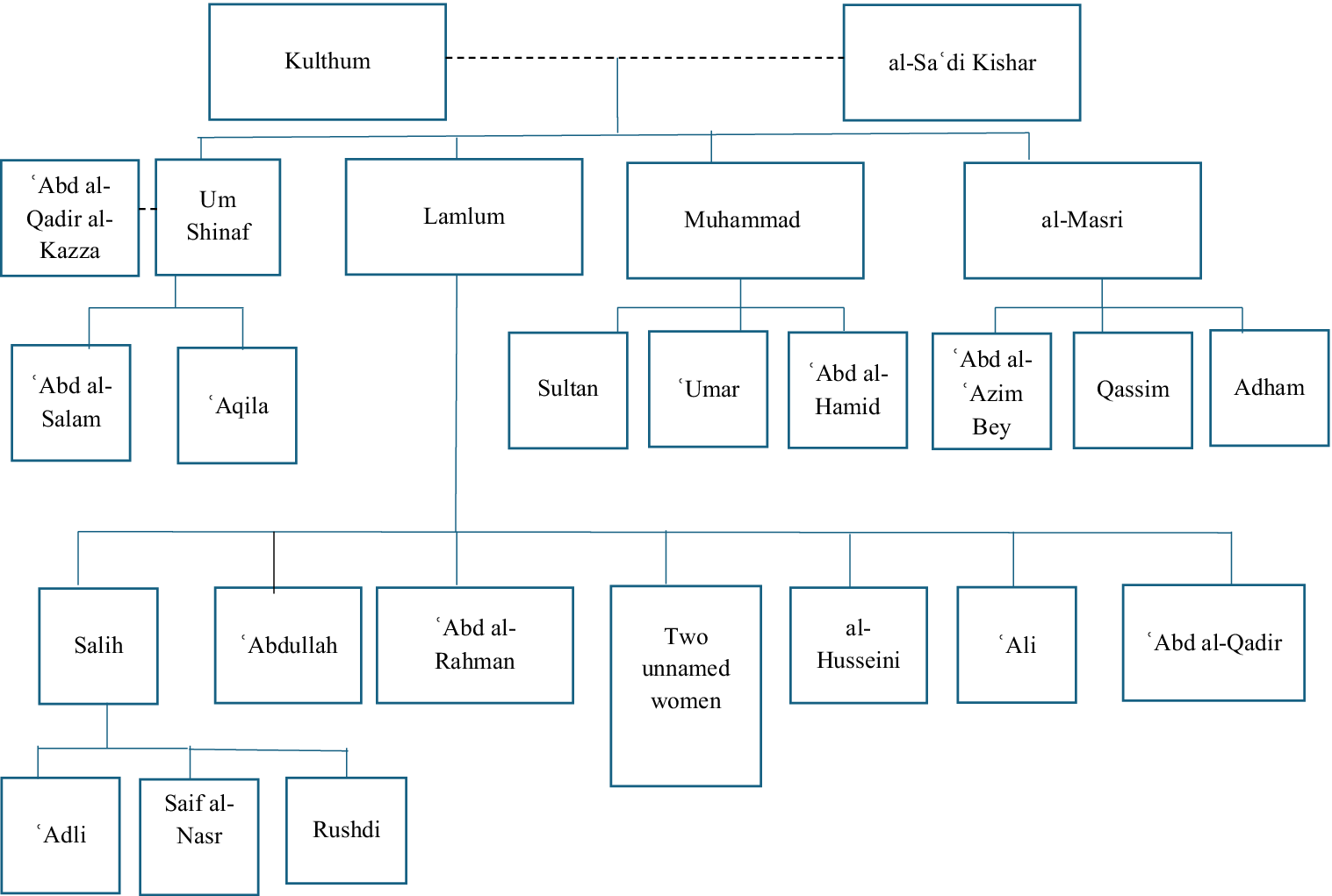
This episode positioned ʿAdli as an emblem of large landlords in the bygone monarchical era. ʿAdli’s wealth and power was made possible largely by his father, Salih Pasha Lamlum, who passed on his property and status to his son. This article traces the rise of the Lamlums, a branch within the Saʿdi family of the Fawayid tribe that migrated to Egypt from Barqa, Libya, in the 18th century.Footnote 5 Under the leadership of Salih Pasha, the Lamlum family reached its zenith. In this microhistorical account, I follow the family’s trajectory across three generations of tribal shaykhs that form ʿAdli’s lineage. Each of their careers was punctuated by revolutionary moments. Al-Saʿdi Kishar, the patriarch of the Lamlums, played a key role in an 1855 bedouin uprising. His son Lamlum al-Saʿdi’s career as ʿumda (headman) of the Fawayid tribe took shape during the ʿUrabi Revolt. Finally, Lamlum al-Saʿdi’s son, Salih, rose to prominence during the 1919 revolution (Fig. 1).
Family tree with focus on the male lineage of the three family members the article follows. Source: Reconstructed by the author from family obituaries in al-Ahram (Egyptian newspaper) between 1946 and 2016. Women’s names are rarely cited in these obituaries.

Figure 1. Long description
The family tree begins at the top with Kulthum and al-Sa’di Kishar connected by a dashed line.
Below them, the second generation consists of four branches from left to right:
1. Um Shinaf, who is connected to ‘Abd al-Qadir al-Kazza.
2. Lamlum.
3. Muhammad.
4. al-Masri.
The third generation branches out as follows:
- From Um Shinaf and ‘Abd al-Qadir al-Kazza: ‘Abd al-Salam and ‘Aqila.
- From Lamlum: Salih, ‘Abdullah, ‘Abd al-Rahman, Two unnamed women, al-Husseini, ‘Ali, and ‘Abd al-Qadir.
- From Muhammad: Sultan, ‘Umar, and ‘Abd al-Hamid.
- From al-Masri: ‘Abd al-‘Azim Bey, Qassim, and Adham.
The fourth generation descends from Salih at the bottom left, consisting of ‘Adli, Saif al-Nasr, and Rushdi.
The Lamlums’ history is telling but not exceptional. It is part of a larger process in which a new bedouin elite emerged throughout the 19th century. Bedouins, often called ʿurbān or ʿarab in Egyptian sources, were members of tribes that started migrating to Egypt from the Arabian Peninsula and North Africa as early as the 7th century. I use the word bedouin(s), unless quoting a primary source in Arabic, with an understanding that this is not a homogeneous category. Egyptian bedouins led diverse forms of living, subsisted on different economic activities, from pastoral nomadism to agriculture, and interacted with villagers.Footnote 6 The bedouin shaykhs were leading figures within their tribes whose roles underwent several transformations in the 19th century, as I will demonstrate. This article asks, How did the shaykhs of the Lamlum family amass their wealth and status between the early 19th century, when their tribe settled in Middle Egypt, and the mid-20th century, when they were one of the most propertied families in their province? And what does their family history reveal about bedouins’ paths to social mobility during a critical period of modern state-making?
Historiographies of modern Egypt have often confined bedouins to marginal roles and geographies. They are perhaps most dominant in scholarship on state policies toward bedouins, especially under Mehmed Ali (r. 1805–48).Footnote 7 In this literature, bedouins are exceptional figures, on the outskirts of historical transformation. In scholarship on land tenure and agrarian administration, bedouins are recipients of large land grants.Footnote 8 They are either absent or make marginal appearances in studies of Egyptian bureaucracy, rural governance, and policing.Footnote 9 In these scant appearances, they are often part of a criminalized class or the victims of state centralization and agrarian transformations that destroyed their ways of life. This historiographic marginalization exceptionalizes or erases the centrality of bedouins to political processes that reshaped bureaucracy and land ownership. Only a few works have shown the dynamic roles that bedouins played in provincial administration and in defining the Egyptian borderlands.Footnote 10 In the case of the Syrian interior, Nora Barakat has recently shown that the Ottoman state’s attempts to manage land and people through standardized administrative structures created “bedouin bureaucrats;” these were tribesmen who integrated state and tribal systems as administrators of their tribes and used their role as bureaucrats to accumulate political and material capital.Footnote 11
Barakat’s concept of bedouin bureaucrats provides an apt critical framework for analyzing the Lamlums’ generational accrual of power. I engage with and contribute to three specific aspects of Barakat’s work. First is the inextricability of land and bureaucracy. The settling of bedouin tribes (tawṭin al-ʿurbān) was a key aspect of Mehmed Ali’s bid to build a centralized bureaucracy.Footnote 12 The basic tenets of Mehmed Ali’s settlement policy (siyasat tawṭin al-ʿurbān) consisted of granting land to tribes, mostly through their shaykhs, to encourage their sedentarization.Footnote 13 In exchange for the use of bedouins’ horses and camels to transport commodities, as well as their participation in wars, the pasha offered certain privileges. The most important of these privileges was exemption from corvée labor and military conscription in times of peace.Footnote 14 This policy could not have worked without the incorporation of tribal shaykhs into state bureaucracy, specifically through their integration in provincial governance as administrators of their tribes. Through this process, many shaykhs started accumulating land.Footnote 15 Bureaucracy gave a path to land accumulation for those tribesmen who integrated with it. The Lamlums’ history shows that neither the shaykhs’ bureaucratic roles nor the processes of land accumulation were static. Second is the transformation of the political economy of the tribe through the newly acquired wealth and status of bedouin bureaucrats. The century-long rise of the Lamlums was marked by profound shifts in modes of capital accumulation. The polymorphous roles of the khedival and colonial states in agrarian management, crises in Egyptian fiscal sovereignty, the acceleration of agrarian capitalism through the commercialization of agriculture, gradual acquisition of individual property rights, and the separation of the majority of cultivators from the means of production impacted the distribution of property and authority among tribe members. Third is the endurance of the tribe as a category of belonging. The integration of bedouins into bureaucracy did not dismantle the tribe but transformed it into an administrative category that coexisted with state-making, settled agriculture, and private property regimes. Rather than begin with a set definition of the tribe, I let the historical processes I examine unravel the changing meanings of this category.
I argue that the uncertain and turbulent process of settling bedouins and streamlining tribal organization in 19th-century Egypt allowed bedouin shaykhs like al-Saʿdi and Lamlum to accumulate land and power in their capacity as bureaucrats. By the interwar period, changing political and economic conditions allowed new generations of landed shaykhs, including Salih, to disembed themselves from the bureaucratic net in which their predecessors had participated. Throughout a century of bureaucratic (dis)integration and land accumulation, these shaykhs transformed the meanings of tribal authority. Until the early 20th century, the Lamlum shaykhs had bureaucratic functions related to an administratively defined tribe. Salih’s tenure marked the transformation of this authority into a representative one, in which he could assume political functions as a spokesperson of Egyptian bedouins as a cohesive population, or better yet a “minority.” The Lamlums’ rocky journey to prominence shows the dialectic pull between bureaucracy and land, the unforeseen consequences of the settlement policy, and the malleability of the category of tribe.
Tracing the journey of the Lamlums required a reconstruction of fragmentary evidence from the Egyptian and British national archives, newspapers, and family histories. The Egyptian National Archives were indispensable for the earlier period covered in this article. Through one fragment of al-Saʿdi’s life, the 1855 rebellion, it was possible to retrieve rich details about the family. Focusing on one year across different records—such as al-Maʿiyya al-Saniyya (the viceregal department) and Diwan al-Khidiwi (the Department of Civil Affairs)—I recovered information on tribal shaykhs’ family members and possessions. In addition to records from Diwan al-Dakhliyya (the Department of the Interior) and al-Majlis al-Khussusi (the Privy Council), I studied the records of Sharqiyya, one of the provinces densely inhabited by bedouins.Footnote 16 These records were crucial in shaping my broader understanding of bedouin administration. The centrality of bedouins in these records, as a “problem” and as actors, defies any claims about their marginality.Footnote 17 To supplement the fragments provided by state and colonial archives, I used national newspapers and the available issues of the local newspaper al-Minya. I also examined family obituaries between 1944 and 2016 to redraw the family tree. Surviving members of the Kishar clan produced prosographies, recorded the tribe’s oral traditions, and preserved documents from family archives that were crucial for this article.Footnote 18 These were windows into migratory routes and significant incidents in the life of the tribe, as recollected by its members. Contrasting the memory of the family as preserved by its members with other commemorative practices, like the ballad of Makram al-Minyawi that I touch on later, was key to understanding the Lamlums’ complex legacies. As a microhistorical account, the family journey brings to life activities and relationships buried in broader national historiographies. However, as a history of an elite family of tribal shaykhs in a rural Egyptian province, there are stories it cannot tell. Ordinary tribe members experienced the events that made the Lamlums’ fortunes differently. Tribesmen in the borderlands also had distinct experiences.Footnote 19 These histories deserve their own studies and can only be briefly mentioned here.
Al-Saʿdi Kishar: Settlement, Rebellion, and Exile (1830s–1850s)
On 11 August 1855, the provincial governor (mudīr) of Bani Suaif and Fayum corresponded with Saʿid Pasha, the ruler of Egypt, explaining that al-Saʿdi Kishar, shaykh of the Fawayid tribe, “has not strayed off the straight path since his residence in the Oases. He is asking for forgiveness and would like his ‘group’ of about a thousand people to be considered among the compliant tribes.”Footnote 20 A month later, on 10 September, the mudīr of al-Minya and Bani Mazar inquired again about the status of al-Saʿdi and his brother Muftah. Muftah petitioned the mudīr, requesting that al-Saʿdi be allowed to return to the mudīriyya (province) with his tribesmen and surrender arms to the government. The mudīr stated that because Muftah and al-Saʿdi were among “the insurgent shaykhs,” he needed to present their case to the Khedive for consideration.Footnote 21 Why did al-Saʿdi and his brother rebel in 1855 and why did they plead for forgiveness? To answer this question, we need to look back to the family’s trajectory in the first half of the 19th century.
The precise migratory routes of the Fawayid tribe are subject to debate. One thing is certain: by the 19th century, the tribe resided in the “middle provinces” of al-Fayum, Bani Suaif, and al-Minya. Like many tribes in Egypt at that time, the Fawayid led a seminomadic life. They frequently raided neighboring villages and maintained tense and sometimes hostile relations with other tribes in the region.Footnote 22 Mehmed Ali’s settlement policy, which was continued by his successors, transformed the Fawayid’s relationship to land and authority throughout the 19th and 20th centuries. For any regime, bedouins could be a fearsome enemy—or a valuable ally—as an armed people, skilled at war, with incomparable knowledge of trade routes. For Mehmed Ali, bedouins’ lifestyle posed a more specific challenge to the rationale of centralized bureaucracy, in which subjects are countable, knowable, and locatable. Mehmed Ali’s policy of land and privileges in exchange for settlement and services served several goals: to settle bedouin tribes and streamline their administrative organization, ensure their loyalty and utilize their skills, and turn them into agricultural laborers.Footnote 23
Under the tenures of Mehmed Ali and ʿAbbas I (r. 1848–54), some of the Fawayid’s shaykhs received large land grants. Of particular interest to us is Mahjub Kishar, al-Saʿdi’s brother, who received at least 400 feddans of tax-exempt land from ʿAbbas I.Footnote 24 The correspondence between the provincial governor of al-Minya and the viceregal department following the 1855 rebellion makes it clear that al-Saʿdi also possessed landholdings, although their exact size is unknown.Footnote 25 Other shaykhs of the Fawayid tribe, such as Muqarrab al-ʿIlwani and Abu Quffa Khalil, also received land. The shaykhs of other tribes in the Delta and Upper Egypt received similar grants.Footnote 26 The land grants that bedouin shaykhs accumulated are usually analyzed in the broader context of Mehmed Ali’s agricultural policies.Footnote 27 Agricultural revenue was crucial to financing the pasha’s military ventures and cementing Egypt’s independence of the Ottoman Empire. His agricultural policies transformed labor and tenure regimes. These transformations consisted of the elimination of iltizām (tax farms); expansion of the cultivation of cotton, especially long-staple cotton after 1821; a more aggressive turn toward export-oriented cash-crop agriculture; and state control over the production and distribution of crops.Footnote 28 Since 1826, to maximize production and tax extraction and ensure loyalty, many rural notables and state officials had received tracts of tax-exempt ibʿadiyyāt (idle or uncultivated) lands.Footnote 29
However, most of the bedouin shaykhs who received large land grants were not rural notables or high state officials at this point. Their path to land accumulation was, at least in its initial stages, somewhat distinct from other landowners. The land granted to various members of bedouin tribes served as tools of discipline and bureaucratic co-optation. These grants came with a distinct set of conditions and privileges that did not apply to other landholders. One important condition was that bedouins cultivate the land themselves. In 1850, an order from ʿAbbas I emphasized that the “ʿurbān were responsible for farming the land,” and using the fellahin in its cultivation would result in land confiscation.Footnote 30 These grants sought to settle bedouins and transform them into “productive” subjects. In parallel with these land grants, bedouins were subject to administrative changes. Mehmed Ali introduced new offices, like that of nazir al-ʿurbān, which managed the daily affairs of bedouins.Footnote 31 Simultaneously, since 1833, bedouin shaykhs had started slowly integrating with the bureaucracy of their provinces.Footnote 32
The shaykhs’ newly granted lands came with increased authority over their tribe, more defined bureaucratic duties, and the expectation of rendering services to the government. Under Mehmed Ali, the Fawayid tribe was split into two shaykhdoms, which marked the territorial and administrative jurisdictions of designated shaykhs over the tribe, its members, and the land they managed. The “Southern (Qiblī) Fawayid” resided in al-Minya, whereas the “Northern (Baḥarī) Fawayid” resided in Bani Suaif and al-Fayum. The shaykhs of the Fawayid who benefited from land grants began settling their tribes, offering the government services, and acting as administrators. For instance, in 1834–35, Mehmed Ali used the bedouins of the middle provinces and the Delta to quell a rebellion by bedouins in Gaza.Footnote 33 The Fawayid, among others, were required to send at least 250 of their members to Gaza.Footnote 34 Until the rule of ʿAbbas I, the Fawayid tribe numbered 7,000 people. According to the 1883 census, there were about 13,190 members of the tribe, most of them in al-Minya.Footnote 35 At this point, each tribe had several mashāyikh heading subdivisions, with one or a few ʿumad at the head of the tribe, depending on its size. The tribal mashāyikh headed relatively small groups (firaq) within the tribe, and the ʿumad were the headmen of the collective.Footnote 36 This was an important transformation in the nature of tribal shaykhs’ authority. Before Mehmed Ali, the Ottoman government considered the shaykhs’ authority territorially defined rather than designated authority over a segment of the tribe.Footnote 37
One of the most important administrative duties that came with the shaykhdom was census-taking, an increasingly important task to meet military and fiscal demands.Footnote 38 Census-taking shows how bedouins became at once actors in and objects of a new form of bureaucratic governance. In preparation for the first nationwide census in 1848, Mehmed Ali sent an order on 14 October 1847 to “all the mashāyikh and ʿumad of the ʿurbān” asking them to promptly complete the census.Footnote 39 The census was also important for bedouin exemptions from conscription and corvée labor. What we see here is the making of bedouins as a population through the transformation of their shaykhs into census-takers responsible for the administrative legibility and “scientific” enumeration of their tribe members. Turning individuals into a population was a bureaucratic act, not a natural occurrence. The seemingly mundane task of counting, listing, and describing tribe members constituted an authoritative mandate. In fact, over the next decades tribal shaykhs and villagers would use the census in unforeseen ways. Villagers bribed tribal shaykhs to include them in their census, thereby evading conscription and corvée duties.Footnote 40 Such practices point to the transformation of the tribe into an administrative unit. Tribe members were those recorded by the shaykhs as such. Although tribes have always been formed on bases that bypassed kinship, like political and economic alliances, the 19th-century tribe revolved around administrative privileges and responsibilities. By the end of ʿAbbas I’s rule, the settlement policy had opened the door for the formation of powerful tribal households headed by landed shaykhs vested with official responsibilities over members of their tribes.
The path of landed households to wealth and power was, however, not linear. The relationship between the settling tribes and the authorities was ridden with violent contestations. In fact, the fortunes of al-Saʿdi Kishar took a temporary turn for the worse in the 1850s. We return to the Kishar brothers’ petitions. Saʿid Pasha (r. 1854–63) started his tenure with a new set of measures regarding bedouins, including increasing land taxes, confiscating arms, and mandating travel certificates (tadhākir murūr) to control movement.Footnote 41 He also attempted to abrogate bedouin privileges, particularly exemption from conscription.Footnote 42 These measures triggered one of the most tumultuous confrontations between bedouins and the authorities. The ʿUmar al-Masri rebellion, named after its leader, most likely started in Sharqiyya province when Mahmud Sultan, shaykh of half of the Hanadi tribe, his son, and his nephew refused paying arrears in protest of Saʿid Pasha’s new measures.Footnote 43 Although it is unclear why, Sultan’s son and nephew also murdered the ʿumda of the town of Qasasin.Footnote 44 The new ruler of Egypt showed them no mercy. On 8 June 1855, a firmān dismissed Mahmud Sultan and appointed Sulayman al-Tahawi instead. Sultan’s son and nephew were hanged for murder.Footnote 45 Although the tribes of Sharqiyya accepted the new measures, the discontent had already spread to Upper Egypt, where it took a more belligerent turn.
Under the leadership of ʿUmar al-Masri, shaykh of the Jawazi tribe, several shaykhs rejected the new measures. Al-Saʿdi Kishar was among them.Footnote 46 The rebellious shaykhs refused to hand in their arms as requested by the government. They also resisted centralized control of their movement by refusing to accept travel certificates for their tribe members. In the following month, they conducted raids and robberies against villages, where they attacked both villagers’ and government property. For instance, they stole camels that belonged to the government in Bani ʿUday in Asyut province. They also raided the ibʿadiyyāt of government officials like that of Ahmed Pasha al-Mankali and killed thirty of the mudīriyya’s soldiers in Asyut.Footnote 47 By July 1855, the rebellion had become seriously threatening and evolved into a full-scale armed confrontation between government forces and the rebellious tribes, referred to as ashqiyāʾ al-ʿurbān in official correspondence.Footnote 48 The rebellion created a distinction between “compliant” and “insurgent” groups. Even within the same tribe there were contradicting attitudes toward the events. For instance, although al-Saʿdi Kishar joined the rebellion, members of the Fawayid tribe under the shaykhdom of Hamdi Sulayman accepted the measures.Footnote 49
As the rebellion escalated, Saʿid Pasha deployed infantry, cavalry, and artillery forces to contain it. Eventually, he crushed the rebellion, executed some of its leaders, and imprisoned others. He also confiscated the lands of rebellious shaykhs. Saʿid succeeded in imposing most of his measures. He did not alter bedouin privileges, but he enforced the use of travel certificates and imposed a higher land tax (kharajiyya) on most of their lands.Footnote 50 A year earlier, he had imposed the ʿushūriyya tax on previously tax-exempt land.Footnote 51 In the aftermath of the rebellion, many of the insurgent shaykhs escaped to avoid arrest and execution.Footnote 52 Al-Saʿdi took refuge in the oases of the Egyptian Western Desert. The pursuit of the runaway shaykhs, like al-Saʿdi, continued for a year in the west of Egypt all the way to Siwa and in the south all the way to Kurdufan.Footnote 53
Perhaps more important than the rebellion was the attitude of fractious shaykhs and tribes after its conclusion. Many members of rebellious tribes pleaded for forgiveness. In June 1855, the authorities warned the Fawayid shaykhs that those who proved their innocence and promised to surrender their arms must move their tribesmen to the east of Bahr Yussuf, the canal linking Fayum to the Nile. Anyone found west of Bahr Yussuf would be executed as a rebel.Footnote 54 The Tarhuna tribe members in Upper Egypt also petitioned Saʿid Pasha on 20 July 1855, pleading with him not to expel them from the country.Footnote 55 For bedouins who had settled over the previous decades and depended on agriculture, expulsion was an uprooting. A three-day grace period was granted to bedouins in response to the Tarhuna’s petition, after which anyone found without a travel certificate was to be considered a rebel and executed.Footnote 56 Saʿid pardoned some tribes and restituted part of their lands if they moved to the Delta, farmed the land, signed pledges of loyalty, and used travel certificates.
It seems that al-Saʿdi Kishar was not so lucky, despite his and his brother’s pleas. There is no conclusive evidence about his fate. It is most likely that Saʿid refused to pardon him. Shortly after the warning sent to the Fawayid tribe, twelve of the tribe’s shaykhs moved from the west to the east of Bahr Yussuf to prove their compliance. Al-Saʿdi Kishar was not among them.Footnote 57 A later document mentions that ʿUmar Mahjub Kishar, al-Saʿdi’s nephew, was among the arrested male relatives of the rebellious shaykhs. The correspondence still referred to al-Saʿdi as a rebel, hinting that he was not pardoned.Footnote 58 In the tribe’s oral traditions, the rebellion resulted in the family’s exile to Libya. Al-Saʿdi’s four children, Lamlum, al-Masri, Muhammad, and Um Shinaf, would reside there until Saʿid Pasha’s death.Footnote 59 As there is evidence that the male relatives of rebellious shaykhs were targeted, it makes sense that al-Saʿdi’s children would flee for their lives.
The 1855 rebellion captures a moment of contention over the terms of settlement, bureaucratic authority, and state encroachment upon bedouin autonomy. The settlement of tribes through land acquisition and bureaucratization of the shaykhdom was a process negotiated under specific terms and conditions. The confiscation of arms and introduction of travel certificates introduced an additional layer of administrative control over bedouin tribes. Not all shaykhs were ready to accept these new terms. The rebellion also revealed the nature of the shaykhs’ grip on the land. Their tenure could be fragile in troubling political times; the rebellious shaykhs’ lands were confiscated, auctioned, and reassigned. Yet, through the same conditions of its confiscation, the land could be retrieved again as a grant from the ruler. Why then did al-Saʿdi and other shaykhs request the ruler’s pardon despite the enforcement of many of the measures they rebelled against? Perhaps the fate of the arrested and executed shaykhs was cautionary enough. It might have convinced the rebellious shaykhs that it was better to join the state machinery than to fight it. Certainly, over the following years, many of these shaykhs coveted revenues from their land and feared its confiscation. Saʿid may have introduced higher taxes, but he also consolidated more affluent landholders’ property rights while decreasing the fellahin’s ability to recover or acquire land. This materialized most clearly in the 1858 land code.Footnote 60 Better irrigation technologies and the rising export prices of some crops also increased land value.Footnote 61 This probably persuaded many shaykhs to return to their properties over the next decade.
Lamlum al-Saʿdi: The Return, the ʿUmudiyya, and the ʿUrabi Revolt (1860s–1910s)
On 10 November 1863, the newly throned Ismaʿil (r. 1863–79) pardoned bedouins who had fled under Saʿid and pleaded for forgiveness on the condition that they work in agriculture and follow “the straight path.” Most important, Ismaʿil agreed to return their seized lands or replace them with other mīrī (state-held) lands. A fifteen-article code (laʾiḥat muʿāmalat al-ʿurbān) managed the land (re)distribution.Footnote 62 The code introduced giving land to tribe members in article 3, which stipulated that heads of households should be given two feddans for every five family members. Simultaneously, the code reinforced the stark difference in property ownership between tribe members and the ʿumad and mashāyikh. The mashāyikh were to be given no less than fifty and no more than a hundred feddans depending on the size of their tribe. The tribes’ ʿumad were to be given no less than a hundred and no more than 150 feddans from ibʿadiyya or matrūk (abandoned) lands.Footnote 63 Therefore the shaykh’s property was on average 125 times the size of the ordinary tribe member’s. The shaykhdom was often inherited, allowing for the gradual accumulation of property within the same families.
Another key point of distinction between the shaykhs and the tribe members was the issuance of title deeds, addressed in articles 6 to 10. For instance, according to article 6, those who had ibʿadiyyāt in their names before Ismaʿil’s era and had lost their title deeds were to be issued new deeds after a verification process.Footnote 64 These articles do not stipulate that title deeds should be exclusively issued for shaykhs. Yet those who had ibʿadiyyāt, proof of previous deeds, or land grants in their names were usually the shaykhs of the tribe.Footnote 65 The most important feature of the code, however, was the institutionalization of land grants in exchange for bureaucratic functions. Previously, these lands were a customary grant from the ruler. The code made these lands, and a specific amount of them, the legal right of “bedouin bureaucrats.”Footnote 66
Ismaʿil’s pardon of the bedouin rebels is partly explained by his agrarian policies. The 1860s witnessed the expansion of perennial irrigation across the Nile Delta, which supported cotton cultivation, mostly for export, and the cultivation of several crops per annual cycle.Footnote 67 The spike in cotton prices after the outbreak of the American Civil War made it an even more profitable crop. The cultivation of sugar also burgeoned in the 1870s in al-Minya and Asyut.Footnote 68 In this context, his (re)distribution of land among tribal shaykhs for increased cultivation and tax payment is understandable, especially because some officials perceived Saʿid’s confrontation with them as impulsive and unnecessary.Footnote 69 The last quarter of the 19th century also witnessed the increased acquisition of full property rights over land. This process started in earnest with the law of muqabala (literally, quid pro quo) in 1871, when the government, in need of cash, granted full property rights to those able to advance six years of land taxes.Footnote 70 Only the wealthier landowners could manage to pay this kind of money. It was difficult for tribe members to own their land, even if they had the money. Letters from Sharqiyya show that tribe members attempted to pay the muqabala, but the mudīriyya argued that these lands were only given as usufruct, and the muqabala did not apply to them.Footnote 71 The acceleration of agrarian capitalism under Ismaʿil meant that shaykhs who consolidated and expanded their holdings secured considerable profit. Full individual property rights were granted under the British in April 1891.Footnote 72
It is in this context that the sons of al-Saʿdi eventually returned to Egypt in a more fortuitous chapter of their history. Their sister, Um Shinaf, stayed in Libya and married ʿAbd al-Qadir al-Kazza from the prominent ʿAwaqir tribe.Footnote 73 Although we do not know the exact date of return of the Saʿdis, by the beginning of the 1880s they had regained their status as tribal shaykhs in al-Minya province. In 1881, Lamlum al-Saʿdi was among the notables of Maghagha who fed the poor during the popular festival (mūlid) of Shaykh ʿAbd al-Latif.Footnote 74 Lamlum and his brothers had probably resettled in the province over the previous years and regained their prestige. Sometime in the 1880s or earlier, Lamlum al-Saʿdi was made ʿumda of the Fawayid tribe. In 1882, as the British invasion crushed the ʿUrabi Revolt, Lamlum was arrested for participating in the revolt.Footnote 75 In December 1882 Lamlum was released and sentenced to house arrest, fined 4,000 pounds of insurance over four years, and stripped of his titles and honors (but not his possessions).Footnote 76 This means that Lamlum did in fact possess titles and honors before the British invasion. Khedive Tewfik (r. 1879–92) pardoned him in January 1886 and reinstated his titles and honors. The news of his pardon refers to him as “shaykh al-ʿArab” and the ʿumda of the Fawayid tribe.Footnote 77
In his position as ʿumda of his tribe, Lamlum amassed land and status. The office of the ʿumda (ʿumūdiyya) may have been at the lowest tier of the civil hierarchy, but it was a gateway to capital accumulation. Even if he was unable to retrieve the family’s prior possessions, under the 1863 code Lamlum received at least a hundred feddans as ʿumda. Throughout the 1880s and 1890s, he would have been able to acquire more land through purchase, no longer relying on khedival benevolence for land accumulation. When the British occupied Egypt in 1882, large landowners and the Khedive held “over 40% of the country’s agricultural property.”Footnote 78 The British did not remedy the uneven patterns of land ownership. Their rural policies focused on increasing the productivity of smallholders and improving the quality of crops, especially cotton, through new irrigation techniques, better transportation systems, and restructured taxes.Footnote 79 As Aaron Jakes cautions, British economic policies must not be read as having always intended to enrich large landowners and impoverish the fellahin. The effects of these policies ended up benefiting large landowners all the same, even if somewhat inadvertently.Footnote 80 By the 1890s, Lamlum was among the landowners who benefited from these policies and formed private estates (ʿizab). These large private estates proliferated during Ismaʿil’s tenure and flourished under British rule, exacerbating the divisions between landowners and cultivators who were either tenants or daily wage workers on these estates. A distinct class of large landowners took shape among bedouin shaykhs, and most of the tribe members eventually became tenants. By the first half of the 20th century, the Lamlums were town dwellers with land in Maghagha, property in urban centers, and notably a palace in Heliopolis, an affluent neighborhood to the east of Cairo.
In the long run, the greatest beneficiaries of the settlement policy were the tribal shaykhs and ʿumad, like Lamlum al-Saʿdi. Those who received land before Ismaʿil’s era were able to document their holdings. Those who did not have land were granted relatively large swaths of territory under the new code. Kenneth Cuno argues that Mehmed Ali’s policies temporarily hindered the movement to private property but facilitated it in the longer term.Footnote 81 This holds true for the tribal shaykhs who, by the end of the 19th century, began accruing wealth independently of state authority. That is, a different process of capital accumulation was starting to take shape. Accumulation, as Kristen Alff argues, was transformed into a more impersonal “thing-like” process.Footnote 82 These gradual changes in the mode of capital accumulation rendered widespread bedouin rebellions like ʿUmar al-Masri’s less likely. The stakes of losing land were too high, and the possibility of retrieving it through khedival orders more difficult. Moreover, the tribal shaykhs’ incorporation into state bureaucratic governance had become more ingrained. The same can be said of their assimilation into village life, along with their tribe members.
Contestations over the terms of bedouin settlement did not disappear but were negotiated differently. In 1895, the Ministry of Interior’s new regulations on the appointment of guardsmen in areas inhabited by bedouins caused discontent among several tribal shaykhs. The regulations delegated the selection of guardsmen to government officials and the village ʿumad. Many tribal shaykhs saw this as an encroachment on their privileges, because the selection of these guardsmen had been their prerogative. Some of the protesting shaykhs suggested that if these measures were adopted, they may choose to leave Egypt “with the Khedive’s permission.”Footnote 83 Rather than declaring rebellion, these shaykhs objected by writing letters to national newspapers or, in true bureaucratic fashion, by petitioning the Ministry of Interior and the khedive in July 1896.Footnote 84
Lamlum may have been able to accumulate land without relying on state authority by the end of the 19th century, but much of his status depended on the administrative functions he exercised over his tribe. Since his pardon in 1886, Lamlum’s stock had been on the rise, not only because of how much land he accumulated but also because of his performance as ʿumda. Over the years, he became a trusted bureaucrat among British officials and with the Khedive. In September 1891, Lamlum appointed some of his tribesmen to help the police arrest wanted criminals in al-Minya. With the efforts of his men, the police were finally able to arrest the wanted outlaw Muhammad Abu Musa and his accomplices.Footnote 85 These efforts earned Lamlum the Khedive’s favor. In October 1891, Khedive Tewfik rewarded him with the bahawiyya, the second most prestigious civil rank in Egypt at the time.Footnote 86 From then on, Shaykh al-ʿArab Lamlum al-Saʿdi also became Lamlum Bey.Footnote 87 His power soared between the 1890s and 1910s.Footnote 88 He took every opportunity to praise the khedive and to declare that “upholding security” was of utmost importance to him.Footnote 89
The 1905 law on the administration of tribes comprehensively laid out the duties and benefits of tribal shaykhs like Lamlum. The first four articles addressed the relationship between the provincial administration and bedouin tribes: each tribe should have a primary residence in the province specified by the Ministry of Interior, and each province should have a local committee for “the affairs of the ʿurbān.” The rest of the twenty-five articles delineated the appointment, dismissal, duties, rewards, and sanctions of tribal ʿumad and mashāyikh. The ʿumda was responsible for the “good conduct” of his tribe and had an agent or representative in each mudīriyya in which fifty or more members of his tribe resided. The mashāyikh were responsible for a smaller number of tribesmen residing in the surrounding areas. The ʿumad were responsible for arresting wanted members of their tribe, and the mashāyikh were responsible for any individuals among their respective groups. The ʿumad and mashāyikh were fully responsible for executing police orders related to their tribe members. The ʿumad were also exempt from the taxes of five feddans of their lands as long as they were in office.Footnote 90
A controversy regarding Lamlum indicates his status at the turn of the century. In October 1905, al-Ahram newspaper published an article defending Lamlum Bey against rumors around the “issue of slaves.” The anonymous author stated that the “slaves in the Bey’s house enjoy the utmost freedom that any servant can have, and that he had issued manumission papers for the people he brought with him from Benghazi.”Footnote 91 It is unclear exactly what the rumors were and whether Lamlum was a slaveholder in 1905. It is, however, clear that he had a large number of servants in his household, that he brought enslaved people from Benghazi (even if he issued them manumission certificates), and that there were rumors around the mistreatment of these people. We do not have more information about these captives or the conditions under which they were brought to Egypt; it is hard to fully analyze these relationships of bondage. However, some points stand out and are traceable. Historically, prominent bedouin shaykhs owned enslaved people, and they likely continued to do so into the 20th century, despite the formal abolition of the slave trade.Footnote 92 Moreover, the manumission of enslaved people did not necessarily lead to “freedom.” The Benghazi captives may have been manumitted but recruited as wage laborers or sharecroppers on the Bey’s private estate. Although not enslaved, laborers on these estates were hardly “free.” In the absence of evidence, it is hard to make claims about Lamlum’s household, but it is certain that large estates were sites of corporal violence and abuse. As Samera Esmeir shows, cultivators in large estates lived under legalities established and enforced by estate owners that were outside the gaze of colonial positive law’s regulatory powers.Footnote 93
By the beginning of the 20th century, the majority of bedouins in Lower and Upper Egypt, including those who did not own land, had settled.Footnote 94 Those who maintained a nomadic lifestyle remained primarily in the western and eastern deserts where Egyptian sovereignty had been fragmented. Although many of the tribe members who settled as farmers migrated seasonally to the desert borderlands and other territories like Gaza, this mobility was controlled. The mudīriyya issued travel certificates based on lists prepared and stamped by tribal shaykhs.Footnote 95 Although other factors contributed to this settlement, the shaykhs’ authority and their role in policing and law enforcement were crucial. The marriage of land granting and bureaucratization created a class of elite shaykhs and largely settled bedouins. The closely knit system of governance that took shape in the 19th and early 20th centuries revealed a hierarchical and bureaucratized definition of tribe, in which tribal shaykhs were subordinate to state institutions and tribe members subordinate to their shaykhs. Tribe members were not entirely powerless in this new bureaucratic arrangement. They could use the same bureaucratic tools that established the shaykhs’ authority to contest it; some complained to the government against the shaykhs, asked for their dismissal, or petitioned for transfer to the authority of a different shaykh.Footnote 96
As Khaled Fahmy has argued, bureaucratization was the hallmark of legal and institutional transformations in 19th-century Egypt. Individuals became increasingly embedded in a web of written documents.Footnote 97 The men who populated this newly formed bureaucracy were not isolated from material and economic conditions. They were a product of them. Insofar as political economy is always a set of relations rather than static realities, the rise of the authority of tribal shaykhs in relation to the members of their tribes is one manifestation of agrarian capitalist transformation and the evolution of bureaucratic state-making. It is important to note that despite the formation of an elite class among the shaykhs and the settlement of most tribes in Upper and Lower Egypt, bedouins persisted as a troublesome category, if not an inherently criminal one, to khedival and British authorities. An 1888 report from the Cairo police to the Ministry of Interior described bedouins as uncivilized people (hamag) who always stirred up criminal activity, wherever they were.Footnote 98 A 1901 manual for village ʿumad classified bedouins as a category of people in constant need of surveillance.Footnote 99 These discourses are indicative of the construction of bedouins as subjects in perpetual need of reform, discipline, and redemption. The making of landed bureaucrats among the shaykhs happened in parallel with the policing and “othering” of bedouin tribes. In fact, the disciplinary authority of the shaykhs partially rested on this process of othering that constructed bedouins as people who required special modes of governance.
Salih Lamlum: Representation, “Minorities,” and the British (1910s-1938)
“Oh Salih, we have money from Maghagha to Giza.”Footnote 100
—Excerpt from the ballad of Makram al-Minyawi, “The Story of Salih Pasha Lamlum”
Lamlum’s son Salih was already a player in tribal and political affairs by the 1910s. By 1911, Salih had secured the honorific title of Bey. In April 1917, he was one of a delegation of “big cultivators” meeting with the minister of agriculture in al-Minya.Footnote 101 When his father died sometime between 1917 and 1919, Salih inherited land as well as the tribe’s ʿumūdiyya. This decade, which encompassed the passing of Lamlum and rise of Salih, was one of major transformation. The declaration of Egypt as a protectorate in 1914 entailed more aggressive British intervention in Egyptian agricultural and financial affairs.Footnote 102 By 1914, perennial irrigation had become a reality in Upper Egypt. After World War I, the British introduced technological changes in agriculture to offset the impact of the war and the shortcomings of their prewar agrarian policies. These postwar reforms, like the heavy use of fertilizers and changes in crop rotation, favored large landowners.Footnote 103 What might have been an inadvertent consequence became a more intentional British policy of favoring large landowners after the 1907 financial crisis and World War I.Footnote 104 At the same time, big proprietors became key players on the Egyptian political scene.
Salih’s career as ʿumda of the Fawayid also coincided with the 1919 revolution, the formation of the Wafd Party, and Egyptians’ struggle for independence. Salih quickly filled his father’s shoes, but also departed from him in crucial ways. Rather than confining himself to bureaucratic functions as ʿumda of his tribe, Salih sought to represent the bedouins of Egypt writ large. In negotiations with the government and the British occupation, he positioned himself as a spokesperson of Egyptian bedouins on the national political level. Nothing in his official duties as ʿumda suggested wider political representation, nor was there a mechanism to ensure such a process. This quest for a representative authority first appears in his advocacy against the abolition of bedouin privileges between 1920 and 1923.
In the aftermath of the 1919 revolution, Salih and other bedouin shaykhs feared that Egyptian independence might threaten bedouin privileges. The most significant of these was exemption from military service and Nile protection service, a form of corvée labor that guarded the Nile banks during the annual flood. In exchange for protecting hills and routes, bedouins were exempt from this service.Footnote 105 In 1917, Sir Reginald Wingate, the High Commissioner in Egypt, established the Frontiers Districts Administration (FDA) to administer the areas outside the Nile Valley, namely the Sinai and the Eastern and Western Deserts. In October 1920 Salih met with the FDA’s acting military administrator to express apprehension of “the Bedouins of Egypt” about losing “privileges granted to them by Mohammed Ali should Egypt become self-governing.”Footnote 106 He warned that a recent meeting of bedouin shaykhs concluded that if “the Arabs of Egypt” lost their privileges, they might no longer adhere to the Egyptian government’s authority.Footnote 107 Salih spoke on behalf of the entirety of Egyptian bedouins, not the Fawayid tribe. The FDA was skeptical; Salih “speaks of the Bedouins in Egypt as their spokesman. This is hardly correct. The Lamlum family has great power, but it does not control all or nearly all the Bedouin tribes in Egypt.”Footnote 108 In the years to come, this skepticism eroded as Salih consolidated his representative authority.
Between 1920 and 1922, Salih took a more active role in public life. On 9 October 1921, Sultan Fuʾad (r. 1917–36) granted Salih the pashawiyya, the highest honorific title in the country.Footnote 109 In 1922, Salih joined ex-Wafdists, notables, and eminent politicians in founding the “Liberal Constitutionalist Party” (al-Ahrar al-Dusturiyyin). This was a moderate nationalist party that sought both independence and affiliation with the king and the British. It represented the landed elites for the following three decades.Footnote 110 Most important, in 1922, Salih served on the Constitution Committee. As the only bedouin shaykh on the committee, he took his place among thirty-two men entrusted with drafting the Egyptian constitution.
Salih’s appointment was not without controversy. Wafdists contested the committee’s broader legitimacy, as members were not elected but appointed by the government. Some criticized Salih’s appointment specifically, pointing to his “weak” literacy. A member of the committee defended him, arguing that literacy status was irrelevant, and there could be no argument against appointing a “bedouin from the most notable of families who knows the traditions of his group best.”Footnote 111 Salih’s appointment was legitimate because he “knew” and could represent bedouin traditions—rendered homogeneous here—best.
The committee started its work in April 1922. The proposed article 3 stipulated that all Egyptians were equal in rights and duties regardless of origin, language, or religion. This article, if passed, would effectively end bedouin privileges. In the committee’s discussions, Salih suggested deferring the question of bedouin privileges to the parliament to decide at a later date. The majority of his colleagues disagreed.Footnote 112 At this point, Salih and other tribal shaykhs turned to the British. Between September 1922 and March 1923, Salih led a number of tribal ʿumad, shaykhs, and notables in petitioning the British against the abolition of bedouin privileges.Footnote 113 He hosted meetings in his house, presided over delegations that met with Lord Allenby, the British High Commissioner, and was the first signatory on written petitions.Footnote 114 In September 1922, he sponsored the publishing of a booklet on bedouin privileges titled The Bedouin Arabs in Egypt: A Report on their Privileges (Al-ʿArab al-badw fi Misr: bahth hawl imtiyazatihum) by ʿAbd al-Majid Bey Lutfi, a notable from the Khuwaylid tribe.Footnote 115 Salih’s leadership is not surprising. At this point, he was a prominent political player who certainly wielded authority among bedouin shaykhs as a member of the Constitution Committee. Although Salih also petitioned the Egyptian government in September 1922, it appears that his lobbying efforts were primarily directed to British officials.Footnote 116 This was in part due to the upheaval in political authority, as two different Egyptian governments had resigned between 1922 and 1923. This instability, as well as Salih’s failure to defer the matter of bedouin privileges to parliament, may have led him to calculate that the British would be the most influential party in the outcome of the constitution.Footnote 117
In their first petition to Lord Allenby in September 1922, the ʿumad and notables of at least six tribes expressed their concerns with the loss of bedouin privileges and requested treatment as a minority under British protection.Footnote 118 The protection of minorities was one of the four domains reserved under Britain’s “absolute discretion” in the declaration of independence of on 28 February 1922; this was another reason British lobbying seemed to be the most auspicious avenue. The petition marked one of the first instances that bedouin shaykhs used the term “minority” to describe themselves and their status. Between November 1922 and January 1923, delegations of bedouin shaykhs met with Lord Allenby and other British officials to make their demands.Footnote 119 They protested the proposed article 3 and suggested the addition of a clear reference to bedouins’ exemption from the military and the Nile protection service. In January 1923, Allenby responded that, although he had great sympathy for the bedouins, this matter should be in the hands of the Egyptian government.Footnote 120 The petitioners further pressed Allenby to reconsider. They assured him that they represented the opinion of the ninety-three tribes residing in Egypt.Footnote 121 In March 1923, Allenby ended the negotiations, arguing that the issue did not fall under the protection of minorities because the constitution provided that all Egyptian nationals would enjoy the same civil and political rights. Allenby argued that “his majesty’s government … had undertaken to see [this equality] enforced by the Egyptian government towards racial and religious minorities.”Footnote 122
These negotiations document a set of transitions. The first was the effort of Salih, among others, to transform the tribal ʿumad and shaykhs into political representatives of an aggregate and homogeneous bedouin population rather than administrators of defined tribes or segments of tribes. In their last petition to Allenby, the signatories claimed they represented all Egyptian tribes, even though they were thirty-six ʿumad and notables from only twenty-two tribes.Footnote 123 It is unclear what the claim to represent “the opinion” of all Egyptian tribes meant.Footnote 124 It is questionable whether tribe members’ opinions were accounted for, especially as many of them had become settled cultivators at this point.Footnote 125 Even at the level of notables, each tribe could have more than one ʿumda and certainly include a large number of shaykhs. As to be expected, notables of the same tribe were not in consensus on major questions, such as that of Egyptian independence. For instance, al-Masri al-Saʿdi, Salih’s uncle, was staunchly anti-British.Footnote 126
The key second transition was the transformation of bedouins into a minority. In al-ʿArab al-badw fi Misr, Lutfi argued that safeguarding bedouin privileges would “not cost the government anything,” and that the remaining privileges were insignificant and benefited only a few.Footnote 127 Why then would these shaykhs lobby so adamantly for these privileges? Military exemption was possibly still significant to some. Yet the real bone of contention was the tribal shaykhs’ authority. The functions of the ʿumad and mashāyikh would become obsolete if the administrative distinction between bedouins and village dwellers disappeared. In this case, becoming a minority, in the sense of an institutionalized political status recognized by occupying powers, could grant special rights to bedouins. It also might require representatives to speak in the name of this minority and thereby guarantee the shaykhs a form of authority.Footnote 128
Minority rights had become a significant issue in the Ottoman Empire as early as the 19th century. In the interwar period, the concept acquired an authoritative definition from the League of Nations.Footnote 129 In Egypt, the question of minorities had been heavily debated since the 1910s.Footnote 130 There was no consensus on use of the term among the communities belonging to these minority categories. For instance, Egyptian Coptic intellectuals and politicians debated whether minority status guaranteed equality or reified difference. The Constitution Committee considered the recognition of minority rights to ensure equality, but ended up rejecting the proposal after lengthy discussions.Footnote 131 The bedouin shaykhs’ quest for minority status is interesting because it was not framed as a guarantee for equality but rather couched in a rejection of equal citizenship rights and duties to safeguard bedouin privileges.
Although Salih failed to secure British protection of bedouins as a minority, he ascended as a de facto representative of Egyptian bedouins as a cohesive population in the next decade. The 1923 constitution stipulated equal rights and responsibilities for all Egyptians. In practice, the FDA ruled bedouins in the territories under its jurisdictions through exceptional laws.Footnote 132 Notably, the FDA governed these provinces through customary law (ʿurf) rather than Egyptian civil and penal law until 1936. The FDA operated under the four reserved clauses that also gave Britain the right to protect Egypt against foreign aggressors and secure imperial communications. British officials understood control over borderlands, largely inhabited by bedouins, as essential for security and for the protection of the Suez Canal. Throughout the 1920s and 1930s, the FDA was the source of national resentment. Many Egyptians saw it as a flagrant symbol of British colonialism.Footnote 133 None of these factors tarnished Salih’s relationship with British officials. Indeed, the relationship grew stronger. Salih hosted a party in honor of the next British High Commissioner in Egypt, George Lloyd (1925–29).Footnote 134 More important, FDA officials seemed to consult with him and his cousin Sultan. Salih and Sultan defended the FDA and argued that the application of ʿurf was suitable for the bedouins of the desert.Footnote 135 In their defense of the FDA, Salih and Sultan cemented the otherness of bedouins and claimed to speak authoritatively on behalf of any bedouin, regardless of shared tribal belonging, geography, or administrative organization.
Salih secured his representational authority through other means as well. He visited tribal leaders in Tripoli, eastern Jordan, Palestine, and Iraq, bolstering his role as a spokesperson for Egyptian bedouins.Footnote 136 He organized an “Arab festival” at his palace in Heliopolis.Footnote 137 In his most institutionalist turn, he established the Association for the Renaissance of Arab Egyptian Tribes in 1935. The association was exclusively composed of the ʿumad and mashāyikh of Egyptian tribes and presided over by Salih. Its founding statement declared that “the ʿurbān are only represented by this association.”Footnote 138 It was the first organization to claim collective representation. In this way Salih institutionalized his monopoly over bedouin representation. Like many others, Salih understood the interwar period as a time when political, charitable, and social associations flourished.Footnote 139 This “age of associations” encouraged the founding of meaningful political and social organizations, but it also encouraged the formation of associations that aimed to further personal ambitions while claiming to have a “representative mandate.”Footnote 140 Salih understood the lexicon of the historical moment and put it to use.
Although some of these changes had certainly started taking shape toward the end of Lamlum’s life, Salih’s tenure marked crucial transitions. Lamlum was a tribal ʿumda with bureaucratic responsibilities toward his tribe. His career was contemporaneous with the acceleration of individual property rights, the expansion of large private estates, and the profitability of cotton. He benefited from these conditions through his position as ʿumda. Salih started his career as ʿumda already a large proprietor. He no longer needed to rely on narrowly defined bureaucratic duties over his tribe for further land accumulation. In fact, these duties had become largely obsolete with the settlement of most tribes in the Delta and Upper Egypt. Contrary to the state-building logics of the 19th century, the British were not interested in bedouin settlement. The FDA advocated that keeping bedouins in the desert was of greater value than settling them, because they were “bad cultivators and take the land from the ever-increasing fellahin population.”Footnote 141 Colonial logics of rule once again governed bedouins through the lens of difference and transformed yet again the role of tribal shaykhs. They need not settle their tribes, but rather “keep them in the desert.”
Salih no longer needed, nor could he rely on, the tribe’s ʿumūdiyya for land or capital accumulation. However, like any large proprietor with land, real estate, and cotton mills, Salih sought political influence.Footnote 142 Despite his best efforts, he failed in realizing a successful career in parliament.Footnote 143 Unlike his uncle al-Masri, he did not have strong anticolonial credentials. His party of choice was staffed by such seasoned politicians that it was difficult for Salih to take the lead. Salih understood that capitalizing on his tribal identity by using the interwar politics of minoritization and representation would be his entry to high politics. For this purpose, he would have to represent not his tribe but bedouins as a whole. His tribal belonging and position as ʿumda became a form of political leverage rather than a bureaucratic function. By the 1930s, Salih moved seamlessly between British networks, palace patronage, and party politics. He was regularly invited to palace events, manifested loyalty to the king on different occasions, and continued to play an active role in party politics until 1938.Footnote 144
In April 1938, neither of the two candidates running for the Chamber of Deputies in al-Fant district, Sultan al-Saʿdi and Muʿawad Gad al-Mawla, received a majority. A run-off election was scheduled for April 6. On April 3, Salih and ʿAbd al-Rahman Lamlum headed to the district to campaign for their cousin Sultan, accompanied by nine cars and fifty rifles. When they ran into campaigners from the Gad al-Mawla family, a violent confrontation erupted between the two camps. The result of the bloody battle was the murder of five members of the Gad al-Mawla family, including Ahmad and Khalil, Muʿawad’s brothers. Salih and ʿAbd al-Rahman died shortly thereafter in the hospital.Footnote 145 In “The Story of Salih Pasha Lamlum,” Makram al-Minyawi, a popular singer from al-Minya, transformed the death of Salih and ʿAbd al-Rahman into an epic tale in which Salih stars as a tyrannical landlord. The deadly confrontation happens on Salih’s estate, where Gad al-Mawla’s sons had come to avenge their honor after Salih humiliated their older brother, Muʿawad, in an electoral feud. In the story, Gad al-Mawla’s sons kill Salih and ʿAbd al-Rahman before Salih’s guard kills them. Before Ahmad kills him, Salih professes, “I am Salih Lamlum, and whoever defies me dies.” Ahmad responds, “Oh Pasha, before you kings have died, and kings shall continue to die.”Footnote 146 The epic lore is a rich if factually inaccurate site of memory. The ballad represents a fragment of al-Minya’s inhabitants’ collective memory, in which the Lamlum family, especially its doyen Salih, are opulently wealthy, powerful, and corrupt. For, after all, it was not Salih alone who consolidated his power and capital. His brothers, ʿAbd al-Rahman and ʿAbdullah, held the ʿumūdiyya of Maghagha and served in the Chamber of Deputies and the senate. Each of Lamlum’s six sons held the title of pasha or bey.Footnote 147 They are remembered and memorialized not as bedouin shaykhs, representatives, or bureaucrats, but as pashas and provincial lords.
Conclusions
The Lamlum family history offers a map of social mobility that unfolded over a century. Their trajectory reveals how tribal shaykhs accumulated wealth and status, redefining the relationship between bureaucracy and property and the category of tribe in the process. The settlement policy in the first half of the 19th century had clear goals: to streamline tribal organization, settle bedouins, transform them into agricultural laborers, and create a class of shaykhs who were integrated into state bureaucracy and dependent on it. It succeeded in some of its intentions, namely settling a majority of bedouins in the Delta and the Nile Valley, transforming shaykhs into bureaucrats with disciplining authority over members of their tribes, and weakening the tribal affiliations of the bedouins who settled and assimilated in villages. In the long term, the policy had unforeseen consequences that were linked to broader changes in modes of capital accumulation, state-making, and the shaykhs’ agency in negotiating their authority. By the interwar period, tribal shaykhs were no longer bedouin bureaucrats; they had fewer administrative functions related to defined tribes and no longer relied on state bureaucracy for capital accumulation.
The misfires of the settlement policy are usually seen through the limits of its reach: the (semi)nomadic tribes of the borderlands. Yet the trajectories of tribal shaykhs who settled and integrated state bureaucracies also reveal the unintended consequences of this process. The terms of tribal settlement, specifically the privileges and institutionalization of the shaykhs’ authority, paradoxically remained tools of contestation over state power across a century, in 1855, 1896, and 1922. The process of tribal bureaucratic integration carried within it the mechanisms of bedouin othering. The special modes of governance on which the authority of the shaykhs rested meant that many also invested in politics that reified the “difference” of bedouins. These politics of difference became especially crucial after the 1919 revolution, as debates around the meaning of citizenship in the nascent nation–state took shape. Salih’s tenure marks the transformation of tribal authority in ways that were impossible to predict a few decades earlier. For men of property and status, tribal authority metamorphosed from an administrative function over defined groups to a representative function over any and all bedouins. Tribe and tribal authority became more ambivalent categories in this process.
In 1952, there was very little in the headlines about ʿAdli’s insurgency that referred to his “Arab” origins, and even less in the nature of his insurgency that indicated tribal mobilization. However, it is important to remember and reconstruct the tribal history of ʿAdli’s political and economic capital. This genealogical approach highlights blind spots in the modern histories of Egyptian bureaucratic and property regimes. It also defies the frontier position of bedouins that sometimes appears timeless in historiographical and popular accounts. Bedouins were neither marginal actors in Egyptian history, nor were they simply pushed to the borderlands through modern state-making. They were key actors in fashioning a new form of bureaucratic governance and in shaping their provinces. Their history is one of population-making, property regimes, and bureaucratic (dis)integration. Trajectories of tribal shaykhs tell the stories of generational wealth that persists today. The mobilization of ever-changing tribal belongings and identities also continues to shape new histories of political and social ascendance in the present.
Acknowledgments
I would like to express my utmost gratitude to Sherene Seikaly for her guidance and extensive feedback on countless versions of this article. I also would like to thank the two anonymous reviewers and the IJMES editors for their invaluable comments, which greatly improved this article. I also am grateful to my friends Gukha Amin, Bayan Arouri, Ambyaa Hosni, and Sara Hussein for reading and engaging with this article, as well as Tamara Maatouk, Soheila El Ghaziri, and Claire Begbie for bearing with me through many writing sessions, in which I talked incessantly about the Lamlums.

 Open access

