1. INTRODUCTION
The concept of using lasers to accelerate particles to relativistic energies in plasma (Hora, Reference Hora2009; Karmakar & Pukhov, Reference Karmakar and Pukhov2007; Mikhailov et al., Reference Mikhailov, Nikitina, Sklizkov, Starodub and Zhurovich2008; Nickles et al., Reference Nickles, Ter-Avetisyan, Schnuerer, Sokollik, Sandner, Schreiber, Hilscher, Jahnke, Andreev and Tikhonchuk2007; Niu et al., Reference Niu, He, Qiao and Zhou2008; Leemans et al., Reference Leemans, Nagler, Gonsalves, Toth, Nakamura, Geddes, Esarey, Schroeder and Hooker2006) has been theoretically (Tajima & Dawson, Reference Tajima and Dawson1979; Esarey et al., Reference Esarey, Sprangle, Krall and Ting1996; Sprangle et al., Reference Sprangle, Esarey and Ting1990; Decker & Mori, Reference Decker and Mori1995; Decker et al., Reference Decker, Mori, Tzeng and Katsouleas1996; Leemans & Esarey, Reference Leemans and Esarey2009; Pukhov & Meyer-ter-vehn, Reference Pukhov and Meyer-Ter-Vehn2002) as well as experimentally (Faure et al., Reference Faure, Glinec, Pukhov, Kiseles, Gordienkos, Lefebvre, Rousseau, Burgy and Malka2004; Geddes et al., Reference Geddes, Toth, Telborg, Esarey, Schroeder, Bruhwiler, Nieter, Cary and Leemans2004; Mangles et al., Reference Mangles, Murphy, Najmudin, Thomas, Collier, Dangor, Divall, Foster, Gallacher, Hooker, Jaroszynski, Langley, Mori, Norreys, Tsung, Viskup, Walton and Krushelnick2004) analyzed. In the laser wakefield acceleration (Chen et al., Reference Chen, Unick, Vafaei-Najafabadi, Tsui, Fedosejevs, Naseri, Masson-Laborde and Rozmus2008; Sadighi-Bonabi et al., Reference Sadighi-Bonabi, Navid and Zobdeh2009; Xie et al., Reference Xie, Aimidula, Niu, Lium and Yu2009) concept, a radial and axial ponderomotive force acts on the plasma electrons due to propagation of a short pulse, high power laser beam. Plasma electrons are radially expelled on account of the radial ponderomotive force while the front (back) of the laser pulse exerts a forward (backward) force on the electrons. These forces result in the excitation of plasma waves. For acceleration purposes, a laser beam having a wavelength of approximately 1 μm requires intensities on the order of 1018W/cm2, so that large amplitude plasma waves can be generated. Such high intensities lead to the modification of the index of refraction of the plasma (Esarey & Ting, Reference Esarey and Ting1990) on account of relativistic effects and plasma density modulation arising via the excited plasma wave. The interaction with the plasma affects both longitudinal and transverse properties of the laser pulse which, in turn, leads to changes in the coupling between the laser pulse and the plasma.
Accelerator schemes require that the laser pulse be self-focused or guided over several Rayleigh lengths. The Rayleigh length and consequently the electron energy gain may be greatly increased by optical guiding of the laser pulse in plasma by relativistic effects (Sun et al., Reference Sun, Ott, Lee and Guzdar1987; Sprangle et al., Reference Sprangle, Zigler and Esarey1991; Borisov et al., Reference Borisov, Borovsky, Shiryaev, Korobkin, Prokhorov, Solem, Luk, Boyer and Rhodes1992; Upadhyay et al., Reference Upadhyay, Raj, Mishra and Jha2007), preformed density channels (Ehrlich et al., Reference Ehrlich, Cohen, Zigler, Krall, Sprangle and Esarey1996; Esarey et al., Reference Esarey, Sprangle, Krall and Ting1997; Sprangle et al., Reference Sprangle, Hafizi, Penano, Hubbard, Ting, Zigler and Antonsen2000a, Reference Sprangle, Hafizi and Penano2000b; Esarey et al., Reference Esarey, Schroeder, Shadwick, Wurtele and Leemans2000; Hafizi et al., Reference Hafizi, Ting, Hubbard, Sprangle and Penano2003) or tailored laser pulse profile (Krall et al., Reference Krall, Esarey, Sprangle and Joyce1994). In a parabolic plasma density profile, a laser pulse propagates with constant spot size if the channel depth is equal to a certain critical value, Δn c (Esarey et al., Reference Esarey, Sprangle, Krall and Ting1997). However, due to simultaneous evolution of the pulse length, the laser spot size becomes mismatched (Jha et al., Reference Jha, Malviya, Upadhyay and Singh2008; Upadhyay et al., Reference Upadhyay, Raj, Mishra, Malviya and Jha2007, Reference Upadhyay, Singh, Singh and Jha2008). In a recent study of asymmetric laser pulses propagating in a plasma channel (Upadhyay et al., Reference Upadhyay, Singh and Jha2009), it has been shown that the pulse length variation as well as the presence of wakefields (density modulation), significantly affects the propagation characteristics of the laser pulse. The present study deals with propagation of a symmetric (sinusoidal) laser pulse in a plasma channel, taking into account relativistic as well as ponderomotive (wakefields) effects. It is well known that for such pulses, maximum wakefields are obtained when the laser pulse length is nearly equal to the plasma wavelength (Esarey et al., Reference Esarey, Ting, Sprangle and Joyce1989; Jha et al., Reference Jha, Kumar, Upadhyay and Raj2005). Hence, it is important to study the simultaneous evolution of the laser spot size and pulse length for regimes, in which the pulse length is either slightly larger than or less than the plasma wavelength. The organization of this paper is as follows: In Section 2, a nonlinear, nonparaxial wave equation for propagation of a short laser pulse, in a preformed parabolic plasma channel, is set up. The nonlinear source terms arise due to relativistic and ponderomotive effects. Using a variational technique, the reduced Lagrangian for the wave equation is obtained. The evolution equations for the laser pulse length and spot size are derived. Further, numerical methods are used to obtain a graphical analysis for simultaneous evolution of the laser pulse length and intensity, in Section 3. Summary and conclusions are presented in Section 4.
2. FORMULATION
Consider a linearly polarized, short laser pulse propagating in a preformed plasma channel of the form n(r) = n 0 + Δnr 2/r 2ch where Δn and r ch are the channel depth and radius, respectively. The electric vector of the radiation field is given by

where E(r,z,t), ω, and k are the field amplitude, frequency and wave number, respectively. The wave equation for the laser electric field, driven by linear as well as nonlinear source terms is given by

where  is the normalized electric field and
 is the plasma wave number. The second, third, fourth, and fifth terms on the right-hand side of Eq. (2), respectively, represent the contributions due to the plasma channel, relativistic nonlinearity, ponderomotive effect, and coupling of the relativistic nonlinearity with the plasma channel (channel coupling). The evolution equation for the density perturbation is given by

Transforming the independent variables z, t to z, ξ (= z − βgct, where βg (= ck/ω) is the normalized group velocity of the laser pulse), Eq. (2) reduces to
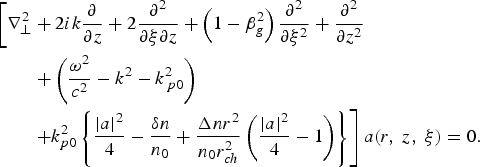
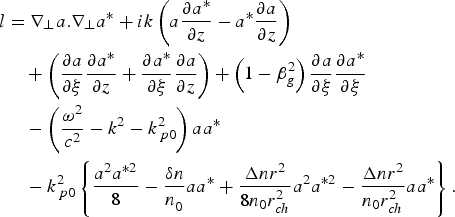
Neglecting the higher-order diffraction effect (∂2a/∂z2) in comparison to the terms (2∂2a/∂ξ∂z) and 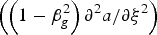 in the limit L ≪ 2Z R and

 , respectively, the Lagrangian density of the wave Eq. (4) is given by
A similar transformation of Eq. (3) yields
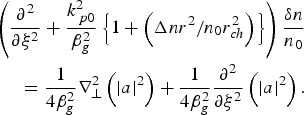
Solving Eq. (6) gives the density perturbation as
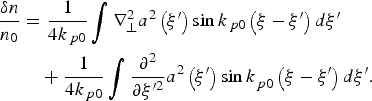
In deriving Eq. (7), a wide channel (k p0r ch > 1) has been considered. Therefore, the radial dependence of the plasma frequency has been neglected. The trial function for sinusoidal laser pulse amplitude may be represented by

where  , and
 are the amplitude, phase shift, curvature, spot size, and length of the laser pulse, respectively. Substituting Eq. (8) into Eq. (7) gives
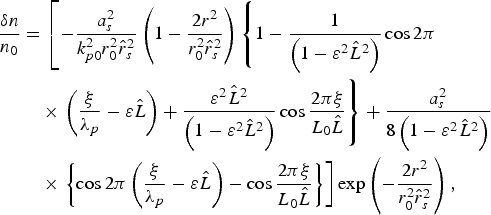
where  and
 are the normalized pulse length and spot size (L 0, r 0 are the initial pulse length and spot size, respectively), λp is the plasma wavelength and ε = L 0/λp. The first and second terms on the right-hand side of Eq. (9a), respectively, arise due to transverse and longitudinal ponderomotive effects. Since
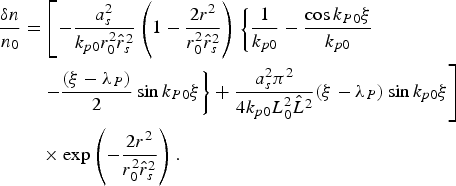
 varies with propagation distance, Eq. (9a) becomes invalid if
 . Hence in this limit the l'Hospital rule is applied to give maximum density perturbation (Esarey et al., Reference Esarey, Ting, Sprangle and Joyce1989) as
Inserting Eq. (8) and (9a) into Eq. (5) and using 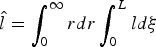 yields the reduced Lagrangian density as

Similarly, substituting Eqs. (8) and (9b) into Eq. (5) and using 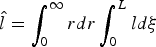 gives the reduced Lagrangian density in the limit
 as,
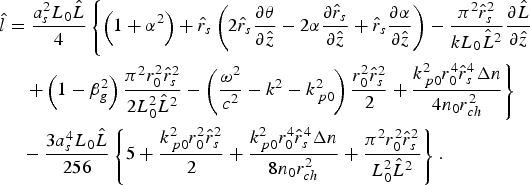
Considering the variation of the reduced Lagrangian density (Eq. (10a)) with respect to phase (θ) and pulse length  , respectively, gives
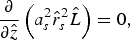
and

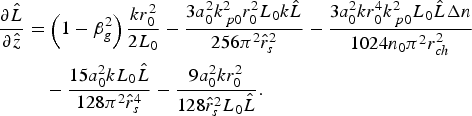
where  is the Rayleigh length) is the normalized propagation distance. Eq. (11), representing the conservation of energy (a s2r s2L = a 02r 02L 0 = constant where a 0 is the initial laser field amplitude), has been used while deriving the evolution equation for the laser pulse length. The first, second, and third terms on the right-hand side of Eq. (12a) arise due to group velocity dispersion effect, relativistic nonlinearity, and its coupling with the plasma channel, respectively. The remaining terms are due to the presence of wakefields. Similarly, varying the reduced Lagrangian density (Eq. (10b)) with respect to the pulse length, gives the evolution equation for the pulse length in the limit
 as
Varying the reduced Lagrangian density (Eq. (10a)) with respect to curvature (α) and spot size  , respectively, gives

and the equation governing the evolution of the laser spot size, as
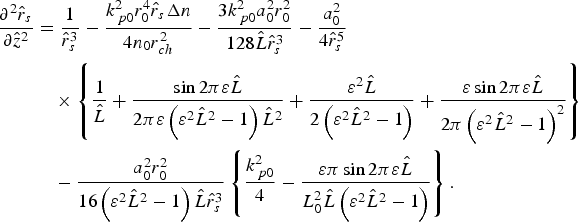
In deriving the evolution equation for the laser spot, Eqs. (11) and (13) have been used. The first term on its right-hand side of Eq. (14a) shows vacuum diffraction, the second term represents channel focusing, the third term leads to relativistic self-focusing, and is a function of pulse length. The fourth and fifth terms arise due to the transverse and axial ponderomotive effects, respectively. Similar variation of the reduced Lagrangian density (Eq. (10b)) with respect to spot size  gives the evolution of spot size when the pulse length approaches the plasma wavelength, as

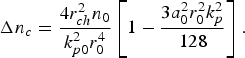
Neglecting the effect of wakefields and assuming the pulse length to be constant, the laser beam will propagate with a constant spot size (matched beam) if the channel density gradient is equal to a certain critical value given by
The intensity of the laser pulse after it has propagated a given distance, is represented by

where  and
 can be obtained by simultaneously solving Eqs. (12a) and (14a) or Eqs. (12b) and (14b).
3. GRAPHICAL DESCRIPTION
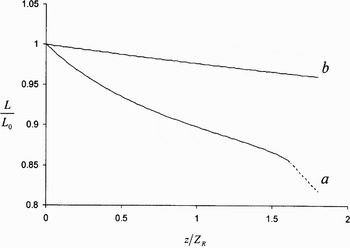
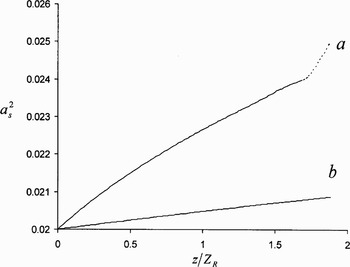
The evolution equations for the spot size and length of the laser pulse exhibit singularity if the pulse length is nearly equal to the plasma wavelength (ε → 1). Hence, numerical studies for two cases viz. ε > 1 and ε < 1 have been presented. Figures 1 and 2, respectively, represent the evolution of the laser pulse length and peak intensity when ε > 1. Curve a is plotted when the combined effect of relativistic and wakefield nonlinearities are present while curve b shows the variation when the effect of wakefields is neglected. The laser and plasma parameters are L 0 = 25 µm, r 0 = 20 µm, a 02 = 0.02, λ = 1 µm, λp = 20 µm, r ch = 40 µm, and Δn = Δn c = 4.38 × 1018 cm−3 (from Eq. (15)). It is seen that in this regime, the laser pulse length tends to compress in the presence as well as in the absence of wakefields. However, the presence of wakefields contributes toward enhancement in compression of the laser pulse. Due to rapid compression, the pulse length approaches the plasma wavelength and Eqs. (12a) and (14a) become invalid. Therefore, in this regime, Eqs. (12b) and (14b) are used to plot the dotted part of curve a. It is seen that the pulse is further compressed. Consequently, the peak intensity of the laser pulse (Eq. (16)) increases with propagation distance, for both cases (curves a and b). The increment in the laser intensity is faster in the presence of wakefields as compared to the case when the wakefields are neglected. The continuous part of curve a has been plotted with the help of Eqs. (12a), (14a), and (16) while Eqs. (12b), (14b), and (16) have been used to plot the dotted part (L → λp regime).
Variation of normalized pulse length (L/L 0) with normalized propagation distance when relativistic as well as wakefield effects are considered (curve a, solid and dashed part of the curve are valid under Eqs. (12a) & (14a) and Eqs. (12b) & (14b), respectively) and when wakefield effect is neglected (curve b) for λ = 1 µm, L 0 = 25 µm, r 0 = 20 µm, a 02 = 0.02, λP = 20 µm, r ch = 40 µm, Δn = Δn c = 4.38 × 1018 cm −3 (ε > 1).

Variation of laser peak intensity with normalized propagation distance when relativistic as well as wakefield effects are considered (curve a, solid and dashed part of the curve are valid under Eqs. (12a) & (14a) and Eqs.(12b) & (14b), respectively) and when wakefield effect is neglected (curve b) for λ = 1 µm, L 0 = 25 µm, r 0 = 20 µm, a 02 = 0.02, λP = 20 µm, r ch = 40 µm, Δn = Δn c = 4.38 × 1018 cm−3 (ε > 1).

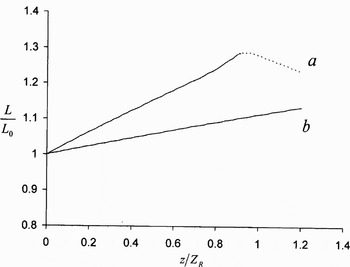
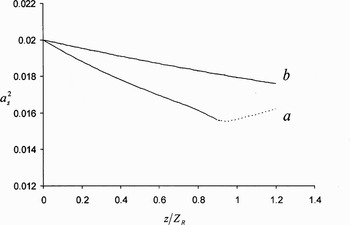
Figures 3 and 4, respectively, shows the variation of pulse length and peak intensity of the laser pulse when ε < 1. Curve a (b) is plotted in the presence (absence) of wakefields. The laser and plasma parameters are L 0 = 15 µm, r 0 = 20 µm, λ = 1 µm, a 02 = 0.02, λp = 20 µm, r ch = 40 µm, and Δn = Δn c = 4.38 × 1018 cm −3. It is interesting to note that the results obtained in this case are contrary to the earlier results. Both curves show that the laser pulse is broadened although curve a shows larger broadening effects. Due to broadening, the pulse length (which was initially less than the plasma wavelength) tends to become nearly equal to the plasma wavelength after traversing a certain distance and Eqs. (12a) and (14a) do not remain valid. Using Eqs. (12b) and (14b), the dotted part of curve a is plotted for this regime. It is seen that as the pulse length increases and approaches the plasma wavelength the broadening of the pulse length reduces. However, if wakefields are neglected the pulse length broadens continuously. Figure 4 shows that the peak laser intensity decreases with propagation distance. The intensity tends to increase in the regime where the pulse length becomes equal to the plasma wavelength. However, when wakefields are neglected the laser intensity decreases continuously.
Variation of normalized pulse length (L/L 0) with normalized propagation distance when relativistic as well as wakefield effects are considered (curve a, solid and dashed part of the curve are valid under Eqs. (12a) & (14a) and Eqs. (12b) & (14b), respectively) and when wakefield effect is neglected (curve b) for λ = 1 µm, L 0 = 15 µm, r 0 = 20 µm, a 02 = 0.02, λP = 20 µm, r ch = 40 µm, Δn = Δn c = 4.38 × 1018 cm−3 (ε < 1).

Variation of laser peak intensity with normalized propagation distance when relativistic as well as wakefield effects are considered (curve a, solid and dashed part of the curve are valid under Eqs. (12a) & (14a) and Eqs. (12b) & (14b), respectively) and when wakefield effect is neglected (curve b) for λ = 1 µm, L 0 = 15 µm, r 0 = 20 µm, a 02 = 0.02, λP = 20 µm, r ch = 40 µm, Δn = Δn c = 4.38 × 1018 cm−3 (ε < 1).

4. SUMMARY AND CONCLUSION
The present paper deals with the combined effect of wakefields (inside the laser pulse) and relativistic nonlinearity on the propagation of a laser pulse in a parabolic plasma channel. The density variation of plasma electrons produced by the combined effect of transverse and axial ponderomotive nonlinearity is obtained. Using a variational technique, coupled equations describing the evolution of the laser pulse length and spot size have been obtained. It is seen that due to the presence of wakefields, the evolution equation for pulse length and spot size exhibit singularity if the pulse length approaches the plasma wavelength. Therefore in this limit, the density perturbation is obtained using l'Hospital's rule. Further, the reduced Lagrangian and evolution equations for the pulse length and spot size of the laser are derived. The numerical solutions of these equations have been used to determine the laser peak intensity. The channel depth is considered to be equal to a certain critical value for which a laser beam (assuming constant pulse length and neglecting wakefields) propagates with a constant spot size.
The evolution of the laser pulse length and intensity have been graphically depicted in the presence as well as in the absence of wakefields for two cases viz. ε > 1 and ε < 1 (ε represents the ratio between the laser pulse length and plasma wavelength). In the former case, the laser pulse length compresses irrespective of whether combined relativistic and wakefield effects are considered or wakefields are neglected. However, it is seen that the presence of wakefields leads to a larger rate of pulse compression. It is also seen that due to rapid compression, the pulse length approaches the plasma wavelength after propagating a certain distance. In this regime, Eqs. (12a) and (14a) become invalid and the evolution of pulse length and spot size is obtained with the help of Eqs. (12b) and (14b). It is seen that the laser pulse is further compressed. Consequently, the peak intensity of the laser pulse enhances in the presence of wakefields as compared to the case when wakefields are neglected. When the laser pulse length is initially less than the plasma wavelength (ε < 1) the pulse length broadens. Due to broadening, the pulse length tends to become nearly equal to the plasma wavelength and again the theory (in presence of wakefields) breaks down. Using Eqs. (12b) and (14b) it is seen that broadening of the pulse length reduces. However, if wakefields are neglected the pulse length broadens continuously. Accordingly, the peak intensity of the laser decreases when the pulse length remains less than λp but tends to increase as L approaches λp. However, when the wakefields are neglected the laser intensity decreases continuously. Thus, the results obtained for the two cases (ε > 1 and ε < 1) are contrary to each other. It is important to note that in the regime where maximum wakefields are obtained (L ≈ λP), the propagation characteristics of the laser pulse are extremely sensitive to the ratio of the pulse length and plasma wavelength and show contrary behavior for ε less than or greater than unity. This result will be significant for operation of laser-plasma based accelerator systems.
ACKNOWLEDGMENT
This work has been done with the financial support of the science and engineering research council, department of science and technology, government of India. The authors thank the organization for funding the research project.