Introduction
Growers are interested in seeding a cover crop of annual ryegrass (ARG) at the same time as corn, after which the herbicide is applied to suppress the cover crop enough to minimize negative effects on grain corn yield. Cover crops have been shown to reduce soil erosion, decrease nutrient leaching, reduce the amount of synthetic fertilizer required, increase soil organic matter, increase soil aeration, increase soil water-holding capacity, and suppress weeds (Snapp et al. Reference Snapp, Swinton, Labarta, Mutch, Black, Leep, Nyiraneza and O’Neil2005; Thilakarathna et al. Reference Thilakarathna, Serran, Lauzon, Janovicek and Deen2015). A cover crop seeded early in the growing season may improve its establishment and growth because of increased soil moisture and a longer growing season, which may increase the benefits from the cover crop (Salon et al. Reference Salon, Dickerson and Hartwig2001). Some have reported that cover crops increase and stabilize the yield of corn and soybean in years with low rainfall (Snapp et al. Reference Snapp, Swinton, Labarta, Mutch, Black, Leep, Nyiraneza and O’Neil2005). However, the feasibility of these benefits may be negated if the cover crop reduces crop yield or quality, which can occur especially when cover crops are growing with the main crop (Zimdahl Reference Zimdahl2004).
The level of interference tolerated by corn plants during vegetative growth has been investigated in critical weed-free period studies. Researchers have found that corn must remain weed-free 3 to 5 wk after seeding, or from seeding to the six-leaf stage, or from seeding to 9 wk after emergence (Zimdahl Reference Zimdahl2004); it has been argued, however, that the most critical period is between the four- and eight-leaf stages in corn (Hall et al. Reference Hall, Swanton and Anderson1992; Page et al. Reference Page, Cerrudo, Westra, Loux, Smith, Foresman, Wright and Swanton2012). Small plants growing with corn may interfere with corn early in the season. For example, Rajcan and Swanton (Reference Rajcan and Swanton2001) reported numerous physiological and irreversible changes in corn when other plants are growing nearby because of changes in the ratio of red to far-red light within the crop canopy. The ratio is influenced by the angle and source of the incident light, the orientation of the leaf surface, and the distance between the two plants (Cressman et al. Reference Cressman, Page and Swanton2011). Plants can react within a few hours to these signals, which can permanently affect shoot-to-root ratio, leaf area, height, internode elongation, silking time, kernel number, and metabolic pathways (Cressman et al. Reference Cressman, Page and Swanton2011).
Cover crops growing simultaneously with corn have resulted in corn yield loss in some studies (Abdin et al. Reference Abdin, Zhou, Cloutier, Coulman, Faris and Smith2000). Scott et al. (Reference Scott, Pleasant, Burt and Otis1987) found that forage species seeded when corn was 15 to 30 cm in height influenced corn yield in one of 2 yr. In contrast, sweet corn yields in another study were not reduced when white clover (Trifolium repens L.), ladino clover [T. repens (L.) forma lodigense Hort. ex Gams.], or alfalfa (Medicago sativa L.) were seeded at the same time or 4 wk after seeding corn (Zhou et al. Reference Zhou, Madramootoo, MacKenzie, Kaluli and Smith2000). Abdin et al. (Reference Abdin, Coulman, Cloutier, Faris, Zhou and Smith1998) compared several cover crop species that were interseeded 10 or 20 d after corn emergence and found no reduction in corn yield in most years; however, in a year with moisture deficits, crimson clover (Trifolium incarnatum L.) reduced corn yield. Zhou et al. (Reference Zhou, Madramootoo, MacKenzie, Kaluli and Smith2000) found that when ARG was seeded 10 d after corn seeding but before corn emergence, there was no decrease in corn yield if soil moisture and nutrients were not limiting. Wivutvongvana (Reference Wivutvongvana1974) found that corn yield was reduced when ARG was seeded the day after corn. Salon et al. (Reference Salon, Dickerson and Hartwig2001) reported no effect on corn yield when perennial ryegrass (Lolium perenne L.) was seeded at the same time as corn followed by a POST herbicide. Kleinman et al. (Reference Kleinman, Salon, Sharpley and Saporito2005) reported lower corn yields at one of two sites when perennial ryegrass, red clover (Trifolium pretense L.), or alfalfa was seeded within 9 d after seeding imidazolinone-resistant corn, followed by an application of imazethapyr and bromoxynil before the cover crops reached 8 cm in height. In summary, some studies support the feasibility of seeding a cover crop at the same time as corn without affecting grain corn yields, but others report interference in some environments. Thus, measures to suppress or control the cover crop in the corn may be necessary to avoid interference with the corn crop in some environments.
The objective of this study was to determine the rate of nicosulfuron necessary to suppress ARG to minimize corn yield loss due to interference. This production system would use the POST herbicide to suppress the growth of ARG to reduce crop competition while maintaining a cover crop throughout the growing season and after harvest.
Materials and Methods
Site Characteristics
Field studies were conducted during six site-years at the University of Guelph, Ridgetown Campus, Ridgetown, ON (42.7392° N, 81.8871° W) in 2016 and 2017. In each year, three sites were established in adjacent land areas, with each site seeded on a different date. In 2016, those dates were May 6, May 12, and May 19; corn was seeded on May 24, June 5, and June 7 in 2017. The soil type across sites in 2016 was a Normandale sandy loam (68% sand, 30% silt, and 2% clay) with 2.5% organic matter, pH of 6.4, and a CEC of 12 mEq 100 g–1. In 2017, the soil type was a Brookston clay sand (58% sand, 29% silt, and 13% clay) with 3.8% organic matter, pH of 6.3, and a CEC of 14 mEq 100 g–1. All sites were chisel-plowed after winter wheat in the previous autumn, followed by one pass with a cultivator on the day of seeding. Urea ammonium nitrate was broadcast applied before secondary tillage in the spring at a recommended rate for corn production in Ontario (202 kg N ha–1). At all sites, the full-season hybrid P0216AM (Pioneer Hi-Bred, Chatham, ON) was seeded 4 cm deep at 86,450 seeds ha–1 using a John Deere 7200 planter. The planter was equipped with starter fertilizer (8-32-16), which was applied at 168 kg ha1 and placed in a 5- by 5-cm band from the seed. On the same day of seeding corn, ARG (“Common No. 1”; Speare Seeds Ltd., Harriston, ON) was broadcast at 15.7 kg ha–1 using a Valmar 1255 pneumatic-broadcast applicator (Salford Group Inc., Salford, ON), followed by a pass with a sprocket packer to improve ARG seed–soil contact. The seeding of both crops on the same day was an attempt to mimic cover crop seeders installed on a corn planter, but this was accomplished in two passes in this study. All herbicides were applied using a CO2-pressurized backpack sprayer calibrated to apply 200 L ha–1 at 276 kPa equipped with a 1.5-m-wide boom with four ULD 120-02 (Hypro, New Brighton, MN) nozzles spaced 0.5 m apart, which produced a spray width of 2.0 m.
Experimental Design
A total of 16 treatments were arranged at each site in randomized complete block design including two controls: untreated ARG (no nicosulfuron) and an ARG-free control. In plots seeded with ARG, other treatments included seven different rates of nicosulfuron (E.I. du Pont Canada Co., Mississauga, ON) applied with two different timings. The rates of nicosulfuron were 0.8, 1.6, 3.1, 6.3, 12.5, 25 (label rate), and 50 (2× label rate) g ai ha–1 with a nonionic surfactant (Agral 90; Norac Concepts Inc., Guelph, ON) at 0.2% (v/v). The first timing was applied when most ARG had emerged with two to three leaves (two- to three-leaf stage) (Application A); the second timing (Application B) was applied when ARG had four to five leaves (four- to five-leaf stage), which often included one tiller. As a result, Application A occurred 18 to 21 d after seeding; this was achieved on five of six site-years, but the application was 25 d after seeding on one site year because of a weather delay. Application B treatments were applied 7 to 10 d after Application A, depending on the site. Plots were 3-m-wide (four corn rows spaced 0.76 m apart) by 7.25 m long. The ARG-free control was maintained weed-free by POST application of S-metolachlor/mesotrione/atrazine at 2,065 g ai ha–1 (Syngenta Crop Protection Canada, Guelph, ON) plus two applications of glyphosate at 900 g ae ha–1 (Monsanto Canada Inc., Winnipeg, MB). Broadleaf weeds in all plots were controlled with a tank mix of prosulfuron (10 g ai ha–1) (Syngenta Crop Protection Canada, Guelph, ON), bromoxynil (140 g ai ha–1) (Bayer CropScience, Mississauga, ON), and Agral 90 (0.2% v/v); a second application of bromoxynil (280 g ai ha–1) was necessary to control weed escapes in 2017.
Measurements
Apparent suppression of ARG was visually estimated at 1, 2, and 4 wk after nicosulfuron Application A (WAAA) and B treatments (WAAB). The ARG suppression was visually estimated at 8 WAAB in all plots. Suppression estimates were made on a scale of 0 to 100%, with 0 representing no apparent suppression and 100% representing complete death. The aboveground biomass of ARG was harvested at four WAAB in all plots by cutting stems and leaves at the soil surface from two 0.25-m2 quadrats positioned between corn rows 2 and 3 in representative areas of each plot. The plant material was dried at 80 C until constant weight, after which dry weights were recorded. At corn maturity, the two middle rows of each plot were harvested with a small-plot combine for yield and grain moisture determinations; grain yields were adjusted to 15.5 g g–1 moisture content before statistical analysis. The ARG ground cover was visually assessed near November 15 using a scale of 0 to 100%, with zero representing no ground cover and 100% complete ground cover. ARG biomass was harvested near November 15 in all site-years.
Data Analysis
Data were analyzed by timing (Application A or B) using PROC NLIN method Marquardt in SAS (Version 9.4; SAS Institute Inc., Cary, NC). A rectangular hyperbola curve was used for the ARG suppression:
 $$y{\equals}(i\,{\times}{\rm rate})\,/\,[1{\plus}(i{\times}{\rm rate}\,/\,a)]$$
where y is the percent ARG suppression, a is the upper asymptote, and i is the initial slope of the curve. An exponential decay curve was used for the ARG biomass:
 $$y{\equals}f{\plus}g{\times}{\rm e}^{{(-h\times{\rm rate)}}} $$
where y is g m–2 of ARG biomass, f is the lower asymptote, g is the reduction in y from the intercept to f, and h is the slope of the line. A parabolic curve was used to fit the grain corn yield
 $$y{\equals}[t{\times}\left( {{\rm rate}-r} \right)^{2} ]{\plus}s$$
where y is grain corn yield in kg ha–1, r is the x value of the vertex, s is the y value of the vertex, and t is the constant.
A new dataset that consisted of the predicted values at the applied rates of nicosulfuron was used to determine if the timings (Applications A and B) could be combined for all site-years. This was achieved with a t-test using PROC MIXED with timing as the fixed effect. As the timings could be combined, data were subsequently analyzed using PROC NLIN, which resulted in a curve averaged across the two application timings for all site-years.
The predicted nicosulfuron rate (R) to suppress ARG was calculated using the regression equations. For the ARG suppression and biomass, R5, R10, R25, R50, and R95 represent the rate at which ARG was suppressed or biomass reduced 5%, 10%, 25%, 50%, and 95%, respectively. For the grain corn yield, R1, R2.5, R5, R7.5, and R10 represent the nicosulfuron rate at which grain corn yields were reduced by 1%, 2.5%, 5%, 7.5%, and 10%, respectively.
Results and Discussion
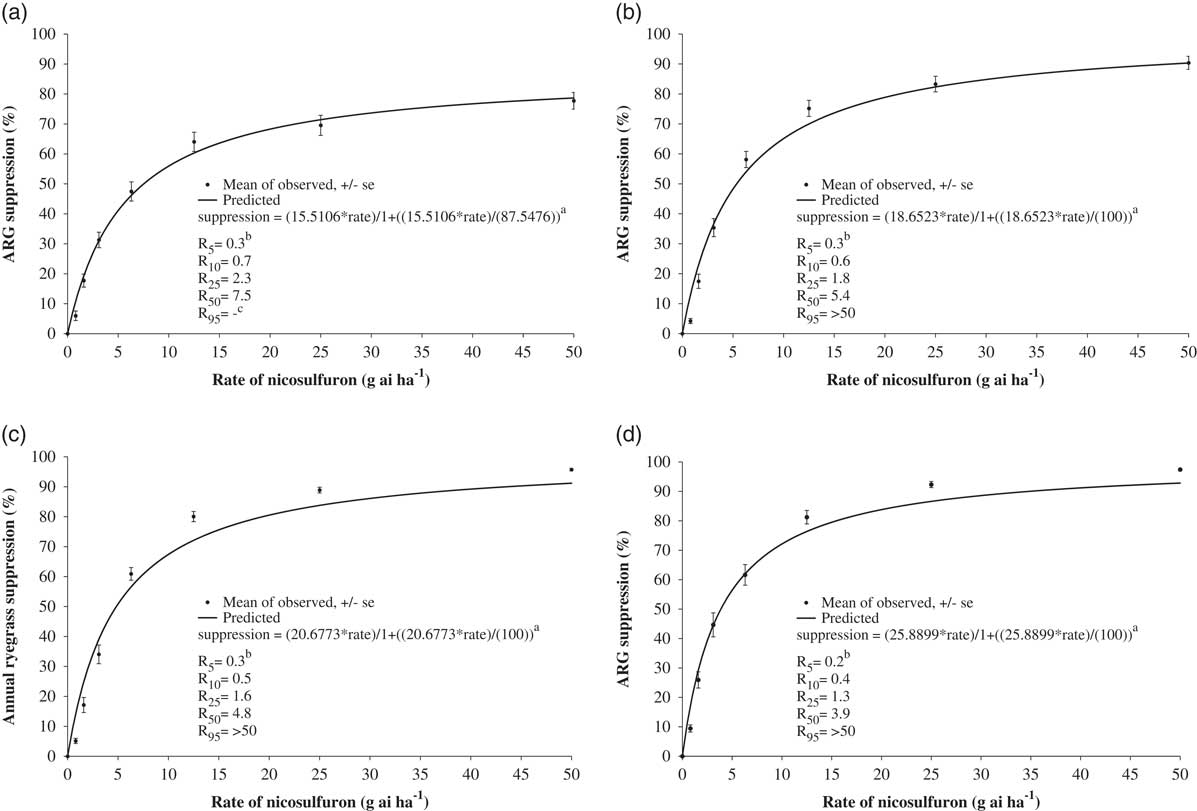
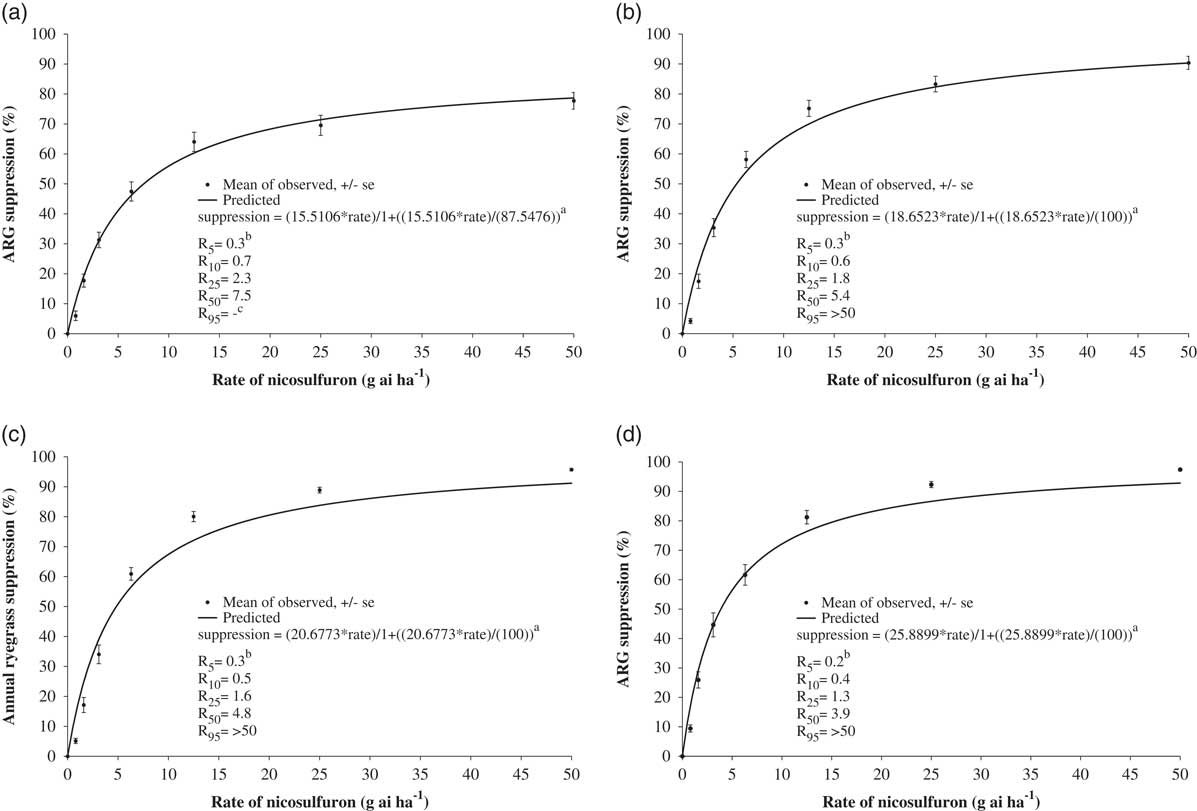
Corn emergence occurred approximately 12 to 18 d after seeding in 2016, and 5 to 6 d after seeding in 2017. ARG emerged approximately 9 to 12 d after seeding in 2016 and 4 to 5 d in 2017; in almost all site-years, ARG emergence was spatially variable across the experimental areas (data not shown), probably because of poor seed–soil contact and dry conditions close to the surface for ARG seeds to germinate. There were no response differences between the two nicosulfuron application timings across site-years (data not shown); therefore, data from the two timings were combined for analyses and presentation purposes. The results of this study should correspond to nicosulfuron application during an approximate 7- to 10-d window between V3 and V4 corn stages (Application A vs. Application B) if ARG emerged within 3 d of corn emergence across all site-years. At 1 WAA of nicosulfuron, the amount of annual ryegrass suppression or control varied from 6% at 0.8 g ai ha–1 to 76% at 50 g ai ha–1 of nicosulfuron when averaged across the two timings and six site-years (Figure 1A). Suppression or control of ARG with nicosulfuron increased to 91% at 50 g ai ha–1 at 2 WAA (Figure 1B). As ARG did not recover from nicosulfuron injury at the 2× labeled use rate (50 g ai ha–1), ARG could not be utilized as a living cover crop after the date of application. The rates of nicosulfuron for a modest 5% suppression were estimated to be 0.3, 0.3, and 0.2 g ai ha–1 at 2, 4, and 8 WAA, respectively; for 10% suppression the estimated rates were 0.6, 0.5, and 0.4 g ai ha–1; for 25% suppression the rates were 1.8, 1.6, and 1.3 g ai ha–1, and for 50% suppression the use rates were 5.4, 4.8, and 3.9 g ai ha–1 at 2, 4, and 8 WAA (Figure 1B–D), respectively. The rate of nicosulfuron estimated to achieve 95% suppression or control at 2, 4, and 8 WAA was above the highest rate of nicosulfuron evaluated in this study.
Annual ryegrass (ARG) suppression at 1, 2, 4, and 8 wk after application of nicosulfuron across two nicosulfuron timings and six site-years with ARG seeded at the same time as corn (Equation 1). (A) ARG suppression at 1 wk after nicosulfuron application. aRegression parameters: rectangular hyperbola; a, upper asymptote; i, initial slope at x=0; y=(i × rate) / [1+(i × rate / a)]; standard error (SE): a=3.0, i=1.3. bR5, R10, R25, R50, and R95: predicted rates required to achieve 5%, 10%, 25%, 50%, and 95% ARG suppression compared to the control with no nicosulfuron applied. c–, Not estimable. (B) ARG suppression 2 wk after nicosulfuron application. aRegression parameters: rectangular hyperbola; a, upper asymptote; i, initial slope at x=0; y=(i × rate) / [1+(i × rate / a)]; SE: a=0, I=0.9. bR5, R10, R25, R50, and R95: predicted rates required to achieve 5%, 10%, 25%, 50%, and 95% ARG suppression compared to the control with no nicosulfuron applied. (C) ARG suppression 4 wk after nicosulfuron application. aRegression parameters: rectangular hyperbola; a, upper asymptote; i, initial slope at x=0; y=(i × rate) / [1+(i × rate / a)]; SE: a=0, i=0.9. bR5, R10, R25, R50, and R95: predicted rates required to achieve 5%, 10%, 25%, 50%, and 95% ARG suppression compared to the control with no nicosulfuron applied. (D) ARG suppression 8 wk after nicosulfuron application. aRegression parameters: rectangular hyperbola; a, upper asymptote; i, initial slope at x=0; y=(i × rate) / [1+(i × rate / a)]; SE: a=0, i=1.3. bR5, R10, R25, R50, and R95: predicted rates required to achieve 5%, 10%, 25%, 50%, and 95% ARG suppression compared to the control with no nicosulfuron applied.
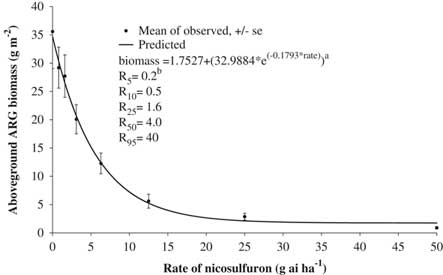
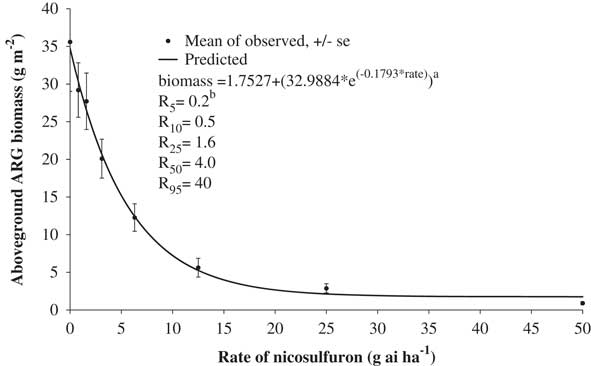
The average aboveground biomass of ARG was 36 g m–2 in the untreated control (no nicosulfuron) at approximately 4 WAA across all site-years (Figure 2). A nicosulfuron rate >6.3 g ai ha–1 was required to reduce ARG biomass by >65% at 4 WAA (Figure 2). The rates of nicosulfuron that caused 5%, 10%, 25%, and 50% reductions in ARG biomass were 0.2, 0.5, 1.6, and 4.0 g ai ha–1, respectively, at 4 WAA (Figure 2). At 4 WAA, the R values (rate of nicosulfuron to achieve a level of suppression) for ARG biomass were generally similar to the R10 and R25 values for visible suppression (Figure 1A–C); however, the R5, R50, and R95 values were higher for ARG suppression than for biomass reduction.
Aboveground annual ryegrass (ARG) biomass 4 wk after application of nicosulfuron across two nicosulfuron timings and six site-years with ARG seeded at the same time as corn. aRegression parameters: inverse exponential; f, lower asymptote; g, reduction in y from the intercept to f; h, slope of the line; y=f+g × e(–h × rate) (Equation 2); standard error: f=1.8, g=2.7, h=0.04. bR5, R10, R25, R50, and R95: predicted rates required to achieve 5%, 10%, 25%, 50%, and 95% ARG biomass reduction compared to the control with no nicosulfuron applied.
Annual ryegrass ground cover rating and biomass in November of each year are not presented. In most treatments across all site-years, ARG plants did not survive intense competition with corn during the corn grain fill phase from the beginning of August and into September; grain corn yields exceeded 12,000 kg ha–1 averaged across all site-years (data not shown). There were surviving ARG plants in border plots near the perimeter of the experimental areas, probably because of greater resource availability.
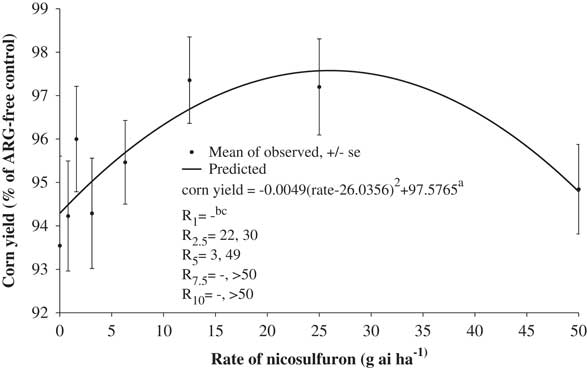
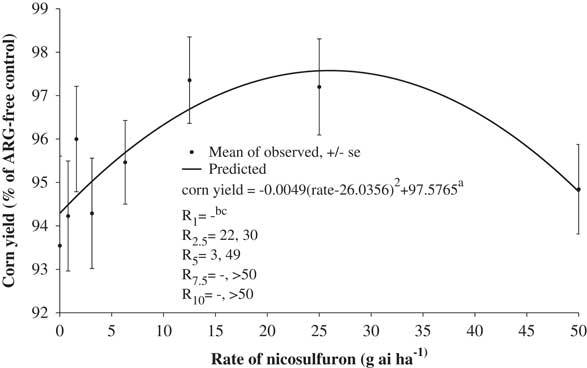
Treatments where nicosulfuron was applied at 0.8 g ai ha–1 in V3 or V4 corn reduced grain corn yields by approximately 6% compared to the ARG-free control (Figure 3), presumably because of interference by ARG. Nicosulfuron applied near 25 g ai ha–1 resulted in a maximum average grain corn yield of 97.5% relative to the ARG-free control across site-years (Figure 3); however, the 2.5% lower corn yield was not statistically different from zero (P > 0.05). Grain corn yields tended to decrease when nicosulfuron was applied >25 g ai ha–1, probably because of herbicide injury––even though annual ryegrass was more suppressed at rates closer to 50 g ai ha–1.
Grain corn yield as a percent of the control when annual ryegrass (ARG) was seeded at the same time as corn followed by an application of nicosulfuron across six site-years. aRegression parameters: parabolic curve; r, x value for the vertex; s, y value for the vertex; t, constant; y = [t × (rate – r)2]+s (Equation 3); standard error: t = 0.002, r = 2.7, s = 0.91. bR1, R2.5, R5, R7.5, and R10: predicted nicosulfuron rates that result in 1%, 2.5%, 5%, 7.5%, and 10% grain corn yield reduction compared to the ARG-free control; the two values represent predicted rates prior to and following the vertex, respectively. c–, Not estimable.
The literature states that corn interference from weeds is most likely to occur between the four- and eight-leaf stages in corn (Hall et al. Reference Hall, Swanton and Anderson1992; Page et al. Reference Page, Cerrudo, Westra, Loux, Smith, Foresman, Wright and Swanton2012). Others have indicated that critical weed-free period in corn can range from corn emergence up to 9 wk after emergence (Zimdahl Reference Zimdahl2004). Therefore, it is not surprising that an ARG cover crop emerging within 3 d of corn emergence lowered corn yields, and that nicosulfuron applied up to 3 wk after corn and ARG emergence was not enough to achieve the yields of the ARG-free control treatment. It can be speculated that an earlier timing of Application A (before the two- to three-leaf stage of ARG) may have reduced grain corn yield losses; however, it was observed that the emergence of ARG was spatially variable across each site. An earlier application of nicosulfuron would probably miss late-emerging ARG plants, and these would escape the nicosulfuron because of the need to apply the herbicide POST for control or suppression.
The duration that ARG interfered with corn may be longer than the time from emergence to application; time is probably required for the herbicide to affect ARG sufficiently to reduce interference. For example, the nicosulfuron label states that control symptoms may appear within 5 to 7 d after application, with control apparent 2 to 3 wk after application (E.I. du Pont Canada Co. 2017); these effects were observed in the present study. Scott et al. (Reference Scott, Pleasant, Burt and Otis1987) reported no grain corn yield loss when a living mulch was seeded when the corn was 15 to 30 cm in height in one of 2 yr. In contrast, in this study the cover crop was seeded the same day as corn and emerged often a few days earlier than corn emergence, followed by suppression with nicosulfuron when applied when the corn was 17 and 30 cm tall at Applications A and B, respectively. Salon et al. (Reference Salon, Dickerson and Hartwig2001) reported that perennial ryegrass seeded at the same time as corn, and stunted with imazethapyr, did not reduce grain corn yields; those results contrast with the results from this study.
The results of the current study are similar to Wivutvongvana (Reference Wivutvongvana1974), who reported lower corn yields when ARG was seeded on the same day as corn. Abdin et al. (Reference Abdin, Coulman, Cloutier, Faris, Zhou and Smith1998) reported lower corn yields when crimson clover was seeded 10 to 20 d after corn emergence. This study showed that ARG planted the same day as corn reduced grain yields as much as 6% with no nicosulfuron or suppression tactics. Corn yields were still lower in ARG-seeded plots when nicosulfuron was used to suppress two- to three-leaf or four- to five-leaf ARG in V3 to V4 corn, presumably because of interference during the critical weed control period. Swanton and Weise (Reference Swanton and Weise1991) stated that crop cultivars, (weed) species competition, and environmental conditions have strong impacts on early weed (cover crop)–crop interactions. The benefits of long-term use of cover crops should be investigated, as they may offset the small decrease in grain corn yield.
Acknowledgments
No conflicts of interest have been declared. Funding for this project was provided in part by the Grain Farmers of Ontario and the Growing Forward 2 program of the Agricultural Adaptation Council.