Introduction
Modern agriculture is shifting towards green farming to maintain less dependence on synthetic and known hazardous materials. Researchers have extensively studied soil degradation caused by xenobiotic chemicals (such as agricultural chemicals) or improper disposal of waste. Farming with inorganic fertilizers has certain disadvantages. Long-term repeated fertilization, especially with nitrogen, may alter microbial community composition even when pH changes are small (Geisseler and Scow, Reference Geisseler and Scow2014), while the addition of fertility-enhancing amendments can ameliorate particular disturbances in soils. Among these, microbe-laden fertilizers — collectively known as biofertilizers — are alternatives to synthetic fertilizers. Biofertilizers have been studied to understand nutrient uptake, water holding capacity, soil texture and physical and chemical properties. Biofertilizers are mainly exploited to decompose soil organic matter into minerals and organic products.
Ecological benefits of organic farming often include increased species richness and abundance. However, effects are likely to differ between organism groups and landscapes (Bengtsson et al., Reference Bengtsson, Ahnström and Weibull2005). Jiang et al. (Reference Jiang, Wang, Liusui, Sun, Zhao and Liu2015) report that the application of organic fertilizers (sheep manure or crop residues), increased crop yields and promoted the number of individuals and species of soil fauna, and applied sheep manure was significantly beneficial for these actions compared to crop residues returned to the soil. However, the long-term application may result in accumulation of salts, nutrients and heavy metals that could cause adverse effects on plant growth, development of soil organisms and water quality (Chen, Reference Chen2006). Faunal diversity study at ground level indicates that soil of organic plantations is healthier than that of the conventional plots. Beneficial microorganism-inoculated plants were impaired in the induction of the toxic glycoalkaloid molecule tomatine and the defence-related phytohormone jasmonic acid after herbivore (Spodoptera littoralis) attack (Megali et al., Reference Megali, Glauser and Rasmann2014). Organic fertilizers can increase the total abundance of Prostigmata, oribatids, Collembola, Mesostigmata, dipteran larvae and orthopteran fauna (Wang et al., Reference Wang, Chen, Tan, Fan and Ruan2016). Among these soil organisms, termites are particularly sensitive to specific changes caused by biofertilizers. Organic amendments attracted humivorous termites, which are destructive to seedlings (Sop et al., Reference Sop, Kagambega, Bellefontaine, Schmiedel and Thiombiano2011).
Diatomaceous earth (DE) placed on the surface of the soil in crawl spaces beneath homes prevented subterranean termite penetration. Use of DE in this fashion is analogous to the post-construction use of sand barriers in crawl spaces for subterranean termite control (Ebeling and Forbes, Reference Ebeling and Forbes1988). Abrasive actions of DE after absorbing moisture from the soil result in physical damage and desiccation of termite foragers that are sufficient to prevent penetration of the diatomite barrier (Grace and Yamamoto, Reference Grace and Yamamoto1993). Experts also recommend DE as garden fertilizer.
Since few studies relate the effect of biofertilizers and DE against termite foragers, we hypothesized that biofertilizers could attract more termites and DE being an abrasive agent can kill termite foragers.
Materials and methods
Collection of termites
Coptotermes heimi termites were obtained from a long-established colony at the Post Agriculture Research Station (PARS), University of Agriculture, Faisalabad, before the start of each experiment. Termites were sampled from PVC pipes of 0.46– 0.69 m in length placed vertically in the soil, in such a way that 1–2 cm remained above the ground. A roll of moist corrugated cardboard was placed inside the pipes to attract the termites. The above ground portion of pipes was covered with black plastic sheets. These traps were installed at least three days before collection of termites for bioassays.
Preparation of soil for experiments
Sandy loam soil at PARS was sieved through a 60-mesh panel. Organic matter, in the form of kitchen waste, and fruit and vegetable market waste, was added in the soil at 30% W/W, and stored, with the addition of biofertilizers, for a period of two weeks in a glass container with a perforated lid in the dark. The mixture was sprinkled occasionally with water and then used for the bioassay. The amount of biofertilizer was fixed as described in the experiments below. Rhizogold, Rhizogold Plus and Unigrow, manufactured by the Institute of Soil and Environmental Sciences, University of Agriculture, Faisalabad, were used as biofertilizers.
Mortality and gallery formation in biofertilizers mixed soil
This experiment was conducted in the Insect Toxicology Laboratory, Department of Entomology, University of Agriculture, Faisalabad. Rhizogold, Rhizogold Plus and Unigrow were mixed with soil at a rate that simulated the amount of field recommendation. Ratios of soil: biofertilizers tested were 50:1, 50:5 and 50:10. There were nine treatments of soil and biofertilizers with one control having no biofertilizers, following a completely randomized design (CRD) in three replications. In each Petri dish, 100 termite workers and 10 soldiers were released. Data on length of gallery and percent mortality were recorded after 72 hr.
Mortality and gallery formation in biofertilizers and diatomaceous earth mixed soil
In this experiment, soil, biofertilizers and DE were mixed in 50:1:1, 50:5:1 and 50:10:1 ratio. Thus, 50 g soil was mixed with 1, 5, 10 g of soil and 1 g of DE (constant) separately in each Petri dish. The assay procedure was the same as in the above experiment.
Mortality and gallery formation in biofertilizers mixed soil with different amounts of DE
In this experiment, the highest amount (10 g) of three biofertilizers was kept constant, but amount of DE was changed to 1, 5 and 10 g and mixed with 50 g of soil. Therefore, the ratio of soil, biofertilizers and DE was 50:10:1, 50:10:5 and 50:10:10.
Mortality and gallery formation in biofertilizers mixed soil with different insecticides
Three different biofertilizers, i.e. Rhizogold, Rhizogold Plus or Unigrow, were mixed with soil (50 g) and 100 ppm of three insecticides (imidacloprid (Mirage 45 EC), bifenthrin (Biflex 2.5 EC), and chlorfenapyr (Phantom® 21.45% W/W)). The control treatment was without insecticide concentration. The procedure of assay was the same as in all experiments.
Statistical analysis
In the first three experiments, differences of means in mortality and length of gallery formation were separated by Tukey's HSD post-hoc test following two-way ANOVA at P < 0.05. Difference in the fourth experiment was calculated through non-parametric statistics.
Results
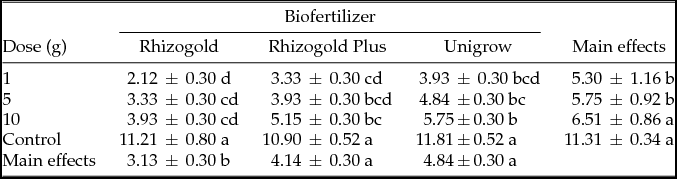
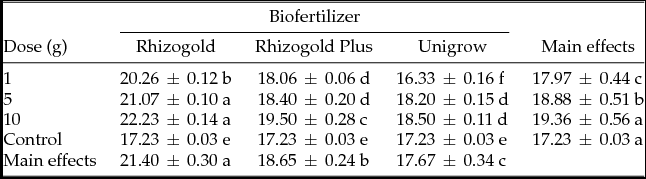
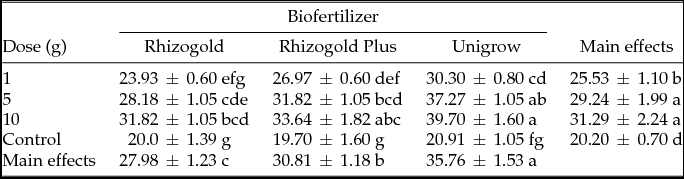
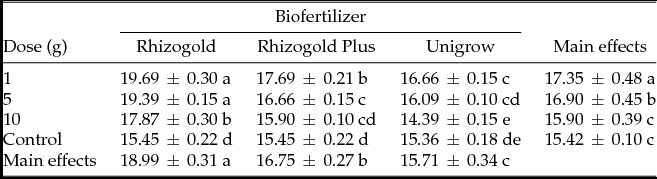
Mortality of termites in soil mixed with biofertilizers was low as compared to its control treatment (Table 1). Differences in the performance of biofertilizers at the lowest quantity were statistically non-significant. Minimum mortality was recorded in Rhizogold-treated soil at the lowest quantity (Table 1). Length of galleries in Rhizogold was longer than Unigrow. However, termite gallery lengths were non-statistically different in soil with 5 g Rhizogold Plus. Similarly, the gallery length at 10 g of Unigrow and 5 g of Rhizogold Plus was also not statistically significant (Table 2). In the presence of DE, mortality of termites increased compared to that observed when no DE was mixed in soil with biofertilizers (Table 3). Maximum mortality (39.70 ± 1.60%) was observed in Unigrow treated soil, which had a non-significant difference with Rhizogold Plus at the highest amount (Table 3). Gallery length also reduced in the presence of DE. Maximum length was observed in Rhizogold and minimum in Unigrow, which were significantly different from one another. Unigrow and Rhizogold Plus had similar significant difference in gallery length at different quantities (Table 4). In the experiment where DE was used at different amounts with constant amounts of biofertilizers, mortality and doses interaction were non-significant among the treatments (data not shown). Gallery length was shorter at the highest dose of DE.
Comparison of termite mean (±SE) percent mortality after 72 hr of exposure to biofertilizers at different doses

Means in columns and rows that do not share the same letter(s) are significantly different; F = 2.48; P < 0.05.
Comparison of termite gallery formation (cm) (±SE) after 72 hr of exposure to biofertilizers at different doses

Means in columns and rows that do not share the same letter(s) are significantly different. F = 16.01; P < 0.05.
Comparison of termite mean (±SE) percent mortality after 72 hr of exposure to biofertilizers at different doses (DE at constant ratio)

Means in columns and rows that do not the share same letter(s) are significantly different. F = 4.06; P < 0.05.
Comparison of termite gallery formation (cm) (±SE) after 72 hr of exposure to biofertilizers at different doses (DE at constant ratio)

Means in columns and rows that do not share the same letter(s) are significantly different. F = 8.02; P < 0.05.
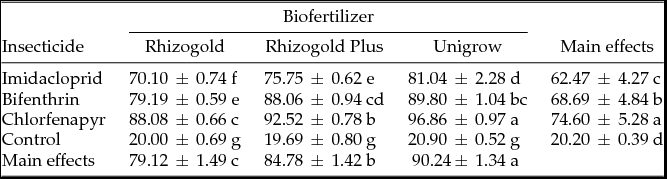
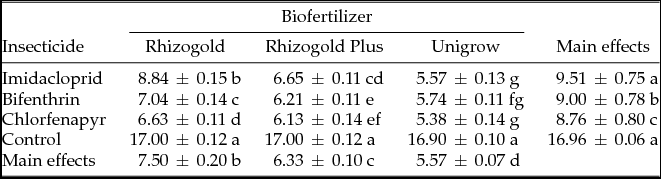
Mortality increased in the presence of insecticides in soil substrate. Unigrow mixed soil having chlorfenapyr had maximum mortality followed by Rhizogold and Rhizogold Plus (Table 5). Length of gallery was also reduced in the presence of insecticides in soil substrate. Gallery formation had similar fashion as noticed in mortality assays where Unigrow significantly had shorter galleries (Table 6).
Comparison of termite percent mortality (±SE) after 72 hr of exposure to biofertilizers and different insecticides

Means in columns and rows that do not share same letter(s) are significantly different. F = 23.6; P < 0.05.
Comparison of termite gallery formation after 72 hr of exposure to biofertilizers and different insecticides

Means in columns and rows that do not the share same letter(s) are significantly different. F = 42.68; P < 0.01.
Discussion
The addition of biofertilizers in the soil can affect life and movement of subterranean organisms. In the current study, biofertilizers promoted the movement of termites, which was evident with increased gallery length. However, we also observed comparable mortalities with the control treatment. Under field conditions, termites are capable of causing a loss of over 70% organic amendment mass in the soil within 1 year. Organic matter in biofertilizers is depleted into mineralization by microorganisms. The loss may relate to termite mortality as more organic matter becomes unavailable for the survival of termites (Mando and Brussaard, Reference Mando and Brussard1999). More extended galleries in the current study can be due to water and particles available to the termites for construction in fertilized soils. Our findings are in agreement with Sop et al. (Reference Sop, Kagambega, Bellefontaine, Schmiedel and Thiombiano2011) who reported that organic amendment attracted humivorous termites, which were destructive to the seedlings.
The poor survival rate of the plants in the soil amended by organic matter is possibly due to termites, which attacked the seedlings starting with the roots, especially during the dry season (Sop et al., Reference Sop, Kagambega, Bellefontaine, Schmiedel and Thiombiano2011). Biofertilizer manufacturers should incorporate protection attributes in their studies before commercialization (Megali et al., Reference Megali, Glauser and Rasmann2014). Addition of DE has resulted in an increase in termites’ mortality and shorter galleries. However, Grace and Yamamoto (Reference Grace and Yamamoto1993) reported that DE was not a barrier to Formosan subterranean termites. Insecticides, however, brought about a significant decline in galleries and increased mortalities. These results are equivalent to a study where neem oil in biofertilizers promoted a more substantial adverse impact on B. bassiana, inhibiting germination (−45.27%), colony diameter (−36.62%) and conidiogenesis (−84.93%) (Hirose et al., Reference Hirose, Neves, Zequi, Martins, Peralta and Alcides2001).
According to our hypothesis, we assume that biofertilizers attract termites and promote movement in the soil to construct galleries, which was evident from more extended galleries in biofertilizer-treated soils. However, these termites also suffered mortality, which may be due to the presence of cellulytic bacteria (Osaka et al., Reference Osaka, Nagai, Mizuno, Sakka and Sakka2011) that decompose cellulosic materials, leading to the depletion of food for the termites. The involvement of organic acids in mortality of termites in biofertilizer mixed soil can only be under anaerobic conditions, but in the current study, decomposition of organic matter was allowed under aerobic conditions.
Our study shows that biofertilizers may facilitate movement of termites in the soil while concurrently causing mortality due to starvation, as cellulolytic bacteria can deplete cellulose. We suggest that biofertilizer manufacturing companies should incorporate some insect protection attributes in their products before commercialization (Sop et al., Reference Sop, Kagambega, Bellefontaine, Schmiedel and Thiombiano2011; Megali et al., Reference Megali, Glauser and Rasmann2014). From our study, the addition of DE and insecticide further enhances mortality of termites. Researchers should test more chemicals as additives of biofertilizers to control subterranean termites.