Acardiac malformation occurs in 1% of neonates and represents the most common type of congenital disease. Nearly one-third of children with CHD need corrective or palliative treatment via either surgery or catheterisation. 1 With advances in surgical and postoperative care, the large majority of children nowadays reach adulthood. Therefore, long-term follow-up with regard to health-related quality-of-life measurement has become increasingly important.
Defining quality of life as a concept for children is challenging, particularly in view of the developmental stages.Reference Bullinger, Schmidt and Petersen 2 Nevertheless, research focussing on health-related quality of life for children with CHD has increased during the last decade.Reference Bratt and Moons 3 Health-related quality of life is defined “as the influence of a specific illness, medical therapy, or health services policy on the ability of patients to both function in and derive personal satisfaction from various physical, psychological, and social life contexts”.Reference Costello, Mussatto and Cassedy 4
Previous research in the field of CHD has yielded different results. Kwon et alReference Kwon, Mussatto, Simpson, Brosig, Nugent and Samyn 5 showed that the health-related quality of life in 20 children with tetralogy of Fallot, which typically requires at least one surgery, was comparable with healthy children and was higher compared with other chronically ill children. Similar findings were obtained by Mussatto and Twedell et alReference Mussatto and Twedell 6 that health-related quality of life of 182 children with complex CHD was higher than in those with non-cardiac chronic diseases. Uzark et alReference Uzark, Jones, Slusher, Limbers, Burwinkle and Varni 7 reported that children with various types of CHD (n=347) perceived their health-related quality of life to be lower than healthy children. In the same study, children with more than one cardiac surgery and need for additional surgery and those with untreatable or palliated CHD had lower physical functioning and cognitive function scores. In a multi-centre study by Marino et alReference Marino, Tomlinson and Wernovsky 8 on 1605 children, those with repaired biventricular heart disease had lower health-related quality of life than children with mild CHD, with no previous surgical or catheter-based interventions. According to the same study, an increased number of cardiac surgeries appears to decrease the health-related quality of life. This finding could not be replicated by Mussatto and Twedell,Reference Mussatto and Twedell 6 who found no association between the number of open-heart operations and quality of life in children.
The discrepancy in results could be explained by differences in the data collection questionnaire, cohort size, or selected diagnoses.Reference Latal, Helfricht, Fischer, Bauersfeld and Landolt 9 A generic questionnaire such as the Pediatric Quality of Life Inventory (PedsQL) 4.0 generic core scales provides the advantage of comparing cardiac children with healthy and/or chronically ill children.Reference Kwon, Mussatto, Simpson, Brosig, Nugent and Samyn 5 , Reference Mussatto and Twedell 6 , Reference Eagleson, Justo, Ware, Johnson and Boyle 10 Disease-specific questionnaires for children with CHD such as the PedsQL 3.0 cardiac module and Pediatric Cardiac Quality of Life Inventory (PCQLI) have the ability to distinguish between subgroups within a certain disease.Reference Uzark, Jones, Slusher, Limbers, Burwinkle and Varni 7 , Reference Marino, Tomlinson and Wernovsky 8 , Reference Sand, Kljajic and Sunnegårdh 11 DISABKIDS questionnaires are available as both generic and disease-specific versions for children with chronic conditions and have been used in studies on children with diabetes,Reference Chaplin, Hanas, Lind, Tollig, Wrammer and Lindblad 12 cancer,Reference Sandeberg, Johansson, Björk and Wettergren 13 and previous major trauma.Reference Janssens, Gorter, Ketalaar and Holtslag 14 To the best of our knowledge, there are no published studies using DISABKIDS questionnaires in children with CHD.
Since 1994, paediatric cardiac surgery in Sweden has been centralised to only two tertiary referral centres, in Lund and Gothenburg. Approximately 600 cardiac surgeries are performed every year at these two hospitals 1 and a number of variables including health-related quality of life are stored in the Swedish National Registry for Congenital Heart Disease, which was started in 2009. In the paediatric population, the health-related quality of life is assessed using the DISABKIDS chronic generic measure-short version. As a complement to this generic short questionnaire, other measures related to health-related quality of life such as NYHA classification, cognitive function, physical activity, and psychosocial ability are added to the Swedish National Registry for Congenital Heart Disease.
The overall aim of this study was to describe the relationship between the number of surgeries for CHD in children and the DISABKIDS chronic generic measure-short version-based health-related quality of life, NYHA, cognitive function, physical activity, and psychosocial ability using data from the Swedish National Registry for Congenital Heart Disease. Another goal was to compare the health-related quality of life of children with CHD with a reference population of children with other chronic diseases.
Material and methods
The Swedish National Registry for Congenital Heart Disease
The paediatric part in the Swedish National Registry for Congenital Heart Disease contains information about medical data including diagnosis, medication, type and number of surgeries and catheter interventions, types of cardiac investigations, physical function as NYHA class and physical activity, psychosocial data as cognitive function and psychosocial ability, and health-related quality-of-life data. 1 The health-related quality-of-life data, physical activity, and psychosocial data are collected at seven hospitals, whereas other data are collected at 30 hospitals across the country. 1 Information about the Swedish National Registry for Congenital Heart Disease is given to children and their parents during their visit at the outpatient clinics. Those who agree to participate in the registry are asked to complete DISABKIDS chronic generic measure-short version and to answer additional questions regarding NYHA, cognitive function, physical activity, and psychosocial ability. In this study, the degree of registry completeness was 91%.
Data collection
Children who attended the outpatient clinic at Pediatric Heart Center of the Skåne University Hospital in Lund between February, 2009 and September, 2014 were included. All data (detailed below) were retrieved from the Swedish National Registry for Congenital Heart Disease. Inclusion criteria were as follows: history of CHD, between 9 and 17 years, and completion of DISABKIDS chronic generic measure-short version. The registry variables included health-related quality of life, demographics, cardiac diagnosis, and previous cardiac surgeries including information on type, number, and age at surgery, NYHA, cognitive function, physical activity, and psychosocial ability. Children with a biventricular heart were divided into four groups based on the number of cardiac surgeries: no cardiac surgery, one cardiac surgery, two cardiac surgeries, and three or more cardiac surgeries. Children with a univentricular heart were grouped separately. Cardiac surgery was defined as an operation on the heart or the intrathoracic great vessels through a sternotomy or thoracotomy in either curative or palliative purpose.
DISABKIDS chronic generic measure-short version
The DISABKIDS chronic generic measure-short version is a self-reported questionnaire earlier validated for use in children from 8–17 years of age with chronic diseaseReference Bullinger, Schmidt and Petersen 2 and was developed by “The DISABKIDS group Europe”, a cooperation project between Germany, Sweden, France, the Netherlands, Austria, and the United Kingdom. 15 The DISABKIDS chronic generic measure-short version assesses health-related quality of life of children with disabilities in relation to subjective and social well-being with special emphasis on health care and medical treatment.Reference Bullinger, Schmidt and Petersen 2 The questionnaire includes 12 items – 10 items excluding medications – measuring mental (four items), social (four items), and physical (four/two items) impact on the health condition. 15 Each question considers the last 4-week period, and the response for each item is graded using a five-point scale, indicating frequency of behaviours or feelings as 1=never, 2=seldom, 3=quite often, 4=very often, and 5=always. The higher the score (maximum 100), the higher the self-perceived health-related quality of life. Percentiles for self-perceived health-related quality of life are integrated in the DISABKIDS chronic generic measure-short version from a reference population of children of the same age and gender with other chronic conditions. This enables a comparison with children with asthma, arthritis, dermatitis, diabetes, cerebral palsy, cystic fibrosis, and epilepsy. 15
NYHA, cognitive function, physical activity, and psychosocial ability
Questions about these variables were addressed to children and their parents together. NYHA 16 ranged from (1–4) “capacity like healthy peers” to “symptom at rest”; cognitive function ranged from (1–4) “regular school” to “severe impairment learning ability”; psychosocial abilityReference Birkeland, Rydberg and Hägglöf 17 ranged from (1–4) “no significant conflicts with friends” to “permanent contact problems”; and physical activity ranged from (1–3) “no extra physical activity” to “more than 3 hours physical activity per week”. Moreover, two additional options were added to the variables NYHA, cognitive function, and psychosocial ability: “not classifiable/mainly limited by non-cardiac conditions” and “unknown”. For the variable physical activity, “unknown” was added.
Statistical analysis
Analyses for group comparison and descriptive statistics were performed using SPSS version 21.0 (SPSS IBM, New York, United States of America). The remaining analyses were carried out using R version 3.1.2. 18 The DISABKIDS chronic generic measure-short version total score is given as median and as a measure of dispersion at the 10 to 90th percentiles. As these data were skewed, non-parametric tests such as the Kruskal–Wallis with Monte Carlo p values based on 10,000 samples and exact Mann–Whitney U-test when appropriate were used to assess the differences. The total score from The DISABKIDS chronic generic measure-short version were transformed from a raw score to a range of 0–100. Thus, a “standardised raw score”=((point−12)/48)×100 (if 12 questions were answered)) or =((point−10)/40)×100 (if 10 questions were answered)). A p value <0.05 was considered to be statistically significant. Post-hoc tests were Bonferroni-adjusted for multiple comparisons.
In order to adjust for confounding factors, a model for the health-related quality of life in the different groups was made. Transformed scores, 100 – standardised score, were analysed using a quasi-Poisson model with identity link to allow for remaining over-dispersion and to correct for the variance structure. Estimates were then converted back to the standardised scale. All pairwise interactions were assessed; interactions with p<0.05 were retained.
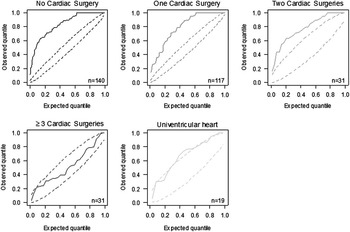
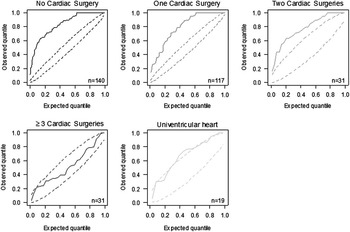
For each of the four groups with children with a biventricular heart and for the one with a univentricular heart, the confidence interval for the expected quantiles was found by simulating 1000 replicates with as many observations as those present in a specific group. The 2.5th and 97.5th bootstrapped empirical percentiles for each expected quantile were then used to provide the confidence intervals for the expected pattern in Figure 2. The observed quantiles of the DISABKIDS chronic generic measure-short version score were also compared with the expected distribution using a Kolmogorov–Smirnov test.
Results
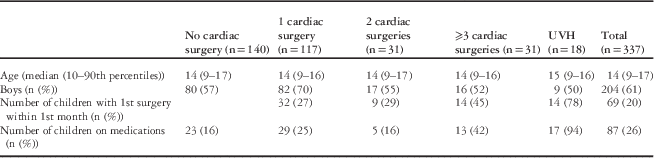
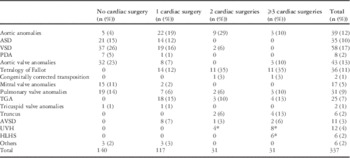
In total, 337 children who completed the DISABKIDS chronic generic measure-short version were included. The median age (10–90th) was 14 years (9–17 years) and 39% were girls. The median time between surgery and DISABKIDS chronic generic measure-short version was 10 years (6–14 years). The main demographic surgical and pharmacological characteristics are detailed in Table 1. The majority (n=319, 95%) had a biventricular heart. Of these, 140 (42%) children had no cardiac surgery, 117 (35%) had one cardiac surgery, 31 (9%) had two surgeries, and 31 (9%) had three or more cardiac surgeries. In total, 18 (5%) children had univentricular heart surgeries (Table 1). The main cardiac diagnoses are shown in Table 2.
Demographic, pharmacological, and surgical characteristics of the study groups.

UVH=univentricular heart
Main cardiac diagnoses in the study groups.

ASD=atrial septal defect; AVSD=atrioventricular septal defect; HLHS=hypoplastic left heart syndrome; PDA=persistent ductus arteriosus; TGA=transposition of the great arteries; UVH=univentricular heart; VSD=ventricular septal defect
* Only included in the UVH group
The DISABKIDS chronic generic measure-short version
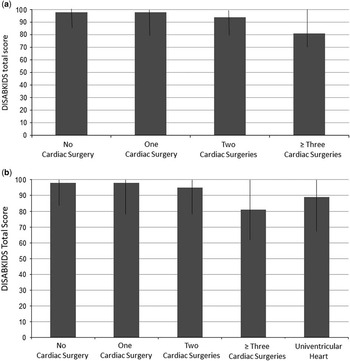
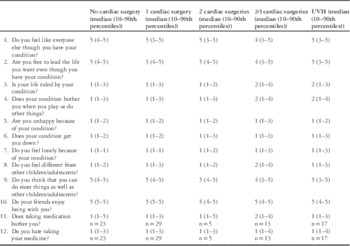
The overall total score was 95 (75–100) with no difference in gender (p>0.3). When children with biventricular heart and univentricular heart were grouped together, those with three or more cardiac surgeries had a lower total score than those with no, one, or two cardiac surgeries (p<0.001; Fig 1a). When children with univentricular heart were grouped separately, the total score remained significantly lower for those with biventricular heart and three or more surgeries (p<0.001; Fig 1b). Children with a univentricular heart had a lower total score than those with one or no surgery (p=0.005, Fig 1b). The total score for children with three or more cardiac surgeries was comparable with that for children with other chronic diseases; however, the total score for children with no, one, or two cardiac surgeries (p<0.001) and for those with univentricular heart (p=0.047) was higher compared with children with other chronic diseases (Fig 2). Among those with cardiac surgery, there was no difference (p>0.3) in total score between children undergoing their first surgery before 1 month of age and those with surgery beyond 1 month of age. The results of the items included in the DISABKIDS chronic generic measure-short version are detailed in Table 3. Although we could not observe any interaction between NYHA and cardiac surgeries, we studied children classified in NYHA I (Table 4) and found that children with three or more surgeries had lower total scores than those with none or one surgery (p>0.001) or those with two surgeries (p=0.002). The internal consistency for the DISABKIDS chronic generic measure-short version expressed by Cronbach’s α was 0.84.
( a ) The DISABKIDS chronic generic measure-short version total score in children grouped according to the number of surgeries. ( b ) Children with univentricular heart are grouped separately. Data are shown as median (10–90th percentiles).

The distribution of the DISABKIDS chronic generic measure-short version total score in relation to the reference score for children with other chronic disease. The full line denotes total score for children with CHD; the area within the dotted lines includes total score for children with other chronic disease.
Items included in the DISABKIDS chronic generic measure-short version.

UVH=univentricular heart
Each item is graded using a five-point scale, indicating frequency of behaviours or feelings as 1=never; 2=seldom; 3=quite often; 4=very often; 5=always. 5 is the highest total score for items 1, 2, 9, and 10. For the other items, 1 is the highest total score
Data are shown as median (10–90th percentiles)
DISABKIDS chronic generic measure-short version total score for children in NYHA I in the study groups.

UVH=univentricular heart
The total score is shown as median (10–90th percentiles)
NYHA, cognitive function, physical activity, and psychosocial ability
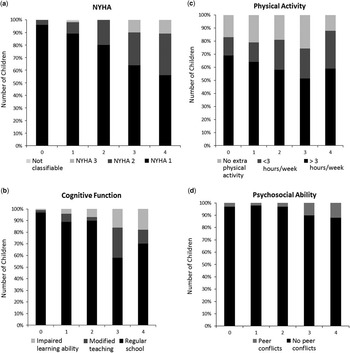
Data on NYHA, physical activity, cognitive function, and psychosocial ability were unavailable for five and nine children, respectively. The majority of respondents were classified in NYHA I (n=290, 87%) and attended regular school (n=293, 88%). The groups with two (p=0.005), three, or more surgeries (p<0.001) and univentricular heart (p<0.001) had a larger number of children in NYHA II than those with no or one cardiac surgery (Fig 3). Nearly all children in NYHA III were among those with three or more surgeries and those with a univentricular heart (p<0.001). Children with three or more surgeries and those with a univentricular heart needed more help in school than children with no or one cardiac surgery (p<0.001). No significant differences between the groups of children were found in terms of “physical activity” and “psychosocial ability” (Fig 3).
Supplementary variables in the Swedish National Registry for Congenital Heart Disease: 0=no cardiac surgery, 1=one cardiac surgery, 2=two cardiac surgeries, 3=three or more cardiac surgeries, 4=univentricular heart. For the variable “cognitive function”, the answer options 3–4 are merged; for the variable “psychosocial ability”, 2–4 are merged. ( a ) NYHA; ( b ) Cognitive function; ( c ) Physical activity; ( d ) Psychosocial ability.

Adjusted model
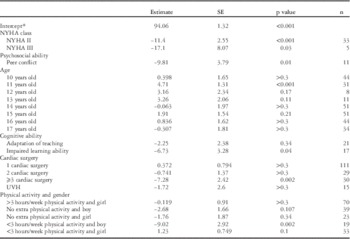
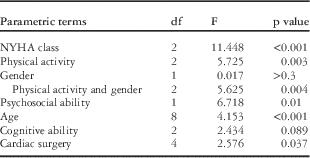
In total, 38% of the deviance for the total score in DISABKIDS chronic generic measure-short version was explained in the quasi-Poisson regression model (Tables 5 and 6). Variables that predicted lower total score were “NYHA”, “number of cardiac surgery”, “cognitive function”, “psychosocial ability”, and “physical activity and gender”.
Estimates from the quasi-Poisson model.

UVH=univentricular heart
* Intercept represent: boys (n=198), age=9 years (n=50), no cardiac surgery (n=139), NYHA I (n=286), >3 hours/week physical activity and boy (n=140), no conflicts with peers (n=313), regular school (n=286)
Analysis of variance table of deviances.

df=degree of freedom; F=observed F-statistic
R2 (adjusted)=0.381, n=324
Discussion
In a retrospective survey of a nationwide registry for CHD including a relatively large cohort from a tertiary referral centre for paediatric cardiac surgery, we found that children with a biventricular heart and three or more cardiac surgeries and children with a univentricular heart had lower health-related quality of life, were more frequently classified in NYHA II or III, and needed help more often in school. To the best of our knowledge, this is the first registry-based study using DISABKIDS chronic generic measure-short version to assess health-related quality of life of children with CHD.
In our cohort, the majority of cardiac surgeries were performed on bypass (“open-heart”), and nearly one-third were relatively complex, including corrective or palliative surgeries in children with tetralogy of Fallot, transposition of the great arteries, and aortic valve disease. Importantly, the distribution of these surgeries (detailed in Table 2) resembled the overall distribution of paediatric cardiac surgeries at our centre. In a comprehensive review of previous randomised, case-controlled, and cohort studies, Latal et alReference Latal, Helfricht, Fischer, Bauersfeld and Landolt 9 noticed that children with open-heart surgery for CHD are at risk for impaired quality of life. The authors’ call for future self-report studies addressing the quality of life in children and adolescents with cardiac surgery remains important. Other aspects related to cardiac surgery deserve attention too. In the multi-centre study by Marino,Reference Marino, Tomlinson and Wernovsky 8 both the disease severity and the frequency of cardiac surgeries were associated with lower health-related quality of life. The main finding in our study indicating lower quality of life in children with three or more cardiac surgeries is thus in line with previous studies showing an impaired health-related quality of life in children with more complex heart disease.Reference Marino, Tomlinson and Wernovsky 8 – Reference Sand, Kljajic and Sunnegårdh 11 , Reference Tahirović, Begić, Nurkić, Tahirović and Varni 19 On the other hand, as suggested in a previous study by Ternestedt et al 20 and 30 years after surgery for atrial septal defect and tetralogy of Fallot,Reference Ternestedt, Wall, Oddsson, Riesenfield, Groth and Schollin 20 the complexity of CHD is not necessarily congruent with certain aspects related to the health-related quality of life.
Comparison with children with other chronic diseases
In our study, 306 children (92%) had a higher total score compared with children of the same age and gender with other chronic diseases; this is comparable with results from previous studies, although a different questionnaire was used.Reference Kwon, Mussatto, Simpson, Brosig, Nugent and Samyn 5 , Reference Mussatto and Twedell 6 The reference population in the DISABKIDS questionnaire is composed of European children with asthma, arthritis, dermatitis, diabetes, cerebral palsy, cystic fibrosis, and epilepsy. The differences between healthcare systems in European countries may have an impact on the result; however, in another study,Reference Chaplin, Hanas, Lind, Tollig, Wrammer and Lindblad 12 Swedish children with diabetes responded to DISABKIDS chronic generic measure-long version and the median of total score was 80. Importantly, the total score in the long version is comparable with that of the short version. 15 Children born with diseases, similar to the children in our study, may rate their health-related quality of life independent of their functional or health state because they have no perception of another health state.Reference Davis, Waters and Mackinnon 21 The difference between acquired and congenital disease could have had an impact on the results of our study.
NYHA
NYHA is a subjective index of heart-related physical capacity and was earlier used as a surrogate in quality-of-life research.Reference Bratt and Moons 3 A study by Berghammer et alReference Berghammer, Karlsson, Ekman, Eriksson and Dellborg 22 showed that NYHA was a predictor of self-reported health status according to the generic Euro QoL-5 Dimension questionnaire responded by adults with CHD. In our study, a decreased total score was associated with NYHA II and III, suggesting a possible link between decreased health-related quality of life, NYHA classification, and the complexity of heart disease. As children in NYHA I with three or more surgeries had lower total score than the rest of children in NYHA I, it is conceivable that the complexity of the heart disease rather than NYHA accounts for the decreased health-related quality of life.
Cognitive function
The association between CHD and cognitive function has been assessed in several studies, with results suggesting a link between severity of CHD and impaired cognitive function.Reference Uzark, Jones, Slusher, Limbers, Burwinkle and Varni 7 , Reference Sand, Kljajic and Sunnegårdh 11 , Reference Tahirović, Begić, Nurkić, Tahirović and Varni 19 , Reference Marino, Uzark, Ittenbach and Drotar 23 In our study, cognitive ability was estimated by the need for aid at school, which is a fairly rough measure of cognitive impairment. Further research is needed to better understand the link between health-related quality of life, neurodevelopment, and psychosocial factors.Reference Marino, Uzark, Ittenbach and Drotar 23
Physical activity and gender
In the study by Mueller et al,Reference Mueller, Sarikouch and Beerbaum 24 boys reported higher scores than girls in one item, physical well-being. In this study, 168 children with tetralogy of Fallot responded to self-reported KINDL-R quality-of-life questionnaire. This is consistent with our result showing that boys with <3 hours of physical activity a week had a decreased total score.
There were no significant differences in total score between children with one, two, or no cardiac surgery. This finding can indicate that fewer surgeries have no impact on total score or that DISABKIDS chronic generic measure-short version is not sufficiently sensitive to discriminate between these groups. A drawback with this questionnaire is that there is no possibility to divide the result into domains, as with a longer questionnaire. The shorter time required to complete the questionnaire is clearly an advantage.
In order to achieve a better understanding at a group level for children with CHD, categorising is necessary because of the mixed spectrum of CHD with both mild and complex diagnoses. Categories in previous research were severity of CHDReference Tahirović, Begić, Nurkić, Tahirović and Varni 19 , separate diagnoses,Reference Ternestedt, Wall, Oddsson, Riesenfield, Groth and Schollin 20 or cardiac surgeryReference Marino, Tomlinson and Wernovsky 8 . In our study, children were categorised based on the number of cardiac surgeries, as this illustrates the complexity of CHD and enables rough delineation between mild and complex CHD within the same diagnosis.
Study limitations
The overall cohort size, the relatively low number of children with two or more surgeries, and children with univentricular heart may have influenced the results. Although the rate of response in our study was very high, the non-responders may choose to do so for various reasons including different perception of the utility of long-term health data acquisition. In addition, there are other potential ways to assess cognitive function and physical ability, such as intelligence test and exercise test, respectively, which were not used in our study. Future studies may be important to interrogate the correlation of these indices to those derived from the questionnaire.
Conclusion
Children with CHD estimated their health-related quality of life to be higher than children with other chronic diseases, except for children with a biventricular heart and three or more cardiac surgeries. Children with higher number of cardiac surgeries, probably coincident with more severe cardiac disease, appear to have lower health-related quality of life, cognitive ability, and NYHA. Thus, health-related quality-of-life variables in the Swedish National Registry for Congenital Heart Disease could be used to identify children at risk for lower health-related quality of life. A validated instrument for health-related quality of life in children with CHD is important for future “interventional” studies aimed to improve the health-related quality of life in risk patients.
Acknowledgements
The authors thank Associate Professor Gudrun Björkhem for sharing her in-depth knowledge of the SWEDCON registry.
Financial Support
This study was supported with grants from Vårdakademin (Academy of Caring Science), UFo (Development and Research in the Health Care Area, Region Skåne and the Southern Health Care Region), and Pediatric Heart Center at the Skåne University Hospital and Lund University.
Conflicts of Interest
None.
Ethical Standards
The study was approved by the Ethics Committee for Human Research at the Lund University (#2011/749).