Introduction
Major depression (MD) is highly prevalent, has a high incidence and is associated with a substantial loss of quality of life, increased mortality rates, and enormous social and economic costs (Ebmeier et al. Reference Ebmeier, Donaghey and Steele2006). Moreover, MD is currently ranked third worldwide in disease burden, and is expected to rank first in high-income countries in 2030 (Mathers & Loncar, Reference Mathers and Loncar2006).
While pharmacological interventions remain the cornerstone of the management of MD, they are often unable to yield adequate clinical improvements in a relatively large proportion of subjects. In fact, up to 20–30% of subjects suffering from MD remain significantly ill despite the use of multiple therapeutic approaches (Berlim et al. Reference Berlim, Fleck and Turecki2008) and, as demonstrated by the large Sequenced Treatment Alternatives to Relieve Depression (STAR*D) study, less than a third of them achieve remission within 12 weeks of starting a first-line antidepressant (Trivedi et al. Reference Trivedi, Rush, Wisniewski, Nierenberg, Warden, Ritz, Norquist, Howland, Lebowitz, McGrath, Shores-Wilson, Biggs, Balasubramani and Fava2006). Furthermore, medications, including antidepressants, are often associated with significant side effects such as metabolic abnormalities and sexual dysfunction (Lam et al. Reference Lam, Kennedy, Grigoriadis, McIntyre, Milev, Ramasubbu, Parikh, Patten and Ravindran2009).
In recent years, a variety of novel neuromodulation techniques targeting MD have emerged (George & Aston-Jones, Reference George and Aston-Jones2010). Among these, repetitive transcranial magnetic stimulation (rTMS) is the most promising, as it allows for discrete and safe non-invasive modulation of cortical excitability and function (Rossi et al. Reference Rossi, Hallett, Rossini and Pascual-Leone2009). More specifically, rTMS involves the induction of electric currents within the brain (up to a depth of 2 cm) produced by pulsating magnetic fields generated through a coil of wire near the scalp (Rosa & Lisanby, Reference Rosa and Lisanby2012). These induced currents can modulate nerve cell activity in relatively focused brain regions, with frequencies ⩾5 Hz [i.e. high-frequency rTMS (HF-rTMS)] being generally associated with excitatory effects (George & Aston-Jones, Reference George and Aston-Jones2010).
Meta-analyses have shown HF-rTMS applied over the left dorsolateral prefrontal cortex (DLPFC) to have antidepressant properties as indexed mainly by statistically significant pre- to post-treatment changes in depression scores when compared with sham rTMS (Ebmeier et al. Reference Ebmeier, Donaghey and Steele2006; Lam et al. Reference Lam, Chan, Wilkins-Ho and Yatham2008; Slotema et al. Reference Slotema, Blom, Hoek and Sommer2010). However, its overall response and remission rates in primary MD remain unclear, and this is particularly problematic as growing consensus in the literature suggests that interventions with a greater likelihood of attaining at least a clinical response (and ideally a remission) have clear advantages in terms of patients' long-term overall functioning and prognosis (Nierenberg & DeCecco, Reference Nierenberg and DeCecco2001; Keller, Reference Keller2004; Rush et al. Reference Rush, Kraemer, Sackeim, Fava, Trivedi, Frank, Ninan, Thase, Gelenberg, Kupfer, Regier, Rosenbaum, Ray and Schatzberg2006). Furthermore, previous meta-analyses have usually combined studies with mixed patient populations (e.g. vascular/post-stroke depression, primary MD), and have often merged data from varying rTMS protocols (e.g. primed rTMS, bilateral rTMS, HF-rTMS over the left DLPFC and/or low frequency rTMS over the right DLPFC), while overlooking their dissimilar neurophysiological basis (Rossi et al. Reference Rossi, Hallett, Rossini and Pascual-Leone2009; Sandrini et al. Reference Sandrini, Umilta and Rusconi2011). Also, the confounding effects of medication use (e.g. subjects who started HF-rTMS concomitantly with a new antidepressant compared with those who were previously on stable medication regimens or off medication) have been rarely accounted for. Finally, previous meta-analyses often lacked relevant details about their key methodological aspects (for additional information, please refer to the Supplementary material). Undoubtedly, these limitations may have contributed to the recent questioning about the therapeutic relevance of rTMS for MD (Ridding & Rothwell, Reference Ridding and Rothwell2007; Fitzgerald, Reference Fitzgerald2010).
To summarize the best available evidence on the use of HF-rTMS for treating MD (considering the limitations of the previous meta-analyses), we have carried out a systematic review and meta-analysis of randomized, double-blind and sham-controlled trials (RCTs). We assessed the following issues: (a) rates of response and remission following HF-rTMS treatment; (b) the utility of HF-rTMS as a monotherapy or as an augmentation strategy; (c) the differential efficacy of HF-rTMS in samples with unipolar MD versus in mixed samples with unipolar and bipolar MD and in patients with categorically defined treatment-resistant depression (TRD) versus in patients with a less resistant illness; (d) the impact of the strategy for managing missing data and of alternative stimulation parameters on the efficacy of HF-rTMS; and (e) its overall acceptability (as indexed by drop-out rates).
Methodology of the literature review
Search strategy
We identified articles for inclusion in this meta-analysis by:
-
(1) Screening the bibliographies of all meta-analyses on rTMS for MD published to date (McNamara et al. Reference McNamara, Ray, Arthurs and Boniface2001; Burt et al. Reference Burt, Lisanby and Sackeim2002; Kozel & George, Reference Kozel and George2002; Martin et al. Reference Martin, Barbanoj, Schlaepfer, Clos, Perez, Kulisevsky and Gironell2002, Reference Martin, Barbanoj, Schlaepfer, Thompson, Perez and Kulisevsky2003; Couturier, Reference Couturier2005; Herrmann & Ebmeier, Reference Herrmann and Ebmeier2006; Gross et al. Reference Gross, Nakamura, Pascual-Leone and Fregni2007; Lam et al. Reference Lam, Chan, Wilkins-Ho and Yatham2008; Schutter, Reference Schutter2009, Reference Schutter2010; Slotema et al. Reference Slotema, Blom, Hoek and Sommer2010; Allan et al. Reference Allan, Herrmann and Ebmeier2011) as well as of all included RCTs;
-
(2) Searching Medline, EMBASE, PsycINFO, the Cochrane Central Register of Controlled Trials (CENTRAL), SCOPUS and ProQuest Dissertations & Theses (PQDT) from 1 January 1995 until 22 July 2012.
The search procedures (including syntaxes, parameters and results) are described in detail in the Supplementary material.
Study selection
Candidate studies (judged on the basis of their title and abstract) had to satisfy the following criteria (Higgins & Green, Reference Higgins and Green2008):
-
(1) Study validity: random allocation; double-blind (i.e. patients and clinical raters blinded to treatment conditions); sham-controlled (i.e. coil angled on the scalp or use of a specific sham coil); parallel or crossover design (with only data from the initial randomization being used for the latter to avoid carryover effects); ⩾5 subjects with MD randomized per study arm;
-
(2) Sample characteristics: subjects aged 18–75 years with a diagnosis of primary MD according to the Diagnostic and Statistical Manual of Mental Disorders, fourth edition or later (APA, 1994) or the International Classification of Diseases criteria (World Health Organization, 1992);
-
(3) Treatment characteristics: HF-rTMS (⩾5 Hz) over the left DLPFC given for ⩾10 sessions;
-
(4) Publication related: articles written in English.
Studies were excluded if they:
-
(1) Enrolled subjects with ‘narrow’ diagnoses (e.g. postpartum MD) or secondary MD (e.g. vascular depression);
-
(2) Started HF-rTMS concomitantly with a new antidepressant medication;
-
(3) Did not report rates of response and/or remission.
Data extraction
Data were recorded in a structured manner as follows:
-
(1) Sample characteristics: mean age, gender, treatment strategy (i.e. augmentation versus monotherapy), primary diagnosis, presence of TRD;
-
(2) Study design: strategy for managing missing data (i.e. intention-to-treat approach versus completers-only analyses);
-
(3) rTMS-related parameters: stimulation frequency and intensity (including the total number of stimuli delivered), number of treatment sessions, type of sham;
-
(4) Primary outcome measure: number of responders to treatment based on the RCTs' primary efficacy measure (defined as a ⩾50% reduction in post-treatment scores on the Hamilton Depression Rating Scale (HAMD; Hamilton, Reference Hamilton1960) or on the Montgomery–Asberg Depression Rating Scale (MADRS; Montgomery & Asberg, Reference Montgomery and Asberg1979) at the end of the blinded treatment;
-
(5) Secondary outcome measure: number of remitters based on the RCTs' primary efficacy measure (e.g. 17- or 21-item HAMD scores ⩽7 or ⩽8 (Rush et al. Reference Rush, Kraemer, Sackeim, Fava, Trivedi, Frank, Ninan, Thase, Gelenberg, Kupfer, Regier, Rosenbaum, Ray and Schatzberg2006), respectively, or MADRS scores ⩽6 (Rush et al. Reference Rush, Kraemer, Sackeim, Fava, Trivedi, Frank, Ninan, Thase, Gelenberg, Kupfer, Regier, Rosenbaum, Ray and Schatzberg2006)) at the end of the blinded treatment;
-
(6) Acceptability of treatment: differential drop-out rates between the HF- and sham rTMS groups at the end of the blinded treatment.
Data synthesis
Analyses were performed using Comprehensive Meta-Analyses version 2.0 (Biostat, USA), and IBM SPSS version 20 (IBM Corp., USA).
We used a random-effects model because we assumed that the true treatment effects had probably varied between the included RCTs (Riley et al. Reference Riley, Higgins and Deeks2011). If provided, intention-to-treat data, using a method such as ‘last observation carried forward’ (Fergusson et al. Reference Fergusson, Aaron, Guyatt and Hebert2002), were preferred over data from completers. The efficacy of HF-rTMS for MD as well as its acceptability were investigated by odds ratios (ORs) (Deeks, Reference Deeks2002) and the number needed to treat (NNT). We considered a NNT ⩽10 as clinically meaningful because such a treatment difference would be routinely encountered in day-to-day clinical practice (Citrome, Reference Citrome2011). We also performed cumulative analyses to retrospectively identify the point in time when HF-rTMS (compared with sham rTMS) first reached conventional levels of statistical significance in terms of higher response and remission rates (Egger et al. Reference Egger, Smith and Altman2001). To rule out the presence of baseline differences in depressive symptoms between HF- and sham rTMS groups, we computed the pooled standardized mean difference (SMD) for subjects' baseline depression scores. Furthermore, we conducted subgroup analyses to assess the potential impact of the following study characteristics on effect size estimates for response and remission rates: (a) presence of TRD at baseline (i.e. <2 versus ⩾2 failed antidepressant trials in the current depressive episode; Berlim & Turecki, Reference Berlim and Turecki2007); (b) treatment strategy (i.e. monotherapy versus augmentation); (c) diagnosis (i.e. unipolar MD versus mixed samples with unipolar and bipolar MD); and (d) strategy for managing missing data (i.e. intention-to-treat approach versus completers-only analyses; papers lacking information on this issue were conservatively deemed to have employed the latter; Moher et al. Reference Moher, Hopewell, Schulz, Montori, Gøtzsche, Devereaux, Elbourne, Egger and Altman2010). Finally, we conducted meta-regression analyses (method of moments) to assess the potential impact of the following stimulation parameters on effect size estimates for response and remission rates: (a) frequency in Hz; (b) percentage of the resting motor threshold (%rMT), (c) number of sessions; and (d) total number of magnetic pulses.
Heterogeneity was assessed using the Q statistics and the I 2 index (Cooper et al. Reference Cooper, Hedges and Valentine2009). Values of p < 0.10 for the former and >35% for the latter were deemed as indicative of study heterogeneity (Borenstein et al. Reference Borenstein, Hedges, Higgins and Rothstein2009). Finally, we used funnel plots, Rosenthal's fail-safe N (Rosenthal, Reference Rosenthal1979), Egger's regression intercept (Egger et al. Reference Egger, Davey Smith, Schneider and Minder1997) and Duval & Tweedie's trim-and-fill procedure (Duval & Tweedie, Reference Duval and Tweedie2000) to test for the presence of publication bias (Borenstein et al. Reference Borenstein, Hedges, Higgins and Rothstein2009; Cooper et al. Reference Cooper, Hedges and Valentine2009).
Results
Literature search
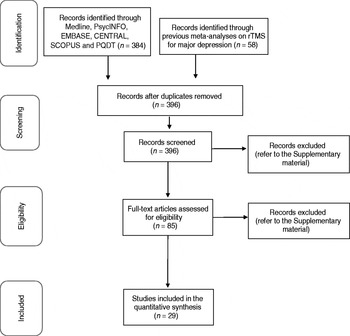
Of the 34 RCTs on HF-rTMS for MD included in the previous meta-analyses, 20 were selected for the present investigation (George et al. Reference George, Wassermann, Kimbrell, Little, Williams, Danielson, Greenberg, Hallett and Post1997; Berman et al. Reference Berman, Narasimhan, Sanacora, Miano, Hoffman, Hu, Charney and Boutros2000; George et al. Reference George, Nahas, Molloy, Speer, Oliver, Li, Arana, Risch and Ballenger2000; Garcia-Toro et al. Reference Garcia-Toro, Mayol, Arnillas, Capllonch, Ibarra, Crespi, Mico, Lafau and Lafuente2001; Boutros et al. Reference Boutros, Gueorguieva, Hoffman, Oren, Feingold and Berman2002; Padberg et al. Reference Padberg, Zwanzger, Keck, Kathmann, Mikhaiel, Ella, Rupprecht, Thoma, Hampel, Toschi and Moller2002; Fitzgerald et al. Reference Fitzgerald, Brown, Marston, Daskalakis, De Castella and Kulkarni2003; Hoppner et al. Reference Hoppner, Schulz, Irmisch, Mau, Schlafke and Richter2003; Nahas et al. Reference Nahas, Kozel, Li, Anderson and George2003; Holtzheimer et al. Reference Holtzheimer, Russo, Claypoole, Roy-Byrne and Avery2004; Koerselman et al. Reference Koerselman, Laman, van Duijn, van Duijn and Willems2004; Mosimann et al. Reference Mosimann, Schmitt, Greenberg, Kosel, Muri, Berkhoff, Hess, Fisch and Schlaepfer2004; Rossini et al. Reference Rossini, Lucca, Zanardi, Magri and Smeraldi2005; Su et al. Reference Su, Huang and Wei2005; Avery et al. Reference Avery, Holtzheimer, Fawaz, Russo, Neumaier, Dunner, Haynor, Claypoole, Wajdik and Roy-Byrne2006; Anderson et al. Reference Anderson, Delvai, Ashim, Ashim, Lewin, Singh, Sturman and Strickland2007; Loo et al. Reference Loo, Mitchell, McFarquhar, Malhi and Sachdev2007; O'Reardon et al. Reference O'Reardon, Solvason, Janicak, Sampson, Isenberg, Nahas, McDonald, Avery, Fitzgerald, Loo, Demitrack, George and Sackeim2007; Stern et al. Reference Stern, Tormos, Press, Pearlman and Pascual-Leone2007; Mogg et al. Reference Mogg, Pluck, Eranti, Landau, Purvis, Brown, Curtis, Howard, Philpot and McLoughlin2008). Also, we retrieved 15 RCTs on HF-rTMS for MD from Medline, PsycINFO, EMBASE, CENTRAL, SCOPUS and PQDT. Of these, nine met the eligibility criteria (George et al. Reference George, Lisanby, Avery, McDonald, Durkalski, Pavlicova, Anderson, Nahas, Bulow, Zarkowski, Holtzheimer, Schwartz and Sackeim2010; Triggs et al. Reference Triggs, Ricciuti, Ward, Cheng, Bowers, Goodman, Kluger and Nadeau2010; Zheng et al. Reference Zheng, Zhang, Li, Liu, Gao, Liu, Zou, Zhang, Liu, Zhang, Li and Men2010; Zhang et al. Reference Zhang, Wang, Wang, Liu and Fan2011; Blumberger et al. Reference Blumberger, Mulsant, Fitzgerald, Rajji, Ravindran, Young, Levinson and Daskalakis2012; Fitzgerald et al. Reference Fitzgerald, Hoy, Herring, McQueen, Peachey, Segrave, Maller, Hall and Daskalakis2012; Hernández-Ribas et al. Reference Hernández-Ribas, Deus, Pujol, Segalàs, Vallejo, Menchón, Cardoner and Soriano-Mas2013; Bakim et al. in press). See Fig. 1 for a PRISMA flowchart (Moher et al. Reference Moher, Liberati, Tetzlaff and Altman2009), and the Supplementary material for a detailed description of the study selection procedures.
Study selection procedures: PRISMA flowchart. CENTRAL, Cochrane Central Register of Controlled Trials; PQDT, ProQuest Dissertations & Theses; rTMS, repetitive transcranial magnetic stimulation.

Included RCTs and subject characteristics
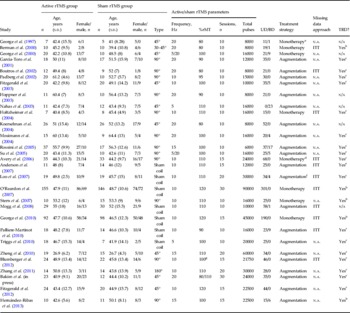
A total of 29 RCTs were included in our meta-analysis, totaling 1371 subjects with MD, of whom 730 were randomized to HF-rTMS (mean age = 47.6, s.d. = 7.1 years, 58.6% females), and 641 were randomized to sham rTMS (mean age = 47.4, s.d. = 6.7 years, 54.4% females) (Table 1). The mean number of HF-rTMS sessions and magnetic pulses delivered were 13.4 (s.d. = 5.7) and 20922 (s.d. = 17656), respectively, and 18 RCTs (62.1%) included subjects with treatment-resistant MD (i.e. ⩾2 failed antidepressant trials in the current depressive episode; Berlim & Turecki, Reference Berlim and Turecki2007). Finally, rTMS was offered as an augmentation treatment strategy in 21 out of 29 (72.4%) trials.
Included randomized, double-blind and sham-controlled trials on high-frequency rTMS for major depression: main characteristics

rTMS, Repetitive transcranial magnetic stimulation; s.d., standard deviation; %rMT, percentage of the resting motor threshold; UD, unipolar major depression; BD, bipolar depression (type I or II); TRD, treatment-resistant depression; n.a., information not available; ITT, intention to treat; MDE, major depressive episode.
a Only three subjects continued with stable medication regimens.
b Failure to respond to ⩾1 antidepressant in the current or previous MDE.
c Failure to respond to ⩾2 antidepressants in the current MDE.
d 31% (n = 11) of the subjects maintained stable dosages of antidepressants during the study and 69% (n = 24) were off medication.
e No explicit criteria for TRD.
f Of the subjects, 55.3% (21/38) kept a stable medication regimen.
g 120% of the rMT in subjects older than 60 years old.
Response rates
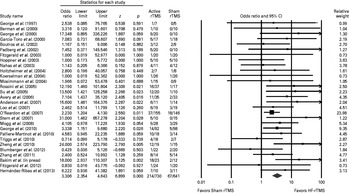
Data relating to response rates were available from all 29 RCTs. Overall, 214/730 (29.3%) and 67/641 (10.4%) subjects receiving HF- or sham rTMS were classified as responders, respectively. The pooled OR was 3.3 [95% confidence interval (CI) 2.35–4.64, z = 6.9, p < 0.0001], indicating a significant difference in outcome favoring HF-rTMS (Fig. 2). The risk difference translated into a NNT of 6 (95% CI 4.4–6.8), meaning that about one in every six patients have clinically responded following HF-rTMS treatment (Citrome, Reference Citrome2011).
Meta-analysis of high-frequency (HF) repetitive transcranial magnetic stimulation (rTMS) versus sham rTMS for major depression: response rates. CI, Confidence interval.

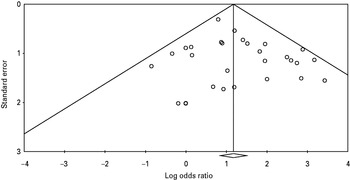
Heterogeneity between RCTs did not exceed that expected by chance [Q 29 = 28.9, degrees of freedom (df) = 28, p = 0.42, I 2 = 2.97], implying that the variance among the effect sizes was not greater than expected by sampling error. The fail-safe N was 321, indicating that at least 321 unpublished or missing null findings would be needed to render the clinical effect of active HF-rTMS in terms of response statistically non-significant (i.e. p ⩾ 0.05). Additionally, the associated funnel plot was reasonably symmetrical (Fig. 3). Publication bias was assessed more conservatively with Egger's regression intercept, which was 0.45 (df = 27, t = 1.1, two-tailed p = 0.28), suggesting a low risk of publication bias. In the more conservative Duval and Tweedie's trim-and-fill procedure, two of the RCTs with the highest ORs were trimmed and filled on the opposite side of zero, resulting in a corrected pooled OR of 3.16 (95% CI 2.18–4.6, Q adj = 34.59).
Funnel plot of standard error by log odds ratio: response rates.

Remission rates
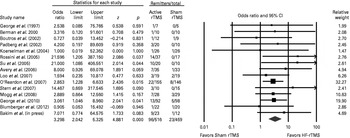
Data relating to remission rates were available from 15 RCTs. Overall, 96/516 (18.6%) and 23/459 (5%) subjects receiving HF- or sham rTMS were classified as remitters, respectively. The pooled OR was 3.3 (95% CI 2.04–5.32, z = 4.88, p < 0.0001) (Fig. 4). The risk difference translated into a NNT of 8 (95% CI 5.8–10.5).
Meta-analysis of high-frequency (HF) repetitive transcranial magnetic stimulation (rTMS) versus sham rTMS for major depression: remission rates. CI, Confidence interval.

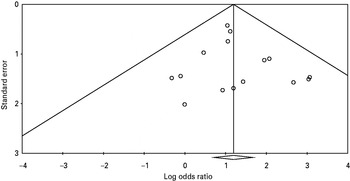
Heterogeneity between RCTs did not exceed that expected by chance (Q 15 = 8.05, df = 14, p = 0.89, I 2 = 0). The associated funnel plot was reasonably symmetrical (Fig. 5), the fail-safe N was 67, and Egger's regression intercept was 0.3 (df = 13, t = 0.73, two-tailed p = 0.48), suggesting a low risk of publication bias. In the Duval and Tweedie's trim-and-fill procedure, one RCT was trimmed and filled on the opposite side of zero, resulting in a corrected pooled OR of 3.13 (95% CI 1.95–5, Q adj = 9.82).
Funnel plot of standard error by log odds ratio: remission rates.

HF-rTMS for MD: acceptability
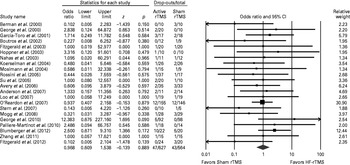
No differences on drop-out rates were observed at study end between HF- and sham rTMS groups (7.5% v. 7.6%, respectively) (OR = 0.97, z = –0.14, p = 0.89) (Fig. 6). Furthermore, heterogeneity between RCTs did not exceed that expected by chance (Q 22 = 14.5, df = 21, p = 0.84, I 2 = 0). Finally, no differential drop-out rates were observed when HF-rTMS was used as an augmentation strategy or as a monotherapy for MD (Q = 0.1, df = 1, p = 0.76). For the associated forest plots, please refer to the Supplementary material.
Meta-analysis of high-frequency (HF) repetitive transcranial magnetic stimulation (rTMS) versus sham rTMS for major depression: drop-out rates. CI, Confidence interval.

Efficacy of HF-rTMS for MD: presence of TRD
There were no significant differences in terms of efficacy between HF-rTMS used in samples with categorically defined TRD or in samples including less treatment-resistant patients (response: Q = 0.95, df = 1, p = 0.33; remission: Q = 0.39, df = 1, p = 0.53). For the associated forest plots, please refer to the Supplementary material.
Efficacy of HF-rTMS for MD: augmentation versus monotherapy
There were no significant differences in terms of efficacy between HF-rTMS used as an augmentation strategy or as monotherapy for MD (response: Q = 0, df = 1, p = 0.95; remission: Q = 0.01, df = 1, p = 0.91). For the associated forest plots, please refer to the Supplementary material.
Efficacy of HF-rTMS for MD: primary diagnosis
There were no significant differences in terms of efficacy between HF-rTMS used in samples with primary unipolar MD or in mixed samples with unipolar and bipolar MD (response: Q = 0.39, df = 1, p = 0.39; remission: Q = 0.11, df = 1, p = 0.74). For the associated forest plots, please refer to the Supplementary material.
Efficacy of HF-rTMS for MD: missing data management
There were no significant differences in terms of efficacy between RCTs using an intention-to-treat approach or a completers-only analysis (response: Q = 1, df = 1, p = 0.32; remission: Q = 2.67, df = 1, p = 0.10). For the associated forest plots, please refer to the Supplementary material.
Efficacy of HF-rTMS for MD: stimulation parameters
Meta-regressions have shown no significant association between alternative rTMS-related parameters and estimates of response and remission rates: frequency (response: coefficient = 0.06, s.e. = 0.04, z = –0.12, p = 0.9; remission: coefficient = 0.02, s.e. = 0.07, z = 0.27, p = 0.79),%rMT (response: coefficient = –0.009, s.e. = 0.014, z = –0.62, p = 0.53; remission: coefficient = –0.005, s.e. = 0.02, z = –0.28, p = 0.78), total number of sessions (response: coefficient = –0.001, s.e. = 0.02, z = –0.05, p = 0.93; remission: coefficient = –0.003, s.e. = 0.028, z = –0.12, p = 0.9), and total number of magnetic pulses (response: coefficient = <0.0001, s.e. = <0.0001, z = –0.88, p = 0.39; remission: coefficient = <0.0001, s.e. = <0.0001, z = –0.18, p = 0.86). For the associated regression scatter plots, please refer to the Supplementary material.
Cumulative analyses
RCTs on HF-rTMS for MD showed it to be significantly superior to sham rTMS in terms of response and remission rates by the years 2002–2003 and 2005, respectively. Further studies essentially narrowed the CI around relatively similar OR estimates. For the associated forest plots, please refer to the Supplementary material.
HF- versus sham rTMS: baseline depression severity
No differences on mean baseline depression scores for HF- and sham-rTMS groups were found (SMD = –0.001, z = –0.02, p = 0.98), thus ruling out illness severity at baseline as a confounding factor. Heterogeneity between RCTs did not exceed that expected by chance (Q 28 = 33.9, df = 27, p = 0.17, I 2 = 20.4). For the associated forest plot, please refer to the Supplementary material.
Discussion
To our knowledge, this is the first (and largest overall) meta-analysis to investigate response, remission and drop-out rates following HF-rTMS for primary MD. Briefly, our results show that this neuromodulation technique is significantly more effective than sham rTMS in terms of both response and remission rates [with pooled ORs of 3.3 for each and clinically relevant NNTs (Citrome, Reference Citrome2011) of 6 and 8, respectively]. Furthermore, HF-rTMS seems to be equally effective as an augmentation strategy or as a monotherapy for MD, when it is used in patients with categorically defined TRD or in patients with less resistant depressive illness, and in samples with primary unipolar MD or in mixed samples with unipolar and bipolar MD. Moreover, alternative stimulation parameters were not associated with differential efficacy estimates. Finally, HF- and sham rTMS groups did not differ in terms of baseline depressive symptomatology and drop-out rates at study end.
Overall, HF-rTMS seems to be an acceptable treatment for MD, and is associated with clinically relevant antidepressant effects (especially considering that it has been mostly investigated in samples with TRD). This notion is further strengthened by the fact that the observed effect sizes for HF-rTMS are comparable with those reported for several commercially available antidepressants and augmenting medications. For example, a recent meta-analysis of 122 trials on antidepressants for MD (mostly in non-TRD samples) found a pooled drug–placebo rate ratio for response to treatment of 1.42 (95% CI 1.38–1.48) and a corresponding NNT of 8 (95% CI 7.1–9.1) (Undurraga & Baldessarini, Reference Undurraga and Baldessarini2012); our estimate, when converted to rate ratio, is 2.2 (95% CI 1.72–2.83). Moreover, a recent meta-analysis on the use of atypical antipsychotics as augmenting agents for TRD has shown that the ORs for response and remission with drug versus placebo were 1.69 (95% CI 1.46–1.95) and 2.00 (95% CI 1.69–2.37), respectively (Nelson & Papakostas, Reference Nelson and Papakostas2009). Furthermore, our findings resemble those reported by the large and representative STAR*D study in which remission rates after lithium carbonate or triiodothyronine augmentation of a second unsuccessful antidepressant course were 20.4% (Nierenberg et al. Reference Nierenberg, Fava, Trivedi, Wisniewski, Thase, McGrath, Alpert, Warden, Luther, Niederehe, Lebowitz, Shores-Wilson and Rush2006). More specifically, HF-rTMS in the current meta-analysis was associated with remission rates of 18.6% in depressed individuals who had often not responded to at least two antidepressant trials in the current episode.
It is difficult to compare our findings with those of previous meta-analysis as their main outcome measures and methodology differed significantly from ours. For example, we included a homogeneous set of RCTs in terms of the stimulation protocol used (i.e. HF-rTMS over the left DLPFC). Furthermore, our use of clinically relevant outcome measures such as response and remission rates is in line with current guidelines on the assessment of treatment efficacy in MD (Rush et al. Reference Rush, Kraemer, Sackeim, Fava, Trivedi, Frank, Ninan, Thase, Gelenberg, Kupfer, Regier, Rosenbaum, Ray and Schatzberg2006), and is clearly more useful and understandable for healthcare professionals and administrators, as well as for patients and their relatives, than traditional effect sizes such as Cohen's d or Hedges' g (Fritz et al. Reference Fritz, Morris and Richler2012). All but one previous meta-analysis (Lam et al. Reference Lam, Chan, Wilkins-Ho and Yatham2008) has reported response and remission rates following rTMS for MD, although in this study the focus was on treatment-resistant cases, diverse stimulation protocols were combined (e.g. HF-, bilateral and low-frequency rTMS) and significant heterogeneity between the included RCTs (e.g. I 2 > 30%) was observed (Lam et al. Reference Lam, Chan, Wilkins-Ho and Yatham2008).
As the therapeutic use of HF-rTMS involves several variables, it is possible that the optimum treatment protocol is yet to be determined (Wassermann & Zimmermann, Reference Wassermann and Zimmermann2012). However, based on our findings, we could not show that the optimization of parameters such as frequency,%rMT, and number of sessions/total magnetic stimulation produced higher efficacy estimates. In other words, intensive HF-rTMS protocols are not necessarily more effective for MD than less intensive ones, and this might have implications for the ‘real-world’ delivery of this neuromodulation treatment. More broadly, and in light of our main results, we propose that future studies on HF-rTMS for MD should move away from establishing the efficacy of current stimulation protocols against sham rTMS – which we believe has now been firmly demonstrated – and focus instead on new ways of improving its therapeutic effects, tolerability and availability. For instance, new stimulation protocols and devices, such as theta burst stimulation (Chistyakov et al. Reference Chistyakov, Rubicsek, Kaplan, Zaaroor and Klein2010) and the H-coil (Levkovitz et al. Reference Levkovitz, Harel, Roth, Braw, Most, Katz, Sheer, Gersner and Zangen2010), respectively, and the application of baseline electrophysiological and/or neuroimaging evaluations to determine whether HF-rTMS will be effective for individual patients (Arns et al. Reference Arns, Drinkenburg, Fitzgerald and Kenemans2012) have already yielded encouraging results. Also, an interesting avenue for potentially enhancing the overall efficacy of HF-rTMS for MD is the targeting of alternative brain regions (e.g. dorsomedial, ventrolateral and ventromedial prefrontal cortices; Downar & Daskalakis, Reference Downar and Daskalakis2012). However, the clinical utility of this strategy has not yet been established in the literature.
Limitations
First, the quality of the available sham/control rTMS conditions is still unresolved (Rosa & Lisanby, Reference Rosa and Lisanby2012). The majority of the included RCTs have used active stimulation with the magnetic coil tilted at angles of 45° to 90° from the scalp. Even though the magnetic field intensity in this sham method is oriented away from the target, it has been demonstrated that it can still affect brain functioning (George & Aston-Jones, Reference George and Aston-Jones2010). Furthermore, first-generation sham coils have been shown to only partially mimic the experience of real rTMS (Rossi et al. Reference Rossi, Hallett, Rossini and Pascual-Leone2009), and this might have resulted in ineffective blinding. However, we have recently shown that a similar percentage of subjects receiving HF- and sham rTMS (52% v. 59%, respectively; risk difference = –0.04, z = –0.51, p = 0.61) were able to correctly guess their treatment allocation at study end (Berlim et al. Reference Berlim, Broadbent and Van den Eynde2013). Second, the ideal strategy for targeting the DLPFC is still debatable (Rosa & Lisanby, Reference Rosa and Lisanby2012). Most RCTs in MD to date have used the so-called ‘5 cm rule’, which involves the localization of the motor cortical site for optimal stimulation of the abductor pollicis brevis muscle, and then a measurement 5 cm anteriorly along the scalp surface to identify the DLPFC (George & Aston-Jones, Reference George and Aston-Jones2010). However, a number of recent studies have shown this method to be probably suboptimal (Fitzgerald et al. Reference Fitzgerald, Hoy, McQueen, Maller, Herring, Segrave, Bailey, Been, Kulkarni and Daskalakis2009; Herbsman et al. Reference Herbsman, Avery, Ramsey, Holtzheimer, Wadjik, Hardaway, Haynor, George and Nahas2009; Rusjan et al. Reference Rusjan, Barr, Farzan, Arenovich, Maller, Fitzgerald and Daskalakis2010) and, thus, the use of neuronavigation, which involves the localization of the scalp position associated with the DLPFC based on structural magnetic resonance imaging scans from individual subjects, may be useful for future RCTs (Ruohonen & Karhu, Reference Ruohonen and Karhu2010; Schonfeldt-Lecuona et al. Reference Schonfeldt-Lecuona, Lefaucheur, Cardenas-Morales, Wolf, Kammer and Herwig2010). Third, although the interaction between professionals administering rTMS and patients was kept to a minimum, the fact that the former were not blind to treatment allocation may have influenced treatment outcome (Rosa & Lisanby, Reference Rosa and Lisanby2012). Fourth, we only examined the efficacy of HF-rTMS immediately after study end, and thus cannot estimate the stability of its medium- to long-term antidepressant effects. This is especially relevant considering the labor-intensive and time-consuming nature of rTMS (Wassermann & Zimmermann, Reference Wassermann and Zimmermann2012). Although data remain limited in this regard, a recent 6-month follow-up study with over 90 depressed subjects has shown that the therapeutic benefits of HF-rTMS are durable, and that it can be also used for precluding impending relapse (Janicak et al. Reference Janicak, Nahas, Lisanby, Solvason, Sampson, McDonald, Marangell, Rosenquist, McCall, Kimball, O'Reardon, Loo, Husain, Krystal, Gilmer, Dowd, Demitrack and Schatzberg2010). Additionally, Mogg et al. (Reference Mogg, Pluck, Eranti, Landau, Purvis, Brown, Curtis, Howard, Philpot and McLoughlin2008) have reported that the clinical improvements associated with HF-rTMS were maintained overall at a 4-month follow-up. Fifth, because we did not have access to individual patient data, we could not compare the efficacy of HF-rTMS in patients at different stages of the treatment of MD. Sixth, one could argue that our main results were principally derived from two large multicenter trials (O'Reardon et al. Reference O'Reardon, Solvason, Janicak, Sampson, Isenberg, Nahas, McDonald, Avery, Fitzgerald, Loo, Demitrack, George and Sackeim2007; George et al. Reference George, Lisanby, Avery, McDonald, Durkalski, Pavlicova, Anderson, Nahas, Bulow, Zarkowski, Holtzheimer, Schwartz and Sackeim2010) (as the remaining RCTs were numerous but had relatively small samples). However, the random-effects model (DerSimonian & Kacker, Reference DerSimonian and Kacker2007) employed in this meta-analysis assigned a relative weight of <35% to those two large trials. Finally, meta-analyses have been often criticized for combining heterogeneous studies, for the potential of publication bias, and for the inclusion of poor-quality trials (Borenstein et al. Reference Borenstein, Hedges, Higgins and Rothstein2009). In the present study, however, these concerns were addressed by the use of stringent inclusion criteria, and by the objective examination of both publication bias and heterogeneity. In particular, the lack of significant heterogeneity among the included RCTs shows that our results are reliable overall. Also, the estimated fail-safe Ns for response and remission rates after HF-rTMS were 321 and 67, respectively, and we believe that it is unlikely that such a large number of unpublished RCTs with null effects have been either missed by our literature search or never published.
Practical suggestions for future RCTs
We propose the following practical suggestions for future RCTs on rTMS for MD: (1) investigators should systematically and thoroughly report relevant MD-related variables (e.g. number of lifetime depressive episodes, current episode duration, current and past use of antidepressants and/or of other somatic or psychotherapeutic treatments, current suicidality), as well as response and remission rates according to current recommendations on efficacy assessment in MD (Rush et al. Reference Rush, Kraemer, Sackeim, Fava, Trivedi, Frank, Ninan, Thase, Gelenberg, Kupfer, Regier, Rosenbaum, Ray and Schatzberg2006); (2) trials should include other clinically relevant treatment outcomes encompassing constructs that go beyond the estimation of depressive symptoms (e.g. quality of life, social functioning) (Berlim & Fleck, Reference Berlim and Fleck2003); (3) the use of novel sham rTMS techniques, such as focal electrical stimulation of the scalp (Borckardt et al. Reference Borckardt, Walker, Branham, Rydin-Gray, Hunter, Beeson, Reeves, Madan, Sackeim and George2008), should be probably favored over coil angulation and first-generation sham coils; (4) studies should include longer follow-up periods (e.g. >6–12 months) in order to establish the medium- to long-term cost-effectiveness of HF-rTMS; and (f) the use of novel stimulation protocols [e.g. theta burst stimulation (Chistyakov et al. Reference Chistyakov, Rubicsek, Kaplan, Zaaroor and Klein2010), accelerated rTMS (Holtzheimer et al. Reference Holtzheimer, McDonald, Mufti, Kelley, Quinn, Corso and Epstein2010)] and techniques (e.g. deep transcranial magnetic stimulation; Levkovitz et al. Reference Levkovitz, Harel, Roth, Braw, Most, Katz, Sheer, Gersner and Zangen2010) should be carefully evaluated.
Supplementary material
For supplementary material accompanying this paper visit http://dx.doi.org/10.1017/S0033291713000512.
Declaration of Interest
M.T.B. has received a researcher-initiated grant from Brainsway Inc. Z.J.D. received external funding through Neuronetics and Brainsway Inc., Aspect Medical and a travel allowance through Pfizer and Merck. He has also received speaker funding through Sepracor Inc. and served on the advisory board for Hoffmann-La Roche Ltd.