Child sexual abuse (CSA) is a public health issue that is associated with multiple adverse psychosocial repercussions. In children, CSA has been linked to posttraumatic stress symptoms and behavior problems, among other negative outcomes (Lewis, McElroy, Harlaar, & Runyan, Reference Lewis, McElroy, Harlaar and Runyan2016; McLaughlin et al., Reference McLaughlin, Koenen, Bromet, Karam, Liu, Petukhova and Alonso2017). These consequences can impact the different spheres of life of the child. For instance, a recent study showed that child victims had more social problems at school than nonabused children (Amédée, Tremblay-Perreault, Hébert, & Cyr, Reference Amédée, Tremblay-Perreault, Hébert and Cyr2019). The association between CSA and revictimization in other contexts is also well documented. CSA victims are at risk of experiencing other forms of interpersonal victimization during childhood (Papalia et al., Reference Papalia, Luebbers, Ogloff, Cutajar, Mullen and Mann2017) and adulthood (Walker, Freud, Ellis, Fraine, & Wilson, Reference Walker, Freud, Ellis, Fraine and Wilson2019). Very few studies on the revictimization of child victims of CSA have included peer victimization. Nevertheless, victimization occurring in the school context should be considered, especially in middle childhood, since children spend a significant part of their day in school.
Peer victimization may take many forms and is often categorized into overt and relational victimization (Casper & Card, Reference Casper and Card2017). Relational victimization involves the manipulation of social relationships or one's reputation, such as spreading rumors or excluding someone from a group of peers. Conversely, overt victimization includes physical victimization (e.g. hitting, pushing, etc.) and verbal victimization which can take the form of insults, threats, and teasing, among others. Peer victimization has been linked to a host of negative and long-lasting ramifications, including, but not limited to, anxiety, depression, conduct problems (Singham et al., Reference Singham, Viding, Schoeler, Arseneault, Ronald, Cecil and Pingault2017), and problematic social relationships (McDougall & Vaillancourt, Reference McDougall and Vaillancourt2015). Evidence suggests that the prevalence of peer victimization is heightened in children who have been victims of other forms of interpersonal violence. Children and adolescents who have been maltreated (i.e., victims of physical, emotional, sexual abuse, and neglect) present greater rates of peer victimization than nonvictims (Lereya, Copeland, Costello, & Wolke, Reference Lereya, Copeland, Costello and Wolke2015). Albeit scarce, studies examining the intersection of peer victimization and CSA, specifically, also suggest an increased vulnerability to peer victimization in these youths (Auslander, Myers Tlapek, Threlfall, Edmond, & Dunn, Reference Auslander, Myers Tlapek, Threlfall, Edmond and Dunn2018; Tremblay-Perreault & Hébert, Reference Tremblay-Perreault and Hébert2020). Importantly, peer victimization may be more detrimental when it co-occurs with other forms of interpersonal victimization. In fact, peer victimization was found to predict behavioral problems above and beyond the effect of CSA (Tremblay-Perreault & Hébert, Reference Tremblay-Perreault and Hébert2020).
Researchers face an important methodological challenge when assessing peer victimization. Studies have relied on various methodologies to assess peer victimization and have used reports of children, teachers, parents, or peers. Yet, one of the most consistent findings in the field is that the ratings obtained from different informants do not agree. More precisely, concordance between reports often yields low, or at best moderate, correlations (Ladd & Kochenderfer-Ladd, Reference Ladd and Kochenderfer-Ladd2002). As such, it is hypothesized that ratings differ accordingly to the context in which the behavior is observed (Achenbach, McConaughy, & Howell, Reference Achenbach, McConaughy and Howell1987). As a result of this observation, scholars have emphasized the importance of relying on multiple informants for the assessment of peer victimization.
Perceptions of multiple informants endorsing distinct roles are complementary and offer a more comprehensive understanding of the construct. Parents have a unique take on their children's behavior, given they had a privileged role during the child's development. However, parents do not usually have the opportunity to observe their child on the school ground. Their knowledge of their child victimization is mostly drawn from their child verbalizations or from communications with the school personnel. Besides, self-reports are believed to be the most reliable way to capture the full scope of the child victimization, given children may experience forms of victimization not readily observable by external sources (Ladd & Kochenderfer-Ladd, Reference Ladd and Kochenderfer-Ladd2002). Notably, children may be in a better position to report on the subjective experience of relational victimization (Schäfer, Werner, & Crick, Reference Schäfer, Werner and Crick2002). Nevertheless, self-reports are sensitive to subjectivity bias. Some victims may under-report their negative social experiences as a way to protect one's self-esteem or as a result of social desirability (Goodman, De Los Reyes, & Bradshaw, Reference Goodman, De Los Reyes and Bradshaw2010).
The reliable assessment of children's difficulties is perhaps an even greater challenge in populations affected by sexual abuse, since symptoms frequently displayed by CSA victims and their nonoffending parent may alter reporting styles. For one, according to the Depression–Distortion hypothesis, depressive mood and distress of an informant could artificially inflate reporting of a negative behavior, their attention being drawn more easily towards negative, as opposed to neutral or positive, stimuli (Gartstein, Bridgett, Dishion, & Kaufman, Reference Gartstein, Bridgett, Dishion and Kaufman2009). Under these circumstances, both CSA victims and their parents may overestimate the child's difficulties, including his/her experiences of victimization. Conversely, victims of CSA can experience shame and guilt related to the abuse that could possibly hinder their ability to identify and report other forms of victimization (Finkelhor & Browne, Reference Finkelhor and Browne1985).
Recently, the study of informant discrepancies underwent a paradigm shift, and thus gained attention from child development researchers. While these discrepancies were once thought to reflect measurement error, scholars have now started to conceive discrepancies between informant ratings as valuable and rich sources of information regarding child development. Divergence between parents and child ratings may either signal that the behavior is not consistent across contexts (e.g., displayed at school, but not at home), or may reflect particularities of the parent–child dynamics (e.g. parental lack of awareness, lack of self-disclosure of the child; Makol, De Los Reyes, Ostrander, & Reynolds, Reference Makol, De Los Reyes, Ostrander and Reynolds2019). Recent research has examined informant discrepancies as predictors of children's psychosocial functioning. Studies have found associations between parent–child discrepancies and poor levels of child functioning (De Los Reyes, Ohannessian, & Racz, Reference De Los Reyes, Ohannessian and Racz2019). On the other hand, informant agreement regarding high levels of a negative construct (e.g., family conflict, child's psychopathology) may reflect a greater severity, or stability of the said construct, therefore leading to a greater impairment (De Los Reyes & Ohannessian, Reference De Los Reyes and Ohannessian2016). The pervasiveness of informant discrepancies and their influence on children's adjustment call for further research relying on optimal methodological approaches in order to better understand the meaning of these discrepancies.
Earlier studies have examined discrepancies between informants by subtracting one score from the other. However, this method poses multiple interpretative challenges (for a review, see Laird & De Los Reyes, Reference Laird and De Los Reyes2013). For one, a difference score informs on the extent to which an informant reports higher levels of a certain behavior relative to the other. Such scores indicate the magnitude of the difference, but do not distinguish between dyads who report high and low levels of a behavior. To overcome this problem, De Los Reyes and colleagues (Reference De Los Reyes, Ohannessian and Racz2019) have advocated studying informant discrepancies using latent class analysis (LCA). LCA is a person-centered approach that allows researchers to classify heterogeneous groups (or responses) into homogeneous subgroups (Lanza & Cooper, Reference Lanza and Cooper2016). This method is well suited to analyze discrepancies as it enables the reliable identification of specific patterns of reporting (e.g., child report > parent report, or a relative concordance between informants).
In general, LCA analyses have identified two convergent patterns of reporting (agreement on low levels, and on high levels of the studied construct), and two divergent (parent report > youth report, and vice-versa; De Los Reyes et al., Reference De Los Reyes, Ohannessian and Racz2019), that are associated to varying levels of psychosocial adjustment. For instance, in a sample of adolescents in psychiatric inpatient care (M age = 14.7 years), Makol et al. (Reference Makol, De Los Reyes, Ostrander and Reynolds2019) found that youth with divergent reporting, as well as those who reported convergent high levels of internalizing problems generally had a poorer clinical presentation than youth who agreed with their parent regarding low levels of internalizing problems. The bulk of studies were conducted with samples of adolescent youth, rather than elementary school-aged children. Yet, it remains important to study informant discrepancies at this particular developmental stage, especially in regards to peer victimization, given that school-age children are brought to multiply relationships with peers.
Most of the work on parent–child discrepancies that have leveraged a person-centered approach has focused on ratings of various aspects of the parent–child relationship (e.g., conflict, parental monitoring, warmth) and of the child's psychological functioning (e.g., internalizing, externalizing problems; Becker-Haimes, Jensen-Doss, Birmaher, Kendall, & Ginsburg, Reference Becker-Haimes, Jensen-Doss, Birmaher, Kendall and Ginsburg2018; De Los Reyes et al., Reference De Los Reyes, Ohannessian and Racz2019). Although the current literature on discrepancies offers some informative insights, peer victimization differs from the existing body of work for two main reasons: (a) contrary to the parent–child relationship, peer victimization is experienced by the child alone; (b) contrary to child's mental health, the manifestations of which can differ according to the context (e.g., at home, school), peer victimization, by definition, exclusively occurs within a peer context, and is thus rarely directly observable by parents. To our knowledge, only one study has used LCA to examine parent–child discrepancies in reports of the child's experiences of victimization. Much like the aforementioned studies, Goodman (Reference Goodman2013) identified classes of reporting that entailed varying patterns of psychological adjustment of youth: youths who self-reported lower levels of victimization than their parent showed an increased risk of maladjustment, compared to the other classes. This study, however, assessed a wide range of victimization experiences, including being shot at, being sexually abused, and being hit, which are not usually captured into the definition of peer victimization.
The current study examined parent–child discrepancies in reports of child peer victimization in school among child victims of sexual abuse and a comparison group. The objectives of the present study were threefold. The first objective was to identify different profiles of reporting of child peer victimization between parents and children using LCA. In accordance with prior research, it was expected that distinct patterns of agreement and disagreement would be revealed. Secondly, this study explored whether CSA victims and their nonoffending parent present a specific pattern of responses comparatively to dyads without a history of CSA. Since different mechanisms (e.g. depression, shame, etc.) appear to alter parents and children reporting of child behavior, this objective was exploratory.
Finally, we examined whether patterns of discordance and agreement between the parent and child evaluations of peer victimization were associated with distinctive adjustment outcomes 6 months later, specifically in child victims of sexual abuse. Since CSA victims have been found to display more psychosocial difficulties than nonvictims of sexual abuse (Amédée et al., Reference Amédée, Tremblay-Perreault, Hébert and Cyr2019; Lewis et al., Reference Lewis, McElroy, Harlaar and Runyan2016), combining CSA victims and nonvictims could be confounding and unrepresentative of children from both groups. In order to mitigate the influence of shared method variance, adjustment outcomes were assessed by children, parents, as well as teachers. Relying on independent criterion, such as reports of teachers who have no knowledge of the sexual abuse is thought to facilitate the interpretation of the results (Garb, Reference Garb2003).
Method
Procedures and participants
This study included data from 893 school-aged children (6- to 12-years-old) and their parent. A group of child victims of sexual abuse was recruited as well as a comparison group of nonsexually abused children. Parent–child dyads from the comparison group were recruited in multiple elementary schools in the same geographical area. Recruitment was conducted through flyers or direct solicitation. Participants who expressed their interest were met at their residence by a research assistant who further explained the project and administered the questionnaires. A screening question was presented to the parent in order to exclude children who had disclosed a CSA. This study was approved by the Université du Québec à Montréal and the Centre Hospitalier Universitaire (CHU) Sainte-Justine ethics boards.
Data collection for the CSA group took place in five sites offering services to CSA victims and their parents. Clinicians referred the participants to the research team at the inception of their services. A trained undergraduate or graduate level research assistant introduced them to the purpose and implications of the study. They were informed that their refusal to participate would not impact the quality of the services received. After a written consent was obtained, the parent or caregiver and children filled questionnaires with the research assistant at the intervention center. Children and parents completed questionnaires once before they received services and/or treatment (T1) and approximately 6 months later (Time 2; T2; M days = 171.38, SD = 79.35). A consent form and a questionnaire were also mailed to the child's teacher at school, after parental written consent was obtained. As a matter of confidentiality, the letter made no mention of the child's history of sexual abuse. A small financial compensation was offered to teachers in exchange for their participation. Teachers were solicited at follow-up (T2).
The CSA group was composed of 720 children (M age = 8.94, SD = 1.89; 67.9% girls) victims of sexual abuse and their nonoffending parent. Only caregivers who were not the perpetrators of the CSA were included in the sample. Adult participants were mothers in 74.3% of the cases. Adults who were not biological or adoptive parents (e.g., step-parent, foster parent) knew the child for 52 months on average. More than half of the families of the CSA group (55.1%) had a gross annual family income of under $40,000 (CAN). One fifth of the children (20.5%) were in a nuclear family, 38.8% lived with a single parent, 26.1% in a blended family (with a step-parent), while close to 15% lived in a foster home. Five hundred and sixteen dyads and 282 teachers participated at T2.
For 26.2% of the victims, the abuse involved a single episode, for 38.3% it happened on a few occasions, while it lasted more than 6 months for 35.5%. The vast majority of the sample (60.5%) experienced physical contact with penetration or attempted penetration (vaginal, oral, or anal). Abuse was perpetrated by a member of the immediate family for more than half of the children (53.6%; parents, siblings, step-parents, or step-siblings), by a member of the extended family (grandparents, cousins, etc.) for a fifth, and by an acquaintance for a quarter of children.
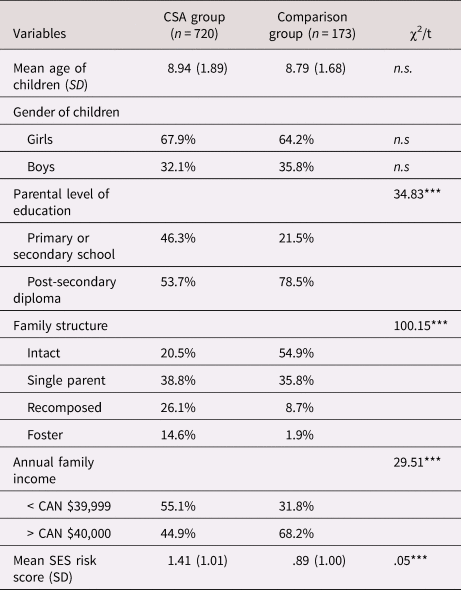
In total, 173 children (64.2% girls) aged 6–12 (M = 8.79, SD = 1.68) who never disclosed a CSA and one of their parents (84.4% mother) were recruited for the comparison group. More than half of these children lived in nuclear family (54.9%), 35.3% in a single-parent family, and 8.7% in a blended family. Three quarters of the parents of this group (78.5%) had more than a high school diploma, and 68.3% of the families had an annual income of more than $40,000 (CAD). Socio-demographic characteristics of the CSA group and comparison group are displayed in Table 1. A small financial compensation ($20 CAN) was given to thank them for their contribution. Dyads from the comparison group completed questionnaires only once, at their enrolment in the study (Time 1; T1).
Sample characteristics

Note: *** p < .001. CSA = child sexual abuse; SES = socio-economic status.
Measures
Indicators of the LCA
Peer victimization was assessed with the Self-Report Victimization Scale and the Parent-Report Victimization Scale (Ladd & Kochenderfer-Ladd, Reference Ladd and Kochenderfer-Ladd2002), which are respectively completed by the child and the parent. Both measures assess four different forms of peer victimization, namely general victimization (i.e., being picked on), direct verbal victimization, indirect verbal (or relational) victimization and physical victimization. The Self-Report Victimization Scale contains four items, each pertaining to a different form of peer victimization. The Parent-Report Victimization Scale includes the same items as the child's version, with an additional one also prompting on general victimization (i.e., teasing). Respondents rated each question on a three-point scale indicating the frequency of the child experiences of peer victimization (1 = rarely or never, 2 = sometimes, and 3 = often). The two items relating to general victimization, of the parent-reported measure, were averaged to yield a single score. A dichotomous score was computed for each variable to reflect the presence (1) or absence (0) of each form of peer victimization. A score of two (sometimes) or three (often) was coded 1. The self-report and parent-report showed adequate reliability and stability in a sample of students from second to fourth Grade 2 (Ladd & Kochenderfer-Ladd, Reference Ladd and Kochenderfer-Ladd2002). Internal consistency was also adequate in this sample for both scales (α = .78 for self-report, and α = .88 for parent-report). These eight dichotomous variables (four different forms of peer victimization assessed by both informants) were used as separate indicators in the LCA.
A continuous score was also derived from the Self-Report Victimization Scale and the Parent-Report Victimization Scale (Ladd & Kochenderfer-Ladd, Reference Ladd and Kochenderfer-Ladd2002) to compare the classes on the frequency of peer victimization experiences. Two continuous scores of global peer victimization were obtained, one for the self-report and one for the parent-report measure, by averaging the score of each item. The total scores ranged from 1 to 3, a higher score indicating a greater frequency. Peer victimization frequency was included as a covariate in the third objective to further describe the classes.
Outcomes
A number of outcomes were considered to contrast the latent classes identified in the first aim of this study. As the comparisons of classes were solely conducted on CSA victims, the following questionnaires were completed by children, parents, and teachers from the CSA group at follow-up (T2).
Internalizing and externalizing behavior problems
Children's internalizing and externalizing behavior problems were assessed separately by parents and teachers using the Achenbach System of Empirically Based Assessment. Parents completed the Child Behavior Checklist (CBCL) and teachers the Teacher-Report Form (TRF; Achenbach & Rescorla, Reference Achenbach and Rescorla2001). The CBCL and the TRF are widely used in research studies to compile parents’ and teachers’ perspective of a wide range of behaviors. Adults rated each item on a three-point scale (0 = not true, 1 = somewhat or sometimes true, or 2 = very true or often true). Scores for the internalizing and the externalizing subscales were added and computed into T-scores. The CBCL and the TRF have consistently shown sound psychometric proprieties in diverse samples. The two subscales were used as separate distal outcomes to compare the identified classes. A good internal consistency was obtained for this sample for both scales of the CBCL (α = .88 for internalizing, and α = .93 for externalizing) and the TRF (α = .89 for internalizing, and α = .94 for externalizing).
Loneliness
The short form of the Child Loneliness Questionnaire (CLQ; Ebesutani et al., Reference Ebesutani, Drescher, Reise, Heiden, Hight, Damon and Young2012; adapted from Asher, Hymel, & Renshaw, Reference Asher, Hymel and Renshaw1984) was completed by children to assess their feelings of loneliness and social inadequacy in school. This instrument contains nine of the 16 items of the original questionnaire. Children rated each item on a three-point scale (1 = not true, 2 = somewhat true, and 3 = very true). The scale yields a total score of 9 to 27, with a higher score indicating elevated levels of subjective loneliness. The short form of the CLQ has demonstrated good convergent validity and reliability in a nonclinical sample of children (Ebesutani et al., Reference Ebesutani, Drescher, Reise, Heiden, Hight, Damon and Young2012). The coefficient alpha for this study was .85.
Interpersonal trust
The Children's Attributions and Perception Scale (CAPS; Mannarino, Cohen, & Berman, Reference Mannarino, Cohen and Berman1994) was originally developed to assess four types of attributions and perceptions in CSA victims. In the current study, only the Reduced interpersonal trust scale (five items) was used. Children rated their endorsement of every item on a 5-point Likert scale ranging from 1 = never to 5 = always. Sample items include “Do you ever feel that you can't count on anyone?” Points for each scale are added to yield a total score of 5 to 25. Higher scores indicate a lower interpersonal trust. Internal consistency of the Reduced interpersonal trust scale for the sample of CSA victims was α = .61.
Covariates
Socio-demographic characteristics
Sociodemographic characteristics of the parent–child dyads were gathered with a questionnaire completed by the parents at T1. Questions pertained to the age and gender of the participants, their gross annual family income, family composition, and parental level of education. A socio-economic status (SES) risk score was computed. One point was attributed for each of the following risk factors: single-parent family, parent with fewer than 12 years of education (including kindergarten), and gross annual family income of less than $40,000 (CAN). Scores ranged from 0 to 3, a higher score indicating a greater level of risk. Participants from the CSA group and the comparison group were compared on their socio-demographic characteristics, using chi-squares and t tests (see Table 1). The groups were similar in terms of child's age and gender, but significantly differed on their parental level of education, annual family income and family structure. Overall, participants from the CSA group had a greater SES risk score.
Abuse characteristics
Information regarding the abuse characteristics was compiled by the clinician assigned to the case using a French adaptation (Hébert & Cyr, Reference Hébert and Cyr2010) of the History of Victimization Form (Wolfe, Gentile, & Bourdeau, Reference Wolfe, Gentile and Bourdeau1987). Abuse characteristics were binary coded for the analyses: identity of the abuser (0 = extrafamilial; 1 = intrafamilial perpetrator), severity (0 = clothed or unclothed touching; 1 = penetration or attempted penetration), and duration (0 = less than 6 months; 1 = 6 months or more).
Data analytic plan
Missing data analyses conducted with SPSS 25 revealed that 5% of data were missing on the indicators. Little's Missing at Random test was not significant (χ2 = 44.12, dl = 35, p = .14), indicating that data were missing at random. Therefore, further analyses could be conducted using an estimation method for missing values (Lanza & Cooper, Reference Lanza and Cooper2016). LCA were conducted using Mplus 8 (Muthén & Muthén, Reference Muthén and Muthén1998–2017) using Full Information Likelihood (FIML). This approach is considered superior to other missing data estimation methods, since it allows for all participants to be retained in the analysis (Enders, Reference Enders2001). By default, the software used the maximum likelihood robust (MLR) estimator, which is robust to nonnormal data (Lanza & Cooper, Reference Lanza and Cooper2016).
Eight indicators were used to determine the optimal latent class solution: general victimization, direct verbal victimization, indirect verbal (or relational) victimization and physical victimization, each assessed by the Parent-Reported Victimization Scale and the Self-Reported Victimization Scale (Ladd & Kochenderfer-Ladd, Reference Ladd and Kochenderfer-Ladd2002). To reduce sparseness in the data for the LCA, dichotomized scores were used in the analyses. Several fit indices can be used to select the best class solution: the Akaike information criterion (AIC; Akaike, Reference Akaike1987), the Bayesian information criterion (BIC; Schwarz, Reference Schwarz1978), and the adjusted Bayesian information criterion (aBIC; Sclove, Reference Sclove1987). A lower value on these criteria indicates a better fit. To ensure that there is a difference between classes, the entropy value is used; a higher entropy indicates a better class differentiation. The bootstrapped likelihood ratio test (BLRT) and the Lo–Mendell–Rubin (LMR) Adjusted Likelihood ratio test are both used to indicate the parsimony of the model. For both tests, a significant p value indicates that an n profiles solution is a better fit than the n−1 model (Lo, Mendell, & Rubin, Reference Lo, Mendell and Rubin2001). The optimal class solution was chosen using the above indices as well as its interpretability (Lanza & Cooper, Reference Lanza and Cooper2016). The LCA was conducted with the full sample, which included the CSA group and the comparison group.
For the second objective, the classes were compared on their CSA status (CSA group vs. comparison group) using the AUXILIARY function with a categorical covariate (DCAT method). This method is used for dichotomous or categorical outcomes and covariates by assessing probability differences between classes using odds ratios (OR; Asparouhov & Muthén, Reference Asparouhov and Muthén2014; Lanza, Tan, & Bray, Reference Lanza, Tan and Bray2013). Since the CSA and comparison groups were found to differ on SES, the composite score of SES risk was included as a covariate in the analyses. Following recommendations of Nylund-Gibson and Masyn (Reference Nylund-Gibson and Masyn2016), we explored the influence of SES across classes after class enumeration, to avoid class misspecification. Hence, SES indicators were included as an auxiliary variable in the second objective.
Further analyses were conducted to compare the classes on the different psychological adjustment outcomes assessed at T2, namely internalizing and externalizing behavior problems, loneliness, and interpersonal trust (Objective 3). Analyses for the third objective were carried for only the CSA group, since it was our population of interest. We first tested whether the optimal number of class solution held for the CSA group, using the fit indices described above. We also estimated covariates (child's gender, age, SES risk, and abuse characteristics) as predictors of class membership using the auxiliary function. For continuous outcomes, the Bolck, Croon and Hagenaars (Reference Bolck, Croon and Hagenaars2004) method in Mplus (BCH) was used, while the DCAT method was used for dichotomous or categorical outcomes. The BCH method, like the analysis of variance (ANOVA), assesses the mean differences between classes for each outcome. DCAT and BCH methods account for uncertainty of class assignment, while minimizing potential class change. First, results from an omnibus chi-square test were examined, then pairwise comparisons were interpreted.
Results
Descriptive statistics
Chi-square tests were calculated to compare the proportion of children and parents reporting peer victimization in the CSA and comparison groups. For the self-reported measure, children of the comparison group reported more general victimization (71.5% vs. 58.4%) than CSA victims (χ2 (1, N = 848) = 9.87, p < .01), but prevalence did not differ between the groups on the other forms of peer victimization. Fifty percent of CSA victims (vs. 54.1%) endorsed verbal victimization, 43.2% (vs. 44.2%) relational victimization, and 30.2% (vs. 32.6%) physical victimization.
Parents of the CSA group reported more victimization than those of the comparison group across all forms of peer victimization. Percentage of parents reporting that their child was victimized by peers was 56.6% (vs. 37.6%) for general victimization (χ2 (1, N = 865) = 20.21, p < .001), 36.1% (vs. 21.4%) for verbal victimization (χ2 (1, N = 866) = 13.48, p < .001), 39.7% (vs. 26.0%) for relational victimization (χ2 (1, N = 865) = 11.11, p < .01), and 22.9% (vs. 9.8%) for physical victimization (χ2 (1, N = 865) = 14.71, p < .001).
Identifying latent classes of peer victimization reporting
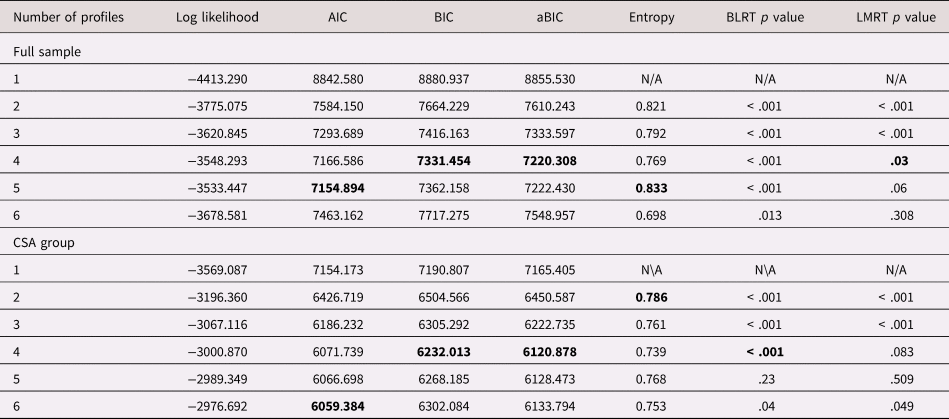
To determine the appropriate number of subgroups, a series of one to six classes were estimated. Fit indices did not yield one clear-cut solution (see Table 2). BIC and aBIC decreased until the four-class solution, before increasing, indicating a superior fit for the four-class model. Conversely, AIC favored the five-class model; however, BIC and aBIC are considered to be stronger indicators of the correct number of classes than AIC (Tein, Coxe, & Cham, Reference Tein, Coxe and Cham2013). The BLRT remained significant for all of the estimated models, suggesting a better fit for the solution with the highest number of classes, whereas the Lo–Mendell–Rubin (LMR) adjusted likelihood ratio test favored the four-classes model. Therefore, the four-class solution was selected as the best-fitting model, based on the relative fit indices (BIC and aBIC), parsimony (LMR test) and interpretability.
Fit indices for latent class models with 1 to 6 classes with the full sample
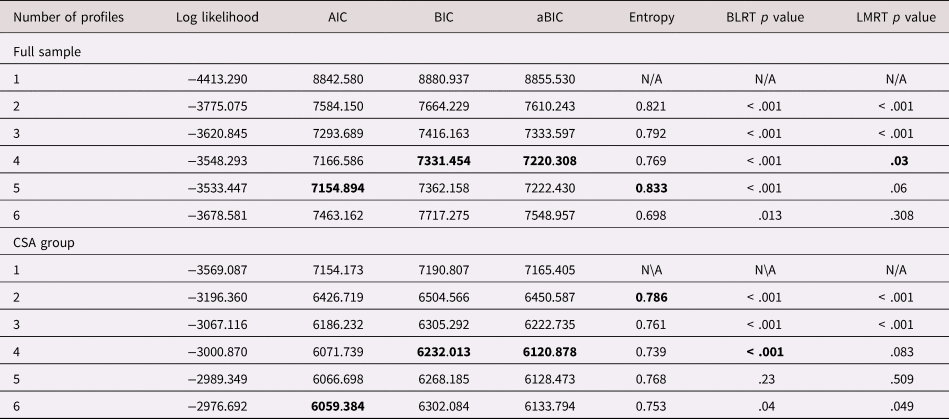
Note: CSA = child sexual abuse; AIC = Akaike's information criterion; BIC = Bayesian information criterion; aBIC = sample-size-adjusted BIC; BLRT = bootstrapped likelihood ratio test; LMRT = Lo–Mendell–Rubin adjusted likelihood ratio test. Boldface indicates the best-fitting model for that particular indicator.
Interpretation of the four-class solution
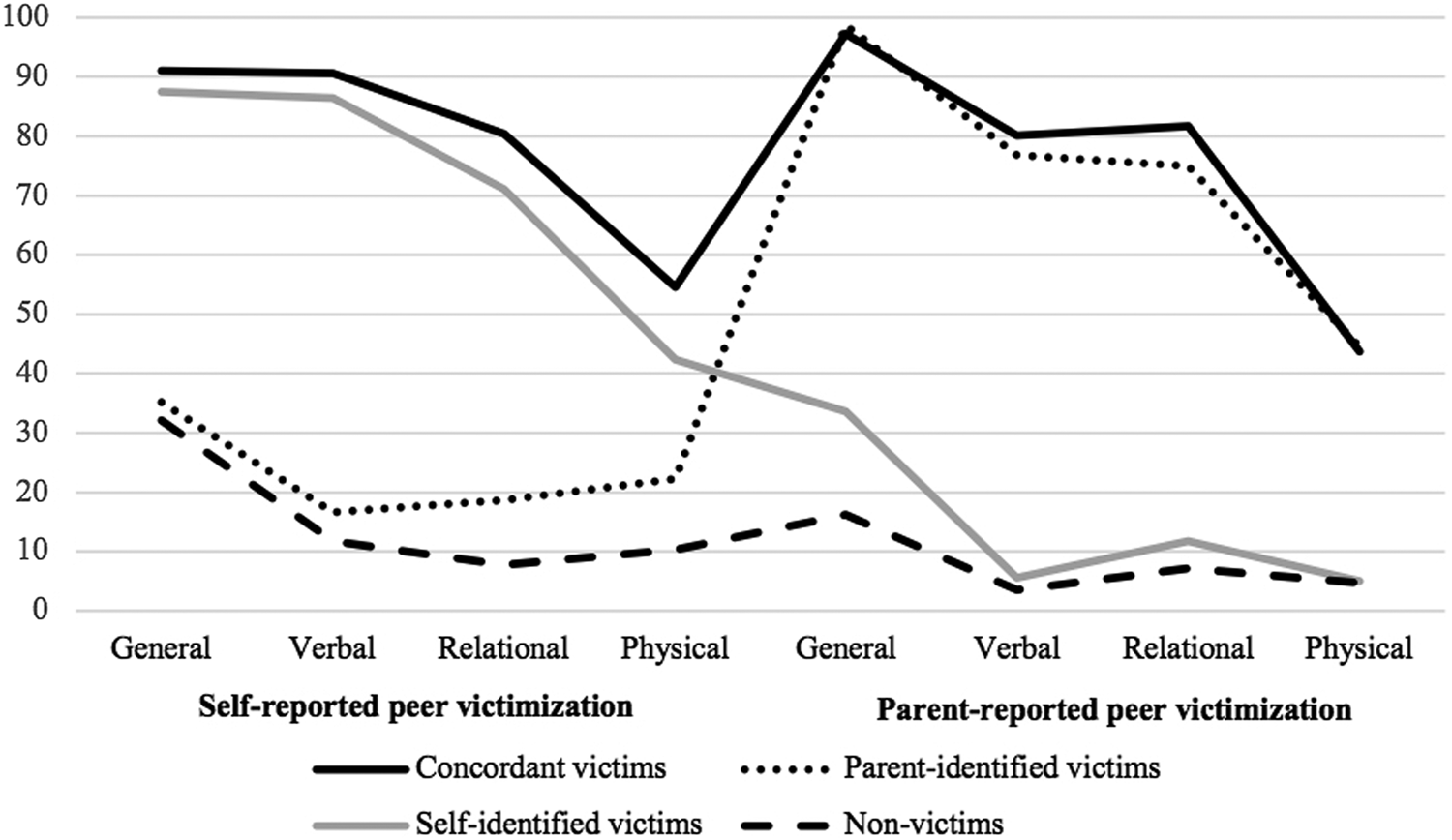
The four classes depicted different patterns of peer victimization reporting (Figure 1). The nonvictims of peer victimization class was the most prevalent (33.59%). In this class, about a third of children (32.1%) reported experiencing general victimization, while probabilities for all other forms of victimization were relatively low across both informants. Hence, children and parents were concordant in their evaluations of the child's peer victimization. A fifth of the participants (19.82%) belonged to the concordant victims of peer victimization class. A significant proportion of children classified in this group were victimized by peers, according to both informants. The final two classes represented divergent parent and child evaluations of peer victimization. Children classified in the self-identified victims class (29.68%) generally reported experiencing diverse forms of peer victimization, while only a few parents reported peer victimization. Conversely, most children within the parent-identified victims class denied peer victimization, whereas parents tended to report peer victimization. This class comprised 16.91% of the sample.
Item probability plot for peer victimization classes. The eight response items (four from the self-report and four for the parentreport) comprised in the latent classes are listed along the x-axis. The y-axis denotes the probability of endorsing each item.

Association between CSA and class membership
The DCAT method was used to compare the participants from the CSA group with the comparison group on their probabilities of belonging to each of the identified classes. Odds ratios (OR) and 95% confidence intervals (CI) were obtained for the CSA group. There were no differences between groups in the risk of being classified in the concordant victims versus parent-identified victims (OR = 0.46, 95% CI = 0.15–1.38, ns), concordant victims versus nonvictims of peer victimization (OR = 1.58, CI = .90–2.78, ns), and self-identified victims versus nonvictims of peer victimization (OR = .69, CI = .40–1.17, ns). However, CSA victims were more likely than the comparison group to belong to the parent-identified class than to be classified in the nonvictims of peer victimization class (OR = 3.42, 95% CI = 1.26–9.27, p < .001). Compared to their nonabused counterparts, sexually abused children were also five times more likely to be classified into the parent-identified victim class than to be self-identified victims of peer victimization (OR = 5.00, 95% CI = 1.8–13.84, p < .001). Further, compared to the self-identified victims class, a history of CSA was associated with greater odds of belonging to the concordant victims class (OR = 2.30, 95% CI = 1.23–4.32, p < .01). SES was not associated to class membership. Overall, results of these comparative analyses indicate that CSA victims were generally more likely than children from the comparison group to belong to the parent-identified class. On the other hand, nonsexually abused children were more prone to be self-identified victims of peer victimization.
Class membership and adjustment in sexually abused children
The final objective was to determine if class membership was associated to different adjustment outcomes (T2) and socio-demographic characteristics (T1) in CSA victims. Similarly to the analysis carried out with the full sample, the four-class solution was found to be the optimal solution (see Table 2). Class prevalence for CSA victims were of 34.03% for the nonvictims of peer victimization class, 20.14% for the concordant victims, 27.36% for the self-identified victims, and 18.47% for parent-identified victims. Results from DCAT analyses revealed that girls were more likely to self-identify as victims than to belong to the nonvictims of peer victimization class (OR = 1.80, 95% CI = 1.03–3.12, p < .05). Boys were more than twice (OR = 2.59, 95% CI = 1.43–4.68, p < .001) more prone to be parent-identified as victims than self-identified. There were no additional significant gender differences between classes. Abuse characteristics (identity of the abuser, duration, severity) were not associated to class membership.
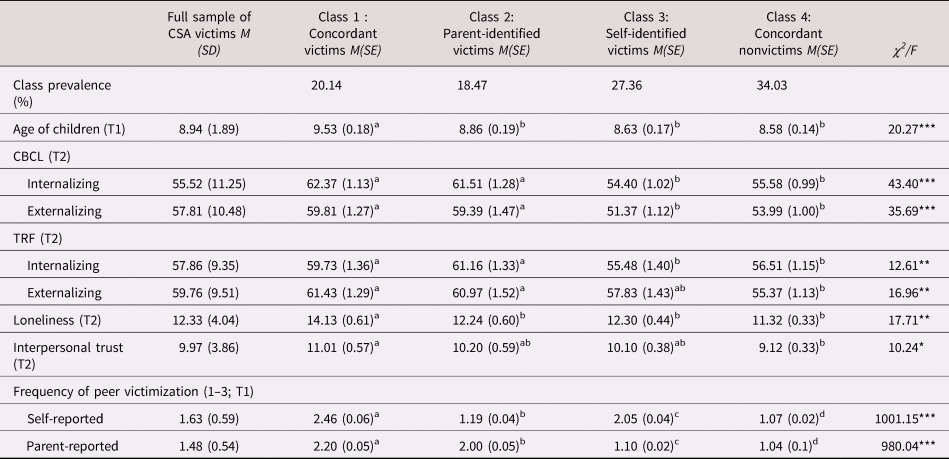
The BCH method was used to examine mean differences between classes in relationship to different continuous outcomes, namely behavior problems as reported independently by the parent and the teacher, and self-reports of feelings of loneliness and interpersonal trust. Classes were also compared on the child's age and SES risk. Results are presented in Table 3. Means on assessment for the full sample are also provided in the table to facilitate interpretation of the results. Children classified as concordant victims (M = 9.53; SE = .18) were older than the ones in the other classes. The classes did not differ as a function of the SES risk. We also compared the classes on their frequency of peer victimization using the continuous score, in order to determine if participants from some classes sustained more frequent victimization than others. Concordant victims experienced were more frequently victimized by peers than the other three classes, according to both the self- and parent-reports.
4-Class solution means of outcomes of child functioning for CSA victims (n = 720)

Note: *p < .05; **p < .01; ***p < .001. Cells with differing subscripts are statistically different from one another at p < .05.
CSA = child sexual abuse; CBCL = Child Behavior Checklist; TRF = Teacher-Report Form.
The analyses also revealed that parents of children of the concordant victims class (M = 62.37; SE = 1.13) and the parent-identified victims class (M = 61.51; SE = 1.28) reported that their child had more internalizing behavior problems than self-identified victims (M = 54.40; SE = 1.02) and nonvictims of peer victimization (M = 55.58; SE = .99). For externalizing behavior problems, parents of concordant victims (M = 59.81; SE = 1.27) and parent-identified victims (M = 59.39; SE = 1.47) also reported the highest scores. Self-identified victims (M = 51.37; SE = 1.12) and nonvictims of peer victimization (M = 53.99; SE = 1.00) scored the lowest on parent-reported externalizing problems.
A similar pattern was found for teacher-reports of behavior problems. Concordant victims and parent-identified victims displayed more internalizing behavior problems than self-identified victims and nonvictims of peer victimization. For externalizing problems, concordant victims (M = 61.43; SE = 1.29) and parent-identified victims (M = 60.97; SE = 1.52) had higher scores than nonvictims of peer victimization.
Self-reported outcomes also yielded differences between the classes. Concordant victims felt lonelier (M = 16.91; SE = .55) than other children. Finally, concordant victims reported the lowest level of interpersonal trust (M = 13.76; SE = .52), while nonvictims of peer victimization reported the highest (M = 9.39; SE = .32).
Discussion
This study used LCA to first highlight the heterogeneity of (dis)agreement between parent- and self-reports of peer victimization in a sample of child victims of CSA and nonvictims of CSA. The second objective of our study sought to determine whether participants from the CSA group were more prone to belong to a specific class. Our final focus was to compare the classes on a series of outcomes assessed 6 months later, namely behavior problems assessed by the parent and the teacher, and self-reported feelings of loneliness, and interpersonal trust in our sample of CSA victims. Our results revealed four groups of children which varied on their level of agreement with their parent regarding peer victimization. Significant differences in adjustment were also found between the classes.
The largest class (i.e., nonvictims of peer victimization) was characterized by a low probability that parents and children report peer victimization. Interestingly, a third of children classified in this class reported being occasionally picked on, indicating that teasing is a common experience during middle childhood. Children from this class had the best adjustment on all of the studied outcomes. Consistent with our hypothesis and with the plethora of research in the field of peer victimization and informant discrepancies, children who did not experience peer victimization, as corroborated by both informants, had fewer psychological difficulties.
The concordant victims class was characterized by a large proportion of parents and children reporting peer victimization. CSA victims were more than two times more likely than children from the comparison group to belong to this class than to the self-identified victims class. This is consistent with the fact that CSA victims are more at risk of experiencing diverse forms of victimization, including victimization taking place in the school context. The post-hoc analysis confirmed that children from the concordant victims class also were the ones who had experienced the most frequent peer victimization, which is consistent with findings from Holt, Kaufman Kantor, and Finkelhor (Reference Holt, Kaufman Kantor and Finkelhor2008). Hence, the pervasiveness of victimization could maximize the possibility that the parent would be informed of their child's victim status either by the school personnel or their child.
Research in the field of informant discrepancies anticipates that consonant reports regarding high levels of a negative domain of assessment, may portend negative outcomes, since it may signal that the studied construct is more stable or chronic (De Los Reyes & Ohannessian, Reference De Los Reyes and Ohannessian2016). In accordance with this hypothesis, concordant victims consistently showed the most severe psychosocial difficulties. They were more at risk of displaying internalizing and externalizing problems, experiencing loneliness, and having a reduced interpersonal trust. This finding also offers additional evidence to the fact that chronic victimization is associated to poorer outcomes (Ladd, Ettekal, & Kochenderfer-Ladd, Reference Ladd, Ettekal and Kochenderfer-Ladd2017). A similar trend is also observable in studies of discrepancies between children and peer reports of peer victimization. Scholte, Burk, and Overbeek (Reference Scholte, Burk and Overbeek2013) found that adolescents who were identified as targets of peer victimization by both self-reports and peer nominations had the most problematic adjustment pattern on the emotional and social spheres. Compared to the divergent classes and nonvictims of peer victimization, they felt lonelier, had lower self-esteem and had fewer friends, among others.
The two final classes reflected discordant reports of peer victimization in the parent–child dyad. Discordant classes represented close to half of our sample, which justifies the need to study these specific subgroups. In the parent-identified victims class, most parents reported that their child was victimized by peers, while few children acknowledged it. CSA victims were five times more likely to deny victimization while their parent reported it than the opposite. These results suggest that CSA may potentially hinder the child's capacity to accurately reflect on their own experiences of victimization. Child victims of CSA may be more prone to shame, denial or social desirability, preventing them from attesting to their harmful interactions with peers (Goodman et al., Reference Goodman, De Los Reyes and Bradshaw2010). It could also be that children do not recognize their negative interactions as falling outside the spectrum of appropriate peer behaviors, given their past history of victimization. Moreover, CSA victims have been found to display heightened difficulties in identifying and expressing emotions (Boisjoli & Hébert, Reference Boisjoli and Hébert2020), which could hinder them from realizing that their peers are being mean. CSA is often associated with self-blame and these feelings can generalize to negative events (Daigneault, Tourigny, & Hébert, Reference Daigneault, Tourigny and Hébert2006). As such, children who blame themselves for the abuse may also come to feel responsible for their victimization at school. Disclosing their experiences of peer victimization could be even more compromising for children who believe they are at fault.
Nonetheless, the possibility that this finding is due to the parents’ overestimation rather than an underestimation by children should not be discarded. In fact, psychological distress or depressive symptoms experienced by the parent following the disclosure of the sexual abuse might predispose the parent to over-report problems that the child may experience. Furthermore, studies have shown that up to 50% of mothers of child victims have also been victims of CSA themselves (Baril, Tourigny, Paillé, & Pauzé, Reference Baril, Tourigny, Paillé and Pauzé2016). The divulgation of the abuse could trigger psychological symptoms in parents with unresolved traumatic histories, hindering their ability to accurately rate or interpret the child's problems.
Nevertheless, children who did not report peer victimization while their parents did show marked difficulties that were in some instances comparable to the concordant victims group, even when these difficulties were assessed by teachers. Our study replicated Goodman's findings, as we also found that parent-identified victims displayed problematic patterns of adjustment. It is plausible that the mechanisms responsible for the child's discounting of victimization also predispose the child to develop difficulties. For instance, both shame and avoidance coping have been linked to negative outcomes, such as depressive symptoms, posttraumatic stress symptoms, and low self-esteem (Feiring, Taska, & Lewis, Reference Feiring, Taska and Lewis2002; Hébert, Daspe, & Cyr, Reference Hébert, Daspe and Cyr2018).
The identification of the often forsaken parent-identified class constitute one of the key contributions of the study. Most studies on peer victimization rely on self-reports and are thus unable to capture this particularly at-risk subgroup. This particularly emphasizes the importance of relying on external sources of information when assessing sensible matters such as peer victimization, especially in this vulnerable population. However, it warrants further attention from researchers as it remains unclear why parent and child evaluations of peer victimization sometimes do not converge.
Finally, children from the self-identified victims class tended to report being victimized by peers while their parents did not. Self-identified victims generally were less symptomatic than concordant and parent-identified victims, and showed an adjustment pattern similar to nonvictims of peer victimization. This pattern may even be quite typical, since parents in general tend to report lower levels of victimization than their child (Demaray, Malecki, Secord, & Lyell, Reference Demaray, Malecki, Secord and Lyell2013), mostly due to the fact that parent-reports usually rely on children's account. Moreover, this reporting pattern appears to be more common in our comparison group than in victims of sexual abuse and their parent, potentially suggesting that children from the comparison group have a lower threshold for feeling victimized than CSA victims.
Research in the field of informant discrepancies suggest that not all parent–child discrepancies portend negative outcomes. For instance, in adolescents, reports of high levels of family dysfunctions (e.g., poor communication, conflicts) relative to parents may rather be adaptive and may indicate that youth follow a normative development process (for a review, see De Los Reyes & Ohannessian, Reference De Los Reyes and Ohannessian2016). In fact, these adolescents may have reached an important milestone in their autonomy development, which can be manifested by perceptions contradicting those of their parent. In the current study, the fact that this pattern is predominantly presented by nonsexually abused children and that it is associated to a generally positive clinical picture may also reflect a normative developmental process. For example, reporting more peer victimization than parents could reflect an increased mastery to discriminate harmless teasing from intentional aggression.
Our gender analyses revealed that sexually abused boys were more likely to deny their peer victimization while their parent reported it. Boys are socialized to be “tough” and are expected to be able to defend themselves (Rosen & Nofziger, Reference Rosen and Nofziger2019). Consequently, admitting their victimization could be perceived as failure in their “boyhood.” Also, aggressive behaviors among boys are generally more accepted. Therefore, they might not be able to distinguish horseplay from violent behavior. Conversely, girls were found to be more inclined to self-identify as victims, while their parents did not. Since victimization among girls tends to be more of relational nature (Putallaz et al., Reference Putallaz, Grimes, Foster, Kupersmidt, Coie and Dearing2007), parents may not be the best informants to attest to their child relational victimization. Furthermore, girls are socialized to discuss their feelings and thoughts; it can thereby be easier for them to disclose their victimization.
Strengths and limitations
The strengths of the study include the reliance on a large sample and a multi-informant method to assess peer victimization and psychological outcomes. More importantly, the use of a person-centered approach, precisely LCA, in the study of discrepancies is the gold standard (De Los Reyes et al., Reference De Los Reyes, Ohannessian and Racz2019). It allowed the identification of an at-risk subgroup which would have gone unnoticed if the associations between the variables were assessed for the whole sample. Finally, the longitudinal design offers compelling evidence for the effects of reporting patterns on psychological adjustment over a 6-month period.
That being said, some shortcomings are worth mentioning. First, although our findings suggest CSA is associated to a particular and often unrecognized pattern of response, it came up short in uncovering the underlying mechanisms behind this discrepancy. Future studies should aim to extricate the influence of CSA on child reports from its effect on parents’ perceptions.
Second, findings of the current study need to be interpreted cautiously in light of some potential confounding variables. Because the current study focused on the intersection of peer victimization and CSA specifically, we did not simultaneously examine other co-occurring forms of interpersonal victimization or maltreatment, such as neglect and physical abuse. In victimized children, experiencing multiple types of victimization is found to be the norm rather than the exception (Turner, Finkelhor, & Ormrod, Reference Turner, Finkelhor and Ormrod2010), making it difficult to isolate the specific contribution of CSA. Although we decided to limit our inclusion of covariates in this study, as they may unintentionally destabilize the latent classes (Asparouhov & Muthén, Reference Asparouhov and Muthén2014), there remains a possibility that some of the effects are attributable to other concomitant variables (e.g., co-occurring victimization, social desirability) that were not taken into account.
Third, despite our considerable sample of child victims of sexual abuse, the representativity of the sample cannot be assumed. Our sample fails to include children who are not reported to the Child Protective Services and whose parents did not seek professional help. Another drawback of the study lies with the significant attrition rate from T1 to T2, which constitutes an inherent difficulty to this specific population. Since a CSA disclosure is often associated to a host of stressors that can upheave the family (Cyr et al., Reference Cyr, Frappier, Hébert, Tourigny, McDuff and Turcotte2016), participants may decline participation or may be difficult to reach at follow-ups. Nevertheless, the use of the FIML procedure mitigated the possible bias related to this condition.
It should also be noted that shared method variance may have affected the results. As such, an informant who tends to score low on the peer victimization measure will most likely score low on children psychological outcomes. However, using a measure of behavior problems occurring at school rated by teachers, who had no knowledge of children's CSA status, helped mitigate this bias. Of note, the results obtained with the teacher-reported measure of internalizing and externalizing behavior problems matched those found with child-reported and parent-reported adjustment outcomes. Children from the concordant victims and parent-identified victims classes tended to have more internalizing and externalizing behavior problems, according to their teacher, than participants from the two other classes. The fact that a similar pattern of results was obtained with an independent information source (i.e., teacher) alleviates interpretative issues and rules out the possibility that the findings are entirely due to shared method variance.
Future research
Future research should pay special attention to the subgroup of children who are identified as victims of peer victimization solely by their parents, as they represent an at-risk group and often go unnoticed. Efforts will need to focus on the mechanisms responsible for this discrepancy, especially for CSA victims. Plausible mechanisms that should be tested include shame, denial, normalization of violence, and psychological symptoms of parents. Parent and child reports could also be triangulated with teacher or peer reports of peer victimization to elucidate whether the discrepant reports are due to an underestimation or overestimation from one part or the other. To help resolve this question, parent questionnaire of the child's peer victimization could include a follow-up question prompting on the reasons they are aware of their child's victimization. This could therefore distinguish between parents who have been informed by verbalizations of their child, by school personnel or whether “they just have a feeling.”
Furthermore, future studies should attempt to minimize bias introduced by shared method variance by including measures of outcomes completed by external informants, such as clinicians, teachers, or peer nominations. As children usually stay in class with the same students, some children are at risk of repeated peer victimization that can span over several years. Longitudinal studies could help determine if the discrepancies tend to dissipate or accentuate with time, as it can be surmised that dyads whose disagreement is crystallized could present a more symptomatic profile. Besides, these analyses could identify trajectories of subgroups of children who represent the most persistent targets.
Implications
Results of this study raise important implications for future research, intervention, and school-based practices. From a methodological perspective, the findings point to the relevance of resorting to multiple informants and to favor a person-centered approach. From a clinical point of view, results highlight the importance of assessing peer victimization experiences when working with sexually abused children. In order to detect at-risk children who tend to discount their victimization, clinical assessments should also include, whenever possible, the perspective of the caregiver. Children who do not disclose their peer victimization to their parent might have unique intervention needs. Efforts should be directed towards destigmatization, so that the child is able to seek help and support from significant adults or friends. For instance, modules aiming to reduce shame and self-blame could contribute to the reduction of psychological symptoms. Moreover, this could help prevent further victimization, as these variables were found to be predictors of peer victimization (Irwin, Li, Craig, & Hollenstein, Reference Irwin, Li, Craig and Hollenstein2019; Schacter, White, Chang, & Juvonen, Reference Schacter, White, Chang and Juvonen2015). Treatments could benefit from being strength-based and could focus on the acquisition of assets that minimize the risk of being targeted by bullies (i.e., assertion, social skills, emotion regulation).
Conversely, parents and school personnel need to be able to detect victims of peer victimization. Prevention programs could allocate resources to reach parents and teach them about ways to accurately identify abusive peer interactions. Relational interventions could be added to the gold standard intervention for CSA (i.e. Trauma-Focused Cognitive-Behavioral Therapy; Cohen, Mannarino, & Deblinger, Reference Cohen, Mannarino and Deblinger2017) in order to strengthen parent–child communication, parental support, and monitoring. Findings of this study also emphasize the need for schools to adopt a trauma-informed approach. Teachers, social workers, and special educators often receive little training regarding the effects of trauma. By being knowledgeable on the risk of revictimization of victims of CSA, they will be able to be more vigilant and consider the fact that not all children are equipped to disclose being tormented by peers. It appears primordial that adults share the responsibility of the prevention of interpersonal violence, in order to foster optimal development of all children.
Acknowledgments
The authors wish to thank the families who participated in the study, as well as the practitioners from the different intervention settings involved in this project.
Financial Statement
This research was supported by the Canadian Institutes of Health Research (CIHR) under grant numbers 77614, 353537, 110945.
Conflicts of Interest
None.