




No CrossRef data available.
Article contents
The basal ganglia and semantic engagement: Potential insights from semantic priming in individuals with subcortical vascular lesions, Parkinson's disease, and cortical lesions
Published online by Cambridge University Press: 12 February 2004
Abstract
The impact of basal ganglia dysfunction on semantic processing was investigated by comparing the performance of individuals with nonthalamic subcortical (NS) vascular lesions, Parkinson's disease (PD), cortical lesions, and matched controls on a semantic priming task. Unequibiased lexical ambiguity primes were used in auditory prime-target pairs comprising 4 critical conditions; dominant related (e.g., bank–money), subordinate related (e.g., bank–river), dominant unrelated (e.g., foot–money) and subordinate unrelated (e.g., bat–river). Participants made speeded lexical decisions (word/nonword) on targets using a go–no-go response. When a short prime–target interstimulus interval (ISI) of 200 ms was employed, all groups demonstrated priming for dominant and subordinate conditions, indicating nonselective meaning facilitation and intact automatic lexical processing. Differences emerged at the long ISI (1250 ms), where control and cortical lesion participants evidenced selective facilitation of the dominant meaning, whereas NS and PD groups demonstrated a protracted period of nonselective meaning facilitation. This finding suggests a circumscribed deficit in the selective attentional engagement of the semantic network on the basis of meaning frequency, possibly implicating a disturbance of frontal–subcortical systems influencing inhibitory semantic mechanisms. (JINS, 2003, 9, 1041–1052.)
Keywords
Information
- Type
- THEMATIC ARTICLES
- Information
- Journal of the International Neuropsychological Society , Volume 9 , Issue 7 , November 2003 , pp. 1041 - 1052
- Copyright
- © 2003 The International Neuropsychological Society
INTRODUCTION
The role of the basal ganglia in human language function remains unknown, despite a corpus of literature documenting language deficits following vascular lesions of the dominant nonthalamic subcortical (NS) region and more recent functional neuroimaging data identifying basal ganglia activity during various language functions (see below). Theories of subcortical language function have been postulated (Crosson, 1985; Wallesch & Papagno, 1988), however, research in this field has not been theoretically constrained and has remained largely data-driven, providing limited descriptions of individuals with vascular NS lesions in terms of performance on standard off-line language measures, without reference to contemporary psycholinguistic models. This approach has failed to reveal the underlying nature of these language deficits “locally” in terms of various dynamic and temporally constrained linguistic and nonlinguistic component processes. Possibly as a consequence, this line of research has lagged far behind the understanding of traditional cortically based aphasia syndromes which have seen the delineation of underlying dynamic language processing components and their disruption (Blumstein, 1997). One plausible explanation for the lack of progress in this area, which has gained increased currency in recent times, is that language deficits associated with vascular NS lesions are actually the sequelae of concomitant cortical dysfunction, suggesting that the basal ganglia play no role in language processing, or that more subtle subcortical language contributions may be masked (Nadeau & Crosson, 1997). The present study addresses these issues by providing a novel comparison of individuals with PD and vascular basal ganglia lesions and a cohort with cortical vascular lesions on a semantic priming lexical decision task.
The locus of impairment following NS lesions is typically centered on lexical–semantic functions, with evidence of confrontation naming deficits, semantic paraphasias and word-finding difficulties (Cappa & Vallar, 1992; Wallesch & Papagno, 1988). Theories of basal ganglia language function have been developed accordingly. Crosson (1985, 1992a, 1992b) provided an integrated model of subcortical-cortical language production which included a neuroregulatory role for the basal ganglia in regulating the release of preformulated language segments for motor programming following semantic verification. Wallesch and Papagno (1988) proposed that the striatum plays an information processing role in monitoring the cortical parallel processing of lexical units and integrating situational and motivational constraints to influence the selection of lexical items for output which are meaningful and conceptually adequate, although this proposal was more recently modified (Wallesch, 1997).
Evidence from lesion studies in animals and humans suggests that the role of the basal ganglia in cognition may be conceived in terms of “network-specific” functions, whereby damage to different components in cortical-subcortical networks results in a similar functional deficit (e.g., Cummings, 1993; Divac et al., 1967; Mendez et al., 1989). The exact role of the nonmotor basal ganglia–thalamocortical circuits in higher level functions is not yet fully determined, but there is emerging evidence that several of these subcortical–cortical loops (i.e., anterior cingulate, dorsolateral prefrontal) may be involved in various cognitive processes which could influence language processing (Cummings, 1993). For instance, the anterior cingulate circuit has been associated with attentional control of semantic activation in circumstances of competition (Early et al., 1989; Posner & DiGirolamo, 1998) and controlled semantic priming (Mummery et al., 1999). In addition, the dorsolateral prefrontal cortex appears involved in aspects of working memory as well as strategy formation and/or maintenance including semantic strategy formation which may influence engagement of the semantic network (Gold et al., 1997; Gonzalez Rothi, 1990).
Recent functional neuroimaging data also allow for possible involvement of the basal ganglia in language, and more specifically, lexical–semantic processing (but see Cabeza & Nyberg, 2000). Increased basal ganglia activity has been associated with semantic judgments and categorization (Abdullaev et al., 1998; Binder et al., 1997; Mummery et al., 1998; Pilgrim et al., 2002; Price et al., 1997), semantic anomaly and sense judgments in sentences (Kuperberg et al., 2000; Ni et al., 2000), and semantic working memory (Crosson et al., 1999). Findings of increased basal ganglia activity for lexical decisions (Abdullaev et al., 1998), lexical decisions on low versus high frequency words (Fiebach et al., 2002) and in semantic priming tasks for real words versus nonwords (Kotz et al., 2002) and related versus unrelated word pairs (Rossell et al., 2001) provide further impetus for the present investigation of semantic priming using lexical decision following basal ganglia damage.
Functional neuroimaging provides a promising avenue for confirming, refuting, or developing theories of subcortical language function; however, it has been argued that the strongest inferences can be made concerning the neural substrates of cognition when evidence from functional neuroimaging in normals is complemented with lesion study data (D'Esposito, 2000), and such an approach appears necessary to determine whether the basal ganglia are involved in language, and if so, whether this role is critical or supportive. Unfortunately, the study of subcortical functions with individuals with NS vascular lesions is made difficult by possible concomitant cortical hypoperfusion (see Nadeau & Crosson, 1997). As a consequence, language deficits in individuals with NS lesions may reflect cortical dysfunction, or cortically based language disturbances may mask more subtle language deficits arising directly from the subcortical lesion. An alternative approach is to study language in PD, given that one of the hallmark features of PD is degeneration of the nigrostriatal dopaminergic system, which acts to alter striatal output (Gerfen, 1992; Mink, 1996). Consequently, Parkinson's disease has been used extensively as a model for exploring cognitive functions of the basal ganglia (e.g., Brown & Marsden, 1998; Taylor et al., 1986; Ullman et al., 1997). Any assumption that cognitive deficits in PD reflect striatal dysfunction should be made cautiously, however, given that (1) various frontal regions may be affected by the degeneration of mesolimbic and mesocortical dopaminergic pathways also, which have been implicated in cognitive changes (Javoy-Agid & Agid, 1980; Scatton et al., 1982), and (2) certain cognitive deficits in PD may relate to other cortical dysfunction (Hu et al., 2000), or neurochemical alterations including cholinergic systems with cortical and subcortical projections (e.g., Bedard et al., 1999). In addition, differences may be expected in the language processing of PD and NS lesion groups, given the different effects of dopaminergic deafferentation of the striatum versus structural lesions of striatal tissue on striatal output and function (Crosson, 1992b).
A novel way to address these various pathophysiological confounds and use the lesion method to examine subcortical language functions is to compare different subcortical groups (i.e., individuals with Parkinson's disease and NS vascular lesions) with specific forms of possible cortical involvement, leaving basal ganglia pathology as the common salient feature between these groups (Crosson, 1992a). A further method for addressing this limitation is the direct comparison of subjects with subcortical lesions and subjects with cortical lesions (e.g., Kirk & Kertesz, 1994). If language deficits in NS subjects are due to a breakdown in specific subcortical language mechanisms, then these subjects may present with qualitatively different language impairments to those subjects with cortical lesions. A recent series of studies have combined these approaches to provide a comparison of on-line language processing in individuals with NS vascular lesions, PD, cortical lesions, and matched controls (Copland et al., 2000a, 2001). These studies demonstrated a pattern of impairment in the attention-based resolution of lexical ambiguities in context for PD and NS lesion groups that differed from both control and cortical lesion groups. In certain instances, the performance of PD and NS lesion groups also differed (Copland et al., 2001), suggesting the influence of different pathophysiological mechanisms on language operations. The present study further examines differences among these groups on a measure of semantic priming for lexical ambiguities presented without context.
Semantic priming refers to the increased speed and accuracy in recognizing a target preceded by a related word (prime), compared to an unrelated word. Semantic priming effects are attributed to automatic spreading activation within semantic networks or strategic/controlled mechanisms including expectancy generation and postlexical integration or semantic checking (Neely, 1991). Lexical ambiguity priming is a useful tool for examining lexical–semantic operations, as it is seen to be more demanding of the semantic system than standard priming because the semantic associates of lexical ambiguities (e.g., bank–river), are usually less highly associated than nonambiguous items (e.g., cat–dog). Consequently, lexical ambiguity priming effects are less likely to reflect the accessing of highly associated words possibly without full reference to underlying semantic relationships (Milberg et al., 1987). Lexical ambiguity priming also furnishes a window on processes of meaning selection, competition and inhibition. The priming of lexical ambiguities presented in isolation has provided valuable information concerning the time course of lexical activation, the influence of meaning frequency, and the underlying semantic structure of lexical ambiguities (Balota et al., 1999; Simpson & Burgess, 1985).
The present study employs a paradigm similar to that used by Simpson and Burgess (1985), where non-equibiased lexical ambiguities were presented with associates related to the dominant (more frequent) or subordinate (less frequent) meaning of the ambiguity (e.g., bank–money, bank–river), in addition to unrelated word pairs which acted as controls (e.g., calf–money, calf–river). At 16 ms SOA only the dominant meaning showed facilitation relative to unrelated words, whereas both dominant and subordinate meanings appeared active at intermediate SOAs of 100 ms and 300 ms. At longer SOAs of 500 and 750 ms, the advantage for the dominant meaning was reestablished, as the subordinate meaning was no longer facilitated relative to unrelated words. This pattern of results suggested that when lexical ambiguities are encountered in isolation, both meanings are activated; however, the speed with which each meaning is retrieved, and the strength and duration of its activation, varies as a function of its relative frequency. Simpson and Burgess (1985) also demonstrated that the process by which dominant meanings are selectively facilitated at longer ISIs involves an active direction of attention toward the dominant meaning and inhibition of the subordinate meaning. Importantly, the attention-based process of meaning facilitation and inhibition appears particularly robust in normal subjects, as this pattern of priming was maintained when the proportion of dominant and subordinate biased pairs was manipulated and when subjects were instructed to focus on less frequent meanings.
The aims of the present study were to investigate lexical ambiguity priming in subjects with NS lesions, PD, cortical lesions, and matched controls with respect to (1) the time course of lexical activation for dominant and subordinate meanings of lexical ambiguities presented in isolation, and (2) the integrity of automatic and attentional/controlled lexical processing. These issues were addressed by an experiment which involved the presentation of lexical ambiguities in isolation with unrelated targets or targets related to the dominant or subordinate meanings at 200 ms ISI and 1250 ms ISI. It was predicted that control subjects would show facilitation for dominant and subordinate meanings at the short ISI followed by selective priming for the dominant meaning at the long ISI, reflecting an automatic nonselective lexical access followed by attention-based meaning selection and inhibition (Simpson & Burgess, 1985). It was hypothesized that NS subjects would show intact automatic facilitation for dominant and subordinate meanings at 200 ms ISI, given recent findings of intact automatic lexical ambiguity processing in this cohort (Copland et al., 2000b, 2001). It was expected that selective facilitation of the dominant meaning at 1250 ms ISI would be compromised, given the finding of impaired controlled lexical processing in previous priming studies with this population (Copland et al., 2000a, 2000b, 2001).
METHOD
Research Participants
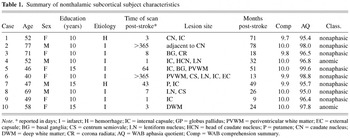
The NS lesion group comprised 10 participants (6 females, 4 males) included on the basis of the following criteria: (1) CT or MRI confirmed lesions visible only in subcortical regions, excluding the thalamus, following a single cerebrovascular accident (CVA); (2) no previous history of head trauma, dementia, brain tumor, cerebral abscess or alcoholism; (3) right handedness, monolingual in English and no reported visual and/or hearing abnormality; (4) at least 6 months post onset at the time of testing; (5) able to perform the lexical decision task. All lesion sites were confirmed by a radiologist. It is noted that subcortical lesions were located in the left hemisphere except in the case of Subject 10, who had bilateral deep white matter lesions. Neuroradiological, demographic and language performance data for the NS subjects is presented in Table 1. All NS subjects obtained Western Aphasia Battery (WAB) Aphasia Quotients above the 93.8 cut-off. Eight subjects were classified as non-aphasic, and 2 as anomic.
Summary of nonthalamic subcortical subject characteristics

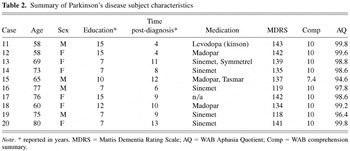
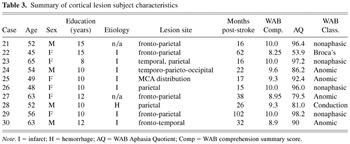
The cortical lesion (CL) group consisted of 10 subjects (6 female; 4 male) who had CT or MRI confirmed cortical lesions following a single left CVA and met criteria (2) to (5) above. It should be noted that it was not possible to completely rule out periventricular white matter disease in all CL subjects due to scan limitations. Six CL subjects performed below the WAB Aphasia Quotient cut-off of 93.8, comprising 1 Broca's, 4 anomic, and 1 conduction aphasic, according to WAB classification. The PD group comprised 10 subjects (6 female; 4 male) who had been diagnosed as suffering from idiopathic PD by a neurologist prior to inclusion in the study. Subjects were excluded if (1) English was not their first language; (2) they had a history of alcohol abuse, stereotaxic surgery, and/or neurological disease other than PD; (3) they had uncorrected vision and/or hearing impairment; and (4) they could not make the lexical decision response. The PD subjects had a mean score of 2.75 (SD = .825) on the Hoehn and Yahr Scale (Hoehn & Yahr, 1967). All PD subjects obtained a WAB Aphasia Quotient above the 93.8 cut-off, and the PD group obtained a mean Mattis Dementia Rating Scale (Mattis, 1988) score of 135. Demographic, neuroradiological, and language performance data for each subject in the CL, and PD groups is presented in Tables 2 and 3, respectively.
Summary of Parkinson's disease subject characteristics

Summary of cortical lesion subject characteristics

The control group comprised 10 nonneurologically impaired individuals matched to the NS participants for age, sex, and educational level. Control subjects were excluded if (1) they had a history of neurological disease or head trauma; (2) they had a history of alcohol abuse; (3) they had defective vision and/or hearing which would affect the validity of the task performance; and (4) English was not their first language. Subjects from the CL, PD, and normal control groups were matched to the NS subjects in years of education, gender, and where possible, age. There was no significant difference among the groups in years of education [F(3,36) = .375, p = .771]. There was a significant difference among the groups in age [F(3,36) = 5.030, p = .006], with post-hoc tests revealing that the PD patients (M = 68.60, SD = 8.33) were significantly older than normal controls (M = 54.00, SD = 11.65) and CL subjects (M = 54.70, SD = 6.93), while there was no significant difference between the age of PD and NS subjects (M = 56.00, SD = 12.37) . There was also no significant difference in age between the CL, NS, and normal control subjects [F(2,27) = .092, p = .913].
Materials
The present experiment used auditorily presented word pairs. The first word presented was a lexical ambiguity or a nonambiguous word, representing the prime, followed by a target which was either a nonword or a real word which was related or unrelated to the prime word. Twenty lexical ambiguities and their associates were selected on the basis of a pretest which was carried out to obtain regional and age-appropriate stimuli in terms of meaning dominance for lexical ambiguities and strength of association for targets. A group of 50 neurologically intact elderly adults (age range 60–89) were presented with 79 lexical ambiguities (selected from the homograph norms of Nelson et al. (1980) and Twilley et al. (1994)), and were asked to provide a word related to the first meaning of the ambiguity which came to mind, followed by any secondary meaning associates. From this survey, 20 lexical ambiguities were chosen which had (1) two distinct meanings, (2) common related associates which were signaled by the respondents, (3) a dominant meaning which was provided by the subjects as the first related meaning at least 70% of the time, (4) a subordinate meaning which was provided second at least 70% of the time. Dominant and subordinate associates were selected for each of the 20 lexical ambiguities, based on the most common responses given in the pretest. There was no significant difference (p < .05) between dominant and subordinate associate targets in terms of length and frequency (Kucera & Francis, 1967). Unrelated pairs were created by changing the prime word to an unrelated lexical ambiguity (from Twilley et al., 1994, or Nelson et al., 1980), so that comparisons of related and unrelated pair latencies were based on responses to the same target words presented in different sessions.
Twenty nonword pairs were also constructed, with 10 pairs consisting of a homograph (from Nelson et al., 1980; Twilley et al., 1994) followed by a pronounceable nonword, and ten pairs including a nonambiguous word followed by a pronounceable nonword. The probability of seeing a word or nonword target was .50 for any trial. In total, 80 critical word pairs were presented (20 subordinate related, 20 subordinate unrelated, 20 dominant related, 20 dominant unrelated). Eight session lists were constructed, with each homophone appearing once in each session in one of the four conditions stated above at 200 ms ISI and 1250 ms ISI. The same set of nonword pairs was used twice in each session. The order of critical and filler word pairs was pseudorandomized in each session, with the condition that no more than three real word or nonword targets were presented in succession.
All stimuli were spoken by a female speaker with neutral intonation in a sound-proof booth and digitized with a sampling rate of 22 kHz directly into an IBM compatible computer. Word pairs were then constructed, where identical words were represented by the same physical token. An ISI of 200 ms and 1250 ms was placed in between each word pair, with four sessions consisting of pairs with an ISI of 200 ms, and four sessions using word pairs with an ISI of 1250 ms.
Apparatus and Procedure
The experiment was conducted using an IBM compatible laptop computer with Pentium processor, sound card, millisecond timer, and free-field speakers. The computer presented the word pairs in free-field and recorded the time elapsed from the offset of the target to the response made by the mouse button press in milliseconds. The time-out was set to 5000 ms, after which a no-response was recorded and the next trial began. All reaction times were saved directly onto computer.
Subjects were tested individually in eight single sessions including 10 practice trials. Participants were instructed that they would hear a real word followed by either another real word or a nonword. Subjects were seated directly in front of a laptop computer, with their left index finger placed directly on the left internal mouse key in order to make speeded lexical decisions using a go–no-go response procedure. Subjects were instructed to press the mouse button as quickly as possible if the second item was a real word, and do nothing if the second word was a nonsense word. There was an intertrial interval of 4 s. Subjects could repeat the practice block until performance was accurate. No feedback was given following the practice block(s).
RESULTS
Analyses were carried out on correct yes responses for real word pairs. Nonword errors (yes response for nonword) were made 18 times by control subjects (1.1%), 53 times by NS subjects (3.3%), 52 times by PD subjects (3.3%), and 22 times by CL subjects (1.4%). On 1600 critical trials (including all subjects per group at ISI 200 and 1250 ms), control subjects made a total of 9 real word errors (less than 1%), NS subjects made 59 real word errors (3.6%), PD subjects made 37 real word errors (2.3%), and CL subjects made 28 real word errors (1.8%). The distribution of errors did not differ significantly as a function of priming condition in any of the subject groups at p < .05. Outliers (responses differing from each subject's mean per condition by >2 SD) were replaced with a Tukey's biweight mean estimator for that particular subject and condition, in order to ensure that latencies best reflected “on-line” processes. Forty-seven outliers were replaced for control subjects (2.9% of total responses), while 40 outliers were replaced for NS subjects (2.5%). Forty-five outliers were replaced for PD subjects (2.8%), and 53 outliers were replaced in this manner for CL subjects (3.3%). Due to increased variance of the data, the mean latencies for each subject per condition were then examined for group outliers (values >2 SD from the group mean per condition). Any group outlier was replaced with a M-Estimator of the group per condition. No group outliers were identified for control subjects or NS subjects, while two outliers were replaced for PD subjects (1.3%), and one outlier was replaced for CL subjects (<1%).
The data were then assessed for normality and homogeneity of variance. While the data for each group did not vio-late assumptions of normality, as indicated by Shapiro-Wilks results, assumptions of homogeneity of variance were violated, according to F-max ratios (Coakes & Steed, 1997). Consequently, a log transformation was performed, which stabilized the data in terms of variance. Analyses were then carried out on the transformed data, although mean latencies from the raw data are provided for ease of interpretation.
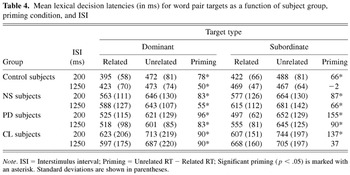
Table 4 presents the mean latencies and standard deviations for related and unrelated targets across the four subject groups, with significant priming effects indicated (p < .05). Prior to independent analysis of each group's data, an overall groupwise comparison on latencies revealed a significant main effect for group [F(3,36) = 7.145, p = .001]. Post-hoc comparisons revealed that the control group latencies were significantly faster than all other groups (p < .05), but NS, PD, and CL subject latencies did not differ significantly. There was also a significant Group × Relatedness interaction [F(3,36) = 3.052, p = .041]. Each group's data were then submitted to an independent 2 (ISI) × 2 (dominant vs. subordinate) × 2 (related vs. unrelated) within subjects repeated measures ANOVA.
Mean lexical decision latencies (in ms) for word pair targets as a function of subject group, priming condition, and ISI

The control subjects showed a significant main effect for dominance [F(1,9) = 11.550, p = .008], and relatedness [F(1,9) = 95.108, p < .001], indicating that responses were faster for dominant targets, and that related target latencies were in general faster than latencies for unrelated targets. There were significant interactions for ISI × Relatedness [F(1,9) = 7.867, p = .021], and Dominance × Relatedness [F(1,9) = 19.720, p = .002], indicating a general trend for greater facilitation of related targets at the short ISI, and increased facilitation of dominant related targets, compared to subordinate related targets. There was also a marginal three-way interaction effect for ISI by Dominance × Relatedness [F(1,9) = 4.669, p = .059]. Given the importance of changes in facilitation over time, and the significant interactions of ISI × relatedness, separate dominance by relatedness analyses were conducted at 200 ms and 1250 ms ISI.
At 200 ms ISI, there was a significant main effect for dominance [F(1,9) = 6.775, p = .029] and relatedness [F(1,9) = 50.342, p < .001], but no Dominance × Relatedness interaction [F(1,9) = 1.672, p = .234]. This indicates an advantage for dominant targets, compared to subordinate targets, but also demonstrates that facilitation of related targets occurred regardless of dominance at this stage. Planned pairwise comparisons (p < .05) confirmed that dominant and subordinate related targets were facilitated.
At 1250 ms ISI, there was a significant main effect for relatedness [F(1,9) = 6.120, p = .035] and a significant Dominance × Relatedness interaction [F(1,9) = 14.445, p = .004], indicating that facilitation of related targets varied as a function of meaning dominance. Planned pairwise comparisons showed significant facilitation of dominant associates, while latencies for subordinate related targets did not differ significantly from unrelated targets (p > .05).
The NS subjects obtained a significant main effect for the factor of relatedness only [F(1,9) = 76.351, p < .001], and there were no significant interactions. This pattern of results indicated that NS subjects facilitated related targets, relative to unrelated control words, regardless of meaning dominance or ISI. This trend was confirmed by planned pairwise comparisons, which revealed significant facilitation of dominant and subordinate associates compared to unrelated targets at both 200 ms ISI and 1250 ms ISI.
A significant main effect for relatedness [F(1,9) = 48.679, p < .001] was also observed in PD subjects, while there were no other significant main effects or interactions (p > .05). These results indicate that related targets were facilitated compared to unrelated control targets regardless of meaning dominance or ISI, as confirmed by pairwise comparisons which showed significant facilitation for dominant and subordinate associates at 200 ms ISI and 1250 ms ISI.
The CL subjects obtained a significant main effect for relatedness [F(1,9) = 33.686, p < .001], while there was a marginal ISI × Relatedness interaction [F(1,9) = 4.841, p = .055], and a marginal three way interaction for ISI × Dominance × Relatedness [F(1,9) = 4.561, p = .061]. Given the effect of ISI in several interactions, and the interest in facilitation over time, separate analyses were conducted at each ISI. At 200 ms ISI, there was a main effect for relatedness only [F(1,9) = 28.365, p < .001], indicating that both dominant and subordinate related associates were significantly facilitated, as confirmed by pairwise comparisons (p < .05). At 1250 ms ISI, there was a significant main effect for dominance [F(1,9) = 5.176, p = .049], and relatedness [F(1,9) = 13.376, p = .005], and a significant Dominance × Relatedness interaction [F(1,9) = 8.018, p = .020], indicating that dominant associates were significantly facilitated while subordinate associates were not, as confirmed by pairwise comparisons (p < .05).
DISCUSSION
The present study provides evidence that basal ganglia dysfunction from vascular or degenerative damage can lead to a common pattern of impaired controlled semantic priming not present in matched individuals with cortical lesions or controls. Specifically, NS and PD subjects were able to process lexical ambiguities presented in isolation via automatic and attention-based procedures; however, attentional processing was typically limited to the facilitation of both dominant and subordinate meanings, implying a deficit in selectively engaging the semantic network on the basis of meaning frequency. In the following discussion, the similar results of the control and CL groups are interpreted in terms of models of lexical ambiguity processing, then the NS and PD group findings are interpreted first in terms of a breakdown in attentional engagement and semantic selection and then with reference to possible underlying frontal–subcortical neurocognitive mechanisms.
The control subjects and CL subjects evidenced a pattern of priming consistent with multiple lexical activation at 200 ms ISI, followed by selective facilitation of the dominant meaning at 1250 ms ISI. These results are in keeping with the findings of Simpson and Burgess (1985), who found that the dominant meaning of an ambiguity was selectively facilitated at a very brief SOA (16 ms); however, by 300 ms the subordinate meaning was also significantly facilitated. This pattern of priming suggests that multiple meanings are activated for lexical ambiguities presented in isolation, but the speed of activation for each particular meaning varies as a function of its relative frequency. In view of these observations, the current finding of nonselective meaning facilitation at 200 ms ISI may be considered to reflect the intermediate stage of lexical ambiguity processing, where the less frequent meaning has been allowed sufficient time to be activated to a level above the priming threshold. The intact priming observed for the CL group is also similar to previous reports of normal word-pair priming of ambiguities in individuals with aphasia (Katz, 1988).
Following the multiple meaning facilitation witnessed at 200 ms ISI, subordinate meanings were no longer facilitated at 1250 ms ISI in control subjects and CL subjects. Similarly, Simpson and Burgess (1985) reported that dominant meaning facilitation was maintained beyond 300 ms SOA, while the level of activation for the subordinate meaning was diminished over time until it did not differ significantly from unrelated words at 750 ms SOA. A subsequent experiment by Simpson and Burgess (1985) utilized a neutral prime condition to demonstrate that this reduction in subordinate meaning activation was due to inhibition of the less frequent meaning. It was suggested that following an automatic activation of all related meanings, subjects used the ambiguous prime to actively direct attention toward the dominant meaning, at the expense of subordinate meanings. As the present experiment did not include a neutral condition, we can only speculate that subordinate meanings in the present study were also inhibited through limited-capacity attentional mechanisms rather than simply decaying, based on the consistency of the present findings in the CL and control groups with the findings of Simpson and Burgess (1985) for related and unrelated targets.
The NS and PD subjects showed a pattern of priming that diverged from the normal pattern of multiple lexical activation followed by frequency-based meaning selection. At 200 ms ISI, the NS and PD subjects showed priming for both dominant and subordinate meanings, consistent with previous findings in young normal controls (Simpson & Burgess, 1985), and the present group of controls and CL subjects. This finding suggests an intact automatic activation of all related meanings of an ambiguity upon its presentation. At 1250 ms ISI, priming for dominant and subordinate meanings was maintained in NS and PD subjects, unlike normal controls and CL subjects. At this stage, Simpson and Burgess (1985) suggested that the subordinate meaning is usually inhibited as limited-capacity attentional resources are directed toward the dominant meaning of the ambiguity. As the lack of a neutral condition precluded the true dissociation of facilitation and inhibition, it can only be speculated that NS and PD subjects were unable to focus or constrain attention toward the dominant meaning and actively suppress the subordinate meaning. It should be noted that the pattern of nonselective priming exhibited by the NS and PD subjects at 1250 ms ISI does not represent an absolute failure in attention-based lexical processing per se, as the subjects were able to maintain lexical activation over time, presumably through attentional/strategic processing.
Instead, the aberrant maintenance of subordinate meaning activation suggests an inability to constrain attention within the lexical–semantic network on the basis of the relative meaning frequency, possibly through deficient inhibitory mechanisms. The possible locus of this inhibitory disturbance is illustrated in Figure 1, which shows one proposal for the lexical and semantic structure of ambiguous words, and the facilitatory and inhibitory operations involved in their computation. Briefly, it has been argued that lexical ambiguities are represented by a single lexical node at the entry level, which activates separate meaning nodes at the semantic network or word sense level, which are connected by inhibitory pathways (Balota et al., 1999; Cottrell, 1989; Tanenhaus et al., 1987; but see Balota & Paul, 1996). The presentation of an ambiguity causes an obligatory activation of all word senses via bottom-up excitatory connections, while lateral inhibitory connections between word senses at the semantic level provide the mechanism for selective meaning facilitation, usually on the basis of contextual feedback, or in this case, on the basis of the strength of associations. These inhibitory mechanisms may be passive in the sense that once activation accrues for one meaning representation, it automatically decreases for connected representations, without explicit attentional control (Balota & Paul, 1996). Some form of disturbance in these inhibitory mechanisms within the semantic system may be indicated in the NS and PD subjects.

Potential lexical and semantic structure of lexical ambiguities. Facilitatory and inhibitory mechanisms for ambiguities presented in isolation. Arrowed pathways (i.e. →) indicate facilitatory connections. Segmented pathways (i.e., [bull ]—[bull ]) reflect inhibitory connections. Adapted from Balota et al. (1999).
The implication of the basal ganglia in semantic inhibition appears analogous to a proposed basal ganglia role in motor functions; namely, that the basal ganglia act focally to select appropriate motor programs and inhibit competing motor mechanisms (Mink, 1996). A disturbance in competitive and inhibitory semantic processing has been suggested previously in subjects with PD on the basis of word production performance (Gurd & Oliveira, 1996). Specifically, Gurd and Oliveira (1996) found that individuals with PD evidenced difficulties in selecting an appropriate word from semantic competitors in a word search task, suggesting difficulties in semantic inhibition. Interestingly, a neural network simulation of semantic processing in PD also demonstrates semantic processing deficits in terms of aberrant semantic inhibition between competing meanings of lexical ambiguities (Watters & Patel, 2002); however, PD-like errors occurred due to increased inhibition for ambiguities with similarly frequent meanings but did not effect unequibiased ambiguities; a finding which is clearly at odds with the present data. The apparent inability of NS and PD subjects to focus attention within the semantic network is suggested by previous evidence from a lexical decision priming paradigm where PD patients experienced difficulties in semantic set shifting (McDonald et al., 1996). This finding is also consistent with difficulties experienced by PD subjects in focusing on salient information and ignoring irrelevant information (Brown et al., 1997; Levin et al., 1989). The present data provide further evidence that individuals with basal ganglia dysfunction have difficulties in selecting meanings, whether on the basis of meaning frequency, as shown presently, or through the attention-based integration of lexical, sentential or discourse level contextual constraints (Copland et al., 2000a, 2000b, 2001).
How may the present data be accommodated by theories and conceptions of subcortical language function? At a general level, the current findings are in keeping with the view that the basal ganglia are involved in lexical–semantic operations (Cappa & Vallar, 1992; Wallesch & Papagno, 1988). The evidence of intact lexical–semantic representations following basal ganglia dysfunction is in agreement with the common assumption that such information is located or stored cortically rather than in subcortical locations (Crosson et al., 1997). The performance of the NS and PD cohorts implies that the basal ganglia are not significantly involved in the automatic accessing of lexical–semantic information, but may play a supportive role in the attention-based processing of this information. This proposal is further endorsed by recent neuroimaging data in healthy individuals, indicating increased striatal activity during controlled but not automatic semantic priming (Rossell et al., 2001) and findings of increased basal ganglia activity during various semantic judgment tasks which are assumed to involve or allow for controlled processing (e.g., Abdullaev et al., 1998; Binder et al., 1997; Mummery et al., 1998; Price et al., 1997).
The present findings are not consistent with the argument that language processing is not affected in PD individuals due to functional reorganization of the language systems (Wallesch & Papagno, 1988). Instead, the current data add to mounting evidence that various aspects of language processing are indeed compromised in PD, including semantic priming (e.g., Arnott et al., 2001), lexical ambiguity resolution in sentences (Copland et al., 2000a, 2001) and sentence processing (Grossman, 1999). The same pattern of priming for NS and PD groups is also at odds with the view that language disturbances following NS lesions are due to white matter pathway disruption causing cortico–cortical or thalamocortical disconnection (Alexander et al., 1987). Instead, the inability to modulate meaning activation for lexical ambiguities in PD and NS individuals is consistent with the general position that frontal–striatal systems may contribute to lexical–semantic processing, but the present findings do not support the view that this role is restricted to the release or selection of lexical items for production as postulated by previous models of subcortical language function (Crosson, 1985; Wallesch & Papagno, 1988).
Interestingly, a more recently proposed model of thalamic language function (Crosson, 1999; Nadeau & Crosson, 1997) may be of relevance to the current findings. According to this model, the thalamus acts via the frontal lobes to selectively engage aspects of the lexical–semantic network, which serves to heighten the difference in activation between representations during cognitive operations. This mechanism has been developed primarily with lexical output functions in mind, where an appropriate response is selected from competing representations for naming purposes. It may be argued that the selective activation of a dominant meaning via attentional semantic processing mechanisms represents an analogous competitive situation within the semantic network. Given the postulated structure of lexical ambiguities with regards to semantic–level inhibitory mechanisms (see above), the present finding of impaired meaning selection via attentional operations in the subcortical groups may be viewed as a disruption of “semantic engagement” mechanisms due to nonthalamic subcortical disruption. This interpretation suggests the need to further consider the neural underpinnings and functional scope of the selective engagement model of thalamic language function.
Although the neural basis of the present deficits remains a point of contention, it is argued that a breakdown in proposed frontal–subcortical attentional and strategic operations via various pathophysiological mechanisms provides a parsimonious explanation for the dissociation between spared automatic lexical processing and compromised attentional/strategic processing in the NS participants. This position is strengthened by the observation that controlled semantic processing served to discriminate between the NS and CL groups, and was disturbed in a similar manner in the NS and PD groups.
In addition to previously cited neuroimaging evidence of possible basal ganglia involvement in controlled semantic processing (e.g., Rossell et al., 2001), the present findings are consistent with a disruption of frontal–subcortical circuits. A disturbance of the anterior cingulate loop functions may account in some way for the breakdown in attentional control of meaning activation in the PD and NS individuals. Posner and DiGirolamo (1998) proposed that the anterior cingulate circuit including the basal ganglia is involved in mechanisms of executive attention which are invoked under certain conditions where automatic or routine processes are inadequate, including the attentional control of semantic activation through various “top-down” processes. One such situation is the presentation of a lexical ambiguity in context, where the anterior cingulate is suggested to be involved in the development of expectancy-based processes responsible for bringing a single contextually appropriate meaning to consciousness (Posner & DiGirolamo, 1998). Early et al. (1989) also proposed the involvement of the anterior cingulate in the attentional control of the semantic relations of words, citing the resolution of lexical ambiguities as a salient example of a situation where anterior cingulate attentional mechanisms may be invoked to select one meaning from a range of competing candidates. Based on the present findings, it is speculated that this postulated function may also extend to the selection of meanings on the basis of meaning frequency in the absence of disambiguating context. There is already evidence of increased activity in the anterior cingulate associated with other relevant tasks involving attention-dependent semantic processing (Frith et al., 1991), and controlled semantic priming (Mummery et al., 1999; Rossell et al., 2001).
The current findings are also consistent with Gold et al.'s (1997) proposal that a disruption in the dorsolateral prefrontal loop via striatocapsular lesions may prevent the formation of lexical or semantic strategies and as a consequence disrupt activation of the semantic network. According to the semantic activation hypothesis (Gold et al., 1997; Gonzalez Rothi, 1990), semantic or lexical strategies are developed to selectively engage and activate aspects of the semantic network. Gold et al. (1997) reported impaired semantic strategy formation in a patient with bilateral striatocapsular lesions and proposed that a disruption in the DLPFC loop may prevent the formation of semantic strategies and as a consequence disrupt the selective engagement of the semantic network. The inability of the PD and NS subjects to selectively facilitate dominant meanings at the long ISI may also be conceptualized as a failure to sustain a semantic strategy that guides meaning selection within the semantic network on the basis of meaning frequency, although it should be noted that the selection of dominant meanings within this paradigm appears quite obligatory (Simpson & Burgess, 1985).
Finally, Kischka et al. (1996) proposed that dopaminergic systems, which include frontal–striatal projections, may serve to modulate activation levels within semantic networks by amplifying stronger signals and dampening weaker signals (Kischka et al., 1996). This argument was supported by the observation that the ingestion of L-dopa by healthy subjects modulated semantic priming effects by decreasing priming of indirect associates. Based on the present data, it may be speculated that the proposed dopaminergic regulation of signal-to-noise ratio within the semantic network may be expressed through frontal–striatal systems, and that the notion of attenuating stronger and weaker signals is compatible with the selection of dominant meanings and the inhibition of subordinate representations within semantic memory. While this proposal is plausible, it is at variance with the argument advanced by Kischka et al. (1996) that the dopaminergic modulation of semantic network activation most likely occurs through mesocortical projections.
In summary, the present study provided a novel comparison of individuals with cortical lesions and individuals with vascular or degenerative basal ganglia damage on a semantic priming task. The significant difference in the age of the PD group and the control group is a limitation of the present study, however, this does not impact upon the major findings presented. The similar performance of the NS lesion and PD groups on the lexical ambiguity priming task suggest that basal ganglia dysfunction interrupts the attention-based selective engagement of the semantic network on the basis of meaning frequency. Although this finding is at odds with traditional theories of subcortical language function, it is in keeping with recent neuroimaging data and current conceptions of frontal–subcortical mechanisms supporting the controlled processing of semantic information.
ACKNOWLEDGMENTS
Portions of this study were presented at the 37th Annual Academy of Aphasia Meeting, Montreal, 2000. I thank Helen Chenery and Bruce Murdoch for valuable discussions and advice during the course of this study.
References
REFERENCES
Abdullaev, Y.G.,
Bechtereva, N.P., &
Melnichuk, K.V.
(1998).
Neuronal activity of human caudate nucleus and prefrontal cortex in
cognitive tasks.
Behavioral Brain Research,
97,
159–177.Google Scholar
Alexander, M.P.,
Naeser, M.A., &
Palumbo, C.L.
(1987).
Correlations of subcortical CT lesion sites and aphasia profiles.
Brain,
110,
961–991.CrossRefGoogle Scholar
Arnott, W.L.,
Chenery, H.J.,
Murdoch, B.E., &
Silburn, P.
(2001).
Semantic priming in Parkinson's disease: Evidence for delayed
spreading activation.
Journal of Clinical and Experimental Neuropsychology,
23,
502–519.CrossRefGoogle Scholar
Balota, D.A. &
Paul, S.T.
(1996).
Summation of activation: Evidence from multiple primes that
converge and diverge within semantic memory.
Journal of Experimental Psychology: Learning, Memory, and Cognition,
22,
827–845.Google Scholar
Balota, D.A.,
Watson, J.M.,
Duchek, J.M., &
Ferraro, F.R.
(1999).
Cross-modal semantic and homograph priming in healthy young,
healthy old, and in Alzheimer's disease individuals.
Journal of the International Neuropsychological Society,
5,
626–640.Google Scholar
Bedard, M.A.,
Pillon, B.,
Dubois, B.,
Duchesne, N.,
Masson, H., &
Agid, Y.
(1999).
Acute and long-term administration of anticholinergics in
Parkinson's disease: Specific effects on the subcortico-frontal
syndrome.
Brain and Cognition,
40,
289–313.Google Scholar
Binder, J.R.,
Frost, J.A.,
Hammeke, T.A.,
Cox, R.W.,
Rao, S.M., &
Prieto, T.
(1997).
Human brain language areas identified by functional magnetic
resonance imaging.
The Journal of Neuroscience,
17,
353–362.Google Scholar
Blumstein, S.E.
(1997).
A perspective on the neurobiology of language.
Brain and Language,
60,
335–346.Google Scholar
Brown, P. &
Marsden, C.D.
(1998).
What do the basal ganglia do?
Lancet,
351,
1801–1804.Google Scholar
Brown, L.,
Schneider, J., &
Lidsky, T.
(1997).
Sensory and cognitive functions of the basal ganglia.
Current Opinion in Neurobiology,
7,
157–163.Google Scholar
Cabeza, R. &
Nyberg, L.
(2000).
Imaging cognition II: An empirical review of 275 PET and fMRI
studies.
Journal of Cognitive Neuroscience,
12,
1–47.Google Scholar
Cappa, S.F. &
Vallar, G.
(1992).
Neuropsychological disorders after subcortical lesions:
implications for neural models of language and spatial attention. In
G. Vallar,
S.F. Cappa, &
C.-W. Wallesch (Eds.),
Neuropsychological disorders associated with subcortical lesions
(pp.
7–41).
Oxford, UK:
Oxford University Press.
Coakes, S.J. &
Steed, L.G.
(1997).
SPSS: Analysis without anguish.
Brisbane, Australia:
John Wiley & Sons.
Copland, D.A.,
Chenery, H.J., &
Murdoch, B.E.
(2000a).
Understanding ambiguous words in biased sentences: Evidence of
transient contextual effects in individuals with nonthalamic
subcortical lesions and Parkinson's disease.
Cortex,
36,
601–622.Google Scholar
Copland, D.A.,
Chenery, H.J., &
Murdoch, B.E.
(2000b).
Processing lexical ambiguities in word triplets: Evidence of
lexical-semantic deficits following dominant nonthalamic subcortical
lesions.
Neuropsychology,
14,
370–390.Google Scholar
Copland, D.A.,
Chenery, H.J., &
Murdoch, B.E.
(2001).
Discourse priming of homophones in individuals with dominant
subcortical lesions, cortical lesions, and Parkinson's disease.
Journal of Clinical and Experimental Neuropsychology,
23,
338–356.Google Scholar
Cottrell, G.W.
(1989).
A connectionist approach to word sense disambiguation.
London:
Pitman.
Crosson, B.
(1985).
Subcortical functions in language: A working model.
Brain and Language,
25,
257–292.Google Scholar
Crosson, B.
(1992a).
Subcortical functions in language and memory.
New York:
Guilford Press.
Crosson, B.
(1992b).
Is the striatum involved in language? In
G. Vallar,
S.F. Cappa, &
C.-W. Wallesch (Eds.),
Neuropsychological disorders associated with subcortical lesions
(pp.
268–293).
Oxford, UK:
Oxford University Press.
Crosson, B.,
Moberg, P.,
Boone, J.,
Gonzalez Rothi, L., &
Raymer, A.
(1997).
Category-specific naming deficit for medical terms after fominant
thalamic/capsular hemorrhage.
Brain and Language,
60,
407–442.CrossRefGoogle Scholar
Crosson, B.
(1999).
Subcortical mechanisms in language: Lexical–semantic
mechanisms and the thalamus.
Brain and Cognition,
40,
414–438.CrossRefGoogle Scholar
Crosson, B.,
Rao, S.M.,
Woodley, S.J.,
Rosen, A.C.,
Bobholz, J.A.,
Mayer, A.,
Cunningham, J.M.,
Hammeke, T.A.,
Fuller, S.A.,
Binder, J.R.,
Cox, R.W., &
Stein, E.A.
(1999).
Mapping of semantic, phonological, and orthographic verbal working
memory in normal adults with functional magnetic resonance imaging.
Neuropsychology,
13,
1–17.Google Scholar
Cummings, J.L.
(1993).
Frontal–subcortical circuits and human behavior.
Archives of Neurology,
50,
873–880.Google Scholar
D'Esposito, M.
(2000).
Functional neuroimaging of cognition.
Seminars in Neurology,
20,
487–498.CrossRefGoogle Scholar
Divac, I.,
Rosvold, H.E., &
Swarcbart, M.
(1967).
Behavioral effects of selective ablation of the caudate nucleus.
Journal of Comparative and Physiological Psychology,
63,
184–190.Google Scholar
Early, T.S.,
Posner, M.I.,
Reiman, E.M., &
Raichle, M.E.
(1989).
Left striato–pallidal hyperactivity in schizophrenia part II:
Phenomenology and thought disorder.
Psychiatric Developments,
2,
109–121.Google Scholar
Fiebach, C.,
Friederici, A.D.,
Muller, K., &
von Cramon, D.Y.
(2002).
fMRI evidence for dual routes to the mental lexicon in visual word
recognition.
Journal of Cognitive Neuroscience,
14,
11–23.Google Scholar
Frith, C.D.,
Friston, K.,
Liddle, P.F., &
Frackowiak, S.J.
(1991).
A PET study of word finding.
Neuropsychologia,
29,
1137–1148.Google Scholar
Gerfen, C.R.
(1992).
The neostriatal mosaic: Multiple levels of compartmental
organization in the basal ganglia.
Annual Review of Neuroscience,
15,
285–320.Google Scholar
Gold, M.,
Nadeau, S.E.,
Jacobs, D.H.,
Adair, J.C.,
Gonzalez Rothi, L.J., &
Heilman, K.M.
(1997).
Adynamic aphasia: A transcortical motor aphasia with defective
semantic strategy formation.
Brain and Language,
57,
374–393.CrossRefGoogle Scholar
Gonzalez Rothi, L.
(1990).
Transcortical aphasias. In
L.L. LaPointe (Ed.),
Aphasia and related neurogenic language disorders (pp.
78–95).
New York:
Thieme Press.
Grossman, M.
(1999).
Sentence processing in Parkinson's disease.
Brain and Cognition,
40,
387–413.Google Scholar
Gurd, J. &
Oliveira, R.
(1996).
Competitive inhibition models of lexical–semantic processing:
Experimental evidence.
Brain and Language,
54,
414–433.Google Scholar
Hoehn, M.M. &
Yahr, M.D.
(1967).
Parkinsonism: Onset, progression and mortality.
Neurology,
17,
427–442.Google Scholar
Hu, M.T.,
Taylor-Robinson, S.D.,
Ray Chaudhuri, K.,
Bell, J.D.,
Labbe, C.,
Cunningham, V.J.,
Koepp, M.J.,
Hammers, A.,
Morris, R.G.,
Turjanski, N., &
Brooks, D.J.
(2000).
Cortical dysfunction in non-demented Parkinson's disease
patients: A combined P-MRS and FDG-PET study.
Brain,
123,
340–352.Google Scholar
Javoy-Agid, F. &
Agid, Y.
(1980).
Is the mesocortical dopaminergic system involved in
Parkinson's disease.
Neurology,
30,
1326–1330.Google Scholar
Katz, W.F.
(1988).
An investigation of lexical ambiguity in Broca's aphasics
using an auditory lexical priming technique.
Neuropsychologia,
26,
747–752.Google Scholar
Kirk, A. &
Kertesz, A.
(1994).
Cortical and subcortical aphasias compared.
Aphasiology,
8,
65–82.Google Scholar
Kischka, U.,
Kammer, T.,
Maier, S.,
Weisbrod, M.,
Thimm, M., &
Spitzer, M.
(1996).
Dopaminergic modulation of semantic network activation.
Neuropsychologia,
34,
1107–1113.Google Scholar
Kotz, S.,
Cappa, S.,
von Cramon, D., &
Friederici, A.
(2002).
Modulation of the lexical–semantic network by auditory
semantic priming: An event-related functional MRI study.
Neuroimage,
17,
1761–1772.Google Scholar
Kucera, H. &
Francis, W.N.
(1967).
Computational analysis of present-day American English.
Providence, RI:
Brown University Press.
Kuperberg, G.R.,
McGuire, P.K.,
Bullmore, E.T.,
Brammer, M.J.,
Rabe-Hesketh, S.,
Wright, I.C.,
Lythgoe, D.J.,
Williams, S.C.R., &
David, A.S.
(2000).
Common and distinct neural substrates for pragmatic, semantic, and
syntactic processing of spoken sentences: An fMRI study.
Journal of Cognitive Neuroscience,
12,
321–341.Google Scholar
Levin, B.,
Llabre, M., &
Weiner, W.
(1989).
Cognitive impairments associated with early Parkinson's
disease.
Neurology,
39,
557–561.Google Scholar
Mattis, S.
(1988).
DRS: Dementia Rating scale: Professional manual.
Odessa, Florida:
PAR, Inc.
McDonald, C.,
Brown, G.G., &
Gorell, J.M.
(1996).
Impaired set-shifting in Parkinson's Disease: New evidence
from a lexical decision task.
Journal of Clinical and Experimental Neuropsychology,
18,
793–809.CrossRefGoogle Scholar
Mendez, M.F.,
Adams, N.L., &
Lewandowski, K.S.
(1989).
Neurobehavioral changes associated with caudate lesions.
Neurology,
39,
349–354.Google Scholar
Milberg, W.,
Blumstein, S., &
Dworetzky, B.
(1987).
Processing of lexical ambiguities in aphasia.
Brain and Language,
31,
138–150.CrossRefGoogle Scholar
Mink, J.W.
(1996).
The basal ganglia: Focused selection and inhibition of competing
motor programs.
Progress in Neurobiology,
50,
381–425.Google Scholar
Mummery, C.J.,
Patterson, K.,
Hodges, J.R., &
Price, C.J.
(1998).
Functional neuroanatomy of the semantic system: Divisible by what?
Journal of Cognitive Neuroscience,
10,
766–786.Google Scholar
Mummery, C.J.,
Shallice, T., &
Price, C.J.
(1999).
Dual-Process model in semantic priming: A functional imaging
perspective.
NeuroImage,
9,
516–525.Google Scholar
Nadeau, S.E. &
Crosson, B.
(1997).
Subcortical aphasia.
Brain and Language,
58,
355–402.Google Scholar
Neely, J.H.
(1991).
Semantic priming effects in visual word recognition: A selective
review of current findings and theories. In
D. Besner &
G.W. Humphreys (Eds.),
Basic processes in reading: Visual word recognition (pp.
264–336).
Mahwah, NJ:
Lawrence Erlbaum.
Nelson, D.L.,
McEvoy, C.L.,
Walling, J.R., &
Wheeler, J.W.
(1980).
The University of South Florida homograph norms.
Behavior Research Methods and Instrumentation,
12,
16–37.Google Scholar
Ni, W.,
Constable, R.T.,
Mencl, W.E.,
Pugh, K.R.,
Fulbright, R.K.,
Shaywitz, S.E.,
Shaywitz, B.A.,
Gore, J.C., &
Shankweiler, D.
(2000).
An event-related neuroimaging study distinguishing form and content
in sentence processing.
Journal of Cognitive Neuroscience,
12,
120–133.Google Scholar
Posner, M.I. &
DiGirolamo, G.J.
(1998).
Executive attention: Conflict, target detection, and cognitive
control. In
R. Parasuraman (Ed.),
The attentive brain (pp.
401–423).
Cambridge, MA:
MIT Press.
Pilgrim, L.,
Fadili, J.,
Fletcher, P., &
Tyler, L.
(2002).
Overcoming confounds of stimulus blocking: An event-related fMRI
design of semantic processing.
Neuroimage,
16,
713–723.Google Scholar
Price, C.J.,
Moore, C.J.,
Humphreys, G.W., &
Wise, R.J.S.
(1997).
Segregating semantic from phonological processes during reading.
Journal of Cognitive Neuroscience,
9,
727–734.Google Scholar
Rossell, S.L.,
Bullmore, E.T.,
Williams, S.C.R., &
David, A.S.
(2001).
Brain activation during automatic and controlled processing of
semantic relations: A priming experiment using lexical decision.
Neuropsychologia,
39,
1167–1176.CrossRefGoogle Scholar
Scatton, B.,
Rouquier, L.,
Javoy-Agid, F., &
Agid, Y.
(1982).
Dopamine deficiency in the cerebral cortex in Parkinson's
disease.
Neurology,
32,
1039–1040.Google Scholar
Simpson, G.B. &
Burgess, C.
(1985).
Activation and selection processes in the recognition of ambiguous
words.
Journal of Experimental Psychology: Human Perception and
Performance,
11,
28–39.Google Scholar
Tanenhaus, M.K.,
Dell, G.S., &
Carlson, G.
(1987).
Context effects and lexical processing: A connectionist approach
to modularity. In
J.L. Garfield (Ed.),
Modularity in knowledge representation and natural language
understanding (pp.
83–108).
Cambridge, MA:
MIT Press.
Taylor, A.E.,
Saint-Cyr, J.A., &
Lang, A.E.
(1986).
Frontal lobe dysfunction in Parkinson's disease. The cortical
focus of neostriatal outflow.
Brain,
109,
845–883.Google Scholar
Twilley, L.C.,
Dixon, P.,
Taylor, D., &
Clark, K.
(1994).
University of Alberta norms of relative meaning frequency for 566
homographs.
Memory and Cognition,
22,
111–126.Google Scholar
Ullman, M.T.,
Corkin, S.,
Coppola, M.,
Hickok, G.,
Growdon, J.H.,
Koroshetz, W.J., &
Pinker, S.
(1997).
A neural dissociation within language: Evidence that the mental
dictionary is part of declarative memory, and that grammatical rules
are processed by the procedural system.
Journal of Cognitive Neuroscience,
9,
266–276.Google Scholar
Wallesch, C.W. &
Papagno, C.
(1988).
Subcortical aphasia. In
F.C. Rose,
R. Whurr, &
M.A. Wyke (Eds.),
Aphasia.
London:
Whurr Publishers.
Wallesch, C.-W.
(1997).
Symptomatology of subcortical aphasia.
Journal of Neurolinguistics,
10,
267–275.Google Scholar
Watters, P. &
Patel, M.
(2002).
Competition, inhibition, and semantic judgment errors in
Parkinson's disease.
Brain and Language,
80,
328–339.Google Scholar
Summary of nonthalamic subcortical subject characteristics
Summary of Parkinson's disease subject characteristics
Summary of cortical lesion subject characteristics
Mean lexical decision latencies (in ms) for word pair targets as a function of subject group, priming condition, and ISI
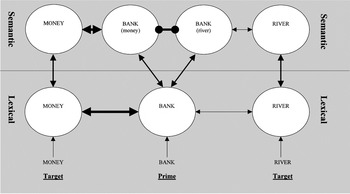
Potential lexical and semantic structure of lexical ambiguities. Facilitatory and inhibitory mechanisms for ambiguities presented in isolation. Arrowed pathways (i.e. →) indicate facilitatory connections. Segmented pathways (i.e., [bull ]—[bull ]) reflect inhibitory connections. Adapted from Balota et al. (1999).
 You have
Access
- 107
- Cited by