




No CrossRef data available.
Article contents
A metacognitive contextual intervention to enhance error awareness and functional outcome following traumatic brain injury: A single-case experimental design
Published online by Cambridge University Press: 23 January 2006
Abstract
Very few empirically validated interventions for improving metacognitive skills (i.e., self-awareness and self-regulation) and functional outcomes have been reported. This single-case experimental study presents JM, a 36-year-old man with a very severe traumatic brain injury (TBI) who demonstrated long-term awareness deficits. Treatment at four years post-injury involved a metacognitive contextual intervention based on a conceptualization of neuro-cognitive, psychological, and socio-environmental factors contributing to his awareness deficits. The 16-week intervention targeted error awareness and self-correction in two real life settings: (a) cooking at home; and (b) volunteer work. Outcome measures included behavioral observation of error behavior and standardized awareness measures. Relative to baseline performance in the cooking setting, JM demonstrated a 44% reduction in error frequency and increased self-correction. Although no spontaneous generalization was evident in the volunteer work setting, specific training in this environment led to a 39% decrease in errors. JM later gained paid employment and received brief metacognitive training in his work environment. JM's global self-knowledge of deficits assessed by self-report was unchanged after the program. Overall, the study provides preliminary support for a metacognitive contextual approach to improve error awareness and functional outcome in real life settings. (JINS, 2006, 12, 54–63.)
Keywords
Information
- Type
- Research Article
- Information
- Journal of the International Neuropsychological Society , Volume 12 , Issue 1 , January 2006 , pp. 54 - 63
- Copyright
- © 2006 The International Neuropsychological Society
INTRODUCTION
Various studies have indicated that many individuals with executive dysfunction following traumatic brain injury (TBI) experience poor functional outcomes (Tate & Broe, 1999; Vilkki et al., 1994). A key aspect of executive functioning related to outcome is metacognition which refers to self-awareness or knowledge of one's cognitive abilities and activities relating to self-regulatory mechanisms or strategies for solving problems (Cicerone & Tupper, 1986). Self-awareness and self-regulation skills are commonly impaired following TBI due to damage to the frontal lobe region and connecting pathways (Katz & Hartman-Maeir, 1998; Toglia & Kirk, 2000). Individuals' ability to maintain and generalize rehabilitation gains in the real life setting depends largely upon their metacognitive skills (Cicerone & Tupper, 1991). However, relatively few studies have systematically evaluated interventions designed to improve metacognitive skills and functional outcomes.
Acknowledging that self-awareness is a complex construct, Toglia and Kirk (2000) distinguished between knowledge and beliefs about one's abilities (i.e., “self-knowledge”) and awareness that is activated during a specific situation or task (i.e., “on-line awareness”), which entails self-monitoring of the current task and error recognition. Consequently, a multidimensional assessment approach is required for rehabilitation planning to examine different aspects of self-awareness. Further, the rehabilitation of awareness deficits requires a sound understanding of factors underlying unawareness.
Empirical data from lesion analyses highlights the involvement of the right hemisphere, particularly the frontal lobe, in supervisory control functions such as on-line monitoring of responses, error correction (Stuss et al., 1994), and strategy application (Levine et al., 1998). Various empirical studies support the role of the right frontal lobe in self-awareness, self-reflection, and theory of mind (see Stuss & Anderson, 2004). Domain-specific awareness deficits, such as anosognosia for hemiplegia (see Marcel et al., 2004), are particularly common after right hemisphere damage (McGlynn & Schacter, 1989), but are most prevalent when lesions encompass both frontal and parietal regions (Pia et al., 2004). Global awareness deficits in TBI relate to an inability to detect changes across a range of functional domains and are associated with impaired executive function (Ownsworth & Fleming, 2005) and a higher number, but not specific location, of brain lesions (Sherer et al., 2005).
A common premise of cognitive neuropsychological models is that higher-order cognitive processes are mainly responsible for self-awareness and self-monitoring and that a comparator mechanism detects changes in level of functioning (Agnew & Morris, 1998; McGlynn & Schacter, 1989; Prigatano, 1999; Stuss et al., 2001). Ownsworth et al. (in press) argued the need to also consider psychosocial explanations for awareness deficits. Two models that consider the role of psychosocial factors and have specific relevance for rehabilitation will now be briefly reviewed.
The Cognitive Awareness Model (CAM; Agnew & Morris, 1998; Morris & Hannesdottir, 2004) asserts that self-appraisal of one's cognitive ability is based on perceptions of relative success or failure on cognitive or behavioral tasks. A Personal Data Base (PDB), or the store of personal information concerning ability or impairment, is updated by a comparator mechanism within the central executive system and shaped by sociocultural experiences, such as other peoples' expectations, that influence sense of success or failure. Conscious awareness of cognitive failure occurs through a mechanism called the Metacognitive Awareness System (Morris & Hannesdottir, 2004). Behavioral responses to cognitive failure may occur without conscious awareness via the comparator systems providing output to an implicit mechanism.
The CAM explains that awareness disorders may result from different types of cognitive impairment. For example, memory impairment may result in a failure to encode or update the PDB, and thus self-evaluation of cognitive ability remains unchanged. However, a memory failure may be detected in an immediate sense and influence behavioral change through implicit knowledge. Inaccurate self-judgment of cognitive abilities may also arise from a breakdown in the executive system, whereby no mismatch is detected between incoming information and the PDB (Morris & Hannesdottir, 2004). Empirical research generally supports an association between awareness deficits and executive impairment, but also suggests that memory impairment may contribute to the maintenance of awareness deficits (Agnew & Morris, 1998; Cocchini et al., 2002). In terms of rehabilitation, the CAM suggests that self-awareness of impairments might potentially be facilitated through systematic feedback or, alternatively, that behavioral adaptation might be promoted without explicit awareness.
Prigatano's (1999) model proposes that awareness syndromes can be complete or partial for different areas of functioning and emphasizes the need to consider coping methods when developing therapeutic interventions. Specifically, individuals with partial unawareness might employ “defensive” coping strategies to protect against emotional distress or “nondefensive” strategies that reflect pre-injury characteristics.
A general limitation of the models by Prigatano (1999) and Morris and Hannesdottir (2004) is that these frameworks do not simultaneously consider neurocognitive, psychological, and socioenvironmental factors that may be related to awareness deficits. Ownsworth et al. (in press) presented an integrated biopsychosocial model of awareness disorders. As depicted in Figure 1, this model proposes that there is a relative and potentially interactive contribution of these factors to a given individual's presentation of awareness deficits.

An integrated biopsychosocial model of awareness disorders (note: the dotted triangle represents the relative and potentially interactive contribution of neurocognitive, psychological and socioenvironmental factors to a given individual's presentation of awareness deficits).
In terms of neurocognitive factors, interventions recommended for awareness deficits primarily related to higher-order cognitive deficits include selecting key tasks and environments in which self-awareness is important for personal goal attainment and developing systematic opportunities for self-evaluation and feedback on performance (Toglia, 1998). However, when individuals cannot assimilate these experiences into their self-knowledge, behavioral change might instead be promoted through procedural learning and habit formation (Sohlberg et al., 1998). Finally, skills need to be trained in the environment in which self-awareness and self-monitoring of performance is required, with programming for generalization (Fleming & Ownsworth, in press).
Psychological factors contributing to awareness deficits occur when a change in one's functioning is perceived as emotionally threatening or difficult to understand. Individuals demonstrating defensive reactions such as denial or avoidance may benefit from nonconfrontational approaches such as psychotherapy (Fleming & Ownsworth, in press; Ownsworth, 2005; Prigatano, 1999). Alternatively, a person using nondefensive coping may sense that something is wrong but continue to act as if everything is normal and rely on pre-injury ways of thinking and reacting. According to Prigatano (1999), these individuals can typically be assisted to realize that their impairments are interfering with success on tasks, and are receptive to learning more adaptive strategies.
The social environment can play an important role in shaping an individual's awareness of deficits (Ownsworth et al., in press; Prigatano & Weinstein, 1996). In particular, some individuals may not receive adequate information about their impairments, or be provided with meaningful opportunities to learn about these. The high levels of support provided by family or professionals may ensure that individuals mainly experience success on tasks, rather than provide the opportunity to learn and adjust to post-injury changes (Ylvisaker et al., 1998). Accurate self-appraisal is often necessary to meet performance expectations in other contexts. Socioenvironmental interventions include providing individuals with meaningful information and feedback, creating supportive opportunities for learning about post-injury changes, and providing education to family and other social supports (Fleming & Ownsworth, in press).
There are different viewpoints concerning the degree to which self-awareness is necessary for functional gains. One perspective is that individuals with impaired awareness are less likely to participate in and benefit from rehabilitation and, thus, interventions should focus on improving awareness (Robertson & Murre, 1999; Sherer et al., 1998b). Other researchers suggest that behavioral changes can occur without explicit awareness through task-specific learning and habit formation (Agnew & Morris, 1998; Bieman-Copland & Dywan, 2000; Schacter, 1990; Sohlberg et al., 1998). However, previous awareness intervention studies have lacked adequate baseline and follow-up periods and failed to investigate factors underlying unawareness.
Therefore, the present study aimed to investigate neurocognitive, psychological, and socioenvironmental factors underlying unawareness for an individual with severe awareness deficits and develop an associated treatment rationale. Additionally, this study aimed to evaluate a theory-driven intervention to promote functional gains.
Method
Design
We employed a single-case experimental design with multiple baselines across settings in the present study (Domholdtz, 2005). The four-week baseline, eight-week treatment, and four-week maintenance and generalization periods for one setting were conducted in conjunction with a 12-week baseline and four-week treatment period in the second setting. This design enabled evaluation of any changes in the participant's performance in response to the intervention in one setting, whilst examining any changes in performance in a different setting in which a behavioral observation procedure was used but no intervention was provided until the 13th week.
Participant background information
At the time of his injury in 2000, JM was single and working as an assistant driller on an offshore oilrig. Since leaving high school after Year 10, with “average” grades, JM had worked consistently in a range of skilled laboring positions. At age 32 JM sustained a very severe open head injury in a car accident. A Glasgow Coma Scale score of 3/15 was recorded at hospital admission. Neurosurgery was performed to remove a large piece of fence post from the right frontal region of JM's skull. A CT head scan revealed a large compound comminuted open-skull fracture with linear extension down the frontal bone to the right midline and along the floor of the anterior cranial fossa. There was an area of extensive haemorrhage beneath the fracture with moderate midline shift. The mass of the haemorrhage was greater in the right frontal region but also extended into the left frontal lobe. The hospital discharge report documented that JM had not emerged from posttraumatic amnesia (PTA) at six months post-injury. Consistent with right hemisphere damage, JM displayed left-sided neglect and his left upper limb was nonfunctional except to stabilize objects with prompting. JM attended outpatient occupational and physical therapy for 18 months. At two years post-injury, a prevocational assessment provided the opinion that JM was not commercially employable but might have the capacity to perform volunteer work, which he commenced in 2003. JM consented to participate in the present study, which was conducted in accordance with institutional research standards for human research.
Neuropsychological and psychological assessment
JM received a neuropsychological assessment at two and a half years post-injury (2002) and review at four years post-injury (2004), which included the following measures.
Measures of self-awareness. The Self-Awareness of Deficits Interview (SADI; Fleming et al., 1996) and the Awareness Questionnaire (AQ; Sherer et al., 1998a) are two standardized measures of self-awareness. The SADI is a semistructured, clinician-rated interview that assesses awareness of deficits across three subscales and yields a total SADI score of 0–9 (0 = accurate self-awareness to 9 = very poor awareness). JM's parents completed a checklist concerning JM's current level of functioning, which assisted scoring. The AQ measures self-awareness using a discrepancy score based upon individuals' and significant others' ratings on 17 items which compare current abilities to pre-injury cognitive, behavioral, affective, and motor/sensory functioning. Items are rated on a five-point scale (1 = much worse to 5 = much better), which yields a total score of 17–85 for each version. A high positive discrepancy score between the self- and significant other versions indicates that the individual has overestimated his or her level of functioning.
Measures of psychological functioning. Based on an established approach (see Ownsworth et al., 2002) for assessing the contribution of psychological factors to awareness deficits, JM completed the Marlowe-Crowne Social Desirability Scale (M-CSDS; Crowne & Marlowe, 1960) and the Symptom Expectancy Checklist (SEC; Mittenberg et al., 1992). The M-CSDS is a 33-item questionnaire that measures the degree to which individuals display defensiveness. Based upon norms (M = 15.0, SD = 5.9) (Reynolds, 1982), a score equal to or greater than one SD above the mean (i.e., ≥ 21/33) reflects a high level of defensiveness (Ownsworth et al., 2002). The SEC is a 30-item checklist of relatively benign head-injury symptoms; it measures the degree to which individuals report common symptoms compared with controls (M = 4.9, SD = 4.8) and individuals with head injury (typical score range = 11/30–18/30) (Mittenberg et al., 1992). Scores less than or equal to 10 suggest that individuals are minimising their symptoms (Ownsworth et al., 2002).
JM's emotional status was assessed using the Hospital Anxiety and Depression Scale (Snaith & Zigmond, 1994), which has 14 items rated on a four-point scale to reflect how an individual has been feeling in the past week on a range of symptoms related to depression and anxiety. The anxiety and depression subscales are each scored from 0 to 21 (0–7 = normal, 8–10 = mild, 11–14 = moderate, and 15–21 = severe).
Measures of executive functioning. Standardized measures of executive functioning were selected to identify the influence of neurocognitive factors underlying deficits in self-awareness (Ownsworth & Fleming, 2005). These included the Health and Safety subtest of the Independent Living Scales (Loeb, 1996), Tinker Toy Test (Lezak, 1993), Five-Point Test, FAS test (see Spreen & Strauss, 1998), and the Key Search Test and Zoo Map Test from the Behavioural Assessment of Dysexecutive Syndrome (Wilson et al., 1996).
Assessment findings, opinion, and rationale for the intervention
JM's performance on the assessment measures at two and a half years and four years post-injury is summarized in Table 1. JM displayed a global cognitive decline with severe deficits in visuo-spatial functioning, visual memory, and processing speed. His performance on measures of executive functioning varied between the “low average” and “severe impairment” range. Some improvement was observed over time in relation to aspects of verbal memory, auditory attention, and visual neglect. Overall, JM's neuropsychological profile was consistent with right hemisphere and frontal lobe damage. JM demonstrated a severe impairment in self-awareness at two and a half years post-injury and at four years post-injury. JM's parents reported extensive physical, cognitive, and behavioral changes. JM reported only minor difficulties with physical functioning (e.g., reduced strength on his left side). His explanation of difficulties was related to his premorbid self. For example, he attributed his left-sided weakness to being right handed and his poor fine-motor manipulation to his pre-injury work duties, which involved mainly gross manual handling. JM's responses on self-report measures indicated that he was not displaying defensive denial.
The Results of Assessments Conducted at 2.5 years and 4 Years Post-Injury

An interview with JM's parents and observation of JM in social settings suggested that people in his home and volunteer work environments had adjusted their expectations of his performance on functional tasks. For example, JM was not expected to cook, remember appointments, or assist with household tasks. His parents and co-workers made corrections on his behalf and provided reassuring comments. When JM was sweeping at work he did not move out of the way of the forklift driver, who accommodated for this by driving in wide arc around JM, or waiting for him to finish sweeping (note: JM explained that as a higher-level employee on the oilrig before his injury, forklift drivers used to drive around him).
Overall, neurocognitive factors were considered to be the main issue underlying JM's awareness deficits due to his very severe TBI, extensive area of haemorrhage in the right hemisphere and frontal region, and evidence of global cognitive and executive deficits, including poor error self-regulation. However, his tendency to attribute difficulties to his pre-injury functioning and the lack of feedback opportunities indicated that psychological and socioenvironmental factors had maintained his awareness deficits. Thus, an intervention based upon guidelines for neurocognitive and socioenvironmental interventions was developed.
The need for an intervention and potential for emotional distress were initially discussed with JM and his family. JM identified two main goals, which included becoming more independent at home and returning to paid employment. JM had not cooked meals since his injury due to his parents' safety concerns and had not attempted to return to paid work. He had volunteered in a second-hand clothing and furniture factory for approximately twelve months. It was decided that a systematic feedback approach be used to target error behavior (i.e., self-monitoring and correction) on functional tasks to achieve his cooking and paid employment goals. This approach was chosen in preference to individual or group psychoeducation approaches that focus primarily on facilitating global self-knowledge of deficits (Ownsworth et al., 2000). However, JM received feedback about his post-injury changes as part of the rationale for the intervention. The intervention incorporated education for JM's social supports and demonstrated the use of effective feedback and prompting during his performance on cooking and work tasks.
Initial observations and baseline assessments
JM chose four meals to prepare, including spaghetti bolognaise, rissoles, chicken stir-fry, and a casserole. Prior to the intervention, behavioral observations of JM's performance were conducted in the cooking and work settings. Behavioral measures of on-line awareness were developed based upon the procedure by Hart et al. (1998). These involved recording error frequency and error behaviors during performance in 1-hour observations of JM's performance in the cooking and work settings. The following guidelines were developed for recording these aspects of performance.
Error frequency. An error was recorded when JM's actions were considered to compromise: (a) his own or others' safety, (b) the outcome of the meal or work task, or (c) time efficiency. Independent ratings of error frequency were conducted during an initial observation by two therapists in each setting. Exact percentage inter-rater agreement was 83% in the cooking setting and 91% in the work setting. To maximize accuracy using this approach and provide training to JM's social supports throughout the 16-week intervention, the therapist and either JM's mother or his work supervisor recorded errors in respective settings and compared observations to reach agreement.
Error behavior. The classification of error behavior and systematic prompting procedure was derived from principles of the “Pause, Prompt, and Praise” technique (Glynn et al., 1979; McNaughton et al., 1987), and tailored to meet JM's needs in the present study. This included delayed response to errors detected by the observer, which provided JM with the opportunity to self-correct, or to attempt to self-correct—an action that is unlikely to occur when an observer immediately intervenes to correct an individual's error (McNaughton et al., 1987). When the observer identified that JM was making an error, he or she would pause to provide an opportunity for JM to identify and self-correct his errors (This was not possible on two occasions when JM's safety was considered at risk). When self-correction did not occur following the pause, standard nonspecific prompts were used which included: “can I get you to stop and tell me what you are up to right now?” If JM was unable to correct his error with a nonspecific prompt, the observer provided a specific prompt, such as “can you check the recipe and see what goes in the mixing bowl first?” These error behaviors were classified as “self-correction,” “nonspecific prompts,” and “specific prompts.” Based on these guidelines, two therapists' independent ratings of error behavior yielded an exact agreement of 88% for cooking and 94% for volunteer work.
Treatment, maintenance, and generalization
Prior to the baseline assessment, JM practiced cooking each meal with his mother's support. A subsequent four-week baseline assessment identified a trend for a gradual decline in the frequency of errors (Hersen, 1990). The treatment intervention commenced in the fifth week with structured opportunities for JM to spontaneously identify and correct his errors, or receive systematic external prompting for correction.
During the first of the eight treatment sessions, a role-reversal technique (Toglia, 1998) was used in which JM observed his mother cooking and making the same type of errors he made at baseline. JM was encouraged with prompting from the therapist to stop his mother and describe the errors she was making and corrective actions. JM made the same meal immediately after this demonstration. An electronic timer was introduced as an alerting device to remind JM to check the recipe every 3 minutes. In response to the alarm, JM was to stop what he was doing (if cooking, he turned the frying pan down), read out aloud the last step, the current step, and the future step of the recipe, then reset the alarm and continue cooking. In a post-cooking discussion, JM was encouraged to describe the errors he observed and corrective actions, and received additional feedback about errors from the therapist.
During the second treatment session, JM initially observed a videotape of his cooking performance during the baseline period. With prompting, he was encouraged to stop the videotape, identify his errors, and describe corrective actions throughout the meal. Following a discussion of the errors and corrective actions, JM proceeded to cook the same meal according to the procedure described for the first treatment session. The remaining six treatment sessions involved the use of the electronic timer, a precooking discussion (5–10 minutes) with feedback on his baseline performance, and a post-cooking feedback discussion.
During the four-week maintenance period, the electronic timer was withdrawn and JM's mother assumed the supportive role of providing feedback and prompting, to approximate a more “real life” situation. In conjunction with the maintenance period in the cooking setting, the therapist introduced similar treatment techniques to provide feedback on JM's performance on volunteer work activities (i.e., sweeping, sorting items, and cleaning equipment) over four sessions. Additionally, his work supervisor received education and training regarding strategies for providing effective feedback. The Self-Awareness of Deficits Interview, Awareness Questionnaire, and Hospital Anxiety and Depression Scale were re-administered at the end of the program.
Results
Error frequency
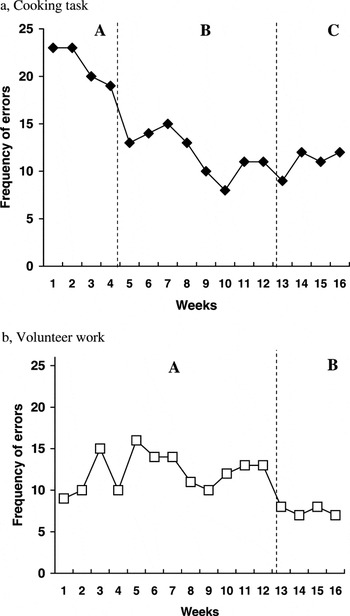
During the four-week baseline period on the cooking task (see “a” in Figure 2) JM made an average of 21 errors with the error frequency gradually declining over the baseline period. However, in the first week of treatment (week 5), a marked decline in the error frequency was observed. During the 8-week treatment period in the cooking setting, a 44% reduction in the average error frequency (11.8) was observed relative to the baseline period. The average error frequency (11.0) in the maintenance period indicated that the treatment effect was maintained. The error frequency observed in the volunteer work setting during the 12-week baseline period (see “b” in Figure 2) varied from 9 to 16 (M = 12.3) with no particular trend evident. However, when treatment was introduced in the work setting in week 13, a 39% reduction in errors (M = 7.5) was observed and appeared stable over the four-week period.

The frequency of errors observed in performance during the baseline (A), treatment (B) and maintenance (C) periods for the cooking setting and the baseline (A) and treatment (B) periods for the volunteer work setting.
Error behaviors
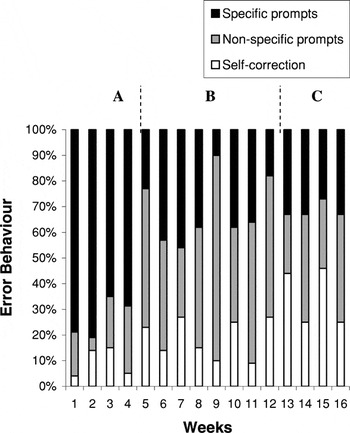
Figure 3 presents the proportion of error behaviors observed on the cooking task over the 16-week period. During the baseline period, JM mainly required specific prompting for correction and self-corrected only 4–15% of errors. During the treatment period, the proportion of self-corrected errors increased to 9–27% and JM mainly required nonspecific prompting to correct errors. During the maintenance period, JM self-corrected 25–46% of errors, required nonspecific prompts for 27–42% of errors, and specific prompts for 27–33% of errors. Thus, over time JM displayed greater self-correction and correction of errors with nonspecific prompts.

The proportion of error behaviors observed in performance on the cooking task over the 16-week period (A = baseline, B = treatment and C = maintenance).
General awareness of deficits
Compared with JM's pre-intervention performance on the Self-Awareness of Deficits Interview (2,2,2 = 6/9), no appreciable improvement (2,2,1 = 5/9) was observed in his level of awareness after the 16-week program. On the Awareness Questionnaire (AQ), a comparison of pre-intervention scores (self = 45; significant other = 27) with post-intervention scores (self = 43; significant other = 33) indicated a decrease in the level of discrepancy between ratings. However, the 8-point decrease occurred mainly as a result of JM's parents rating his skill level as higher on the AQ. Overall, there was no clinically meaningful change observed in JM's self-awareness on these measures. JM's self-reported level of emotional well-being at post-intervention (anxiety score = 6, depression score = 4) was similar to pre-intervention.
Programming for generalization
Some general observations provided evidence of spontaneous generalization, particularly on the cooking task. For example, during the treatment period JM began checking the recipe as needed between the 3-minute alarm intervals. Additionally, during the maintenance period, without prompting, JM turned down the frying pan when the telephone and doorbell rang, attended to these interruptions and then returned to the cooking task. However, it was apparent that JM would always require a degree of supervision and prompting during cooking. Additional strategies were discussed with JM and his parents to promote his independence.
Due to the positive outcome of the cooking and volunteer work interventions, JM was encouraged to seek paid employment with assistance from a disability employment service. Three weeks after the intervention he gained paid part-time work (16 hours per week) in a plant nursery with initial one-to-one support from a job coach. The therapist conducted a behavioral observation and provided training to JM's job coach and supervisor regarding the use of effective feedback for errors. After four weeks, JM no longer required a job coach and his supervisor reported a decrease in errors and an associated reduction in the level of supervision required.
Discussion
Overall, the present findings provide preliminary support for a metacognitive contextual approach for enhancing self-correction and functional gains for an individual with awareness deficits relating to neuro-cognitive and socio-environmental factors. These findings underscore the importance of selecting key tasks and environments in which poor self-awareness is likely to create a barrier to achievement of personal goals and providing systematic feedback opportunities (Fleming & Ownsworth, in press; Sohlberg et al., 1998). The emphasis placed upon targeting error awareness in real life activities contributed gains in JM's role participation, which is a valued outcome for cognitive rehabilitation (Carney et al., 1999). Positive feedback was received from his parents, job coach and supervisor regarding the value of the training and feedback strategies, which highlighted the broader social impact of the intervention. Although the intervention did not lead to gains in JM's global self-knowledge of deficits, the specific application of techniques in the workplace promoted a reduction in errors and associated functional gains across settings (Fleming & Ownsworth, in press).
Mechanisms underlying change
There are a number of proposed mechanisms underlying the decline in errors in JM's performance. One possible explanation is that the systematic error prompting procedure contributed to the initial decrease in errors observed during the four-week cooking baseline period. However, the concurrent use of this procedure in the work setting during the 12-week baseline was not associated with a decline in errors. Alternatively, it is possible that the reduction in errors in the cooking baseline period reflected behavioral change associated with task-specific learning and habit formation (Sohlberg et al., 1998). Although JM had been volunteering for approximately 12 months, he started cooking just prior to the baseline and, thus, the gains made during this period may have represented practice effects. Therefore, it may also be argued that the further reduction in errors and associated functional gains observed during treatment were due to practice. However, the lack of improvement in self-correction of errors during the cooking baseline was not consistent with this explanation.
Although a stable error behavior baseline was not established, JM's ability to self-correct errors without prompting or with nonspecific prompts improved following an introduction of the systematic feedback techniques. These techniques were designed to promote JM's self-evaluation of performance, anticipation of errors, use of corrective strategies and “on-line” self-correction during performance (Toglia, 1998). The greater proportion of self-corrected errors and corrections to nonspecific prompts following the baseline period suggested that an increase in self-regulatory behavior contributed to JM's functional gains (McNaughton et al., 1987). It is possible to speculate about underlying mechanisms for functional gains using the Cognitive Awareness Model (Morris & Hannesdottir, 2004). Specifically, the provision of systematic feedback may have served to update JM's personal database (PDB) concerning other people's expectations of his performance. In terms of self-appraisal of his performance, it is unclear whether errors were only perceived in the immediate sense, thus influencing behavioral change (i.e., self-correction) through implicit knowledge, or if errors were maintained in the PDB either with or without input received by the conscious awareness system (Morris & Hannesdottir, 2004). Other researchers have indicated that behavioral gains can occur without conscious awareness through implicit processes (e.g., Bieman-Copland & Dywan, 2000; Sohlberg et al., 1998). Overall, it appeared that JM's global self-knowledge concerning his impairments was unchanged and that the increase in self-monitoring was context-specific, although the extent to which JM was consciously aware of his errors on-line cannot be determined.
Such findings suggest that a metacognitive contextual intervention might have more clinical efficacy for facilitating on-line awareness than updating self-knowledge. As previously discussed, an a priori decision was made on the basis of JM's neurocognitive deficits and personal goals to target his error behavior in specific real-life contexts rather than primarily aiming to increase his self-knowledge. The latter therapeutic objective would appear to require an alternative rehabilitation approach, such as intensive psychoeducation or group programs (Ownsworth et al., 2000), which might not be specifically tailored to achieving functional goals. The key implication of this study is that rehabilitation planning requires due consideration of the nature of the clients' awareness deficits and the type of clinical outcomes that are perceived to be most beneficial or valued by the client. Whilst it may be important for some clients to clearly understand that their difficulties are due to a brain injury rather than pre-injury lifestyle or circumstances, other individuals, such as JM, may be taught to monitor their performance and use corrective strategies without a deeper understanding of their deficits. Further, some individuals might be at risk of heightened emotional distress if confronted by their deficits and by developing a deeper understanding of these (Ownsworth & Clare, 2005).
Methodological considerations
A number of limitations need to be acknowledged in this study. In particular, different feedback techniques were introduced in combination and it is not possible to isolate the therapeutic effects of specific treatment components. Additionally, the assessment of error behavior involved an individualised approach relevant for JM and although inter-rater agreement was examined, this approach has not been standardized. Various limitations of single-case designs have been discussed in relation to internal validity and generalisability (see Domholdtz, 2005). In the present study, the multiple-baseline design enabled examination of extraneous factors contributing to the changes observed throughout the program, which have been discussed. Detailed neuroimaging data were not available to permit a more precise description of the extent of JM's injury. For instance, more specific localization of JM's injury in terms of the relative damage to the ventral medial and lateral frontal regions would potentially have yielded greater understanding of neurocognitive mechanisms of self-awareness and guided recovery (Stuss & Anderson, 2004). However, the provision of comprehensive baseline data concerning JM's neuropsychological and psychological functioning may help readers ascertain the relevance of the findings to other individuals with TBI.
Additionally, it was not possible to determine in this exploratory study the extent to which self-correction on the cooking task increased as a function of practice, particularly given the variability observed in the four-week cooking baseline. An extended baseline would have enabled a more detailed examination of trends in error behavior and potential practice effects prior to introducing the feedback techniques. Thus, whilst it may be assumed that JM learnt to self-monitor and remain on task to enable him to self-correct or adjust his behavior according to non-specific cues, the extent to which metacognitive changes occurred at a more intrinsic level, as a function of the intervention, remains unclear.
Finally, it may have been enlightening to examine JM's theory of mind, or ability to make inferences about others' mental states, using perspective-taking, false beliefs, faux pas or related tasks (Stone et al., 1998; Stuss & Anderson, 2004). Despite the growing body of literature on self-awareness and theory of mind, there is a relative absence of empirical research examining the association between self-awareness deficits and theory of mind following TBI.
In conclusion, the present study provides some initial empirical support for the efficacy of a metacognitive contextual intervention for improving self-correction and functional performance. The importance of considering the relative contribution of factors underlying awareness deficits was emphasized. Further research is needed to develop standardized and ecologically valid procedures for assessing error awareness and to evaluate metacognitive contextual interventions. The efficacy of the present approach needs to be evaluated in a group study of individuals with awareness deficits related to neurocognitive and socioenvironmental factors.
ACKNOWLEDGMENTS
A Public Health Fellowship from the National Health and Medical Research Council and a grant from the Centre of National Research on Disability and Rehabilitation Medicine jointly funded the present study. We are grateful to Associate Professor David Shum and Dr Linda Clare for their valuable feedback and suggestions. We would also like to thank JM and his family for participating in this study.
References
REFERENCES
Agnew, S.K. &
Morris, R.G.
(1998).
The heterogeneity of anosognosia for memory impairment in
Alzheimer's disease: A review of the literature and a proposed
model.
Aging & Mental Health,
2,
7–19.CrossRefGoogle Scholar
Bieman-Copland, S. &
Dywan, J.
(2000).
Achieving rehabilitative gains in anosognosia after TBI.
Brain and Cognition,
1,
1–18.Google Scholar
Carney, N.,
Chesnut, R.M.,
Maynard, H.,
Mann, N.C.,
Patterson, P., &
Helfand, M.
(1999).
Effects of cognitive rehabilitation on outcomes for persons with
traumatic brain injury: A systematic review.
Journal of Head Trauma Rehabilitation,
14,
277–307.CrossRefGoogle Scholar
Cicerone, K. &
Tupper, D.
(1986).
Cognitive assessment in the neuropsychological rehabilitation of
head-injured adults. In
B.P. Uzzell &
Y. Gross (Eds.),
Clinical neuropsychology of intervention (pp.
59–83).
Boston:
Martinus Nijhoff Publishing.
Cicerone, K. &
Tupper, D.E.
(1991).
Neuropsychological rehabilitation: Treatment of errors in everyday
functioning. In
D.E. Tupper &
K.C. Cicerone (Eds.),
The neuropsychology of everyday life: Issues in development and
rehabilitation (pp.
271–292).
Norwell, MA:
Kluwer Academic.
Cocchini, G.,
Beschin, N., &
Della Sala, S.
(2002).
Chronic anosognosia: A case report and theoretical account.
Neuropsychologia,
40,
2030–2038.CrossRefGoogle Scholar
Crowne, D.P. &
Marlowe, D.
(1960).
A new scale of social desirability independent of
psychopathology.
Journal of Consulting Psychology,
24,
349–354.CrossRefGoogle Scholar
Domholdtz, E.
(2005).
Rehabilitation research: Principles and applications.
St Louis, MO:
Elsevier Saunders.
Fleming, J.M.,
Strong, J., &
Ashton, R.
(1996).
Self-awareness of deficits in adults with traumatic brain injury:
How best to measure?
Brain Injury,
10,
1–15.Google Scholar
Fleming, J. &
Ownsworth, T.L.
(2006).
A review of awareness interventions in brain injury
rehabilitation.
Neuropsychological Rehabilitation,
16,
(in press).CrossRefGoogle Scholar
Glynn, T.,
McNaughton, S.,
Robinson, V., &
Quinn, M.
(1979).
Remedial reading at home: Helping you to help your child.
Wellington:
New Zealand Council for Educational Research.
Hart, T.,
Giovannetti, T.,
Montgomery, M.W., &
Schwartz, M.F.
(1998).
Awareness of errors in naturalistic action after traumatic brain
injury.
Journal of Head Trauma Rehabilitation,
13,
16–28.CrossRefGoogle Scholar
Hersen, M.
(1990).
Single-case experimental designs. In
A.S. Bellack,
M. Hersen, &
A.E. Kazdin (Eds.),
International handbook of behaviour modification and therapy
(pp.
175–209).
New York:
Plennum Press.
Katz, N. &
Hartman-Maeir, A.
(1998).
Metacognition: The relationships of awareness and executive
functions to occupational performance. In
N. Katz (Ed.),
Cognition and occupation in rehabilitation: Models for intervention
in occupational therapy (pp.
323–242).
Bethesda, MD:
American Occupational Therapy Association.
Levine, B.,
Stuss, D.T.,
Milberg, W.P.,
Alexander, M.P.,
Schwartz, M., &
Macdonald, R.
(1998).
The effects of focal and diffuse brain damage on strategy
application: Evidence from focal lesions, traumatic brain injury and
normal aging.
Journal of the International Neuropsychological Society,
4,
247–264.Google Scholar
Lezak, M.D.
(1993).
Newer contributions to the neuropsychological assessment of
executive functions.
Journal of Head Trauma Rehabilitation,
8,
24–31.CrossRefGoogle Scholar
Loeb, P.A.
(1996).
The Independent Living Scales manual.
San Antonio:
The Psychological Corporation.
McGlynn, S.M. &
Schacter, D.L.
(1989).
Unawareness of deficits in neuropsychological syndromes.
Journal Clinical Experimental Neuropsychology,
11,
143–205.CrossRefGoogle Scholar
McNaughton, S.S.,
Glynn, T., &
Robinson, V.
(1987).
Pause, prompt, and praise: Effective tutoring for remedial
reading.
Birmingham, UK:
Positive Products.
Marcel, A.J.,
Tegner, R., &
Nimmo-Smith, I.
(2004).
Anosognosia for plegia: Specificity, extension, partiality, and
disunity of bodily unawareness.
Cortex,
40,
19–40.CrossRefGoogle Scholar
Mittenberg, W.,
DiGiulio, D.V.,
Perrin, S., &
Bass, A.E.
(1992).
Symptoms following mild head injury: Expectation as
aetiology.
Journal of Neurology, Neurosurgery, and Psychiatry,
55,
200–204.CrossRefGoogle Scholar
Morris, R.G. &
Hannesdottir, K.
(2004).
Loss of “awareness” in Alzheimer's disease.
In
R.G. Morris &
J.T. Becker (Eds.),
The Cognitive Neuropsychology of Alzheimer's Disease
(pp.
275–296).
Oxford:
Oxford University Press.
Ownsworth, T.L.
(2005).
The impact of defensive denial upon adjustment following traumatic
brain injury.
Neuro-psychoanalysis,
7,
83–94.Google Scholar
Ownsworth, T.L. &
Clare, L.
(2005).
The role and relevance of self-awareness in achieving rehabilitation
gains: Empirical evidence and case illustrations.
Paper presented at the Neuropsychological Rehabilitation
Conference (July 11–12th), Galway, Ireland.
Ownsworth, T.L.,
Clare, L., &
Morris, R.
(2006).
A critical review of cognitive neuropsychological models of
awareness: An integrated biopsychosocial approach for Alzheimer's
disease and brain injury.
Neuropsychological Rehabilitation,
10,
(in press).CrossRefGoogle Scholar
Ownsworth, T.L. &
Fleming, J.
(2005).
The relative importance of metacognitive skills, emotional status
and executive functioning in psychosocial adjustment following acquired
brain injury.
Journal of Head Trauma Rehabilitation,
20,
315–332.CrossRefGoogle Scholar
Ownsworth, T.L.,
McFarland, K., &
Young, R.McD.
(2000).
Self-awareness and psychosocial functioning following acquired brain
injury: An evaluation of a group support programme.
Neuropsychological Rehabilitation,
10,
465–484.CrossRefGoogle Scholar
Ownsworth, T.L.,
McFarland, K., &
Young, R.McD.
(2002).
Investigation of factors underlying deficits in self-awareness and
self-regulation.
Brain Injury,
16,
291–309.CrossRefGoogle Scholar
Pia, L.,
Neppi-Modona, M.,
Ricci, R., &
Berti, A.
(2004).
The anatomy of anosognosia for hemiplegia: A meta-analysis.
Cortex,
40,
367–377.CrossRefGoogle Scholar
Prigatano, G.P.
(1999).
Principles of neuropsychological rehabilitation.
New York:
Oxford University Press.
Prigatano, G.P. &
Weinstein, E.A.
(1996).
Edwin A. Weinstein's contributions to neuropsychological
rehabilitation.
Neuropsychological Rehabilitation,
6,
305–326.CrossRefGoogle Scholar
Reynolds, W.M.
(1982).
Development of reliable and valid short forms of the Marlowe-Crowne
Social Desirability Scale.
Journal of Clinical Psychology,
38,
119–125.3.0.CO;2-I>CrossRefGoogle Scholar
Robertson, I.H. &
Murre, J.M.J.
(1999).
Rehabilitation of brain damage: Brain plasticity and principles of
guided recovery.
Psychological Bulletin,
125,
544–575.CrossRefGoogle Scholar
Schacter, D.L.
(1990).
Toward a cognitive neuropsychology of awareness: Implicit knowledge
and anosognosia.
Clinical and Experimental Neuropsychology,
12,
155–178.CrossRefGoogle Scholar
Sherer, M.,
Bergloff, P.,
Boake, C.,
High, W., &
Levin, E.
(1998a).
The Awareness Questionnaire: Factor structure and internal
consistency.
Brain Injury,
12,
63–68.Google Scholar
Sherer, M.,
Hart, T.,
Whyte, J.,
Nick, T.G., &
Yablon, S.A.
(2005).
Neuroanatomical basis of impaired self-awareness after traumatic
brain injury: Findings from early computed tomography.
Journal of Head Trauma Rehabilitation,
20,
287–300.CrossRefGoogle Scholar
Sherer, M.,
Oden, K.,
Bergloff, P.,
Levin, E., &
High, W.M.
(1998b).
Assessment and treatment of impaired awareness after brain injury:
Implications for community re-integration.
NeuroRehabilitation,
10,
25–37.Google Scholar
Snaith, R.P. &
Zigmond, A.S.
(1994).
The Hospital Anxiety and Depression Scale manual.
Windsor, Berkshire, UK:
NFER-NELSON Publishing Company Ltd.
Sohlberg, M.M.,
Mateer, C.A.,
Penkman, L.,
Glang, A., &
Todis, B.
(1998).
Awareness Intervention: Who needs it?
Journal of Head Trauma Rehabilitation,
13,
62–78.Google Scholar
Spreen, O. &
Strauss, E.
(1998).
A compendium of neuropsychological tests
(2nd ed.).
Oxford, UK:
Oxford University Press.
Stone, V.E.,
Baron-Cohen, S., &
Knight, R.T.
(1998).
Frontal lobe contributions to theory of mind.
Journal of Cognitive Neuroscience,
10,
640–656.CrossRefGoogle Scholar
Stuss, D.T.,
Alexander, M.P.,
Palumbo, C.L.,
Buckle, L.,
Sayer, L., &
Pogue, J.
(1994).
Organizational strategies of patients with unilateral or bilateral
frontal lobe injury in word list learning tasks.
Neuropsychology,
8,
355–373.CrossRefGoogle Scholar
Stuss, D.T. &
Anderson, V.
(2004).
The frontal lobes and theory of mind: Developmental concepts from
adult focal lesion research.
Brain and Cognition,
55,
69–83.CrossRefGoogle Scholar
Stuss, D.T.,
Picton, T.W., &
Alexander, M.P.
(2001).
Consciousness, self-awareness and the frontal lobes. In
S. Salloway,
P. Malloy, &
J. Duffy (Eds.),
The frontal lobes and neuropsychiatric illness (pp.
101–109).
Washington DC:
American Psychiatric Press, Inc.
Tate, R.L. &
Broe, G.A.
(1999).
Psychosocial adjustment after traumatic brain injury: What are the
important variables?
Psychological Medicine,
29,
713–725.Google Scholar
Toglia, J.P.
(1998).
A dynamic interactional model to cognitive rehabilitation.
In
N. Katz (Ed.),
Cognition and occupation in rehabilitation: Models for intervention
in occupational therapy (pp.
5–50),
Bethesda, MD:
American Occupational Therapy Association.
Toglia, J. &
Kirk, U.
(2000).
Understanding awareness deficits following brain injury.
NeuroRehabilitation,
15,
57–70.Google Scholar
Vilkki, J.,
Ahola, K.,
Holst, P.,
Ohman, J.,
Servo, A., &
Heiskanen, O.
(1994).
Prediction of psychosocial recovery after head injury with cognitive
tests and neurobehavioral ratings.
Journal of Clinical and Experimental Neuropsychology,
16,
325–338.CrossRefGoogle Scholar
Wilson, B.A.,
Alderman, N.,
Burgess, P.W.,
Emslie, H., &
Evans, J.J.
(1996).
Behavioural Assessment of the Dysexecutive Syndrome (BADS).
Bury St. Edmunds, UK:
Thames Valley Test Company.
Ylvisaker, M.,
Szekeres, S., &
Feeney, T.
(1998).
Cognitive rehabilitation: executive functions. In
M. Ylvisaker (Ed.),
Traumatic brain injury rehabilitation: children and
adolescents (pp.
221–269).
Boston:
Butterworth-Heinemann.

An integrated biopsychosocial model of awareness disorders (note: the dotted triangle represents the relative and potentially interactive contribution of neurocognitive, psychological and socioenvironmental factors to a given individual's presentation of awareness deficits).

The Results of Assessments Conducted at 2.5 years and 4 Years Post-Injury
The frequency of errors observed in performance during the baseline (A), treatment (B) and maintenance (C) periods for the cooking setting and the baseline (A) and treatment (B) periods for the volunteer work setting.
The proportion of error behaviors observed in performance on the cooking task over the 16-week period (A = baseline, B = treatment and C = maintenance).
 You have
Access
- 92
- Cited by