Clinically significant levels of anxiety co-occur in approximately half the Major Depressive Disorder (MDD) population (Ionescu et al., Reference Ionescu, Niciu, Henter and Zarate2013a; Gaspersz et al., Reference Gaspersz, Nawijn, Lamers and Penninx2018). These forms of anxious depression have been associated with a range of clinical and biological markers, as well as poorer antidepressant treatment outcomes (Goldberg and Fawcett, Reference Goldberg and Fawcett2012; Ionescu et al., Reference Ionescu, Niciu, Henter and Zarate2013a, Reference Ionescu, Niciu, Mathews, Richards and Zarate2013b; Ionescu et al., Reference Ionescu, Niciu, Richards and Zarate2014; Kessler et al., Reference Kessler, Sampson, Berglund, Gruber, Al-Hamzawi, Andrade, Bunting, Demyttenaere, Florescu, De Girolamo, Gureje, He, Hu, Huang, Karam, Kovess-Masfety, Lee, Levinson, Medina Mora, Moskalewicz, Nakamura, Navarro-Mateu, Browne, Piazza, Posada-Villa, Slade, Ten Have, Torres, Vilagut, Xavier, Zarkov, Shahly and Wilcox2015; Braund et al., Reference Braund, Palmer, Williams and Harris2019). However, the validity of these associations has been limited by the range of diagnostic criteria used when defining anxious depression (Ionescu et al., Reference Ionescu, Niciu, Henter and Zarate2013a, Reference Ionescu, Niciu, Mathews, Richards and Zarate2013b; Gaspersz et al., Reference Gaspersz, Nawijn, Lamers and Penninx2018). Recent efforts have also been aimed at understanding mental health and illness in terms of varying degrees of dysfunction (Insel et al., Reference Insel, Cuthbert, Garvey, Heinssen, Pine, Quinn, Sanislow and Wang2010).
Clinically, anxious depression has associated with greater depression severity, higher suicidal risks, lower quality of life (QOL), and more impaired social and occupational functioning (Ionescu et al., Reference Ionescu, Niciu, Henter and Zarate2013a; Gaspersz et al., Reference Gaspersz, Nawijn, Lamers and Penninx2018). Higher levels of anxiety have been associated with impairments in the executive functions inhibition and shifting (Derakshan and Eysenck, Reference Derakshan and Eysenck2009; Eysenck and Derakshan, Reference Eysenck and Derakshan2011), while anxiety disorders have been associated with impairments in executive and working memory functions (Castaneda et al., Reference Castaneda, Suvisaari, Marttunen, Perala, Saarni, Aalto-Setala, Lonnqvist and Tuulio-Henriksson2011; Ferreri et al., Reference Ferreri, Lapp and Peretti2011). People with high anxiety also show increased resting heart rates (HR) and reduced heart rate variabilities (HRV; Licht et al., Reference Licht, De Geus, Van Dyck and Penninx2009; Chalmers et al., Reference Chalmers, Quintana, Abbott and Kemp2014), with the greatest reductions shown by those with anxiety and MDD (Kemp et al., Reference Kemp, Quintana, Felmingham, Matthews and Jelinek2012; Chang et al., Reference Chang, Chang, Tzeng, Kuo, Lu and Huang2013; Chen et al., Reference Chen, Chang, Tzeng, Kuo, Kao, Huang and Chang2014). High scores on the clinician-rated HRSD17 anxiety/somatisation factor is commonly used to characterise anxious depression and has been associated with poorer treatment outcome (Ionescu et al., Reference Ionescu, Niciu, Henter and Zarate2013a; Gaspersz et al., Reference Gaspersz, Nawijn, Lamers and Penninx2018). However, items level analyses suggest treatment outcome is associated with specific types of anxiety symptoms. For example, early reductions in somatic (anxiety, general, and gastrointestinal) items have been associated with better HRSD17 remission (Farabaugh et al., Reference Farabaugh, Mischoulon, Fava, Wu, Mascarini, Tossani and Alpert2005; Farabaugh et al., Reference Farabaugh, Bitran, Witte, Alpert, Chuzi, Clain, Baer, Fava, Mcgrath, Dording, Mischoulon and Papakostas2010; Bitran et al., Reference Bitran, Farabaugh, Ameral, Larocca, Clain, Fava and Mischoulon2011).
Other anxiety related scales have also shown a use in predicting antidepressant treatment outcome. The self-rated Depression Anxiety Stress Scale (DASS) measures the three related negative emotional states of depression, anxiety, and stress (Lovibond and Lovibond, Reference Lovibond and Lovibond1995). The DASS anxiety subscale assesses autonomic arousal, skeletal muscle effects, situational anxiety, and subjective experiences of anxious affect. Furthermore, higher DASS anxiety has been associated with poorer treatment outcome, even after adjusting for depressive severity, diagnostic comorbidity and side effects (Saveanu et al., Reference Saveanu, Etkin, Duchemin, Goldstein-Piekarski, Gyurak, Debattista, Schatzberg, Sood, Day, Palmer, Rekshan, Gordon, Rush and Williams2015). The DASS stress subscale assesses nervous tension, difficulty relaxing, and irritability. DASS stress items have been shown to overlap with symptoms of generalized anxiety disorder (GAD; Brown et al., Reference Brown, Chorpita, Korotitsch and Barlow1997; Gloster et al., Reference Gloster, Rhoades, Novy, Klotsche, Senior, Kunik, Wilson and Stanley2008). Together, these anxiety related scales present promising candidates for characterising anxiety in people with MDD with a use for predicating antidepressant treatment outcome.
Exploratory factor analysis has recently been used to characterise anxiety in people with MDD (Trombello et al., Reference Trombello, Pizzagalli, Weissman, Grannemann, Cooper, Greer, Malchow, Jha, Carmody, Kurian, Webb, Dillon, Mcgrath, Bruder, Fava, Parsey, Mcinnis, Adams and Trivedi2018). While Trombello et al. (Reference Trombello, Pizzagalli, Weissman, Grannemann, Cooper, Greer, Malchow, Jha, Carmody, Kurian, Webb, Dillon, Mcgrath, Bruder, Fava, Parsey, Mcinnis, Adams and Trivedi2018) found four anxiety related factors, these factors mostly aligned with the items corresponding subscales. Furthermore, the study was supported by a small sample size (n < 200) and a low subject to item ratio (3.8:1) for factor analysis (Costello and Osborne, Reference Costello and Osborne2005), only used a single task to assess cognitive functioning, and did not investigate associations between factors and antidepressant treatment outcome.
The aim of our study was to identify and characterise the number of anxiety related factors underlying a broad range of anxious symptoms in people with MDD and assess whether the factors were associated with antidepressant treatment outcome. These aims were evaluated using data from the iSPOT-D study, which was supported by a large sample size (n = 1008), used a broad range of anxiety related scales, included multiple measures of clinical, cognitive, and physiological functioning, and investigated antidepressant treatment outcome (Williams et al., Reference Williams, Rush, Koslow, Wisniewski, Cooper, Nemeroff, Schatzberg and Gordon2011). It was hypothesised that multiple anxiety related factors would emerge, which would be characterised by unique clinical, cognitive, and physiological profiles. Furthermore, it was hypothesised that higher scores on factors associated with somatic symptoms of anxiety would be associated with poorer antidepressant treatment outcome.
Method
Study overview
The International Study to Predict Optimized Treatment for Depression (iSPOT-D) is a phase-IV, multi-site, international, randomized, open-label trial designed to identify markers of treatment response to commonly prescribed medications in an adult depressed, outpatient population. All participants were either antidepressant medication naive or washed out. Assessments were collected at pre-treatment and post-treatment at 8 weeks. The iSPOT-D trial was designed with no placebo arm and participants were aware of the medication that they were taking to best match real-world practice. In this way, findings also reflect treatment regimens that exist in routine practice and promote the translatability of the findings. For more details on the study protocol design, rationale and methods, see Williams et al. (Reference Williams, Rush, Koslow, Wisniewski, Cooper, Nemeroff, Schatzberg and Gordon2011).
Participants
Participants (N = 1008) were adults (18–65 years old) with a current diagnosis of single-episode or recurrent, nonpsychotic, MDD (see Saveanu et al. (Reference Saveanu, Etkin, Duchemin, Goldstein-Piekarski, Gyurak, Debattista, Schatzberg, Sood, Day, Palmer, Rekshan, Gordon, Rush and Williams2015), for detailed recruitment information and demographic features). Participants were diagnosed using the Mini-International Neuropsychiatric Interview – Plus (MINI-Plus; Sheehan et al., Reference Sheehan, Lecrubier, Sheehan, Amorim, Janavs, Weiller, Hergueta, Baker and Dunbar1998) according to Diagnostic and Statistical Manual of Mental Disorders (DSM)-IV criteria (American Psychiatric, 1994). All participants required a 17-item HRSD17 score >16 at entry. Participants provided written informed consent after receiving a complete description of the study. The study was preregistered (Williams et al., Reference Williams, Rush, Koslow, Wisniewski, Cooper, Nemeroff, Schatzberg and Gordon2011) and approved by institutional or ethical review boards at each site. The study protocols followed International Conference on Harmonization and Good Clinical Practice principles, the U.S. Food and Drug Administration Code of Federal Regulations, the Helsinki Declaration of 1975 (as revised in 2008), and country-specific guidelines.
Protocol treatment
Participants were randomized to receive one of two selective serotonin reuptake inhibitors (SSRIs; i.e. escitalopram or sertraline), or the selective norepinephrine reuptake inhibitor venlafaxine-extended release (venlafaxine-XR) with equal probability (1:1:1). All psychotropic medications (except sleep aids and anxiolytics) were discontinued and washed-out prior to baseline assessments. Antidepressants were prescribed and doses were adjusted by the participant's treating physician according to routine clinical practice. Additional medication for associated symptoms (e.g. insomnia) or medication-induced side effects (e.g. nausea) were allowed as they reflect common practice. Any treatment for concurrent general medical conditions, except medications contraindicated with the study-assigned antidepressants, were allowed and recorded.
Clinical features
Symptom severity scores were assessed at baseline by research assistants independent of the prescribing clinicians using the HRSD17 (Hamilton, Reference Hamilton1960), the self-rated 16-item Quick Inventory of Depressive Symptomatology (QIDS-SR16; Rush et al., Reference Rush, Trivedi, Ibrahim, Carmody, Arnow, Klein, Markowitz, Ninan, Kornstein, Manber, Thase, Kocsis and Keller2003; Trivedi et al., Reference Trivedi, Rush, Ibrahim, Carmody, Biggs, Suppes, Crismon, Shores-Wilson, Toprac, Dennehy, Witte and Kashner2004), and the self-rated 42-item Depression Anxiety and Stress Scale (DASS42; Lovibond and Lovibond, Reference Lovibond and Lovibond1995; Lovibond, Reference Lovibond1998). DASS42 item scores ranged from 0 (did not apply to me at all) to 3 (applied to me very much or most of the time). The HRSD17 anxiety/somatisation factor derived from Cleary and Guy (Reference Cleary and Guy1977) was also assessed. The factor includes six items, with three item scores (i.e. insight, general and gastrointestinal somatic symptoms) ranging from 0 to 2, and three item scores (i.e. hypochondriasis, psychic and somatic anxiety) ranging from 0 to 4. Sociodemographic measures were collected as part of the clinical interview and included age, sex, years of education and race. Family history of illness, early life stress (ELS) events, relationship status, and work status were collected in computer based self-report questionnaires. Course of illness and comorbidities were collected at baseline using the MINI-Plus (Sheehan et al., Reference Sheehan, Lecrubier, Sheehan, Amorim, Janavs, Weiller, Hergueta, Baker and Dunbar1998).
Psychological profile
Psychological profile was assessed using the self-reported NEO-Five Factor Inventory (NEO-FFI; Costa and McCrae, Reference Costa and McCrae1989) and Emotion Regulation Questionnaire (ERQ; Gross and John, Reference Gross and John2003). The NEO-FFI is a 60-item questionnaire that examines five personality traits: openness, contentiousness, extraversion, agreeableness and neuroticism. The ERQ is a 10-item scale designed to measure respondents' tendency to regulate their emotions through cognitive reappraisal and expressive suppression.
Quality and satisfaction with life
Quality and satisfaction with life was assessed using the World Health Organization Quality Of Life (WHOQOL)-BREF scale (Harper et al., Reference Harper, Power and Grp1998) and the Satisfaction with Life Scale (SWLS; Diener et al., Reference Diener, Emmons, Larsen and Griffin1985). The WHOQOL-BREF is a 26-item questionnaire assessing quality of life in four domains: physical health, psychological, social relationships, environments. The SWLS is a 5-item scale assessing global cognitive judgments of one's life satisfaction.
Self-regulation
Self-regulation was assessed using the clinician-rated Social and Occupational Functioning Assessment Scale (SOFAS; Goldman et al., Reference Goldman, Skodol and Lave1992) the self-report Brief Risk-resilience Index for Screening (BRISC; Williams et al., Reference Williams, Cooper, Wisniewski, Gatt, Koslow, Kulkarni, Devarney, Gordon and John Rush2012) assessment. The BRISC is a 45-item scale assessing three core domains of self-regulation: negativity bias, emotional resilience, and social skills. The SOFAS is a continuous scale ranging from 0 to 100 that rates social and occupational functioning from excellent functioning to grossly impaired functioning.
Cognitive functioning
Participants completed IntegNeuro™, a computerized battery of tests designed to evaluate a range of cognitive capacities, including working memory, cognitive control, response inhibition, information processing speed and executive function (see online Supplementary Material Table 1; Paul et al., Reference Paul, Lawrence, Williams, Richard, Cooper and Gordon2005; Mathersul et al., Reference Mathersul, Palmer, Gur, Gur, Cooper, Gordon and Williams2009; Williams et al., Reference Williams, Mathersul, Palmer, Gur, Gur and Gordon2009). Tests were selected based on findings showing people with high anxiety symptoms and anxiety disorders show impairments in these domains (Eysenck et al., Reference Eysenck, Derakshan, Santos and Calvo2007; Castaneda et al., Reference Castaneda, Suvisaari, Marttunen, Perala, Saarni, Aalto-Setala, Lonnqvist and Tuulio-Henriksson2011; Ferreri et al., Reference Ferreri, Lapp and Peretti2011). Non-normally distributed outcome measures were log transformed to normality.
Physiological functioning
Electrocardiogram (ECG) recordings were collected in a sound and light-controlled room at 24 °C for 2 min during eyes open resting state. During resting state, participants were asked to rest quietly and focus on a red dot displayed on the computer screen in front of them. HR measures were calculated from the ECG recording and analysed using custom-developed software to perform semiautomated pre-processing to remove noise from the ECG, allowing for the identification of the R-peaks based on established methods (Pan and Tompkins, Reference Pan and Tompkins1985). HR measures included beats per minute and the standard deviation of beats per minute. HRV was measured using the square root of the mean squared differences between successive N–N intervals (RMSSD; an estimate of vagally mediated changes in HRV that is less affected by changes in breathing frequency; Penttila et al., Reference Penttila, Helminen, Jartti, Kuusela, Huikuri, Tulppo, Coffeng and Scheinin2001). RMSSD was log transformed to normality.
Post-treatment measures
Outcome measures were change in HRSD17 and QIDS-SR16 symptom scores, as well as remission and response, from baseline to week 8. Remission was defined as a week 8 HRSD17 score <7 or a week 8 QIDS-SR16 score <5 (Rush et al., Reference Rush, Trivedi, Ibrahim, Carmody, Arnow, Klein, Markowitz, Ninan, Kornstein, Manber, Thase, Kocsis and Keller2003; Trivedi et al., Reference Trivedi, Rush, Ibrahim, Carmody, Biggs, Suppes, Crismon, Shores-Wilson, Toprac, Dennehy, Witte and Kashner2004). Response was defined as a > 50% decrease from baseline to week 8 on the HRSD17 or QIDS-SR16. Study site personnel contacted participants by telephone at day 4 and weeks 2, 4 and 6 to monitor antidepressant dosage, compliance, concomitant medications and adverse events.
Statistical analysis
Exploratory Factor Analysis (EFA) was performed using item level data from anxiety related subscales (i.e. the DASS42 anxiety and stress subscales and the HRSD17 anxiety/somatisation factor). Missing data used in the EFA were first imputed using an iterative PCA algorithm (Josse and Husson, Reference Josse and Husson2013). Missing data ranged from 0% to 8.7% (DASS42 item 36), with 6.8% of data missing in total. To determine the maximum number of factors to retain, we compared four techniques: the Kaiser criterion (Kaiser, Reference Kaiser1960), parallel analysis (Horn, Reference Horn1965), and non-graphical solutions to the Cattell scree test (Cattell, Reference Cattell1966), including the acceleration factor and the optimal coordinates index (Raiche et al., Reference Raiche, Walls, Magis, Riopel and Blais2013). Due to an initial EFA indicating factors were correlated and an oblique promax rotation produced a model with a lower number of cross-loadings (Abdi, Reference Abdi, Lewis-Beck, Bryman and Futing2003), promax rotation was used on successive iterations. Factor scores were estimated using Bartlett (Reference Bartlett1938) weighted least squares method, a correction to Thomson (Reference Thomson1935) method that corrects for bias in factor means (Estabrook and Neale, Reference Estabrook and Neale2013).
Missing baseline clinical, cognition and physiological data were imputed using multivariate imputation by chained equations (MICE; where m = 10), a multiple imputation technique able to handle both continuous and categorical data (Azur et al., Reference Azur, Stuart, Frangakis and Leaf2011; van Buuren and Groothuis-Oudshoorn, Reference Van Buuren and Groothuis-Oudshoorn2011). All variables in the dataset, including interactions of interest, were used in the imputation model (Marshall et al., Reference Marshall, Altman, Holder and Royston2009; van Buuren and Groothuis-Oudshoorn, Reference Van Buuren and Groothuis-Oudshoorn2011). Missing clinical data ranged from 0% to 9.6% (NEO-FFI openness), missing cognition data ranged from 2.8% (Stroop – reaction time (congruent)) to 9.2% (Go No-Go – false positives), and 15.5% of physiological data was missing. Missing data was in the acceptable range for multiple imputation (i.e. up to 60% missing data; Barzi and Woodward, Reference Barzi and Woodward2004). The method of imputation for numeric variables was predictive mean matching (Little, Reference Little1988), logistic regression for categorical variables with two levels, polynomial logistic regression for unordered categorical variables with more than two levels, and proportional odds for ordered categorical variables with more than two levels.
Pearson and Spearman correlations were used to test associations between factors and clinical, cognitive, and physiological measures. Linear regressions were used with the covariates of presence of a cardiovascular condition and use of statins to test whether the associations between factors and physiological measures occurred independent of these covariates. t tests were used to compare differences in factor scores between those with and without various anxiety disorders. Linear and logistic regression models were used to assess whether factor scores predicted symptom change and treatment outcome (respectively). Linear and logistic regressions were used with the covariates of age, sex, years of education, study site, depression severity (i.e. HRSD17 score with anxiety/somatisation factor items removed), recurring MDD, use of sleep aids/anxiolytics, and presence of a current cardiovascular or respiratory condition to test whether the associations between factors and symptom change/treatment outcome occurred independent of these covariates. The false discovery rates for all p-values were corrected to q-values using the Benjamini and Hochberg (Reference Benjamini and Hochberg1995) procedure.
All analyses were conducted using R 3.5.1 (R Core Team, 2019). Missing data used in EFA were imputed using the ‘missMDA’ R package (Josse and Husson, Reference Josse and Husson2016). Missing clinical, cognition, and physiological data were imputed using the ‘mice’ R package (van Buuren and Groothuis-Oudshoorn, Reference Van Buuren and Groothuis-Oudshoorn2011). Factor analysis was performed using the ‘factanal’ function in the ‘stats’ R package (R Core Team, 2019). Correlations and regressions were performed on imputed data using the ‘miceadds’ R package. The scree plot was produced using the ‘nFactors’ R package (Raiche, Reference Raiche2010).
Results
Demographics
iSPOT-D demographics have been published elsewhere (Saveanu et al., Reference Saveanu, Etkin, Duchemin, Goldstein-Piekarski, Gyurak, Debattista, Schatzberg, Sood, Day, Palmer, Rekshan, Gordon, Rush and Williams2015). Briefly, the mean age was 37.85 (s.d. = 12.57) and years of education was 14.54 (s.d. = 2.80). Mean HRSD17 total score was 21.9 (s.d. = 4.1), and 15.72 (s.d. = 3.32) when items from the anxiety/somatization factor were removed. There were 571 (56.6%) females, 884 (87.7%) people with recurrent MDD, 58 (5.8%) people using sleep aids/anxiolytics, 81 (8%) people with a current cardiovascular condition, 31 (3.1%) people with a current respiratory condition, and 7 (0.7%) people using statins.
Factor analysis
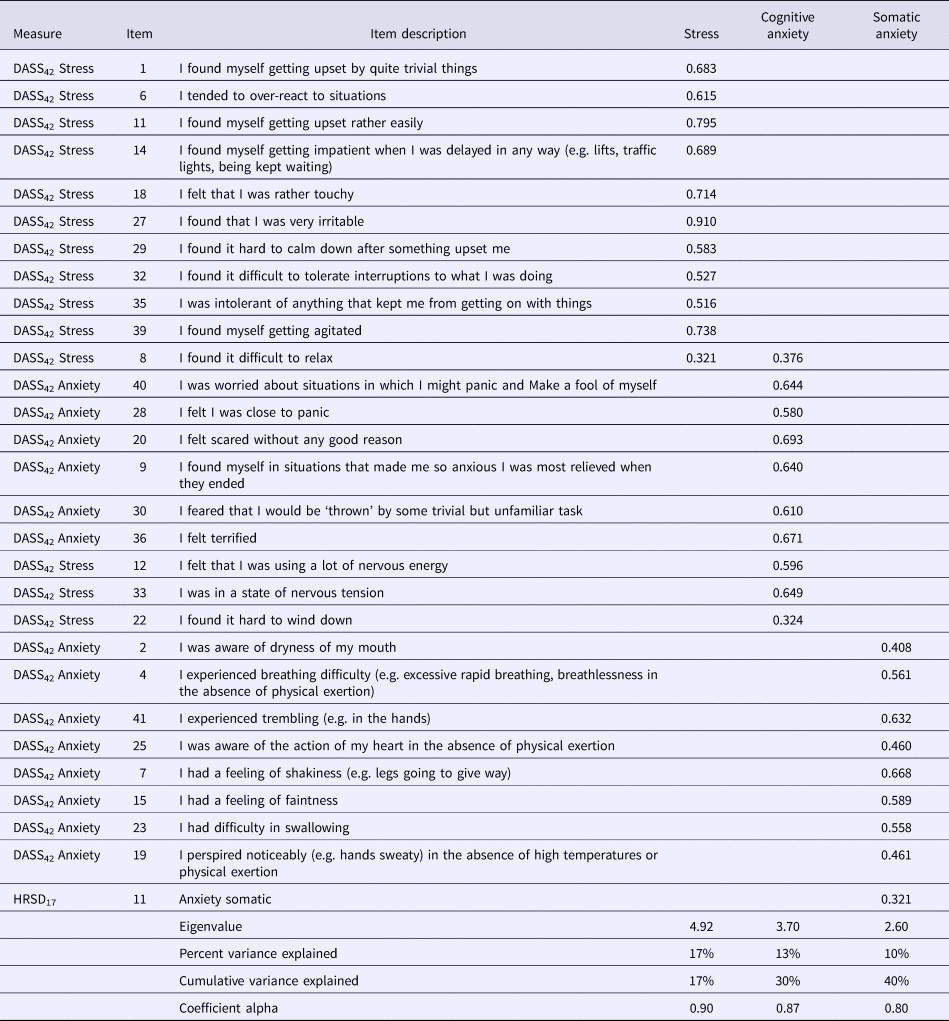
Parallel analysis and the optimal coordinate index suggested a maximum of five factors, so our EFA was initially limited to five factor solutions (see online Supplementary Material Figure 1). After removing five1 items with no significant primary factor loadings (i.e. factor loadings less than 0.32; Tabachnick and Fidell, Reference Tabachnick and Fidell2007), parallel analysis and the optimal coordinate index suggested a maximum of three factors (see online Supplementary Material Figure 2). The final three-factor EFA model resulted in all items loading to a primary factor and only one item with significant cross-loadings. Table 1 shows factor loadings and their psychometric properties. All factors demonstrated appropriate loadings and high degrees of internal consistency. The three factors derived were related to stress, cognitive anxiety, and somatic anxiety.
Factor loadings and psychometric properties of factors

Note: Items with factor loadings below 0.32 are hidden
Correlations between factors and clinical measures
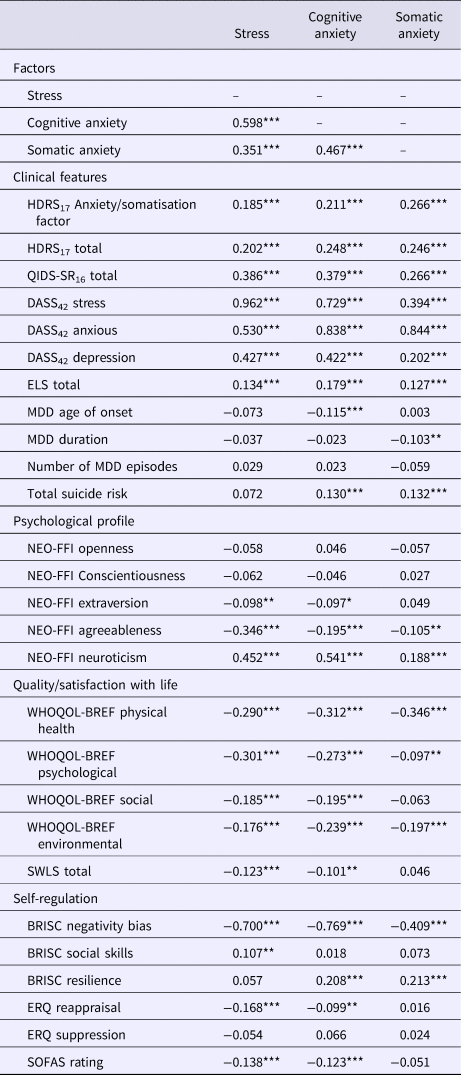
Table 2 shows the correlations between factors and clinical measures. Factors were moderately correlated with each other and all factors were highly correlated with their corresponding scales. Surprisingly, all factors were weakly correlated with the HRSD17 anxiety/somatisation factor (r = 0.185–0.266). All factors showed positive correlations with negative aspects of functioning including depression, ELS, and neuroticism, as well as negative correlations with positive aspects of functioning, including agreeableness, WHOQOL-BREF Psychological, Environmental and Physical Health, and BRISC negativity. Stress was characterised by a weak positive correlation with BRISC social skills and no association with resilience and total suicide risk. Cognitive anxiety was characterised by a negative correlation with MDD age of onset. Somatic anxiety was characterised by a weak negative correlation with MDD duration, and by no associations with extraversion, WHOQOL-BREF Social, SWLS total, ERQ reappraisal, and SOFAS rating. Additionally, given Green et al. (Reference Green, Goldstein-Piekarski, Schatzberg, Rush, Ma and Williams2017) found BMI was associated with treatment outcome in the iSPOT-D sample, we also assessed whether BMI was correlated with factors. BMI was not correlated with factors after correcting for multiple comparisons (see online Supplementary Material Table 2).
Correlations between factors and clinical features, psychological profile, quality/satisfaction with life, and self-regulation

Note. *q < 0.05, **q < 0.01, ***q < 0.001
Differences in factor scores with and without comorbid anxiety disorders
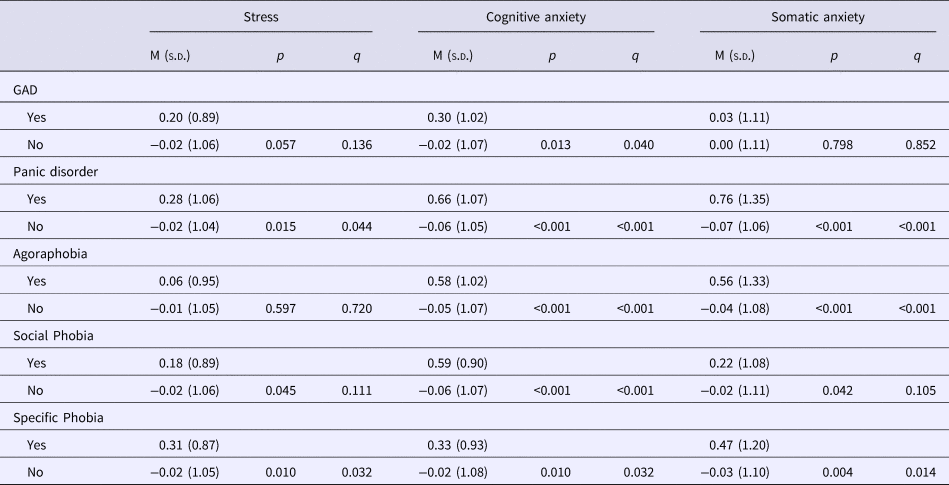
Table 3 shows the differences in factor scores for people with and without various comorbid anxiety disorders. High stress was associated with panic disorder (q = 0.044) and specific phobia (q = 0.032). High cognitive anxiety was associated with all anxiety disorders. High somatic anxiety was associated with panic disorder (q < 0.001), agoraphobia (q < 0.001) and specific phobia (q = 0.014).
Differences in factor scores with and without a comorbid anxiety disorder

Note. Abbreviation: GAD, Generalised Anxiety Disorder
Correlations between factors, and cognitive/physiological functioning
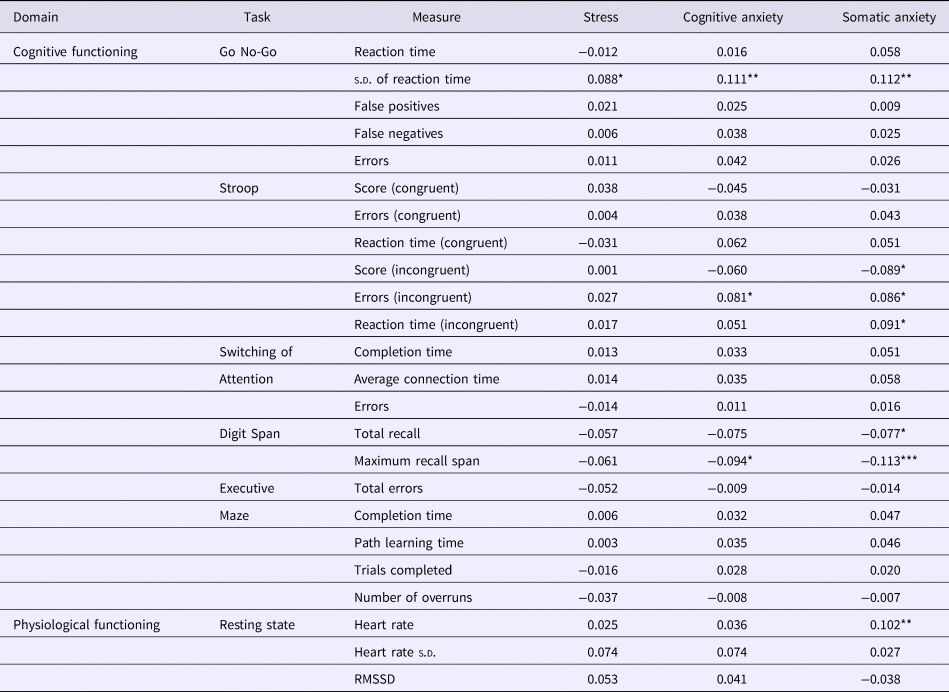
Table 4 shows the correlations between factors and cognitive/physiological functioning. Stress, cognitive anxiety and somatic anxiety all showed significant positive correlations with the reaction time standard deviation for the go no-go task. Cognitive and somatic anxiety showed positive correlations with errors (incongruent) in the stroop task and negative correlations with maximum recall span in the digit span task. However, only somatic anxiety showed negative correlations with the total score (incongruent) for the stroop task and total recall for the digit span task, as well as positive correlations with errors (incongruent) on the stroop task and resting heart rate. Higher somatic anxiety was still associated with a higher resting heart rate after controlling for the presence of a cardiovascular condition and statins (β = 1.03, 95% CI 0.37 to 1.69, q = 0.008).
Correlations between factors and cognitive/physiological functioning

Note. *q < 0.05, **q < 0.01, ***q < 0.001
Associations between factors and antidepressant treatment outcome
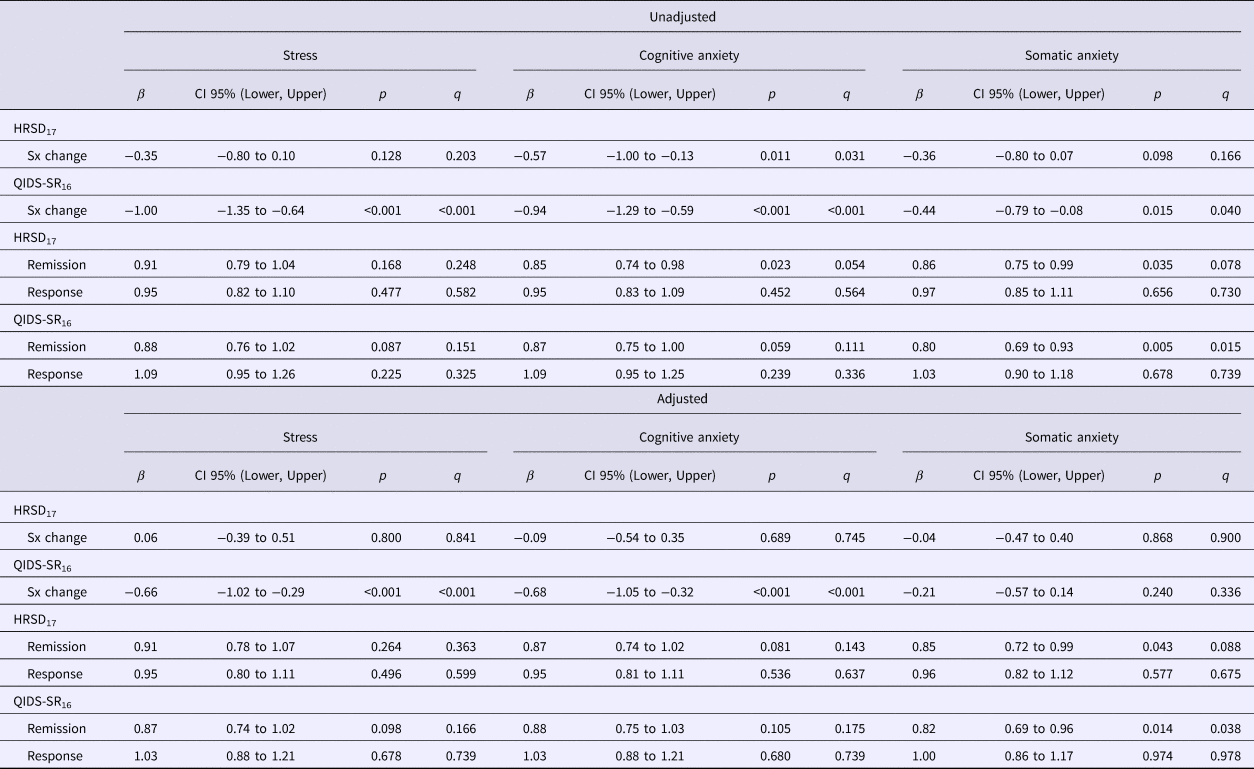
Factor scores did not significantly interact with antidepressant treatment for any measure of symptom change or treatment outcome (see online Supplementary Material Table 3), so antidepressants were pooled for subsequent analyses. Table 5 provides the results from unadjusted and covariate adjusted logistic regression models testing whether factor scores predicted HRSD17 or QIDS-SR16 symptom change and remission/response (for associations between raw anxiety scales and treatment outcome, see online Supplementary Table 4). Higher stress predicted less QIDS-SR16 symptom change after adjusting for covariates and multiple comparisons (β = −0.66, 95% CI −1.02 to −0.29, q < 0.001).
Results from unadjusted and covariate adjusted logistic regression models testing whether factor scores predicted HRSD17 or QIDS-SR16 symptom change and remission/response

Abbreviations: HRSD17, 17-item Hamilton Rating Scale for Depression; QIDS-SR16, 16-item Quick Inventory of Depressive Symptomatology; Sx change, Symptom change.
Higher cognitive anxiety predicted less QIDS-SR16 symptom change after adjusting for covariates and multiple comparisons (β = −0.68, 95% CI −1.05 to −0.32, q < 0.001). Higher cognitive anxiety predicted less HRSD17 symptom change before (β = −0.57, 95% CI −1.00 to −0.13, p = 0.011), but not after adjusting for covariates (β = −0.09, 95% CI −0.54 to 0.35, p = 0.689). Higher cognitive anxiety predicted poorer HRSD17 remission (OR = 0.85, 95% CI 0.74 to 0.98, p = 0.023). However, higher cognitive anxiety no longer predicted HRSD17 remission after adjusting for covariates (OR = 0.87, 95% CI 0.74 to 1.02, p = 0.081).
Higher somatic anxiety predicted less QIDS-SR16 symptom change before (β = −0.44, 95% CI −0.79 to −0.08, p = 0.015), but not after adjusting for covariates (β = −0.21, 95% CI −0.57 to 0.14, p = 0.240). Higher somatic anxiety predicted poorer QIDS-SR16 remission (OR = 0.80, 95% CI 0.69 to 0.93, p = 0.005), even after adjusting for covariates and multiple comparisons (OR = 0.82, 95% CI 0.69 to 0.96, q = 0.038).
Validation of factor structure using only DASS42 items
To test whether we would obtain the same factor structure and associations with treatment outcome when using only DASS42 items, we first performed the same factor analysis procedure using items from the DASS42 anxiety and stress subscales. Three factors were still recommended by parallel analysis and the optimal coordinate's index (see online Supplementary Material Figure 3). Factors still had high internal consistencies, and no significant cross-loadings (see online Supplementary Material Table 5). We then tested whether higher somatic anxiety was still associated with poorer QIDS-SR16 remission after adjusting for covariates and multiple comparisons. Somatic anxiety was still associated with poorer QIDS-SR16 remission after adjusting for covariates and multiple comparisons (OR = 0.83, 95% CI 0.70 to 0.97, q = 0.048). The relationship between both stress and cognitive anxiety and remission/response remained non-significant after adjusting for covariates and multiple comparisons (for all result, see online Supplementary Material Table 6).
Discussion
We found three distinct factors related to stress, cognitive anxiety, and somatic anxiety. All factors showed high internal consistency and minimal cross-loadings. Factors were associated with unique clinical and functional profiles, with higher somatic anxiety being characterised by poorer performance in the stroop and digit span tasks, as well as a higher resting heart rate. Higher somatic anxiety was also associated with poorer QIDS-SR16 remission, even after adjusting for covariates and multiple comparisons.
Our finding that anxiety related symptoms can be separated into at least three distinct factors is in line with other recent efforts exploring factors of anxiety in people with MDD, who found four anxiety related factors (Trombello et al., Reference Trombello, Pizzagalli, Weissman, Grannemann, Cooper, Greer, Malchow, Jha, Carmody, Kurian, Webb, Dillon, Mcgrath, Bruder, Fava, Parsey, Mcinnis, Adams and Trivedi2018). Surprisingly, only one item from the HRSD17 anxiety/somatisation factor loaded onto any factor, and was only weakly correlated with each factor (r = 0.185–0.266). This is especially noteworthy given that the HRSD17 anxiety/somatisation factor is commonly used to characterise anxious depression (Ionescu et al., Reference Ionescu, Niciu, Henter and Zarate2013a; Gaspersz et al., Reference Gaspersz, Nawijn, Lamers and Penninx2018), and suggests its only poorly associated with other anxiety scales. However, given the HRSD17 anxiety/somatisation factor is clinician-rated and the DASS42 is self-rated, the difference in rating methods may contribute towards these results. This suggestion is supported by Trombello et al. (Reference Trombello, Pizzagalli, Weissman, Grannemann, Cooper, Greer, Malchow, Jha, Carmody, Kurian, Webb, Dillon, Mcgrath, Bruder, Fava, Parsey, Mcinnis, Adams and Trivedi2018), who also only found the somatic anxiety item from the HRSD17 anxiety/somatisation factor loaded onto any of their anxiety factors among a range self-rated scales.
While most items from the DASS stress subscale loaded onto the same factor, items from the DASS42 anxiety subscale loaded onto two independent factors associated with cognitive or somatic anxiety. Yeung et al. (Reference Yeung, Yuliawati and Cheung2018) recently completed a review of studies using exploratory factor analysis on DASS42 data. They found that most studies pre-specified the extraction of three factors or did not state their factor retention criteria (Yeung et al., Reference Yeung, Yuliawati and Cheung2018). Of interest, one study into a clinically unwell population also found a four factor model best fit their DASS42 data (Severino and Haynes, Reference Severino and Haynes2010). While the depression and stress subscales loaded consistently on separate factors, the anxiety factor loaded onto multiple factors, with one being comprised only of somatic symptoms (Severino and Haynes, Reference Severino and Haynes2010). Together, our results suggest that in clinically depressed samples, DASS42 anxiety may be parsed out further into cognitive and somatic anxiety.
Higher somatic anxiety was uniquely associated with poorer performance in the stroop and digit span tasks, as well as a higher resting heart rate. The stroop and digit span tasks gauge cognitive flexibility and working memory (respectively). Our findings of impaired working memory, cognitive flexibility, and a higher resting heart rate is consistent with previous findings of people with high anxiety and anxiety disorders (Cohen and Benjamin, Reference Cohen and Benjamin2006; Eysenck et al., Reference Eysenck, Derakshan, Santos and Calvo2007; Castaneda et al., Reference Castaneda, Suvisaari, Marttunen, Perala, Saarni, Aalto-Setala, Lonnqvist and Tuulio-Henriksson2011; Ferreri et al., Reference Ferreri, Lapp and Peretti2011). However, the current findings extend specifically to people with cooccurring somatic anxiety and MDD, and not people with cognitive anxiety or stress. Taken together, the results suggest higher somatic anxiety is uniquely associated with poorer executive functioning and increased sympathetic nervous system activity.
Somatic anxiety was also associated with poor QIDS-SR16 remission, even after adjusting for covariates and correcting for multiple comparisons. The association between higher somatic anxiety and poorer treatment outcome is in line with previous research showing early reduction in items related to somatic anxiety are associated with better remission (Farabaugh et al., Reference Farabaugh, Mischoulon, Fava, Wu, Mascarini, Tossani and Alpert2005; Farabaugh et al., Reference Farabaugh, Bitran, Witte, Alpert, Chuzi, Clain, Baer, Fava, Mcgrath, Dording, Mischoulon and Papakostas2010; Bitran et al., Reference Bitran, Farabaugh, Ameral, Larocca, Clain, Fava and Mischoulon2011). However, our results extend these findings by showing that higher somatic anxiety symptoms at baseline are associated with poorer treatment outcome, and should be considered separately from cognitive symptoms when assessing associations with treatment outcome.
This study has several limitations. Symptoms of anxiety were assessed using anxiety related scales available in the iSPOT-D study. The use of other common anxiety scales such as the State-Trait Anxiety Inventory (Spielberger et al., Reference Spielberger, Gorsuch, Lushene, Vagg and Jacobs1983) may have resulted in additional factors. iSPOT-D was also designed as a practical study and recruited participants who were actively seeking antidepressant treatment to reflect real-world practise (Williams et al., Reference Williams, Rush, Koslow, Wisniewski, Cooper, Nemeroff, Schatzberg and Gordon2011). While this increases the generalisability of results, future studies using more severe populations may find stronger associations with clinical and functional outcomes. Treatment outcome findings are limited to the three antidepressants used in the study, with other classes of antidepressants and psychotherapeutic treatments requiring investigation. Lastly, this study did not include neuroimaging data, limiting our understanding of what structurally or functionally characterises these factors.
In conclusion, our results suggest anxiety can be parsed into multiple distinct factors characterised by unique clinical and functional profiles. Furthermore, higher somatic anxiety is associated with poorer antidepressant treatment outcome, even after adjusting for covariates and multiple comparisons. Future research should explore how DASS42 anxiety and its items predictive of treatment outcome interact with biological markers to better characterise disease states and produce more effective targeted therapies.
Supplementary material
The supplementary material for this article can be found at https://doi.org/10.1017/S0033291719000941
Author ORCIDs
Taylor A. Braund, 0000-0001-8408-9070
Acknowledgements
We thank all the patients and volunteers who agreed to participate in this study. We acknowledge Brain Resource as the sponsor for the iSPOT-D study (NCT00693849). We acknowledge the roles of Evian Gordon, Ph.D. MD, as sponsor Principal Investigator, Leanne Williams, Ph.D., as the cross-site academic Principal Investigator for iSPOT-D (2008–2013) and Claire Day, Ph.D., as the global trial coordinator for iSPOT-D (2008–2014) and the iSPOT-D Publication Team.
Financial support
TAB was supported by a NSW Health Ph.D. scholarship. Brain Resource Ltd is the sponsor for the iSPOT-D study (NCT00693849). Brain Resource personnel coordinated the research sites and data quality control, but did not participate in the collection of any data.
Conflict of interest
TAB and DMP report salaries from The Brain Resource Company outside the submitted work. LMW reports personal fees from BlackThorn Therapeutics, Humana, and Psyberguide, outside the submitted work. AWFH reports personal fees from Janssen Australia, Lundbeck Australia, and Sumitomo Dainoppon Pharma outside the submitted work.
Role of the sponsor
iSPOT-D was sponsored by Brain Resource Company Operations Pty Ltd. Brain Resource personnel coordinated the research sites and data quality control, but did not participate in the collection of any data.
Registry Name: ClinicalTrials.gov
Registration Number: NCT00693849