1 Introduction
In 2005 Kenyon, Sadun, and Solomyak [Reference Robinson6] provided sufficient conditions for weakly mixing, two-letter, discrete substitution shifts, and the one-dimensional tiling flows over them, to be topologically mixing. In this paper, we show that a weakly mixing tiling substitution flow on
 $\mathbb {R}^2$
, in particular, from a class of examples first presented in [Reference Kenyon, Sadun and Solomyak5], is topologically mixing. The following theorem is the main result.
Theorem 1.1. Let
 $T_\sigma $
be the tiling of
 $\mathbb {R}^2$
corresponding to the generalized substitution
 $$ \begin{align}\sigma:\{a,b,c\} &\to \mathcal{F}(\{a,b,c\})\setminus \{\varepsilon\}\nonumber\\ a & \mapsto b \nonumber\\ b & \mapsto c \nonumber\\ c & \mapsto a^{-q}b^{-r}\end{align} $$
where
 $\mathcal {F}(\{a,b,c\})$
is the free group on
 $\{a,b,c\}$
with identity
 $\varepsilon $
. Assume
 $q,r \in \mathbb {N}$
with
 $q-2 \geq r$
. Let
 $X_{T_\sigma }$
be the collection of tiling defined as the orbit closure of
 $T_\sigma $
acted on by
 $\mathbb {R}^2$
by translation. Then the corresponding dynamical system
 $(X_{T_\sigma },\mathbb {R}^2)$
is topologically mixing.
To prove this theorem, we will construct a three-dimensional encoding of all shifts of the tiling from vertex to vertex, which we denote by
 $\Lambda $
. We show that if
 $\Lambda $
is unbounded, and the areas of the tiles are irrationally related, then the tiling is topologically mixing. Finally, we prove that if the substitution is ‘complex non-Pisot’, then
 $\Lambda $
is unbounded.
The structure of the paper is as follows. Section 2 introduces terminology for tiling dynamical systems and defines topological mixing in our setting. Section 3 provides an introduction to the algebraic structures we will be using in the later sections. Section 4 explains how to generate tilings from generalized substitutions. Section 5 proves that if
 $\Lambda $
is unbounded, then we have topological mixing. Finally, §6 gives conditions for
 $\Lambda $
to be unbounded.
2 Tiling dynamical systems and mixing
A connected set
 $D \subseteq \mathbb {R}^2$
is called a tile if it is compact and equal to the closure of its interior. A tiling of
 $\mathbb {R}^2$
is a collection of tiles in which any two tiles have pairwise disjoint interiors and their union is
 $\mathbb {R}^2$
. The prototiles
 $\mathcal {P}$
of a tiling space are the collection of unique (up to translation) tiles. We assume
 $\mathcal {P}$
is finite. A patch P is a collection of tiles in which each pair of tiles have non-intersecting interiors and their union is connected. We always assume the ‘finite local complexity’ condition: that the set of two-tile patches
 $\mathcal {P}^{(2)}$
(up to translation) is finite. In our case, the tiles will be (translations of) a finite set of parallelograms, and we will always assume they meet ‘edge to edge’. The collection of all finite patches is denoted by
 $\mathcal {P}^*$
.
A full tiling space
 $X_{\mathcal {P}}$
is the set of all tilings of
 $\mathbb {R}^2$
by translations of prototiles
 $\mathcal {P}$
such that each two-tile patch is a translation of a patch in
 $\mathcal {P}^{(2)}$
. With the usual tiling metric (see, for example, [Reference Solomyak7]),
 $X_{\mathcal {P}}$
is a compact metric space. In this metric two tilings are close if they agree, up to a small translation, on a large disk around the origin. For
 $T\in X_{\mathcal {P}}$
, let
 $P\in \mathcal {P}^*$
be a patch with
 $P \subseteq T$
, and let
 $\epsilon> 0$
. We define the cylinder set
 $C_{P,\epsilon }$
as
 $C_{P,\epsilon } = \{S \in X_T: \text { there exists} \ \mathbf {y} \in B_\epsilon (0), \mbox { with } P-\mathbf {y} \subseteq S\}. $
The collection of all cylinder sets,
 $\mathcal {C}_{\mathcal {P}} = \{C_{p,\epsilon }:P \in \mathcal {P}^*, \epsilon> 0\}$
, is a basis for the topology on
 $X_{\mathcal {P}}$
[Reference Solomyak7].
Given
 $\mathcal {P}$
(and implicitly
 $\mathcal {P}^{(2)}$
), we define the full tiling dynamical system to be the pair
 $(X_{\mathcal {P}},\mathbb {R}^2)$
, where
 $\mathbb {R}^2$
acts on
 $X_{\mathcal {P}}$
by translation:
 $(T,\mathbf {y})\mapsto T-\mathbf {y}:X_{\mathcal {P}}\times \mathbb {R}^2\to X_{\mathcal {P}}$
. More generally, a tiling dynamical system is any pair
 $(X,\mathbb {R}^2)$
, where
 $X\subseteq X_{\mathcal {P}}$
is closed and T-invariant. Given a tiling
 $T\in X_{\mathcal {P}}$
, let
 $X_T = \overline {\operatorname {\mathrm {Orb}}_{\mathbb {R}^2}(T)}:=\overline {\{T-\mathbf {y}:\mathbf {y}\in \mathbb {R}^2\}}$
be its orbit closure. Then
 $(X_T,\mathbb {R}^2)$
is a tiling dynamical system.
A tiling dynamical system
 $(X,\mathbb {R}^2)$
is topologically mixing if for any open sets
 $U,V\subseteq X$
there exists
 $K\subseteq \mathbb {R}^2$
compact so that
 $U \cap (V-\mathbf {y}) \neq \emptyset , \text { for all } \mathbf {y} \in \mathbb {R}^2 \setminus K.$
It suffices to check this for U and V cylinder sets.
For
 $Y\subseteq Z\subseteq \mathbb {R}^2$
, we say Y is
 $\epsilon $
-dense in Z (for some
 $\epsilon> 0$
) if
 $\bigcup _{y \in Y}B_\epsilon (y) \supseteq Z$
. We say
 $Y\subseteq \mathbb {R}^2$
is eventually dense if for any
 $\epsilon> 0$
, there is a compact set K so that Y is
 $\epsilon $
-dense in
 $\mathbb {R}^2 \setminus K$
. Given a patch P in T,
 $T\in X_{\mathcal {P}}$
, we define its locator set
 $\mathcal {L}_P(T) = \{\mathbf {v} \in \mathbb {R}^2: \mbox { there exists a patch } P_0 \mbox { in } T \mbox { such that } P = P_0 - \mathbf {v}\}.$
Similarly, for two patches
 $P_1$
and
 $P_2$
in T, we define the displacement set
 $\Phi (P_1, P_2) = (\mathcal {L}_{P_1}(T) - \mathcal {L}_{P_2}(T)) \cup (\mathcal {L}_{P_2}(T) - \mathcal {L}_{P_1}(T)).$
It is easy to prove the following characterization of topological mixing.
Proposition 2.1. A tiling dynamical system
 $(X,\mathbb {R}^2)$
is topologically mixing if and only if for any two patches
 $P_1$
and
 $P_2$
, the displacement set
 $\Phi (P_1, P_2)$
is eventually dense in
 $\mathbb {R}^2$
.
3 Generalized substitutions, linear algebra, number theory and geometry
For a finite set
 $\mathcal {A}$
, let
 $\mathcal {F}(\mathcal {A})$
be the free group generated by
 $\mathcal {A}$
. A map
 $\sigma :\mathcal {A} \to \mathcal {F}(\mathcal {A}) \setminus \{\varepsilon \}$
is called a generalized substitution. Let
 $\ell : \mathcal {F}(\mathcal {A}) \to \mathbb {Z}^{|\mathcal {A}|}$
be the population vector mapping, and
 $\ell _a(w)$
is the sum of all the exponents of the occurrences of a in w. Note that
 $\ell (w)$
is essentially the canonical abelianization map of
 $\mathcal {F}(\mathcal {A})$
. The transition matrix
 $ M_\sigma $
of
 $\sigma $
is the
 $|\mathcal {A}| \times |\mathcal {A}|$
matrix whose columns are
 $\ell (\sigma (i))$
, for each
 $i \in \mathcal {A}$
. We have
 $\ell (\sigma ^k(w)) = M_\sigma ^k(\ell (w))$
.
Recall that
 $\lambda \in \mathbb {R}$
is a real Pisot number if it is an algebraic integer with
 $\lambda> 1$
, such that all of its Galois conjugates are have magnitude strictly less than 1. An algebraic integer
 $\lambda \in {\mathbb {C}} \setminus \mathbb {R}$
is complex Pisot if
 $|\lambda |> 1$
, and all of its Galois conjugates except
 $\overline {d}$
have magnitude strictly less than 1. Thus, an algebraic integer
 $\lambda \in {\mathbb {C}} \setminus \mathbb {R}$
is complex non-Pisot if
 $|\lambda | < 1$
, or if one of its algebraic conjugates
 $\theta $
satisfies
 $| \theta | \geq 1$
. Note that for the real part of a complex number
 $\lambda $
we write
 $\mathrm{Re} (\lambda )$
, and for the imaginary part we write
 $\mathrm{Im} (\lambda )$
. We extend this notation to complex vectors where
 $\mathbf {v} = \mathrm{Re} (\mathbf {v})+ i \mathrm{Im} (\mathbf {v})$
.
We say an
 $n \times n$
integer matrix A is a complex Pisot (non-Pisot) matrix if the characteristic polynomial of A is irreducible over
 $\mathbb {Q}$
, and the root with the largest magnitude is complex Pisot (non-Pisot). Further, a generalized substitution
 $\sigma $
is said to be a complex non-Pisot generalized substitution if its transition matrix
 $M_\sigma $
is a complex non-Pisot matrix.
The following may be generalized to any size of matrix (see Reference Aitken[1]), but our interest in this paper is only in the
 $3 \times 3$
and
 $3 \times 2$
cases. For a
 $3 \times 3$
integer matrix A, define its
 $2$
-compound
 $C_2(A)$
to be the
 $3 \times 3$
integer matrix whose entry
 $(C_2(A))_{ij}$
is the determinant of the
 $2 \times 2$
minor obtained by removing row i and column j. For
 $\mathbf {v}_1, \mathbf {v}_2 \in \mathbb {Z}^3$
we define
 $\mathbf {v}_1 \wedge \mathbf {v}_2 = C_2([\mathbf {v}_1\, \, \mathbf {v}_2])\in \mathbb {Z}^3,$
where
 $(C_2[\mathbf {v}_1\, \,\mathbf {v}_2])_{i}$
is the determinant of the
 $2 \times 2$
matrix obtained by removing row i. This is essentially the cross-product without the alternating sign pattern. Note Binet’s theorem says that
 $C_2(AB)=C_2(A)C_2(B)$
and
 $C_2(A)(\mathbf {v}_1 \wedge \mathbf {v}_2)=A\mathbf {v}_1 \wedge A\mathbf {v}_2$
(see Reference Aitken[1]). We write
 $C_2(A) \geq 0$
if all entries are non-negative.
Lemma 3.1. Let A be a
 $3 \times 3$
complex non-Pisot matrix with complex eigenvalue
 $\lambda $
and corresponding eigenvector
 $\mathbf {v} \in \mathbb {R}^3$
. Assume
 $C_2(A) \geq 0$
. Then
 $\mathrm{Re} (\mathbf {v}) \wedge \mathrm{Im} (\mathbf {v}) $
is an eigenvector of
 $C_2(A)$
corresponding to the eigenvector
 $\lambda \overline {\lambda }$
.
For a proof, see [Reference Kenyon4]. Let
 $\operatorname {\mathrm {sgn}}(x)\in \{-1,0,1\}$
be the sign function,
 $x\in \mathbb {R}$
, and extend to
 $\mathbf {x} \in \mathbb {R}^d$
. The following lemma will play an important role in the proof of our main theorem.
Lemma 3.2. Suppose
 $\sigma :\{a,b,c\} \to \mathcal {F}(\{a,b,c\})\setminus \{\varepsilon \}$
is a complex non-Pisot generalized substitution with transition matrix
 $M_\sigma $
. Assume
 $C_2(M_\sigma )$
is non-negative and primitive. If
 $\lambda , \overline {\lambda }$
and
 $\theta $
are the eigenvalues of
 $M_\sigma $
, then the eigenvector
 $\mathbf {n}$
corresponding to the real eigenvalue
 $\theta $
of
 $M_\sigma ^T$
satisfies
 $\operatorname {\mathrm {sgn}}(\mathbf {n}) = [1 \; -\!1 \; 1 ]^T.$
Proof By a standard result in linear algebra,
 $\mathbf {n}$
is orthogonal to the expanding real eigenplane corresponding to the eigenvalue
 $\lambda $
in
 $M_\sigma $
with complex eigenvector
 $\mathbf {v}$
. Let
 $\mathbf {n} = \mathrm{Re} (\mathbf {v}) \times \mathrm{Im} (\mathbf {v})$
. By the Perron–Frobenius theorem there is an eigenvector
 $\mathbf {u}$
for the Perron–Frobenius eigenvalue
 $\omega $
of
 $C_2(M_\sigma )$
. Since
 $M_\sigma $
is complex non-Pisot, Lemma 3.1 implies
 $\omega = \lambda \overline {\lambda }$
. We know
 $\mathbf {u} = \mathrm{Re} (\mathbf {v})\wedge \mathrm{Im} (\mathbf {v}) = [P_1 \; P_2 \; P_3 ]^T,$
where
 $P_i = \det ([\mathrm{Re} (\mathbf {v}) \; \mathrm{Im} (\mathbf {v})][i])$
. However, we know that
 $\mathbf {n} = \mathrm{Re} (\mathbf {v}) \times \mathrm{Im} (\mathbf {v}) = [P_1 \; { -P_2 } \; P_3 ]^T$
. Since
 $\mathbf {u}> 0$
, it follows that
 $\mathbf {n}$
must have the asserted sign pattern.
Given a plane P through the origin, and an orthonormal set of vectors
 $\{\mathbf {v}_1, \mathbf {v}_2\}$
spanning P, we define the mapping
 $\pi _P:\mathbb {R}^3 \to \mathbb {R}^2$
as
 $\pi _P(\mathbf {x}) = [a_1 \; a_2]^T$
, where
 $\mathbf {x} = a_1 \mathbf {v}_1 + a_2 \mathbf {v}_2 + a_3 (\mathbf {v}_1 \times \mathbf {v}_2)$
. Note that the orthogonal projection of
 $\mathbf {x}$
onto P is
 $a_1 \mathbf {v}_1 + a_2 \mathbf {v}_2$
. Similarly, the mapping
 $\pi ^{\perp }_P:\mathbb {R}^3 \to \mathbb {R}$
satisfies
 $\pi ^{\perp }_P(\mathbf {x}) = a_3$
, where
 $a_3$
is defined as above. Again, it is worth noting that
 $a_3(\mathbf {v}_1 \times \mathbf {v}_2)$
is the orthogonal projection onto the orthogonal complement of P. The mapping
 $\pi _P$
will be used to construct tilings from the stepped surfaces we will construct in the sequel. While the mapping
 $\pi _P$
depends on the choice of orthonormal basis, the choice of basis does not affect the mixing properties of the tiling. This is because a different orthonormal basis will simply create a rotation of the original tiling while preserving all the angles between the sides of the tiling. Lastly, we define
 $\pi _{\mathbb {R}^2}:\mathbb {R}^3 \to \mathbb {R}^2$
as
 $\pi _{\mathbb {R}^2}([a \;b \;c]^T) = [a \; b]^T$
.
A plane
 $P \subseteq \mathbb {R}^3$
with
 $\mathbf {0} \in P$
is an irrational plane if
 $P \cap \mathbb {Z}^3 = \{\mathbf {0}\}$
. A lattice L is a discrete subset of
 $\mathbb {R}^3$
which is closed under vector addition and is co-compact (in other words,
 $\mathbb {R}^3 / L$
is compact). A lattice L is said to be an irrational lattice if the projection map
 $\pi _{\mathbb {R}^2}$
on L is injective and
 $\pi _{\mathbb {R}^2}(L)$
is dense in
 $\mathbb {R}^2$
. The following lemmas are simple geometric results, but they will be important in the sequel.
Lemma 3.3. Suppose
 $\mathbf {n}$
is a normal vector to a plane P in
 $\mathbb {R}^3$
. Then the P plane is irrational in
 $\mathbb {R}^3$
if and only if
 $\mathbf {n}$
has linearly independent entries over
 $\mathbb {Q}$
.
Lemma 3.4. Let
 $\mathbf {v}_1 = [a_1 \; a_2]^T$
,
 $\mathbf {v}_2 = [ b_1 \; b_2 ]^T$
,
 $\mathbf {v}_3 = [ c_1 \; c_2 ]^T$
in
 $\mathbb {R}^2$
. If the entries in the vector
 $ \mathbf {u} = [ a_1 \; b_1 \; c_1 ]^T \times [a_2 \; b_2 \; c_2 ]^T$
are linearly independent over
 $\mathbb {Q}$
, then
 ${\operatorname {\mathrm {Span}}_{\mathbb {Z}}\{\mathbf {v}_1, \mathbf {v}_2, \mathbf {v}_3\}}$
is dense in
 $\mathbb {R}^2$
.
Proof Since
 $\mathbf {u} = [u_1 \; u_2 \; u_3 ]^T$
has linearly independent entries over
 $\mathbb {Q}$
, it follows that
 $u_3 \neq 0$
, and thus the matrix
 $[ \mathbf { v_1} \; \mathbf {v}_2 ]$
is invertible. Define
 $A = [\mathbf {v}_1 \; \mathbf {v}_2]^{-1}$
and
 $\mathbf {w}_3 = A \mathbf {v}_3$
. It is easy to show that the entries of
 $\mathbf {w}_3$
have ratio
 ${u_1}/{u_2}$
, which must be irrational as
 $u_1$
and
 $u_2$
are rationally independent. Since A is a change of basis matrix on
 $\mathbb {R}^2$
, it is enough to show that
 $\operatorname {\mathrm {Span}}_{\mathbb {Z}}\{\mathbf {e}_1,\mathbf {e}_2, \mathbf {w}_3\}$
is dense in
 $\mathbb {R}^2$
. Define
 $T:\mathbb {T}^2 \to \mathbb {T}^2$
by
 $T(\mathbf {x}) = (\mathbf {x} + \mathbf {w}_3 )\mod 1$
, and note that T is strictly ergodic and thus minimal. Now choose any
 $(x,y) \in \mathbb {R}^2$
and fix any
 $\epsilon> 0$
. Since
 $\operatorname {\mathrm {Orb}}_{T}(\mathbf {0})$
is dense in
 $\mathbb {T}^2$
, there is an
 $n \in \mathbb {N}$
such that
 $T^n(\mathbf {0}) =( n\mathbf {w}_3)\mod 1 \in B_\epsilon ( (x,y)\mod 1)$
. Take
 $ [k \; l ]^T = [ \lfloor x \rfloor \; \lfloor y \rfloor ]^T - \lfloor n \mathbf {w}_3\rfloor $
. Then
 $ [k \; l ]^T + n\mathbf {w}_3 = k \mathbf {e}_1 + l \mathbf {e}_2 + n\mathbf {w}_3 \in B_{\epsilon }(x,y)$
, which gives us that
 $\operatorname {\mathrm {Span}}_{\mathbb {Z}}\{\mathbf {e}_1, \mathbf {e}_2, \mathbf {w}_3 \}$
is dense in
 $\mathbb {R}^2$
.
Lemma 3.5. Let
 $P_{\mathbf {n}}$
be a plane with normal vector
 $\mathbf {n}$
. If
 $\operatorname {\mathrm {sgn}}(\mathbf {n}) = [ 1 \; -\!1 \;\; 1]^T$
, then
 $0 < \angle \pi _{P_{\mathbf {n}}}(\mathbf {e}_1) \pi _{P_{\mathbf {n}}}(\mathbf {e}_2) \leq ({\pi }/{2}), 0 < \angle \pi _{P_{\mathbf {n}}}(\mathbf {e}_2) \pi _{P_{\mathbf {n}}}(\mathbf {e}_3) \leq ({\pi }/{2})$
and
 $({\pi }/{2}) \leq \angle \pi _{P_{\mathbf {n}}}(\mathbf {e}_1) \pi _{P_{\mathbf {n}}} (\mathbf {e}_3) < \pi $
, where
 $\angle \mathbf {v}\mathbf {w}$
denotes the angle between the vectors
 $\mathbf {v}$
and
 $\mathbf {w}$
.
The following lemmas about lattices are important in the sequel.
Lemma 3.6. Let L be any irrational lattice of
 $\mathbb {R}^3$
. Then, for any
 $\epsilon> 0$
, there exists an
 $N> 0$
such that
 $([-\epsilon , \epsilon ]^2 \times [-N,N]) + L = \mathbb {R}^3$
Proof Let K be compact with
 $L+K = \mathbb {R}^3$
. Choose
 $a> 0$
such that
 $[-a,a]^3 \supseteq K$
. Fix
 $\epsilon> 0$
. By compactness,
 $\text { there exist } \mathbf {v}_1, \mathbf {v}_2, \ldots , \mathbf {v}_n \in L$
such that
 $[-a,a]^2 \subseteq \bigcup _{i=1}^n ([-\epsilon ,\epsilon ]^2 + (\mathbf {v}_i)_{x,y})$
. Choose N so that
 $K' = \bigcup _{i=1}^n ((\mathbf {v}_i)_z +[-a,a]) \subseteq [-N,N]$
. To see that
 $([-\epsilon , \epsilon ]^2 \times [-N,N])+L = \mathbb {R}^3$
, choose any
 $\mathbf {w} \in \mathbb {R}^3$
. We know there exists
 $\mathbf {u} \in L$
such that
 $\mathbf {w} \in K+\mathbf {u}$
. There exists
 $\mathbf {v}_i$
such that
 $(\mathbf {w})_{x,y} - (\mathbf {u})_{x,y} \in [-\epsilon ,\epsilon ]^2 + (\mathbf {v}_i)_{x,y}$
. Now we note that
 $(\mathbf {v}_i)_{z} - (\mathbf {u})_{z} - \mathbf {w}_z \in [-a,a] \subseteq [-N,N].$
Thus,
 $\mathbf {w} \in K + \mathbf {u}$
.
Lemma 3.7. Let
 $([-a,a]\times [-b,b] \times [-c,c]) + L = \mathbb {R}^3$
. Then
 $(\mathbf {v} + ([-a, a]\times [- b, b]\times [-c,c])) \cap L \neq \emptyset $
, for all
 $\mathbf {v} \in \mathbb {R}^3$
.
Proof Let
 $K = [-a,a]\times [-b,b] \times [-c,c]$
and choose any
 $\mathbf {v} \in \mathbb {R}^3$
. Since
 $K+L = \mathbb {R}^3$
, we know there is an
 $\mathbf {l} \in L$
such that
 $\mathbf {v} \in \mathbf {l}+K$
. Since
 $\mathbf {0} \in K$
, we know that
 $\mathbf {l} \in \mathbf {l}+K$
. Now we consider
 $\mathbf {v} + K$
. As before, we see that
 $\mathbf {v} \in \mathbf {v} + K$
. Thus
 $(\mathbf {l}+K) \cap (\mathbf {v} + K) \neq \emptyset $
and
 $\mathbf {l} - \mathbf {v} = \mathbf {k} \in K$
. So,
 $\mathbf {l} = \mathbf {v} + \mathbf {k} \in \mathbf {v} + K$
.
Lemma 3.8. Let L be an irrational lattice in
 $\mathbb {R}^3$
. For
 $\epsilon> 0$
, there exists an
 $N> 0$
such that for all
 $(x,y) \in \mathbb {R}^2$
, there exists
 $(s,t) \in \pi _{\mathbb {R}^2}((\mathbb {R}^2 \times [-N,N]) \cap L)$
such that
 $\Vert (x,y)-(s,t)\Vert < \epsilon $
.
Proof Fix
 $\epsilon> 0$
. By Lemma 3.6, if
 $0 < \delta < \epsilon /\sqrt {2}$
then there is an
 $N> 0$
such that
 $K + L = \mathbb {R}^3$
, satisfying
 $K = ([-\delta , \delta ]^2 \times [-N, N])$
. Choose any
 $x,y \in \mathbb {R}$
. By Lemma 3.7, we know that
 $ ( [ x \;\; y \;\; 0 ]^T + K ) \cap L \neq \emptyset $
. Let
 $\mathbf {v}$
be in that intersection. Thus
 $(s,t) = \pi _{\mathbb {R}^2}(\mathbf {v}) \in \pi _{\mathbb {R}^2}((\mathbb {R} \times [-N,N]) \cap L)$
and
 $(s,t) \in ([-\delta ,\delta ]^2+[ x \; y ]^T) $
. Since
 $0 < \delta < \epsilon /\sqrt {2}$
, it follows that
 $[-\delta ,\delta ]^2 \subseteq B_\epsilon (\mathbf {0})$
. This gives us that
 $(s,t) \in B_\epsilon ( [ x \; y ]^T )$
. Therefore, we see that
 $\Vert (x,y)-(s,t)\Vert < \epsilon $
.
Lemma 3.9. Suppose
 $\mathbf {n}$
is a normal vector to a plane P with basis
 $\{\mathbf {v}_1, \mathbf {v}_2\}$
and let A be the matrix such that
 $A\mathbf {v}_1 = \mathbf {e}_1, A\mathbf {v}_2 = \mathbf {e}_2$
and
 $A\mathbf {n} = \mathbf {e}_3.$
If P is an irrational plane, then the lattice
 $L = A\mathbb {Z}^3 =\{A\mathbf {v}: \mathbf {v} \in \mathbb {Z}^3\}$
is an irrational lattice.
Proof Assume
 $\{\mathbf {v}_1,\mathbf {v}_2,\mathbf {n}\}$
are orthonormal. Then
 $A = [\mathbf {v}_1\; \mathbf {v}_2 \; \mathbf {n}]^T$
. So, if
 $\mathbf {v}_1 = [ a_1 \; a_2 \; a_3]^T, \mathbf {v}_2 = [b_1 \; b_2 \; b_3 ]^T$
and
 $\mathbf {n} = [ n_1 \; n_2 \; n_3 ]^T$
, then
 $\mathbf {w}_1 = \pi _{\mathbb {R}^2}(A\mathbf {e}_1) = [a_1 \; b_1 ]^T, \mathbf {w}_2 = \pi _{\mathbb {R}^2}(A \mathbf {e}_2)= [ a_2 \; b_2]^T$
and
 $\mathbf {w}_3 = \pi _{\mathbb {R}^2}(A \mathbf {e}_2) = [ a_3 \; b_3 ]^T$
. Thus,
 $C_2([ \mathbf {v}_1 \; \mathbf {v}_2 ]) = \mathbf {v}_1 \times \mathbf {v}_2 = \mathbf {n}.$
Since by Lemma 3.3
 $\mathbf {n}$
has linearly independent entries over
 $\mathbb {Q}$
, it follows from Lemma 3.4 that
 $\operatorname {\mathrm {Span}}_{\mathbb {Z}}\{\mathbf {w}_1,\mathbf {w}_2,\mathbf {w}_3\}$
is dense in
 $\mathbb {R}^2$
.
4 Substitution tiling dynamical systems of
 $\mathbb {R}^2$
from generalized substitutions

Note that in what follows we will often identify
 $\mathbb {R}^2$
with
 ${\mathbb {C}}$
. Unless otherwise stated, we will be assuming
 $\sigma $
satisfies (1.1). Notice that the adjacency matrix
 $M_\sigma $
is the companion matrix for the monic algebraic polynomial
 $g(x) = x^3 +rx+q$
.
Lemma 4.1. Let
 $g(x) = x^3 + rx + q$
, where
 $r, q \in \mathbb {N}$
. If
 $q - 2 \geq r,$
then the root
 $\lambda $
of g with the largest magnitude is complex non-Pisot. It satisfies
 $|\lambda |^3\geq r|\lambda |$
,
 $|\lambda |^3 \geq q$
and
 $\mathrm{Re} (\lambda )>~0$
.
We now include the additional assumption that
 $q -2 \geq r$
. We denote the complex roots of g by
 $\lambda , \overline {\lambda }$
, and the real root by
 $\theta $
. Notice that the row vector
 $\mathbf {v_\sigma } = [1\; \lambda \; \lambda ^2]$
is a left eigenvector of
 $M_\sigma $
for the complex eigenvalue
 $\lambda $
.
Lemma 3.2 implies that the eigenvector
 $\mathbf {n_\theta }$
of
 $M_\sigma $
corresponding to
 $\theta $
has sign pattern
 $[+ \; - \; +]^T$
. Since the vector
 $\mathbf {n_\theta }$
is normal to the real eigenplane of
 $M^T_{\sigma }$
corresponding to
 $\lambda ,$
we can write
 ${\mathbf {n_\theta } = \mathrm{Re} ([ 1 \; \lambda \; \lambda ^2]^T) \times \mathrm{Im} ([ 1 \; \lambda \; \lambda ^2]^T)}$
. Therefore, the orthogonal projection onto the real eigenplane of
 $M_\sigma ^T$
corresponding to
 $\lambda $
is the projection defined on
 $\mathbb {R}^3$
by
 $$ \begin{align*}\pi_{P_{\mathbf{n_\theta}}}\mathbf{v} = \left [\begin{array}{ccc} 1 & \mathrm{Re}(\lambda) & \mathrm{Re}(\lambda^2) \\ 0 & \mathrm{Im}(\lambda) & \mathrm{Im}(\lambda^2) \end{array} \right ]\mathbf{v}.\end{align*} $$
We call this projection the Perron–Frobenius projection and denote it by
 $\pi _{E_\lambda }$
. One important consequence of the construction of the Perron–Frobenius projection is that we get the angle relation described in Lemma 3.5.
Given a complex vector
 $\mathbf {v}=[ v_a \; v_b \; v_c ]^T$
, define the position function
 $\eta _{\mathbf {v}}:\{a,b,c\} \to {\mathbb {C}}$
by
 $\eta _{\mathbf {v}}(w)=v_w$
, and extend it to a function
 $\eta :\mathcal {F}(\mathcal {A}) \to {\mathbb {C}}$
, where
 $\eta (i^{-1}) = -\eta (i)$
and
 ${\eta (w_1w_2) = \eta (w_1) + \eta (w_2)}$
(see [Reference Kenyon4, Reference Kenyon, Sadun and Solomyak5, Reference Thurston8]). It will be important to relate words in
 $\mathcal {F}(\mathcal {A})$
to paths along the edges of our tiling. We will call such paths, which are piecewise linear but continuous, broken line curves. For any word
 $w = w_1w_2 \cdots w_k \in \mathcal {F}(\mathcal {A})$
, we define the broken line curve
 $f_w:[0,|w|] \to {\mathbb {C}}$
, by
 $f_w(x) = \eta (w_1w_2 \cdots w_{\lfloor x \rfloor }) (\lfloor x \rfloor +1-x) + \eta (w_1w_2 \cdots w_{\lfloor x \rfloor +1}) (x-\lfloor x \rfloor ).$
Clearly
 $f_w$
ends at the origin if and only if
 $\ell (w) = 0$
. Also, if
 $w \in \mathcal {F}(\mathcal {A})$
then
 $\lambda f_w(|w|) = f_{\sigma (w)}(|\sigma (w)|)$
.
Definition 4.1. (Prototiles generated by generalized substitutions)
Let
 $j, k \in \mathcal {A}$
with
 $j < k,$
and let
 $[j,k] = jkj^{-1}k^{-1} \in \mathcal {F}(\mathcal {A})$
denote the commutator of j and k. The set of prototiles generated by
 $\sigma $
, which we will denote by
 $\mathcal {P}_\sigma $
, are the tiles
 $t_i$
whose support is the region enclosed by the curve
 $f_{[j,k]}$
, where
 $i,j,k$
are distinct.
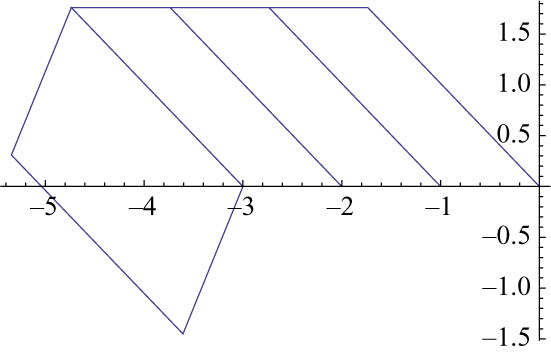
For example, if
 $\sigma $
is given by (1.1) with
 $q = 3$
and
 $r = 1$
, then the left eigenvector of
 $M_\sigma $
corresponding to
 $\lambda $
is
 $[ 1 \; \lambda \; \lambda ^2]$
and
 $P_\sigma $
is shown in Figure 1.
The prototiles
 $t_a, t_b,$
and
 $t_c$
generated by
 $\sigma $
.

We call the vertex at the origin the anchor point of the prototile. We use the notation
 $(0, t_i)$
to refer a prototile
 $t_i$
as defined in Definition 4.1, where
 $0$
denotes the location of the anchor point. We denote by
 $(x,t_i)$
the prototile
 $t_i$
translated by
 $x \in {\mathbb {C}}$
. Let
 $X_{\mathcal {P}}$
be a tiling space where
 $|\mathcal {P}| = d$
. For any patch P, define
 $\ell '(P) \in \mathbb {Z}^d$
where
 $(\ell '(P))_i$
is the number of prototiles
 $t_i$
in P.
Notice that
 $\ell '((0,t_i)) = \mathbf {e}_i$
and
 $\mathbf {e}_i = \mathbf {e}_j \wedge \mathbf {e}_k$
, where
 $i, j, k \in \{a,b,c\}$
are distinct and
 $j < k$
is in alphabetical order (here we identify
 $\{a,b,c\}$
with
 $\{1,2,3\}$
). In addition to our previous notation for prototiles, we will use the notation
 $j \wedge k$
, defined by
 $j \wedge k := t_i$
, where
 $i,j,k$
are distinct, and
 $j < k$
. We switch between the two notations whenever it is convenient. Thus,
 ${\mathbf {e}_i = \ell '(t_i) = \ell '(j \wedge k) = \mathbf {e}_{j} \wedge \mathbf {e}_k = \ell (j) \wedge \ell (k)}$
.
This new notation will require us to clarify some possible issues. Suppose
 $i < j$
; since
 $\ell '(i \wedge j) = \ell (i) \wedge \ell (j) = -\ell (j) \wedge \ell (j) = \ell (j^{-1}) \wedge \ell (i) = \ell '(j^{-1} \wedge i),$
it is clear that
 $i \wedge j$
must be equivalent to
 $j^{-1} \wedge i$
. However, the tile
 $(x, i \wedge j)$
is not equal to the tile
 $(x, j \wedge i^{-1})$
. They are equivalent, and we define
 $(x, j \wedge i^{-1}) = (x + \eta (i^{-1}), i \wedge j)$
. We write
 $(x,i \wedge j) + (y, k \wedge l)$
,
 $i < j, k < l$
to mean the tiles
 $i \wedge j$
located at x and
 $k \wedge l$
located at y. For substitutions of the form (1.1) (see [Reference Kenyon, Sadun and Solomyak5, Reference Thurston8]), we will be able to tile the plane. This is generally not possible for arbitrary generalized substitutions (see [Reference Arnoux, Furukado, Harriss and Ito2, Reference Furukado, Ito and Robinson3]).
Definition 4.2. (Tiling substitution)
Let
 $(x,i \wedge j)$
,
 $i < j$
be an arbitrary tile. We define the substitution tiling,
 $\Theta $
, as
 $\Theta (x,i \wedge j) = \sum _{n=1}^{|\sigma (j)|}(\lambda x + \eta (p_n^{(j)}), w_1^{(i)} \wedge w_n^{(j)}),$
where
 $p_m^{(i)}, w_m^{(i)}, p_n^{(j)}$
and
 $w_n^{(j)}$
are derived from
 $\sigma (i)_m$
and
 $\sigma (j)_n$
.
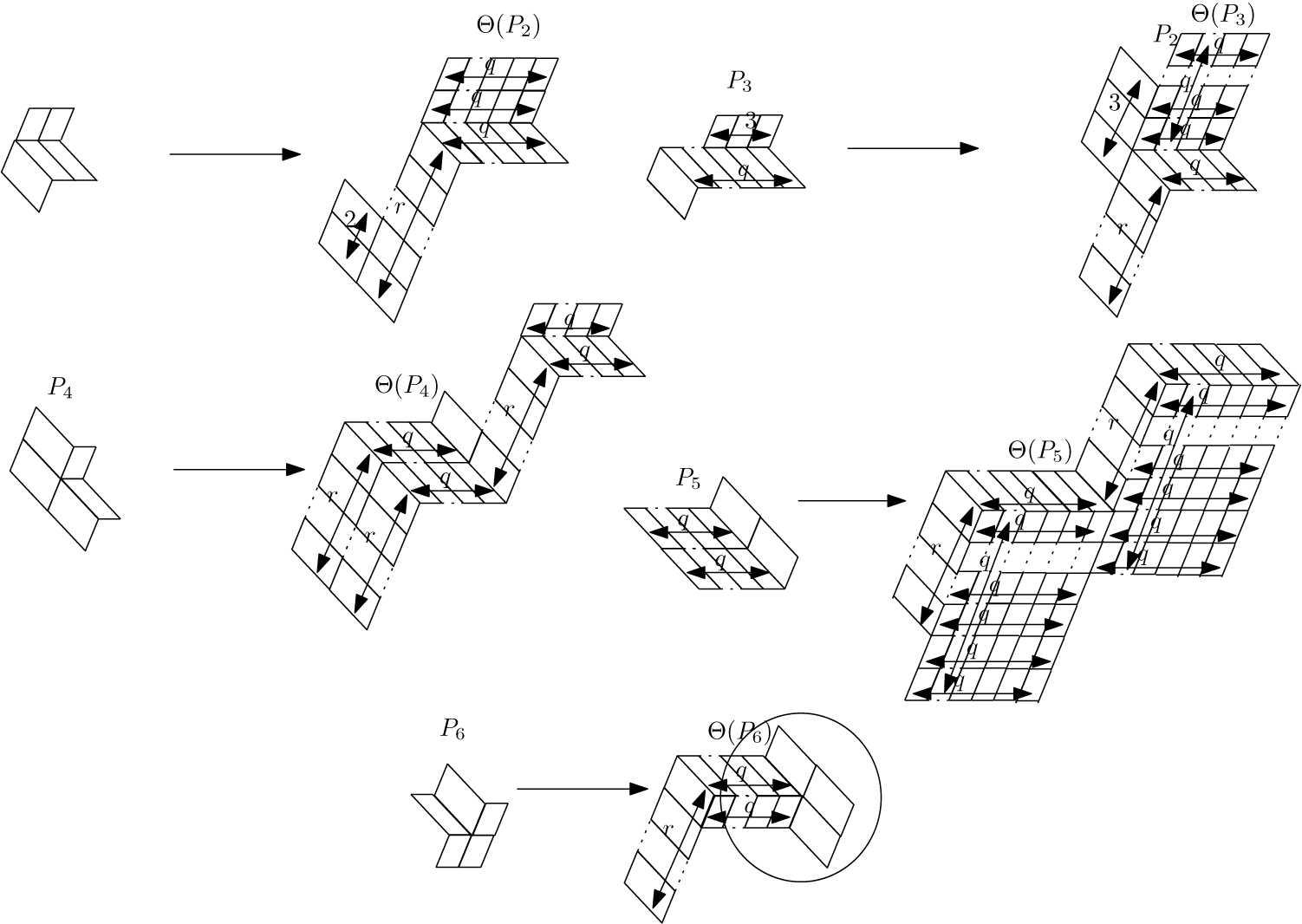
Example 4.2. Let
 $\sigma $
be the generalized substitution of the form (1.1) with
 $q = 3$
and
 $r = 1$
. Then the substitution for
 $b \wedge c$
is
 $$ \begin{align*}\begin{split}\Theta(0,b \wedge c) &= \sum_{n=1}^4 (\lambda 0 + \eta(p_n^{(j)}), w_1^{(i)} \wedge w_n^{(j)})\\ &= (0, c \wedge a^{-1}) + (-1, c \wedge a^{-1}) + (-2, c \wedge a^{-1}) + (-3, c \wedge b^{-1}) \\ &= (-1, a \wedge c) + (-2, a \wedge c) + (-3, a\wedge c) + (-3-\lambda, b \wedge c). \end{split} \end{align*} $$
This patch can be seen in Figure 2.
The substitution of the tile
 $(0,b \wedge c)$
.

Lemma 4.3. Suppose
 $\sigma $
is a generalized substitution on
 $\{a,b,c\}$
. Let
 $C_2(M_\sigma )$
be the
 $2$
-compound matrix of the transition matrix
 $M_\sigma $
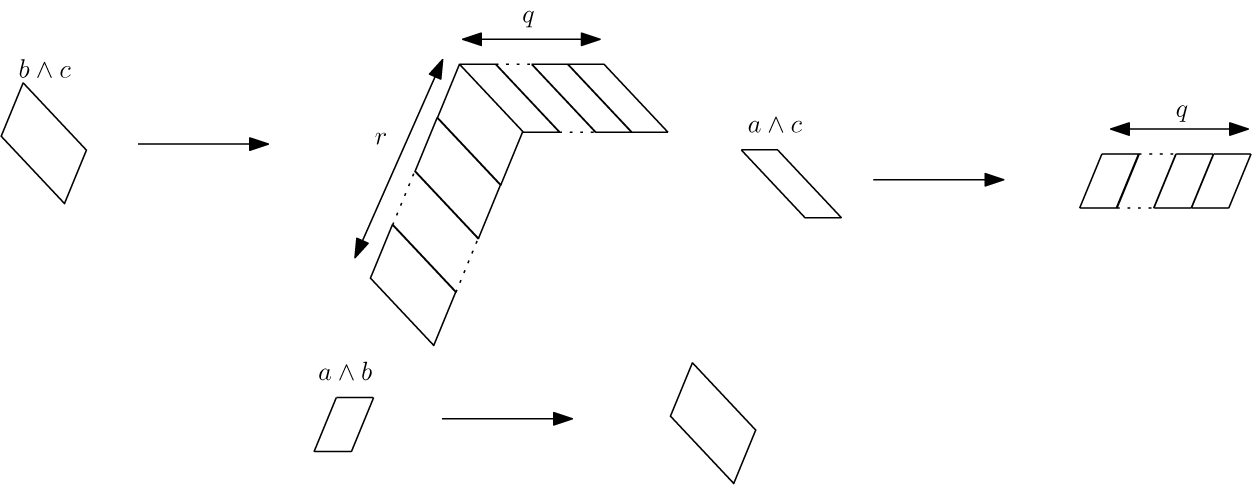
. Figure 3 show
 $\Theta $
acting on the prototiles for any
 $q,r \geq 1$
. Here we have shown how
 $\Theta $
acts on tiles. As usual
 $\Theta $
extends to a map on patches. Then
 $$ \begin{align*}C_2(M_\sigma) = [ \begin{array}{ccc} \ell'(\Theta(0,b\wedge c)) & \ell'(\Theta( 0, a \wedge c)) & \ell'(\Theta( 0, a\wedge b)) \end{array}] = \left [\begin{array}{ccc} r & 0 & 1 \\ q & 0 & 0 \\ 0 & q & 0 \end{array} \right ].\end{align*} $$
Definition 4.3. (
$\mathcal {P}_\sigma ^*$
)

We define
 $\mathcal {P}_\sigma ^*$
as the equivalence class of patches of
 $\mathcal {P}_\sigma $
such that
 $P \in \mathcal {P}_\sigma ^*$
if there exist a
 $k \in \mathbb {N}$
and an
 $t_i \in \mathcal {P}_\sigma $
such that
 $\Theta ^k(t_i)$
contains P.
Substitution on the prototiles.

A proof of the fact that
 $\Theta ^k(0,t_i)$
is a connected patch for each
 $k \in \mathbb {N}$
and
 $t_i \in \mathcal {P}_\sigma ^*$
can be found in [Reference Thurston8]. We choose a representative of each class of patches which has a boundary vertex at the origin, such that the vertex is an anchor point of a prototile. We refer to the patch
 $P \in \mathcal {P}^*_\sigma $
as
 $(0,P),$
and P translated by x would be
 $(x,P)$
.
Definition 4.4. (Vertices of a patch)
Let
 $P \in \mathcal {P}_\sigma ^*$
. Then by
 $\operatorname {\mathrm {Vert}}(P)$
we denote the set of all points in
 ${\mathbb {C}}$
that are vertices of the tiles contained in P.
Definition 4.5. (Front-end cancelation)
A tiling substitution
 $\Theta $
is said to have no front-end cancelation if for all
 $t_i \in \mathcal {P}$
,
 $\lambda ^k x \in \operatorname {\mathrm {Vert}}(\Theta ^k(x, t_i))$
, for all
 $k \in \mathbb {N}$
.
It is easy to see that the tiling substitution
 $\Theta $
corresponding to
 $\sigma $
of the form (1.1) has no front-end cancelations on any
 $P \in \mathcal {P}_\sigma ^*$
. This follows from our choice of representations of the patches.
Definition 4.6. (Boundary map)
Define the boundary map as the function
 $\partial : \mathcal {P}_\sigma ^* \to \mathcal {F}(\mathcal {A})$
, where, for any
 $P \in \mathcal {P}^*_\sigma $
, the boundary
 $\partial (P)$
is the word in
 $\mathcal {F}(\mathcal {A})$
such that the curve
 $f_{\partial (P)}$
traces the boundary of P traversed with positive orientation (counterclockwise).
It is easy to see that if the path
 $f_w([0,|w|])$
lies on
 $T_\sigma $
, for some
 $w \in \mathcal {F}(\mathcal {A})$
, then
 $f_{\sigma (w)}([0,|\sigma (w)|])$
also lies on
 $T_\sigma $
. The following lemma provides the patch that will seed the tiling for our substitution.
Lemma 4.4. The tiling substitution
 $\Theta $
generated by
 $\sigma $
fixes the patch
 $\Theta ^k(P_\sigma )$
in the patch
 $\Theta ^{k+1}(P_\sigma )$
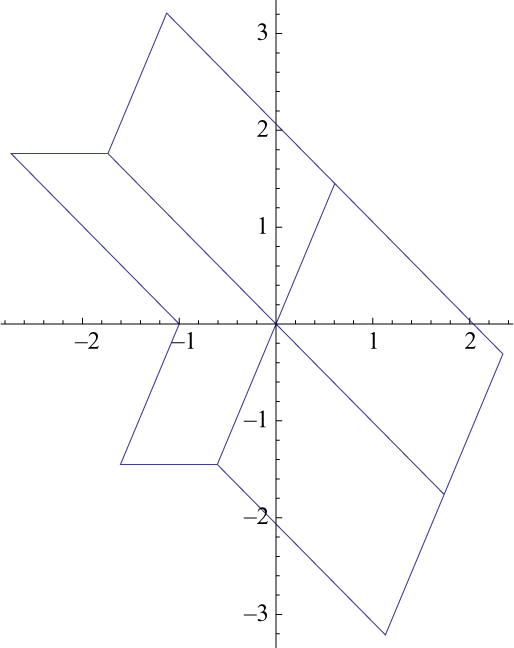
, where
 $P_\sigma $
is the patch shown in Figure 4.
A patch fixed by the tiling substitution
 $\Theta $
as mentioned in Lemma 4.4.

Proof It is easily shown that
 $\Theta (P_\sigma )$
fixes
 $P_\sigma $
if
 $q - 2 \geq r$
. For reference, Figure 5 shows
 $\Theta (P_\sigma )$
for the case
 $q = 3, r = 1$
. The rest of the proof is just induction.
This is
 $\Theta ^3(P_\sigma )$
for
 $q = 3, r = 1$
.

Now we can use the patch
 $P_\sigma $
to generate a tiling of the plane. The argument in [Reference Thurston8] shows that
 $\lim _{n \to \infty } \Theta ^n(P_\sigma )$
tiles the plane if
 $\Theta ^n(P_\sigma )$
grows in every direction as
 $n \to \infty $
The argument in [Reference Thurston8] shows that
 $\lim _{n \to \infty } \Theta ^n(P_\sigma )$
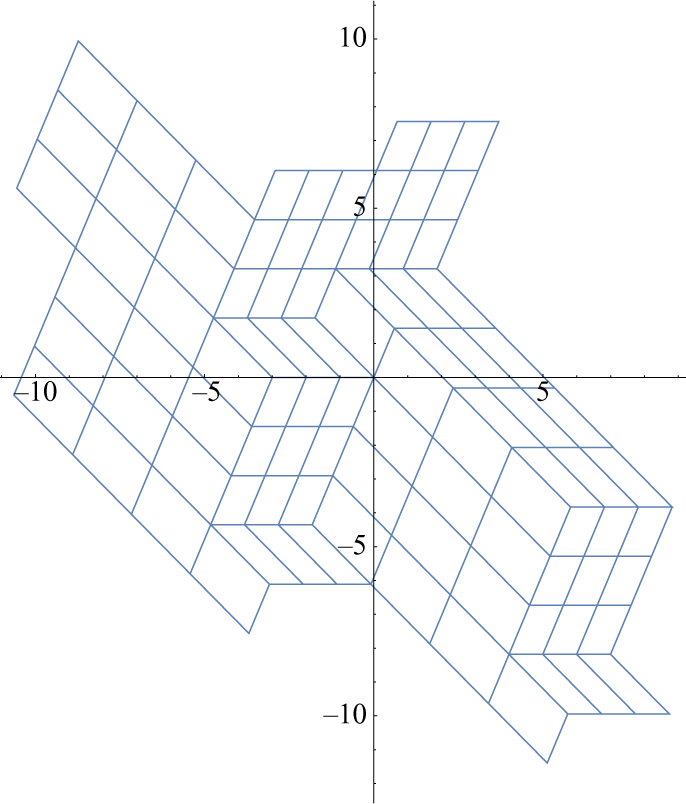
tiles the plane, see Figure 6. Extending
 $\Theta $
to be a mapping on tilings, we see that by the construction of
 $T_\sigma $
, we have
 $\Theta (T_\sigma ) = T_\sigma $
. Define
 $X_{T_\sigma } = \overline {\operatorname {\mathrm {Orb}}_{\mathbb {R}^2}(T_\sigma )}$
, then the substitution dynamical system is
 $(X_{T_\sigma },\mathbb {R}^2).$
This figure shows the tiling of
 $\mathbb {R}^2$
generated by a generalized substitution of the form (1.1) with
 $q = 3$
and
 $r = 1$
.

The next lemma is important in §5. It shows that the patches contained in
 $T_\sigma $
can always be found within a power of the substitution of any prototile.
Lemma 4.5. For every patch P in the tiling
 $T_\sigma $
, there exists
 $n \in \mathbb {N}$
such that P is contained in
 $\Theta ^n(t_i)$
, for all
 $t_i \in \mathcal {P}_\sigma $
.
Proof All that is required is to show that
 $P_\sigma $
is in some power of
 $t_a$
. This is worked out in Figure 7.
The following lemmas show some important properties of
 $T_\sigma $
in relation to
 $\Theta $
and
 $\lambda $
that we use later. The proofs are simple computations and are omitted.
Computations from the proof of Lemma 4.5.

Lemma 4.6. Let
 $\Theta $
be a tiling substitution generated by a generalized substitution
 $\sigma $
. Suppose that
 $T_\sigma $
is a fixed point of
 $\Theta $
, and suppose
 $\Theta $
has no front-end cancelations. If
 $S \in X_{T_\sigma }$
and
 $v \in \operatorname {\mathrm {Vert}}{T_\sigma }$
is such that
 $S = T_\sigma - v$
, then
 $\Theta (S) = T_\sigma - \lambda v$
.
Lemma 4.7. Let
 $T_\sigma $
be the fixed point of the tiling substitution
 $\Theta $
generated by
 $\sigma $
, where
 $\Theta $
has no front-end cancelations. Then
 $\lambda ^k \operatorname {\mathrm {Vert}}(T_\sigma ) \subseteq \lambda ^{k-1}\operatorname {\mathrm {Vert}}(T_\sigma ) \subseteq \cdots \subseteq \operatorname {\mathrm {Vert}}(T_\sigma )$
.
Although we have not discussed the topological mixing of
 $(T_\sigma ,\mathbb {R}^2)$
, the following is already a clear consequence of Lemma 3.4.
Theorem 4.8. If
 $(X_{T_\sigma },\mathbb {R}^2)$
is topologically mixing, then the areas of the tiles are linearly independent over
 $\mathbb {Q}$
.
This follows from the fact that the areas are not linearly independent over
 $\mathbb {Q}$
, which implies the displacement vectors between tiles must be discrete, and therefore not eventually dense.
5 Three-dimensional analysis of the tiling system
We will break the proof of Theorem 1.1 into two parts. The first part of the proof, covered in this section, will show that if a certain three-dimensional structure is unbounded, and the prototiles have rationally independent areas, then the tiling dynamical system is topologically mixing. We begin by taking the two-dimensional tiling and lifting it to a surface in
 $\mathbb {R}^3$
of square tiles whose vertices lie on
 $\mathbb {Z}^3$
. We will call this surface
 $\tilde {\Sigma }$
.
We start by labeling the origin of the tiling
 $T_\sigma $
with
 $\mathbf {0} \in \mathbb {R}^3$
. Next, starting from
 $0 \in {\mathbb {C}}$
, we move from vertex to vertex along edges in
 $T_\sigma $
, labeling the vertices with a point in
 $\mathbb {R}^3$
. If we traverse an edge corresponding to
 $i \in \{a,b,c\}$
in the positive direction we add
 $\mathbf {e}_i$
. If we traverse i in the negative direction, then we add
 $-\mathbf {e}_i$
. The labeling on a particular vertex will depend on the labeling of the previous vertex, and which edge we traversed to reach the new vertex. The vertices of a tile
 $t_i$
in
 $T_\sigma $
lift to the vertices of a
 $1 \times 1$
square. This process leaves us with a stepped surface in
 $\mathbb {R}^3$
, which when viewed from an appropriate angle will appear similar to the tiling it is lifted from. The surface is made up of facet tiles, which are the
 $1 \times 1$
squares. These facet tiles are translations of unit squares in the
 $xy$
-,
 $yz$
-, and
 $xz$
-planes. We can think of them as the lifts of
 $t_a, t_b$
and
 $t_c$
, respectively. We will denote these facet tiles by
 $t^{\prime }_a = \{0\}\times [0,1]\times [0,1], t^{\prime }_b = [0,1]\times \{0\}\times [0,1]$
, and
 $t^{\prime }_c = [0,1]\times [0,1]\times \{0\}$
.
Note that the labeling scheme for the vertices of
 $T_\sigma $
is well defined. The equivalence class of facet tiles, which we will call the facet prototiles, will be denoted by
 $\mathcal {P}^{\prime }_\sigma $
. The collection of all facet patches that are contained in
 $\tilde {\Sigma }$
will be denoted by
 $(\mathcal {P}^{\prime }_\sigma )^*$
.
Define the lifting of a tiling as a map
 $\iota :{\mathbb {C}} \to \mathbb {R}^3$
, where
 $\iota ({\mathbb {C}}) = \tilde {\Sigma }$
. The map
 $\iota $
is bijective on
 $\tilde {\Sigma }$
, and thus invertible on its image. Therefore,
 $\iota $
has an inverse function,
 $\iota ^{-1}$
, which is a type of projection of
 $\tilde {\Sigma }$
. It is easy to verify that
 $\iota ^{-1}$
is the Perron–Frobenius projection
 $\pi _{E_\lambda }$
from §4. From this, we can define the facet tiling substitution induced by
 $\Theta $
as
 $\Theta ':\mathcal {P}^{\prime }_\sigma \to (\mathcal {P}^{\prime }_\sigma )^*$
such that for every
 $t' \in \mathcal {P}^{\prime }_\sigma $
,
 $\Theta '(t') = \iota (\Theta (\pi _{E_\lambda }(t'))).$
The definition of
 $\Theta '$
can be extended to a mapping
 $\Theta ':\tilde {\Sigma } \to \tilde {\Sigma }$
. As a result, it is clear that
 $\Theta '(\tilde {\Sigma }) = \tilde {\Sigma }.$
We can now take the definition of the broken line curve
 $f_w$
and extend it in the natural way to a broken space curve
 $f_w':[0,|w|] \to \mathbb {R}^3$
on the stepped surface. Note that if the path
 $f^{\prime }_w([0,|w|])$
is contained in
 $\tilde {\Sigma }$
, then the path
 $f^{\prime }_{\sigma (w)}([0,|\sigma (w)])$
is also contained in
 $\tilde {\Sigma }$
.
Now we construct a subset of
 $\mathbb {Z}^3$
that can be thought of as encoding information about the substitution tiling dynamical system. Let
 $\Sigma = \tilde {\Sigma } \cap \mathbb {Z}^3$
. Take any
 $\mathbf {v} \in \Sigma $
and consider
 $\Sigma - \mathbf {v} = \{\mathbf {w} \in \mathbb {Z}^3: \mathbf {w} + \mathbf {v} \in \Sigma \}$
. Then the projection
 $\pi _{E_\lambda }(\Sigma - \mathbf {v})$
is the tiling
 $T_\sigma $
translated by
 $\pi _{E_\lambda }(\mathbf {v})$
, which is a point in
 $\mathbb {R}^2$
corresponding to a vertex in the tiling
 $T_\sigma $
. Thus,
 $\Lambda = \Sigma - \Sigma = \{\mathbf {u} - \mathbf {v}: \mathbf {u}, \mathbf {v} \in \Sigma \}$
is the lifting of all the shifts of the tiling
 $T_\sigma $
by the vectors corresponding to the vertices in
 $T_\sigma $
. Next, we will consider words that correspond to paths along our tiling. In particular, we are interested in paths that do not contain backtracking. We call the corresponding words good words.
Definition 5.1. A word w is a good word if
 $|\ell _a(w)| + |\ell _b(w)| + |\ell _c(w)| = |w|.$
A word is good because all powers of a particular letter have the same sign. For example,
 $w = ab^{-1}acb^{-3}c^4$
is good since
 $|w| = 11$
and
 $|\ell _a(w)| + |\ell _b(w)| + |\ell _c(w)| = 2 + 4 + 5.$
However,
 $w' = ab^{-3}acb^{-3}c^4b^2$
is not good. Let
 $\mathbf {v} \in \Lambda $
. A word w is a good word for
 $\mathbf {v}$
if w is a good word and
 $\ell (w) = \mathbf {v}$
. The following will be important in the sequel.
Lemma 5.1. Let
 $\mathbf {v} \in \Lambda $
. Then there is a good word corresponding to
 $\mathbf {v}$
.
Proof Let
 $v \in \Sigma $
and
 $w \in \mathcal {F}(\{a,b,c\}),$
where
 $\ell (w) = \mathbf {v}$
, and assume w is not a good word. Then we can find a smallest subword of w of the form
 $iw'i^{-1}$
, where
 $w'$
is a good word. We will prove that we can always replace
 $iw'i^{-1}$
with a word
 $w_1i w_2 i^{-1}$
(or
 $iw_2i^{-1}w_1$
) in w to get a new word u where
 $|w_2| < w'$
and
 $\ell (u) = \ell (w)$
. This tells us that we can eventually cancel any i and
 $i^{-1}$
pairs from w and still have
 $\ell (w) = \mathbf {v}$
. In this proof we will consider one of several cases, as each case works out similarly. Assume that
 $i = a$
. If
 $w'$
contained a or
 $a^{-1}$
, then there would be a smaller subword of the given form, which is a contradiction. If w only contains one type of letter, say b, then
 $abb \ldots ba^{-1}$
would define a sequence of
 $a \wedge b$
tiles in which the path goes from the lower left of the first tile to the upper left of the last tile. Then we could replace
 $abb \ldots ba^{-1}$
in w with
 $bb \ldots b$
which eliminates the bad subword, and we still have
 $\ell (w) = \mathbf {v}$
. Now assume
 $w'$
contains the letters b and c and that
 $w'$
starts with the letter b. Then
 $w'$
will have some sequence of bs eventually followed by a c. Notice that the edges corresponding to a and b can be tiled in two ways, either with one
 $a \wedge b$
tile or with an
 $a \wedge c$
and
 $b \wedge c$
tile. If it is tiled in the second way, then the tiling of
 $abb \ldots bc$
is fixed, since we now have a consecutive
 $c^{-1}$
and b edge. This forces all remaining tiles to be
 $b \wedge c$
tiles. If we start with
 $a \wedge b$
, then we continue to see
 $a \wedge b$
tiles until the last tile, which must be
 $a \wedge c$
. Lastly, it is possible to see a sequence of
 $a \wedge b$
followed by
 $a \wedge c$
. Again, as in the first case, all remaining tiles are fixed and must be
 $b \wedge c$
. See Figure 8. If we have the first case, we can substitute
 $cabb \ldots b$
for
 $abb \ldots bc$
. If we have the second case, we can substitute
 $bb \ldots bca$
. In the third case, we can substitute
 $bb \ldots bcabb \ldots b$
. In all three cases, a and
 $a^{-1}$
are closer together than before and the result follows. If
 $\mathbf {v} \in \Lambda $
, then
 $\mathbf {v} \in \Sigma - \mathbf {u}$
for some
 $\mathbf {u} \in \Sigma $
. We would follow the same proof in this case as before, except replacing paths along
 $\Sigma - \mathbf {u}$
for paths along
 $\Sigma $
.
Possible tilings of edges corresponding to
 $abb \ldots bc$
.

Now we want prove that there are no holes in
 $\Lambda $
. In other words, if
 $(x,y,z)$
,
 $(x,y,z') \in \Lambda $
, then we have
 $(x,y,z") \in \Lambda $
, for all
 $(x,y,z") \in \mathbb {Z}^3$
with
 $z < z" < z'$
. To do this, we introduce the idea of a unit tiling.
Definition 5.2. (Unit prototiles)
The set of unit prototiles, denoted
 $\mathcal {P}_{\mathcal {U}}$
, is the collection of tiles
 $u_a, u_b,$
and
 $u_c$
in
 ${\mathbb {C}}$
of parallelograms where
 $\operatorname {\mathrm {Vert}}(u_a) = \{0, i, -1+2i,-1+i\}$
,
 $\operatorname {\mathrm {Vert}}(u_b)=\{0, 1, i,-1+i\}$
and
 $\operatorname {\mathrm {Vert}}(u_c) = \{0, 1, 1+i, i\}$
. See Figure 9.
The prototiles of a unit tiling
 $\mathcal {U}_\sigma $
.

Define the tiling dynamical system
 $(X_{\mathcal {P}_{\mathcal {U}}}, \mathbb {R}^2)$
as in §2. Due to the shape of the unit prototiles, for any tiling
 $T \in X_{\mathcal {P}_U}$
which has a tile with a vertex at the origin,
 $\operatorname {\mathrm {Vert}}(T) = \mathbb {Z}^2$
. This gives us the following definition.
Definition 5.3. (Unit tiling)
A tiling
 $T \in X_{\mathcal {P}_U}$
is a unit tiling if there exists a vector
 $\mathbf {v} \in \mathbb {R}^2$
such that
 $\operatorname {\mathrm {Vert}}(T - \mathbf {v}) = \mathbb {Z}^2$
.
If
 $Y_{\mathcal {P}_{\mathcal {U}}}\subseteq X_{\mathcal {P}_{\mathcal {U}}}$
is the set of all unit tilings, then
 $T-\mathbf {v} \in Y_{\mathcal {U}}$
if
 $T \in Y_{\mathcal {U}}$
and
 $\mathbf {v} \in \mathbb {Z}^2$
. This defines a
 $\mathbb {Z}^2$
on
 $Y_{\mathcal {P}_{\mathcal {U}}}$
. Thus,
 $(Y_{\mathcal {P}_{\mathcal {U}}},\mathbb {Z}^2)$
defines a dynamical system.
We will define the unit projection
 $\pi _{\mathcal {U}}$
by
 $\pi _{\mathcal {U}}(\mathbf {v}) = \Big [ \begin {smallmatrix} 1 & 0 & -1 \\ 0 & 1 & 1 \end {smallmatrix} \Big ] \mathbf {v}.$
Notice that
 $\mathbf {n_{\mathcal {U}}} = [\!\begin {smallmatrix}1 & -1 & 1\end {smallmatrix}\!]^T$
spans the kernel of
 $\pi _{\mathcal {U}}$
, and for any
 $t_i \in \mathcal {P}_\sigma , \pi _{\mathcal {U}}(\iota (t_i)) = u_i.$
The following lemma is important for establishing the relationship between our tiling
 $T_\sigma $
and a unit tiling.
Lemma 5.2. Let
 $\tilde {\Sigma }$
be the lifting of a tiling
 $T_\sigma $
. Then
 $\pi _{\mathcal {U}}(\tilde {\Sigma })$
is a unit tiling.
Paths in
 $T_\sigma $
corresponding to permutations of the word
 $ab^{-1}c$
.

The process of obtaining a path corresponding to the word
 $ab^{-1}c$
as in Lemma 5.2.

Proof First, notice that
 $\pi _{\mathcal {U}}(\Sigma ) \subseteq \mathbb {Z}^2$
. Since the angle between the planes
 $P_{n_\theta }$
and
 $P_{n_{\mathcal {U}}}$
is less than
 $\pi /2$
, and
 $\pi _{E_\lambda }$
maps
 $\Sigma $
onto
 $P_{n_\theta }$
, it follows that
 $\pi _{\mathcal {U}}(\Sigma ) = \mathbb {Z}^2$
. All that remains is to show that
 $\pi _{\mathcal {U}}$
is one-to-one on
 $\Sigma $
. Suppose not. Then there exist
 $\mathbf {v}, \mathbf {w} \in \Sigma $
such that
 $\mathbf {v} - \mathbf {w} = k \mathbf {n_{\mathcal {U}}}$
. If
 $k = 1$
, then there is a good word w corresponding to
 $k \mathbf {n_{\mathcal {U}}}$
which is a permutation of the word
 $ab^{-1}c$
. However, it is easy to verify using the angle relations (see Figure 10) that w cannot lead to a tiling
 $T_\sigma $
, so w is not allowed. In the case
 $k> 1$
, again we have a good word w where
 $\ell (w) = k \mathbf {n_{\mathcal {U}}}$
. But such a word must have a subword
 $\alpha \beta ^{-l} \gamma $
, where
 $\alpha , \beta ,\gamma $
are distinct characters. Assume the subword has the form
 $ab^{-l}c$
. In this case, since
 $b^{-1}$
follows a, the angle between the edges must be acute, which implies that
 $ab^{-1}$
must be on the top side of the tile
 $a \wedge b$
. Therefore, we have a tiling similar to Figure 11, which implies again we have a path
 $ab^{-1}c$
, giving a contradiction.
We will denote the unit tiling of
 $\sigma $
by
 $\mathcal {U}_\sigma $
. In other words
 $\mathcal {U}_\sigma = \pi _{\mathcal {U}}(\iota (T_\sigma ))$
. Figure 12 shows a unit tiling generated from the generalized substitution of the form (1.1), where
 $r = 1$
and
 $q = 3$
.
The unit tiling of
 $\mathbb {R}^2$
constructed from the tiling generated by a generalized substitution of the form (1.1) where
 $q = 3$
and
 $r = 1$
.

Instead of thinking of a unit tiling
 $\mathcal {U}_\sigma $
as a tiling of the plane, we will visualize it as an infinite graph whose edges are the boundaries of the tiles and whose vertices are all in
 $\mathbb {Z}^2$
. If we look at any
 $1 \times 1$
square in
 $\mathbb {R}^2$
with vertices on
 $\mathbb {Z}^2$
, there are only five possible arrangements of edges and vertices in
 $\mathcal {U}_\sigma $
. See Figure 13. We refer to these graphs as SWONT graphs, in reference to their appearance (the letters S, W, O, N, and T).
All possible edge configurations, called SWONT graphs, labeled with their height values.

Definition 5.4. (Height function)
Assume
 $\mathcal {A} = \{a,b,c\}$
. Let
 $(x,y) \in \mathbb {Z}^2$
and suppose
 $w = w_1c^{n_1}w_2c^{n_2} \ldots w_kc^{n_k}w_{k+1} \in \mathcal {F}(\mathcal {A})$
, where
 $w_i \in \mathcal {F}(\mathcal {A} \setminus \{c\})$
, such that
 $\pi _{\mathcal {U}}(f^{\prime }_w([0,|w|]))$
is a sequence of tile edges in
 $\mathcal {U}_\sigma $
starting at
 $(0,0)$
and ending at
 $(x,y)$
. Define the height function
 $h:\mathbb {Z}^2 \to \mathbb {Z}$
by
 $h(x,y) = n_1 + n_2 + \cdots + n_k$
.
It is not hard to see that
 $h(x,y) = \pi _{\mathbb {R}^2}^\perp ((\pi _{\mathcal {U}})^{-1}(x,y))$
,
 $x,y \in \mathbb {Z}$
, where
 $(\pi _{\mathcal {U}})^{-1}: \mathbb {R}^2 \to \tilde {\Sigma }$
. Thus, the map h is well defined by Lemma 5.2, and it follows that the height of a vertex in
 $\mathcal {U}_\sigma $
is independent of the path chosen to reach that point. Since
 $(\pi _{\mathcal {U}})^{-1}$
is defined on
 $\mathbb {R}^2$
, this allows us to extend h to a function
 $\tilde {h}:\mathbb {R}^2 \to \mathbb {R}$
. Therefore, we can view
 $\tilde {\Sigma }$
as surface defined as the graph of a function of two variables on
 $\mathbb {R}^2$
.
We can further extend the definition of the height function to any translations of
 $\tilde {\Sigma }$
by a vector
 $\mathbf {v} \in \mathbb {Z}^2$
. Define
 $h_{\mathbf {v}}(x,y)$
as the height function where
 $\mathcal {U}_\sigma $
is replaced by
 $\mathcal {U}_\sigma - \mathbf {v}$
. Finally, we define
 $h_{\max }(x,y) = \max _{\mathbf {v} \in \mathbb {Z}^2}\{ h_{\mathbf {v}}(x,y)\}$
and
 $h_{\min } = \min _{\mathbf {v} \in \mathbb {Z}^2}\{h_{\mathbf {v}}(x,y)\}$
.
Consider each SWONT graph on
 $\mathbb {Z}^2$
with the origin at the lower right-hand side of the graph. Then, using h, we will label the height numbers on the lower left and upper right vertices. See Figure 13. For each
 $(x,y) \in \mathbb {R}^2$
, the number of edges in the shortest path from
 $(0,0)$
is bounded by
 $3(|x|+|y|)$
. Thus, there always exists a finite path to
 $(x,y)$
in
 $\mathcal {U}_\sigma - \mathbf {v}$
, for all
 $\mathbf {v} \in \mathbb {R}^2$
, and since the height function is independent of path, it is clear that
 $h_{\max }(x,y)$
and
 $h_{\min }(x,y)$
are always finite. The following two lemmas prove that
 $\Lambda $
has no holes.
Lemma 5.3. Let
 $(x,y) \in \mathbb {Z}^2$
and
 $\mathbf {v} \in \mathbb {Z}^2$
. Then
 $|h_{\mathbf {v}} - h_{\mathbf {v}\pm \mathbf {e}_i}(x,y)| \leq 1.$
To help clarify the proof of Lemma 5.3. The difference in height in this case is zero.

Proof We will only prove this for
 $\mathbf {e}_1$
and
 $-\mathbf {e}_2$
. The proof of all other cases follows similarly with Figure 13 changed. When a path from
 $(0,0)$
to
 $(x,y)$
is shifted (in this case by either
 $-\mathbf {e}_1$
or
 $\mathbf {e}_2$
, then two SWONT graphs are added to the end of any new path (with
 $(0,0)$
being appropriately translated). See Figure 14. Therefore, Figure 13 tells us that the difference in height is not more than
 $\pm 1$
.
Lemma 5.4. Let
 $(x,y) \in \mathbb {Z}^2$
. For any
 $n \in \mathbb {Z}$
such that
 $h_{\min }(x,y) \leq n \leq h_{\max }(x,y)$
there is a vector
 $\mathbf {v} \in \mathbb {Z}^2$
such that
 $h_{\mathbf {v}}(x,y) = n$
.
This basically follows from Lemma 5.3 since the height can only change by
 $\pm 1$
as we move from vertex to vertex.
Suppose
 $(x,y)$
is a vertex in
 $\mathcal {U}_\sigma - \mathbf {w}$
, and
 $\mathbf {w}' \in \Sigma $
satisfies
 $\pi _{\mathcal {U}}(\mathbf {w}') = \mathbf {w}.$
Let
 $(x',y',z)$
be the unique vector in
 $\Sigma -\mathbf {w}'$
such that
 $\pi _{\mathcal {U}}(x',y',z) = (x,y)$
, and thus
 $h_{\mathbf {w}}(x,y) = z$
. Since
 $\mathbf {\pi_{\mathcal {U}}}$
has a null space spanned by the vector
 $\mathbf {n_{\mathcal {U}}}$
, it follows that for the line L in the direction of
 $\mathbf {n_{\mathcal {U}}}$
through the point
 $(x,y,z)$
, that
 $(x',y',z')\in \mathbb{Z}^3 \cap L$
is contained in
 $\Lambda $
if
 $h_{\min }(\pi _{\mathcal {U}}(x,y,z)) \leq z' \leq h_{\max }(\pi _{\mathcal {U}}(x,y,z))$
. This implies that
 $\Lambda $
contains no jumps. As with h, we can extend
 $h_{\mathbf {v}}, h_{\max }, h_{\min }$
to maps from
 $\mathbb {R}^2 \to \mathbb {R}$
. Define
 $\tilde \Lambda = \{(x,y,z) \in \mathbb {R}^3: \tilde h_{\min }(\pi _{\mathcal {U}}(x,y)) \leq z \leq \tilde h_{\max }(\pi _{\mathcal {U}}(x,y))\}$
.
Theorem 5.5. Let
 $f, g: \mathbb {R}^2 \to \mathbb {R}$
such that
 $f(\mathbf {x}) \geq 0$
and
 $g(\mathbf {x}) \leq 0$
. If for any
 $R> 0$
there exists a compact set
 $K \subseteq \mathbb {R}^2$
such that
 $f(\mathbf {x})> R$
and
 $ g(\mathbf {x}) < -R$
for all
 $\mathbf {x} \in \mathbb {R}^2 \setminus K$
, then
 $\pi _{\mathbb {R}^2}(\Gamma \cap L)$
is eventually dense in
 $\mathbb {R}^2$
where
 $\Gamma = \{(x,y,z) \in \mathbb {R}^3: g(x,y) \leq z \leq f(x,y)\}$
and L is an irrational lattice.
Proof Fix any
 $\epsilon> 0$
. By Lemma 3.8, we know that there is an
 $R> 0$
such that
 $\pi _{\mathbb {R}^2}((\mathbb {R}^2 \times [-R,R]) \cap L)$
is
 $\epsilon $
-dense. From the properties of f and g, we know there exists an
 $N> 0$
such that for all
 $\parallel\!\mathbf {x}\!\parallel\, > N$
,
 $f(\mathbf {x})> R$
and
 $g(\mathbf {x}) < -R$
. Therefore,
 $\pi _{\mathbb {R}^2}((\mathbb {R}^2 \setminus \overline {B_N(\mathbf {0})} \times [-R,R]) \cap L)$
is
 $\epsilon $
-dense in
 $\mathbb {R}^2 \setminus \overline {B_N(\mathbf {0})}$
, and thus
 $\pi _{\mathbb {R}^2}(\Gamma \cap L)$
is eventually dense.
We will show that if
 $\Lambda $
‘grows without bound’ in the direction
 $\mathbf {n_{\mathcal {U}}}$
as we move in the
 $xy$
-plane away from the origin and if the entries of
 $\mathbf {n}$
are linearly independent over
 $\mathbb {Q}$
, then
 $(X_{T_{\sigma ,\mathbf {n}}},\mathbb {R}^2)$
is topologically mixing, where
 $T_{\sigma ,\mathbf {n}}=\pi _{P_{\mathbf {n}}}(\iota (T_\sigma ))$
. Given a facet patch P in
 $\tilde {\Sigma }$
, we define the locator set by
 $\mathcal {L}_P(\tilde {\Sigma }) = \{\mathbf {v} \in \mathbb {R}^3: \mbox {there exists facet patch } P' \mbox { in } \tilde {\Sigma } \mbox { such that } P = P' - \mathbf {v}\}.$
Lemma 5.6. The stepped surface
 $\tilde {\Sigma }$
corresponding to
 $T_\sigma $
with facet tiles
 $t_{a}', t_{b}'$
and
 $t_{c}'$
satisfies
 $\Lambda \subseteq \bigcup _{i,j \in \{t_{a}', t_{b}', t_{c}'\}}( \mathcal {L}_i(\tilde {\Sigma }) - \mathcal {L}_j(\tilde {\Sigma }) ) .$
Proof For any
 $\mathbf {u} \in \Lambda $
there are two vectors
 $\mathbf {v}, \mathbf {w} \in \Sigma $
such that
 $\mathbf {v} - \mathbf {w} = \mathbf {u}$
. Since
 $\mathbf {v}, \mathbf {w} \in \Sigma $
, there are facet tiles
 $t^{\prime }_{\mathbf {v}}$
and
 $t^{\prime }_{\mathbf {w}}$
satisfying
 $t^{\prime }_{\mathbf {v}} - \mathbf {v}, t^{\prime }_{\mathbf {w}}- \mathbf {w} \in \{t_{a}', t_{b}', t_{c}'\}$
. Thus,
 $\mathbf {v} \in \mathcal {L}_{t^{\prime }_{\mathbf {v}}}(\tilde {\Sigma })$
and
 $\mathbf {w} \in \mathcal {L}_{t^{\prime }_{\mathbf {w}}}(\tilde {\Sigma })$
, which implies that
 $\mathbf {u} \in \mathcal {L}_{t_{\mathbf {v}}}(\tilde {\Sigma }) - \mathcal {L}_{t_{\mathbf {w}}}(\tilde {\Sigma }) \subseteq \bigcup _{i,j \in \{t_{a}', t_{b}', t_{c}'\}}( \mathcal {L}_i(\tilde {\Sigma }) - \mathcal {L}_j(\tilde {\Sigma }) ) .$
Lemma 5.7. For any
 $k \in \mathbb {N}$
, we have
 $M_\sigma ^k\Lambda = \{M_\sigma ^k \mathbf {v}: \mathbf {v} \in \Lambda \} \subseteq \Lambda $
.
Proof For any
 $M^k \mathbf {v} \in M^k \Lambda $
, there is a
 $\mathbf {u} \in \Sigma $
such that
 $\mathbf {v} - \mathbf {u} \in \Sigma $
. Choose
 $w \in \mathcal {F}(\mathcal {A})$
such that
 $\ell (w) = \mathbf {v} - \mathbf {u}$
. Since
 $T_\sigma $
is fixed by
 $\Theta $
, it follows that
 $f_{\sigma (w)}$
is also a path in
 $T_\sigma $
and thus
 $f_{\sigma (w)}'$
is a path in
 $\Sigma .$
Since
 $M^k(\ell (w)) = M^k\mathbf {v} - M^k\mathbf {u},$
it follows that
 $M^k\mathbf {v} - M^k\mathbf {u}$
is also in
 $\Sigma $
. The same argument proves that
 $M^k\mathbf u \in \Sigma $
, so
 $M^k\mathbf {v} \in \Lambda $
.
Define
 $\Psi (P^{\prime }_1, P^{\prime }_2) = (\mathcal {L}_{P^{\prime }_1}(\tilde {\Sigma }) - \mathcal {L}_{P^{\prime }_2}(\tilde {\Sigma })),$
where
 $P^{\prime }_1, P^{\prime }_2$
are two facet patches. The set
 $\Lambda $
is said to be unbounded if for any
 $R> 0$
there exists a compact set
 $K \subseteq \mathbb {R}^2$
such that for all
 $\mathbf {v} \in \mathbb {R}^2 \setminus K$
, we have
 $\tilde {h}_{\max }(\mathbf {v}) - \tilde {h}_{\min }(\mathbf {v}) \geq R$
.
Theorem 5.8. If
 $\mathbf {n}$
has linearly independent entries over
 $\mathbb {Q}$
and
 $\Lambda $
is unbounded, then
 $ (X_{T_{\sigma ,\mathbf {n}}},\mathbb {R}^2 )$
is topologically mixing, where
 $T_{\sigma ,\mathbf {n}} = \pi _{P_{\mathbf {n}}}(\tilde {\Sigma })$
.
Proof Choose patches
 $P_1, P_2 \in \mathcal {P}_\sigma ^*$
. By primitivity, there exists
 $k \in \mathbb {N}$
such that
 $P_1, P_2 \subset \Theta ^k(t_i)$
, for all
 $t_i \in \{t_a, t_b, t_c\}$
. It suffices to show that the displacement vectors between
 $\Theta ^k(t_i)$
and
 $\Theta ^k(t_j)$
, for all
 $t_i, t_j \in \{t_a, t_b, t_c\}$
, are eventually dense. Equivalently, it is enough to prove
 $\pi _{E_\lambda }(\Upsilon )$
is eventually dense in
 $\mathbb {R}^2$
, where
 $\Upsilon = \bigcup _{t^{\prime }_i,t^{\prime }_j \in \{t_a', t_b', t_c'\}}\Psi ((\Theta ')^k(t^{\prime }_i),(\Theta ')^k(t^{\prime }_j)).$
To show
 $M^k\Lambda \subseteq \Upsilon $
, choose any
 $\mathbf {z}\in \Lambda $
and let
 $\mathbf {z} = \mathbf {u} - \mathbf {v}$
, where
 $\mathbf {u}, \mathbf {v} \in \Sigma .$
We can find
 $\mathbf {u}, \mathbf {v} \in \Sigma $
such that
 $\mathbf {u} - \mathbf {v} = \mathbf {z}$
and there exist facet tiles
 $t_1'$
and
 $t_2'$
such that
 $(\mathbf {u},t_1')$
and
 $(\mathbf {v},t_2')$
are contained in
 $\tilde {\Sigma }$
. Thus, there is a path which starts at
 $\mathbf {u}$
and ends at
 $\mathbf {v}$
. In other words, there is a word
 $w \in \mathcal {F}(\mathcal {A})$
such that
 $f_w'([0,|w|])$
is a path on
 $\tilde {\Sigma } - \mathbf {u}$
. Notice that
 $\ell (w) = \mathbf {z}$
, so
 $\ell (\sigma ^k(w)) = M^k\mathbf {z}$
. Since
 $f_w$
is contained in
 $T_\sigma - \pi _{E_\lambda }(\mathbf {u})$
, and by Lemma 4.6
 ${\Theta ^k(T_\sigma - \pi _{E_\lambda }(\mathbf {u})) = T_\sigma - \lambda ^k \pi _{E_\lambda }(\mathbf {u})}$
, it follows that
 $f_{\sigma ^k(w)}'([0,|\sigma ^k(w)|])$
is a path from
 $(\Theta ')^k(t_1')$
to
 $(\Theta ')^k(t_2')$
. Since
 $f_{\sigma ^k(w)}'(|\sigma ^k(w)|) = \lambda ^k \mathbf {z}$
and
 $\pi _{E_\lambda }$
is one-to-one, it follows that
 $M^k\mathbf {z} \in \Upsilon $
.
Finally, we prove that
 $\pi _{E_\lambda }(M^k\Lambda )$
is eventually dense. Assume
 $\{\mathbf {v}_1, \mathbf {v}_2\}$
is a basis for
 $P_{\mathbf {n}}$
. Let A be the matrix which takes
 $\mathbf {v}_1$
to
 $\mathbf {e}_1$
,
 $\mathbf {v}_2$
to
 $\mathbf {e}_2$
, and
 $\mathbf {n}$
to
 $\mathbf {e}_3$
. It follows from Lemma 3.4 that
 $A M^k\mathbb {Z}^3$
is an irrational lattice, with
 $AM^k\Lambda $
as a subset. Since
 $\tilde \Lambda $
is unbounded, it follows that
 $AM^k\Lambda $
is unbounded. By Theorem 5.5,
 $\pi _{\mathbb {R}^2}(AM^k\Lambda )$
is eventually dense. Since
 $\pi _{P_{\mathbf {n}}}(M^k\Lambda ) = \pi _{\mathbb {R}^2}(AM^k\Lambda )$
, it follows that
 $(X_{T_{\sigma ,\mathbf {n}}},\mathbb {R}^2)$
is topologically mixing.
6 Non-Pisot implies
$\Lambda $
is unbounded

In this section we will show that if
 $\sigma $
is a generalized complex non-Pisot substitution, then
 $\Lambda $
is unbounded. The main idea of the proof is that the stepped surface
 $\tilde {\Sigma }$
will follow the two-dimensional eigenplane, as it is the dominant subspace. However, since the one-dimensional eigenspace is also expanding it will pull the stepped surface arbitrarily far away from the two-dimensional eigenspace, but nevertheless it must always eventually return (and actually intersect the two-dimensional eigenspace).
We note that if
 $\sigma $
satisfies equation (1.1) with complex eigenvalue
 $\lambda $
, then
 $E_\lambda $
is not perpendicular to the
 $xy$
-plane in
 $\mathbb {R}^3$
. Fix
 $\mathbf {v}$
an eigenvector of
 $M_\sigma $
corresponding to
 $\lambda $
, and let
 $n^{\prime }_\theta $
be an eigenvector of
 $M^T_\sigma $
corresponding to the real eigenvalue
 $\theta $
. Define
 $\pi _{E^{\prime }_\lambda } = \pi _{P_{\mathbf {n^{\prime }_\theta }}}$
and
 $\pi _{E^{\prime }_\lambda }^\perp = \pi _{P_{\mathbf {n^{\prime }_\theta }}}^{\perp }$
. Notice that for any
 $\mathbf {u} \in E_\lambda $
,
 $\pi _{E^{\prime }_\lambda }^\perp (\mathbf {u}) = 0$
. Also, since Lemma 3.2 implies that
 $\mathbf {n_\theta }$
and
 $\mathbf {n^{\prime }_\theta }$
have the same sign pattern, it follows that
 $\pi _{E^{\prime }_\lambda }^\perp (\mathbf {n_\theta }) = \langle \mathbf {n^{\prime }_\theta }, \mathbf {n_\theta }\rangle> 0$
.
Lemma 6.1. For all
 $k \geq 3$
,
 $\parallel\! \ell (\sigma ^k(a))_{x,y}\!\parallel\, > 0$
.
This is a simple induction proof, and is omitted. It will be useful to replace
 $ \sigma $
with
 $\sigma ^N$
, where N is even and
 $\parallel\!\ell ({\sigma ^{\prime }}^k(i))_{x,y} \!\parallel \, >0$
for all
 $k \geq N$
. Additionally, we will assume that
 $\sigma $
satisfies all properties given in §5.
Lemma 6.2. Let
 $\alpha = \log (|\theta |)/\log (|\lambda |)$
. There exist positive constants
 $L_1, L_1', L_2, L_2'$
such that for all
 $k \geq 1$
,
 $$ \begin{align} L_1 |\lambda|^k \leq \Vert(\ell(\sigma^k(j)))_{x,y}\Vert \leq L_1' |\lambda|^k,\quad j \in \{a,b,c,a^{-1},b^{-1},c^{-1}\}\end{align} $$
and
 $$ \begin{align}L_2 |\theta|^k \leq |\pi_{E^{\prime}_\lambda}^\perp(\ell(\sigma^k(i)))| \leq L_2' |\theta|^k = L_2'|\lambda|^{k\alpha}. \end{align} $$
Also,
 $\pi ^\perp _{E^{\prime }_\lambda }(\ell (\sigma ^k(b))) < 0$
for all
 $k \geq 1$
.
Proof First we prove equation (6.1). Fix any
 $j \in \{a,b,c,a^{-1},b^{-1},c^{-1}\}$
and write
 $\ell (j) = a_1^{(j)} \lambda \mathbf {v_\lambda } + a_2^{(j)} \overline {\lambda }\mathbf {\overline {v_\lambda }} + a_3^{(j)} \theta \mathbf {n_\theta }$
, where
 $a_1^{(j)}, a_2^{(j)} \in {\mathbb {C}}$
and
 $a_3^{(j)} \in \mathbb {R}$
. For any
 $k \geq 1$
,
 $\ell (\sigma ^k(j)) = (M_\sigma )^k(\ell (j)) = a_1^{(j)} \lambda ^k \mathbf {v} + \overline {a_1^{(j)}} \overline {\lambda }^k\mathbf {\overline {v}} + a_3^{(j)} \theta ^k\mathbf {n_\theta }.$
It follows that
 $(\ell (\sigma ^k(j)))_{x,y} =a_1^{(j)} \lambda ^k (\mathbf {v_\lambda })_{x,y} + \overline {a_1^{(j)}} \overline {\lambda }^k(\mathbf {\overline {v_\lambda }})_{x,y} + a_3^{(j)} \theta ^k(\mathbf {n_\theta })_{x,y}. $
Therefore,
 $$ \begin{align*}\frac{\parallel\!(\ell(\sigma^k(j)))_{x,y}\!\parallel}{|\lambda|^k} = \bigg |\hspace{-1pt} \bigg | a_1^{(j)} \frac{\lambda^k}{|\lambda|^k} (\mathbf{v_\lambda})_{x,y} + \overline{a_1^{(j)}} \frac{\overline{\lambda}^k}{|\lambda|^k}(\mathbf{\overline{v_\lambda}})_{x,y} + a_3^{(j)} \bigg(\frac{\theta}{|\lambda|} \bigg)^k(\mathbf{n_\theta})_{x,y}\bigg |\hspace{-1pt} \bigg |.\end{align*} $$
Let us consider
 $ | | a_1^{(j)} ({\lambda ^k}/{|\lambda |^k}) (\mathbf {v_\lambda })_{x,y} + \overline {a_1^{(j)}} ({\overline {\lambda }^k}/{|\lambda |^k})(\mathbf {\overline {v_\lambda }})_{x,y} | |.$
Assume that
 $(\mathbf {v_\lambda })_{x,y} = \mathbf {f}_1 + \mathbf {f}_2 i$
,
 $\arg (\lambda )= e^{i\varphi }$
, and
 $a_1^{(j)} = r e^{i\gamma }$
. Applying Euler’s formula and simplifying, we obtain
 $$ \begin{align*}\bigg |\hspace{-1pt} \bigg | a_1^{(j)} \frac{\lambda^k}{|\lambda|^k} (\mathbf{v_\lambda})_{x,y} + \overline{a_1^{(j)}} \frac{\overline{\lambda}^k}{|\lambda|^k}(\mathbf{\overline{v_\lambda}})_{x,y}\bigg |\hspace{-1pt} \bigg | &= 2r \parallel\! \mathbf{f}_1 \cos(k\varphi+\gamma) - \mathbf{f}_2\sin(k\varphi+\gamma)\!\parallel\\ &\leq 2 r (\parallel\! \mathbf{f}_1\!\parallel + \parallel\! \mathbf{f}_2 \!\parallel). \end{align*} $$
A simple calculation show that if
 $\parallel\! \mathbf {f}_1 \cos (k\varphi +\gamma ) - \mathbf {f}_2\sin (k\varphi +\gamma )\!\parallel $
is not bounded away from zero, then
 $f_1$
and
 $f_2$
are linearly dependent. But this is impossible since
 $E_\lambda $
is not perpendicular to the
 $xy$
-plane. Thus, there must exist
 $\epsilon> 0$
such that
 $2r \parallel\! \mathbf {f}_1 \cos (k\varphi +\gamma ) - \mathbf {f}_2\sin (k\varphi +\gamma )\!\parallel\, > \epsilon $
for all k.
For each
 $k \in \mathbb {N}$
, define
 $$ \begin{align*}\gamma_k = \bigg |\hspace{-1pt} \bigg | a_1^{(j)} \frac{\lambda^k}{|\lambda|^k} (\mathbf{v_\lambda})_{x,y} + \overline{a_1^{(j)}} \frac{\overline{\lambda}^k}{|\lambda|^k}(\mathbf{\overline{v_\lambda}})_{x,y}\bigg |\hspace{-1pt} \bigg |\end{align*} $$
and
 $$ \begin{align*}\beta_k = \bigg |\hspace{-1pt} \bigg | a_1^{(j)} \frac{\lambda^k}{|\lambda|^k} (\mathbf{v_\lambda})_{x,y} + \overline{a_1^{(j)}} \frac{\overline{\lambda}^k}{|\lambda|^k}(\mathbf{\overline{v_\lambda}})_{x,y} + a_3^{(j)} \bigg(\frac{\theta}{|\lambda|} \bigg)^k(\mathbf{n_\theta})_{x,y}\bigg|\hspace{-1pt} \bigg|.\end{align*} $$
Since
 $({\theta }/{|\lambda |} )^k$
goes to zero as
 $k \to \infty $
, it follows that
 $\lim _{k \to \infty } (\gamma _k - \beta _k) = 0$
. Thus, there exists
 $N \in \mathbb {N}$
such that for all
 $k \geq N$
we have
 $|\gamma _k - \beta _k| < \epsilon /2,$
which is to say
 $0 < \epsilon /2 \leq \gamma _k - \epsilon /2 < \beta _k < \gamma _k + \epsilon /2.$
By assumption
 $\beta _k> 0$
, for all
 $k \in \mathbb {N}$
, and since there are just finitely many
 $k \leq N$
, we can choose an
 $L> 0$
such that
 $L \leq \beta _k$
for all k.
Also, since
 $\gamma _k \leq 2 r (\parallel\!\mathbf {f}_1\!\parallel + \parallel\!\mathbf {f}_2\!\parallel )$
for all
 $k \in \mathbb {N}$
, and there are at most finitely many
 $k \leq N$
, we can choose
 $L'> 0$
such that
 $\beta _k \leq L'$
, for all
 $k \in \mathbb {N}$
. Since
 $\beta _k = {\parallel\!(\ell (\sigma ^k(j)))_{x,y}\!\parallel }/{|\lambda |^k},$
we obtain equation (6.1).
To prove equation (6.2), we note that
 $\pi _{E^{\prime }_\lambda }^\perp (a_1^{(j)}\lambda ^k \mathbf {v_\lambda } + \overline {a_1^{(j)}}\overline {\lambda }^k\mathbf {\overline {v_\lambda }} ) = 0$
. So,
 $|\pi _{E^{\prime }_\lambda }^\perp (\ell (\sigma ^k(i)))| = |a_3^{(j)}||\theta |^k|\pi _{E^{\prime }_\lambda }^\perp (n_\theta )|$
, which gives us the desired result.
To prove the final statement, note that
 $\mathbf {e}_2 = a_1^{(b)}\mathbf {v_\lambda } + \overline {a_1^{(b)}}\mathbf {\overline {v_\lambda }} + a_3^{(b)}\mathbf {n_\theta },$
and
 $\pi _{E^{\prime }_\lambda }^\perp (\mathbf {v_\lambda }) = \pi _{E^{\prime }_\lambda }^\perp (\mathbf {\overline {v_\lambda }}) = 0.$
Thus,
 $\pi _{E^{\prime }_\lambda }^\perp (\mathbf {e}_2) = (\mathbf {n^{\prime }_\theta })_y < 0,$
by Lemma 3.2. Therefore,
 $\pi _{E^{\prime }_\lambda }^\perp (\ell (\sigma ^k(b))) = \pi _{E^{\prime }_\lambda }^\perp (M^k(\mathbf {e}_2)) = a_3^{(3)}\theta ^k\langle \mathbf {n^{\prime }_\theta }, \mathbf {n_\theta }\rangle < 0,$
since we are assuming
 $\theta> 0$
.
Lemma 6.3. Choose any two vertices
 $\mathbf {v}, \mathbf {v'} \in \mathcal {U}_\sigma $
and let
 $w_{\mathbf {v}}, w_{\mathbf {v'}}$
be the corresponding good words. If
 $(\mathbf {v})_x < (\mathbf {v'})_{x}$
, then
 $\ell _a(w_{\mathbf {v}}) \leq \ell _a(w_{\mathbf {v'}})$
, and if
 $(\mathbf {v})_y < (\mathbf {v'})_y$
, then
 $\ell _b(w_{\mathbf {v}}) \leq \ell _b(w_{\mathbf {v'}})$
.
Proof Without loss of generality, assume
 $\mathbf {v} = \mathbf {0}$
. Suppose
 $\ell _a(w_{\mathbf {v'}}) < 0$
. Since
 $w_{\mathbf {v'}}$
is a good word, this implies
 $w_{\mathbf {v'}}$
contains at least one
 $a^{-1}$
but no occurrences of a. By its relative position in the tiling,
 $w_{\mathbf {v'}}$
contains at least one b and at least one
 $c^{-1}$
but no occurrences of
 $b^{-1}$
or c. Therefore, by a similar argument to the proof of Lemma 5.2 there is a path which cannot be tiled. This is a contradiction. A similar argument shows
 $(\mathbf {v})_y < (\mathbf {v})_{y'}$
.
Lemma 6.4. Choose
 $\delta \in \mathbb {N}$
. If
 $K = (0,\delta ) \times (0,\delta )$
contains a
 $u_c$
tile in
 $\mathcal {U}_\sigma $
, and w is a good word for the vector
 $(\delta ,0)$
(similarly, w is a good word for
 $(0,\delta )$
), then
 $\ell _a(w) \geq 1$
(similarly,
 $\ell _b(w) \geq 1$
).
Proof Since
 $u_c$
is contained entirely in K, then choose two vertices
 $\mathbf {v}_l$
(left vertex) and
 $\mathbf {v}_r$
(right vertex) on the bottom side of
 $u_c$
with corresponding good words
 $w_l$
and
 $w_r$
. By path independence, it follows that
 $0 \leq \ell _a(w_l) < \ell _a(w_r)$
. Since
 $(\mathbf {v}_r)_x < \delta $
, it follows from Lemma 6.3 that
 $1 \leq \ell _a(w_r) \leq \ell _a(w).$
By the repetitivity of
 $T_\sigma $
(see [Reference Thurston8]) (and thus
 $U_\sigma $
), we can find a
 $\delta \in \mathbb {N}$
large enough that any shift of the square
 $K = (0,\delta ) \times (0,\delta )$
contains a tile of type
 $u_c$
. If we tile
 $\mathbb {Z}^2$
by translates of K on top of
 $\mathcal {U}_\sigma $
, then it is clear that at the point
 $(xk, yk) \in \mathbb {Z}^2$
, any good word w corresponding to
 $(xk, yk)$
will have
 $|\ell _a(w)| \geq |x|$
and
 $|\ell _b(w)| \geq |y|$
. As we move from vertex to vertex in
 $\mathcal {U}_\sigma $
, the number of letters a and b in w can change by at most one. Thus, if we want to find a vertex in
 $\mathcal {U}_\sigma $
that has a good word w with
 $\ell _{a}(w) = x$
and
 $\ell _{b}(w) = y$
, it suffices to look in the box
 $K' = [-|x|\delta , |x|\delta ] \times [-|y| \delta , |y| \delta ]$
.
Lemma 6.5. Suppose that, for any
 $k \in \mathbb {N}$
, there exist a patch P contained in
 $T_\sigma $
, and a path with at least k consecutive edges corresponding to the character c in P. Then
 $\Lambda = \mathbb {Z}^3$
.
Proof Choose
 $(d,e) \in \mathbb {Z}^2$
, and fix
 $k \in \mathbb {N}$
. Want to prove there exists a
 $(d,e,z) \in \Lambda $
such that
 $z \geq k$
. Choose
 $\delta> 0$
, and define K and
 $K'$
as in the paragraph above. It follows from Lemma 6.4 that there must be a vertex
 $\mathbf {v} \in \mathbb {Z}^2 \cap K'$
with good word w such that
 $\ell _a(w) = d$
and
 $\ell _b(w) = e$
. Since
 $K'$
is bounded, it is clear that there exists
 $\gamma> 0$
where
 $h(x,y) < \gamma $
for all
 $(x,y) \in K' \cap \mathbb {Z}^2$
. Let
 $\mathbf {v}_1 \in \mathcal {U}_\sigma $
be a vertex that has at least
 $z + \gamma $
consecutive c edges. Notice that our choice of
 $\delta $
is independent of the shift of
 $\mathcal {U}_\sigma $
. Thus, in
 $\mathcal {U}_\sigma - \mathbf {v}_1$
, we can find a vertex
 $\mathbf {v}_2 \in K' \cap \mathbb {Z}^2$
such that there is a good word w in which
 $\ell _a(w) = -d$
and
 $\ell _b(w) = -e$
. Thus, the vertex
 $-\mathbf {v}_2$
in
 $\mathcal {U}_\sigma - \mathbf {v}_1 - \mathbf {v}_2$
will have at least
 $\gamma +z$
consecutive c edges. Notice that
 $\mathbf {v}_1 - \mathbf {v}_2 \in \mathbb {Z}^2$
, and thus the lift of
 $-\mathbf {v}_2$
must be contained in
 $\Lambda $
. Therefore, the vertex
 $-\mathbf {v}_2 + (\gamma +z)[ -1 \; 1 ]^T$
will have a corresponding good word
 $w'$
in which
 $\ell (w') = [d \; e \; z' ]^T$
, where
 $z'> \gamma + z - \gamma = z$
. This proves no upper bound for any
 $(d,e) \in \mathbb {Z}^2$
, and a similar argument shows no lower bound.
If there are an unbounded number of c edges in a row, then
 $\Lambda $
is unbounded. Now we deal with the case that there is a maximum number of consecutive c edges.
Lemma 6.6. Choose any
 $(i,j) \in \mathbb {Z}^2$
with
 $\sqrt {i^2+j^2}> 0$
. For any
 $\mathbf {v} \in \Lambda $
such that
 $(\mathbf {v})_{x,y} = (i,j)$
, there exists a number
 $n \in \mathbb {N}$
(independent of
 $\mathbf {v}$
) such that
 $|\lambda |^n\!\parallel \! (\mathbf {v})_{x,y}\!\parallel \geq \parallel\!\pi _{E_\lambda }(\mathbf {v})\!\parallel $
.
Proof Let w be a good word for
 $\mathbf {v}$
. Assume that the maximum number of consecutive c edges is k. It follows that we can place at most k occurrences of c (or
 $c^{-1}$
) between the letters a or
 $a^{-1}$
, and b or
 $b^{-1}$
. Since there are
 $|i|+|j|+1$
locations to place the k occurrences of c, it follows that
 $|(\mathbf {v})_z| \leq |i| k + |j| k + k$
. Therefore,
 $\parallel\! \pi _{E_\lambda }(\mathbf {v})\!\parallel \leq |i| + |\lambda | |j| + |i| k|\lambda |^2 + |j| k|\lambda |^2 + k |\lambda |^2 \leq |\lambda ^2|((|i|+|j|)(1+k) + k) \leq 2|\lambda |^2(|i|+|j|)(1+k).$
Since
 $\parallel\!( \mathbf {v})_{x,y}\!\parallel\, > 0$
, the relative growth rate of
 $|i|+|j|$
and
 $\sqrt {i^2+j^2}$
is equal, and k only depends on
 $\sigma $
, the result follows.
For the next lemma consider the tiling
 $\lambda ^kT_\sigma ,$
for different
 $k \geq 0$
superimposed on top of each other. To get from one vertex to another vertex in
 $T_\sigma $
, we can travel along the edges of any tiles of the
 $\lambda ^j T_\sigma $
,
 $0 \leq j \leq k$
. We think of the edges in the large scalings as highways, and we want to travel as far as we can on the straightest highways. We formalize this idea in the proof of the following lemma. This idea is due to [Reference Arnoux and Ito9].
Lemma 6.7. (Accordion form for paths in patches)
For any
 $\mathbf {v} \in \Lambda $
, there exists
 $t \in \mathcal {F}(\mathcal {A})$
where
 $f^{\prime }_t(|t|) = \mathbf {v}$
, and t can be expressed as
 $$ \begin{align}t = s_0 \sigma(s_1) \cdots \sigma^{k-1}(s_{k-1})\sigma^{k}(c_{k})\sigma^{k-1}(p_{k-1}) \ldots \sigma(p_1) p_0,\end{align} $$
where
 $s_i, p_j$
and
 $c_k$
are in
 $\mathcal {F}(\mathcal {A})$
, and
 $\parallel\!\ell (\sigma ^{k}(a))_{x,y}\!\parallel \,\leq\, \parallel\!(\mathbf {v})_{x,y}\!\parallel .$
Proof Assume that
 $\parallel\!(\mathbf {v})_{x,y}\!\parallel\, > 0$
. Let
 $\pi _{E_\lambda }(\mathbf {v}) = w \in {\mathbb {C}}$
. There exists a
 $u \in {\mathbb {C}}$
such that
 $w \in \operatorname {\mathrm {Vert}}(T_\sigma ) - u$
. Define
 $S_k = \lambda ^k \operatorname {\mathrm {Vert}}(T_\sigma ) - u$
, for all
 $k \geq 0$
. Lemma 4.7 implies that
 $S_0 \supseteq S_1 \supseteq S_2 \supseteq \cdots $
. Choose the largest
 $k \in \mathbb {N}$
such that
 $\parallel\!\ell (\sigma ^k(i))_{x,y}\!\parallel\ \leq\ \parallel\!(\mathbf {v})_{x,y}\!\parallel $
, for all
 $i \in \mathcal {A}$
. Choose the smallest l such that
 $|\lambda |^l\parallel\!(\mathbf {v})_{x,y}\!\parallel\ \geq |w|$
. Note that Lemma 6.6 implies that
 $l \leq n$
, where n depends only on the substitution and not on
 $\mathbf {v}$
. Lemma 6.2 implies that
 $L_1'|\lambda |^{k+l+1}| \, \geq \,\, \parallel\!\ell (\sigma ^{k+1+1}(i))_{x,y}\!\parallel \,\, \geq \, |\lambda |^l \parallel\!(\mathbf {v})_{x,y}\!\parallel \,\, \geq \, | w |,$
for some
 $i \in \mathcal {A}$
. Recall that
 $L_1'$
only depends on
 $\sigma $
. Notice that
 $\lambda T_\sigma - u$
is a blown-up version of the tiling of
 $T_\sigma - u$
. Consider the tiling
 $\lambda ^{l+k+1}T_\sigma - u$
. Suppose
 $(x_{k}, \lambda ^{k} t_{k})$
contains
 $0$
and
 $(y_{k}, \lambda ^{k}t_{k}')$
contains w. Select the vertex
 $a_{k} \in (x_{k}, \lambda ^{k}t_{k})$
closest to w and the vertex
 $b_{k}$
in
 $(y_{k},\lambda ^{k}t_{k}')$
closest to
 $0$
. Now choose the shortest edge path
 $\gamma _{k}$
on
 $\lambda ^{k}T_\sigma - u$
between
 $a_{k}$
and
 $b_{k}$
. Since there is a one-to-one correspondence between finite paths on a tiling and finite words, there is a word
 $w_k \in \mathcal {F}(\mathcal {A})$
such that
 $\lambda ^k f_{w_k}([0,|w_{k}|])+a_{k} = \gamma _{k}$
. We will set
 $c_{k} = w_k$
. Our careful choice of k ensures that there exists an
 $i \in \mathcal {A}$
such that
 $\parallel\!\ell (\sigma ^k(i))_{x,y}\!\parallel\, \leq\, \parallel\!(\mathbf {v})_{x,y}\!\parallel{\!.}$
Note that the number of choices for
 $c_k$
is finite by the local finite condition on
 $T_\sigma $
.
Now consider
 $\lambda ^{k-1}T_\sigma - u$
. In a similar fashion as earlier, we can find tiles
 $(x_{k-1},\lambda ^{k-1}t_{k-1})$
and
 $(y_{k-1}, \lambda ^{k-1}t_{k-1})$
that contain
 $0$
and w. Choose
 $a_{k-1}$
and
 $b_{k-1}$
such that
 $a_{k-1}$
is the closest vertex to w and
 $b_{k-1}$
is the vertex closes to
 $0$
. Since
 $a_{k},b_{k} \in S_{k}$
, and
 $S_{k} \subseteq S_{k-1}$
, there must be an edge path in
 $\lambda ^{k-1}T_\sigma -u$
connecting
 $a_{k}$
to
 $a_{k-1}$
, and
 $b_{k}$
to
 $b_{k-1}$
. Again, choose the shortest path. We refer to the word corresponding to the path from
 $a_{k-1}$
to
 $a_{k-2}$
as
 $s_{k-2}$
, and the path from
 $b_{k-1}$
to
 $b_{k-2}$
as
 $p_{k-2}$
. We continue in this manner until we have words
 $s_0, \ldots , s_{k-1}, c_{k}, p_{k-1}, \ldots , p_0 \in \mathcal {F}(\mathcal {A})$
. Let
 $t = s_0\sigma (s_1)\cdots \sigma ^{k-1}(s_{k-1})\sigma ^{k}(c_{k})\sigma ^{k-1}(p_{k-1})\cdots p_0 \in \mathcal {F}(\mathcal {A});$
it follows that
 $f_{t}(|t|) = w$
, and the lemma follows.
Lemma 6.8. For any
 $\mathbf {w} \in \Lambda $
, there exists a constant C depending on
 $\sigma $
such that
 $|\pi ^\perp _{E^{\prime }_\lambda }(\mathbf w)| \, \leq \, C \parallel\!(\mathbf w)_{x,y}\!\parallel ^\alpha ,$
where
 $\alpha = \log (\theta )/\log (|\lambda |).$
Proof Choose any
 $\mathbf {w} \in \Lambda $
. By Lemma 6.7, there is a word w of the form
 $w = s_0 \sigma (s_1) \cdots \sigma ^{k-1}(s_{k-1})\sigma ^{k}(c_{k})\sigma ^{k-1}(p_{k-1})\cdots \sigma (p_1) p_0,$
for which
 $f^{\prime }_{w}(|w|) = \mathbf {w}$
. For any
 $\sigma ^i(s_i)$
, where
 $0 \leq i \leq k-1$
(this holds similarly for all
 $\sigma ^{i}(p_i)$
s and
 $\sigma ^{k}(c_{k}))$
, it follows that
 $\ell (\sigma ^i(s_i)) = b_1 \lambda ^i \mathbf {v_\lambda } + b_2 \overline {\lambda }^i \mathbf {\overline {v_\lambda }} + b_3 \theta ^i \mathbf {n_\theta }.$
Since
 $\pi ^\perp _{E^{\prime }_\lambda }(\mathbf {v_\lambda }) = 0$
, it follows that
 $|\pi _{E^{\prime }_\lambda }^\perp (\ell (\sigma ^i(s_i)))| = |b_3| |\theta |^n |\pi _{E^{\prime }_\lambda }^\perp (\mathbf {n_\theta })|.$
Notice that
 $b_3$
only depends on
 $s_i$
and not on the power of
 $\sigma $
. Since the possible choices of the words
 $c_{k}, p_i, s_i$
are finite, we can choose a number C such that
 $|\pi _{E^{\prime }_\lambda }^\perp (\ell (\sigma ^i(s_i)))|\leq C|\theta ^i| \,|\pi _{E^{\prime }_\lambda }^\perp (\mathbf {n_\theta })|,$
for all words
 $c_{k-1}, p_i$
and
 $s_i$
. Define
 $C' = C|\pi _{E^{\prime }_\lambda }^\perp (\mathbf {n_\theta })|$
. Applying the triangle inequality, we get
 $|\pi _{E^{\prime }_\lambda }^\perp (\ell (w))| \leq 2C' \sum _{i = 0}^{k} |\theta |^i \leq 2C' {|\theta |^{k}}/({|\theta |-1}).$
Notice that
 $C'$
depends on the generalized substitution but not on the path. Lemma 6.7 also tells us that
 $\Vert (\mathbf {w})_{x,y}\Vert = \Vert \ell (w)_{x,y}\Vert \geq \Vert \ell (\sigma ^{k}(a))_{x,y}\Vert .$
By Lemma 6.2, there exits a constant
 $C"$
such that
 $C"\Vert (\mathbf {w})_{x,y} \Vert \geq ({2C'}/{|\theta |-1} )^{1/\alpha } |\lambda |^{k}.$
Hence,
 $ |\pi _{E^{\prime }_\lambda }^\perp (\mathbf {w}) | \leq {2C'}/({|\theta |-1}) |\lambda |^{\alpha k}\leq C"\Vert (\mathbf {w})_{x,y}\Vert ^\alpha .$
It is important to note that the surface
 $\tilde {\Sigma }$
divides
 $\mathbb {R}^3$
into two disconnected regions. We will arbitrarily label one side of
 $\tilde {\Sigma }$
as being ‘above’
 $\tilde {\Sigma }$
, thus labeling the other region ‘below’
 $\tilde {\Sigma }$
. So, we cannot go from being ‘below’
 $\tilde {\Sigma }$
to being ‘above’
 $\tilde {\Sigma }$
in a continuous way without passing through
 $\tilde {\Sigma }$
.
Lemma 6.9. Let
 $\mathbf {v}, \mathbf {w} \in \Sigma $
and suppose there is
 $\mathbf {u}$
such that
 $\mathbf {u} + \mathbf {v}$
is ‘above’
 $\tilde \Sigma $
and
 $\mathbf {u} + \mathbf {w}$
is ‘below’
 $\tilde \Sigma $
. Then
 $\mathbf {u} \in \Sigma - \Sigma $
.
Proof Let
 $\gamma $
be a path on
 $\Sigma $
that takes
 $\mathbf {v}$
to
 $\mathbf {w}$
. Then along the path from
 $\mathbf {u}+\mathbf {v}$
to
 $\mathbf {u} + \mathbf {w}$
the path
 $\gamma $
must intersect
 $\Sigma $
at a point
 $\mathbf {z}$
. Let
 $\gamma '$
be the subpath of
 $\gamma $
from
 $\mathbf {u}+\mathbf {v}$
to
 $\mathbf {u}+\mathbf {w}$
that intersects
 $\Sigma $
. Then following the path
 $\gamma '$
from
 $\mathbf {v}$
gives us
 $\mathbf {v'}$
which is necessarily still in
 $\Sigma $
and also
 $\mathbf {v'}+ \mathbf {u}$
is also in
 $\Sigma $
. Thus,
 $\mathbf {u} = \mathbf {u}+\mathbf {v'} - \mathbf {v'} \in \Sigma - \Sigma $
.
Proposition 6.10. Let
 $\mathbf {v} \in \mathbb {Z}^3$
. If there exists a constant
 $C'> 0$
such that
 $0 < |\pi _{E^{\prime }_\lambda }^\perp (\mathbf {v})| < C' \Vert (\mathbf {v})_{x,y} \Vert ^\alpha $
where
 $\alpha = \log (|\theta |)/\log (|\lambda |)$
, then
 $\mathbf {v} \in \Sigma - \Sigma $
.
Proof Suppose that
 $\pi ^\perp _{E^{\prime }_\lambda }(\mathbf {v}) < 0$
and there is no
 $\mathbf {w} \in \Sigma $
such that
 $\mathbf {v}+\mathbf {w}$
is on or below
 $\Sigma $
(it works similarly if
 $\pi ^\perp _{E^{\prime }_\lambda }(\mathbf {v})> 0$
). Since
 $\mathbf {0} \in \Sigma $
, we know that
 $\mathbf {v}$
is above
 $\Sigma $
. There exists
 $\mathbf {t}_1 \in \Sigma $
such that
 $(\mathbf {t}_1)_{x,y} = (\mathbf {v})_{x,y}, \mbox { and } (\mathbf {t}_1)_z < (\mathbf {v})_z.$
Since
 $\mathbf {t}_1 + \mathbf {v}$
is above
 $\Sigma $
, there must a vector
 $\mathbf {t}_2 \in \Sigma $
such that
 $(\mathbf {t}_2)_{x,y} = (\mathbf {t}_1)_{x,y} + (\mathbf {v})_{x,y} = 2 (\mathbf {v})_{x,y} \mbox { and } (\mathbf {t}_2)_z < (\mathbf {t}_1)_z + (\mathbf {v})_z < 2 (\mathbf {v})_z.$
Iterating this provides us with a sequence of vectors
 $\mathbf {t}_m \in \Sigma $
such that
 $(\mathbf {t}_m)_{x,y} = m (\mathbf {v})_{x,y} \mbox { and } (\mathbf {t}_m)_z < m (\mathbf {v})_z.$
Since we know that
 $\pi _{E_\lambda }^\perp (\mathbf {u}) = \langle \mathbf {u}, \mathbf {n}\rangle $
for any vector
 $\mathbf {u}$
, and
 $(\mathbf {n})_z> 0$
, it follows that
 $\pi _{E^{\prime }_\lambda }^\perp (\mathbf {t}_m) < m \pi _{E^{\prime }_\lambda }^\perp (\mathbf {v}) = m \pi _{E^{\prime }_\lambda }^\perp (\mathbf {v}) {\Vert ( \mathbf {v} )_{x,y}\Vert }/{\Vert ( \mathbf {v} )_{x,y}\Vert } = \Vert ( \mathbf {t}_m )_{x,y}\Vert {-|\pi _{E^{\prime }_\lambda }^\perp (\mathbf {v})|}/{\Vert ( \mathbf {v} )_{x,y}\Vert }.$
Lemma 6.8 implies that there is a constant C such that
 $\pi _{E^{\prime }_\lambda }^\perp (t_m) \geq -C\Vert (\mathbf {t}_m)_{x,y} \Vert ^\alpha $
. This gives us
 $-C\Vert (\mathbf {t}_m)_{x,y} \Vert ^\alpha \leq \pi _{E^{\prime }_\lambda }^\perp (t_m) \leq -C" \Vert ( \mathbf {t}_m )_{x,y}\Vert .$
Or simply we see that
 $$ \begin{align}C \Vert (\mathbf{t}_m)_{x,y} \Vert^\alpha \geq C" \Vert (\mathbf{t}_m)_{x,y} \Vert, \end{align} $$
where
 $C" = {|\pi _{E^{\prime }_\lambda }^\perp (\mathbf {v})|}/{\Vert ( \mathbf {v} )_{x,y}\Vert }$
is a constant that depends only on
 $\mathbf {v}$
. However, for any
 $m> N$
, where
 $N = ({C}/{C"})^{1/(1 - \alpha )}\Vert \mathbf {v}_{x,y} \Vert ^{- 1}$
, we see that
 $$ \begin{align*}C\Vert (\mathbf{t}_m)_{x,y}\Vert^\alpha &= C m^{\alpha} \Vert (\mathbf{v})_{x,y} \Vert^\alpha = C \frac{m}{m^{1-\alpha}} \Vert (\mathbf{v})_{x,y} \Vert ^\alpha\\ &< C m\bigg( \bigg(\dfrac{C}{C"} \bigg)^{1/(1 - \alpha)}\Vert (\mathbf{v})_{x,y} \Vert^{- 1}\bigg )^{\alpha-1} \Vert (\mathbf{v})_{x,y} \Vert^\alpha,\end{align*} $$
since
 $0< \alpha < 1$
. Continuing, we see that
 $$ \begin{align*}C m \bigg( \bigg(\dfrac{C}{C"} \bigg)^{1/(1 - \alpha)}\Vert (\mathbf{v})_{x,y} \Vert^{- 1}\bigg )^{\alpha-1} \Vert (\mathbf{v})_{x,y} \Vert^\alpha = mC" \Vert (\mathbf{v})_{x,y} \Vert = C" \Vert (\mathbf{t}_m)_{x,y}\Vert.\end{align*} $$
Hence,
 $C\Vert (\mathbf {t}_m)_{x,y}\Vert ^\alpha < C" \Vert (\mathbf {t}_m)_{x,y} \Vert $
whenever
 $m> N$
, which contradicts equation (6.4). Therefore, we can find a
 $\mathbf {w}$
such that
 $\mathbf {v}+\mathbf {w}$
is below
 $\Sigma $
.
We now need to show that there is a
 $\mathbf {w'} \in \Sigma $
such that
 $\mathbf {v}+\mathbf {w'}$
is above
 $\Sigma $
. Suppose there is no such
 $\mathbf {w'} \in \Sigma $
. Again, since
 $\mathbf {0} \in \Sigma $
, we know that
 $\mathbf {v}$
is below
 $\Sigma $
. Thus, there is a vector
 $\mathbf {t}_1 \in \Sigma $
such that
 $(\mathbf {t}_1)_{x,y} = (\mathbf {v})_{x,y} \mbox { and } (\mathbf {t}_1)_z> (\mathbf {v})_z.$
Iterating as previously, we get a sequence of vectors
 $\mathbf {t}_m \in \Sigma $
such that
 $(\mathbf {t}_m)_{x,y} = m ( \mathbf {v})_{x,y} \mbox { and } (\mathbf {t}_m)_z> m (\mathbf {v})_z.$
Let us define a sequence
 $\mathbf {\zeta }a_n = \ell (\sigma ^n(b))$
, for all
 $n \geq 1$
. It is clear that each
 $\mathbf {\zeta }a_n$
belongs to
 $\Sigma $
. By Lemma 6.2, there are constants
 $L_1, L_1', L_2$
such that
 $$ \begin{align}L_1 |\lambda|^k \leq \Vert (\mathbf{\zeta}a_k)_{x,y} \Vert \leq L_1'|\lambda|^k\end{align} $$
and
 $$ \begin{align} \pi_{E^{\prime}_\lambda}^\perp(\zeta_k) \leq -L_2 |\theta|^k = -L_2|\lambda|^{k\alpha}. \end{align} $$
Since the projections are linear, we can see that
 $\pi _{E^{\prime }_\lambda }^\perp (\mathbf {\zeta }a_k) = \pi _{E^{\prime }_\lambda }^\perp (\mathbf {\zeta }a_k - \mathbf {t}_m) + \pi _{E^{\prime }_\lambda }^\perp (\mathbf {t}_m).$
Lemma 6.8 implies there is a
 $C>0$
such that
 $$ \begin{align}|\pi_{E^{\prime}_\lambda}^\perp(\mathbf{\zeta}a_k-\mathbf{t}_m)| \leq C\Vert (\mathbf{\zeta}a_k-\mathbf{t}_m)_{x,y}\Vert^\alpha = C\Vert (\mathbf{\zeta}a_k - m \mathbf{v})_{x,y}\Vert^\alpha. \end{align} $$
Let us define
 $L_3 = ({L_2}/{2C |\lambda |^\alpha })^{1/\alpha }$
and
 $C' = CL_3/L_1'.$
We define k to be the integer satisfying
 $$ \begin{align} L_3 |\lambda|^k \leq \Vert (\mathbf{v})_{x,y} \Vert < L_3 |\lambda|^{k+1}. \end{align} $$
Choose the largest m satisfying
 $ m \Vert ( \mathbf {v} )_{x,y} \Vert \leq \Vert ( \zeta _k )_{x,y} \Vert $
, and so that
 $$ \begin{align} \Vert (\zeta_k - m \mathbf{v})_{x,y} \Vert < \Vert (\mathbf{v})_{x,y}\Vert .\end{align} $$
Applying (6.8) and (6.9) to (6.7) gives us
 $$ \begin{align} C\Vert (\mathbf{\zeta}a_k - m \mathbf{v})_{x,y}\Vert^\alpha < C \Vert (\mathbf{v})_{x,y} \Vert^\alpha < C(L_3 |\lambda|^{k+1})^\alpha = C L_3^\alpha |\lambda|^{(k+1)\alpha}. \end{align} $$
Since
 $0 < |\pi ^\perp _{E_\lambda }| < C' \| (\mathbf {v})_{x,y}\|^\alpha $
, it follows that
 ${\pi _{E^{\prime }_\lambda }^\perp (\mathbf {v})> -C'\Vert (\mathbf {v})_{x,y}\Vert ^\alpha .}$
Thus
 $$ \begin{align*}\pi_{E^{\prime}_\lambda}^\perp(\mathbf{t}_m)>-C'\Vert (\mathbf{v})_{x,y}\Vert^\alpha > -C' m (L_3|\lambda|^{k+1})^\alpha \geq -C'\frac{\Vert (\mathbf{\zeta}a_k)_{x,y}\Vert}{\Vert (\mathbf{v})_{x,y}\Vert} L_3^\alpha |\lambda|^{(k+1)\alpha},\end{align*} $$
where the last inequality comes from our assumption on m. Continuing, equation (6.5) tells us that
 $-\Vert (\zeta _k)_{x,y}\Vert \geq -L_1' |\lambda |^k$
and equation (6.8) tells us that
 $\Vert (\mathbf {v})_{x,y} \Vert \geq L_3|\lambda |^k$
, which gives us that
 $$ \begin{align} -C'\frac{\Vert (\mathbf{t}_m)_{x,y}\Vert }{\Vert (\mathbf{v})_{x,y}\Vert } L_3^\alpha |\lambda|^{(k+1)\alpha} \geq -C'\frac{L_1'|\lambda|^k}{L_3|\lambda|^k } L_3^\alpha |\lambda|^{(k+1)\alpha} = -CL_3^\alpha|\lambda|^{(k+1)\alpha}. \end{align} $$
Now we can use the inequalities (6.10) and (6.11) to give us
 $$ \begin{align} \pi_{E^{\prime}_\lambda}^\perp(\mathbf{\zeta}a_k) = \pi_{E^{\prime}_\lambda}^\perp(\mathbf{\zeta}a_k - \mathbf{t}_m) + \pi_{E^{\prime}_\lambda}^\perp(\mathbf{t}_m)> -2CL_3^\alpha |\lambda|^{(k+1)\alpha} = - L_2 |\lambda|^{k\alpha}. \end{align} $$
Hence, equation (6.12) contradicts equation (6.6). So,
 $\mathbf {v} \in \Sigma - \Sigma $
by Lemma 6.9.
Notice that, for every
 $r \in \mathbb {R}$
, there are an infinite number of vectors
 $\mathbf {v} \in \mathbb {R}^3$
such that
 $\pi _{E^{\prime }_\lambda }^\perp (\mathbf {v}) = r$
. Explicitly, these are all the vectors
 $\mathbf {v}$
satisfying
 $\langle \mathbf {n^{\prime }_\theta }, \mathbf {v}\rangle = r$
, or the plane
 $P_r$
with normal vector
 $\mathbf {n^{\prime }_\theta }$
through the point
 $(0,0,r/(\mathbf {n^{\prime }_\theta })_z)$
. Recall that
 $(\mathbf {n^{\prime }_\theta })_z> 0$
. If
 $r \geq 0$
, Proposition 6.10 implies that all the vectors
 $\mathbf {w} \in P_r$
in which
 $\Vert ( \mathbf {w})_{x,y}\Vert> \sqrt [\alpha ]{r/C'}$
, are contained in
 $\tilde \Lambda $
. If
 $r < 0$
, then if
 $\mathbf {w} \in P_r$
with
 $\sqrt [\alpha ]{-r/C'} < \Vert (\mathbf {w})_{x,y} \Vert $
, Proposition 6.10 implies
 $\mathbf {w} \in \tilde \Lambda $
. Fix
 $r> 0$
and define
 $F = \{\mathbf {x}:|\langle \mathbf {x}, \mathbf {n}_\theta \rangle | \leq r/(\mathbf {n}_\theta )_z\},$
which is the set of all points lying between the planes
 $P_r$
and
 $P_{-r}$
, and
 $D = \{(x,y,z): x^2 + y^2 < \sqrt [\alpha ]{r/C'} \}\cap F$
(the cylinder
 $x^2+ y^2 \leq \sqrt [\alpha ]{r/C'}$
lying between the planes
 $P_r$
and
 $P_{-r}$
). Therefore, if
 $\mathbf {x} \in F \setminus D$
, then
 $\mathbf {x} \in \tilde \Lambda $
. Since D is compact, we can find a larger cylinder
 $D'$
with sides that are parallel to the vector
 $\mathbf {n^{\prime }_\theta }$
and that also lies between the planes
 $P_r$
and
 $P_{-r}$
. Clearly
 $F \setminus D' \subseteq F\setminus D \subseteq \tilde \Lambda $
. Thus, for all
 $\mathbf {x} \in (F \setminus D') \cap P_r$
, there is a corresponding vector
 $\mathbf {x'} \in (F \cap D') \cap P_{-r}$
such that
 $\mathbf {x} - \mathbf {x'} = k \mathbf {n^{\prime }_\theta }$
, and
 $\Vert \mathbf {x} - \mathbf {x'} \Vert = 2r$
. Since this is possible for any r, this shows that
 $\tilde \Lambda $
is unbounded in the direction of
 $\mathbf {n^{\prime }_\theta }$
as we move away from the origin in the
 $xy$
-plane. What remains to be shown to prove Theorem 1.1 is that if
 $\tilde \Lambda $
increases without bound in the direction of
 $\mathbf {n^{\prime }_\theta }$
, it also increases without bound in the direction
 $\mathbf {n_{\mathcal {U}}}$
. We end with the proof of the main result.
Proof of Theorem 1.1 Proof of Theorem 1.1
If the number of edges corresponding to c is unbounded, then
 $\Lambda = \mathbb {Z}^3$
and Theorem 5.8 immediately implies the desired result. Otherwise, we need to use Lemma 6.10. Notice that
 $\mathbf {n_{\mathcal {U}}}$
is not parallel to the real eigenplane
 $E^{\prime }_\lambda $
. Therefore, any line in the direction of
 $\mathbf {n}_{\mathcal {U}}$
must intersect both
 $P_r$
and
 $P_{-r}$
, for any
 $r> 0$
. Fix r and construct
 $D'$
and F as in the previous paragraph. Since
 $D'$
is compact, we can construct a cylinder
 $D"$
lying between
 $P_r$
and
 $P_{-r}$
whose sides are parallel to
 $\mathbf {n_{\mathcal {U}}}$
, and which contains
 $D'$
. Choose any point
 $\mathbf {x} \in (F \setminus D")\cap P_r$
; by the construction of
 $D"$
there must be a point
 $\mathbf {x'} \in (F\setminus D")\cap P_{-r}$
such that
 $\mathbf {x} - \mathbf {x'} = k \mathbf {n}_{\mathcal {U}}$
. Thus,
 $\Vert \mathbf {x} - \mathbf {x'} \Vert \geq 2r$
, which means that, by Lemma 6.10, if
 $\sigma $
satisfies (1.1), then
 $\Lambda $
is unbounded. Recall that
 $\mathbf {n}$
is a vector with entries that are linearly independent over
 $\mathbb {Q}$
. Therefore, by Theorem 5.8, the substitution tiling dynamical system
 $(X_{T_{\sigma ,\mathbf {n}}},\mathbb {R}^2)$
, where
 $T_{\sigma ,\mathbf {n}} = \pi _{P_{\mathbf {n}}}(\iota (T_\sigma ))$
is topologically mixing.
Acknowledgements
This is work from my dissertation, and I am very grateful for the help of my dissertation adviser E. Arthur Robinson, Jr. I would also like to thank Boris Solomyak for suggesting this problem.