Introduction
Driving is the most important method of transportation for adults across the lifespan. In 2009, there were 33 million licensed drivers over the age of 65 years in the US (US Department of Transportation, 2010) and 40,00,000 drivers over age of 70 years in the UK (BBC News, September 2013). Progressive disease that impairs driving in older adults has at least two serious adverse outcomes: injury or death from a motor vehicle accident (MVA) or driving cessation. However, older drivers are the safest demographic group in terms of crashes per year and older drivers with medical conditions relevant to driving are also safer than younger groups with medical conditions relevant to driving (Redelmeier et al., Reference Redelmeier, Yarnell, Thiruchelvam and Tibshirani2012; Papa et al., Reference Papa2014). This occurs despite higher levels of multi-morbidity, and points to factors in addition to reduced exposure as yet inadequately described such as prudence and wisdom, which may mediate the impact of multiple illnesses on driver safety. However, older adult men aged 70–74 years will be dependent on alternative sources of transportation for about seven years and for women about 10 years after stopping driving (Foley et al., Reference Foley, Heimovitz, Guralnik and Brock2002). Sharp declines in health have been associated with loss of mobility in older adults (Edwards et al., Reference Edwards, Lunsman, Perkins, Rebok and Roth2009). The US due to its size and rural geographic areas makes transportation options for older adults especially challenging when compared to European countries that may have more developed and cost effective public transportation systems. Thus, developed countries will be increasingly faced with an increased transportation burden and need from their elders.
Dementia and specifically common neurodegenerative diseases such as Alzheimer's disease (AD) likely contribute to both issues of traffic safety and loss of mobility. Perhaps, 4% of current drivers over age 75 years have a dementia (Foley et al., Reference Foley, Masaki, Ross and White2000) and many of older adults continue to drive well into the disease process (Odenheimer, Reference Odenheimer1993). In a study where older adults were administered a well-validated brief cognitive screen to detect dementia (e.g. the Short Blessed Test) (Katzman et al., Reference Katzman, Brown, Fuld, Peck, Schechter and Schimmel1983), nearly 20% of those over age 80 years failed (Stutts et al., Reference Stutts, Stewart and Martell1998). The province of Ontario in Canada estimates that they will have over 100,000 drivers with dementia on the road by 2,028 (Hopkins et al., Reference Hopkins, Kilik, Day, Rows and Tsenq2004). These studies probably underestimate the actual number of drivers with dementia on the road, since some older adults with memory loss continue to drive even after they are reported to have stopped or even if they failed to renew their licenses.
In this review, we present an evidenced-based approach to the evaluation, assessment, and counseling of older drivers with cognitive impairment. We review studies that have examined functional abilities and traffic skills in drivers with dementia, identify co-morbidities that can further reduce driving competence, examine options for driving evaluation, and finally, discuss key aspects of mobility counseling to inform patients of transportation alternatives.
Definitions
Mild cognitive impairment (MCI) (termed “mild neurocognitive disorder” under the DSM-5 classification) is a syndrome defined by one more abnormalities in a specific cognitive domain (e.g. memory, executive function), a deviation from the norm on a standardized psychometric test related to the same, and usually the absence of significant impairment in daily activities (Albert et al., Reference Albert2011). Two preliminary studies indicate there may be possible impairment in driving skills MCI (Frittelli et al., Reference Frittelli2009; Wadley et al., Reference Wadley2009). However, one study combined dementia and MCI together which makes interpretation of the analysis difficult and the other showed less than optimal performance rather than severe impairment. More research is needed on MCI. The diagnosis remains somewhat controversial since definitions may vary as to what level of intermittent or very mild functional impairment is allowed, if at all. In addition, many patients obviously fit a phenotype of early AD, even if they do not yet have definite functional impairment.
In contrast, dementia (termed “major neurocognitive disorder” under the DSM-5 classification) is manifested by the onset of impairment in a specific domain (e.g. often memory in the most common form of this syndrome), requires the presence of impairment in an additional cognitive domain (e.g. attention, executive function), and the deficits cause significant impairment in social and/or occupational functioning. Formal criteria to diagnose MCI, dementia, and specifically AD have recently been updated (McKhann et al., Reference Mckhann2011) and have now been placed under the category of Neurocognitive Disorders in the DSM-5 manual [16].
Dementia and driving outcomes
There are two major outcomes of importance in studying the impact of dementia on driving: mobility and safety. It is clear that one of the most devastating consequences of dementia is eventual loss of mobility (driving cessation), and loss of mobility in dementia is associated with mismatch between transportation needs and available resources. This important issue is discussed later in this paper. One key outcome relevant to driving safety is a crash causing injury or death, but a challenge of this outcome is the relative infrequency of crashes. In general, most studies have documented a 2–5-fold increase in crash rate compared to age-matched controls (>70+ years), although two studies have documented no differences (Carr et al., 2010).
Performance-based road tests are often used as a measure of driving competency. The majority of studies report on qualitative outcomes (e.g. “pass/fail” rates) in comparison to controls, but some studies have tracked specific types of errors (Odenheimer et al., Reference Odenheimer, Beaudet, Jette, Albert, Grande and Minaker1994; Hunt et al., Reference Hunt, Murphy, Carr, Duchek, Buckles and Morris1997). Drivers with dementia have been documented to have particular difficulties with lane checking and changing, merging, left turns, signaling to park, and route following (Akinwuntan et al., Reference Akinwuntan, De Weerdt, Feys, Baten and Kiekens2005). The Clinical Dementia Rating (CDR), a global measure of dementia severity, uses a semi-structured interview and exam to rate the severity of the dementia (Morris, Reference Morris1993). Pooled data from two longitudinal studies involving a total of 134 individual drivers with dementia (Duchek et al., Reference Duchek2003; Ott et al., Reference Ott2008b) reveal that 88% of drivers with very mild dementia (CDR = 0.5) and 69% of drivers with mild dementia (CDR = 1.0) were still able to pass a formal road test.
In driving simulation studies, drivers with AD in general perform more poorly than do controls without dementia (Rizzo et al., Reference Rizzo, McGehee, Dawson and Anderson2001; Freund et al., Reference Freund, Gravenstein, Ferris and Shaheen2002) make slower left hand turns, are more likely to drive off the road, and drive more slowly than the speed limit (Cox et al., Reference Cox, Quillian, Thorndike, Kovatchev and Hanna1998). Studies from the National Advanced Driving Simulator at the University of Iowa noted that slow or inappropriate responses were major factors leading to simulator accidents (Rizzo et al., Reference Rizzo, McGehee, Dawson and Anderson2001).
The majority of studies on dementia and driving have focused on AD; however, other degenerative dementias are not uncommon and may impact driving fitness. Indeed, pure dementia syndromes are less common in advanced age justifying the need for more research in this age group (Brayne and Davis, 2012). In a road test study of controls and vascular dementia (VD) and/or AD dementia, driving performance errors were comparable between AD and VD patients (Fitten et al., Reference Fitten1995). Similar to MCI, vascular dementia definitions that is not related to discrete subsequent strokes remain controversial since the minimal amount and location of white matter disease to establish this diagnosis is still unknown. Disinhibited behaviors in patients with frontotemporal dementia (FTD) have been associated with impaired driving (Caselli and Yaari, 2007; de Simone et al., Reference De Simone, Kaplan, Patronas, Wassermann and Grafman2007). Lewy Body dementia (LBD) patients may have prominent visuoperceptual and attention deficits, underlying psychosis and fluctuating levels of alertness, any of which may impair driving abilities early in the course of the disease. However, we are currently unaware of any specific studies on LBD and driving.
Evaluating mobility and driving safety
A preliminary enquiry to all patients who are being assessed for memory disorders and as to whether or not they drive is an important first step in clarifying the impact of dementia on both mobility and safety. The clinical opinion of a primary care physician or subspecialist, evidence of a recent crash, new onset of impaired driving behaviors noted by caregivers, decline in key cognitive domains (e.g. attention, visuospatial skills), impairment in higher order level (executive function), activities of daily living, impairment in performance-based evaluations such as road tests, and difficulty with simulator scenarios have all been used in various settings to risk stratify or assess fitness-to-drive in individuals with a dementing illness. There is no accepted gold standard for an approach to assessing driving safety, although two recent evidenced-based reviews provide clinicians some guidelines based on dementia and driving studies in the literature (Carr and Ott, 2010; Iverson et al., Reference Iverson, Gronseth, Reger, Classen and Dubinsky2010).
A useful approach for clinicians that are providing fitness-to-drive recommendation in older adults with a dementing illness should consider the following three steps: (a) confirming a diagnosis and treating reversible causes for cognitive decline (e.g. sleep apnea, discontinue sedating medications); (b) rating the severity of the dementia; and (c) identify additional co-morbidities that have the potential to further decrease the ability to operate an automobile. Additional queries could focus on identifying any decrements in driving behavior that have occurred during the course of the dementing illness, inquire about the new onset of impairment in other higher order instrumental activities of daily living which could be a proxy for impaired driving impairment, and to document the presence of specific cognitive domains (e.g. attention, visuospatial skill) that have been associated with impaired driving outcomes via psychometric testing.
Although some individuals with dementia have consistent difficulty in driving situations, many patients early in the course of dementia are still able to pass a driving performance test and are likely still relatively safe to drive. One caveat that should be considered is that simply having a diagnosis of dementia should not be the sole justification for the revocation of a driver's license (Iverson et al., Reference Iverson, Gronseth, Reger, Classen and Dubinsky2010). However, with any new diagnosis of a progressive neurodegenerative dementia, clinicians should immediately begin a conversation about the inevitability of future driving cessation. This discussion should include mobility counseling (a discussion of transportation alternatives and/or barriers to cessation). These discussions should be repeated with both the patient and caregiver to reduce the possibility of resistance or non-compliance with future recommendations.
Clinician evaluations
Family members have expressed their desire or wish that physicians provide guidance in this area (Perkinson et al., Reference Perkinson2005). Thus, the primary care physician or subspecialist may be the only opinion available or acceptable to the patient, caregiver, or community in regards to fitness-to-drive in an older adult with dementia. In one study, most accurate were clinicians specially trained in dementia assessment (Ott et al., Reference Ott2005).
Professional guidelines and consensus statements
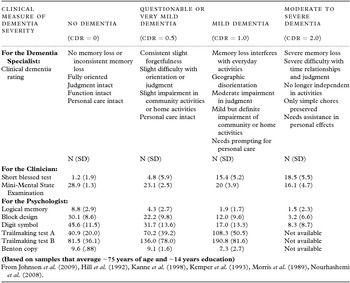
Consensus among national medical, transportation, and elder advocacy societies is that drivers with moderately severe dementia should not drive. Unfortunately, clinicians are rarely taught how to assess dementia severity and would be hard pressed to quantify or rate patients with a moderate dementia. The CDR, used more in research than in clinical practice, takes specialized training and often takes 45 minutes or more to complete, rendering it often impractical for many office settings. Although there are limitations to the use of psychometric testing in assessing dementia severity, specific scores on global psychometric cognitive screens or specific tests may give useful ranges that could place drivers in “at-risk” categories (see Table 1).
Association of global cognitive screens and psychometric tests with dementia severity levels

Co-morbidities and medications
The influence of multiple medical illnesses or co-morbidities on further impairing driving ability in patients with dementia has not been well studied, but should be considered when evaluating driving competency. A comprehensive publication in the past five years summarizes the extensive literature on medical conditions and crash risk (Charlton et al., Reference Charlton2010). However, many medical conditions have not been studied.
Medical conditions that are age-related and associated with impaired driving ability – but which also hold the potential for remediation – include: diseases affecting vision (e.g. macular degeneration, glaucoma, cataracts); cardiovascular diseases (e.g. implantable defibrillators, arrhythmias); respiratory diseases (e.g. COPD, sleep apnea); neurologic diseases (e.g. AD, multiple sclerosis, stroke, Parkinson disease); psychiatric diseases (e.g. psychosis, anxiety, depression); metabolic diseases (e.g. hyper or hypoglycemia); and musculoskeletal diseases (e.g. cervical arthritis with restrictive range of motion). Medications should be reviewed and sedating drugs discontinued if safer alternatives exist. It has been difficult to consistently show associations between some drug classes and driving impairment. The gap between theoretical and real risk has recently been illustrated in a major European study, which showed reduced crash risk with antihistamines and another that showed only significant risk with the use of benzodiazepines (Orriols et al., Reference Orriols2009). Yet, a recent evidenced-based review did find many associations of driving impairment with certain medications and these should be avoided or minimized when operating a motor vehicle especially in older adults with cognitive impairment: sedating antihistamines, antipsychotics, tricyclic antidepressants, bowel/bladder antispasmodics, benzodiazepines, muscle relaxants, and narcotics (Hetland and Carr, 2014).
Psychometric tests
Studies regarding the utility of global cognitive measures like Mini-Mental State Examination (MMSE) for estimating driving impairment have been mixed (Fitten et al., Reference Fitten1995; Lesikar et al., Reference Lesikar, Gallo, Rebok and Keyl2002). Although the MMSE may correlate with degree of driving impairment on road tests and history of crashes, it does not appear to predict future involvement in crashes and valid cut-off scores have not been defined (Molnar et al., Reference Molnar, Patel, Marshall, Man-Son-Hing and Wilson2006). Given its limitation in predicting performance, we do not recommend the MMSE for determining driving privileges. However, the scores can provide a rough estimate of dementia severity and possibly at-risk driving (e.g. need for further assessment) given known limitations for race, education, sensory deprivation, etc.
In 2004, a meta-analysis of neuropsychological tests of driving performance in patients with dementia concluded that tests of visuospatial skills are the most relevant predictor of driving impairment (Reger et al., Reference Reger, Welsh, Watson, Cholerton, Baker and Craft2004). More recently, visuomotor and executive function tests such as Trailmaking Tests and maze completion (Whelihan et al., Reference Whelihan, Carlo and Paul2005; Ott et al., Reference Ott, Festa, Amick, Grace, Davis and Heindel2008a) have been associated with driving impairment in older adults with dementia. One study that evaluated a dementia education program modeled after the American Medical Association older driver curriculum suggested that physicians may be willing to adopt such tests (Meuser et al., Reference Meuser, Carr, Berg-Weger, Niewoehner and Morris2006). Psychometric tests may serve to identify drivers at-risk (e.g. those that may warrant further evaluation by a performance-based road test), but should not be the sole determinants in deciding to continue or revoke driving privileges (Freund, Reference Freund2006; Molnar et al., Reference Molnar, Patel, Marshall, Man-Son-Hing and Wilson2006). This was recently confirmed in an article showing the lack of predictive value for prospective crashes in older adults that completed the MMSE (Joseph et al., Reference Joseph2014).
However, some recognize that standard clinical psychometric tests have little congruence with modern models of driving behavior (Fuller, Reference Fuller2005) and a number of innovative approaches have been developed which seek to draw on these insights, including the Adelaide Driving Self-Efficacy Scale (George et al., Reference George, Clark and Crotty2007) and a scale of strategic and tactical compensation outlined by de Raedt in 2000 (De Raedt and Ponjaert-Kristofferson, 2000). However, neither of these approaches has yet been tested for utility with drivers with dementia.
Referral
In the absence of a gold standard or consensus for determining driving competency, clinicians may request assistance from a driving clinic or refer to other subspecialists in the community such as a geriatrician, psychiatrist, neurologist, or neuropsychologist. A Driver Rehabilitation Specialist (DRS) evaluates, develops, and implements driving services for individuals with disabilities. DRSs in the US are often occupational therapists with additional training in driver evaluation, vehicle modification, and rehabilitation. Occupational therapy practice guidelines for these evaluations have been published, but a recent review of practices across the US and Canada indicates assessments vary significantly across programs and few have adopted standardized tools (Korner-Bitensky et al., Reference Korner-Bitensky, Bitensky, Sofer, Man-Son-Hing and Gelinas2006). A European project found similar results (Middleton et al., Reference Middleton, Westwood, Robson, Kok and Underwood2005). In addition, there are relatively few DRS's trained and available in smaller communities.
A driving evaluation in the US costs approximately $350–$800 and is generally an out-of-pocket expense, but the situation varies in other countries. Clinicians who are interested in this service can contact the occupational therapy departments in local hospitals or rehabilitation centers or the ADED directory (see, online Web resources). Many local chapters of the Alzheimer's advocacy organizations (such as the Alzheimer's Association in the USA) may provide referral sources for area driving evaluation programs.
A performance-based road test for drivers with dementia could be considered to assist with risk stratification when; (a) there is observation of new impairments in traffic skills (e.g. near misses, failure to scan, etc.), (b) prominent impairments in key cognitive domains (e.g. attention, executive function, visuospatial skills), and/or (c) the presence of a mild dementia severity rating (≥ CDR = 1). Private or university-based driving clinics may not available to everyone, but many driver licensing authorities can provide or facilitate on-road tests: in the USA, every state Department of Motor Vehicles (DMV) conducts such tests. In Europe, there is a much broader range of options through state, not-for profit, and private organizations (Sanders et al., Reference Sanders2006).
A review of this topic concluded there was no evidence to demonstrate the benefit of driving evaluations with respect to the preservation of mobility or a reduction in crashes (Martin et al., Reference Martin, Marotolli and O'Neill2009). Yet, a recent longitudinal study noted crash rates for drivers with dementia declined to the levels of healthy control drivers during a period of 3 years when evaluated with road tests every 6 months (Ott et al., Reference Ott2008b). This finding was probably due to the removal of AD drivers who had failed road tests and were no longer driving and/or to changes in behavior of AD drivers who continued to drive.
Mobility counseling
Patients may stop driving based on physician advice (Persson, Reference Persson1993). There is little data to suggest that clinicians should recommend reducing exposure in patients with dementia (e.g. limiting trips) or mandating a co-pilot to significantly reduce driving risk. In fact, data would suggest the older drivers at highest risk for a crash are the infrequent drivers that are on the road less than 3,000 km (2,000 miles) a year (Langford et al., Reference Langford, Methorst and Hakamies-Blomqvist2006). Two recent education interventions for health professionals were positively associated with improving communication when discussing driving with patients with dementia and/or using tools that might be of helpful in the assessment process (Byszewski et al., Reference Byszewski2003; Meuser et al., Reference Meuser, Carr, Berg-Weger, Niewoehner and Morris2006).
Driving cessation has been associated with a decrease in social integration (Mezuk and Rebok, 2008), decreased out-of-home activities (Marottoli et al., Reference Marottoli, de Leon, Glass, Williams, Cooney and Berkman2000), an increase in depressive and anxiety symptoms in the elderly (Fonda et al., Reference Fonda, Wallace and Herzog2001), and an increased risk of nursing home placement (Freeman et al., Reference Freeman, Gange, Muñoz and West2006). Thus, a recommendation to stop driving should not be taken lightly by the clinician. Often, the situation is not urgency and there is time to work through the process of mobility loss. The brochures “We Need to Talk” and “At the CrossRoads” from The Hartford Foundation (see Web resources) could enhance communication with the patient, their families, and their clinicians and assist the patient and the family member to reach important driving decisions and maintain linkage with key destinations. Educational interventions with these materials and group meetings may be effective ways to prepare caregivers for dealing with this difficult issue (Stern et al., Reference Stern2008). Referral to social workers or gerontological care managers may provide important local and regional transportation options. Caregiver support groups for families also have proven efficacy with driving cessation (Dobbs et al., Reference Dobbs, Harper and Wood2009). Finally, the Independent Transportation Network (ITN) America is a model program that assists seniors with transportation to needed destinations and now has many sites across the US (see Web resources).
The physician's legal and ethical obligations
Many physicians are uncertain of their legal responsibility to report unsafe drivers to the state or local licensing authorities (Miller and Morley, 1993; Kelly et al., Reference Kelly, Warke and Steele1999). In Europe, all jurisdictions rely on reporting by the driver or family, with third-party reporting the exception from a physician. The AMA's policy states, “in situations where clear evidence of substantial driving impairment implies a strong threat to patient and public safety, and where the physician's advice to discontinue driving privileges is ignored, it is desirable and ethical to notify the DMV” (American Medical Association, 1999). Obviously, it is preferred that referrals to the license authority be done with the patient's knowledge, and that the report be documented in the medical record. However, many primary care physicians, fearing the deterioration of a long-standing relationship with their patient, may be reluctant to be this forthcoming. If a physician decides to report an unsafe driver, most jurisdictions in the US will accept a formal letter.
Physicians may be in a “double bind,” concerned that they will be liable for breach of confidentiality, but also fearing legal action if they fail to report an unsafe cognitively impaired driver who is involved in an injurious crash. Most legal experts land on the side of reporting where the physician believes that the patient and community are at high risk for a crash. Since laws and regulations on driving often change, clinicians should review their laws, statutes, and regulations in their own jurisdiction to determine current requirements. Development of specific policies regarding reporting should be vetted by legal advice. In jurisdictions with voluntary reporting laws, we recommend formal referral to the driver licensing authority for refractory cases or for those patients deemed to be at a very high risk for a crash and/or injury.
Studies are needed to compare the benefits and costs of mandatory reporting to driver licensing authorities with voluntary reporting, although studies in other illnesses are not supportive of mandatory reporting (McLachlan et al., Reference Mclachlan, Starreveld and Lee2007). Decision analysis studies have not shown the benefits of systematically screening and evaluating drivers with dementia (Retchin and Hillner, 1994; Leproust et al., Reference Leproust, Lagarde and Salmi2008). Some studies have noted positive impact on driving of cognitive stimulation (Edwards et al., Reference Edwards, Wadley, Vance, Wood, Roenker and Ball2005) and exercise interventions on older adults (Marmeleira et al., Reference Marmeleira, Godinho and Fernandes2009), although these studies were not performed in patients with dementia. Intervention studies are needed in the earliest stages of the disease to determine whether driving could be maintained safely. As the baby boom generation comes of age, there will be a pressing need to develop comprehensive interventions to maintain driving life expectancy and to develop alternative transportation systems for our cognitively impaired older drivers. The new era of smart cars and smart roads may be of assistance to those older adults with cognitive and/or physical frailty as they try to navigate down the road in the future.
Conflict of interest
Dr Carr has support from the NIA, Missouri Department of Transportation Division of Traffic and Highway Safety. He has been a paid consultant for the American Medical Association Older Driver Project, ADEPT, TIRF, and Medscape in the past two years. Prof O’Neill is Director of the National Programme Office for Traffic Medicine, Ireland.
Description of authors’ roles
Each author wrote paragraphs, reviewed the literature, and modified each other's contributions.
Web Resources on Dementia and Driving (All accessed 04/12/15)
1. General guidelines for the clinician that include dementia and additional medical conditions
a. CMA Fitness to Drive
b. Austroads Fitness to Drive
https://www.onlinepublications.austroads.com.au/items/AP-G56-13
c. Irish Medical Guidelines
d. AMA Older Driver Curriculum on AGS website
2. For difficult cases, consider referring to a driving rehabilitation specialist
a. AOTA
b. Association of Driver Rehabilitation Specialists: ADED
3. For refractory cases, consider referral to Department of Revenue or your Countries License Authority
a. Summary of United State Guidelines
http://www.iihs.org/iihs/topics/laws/olderdrivers?topicName=older-drivers
4. Consider Web Resources and/or Office Handouts
a. We Need to Talk and At the Crossroads
http://www.thehartford.com/mature-market-excellence/publications-on-aging
b. Alzheimer's Association: Dementia and Driving Resource Center
5. Transportation Alternatives/Social Workers, Case Managers or Local Area on Aging.