Background
Prehospital care is an essential component of an emergency care system, providing a key link between the setting of an acute event and care. Reference Thind, Hsia, Mabweijano, Hicks, Zakariah and Mock1 Up to 54% of the 45 million deaths each year in low- and middle-income countries (LMICs) are potentially addressable by prehospital and emergency care. Reference Thind, Hsia, Mabweijano, Hicks, Zakariah and Mock1 Many of these lives can be saved with simple and inexpensive emergency care interventions, some of which can be performed by prehospital care providers, first responders, and lay rescuers. Reference Reynolds, Sawe, Rubiano, Shin, Wallis, Mock, Jamison, Gelband and Horton2 Establishing or strengthening prehospital systems in these settings has reduced mortality. Reference Thind, Hsia, Mabweijano, Hicks, Zakariah and Mock1,Reference Kobusingye, Hyder, Bishai, Hicks, Mock and Joshipura3,Reference Sasser, Varghese, Kellermann and Lormand4
However, significant barriers to prehospital care exist in LMICs, including communication, transportation, and training. Reference Kironji, Hodkinson and de Ramirez5-Reference Nielsen, Mock, Joshipura, Rubiano, Zakariah and Rivara7 As Emergency Medicine (EM) specialist training programs continue to emerge in LMIC settings, engaging these emergency physicians will be critical to regional prehospital care system development, which function most effectively with emergency physician leadership. Reference Sasser, Varghese, Kellermann and Lormand4,Reference Nielsen, Mock, Joshipura, Rubiano, Zakariah and Rivara7,8 Educating residents in prehospital care systems strengthens collaboration between the prehospital and facility-based components of the emergency care system while generating potential physician leaders in prehospital care. Reference Verdile, Krohmer, Swor and Spaite9
Residency training programs in EM are rapidly growing in number and size in LMICs, producing emergency physicians who often take prominent roles in their regional prehospital systems. No standardized prehospital care rotation exists among these residency programs, and existing curricula for resident training in prehospital care systems in the United States and other high-income countries (HICs) may not be applicable to these lower-resourced settings.
In Haiti, the first EM residency was created in 2014 at the Hôpital Universitaire de Mirebalais (HUM; Mirebalais, Haiti), a public teaching and referral hospital in Central Haiti, two hours from Port-au-Prince. The residency is three-years long and has six residents per year. Although there is a fragmented prehospital care system in Port-au-Prince led by the government and nongovernmental organizations, no formal prehospital care system exists in Mirebalais despite a significant burden of trauma and delayed access to emergency care. Reference Rouhani, Eliacin, Edmond, Checkett, Rimpel and Marsh10 The hospital does operate basic ambulances, which consist of a vehicle with a compartment for patient transport and a stretcher, but no equipment for monitoring or treatment. The vehicles are used primarily for intra-facility transfer and are typically staffed by a driver only. Occasionally, nurses are sent to monitor patients between facilities. Though not their official mandate, drivers sometimes transport patients from the scene of an accident or from home to the hospital despite a lack of training and equipment. This paper discusses the development and implementation of a rotation in prehospital care for senior EM residents in the HUM program, which could serve as a model for other LMIC EM residency programs.
Methods
A needs assessment of the residency education program at HUM performed in anticipation of applying for Accreditation Council for Graduate Medical Education (ACGME; Chicago, Illinois USA) international accreditation revealed the need for prehospital education and experience. A four-person committee consisted of the HUM EM residency director, two HUM EM faculty, and a visiting faculty member with experience in prehospital education and practice. First, existing prehospital curriculum guidelines in HICs were reviewed along with existing prehospital educational resources for EM residents in both HICs and LMICs with the aim of adapting them to the Haitian context. Second, regional partners in Haiti were identified and contacted to participate in the rotation by providing training to the residents and experiential ride-alongs. Third, a didactic curriculum specific to the Haitian context was developed. Fourth, leadership training opportunities were developed which included residents training non-medical hospital staff in emergency care and creating emergency care protocols and manuals.
After reviewing existing prehospital curricula, no published curricula specific to resident physicians in LMICs were identified. However, the ACGME does have requirements for a prehospital experience, which include: (1) ground unit ride-along experience; (2) medical control experience; and (3) participation in multi-casualty drills. 11 As a result, 73.5% of US EM residency programs include a designated prehospital rotation, and nearly all require some level of field exposure for residents. Reference Katzer, Cabanas and Martin-Gill12,Reference Gottlieb, Arno, Kuhns and Chan13 The ACGME has also developed additional program requirements for physician subspecialty training in prehospital care. 14 The model curriculum for EM residents in the US developed by the Society for Academic Emergency Medicine (Des Plaines, Illinois USA) Emergency Medical Services (EMS) Committee was reviewed along with the African Federation for Emergency Medicine (AFEM; Cape Town, South Africa) curriculum for prehospital care. Reference Verdile, Krohmer, Swor and Spaite9,15
Existing prehospital resources in Haiti were assessed to understand the local context and opportunities for partnership. Three organizations were identified and engaged: the Centre Ambulancier National (CAN; Port-au-Prince, Haiti); the Haiti Air Ambulance (HAA; Delmas, Port-au-Prince, Haiti); and HERO Ambulance (Pétion-Ville, Port-au-Prince, Haiti). In addition, the transport department at HUM was engaged to better understand the ambulance mission, current utilization, and future goals. First, CAN is a Basic Life Support capable municipal ambulance system in Port-au-Prince operated by the Ministry of Public Health and Population. It operates ambulances staffed by emergency medical technicians and the center receiving calls to the national emergency number, 116. Second, HAA is a nonprofit foundation that operates an emergency medical helicopter service in Haiti staffed by a physician, nurse, and paramedic team. Last, HERO is a crisis response and risk management company in Haiti that operates an ambulance in the Port-au-Prince area on a contractual basis. Ride-along opportunities were developed with each organization, allowing the residents to experience prehospital care firsthand. Residents participated in the medical support of mass-gathering events, such as Carnival. Generally, HAA provided didactic training on aeromedical care and CAN allowed residents to observe in its emergency call center.
The didactic portion of the rotation was designed to improve resident knowledge of the history of prehospital care, prehospital care delivery models, scope of practice, protocol development, medical control, communications, oversight, documentation, and policy. Standard readings and lectures appropriate to the Haitian context were developed. Readings were assigned from the AFEM Handbook and relevant journal articles and are listed in Table 1. Reference DeGennaro, Owen, Chandler and McDaniel16-Reference Wallis and Reynolds18 This was taught in English and French.
Schedule and Reading Materials for the Prehospital Rotation

Abbreviations: CAN, Centre Ambulancier National; HUM, Hôpital Universitaire de Mirebalais.
Residents on the rotation developed leadership skills by teaching prehospital providers, developing a prehospital protocol collection, and writing a training manual. Each resident’s rotation included leading a four-hour training course for the HUM ambulance drivers. This represented the drivers’ first training in prehospital care. Residents adapted materials from the French language version of the World Health Organization (WHO; Geneva, Switzerland) Emergency Triage Assessment and Treatment course to develop the training modules for the drivers and taught the course in Haitian Creole. 19 Based on early feedback from the drivers, the rotation was adapted to include the development of a prehospital protocol collection and a prehospital manual in Haitian Creole for their use.
To pass the rotation, residents would have to attend all sessions, complete their assigned protocol and their assigned chapter in the prehospital manual, and submit all feedback and survey forms. Ambulance crews were encouraged to complete feedback forms on the residents. Residents would be supervised throughout the rotation by a visiting EM attending physician familiar with the Haitian context, who has prehospital expertise and a longitudinal relationship with the HUM EM residency program. Formal resident evaluations were completed by the supervising attending physician. This study was developed in accordance with and follows the principles of the Declaration of Helsinki.
Results
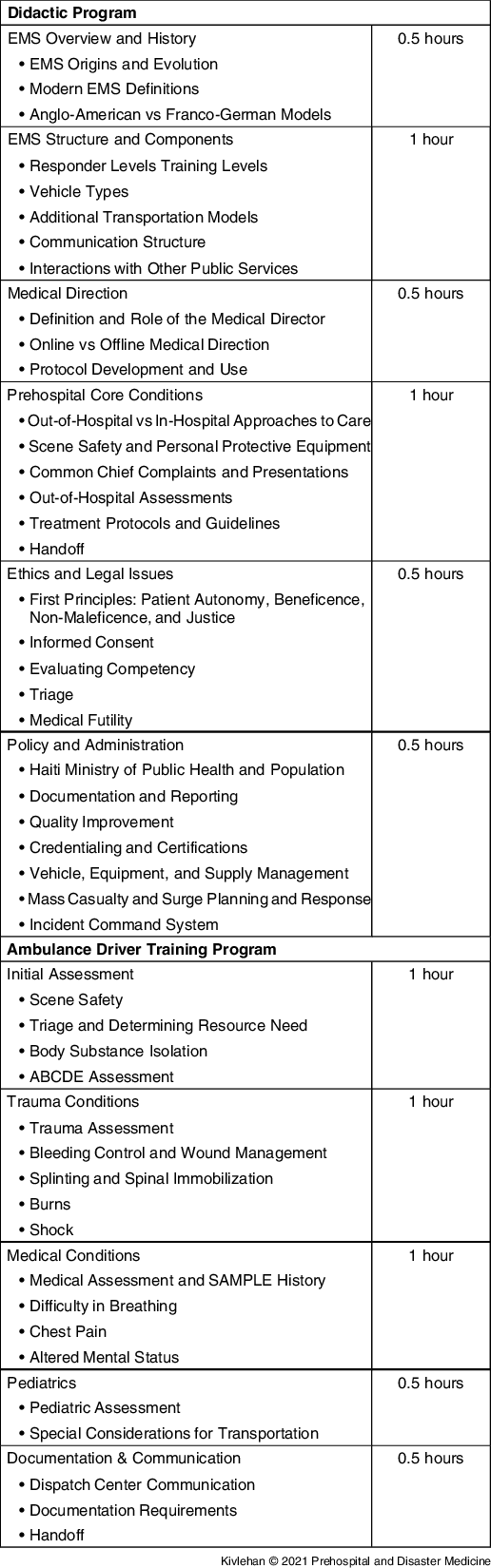
A week-long rotation was incorporated into the schedule of the third-year residents; no more than one resident was on the rotation at a time. The 40-hour curriculum included four hours of didactics, four hours of teaching, four hours observing the CAN communications center, four hours of teaching and observing at HAA, and 24 hours of ambulance ride-alongs (Table 1 and Table 2). Residents spent an additional eight hours completing assigned readings and writing the protocol and manual chapter. Transportation to the various rotation sites was provided by HUM’s transportation department.
Detailed Curriculum for Didactic and Ambulance Driver Training Program

Abbreviation: EMS, Emergency Medical Services.
Despite logistical challenges due to transportation or scheduling with the various agencies, all residents completed the full rotation by the end of their academic year. Six prehospital protocols (ABCDE, Difficulty in Breathing, Bleeding Control, Trauma, Choking, and Airway) and six prehospital manual chapters (ABCDE, Difficulty in Breathing, Shock, Trauma, Altered Mental Status, and Chest Pain) were successfully developed.
The rotation was well-received by the residents and the host organizations, both of whom felt that the experience met educational objectives in standard residency response surveys. A majority of respondents reported desiring additional field time, in response to which the rotation was expanded to two weeks after the first year. Residency graduates now work supporting or collaborating with the Haitian prehospital system in various ways. Leadership of the rotation transitioned from a visiting EM attending to a newly graduated Haitian EM attending with an interest in EMS specialty development after a year-long mentoring process.
Discussion
The rotation successfully filled a gap in education for the EM residents of Haiti and has potential to be a model for other EM specialist training programs in LMICs. Several lessons were learned in the first two years of this rotation which can inform future efforts:
-
The rotation must be designed within the local context of both prehospital and facility-based emergency care. Scope of practice, protocols, and medical direction should cover only available equipment and resources. For example, specialty referral to STEMI or stroke centers were removed as these do not exist in Haiti.
-
Engagement of local stakeholders is crucial for success. A champion within each organization was identified early and included in the development process. This facilitated open and frequent communication between stakeholders, which allowed adaptation to scheduling changes and logistical hurdles.
-
Expect logistical challenges in lower-resourced settings. Last-minute schedule changes were frequently required due to vehicle issues, road closures, or security concerns. To prepare for this, back-up programming was developed for residents if travel to an off-site location could not occur.
-
Staffing changes and turnover at host sites can disrupt institutional memory. It is important to have clear communication with organization leadership and established agreements that can be referred to by new staff.
-
Flexibility in course delivery methods is required. Language barriers, slow internet, and unreliable equipment availability required adaptation of lectures and skills training. Most ambulance drivers spoke only Haitian Creole, so residents translated and adapted materials from English and French. Lectures were prepared to be given on either laptops or dry erase boards if projectors were unavailable. Lectures were shared on thumb drives, as large files or videos could not reliably be downloaded. Low-fidelity simulation techniques were used to avoid cancellation from lack of equipment.
Limitations
Limitations of the curriculum development include the size of the development committee. Future prehospital care curriculum development efforts for EM residents in LMICs should involve consensus building with a large and diverse group of experts in the field. The implementation was limited by the described logistical challenges, which should be anticipated and planned for in future efforts. Assessment of the rotation’s impact and effectiveness is limited by a lack of patient outcome assessment and only subjective assessment of and feedback from participants. The detailed course program was adapted from open-access and published material and is available upon request for programs considering similar implementations.
Conclusion
As EM continues to grow as a recognized specialty around the world and the number of specialist training programs increase, there is an opportunity to directly engage and influence prehospital care systems. Incorporating a prehospital curriculum into resident education can improve physician understanding of and engagement with prehospital systems and prepare them to be leaders in this field. The curriculum described here can be adapted to other EM residency programs in LMICs by identifying and engaging regional stakeholders, maintaining flexibility around logistical challenges, and recognizing the importance of the local context.
Acknowledgements
The authors would like to acknowledge the organizations that hosted and trained residents, including Centre Ambulancier National (CAN), the Haiti Air Ambulance (HAA), and HERO Ambulance, as well as the Hôpital Universitaire de Mirebalais (HUM) medical education department for their support.
Conflicts of interest
All authors report no conflicts of interest.