

The Pueblo of Pojoaque is one of six present-day Tewa communities in the Northern Rio Grande region of New Mexico. The other five villages are Nambé, Tesuque, San Ildefonso, Santa Clara, and Ohkay Owingeh. The six villages are distinct but interrelated through history, culture, ceremony, and social systems. All are robust, vibrant communities with strong, indelible, and continuous linkages to their past and dynamic ceremonial lives that connect them to their landscape and history. The proper Tewa name for the Pueblo of Pojoaque is P'osuwäegeh'ówîngeh, “the water-drinking” or “gathering” village place. Pojoaque people and their ancestors have resided in this area since about AD 900.
For the past six years, the Pueblo of Pojoaque and the University of Colorado Boulder (CU Boulder) have been working together to investigate ancestral sites on and adjacent to Pojoaque land. Through our partnership, we believe we have learned some important lessons about the potential of archaeology for tribal communities, how archaeologists and tribal members can work together as coinvestigators, how such partnerships improve archaeological practice, and how the incorporation of traditional knowledge leads to better archaeology in both its humanistic and social-scientific dimensions. In this article, we share the story of our partnership, consider how it relates to existing perspectives on archaeology and Native communities, present a few results from our work at K'uuyemugeh (an ancestral Pojoaque and Tewa village), and offer some reflections from several years of attempting to put a partnership model into practice.
Our partnership began in 2014 when the senior author, in his capacity as Tribal Historic Preservation Officer, invited the junior author to help the Pueblo develop a heritage program focusing on ancestral sites of the Pojoaque area. Due to repeated episodes of dispersal and resettlement since the 1600s, knowledge of ancestral places among Pojoaque people had become similarly dispersed, and there was a need to regather this information as part of the Pueblo's broader efforts to recultivate its Tewa traditions. Due to this unfortunate history and Pueblo sovereignty, the tribal leadership felt it was important to document the physical evidence of Pojoaque history to assist the Pueblo in its interactions with diverse communities in northern New Mexico. In addition, since the time of its most recent reconsolidation in the 1930s, the Pueblo's population has increased from six families to more than 500 people, with approximately 40% under the age of 18. The leadership consequently recognized a need to expand knowledge of ancestral sites on Pueblo land so that future land use could be managed in culturally appropriate ways.
From the beginning, it was recognized that a land-based program would provide the broadest appeal among tribal members because there is a deep respect for and understanding of the land among Pojoaque people, and it is experienced in tangible ways at both the personal and the community level. Tribal members know their land from walking over it, being warned as children not to go to certain places, or by hearing stories that are associated with places—a way of relating to the land that is described by Keith Basso (Reference Basso1996) in his work with White Mountain Apache people. So, although the Pueblo recognized the need for an archaeologist partner, the purpose of the program would not be to “discover” ancestral sites through archaeology. Instead, the primary purpose would be to visit, document, discuss, and learn from ancestral sites in ways that would benefit the community. And an additional purpose would be to promote a form of archaeology through which the Pueblo could recognize itself in the work of outside scholars. It was hoped the program would reorganize, reorient, and change traditional anthropological practices and methodologies as they concern and affect Native communities.
Despite their proximity to contemporary non-Native populations and their location at the epicenter of European colonialism in what is now New Mexico, Tewa communities, including Pojoaque, are famously resistant to anthropologists. Of the six villages, only Santa Clara and San Ildefonso have been the subjects of traditional ethnographies (Hill Reference Hill1982; Whitman Reference Whitman1947). Archaeological work has also been highly restricted, due in no small part to the arrogance of early investigators. Given this legacy, one way to frame our partnership is as a step along a path that seeks to prove the value of archaeology to a living Tewa community. Although the project makes use of the material culture of anthropology—publications, photographs, and collections—it does so in a way that is consistent with the values of being responsible, respectful, and of use to the community.
As the authors discussed the structure of the program with other community members, it came to have several goals. First and foremost, we hoped it would increase awareness of local ancestral sites among tribal members. Second, we hoped a broader base of experience with local ancestral sites would strengthen the historical consciousness of the Pueblo. Third, we wanted to provide both University of Colorado students and Pueblo youth with experiences and examples of the way archaeology can contribute to the welfare of descendant communities as well as the larger world. Fourth, we wanted to combine informal science education with traditional education by elders to help Pueblo youth imagine STEM-based careers that are relevant in the community. Finally, we felt it was important that the program take both archaeological evidence and traditional knowledge seriously and seek to integrate it in telling the stories of local Tewa communities.
In planning the program, we recognized that for some of the university students, it would be their first time interacting directly with Native people. For those who would not go on to become professional archaeologists, our goal would be to promote understanding of and respect for Native communities and their perspectives on ancestral sites. For those who did decide to pursue archaeology as a career, our goal would be to provide a model for building and sustaining productive working relationships as an essential part of archaeological work. We also recognized that similar circumstances existed from the tribal point of view. For most tribal members, prior experiences with anthropologists and archaeologists had been limited to repatriation meetings, or to road-building and oil-and-gas exploration on Native lands. Pueblo people are understandably reluctant to participate in archaeology because of its reputation of disturbing ancestral sites and removing human remains and large volumes of materials and framing questions that are of little interest to Pueblo people, as well as the unavailability and opaqueness of methodologies and terminology in recording, reporting, and synthesizing its findings. Most had not seen any of the museum collections removed from ancestral sites on their land or been exposed to question-driven archaeological research. Consequently, building positive relationships with archaeologists and gaining a fine-grained understanding of archaeological research were also viewed as important. Moreover, the values of the work and the accessibility of informal and formal presentations would occupy a large space at its center.
THE K'UUYEMUGEH PROJECT
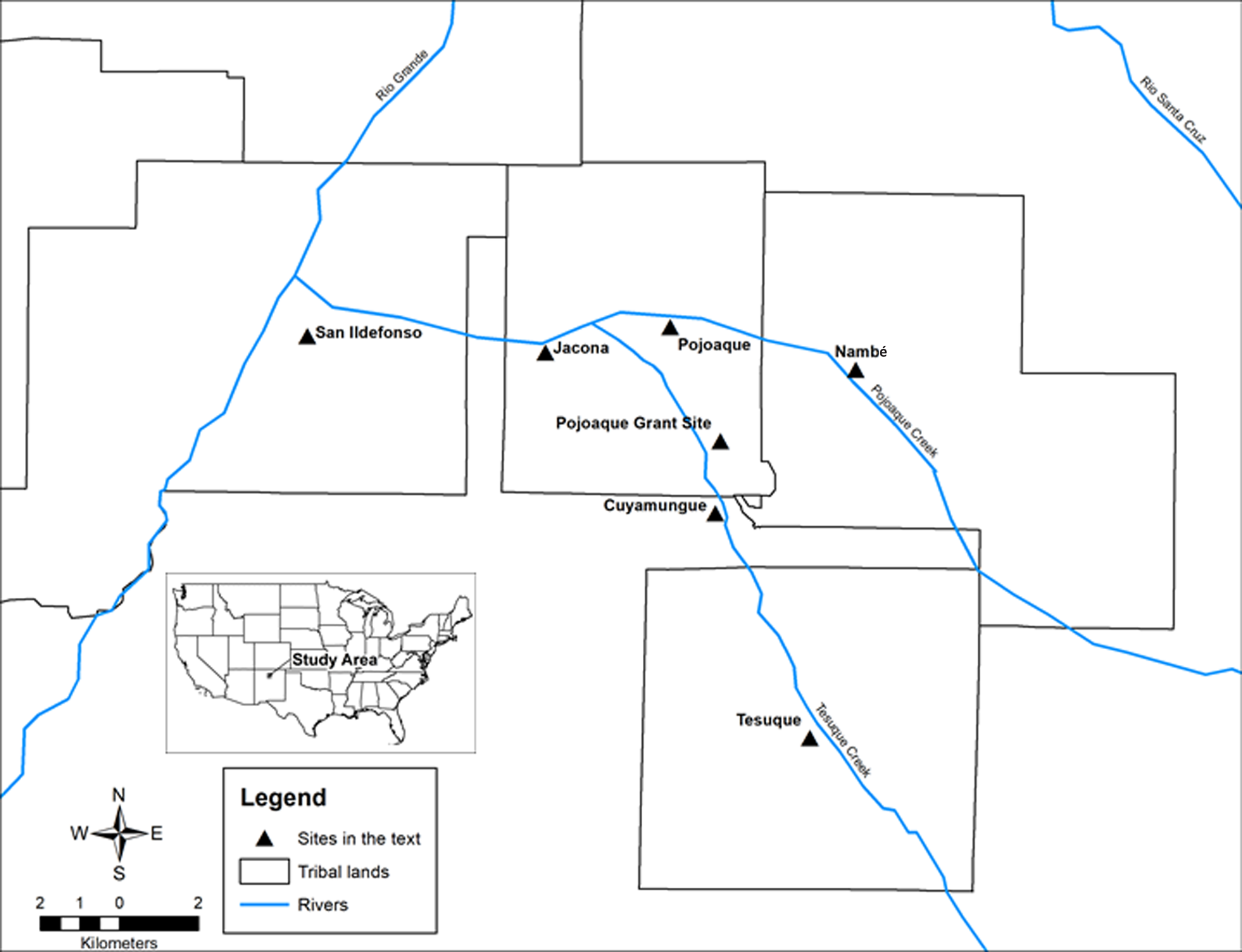
When Pueblo of Pojoaque Lt. Governor (now Governor) Joseph Talachy and Bernstein began discussing the idea of a land-based heritage program, interest quickly turned to Cuyamungue, an ancestral village immediately south of the Pojoaque land-grant boundary, as an appropriate initial location (Figure 1). Several factors made this an obvious choice.
The Pojoaque area, with locations of sites mentioned in the text.

Cuyamungue—or more properly, K'uuyemugeh in Tewa—is an ancestral site for which archaeological, historical, and traditional Tewa information is readily available. Its location adjacent to a major thoroughfare also makes it an important signpost for everyone who drives north from Santa Fe. As the highway descends to Pojoaque, one sees signs with the word “Cuyamungue” written on them. Most people are not aware that this is a Hispanicized version of the Tewa name and not a Spanish word.
An additional consideration was the popular and highly successful marketing campaign by the Georgia O'Keeffe Museum that labels the area north of Santa Fe in New Mexico as “O'Keeffe Country.” This is distasteful from a Native perspective in the sense that an early twentieth-century American artist who had lived in the area for only a few decades had thousands of square miles named after her, while the Native people who have lived in the region for more than a millennium are overlooked. In their view (and ours), this land is more properly referred to as “Tewa Country.”
Finally, the histories of Cuyamungue and Pojoaque are closely connected. The Spanish arrival brought diseases and epidemics that decimated Tewa communities across the region. Spanish greed for land and water also negatively affected Pueblo agriculture and social systems. In this process, the fertile Pojoaque valley, with its many springs at the confluence of the Pojoaque and Tesuque Rivers, was especially prized, and following the reconquest, the native population was largely replaced by a Spanish population. The close proximity and intrusiveness of the Spanish deprived Pojoaque people not only of land but also of privacy for their religious activities. It was not until the 1930s that the population decline was reversed, and it was not until the 1970s that cultural activities were reinaugurated.
Cuyamungue was the first land grant given to Spanish settlers by Don Diego de Vargas upon the reconquest of New Mexico in 1694. During the second revolt, four of the eight remaining Tewa villages emptied in their efforts to resist Vargas. In 1706, 10 people returned to Pojoaque, but none returned to Cuyamungue. Today, the Spanish settlement of Cuyamungue lies adjacent to the ancestral site, an in-holding within the Pueblo of Pojoaque land-grant boundary. Standing at Cuyamungue is, therefore, a history lesson: What happened to the Tewa people who lived here? Why did Tewa people return to Pojoaque but not to Cuyamungue? Close to home but secluded, Cuyamungue is a preeminent location for discussing Tewa history, science, and cosmology.
The K'uuyemugeh project was conceived as a means of returning these lands to the intellectual and cultural capacities of the Pojoaque and larger Tewa community. The project would restore Tewa presence by gathering and advancing the knowledge of archaeology, history, and present-day Tewa people. It would also increase Pueblo cultural capacity by assisting with the regathering of its dispersed cultural patrimony and inserting its authority in telling its own story. To do so, the village would need to delve into the anthropological world, recontextualizing, translating, and transliterating work that has often been unrecognizable to Tewa people. This process would allow the conversation to shift to a more inclusive frame that expanded parameters and boundaries for both the Native and non-Native communities.
The first step in making the project a reality was to secure the proper permissions. Since 1962, the land on which K'uuyemugeh sits has been owned by the Cuyamungue Institute, a private organization founded by anthropologist Felicitas Goodman. Paul Robear and Laura Lee, its current directors, are excellent stewards, protecting the site from looters and other non-Native use. When approached, Robear and Lee welcomed the Pueblo and were supportive of noninvasive research at the site. With their support in hand, Talachy and Bernstein made a brief reconnaissance with several staff from Pojoaque's tribal museum in late 2013. The following January, Tewa cultural leadership granted permission for archaeologists to visit the ancestral site. The K'uuyemugeh project, along with the partnership with CU Boulder, began to take shape following this meeting.
PARTNERSHIP AS A MODE OF RELATIONSHIP
The K'uuyemugeh project involves archaeologists and Native people working together in partnership. Anthropology has struggled with the level of involvement ethnographic “subjects” should have in research, but we have found such involvement is much more comfortable in the context of archaeology because the “subject” of the research is communities of the past, and both present-day tribal members and archaeologists have knowledge and skills that can be applied to understanding them. Although tribal members are engaging with their own ancestors through this process, and Tewa cosmologies are largely unchanged from the past, it is also clear to everyone that Native life has changed over the centuries. So at least in one sense, tribal members are not studying themselves; rather, they are learning about the lives of their ancestors and expanding their understanding of how the present-day community came to be.
The literature on ethics and collaboration in archaeology extends far beyond the boundaries of the United States (Hamilakis and Duke Reference Hamilakis and Duke2007; Schmidt and Kehoe Reference Schmidt and Kehoe2019), and we could not hope to do justice to it here. We also do not want to oversell what we are doing because, in many ways, our approach responds to the local particularities of the Northern Rio Grande. But we can comment on how our approach relates to the literature on working with Native Americans. Thanks to writers such as Chip Colwell (Colwell-Chanthaponh Reference Colwell-Chanthaponh2010; Colwell-Chanthaponh and Ferguson Reference Colwell-Chanthaponh and Ferguson2008), T. J. Ferguson (Reference Ferguson and Mills2004; Ferguson et al. Reference Ferguson, Koyiyumptewa and Hopkins2015), Robert Preucel (Reference Preucel2002), Sonya Atalay (Reference Atalay2012), and others (Hegmon and Eiselt Reference Hegmon, Sunday Eiselt, Hegmon and Eiselt2005; Liebmann and Rizvi Reference Liebmann and Rizvi2008; Wylie Reference Wylie, Cartwright and Montuschi2014), archaeologists have a rich set of concepts for discussing the various forms such relationships can take. Here, we discuss how our work relates to, but is also distinct from, these other ideas.
Although individual Native people have been involved in archaeology in the U.S. Southwest for a long time, prior to 1990, archaeologists generally did not give much thought to the relevance or impact of their work for Native communities, leading to the justified critique that archaeology was merely an extension of colonialism (Colwell-Chanthaponh Reference Colwell-Chanthaponh2010; Liebmann and Rizvi Reference Liebmann and Rizvi2008; Nicholas and Hollowell Reference Nicholas, Hollowell, Hamilakis and Duke2007). Passage of the Native American Graves Protection and Repatriation Act in 1990 changed this situation, initiating a decolonizing process that continues to this day. An initial response by archaeologists was consultation: tribal representatives were enlisted to provide information that helped land managers and museum professionals comply with the new law. In our view, this was an unfortunate response because it modeled the relationship between archaeologists and Native people using the traditional anthropological frame of ethnographer and informant. One could argue that this move emanated from the erroneous perception among archaeologists that they held a privileged position with respect to the repatriation process. Given this, an appropriate response by Native people—and by sympathetic professionals—was to advocate for indigenous control of archaeology overall.
In our opinion, indigenous archaeology solves one set of problems—the unequal power relationship in traditional archaeology—but it also creates new ones. The legitimacy of archaeological evidence lies in its materiality, and archaeologists are trained to study this evidence systematically and empirically. So, even though complete objectivity is impossible, and all data are theory-laden, the results of archaeology have greater weight beyond tribal communities when they emanate from good-faith efforts to be objective than when they emanate from explicit political positions. The key, then, is not for archaeology to be controlled by Native interests, but for archaeologists to apply their training to evidence that connects with Native interests. In addition, archaeology is a profession, not a social identity, and there is no reason why Native American, Tewa, and/or Pojoaque people cannot also be archaeologists. So, although indigenous oversight of archaeology at ancestral sites is appropriate, we do not think it is helpful to set up archaeology as being in opposition to Native identities.
To clarify this perspective, it is helpful to distinguish between science as a set of techniques, science as a way of learning, and science as a body of knowledge. “Scientific techniques,” such as radiocarbon dating, compositional analysis, mapping techniques, artifact classification, and various forms of quantitative analysis, are all forms of systematic observation (Taylor Reference Taylor1948). Native people of the past were also careful observers, and many of the phenomena they paid attention to, especially in the natural world, extend beyond those that archaeologists have typically focused on. At the same time, contemporary technologies facilitate systematic observation and extend its scope beyond unaided human perception. In this sense, the scientific techniques associated with archaeology have the potential to expand the scope of traditional knowledge. But traditional knowledge also expands the scope of archaeology because it draws attention to aspects of the archaeological record that emanate from Native culture and experience (see Cajete Reference Cajete2000:2).
The “scientific method,” however, is a type of reasoning that involves testing hypotheses against systematic observations and revising these ideas based on the results. In an archaeological context, such tests require methods that achieve control over confounding variables, often through statistical analysis. This approach works well for studies of the archaeological record as a present-day phenomenon (Cameron and Tomka Reference Cameron and Tomka1993; Schiffer Reference Schiffer1987), for translating archaeological traces into proxies for past human behavior (Surovell Reference Surovell2009; Varien and Ortman Reference Varien and Ortman2005), and for studies of relationships between specific measures (Ortman and Coffey Reference Ortman and Coffey2017; Smith et al. Reference Smith, Kohler, Feinman, Kohler and Smith2018). But it is insufficient for writing tribal histories, in no small part because historical narratives are abstractions from the totality of past behavior, and as a result, they are always tailored to the interests and biases of the people who create them (Bruner Reference Bruner1991; Hodges Reference Hodges2011). In this sense, the scientific method does not apply to either traditional or archaeological narratives, even though both seek to make sense of the past.
Finally, “scientific knowledge” is the current consensus belief regarding phenomena that have been studied using scientific techniques and method. The fact that current scientific knowledge enables us to predict certain phenomena and incorporate these predictions into technologies that serve human interests encourages us to view this knowledge as true. But scientific knowledge has changed over time, and there have been lengthy periods over which a view that we now know is false held sway (Kuhn Reference Kuhn1962). This fact, combined with the inevitable biases in historical narratives, suggests that there is room to interrogate both archaeological knowledge and traditional knowledge in light of each other. To presume that either must be straightforwardly true is to adopt a fundamentalist stance that hinders integration and limits the persuasiveness of the resulting knowledge claims beyond their community of origin. These considerations lie behind our belief that understandings of the past are generally expanded and improved through dialogues between archaeological knowledge and traditional knowledge (Bernardini Reference Bernardini2005; Duwe and Preucel Reference Duwe and Preucel2019; Hall Reference Hall1997; Ortman Reference Ortman2012; Pauketat Reference Pauketat2013).
Nevertheless, it is often the case that what archaeologists and Native people are most interested in learning about are distinct. Archaeologists, as participants in a global profession, are often interested in local evidence as examples of more general patterns in human affairs (Kohler et al. Reference Kohler, Smith, Bogaard, Feinman, Peterson, Betzenhauser, Pailes, Stone, Prentiss, Dennehy, Ellyson, Nicholas, Faulseit, Styring, Whitlam, Fochesato, Foor and Bowles2017; Nelson et al. Reference Nelson, Ingram, Dugmore, Streeter, Peeples, McGovern, Hegmon, Arneborg, Kintigh, Brewington, Spielmann, Simpson, Strawhacker, Comeau, Torvinen, Madsen, Hambecht and Smiarowski2015; Turchin et al. Reference Turchin, Currie, Whitehouse, François, Feeney, Mullins, Hoyer, Collins, Grohmann, Savage, Mendel-Gleason, Turner, Dupeyron, Cioni, Reddish, Levine, Jordan, Brandl, Williams, Cesaretti, Krueger, Ceccarelli, Figliulo-Rosswurm, Tuan, Peregrine, Marciniak, Preiser-Kapeller, Kradin, Korotayev, Palmisano, Baker, Bidmead, Bol, Christian, Cook, Covey, Feinman, Júlíusson, Kristinsson, Miksic, Mostern, Petrie, Rudiak-Gould, Haar, Wallace, Mair, Xie, Baines, Bridges, Manning, Lockhart, Bogaard and Spencer2018). They are also often interested in comparing patterns and trends across contexts to make generalizations about social processes in any society (Flannery and Marcus Reference Flannery and Marcus2012; Johnson and Earle Reference Johnson and Earle2000; Trigger Reference Trigger2003). Archaeologists have been successful in both pursuits, and through their work, they contribute to discussions about the present and the future (Fowles Reference Fowles2013; Sabloff Reference Sabloff2008). Native people are not disinterested in these outcomes, but they also have stronger interests that are closer to home. In the case of Pojoaque, the community is motivated to document the reality of its ancestral sites to support its interests in broader Native and non-Native communities, and it is also interested in expanding knowledge of ancestral sites among tribal members so that they can care for these sites in culturally appropriate ways as the community population grows over time. In a very real sense, documentation of ancestral sites buttresses the community's sovereignty. Since both archaeological and Native interests are both legitimate and valuable, it does not seem productive to restrict the legitimate domain for archaeology to either set.
Given this reality, we feel that the term “collaboration” does not fully capture our approach to working together.Footnote 1 Although, as we have argued, archaeologists and community members possess complementary knowledge and skills that can be brought together in productive ways, collaboration conveys the idea of diverse investigators who come together in pursuit of a single set of goals. This implies that the interests of archaeologists and tribal members can be known ahead of time and integrated into a single vision that can be achieved through a single project with specific products. Although this certainly can happen—and we would not want to keep it from happening—the needs and wants of tribal members and the larger public overlap, but they are often distinct. And as we have explained above, Native interests can often be better served when archaeologists are not directly advocating for these interests but are instead doing their work in ways that address these interests. Also, even though archaeology and traditional knowledge should rightly influence each other, we think a truly multivocal approach should be characterized more by relationship and discussion than by a single perspective. Given all this, the key question in our minds is how archaeologists can serve a variety of constituencies in mutually beneficial ways while retaining a measure of independence.
We feel the concept of “partnership” captures our approach better for the following reasons: (1) in our approach, both archaeological data and traditional knowledge are evidence, and each has the opportunity to influence interpretations of the other; (2) participation is open ended and ongoing, which allows many people contribute ideas and knowledge to the work; (3) there is no one thing to investigate because archaeologists and Native communities have distinct, overlapping, and mutually legitimate interests related to ancestral sites; and (4) archaeologists and community members both make important contributions in pursuing these inclusive interests. Partnership leads our work to operate simultaneously in the past and in the present. Although some may view this as antithetical to archaeology, we find that it is in this space where new ideas are formed. The opportunity to discuss polar viewpoints in an atmosphere of mutual respect challenges everyone to revise and rethink their preconceived notions. The results we present below reflect these ideals and report on our own evolving perspectives on the history of the Pojoaque area.
THE VILLAGE OF K'UUYEMUGEH
The ancestral Tewa pueblo at Cuyamungue (K'uuyemuge'-ówînkeyi, “Stones coming down pueblo ruin”; Harrington Reference Harrington1916:332) is located about 20 km north of Santa Fe. Spanish documents indicate that the village was visited by Gaspar Castaño de Sosa in 1591 (Barrett Reference Barrett2002), that it was a visita of Nambé in the seventeenth century, and that it participated in the Pueblo Revolt of 1680. During the so-called bloodless reconquest, the war captain of Cuyamungue was among those who resisted Don Diego de Vargas on Tunyo (Black Mesa)—finally agreeing to come down on September 5, 1694—and Vargas's priests baptized 30 children at Cuyamungue on September 30 (Preucel and Aguilar Reference Preucel, Aguilar and Whiteley2018; Wilmeth Reference Wilmeth1956). During the second revolt of 1696, Cuyamungue was closely allied with Pojoaque, Jacona, and Nambé. At that time, residents of all four villages moved to a rancheria near Chimayó along with Tano refugees from San Lazaro and San Cristobal (Preucel and Aguilar Reference Preucel, Aguilar and Whiteley2018). Following a Spanish attack, the people of Cuyamungue moved to Taos (Preucel and Aguilar Reference Preucel, Aguilar and Whiteley2018), and according to Tewa tradition, these people ultimately took their songs to Pojoaque (Ellis Reference Ellis1974) and perhaps also to Tesuque.
Archaeological investigations at Cuyamungue date back to James Stevenson and John Wesley Powell, who surface-collected the site on the same day they surface-collected at Pojoaque.Footnote 2 Adolph Bandelier also visited the site in the 1880s, as did Nels Nelson in 1914. In 1952, Fred Wendorf excavated in the central area of the village under the auspices of the Laboratory of Anthropology (Wendorf Reference Wendorf1952), finding evidence that the community was established around 1200 and inhabited continuously until 1696. Among his more spectacular finds were two pieces of a smashed church bell, obviously related to the Pueblo Revolt, which are now on display in the New Mexico History Museum and the Museum of Indian Arts and Culture, respectively. The associated field notes and collections are curated at the Museum of New Mexico, and results from this work figured into Wendorf's classic statement on Northern Rio Grande archaeology (Wendorf and Reed Reference Wendorf and Reed1955), but the closest thing to a site report is a 1956 master's thesis by Roscoe Wilmeth.
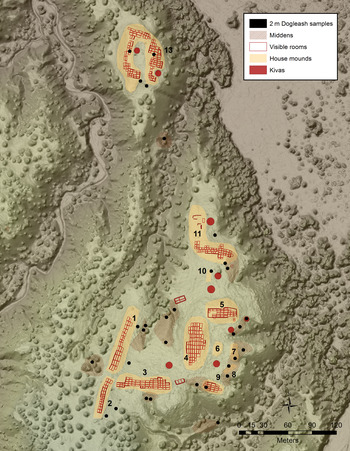
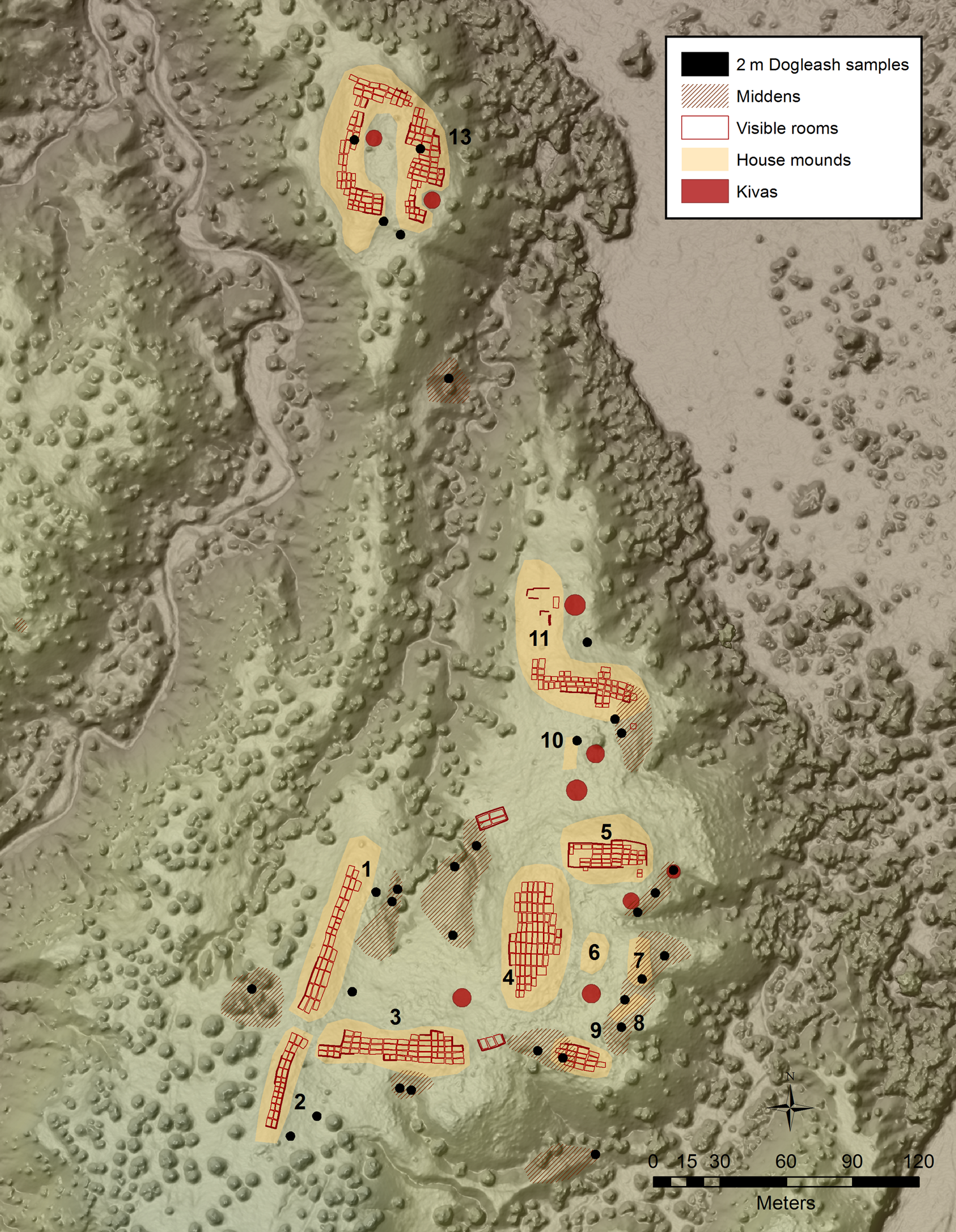
Since we began working together in 2014, archaeological investigations at Cuyamungue have included intensive surface archaeology, work with Wendorf's collections and notes, and sediment sampling from eroding agricultural features. In 2014, we tabulated surface pottery in residential areas and collected drone-based (UAV) aerial imagery with Archaeo-Geophysical Associates LLC. Because the aerial imagery was collected during a strong monsoon season, plant growth patterns visible from the air revealed the outlines of nearly every ground-floor room in the village. Our village map (Figure 2) incorporates this information. In 2015, we correlated surface architectural mounds with the aerial imagery and collected chipped-stone artifact data. Between 2016 and 2018, we reanalyzed the pottery and faunal remains in Wendorf's collections at the Center for New Mexico Archaeology, and we surveyed a square-kilometer area centered on the village, documenting field houses, fields, paths, shrines, and surface artifacts. In 2018, we also began collaborating with Alison Damick and Arlene Rosen of the University of Texas at Austin to collect and study sediment samples from eroding field features at K'uuyemugeh and cutbanks of the adjacent Tesuque Creek. Throughout, we have involved Tewa cultural leaders from Pojoaque and other villages as interlocutors and as members of the archaeological team. Each year, our research area has expanded to include more of K'uuyemugeh's fields and structures, and more importantly, the landscape and sightlines in which the village is located. This expansion mirrors that of our partnership, which has encouraged a continually expanding body of knowledge among both archaeological and Native communities over time.
The ancestral Tewa village of K'uuyemugeh (LA38), “stones falling-down place.” House mounds are labeled by number.
EMERGING KNOWLEDGE AT K'UUYEMUGEH
K'uuyemugeh was never abandoned. Indeed, no Tewa village is ever abandoned, and whenever feasible, someone is entrusted with the responsibility of maintaining the shrines and boundary markers. Due to Pojoaque's recent history, such connections and practices have weakened. Our work at K'uuyemugeh has provided the opportunity for Pojoaque and other Tewa people to reinvigorate their connection with this place, the ancestors who lived there, the painful memories, and the joyous feelings that come from standing at the village and viewing their ancestral landscape. A key point is that the archaeological work and resultant findings are part of this process. In the following section, we provide some concrete examples of how this is progressing based on our work within the ancestral village area.
The first point we wish to discuss concerns the name of the site itself. For the past five years, we have discussed the origin and meaning of K'uuyemugeh with knowledgeable Tewa people from all of the six contemporary Tewa villages. The most commonly offered explanation is that the name refers to a prominent ridge across Tesuque Creek to the east of the village where sandstone boulders are cascading down the slope. This seems consistent with the typical Tewa practice of naming villages after a distinguishing feature of the local surroundings. None of the people we have spoken with has offered or agreed with Harrington's translation of the name as “pueblo ruin where they threw down the stones.” Also, contrary to recent statements in the literature (Schillaci et al. Reference Schillaci, Lakatos and Sutton2017), none of people we have spoken with associates this name with the nearby Pojoaque Grant site (Site LA835)Footnote 3. Although this site is directly visible from K'uuyemugeh, and its end of occupation appears to correspond roughly with the establishment of K'uuyemugeh, we have found no evidence that this name was originally applied to the Pojoaque Grant site. The Tewa people we have spoken with have stated either that this site does not have a Tewa name or that they are not aware of one. But it is also important to mention that during one open house for Tewa people, a narrative was shared that suggests there are traditional names for regions in addition to specific villages. So, it could be that some Tewa people associate the name K'uuyemugeh with the locality surrounding the ancestral site, which includes the Pojoaque Grant site as well. These details are important for understanding Pojoaque and Tewa history, as we explain later.
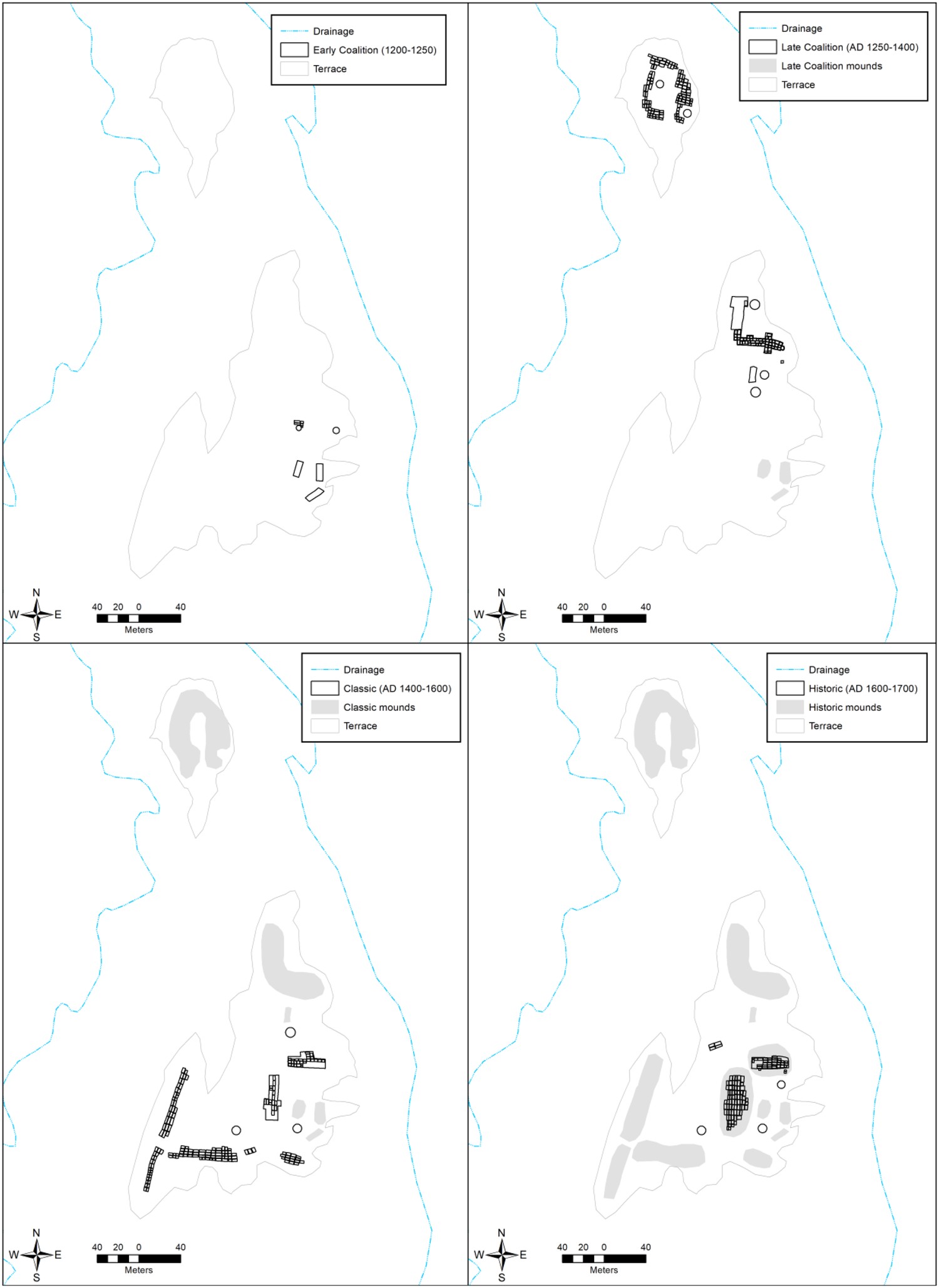
A second important outcome of our work is an understanding of the history of K'uuyemugeh that integrates archaeology and Tewa tradition. We present the archaeological elements of the story first. Figure 2 presents our map of the village area, which we created using a combination of UAV mapping and total station work. The outlined rooms follow actual wall lines that are apparent in the UAV imagery, as mentioned earlier. The figure shows that the residential area of K'uuyemugeh consists of two concentrations of architecture on separate terraces immediately west of Tesuque Creek. When H. P. Mera first recorded K'uuyemugeh, he assigned site number LA38 to the southern concentration and LA792 to the northern concentration (which we label Mound 13 in Figure 2). Wendorf, however, associated LA38 with both concentrations, and we have continued his practice because the two concentrations are surrounded by a continuous distribution of fields, shrines, and paths.
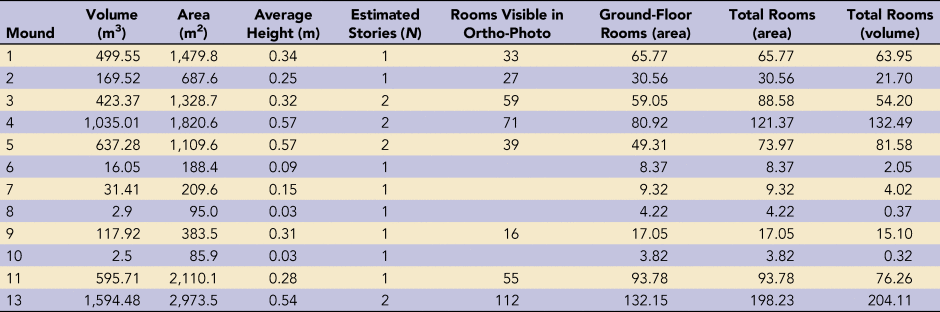
We estimate the number of rooms in each of the house mounds at K'uuyemugeh using two methods. The first involves measuring the volume of each mound based on the digital elevation model produced by the UAV imagery and using Duwe and colleagues’ (Reference Duwe, Sunday Eiselt, Andrew Darling, Willis and Walker2016) model to estimate that each room that once existed within the mound would have decomposed into 7.81 m3 of adobe (the volume represented by two walls and a roof per room). We then divided the volume of each mound by this figure to estimate the total number of rooms represented by the mound. The second method involves the following steps: (1) estimating the number of ground-floor rooms by dividing the areal extent of each mound by Duwe and colleagues' (Reference Duwe, Sunday Eiselt, Andrew Darling, Willis and Walker2016) conversion of 22.5 m2 of house mound per room, (2) determining which mounds reflect two-story architecture based on mound heights, and (3) adding half of the ground floor rooms to the total estimate for two-story mounds. Table 1 demonstrates that the two methods yield nearly identical results. The only mound for which the results differ substantially is Mound 3. The difference in this case is attributable to the fact that the central portion of Mound 3 has eroded down the slope to the south, leaving the appearance of two smaller mounds. Nevertheless, it is apparent from visible rooms in the UAV imagery that this represents a single mound, and as a result, its total area is more accurate than its volume.
Room Count Estimates for K'uuyemugeh House Mounds.

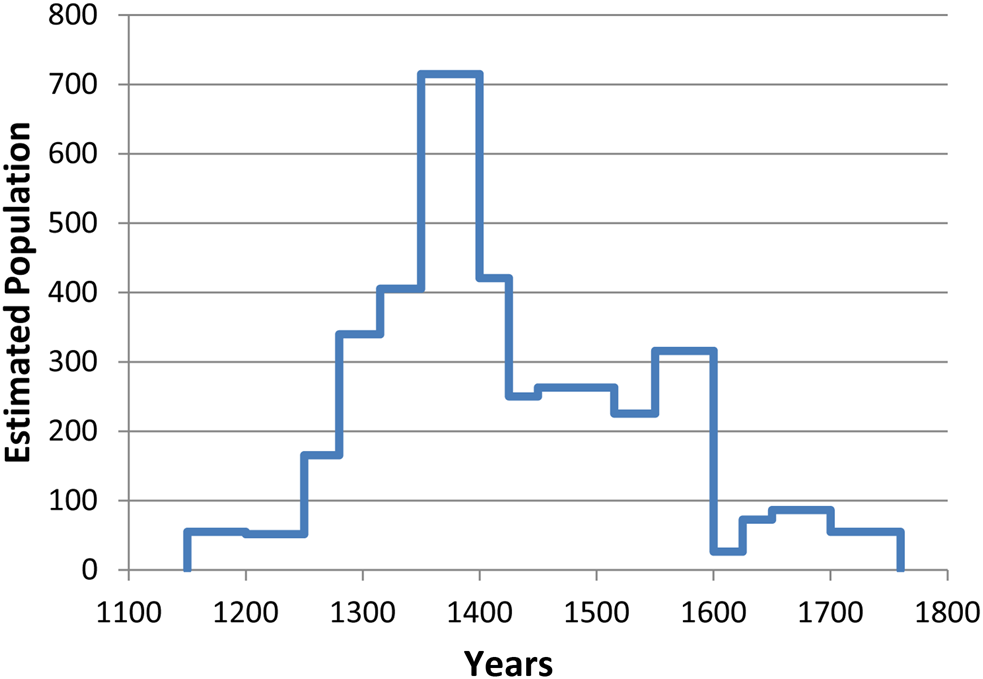
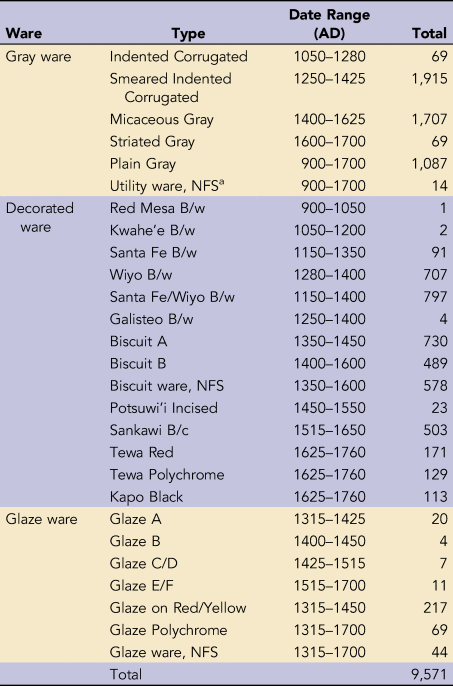
Figure 2 also shows the locations of middens or ash piles and the locations of 31 2 m radius “dog leash” sampling units from which we collected surface artifact data. The overall assemblage tabulated across these areas is presented in Table 2. Ortman (Reference Ortman2016) has previously estimated the population history of K'uuyemugeh using a method known as “uniform probability density analysis” and information from the initial field season. Figure 3 presents an updated population history using the same method and current data. The differences between the two sets of estimates derive primarily from improved (and generally lower) estimates of the number of rooms in various room blocks based on the UAV results. Although Puebloan settlement in the Pojoaque area dates from as early as AD 900 (McNutt Reference McNutt1969; Schillaci and Lakatos Reference Schillaci and Lakatos2017; Wiseman Reference Wiseman, Duran and Kirkpatrick1995), the pottery assemblage from K'uuyemugeh suggests that this location was initially settled around AD 1150 by a group of perhaps 50 people. The population then grew substantially between approximately 1250 and 1400, reaching a peak population of about 700 persons in the second half of the 1300s. Rapid population growth during this period suggests a consistent influx of residents over a period of several decades. After 1400, the population declined substantially, reducing the population to about 250 persons by AD 1450. This local decline seems to have been part of a larger flow of Tewa ancestors from the eastern tributaries of the northern Rio Grande Valley (Dickson Reference Dickson1979; Ellis Reference Ellis1964; Marshall and Walt Reference Marshall and Walt2007; Ortman Reference Ortman2016) into the Chama Valley and Galisteo Basin (Ortman and Davis Reference Ortman, Davis and Ortman2019; Toll and Badner Reference Toll and Badner2008). The population of K'uuyemugeh was roughly stable from that point until the Spanish entrada, when the population was further reduced to about 100 persons.
Population history of K'uuyemugeh based on its architectural footprint and surface pottery assemblage. Estimates represent the summed results of uniform probability density analysis of five spatial subdivisions of the site.

Surface Pottery Assemblage from 31 2 m Diameter Dog-Leash Sampling Units in High-Artifact-Density Areas at K'uuyemugeh.
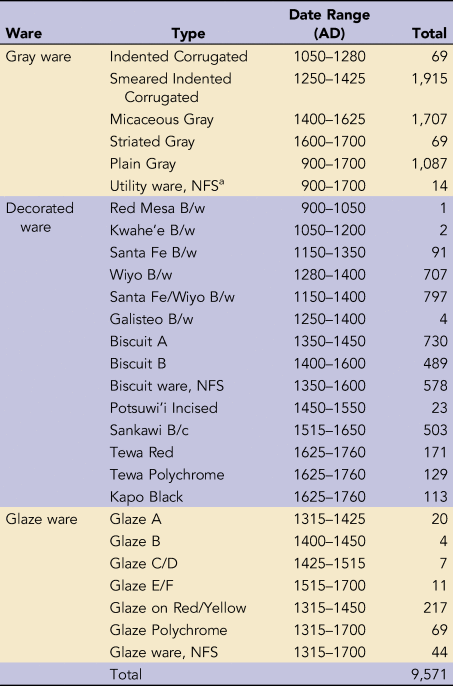
aNFS = not further specified
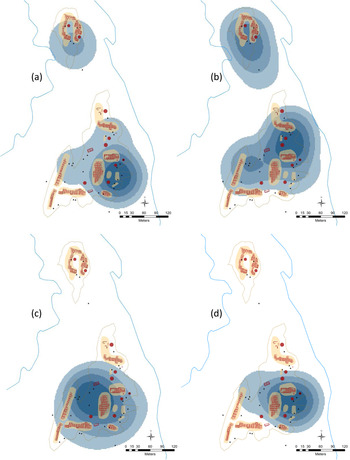
We reconstruct the changing community plan of K'uuyemugeh over time by correlating architecture with the spatial distributions of pottery types. To this end, Figure 4 presents kernel-density maps of selected pottery types, with the depth of the shade reflecting the number of potsherds of a given type within 100 m of each 2 m pixel. Note that these distributions are based on counts, not percentages, so as to take spatial variation in densities—which correlate with person-years of occupation—into account. The earliest dated pottery type that occurs with any frequency is Indented Corrugated (Figure 4a). Due to the near absence of earlier types (namely, Kwahe'e Black-on-white), these sherds were probably deposited between 1150 and 1250, and the spatial distribution of this type suggests that the initial settlement at K'uuyemugeh consisted of a group of small mounds and pit structures along the eastern edge of the southern terrace (Mounds 6–8). Interpretation of these features as residences is based on several lines of evidence: (1) they do not represent backdirt piles from Wendorf's 1952 excavations because they also appear on H. P. Mera's roughly 1930s map of the site; (2) their location, size, and arrangement are similar to house mounds at other early sites in the Pojoaque area, such as LA12271 at Pojoaque Pueblo (Duwe and Cruz Reference Duwe, Cruz, Duwe and Preucel2019); (3) upright slab wall foundations are apparent in a few of these mounds; (4) Wendorf's excavations exposed a pit structure and set of rooms that appear to date to this period beneath the more recent architecture of Mound 5; and (5) middens containing more recent pottery cover Mounds 7 and 8 (see Figure 2). This evidence suggests that the initial settlement at K'uuyemugeh consisted of a cluster of household residences, a community plan that was similar to other local settlements dating back to the 900s.
Kernel density maps of selected pottery types at K'uuyemugeh. Black triangles mark sampling locations: (a) Indented Corrugated (Early Coalition Period, AD 1150–1250); (b) Santa Fe B/W (Later Coalition Period, AD 1250–1350); (c) Biscuit B (Classic Period, AD 1400–1600); (d) Tewa Polychrome (Historic Period, AD 1600–1700).

By the end of the thirteenth century, K'uuyemugeh had developed into a paired-village community. This is apparent from the distribution of Santa Fe Black-on-white, the characteristic pottery type of this period (Figure 4b). During this period, the focus of settlement on the southern terrace shifted northward to (1) a single large, L-shaped room block opening to the northeast (Mound 11); and (2) a second settlement on the northern terrace consisting of a U-shaped arrangement of houses that enclosed a plaza and opened to the south (Mound 13). The proximity of the two settlements, the fact that each plaza is directly accessible from the other, and the fact that the surrounding hills are covered by a single distribution of fields, paths, and shrines suggest that the two settlements were part of a single community—and that the northern settlement was somewhat younger and more populous than the southern settlement.
By the early 1400s, the northern village had dwindled, the overall population had declined, and the remaining residents had coalesced into the southern village, where the western part of the terrace had developed into an area of long room blocks surrounding a large plaza (Mounds 1–3). This change is apparent in the distribution of Biscuit A pottery (Figure 4c). Wendorf also encountered a layer of prehispanic rooms beneath the seventeenth-century rooms in Mounds 4 and 5, indicating that the eastern part of the southern terrace continued to be inhabited and that it focused around a second plaza at its eastern edge. During the 1400s, then, K'uuyemugeh took the form of a dual-plaza village—with a larger, newer, and more populous plaza to the west, and a smaller, older, and less populous plaza to the east (see Liebmann and Preucel Reference Liebmann and Preucel2007). This community plan appears to have been maintained until the arrival of the Spanish, at which time the community population again declined and the remaining residents coalesced into the eastern plaza. This is apparent from Wendorf's excavations and the concentration of Tewa Polychrome pottery around Mounds 4 and 5 (Figure 4d).
There are several ways in which the archaeological record of K'uuyemugeh reflects Tewa traditional history. A brief discussion of this history as it is presented in published statements will help to make these parallels clearer. Tewa people generally understand that their ancestors migrated to the Tewa Basin from a homeland in the distant north (Ortiz Reference Ortiz1969; Parsons Reference Parsons1994 [1926]). The narrative accounts refer to the migration as having involved two groups corresponding to the winter people and summer people of present-day Tewa communities. The narratives indicate that the winter chief led the way, with the summer chief following behind. This suggests that the winter people came down first, with the summer people following later. The accounts also indicate that the winter people migrated down the east side of the Rio Grande, whereas the summer people came down the west side (Ortman Reference Ortman2012, Reference Ortman and Whiteley2018). During the migration process, the two groups established separate villages before eventually merging to form a single village containing both summer and winter people.
There are a number of points of contact between this history and the archaeology of K'uuyemugeh and the larger Pojoaque area. First, regional archaeological studies have noted that the initial Pueblo population of what is now the Tewa Basin settled along the eastern tributaries of the Rio Grande (Cooper Reference Cooper2020), and this initial population was joined a few centuries later by a second population that settled primarily on the Pajarito Plateau to the west (Duwe and Anschuetz Reference Duwe, Anschuetz and Vierra2013; Duwe and Cruz Reference Duwe, Cruz, Duwe and Preucel2019; Ortman Reference Ortman2016, Reference Ortman and Whiteley2018). These trends seem to reflect the separate migrations of the winter people and summer people in Tewa traditional history. Second, if one associates the initial settlement of the Tewa Basin, including the Pojoaque area, with the winter people, then it would seem that the initial settlement of K'uuyemugeh was also created by winter people. The fact that this initial settlement exhibits the same community plan as other early settlements of the Pojoaque area is consistent with this interpretation. Third, the growth of K'uuyemugeh in the late 1200s, combined with the formation of a second village on the northern terrace, seems to reflect the arrival of the summer people and the formation of separate but closely tied summer and winter villages.Footnote 4 If so, the relative sizes of the two villages suggest that, at this time, the summer people were about twice as numerous as the winter people. This pattern is also consistent with previous studies of both archaeological and traditional evidence that suggest that a large population moved from the Mesa Verde region to the Tewa Basin during this period (Kemp et al. Reference Kemp, Judd, Monroe, Eerkens, Hilldorfer, Cordray, Schad, Reams, Ortman and Kohler2017; Ortman Reference Ortman2012). Fourth, over the next century or so, these two villages coalesced into a single village on the southern terrace. The layout of this village, in combination with its prior history, suggests that the winter people were localized around the east plaza, whereas the summer people were around the west plaza. This is also consistent with the unification of the winter people and summer people in a single village in Tewa traditional history.
This interpretation of the social history of K'uuyemugeh is summarized in Figure 5. In this figure, we also show the remains of earlier settlements that would have been experienced by community residents during each period to make an additional point. Today, Pueblo people view ancestral sites as imperative locations of traditional history (Harrington Reference Harrington1916; Kuwanwisiwma et al. Reference Kuwanwisiwma, Ferguson and Colwell2018; Malotki Reference Malotki1993), and it is reasonable to infer that this was also true for Tewa ancestors. But archaeologists tend to ignore the development of the archaeological record over time in their site maps, and as a result, they remove material traces of history that would have been salient for the inhabitants of ancestral sites. Given this, showing the archaeological remains that community residents would have experienced at different points in the past provides an additional means of connecting archaeology and traditional knowledge. Figure 5 includes such traces, and these make it clear that community residents of the 1400s would have experienced physical remains of the earlier paired summer and winter villages, and that residents of the 1600s would have experienced physical remains of the unified village as well. Both sets of remains illustrate episodes in Tewa traditional history, as discussed above. It is therefore likely that these archaeological traces served both as tangible evidence of these stories and as aids for remembering and recounting them.
Community plan of K'uuyemugeh during four phases of occupation.

A final way the history of K'uuyemugeh reflects Tewa tradition is that its spatial development over time follows a Tewa ritual circuit. The typical pattern of movement in Tewa dances today is a counterclockwise spiral (Kurath and Garcia Reference Kurath and Garcia1970; Ortiz Reference Ortiz1969). Our studies of the surface pottery at K'uuyemugeh show that the locations of residences also flowed in a counterclockwise, inward spiral over the centuries—from the north to the west, and then south and east. This pattern suggests that habitual patterns of human movement in ceremonies influenced the pattern of village growth. Norms regarding the proper direction for new construction remain a part of Tewa tradition today, and violation of such norms has been cited as a source of misfortune in specific communities (Harrington Reference Harrington1916:305–306). An archaeologist might never think to look for such patterns on their own. But in the context of partnership, such questions are natural ones to ask. Whether this counterclockwise spiral pattern characterizes the growth of other villages is unknown, but our results for K'uuyemugeh suggest that further exploration of growth patterns at ancestral sites would be illuminating.
Our investigations of community history at K'uuyemugeh lead to two important insights regarding the relationship between Tewa traditional history, Tewa identity, and Pojoaque identity. First, the fact that episodes in Tewa traditional history correspond with details of the archaeological record of K'uuyemugeh does not mean that the narratives derive specifically from this community. Many episodes in Tewa traditional histories adopt the perspective of a single community, but our perception is that the narrative is understood as reflecting the history of Tewa people overall, or what Alfonso Ortiz (Reference Ortiz1969) refers to as O'pa—everything that is known, the areas between the cardinal mountains and the world beyond. Given this, it seems most likely that traditional histories are composites of episodes that took place in generally similar ways across many communities, of which K'uuyemugeh is merely one. As a result, one might expect these narratives to map onto local experience—as revealed by the archaeological record of ancestral sites—in a variety of ways. This seems to be reinforced by stories that associate the origins or unification of the summer and winter people with several different ancestral sites in Harrington's (Reference Harrington1916) compilation, including Tekhe'owingeh (21:31)Footnote 5 and Wiyo'owingeh (22:unlocated). Perhaps this pattern reflects a reality that Tewa social history followed similar courses across many different communities.
Second, the combination of Tewa traditional history, Tewa language names for ancestral sites, and the archaeological histories of these sites suggest that it is nevertheless productive to frame the histories of specific communities as being distinct from a generalized Tewa history. In this particular case, it seems clear that ancestors of present-day Pojoaque people have resided in the area since AD 900. A few Tewa names for areas where early sites occur are known (Schillaci et al. Reference Schillaci, Lakatos and Sutton2017), but the largest and most prominent settlement of this era—the Pojoaque Grant site—is not associated with a Tewa name. The Pojoaque Grant site was no longer inhabited in the late thirteenth century, when large numbers of people from the Mesa Verde region moved into the Tewa Basin. In contrast, both K'uuyemugeh and P'osuwäegeh were inhabited at this time and continued to be, and both are associated with Tewa language names today. In addition, the early community pattern at both of these sites consisted of clustered family residences similar to the Pojoaque Grant site and other early settlements. These patterns raise the possibility that residents of K'uuyemugeh and P'osuwäegeh spoke a language other than Tewa when they were first established, with the implication that the in-migrating summer people brought Tewa speech to these communities in the thirteenth century. This scenario would account for the continuities in settlement and material culture across the migration period noted in recent archaeological studies of the Pojoaque area (Boyer et al. Reference Boyer, Moore, Lakatos, Akins, Dean Wilson, Blinman, Kohler, Varien and Wright2010; Lakatos Reference Lakatos2007; Lakatos and Post Reference Lakatos, Post, Young and Herr2012; Lakatos and Wilson Reference Lakatos, Dean Wilson, Wilshusen, Schachner and Allison2011) as well as the biological and demographic evidence for large-scale in-migration (Kemp et al. Reference Kemp, Judd, Monroe, Eerkens, Hilldorfer, Cordray, Schad, Reams, Ortman and Kohler2017; Ortman Reference Ortman2012, Reference Ortman2016) and linguistic evidence suggesting that the Tewa language originated on the Colorado Plateau (Ortman Reference Ortman2012; Ortman and McNeil Reference Ortman and McNeil2018). It also suggests that Pojoaque ancestors have lived in the area since about AD 900, but they may not have spoken the Tewa language until they were joined by the summer people in the late thirteenth century (see also Duwe and Cruz Reference Duwe, Cruz, Duwe and Preucel2019).
DISPERSAL AND REGATHERING
In the preceding section, we focused on some of the new ideas emerging from our investigation of K'uuyemugeh in the context of partnership. This is just one dimension of the work we are doing together. Publications on additional aspects of our work have begun to appear (Catanach and Agostini Reference Catanach, Agostini, Duwe and Preucel2019; Cooper Reference Cooper2018, Reference Cooper2020; Cruz Reference Cruz2018; Duwe and Cruz Reference Duwe, Cruz, Duwe and Preucel2019; Linford Reference Linford2018; Ortman Reference Ortman and Nash2020), and Pojoaque tribal members have made a series of presentations at local and national meetings as well. In addition to these traditional archaeological products, we are producing products specifically for the Pojoaque community, ranging from tribal council presentations to 3D models to exhibits for the tribal museum. In practice, our partnership has been organic, and we continue to tinker with its workings, deciding each year how to proceed. The Pueblo of Pojoaque has supported this work financially throughout, and we have supplemented this support through grants from the National Science Foundation, the Continuous Pathways Foundation, and the CU Office of Outreach and Engagement. These grants have provided support for specialist analyses and Tewa cultural leadership, in addition to defraying the costs of participation by CU students and tribal youth.
In recent years, work has expanded from K'uuyemugeh to other Pueblo lands, including areas threatened by development. In several cases, construction has been rerouted to protect tangible and intangible cultural heritage we have documented together. So far, we have documented at least four different areas of ancestral residences that can be reliably dated from AD 900 based on surface pottery. This is as exciting to Pojoaque people as it is to archaeologists. Tribal members are aware of these places because they are mentioned in stories, encountered while walking and living on the landscape, and connected with experiences that demonstrate their continuing agency to community members. Learning more about these footprints from archaeological work—which is shared at tribal council meetings, during community days at specific sites, through written and printed products, and through casual conversations—only adds to their importance in the minds and hearts of tribal members. Our work has stimulated the development of a proprietary database of information on ancestral sites and other traditional properties on Pueblo lands, a movement to map the entire Pueblo's land base to better understand its use and to take this into account when making new land assignments, and discussions about creating a permanent Native-run learning institute on Pueblo lands.
Deep within the collective memory of Pojoaque people are the experiences of their ancestors. Along this great journey, Pojoaque ancestors lived in many places, but for the past millennium, most have lived within the boundaries of today's Pueblo of Pojoaque. Many generations lived their lives in this landscape—and Pojoaque people continue to do so, sustaining the cultural practices, traditions, beliefs and lifeways that maintain their identity as Native, Pueblo, Tewa, and Pojoaque people. Consequently, archaeological and natural features within and beyond the Pueblo boundaries are cultural resources for Pojoaque (and other Pueblo) people. Remembered in song and prayer, by Tewa names, and by pilgrimages seen and unseen, Pojoaque's landscape teems with the life and memory that constitute the cultural values through which Pojoaque people continue to thrive. The indelibility of the land and its Tewa values is inside each Tewa person, as Tewa people are formed from the collective pool of all Tewa consciousness. As a result, the land is lived and read as lesson and validation.
The archaeological results generated through our partnership are contributing to this consciousness and generally support statements in Tewa tradition that Pojoaque is the middle Tewa “mother village”—the place Tewa ancestors gathered before spreading out to inhabit the larger Tewa Basin (Harrington Reference Harrington1916:336–337). This early and strong presence—an advance guard, perhaps—may help explain why the Spanish directed so much of their aggression toward Pojoaque. The uniqueness and importance of Pojoaque is also suggested by the fact that it is the only Tewa village that is still inhabited today that did not relocate following the arrival of the Spanish. As the mother village, the survival and continuance of Pojoaque appears to have been critical to Tewa people in the past, as it remains today.
LESSONS FROM PARTNERSHIP
The results presented here show that, through partnership, we are doing archaeology and seeking to answer the kinds of questions non-Native archaeologists typically ask. But we are also incorporating contemporary Tewa interests and ideas into archaeological practice to make it relevant to the Pueblo of Pojoaque and other Tewa people. This is leading us to document and investigate aspects of the archaeological record that non-Native archaeologists have not traditionally emphasized, and the results are filtering back into discussions among Tewa people regarding their traditions. What one can begin to see through this work is that partnership creates opportunities for Tewa traditional knowledge and archaeological evidence to enter into dialogue. In this way, our partnership leads to archaeology that fosters a deeper understanding of and respect for a living Tewa tradition. We have focused here on the ways partnership influences archaeological practice and results, but it is clear from various forms of assessment that partnership is also achieving our broader goals. Tribal members say things such as “I always knew this site was here, but seeing it for myself makes things so much more real,” and CU students say things such as “I understand now that archaeology is much more personal for Native people than it is for non-Natives.” Based on these kinds of statements, we are confident that our approach is achieving our social goals in addition to the research goals we have emphasized in this article.
The point of our partnership is not to criticize past work but to define a way forward using archaeology as a tool to help in the clarification and amplification of Pueblo history. Pueblo people are interested in their history, and they utilize it every day in their worldviews, cultural understandings, and cosmologies. But sometimes, this valuable asset is opaque and unknown and/or unavailable to non-Pueblo people. Archaeologists are also interested in Pueblo history and the lessons it has to offer a larger world. But archaeological narratives have often not been connected with Pueblo people's own histories and understandings of themselves. Partnership seeks to reduce these barriers.
Speaking as anthropologists, we find that, through partnership, we have the privilege of walking over K'uuyemugeh and other ancestral sites with different groups of Tewa people. We are continually made aware of how much there is to know and see—no matter how many times we visit a given site or speak with a particular person about it. This “slow talk” is a luxury relative to customary archaeological practice, but an increasing number of studies show that it is attainable (Kuwanwisiwma et al. Reference Kuwanwisiwma, Ferguson and Colwell2018; Schmidt and Kehoe Reference Schmidt and Kehoe2019). Partnerships create the conditions where one can learn from the collective consciousness of Tewa people—a consciousness that brims with possibilities for enhanced, new, and different insights. Such insights can be shared in direct or oblique ways, but in a relationship of mutual respect and shared responsibility, there is a much better chance of being exposed to ideas and information that otherwise would not be shared. As non-Native people and scholars, it is crucial that we are prepared to hear and act appropriately on these insights—to take responsibility for the proper use of traditional knowledge in the larger world. In our experience, the best way to approach this outcome is to partner with living descendants of the people who created the archaeological record in the construction of local history.
We conclude by sharing a few lessons we have learned over the past several years. Perhaps the most important advice we have to offer others who are interested in building partnerships is that the single most important ingredient is personal relationships grounded in mutual respect. Mutual respect is not just something one feels. It is something one must act on. Archaeologists need to acknowledge that although they are experts at studying the archaeological record, they are not the only ones who know things about the past. Accordingly, archaeologists show respect to Native people by inviting them to participate in data collection and interpretation, by treating traditional knowledge as evidence, and by listening and sharing (as opposed to always asking questions). The more archaeologists do this, the more they will earn the respect of Native people in return.
A second piece of advice is to focus on experiencing ancestral places together. Partnership involves Natives and non-Natives sharing their expertise and learning from each other to enhance their joint understanding. All forms of evidence are relevant, and putting them into creative tension leads to better history—and better science—across the board. In this context, ancestral sites themselves are the best common denominator around which partnerships are built. This is because ancestral sites provide a concrete reality that both Native and non-Native archaeologists can experience simultaneously. In this way, they provide a stronger tether for conversation, translation, and coinvestigation than a meeting room ever could. Partnerships at ancestral sites also provide opportunities for Native people from different communities who are interested in culture and history to get together and “talk shop.” Such communication does not happen as often as one might think, so it is gratifying to see how our partnership facilitates knowledge exchange between villages.
Third, it is important for archaeologists to get their heads out of the ethnographic literature, particularly as a substitute for engaging with community members. A key benefit of partnership is the opportunity it provides for a multivocal investigation of Native history. Archaeologists who work in the U.S. Southwest have a long tradition of relying on ethnographic works as a basis for incorporating Native tradition into their interpretations. This is far better than nothing, but it is important to acknowledge that such works represent statements by a single investigator writing in a specific context, for specific purposes, at a specific time, and often working with a single collaborator. Moreover, utilizing the ethnographic literature is a skill that requires study and context in the same way that understanding the archaeological literature does. Taken out of context, such writings—even by Native anthropologists such as Alfonso Ortiz (Reference Ortiz1969, Reference Ortiz and Ortiz1972, Reference Ortiz, Ortiz and Sturtevant1979a, Reference Ortiz1979b, Reference Ortiz, Demallie and Ortiz1994) and Rina Swentzell (Reference Swentzell1988, Reference Swentzell, Markovich, Preiser and Sturm1990a, Reference Swentzell1990b, Reference Swentzell, Morrow and Price1997)—can encourage a view of Native tradition that is more canonical and static than it truly is. To the extent that it welcomes participation by many, partnership permits the dynamic and pluralistic nature of Native worldviews to be incorporated into interpretations of the archaeological record. In our specific context, the archaeological record is deeply meaningful for Tewa people, but the elements of this record do not have a single meaning that is shared by everyone. Because of this, it is important that partnerships involve multiple Native and archaeological voices. The goal should not be canonical answers but deeper levels of understanding.
As a final word, we emphasize that despite its checkered past, the potential value of archaeological research for the Pueblo of Pojoaque is rich and unlimited. Community members, such as Governor Joseph Talachy, remind us of this time and time again:
I grew up here, learning about the landscape by living within it and walking over it. Evidences of our long history are found everywhere and I always wanted to know more. Our older members taught us about our land too. But it was difficult to recognize Pojoaque when I read archaeology; I also noticed the dearth of information about Pojoaque. The partnership provides more opportunities to learn, but most importantly, to participate in the researching of our history. It is only with the hands and minds of Pojoaque community members that we can make sense of our unique ancestral and recent history. As Pueblo and Native American people, we are presented with a complex set of governmental and cultural concerns every day. Archaeological research and the K'uuyemugh Partnership help balance these concerns because they are about our culture. Ongoing research provides Pojoaque with the foundation for understanding how we came to be and who we are, and what we are becoming [Governor Joseph Talachy, personal communication 2016].
Acknowledgments
Portions of this research have been supported financially by the National Science Foundation (BCS-1729780), the University of Colorado Boulder Office of Outreach and Engagement, the Continuous Pathways Foundation, and the Pueblo of Pojoaque. We also thank the Cuyamungue Institute and the Pueblo of Pojoaque Tribal Council for their support of this work, as well as Archaeo-Geophysical Associates LLC for UAV data collection and processing. Finally, we thank the many CU undergraduate and graduate students, Pojoaque Pueblo youth, and Tewa coinvestigators who have contributed their knowledge and effort to this project.
Data Availability Statement
To request access to the data analyzed in this article, please contact the Pueblo of Pojoaque Tribal Historic Preservation Office, 39 Camino Del Rincon, Santa Fe, NM 87506. Phone: (505) 455-2278. E-mail: bbernstein@pojoaque.org.