Introduction
Amid economic globalization and trade liberalization, economic and trade exchanges among countries are becoming more and more frequent. The world has formed an international industrial division of labor patterns in which ‘all prosper and all lose’. Interdependence and influences on the economies of various countries are deepening. Multinational enterprises (MNEs), as important participants and carriers of economic globalization, are regarded as the pioneers of a world market and bridges that link markets between MNEs’ home countries (i.e., domestic markets) and host countries (i.e., foreign markets) (Anand, McDermott, Mudambi, & Narula, Reference Anand, McDermott, Mudambi and Narula2021; Cannizzaro, Reference Cannizzaro2020). MNEs helped to spread the concept of the open market economy. They have advanced modes of organization and management all over the world while integrating the resource endowments of different countries and regions into a global supply chain, industrial chains, and value chains (Kano, Tsang, & Yeung, Reference Kano, Tsang and Yeung2020; Lee, Kim, Choi, & Jiménez, Reference Lee, Kim, Choi and Jiménez2023; Pananond, Gereffi, & Pedersen, Reference Pananond, Gereffi and Pedersen2020). These phenomena have promoted in-depth docking and integration of markets, further strengthening the market relationships between home and host countries.
In recent years, affected by the economic and trade disputes between China and the United States and the epidemic crisis brought by COVID-19, the great power game has further intensified, although economic globalization has encountered a countercurrent. As a result, governments of different countries have actively protected their own enterprises and trade interests. Amid the various uncertainties caused by international competition, MNEs face a reduction in personnel mobility, inconsistencies in the regulatory bodies of various countries, an anti-globalization economic worldview, and other disruptive factors. Similarly, overseas production and operational activities face great challenges (Cui, Vertinsky, Wang, & Zhou, Reference Cui, Vertinsky, Wang and Zhou2023; Li, Reference Li2022).
Apart from MNEs needing to meet cost and quality requirements, governments are increasing their demands for corporate social responsibility (CSR) practices, environmental contributions, and improved labor conditions. MNEs need to voluntarily participate in CSR to help solve social problems beyond the requirements of legal frameworks. However, the use of institutional arbitrage in the home and host countries, and the cost difference required to maximize the economic benefits of traditional strategies, are no longer effective. Meanwhile, the corporate social performance (CSP) of enterprises has become a recognized high-standard indicator by governments when evaluating the performance and contributions of MNEs; that is, CSP has transformed into a recognized indicator of high standards and strict requirements for MNEs by governments in both home and host markets. However, merely relying on market strategies to obtain economic benefits can no longer satisfy the current complex international environment – economic and social aspects must be equally considered to synergistically obtain competitive advantages overseas (Zhao, Park, & Zhou, Reference Zhao, Park and Zhou2014). Amid the urgent need for MNEs to shift their social roles, issues related to enhancement of CSR and CSP have gained traction within the business community and academia. Knowing how MNEs can transform social responsibility pressures exerted by home and host countries into ways to improve their own competitiveness has become an urgent topic.
When MNEs develop in emerging economies, they often face challenges of moral legitimacy, such as maintaining labor and environmental standards and eliminating corruption; this aspect further implies the need to improve the CSP of MNEs’ foreign subsidiaries to safeguard their own reputations and status (Zyglidopoulos, Williamson, & Symeou, Reference Zyglidopoulos, Williamson and Symeou2016). For example, Indian MNEs face CSR pressure exerted by governments from both the home country and the host country. Government pressure from the host country mainly originates from formal regulatory and legal rules applied to foreign MNEs (Boso et al., Reference Boso, Amankwah-Amoah, Essuman, Olabode, Bruce, Hultman, Kutsoati and Adeola2023; Cui & Jiang, Reference Cui and Jiang2012; Park & Xiao, Reference Park and Xiao2021). Meanwhile, government pressure from the home country is regarded as another important regulative institutional pressure, and is mainly exerted to gain legitimacy (Wang, Hong, Kafouros, & Wright, Reference Wang, Hong, Kafouros and Wright2012).
In terms of parent–subsidiary relationships, the CSR practices of foreign subsidiaries’ parent companies directly affect the performance of their overseas subsidiaries; furthermore, signals from MNEs to stakeholders in the host country, including attempts to improve CSR, not only help to reduce the transaction costs of information but also increase the government’s perceived value of the firm, allowing this particular firm to improve its reputation and gain legitimacy and other benefits (Jiang, Jung, & Makino, Reference Jiang, Jung and Makino2020). However, opportunities and challenges must both be considered. MNEs generally perform poorly in host countries during epidemics, geopolitical conflicts, high inflation, shrinking market demand, or from government restrictions on foreign investment and other factors. Furthermore, in the face of dual CSR pressure from governments in both home and host countries, many foreign MNE subsidiaries may choose to participate passively or selectively. The degree of participation is mainly determined by the intensity of institutional pressure. When pressure is high, MNEs are more willing to initially solve employee-related problems but tend to ignore environmental and community issues (Chiou & Shu, Reference Chiou and Shu2019). When the institutional environment of a subsidiary completely differs from that of the home country, and when stakeholders continuously demand CSR, MNEs will selectively meet the requirements to initially obtain legitimacy. However, when the subsidiary is heavily dependent on the home country for important resources, and when the benefits of legitimacy in the home country outweigh those in the host country, the firm may not engage in socially responsible practices in the host country at all (Yang & Rivers, Reference Yang and Rivers2009). Furthermore, when the pressure for social responsibility exerted on MNEs by home and host countries is consistent with one another, they can get firms to engage in socially responsible practices, but when it is inconsistent, the willingness of firms to adopt socially responsible practices weakens. But when the host country’s requirement for CSR is stricter than the home country, it can push firms to adopt socially responsible practices (Marano & Kostova, Reference Marano and Kostova2016). In addition, the greater the distance between home and host countries in terms of cultural, administrative, geographic, and economic differences, the lower the likelihood of MNEs adopting CSR in the host country (Campbell, Eden, & Miller, Reference Campbell, Eden and Miller2012; Reimann, Rauer, & Kaufmann, Reference Reimann, Rauer and Kaufmann2015).
In summary, most of the previous studies on government pressure from home and host countries have viewed subsidiaries and institutional differences between parent and subsidiary companies from the perspective of the parent company. MNEs tend to passively promote social responsibility during changes in the institutional environments of the home and host countries. The literature rarely examines issues from the perspective of the subsidiaries. With the need for CSR becoming a global consensus amid pressure from both governments, overseas MNE subsidiaries changing their social strategy into actively improving social performance has been the general trend. An urgent call is to explore how MNEs can transform government pressure into motivation to actively improve social performance and thus improve their competitiveness. From the standpoint of MNEs in new markets, overseas foreign direct investment (FDI) not only improves CSP but also, more importantly, helps MNEs search for strategic assets in their host countries (Cui, Meyer, & Hu, Reference Cui, Meyer and Hu2014). The world is currently in a period of digital transformation, with the digital capabilities of firms directly affecting their technological capabilities and performance (Heredia, Casillo-Vergara, Geldes, Gamarra, Flores, & Heredia, Reference Heredia, Castillo-Vergara, Geldes, Gamarra, Flores and Heredia2022). The intricate relationships depicted by government pressure from home and host countries in terms of digitization capabilities, strategic asset search, CSP, and a firm’s competitiveness need to be studied in depth.
Moreover, the institutional perspective is a powerful theoretical lens providing important insights into the effects of institutional forces on strategic choices and behaviors of MNE subsidiaries, such as CSR (e.g., Beddewela & Fairbrass, Reference Beddewela and Fairbrass2016; Husted & Allen, Reference Husted and Allen2006; Jamali, Jain, Samara, & Zoghbi, Reference Jamali, Jain, Samara and Zoghbi2020; Sun, Doh, Rajwani, & Siegel, Reference Sun, Doh, Rajwani and Siegel2021). But that perspective suffers from a serious limitation in that it does not examine the necessary resources and capabilities possessed by these MNE subsidiaries, and is thus only a partial accounting of MNE subsidiaries’ strategic behaviors. For example, although institutional pressure may motivate MNE subsidiaries to seek for or increase their legitimacy by responding to and conforming with such institutional pressures, these subsidiaries may not have the willingness or ability to do so without a strong inherent intent and the necessary capabilities. As a result, the interplay of institutional and resource-based forces remains a currently unfilled research gap in the literature.
To fill the aforementioned gaps, this study focuses on two research questions. First, what drives foreign subsidiaries of MNEs to engage in CSP? Second, how does CSP contribute to the building of competitiveness? Then, by building upon institutional logic, we theorize and empirically examine the institutional effects of government pressure exerted by both the home and host countries on the CSP strategies and activities of foreign MNE subsidiaries. On that basis, a firm’s competitiveness can be built and developed. Furthermore, we extend prior research on institutional logic by incorporating new developments of the resource-based view (RBV) to specifically explore how institutional effects (i.e., government pressure from the home and host countries) on the CSP of foreign subsidiaries may be shaped by their unique resources and capabilities. More specifically, while considering the effect of such government pressure, we explore and analyze how MNE subsidiaries can transform government pressure for CSR by both home and host markets into competitiveness. Then, we explore the presence of any moderating role from a strategic asset search and a digitization capability in MNE foreign subsidiaries, and we subsequently analyze how MNEs could transform CSR pressure into competitiveness. This study is expected to contribute substantially to the literature on institutional pressure and CSP by determining the relationships among government pressure, digitization capability, strategic asset-seeking, CSP, and competitiveness. This research is expected to extend the research on MNEs from a new perspective, thereby motivating scholars to better understand how MNE subsidiaries transform social performance into competitiveness. This study can also promote development of the theory and practice of CSR, and can help MNE subsidiaries enhance their competitiveness from social and non-marketing strategies.
Conceptual Background and Hypotheses Development
Institutional theory provides a good perspective for our study exploring the effect of government pressure (i.e., institutional pressure) on the CSP of foreign subsidiaries. According to institutional theory, organizational strategic behaviors and performance are shaped by institutional environments and the social contexts within which the firm’s activities are embedded (Haveman & Gualtieri, Reference Haveman, Gualtieri and Aldag2017; Haveman, Joseph-Goteiner, & Li, Reference Haveman, Joseph-Goteiner and Li2023; Scott, Reference Scott1995; Thornton, Ocasio, & Lounsbury, Reference Thornton, Ocasio and Lounsbury2012). Drawing on these insights from institutional logic, we argue that government institutions are characterized by legitimacy, universality, and coercion, which form the set of molded frameworks and rule systems exerting institutional pressure on a firm’s management via constraints and incentives (Berente & Yoo, Reference Berente and Yoo2012; DiMaggio & Powell, Reference DiMaggio and Powell1983, Reference DiMaggio and Powell2000; Xu, Pan, & Beamish, Reference Xu, Pan and Beamish2004). The dual institutional pressure from home and host countries has become one of the main themes in the study of the organizational practices of MNEs. In the international expansion of MNEs, institutional theory has been widely used in MNE research (e.g., Chung, Xiao, Lee, & Kang, Reference Chung, Xiao, Lee and Kang2016; Cui & Jiang, Reference Cui and Jiang2012; Lee, Xiao, & Choi, Reference Lee, Xiao and Choi2021; Peng, Wang, & Jiang, Reference Peng, Wang and Jiang2008). A friendly institutional environment can improve the performance of market-seeking MNEs (He, Zhang, & Wang, Reference He, Zhang and Wang2015). Institutional differences, such as culture and regulation between home and host countries, directly impact knowledge transfer (Cui, Griffith, Cavusgil, & Dabic, Reference Cui, Griffith, Cavusgil and Dabic2006) and the degree of CSR participation (Sahasranamam, Arya, & Mukundhan, Reference Sahasranamam, Arya and Mukundhan2022).
However, despite the wide use of institutional theory in the strategy and international business (IB) literature, the specific role of particular institutional frameworks in explaining strategic choices of MNE subsidiaries may vary in different contexts, and this stream of research should embody real-life situations. Thus, to further understand the effect of MNE subsidiaries’ proactive efforts to improve their CSP, we adopt an integrative approach by combining institutional and RBVs to explain their CSP. We contend that institutional context and resource-based factors are complementary forces leading to better CSP in MNE subsidiaries because the two theoretical underpinnings are concerned with similar phenomena despite their often different underlying assumptions. The RBV suggests that a firm needs to possess unique resources that can be used to create competitive advantages, and subsequently create value and achieve superior performance (Barney, Reference Barney1991; Penrose, Reference Penrose1959; Wernerfelt, Reference Wernerfelt1984). In essence, the RBV highlights the particular value of developing more unique, valuable, rare, costly-to-imitate, and non-substitutable resources and capabilities in driving their competitive advantages and performance (Barney, Reference Barney1991; Kraaijenbrink, Spender, & Groen, Reference Kraaijenbrink, Spender and Groen2010; Wernerfelt, Reference Wernerfelt1984). In response to the recent developments in digital technologies and rapid advancements in the digital transformation of business activities, recent studies have pointed out the importance of extending traditional research on the RBV, yielding new insights by bringing in new contexts like digital technologies and digitization (Cooper, Pereira, Vrontis, & Liu, Reference Cooper, Pereira, Vrontis and Liu2023; Giustiziero, Kretschmer, Somaya, & Wu, Reference Giustiziero, Kretschmer, Somaya and Wu2023; Helfat, Kaul, Ketchen, Barney Jr, Chatain, & Singh, Reference Helfat, Kaul, Ketchen, Barney, Chatain and Singh2023).
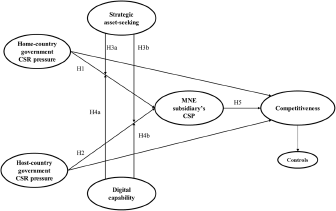
More recently, fast-growing industrial activities and resource use have challenged the extent to which natural resources can be utilized. For instance, amid increasing environmental challenges, firms can consider pollution prevention, product stewardship, and sustainability as solutions; however, these three strategies differ in their driving forces, need different core resources, and can result in different competitive advantages. The specific type of strategy to be adopted mainly depends on what role the external environment plays in the process of enhancing a firm’s competitiveness. Given that firms may differ in their purposes, and face a variety of forces when implementing environmental management, they will likely adopt different strategies (Hart & Dowell, Reference Hart and Dowell2011). For CSR in matters such as environmental protection, it is insufficient for firms to sponsor environmental initiatives and disclose CSR activities; rather, they need to be proactive and strategic when engaging in social responsibility (Taylor, Vithayathil, & Yim, Reference Taylor, Vithayathil and Yim2018). Institutional theory and RBV both provide a systematic, theoretical perspective for MNE subsidiaries to transform institutional pressure into competitiveness. Figure 1 presents our conceptual framework. First, we theorize and propose the institutional effects of government pressure from home and host countries on CSP engagement of foreign MNE subsidiaries. Then, we attempt to examine how strategic asset-seeking intent and the digitization capabilities of MNE subsidiaries can moderate the relationships between government pressure and the subsidiary’s CSP. Finally, we examine how the engagement of MNE subsidiaries in CSP can contribute to their competitiveness.
Conceptual framework of this study

Institutional Pressure and CSP
CSP has been conventionally defined as ‘a business organization’s configuration of principles of social responsibility, processes of social responsiveness, and policies, programs, and observable outcomes as they relate to the firm’s societal relationships’ (Wood, Reference Wood1991: 693). CSP is often associated with the research of Hillman and Keim (Reference Hillman and Keim2001), who argued that CSP, compared with CSR, emphasizes the importance of business practices to achieve CSR-related social goals. Napier, Knight, Luo, and Delios (Reference Napier, Knight, Luo and Delios2023: 62) recently recognized the important role of business processes in implementing social responsibility, explaining as follows:
CSP emphasizes the role of business processes in implementing social responsibility, responding to stakeholders, and the resultant outcomes of CSR-related behaviors. Researchers and practitioners emphasize not only the ‘why’ (principles) of CSR but also the ‘who’ (stakeholders), the ‘what and how’ (processes), and the ‘what happened’ (outcomes) necessary to translate CSR into CSP.
CSP represents a firm’s ability to increase trust and loyalty from employees, customers, and society by engaging in social practices and activities. Examples include initiatives toward environmental protection, improved workplace and labor conditions, product quality and safety, employee health and safety, and responsiveness to social issues that are relevant to various stakeholders (employees, customers, governments, communities, etc.), implemented by training or human rights and community engagement (Greening & Turban, Reference Greening and Turban2000; Hillman & Keim, Reference Hillman and Keim2001; Zyglidopoulos et al., Reference Zyglidopoulos, Williamson and Symeou2016). Therefore, CSP broadly emphasizes the important role of the business practices and social behaviors of firms in achieving CSR-related outcomes, which are largely aimed at addressing three types of challenge: environmental concerns, social conditions for employees, and social challenges faced by local communities and other stakeholders (Chiou & Shu, Reference Chiou and Shu2019). Concerns about environment-related performance might consider the importance of improving quality and trust by acquiring global ISO and MIT certifications, reducing carbon emissions, and pursuing green approaches to promote environmental protection. Employee-related social performance is concerned with social issues related to staff turnover, employee education, and training and pay differences between top management and lower-ranked employees. Social concerns faced by local communities might reflect the interests of disadvantaged social groups, institutions seeking charitable donations, ensuring positions for and promotion of women (e.g., increasing the percentage of female directors), and public disclosure of CSR. Moreover, institutional pressure by home- and host-country governments can encourage MNE subsidiaries to adopt more social responsibility (Sahasranamam et al., Reference Sahasranamam, Arya and Mukundhan2022). MNEs usually diffuse CSR practices and strategies from their headquarters; for instance, the home office in the home country and subsidiaries in host countries with the same or similar social responsibility practices will promote strategies to enhance the social performance of the subsidiaries (Ilhan-Nas, Koparan, & Okan, Reference Ilhan-Nas, Koparan and Okan2015). Following this logic, if the governments of the home and host countries exert strong institutional pressure on MNEs to practice CSR, then the foreign subsidiaries of MNEs may infuse social responsibility indicators into all aspects of management. This approach is expected to positively impact the social performance enhancement of subsidiaries. Subsequently, we propose the following hypotheses:
Hypothesis 1 (H1): All things being equal, government pressure for CSR from the home country will impact the CSP of foreign MNE subsidiaries positively.
Hypothesis 2 (H2): All things being equal, government pressure for CSR from the host country will impact the CSP of foreign MNE subsidiaries positively.
Institutional Pressure, Strategic Asset-Seeking, and CSP
Strategic assets represent the resources that can provide a firm with a cost advantage or a basis for differentiation; these assets are characterized as difficult to imitate or substitute, non-tradable, slow to accumulate, creating customer value, and meeting market demand (Barney, Reference Barney1986, Reference Barney1991; Markides & Williamson, Reference Markides and Williamson1994). Strategic assets include tangible and intangible resources, such as new markets, advanced technology and management skills, business efficiency, and natural resource availability. Among late-mover firms, these resources are sought to compensate for capability deficiencies and latecomer disadvantages, with the emerging markets of MNE subsidiaries targeted to catch up with competitors to subsequently obtain a favorable market position (Cui et al., Reference Cui, Meyer and Hu2014; Luo & Tung, Reference Luo and Tung2007; Rui & Yip, Reference Rui and Yip2008). From the springboard perspective, MNEs in emerging markets use outward FDI and international expansion as a springboard due to the disadvantages of latecomer status, the presence of strong competitors in the home market, rapid changes in technology and product development, and institutional constraints in the home country (Liu & Woywode, Reference Liu and Woywode2013; Lu, Liu, & Wang, Reference Lu, Liu and Wang2011; Luo & Tung, Reference Luo and Tung2007, Reference Luo and Tung2018). When investing abroad, firms commonly face various heterogeneous challenges, such as cultural differences, language barriers, political risks, and other uncertainties in the host country. Meanwhile, the government of the host country may be prejudiced against MNE subsidiaries in emerging markets due to their relatively weak experience in engaging CSR practices and activities, lack of experience in global management, and weak technological and innovation capabilities. Therefore, MNE subsidiaries need to actively undertake CSR-related business practices and behaviors to reduce their dependence on the resources of the home country and to obtain more resource support (Gu, Yang, & Zuo, Reference Gu, Yang and Zuo2022). Emerging MNEs also need to narrow the gap with developed countries that compete for and seek more strategic assets. For instance, enterprises no longer take CSR as a means to establish a good reputation and avoid financial risks; rather, they have shifted their defensive strategies to offensive strategies. For example, they adapt to dynamic changes in CSR, incorporate social factors into strategies and operations, focus on employee health and well-being, and improve employee welfare programs and other CSR activities, consequently employing them as strategic assets (Sørensen & Brand, Reference Sørensen and Brand2011).
When MNEs face government pressure for CSR from both home and host countries, they will likely have a strong motivation to seek strategic assets, are less likely to choose to passively withstand such government pressure, and are more likely to initiate improving their social performance. These approaches manifest the shift from a defensive strategy to an offensive strategy with respect to CSR-related issues. Thus, the motivation of MNE subsidiaries to seek strategic assets will moderate the effects of government pressure for CSR on the CSP of the firm. Subsequently, we propose the following hypotheses:
Hypothesis 3a (H3a): All things being equal, strategic asset-seeking of MNE subsidiaries will moderate the effect of government pressure for CSR from the home country on the CSP of the firms.
Hypothesis 3b (H3b): All things being equal, strategic asset-seeking of MNE subsidiaries will moderate the effect of government pressure for CSR from the host country on CSP of the firms.
Institutional Pressure, Digitization Capability, and CSP
In this study, a digitization capability represents the ability of MNE subsidiaries to develop and enhance their competencies by employing advanced digital technologies, systems, and other digital resources or capabilities to address rapidly changing environments abroad (cf. Coreynen, Matthyssens, & Van Bockhaven, Reference Coreynen, Matthyssens and Van Bockhaven2017; Coreynen, Matthyssens, Vanderstraeten, & van Witteloostuijn, Reference Coreynen, Matthyssens, Vanderstraeten and van Witteloostuijn2020; Park & Xiao, Reference Park and Xiao2021; Ritter & Pedersen, Reference Ritter and Pedersen2020). A global CSR strategy spreads from the CSR strategy of the MNE’s headquarters to the host country, with the specific degree of engagement being influenced by a subsidiary’s own capabilities and the host country’s institutional environment (Jamali, Reference Jamali2010). Digitization capability also represents the ability of firms to build, design, and control systems by using advanced digital technology without the involvement of third-party actors or deliberate planning by system creators (Yoo, Boland, Lyytinen, & Majchrzak, Reference Yoo, Boland, Lyytinen and Majchrzak2012). In other words, a digitization capability reflects the ability of the firm to utilize digital systems, resources, or capabilities for product and service output (Srivastava & Shainesh, Reference Srivastava and Shainesh2015). During special times such as the COVID-19 pandemic, employees of digitally capable firms can telecommute to conduct business and can engage in activities via online collaboration, communication, and logistics with related firms (Heredia et al., Reference Heredia, Castillo-Vergara, Geldes, Gamarra, Flores and Heredia2022). From the perspective of international entrepreneurship, digital competence might promote attitudes and perceived behavioral control of overseas investments. It allows firms to effectively control and deal with complex internationalization processes while obtaining timely information about the international market via digital technology and online channels for communication, cooperation, and sales, hence reducing uncertainties in the international market (Vadana, Torkkeli, Kuivalainen, & Saarenketo, Reference Vadana, Torkkeli, Kuivalainen and Saarenketo2020; Zhou, Kautonen, Dai, & Zhang, Reference Zhou, Kautonen, Dai and Zhang2021).
When expanding abroad, MNE subsidiaries generally face two types of CSR pressure exerted by institutions in the home and host countries. The first is government pressure (Gu et al., Reference Gu, Yang and Zuo2022; Sahasranamam et al., Reference Sahasranamam, Arya and Mukundhan2022). In this case, digitally capable firms not only need to improve their corporate performance but must also promote the establishment of a diversified strategy based on CSR, taking on more social responsibility at both production and corporate levels to enhance their involvement in social issues (Park & Xiao, Reference Park and Xiao2021). Following this logic, the digitization capabilities possessed by MNE subsidiaries are likely dynamic in nature and take on a variety of roles implemented at different times, e.g., to deal with pressure from the governments of both home and host countries for social responsibility. The higher the digital capabilities of MNE subsidiaries, the greater they can pursue CSR and engage in more CSR practices and activities at both production and corporate levels in advance as a coping mechanism, thus proactively improving their CSP. Therefore, the digitization capability of MNE subsidiaries will likely play an important role for their CSP in moderating the effects of government pressure from home and host countries. Following this logic, we propose the following hypotheses:
Hypothesis 4a (H4a): All things being equal, the digitization capabilities of MNE subsidiaries will moderate the effect of government pressure for CSR from their home country on the CSP of the firms.
Hypothesis 4b (H4b): All things being equal, the digitization capabilities of MNE subsidiaries will moderate the effect of government pressure for CSR from their host country on the CSP of the firms.
CSP of MNE Subsidiaries and Firm Competitiveness
CSP mainly emphasizes CSR principles, social response processes, and policies to address social relationship programs and observable social behavioral outcomes (Wood, Reference Wood1991). With maturity of the regulatory system and changes in the social environment, the social expectations of stakeholders in the home and host countries of MNEs have been rapidly changing. Thus, MNE subsidiaries need to strategically adapt to the social expectations of various stakeholders (e.g., environmentalists, employees, customers, governments, and the community), allowing them to transform and reevaluate their own social behaviors, satisfy stakeholders’ expectations in the host country in terms of social roles and responsibilities, monitor stakeholder feedback, and meet expectations via social adaptation and transformation. This type of social activity adaptation can help firms establish a good social image, gain social identity, and avoid public crises (Zhao et al., Reference Zhao, Park and Zhou2014). Firms can integrate social factors into their products and services. The closer the relationship between the company’s business and social issues, the greater the social activities implemented by the company, and the more resource opportunities afforded to the firm. Thus, firms must create more social value from value chain reform, improve corporate citizenship efforts as a social citizenship builder, or participate in strategic social responsibility as an active facilitator, allowing them to achieve a unique competitive advantage (Porter & Kramer, Reference Porter and Kramer2006). Following this logic, we expect an improved CSP from foreign MNE corporate subsidiaries to contribute positively to their own competitiveness. Subsequently, we propose the following hypothesis.
Hypothesis 5 (H5): All things being equal, the CSP of MNE subsidiaries will impact their competitiveness positively.
Methods
Sampling and Data Collection
The dataset used in this research was collected by surveying representatives of foreign subsidiaries established by Chinese multinationals, allowing us to empirically verify our hypotheses. China provides an ideal research setting to test the hypotheses. With its valuable business opportunities, China has not only been one of the largest FDI recipients in the world but is also one of the world’s largest FDI sources. As stated in the World Investment Report 2021, outward FDI by Chinese multinationals reached a record high of $133 billion in 2020, making China the top source of outward FDI in the world (UNCTAD, 2021). Furthermore, China’s Ministry of Commerce, the National Bureau of Statistics, and the State Administration of Foreign Exchange jointly reported that more than 28,000 Chinese firms had established 45,000 foreign subsidiaries in 189 countries and regions by the end of 2020. Furthermore, the Chinese government has been stepping up its efforts to create an important environment for firms to undertake CSR practices, and encourages their involvement in CSR efforts. Subsequently, the Shanghai Stock Exchange and the Shenzhen Stock Exchange issued detailed guidelines for firms to report their CSR performance. The Chinese Academy of Social Sciences has also attempted to evaluate Chinese firms on their CSR management performance and their disclosed CSR information by releasing an annual report, allowing the university to measure Chinese firms’ social responsibility performance. In addition, Chinese firms have been undergoing rapid digital transformations by adopting new technologies such as artificial intelligence, big data analytics, cloud computing, and machine learning to transform their business models and value chains. For example, according to a survey by Global Consultancy Accenture in collaboration with the China Industrial Control Systems Cyber Emergency Response Team, Chinese firms are accelerating their digital transformations by investing in digital technologies, and some firms successfully transformed their digital core into key competitive advantages through rapid digital transformations throughout their organizations. Similarly, a report by market research company International Data Corporation suggested that Chinese firms have been increasingly applying new digital technologies in a wide range of business fields, and the revenue share contributed by the digital business of the top 2,000 Chinese firms is expected to grow from less than 20% at present to 40% by 2026. More importantly, as reported by MIT Technology Review, DeepTech, and LinkedIn China experienced a quick transit from the internationalization of trade and capital to a digital technology-driven global strategy by investing in digital technologies.
For our data collection, we surveyed Chinese foreign subsidiaries in manufacturing sectors during the spring of 2023. We randomly selected 600 Chinese foreign-investment subsidiaries from the sampling lists in the Directory of Chinese MNEs’ Overseas Subsidiaries published by China’s Ministry of Commerce. We followed a careful process to prepare and develop the questionnaire. To gain insights into the focal phenomenon and to enhance construct validity, we interviewed senior managers in foreign subsidiaries before implementing the survey. During the interviews, we asked respondents to check the construct validity and relevance of the items in the questionnaire. Based on their feedback, we further checked the relevance of items in the questionnaire and clarified some ambiguous items to ensure their accuracy. Prior studies repeatedly emphasized the importance of building close relationships to increase the response rate and enhance the quality of the survey data when collecting data on Chinese firms (Peng & Luo, Reference Peng and Luo2000). Thus, to gain more high-quality and reliable data from foreign subsidiaries of Chinese MNEs, we hired a renowned professional research institution with experience in collecting survey data from Chinese MNEs. Following the recommendations of Phillips (Reference Phillips1981), we utilized a key informant approach by capitalizing on senior managers (e.g., CEOs, vice presidents, senior directors, and general managers) in each foreign subsidiary as key informants to collect valid and high-quality data.
After adopting the aforementioned data collection procedures, we received 286 responses (approximately 47.7%). Then, after excluding eight responses with incomplete data for some key variables, we utilized a final sample of 278 responses for analysis (a 46.3% response rate). The average number of employees in these 278 subsidiaries was 561. The majority (76.3%) had fewer than 500 employees. Among the 278 firms, we found their operating periods in foreign markets was 14.7 years on average, although most of them (65.8%) had been operating abroad for less than 16 years. In terms of industry, 59.7% produced electronics, communications equipment, electric machinery, and new energy products, as well as new materials, chemicals, biotech, and transportation equipment. By contrast, 40.3% of the firms produced consumer products such as electronics, toys, apparel, and furniture.Footnote 1
Bias Checking
Given that nonresponse bias may arise from survey-based research, we checked for this possibility in our data. Furthermore, some CEOs and top management may have hesitated to participate fearing disclosure of subsidiary information. To enhance participation in our survey and gain more reliable and high-quality data, we repeatedly emphasized confidentiality and anonymity in a cover letter accompanying the questionnaire, and we did not include questions that could be used to identify the firms. However, given the nature of the data collection process, we could not differentiate responding firms from nonresponding firms. Consequently, we could not compare the differences among them. Following the approach recommended by Armstrong and Overton (Reference Armstrong and Overton1977), we compared differences in key characteristics (e.g., company size and age) between early-responding and late-responding firms. Our initial results showed that t statistics for the number of employees (t = 0.52, p > 0.60) and company age (t = 0.58, p > 0.56) between early- and late-responding firms were all statistically insignificant, and nonresponse bias was unlikely (Armstrong & Overton, Reference Armstrong and Overton1977). We checked for the presence of common method variance (CMV). Our data may not have suffered from any serious CMV concerns because of efforts to minimize bias. We also used a number of procedures during the survey’s development and administration. First, we attempted to minimize possible CMV in the questionnaire’s design, which could occur from a simple CMV-biased straight-line response. Subsequently, we separated the measures included in the questionnaire into subsections with different response formats (Chang, van Witteloostuijn, & Eden, Reference Chang, van Witteloostuijn and Eden2010; Johnson, Rosen, & Djurdjevic, Reference Johnson, Rosen and Djurdjevic2011). Moreover, we randomized the order of items in the questionnaire by using survey software. To better check the quality of the data and the presence of CMV, we reversed item scaling for several variables.
We explained the purpose of the study and the importance of the data in a cover letter. More importantly, we assured respondents there is no right or wrong answer, asking only that they answer honestly. We also assured them the responses would be used only for this study. Following the method of Podsakoff, MacKenzie, Lee, and Podsakoff (Reference Podsakoff, MacKenzie, Lee and Podsakoff2003), we checked for CMV by adopting Harman’s one-factor analysis. Therefore, we conducted an unrotated principal-components factor analysis of all multiple-item variables. The results of the factor analysis demonstrated the absence of a general factor in the unrotated factor structure; it accounted for a majority of the variance (more than 50%), with the first factor accounting for only 36.3% of the total variance. Therefore, CMV was less likely to be a serious concern. Additionally, we conducted a marker variable test by including attitudes toward the color blue (ATCB) as the marker variable in the model (Lindell & Whitney, Reference Lindell and Whitney2001). The results demonstrated that the correlation coefficient values (−0.116 < bATCB < 0.099) for all marker variable items and all latent variables are not statistically significant at less than the 5% level (p < 0.05), again suggesting that CMV was not a concern.
Variables and Measurements
We measured all dependent, independent, and moderating variables by using multiple-item, seven-point Likert scales (1 = strongly disagree, 7 = strongly agree). All scales to measure our variables were well developed; tools were adapted from prior research.
We asked respondents to assess their overall competitiveness relative to their main competitors. As done in prior work (Adomako, Abdelgawad, Ahsan, Amankwah-Amoah, & Liedong, Reference Adomako, Abdelgawad, Ahsan, Amankwah-Amoah and Liedong2023; Yang, Zhang, Jiang, & Sun, Reference Yang, Zhang, Jiang and Sun2015), we used six items to measure overall competitiveness. To measure CSP, we asked respondents to assess their performance when implementing social responsibility strategies regarding social and environmental concerns. Following the methods in the literature (Bhattarai, Kwong, & Tasavori, Reference Bhattarai, Kwong and Tasavori2019; Feng, Yu, Wang, Wong, Xu, & Xiao, Reference Feng, Yu, Wang, Wong, Xu and Xiao2018; Weidner, Nakata, & Zhu, Reference Weidner, Nakata and Zhu2021; Zhang, Zeng, Tse, Wang, & Smart, Reference Zhang, Zeng, Tse, Wang and Smart2021), we adopted 10 items and modified them for this study to capture CSP. Furthermore, as in previous work (Cui & Jiang, Reference Cui and Jiang2012; Lee, Choi, Xiao, Lew, & Park, Reference Lee, Choi, Xiao, Lew and Park2024), we measured institutional pressure exerted by home- and host-country governments on Chinese MNE’s foreign subsidiaries’ CSR practices and modified them specifically for this study. Consistent with prior work (Chung, Xiao, Lee, & Kang, Reference Chung, Xiao, Lee and Kang2016; Cui & Jiang, Reference Cui and Jiang2012; Lee, Choi, et al., Reference Lee, Choi, Xiao, Lew and Park2024; Luo, Xue, & Han, Reference Luo, Xue and Han2010), we measured government pressure for CSR from the home country by asking respondents to assess the perceived government pressure to implement CSR practices and activities in the home country. To measure government pressure for CSR from the host country as perceived by Chinese foreign subsidiaries in the host market, we adopted four items from prior research (Cui & Jiang, Reference Cui and Jiang2012; Lee, Choi, et al., Reference Lee, Choi, Xiao, Lew and Park2024; Park & Xiao, Reference Park and Xiao2021) and asked respondents to assess institutional pressure by the host country on their CSR practices and activities. Following prior work (e.g., Cui et al., Reference Cui, Meyer and Hu2014; Lu et al., Reference Lu, Liu and Wang2011), we used four items to measure the strategic asset-seeking intent of MNE subsidiaries. To measure the digitization capabilities of foreign MNE subsidiaries, we adopted four items from the literature (Li, Reference Li2022; Nasiri, Ukko, Saunila, & Rantala, Reference Nasiri, Ukko, Saunila and Rantala2020; Park & Xiao, Reference Park and Xiao2021) to capture an MNE subsidiary’s capability to employ digital technologies in its operations.
To rule out alternative explanations, we included a number of control variables in our analysis: company size, company age, industry, ownership, market growth, and competitive intensity. Following prior studies (Park & Xiao, Reference Park and Xiao2021; Shu, Zhao, Yao, & Zhou, Reference Shu, Zhao, Yao and Zhou2024), we measured the size and age of an MNE subsidiary by using the logarithm of total number of employees to control for the human capital of the subsidiary, and we used the number of years the subsidiary had been operating in the foreign local market to control for the effect of experience. We included company size and age because larger and older firms may have supplementary resources/capabilities and more experience in solving a variety of potential challenges, and thus, a stronger basis for competitive advantage (Barney, Reference Barney2018; Crick & Crick, Reference Crick and Crick2021; Jaskiewicz, Combs, & Rau, Reference Jaskiewicz, Combs and Rau2015).
We also controlled for industrial effects because industrial product subsidiaries might perform better than consumer product firms (Park, Li, & Tse, Reference Park, Li and Tse2006). To measure industrial effect, we included a dummy variable, where 1 = industrial products and 0 = consumer products. Because prior studies suggested that the choice of entry mode made by MNE subsidiaries plays an important role in explaining their performance variations (Chang, Chung, & Moon, Reference Chang, Chung and Moon2013), we also controlled for the ownership effect with another dummy variable: 1 indicates the foreign subsidiary was established by the MNE as an international joint venture; 0 indicates the subsidiary was established by the MNE as a wholly owned subsidiary. In addition, because subsidiaries operating in a market with rapid growth and high competitive pressures may have a stronger motivation to learn and acquire valuable knowledge, compared with those operating under statured and less competitive environments (Lee, Ghauri, Oh, Xiao, Park, & Romero-Martínez., Reference Lee, Ghauri, Oh, Xiao, Park and Romero-Martínez2024), we controlled for the effect of market growth by adopting a seven-point Likert scale (1 = very low and 7 = very high) and asked respondents to assess the degree of market growth over the previous 3 years. Finally, we captured the effect of market competitive intensity by asking respondents to assess the degree of market competition over the previous 3 years in their industry.
Empirical Analyses and Results
To empirically test our proposed hypotheses, we performed partial least squares (PLS) structural equation modeling (SEM) analysis. Before empirically examining the hypotheses, we first checked the reliability and validity of the constructs in the measurement model.
Construct Reliability and Validity Testing
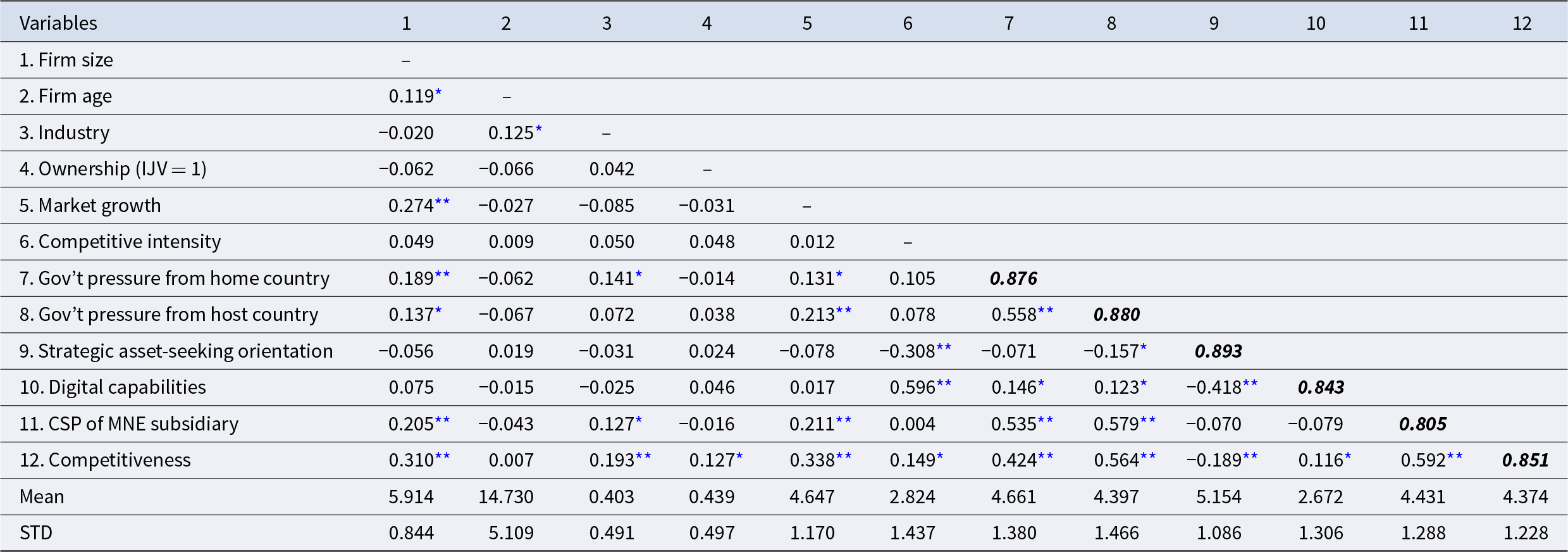
Table 1 presents the descriptive statistics and results of the validity test. Both Cronbach’s alpha (ranging from 0.875 to 0.940) and composite reliability (ranging from 0.908 to 0.948) were greater than 0.80, exceeding the 0.70 cutoff (Fornell & Larcker, Reference Fornell and Larcker1981; Nunnally, Reference Nunnally1978). Therefore, the measures used on our variables are highly reliable and valid. Moreover, the factor loading for all constructs was greater than 0.70 and statistically significant, further demonstrating strong reliability (Chin, Reference Chin and Marcoulides1998; Hulland, Reference Hulland1999). In addition, average variance extracted (AVE) values (ranging from 0.648 to 0.797) for all constructs were greater than the 0.50 benchmark, demonstrating the adequate convergent validity and reliability of our measures (Fornell & Larcker, Reference Fornell and Larcker1981). To assess discriminant validity in the measures, we compared the square root of the AVE for each construct and the absolute value of the correlation between the construct and all other constructs. As presented in Table 2, the former is larger than the latter, demonstrating adequate discriminant validity in our measures (Fornell & Larcker, Reference Fornell and Larcker1981).
Descriptive statistics and validity assessments

Notes: N = 278. AVE = average variance extracted, CR = composite reliability, STD = standard deviation, FL = factor loading.
Construct correlations and discriminant validity

* Notes: N = 278. Values in bold italics represent the square root of the AVE of each construct: p < 0.05, **p < 0.01.
To further check for discriminant validity, we compared the loading values of each single indicator with cross-loadings for other indicators. The results show that each indicator’s loading is higher than the respective cross-loadings, providing adequate discriminant validity in our measures. In addition, we checked for discriminant validity by examining the heterotrait–monotrait ratio (HTMT) of the correlations. All HTMT correlation values are less than 0.85, providing satisfactory discriminant validity for all constructs (Henseler, Ringle, & Sarstedt, Reference Henseler, Ringle and Sarstedt2015). Finally, as recommended by prior researchers (Geisser, Reference Geisser1975; Stone, Reference Stone1974), we assessed the predictive validity of latent constructs in the model by using Stone–Geisser Q 2. The cross-validated communality and redundancy values are greater than zero, providing evidence of predictive validity (Fornell & Cha, Reference Fornell, Cha and Bagozzi1994).
Hypotheses Testing
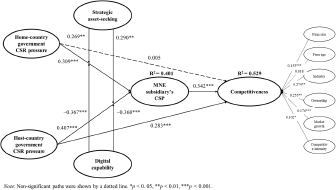
After checking for validity, we examined the hypotheses by testing the statistical significance of the path estimates. We employed the method of Chin (Reference Chin and Marcoulides1998) to obtain p values via the bootstrap approach with 5,000 samples. In particular, we estimated the coefficient of determination (R 2) and the path coefficient with their respective t values. Figure 2 presents the results of our structural equation model. R 2 (ranging from 0.401 to 0.529) for two endogenous variables (the CSP of an MNE subsidiary and the firm’s competitiveness) demonstrate adequate explanatory power in our model. The results also demonstrate significant positive relationships between government pressure for CSR from the home country (b = 0.309, p < 0.001) and from the host country (b = 0.407, p < 0.001) regarding the CSP of MNE subsidiaries. Thus, MNE subsidiaries with strong institutional pressure for CSR from the government of either the home country or the host country are more likely to achieve higher CSP when investing abroad. These results provide strong support for H1 and H2.
We tested H3a and H3b by examining how the strategic asset-seeking intent in foreign subsidiaries of MNEs moderates the effects of government pressure from the home and host countries on CSP. As shown in Figure 2, all coefficients for interactions between strategic asset-seeking intent and government pressure from either the home country (b = 0.269, p < 0.01) or the host country (b = 0.290, p < 0.01) are positive and statistically significant, as predicted. These findings strongly support the view that strategic asset-seeking in an MNE subsidiary plays a positive role in moderating the respective contributions of government pressure from home and host countries to the CSP of the subsidiary. In other words, foreign subsidiaries of MNEs achieving a higher level of innovation ambidexterity are more likely to enhance their environmental and social performance. These results provide strong support for H3a and H3b.
We tested H4a and H4b regarding the moderating effects of digitization capability on the effects of government pressure from both home and host countries on CSP of the MNE subsidiary (we proposed a positive moderating effect). Contrary to our expectations, Figure 2 shows statistically significant but negative interactions between the home country (b = – 0.367, p < 0.001) and the host country (b = – 0.360, p < 0.001) with regard to a digitization capability. Therefore, H4a and H4b are not supported. A plausible explanation for the significant, unexpected negative role is that MNE subsidiaries with higher digitization capabilities may be less likely to conform to institutional pressure exerted by the governments of home and host countries. Typically, MNE subsidiary responses to government pressure from either home or host country would reflect the firm’s dependence on governments; however, MNE subsidiaries with a strong digitization capability might mitigate the resource dependence or institutional influence of governments in home and host countries. Following this logic, we expect that a strong digitization capability would help an MNE subsidiary reduce its dependence on both home- and host-country governments, making the subsidiary less likely conform to institutional pressure for CSR as exerted by a government. This scenario implies a passive response, or even resistance, to government pressure.
We tested H5 by examining the possible contribution of the CSP of an MNE subsidiary to competitiveness between firms. The results in Figure 2 show a positive relationship between the CSP of MNE subsidiaries and competitiveness (b = 0.342, p < 0.001), providing strong support for H5.
Estimated results of structural equation analysis

Finally, we checked for robustness in our results by analyzing the datasets in different ways. We performed SEM by using a covariance-based AMOS modeling technique. The results demonstrated that the AMOS measurement model provided a satisfactory fit to the data: χ 2(449) = 824.58, p < 0.001; comparative fit index [CFI] = 0.94; incremental fit index [IFI] = 0.94; and root mean square error of approximation [RMSEA] = 0.055. The results from hypothesis testing using the covariance-based AMOS technique were effectively equivalent to our results obtained using PLS estimation. Moreover, we assessed our main results via regression analysis, and the results were robust, confirming our findings.Footnote 2 In addition, we examined the robustness of our findings by looking at the subdimensions of CSP (i.e., social and environmental dimensions). The overall results remained qualitatively unchanged.
Supplementary Analyses
While it is beyond the scope of our current study to explore any potential mediating effects in the conceptual model and discuss their implications in detail, we attempted to examine the mediating effects of CSP on the strategies of MNE subsidiaries. Our goal was to provide a more comprehensive perspective on the research. To check for such mediating effects, we followed the method of Zhao, Lynch, and Chen (Reference Zhao, Lynch and Chen2010) to estimate the possible role of CSP by MNE subsidiaries in mediating the respective effects of government pressure from home and host countries on competitiveness. Table 3 summarizes the results. The indirect effects (a × b) of government pressure from the home country on CSR (b = 0.105, p < 0.001) and of government pressure from the host country on CSR (b = 0.139, p < 0.001) with respect to competitiveness were determined. The results indicate that while government pressure from the host country has a positive and statistically significant direct effect on the competitiveness of MNE subsidiaries (b = 0.283, p < 0.001), we did not find a statistically significant direct effect from government pressure by the home country (b = 0.005, p > 0.05). The mediating (a × b) effect of government pressure from the home country on competitiveness was positive and statistically significant, whereas the direct effect (path c) on competitiveness was statistically insignificant. These results indicate indirect mediation (a full mediating role) from the CSP of MNE subsidiaries on the relationship between government pressure from the home country and a firm’s competitiveness. However, we also found a mediating effect (a × b) and a direct effect on competitiveness (path c) from government pressure by the host country, apart from the direct and indirect effects (a × b × c), and they manifested similar trends. Thus, complementary mediation (a partial mediating role) from CSP of MNE subsidiaries exists in the relationship between government pressure from the host country and a firm’s competitiveness.
Results of structural model assessment for direct and indirect effects

*** Notes: N= 278. n.s. = not significant. p < 0.001.
Discussion
Contributions and Implications
After the global economy experienced the impact of the COVID-19 pandemic, social and environmental issues became prominent. MNEs in emerging markets continuously face not only heterogeneous liabilities (e.g., foreignness and challenges stemming from cultural differences, institutional barriers, and political risks) in the host market when expanding abroad but increasing pressure from the governments of home and host countries to take on more CSR (Gu et al., Reference Gu, Yang and Zuo2022). The traditional strategy of maximizing profitability and other performances by taking advantage of institutional and cost differences between the home and host countries has begun to fail. Furthermore, MNEs are more subject to a variety of accusations, including environmental pollution, employee oppression, and insufficient engagement in CSR, which can lead to social crises in the long run. For MNEs to satisfy the needs of different stakeholders (e.g., customers, environmentalists, employees, and government), they need to urgently transform their social roles and focus on both economic and social aspects (Zhao et al., Reference Zhao, Park and Zhou2014). Given this context, we considered how government pressure from home and host countries could motivate MNE subsidiaries to improve CSP and eventually gain competitiveness. On this basis, the issue of developing non-market CSP strategies in MNE subsidiaries was analyzed.
By building upon institutional logic, we theorized about institutional effect by dividing government pressure as perceived by MNE subsidiaries into pressure from the home country and pressure from the host country. We specifically examined how varied forms of institutional pressure could motivate MNE subsidiaries to engage in CSP practices and activities. In addition, we addressed the gaps in the literature by exploring another important question: Under what conditions does government pressure from home and host countries motivate MNE subsidiaries to engage in CSP? To theorize and examine these questions, we considered the influence of strategic asset-seeking and digitization capabilities on CSP, subsequently determining whether the degree of strategic asset-seeking and digitization capabilities could enhance or constrain the effect of government pressure. In addition, we further theorized and examined whether MNE subsidiaries could develop or enhance their competitiveness by engaging in more CSP in the host market. Taken together, we believe the conceptual framework proposed in this study and our analysis contribute to an understanding of the effects of government pressure from home and host countries on CSP, and more importantly, what conditions strengthen or mitigate those institutional effects.
Moreover, this study contributes specifically to a nascent stream of research on how various institutional pressures may facilitate or hinder foreign subsidiaries’ CSP. In it, we comprehensively and systematically examined the role of institutional pressure in motivating MNE subsidiaries to engage in CSP. Then, we explored the effects of government pressure from both home and host countries on the CSP of MNE subsidiaries. Our results suggest that government pressure from both countries contributes positively to the CSP of MNE subsidiaries. The results further indicate that institutional pressure exerted by governments of both home and host countries not only forces MNEs to take on more CSR (Sahasranamam et al., Reference Sahasranamam, Arya and Mukundhan2022) but also encourages MNE subsidiaries to improve their CSP. Our study offers an important contribution to the research on institutional pressure by suggesting that both home- and host-country governments can shape the CSP of foreign subsidiaries. Though some prior studies considered the role of government pressure in shaping the effects of strategic behaviors of foreign subsidiaries (e.g., Lee et al., Reference Lee, Xiao and Choi2021), there has been relatively little explicit discussion of how specific home- and host-government pressures shape CSP. In this regard, our study enriches the literature on CSP of foreign subsidiaries by articulating what key institutional forces might be relevant in explaining CSP at the subsidiary level.
Another theoretical implication is that the strategic asset-seeking orientation and digital capability of foreign subsidiaries represent important means through which these subsidiaries can actively or passively respond to the institutional pressure for them to engage in CSR practices. Our systematic review demonstrates there has been very little research exploring strategic asset-seeking orientation or the digital capability of foreign subsidiaries as a moderating influence on CSP. By examining both strategic asset-seeking orientation and digital capability as moderators, the present study goes beyond the recent literature concerning forces shaping CSP by foreign subsidiaries, building a rich discussion around the question of what strategic asset-seeking orientation and a digital capability provide to foreign subsidiaries that enhance their CSP. More importantly, it is not productive to consider strategic asset-seeking orientation and a digital capability as inherently beneficial or disruptive organizational resources directly determining the CSP by foreign subsidiaries. Rather, a more meaningful contingency perspective on this matter concerns what strategic asset-seeking orientation and a digital capability entail – such as fostering or hindering the institutional effects of both home- and host-country government pressures for CSR on the CSP of subsidiaries.
Our study also provides important implications for practitioners. First, because our study systematically and comprehensively recognizes and clarifies the positive impact of institutional pressure for CSR as exerted by both home- and host-country governments, more MNEs might engage in CSR and adopt it as an important index for strategic management. In this regard, MNE subsidiaries should consider following this important strategic trend by integrating and using their social resources to tap their abilities to solve social problems. Examples include proactively addressing workplace and labor conditions, pursuing sustainable development by paying closer attention to environmental concerns and climate issues, and focusing on the concerns of local communities and the interests of broader stakeholders.
Second, by addressing the moderating role of strategic asset-seeking, we found that strategic asset-seeking motives positively moderate the contributions of government pressure from home and host countries to the CSP of foreign MNE subsidiaries. As emphasized in the literature, convergence in strategic asset-seeking motivation may arise between MNEs from emerging countries and those from developed countries (Sutherland, Anderson, & Hertenstein, Reference Sutherland, Anderson and Hertenstein2018). When firms carefully consider the need for, and possession of, resources and capabilities, and recognize that their own resources are insufficient or that holes exist in their capabilities, they will seek strategic assets.
Similarly, if MNEs do not have corresponding domestic strategic assets, they will take actions such as acquiring new technologies and well-known management know-how from overseas (Shi, Sutherland, Williams, & Rong, Reference Shi, Sutherland, Williams and Rong2021). MNEs can acquire valuable intangible resources, or enhance their innovation and management capabilities (Meyer, Reference Meyer2015), ensuring they are always a step ahead in all dimensions, such as product development, technology, social capital, and resources. On the basis of the abovementioned merits, this study extends the scope of strategic-asset research and reemphasizes the importance of motivation when seeking strategic assets and explaining the responses of MNE subsidiaries to institutional pressure, as exerted by the governments of both home and host countries. In the context of CSR as an important strategic choice to mitigate conventional disadvantages and to acquire social legitimacy in the host market – or in narrowing the competitive gap with advanced firms when seeking more strategic assets – MNEs no longer consider the pressure to engage in CSR (as exerted by governments) as real pressure and a burden. Instead, MNEs have shifted their responses to institutional pressure from passive to proactive by considering such responses to be important non-market social strategies. By engaging in such social strategies, MNEs are now more willing to combine corporate interests with the social interests of their stakeholders (e.g., employees, customers, and local communities). Social considerations have been integrated into the strategies and operations of these MNEs, allowing them to enhance their CSP as a strategic asset in its own right.
Third, contrary to our expectations, the findings of this study suggest that the contribution of government pressure for CSR to the CSP of MNE subsidiaries is negatively moderated by the development of digitization capabilities. Thus, MNE subsidiaries can assert their freedom from institutional pressure for CSR, even if exerted by the governments of both home and host countries. The empirical results of this study demonstrate the different responses of MNE subsidiaries to government pressure for CSR, and these responses vary according to the degree of their potential resources and of their institutional independence from the aforementioned governments.
By developing a strong digitization capability, MNE subsidiaries can create higher levels of resource independence, and thus, more freedom from the institutional influence of government pressure for CSR. This logic implies that MNE subsidiaries that have the ability to accumulate necessary resources and capabilities by themselves represent an important mechanism through which these firms reduce influence from external institutions (e.g., governments); it can also explain why some MNE subsidiaries tend to respond differently to government pressure. These results are expected to offer particularly important contributions to both scholarly work and practical management. As the global economy is increasingly transformed into the era of digitization, the asymmetry of information has been broken even further, and loopholes in the implementation of CSR management will be more easily recognized. Given this rapid digital transformation, the ability to develop one’s own digitization capability by developing and utilizing digital resources will help firms reshape their corporate business models and management paradigms by penetrating all aspects of CSR management. Thus, when faced with institutional pressure for CSR as exerted by the governments, MNE subsidiaries may choose to cope with this institutional influence by developing a strong digitization capability. MNE subsidiaries with a strong digitization capability can reduce resource dependence on external institutions and enjoy more freedom and autonomy in responding to institutional pressure for CSR.
Finally, we found that MNE subsidiaries can achieve much higher levels of competitiveness by enhancing their CSP. The results are largely consistent with prior work, which suggests that MNEs usually attempt to build a good social image, try to gain social acceptance, and avoid public crises by working diligently to meet the social expectations of customers, environmentalists, employees, governments, etc., initiating a change in their social roles to adjust their relationships with those various stakeholders (Zhao et al., Reference Zhao, Park and Zhou2014). If MNE subsidiaries can integrate social factors into their strategic choices and improve their products and services to create more social value, then they are more likely to effectively create social value. Consequently, these MNEs can gain more unique competitive advantages and improve long-term competitiveness by integrating social factors into their products and services (Porter & Kramer, Reference Porter and Kramer2006). In this regard, MNEs must improve their CSP when operating abroad, because this scheme not only allows them to obtain a competitive passport to enter the international market and skillfully resolve the pressure for CSR from governments, but it also plays a key role in rapidly improving their competitiveness.
The results obtained in this research provide strong evidence that MNE subsidiaries can fully transform CSP strategies and practices into real competitiveness. The more MNE subsidiaries focus on engaging and enhancing their CSP, the more likely they are to gain higher levels of competitiveness when operating abroad. MNE subsidiaries that are more engaged in CSP are more visible compared with their competitors, and thus, are more likely to gain the goodwill and trust of stakeholders; subsequently, they are more likely to recruit and retain more talent, making them more likely to secure long-term competitiveness. In summary, we examined the links between institutional influence, firm-specific resources/capabilities, CSP, and firm competitiveness in a distinctive empirical approach. We estimated a conceptual model of CSP drivers and subsequently analyzed the potential moderating effects of resource-based factors reflected by MNE subsidiaries’ different focuses when seeking strategic assets for international expansion. Developing digitization capabilities and competitiveness in MNE subsidiaries are the other factors affecting active engagement in CSP. Subsidiaries are more likely to engage in CSP if more institutional pressure is exerted by the governments of both home and host countries. Furthermore, firms with better CSP tend to achieve more competitiveness. However, the responses of MNE subsidiaries to institutional pressure for CSR largely depend on their level of strategic asset-seeking motives and digitization capabilities. As such logic suggests, firm-specific resources and capabilities play important contingency roles in the relationships between institutional influence and the CSP strategies of MNE subsidiaries. This evidence reveals important theoretical and empirical contributions to, and implications for, different streams of CSP research, and in particular, can form the basis of future research.
Overall, this study explored how institutional and resource-based logical perspectives can jointly explain the CSP of emerging-market MNEs’ foreign subsidiaries operating in a host market, and show how CSP can further contribute to the competitiveness of these firms. In doing so, we especially examined the resource/capability-based conditions under which home- and host-country government pressure for CSR contribute more or less to the CSP of MNE subsidiaries. Our results provide valuable and interesting implications by contributing to a rich understanding of the importance of home- and host-country government pressure in driving MNE subsidiaries’ CSP. They also demonstrate that resource-based firm-specific contingencies within MNE subsidiaries (and their complex interplay with home- and host-country government pressure) simultaneously determine the CSP of these subsidiaries. In this regard, our results shed new light on the question of how and when government pressure can be used as a powerful mechanism to motivate MNE subsidiaries to engage in more CSR activities and subsequently achieve superior CSP.
Our findings provide novel insights into the CSP literature. While both the institutional perspective and RBV acknowledge that the role of either institutions or resources is dependent on context (Barney, Reference Barney1991; Scott, Reference Scott1995), few empirical studies in the IB field have systemically examined whether (and how) institutional forces and resource-based factors (independently, complementarily, or interactively) may or may not enhance MNE subsidiaries’ CSP. In this vein, one of the distinct theoretical contributions of our study is its theoretical development of the integrated framework and empirical illustrations of the importance of joint consideration of both institutional forces and resource-based firm-specific idiosyncrasies that create a unique situation for an MNE subsidiary.
Limitations and Avenues for Future Research
Similar to many studies, our research is not without limitations that can later serve as avenues for future research. First, we only considered the influence of regulatory institutional pressure from governments. Institutional pressure from other stakeholders may play an important role in explaining the CSP of MNE subsidiaries. Consequently, future research should be encouraged to investigate other types of institutional influence. Second, our analysis of CSP in this study primarily emphasized business practices and activities of MNE subsidiaries in addressing social and environmental concerns. CSP may be regarded as a rich and multidimensional construct embodying a wide range of corporate practices and behaviors related to broader stakeholders. Examples include workplace and labor conditions, product safety, management opportunities for women and minorities, or even equality issues among various stakeholders. Subsequently, we encourage future research to extend our analysis to other dimensions of CSP that offer interesting avenues for further enriching our understanding. Third, we only empirically investigated the theme by looking at foreign subsidiaries originating from a single country. Our focus on MNE subsidiaries in the Chinese context may raise concerns about the potential generalizability of our findings to other economies. Although these findings may be specific to the Chinese setting and not to more advanced economies, we believe our results are largely generalizable to subsidiaries established by MNEs originating from other large emerging markets, such as BRICS economies. Nevertheless, future research may integrate different settings to further strengthen and validate our findings. Moreover, our focus in this study is on the influence of CSP on a firm’s competitiveness, and subsequently, another important limitation is the lack of attention to the role of CSP in contributing to other outcomes. Future research is thus encouraged to adopt more varied outcome measures, such as financial and innovative performance, and exploring how CSP may contribute to their improvement. In addition, we only looked at strategic asset-seeking intent and digitization capability, restricting the focus to manufacturing. Other firm-specific characteristics or industry-level differences (e.g., service providers) may contribute relevance to CSP management. Future research considering the influence of other heterogeneous firm-specific or industry-specific conditions on CSP management is warranted. Finally, given the nature of the cross-sectional design in this study, we were unable to explore the dynamic processes of the relationships examined. Therefore, future research should be encouraged to explore these relationships in strategic, dynamic situations by using a longitudinal design.
Data availability statement
The data that support the findings of this study are available from the corresponding authors upon reasonable request.
Mengmeng Wang (bizmwang@gachon.ac.kr) is an assistant professor at the College of Business, Gachon University, Korea. Her research focuses on emerging-market multinationals, big data analytics, sustainable innovation, new technologies, and e-business strategies in emerging markets. Her work has been published in leading academic journals, including Asian Business & Management, Cross Cultural & Strategic Management, Environmental Impact Assessment Review, International Journal of Technology Management, Journal of General Management, International Journal of Development Issues, among others.
Shufeng (Simon) Xiao (bizsxiao@sookmyung.ac.kr) is a professor of international business in the Division of Business Administration at Sookmyung Women’s University, Seoul, Korea. His recent research primarily focuses on the rise of emerging multinational enterprises, entrepreneurship and innovation, and international business in the digital economy. His work has appeared in leading journals such as Industrial Marketing Management, International Journal of Production Economics, Journal of Business Research, Journal of Knowledge Management, Journal of International Management, International Business Review, Management International Review, International Journal of Human Resource Management, and others.