Introduction
Economic considerations play an important role in financing and service provision for the diagnosis of dementia, and the treatment and care available for people with dementia. Economic evidence is presented in many formats, including cost of illness studies, within-trial cost-effectiveness analyses, and model-based economic evaluations. We focus here on the latter and the use of decision-analytic models to assess the cost-effectiveness of interventions for dementia. The use of model-based evaluations is attractive in a health policy context as it provides an explicit framework to systematically synthesize evidence available from multiple sources, and to estimate and compare longer term outcomes (e.g. life expectancy and quality-adjusted life years) and inputs (costs) for alternative interventions and/or treatment pathways. Model-based economic evaluations are commonly used to support decision-makers in a health policy context, where the assessment of effectiveness and cost-effectiveness in a policy-relevant context is required.
The usefulness and validity of the evidence available from model-based evaluations is dependent on the methods and data used to estimate and report the expected costs, outcomes, and cost-effectiveness of interventions. Decision-makers must assess the quality of the model-based evaluations and be familiar with the pros and cons of the evaluations when interpreting findings and using them to inform health policy. There is a growing literature on the use of decision-analytic models in the dementia context, including a number of high-quality systematic reviews. While each of the available reviews has focused on a distinctive segment of the care continuum, i.e. diagnosis (Handels et al., Reference Handels, Wolfs, Aalten, Joore, Verhey and Severens2014), pharmacological treatment (Green, Reference Green2007; Cohen and Neumann, Reference Cohen and Neumann2008; Oremus, Reference Oremus2008; Gustavsson et al., Reference Gustavsson, Van Der Putt, Jönsson and McShane2009; Green et al., Reference Green, Shearer, Ritchie and Zajicek2011; Hernandez et al., Reference Hernandez, Ozen, DosSantos and Getsios2016), non-pharmacological treatment (Jones et al., Reference Jones, Edwards and Hounsome2012), and interventions for dementia carers (Sopina and Sørensen, Reference Sopina and Sørensen2018), they shared similar objectives and a number of common themes. A majority of reviews aimed to understand the analytical approaches used to evaluate cost-effectiveness through providing a detailed description of study characteristics, methodologies, model elements, and main findings. Common findings across reviews have been that (i) many studies failed to present sufficient information to fully assess methodologies used, thus increasing the uncertainty surrounding the interpretation and generalization of the results, (ii) considerable variation exists in methodological assumptions applied and target populations among studies, preventing a meaningful comparison of cost-effectiveness results, and (iii) evaluations should use better quality and up-to-date data, particularly outcome data that better reflect the breadth of dementia symptoms. Prior reviews have taken a varied approach to the critical appraisal and assessment of methods, with few providing a comprehensive quality assessment of modeling methods and reporting practices against published decision-analytic models in dementia. None of the prior reviews have reported across the full continuum of dementia care, from prevention, screening, early detection, and diagnosis, to treatment and care programs for people with dementia and their carers.
In the current review, we present a comprehensive overview of contemporary model-based economic evaluations of dementia interventions. We systematically review the literature reporting decision-analytic models used in economic evaluation of interventions for people with dementia and their carers (informal and family carers) across prevention, early detection, diagnosis, and treatment and care strategies, including all types of dementia. Additionally, we critically assess the modeling methods used and reporting quality against good practice guidance on methods for decision-analytic modeling in health technology assessment, across key domains of model structure, data, and model consistency.
Methods
The systematic search and review of the literature
We have undertaken the systematic review in line with the Preferred Reporting Items for Systematic Review and Meta-Analyses (PRISMA) guidelines (Moher et al., Reference Moher, Liberati, Tetzlaff and Altman2009). The systematic review was registered in PROSPERO international prospective register of systematic reviews (ID: 42017059154) in April 2017. The search strategy and keywords are presented in Table SA1.1 (Appendix 1, published as supplementary material online attached to the electronic version of this paper at https://multimediafluids.uam.elogim.com/core/journals/international-psychogeriatrics). The search was applied to the literature available up to February 2018, in the electronic databases of MEDLINE, CINAHL, Cochrane Library, Embase, PsycINFO, Econlit, HTA database, CEA registry, and PubMed. Reference lists of identified publications were checked for additional articles meeting the inclusion criteria.
Inclusion criteria (Table SA1.2) were (i) evaluations of interventions for people with dementia and/or their carers, covering surveillance, screening, early diagnosis, treatment, management, and care, and (ii) economic evaluation using a decision-analytic model-based framework. The identification of studies was undertaken by two independent reviewers, who initially screened the titles and abstracts for eligibility. A study was included if both reviewers agreed that it met all the inclusion criteria. Dissimilarities in reviewers’ conclusion were resolved by discussion and/or examining the full article. Full texts of all included studies were reviewed independently by both reviewers. Resulting citations and reference lists in these reviewed studies, studies that published systematic reviews, and meta-analyses were examined to ensure that no eligible studies were missed. Both reviewers systematically and independently documented the properties of the included studies.
Quality assessment of decision-analytic models
For the quality assessment of included studies, we used the framework for assessment of good practice in decision-analytic models in a health technology assessment context, presented by Philips et al. (Reference Philips, Bojke, Sculpher, Claxton and Golder2006) (hereafter, referred to as the Philips checklist). The checklist is a broad framework which assesses three key dimensions of modeling: structure, data (including uncertainty), and consistency. It includes 58 items, with 9 distinct areas for model structure (23 items), 11 areas for data (30 items), and 2 areas for model consistency (5 items). See Table SA1.3 for detail on the Philips checklist. This checklist was used because of its relevance to the HTA context (Philips et al., Reference Philips, Ginnelly, Sculpher, Claxton and Golder2004), and as it is considered to be consistent with the ISPOR principles of good practice for decision-analytic modeling for health care evaluation (Weinstein et al., Reference Weinstein2003; Caro et al., Reference Caro, Briggs, Siebert and Kuntz2012).
The quality assessment using the Philips checklist was conducted by two independent reviewers. Differences between the two reviewers’ responses for each item were resolved by discussion and/or consultation with a third reviewer. We followed the questions and examples presented in Philips et al. (Reference Philips, Ginnelly, Sculpher, Claxton and Golder2004, Reference Philips, Bojke, Sculpher, Claxton and Golder2006) to score a response for each item (Y = Yes, N = No, U = Unsure, and NA = Not Applicable). The scoring decisions for a study were also influenced by the available literature up to that point in time, particularly with respect to other published models, data sources, and best practice guidelines. The standards for the assessment of uncertainty increased over time as the number of published studies using competing models increased. For instance, the lack of discussion on alternative models was not heavily penalized prior to 2000 (before the good practice guidelines released and widely adopted in the mid-2000s), while studies published from late 2000s required a more comprehensive assessment of uncertainty.
Many model-based evaluations of pharmacological treatments for Alzheimer's disease (AD) have been subject to critical appraisal in the prior review by Green (Reference Green2007), which reviewed the literature reported up to 2005. For this reason, and for pragmatic reasons, we use this prior review as a point of departure and limit the quality assessment of studies in this category to those published from 2005 onwards. All studies identified on prevention, diagnosis, and non-pharmacological interventions are subject to quality assessment in the current review.
Results
Basic properties of studies included in the systematic review
We identified 67 studies that met the inclusion criteria (evaluating a dementia intervention using decision-analytic model/s). See Figure SA2.1 (Appendix 2, published as supplementary material online) for detail on screening, identification, and selection of studies and Table SA2.1 for basic characteristics of the studies identified by intervention type, target population, types of decision-analytic models, and their major features.
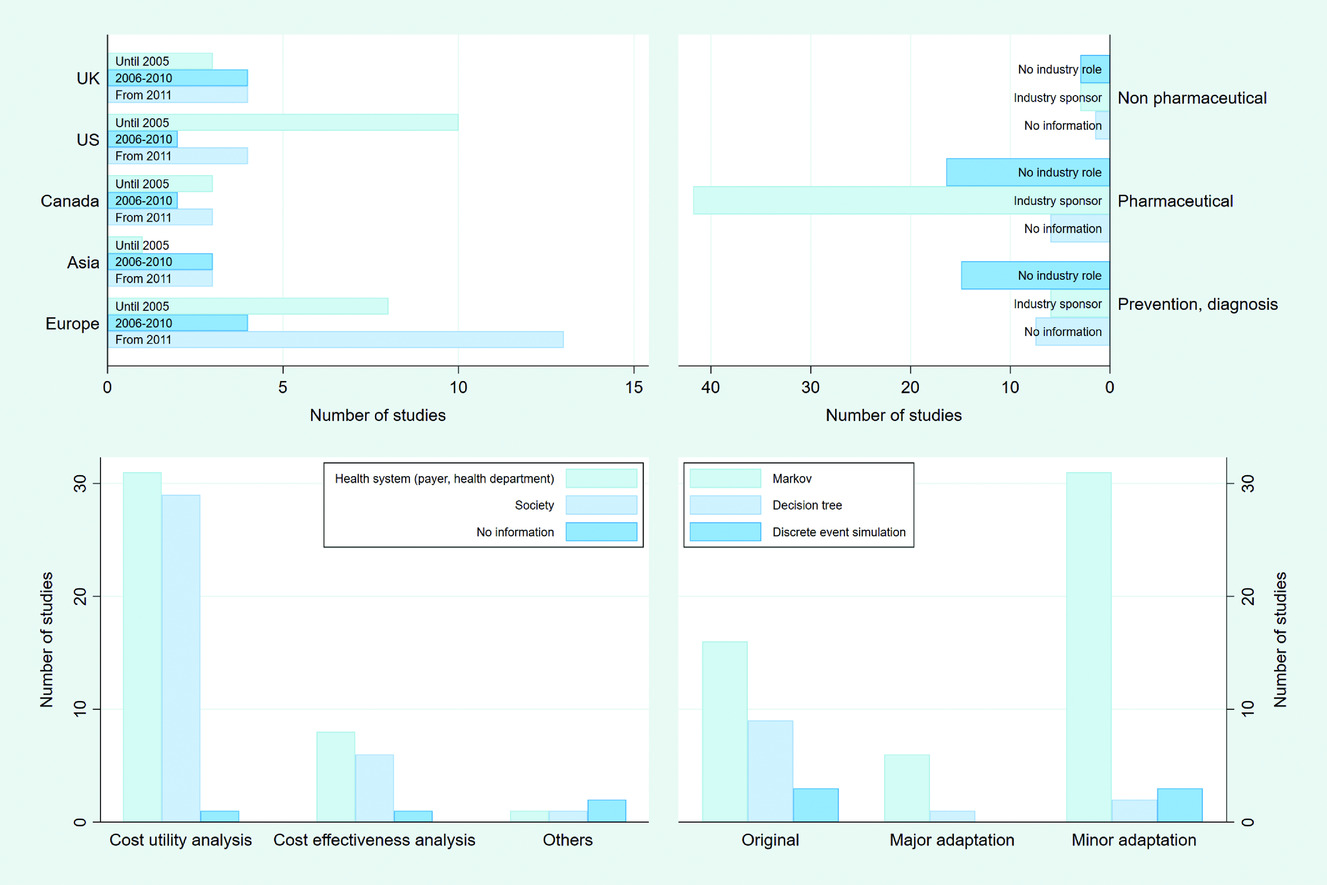
Two-thirds of identified studies (42/67) were published after 2005 (see Figures 1 and SA2.2). All but three studies (Fuh and Wang, Reference Fuh and Wang2008; Hu et al., Reference Hu, Yu, Chen, Clay, Toumi and Milea2015; Yang and Chen, Reference Yang and Chen2016) were conducted in OECD countries. More than half of the studies had some degree of industry involvement (e.g. authors received direct funding from industry or were affiliated with industry-funded projects or groups); ten studies did not declare any information about industry involvement.
Some characteristics of decision-analytic models used in the economic evaluation of dementia interventions.

In terms of the perspective/s stated and employed in included studies, in many cases, the perspective is dictated by the research context (and decision problem) being addressed. For example, specific reimbursement-setting studies commonly follow recommendations or reference case methods, for regulatory agencies, government subsidy, or insurance approval. Approximately, 40% of studies applied a societal perspective, in which both (formal) health and care service costs and the opportunity cost of informal care (provided by family carers) were accounted for, and another 40% used a narrower health system perspective (including Third Party Payer, Department of Health). A small number of studies (10/67) used more than one perspective, often the combination of societal and health system (Figure 1).
Evaluations of pharmacological treatments accounted for 43 of the 67 included studies. A majority of studies (40/43) assessed the three cholinesterase inhibitors (donepezil, galantamine, and rivastigmine) and a receptor antagonist (memantine), which have demonstrated modest effectiveness for the symptomatic treatment of AD (Birks, Reference Birks2006). Three studies evaluated tacrine (Henke and Burchmore, Reference Henke and Burchmore1997), olanpazine (Kirbach et al., Reference Kirbach, Simpson, Nietert and Mintzer2008), and an immunotherapy (Aβ42) (Yang and Chen, Reference Yang and Chen2016). In the majority of these studies, the decision context was treatment for people with a diagnosis of AD (42/43); two studies covered dementia with Lewy bodies (Gustavsson et al., Reference Gustavsson, Van Der Putt, Jönsson and McShane2009) and vascular dementia (Wong et al., Reference Wong, Bansback, Lee and Anis2009). The main comparator in these studies was standard care or no treatment (35/43). None compared a pharmacological agent with a non-pharmacological intervention.
Two studies (2/67) evaluated a hypothetical disease modification treatment for people with mild cognitive impairment and pre-dementia (Budd et al., Reference Budd, Burns and L'Italien2011; Skoldunger et al., Reference Skoldunger, Johnell, Winblad and Wimo2013), and three other studies evaluated non-pharmacological interventions: a family-based program for mild AD (Martikainen et al., Reference Martikainen, Valtonen and Pirttila2004), deep brain stimulation for mild AD (Mirsaeedi-Farahani et al., Reference Mirsaeedi-Farahani, Halpern, Baltuch, Wolk and Stein2015), and a connected health care program for mild dementia (Dowd et al., Reference Dowd2018).
We identified 19 studies evaluating strategies for prevention (Zhang et al., Reference Zhang, Kivipelto, Solomon and Wimo2011), early assessment (Getsios et al., Reference Getsios, Blume, Ishak, MacLaine and Hernández2012; Yu et al., Reference Yu, Lee, Jang, Han, Kim and Kim2015), screening (Retchin and Hillner, Reference Retchin and Hillner1994; Djalalov et al., Reference Djalalov2012), or diagnosis of dementia (14/19). Diagnosis studies covered a large variety of strategies, from imaging (magnetic resonance imaging, positron emission tomography, etc.) to biomarker (Aβ41, cerebrospinal fluid) detection. In these studies, the main target populations were elderly people or those with mild cognitive impairment.
Almost all studies used a cost utility framework (48/67), in which the primary outcome was quality-adjusted life years or a cost-effectiveness analysis (15/67). Four studies used either cost benefit analysis or evaluated either outcomes or cost only. In cost-effectiveness studies, the final outcomes were measured by clinical endpoints such as life years, the number of accurate diagnoses, and the number of years before full-time care or before institutionalization.
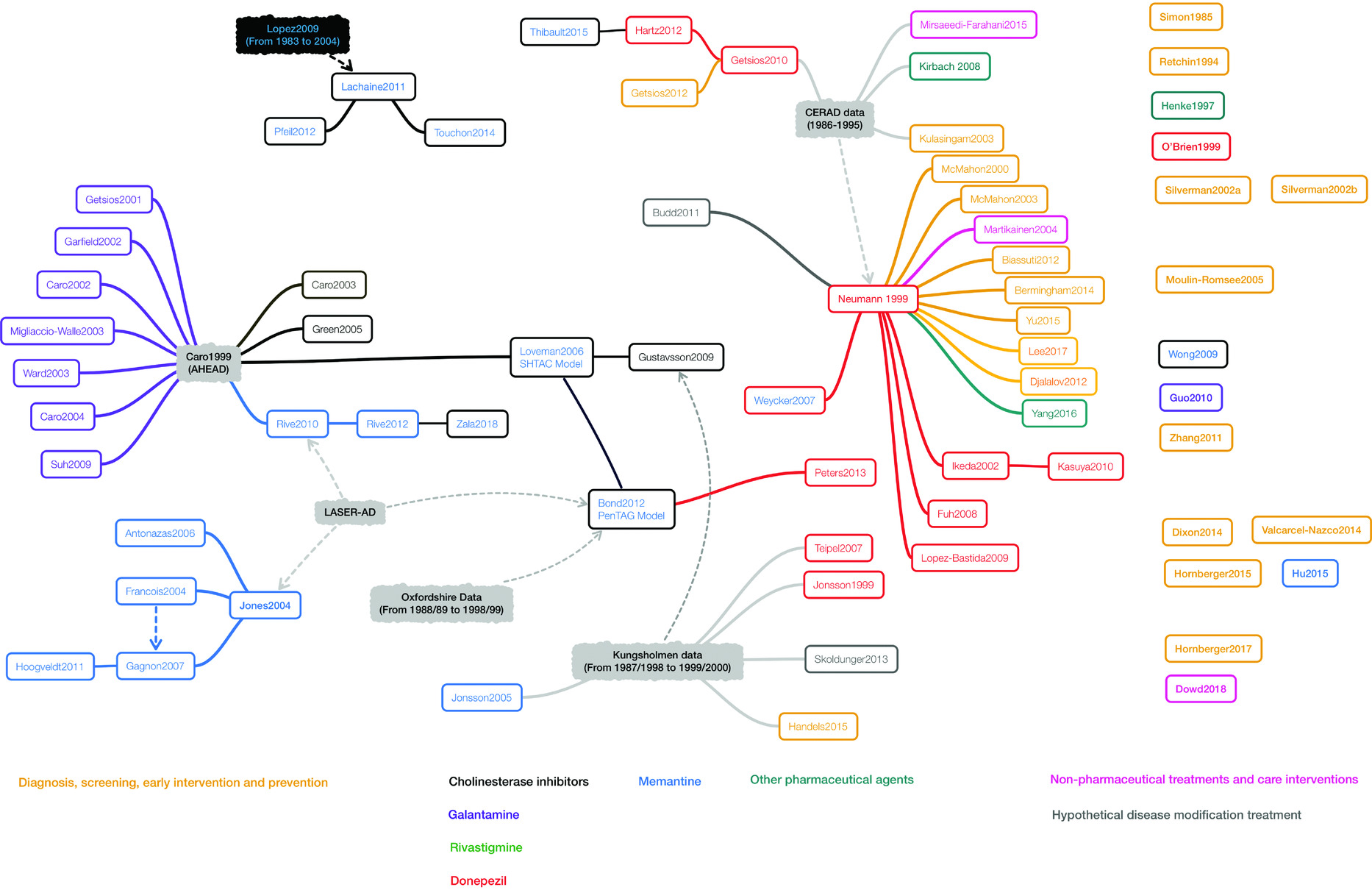
The most commonly used modeling framework was a Markov state transition model (52/67), followed by a decision tree approach (12/67). Four studies combined a decision tree (for diagnosis) with either a Markov or a discrete event simulation model (for dementia progression). Six studies used a discrete event simulation (DES) framework, four of which were based on the model structure developed in Getsios et al. (Reference Getsios, Blume, Ishak and Maclaine2010). More than two-thirds of all studies evaluating pharmacological treatments applied a previously published model-based framework (see Figure 2). For instance, 16 studies adopted the model published by Neumann et al. (Reference Neumann1999), and 13 studies were based on the Assessment of Health Economics in Alzheimer's Disease (AHEAD) model (Caro et al., Reference Caro2001). Approximately, a half of studies (10/19) evaluating prevention, screening, and diagnosis of dementia developed their own original models, while the rest translated previously published models into other settings.
Links among cost-effectiveness models of dementia interventions.

Neumann et al. (Reference Neumann1999) estimated the cost-effectiveness of donepezil, compared to no treatment, using a Markov transition model with four health states: mild, moderate, severe, and dead. Three AD severity states/stages were used based on the Clinical Dementia Rating (CDR) scale, and patients were either living in the community or in a nursing home. The underlying AD progression probabilities were estimated from Consortium to Establish a Registry for Alzheimer's Disease (CERAD) data, which is a longitudinal database of 1,145 dementia patients in the United States between 1986 and 1995 (Morris et al., Reference Morris1989). Data on the impact of donepezil on progression and mortality were sourced from the 24-week randomized, double-blinded, placebo-controlled clinical trial that investigated the impact of donepezil on patients with mild or moderate AD (Rogers et al., Reference Rogers, Farlow, Doody, Mohs and Friedhoff1998). Subsequent studies applying the Neumann model kept the four-state model structures and the underlying AD progression while updating treatment impacts, mortality risks, costs, and outcomes using the relevant settings. Model durations (e.g. six months, two years, ten years to life time) and cycle lengths (e.g. one month, six weeks, one year) were applied to suit the study objectives.
The AHEAD model (Caro et al., Reference Caro2001) applied a different interpretation of disease progression, using “need for full-time care (FTC)” as the main end-point to classify three health states: not requiring FTC, requiring FTC, and dead. FTC was defined as the consistent requirement of caregiving for a significantly large amount of time per day, which was indicated by the need for institutional care (in a health-related facility). The likelihood of FTC at any point in time was estimated using patient characteristics observed in the predictors study cohort of 236 patients with AD observed for a period of up to seven years in the United States (Stern et al., Reference Stern1997). Patient characteristics included the (modified) Mini-Mental Sate Examination (m-MMSE) scores, extrapyramidal signs, psychotic symptoms, disease duration, and whether or not the patient had a young onset AD. Subsequent studies using the AHEAD model continued with the three-state model and its progression probabilities while revising treatment impacts, mortality risks, costs, and outcomes. In some occasions, the definition of FTC was revised to “institutionalization.” The majority of these studies used a five-year or a ten-year horizon. The cycle length of one month was explicitly reported in five studies (out of 13).
A small number of alternative (dementia progression) models to AHEAD and Neumann incorporate more disease characteristics than just cognitive impairment. Some combinations of physical function (e.g. using activities of daily living, instrumental activities of daily living, or severe impairment battery instruments), care requirement (e.g. full-time care) and/or residence (community vs. nursing home), or behavior symptoms (e.g. using Neuropsychiatric Inventory) were used in five Markov transition models to define health states (nine to 12 health states), and in six DES models to initiate events and assign attributes to patients (see Table SA2.1 for more details).
Similar to other areas of disease modeling literature, models in this dementia literature relied upon disease progression data estimated from observational studies, many of which date from the 1980s and 1990s (such as CERAD, Kungsholmen, or Predictors Study Cohort). Mortality risks were often assumed either constant over time in studies published in the early half of the literature, or age- and gender-specific (based on country-specific all-cause mortality risk) in the recent half of the literature. In a small number of cases, a hazard ratio due to dementia was added to the base mortality (Gagnon et al., Reference Gagnon, Rive, Hux and Guilhaume2007; Kirbach et al., Reference Kirbach, Simpson, Nietert and Mintzer2008; Budd et al., Reference Budd, Burns and L'Italien2011; Lachaine et al., Reference Lachaine, Beauchemin, Legault and Bineau2011; Touchon et al., Reference Touchon, Lachaine, Beauchemin, Granghaud, Rive and Bineau2014; Thibault et al., Reference Thibault2015; Lee et al., Reference Lee, Sposato, Hachinski and Cipriano2017). Impacts of treatment were extrapolated from short-duration clinical trials (e.g. six months) to the longer term (e.g. five or ten years) to fit the model duration. All studies grouped costs into the three main categories: intervention costs; direct medical expenditure (e.g. doctor visits, monitoring tests, and hospitalization); and paid (formal) care cost (e.g. community-based social and nursing services, and nursing home fee). In cost utility analysis models, most of the studies sourced the quality of life weights from valuation studies that used one of two generic instruments: the Health Utility Index (developed with a US population using HUI2, in Neumann et al., Reference Neumann, Hermann and Weistein1998 and Reference Neumann1999 or a Japanese population using HUI3 in Ikeda et al., Reference Ikeda, Niwata and Igarashi2001) or the EuroQol, developed with a mostly European population (including the UK in Jonsson et al., Reference Jonsson2006, Spain in Lopez-Bastida et al., Reference Lopez-Bastida, Serrano-Aguilar, Perestelo-Perez and Oliva-Moreno2006, and Sweden in Ekman et al., Reference Ekman, Berg, Wimo, Jönsson and McBurney2007). A dementia-specific quality of life weight (e.g. DEMQOL developed in Rowen et al., Reference Rowen2012) was used in one study (Dowd et al., Reference Dowd2018) and the quality of life instrument for people with Alzheimer's disease (QoL-AD) was used in a small number of studies, in which the quality of life scores were mapped into a utility scale (e.g. Gagnon et al., Reference Gagnon, Rive, Hux and Guilhaume2007; Rive et al., Reference Rive2010). Out of 36 studies using a societal perspective, 32 incorporated the informal care cost, approximated by total number of hours of caregiving and hourly opportunity cost, but only seven studies accounted for carers’ quality of life.
Quality assessment of decision-analytic models using the Philips checklist
We conducted quality assessment using the Philips checklist for 55 (out of 67) studies: all 19 studies evaluating interventions/strategies for prevention, screening, early detection, and diagnosis of dementia; five studies evaluating non-pharmacological interventions and programs for people with dementia and their carers; and 31 studies (published after 2005) evaluating pharmacological treatments.
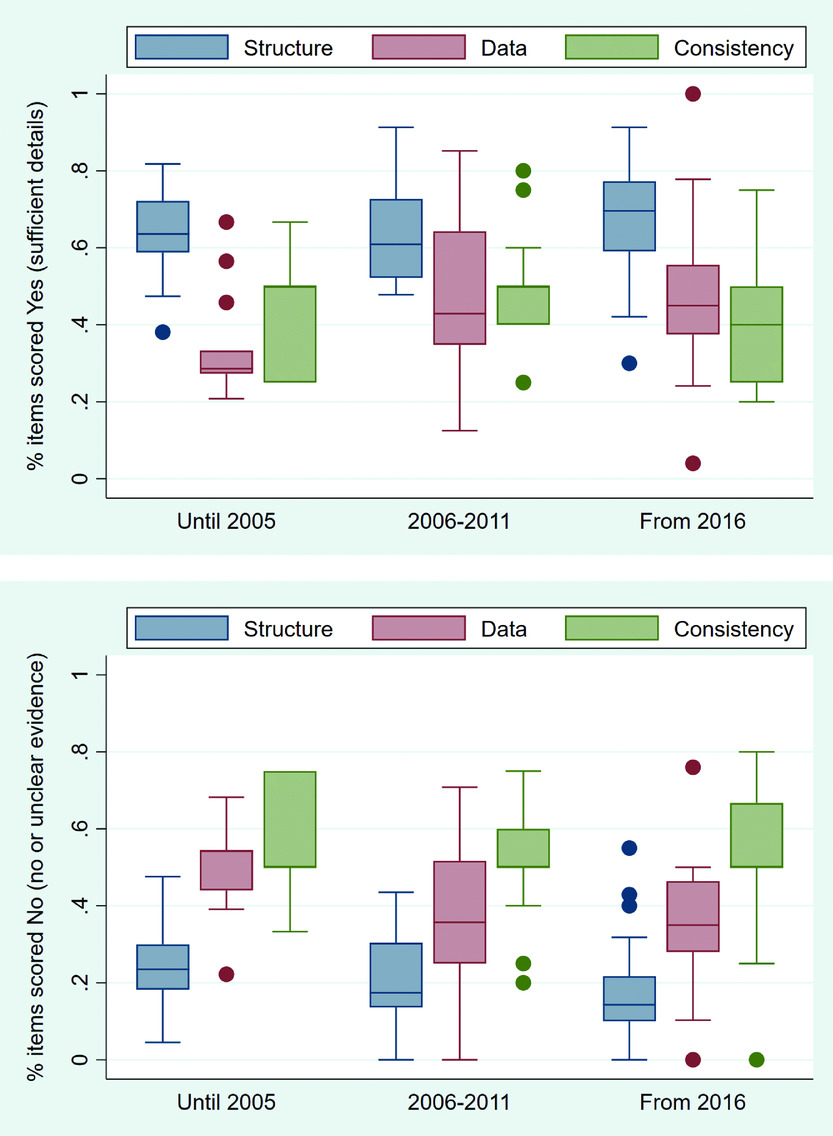
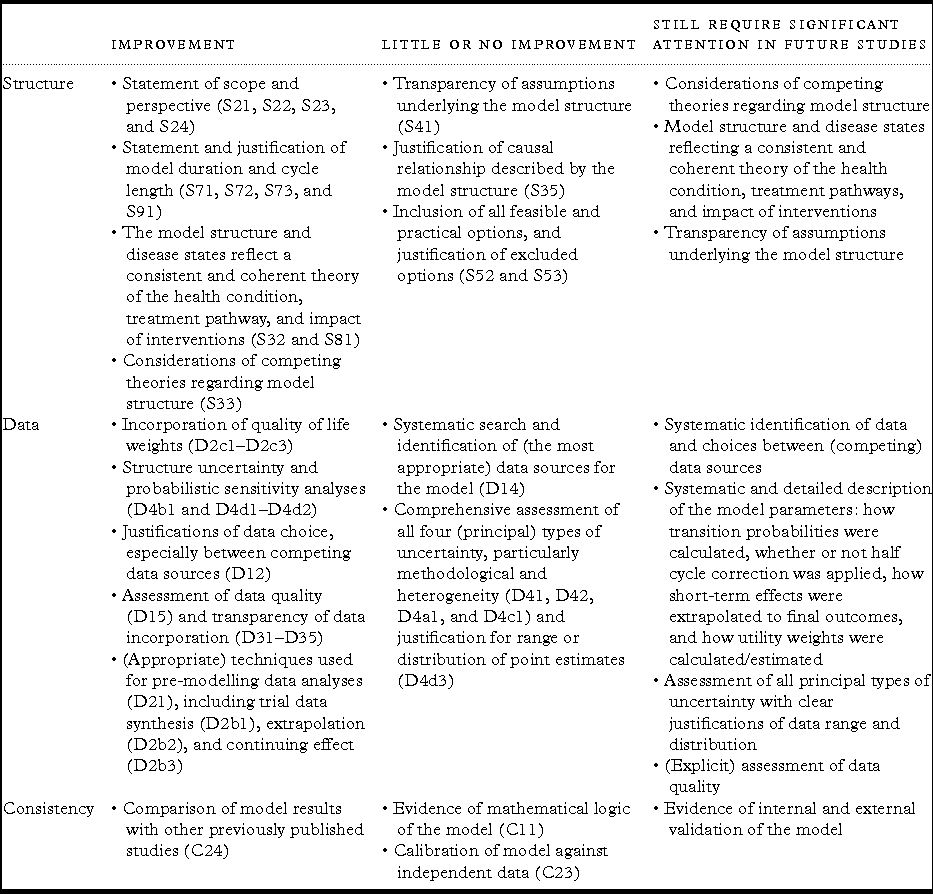
Overall, “Structure” (23 items) was the area where a majority of studies scored more positively (“Yes,” providing sufficient details) than negatively (“No,” insufficient information or unclear evidence), while “Data” (30 items) and “Consistency” (5 items) showed greater limitations in reporting quality. It is clear that some aspects of modeling and reporting practices have improved overtime, evidenced by the rising percentage of items scored positively (Yes) in the Data domain over time (see Figure 3). However, information/evidence provided in certain domains was still inadequate to meet the checklist criteria, including the comprehensive assessments of uncertainty (e.g. covering all four principal types of uncertainty: methodological; structural; heterogeneity; and parameter), validation of internal consistency, and calibration against independent data. Only two studies scored “Yes” in more than 85% of all items; both of them were comprehensive (long) health technology assessment (HTA) reports submitted to NICE (Loveman et al., Reference Loveman2006; Bond et al., Reference Bond2012). They both explicitly described a systematic approach to the literature search and thorough consideration and selection of models, parameters, assumptions, and pre-modeling methods, which were commonly omitted in other publications. We present the full quality assessment findings in Table SA2.2, and a summary of key observations on the changes of modeling and reporting quality over time in Table 1.
Changes of quality reporting, by percentage of items scored “Yes” (sufficient evidence) and “No” (no or unclear evidence).

Changes in modeling and reporting practice and quality (based on the Philips checklist scoring results)

Structure: Most studies clearly stated their objective and scope, the options under evaluation, and the analytical perspective/s and outcomes. The evidence of model types, disease states and pathways, evaluation horizon, and cycle length was described clearly. However, those modeling decisions were often not accompanied by an explicit rationale and justification, such as why competing model structures were not considered, or why other comparator/s should be excluded. Studies that replicated existing models in another setting were more likely to omit rationale for comparators, duration, and cycle length, compared to studies that developed original models. Unexpectedly, the latter failed to justify their (newly developed) model choices more often than the former (22/24 vs. 22/31).
Data: Modeling quality has improved over time. Strong improvements were observed in the reporting of baseline data, quality of life weights, and analysis of parameter uncertainty. While the adoption of good modeling and reporting practices is also reflected in critical areas such as selecting data sources and using appropriate techniques for pre-modeling analyses, a majority of studies simply reported the modeling decision/approach without providing a rationale. For instance, while more than 80% of all studies discussed, reported, and referenced the model data properly (items D11, D2c1, D31, D33, and D35), fewer than 20% provided sufficient justification for its use (items D12, D2a4, D2b2, D2b3, D2c3, D32, and D42). Surprisingly, only a third of studies clearly reported their systematic approach to data identification and selection, and 25% provided any quality assessment of the data used in their models (including risk of bias). With regard to uncertainty analyses, while the assessment of parameter uncertainty improved significantly over time (from <50% in studies published before 2005 to >90% in those published after 2010), little improvement was observed in the assessment of methodological and heterogeneity uncertainties (approximately 20–25% of all studies).
Consistency: This domain consists of fewer assessment items than the other domains: one internal and four external consistency checks. Out of 55 studies, two explicitly stated that the mathematical logic of their models was examined (both of them were HTA reports, Bond et al., Reference Bond2012 for the UK and Bermingham, Reference Bermingham2014 for Canada) and another two reported that they calibrated their models using external data (Gagnon et al., Reference Gagnon, Rive, Hux and Guilhaume2007; Gustavsson et al., Reference Gustavsson, Van Der Putt, Jönsson and McShane2009). All studies drew consistent conclusions (of cost-effectiveness) from the model results and more than half (32/55) compared their findings with other published models. Only a few studies (4/55) reported “counter-intuitive results” and attempted some explanation. Overall, we did not see strong evidence of improvement in the quality of modeling and reporting of evidence in the “Consistency” domain across the 30-year period of this literature review.
Discussion
Decision-analytic models have been used widely in the economic evaluation of dementia interventions in the past three decades. While this approach has been attractive in a health policy context, the validity of (cost-effectiveness) findings depends entirely on the modeling quality. That is, how well the model addresses the decision problem through modeling of disease progression and treatment pathways, and capturing the relevant costs and outcomes, and whether or not the model can be validated against external data.
As expected, recent studies (e.g. those published after 2010) showed significant improvement in terms of modeling quality and reporting standard, which may be a result of the introduction of guidelines on decision-analytic modeling and good practice checklists (e.g. CHEERs, Philips checklist). Despite this positive trend, there remain areas requiring substantial improvement. Some would be relatively simple, such as a clear documentation of model characteristics (model type, number of health states, model duration, cycle length, and half-cycle correction), data sources, and assumptions underlying the model structure. Others require substantial improvements in modeling practice, such as a systematic approach to literature searches and selection of data sources and alternative models (including assessment of data quality), appropriate application and rationale for pre-data modeling methods, and comprehensive assessment of model validity and consistency using internal and external data sources. We acknowledge that the critical appraisal using the Philips checklist was a subjective process and may be more reflective of the quality of reporting than the quality of modeling. Studies with a higher percentage of items scored positively (Yes) did not necessarily have higher quality modeling. For instance, many items were easier to report and to evaluate (i.e. whether or not there was sufficient information): evaluation objective, target population, interventions, model type, number of health states, duration, and cycle length. Additionally, studies that translated existing modeling frameworks into new settings/evaluations (with minimal revisions) could often refer to the original models (for pre-modeling and data sources), which may have freed up space in the main text for content on rationale and discussion surrounding modeling methods. Our approach to critical appraisal and use of the Philips checklist does not allow a detailed assessment of the appropriateness of the model structure, assumptions, and data sources. Nor was it possible to make meaningful direct comparisons of models against each other, which is only feasible through replicating the models used in those studies. Despite these limitations, the Philips checklist remains useful as a self-assessment tool for model developers to improve both modeling and reporting quality.
In this review, we found the majority of models use a crude representation of dementia and fail to account for distinguishing features of the condition, such as behavioral and psychological symptoms and functional performance, all of which affect care needs and quality of life. This finding supports other interpretations of the literature in this field (Cohen and Neumann, Reference Cohen and Neumann2008; Green et al., Reference Green, Shearer, Ritchie and Zajicek2011). A few recent studies (Gagnon et al., Reference Gagnon, Rive, Hux and Guilhaume2007; Getsios et al., Reference Getsios, Blume, Ishak and Maclaine2010; Hartz et al., Reference Hartz, Getsios, Tao, Blume and Maclaine2012) incorporated, at least conceptually, a combination of domains to better reflect the impact of the underlying biological process on disease states and progression. Recent contributions to the modeling literature in this area, Green and Zhang (Reference Green and Zhang2016) have argued for, provided empirical evidence to support the modeling of Alzheimer's disease progression using a multi-domain descriptive system, for example, using cognition, behavior, and function as core symptom domains. Such recommendations respond to earlier findings in the literature on methods for model-based evaluations, and it is suggested that this practice becomes an integrated part of future modeling initiatives and developments for the assessment of the progression of dementia in an HTA setting.
While the evaluation of pharmacological agents accounted for two-thirds of all studies, attention on non-pharmacological interventions, prevention, and diagnosis has been consistent over time, although infrequent, and possibly on the rise over recent years. The dominance of drug evaluation for people with AD strongly mirrors both the target population of pharmacological agents and the distribution pattern of dementia prevalence by types of dementia, where Alzheimer's disease accounts for 50%–75% of dementia cases (Prince et al., Reference Prince, Albanese, Guerchet and Prina2014). It also reflects the environment in which many economic evaluations are conducted: prior to approval of public funding for a wide-scale implementation of interventions, most of which were pharmacological. The question remains whether or not a pharmacological-based evaluation model can be reapplied directly to evaluating prevention, diagnosis, or non-pharmacological interventions. This current literature indicates that it is a reasonable approach: a half of non-pharmacological studies sourced their models from pharmacological evaluations. For instance, a prevention strategy that reduced the dementia incidence rate (Zhang et al., Reference Zhang, Kivipelto, Solomon and Wimo2011) or a more precise diagnosis method that led to a higher number of patients correctly diagnosed at early stage (Biasutti et al., Reference Biasutti, Dufour, Ferroud, Dab and Temime2012; Djalalov et al., Reference Djalalov2012; Getsios et al., Reference Getsios, Blume, Ishak, MacLaine and Hernández2012; Yu et al., Reference Yu, Lee, Jang, Han, Kim and Kim2015) or a care program (for the dementia dyads) impacting on the disease progression (Martikainen et al., Reference Martikainen, Valtonen and Pirttila2004; Dowd et al., Reference Dowd2018) can all share a disease progression model where subsequent costs and QALYs are accumulated and compared. This approach can potentially allow for the comparison of all interventions along the continuum of dementia care from prevention to active disease management. It will also facilitate a better understanding of the impacts and potential trade-offs between interventions, thus offering decision-makers an opportunity to consider low-value versus high-value strategies, and the possibility of combining complementary therapies to suit patient settings and preferences. This is particularly relevant in countries where health and social services are both funded centrally through tax and/or social insurance and where the primary goal of HTA is ensuring efficient allocation of scarce resources. A caveat here is that the feasibility of this approach rests entirely on the quality of the core models that can successfully represent the disease progression patterns, capture relevant dementia symptoms, and outcomes (of both person with dementia and their carers), and account for important disease modification factors.
Our last observation relates to the existing capacity to perform cross (external) validation and convincingly draw a cost-effectiveness conclusion. It may be that cost effectiveness is evidenced when many studies, even when using different modeling methods, arrive at a similar conclusion. For instance, the cost effectiveness of memantine was established in four different studies/models (Jones et al., Reference Jones, McCrone and Guilhaume2004; Jonsson, Reference Jonsson2005; Rive et al., Reference Rive2010; Hu et al., Reference Hu, Yu, Chen, Clay, Toumi and Milea2015) and multiple reapplications of those models in other settings. A similar observation can be seen for donepezil with its economic value confirmed by at least six different studies/models, (Jonsson et al., Reference Jonsson, Lindgren, Wimo, Jonsson and Winblad1999; Neumann et al., Reference Neumann1999; O'Brien et al., Reference O'Brien1999; Teipel et al., Reference Teipel, Ewers, Reisig, Schweikert, Hampel and Happich2007; Getsios et al., Reference Getsios, Blume, Ishak and Maclaine2010; Peters et al., Reference Peters, Anderson, Hoyle and Hyde2013). While this consistency could be interpreted as a source of strong evidence of external validity for those models/evaluations, it may be that the direction of the evidence correlates with the source of funding/sponsor. Many of these studies have received direct funding from industry, and in many instances, may reflect the economic evaluation models that were likely to have been submitted by industry for subsidy consideration (reimbursement purposes). Studies conducted independently of industry, or for HTA authority, showed a less optimistic conclusion regarding the economic value of some interventions. This observation is supported by previous authors (Bond et al., Reference Bond2012; Peters et al., Reference Peters, Anderson, Hoyle and Hyde2013). In particular, Bond et al. (Reference Bond2012) stated that when using more conservative assumptions on elements with high uncertainty, the (estimated) incremental cost-effectiveness ratio (using industry submission models) could be at the margins of what would normally be considered cost-effective. Some consideration of this issue may be useful in future research on the validity and consistency of results and conclusions in modeling methods.
Conclusion
We identify an expanding literature on model-based evaluations of interventions for dementia. The literature is predominantly reporting on pharmaceutical interventions for Alzheimer's disease, but there is a growing literature for dementia prevention and non-pharmacological interventions. We provide a comprehensive summary and a critical review of the literature, finding that reporting of decision-analytic models has improved with the recent introduction of checklists and guidelines. However, we find some important aspects of model reporting still require substantial improvement, including justification of key model components and data selection. Findings here clearly demonstrate that decision-makers using model-based evaluations of dementia care need to critically appraise and understand the methods and data applied, and the limitations of any evaluation to ensure they are used, interpreted, and applied appropriately.
Supplementary material
To view supplementary material for this article, please visit https://doi.org/10.1017/S1041610218001291