1. Introduction
This paper attempts to sketch a broad framework that can be used to model processes of language contact. The key theoretical notion adopted is that of bilingual optimization strategies, adopted by speakers in specific contact scenarios. This notion is adopted because it hopefully helps to overcome a number of challenges for adopting a unified model or framework for language contact studies. These challenges include the internal diversity in the field (Section 1.1), the multiplicity of outcomes of language contact (Section 1.2), and the need to integrate various types of factors and levels of explanation: social, cognitive, linguistic (Section 1.3).
1.1 Internal diversity in the field
Language contact studies started out as a branch of historical linguistics, most prominently in the work of Hugo Schuchardt (e.g. 1890). Since then the field has diversified tremendously, so as to become part of a number of separate sub-disciplines: sociolinguistics, psycholinguistics, and historical linguistics (for an overview, see Appel & Muysken, Reference Appel and Muysken1987; Clyne, Reference Clyne2003; Goebl, Nelde, Starý & Wölck, 1996, Reference Goebl, Nelde, Starý and Wölck1997; Matras, Reference Matras2009; Myers-Scotton, Reference Myers-Scotton2002; Romaine, Reference Romaine1994; Thomason, Reference Thomason2001; Winford, Reference Winford2003). Thus there are studies on language contact at least within the fields listed below, distributed across different linguistic sub-disciplines. I have organized them here under the headings “Language systems in contact”, “Bilingual individual”, and “Bilingual speech community”.
Language systems in contact: Grammatically-oriented and historical linguistics
code-switching
pidgin and Creole studies
contact-induced language change
areal typology
Bilingual individual: Psycholinguistics
bilingual first language acquisition
second language acquisition
bilingual production and comprehension
bilingual aphasia and neurolinguistics
Bilingual speech community: Sociolinguistics
interactional sociolinguistics
variation and dialect contact
sociology and social psychology of language choice
Most researchers will acknowledge that these fields are closely interconnected, through their focus on interaction between languages and its outcomes; however, many of the topics listed have been studied in relative isolation from one another. In actual academic practice, separate conferences are held for most of these sub-disciplines, with different journals and debates, and apparently unrelated conceptual frameworks and terminologies. The aim of this paper is to explore the possibility of unifying these fields, all different approaches to language contact, creating a single framework within which it is possible to link results from different sub-fields. If indeed we can analyze different language contact situations in terms of the same framework, we have come one step further towards a unified model of language contact.
It should be borne in mind that this does not imply that all sub-fields have the same intermediate or even ultimate theoretical aims: some researchers are interested in finding out what happened in the past, others in properties of the processing systems, and yet other in the role of identity formation in social processes, etc. However, even though research aims are distinct in different sub-fields, outcomes and findings can and should be linked to what is found elsewhere. In particular, what unites the different fields mentioned is that they manifest the interaction of different languages. By necessity, the focus of a unified model will also be on the respective roles of the two languages rather than on some concept specific to a particular sub-field, such as “cognitive control” or “lexical expansion”.
In addition to the conceptual attractiveness of a single unifying model, the most important reason for such a model is that language contact phenomena cannot be seen in isolation. To name but one example, psycholinguistic studies of interlingual word recognition often yield contradictory results because the context in which the different languages are learned and used by the multilingual language user are not taken into account. This concern is further addressed in the next section.
1.2 Multiple outcomes
A second important challenge to a unified model of language contact concerns the fact that language contact may have multiple outcomes. It is important to realize that there are many different results of language contact. Languages do not interact in a single way, but rather in many different ways, depending on the social setting of the contact. This important insight had been lingering in various publications previously, but was most clearly articulated in work that appeared towards the late 1980s, notably Thomason and Kaufman (Reference Thomason and Kaufman1988) and Van Coetsem (Reference Van Coetsem1988). In other words, it does not suffice to say: when two languages A and B come into contact, X happens, but we need to specify the circumstances (e.g. maintenance of language A, shift to B of the original speakers of language A, prolonged coexistence of A and B) under which the contact occurs. This recognition will be referred to here as the scenario approach (see also Muysken, Reference Muysken and Hickey2010b). A scenario could be defined as a socially contextualized interpretation of a certain outcome of language contact. Within scenarios, language contact processes such as code-switching, lexical change, Creole genesis, relexification, and bilingual convergence take a specific shape.
We find multiplicity and variation not only at the level of processes of the type just listed, but also at a more detailed level. Code-switching is not a unified phenomenon, it is argued in Muysken (Reference Muysken2000), but can have different manifestations, depending on the languages involved, the nature of the speech communities, degree of normativity, etc. Likewise, Creole languages fall into different classes, again depending on different factors. In this paper I will argue that this holds for most or all manifestations of language contact, and that we need a model to account for these multiple outcomes. Although there is tremendous variation in eventual outcome, it is incumbent on a model for language contact to try to understand the factors underlying this variation.
1.3 Different factors and levels of explanation
A third challenge is that a number of rather diverse key notions need to be linked to each other in a full model. These notions include at least social factors and contact scenarios (Thomason & Kaufman, Reference Thomason and Kaufman1988), cognitive constraints and stability hierarchies, and the distance between languages or language varieties (Clyne, Reference Clyne2003). These notions are represented below. I do not claim that all of these are independent, and ultimately some are in part or wholly reducible to others, but they certainly play a role when contrasting different language contact settings and outcomes.
These factors play a role in all three sub-disciplines, namely that focusing on the bilingual individual, the bilingual speech community and the language system. The challenge is to interpret the relative weight and the interaction between these factors in all three levels.
If we want to link languages to behavior of individuals across different sub-fields, we need to distinguish the elements that are responsible for the differences between individual behavior and shared results. The two main points of distinction are: processes versus outcomes, and individual behavior versus the speech community.
Processes versus outcomes
As regards the distinction between the processes involved in language use versus the resulting outcomes in individual language systems, Weinreich (Reference Weinreich1953, p. 11) likens contact-induced language change – as resulting from individual interferences – to the sediment left at the bottom of a lake by the sand carried along in a stream. The way individual choices become fixed and part of a commonly shared code is quite complex. It needs to be studied in a more general perspective, as part of general processes of change and consolidation involving both individual and group innovations.
Group versus individual
Slightly less complicated is the distinction between the group and the individual. The notion of strategy employed
here suggests an individual choice; however there is increasing evidence that much language behavior emerges through interaction. Individuals are members of groups and tied into various networks, some of which are actually quite closed-knit. Hence, group behavior is more than the sum of a set of separate individual choices. Findings of the code-switching research actually suggest roughly parallel choices made by members of a group or network, e.g. where different factors affect the choice for insertion, alternation, or congruent lexicalization (see Section 3).
1.4 Earlier analyses of language contact and the contribution of the present paper
Key in the model proposed are the bilinguals and the bilingual optimization strategies at their disposal; these strategies are directed at the roles attributed to the various languages in their environment, in particular the first language versus the second language.Footnote 1 The notion of “optimization strategy” in itself presupposes a dynamic and multifactor perspective on language behavior. Speakers are influenced by different constraints on language behavior, given the different circumstances in which they find themselves and the languages involved.
There have been a number of earlier attempts to define a global model for language contact; what these models have in common is that they stress two dimensions, through the contrast between L1 and L2. They range from Whitney's borrowability hierarchies in historical linguistics (Reference Whitney1881), through Schuchardt's language contact formulas (1890; see also Muysken, Reference Muysken, Brendemoen, Lanza and Ryen1999), to Haugen's (Reference Haugen1950) distinction between importation and substitution, and Weinreich's (Reference Weinreich1953) interference. A wider sociolinguistic perspective is introduced by Thomason and Kaufman (Reference Thomason and Kaufman1988) in the borrowing/shift contrast, and between different kinds of agentivity in Van Coetsem (Reference Van Coetsem1988, Reference Van Coetsem2000).Footnote 2 A focus on the structures involved comes in the concept of code copying of Johanson (Reference Johanson1992) and the matrix/embedded language contrast of Myers-Scotton (Reference Myers-Scotton1993, Reference Myers-Scotton2002).
The model proposed here differs from these earlier models in two ways, at least: (a) it is formulated in terms of speaker optimization strategies rather than structural or sociolinguistic processes; and (b) it is not two-dimensional, like most other models, but expands to four dimensions, also explicitly taking into account the language and distance and convergence dimension, on the one hand, and universal processes on the other.Footnote 3
Two recent approaches are potentially more-dimensional. First of all the Language Ecology model developed by Mufwene (Reference Mufwene2001) stresses competition and selection from various feature pools with internally heterogeneous linguistic systems, selective advantage, and adaptation as the fundamental principles leading to both language creation and contact-induced language change. Heine and Kuteva (Reference Heine and Kuteva2005) link the study of language contact with grammaticalization and typology: the ways in which elements are transferred are constrained by universal principles of grammaticalization, and obey principles of interlingual identification which also include a notion of grammaticalization path. Thus their discussion is enriched by appeal to universal principles.
This paper is organized as follows. In Section 2 the model is outlined on the basis of code-switching and Creole language material. In Section 3 I extend the model to other new language varieties, in Section 4 to contact-induced language change, and in Section 5 to the bilingual individual and to bilingual interaction. Section 6 concludes the paper. I now turn to the discussion of various contact processes, starting with code-switching and Creole studies.
2. Optimization strategies in code-switching and Creole studies
2.1 Code-switching
The original point of departure for this paper was the claim elaborated in Muysken (Reference Muysken2000) that there are three distinct, if not always clearly separable, strategies in code-switching operant in different bilingual speech communities: insertion, alternation, and congruent lexicalization, illustrated in (1)–(3). This is to say, there is considerable variation in code-switching patterns, and this variation needs to be captured. (For abbreviations used in example glosses see list at the end of the paper.)
(1)

In the Bolivian example (1a), a fragment from Spanish, the compound expression las cuatro “at four”, with the Quechua accusative marker -ta is inserted into a Quechua clause. Similarly the expression bukis “box” is taken from Spanish (and ultimately from English), and occurs without the accusative case marker. This lexical loan and the SVO order (rather than traditional SOV) suggest Spanish influence, but this influence is much more general and not directly linked to code-switching.
In the Shaba Swahili/French example from Lumumbashi, Congo, (1b), we find an inserted element like faible, from French, prefixed with a 2nd noun class marker agreeing with elements from the previous sentence. The element donc is more like an alternational, discourse-oriented switch (see below).
(2)
In (2a) a Spanish fragment is cited in an otherwise Quechua utterance. In (2b), recorded in a Mexican-American community, an expression from Spanish, ándale pues, is combined with, or juxtaposed to, an English expression, without either one being subordinated to the other.
(3)
Congruent lexicalization, as proposed in Muysken (Reference Muysken2000), involves cases of code-switching where languages have substantial parts of their grammar in common, and the switching mostly involves inserting words from either language into the shared structure. In (3a), from a non-fluent Catalan speaker (with Spanish as an L1 background), a single Spanish preposition+pronoun combination, a él “to him”, is inserted into an otherwise Catalan utterance, facilitated by both structural and morpho-lexical similarities between the languages. In (3b), from the New York Puerto Rican corpus reported on in Poplack (Reference Poplack1980), Spanish and English fragments alternate in rapid succession, but the switch boundaries do not always correspond to the clause boundaries, as in the case of (B).
Here I propose to incorporate a fourth strategy into this taxonomy of code-switching, which I term “backflagging”. In this strategy the principal or matrix language in the code-switched discourse is not the original community language, but the language some speakers have shifted towards as an L2, and this L2 is marked with flagging elements from the original community language. This type of element is encountered in ethnolectal speech varieties in many bilingual communities. Speakers select the strategy of backflagging to signal their traditional ethnic identity even though they themselves may have shifted to a dominant non-ethnic language. An example would be (4a), where the Moroccan Arabic conjunction wella “or” is inserted in an otherwise Dutch utterance, the L2 for the community involved. Only Moroccan Arabic discourse markers show up in Dutch utterances, no other elements. Similarly in (4b), in a chat on Suriname community website, Sranan no mang “no man” is inserted into an otherwise Dutch comment.
(4)
The following discourse fragments cited from an educational television program show the very frequent use of Spanish elements in Latino English speech in the US:
(5)
Characterizing features of these backflagging markers are that they are clause-peripheral, concern single items, are simple and frequent, and have a clear ethnic connotation.Footnote 4
Much more can and needs to be said about these types of code-switching, but the above will suffice to give a general idea. The choices that speakers, as members of speech communities, make in their code-switching for one of these strategies depends on a number of factors (see Muysken, Reference Muysken2000, for further discussion).Footnote 5
Social factors include power relations, normativity, political comnpetition, and network membership. Highly unequal power relations between the languages lead to insertion, while a more egalitarian relation can lead to other alternatives. Thus both (post-)colonial settings, in which there is a (often European) prestige language, and settings involving immigrant minority languages and a dominant national language, typically show insertional code-switching patterns (Myers-Scotton, Reference Myers-Scotton1993).
A high degree of normativity for the languages in the speech community prevents convergence and hence easy congruent lexicalization, while relaxed norms for the languages involved stimulates it. Typical examples include Moluccan Malay in the Netherlands, which long developed separately from the varieties spoken in Indonesia, for political reasons, and Sranan Tongo, for which a norm was never developed. In contrast, purism may hinder extensive and intimate code-switching practices.
Strong political competition between the languages involved tends to lead to alternational code-switching, while e.g. congruent lexicalization depends on a much less sharply perceived contrast between the two languages in the speech community. Thus Ottawa (French/English; Poplack, Reference Poplack and Warkentyne1985), Barcelona (Catalan/Spanish; Woolard, Reference Woolard1989), and Brussels (French/Dutch; Treffers-Daller, Reference Treffers-Daller1999) are three cities with strong competition, and relatively rigid separation, between the languages, leading to alternational code-switching.
Finally, membership in a particular network or generation and duration of language contact play an important role. Typically, congruent lexicalization depends on a closely-knit network. In immigrant communities, first generation speakers show insertional code-switching, while other types are more typical of second-generation speakers, particularly backflagging. Networks of switchers have been studied, among others, by Backus (Reference Backus1996) and Milroy and Li Wei (Reference Milroy, Milroy and Muysken1995). Longer duration of contact may lead to preferences for congruent lexicalization.
Cognitive factors include proficiency. High proficiency in the languages involved generally leads to congruent lexicalization or alternation, while lower proficiency in one of the languages leads to insertion. Both Poplack (Reference Poplack1980) and Nortier (Reference Nortier1990) have shown that bilinguals with considerable proficiency in both of their languages are best capable of fluent and intimate switching.
Linguistic factors include typological and lexical distance. Considerable typological distance of the languages leads to either insertion or alternation, while congruent lexicalization is only possible when the languages are close typologically. Muysken (Reference Muysken2000) argues this for a number of language pairs, including Dutch Ottersum dialect/Dutch, Frisian/Dutch, Sranan/Surinamese Dutch.
Similarly, congruent lexicalization occurs when there is limited lexical distance between the languages. This has been argued to be the case for code-switching between Australian English and Australian Immigrant Dutch (Clyne, Reference Clyne2003).Footnote 6
Taken together, combinations of factors such as the ones outlined favor particular strategies, often not excluding occasional use of another strategy. If we want to explore the possible application of these strategies – insertion, alternation, congruent lexicalization, and backflagging – to other domains of language contact, we need to reformulate them in more general terms. I will do so first in terms of different outcomes for code-switching:
(6) Insertion: Use the L1, i.e. the grammatical and lexical properties of the first language, as the matrix or base language.
(7) Congruent lexicalization: Produce structures and words which share properties of L1 and L2.
(8) Alternation: Use universal combinatory principles, procedures by which fragments from different languages can be combined independently of the grammars involved.
(9) Backflagging: Use as much as possible of the L2, i.e. the grammatical and lexical properties of the second language, as the matrix or base language.
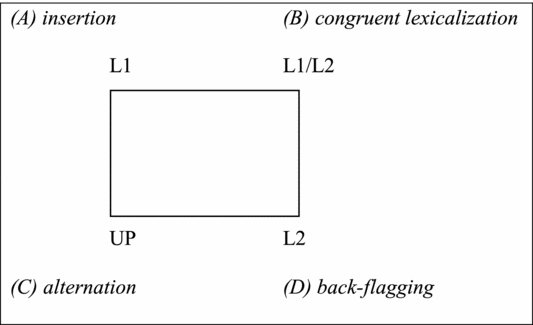
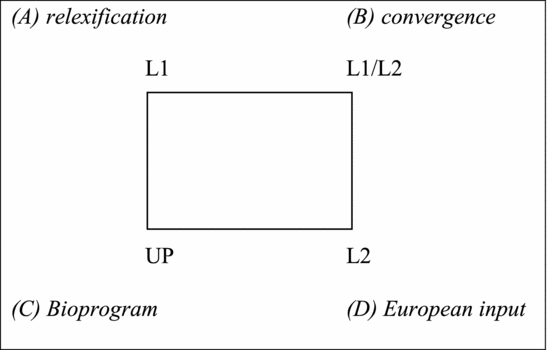
These four principles can be arranged in the schema in Figure 1. In this quadrangle, the L1- and the L2-focussed strategies are in opposite corners (as in the earlier models), with the matching and the universal strategies as the other options.
Schematic representation of extended range of code-switching options.

These four code-switching outcomes can be modeled in terms of optimization strategies, which have been formalized in the grammatical model of Optimality Theory (see e.g. Prince & Smolensky, Reference Prince and Smolensky2004). Following this approach, the external factors determining outcomes of language contact are modeled as ranked constraints on language behavior.Footnote 7 With respect to the four code-switching strategies mentioned, I will take four constraints into account, following in part the model for code-switching in Optimality Theory proposed in Hogeweg (Reference Hogeweg2009, pp. 185–190):
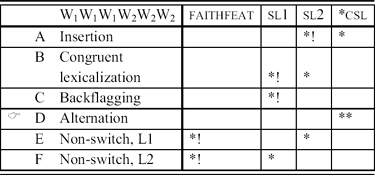
(10)
In the case of code-switching, the input (for which faithfeat requires that the output reflects it) contains the intention of the speaker to switch, i.e. to use words from both L1 (W1 in the representations below) and from L2 (W2), to adequately reflect the intentions of the speaker in terms of meanings, cultural connotations, etc.
We now can have different rankings for the different strategies. The optimization model allows for flexibility, since other strategies than the one ranked highest always play a secondary role. Before formally implementing the four strategies in terms of an Optimality framework I should stress that indeed this use of Optimality in bilingual speech constitutes a radical departure from its use in phonology or syntax. The principles are quite different and fairly general, and their application is stochastic rather than absolute.
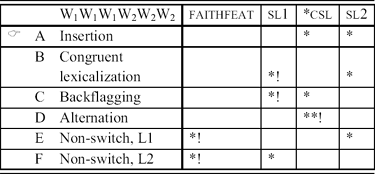
Evaluation of insertion as a choice in code-switching.

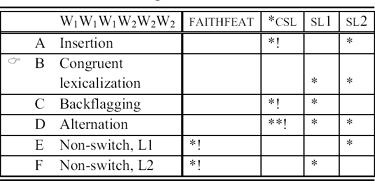
Evaluation of congruent lexicalization as a choice in code-switching.
Evaluation of alternation as a choice in code-switching.
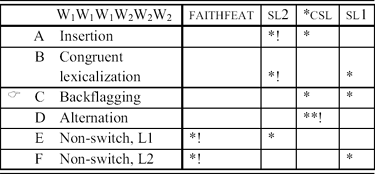
Evaluation of backflagging as a choice in code-switching.
For the code-switching patterns analyzed in this paper, we can present the information in four tableaux (the term used in Optimality Theory for these schematic representations). In each tableau, a different strategy is selected because it offends only lower ranked constraints. Insertion respects sl1, congruent lexicalization *csl (that is, in congruent lexicalization the languages are treated as non-separtate), alternation respects both sl1 and sl2, and backflagging sl2. A star indicates the violation of a constraint by a strategy, and the notation *! marks the fatal violations. The double star marks a double violation (in the case of alternation the full grammar of the two languages involved is activated). The non-switch options E and F violate faithfeat, because the speaker wants to convey a meaning in terms of words from different languages.
There have been several attempts to model language contact phenomena within versions of Optimality Theory. Koontz-Garboden (Reference Koontz-Garboden2004) has tried to model the changing distribution of Spanish progressive aspect in heritage speakers in terms of Stochastic Optimality, which involves quantitative weighing of different strategies. Hogeweg (Reference Hogeweg2009), cited above, gives a stochastic Optimality account of insertional code-switching in the framework of a model of lexical selection. Bhatt and Bolonyai (Reference Bhatt and Bolonyai2011) have modeled a number of pragmatic and socio-linguistic strategies in code-switching in terms of classical Optimality Theory rankings, as in the approach taken here. However, the constraints proposed in their work, except for their faith (11a), are somewhat different from the ones listed in (10). They are:
(11) a. faith: Principle of interpretive faithfulness, which serves ‘to maximize informativity with respect to specificity of meaning and economy of expression’ (p. 526)
b. power (symbolic domination) (p. 528)
c. solidarity (symbolic concurrence) (p. 530)
d. face: Principle of face management, which serves “to maximize effective maintenance of ‘face’ or public image” (p. 531)
e. perspective: Principle of perspective taking serves to “maximize perspectivity in interaction” and “signal what is assumed to be currently salient point of view and socio-cognitive orientation in discourse” (p. 533)
Notice that the constraints that Bhatt and Bolonyai (Reference Bhatt and Bolonyai2011) propose are quite general ones, and hold for all types of interaction. They are grounded in the pragmatic and sociolinguistic theories that have been developed over the last five decades, and undoubtedly play a role in explaining naturalistic interactions. However, since they are not directly attuned to language contact and bilingualism, they are only partly useful for the broader purpose of making different types of language contact comparable, the purpose of the present paper.Footnote 8
I will now turn to a discussion of other contact settings, starting with Creole studies, and argue that the metaphor of a quadrangle representing the major strategies involved in language contact may help us understand the dynamics of different areas of language contact studies better.
2.2 Universal principles and Universal Grammar (UG)
The universal principles in my approach are assumed to be distinct from Chomskyan UG-principles, which are universal properties of the language faculty as instantiated in each individual language and governing the well-formedness of individual grammars. Examples would be X-bar theory or locality principles holding for binding and movement operations. The language-independent universal principles (UPs) assumed here are much more like general combinatory principles governing improvised language behavior, such as radical foreigner talk or incipient pidgin construction (Ferguson, Reference Ferguson and Hymes1971), and the principle a child has recourse to when constructing adjoined relative clauses without the appropriate input (Goodluck & Tavakolian, Reference Goodluck and Tavakolian1982). Key elements in this set of universal principles are discourse sequencing (a), iconicity, which plays a role in (b, c, d, e), and paratactic adjunction (e, g):
Universal principle family of strategies
(a) Use TopicComment sequences.
(b) Let Circumstance precede Realization, in an adverbial clause/main clause combination (if . . ., then . . .; although . . ., still . . .).
(c) Narrate events in the order in which they occurred, in a coordinated clause chain.
(d) Reduplicate elements to mark emphasis or iteration.
(e) Use single elements, on the basis of the “one form, one meaning” principle.
(f) Use Left and Right Dislocation.
(g) Adjoin information relevant to something just mentioned in an adverbial clause.
Since these UP strategies are not linked to any particular grammar, I assume them to hold for all languages and language combinations.
2.3 Creole studies
A second domain that is profitably viewed in the perspective of competing strategies is Creole studies, research into the class of languages for which we can pinpoint the time and circumstances of genesis with some precision. Creoles sometimes have been treated as a unified class of languages as well, but in actual fact differ in important respects, and in my view these differences point to different scenarios leading to their genesis.
A multitude of scenarios have been proposed for the genesis of Creoles, but these may be reduced to four main strategies. In listing these strategies, I try to mention an important early source as well as a recent formulation, stressing the continuities in the research traditions.
(A) Relexification or transfer of L1 structures (Adam, Reference Adam1883; Alleyne, Reference Alleyne1980; Lefebvre, Reference Lefebvre1998), leading to strong substrate influence in the Creoles. When there are few speakers of the L2 present, many speakers of at most a few L1s, with dominance of one or two of these L1s and structural similarities between them: this leads to relexification or transfer, as in the case of Saramaccan. Saramaccan may be the best example of an L1-oriented Creole (Alleyne, Reference Alleyne1980), given its origin as a Maroon Creole and the dominant contribution from the Gbe languages.
(B) Convergence of sub- and superstrate patterns (Kihm, Reference Kihm, Boretzky, Enninger and Stolz1988; Kouwenberg, Reference Kouwenberg1992; Schuchardt, Reference Schuchardt1890; Silverstein, Reference Silverstein1972a, b), leading to highly mixed systems. A relative balance over a longer period between speakers of the L2 and a single important L1 leads to convergence, as in the case of Berbice Dutch Creole and Senegal Portuguese Creole. These may be very good examples of convergence (Kihm, Reference Kihm, Boretzky, Enninger and Stolz1988; Kouwenberg, Reference Kouwenberg1992), given the prolonged co-existence in the period of genesis of these languages of a lexifier and a substrate.
(C) Reliance on universal principles (Bickerton, Reference Bickerton1981; Coelho, Reference Coelho1880–6) causes the Creole features to directly reflect a Language Bioprogram or Universal Grammar, or at least show highly unmarked patterns. The presence of several L1s with considerable structural differences between them leads to important universal effects, portrayed in the Bioprogram, as in the case of Hawaii Creole English. Hawaii Creole English may well reflect a number of universal patterns (Bickerton, Reference Bickerton1981), given the diversity of substrate languages involved and the limited access to the L2 lexifier English.Footnote 9
(D) There is imitation of European vernacular varieties (Bloomfield, Reference Bloomfield1933, p. 472; Chaudenson, Reference Chaudenson1992), leading to Creoles which resemble European settler languages. Relatively many speakers of the L2 are present in the formative stage, leading to strong European L2 lexifier input, as in the case of Réunion French Creole (Chaudenson, Reference Chaudenson1992); here Creole formation is closest to language shift.
The constructed sentence in (12) below from the Caribbean Ibero-Romance-based Creole language Papiamentu illustrates the effect of these strategies, where different fonts have been used to mark these strategies. The serial chain kana bini illustrates L1 substrate influence, the result of transfer; the use of the third person plural pronoun nan as a nominal plural marker may be taken as a case of a universal strategy; the use of the particle bèk may be viewed as a case of convergence between the English V+particle pattern and an African serial verb chain; finally, the choice of lexical items, the aspectual marker ta and the preposition di may have resulted from superstrate influence.
(12)

The four strategies correspond directly to the four bilingual strategies listed above for code-switching.Footnote 10 We may represent them in a quadrangle, as in Figure 2.
Schematic representation of options for Creole genesis in Creole studies.
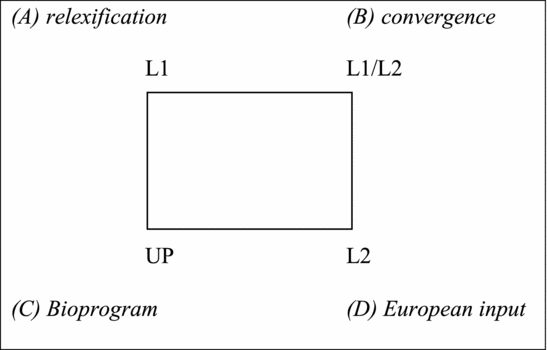
Following the logic of the code-switching studies in terms of optimization strategies, the claim inherent here is that no single strategy may explain the genesis of Creoles. Rather, the four competing strategies have played a role in different combinations, in the genesis of specific Creoles, thus explaining why they do not form a uniform class of languages. Most theories of Creole genesis contain a grain of truth, but none is applicable to all situations. None of the Creoles listed are “pure” cases, and other Creoles (a typical case would be indeed Papiamentu) are even more the result of a mixture of these strategies and can be located somewhere nearer the center of the abstract space delineated in Figure 2.
3. Other new languages
In this section I will discuss some other cases of new linguistic forms arising out of contact: pidgins, mixed or intertwined languages, and ethnolects.
3.1 Pidgins
It comes as no surprise perhaps, that pidgins can also be viewed in terms of the quadrangle just illustrated. Pidgins are more or less stable communication systems that lack native speakers, with a reduced vocabulary and grammatical structure. Winford (Reference Winford2003) provides an excellent overview of pidgins, stressing the multi-dimensional character of the notion. In part following his suggestions, we may distinguish four types of pidgins, or alternatively, four scenarios for the genesis of pidgins may be classified.
(A) L1-oriented pidgins, such as Ndyuka-Trio Pidgin, which is based primarily on Trio grammatical properties (Huttar & Velantie, Reference Huttar, Velantie and Thomason1997; Winford, Reference Winford2003, p. 283), which have been reinterpreted morphologically, and such as Pidgin Delaware, a variety simplified on purpose by target language native speakers (Goddard, Reference Goddard and Thomason1997; Winford, Reference Winford2003, p. 278). Such pidgins arise when there is a resident community dealing with newcomers.
(B) Compromise pidgins, such as Russenorsk, in which both languages, in this case Russian and Norwegian, have contributed vocabulary and structural elements (Jahr, Reference Jahr, Jahr and Broch1996). There is a relative balance in power and numbers between the two speaker groups.
(C) There are no pidgins based exclusively on universal communicative strategies, since the contributing languages always play a role, but it is clear that general principles of grammar development play a role in many pidgins, as in Naro's “factorization principle” assumed to operate in the genesis of West-African Portuguese Pidgin (Naro, Reference Naro1978).
(D) Lexifier-oriented pidgins, which are primarily the result of second language acquisition; in this class would be simplified immigrant varieties of dominant languages, which arise when there is social distance between a dominant society and a low prestige immigrant group (Clyne, Reference Clyne1968).
This leads to four main proto-types of pidgins. Many pidgins will of course have features from several of these different types.
3.2 Mixed languages
Mixed, relexified, or intertwined languages share some properties with pidgins but are characterized by deriving substantial components of their lexicon and/or structure from more than one source language, without much reduction of morpho-syntactic distinctions. However, the group of mixed languages is far from forming a single type. I propose to also organize the complex phenomena surrounding the class of bilingual mixed languages into a more coherent framework using the model. Different mixed languages have different properties, and they can be grouped as in (A)–(D);
(A) L1-oriented mixed languages which primarily have resulted from relexification of elements from the original language by target language phonetic shapes, as in the case of Media Lengua from Ecuador, which is built with the grammatical components from Quechua and lexicon from Spanish (Muysken, Reference Muysken, Highfield and Valdman1981, Reference Muysken and Thomason1997). In this case, the lexifier language had a very limited presence in the community.
(B) Compromise mixed languages, in which both languages have contributed substantial components of lexicon and structure, such as Michif, which has noun phrases from French and a verbal system from Cree (Bakker, Reference Bakker1997). Involved were bilingual settings with a clear division between the two languages.
(C) Universal communicative strategies in mixed languages. To give but one example, Media Lengua has reduplication to mark emphasis (Muysken, Reference Muysken, Highfield and Valdman1981) while this is largely absent in the relevant varieties of Quechua and Spanish. Similarly, the mixed language Kallawaya has been shown to have extensive reduplication, again with the relevant variety of Quechua and, as far as we know, Puquina, the other contributor, lacking it (Hannss & Muysken, in press).
(D) L2-oriented mixed languages show a much stronger presence of the second language. Typical examples would be Copper Island or Mednyj Aleut (e.g. Thomason, Reference Thomason and Thomason1997), Light Warlpiri and Gurindyi Kriol (Meakins & O'Shannessy, Reference Meakins and O'Shannessy2010; O'Shannessy, Reference O'Shannessy2005; O'Shannessy & Meakins, Reference O'Shannessy and Meakins2012). In these cases the “new” language provides essential components of the grammatical skeleton, in contrast with e.g. Media Lengua, as the result of language shift.
3.3 Ethnolects
A third category of new linguistic contact varieties concerns ethnolects: ethnically specific forms of speech that characterize ethnic minority communities that form part of a larger dominant society. Often ethnolects are spoken in immigrant communities, but they may also result from progressive assimilation of traditional ethnic minorities into the mainstream.
I have kept the definition of ethnolect somewhat vague because their linguistic properties differ from case to case. It may be useful to distinguish between an ethnolect narrow as a variety of a dominant (often national) language spoken by a specific (non-dominant) ethnic group, and an ethnolect broad as the range of varieties in the repertoire of a non-dominant ethnic group used in a larger context (including the heritage language, code-switching, etc.).
Keeping this in mind, we can usefully distinguish four dimensions in ethnolects, as suggested in Muysken (Reference Muysken, Norde, Hasselblatt and de Jonge2010a):
(A) L1 dimension: The local variety of the maintained original language, as in the heritage languages Italian in Toronto, American Finnish, Turkish in Germany and the Netherlands, a research tradition pioneered by Haugen's (Reference Haugen1953) monumental The Norwegian Language in America.
(B) L1/L2: Convergence between L1 and L2 in the ethnolect, as found e.g. in Melayu Sini, the Malay spoken in the Moluccan community in the Netherlands, characterized by code-switching and grammatical convergence between Malay and Dutch (Tahitu, Reference Tahitu1988).
(C) Simplification and omission of unstressed functional elements: In the reports on ethnolects in different immigration settings the systematic reduction in the morpho-syntactic inventories of the dominant languages is constantly mentioned; it involves gender and number, the copula and tense markers, determiners and definiteness markers.
(D) Finally, the L2 dimension in the narrow definition of ethnolects speaks for itself, since they are defined as the product of language shift.
A number of social factors contribute to what form particular ethnolects take, if they emerge at all. These include power relations and the openness of the dominant community to newcomers (a distinctive ethnolect or not), immigration history and time depth of language contact, social or demographic barriers to complete learning of the dominant language, constructions of ethnicity in a subordinate community (degree of influence from specific ethnic languages), numbers of speakers, competing varieties in the form of local varieties of the community language (local dialect influence or not), and cross-ethnic identifications (multi-ethnolects or not; Quist, Reference Quist2000).
3.4 Summary
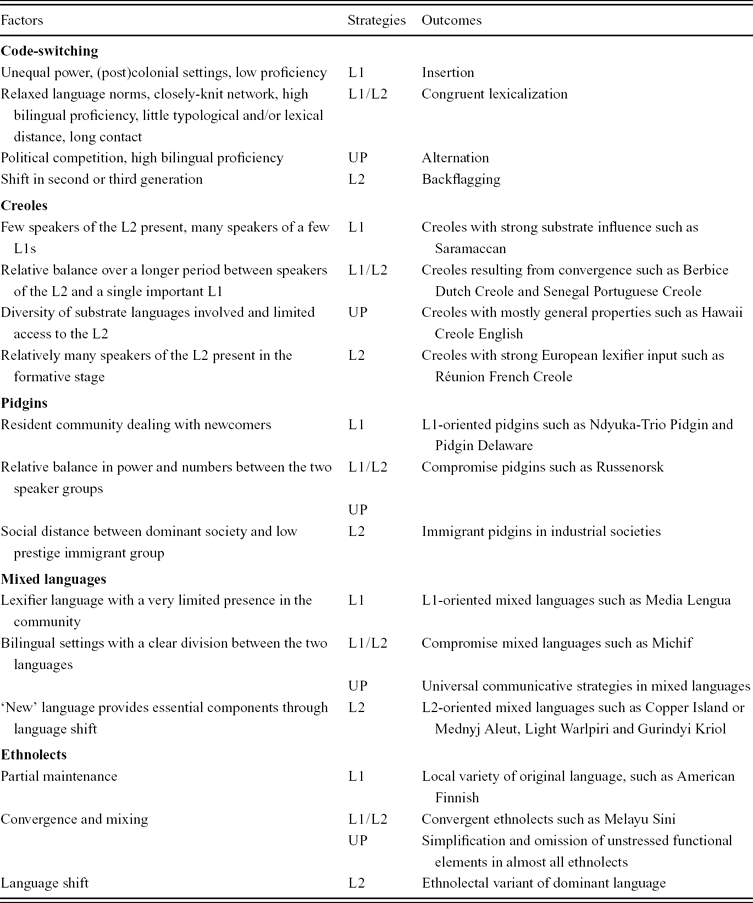
In Table 1 the underlying factors, as far as known, strategies, and outcomes in code-switching and new languages are summarized. It is clear that there are many parallels between the different domains.
Factors, strategies, outcomes in code-switching and new languages.
4. Contact-induced language change
Following up on the earlier discussion of Creoles and other types of new languages, I now turn to language change in a number of components of language which may be profitably viewed in the light of the model proposed here, starting with contact-induced morphological change.
4.1 Morphological change
It is insightful to model specific types of morphological change, in particular the borrowing of affixes, in this way as well. Although affix borrowing is assumed to typically proceed through word borrowing (Joseph, Reference Joseph, Dixon and Aikhenvald2002, p. 261), Muysken (Reference Muysken, Adelaar, Valenzuela Bismarck and Zariquiey Biondi2011a, Reference Muyskenb) distinguishes four types of Spanish affix borrowing processes in different Quechua varieties:
(A) L1-oriented morphological change through affix borrowing can involve the replacement of the phonetic shape of an affix by a form from the donor language while retaining the grammatical and lexical behavior of the original affix. An example is relatively isolated Inga Quechua (Colombia) agentive -k replaced by Spanish -dor, remaining a past habitual marker.
(B) Sometimes properties of both languages are conditioning factors, e.g. the Spanish diminutive -itu/-ita/-situ (in which Spanish /o/ is pronounced as [u] under Quechua influence), where phonological properties of Bolivian Quechua (final vowel of the base word) replace semantic and grammatical properties of Spanish (gender), but on the basis of the same distinctions. In Bolivia there has been prolonged bilingualism.Footnote 11
(C) The creation of a class of “characterizing” or “descriptive” suffixes in different varieties of Quechua, loosely modeled on Spanish morphological material, of the type macha-q-nyintu [imbibe-ag-char] “drunkard”.
(D) The generalization of Spanish plural markers in Ecuadorian Quechua, on the basis of borrowed items, mostly mass nouns and nouns describing body parts, such as ala-s “wing/wings”, the result of extensive lexical borrowing.
Thus the phenomenon of affix borrowing is far from straightforward, and involves L1, L2, universal, and convergence dimensions.
4.2 Syntactic change
Consider then syntactic change due to language contact. The extent to which this occurs and the constraints on the process are a matter of some controversy. However, the four-way division I am proposing here yields a useful perspective to distinguish four kinds of change:
(A) Perhaps the best candidate for L1-oriented syntactic change is the relative increase in use in partial maintenance settings, under influence of another language, of a construction which is already present in a language (the frequential dimension of code-copying in Johanson's Reference Johanson1992 framework). Silva-Corvalán (Reference Silva-Corvalán, Ashby, Mithun, Perissinotto and Raposo1993, Reference Silva-Corvalán1994, Reference Silva-Corvalán2008) has argued that syntactic change nearly always involves adaptation in the frequency distribution of already existing patterns in the recipient language, so-called indirect transfer.
(B) Syntactic convergence (Gumperz & Wilson, Reference Gumperz, Hernández Chavez and Whiteley1971) is of course quite frequent, particularly when there is prolonged bilingualism, resulting e.g. in pragmatic bleaching in word order change. To take but one example, in some varieties of Quechua, many sentences now have VO order rather than the original OV, while in rural Spanish, many sentences are OV rather than the original VO (Muntendam, Reference Muntendam2009, Reference Muntendam2012; Muysken, Reference Muysken and Andersen1982).
(C) Simplification due to contact (Mühlhäusler, Reference Mühlhäusler1974), particularly when the languages contrast. Simplification in many cases involves morpho-syntactic features (Kusters, Reference Kusters2003), but also word order patterns may change in contact situations, such as the original German- or Dutch-like orders of Old English – with OV in subordinate clauses and V2 in main clauses – being replaced by an SVO system due to contact (e.g. Weerman, Reference Weerman1993).
(D) The wholesale adoption of a grammatical pattern from another language (Nadkarni, Reference Nadkarni1975). The most controversial kind, to be sure, is the wholesale adoption of a grammatical pattern from another language, such as the one involving Konkani relative clauses described by Nadkarni (Reference Nadkarni1975). Often there are strong differences in prestige between L1 and L2.
4.3 Contact-induced change at the lexical level
Turning from grammar change to the contrasting area of lexical change, including but by no means limited to the familiar lexical borrowing, the differences are striking. For lexical change four options can be distinguished in the framework adopted here:
(A) “Classical” relexification, the grafting of the phonetic form of an L2 lexical item onto an L1 lemma (Lefebvre, Reference Lefebvre1998; Muysken, Reference Muysken, Highfield and Valdman1981, Reference Muysken and Thomason1997), or calquing, the borrowing of lexical meanings without their forms. Often this is when the dominant language has a limited presence.
(B) Lexical change can be due to partial overlap in meaning or form between elements in the two languages. Convergent change is likewise very common when the situation of contact is more developed. An example given by Campbell (Reference Campbell1998, p. 266) is K'iche’ (Mayan) kje:x, which originally meant “deer” and then after European contact also came to mean “horse”.Footnote 12
(C) Autonomous processes of lexical enrichment or simplification/loss, documented for Tok Pisin by Mühlhäusler (Reference Mühlhäusler1974, Reference Mühlhäusler1979).
(D) Straight lexical borrowing, the wholesale adoption of L2 lexical items, very frequent when there is an unqueal relation between the languages (Poplack, Sankoff & Miller, Reference Poplack, Sankoff and Miller1988).
It should be noted that the L2 option of borrowing, (D), is entirely uncontroversial, and indeed the paradigm case, in lexical change, while it is the most extreme option in grammar change. This contrast can be explained in terms of the different systemic properties of the lexicon and the grammar: the latter is inherently much more structured, and hence more resistant of external influence. Following particularly the work of Myers-Scotton (Reference Myers-Scotton2002), it will be useful in this respect to separate syntactic change from lexical change.
4.4 Phonological change
A fourth domain of contact-induced language change that may be addressed in this way is phonological change. Contact phonology is a very rich but as yet not fully explored area, and it does not have much internal coherence as yet (but see Singh, Reference Singh1995). Again there are a number of sub-domains, the most important ones of which are the phonological adaptation of lexical loans (L1-oriented) and interlanguage phonology (L2-oriented).
(A) The phonological adjustment of loanwords, particularly in early stages of contact (Haugen, Reference Haugen1950; Weinreich, Reference Weinreich1953).
(B) Phoneme matching through phonetic overlap in L2 acquisition, as studied by Flege (Reference Flege1987), particularly in intermediate stages of L2 development.
(C) Fall-back on unmarked structures, e.g. in phoneme inventories and syllable structures (see Eckman, Reference Eckman1977, on the Markedness Differential Hypothesis).
(D) L1 transfer in L2 pronunciation (Major, Reference Major2001; Tarone, Reference Tarone1980), as part of processes of shift.
The distinction made in Haugen (Reference Haugen1950) between “importation” and “substitution” of mostly phonological material in loans corresponds to the L2- versus L1-orientation adopted here. Likewise, Van Coetsem's (Reference Van Coetsem1988) distinction between Agent and Source Agentivity also has to do with the relative importance of L1 and L2.Footnote 13
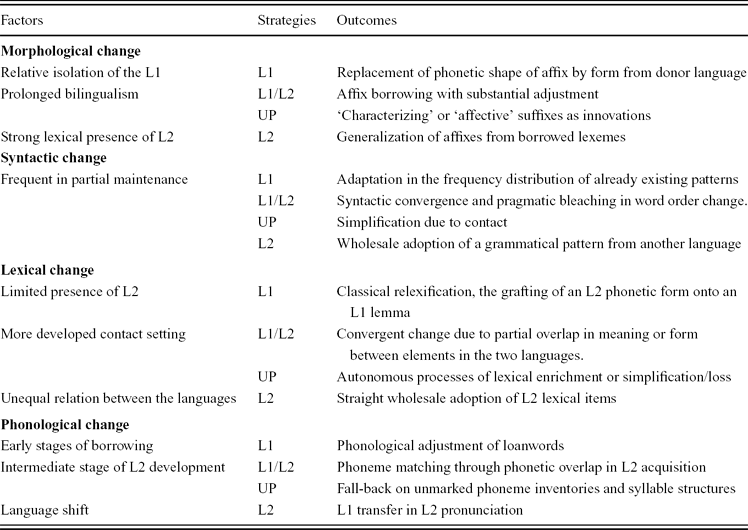
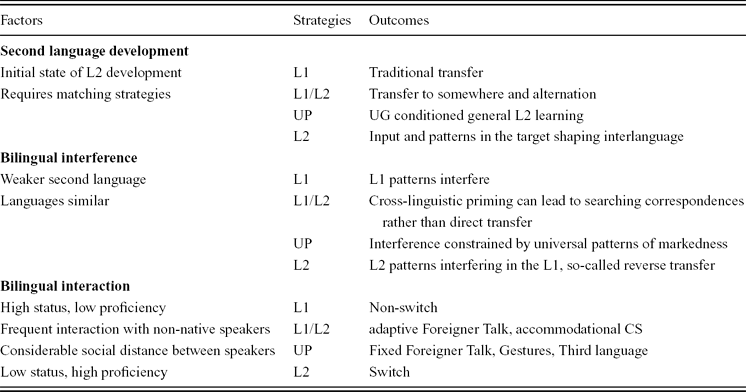
To summarize this discussion of contact-induced language change, modeling different kinds of change in terms of the four-way distinction proposed here has yielded insights into stability differences between these different components of the grammar in language contact, where stability can be defined in terms of the dominant role of the L1. The discussion in historical linguistics about the stability of particular features, brought into the domain of language contact once again by Thomason and Kaufmann (Reference Thomason and Kaufman1988) and further elaborated in Nichols (Reference Nichols, Janda and Joseph2003), has become increasingly complex and sophisticated. Recent work by Parkvall (Reference Parkvall2008) on different components, Tadmor, Haspelmath and Taylor (Reference Tadmor, Haspelmath and Taylor2010) on the lexicon, and Bickel (Reference Bickel2011) and Wichmann and Holman (Reference Wichmann and Holman2009) on grammatical features departs from larger cross-linguistic comparisons and requires further elaboration within the framework proposed here. In any case, it is clear that there are stability differences both within components (e.g. phonology, lexicon) and across components. The latter are reflected in the different weights between the four dimensions proposed here that play a role in different components of language: in phonological and syntactic change, L1-oriented options A and B play an important role, while in lexical and morphological change, L2-oriented options C and D are prevalent. In Table 2 the different types of contact-induced language change are summarized.
Factors, strategies, outcomes in different types of language change.
5. The bilingual individual and bilingual interaction
In the study of the bilingual individual a first perspective relevant to the model proposed here concerns second language development. I will briefly analyze it, then subsequently bilingual interference and bilingual interaction.
5.1 Second language development
Perhaps not surprisingly given the dominant role of L2 learning in Creole genesis, the field of L2 learning resembles that of Creole studies in that many rivaling explanations and models have circulated over the years. However, leaving aside a host of factors, again four main theories about the respective roles of L1 and L2 can be discerned in the research literature:Footnote 14
(A) The traditional transfer or cross-linguistic influence hypothesis, now given new fire by the conservation hypothesis and the full access/full transfer model (Schwartz & Sprouse, Reference Schwartz and Sprouse1996; van de Craats, Corver & van Hout, Reference Craats, Corver and van Hout2000; van de Craats, van Hout & Corver, Reference Craats, van Hout and Corver2002), particularly in initial states of L2 development.
(B) Approaches that favor transfer only in relation to patterns in the L2 (such as Transfer to somewhere (Andersen, Reference Andersen, Gass and Selinker1983) and the Alternation Hypothesis (Jansen, Lalleman & Muysken, Reference Jansen, Lalleman and Muysken1982)), require matching strategies on the part of the learner.
(C) Approaches that stress UG and general properties of learning, which had an early impulse in Dulay, Burt and Krashen (Reference Dulay, Burt and Krashen1982), and were later taken up by researchers such as White (Reference White1989) and much subsequent work;
(D) Approaches that focus on the nature of the input, and stress the dominant role of patterns in the target in shaping interlanguage (Gass, Reference Gass1997).Footnote 15
5.2 Bilingual interference
Another major field of study concerning the bilingual individual is bilingual interference. The phenomenon of interference has remained rather mysterious, except for the domain of the lexicon, where a number of proposals have been made. To name but one recent reference, Dijkstra, Hilberink-Schulpen and Van Heuven (Reference Dijkstra, Hilberink-Schulpen and Van Heuven2010) have developed the BIA+ model in this area.Footnote 16 The direction of the interference (from L1 to L2 or vice versa) and the role of distance (in particular cognate/non-cognate distinctions and phonetic and orthographic similarity) have been hotly debated. In recent years, however, the field is gaining increasing impetus in areas outside the lexicon through work in the cross-linguistic syntactic priming paradigm. Jarvis and Pavlenko (Reference Jarvis and Pavlenko2008) provide a comprehensive overview of the second language development literature in this domain, Hartsuiker and Pickering (Reference Hartsuiker and Pickering2008) of the processing literature.
(A) L1 patterns interfere in a weaker second language (Hartsuiker, Pickering & Veltkamp, Reference Hartsuiker, Pickering and Veltkamp2004). These authors have developed a paradigm to study cross-language activation (their term for interference) from L1 to L2 and concluded that Spanish–English bilinguals would use more passives in their English L2 when primed by a passive in their Spanish L1.
(B) Mutual interference and convergence. In one study related to passives, Heydel and Murray (Reference Heydel and Murray1997) have shown that bilingual German–English speakers, when primed with German topicalized sentences, produced English passive structures rather than topicalizing in English; this suggests that cross-linguistic priming can lead to searching correspondences rather than direct transfer. Similarly, Bernolet, Hartsuiker and Pickering (Reference Bernolet, Hartsuiker and Pickering2007) have found that syntactic priming is strongest when word orders are similar between the languages involved. Finally, Kootstra, Van Hell and Dijkstra (Reference Kootstra, Van Hell and Dijkstra2010) have shown that alignment in code-switching is strongest when syntactic contexts are similar. For comprehension, the competition model developed by Bates and MacWhinney has provided insight into the role of interference as well (e.g. MacWhinney, Reference MacWhinney1987). In all cases it is a perceived similar structure in the languages involved which triggers the priming effects.
(C) Interference constrained by universal patterns of markedness. Vasilyeva, Waterfall, Gámez, Gómez, Bowers and Shimpi (Reference Vasilyeva, Waterfall, Gámez, Gómez, Bowers and Shimpi2010) show that this type of influence need not be bidirectional and may also involve markedness considerations. Priming from Spanish passives to English passives was found, but not the other way around, suggesting a strong role for universal principles related to the markedness of passive.
(D) L2 patterns interfering in the L1, so-called reverse transfer (Odlin, Reference Odlin1989). It is clear that the study of bilingual individuals is rapidly developing as new research paradigms and experimental techniques become available. The survey given in this section barely scratches the surface of this exciting domain of research.
5.3 Bilingual interaction
With respect to bilingual interaction, the topic in the present section, the model proposed sometimes is revealing, but at other times complicated to apply.
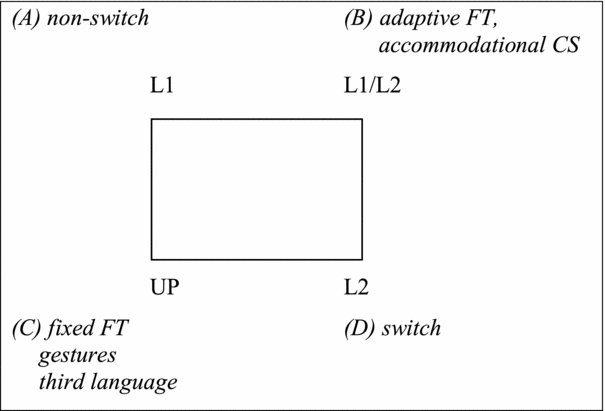
The field of study of what Georges Lüdi calls exolingual communication (Lüdi, Reference Lüdi and Lüdi1987) involves communication between speakers with different L1s. It has not been approached systematically as a sub-specialty. One of the ways to consider bilingual interaction is through Foreigner Talk (FT), the way native speakers of a language address foreigners in that language. This has been studied in a comparative perspective in a volume assembled by Michael Clyne (Clyne Reference Clyne1981), who was inspired by work of Ferguson (Reference Ferguson and Hymes1971). It turns out that the use of foreigner talk can take two different forms: (i) Fixed patterns of simplified language use (infinitives, absence of articles and the copula) independent of the competence of the addressee (Ferguson, Reference Ferguson and Hymes1971). These patterns consist mostly of single units, obeying a “one form, one meaning” principle; (ii) Adaptive L1 language use, fine-tuned in complexity to the level of L2 competence of the addressee (Snow, van Eeden & Muysken, Reference Muysken, Highfield and Valdman1981).
The first type is found particularly when there is considerable social distance between the speakers involved; often with a difference in social status and an assumption of non-competence of the addressee, as in the following case, from Ecuador:
(13)

The part Quito ir results from simplification, in that a directional phrase is used without a preposition, while the verb is in the infinitive form, and the italic part involves adaptation to a putative non-Spanish address form (pronounced as [mí:ster]).
The second type was found e.g. in the speech of municipal employees who address non-native speakers professionally on a daily basis (Snow et al., Reference Snow, van Eeden and Muysken1981). Here we find proportional adjustment to the syntactic complexity of the speech of the non-native interlocutor, and subtle restructurings to facilitate comprehension, such as SVO in Dutch subordinate clauses.
Another issue that has been studied in the general domain of bilingual interaction is obviously the determining factors of language choice, speaker accommodation, and negotiation of language use. What brings a speaker to use either the native language (the non-switch) or the second language (the switch strategy) when interacting with someone speaking a second language (Fishman, Reference Fishman1965; Giles, Bourhis & Taylor, Reference Giles, Bourhis, Taylor and Giles1977; Myers-Scotton, Reference Myers-Scotton1976)?
The binary choice a speaker has of either L1 or L2, coupled with the choice between the two types of Foreigner Talk, again leads to four possibilities, along two separate dimensions. It can be enriched if we include accommodational code-switching (Myers-Scotton, Reference Myers-Scotton1976) in the L1/L2 corner, and the use of a neutral third language, gestures, etc. in the UP (= –L1/–L2) corner (see Figure 3).Footnote 17 The result yields a framework to organize the results of research in bilingual interactions, a field that has not been very organized in the past.
Schematic representation of possible types of bilingual interaction.
5.4 Summary
In Table 3 I have tried to summarize the main findings so far regarding factors, strategies, and outcomes in the areas of second language acquisition, bilingual interference, and bilingual interaction.Footnote 18
Factors, strategies, outcomes in Second language development, Bilingual interference, and Bilingual interaction.
6. Concluding remarks
In Sections 3–5 above I have applied the model for language contact strategies originally developed for code-switching and Creole studies to different kinds of language genesis, to language change, second language learning, bilingual interference, and bilingual interaction. I now turn to a few more general issues concerning this model, starting with the question what the model has brought us.
I have argued that the quadrangle model may be successfully applied to model different situations of language contact. This has several advantages. First of all, the model makes it possible to compare results from one domain (e.g. different types of Creole languages) to those in another (e.g. different code-switching strategies). This allows us to compare different types of contact, and discern similarities as well as differences between them, both in terms of outcomes and in terms of conditioning factors. An example is language change. In some areas, such as lexical change, the L2 plays a dominant role, while in others, such as syntactic change, the L1 is more important. This tells us something about the stability of different components of language, such as the lexicon and the syntax.
Second, it allows us to systematically organize the findings in a specific domain. This is relevant both when a domain has been relatively undeveloped as a systematic field of study (e.g. bilingual interaction or contact phonology), and when a field is so much developed that it becomes difficult to see the overall patterns in it, as in the case of code-switching.
Third, since it is formulated in terms of optimization strategies and linked to Optimality Theory, it allows for a fairly precise definition within an established framework. It also allows a game theoretic approach to the choices made by bilinguals (Dekker & Van Rooij, Reference Dekker and van Rooij2000), in principle making a link possible with the growing literature in game theory – the mathematical modeling of rational decision making in interactions between individuals – a theory which has been applied in language studies as well (see further Benz, Jäger & van Rooij, Reference Benz, Jäger, van Rooij, Benz, Jäger and van Rooij2005; Jaeger, Reference Jaeger2008). In these approaches (networks of) language users have to find a balance between the strengths derived from their entrenched L1-system and the requirements of communicating in an environment in which other languages are also used, and taking into account the strategic choices of their interactants.
Finally, it will allow us to see whether the same factors are responsible for specific options in different contact settings. One of the potential advantages of developing a comprehensive model of language contact is that it is possible to comparatively study the role of social factors and contact scenarios that operate in various domains at the same time. In Sections 3–5 a number of social, linguistic, and psychological factors were mentioned that influence specific outcomes of language contact. These factors can be divided into:
(a) Similarity factors: Lexical similarity/distance, Typological similarity/distance;
(b) Prestige and status factors: L1 prestige, L2 prestige;
(c) Proficiency factors: Low L2 proficiency, High L2 proficiency;
(d) Contact factors: Large/Small numbers of L1 or L2 speakers present, Type of network;
(e) Time factors: Long/Short contact period;
(f) Attitudinal factors: Low normativity, Political distance.
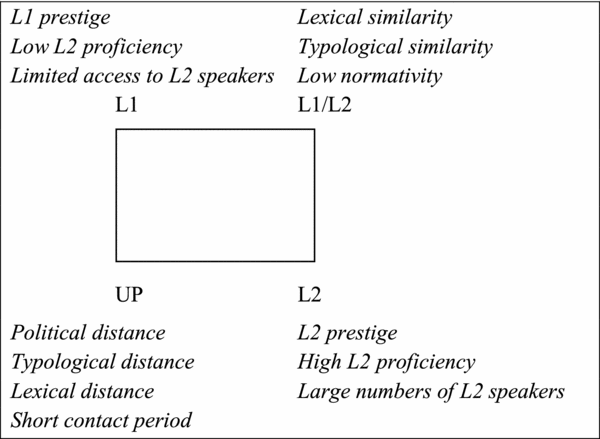
The interaction between these different types of factors may, as a first approximation, be represented as in Figure 4 with respect to the quadrangle that we have been operating with. Prestige of the L1 and low proficiency in the L2 lead to choices in the upper left-hand corner, while prestige of the L2 and high proficiency in the L2 lead to choices in the lower right-hand corner. Similarity in lexicon and grammar, as well as low normativity, lead to choices in the upper right-hand corner, while political distance and purism, as well as typological and lexical distance and a short period of contact lead to choices in the lower left-hand corner. Other factors intervene, but these are the most important ones. These factors are the key elements in the different contact scenarios.
Schematic representation of factors influencing the four options.
There are several potential problems with the model proposed here. A conceptual problem arises because it may not always be clear at what level of analysis a particular construct is being used: when L1-oriented approaches are favored, are we talking about the community language from the perspective of ethnic identity or truly of the first language of all individual speakers? Does a given strategy reflect a resulting state or an ongoing process? As I mentioned in the introduction, the approach taken here necessarily abstracts away from many of these distinctions.
Second, many of the processes listed above may and often do interact. A typical example is the emergence of a linguistic area or Sprachbund. Linguistic areas are the result of convergence in the grammar over a very long time, but the processes which have led to their emergence may well vary and be difficult to tease apart. Hence it is not entirely straightforward to approach this phenomenon directly from the perspective of the four dimensions taken as central here.
A third potential problem is that the model used here may be thought to presuppose an asymmetry between L1 and L2: either one is dominant in the strategies adopted here. However, there are cases, both within the individual (as in e.g. simultaneous bilingual acquisition) and the bilingual community, in which no such dominance relation holds. However, the upper right- and lower left-hand corners can be viewed as the neutral cases in this respect. Possibly, convergence-related options are preferred when there is some kind of space for overlap, or universal options if the structural conflicts between the languages are simply too great.
Fourth, the factors interact, necessarily, and the model as presented here does not by itself assign weights. How does the similarity between the languages involved compare with weak network ties of the speakers? This lack of weight for factors necessarily makes this an interpretive model rather than a predictive one, as noted by a reviewer. More explicit information is needed, for the model to gain more power, about which factors constitute necessary and which sufficient conditions for a particular outcome. An even further goal would be some kind of quantitative weighing of the factors, allowing for more specific predictions.
7. Conclusion: Speakers choose strategies
I hope to have been able to show that a large range of types of language contact can be profitably modeled in terms of a simple four-way division in terms of speaker strategies. Modeling language contact necessarily involves modeling the choices of speakers. Speakers are individuals but part of networks and speech communities. Choices are made in terms of external (dominance and proficiency) as well as internal (various types of distance) factors and these choices can be ranked in terms of Optimality constraints.