I. INTRODUCTION
Mg and Mg-based alloys are the most promising hydrogen storage materials because of their high hydrogen storage capacity, lightweight, abundant resources, and low raw material cost.Reference Lupu, Biris and Indrea1 As a consequence, Mg2Ni-type alloys are promising energy conversion and storage materials. However, it is known that conventional Mg2Ni alloy absorbs at elevated temperature under high pressure. Therefore, the application of Mg-based alloy is prevented by their poor hydriding/dehydriding kinetics and charge/discharge cycling performance at room temperature. To improve the above-mentioned drawbacks, a variety of attempts have been made,Reference Zaluski, Zaluska, Tessier, Srom-Olsen and Schudz2–Reference Sakintuna, Lamari-Darkrim and Hirscher6 e.g., mechanical alloying (MA), melt spinning, hydriding combustion synthesis, surface modification, adding catalysts, and so on.
MA and melt-spinning technologies are very effective methods for the fabrication of nanocrystalline and amorphous Mg and Mg-based alloys. Lei et al.Reference Lei, Wu, Yang, Wu and Wang7 improved discharge capacity of Mg2Ni alloys prepared by MA and obtained a discharge capacity of 500 mAh/g. Kohno et al.Reference Kohno, Yamamoto and Kanda8 obtained a large discharge capacity of 850 mAh/g for Mg2Ni alloys upon surface medication with Ni powder by ball-milling. Gasiorowski et al.Reference Gasiorowski, Iwasieczbo and Skoryna9 synthesized Mg2−xMxNi (M = Mn, Al) alloy by MA, and its electrochemical and kinetic properties have improved markedly. The ball-milling can facilitate the destabilization of MgH2 or Mg2NiH4, but milled Mg2Ni alloy as the negative electrode material in Ni–MH batteries shows very poor electrochemical cycling stability because of the evanishing of the metastable structure of the alloy material during the multiple electrochemical charging and discharging cycles.Reference Liang10,Reference Huang, Liang, Sun and Zhou11
Nevertheless, the melt-spinning technique is not only the most convenient method to obtain an amorphous and nanocrystalline phase compared with MA but also more suitable for mass-production of amorphous alloys. High mechanical strength, high fracture toughness,Reference Naka, Hashimoto and Masumoto12 high density of the lattice defect (including dislocation, vacancies, stacking faults) as the feature of amorphous plays an important part in ameliorating electrochemical and kinetic performances of Mg and Mg-based alloys (especially for Mg2Ni-type alloy). Huang et al.Reference Huang, Liang, Sun and Wu13 researched that the Mg-based alloy (Mg60Ni25)100−xNd10 prepared by melt spinning possesses the amorphous and nanocrystalline structures and thought that such structures reached a maximum hydrogen capacity mount up to 580 mA h/g and 4.2 wt% H, respectively. Zhang et al.Reference Zhang, Guo, Qi, Li, Ma and Zhang14 synthesized Mg2Ni-type Mg2Ni1−xMnx alloy by melt-spinning technology and thought that this technology was helpful for the amorphous and nanocrystalline structures, which evidently meliorated its electrochemical discharge capacity and kinetic property. Spassov and KösterReference Spassov and Köster15 prepared the Mg2(Ni,Y) hydrogen storage alloy by the rapid solidification process exhibiting a maximum hydrogen absorption capacity of about 3.0 wt%, which exceeds that of the conventionally prepared polycrystalline Mg2Ni alloys. Zhang et al.Reference Zhang, Zhao, Ren, Guo and Wang16 reported that the partial substitution of La for Mg improved the hydriding and dehydriding kinetic performances of as-cast Mg2Ni-type alloys, increasing the rapid solidification rate significantly ameliorated the hydrogen absorption/desorption kinetics and capacity of Mg2Ni-type alloys containing La. Xie et al.Reference Xie, Li, Zeng, Sun and Qu17 investigated the microstructure and hydrogen storage properties of Mg2−xNdxNi (x = 0, 0.1, 0.2, 0.3) alloys prepared by vacuum induction melting, thinking that replacement of Nd for Mg made the experimental alloy appear as a multiphase structure and that the Mg1.9Nd0.1Ni alloy exhibited the best hydrogen absorption/desorption kinetics and hydrogen capacities. The electrochemical hydrogen storage performances of as-spun nanocrystalline/amorphous Mg2−xLaxNi (x=0–0.6) were investigated systematically by Zhang et al.,Reference Zhang, Cai, Wang, Ren, Guo and Zhao18 suggesting that the La substitution and the melt spinning markedly ameliorated the electrochemical hydrogen storage properties of alloy samples involving hydrogen storage capacity and kinetics.
In the present study, the object of the study is to synthesize the Mg2Ni-type Mg20−xLaxNi10 (x = 0, 2, 4, 6) hydrogen storage alloy, with amorphous and nanocrystalline structures, by substituting La for Mg and altering the quenched rate. Moreover, the effect of element substitution and quenching technology on the electrochemical hydrogen storage and kinetic properties of Mg2Ni-type Mg20−xLaxNi10 (x = 0, 2, 4, 6) are investigated in detail.
II. EXPERIMENTAL
Hydrogen storage alloys with the composition of Mg20−xLaxNi10 (x = 0, 2, 4, 6) were prepared by vacuum induction levitation melting on a water-cooled copper crucible under helium atmosphere. High-purity helium with a pressure of 0.04 MPa was used as a protecting atmosphere for effectually preventing the volatilization of magnesium during melting. The alloy ingots were turned over and remelted twice to get a homogeneous composition. Then, parts of the as-cast alloys were remelted and quenched by melt spinning with a rotating copper roller, and the quenching rate was approximately expressed by the linear velocity of the copper roller because it is too difficult to measure a real cooling rate of the sample during quenching. The quenching rates used in the experiment were 15, 20, 25, and 30 m/s, respectively. Besides, for convenience, all alloys were denoted with La content as La0, La2, La4, and La6, respectively.
The crystal structures, phase composition, and lattice parameters of the alloys were determined by XRD using Cu Ka1 radiation on an x-ray diffractometer (D/max/2400; Tokyo, Japan). The experimental parameters were 160 mA, 40 kV, and 10°/min, respectively. The XRD data were analyzed by the Rietveld MethodReference Izumi19 using Jade 6.0 software.
The samples of the as-quenched alloys were prepared for observing the grain morphology with high-resolution transmission electron microscope (HRTEM) (JEM-2100F, operated at 200 kV, JEOL, Tokyo, Japan), and for determining the crystalline state of the samples with selected area electron diffraction.
Pellet-type alloy electrodes of 10 mm in diameter were prepared by cold pressing a mixture of 0.2 g of alloy powder and 0.8 g of carbonyl nickel powder under 25 MPa pressure. Electrochemical measurements were conducted in a standard trielectrode cell consisting of a working electrode (the MH electrode), a sintered Ni(OH)2/NiOOH counter electrode, and a Hg/HgO reference electrode, and the electrolyte was a 6-M KOH solution. Each electrode was charged at a current density of 20 mA/g for 40 h followed by a 10-min rest, and then discharged at 20 mA/g to the cut-off potential of −0.5 V versus the Hg/HgO reference electrode.
To investigate the high-rate discharge ability (HRD), the discharge capacities at different charge–discharge current densities were determined. The HRD value can be calculated by the following equation:
 $${\rm{HRD}} = {{C_{\rm{d}} } \mathord{\left/ {\vphantom {{C_{\rm{d}} } {C_{20} }}} \right. \kern-\nulldelimiterspace} {C_{20} }} \times 100\% \quad ,$$
where C d is the discharge capacity with the cut-off potential of −0.5 V versus Hg/HgO reference electrode at the charge–discharge current density of I d, and C 20 is the discharge capacity with a cut-off potential of −0.5 V versus Hg/HgO reference electrode at the charge–discharge current density of 20 mA/g.
Electrochemical impedance spectrum (EIS), linear polarization curves, and step-potential discharge were measured at 50% depth of discharge (DOD) utilizing PARSTAT2273 Potentiostats Electrochemistry Workstation (AMETEK EIG, Princeton, NJ). The EIS spectra of the electrode after definite cycles were obtained in the frequency range from 10 kHz to 5 mHz with an AC amplitude of 5 mV versus the open-circuit condition. The linear polarization curves of the test electrodes were measured by scanning the electrode potential at a rate of 5mV/s from −5 to 5 mV (versus open circuit potential) at 50% DOD. For potentiostatic discharge, the test electrodes at 50% DOD were discharged at +600-mV potential steps for 5000 s on PARSTAT2273 Potentiostats Electrochemistry Workstation. The environment temperature for measurement was kept at 30 °C.
III. RESULTS AND DISCUSSION
A. Microstructure
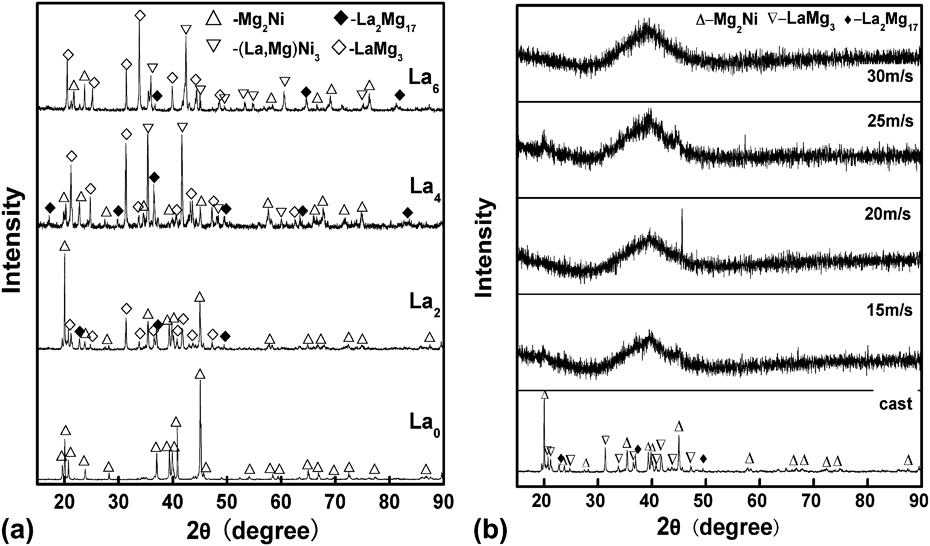
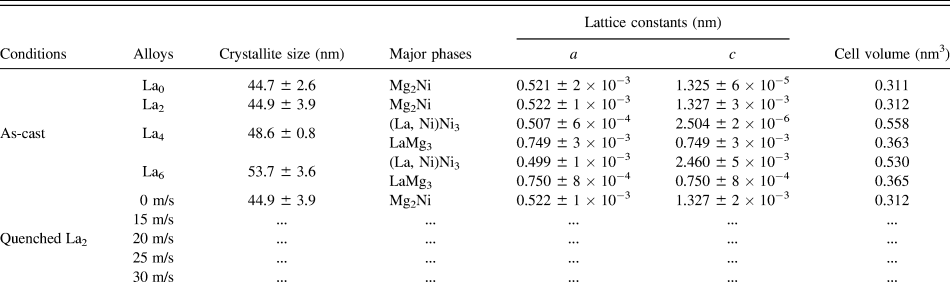
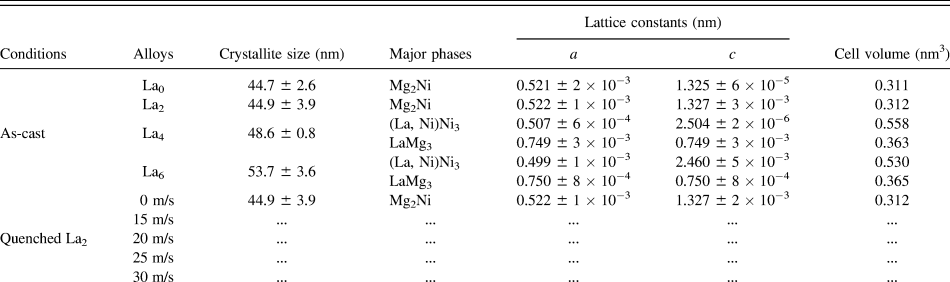
Figure 1 shows the XRD patterns of the as-cast Mg20−xLaxNi10 (x = 0, 2, 4, 6) and quenched La2 alloys. Diffraction patterns of all alloys except for La0 indicate that they consist of multiphase structures. Figure 1(a) shows that with increasing La content, the major phase of as-cast La2 alloy is still the Mg2Ni phase, but that of as-cast La4 and La6 comprises (La, Mg)Ni3 with the PuNi3-type rhombohedral structure and the LaMg3 phase. Figure 1(b) illustrates that no amorphous phase forms in the as-cast La2 alloy, but the as-spun La2 alloys display a typical amorphous structure, and the amorphization degree of La2 alloys increases significantly with rising quenched rate. Therefore, the quenched rate is advantageous for the amorphous formation of La2 alloys. Listed in Table I are the lattice parameters, the crystallite size, and the phase composition of main diffraction peaks of as-cast Mg20−xLaxNi10 (x = 0, 2, 4, 6) and spun La2 alloys which were calculated by software Jade6.0. It can be derived from Table I that the La substitution for Mg makes the crystallite size, lattice parameter, and cell volume significantly enlarge, which is ascribed to the larger radius of La atom compared with Mg atom. It can also be seen from Fig. 1 that the increasing quenched rate broadened the diffraction peaks, indicating the refinement of grain and the storage of stress inside alloy.
XRD patterns of the as-cast and spun alloys: (a) cast alloy and (b) spun alloy (La2).

Lattice parameters, cell volume, and phase abundance of as-cast and quenched alloys.
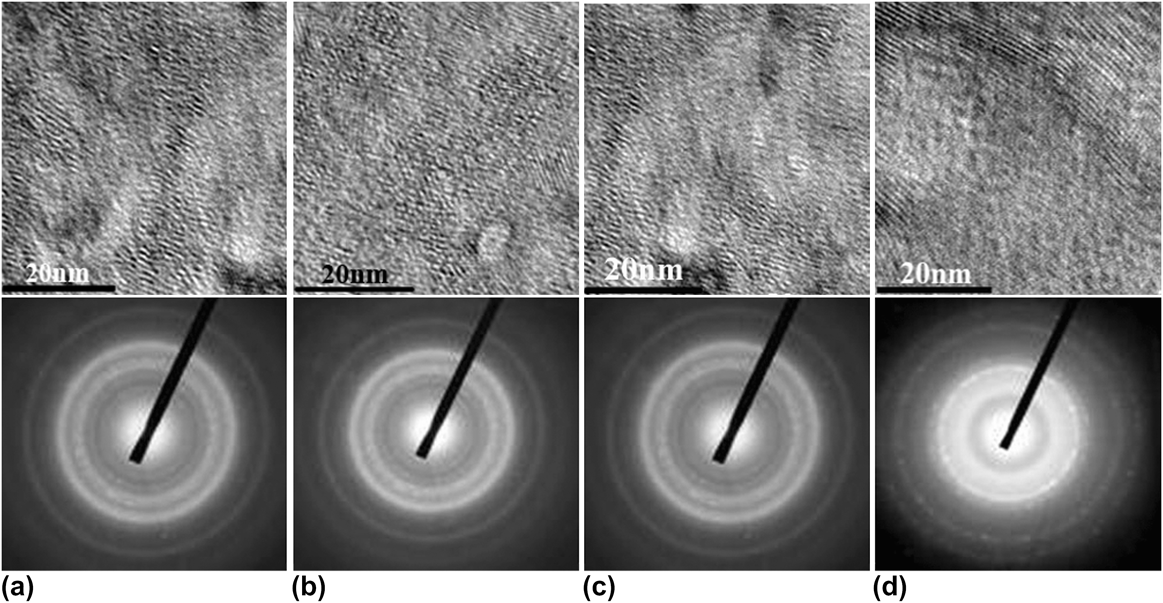
Presented in Fig. 2 are the HRTEM micrographs and electron diffraction (ED) patterns of as-spun La2 alloys. It is plainly viewable that the quenched alloys consisted of amorphous and nanocrystalline structures, and the glass-forming ability is notably enhanced with increasing spinning rate. Therefore, for as-spun Mg2Ni-type La2 alloy, the substituted La for Mg and the spinning technology is conducive to glass formation, which further ameliorated the hydrogen storage properties.
HRTEM micrographs and ED patterns of the spun La2 alloys: (a) 15 m/s, (b) 20 m/s, (c) 25 m/s, and (d) 30 m/s.
B. Electrochemical properties
1. Activation performance and discharge capacities
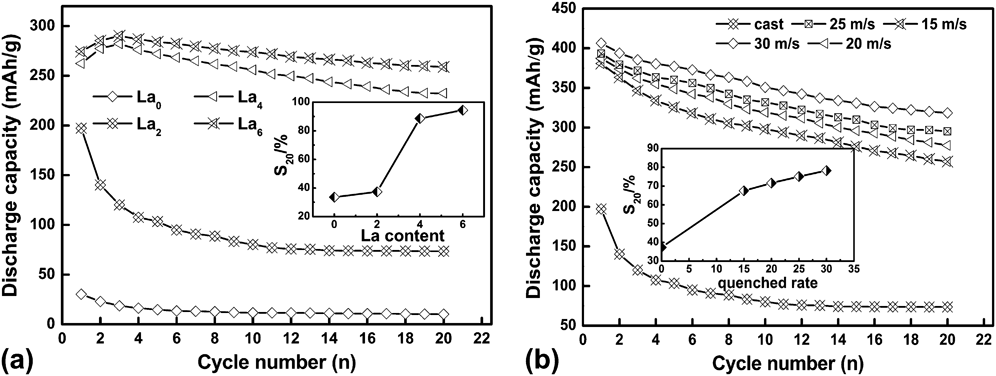
Figure 3 illustrates the dependence of the discharge capacity on the cycle number of the as-cast and spun alloy electrodes. Although, the increase in La content impairs the activation properties of the as-cast electrode alloys, the maximum discharge capacity is markedly ameliorated. Hence, La substitution can remarkably enhance the discharge capacity of as-cast alloys. With rising La content, the reduction in activation performance for as-cast electrode alloys may be attributed to the oxidation of La on the surface of the alloy in the electrolyte. Meanwhile, La replacement for Mg leads to the emergence of secondary phases, which is a key factor for improving the maximum discharge capacity.
Relationship curve between discharge capacity and cycle number of the electrode alloys: (a) as-cast and (b) as-spun alloy of La2.
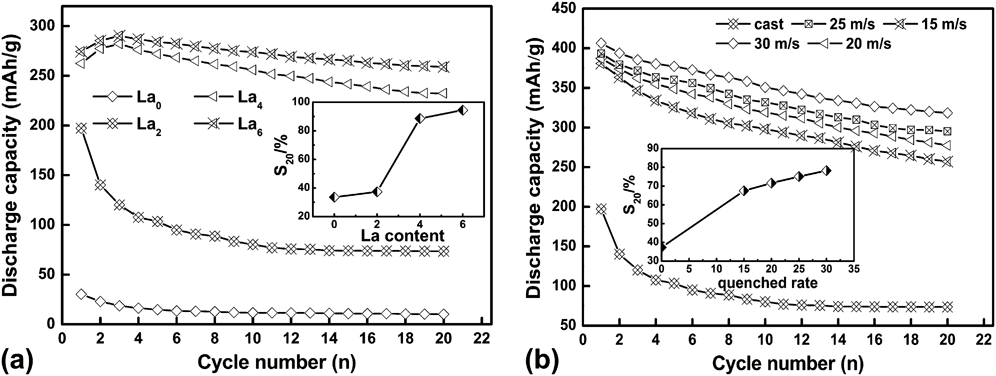
The maximum discharge capacity of the as-spun La2 alloy significantly increases with rising spinning rate, the discharge capacity grows from 197.2 to 406.5 mAh/g when the spinning rate mounts up from 0 to 30 m/s, but it does not influence the activation property. Two explanations may be offered as the reason of which led to the above-mentioned results. On the one hand, the increasing spinning rate is helpful for enhancing glass-forming ability of Mg2Ni-type alloy, the amorphous Mg2Ni shows higher electrochemical discharge capacity. On the other hand, the spinning technology introduces distortion of crystal lattices resulting in high densities of defects, which produces internal strain. It is concluded by Niu and NorthwoodReference Niu and Northwood20 that the exchange current density and H-diffusion coefficient are directly proportional to the internal strain. Therefore, it seems to be self-evident that the discharge capacity of as-quenched alloys grew with rising quenching rate.
The capacity retention rate (S n), being defined as S n = C n/C max × 100% (where C max is the maximum discharge capacity and C n is the discharge capacity at the nth charge–discharge cycle), is an important factor to characterize the cycle stability of the alloy electrode. The insets plotted in Fig. 3 show the capacity retention rate (S 20) curves undergoing 20 electrochemical charge–discharge cycles. According to XRD results listed in Table I, the substitution of La to Mg changes the phase structure and composition of as-cast alloys, which may be the main reason to ameliorate cyclical stability. The rapid quenching made alloy La2 produce more amorphous phase, which significantly enhances the cycle stability of the quenching La2 alloy, because the amorphous phase improves not only the antipulverization ability but also anticorrosion and antioxidation abilities of the alloy electrode in a corrosive electrolyte.Reference Zhang, Li, Ren, Cai, Dong and Wang21
2. High-rate discharge ability
The high-rate discharge ability (HRD) is an important factor in practical use of hydrogen storage electrode alloy. It is well known that the electrochemical kinetics of the hydrogen storage electrode alloys is mainly controlled by the charge-transfer reaction rate on the alloy surface and the hydrogen diffusion rate in the bulk of the alloy.Reference Zhang, Kumar, Srinivasan and Ploehn22–Reference Ratnakumar, Witham, Bowman, Hightower and Fultz24Figure 4 shows the HRD values of the as-cast Mg20−xLaxNi10 (x = 0, 2, 4, 6) and quenched La2 electrode alloys. The HRD values at the different discharge current density can be calculated by Eq. (1).
HRD of the as-cast Mg20−xLaxNi10 (x = 0, 2, 4, 6) and spun (La2) electrode alloys at 303 K: (a) as-cast and (b) as-spun (La2).
Obviously, when x increases from 0 to 6, the HRD values of the as-cast Mg20−xLaxNi10 (x = 0, 2, 4, 6) alloy electrodes grow from 25.43% (x = 0) to 47.64% (x = 6), indicating that the replacement of La for Mg can improve effectively the electrochemical and kinetic performances of the as-cast electrode alloys. With the increasing quenched rate, the HRD values of the as-spun La2 alloy mounts up from 36.7% (0 m/s) to 54.7% (30 m/s). Based on this, it can be concluded that rapid quenching can ameliorate the HRD of as-spun La2 electrode alloys. The improvement of HRD is attributed to two reasons. First, the increasing rapid solidification rate can enhance the glass-forming ability of spun La2 alloys, which changes the surface properties of alloy samples and facilitates the electrochemical reaction. Second, the increase in spinning rate is helpful for refining the grain of spun La2 alloys, which enhances the hydrogen diffusion ability inside alloy samples. To further investigate the changing mechanism of electrochemical and kinetic performances of as-cast and spun alloys, electrochemical impedance spectra (EIS), linear polarization curve, and hydrogen diffusion coefficient (D) are measured in more detail.
3. EIS and LP of alloy electrodes
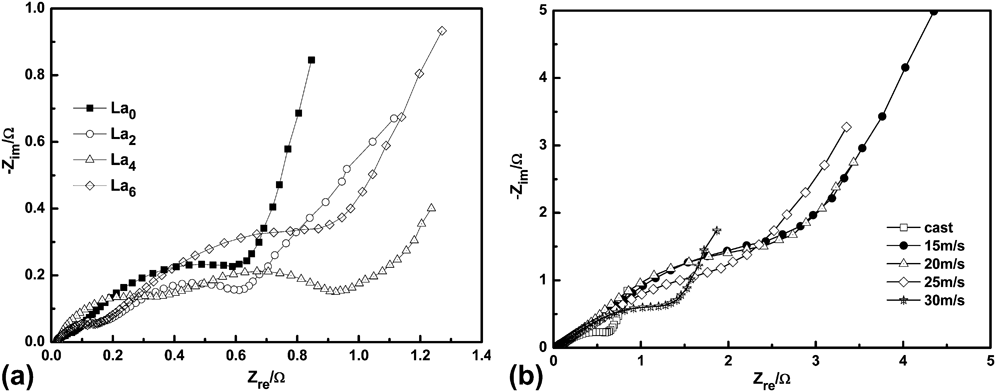
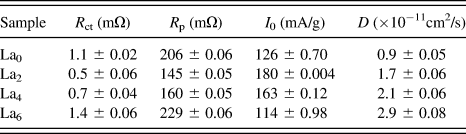
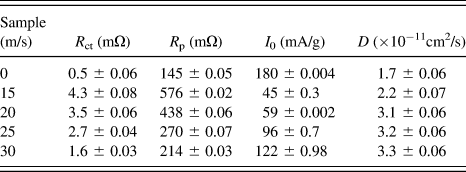
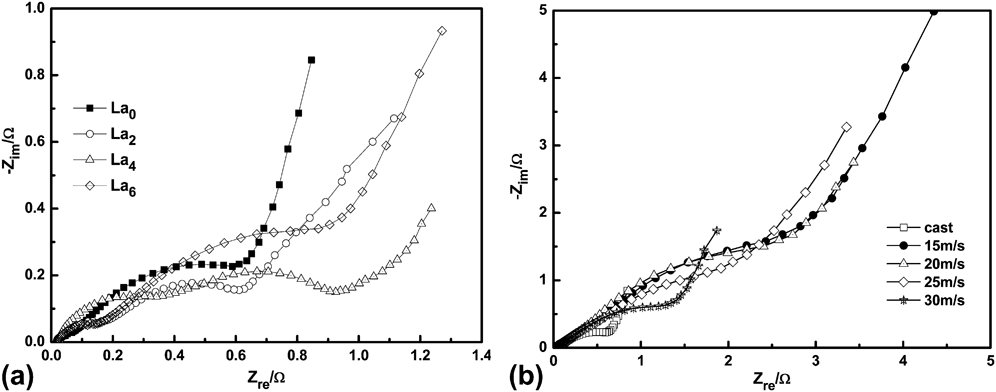
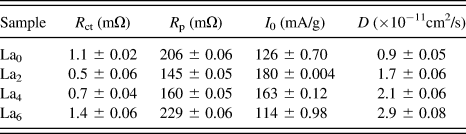
Figure 5 illustrates EIS of the as-cast Mg20−xLaxNi10 (x = 0, 2, 4, 6) and spun La2 electrode alloys at 50% DOD. Typically, each EIS consists of two semicircles followed by a straight line at low frequency range. Kuriyama et al.Reference Kuriyama, Sakai, Miyamura, Uehara, Ishikawa and Iwasaki25 thought that the first semicircle in high-frequency region was related to the contact resistance between the current collector and the alloy particles; the second semicircle represented the charge-transfer reaction resistance on the alloy surface in the middle-frequency region. Evidently, for as-cast Mg20−xLaxNi10 (x = 0, 2, 4, 6) alloys showed in Fig. 5(a), the radius of the larger semicircle in the middle-frequency region initially reduces to a minimum value and then enlarges with x increasing from 0 to 6. This phenomenon shows that the R ct of as-cast electrode alloys initially decreases and then increases with increasing La content, for which the R ct values listed in Table II further prove the above-mentioned results. The initial decrease in R ct values may be attributed to the following two reasons. On the one hand, the increase in La content results in increase in the electrocatalytic activity of as-cast electrode alloys. On the other hand, the substitution of La for Mg induces the formation of a secondary phase, which enhances electrochemical reaction activity on the surface of the as-cast alloy. The increase in the R ct values may be ascribed to the fact of formation of La(OH)2 and Mg(OH)2 on the surface of the as-cast La4 and La6 alloys. Meanwhile, Fig. 5(b) shows that the rapid quenching dramatically improves electrochemical reaction on the surface of the as-spun La2 alloy. As the rising of the spinning rate, the R ct values listed in Table III initially mount up and then decline, indicating that increasing rapid solidification rate is conducive to ameliorate the charge transfer reaction interface of the electrode/electrolyte. The reason can be explained that rapid quenching enhances the formation of the nanocrystalline and amorphous structures, which is detrimental to enhance the surface activity of the as-spun La2 alloy and decrease its R ct values.
EIS of the as-cast Mg20−xLaxNi10 (x = 0, 2, 4, 6) and spun (La2) electrode alloys at 303 K: (a) as-cast and (b) as-spun (La2).
The charge-transfer resistance R ct, the polarization resistance R p, and the exchange current density I 0, diffusion coefficient D of casting Mg20−xLaxNi10 (x = 0, 2, 4, 6) alloy electrode at 303 K.
The charge-transfer resistance R ct, the polarization resistance R p, and the exchange current density I 0, diffusion coefficient D of quenching La2 alloy electrode at 303 K.
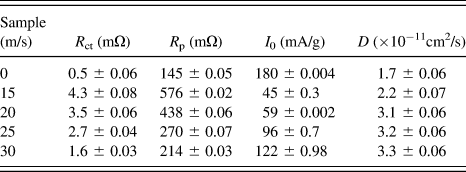
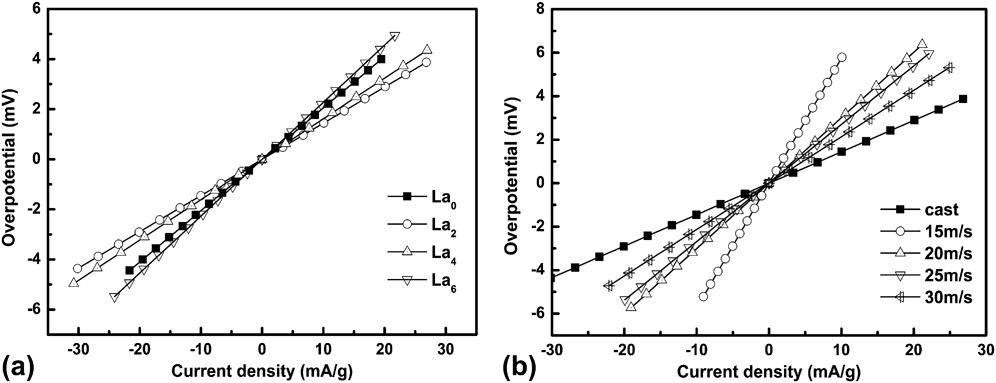
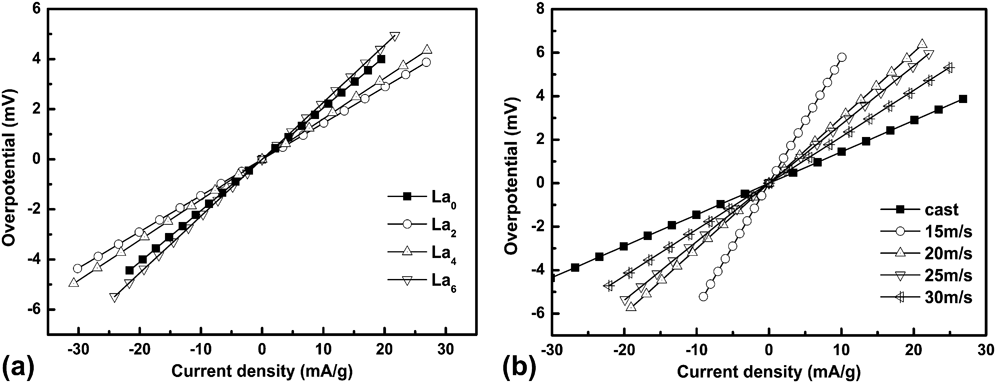
About the charge-transfer reaction rate on the alloy surface, further investigation can be also characterized by the exchange current density (I 0) of the electrode alloy, which can be evaluated by the linear polarization curve. Figure 6 displays the linear polarization curves of the as-cast Mg20−xLaxNi10 (x = 0, 2, 4, 6) and as-spun La2 electrode alloys. By fitting the polarization curves, the slope can be used for calculating the exchange current density (I 0) by the following equationsReference Notten and Hokkeling26:
 $$I_0 = {{IRT} \mathord{\left/ {\vphantom {{IRT} {F{\rm{\eta }}}}} \right. \kern-\nulldelimiterspace} {F{\rm{\eta }}}}\quad ,$$
 $$I_0 = {{RT} \mathord{\left/ {\vphantom {{RT} {FR_{\rm{P}} \quad ,}}} \right. \kern-\nulldelimiterspace} {FR_{\rm{P}} \quad ,}}$$
Where I, R, T, F, η, and R p denotes the polarization current density, the gas constant, the absolute temperature, the Faraday constant, the overpotential, and the polarization resistance, respectively. Tables II and III list the I 0 and R p values of the as-cast Mg20−xLaxNi10 (x = 0, 2, 4, 6) and as-spun La2 electrode alloys. It can be seen from Fig. 6 that the polarization current density almost linearly relates to the overpotential in the small range of overpolarization of ±5 mV. With increasing La content, the I 0 values of as-cast Mg20−xLaxNi10 (x = 0, 2, 4, 6) alloys initially augment and then drop as shown in Fig. 6(a). This result is in accordance with the varied tendency of EIS of the as-cast alloy. Figure 6(b) shows that the exchange current density I 0 of the as-spun La2 alloy increased rapidly with rising quenching rate, showing the same tendency as with its EIS.
Linear polarization curves of the as-cast Mg20−xLaxNi10 (x = 0, 2, 4, 6) and spun (La2) electrode alloys at 303 K: (a) as-cast and (b) as-spun (La2).
4. Hydrogen diffusion behavior of electrode alloys
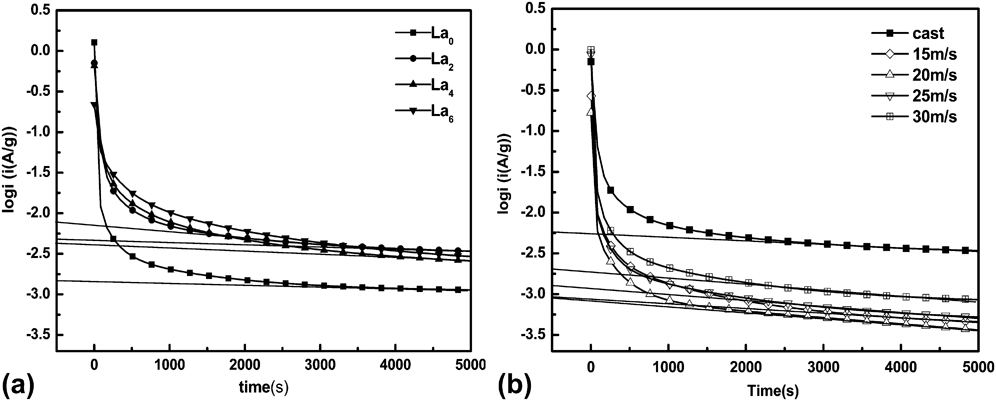
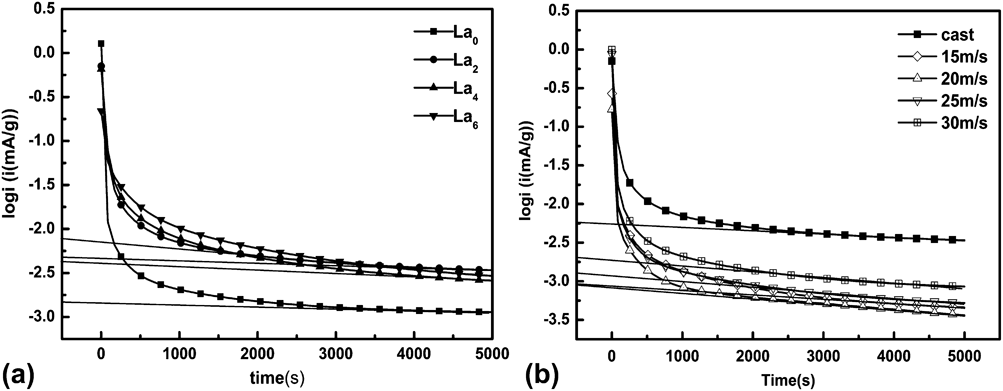
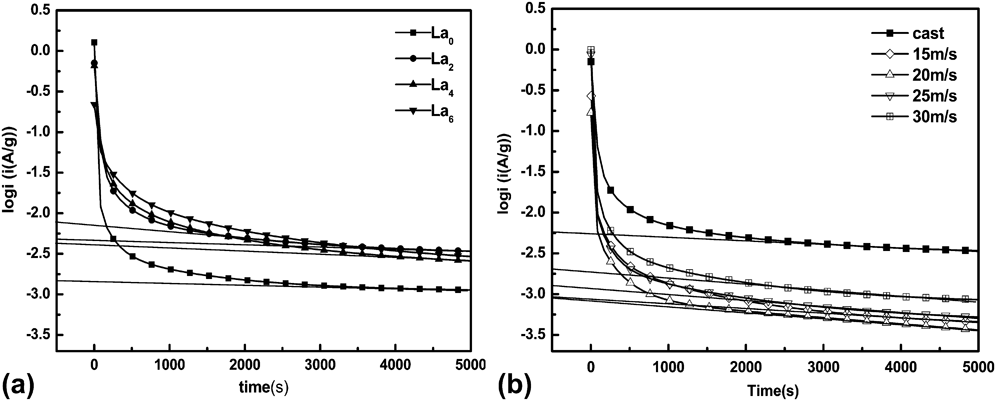
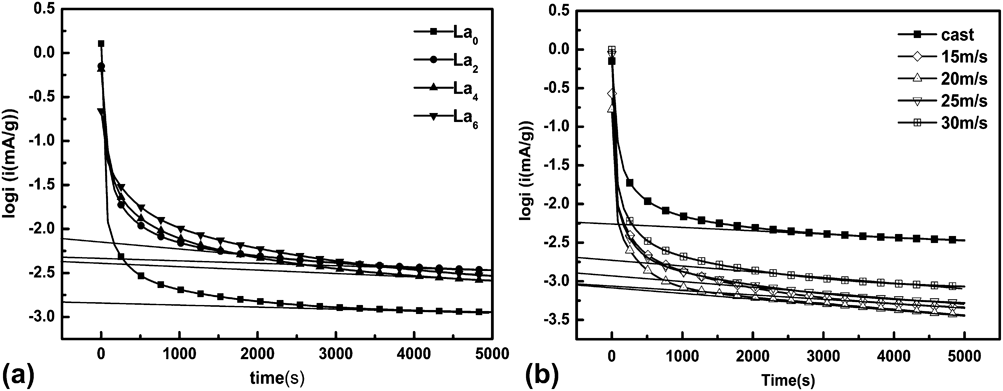
To investigate further the hydrogen diffusion rate in the bulk of the alloys, the potentiostatic step discharge is carried out for the as-cast Mg20−xLaxNi10 (x = 0, 2, 4, 6) and as-spun La2 electrode alloys by applying a potential step of 600 mV, and the results are shown in Figs.7(a) and 7(b). It was reported that the curve of current–time (log i versus t) can be divided into two regions by Nishina et al.Reference Nishina, Ura and Uchida27 In the first domain, the current rapidly decreased owing to the consumption of hydrogen atoms on the surface of alloy particles with increasing time. In the second domain, the current laxly declines in a linear fashion with further increase in time. The linear region can be taken as the finite diffusion of hydrogen atoms inside the alloy particles.Reference Notten and Hokkeling26 According to the slope of the linear region, the hydrogen diffusion coefficient (D) of the alloy electrodes can be calculated by the following equationsReference Zhang, Popov and While28:
 $$\log i = \log [{{6FD\left( {C_0 - C_{\rm{s}} } \right)} \mathord{\left/ {\vphantom {{6FD\left( {C_0 - C_{\rm{s}} } \right)} {da^2 }}} \right. \kern-\nulldelimiterspace} {da^2 }}] - {{{\rm{\pi }}^2 Dt} \mathord{\left/ {\vphantom {{{\rm{\pi }}^2 Dt} {2.303a^2 }}} \right. \kern-\nulldelimiterspace} {2.303a^2 }}\quad ,$$
 $$D = - ({{2.303a^2 } \mathord{\left/ {\vphantom {{2.303a^2 } {{\rm{\pi }}^2 )}}} \right. \kern-\nulldelimiterspace} {{\rm{\pi }}^2 )}}{{d\log i} \mathord{\left/ {\vphantom {{d\log i} {{\rm{d}}t}}} \right. \kern-\nulldelimiterspace} {{\rm{d}}t}}\quad ,$$
where D, C 0, C s, a, d, t, and i are the hydrogen diffusion coefficient (cm2/s), the initial hydrogen concentration in the bulk alloy (mol/cm3), the concentration of H atom on the surface of the alloy particles (mol/cm3), the alloy particle radius (cm), the density of the alloy (g/cm3), the discharge time (s), and the diffusion current density (A/g), respectively. The D values calculated are listed in Tables II and III. It is obvious that when x increases from 0 to 4, the D values increase from 3.38 × 10⁻¹¹ cm2/s to a maximum value of 6.97 × 10⁻¹¹ cm2/s for as-cast Mg20−xLaxNi10 (x = 0, 2, 4, 6) alloys as shown in Fig. 7(a). The result indicates that the hydrogen diffusion rate in the bulk of as-cast Mg20−xLaxNi10 (x = 0, 2, 4, 6) alloys dramatically accelerates with increasing La content, which may be related to the change of lattice parameters, crystallite size, phase structure, and electrocatalytic activity of alloy samples. First, the multiphase structure provides lots of paths for the hydrogen diffusion. Second, the increasing La content strengthens the electrocatalytic function of hydrogen diffusion inside the alloy electrode. Figure 7(b) indicates that the quenching rate conduced to the formation of amorphous and nanocrystalline structures, including a great quantity of crystal defects (including dislocations and grain boundaries), which can act as effective diffusion paths for hydrogen atoms.Reference Wu, Han, Zhou, Lototsky, Solberg and Yartys29 Furthermore, the refined grains triggered by the melt spinning are highly favorable for hydrogen diffusion, which is also an important factor.
Potentiostatic step discharge curves of the as-cast Mg20−xLaxNi10 (x = 0, 2, 4, 6) and spun (La2) electrode alloys at 303 K: (a) as-cast and (b) as-spun (La2).
According to the above-mentioned discussion, for the as-cast Mg20−xLaxNi10 (x = 0, 2, 4, 6) and the as-spun La2 alloy, the hydrogen diffusion coefficients exhibit the same varied tendency with the HRD values of alloy samples, indicating that the electrochemical and kinetic properties are basically dominated by the hydrogen diffusion ability between the interior of the bulk and the surface of the alloy particle.
IV. CONCLUSIONS
In this paper, the microstructure and electrochemical and kinetic properties of the as-cast Mg20−xLaxNi10 (x = 0, 2, 4, 6) and spun La2 alloys have been investigated systematically. Some conclusions can be summarized as follows:
(1) X-ray diffraction analysis shows that the phase composition of as-cast Mg20−xLaxNi10 (x = 0, 2, 4, 6) alloys has changed with increasing La content. The substitution of La for Mg results in the changing of the major phase of as-cast La4, La6 alloys, consisting of (La, Mg)Ni3 and LaMg3 phases, compared with as-cast La0, La2 alloys. For the as-spun La2 alloy, the rapid quenching enhances the forming ability of amorphous and nanocrystalline structures.
(2)With an increase in La content, HRD values of as-cast La0, La2, La4, and La6 alloys mounts up monotonously, showing that the La substitution for Mg efficiently improves the electrochemical and kinetic properties of as-cast alloy samples.
(3) The rapid quenching technology promotes the formation of amorphous and nanocrystalline structures inside as-spun La2 alloy. Such a structure is beneficial to accelerate the diffusion of hydrogen atoms and the charge-transfer reaction, ameliorating the electrochemical and kinetic performances of the as-spun La2 alloy.