Introduction
An important research direction for new herbicides is the development of lead compounds from microorganisms by using active substances from the metabolites that have activity against weed pathogenic microorganisms. The screening, utilization, and development of these metabolites are a hot spot in the field of weed control. More than 100 species of fungal metabolites, from microorganisms in nearly 20 genera, have been reported to have certain herbicidal activity and are expected to be developed into herbicides. Azumi et al. (Reference Azumi, Ogawa, Fujita, Takeshita, Yoshida, Furumai and Igarashi2008) obtained two active compounds (the new macrocyclic endocrinoids bacilosarcins A and B) that can inhibit the growth of barnyard grass [Echinochloa crus-galli (L.) P. Beauv.] from a Bacillus subtilis Cohn strain in the ocean through the application of separation and extraction technology to fermentation broth. Vikrant et al. (Reference Vikrant, Verma, Rajak and Pandey2006) studied the metabolites of Phoma herbarum Westendorp, and the 3-nitrophthalic acid isolated from it showed strong herbicidal activity against ragweed parthenium (Parthenium hysterophorus L.). Weaver et al. (Reference Weaver, Boyette and Hoagland2012) isolated a type of trichothecene from Myrothecium verrucaria (Alb. & Schwein.) L Lombard & Crous that has strong herbicidal activity against kudzu [Pueraria lobata (Willd.) Ohwi; syn.: Pueraria montana (Lour.) Merr.]. The research of Mejri et al. (Reference Mejri, Gamalero, Tombolini, Musso, Massa, Berta and Souissi2010) shows that Pseudomonas fluorescens Migula can produce indoleacetic acid, which has a strong inhibitory effect on ripgut brome (Bromus diandrus Roth). Javaid and Ali (Reference Javaid and Ali2011) reported that four species of Trichoderma—Trichoderma reesei Simmons, Trichoderma harzianum Rifai, Trichoderma viride Pers., and Trichoderma pseudokoningii Rifai—showed various herbicidal effects on the weeds toothed dock (Rumex dentatus L.) and littleseed canarygrass (Phalaris minor Retz.) in wheat (Triticum aestivum L.) fields. Cimmino et al. (Reference Cimmino, Andolfi, Zonno, Troise, Santini, Tuzi, Vurro, Ash and Evidente2012) found that the mycotoxin of Phomopsis sp. can be used to control Australian woolly distaff thistle (Carthamus lanatus L.). These studies have laid a foundation for the further discovery of new herbicides from microorganisms and the exploration of lead compounds with herbicidal activity.
Previous research has identified a large number of natural active products from microorganisms with herbicidal activity (Evidente et al. Reference Evidente, Cimmino, Berestetskiy, Andolfi and Motta2008; Ņečajeva et al. Reference Ņečajeva, Bleidere, Jansone, Gailīte and Ruņis2021). The continuous study of the structure–activity relationships and herbicidal mechanisms of these natural active compounds has opened up an effective method for research on and development of new herbicides (Holloway et al. Reference Holloway, Steinbrecher, Pérez, Seville, Stock, Nakabayashi and Leubner-Metzger2021; Singh and Pandey Reference Singh and Pandey2022). In addition, although tens of thousands of microorganisms have been discovered and identified, it is widely believed that there are still more than 10 times as many unknown microorganisms that have not yet been studied (López-González et al. Reference López-González, Ledo, Cabeiras-Freijanes, Verdeguer, Reigosa and Sánchez-Moreiras2020; Zhang et al. Reference Zhang, Chen, Li, Hu, Wang, Ruan, Zhou, Zhao, Zhou, Ding and Yang2017). Therefore, there is great potential for the development of herbicidal products from a large number of microorganisms (Cimmino et al. Reference Cimmino, Andolfi, Berestetskiy and Evidente2008; Zhu et al. Reference Zhu, Ma, Guo and Xu2020).
Microbial fermentation products are composed of various complex compounds, among which there may be only one or several kinds of effective active substances (Delgado-Sánchez et al. Reference Delgado-Sánchez, Jiménez-Bremont, Guerrero-González and Flores2013). The separation and purification of the target products is an effective method for structural identification and property determination. Column chromatography, thin-layer chromatography (TLC), and liquid chromatography are typically used to separate and purify the active substances of microorganisms (Zhang et al. Reference Zhang, Zhang and Dong2011). The physical and chemical properties of each component in the mixture, including the differences of adsorption capacity, molecular shape, polarity, affinity, and distribution coefficient, make each component migrate at different rates and distribute into the mobile and stationary phases to varying degrees, so as to achieve the purpose of separation and purification (Xue et al. Reference Xue, Du, Jia and Du2010).
Trichoderma polysporum HZ-31 is a weed pathogenic fungus with broad-spectrum and high-efficiency herbicidal activity against farmland weeds in Qinghai, such as common lambsquarters (Chenopodium album L.), A. fatua, dense Himalayan mint (Elsholtzia densa Benth.), prostrate knotweed (Polygonum aviculare L.), false jagged-chickweed [Lepyrodiclis holosteoides (C.A. Mey.) Fenzl ex Fisch. & C.A. Mey.], pale smartweed (Polygonum lapathifolium L.), and others. This strain also could infect canola (Brassica napus L.); the disease rate was 93.33%. To identify the herbicidal active substances in the fermentation broth of T. polysporum HZ-31, the herbicidal components were gradually separated by TLC, column chromatography, and high-performance liquid chromatography (HPLC) in this study. Through biological activity tracking, the pure active ingredients were obtained and the chemical structures of the compounds were clarified, which laid a foundation for the development of novel microbial herbicides directly using active substances or their modification as lead compounds.
Materials and Methods
Tested Strains
Trichoderma polysporum HZ-31 was isolated and preserved by Qinghai Provincial Key Laboratory of Comprehensive Management of Agricultural Pests and deposited in the China General Microbiological Culture Collection Center (CGMCC no. 12867) on September 12, 2016, at the Institute of Microbiology, Chinese Academy of Sciences (No.1 Beichen West Road, Chaoyang District, Beijing).
Plants to Be Tested
The plant materials used for the assays were C. album leaves, A. fatua leaves, E. densa leaves, P. aviculare leaves, L. holosteoides leaves, P. lapathifolium leaves, B. napus seeds, and A. fatua seeds.
Fermentation Culture of Trichoderma polysporum HZ-31 and Bioassay of Active Substances
Preparation of Fermentation Broth and Fermentation Filtrate of Trichoderma polysporum HZ-31
The slant strain of T. polysporum was prepared as a fungal suspension, which was shaken and mixed evenly, inoculated into potato dextrose broth (PDB) culture solution with a 2% inoculation volume, and shaken for 120 h at 25 C and 150 rpm to obtain the fermentation broth. After flask fermentation, the fermentation broth was filtered with four layers of gauze to remove mycelia and impurities. The filtered broth was then centrifuged at 4,000 rpm for 30 min to obtain the supernatant. After standing in a refrigerator at 4 C for 24 h, the supernatant was centrifuged to remove the precipitate and obtain fermentation filtrate.
Effects of Trichoderma polysporum HZ-31 Fermentation Broth and Fermentation Filtrate on the Germination of Avena fatua and Brassica napus Seeds
This experiment was carried out by the method of filter paper germination in a petri dish. Full and complete A. fatua and B. napus seeds were selected and then rinsed and disinfected with sterile water. Filter paper was spread on a 9-cm-diameter Petri dish, 5 ml of fermentation broth and fermentation filtrate of biocontrol bacteria to be tested were added, and 20 seeds were placed in each dish for the seed germination test. Each treatment was repeated three times, with sterile water germination treatment as the control. During culture at 25 C in the dark, the lid was opened to ventilate for 1 h every day, and a supplemental 5 ml of corresponding treatment solution was added to each culture dish every other day. The germinated seeds were counted for the first time on day 3 by the method specified by the International Seed Testing Association (ISTA), and then once every subsequent day, with the last count on the day 7 (ISTA 1999).
Taking the length of seed germination that exceeds the length of the seed itself as the standard of seed germination, the formula for the seed germination inhibition rate is as follows:
 $$\matrix{
{{\rm{Percentage }}{\mkern 1mu} \, {\rm{germination}}\left( {{\rm{PG}}} \right)\left( \% \right)} \hfill \cr
{ = {\rm{total}}{\mkern 1mu} \, {\rm{number}}{\mkern 1mu} \, {\rm{of}} \, {\mkern 1mu} \, {\rm{normally}}{\mkern 1mu} \, {\rm{germinated}}{\mkern 1mu} \, {\rm{seeds}}{\mkern 1mu} \, {\rm{on}}{\mkern 1mu} \, {\rm{day}}{\mkern 1mu} \, {\rm{7/the}}{\mkern 1mu} \, {\rm{total}}{\mkern 1mu} \, {\rm{number}}{\mkern 1mu} \, {\rm{of}}{\mkern 1mu} \, {\rm{tested}}{\mkern 1mu} \, {\rm{seeds}}} \hfill \cr
{ \times 100\% } \hfill \cr } $$
 $$\matrix{
{{\rm{Seed}}{\mkern 1mu} \, {\rm{germinationrate}}{\mkern 1mu} \, {\rm{of}}{\mkern 1mu} \, {\rm{in}}{\mkern 1mu} \, {\rm{hibition}}\left( {{\rm{RI}}} \right)\left( \% \right)} \hfill \cr
{ = [{\rm{control}}{\mkern 1mu} \, {\rm{seed}}{\mkern 1mu} \, {\rm{germination}}{\mkern 1mu} \, {\rm{rate}}\left( \% \right)} \hfill \cr
{ - {\rm{treated}}{\mkern 1mu} \, {\rm{seed}}{\mkern 1mu} \, {\rm{germination}}{\mkern 1mu} \, {\rm{rate}}\left( \% \right)]/{\rm{control}}{\mkern 1mu} \, {\rm{seed}}{\mkern 1mu} \, {\rm{germination}}{\mkern 1mu} \, {\rm{rate}}\left( \% \right)} \hfill \cr
{ \times 100\% } \hfill \cr } $$
Activity Determination of Extracts Prepared with Various Organic Solvents
Extraction with Various Organic Solvents
The fermentation filtrate of T. polysporum HZ-31was extracted with four different polar organic solvents, namely n-butanol, petroleum ether, chloroform, and ethyl acetate. For each solvent, the filtrate was extracted three times using equal volumes, and the three extracted organic phases were combined. The pooled n-butanol phase was rotary evaporated at 45 C, the petroleum ether phase and chloroform phase were rotary evaporated at 37 C under reduced pressure, and the ethyl acetate phase was rotary evaporated at 34 C. Each rotary evaporation step was performed until all the organic solvents had volatilized, and the crude extract was concentrated to obtain the extracts. Each of the four organic-phase extracts was first dissolved in methanol, then distilled water was added, and 5 mg ml−1 and 3 mg ml−1 crude extract solutions were prepared for later use. In vitro leaf grafting and seed germination were used to determine the herbicidal activity of the extracts and the polarity of the active substances. Assays of in vitro leaf inoculation and seed germination were used to trace the activity, and the polar components of herbicidally active substances were determined according to the toxicity symptom status of the leaves and the inhibition rate of seed germination.
In Vitro Leaf Treatment Method
Fresh leaves of A. fatua, E. densa, P. aviculare, P. lapathifolium, L. holosteoides, and C. album weeds were collected in the field, brought into the lab, washed with running water, and then placed in sterilized large petri dishes (ϕ = 15 cm) with filter paper. The 5 mg ml−1 solutions of the crude extracts of different organic solvents were quantitatively dripped on the leaves by acupuncture, and methanol was used as the control. The toxicity symptom status of leaves of the 6 weeds tested was observed irregularly, and the toxicity degree was determined by disease symptoms such as yellowing, chlorosis, and withering of the leaves to compare the toxicities of the crude extracts of the four polar organic solvents to different weed leaves in vitro.
Seed Germination Treatment Method
The seeds of A. fatua and B. napus were soaked in cups with tap water for 2 h, then the seeds were placed in a seed culture dish with filter paper, with 4 A. fatua seeds and 8 B. napus seeds in each dish, and 100 μl of crude extract solution of each organic phase with a concentration of 5 mg ml−1 was added. To reduce the influence of the solvent on seed germination, the crude extract solution was dripped on the filter paper, and 0.5 ml of sterilized water was then dripped evenly after the filter paper had completely dried; each treatment was repeated five times, with methanol as a blank control. After 5 d, the germination rates and inhibition rates were assessed.
The filter paper was spread out in a sterilized glass petri dish, 20 A. fatua seeds and 20 B. napus seeds were added, and 100 μl of a crude extract solution of 3 mg ml−1 for each organic phase was then added. After the filter paper had completely dried, 3 ml of sterilized water was evenly dropped onto it; each treatment was repeated three times, with methanol as the blank control. After 5 d, the germination rates and inhibition rates were assessed.
TLC Detection and Biological Activity Determination
The n-butanol phase crude extract and ethyl acetate phase crude extract were pre-dissolved with methanol, and a sample of the crude extract solution was placed on a TLC silica gel plate (5 by 20 cm) with a capillary tube. The distance between the sample line and the short side was 1 cm, the sample diameter was less than 5 mm, the sample quantity of each sample was kept basically the same, and the sample was blown dry with an electric hair dryer for later use. Different proportions of methanol and dichloromethane (1:5, 1:10, and 1:15) were used as the developing solvents in the chromatographic solution. The developing solvent was poured into the chromatographic cylinder, and then the silica gel plate with the sample was placed in the chromatographic cylinder for development. After the strip was spread out on the thin-layer plate, the chromatographic plate was removed and air-dried naturally. Using a TLC silica gel plate with strips as a carrier, 1.5% water agar medium was gently poured on the thin-layer plate, so that the medium could be spread out across the whole plate with a thickness of about 0.3 to 0.5 cm. The A. fatua seeds and B. napus seeds were placed in rows on a chromatographic plate overlaid with culture medium, and then the chromatographic plate was placed in a moisture-retaining environment, such as a plastic box filled with water, and cultured in an incubator in the dark at 25 C. After 3 d, seed germination was observed, and the Rf values of the active substances produced by the strain and the optimal developing solvent ratio in the chromatographic solution were determined according to the positions where the bands inhibited seed germination.
Active Substance Column Chromatography and Biological Activity Determination
Active Substance Column Chromatography
The optimum proportion of the chromatographic solution was determined by the results of TLC, and the column chromatography used gradient elution.
Samples were eluted with different organic solvent gradient methods. First, the selected ratio is twice that used in the TLC. If the developing solvent obtained by TLC is used as the eluent directly, the polarity will be larger. Then, the ratio of organic solvents needs to be gradually increased. In this experiment, the ratio of methanol and dichloromethane was 1:20, then 1:15, 1:10, and 1:5 gradient eluviation in sequence, and finally, all the remaining samples were eluted with pure methanol. When collecting the samples, the flow rate was controlled at about 1 to 2 drops s−1, to ensure that the solvent covered the adsorbent during the whole process. The TLC analysis of each bottle involved four steps. (1) For preparation of the silica gel plate, scribe with a pencil at 1/5. (2) To order samples, the fractions obtained by chromatographic separation were evenly distributed on the silica gel plate by a capillary to prevent sample diffusion. (3) To separate, the developing solvent was methanol:dichloromethane at 1:10. (4) For ultraviolet (UV) color development, the color development was assayed under 254-nm and 263-nm UV lamps. For the results, samples with similar results were combined and evaporated to dryness, and the combined fractions were then concentrated and dried to test their effects on the germination activity of seeds.
Activity Test of Each Fraction
The seeds were placed in a seed culture dish with filter paper, with 5 A. fatua seeds and 8 B. napus seeds in each dish. An aliquot of 100 μl of column chromatography concentrated and combined fraction solution was added into the dish. After all the organic solvents on the filter paper evaporated, 0.5 ml sterile water was dropped onto the paper. The treatment was repeated four times, and a treatment with only sterilized water was used as the control. The dishes were then cultivated in the dark in a 25 C incubator, the germination of seeds was observed irregularly, and the experimental results were counted after 5 d.
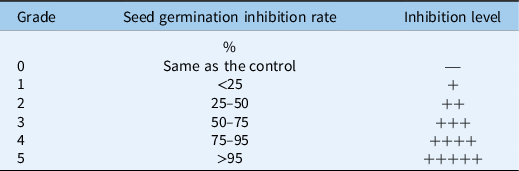
For the seed classification criteria, the seed germination inhibition grades and grading standards are shown in Table 1.
Classification standards of seed germination inhibition.

HPLC Analysis and Activity Tracking
Each fraction solution was ultrasonically dissolved in an ultrasonic cleaner, shaken well, 1 ml was accurately absorbed, and it was filtered into a brown sampling bottle with an organic filter membrane. For the mobile-phase parameters: mobile phase A was water, mobile phase B was methanol, and the gradient elution was (95% B; 90% B; 80% B; 70% B; 60% B; 50% B; 45% B; 40% B; 35% B; 30% B; 25% B; 15% B; 10% B; 5% B); flow rate: 1 ml min−1; sampling volume: 10 μl; detection wavelength: 220 nm; and column temperature: 30 C. According to the detection peak of the sample and its retention time, the required portions were collected separately. The effective components corresponding to each absorption peak were collected manually. The pipeline behind the detector was a 0.18-mm PEEK tube, and the lag volume was negligible. The peak was completely collected by repeating several times. The rotary steaming bottle was rinsed with methanol, and the active ingredients were dried by rotary steaming at 38 C. Then, distilled water (1 ml) was added into the rotary steaming bottle, and the effective components were ultrasonically dissolved in an ultrasonic cleaner for later use.
Seed germination experiments were carried out for each component collected. The recipient materials were A. fatua seeds and B. napus seeds. Healthy A. fatua seeds and B. napus seeds with intact skin were selected and placed in a seed germination dish (ϕ = 1.5 cm) with a layer of filter paper and 8 A. fatua and 10 B. napus seeds per dish. The collected components were added into the seed germination dish at 200 μl per dish, while 200 μl of distilled water was added to each control dish, and the dishes were cultured at a constant 25 C in the dark. Water was added every 24 h, and germination was observed. After 5 d, the germination rates and inhibition rates were counted. The components with herbicidal activity were then prepared separately to obtain pure products.
According to the best proportion of the mobile phase, the samples enriched by liquid chromatography were prepared, and a large number of pure products were prepared and collected. The preparation conditions of the high-performance liquid phase were: COSMOSIL5 C18-MS-II, 30-mm I.D. by 250-mm preparative chromatographic column (Beijing Lvbaicao Technology Development Company, Beijing, China, 100081), UV detector at 220 nm, and a flow rate of 15 ml min−1. After the target peak was collected, the collected samples were concentrated by steaming.
Structural Identification of the HZ-31 Pure Product
For nuclear magnetic resonance (NMR) analysis, the monomer compound was dissolved in a suitable deuterated solvent and transferred to a nuclear magnetic tube for NMR detection. The 1H NMR and 13C NMR spectra were obtained. The chemical shift values of the 13C nucleus and hydrogen nucleus were used to query the microspectrogram data, and the structures of the compounds were preliminarily judged by comparison.
The molecular weights of compounds were determined by mass spectrometry. The samples to be tested were dissolved with chromatographic methanol and injected into a mass spectrometer, and an electrospray ionization source was used to detect the molecular weights of the compounds.
The NMR analysis conditions were: Bruker AVANCE III 400 MHz (Switzerland Brucker Company, Billerica, MA, USA, 01821); solvent: deuterated methanol; hydrogen spectrum resonance frequency: 400 MHz; resolution: 0.244532 Hz; carbon spectrum resonance frequency: 100 MHz; and carbon spectrum resolution: 0.733596 Hz.
The structures of the compound were determined by analyzing the spectra of the compounds using the hydrogen spectrum, carbon spectrum, and mass spectrum, in combination with a literature investigation. ChemDraw 12.0 was used to draw the structures.
Activity Verification of Monomer Compounds
Referring to the seed germination method in “HPLC Analysis and Activity Tracking,” the herbicidal activities of the monomer compounds obtained by separation were verified again. The treatments were repeated three times.
Results and Discussion
Fermentation Culture of Trichoderma polysporum HZ-31 and Bioassay of Active Substances
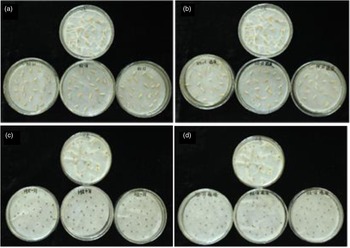
The data in Table 2 show that the inhibition rates of the fermentation broth of strain HZ-31 on the seed germination of A. fatua and B. napus are 70.00% and 86.67%, respectively, and the inhibition rates of the fermentation filtrate of strain HZ-31 on the seed germination of A. fatua and B. napus are 80.00% and 91.67%, respectively. These data show that there is a remarkable inhibitory effect on the growth of the radicle and embryo (Figure 1), the active substances exist in both fermentation filtrate and fermentation broth, and the activity in the fermentation filtrate is higher than that in the fermentation broth.
Effects of fermentation broth and filtrate of strain HZ-31 on seed germination of Avena fatua and Brassica napus. a

a Different lowercase letters in the same column indicate significant differences (P < 0.05).
Effect of Trichoderma polysporum strain HZ-31 on seed germination (the top rows of A to D were the control, the bottom rows of A to D were treatments). (A) Effect of fermentation broth on Avena fatua; (B) effect of fermentation filtrate on A. fatua; (C) effect of fermentation broth on Brassica napus; (D) effect of fermentation filtrate on B. napus.

Activity of Different Organic Solvent Extracts
In Vitro Leaf Treatment Method
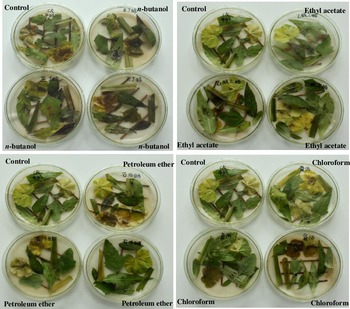
The leaves of seven kinds of weeds were treated with 5 mg ml−1 of the ethyl acetate, n-butanol, petroleum ether, and chloroform phases. After treatment with crude extract solution, the leaves of weeds turned yellow, and some leaves turned brown (Figure 2). The crude extract of n-butanol was highly toxic to the isolated leaves of E. densa and P. lapathifolium, and the infected lesion areas accounted for more than 60% of the total leaf area. It was moderately toxic to A. fatua, P. aviculare, and L. holosteoides, and the disease spot areas accounted for 16% to 59% of the total leaf area. It has slight toxicity to C. album. The ethyl acetate phase crude extract was slightly toxic to C. album and P. aviculare leaves, but moderately toxic to the leaves of the other five weeds. The crude extract of petroleum ether has slight toxicity to the leaves of C. album, P. aviculare, and P. lapathifolium, and moderate toxicity to the leaves of other four weeds. The chloroform phase crude extract has slight toxicity to the leaves of E. densa and L. holosteoides, and moderate toxicity to the leaves of A. fatua (Table 3).
Control effect of the four organic solvent extracts on leaves of different weeds in vitro.

Comparison of toxicities of crude extracts using four polar organic solvents to the leaves of different weeds in vitro. a

a Symbols: —, no symptoms; +, mild symptoms, and the lesion area accounts for about 15% of the total leaf area; ++, moderate symptoms, and the lesion area accounts for 16%–59% of the total leaf area; +++, severe symptoms, and the lesion area accounts for 60%–80% of the total leaf area; ++++, severe symptoms, and the lesion area accounts for 80%–100% of the total leaf area.
These results showed that the toxic effects of the different organic phases were, from strong to weak: n-butanol > ethyl acetate > petroleum ether > chloroform. This suggests that the best active component is in the n-butanol phase.
Seed Germination Treatment Method
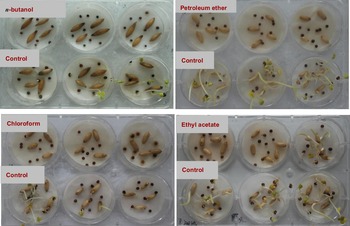
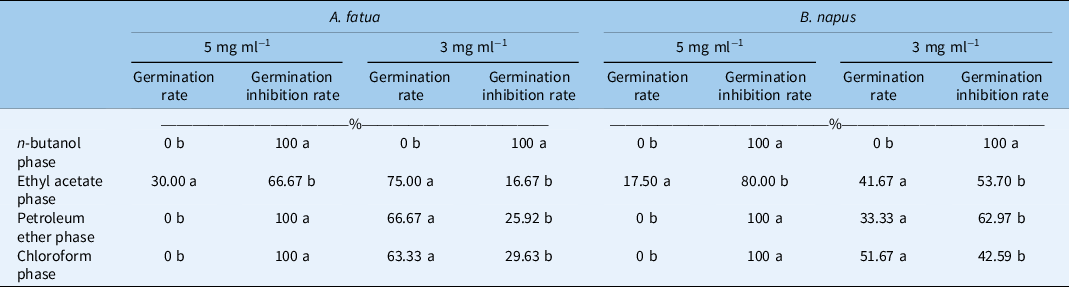
The 5 mg ml−1 solutions of the four different organic solvent extracts strongly inhibited the germination of A. fatua and B. napus seeds (Figure 3). Except for ethyl acetate, the other treatments completely inhibited the growth of embryos and radicles, and the germination inhibition rates were 100%, with no significant differences (Table 4).
Effects of 5 mg ml−1 of each extraction fraction on seed germination of Avena fatua and Brassica napus.

Inhibitory effects of four kinds of crude organic extracts on Avena fatua and Brassica napus seeds. a

a Different lowercase letters in the same column indicate significant differences (P < 0.05).
The inhibitory effects of ethyl acetate extract and n-butanol extract solutions on seed germination showed that the n-butanol extract at a 3 mg ml−1 concentration could completely inhibit the germination of A. fatua and B. napus seeds, but the inhibitory effect of the ethyl acetate extract on the germination of A. fatua and B. napus seeds was not as good as that of the n-butanol extract. The ethyl acetate phase crude extract inhibited the germination of A. fatua seeds by 16.67% and B. napus seeds by 53.70% (Table 4). Therefore, the determination of crude extract activity was based on the in vitro leaf bioassay and seed germination results, and the best active component was determined to be in the n-butanol phase.
Detecting Herbicidal Activity by TLC
The proportion of the chromatographic developing solvent was determined by TLC detection, and the samples extracted from strain HZ-31 were analyzed by TLC. Finally, the crude extract was developed in the developing system of methanol:dichloromethane at 1:10, with clear bands and large spacing between the bands. After biological measurement and tracking, the Rf of the herbicidally active substance in the sample was found to be 0.5. The herbicidally active substance at this band position significantly inhibited the germination of A. fatua and B. napus seeds, and radicle elongation was significantly inhibited. The material band with Rf < 0.5 on the TLC plate had a secondary inhibitory effect on the germination of A. fatua and B. napus seeds, and the material band with Rf > 0.5 on the TLC plate had the weakest inhibitory effect on the germination of A. fatua and B. napus seeds.
Active Substance Column Chromatography and Biological Activity Determination
Active Substance Column Chromatography
According to the experimental results of TLC, it was determined that the ratios of organic solvents in column chromatography are methanol and dichloromethane at 1:20, 1:15; 1:10; and 1:5 in sequence, with gradient elution, and finally a pure methanol washing. Every 100 ml of eluent was collected as a fraction, and a total of 160 bottles of samples were collected. Each bottle of eluent was analyzed using a TLC plate, and the eluents with the same number and position of bands on the TLC plate were combined and concentrated to yield 12 fractions. The 12 combined fractions were then concentrated and dried into solid extracts separately. They were then dissolved with a small amount of methanol and used to test the activity on the germination of seeds.
Seed Germination Activity Testing
The crude active substances obtained by column chromatography were separated using a large number of TLC plates, and the same components were combined to obtain 12 fractions.
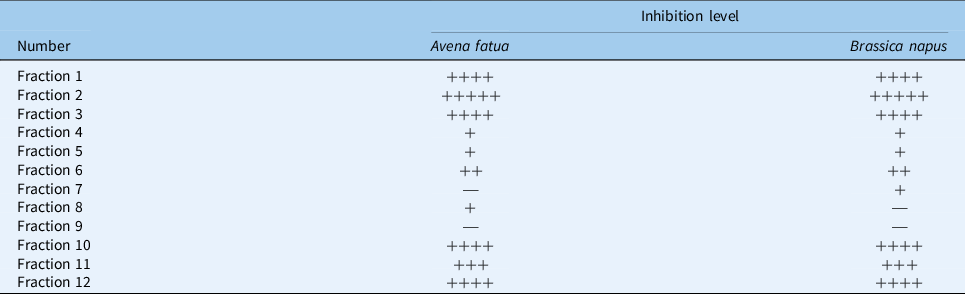
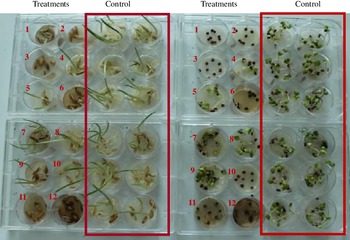
The results in Table 5 show that all of the fractions obtained by TLC exhibit different degrees of activity, among which fraction 2 had the strongest inhibitory effect on the germination of A. fatua and B. napus seeds, reaching level 5, while fractions 1, 3, 10, and 12 had level 4 activity; fraction 11 had level 3 activity; fraction 6 had level 2 activity; fractions 4, 5, and 8 had level 1 activity; and fractions 7 and 9 showed no activity (Table 5; Figure 4). Thus, fractions 1, 2, 3, 6, 10, 11, and 12 were determined to have good herbicidal activity, and the order of herbicidal activity from strong to weak is: fraction 2 > fraction 1, fraction 3, fraction 10, fraction 12 > fraction 11 > fraction 6.
Test results of seed germination activity of fractions obtained by thin-layer chromatography (TLC). a

a Symbols: —, no inhibition; +, the inhibition rate of seed germination is lower than 20%; ++, the inhibition rate of seed germination is lower than 40%; +++,the inhibition rate of seed germination is lower than 60%; ++++, the inhibition rate of seed germination is lower than 80%; +++++, the inhibition rate of seed germination is 100%.
Activities of each fraction as determined by column chromatography.

HPLC Analysis and Activity Tracking
Fraction 1 Liquid Chromatography Separation
After gradient elution, the mobile phase is 20% B, the peak-to-peak width is moderate, and better separation can be obtained under conditions of UV detector at 220 nm, mobile phase of methanol:water is 20:80, and a flow rate is 1 ml min−1.
The five absorption peaks separated from fraction 1 were tested for seed germination inhibition. Absorption peaks 1 and 3 significantly inhibited the germination of A. fatua and B. napus seeds (Table 6). The inhibition rates of peak 3 on the germination of A. fatua and B. napus seeds were the highest, at 87.5% and 70%, respectively. The inhibition rates of absorption peak 1 on the germination of A. fatua and B. napus seeds were 62.5% and 60%, respectively. The peak retention times of absorption peaks 1 and 3 were 8.126 min and 22.722 min, and they were respectively labeled as component 1 and component 2 and collected.
Influence of Trichoderma polysporum strain HZ-31 fraction 1 on Avena fatua and Brassica napus seed germination. a

a Different lowercase letters in the same column indicate significant differences (P < 0.05).
Separation of Fraction 2 by Liquid Chromatography
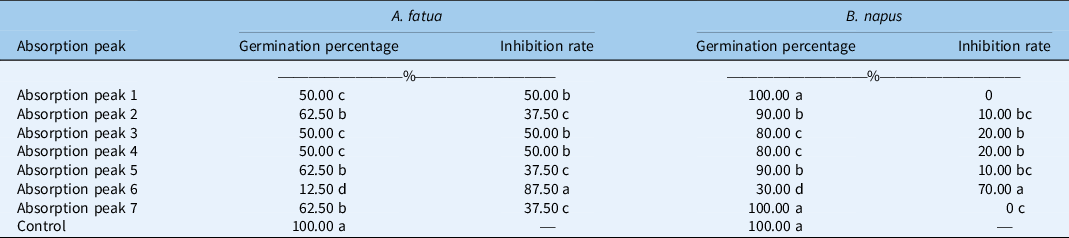
Under the same conditions given for fraction 1, the seven absorption peaks separated from fraction 2 were tested for seed germination inhibition. Absorption peak 6 significantly inhibited the germination of A. fatua and B. napus seeds at rates of 87.5% and 70.0%, respectively (Table 7). The peak retention time of absorption peak 6 was 22.918 min, and it was labeled as component 3 and collected.
Influence of Trichoderma polysporum strain HZ-31 fraction 2 on Avena fatua and Brassica napus seed germination. a

a Different lowercase letters in the same column indicate significant differences (P < 0.05).
Separation of Fraction 3 by Liquid Chromatography
For this fraction, after gradient elution, the mobile phase is 10% B, the peak-to-peak width is moderate, and better separation can be obtained under conditions of UV detector at 220 nm, mobile phase of methanol:water is 10:90, and a flow rate is 1 ml min−1.
The three absorption peaks separated from the fraction 3 were tested for seed germination inhibition. Absorption peaks 1 and 2 inhibited the germination of A. fatua seeds at rates of 37.5% and 62.5%, but the inhibition rates on B. napus seed were 0. Absorption peak 3 significantly inhibited the germination of A. fatua and B. napus seeds at rates of 75.0% and 80.0%, respectively (Table 8). The peak retention time of absorption peak 3 was 65.308 min, and it was labeled as component 4 and collected.
Effect of Trichoderma polysporum strain HZ-31 fraction 3 on Avena fatua and Brassica napus seed germination. a

a Different lowercase letters in the same column indicate significant differences (P < 0.05).
Structural Identification of the Four Monomer Compounds
Compound 1: The molecular formula of compound 1 is C9H12O4, and its molecular weight is 184.07. 1H-NMR (400 MHz, MeOD) δ: 7.04 (2H, d, J = 8 Hz), 6.73 (2H, d, J = 8 Hz), 3.70 (3H, d, J = 8 Hz), 3.52(3H, d, J = 8 Hz). 13C-NMR (400 MHz, MeOD) δ: 156.2, 131.2, 130.9, 116.1, 115.7, 73.7, 64.4, 64.1. Through the analysis and comparison of 1H-NMR, 13C-NMR, electron spray mass spectrometry (ESMS), fast atom bombardment mass spectrometry (FABMS), and other spectral data, the identity of this compound was determined to be p-hydroxyphenyl-2,3-dihydroxypropyl ether.

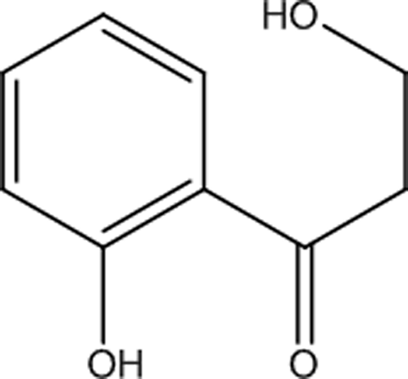
Compound 2: Combined with the hydrocarbon spectrum data, it could be determined that its molecular formula is C9H10O3 and its molecular weight is 166.06. 1H-NMR (400 MHz, MeOD) δ: 9.52 (H, s, OH), 7.78 (H, d, J = 8 Hz), 7.06 (H, d, J = 8 Hz), 6.93 (H, d, J = 8 Hz), 6.75 (H, d, J = 8 Hz), 3.58 (2H, m), 3.52 (2H, m). 13C-NMR (400 MHz, MeOD) δ: 181.0, 162.1,133.2, 130.9, 117.1, 116.7, 64.3, 58.1. The identity of this compound as o-hydroxy-3-carbonyl-1-phenylpropanol was determined by analyzing and comparing the spectral data of 1H-NMR, 13C-NMR, ESMS, and FABMS.
Compound 3: The molecular formula of compound 3 is C14H22O4, and its molecular weight is 254.32. 1H-NMR (400 MHz, MeOD) δ: 7.08 (2H, d, J = 8 Hz), 6.72 (2H, d, J = 8 Hz), 4.89 (4H, s), 3.60 (4H, m), 3.52 (4H, m), 3.32 (2H, brs, OH), 2.71 (4H, m). 13C-NMR (400 MHz, MeOD) δ:131.3, 130.9, 116.1, 73.8, 64.6, 64.4, 39.3. Through the analysis and comparison of 1H-NMR, 13C-NMR, ESMS, FABMS, and other spectral data, the identity of this compound was determined to be 1,8-propanediol o-xylene.

Compound 4: The molecular formula of C6H12O4 and molecular weight of 148.07 could be determined by combining the data for the hydrocarbon spectrum. 1H-NMR (400 MHz, MeOD) δ: 3.57 (6H, m), 2.57 (2H, brs), 1.15 (3H, s). 13C-NMR (400 MHz, MeOD) δ: 176.4, 72.5, 64.3, 29.9, 18.5. Through the analysis and comparison of 1H-NMR, 13C-NMR, ESMS, FABMS, and other spectral data, the identity of this compound was determined to be 2,3-dihydroxypropyl propionate.

Verification of Monomer Activities
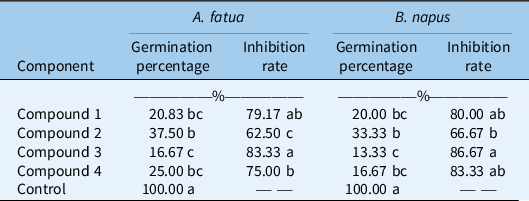
The effects of the four monomer compounds on the germination of A. fatua and B. napus seeds were determined, and the results showed that compounds 1, 3, and 4 had high activity. Compound 3 showed the strongest inhibitory effect on the germination of both A. fatua and B. napus seeds, with inhibition rates of 83.33% for A. fatua seeds and 86.67% for B. napus seeds. Compounds 1 and compound 4 had less activity than compound 3 (Table 9).
Effects of monomer compounds on seed germination of Avena fatua and Brassica napus. a

a Different lowercase letters in the same column indicate significant differences (P < 0.05).
The liquid fermentation of strain HZ-31 was extracted by organic solvent, and the active substance was prepared repeatedly by silica gel column chromatography and TLC. When the TLC method is used to separate active substances, the chromatographic mobile phase needs to be constantly adjusted to separate each band as much as possible (Kankam et al. Reference Kankam, Qiu, Pu, Long, Zhang, He and Zhang2016). In this study, through adjusting the developing agent of different proportions (methanol:dichloromethane), the active substance was determined at the position where Rf was about 0.5.
The complexity of column chromatography showed the complexity of the substances in crude toxin extraction. The target active substances can be selectively separated and eluted by gradient elution (El-Hasan et al. Reference El-Hasan, Walker, Schöne and Buchenauer2009; Regassa et al. Reference Regassa, Cho and Kim2020). The liquid-solid chromatography method was used to explore the conditions of HPLC (Sidana and Joshi Reference Sidana and Joshi2013). First, the peaks were collected using analytical liquid chromatography for the biological activity test, and then the samples were separated and purified through the preparation of liquid chromatography, and then a large number of high-purity samples were enriched and prepared.
The results showed that n-butanol was the best solvent for extracting herbicide active substances, and the ratio of methanol to dichloromethane was 1:10, which was the best TLC developer. With methanol and dichloromethane of different proportions as eluents, 12 fractions were obtained after silica gel column chromatography separation. After vacuum concentration and activity tracking, fractions 1, 2, and 3 were determined to have good herbicidal activity. The herbicidal active substances were further separated and tracked by HPLC, and four active components were obtained. The structures of the compounds were determined to be p-hydroxyphenyl-2,3-dihydroxypropyl ether, o-hydroxy-3-carbonyl-1-phenylpropanol, 1,8-propanediol o-xylene, and 2-3-dihydroxypropyl propionate through comparative analysis of the database and relevant literature review. The herbicidal activity has not been reported yet.
Acknowledgments
This research was funded by the Central Leading Local Science and Technology Development Fund Project (2022ZY034) and the International Cooperation Project (2023-HZ-808) of the Science and Technology Department of Qinghai Province. We are also grateful to the anonymous reviewers for their valuable suggestions and comments. The authors declare no conflict of interest.