Implications
A broiler chicken grower diet containing less calcium and phosphorus than recommended (depletion) affects bone mineral status but not growth performance. Bone mineralisation is restored at least partially when the finisher diet contains adequate amounts of calcium and phosphorus (repletion). Calcium and phosphorus utilisation efficiency appears to increase under depletion conditions. This suggests that phosphorus ingestion and excretion can be reduced and that the sustainability of broiler production can thus be improved.
Introduction
Phosphorus utilisation is of increasing concern regarding the sustainability of broilers’ production, considering high phosphorus excretion can lead to eutrophication. Phosphorus represents an important nutrient constraining feed costs. Several nutritional strategies have been developed to improve its utilisation. Yan et al. (Reference Yan, Angel, Ashwell, Mitchell and Christman2005) demonstrated that chickens fed diets deficient in calcium (Ca) and non-phytate phosphorus (nPP) during an early phase of growth (depletion) and later fed diet containing adequate levels of these minerals (repletion) exhibited better phosphorus and Ca utilisation and bone mineralisation. In fact, birds seem to respond to a decrease in Ca and nPP dietary content by increasing expression of mRNA encoding Ca transporters (Centeno et al., Reference Centeno, Diaz de Barboza, Marchionattia, Alisioa, Dallorsob, Nasif and Tolosa de Talamonia2004; Bar, Reference Bar2009) and phosphorus transporters (Ashwell and Angel, Reference Ashwell and Angel2010) in the small intestine. Some authors have suggested that recommendations made by National Research Council (NRC) (1994) regarding dietary Ca and phosphorus for broiler chickens might exceed actual requirements (Angel et al., Reference Angel, Saylor, Mitchell, Powers, Applegate and Dhandu2006; Létourneau-Montminy et al., Reference Létourneau-Montminy, Narcy, Dourmad, Crenshaw and Pomar2010). In a meta-analysis, Létourneau-Montminy et al. (Reference Létourneau-Montminy, Narcy, Dourmad, Crenshaw and Pomar2010) have shown that feeding 21-day-old broilers 6.0 g of Ca and 3.0 g of nPP/kg of BW did not affect growth performance. Concomitant reduction of dietary nPP and Ca maintains phosphorus availability in the digestive tract. However, this can lead to poor bone mineralisation and thus impairing animal welfare or increased processing losses (Applegate and Angel, Reference Applegate and Angel2008). We focused on the grower phase for the initial depletion as a reduction of phosphorus and Ca intake during an early phase could lead to imprinting allowing birds to be more efficient for the entire period. More precisely, we expected that the initial depletion could allow a reduction in phosphorus intake later during the finisher phase. The results would allow the highest economic and environmental gain as birds consume two-thirds of feed during the finisher phase. We hypothesised that: (1) we could lower the nPP and Ca levels of the diet compared with NRC (1994) recommendations without impairing animal performance, (2) the depletion will reduce bone mineralisation and induce regulations which in turn will increase phosphorus and Ca utilisation efficiency, (3) broilers previously depleted will deposite more Ca and phosphorus (g/d) in the bone allowing them to catch-up in bone mineralisation at the control levels during repletion. Thus, this study was designed to test the effect of several Ca and nPP depletion degree and duration in order to improve Ca and phosphorus utilisation, and the levels of dietary Ca and nPP required subsequently in order to replenish the bone mineral deficit thus created.
Material and methods
Experimental diets
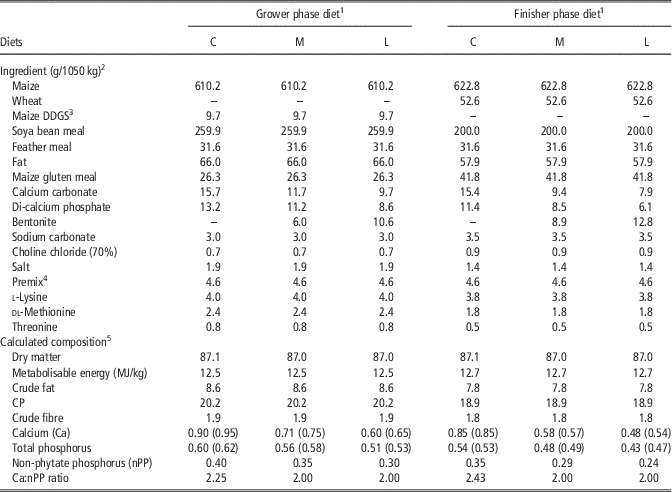
Except for Ca and phosphorus, all nutritional requirements of broiler chickens (NRC, 1994) were met or exceeded by the maize, soya bean meal-based diets formulated (Table 1). During the starter period (0 to 10 days of age), the chicks received a diet meeting all nutritional requirements (NRC, 1994). During the grower period (11 to 21 days of age), they received the control diet (C, 0.90% Ca and 0.39% nPP), the mid-level diet (M, 0.71% Ca and 0.35% nPP) or the low-level diet (L, 0.60% Ca and 0.30% nPP). During the finisher phase (22 to 37 days of age), Ca and nPP contents were, respectively, 0.85%, 0.57% and 0.48% and 0.35%, 0.29% and 0.24% in the C, M and L diets. The C diet contained Ca and nPP at the levels used in standard commercial conditions in Canada, whereas the L diet was based on previous studies (Yan et al., Reference Yan, Angel, Ashwell, Mitchell and Christman2005; Létourneau-Montminy et al., Reference Létourneau-Montminy, Narcy, Dourmad, Crenshaw and Pomar2010; Rousseau et al., Reference Rousseau, Valable, Létourneau-Montminy, Même, Godet, Magnin, Nys, Duclos and Narcy2016). The M diet was intermediate between the C and L diet and had the same Ca:nPP ratio as the L diet. Grower and finisher diets were combined to form six dietary treatment sequences: CC, MM, LC, LM, ML and LL. The first treatment (CC) is the North American positive control whereas the second is the French positive control (MM) according to Létourneau-Montminy et al. (Reference Létourneau-Montminy, Narcy, Dourmad, Crenshaw and Pomar2010) and Rousseau et al. (Reference Rousseau, Même, Magnin, Couty, Bordeau and Narcy2013 and Reference Rousseau, Valable, Létourneau-Montminy, Même, Godet, Magnin, Nys, Duclos and Narcy2016). The third (LC) and fourth (LM) dietary sequences have been built to test depletion and repletion strategies. When comparing them it will be possible to set the level (C or M) allowing a catch-up in bone mineralisation to reach the level of the two first dietary sequences. The fifth sequence (ML) will informed about the dietary Ca and phosphorus reduction that is possible to perform during finishing phase (22 to 35 days) for which few information is available in literature. Finally, the last dietary treatment represents the negative control (LL).
Composition of experimental diets fed to broiler chickens aged 11 to 37 days

C=standard commercial levels of Ca and nPP (positive control); M=mid-levels of Ca and nPP; L=low levels.
1 Days 11 to 21 and days 22 to 37.
2 1000 kg of masterbatch diet, 50 kg to adjust Ca and nPP levels.
3 Maize distillers dried grains.
4 Per kg: 6487 IU retinol; 2366 IU cholecalciferol; 20.8 IU dl-α-tocopherol; 3 mg menadione; 2 mg thiamine; 6 mg riboflavin; 78 mg niacin; 14 mg pantothenate; 3 mg pyridoxine; 104 mcg biotin; 1 mg folic acid; 14 mcg cyanocobalamin; 35 mg Fe; 65 mg Cu; 92 mg Mn; 92 mg Zn; 2 mg I.
5 Calculated from NRC (1994). All values except metabolisable energy are percentages. Analysed values in brackets.
On each phase, one basal diet was manufactured and then divided in three mix corresponding to the different diets. In each mix, Ca and phosphorus sources (calcium carbonate and di-calcium phosphate), maize (19.6 and 21.7 g/kg during grower and finisher phase) and bentonite were added to obtain the different Ca and nPP levels required. Diets were fed as medium crumb during starter phase and as short pellets during grower and finisher phases. Birds had free access to feed and water throughout the experiment.
Birds and management
Animals were cared for according to the guidelines of the Canadian Council on Animal Care (2009). A total of 3600 1-day-old male Ross 708 broiler chicks were used. On arrival, chicks were assigned randomly to pens, 60 chicks/pen. The study fit a random block design consisting of 10 blocks of six pens each. The room temperature was settled at 32°C upon arrival and decreased progressively to reach 24°C at day 35 with a 23L:1D schedule from 0 to 7 day-of-age and 20L:1D schedule after day 7. Total chick weight in the pen and mean chick body mass were determined at 0, 10, 21 and 37 days of age. Feed intake per pen was measured for each period. Morbidity and mortality were recorded. Barn temperature and relative humidity were recorded daily. At the end of each period, one or two birds per pen were euthanised using CO2 to sampled 10 birds/treatment. They were scanned dorsally in prone position by dual-energy X-ray absorptiometry (DXA) according to the method used by Schreiweis et al. (Reference Schreiweis, Orban, Ledur, Moody and Hester2005) to determine total bone mineral content and total body lean and fat contents. Schreiweis et al. (Reference Schreiweis, Orban, Ledur, Moody and Hester2005) had validated the use of DEXA to assess bone integrity in birds compared with tibia ash and breaking strength. The acquisitions were realised using the small animal mode as recommended by Mitchell et al. (Reference Mitchell, Rosebrough and Conway1997) (DPX-L; LUNAR Prodigy Advance Corp., Madison, WI, USA) in a study comparing DXA results with carcass dissection measurements for bone mineral content and total body lean and fat contents. Tibias and toes were then collected for mineral analysis.
Laboratory analysis
Representative samples of the diets were taken upon delivery and once weekly. Samples of each feed were mixed together weekly and at the end of the experiment to obtain a representative composite sample and analysed using the Association of Analytical Communities official methods for dry matter, protein and ash (Methods 930.15, 990.03 and 942.05). Ash was then solubilized using HCl in order to determine dietary Ca and phosphorus by inductively coupled plasma mass spectometry (Method 985.01). The right and left tibias were freed from adhering tissue. The middle left toe was separated between the second and the third metatarsal bone without removing either nail or skin, then cleaned. The left tibia and toes were weighed, dried at 110°C for 24 h and then placed in a muffle furnace (Lindberg/Blue M Vacuum oven; Thermo Scientific, Waltham, MA, USA) at a temperature ramped from 200°C to 600°C over 6 h followed by 48 h at 600°C. The right tibia was used to measure breaking strength (Chatillon TCM 201; Wagner Instrument, Greenwich, CT, USA).
Calculation and statistical analysis
Bone mineral content gain was calculated by dietary treatments for each bird as the bone mineral content at the end of the phase minus the mean for the same dietary treatment at the beginning of the phase. The Ca and nPP relative transfer to whole-body, tibia and toe were calculated separately for the bone criteria: bone mineral content gain, tibia and toe ash weight. It was defined as the ratio between the value of each bone criterion (g) and the Ca or nPP ingested (g) during the corresponding period. Ingested Ca and nPP were calculated from the average daily feed intake over the period for the corresponding pen. The pen was the experimental unit for growth performance and the bird was the experimental unit for bone mineralisation. Dietary sequences were included in the model as a fixed effect and the block as a random effect. ANOVA were performed using the MIXED procedure of SAS (Statistical Analysis System Institute Inc., 2003) after the normality of the variables had been checked using the Shapiro–Wilk test. Orthogonal contrasts with linear (Lin) and quadratic (Qua) effects were used in the grower phase (C v. M v. L) and for the overall experiment to study the extent of the depletion in dietary nPP and Ca levels (CC v. MM v. LL), the impact of the depletion duration (ML v. LL), and the effect of the levels of dietary nPP and Ca during the finisher phase (CC v. LC v. LM). Linear regression between tibia, toe and whole-body criteria was conducted within each phase. Differences were considered significant at P<0.05.
Results
Analysed phosphorus and Ca concentrations were in accordance with expected values.
Grower phase
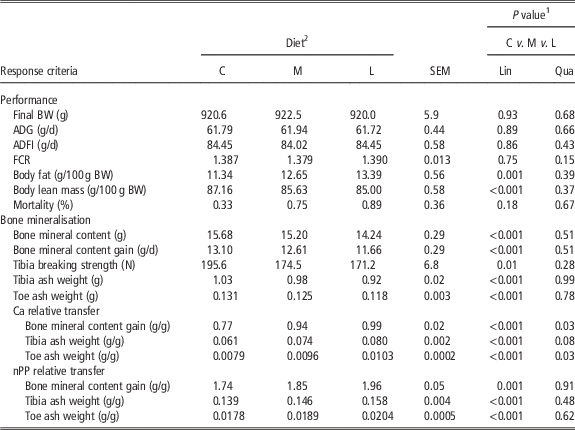
Diet had no effect on growth performance measured on day 21 (Table 2). Birds fed the L diet had a higher body fat content (g/100 g BW) than those fed the C diet (+18%, Lin, P=0.001), whereas lean content (g/100 g BW) decreased with a decreased of dietary Ca and nPP (−3%, Lin, P<0.001). A reduction of 33% of Ca and of 23% of nPP content reduced bone mineral content and gain (−9% and −11%, Lin, P<0.001), breaking strength (−13%, Lin, P=0.01), tibia and toe ash weight (−11% and −10%, Lin, P<0.001). Lowering the level of Ca and nPP in the diets improved the Ca relative transfer to tibia (Lin, P<0.001) and nPP relative transfer to whole-body, tibia and toe (Lin, P<0.001). Based on bone mineral content and toe ash weight, C diet lead to lower Ca relative transfer to whole-body and toe compared with M and L diets (Lin, P<0.001, Qua, P<0.05).
Effect of calcium (Ca) and non-phytate phosphorus (nPP) on broiler chicken growth performance and bone mineralisation during the grower phase (days 11 to 21)

C=standard commercial levels of Ca and nPP (positive control); M=mid-levels of Ca and nPP; L=low levels; Lin=linear effect; Qua=quadratic effect; ADG=average daily gain; ADFI=average daily feed intake; FCR=feed conversion ratio.
1 For growth performance, n=10 pens for C, n=20 for M, n=30 for L. For bone mineralisation, n=10 birds/treatment.
2 See Table 1.
Finisher phase
Impact of reducing dietary phosphorus and calcium
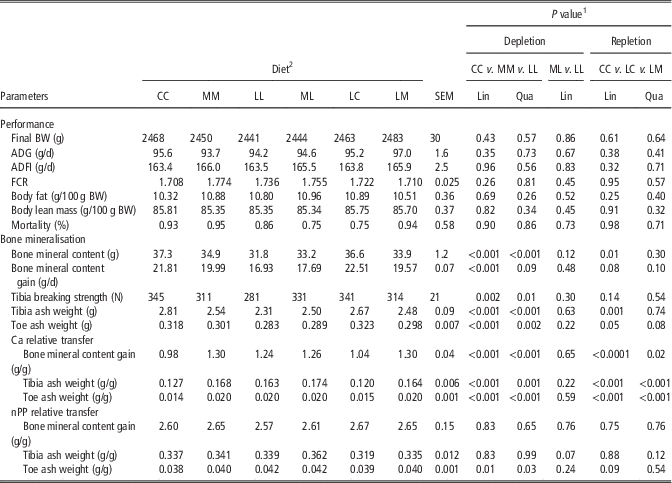
The effect of the reduced intake of Ca and phosphorus is shown by the contrast CC v. MM v. LL. Growth performance were unaffected (Table 3). The LL treatment resulted in a lower bone mineral content gain (Lin, P<0.001). The MM and LL treatments both led to lower bone mineral content, tibia breaking strength, tibia ash and toe ash weights than did the control treatment (Lin, Qua, P<0.01) but higher Ca relative transfer to whole-body, tibia and toe (Lin, Qua, P<0.001) and higher nPP relative transfer to toe (Lin, P=0.01, Qua, P<0.05). The duration of the depleting treatment (ML v. LL contrast) had no effect on performance.
Effect of calcium (Ca) and non-phytate phosphorus (nPP) on broiler chicken growth performance and bone mineralisation during the finishing phase (days 22 to 37)

C=standard commercial levels of Ca and nPP (positive control); M=mid-levels of Ca and nPP; L=low levels; Lin=linear effect; Qua=quadratic effect; ADG=average daily gain; ADFI=average daily feed intake; FCR=feed conversion ratio.
1 For growth performance, n=10 pens. For bone mineralisation, n=10 birds.
2 First letter corresponds to days 11 to 21. Second letter corresponds to days 22 to 37. See Table 1.
Impact of dietary phosphorus and calcium during the repletion period
The effect of replenishing the two minerals is shown by the contrast CC v. LC v. LM. Growth performance were not affected (Table 3). On day 37, breaking strength was similar for all treatments. The LC sequence yielded superior bone mineral content as well as tibia and toe ash weights compared with the LM sequence but did not reach the levels obtained with the CC sequence (Lin, P<0.05). The LM sequence led to poor bone mineral status even though the Ca relative transfer to whole-body, tibia and toe were higher than for CC or LC (Lin, P<0.001, qua, P<0.05). Diet had no effect on nPP relative transfer.
Overall performance
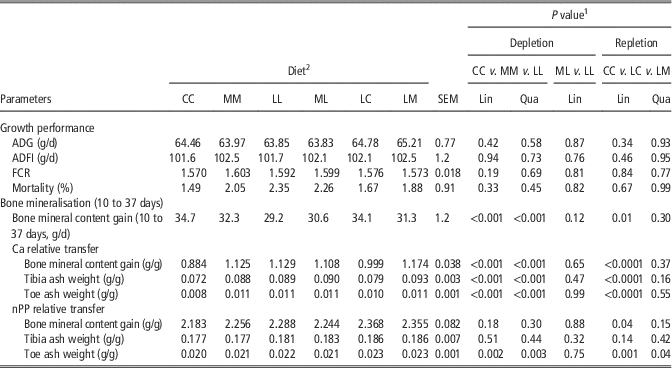
The reduced mineral intake had no effect on growth performance from days 0 to 37 (CC v. MM v. LL, Table 4). In comparison with CC or MM, the LL sequence decreased bone mineral content gain (Lin, Qua, P<0.001). However, Ca relative transfer to whole-body, tibia and toe were higher in chickens fed LL or MM (Lin, Qua, P<0.001). These two diets also improved nPP relative transfer to toe (Lin, P<0.01, Qua, P<0.01). The duration of the mineral depletion treatment had no effect on growth performance, bone mineral content gain or Ca and nPP relative transfer. The level of Ca and nPP repletion (CC v. LC v. LM contrast) had no effect on growth performance. The degree of repletion that followed the grower phase depletion treatment (i.e. M diet v. C diet during the finisher phase) decreased the bone mineral content gain but also increased the Ca relative transfer to whole-body, tibia and toe (Lin, P<0.01) and the nPP relative transfer to whole-body (Lin, P<0.05). The LC and LM treatments both resulted in higher nPP relative transfer to toe than did the control (CC) treatment (Lin, P=0.001, Qua, P<0.05).
Effect of calcium (Ca) and non-phytate phosphorus (nPP) on broiler chicken overall growth performance and bone mineralisation (days 0 to 37)

C=standard commercial levels of Ca and nPP (positive control); M=mid-levels of Ca and nPP; L=low levels; Lin=linear effect; Qua=quadratic effect; ADG=average daily gain; ADFI=average daily feed intake; FCR=feed conversion ratio.
1 For growth performance, n=10 pens. For bone mineralisation, n=10 birds.
2 First letter corresponds to days 11 to 21. Second letter corresponds to days 22 to 37. See Table 1.
Discussion
Effect of dietary calcium and non-phytate phosphorus depletion
Reducing dietary nPP and Ca levels during the grower phase did not appear to affect growth performance. In a meta-analysis, Faridi et al. (Reference Faridi, Gitoee and France2015) found that 0.60% Ca and 0.30% nPP allow maximal growth performance. At day 21, a decrease of Ca and nPP dietary content led to a decrease of the body lean content and an increase of body fat content. Phosphorus ingested is fixed at 40% in the soft tissue (Narcy et al., Reference Narcy, Rousseau, Même, Magnin and Nys2015) and will be fixed in priority in the soft tissue over in the bones (Létourneau-Montminy et al., Reference Létourneau-Montminy, Narcy, Lescoat, Bernier, Magnin, Pomar, Nys, Sauvant and Jondreville2015). As a result, a decrease in Ca and nPP content led to a decrease in soft tissue content in the body. As for the body fat content, in the digestive tract, Ca can precipitate with fatty acids, making the subsequent availability of both uncertain. Dietary Ca in excess might reduce carcass fat content by forming such precipitates and thereby interfering with fat emulsification, absorption and deposition (Shafey, Reference Shafey1998). However, body lean and fat content results must be interpreted with caution as the accuracy of DXA analysis for this parameter is lower than that of bone ash determination. Some of the variability could be due to factors that arise during data acquisition, such as the scan programme, mode and bird BW (Swennen et al., Reference Swennen, Janssens, Geers, Decuypere and Buyse2004).
Between 11 to 21 days, a broiler feed containing 33% less Ca than the NRC-recommended level and 23% less nPP decreased bone mineralisation as shown previously (Rousseau et al., Reference Rousseau, Même, Magnin, Couty, Bordeau and Narcy2013; Hamdi et al., Reference Hamdi, López-Vergé, Manzanilla, Barroeta and Pérez2015). Faridi et al. (Reference Faridi, Gitoee and France2015) showed that in the absence of phytase or vitamin D3, dietary nPP should be above 3.5 g/kg during the first 21 days in order to maximise tibia ash content. As dietary depletion increased, Ca and nPP relative transfer increased suggesting an increase in apparent digestibility of Ca and phosphorus in the intestine as reported by Rousseau et al. (Reference Rousseau, Valable, Létourneau-Montminy, Même, Godet, Magnin, Nys, Duclos and Narcy2016) in chicks fed low-phosphorus or Ca diets for 10 days. Studies have suggested that depletion appears to stimulate the expression of mRNA encoding Ca transporters CALB1, SLC8A1 and ATP2B1 and phosphorus transporters SLC20A1 and SLC34A2 (Centeno et al., Reference Centeno, Diaz de Barboza, Marchionattia, Alisioa, Dallorsob, Nasif and Tolosa de Talamonia2004; Bar, Reference Bar2009; Proszkowiec-Weglarz and Angel, Reference Proszkowiec-Weglarz and Angel2013) in the intestine and the kidney. Given this adaptation process, more efficient utilisation of both Ca and phosphorus in the intestine may be expected in response to reduced dietary content. Furthermore, the adaptation to low Ca and nPP diet could have occurred primarily in the kidney with an increase in the reabsorption of the minerals. Studies have shown that low plasma Ca and phosphorus concentrations to the stimulation of Ca and phosphorus transporters in the kidney (Proszkowiec-Weglarz and Angel, Reference Proszkowiec-Weglarz and Angel2013).
The absence of growth performance alteration when reducing dietary Ca and nPP during days 22 to 37 is in agreement with the results of Wilkinson et al. (Reference Wilkinson, Bradbury, Bedford and Cowieson2014), Delezie et al. (Reference Delezie, Bierman, Nollet and Maertens2015) and Rousseau et al. (Reference Rousseau, Valable, Létourneau-Montminy, Même, Godet, Magnin, Nys, Duclos and Narcy2016) for BW gain and feed conversion ratio. A further reduction of Ca and nPP during the finisher phase increased the deficit in bone mineralisation, from −11% on day 21 (C v. L) to −20% on day 37 (CC v. LL) based on tibia ash content. The effect of a decrease in Ca and nPP dietary content on bone mineralisation but not on growth performance further confirmed that the requirements for maximising skeletal development are greater than those for lean mass development (Larbier and Leclercq, Reference Larbier and Leclercq1992). Although it is well known that about 85% of phosphorus is found into bone, in modern broilers that amount is higher probably due to higher body protein as more than 60% of the phosphorus ingested is deposited in bone with Ca (Narcy et al., Reference Narcy, Rousseau, Même, Magnin and Nys2015). The duration of the depletion treatment (ML v. LL) did not impact bone mineralisation (ML and LL led to the same final Ca and nPP relative transfer to whole-body, tibia and toe). We can conclude that the decreased in nPP and Ca content during finisher phase was more crucial to bone development than any adaptation occurring during the decreased in grower phase.
Although the depletion treatment decreased the bone mineralisation values measured on day 37, Ca relative transfer to whole-body, tibia and toe was higher compared with the control treatment. Yan et al. (Reference Yan, Angel, Ashwell, Mitchell and Christman2005) also demonstrated 20% increases in total Ca apparent absorption measured on day 32 in birds fed such diets during both phases compared with those fed a control diet. The more efficient utilisation of Ca and phosphorus confirms adaptation in depleted animals as shown previously by Rousseau et al. (Reference Rousseau, Valable, Létourneau-Montminy, Même, Godet, Magnin, Nys, Duclos and Narcy2016). The absence of significant effects of a decreased in Ca and nPP dietary content on nPP relative transfer to whole-body, tibia, except based on toe ash during the finisher period suggests that Ca may have been the limiting nutrient in our experiment. The relative transfer to whole-body, tibia and toe were similar for ML and LL. Nonetheless, Yan et al. (Reference Yan, Angel, Ashwell, Mitchell and Christman2005) showed that birds that had been depleted from days 0 to 18 responded better to continued depletion from days 19 to 32 with enhanced Ca and nPP relative transfer to tibia compared with birds receiving a control diet from days 0 to 18 then depleted from days 19 to 32. In our study, the adaptation process may have occurred early in the finisher phase, resulting in complete recovery in bone mineralisation, with a subsequent decline in utilisation efficiency, possibly indicating a transient response.
Effect of dietary calcium and non-phytate phosphorus repletion
The bone mineralisation deficit showed the importance of the repletion phase for restoring the bone mineral criteria to acceptable values (Ashwell and Angel, Reference Ashwell and Angel2010). The level of repletion (CC v. LC v. LM) did affect bone mineralisation. Despite the lesser degree of mineralisation at the end of the depletion period, increasing the dietary supply of the Ca and nPP to level C or even level M resulted in the same breaking strength on day 37 compared with CC birds. For the other bone mineral status criteria, the LC sequence gave a better result than the LM but LC birds were not able to fully compensate to the levels of the control birds. Rousseau et al. (Reference Rousseau, Même, Magnin, Couty, Bordeau and Narcy2013) found that the effects of mineral depletion (0.60% Ca and 0.30% nPP) from days 10 to 21 were erased over days 22 to 35 by switching to a diet containing only slightly more of both minerals (0.70% Ca and 0.35% nPP). This difference could be due to higher Ca:nPP ratio for the control diet during finisher phase in our experiment (2.45) compared with Rousseau et al. (Reference Rousseau, Même, Magnin, Couty, Bordeau and Narcy2013, 2.00). Despite the reduced bone mineralisation, Ca relative transfer to whole-body during the finisher period was greater following the LC or LM treatment compared with the control treatment. In contrast, nPP relative transfer to whole-body, tibia and toe was not affected in our experiment. This confirmed that Ca was the limiting element. Létourneau-Montminy et al. (Reference Létourneau-Montminy, Lescoat, Narcy, Sauvant, Bernier, Magnin, Pomar, Nys and Jondreville2008) have reported previously that bone mineralisation in chicks fed a marginally deficient diet for 10 days was restored by replenishing the mineral depletion over the next 11 days as a result of improved bone mineral deposition. Ashwell and Angel (Reference Ashwell and Angel2010) have suggested that an early deficiency could lead to an epigenetic imprinting effect that enhances Ca absorption capability. However, the deficiency began early in the Ashwell and Angel study (90 h after hatching) and even earlier (day 1, lasting through day 18) in a study by Yan et al. (Reference Yan, Angel, Ashwell, Mitchell and Christman2005), compared with day 11 in our study. A deficiency beginning immediately after hatching might indeed have a genetic and an epigenetic effect. In the absence of such an effect, the gain in Ca and nPP utilisation efficiency might decline over a finisher phase lasting 16 days, as in our experiment. As the LC treatment resulted in the same bone mineral status as the CC treatment did, Ca and nPP utilisation efficiency may have been the same overall in both groups over the entire finisher phase. As LC birds reached the same bone mineral status compared with CC birds, they shared the same efficiency to use Ca and nPP for the remaining of the finisher period. As a result, we might not see a statistical difference over the 16-day period. Based on tibia ash and toe ash, Ca utilisation was more efficient in the LM treatment group than in the LC or CC groups. The LC and LM treatments thus suggest strategies for maximising bone mineralisation. If ~75% of total phosphorus intake occurs during the finisher phase and phosphorus excretion is high at the same time, as reported previously (Rousseau et al., Reference Rousseau, Même, Magnin, Couty, Bordeau and Narcy2013), increasing nPP in the finisher diet appears contrary to our objective of reducing phosphorus excretion. The LM diet seems more appropriate. The depletion and repletion strategy could be improved by including a second depletion towards the end of the finisher phase, considering that absorption will be more efficient due to the first depletion, assuming that the metabolic adaptation is not transient.
Overall, reducing dietary nPP and Ca did not improve the litter score (results not shown). Rousseau et al. (Reference Rousseau, Valable, Létourneau-Montminy, Même, Godet, Magnin, Nys, Duclos and Narcy2016) had found that reducing Ca content from 9.0 to 7.0 g/kg in the diet improved litter dry matter during a finisher phase with a nPP level of 3.5 g/kg. The acceptable litter quality observed according to Welfare Quality (2009) for all of the diets in our experiment could explain the lack of effect (Tuyttens et al., Reference Tuyttens, Federici, Vanderhasselt, Goethals, Duchateau, Sans and Molento2015).
Assessment of bone mineralisation
Assessing bone mineral status is critical to the study of the mineral adequacy of diets. Bone physical and mechanical properties such as strength and the structure of bone tissue reflect overall skeletal health (Bradbury et al., Reference Bradbury, Wilkinson, Cronin, Thomson, Bedford and Cowieson2014). We used several criteria to evaluate the impact of dietary strategies on bone mineralisation. The bone mineral content assessed by DXA scanning demonstrated to discriminate the treatments as well as the tibia and toe ash measurements. Whole-carcass bone mineral content was correlated best with tibia ash weight, followed by the toe ash mass (results not shown). These results assessed the validity of DXA scanning in broilers experiment. This technology had been applied previously to broilers by only few authors (Angel et al., Reference Angel, Saylor, Mitchell, Powers, Applegate and Dhandu2006; Shahnazari et al., Reference Shahnazari, Lang, Fosmire, Sharkey, Mitchell and Leach2007). It present the advantage, compared with traditional measurements, to provide a rapid and non-invasive measurement of whole-body bone mineralisation. We also assess the advantage to use toe instead of tibia for ash measurements. In our experiment, tibia ash and toe ash were poorly correlated, making it difficult to consider toe ash as a good proxy measurement of bone mineralisation. Shastak et al. (Reference Shastak, Witzig, Hartung, Bessei and Rodehutscord2012) found toe ash to be highly correlated with tibia ash in 3-week-old broilers (R 2=0.94). However, these authors used all toes for the measurement rather than only the middle toe as we did. They also found a stronger correlation between tibia ash and whole foot ash compared with toe ash. The increased accuracy in other experiments for toe ash could be due to the greater number of bones.
Although breaking strength responded to the dietary treatments the same way as other bone mineralisation criteria did (bone mineral content, tibia and toe ash weights), it showed higher variability (coefficients of variation of 6.55% v. 3.39%, 3.55% and 3.32%, respectively). Ravindran et al. (Reference Ravindran, Kornegay, Potter, Ogunabameru, Welten, Wilson and Potchanakorn1995) did not consider tibia breaking strength as a good indicator of phosphorus bioavailability, as it appeared to be more sensitive than other bone mineral criteria to variations in the measurement technique (handling, shear force, crosshead speed).
In conclusion, this study confirms that it is possible to reduce dietary Ca and nPP levels below the NRC (1994) recommendations during the grower and finisher phases without affecting growth performance. Despite decreased bone mineralisation when mineral depletion occurs during the grower phase, the deficit is restored if the minerals are replenished with control diet during the finisher phase. However, the dietary Ca and nPP levels in the repletion diet determine the final levels of bone mineralisation, the control (commercial conditions) level resulting in better mineralisation than an intermediate level. Bone mineralisation under these conditions benefits from Ca and nPP relative transfer, particularly Ca relative transfer in the finisher phase, being increased in response to grower phase conditions.
Acknowledgements
The authors gratefully acknowledge Nutreco Canada Inc. for its financial support and for conducting the experiment. The authors are grateful to the Sherbrooke centre of Agriculture and Agri-food Canada, Marcel Marcoux and Nancy Bolduc for their technical support in performing the laboratory analysis.