


I. A LEGAL HUB FOR A LARGELY CIVIL LAW REGION
Singapore aims to be a legal service hub for its region and therefore aims to provide legal services not only to common law jurisdictions but also to the civil law jurisdictions of Southeast Asia, East Asia, and beyond.Footnote 1 This is a national and government priority. One would therefore think that the teaching of at least the rudiments of the civil law focusing mainly on private law would be a high priority at the Faculty of Law of the National University of Singapore (‘NUS Law School’, or ‘the School’) – especially since the School's slogan is ‘Asia's Global Law School’. Most of the world uses the civil law, not the common law, and a school is simply not global if it teaches only one of the two main legal traditions.
Unfortunately, the NUS Law School does not teach the core of the civil law, let alone teach it in compulsory courses. It does a better job than most schools at covering many aspects of international and Asian law through elective courses,Footnote 2 and therefore in some ways it is a global and Asian law school. But it forgot about the very basics: it simply does not teach the civil law applicable in most of Asia, by which I mean the core or private law foundations of the civil law tradition, that is, primarily the law of obligations – contract law, but also delictual liability (tort) – as well as property law, and possibly also civil procedure and the legal method of the civil law. It also does not teach the basics of public law, that is, administrative law and constitutional law as practised in many Asian civil law jurisdictions, such as the French-inspired administrative law practised in Thailand or the Kelsenian model of constitutional review practiced for example in Indonesia, Taiwan, and South Korea. This article will however focus mainly on the private law core of the civil law tradition.
After this introduction (Part I), I will look (in Part II) at the national and governmental goal of making Singapore a hub for legal services in Asia and the measures taken by the government to that end. I will then look (in Part III) at why this goal cannot be accomplished unless Singapore lawyers have a basic understanding of the civil law, and I will also indicate how my arbitration practice has confirmed the need to better train lawyers so that they are better able to handle civil law matters. I will then look (in Part IV) at measures taken by the NUS Law School to help Singapore achieve that goal and how these measures fall far short of what would be the bare minimum in preparing our graduates to handle matters in which some aspects of the file are governed by the civil law. I will also show the long-standing resistance of the NUS Law School to the introduction of the civil law in our core curriculum. I will then propose (in Part V) possible avenues for the future which may have better chances of success.
I regret if at times this account sounds a bit personal – it is in a way the account of twenty-three years of efforts and great frustration on my part and the part of many others to seek to convince the School that there is a need to do more to prepare our graduates for the civil law they will encounter in our region. I could have better explained my frustration if I could have detailed in this article the many different debates and arguments that took place over the years each time it was proposed that the School makes sure that our graduates are sufficiently familiar with the civil law. However, unfortunately in my view, at the NUS Law School, such policy debates and arguments take place confidentially in faculty committees and meetings. I will therefore only report on documents that were the subject of public consultation and on propositions that I have personally made, and compare those to the final result, that is how, in my view, the current and previous undergraduate curricula of the School do not sufficiently familiarize our students with the civil law.
II. SINGAPORE AS A LEGAL HUB FOR THE REGION
One of the priorities of the Singapore government, for many years now, has been to turn Singapore into a hub for legal services in the region. The government wants Singapore to offer legal services to corporations – multinational, foreign and domestic, and government-linked corporations – that invest and trade in Asia. Over the years, the Singapore government has taken many measures to that end.
Many foreign law firms have been using Singapore as a base from which to conduct their work in the region, which often involves the laws of civil law countries. In order to tap on this to build a regional hub, the Singapore government first encouraged joint ventures between local and foreign firms so that local firms gain regional and civil law expertise and, as an incentive to foreign firms, those joint ventures would be able to practice Singaporean law through the local firm. There were a few takers but eventually in an effort to attract more foreign firms and make Singapore into a true hub, some foreign firms were allowed to practise Singapore law in the corporate and commercial fields without the need for a joint venture.Footnote 3 While these were multinational firms with expertise in civil law, they were all originally from common law jurisdictions (US or UK), as most large multinational law firms are.Footnote 4 It should also be noted that some foreign lawyers can individually seek admission to the Singapore Bar with certain conditions.Footnote 5
There have been many other initiatives. One of the most successful was the promotion of Singapore as an arbitration hub. The government invested in Maxwell Chambers, an arbitration venue, and adopted very arbitration-friendly laws, and even gave tax-credits to foreign firms which brought their arbitration practice to Singapore.Footnote 6 Singapore is now one of the preferred arbitration seats in the world.Footnote 7
However, it seems that few arbitrations governed by the civil law have been seated in Singapore – at least that is what the statistics for cases administered by the Singapore International Arbitration Centre (SIAC) seem to suggest.Footnote 8 For the year 2018, the SIAC reports that 80 per cent of contracts under dispute included choice of law clauses in favour of Singaporean (56 per cent), English (18 per cent), or Indian law (6 per cent), ie the law of common law jurisdictions. Another 7 per cent of contracts did not express a choice of law, leaving 13 per cent of contracts to be what the SIAC classifies as governed by other laws.Footnote 9 This 13 per cent would include the law of civil law jurisdictions and also the law of other common law jurisdictions (Australia, Hong Kong, etc). One can therefore conclude that not many cases governed by the civil law are coming to the SIAC. It may be that, even when the parties are from civil law jurisdictions, they would more often choose the common law as the governing law.Footnote 10 Conversely, it could also be that when they choose the civil law, the parties go to the International Chamber of Commerce (ICC)Footnote 11 or to a seat or institution in a civil law jurisdiction or in a jurisdiction more familiar with the civil law, perhaps because the SIAC and Singapore are perceived as too common law oriented.Footnote 12 Indeed, at the ICC in 2017, the third and fourth most popular choices of law were French and Swiss law.Footnote 13 Even more worrisome for Singapore, at the Hong Kong International Arbitration Centre (HKIAC), Chinese law, part of the civil law tradition, was the third most popular choice of law after Hong Kong law and English law.Footnote 14
Although there may be some more Singapore-seated cases governed by the civil law than the SIAC statistics may suggest, it remains that these statistics do not show a lot of civil law cases coming to Singapore and this may have to do with the fact that Singapore lawyers, arbitrators, and institutions do not yet have the reputation of being well versed in the civil law.
It should also be noted that the government also recently created the Singapore International Commercial Court (SICC) to hear international commercial cases, particularly those involving foreign law. Interestingly, foreign lawyers may appear before the court and may be allowed to plead the foreign law without having to prove it through witnesses.Footnote 15 In addition, many foreign judges have been appointed to the SICC, including two current judges from civil law jurisdictions.Footnote 16 The court therefore hears civil law cases even though there have not been many thus far.
Another initiative of the government is the modification of our laws to turn Singapore into a regional debt restructuring hub. The goal is to attract to Singapore cross-border insolvency and debt restructuring cases.Footnote 17 Again, it is likely that many of these cases will involve the civil law.
Notwithstanding the fact that the government is also promoting the use of Singapore law in international transactions,Footnote 18 it remains that many of the cases that will come to the ‘Singapore legal hub’, or that Singapore hopes to attract, will be governed by the law of a civil law jurisdiction. This stems from the fact that Singapore wants to be a hub in a region largely governed by the civil law.
Singapore cannot become a serious legal hub for the region that includes so many civil law jurisdictions unless it is able to handle civil law matters. While international law firms have partners and lawyers trained in the civil law, Singapore law firms generally do not (except for a few consultants not called to the Singapore Bar).
III. THE NEED TO TEACH BASIC CIVIL LAW
I have argued elsewhere for the need to teach more Asian and comparative law.Footnote 19 This article will focus on a narrower objective, one which is not well achieved at the NUS Law School, namely, the teaching of the core of the civil law: contracts, delictual liability (tort), property, etc.
I will not account here for the numerous academic writings detailing the benefits of learning both civil and common law but will simply quote at length the best summary I could find of this literature:
Comparative law also has an important function in legal education. In legal education as in legal science generally it is too limiting smugly to study only one's national law, and for universities and law schools so to act at a time when world society is becoming increasingly mobile is appallingly unprogressive. Comparative law offers the law student a whole new dimension; from it he can learn to respect the special legal cultures of other peoples, he will understand his own law better, he can develop the critical standards which might lead to its improvement, and he will learn how rules of law are conditioned by social facts and what different forms they can take. What he learns in this science, as in others, will prove useful in practice too. Here we need only mention how useful comparative law is in conflict of laws, for the interpretation of treaties, for those who are involved in international adjudication, arbitration, or administration, or concerned with the unification of law. The younger generation of lawyers, and probably their successors as well, will be faced with an unparalleled ‘internationalization’ of legal life. But it is the general educational value of comparative law which is most important: it shows that the rule currently operative is only one of several possible solutions; it provides an effective antidote to uncritical faith in legal doctrine; it teaches us that what is often presented as pure natural law proves to be nothing of the sort as soon as one crosses a frontier, and it keeps reminding us that while doctrine and categories are essential in any system, they can sometimes become irrelevant to the functioning and efficacy of the law in action and degenerate into futile professorial games.Footnote 20
In this part, I will focus on the need to train at least some Singapore lawyers in the basics of the civil law if Singapore is to be a true hub for legal services in this region, especially if Singapore firms (as opposed to foreign firms established in Singapore) are to play a role in providing legal services to a region which includes so many civil law jurisdictions.
The first thing to realize therefore is how widespread the civil law is in Asia and, for that purpose, an image is worth a thousand words:
The Civil Law and the Common law in AsiaFootnote 21
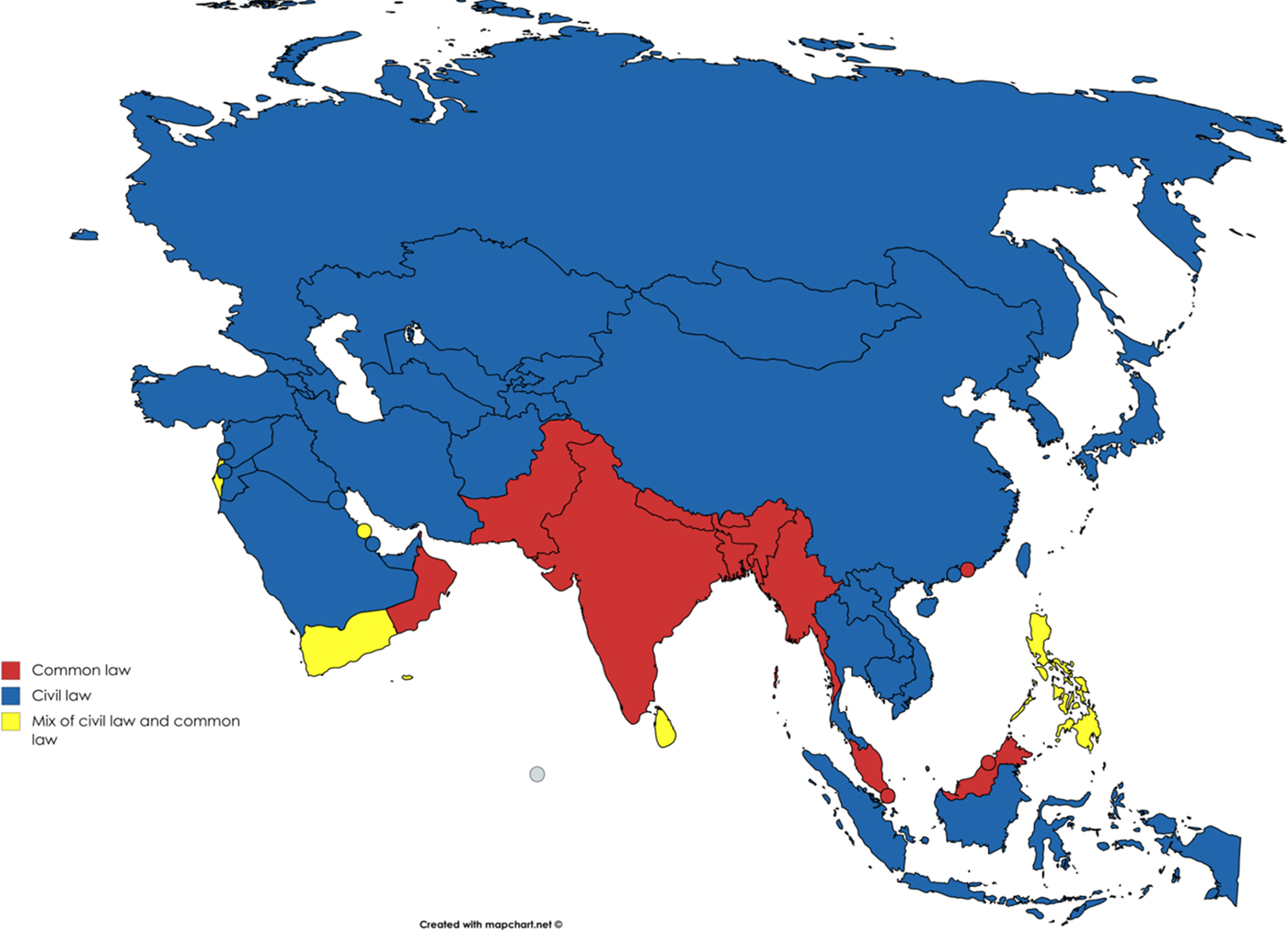
In the Association of Southeast Asian Nations (ASEAN), six out of ten countries are civil law countries,Footnote 22 including the Philippines, a country which has a mix of civil law and American common law. Among the civil law countries of ASEAN is our neighbour, Indonesia, the fourth largest country in the world by population. It should be noted that Singaporean companies, including government-linked companies (GLCs) are heavily invested in the region. In 2016, Singapore was the country that invested the most in Indonesia (more than Japan and China combined and more than the USA).Footnote 23 Singapore is also a very large investor in VietnamFootnote 24 and has also invested in China.Footnote 25 It is fair to say that Singapore is heavily invested in many civil law countries in this region. Singapore companies often rely on Singapore law firms rather than foreign firms for their legal services, but unfortunately the local firms are not as well prepared to handle civil law matters – their Singaporean lawyers are not trained in civil law and they usually have no foreign partners in the Singapore firm who are trained in civil law, unlike in large multinational law firms.
If Singapore, and in particular Singaporean law firms, are to play a role in servicing Singapore companies as well as foreign investors and traders in this region, we have to train some of our lawyers to handle civil law matters. I am not too worried for the international firms established in Singapore – many of them have, for many years, handled civil law matters all around the world and have for a very long time had continental European partners trained in the civil law. They therefore have at all levels of the firm (junior and senior) lawyers and partners trained in the civil law. This is simply not the case for large Singaporean firms with regional ambitions. In these firms, the lawyers remain almost exclusively trained in the common law except for young foreign consultants hired from the region and trained in the civil law who are usually not members of the Singapore Bar and therefore usually do not stay in Singapore in the long term. The local firms are therefore ill-equipped to handle civil law matters.Footnote 26
The government understood the need for training in Asian law and civil law very early on:
As early as 2002, after broad consultation of the public, including the profession, the judiciary, the faculty, and the industry, the Working Group on Legal Services of the Economic Review Sub-Committee on Service Industries (a Government established Committee) made the following recommendations regarding the legal education…:
7. The LWG recognises the need for Singapore lawyers to develop niche expertise in … various aspects of international trade law and financial services. Some knowledge of substantive Chinese law is also important following China's entry into the World Trade Organisation (‘WTO’).
8. NUS law professors and other contributors to legal literature should consider research in Asian law and other comparative legal systems. The legal curricula of NUS should therefore be oriented around a transnational legal system (going beyond the Singapore legal system), spanning core and specialist subjects.
…
11. Further initiatives which would promote Singapore as a regional hub for legal training and research include the following:
(a) to set up an Institute of Asian Legal Studies in Singapore with a view to facilitating an exchange of Asian legal scholars who will teach and research in Singapore.
(b) to establish facilities and scholarships for local and foreign students to pursue dual or combined law degree courses, as well as language courses and executive programmes, in Singapore and overseas.
(c) to market and promote the NUS Law Faculty's law courses in the region.
(d) to put into place an attractive curriculum and scholarship programme which would attract top legal scholars and Asian and foreign talent to Singapore for research, education and training.
(e) for the NUS Law Faculty to work with the Singapore Academy of Law and Law Society of Singapore to further develop continuing legal education programmes.
(f) for NUS Law Faculty to initiate ‘summer school’ programmes with other renowned law schools in the US and UK.
(g) for NUS Law Faculty to set up local training facilities for local and professional qualification, in collaboration with foreign institutions.
(h) for NUS Law Faculty to organise training programmes for students from third-world countries, in collaboration with other prestigious law schools in the US, UK and China.Footnote 27
I have seen the need for such training on the civil law for Singapore lawyers first-hand. Having myself been trained in the civil law (as well as the common law), I have sat as an arbitrator in ICC and SIAC cases seated in Singapore where the governing law was the civil law. As was mentioned elsewhere:
it is quite clear that the majority of Singapore lawyers are not sufficiently familiar with the basics of the civil law. On the other hand, the specialised arbitration lawyers from Hong Kong, probably because of their increased exposure to Chinese law, and from England, probably because of their exposure to Europe, seem more familiar with the civil law.Footnote 28
It is not that Singapore lawyers do not come prepared for their cases. They would have hired foreign lawyers and expert witnesses on the civil law and studied that part of the law relevant to their cases very well, but when, during cross-examination for example, an expert witness refers to a broader notion of civil law in response to a question, the Singapore lawyer often lacks the basic civil law background necessary to understand the point just made and often needs to refer to their own experts before closing the cross-examination. Although Singapore lawyers come very well prepared on the specifics of the civil law relating to the problem, they lack the general background which would make them more comfortable and at ease when arguing and carrying the case.
Some leading competing law schools in Asia (but luckily for NUS, not yet in Singapore) have also understood the benefit of teaching both civil and common law to their students. Peking University has its School of Transnational Law in Shenzhen,Footnote 29 which grants a degree in American common law in English to Chinese students as well as a master's degree in civil law so that its graduates will be familiar with both the common law and the civil law. Soochow University School of Law in TaiwanFootnote 30 has had a long history of teaching both the civil law and the common law to all its students, combining both the domestic law curriculum and the Anglo-American law curriculum. Closer to home, the Universitas Internasional Batam, Indonesia,Footnote 31 no longer offers a course on comparative law; instead the common law and civil law are taught in all the courses the faculty offers. It is seen as the only way forward given the forthcoming economic integration within ASEAN and Batam's proximity to Singapore.Footnote 32 It should be noted that Batam is as close to Singapore as Singapore is to Batam, and that therefore, the logic should work both ways. In the training of lawyers in both civil and common law, the NUS Law School is simply not a leader in Asia, and in fact, we lag far behind the leaders.
It should also be noted that there is a way in which law students from civil law jurisdictions have an advantage over our own common law-trained students. As the civil law-trained students understand the need to know both civil and common law and because Master of Laws (LL.M.) programmes on the common law in English are widely available (much more so than LL.M. programmes on the civil law in English), large numbers of civil law students – Chinese students for example – do an LL.M. at a common law institution including at NUS. We, at NUS, in fact make sure that all our LL.M. students from civil law jurisdictions have good grounding in the common law of contract by forcing them to take a compulsory common law course on contract law, but, as we will see below, we do not make sure our own Singaporean students have good grounding in the civil law of contract. These foreign LL.M. graduates of NUS are therefore better equipped than our own Bachelor of Laws (LL.B.) graduates for transnational work since our students, if they go abroad for an LL.M., almost never go on to learn the civil law in a civil law jurisdiction.
The benefits of learning the civil law go beyond servicing civil law jurisdictions. When I taught at McGill University,Footnote 33 law firms in Canada and around the world hired our young McGill law graduates trained in both civil and common law. Although many of these firms had an international practice, many others did not and practiced almost exclusively domestic law (civil or common law). What employers told us was that McGill graduates were creative, innovative, and able to think out of the box. I submit that when you are trained comparatively, you no longer see laws as strictures but as offering possibilities, if not in this country, maybe in another one. You become a better, more innovative lawyer if you know different ways of approaching the law.
And in any event, many fields which not long ago were thought never to involve foreign law now do. With so many Singaporeans marrying foreigners, some knowledge of civil law is now useful even in family law, and of course, knowing the civil law is extremely useful in law reform.
IV. HOW NUS IS FAILING AT TEACHING THE BASICS OF THE CIVIL LAW
A. The Evolution of the Curriculum at NUS
I was first offered a position as a lecturer at the NUS Law School in 1993 under the then-Dean Chin Tet Yung. I was interviewed by my now colleague, Bob Beckman and was told that the reason NUS was interested in hiring me was that I was interested in conducting research on Indonesia and was trained in the civil law, and the School had to do more to teach the civil law and the laws of the region. So even in 1993, twenty-six years ago, there was already a sense that the School was not doing enough to prepare its graduates for work in the region and to make Singapore a hub for legal services for the region. Already, NUS had hired Li Mei Qin, a colleague from the People's Republic of China, and was looking to hire me to teach civil law and eventually Indonesian law.
I decided to start my career at McGill but later came to NUS as a visitor in 1996 and decided to stay. My decision to stay was based mainly on a promise to support my research in Indonesia (which was fulfilled very generously) and a promise that the School would not remain only a common law law school, but that increasingly the School would teach Asian laws and the civil law in particular. How, twenty-three years later, this second promise remains, in my view, only partially fulfilled is the subject of this article.
When I arrived at NUS, the curriculum was very much a pure common law curriculum. There was no compulsory course on any aspect of the civil law or on Asian law other than Singapore's. There were a few elective courses on Chinese law taught by my colleague Li Mei Qin, and I co-taught, and later took over, the elective course on comparative law which was then a general introductory course on the civil law taught mainly with materials focusing on Europe. I also started to teach an elective course entitled ‘International and Comparative Law of Sale’, which taught the United Nations Convention on Contracts for the International Sale of Goods (CISG)Footnote 34 and therefore included some aspects of comparative contract law. Professor Gautama from the University of Indonesia also visited and taught an elective course on Indonesian law, which I later took over. There were very few other options for civil law courses and, as mentioned, there was no compulsory course on the civil law.
Not long after I had joined the NUS Law School in 1998, my colleague Kevin TanFootnote 35 and I proposed to add to the curriculum a compulsory course that would introduce the students to the laws of neighbouring countries, including their civil laws. The School rejected the proposal and the curriculum remained unchanged.
It was only in 2002 that the matter was reconsidered. The Academic Affairs Review Committee of the Law School in its report of 4 January 2002 on the ‘Compulsory Core Law Curriculum’ wrote the following:Footnote 36
26. Rationale for perspective courses. The Committee recommends that students learn to think about law in the wider context at the same time as they are learning core substantive law subjects and legal skills. These perspective courses will enable students to view law in an international, comparative and theoretical context. They will also expose students to the fact that in an increasingly globalised world, legal problems must often be analysed in a transnational context. Increasingly, more and more areas of law are now governed to some extent by international treaties, and rules of international law are being incorporated into national legal systems. Also, more and more legal problems involve interplay between the national legal systems of two or more jurisdictions. Therefore, the Committee believes that it is essential that perspective courses be introduced into the curriculum from the very first semester, and that they be part of the CCLC [core curriculum law courses]. This is the only way to ensure that students are taught to think about the law in the wider context from the outset of their legal education.
…
28. Linkages between perspective courses. … Comparative Legal Cultures and Traditions will introduce some principles relating to conflict of laws toward the end of its course, to demonstrate what happens when legal issues are governed by more than one national legal system. … The Committee believes that this approach has the added advantage of ensuring that students do not ‘compartmentalise’ what they learn in the perspective courses.
This recommendation was adopted and therefore a course entitled ‘Comparative Legal Traditions’ with a focus on Asia was taught from 2003 as a compulsory course and was later renamed ‘Legal Systems of Asia’. At the time, in 2003, NUS was a leader in introducing comparative law as a compulsory subject. Even though, in my view, this was insufficient to achieve the goal of preparing our graduates for dealing with the civil law, it was still, at the time, innovative and cutting edge as few other law schools had comparative law as a compulsory course. In any event, we did not have the personnel at the time to do much more. For many years, I was the sole teacher of this course to 250 students, but eventually the School hired more colleagues to teach the course. The official course description now stands as follows:
This module introduces students to some of the most important legal systems in the world, with a particular emphasis on Asia. Systems that are explored include the civil law in particular, as well as Islamic law, Chinese law, the law of Southeast Asian jurisdictions and transnational law. Exploration focuses largely on the institutional and intellectual structure of these systems both individually and in comparison, and will also use examples and case studies to illustrate aspects of the systems discussed. The course gives students sufficient insight into these systems to facilitate effective autonomous research and a basic familiarity with the systems that should prove useful in later professional life.Footnote 37
As can be seen, the civil law is only one of many legal traditions being studied in this introductory course. As this course is now being taught by different colleagues, the portion of the course on the civil law varies from colleague to colleague. I personally spend 30 per cent of the course (fourteen hours of class time) on the civil law. It is, however, simply an introductory course and there is no time to give the student a good grounding in the private law of the civil law as the course covers both public (constitutional, administrative, and criminal law) as well as private law. The course was never intended to provide good grounding in the basics of the civil law proper such as contract law.
There is no other compulsory course at NUS that teaches the core of the civil law. As I mentioned before, I continue to teach (although not every year) an elective course on the CISG which to some very limited extent is a course on comparative contract law.
In academic years 2012–2013 and 2013–2014, I taught (in 2013–2014 with my German colleague Christian Hofmann) an elective course entitled ‘Contract and Commercial Law in Civil-Law Asia’.
The course description was as follows:
This course looks mainly at contract law but also at some issues of commercial law in civil law jurisdictions in Asia using as examples a few Asian civil and commercial codes (for example the Indonesian codes which are similar to the French codes). It also looks at civil law in general as, unfortunately, more materials are available in English on European civil law than on Asian civil law. The course is comparative in nature as it will compare civil and common law solutions. It would be a useful course for those who will works for firms with dealings across Asia.Footnote 38
The course looked at both the German model on contract law, which is followed especially in East Asia, and the French model of contract law, which is followed mainly in Indonesia. It built on the students' knowledge of common law contract law and looked comparatively at the civil law. Whenever available in English (that is rarely, except for extracts of the relevant codes), we also looked at the law of either Japan or Indonesia as examples of the German and French traditions. This course gave the students a solid foundation in the civil law of contract. I was hoping that this course would eventually be made compulsory in a revised curriculum. Events that followed were in that respect very disappointing. The course has unfortunately not been offered even as an elective course in the last five academic years. Luckily in academic year 2019–2020, a new elective course entitled ‘Principles of Civil Law’ will be offered by my colleague Christian Hofmann as an introduction to the whole of civil law. However, in my view, one elective course will not be enough to give the students a thorough overview of the civil law.
B. The New Curriculum: How the Students are Still Not Exposed to the Basics of the Civil Law
Before pointing at the obvious gap in the NUS curriculum, let me first point to one of its strengths. The NUS Law School offers no less than fifty elective courses that are comparative or international in nature, including many on Asian law.Footnote 39 However, the problem in my view is that there is no compulsory course introducing the students to the core of civil law. There is not even a policy of making sure that an elective course introducing the core of the civil law is offered every yearFootnote 40 – a policy which should have consequences on hiring at the School.
In 2012, a Curriculum Review Committee, of which I was a member, was formed to relook at the curriculum. By then, the NUS Law School had hired a few colleagues trained in the civil law and I felt we had enough personnel to reform the curriculum so that all of our students learn about the civil law. I was in favour of including a compulsory course on the civil law – basically on contract law – and maybe even consider teaching the civil law along with the common law in some, and perhaps eventually in all, of our core curriculum, namely the compulsory courses of first and second year (contract, delictual liability (tort), property, etc), perhaps starting first with contract law. This was referred to as the McGill option because McGill University teaches both civil and common law in all compulsory courses and grants two degrees at the end of four years.
After all, this was what the government-mandated Working Group on Legal Services of the Economic Review Sub-Committee on Service Industries had recommended ten years earlier in 2002: ‘The legal curricula of NUS should therefore be oriented around a transnational legal system (going beyond the Singapore legal system), spanning core and specialist subjects.’Footnote 41
The recommendation of the Working Group on Legal Services could not be clearer: the core courses such as contract, delictual liability (tort), and property should be ‘oriented around a transnational legal system (going beyond the Singapore legal system)’ and contract law should be taught comparatively and not by focusing only on Singapore law, though of course all graduates should be fully competent in Singapore law.
The Curriculum Reform Committee, on 19 November 2012, circulated a ‘Discussion Paper’ which set out a range of possibilities between two options for the teaching of the civil law:
1. Civil Law
30. A particular challenge is how to ensure that our students develop an understanding of civil law jurisdictions. Possibilities range from the approach at McGill, in which all students (and faculty) are trained in both Civil and Common Law traditions, to an intensive introduction to Civil Law as a compulsory subject.Footnote 42
The proposals of the Curriculum Reform Committee were not adopted. To be fair, it is understandable that colleagues were not ready to teach core topics comparatively since they have only been trained in common law and have no knowledge of the civil law.Footnote 43 It would be quite unfair to expect them to teach the civil law.
It is less understandable why the proposal to have ‘an intensive introduction to Civil Law as a compulsory subject’Footnote 44 was also rejected. It would not have required common law colleagues to introduce the civil law into their courses. Presumably, our now more numerous civil law-trained colleagues would have taught that compulsory course.
The new curriculum instead requires that all students should take one course on the law of a civil law jurisdiction from a basket of such elective courses already offered at the School. This unfortunately would not ensure that the students learn about the core of the civil law – a course on Indonesian competition law would be on the law of a particular civil law jurisdiction but would have nothing to do with the core of the civil law.
This was not a reform by any measure – no one would have to teach anything new, no new course would be introduced, and all courses would remain the same even though the students would have to take one elective course on the law of a civil law jurisdiction. Again, it should be noted that the course would not have to be on the core of civil law (such as private law) or even on the civil law in the broadest sense (constitutional law in civil law jurisdictions for example). Instead, the course could be on the law of a civil law country, but not on the civil law itself, such as on international law in China or the World Trade Organization (WTO) and China, and of course, the choice of which course to take remains elective – there would be no compulsory course on the core of the civil law. For example, the complete list of courses that counted as courses from a civil law jurisdiction in academic year 2017–2018 was very short:
• Chinese Legal Tradition & Legal Chinese
• Chinese Corporate and Securities Law
• Japanese Corporate Law and Governance
• China, India and International Law
• European Company Law
• Law, Institutions, and Business in Greater China
None of these courses is on the core of the civil law – none is specifically on contract law or delictual liability (tort), or property for example. In fact, one of the courses originally listed was Comparative Constitutional Law, until I discovered that the course only looked at common law jurisdictions and I asked that the course be deleted from the list.
Without training on civil law methodology or on other aspects of civil law such as contract law, the NUS Law School is simply not preparing its students for work in the region unlike other law schools in Asia, such as Peking University School of Transnational Law and others as mentioned above. Given that NUS does not offer training on the civil law core subjects, NUS students would be well advised to pursue an exchange programme or an LL.M. in a civil law jurisdiction so that they can be exposed to the civil law. Unfortunately, however, even in the few exchange agreements with civil law law schools that NUS has entered into, the students are unlikely to be able to take the first-year courses on contracts, delictual liability, etc. Most of these exchanges offer only upper-year courses to our students and usually, especially in English language programmes, the courses on offer have nothing to do with the civil law and more to do with international law, etc.
V. POSSIBLE AVENUES FOR CHANGE
So, we are not training the lawyers Singapore needs to be a hub for legal services in this region. We need to help Singapore firms compete with international firms which have senior lawyers trained in the civil law. What are the possible avenues to remedy this situation?
Within the current NUS LL.B. programme there are very few avenues – it would not be fair to expect colleagues who teach the common law core courses to also teach the civil law as they are not trained in the civil law. We must therefore find a solution which does not require any change to the courses already taught by common law colleagues.
A. A Double Degree Programme in Collaboration with Civil Law Law Schools
We presently have double degree programmes with common law institutions in which the students do three (instead of four) years at NUS and then do their fourth year at New York University (NYU) for example, and get an LL.B. from NUS and an LL.M. from NYU in common law. All of these programmes but one are with common law law schools.Footnote 45 Why not have such a programme with reputable civil law law schools that would offer our students core civil law training?
Of course, most civil law law schools teach in languages other than English, but an increasing number of law schools in Asia now offer their undergraduate degree in English (although usually, some or most of the materials are in the local language). For example, Thammasat University in Bangkok, the University of Indonesia in Greater Jakarta, and Gadjah Mada University in Yogyakarta all offer their undergraduate core civil law courses in English. We could try to negotiate a double degree programme by which our students go to such a university in their third year and, after their fourth year at NUS, they obtain both the NUS LL.B. and an LL.M. in civil law from these universities. Students with linguistic abilities in Mandarin could go to National Taiwan University or to a university in mainland China and do the same. Those with abilities in Malay could attend the programme in Bahasa Indonesia at an Indonesian university.
This would be the easiest programme to establish as it would require no changes whatsoever to the NUS curriculum. On the other hand, we would be subcontracting the training to our partner universities and would be able to send only some of our students abroad. It would most probably require reciprocity. Would our common law colleagues be willing to open their core common law courses to students from our partner universities to ensure reciprocity? The main problem though is that the students would have to repeat all the core courses (contract, etc), which are usually first- or second-year courses at a foreign institution, and may not be able to take all of the core courses within one year on exchange. Such a programme might therefore require more than four years of studies and therefore be less attractive to students.
B. Integrated Double Degrees in Civil and Common Law in Asia at NUS with a Limited Exchange to a Civil Law Jurisdiction
The best solution in my view would be for us to teach both the civil law and the common law core courses at NUS. We do not have the human resources (ie a sufficient number of colleagues trained in both civil law and common law) to teach the civil law as well as the common law to all 250 students we admit every year. In many core courses nowadays, our cohort of 250 students is divided into five sections of fifty students and each section is taught the whole course by one professor. The lecture/tutorial system is still used in other core courses where each week, a professor lectures 250 students who also have small group tutorials with individual professors. We now have close to a sufficient number of NUS colleagues trained in both civil law and common law to be able to offer, for each core course (contract, delictual liability (tort), property, etc), one section (fifty students) out of the five sections (250 students), in a way that integrates both civil and common law. That would mean that 50 out of 250 students would be trained in both civil and common law.Footnote 46 We could add to the NUS Law School a few new hires as well as a few visitors from civil law jurisdictions who could teach more civil law courses or courses that teach advanced topics from both a civil and common law perspective. In addition, we could organize intensive courses for our students in civil law jurisdictions during the May-July break – NUS faculty members could co-teach such courses abroad with foreign colleagues.
We could therefore have a new double degree programme under which an elite group of fifty students (out of 250 undergraduates) would earn both an LL.B. and a Bachelor of Civil Law (BCL) from NUS in four years. The first two years would include compulsory courses (on contract, delictual liability (tort), property, etc) which would all be taught from a comparative perspective between civil and common law. This is what is often referred to as the McGill approach: rather than teach a course in the common law of contract in first year and a course on the civil law of contract in second year, the student would take a course on contract law that would cover both civil and common law comparatively. This method is well documented and has won a lot of praise.Footnote 47 It also avoids a lot of duplications and wasted time. I was both a student and a professor at McGill before it adopted its new integrated programme, which meant that as a student, I had to learn the civil law of contract in the first year of law school and the common law of contract in the second year. It was a waste of time because most of the issues encountered were in fact similar in both courses and the solutions could have been learned faster and better comparatively.
Under the proposed approach, after studying the core topics comparatively, in their third year, the students would go on a six-month (rather than a year-long) exchange to a partner university in a civil law jurisdiction and take advanced courses on the civil law. The rest of their programme would be similar to the regular LL.B. programme except maybe for the introduction of a series of new elective advanced courses about the civil law for these students. Some of these advanced civil law courses could be taught by visiting professors from Asian civil law jurisdictions who would teach regularly at the NUS Law School, bringing Asian and civil law expertise to NUS. We could consider establishing an ‘Asian Visiting Faculty Programme’ based on the model of the NYU Global Faculty.Footnote 48 In addition, as mentioned above, between May and July, some courses could be co-taught by an NUS colleague with a foreign colleague from an Asian civil law law school giving the students an in-country experience.
The main practical advantage of this integrated programme is that it keeps four sections of fifty students (or lectures and tutorials for 200 students) of core common law courses exactly as they are – no changes would be required and these 200 students would take the present LL.B. programme and their teachers would not have to change a thing – they would continue to teach exclusively the common law. It also does not require admitting foreign students to the core common law courses (which reciprocal double degree programmes would require) and is therefore easier to implement as exchange students from civil law partner institutions would only take elective courses. We at NUS, possibly with the help of a few new hires and visitors, would teach the core of both the civil law and the common law according to our own rules and standards at the beginning of the student's study, which is the ideal timing, and this would allow the students to pursue advanced civil law courses while on exchange.
The disadvantage is that we would train only fifty students in the civil law, but this is better than none. This programme could be seen as a Special Assistance Plan (SAP) that prepares elite transnational lawyers fluent in both civil and common law.Footnote 49 Eventually graduates from this programme might pursue graduate studies on the civil law in Asian jurisdictions and join the NUS Law School to teach the civil law – in fact this should be a hiring priority so that we could finally have a sufficient number of local colleagues trained in civil law who can teach the civil law.
Some changes in the sequencing and the length of courses would need to be worked out, but I foresee no insurmountable difficulty. The main difficulty would be finding or creating course materials in English on the civil law, particularly on the civil law in Asia, but this could be worked out provided that there are sufficient budgets and assistance for translation. I really think that this is feasible and realistic and that we almost have enough personnel to do this (although we would need to hire a few more civil law trained colleagues preferably from the region and a few more visitors on a regular basis).
VI. CONCLUSION
The case for making the core of the civil law compulsory is, in my view, clear and was suggested by the government-mandated Working Group on Legal Services as early as 2002. It did not stop the NUS Law School from resisting this proposal. At this point I just hope to see this change implemented at NUS before I retire.
We must remember however that training future Singapore lawyers in the civil law of Asia is not for the benefit of NUS but is in the national interest of Singapore – it is essential to have Singaporeans trained in the civil law if we want Singapore to remain competitive as a hub for legal services in Asia. The matter is urgent – the vast majority of lawyers trained in both civil and common law in Asia are not Singaporeans but Koreans, mainland Chinese, Taiwanese Chinese, Indonesians, etc – these are civil law lawyers who have pursued an LL.M. in common law jurisdictions such as Singapore. These bijuridical and juridically bilingualFootnote 50 foreign lawyers will have an advantage over our unijuridical and juridically unilingualFootnote 51 Singapore lawyers. This integrated double degree programme would be a bold move to address this pressing issue. It will require a lot of resources, human (new hires) and financial, but it is in my view an investment that the Singapore government should support. In fact, I doubt that such a programme could be brought to fruition without the explicit and financial support of the Singapore government.
As mentioned, there has been a lot of resistance to the teaching of the civil law at NUS. On the other hand, the Singapore Management University (SMU) is a new and younger school. SMU now hosts a Centre for Cross-Border Commercial Law in Asia (CEBCLA), which will require knowledge of, and research in, the civil law. It might be easier to gain the support of colleagues at SMU, rather than at NUS, for introducing the civil law into the core curriculum. I would be sad for NUS if this initiative is first taken by SMU, especially since NUS has more civil law expertise (from foreign colleagues) and Asian law expertise (such as the Centre for Asian Legal Studies (CALS) and the Asian Law Institute (ASLI)) than SMU. However, it would be in the best interest of Singapore that this programme be offered by a law school in Singapore, and in the end, that is what matters most.



