Introduction
In developing countries, such as Ethiopia, feed resources for livestock mainly come from marginal pasturelands, crop residues and aftermath grazing (Alemu et al., Reference Alemu, Animut and Tolera2014). Most tropical feed resources are generally deficient in protein, energy or some minerals and vitamins resulting in low nutrient supply. As a result, they cannot support adequate levels of animal production. The problem is further aggravated by the expansion of crop cultivation at the expense of grazing land. Hence, most developing countries in the tropics are increasingly challenged by the shortage of animal feed, which is particularly critical during the dry season (Negesse et al., Reference Negesse, Makkar and Becker2009; Melesse et al., Reference Melesse, Steingass, Boguhn, Schollenberger and Rodehutscord2012).
There have been considerable efforts undertaken by various scholars to explore alternative feed resources that do not compete with human food and improve the values of diets based on low quality roughages (Negesse et al., Reference Negesse, Makkar and Becker2009). Feedstuffs such as fruit by-products (pineapple fruit, banana hulls, papaya pulps and mango seeds) and leaves of root and tuber crops (cassava, enset, yam, sweat potato and samma) are often disposed as waste or underutilized. On smallholder mixed farms that are scattered in rural areas, supplementation with concentrate is not a feasible option due to the cost and limited availability. In such cases, use of fruit by-products or leaves of root crops or both as a source of supplements may present an appropriate option.
These feed resources could partly fill the gap in the feed supply, decrease competition for food between humans and livestock, reduce feed cost and contribute to self-sufficiency in nutrients from locally available feed sources. However, some of these feedstuffs may contain anti-nutritional factors that may influence their suitability as alternative feed supplement to both ruminant and monogastric animals. Thus, assessing the presence or absence of anti-nutritional factors such as total phenols and condensed tannins of such unconventional feed resources would be of paramount importance.
Methane (CH4) production in the rumen is an energetically wasteful process as the portion of the animal feed converted to CH4 is eructated as gas contributing to greenhouse gas emissions. Thus, reducing CH4 losses in ruminant animals could increase feed conversion into useful products, such as milk and meat, thereby lessening atmospheric carbon releases. Improving the feed resource base by identifying alternative and nutritious feeds with low CH4 production is thus necessary to alleviate the prevailing nutritional problems of livestock in the tropics. In this regard, in vitro gas production (GP) could serve as a useful technique to obtain CH4 production data from diverse forages to allow estimation of in vivo enteric CH4 production from ruminants. The objectives of the current study were thus to assess the component composition, anti-nutritional factors, in vitro GP kinetics and CH4 production profiles of some fruit by-products and leaves of root crops.
Materials and methods
Feed sample collection and preparation
All feed samples assessed in the current study were collected from various agro-ecological zones of Ethiopia during the short rainy season from 1 March to 15 May 2013. Samples of pineapple pulp, mango seed kernels and peel of banana and papaya were collected from Hotels of Hawassa City. Green pods of Moringa stenopetala were collected from farmers’ fields in Mirab Abaya (6°09′N, 38°00′E, 1450 m a.s.l.), southern Ethiopia and those of Moringa oleifera from Southern Agricultural Research Institute, Hawassa (7°03′N, 38°28′E, 1700 m a.s.l.). Seeds were removed manually from green pods, spread on plastic sheets and dried under shade. Samples of leaves of enset (Ensete ventricosum), cassava (Manihot esculenta) and yam (Dioscorea abyssinica) were obtained from the farms of the College of Agriculture, Hawassa University, Hawassa (7°03′N, 38°28′E, 1650 m a.s.l.). Leaves of sweet potato (Ipomoea batatas) were obtained from farmers of Dale district, Sidama zone (6°44′N, 38°19′E, 1890 m a.s.l.). The vines were separated into leaf and stem and only the leaf part was used in the current experiment. Leaves of samma (Urtica simensis S.) were obtained from Kofele area of Arsi zone (7°09′N, 38°49′E, 2515 m a.s.l.).
Samples of fruit by-products were sun-dried while that of leaves from root crops and samma were air-dried on plastic sheets kept in the shade. All dried samples were then ground to pass through a 1-mm sieve size, stored in airtight bags and transported to the University of Hohenheim, Germany.
Chemical analysis
Analyses of proximate nutrients and fibre fractions were performed as outlined by Verband Deutscher Landwirtschaftlicher Untersuchungs- und Forschungsanstalten (VDLUFA 2007) at the Institute of Animal Science, University of Hohenheim, Germany. The samples were analysed for dry matter (DM, method 3.1), ash (method 8.1), crude protein (CP, method 4.1.1), petroleum ether extract (EE, method 5.1.1) and crude fibre (CF, method 6.1.1). Neutral detergent fibre (aNDFom) was assayed on organic matter basis after amylase treatment and acid detergent fibre (ADFom) on organic matter basis, according to VDLUFA (2007; methods 6.5.1 and 6.5.2, respectively). Acid detergent lignin (ADL) was analysed according to method 6.5.3. Starch was analysed polarimetrically (method 7.2.1) and sugar was determined according to method 7.1.2 and expressed as sucrose equivalents (VDLUFA 2007).
Minerals were determined according to methods 10 and 11 of VDLUFA (2007) using an inductively coupled plasma spectrometer (ICP-OES). Analysis of amino acids was only performed on feed samples of leaves from root crops and samma, due to their high-CP concentration, as these feeds could have potential in the nutrition of non-ruminant animals. Amino acid concentrations were measured by ion-exchange chromatography using an amino acid analyser L8900 (VWR/Hitachi, Darmstadt, Germany). After a performic acid oxidation step, protein was hydrolysed with 6 m hydrochloric acid (HCl) for 24 h at 113 °C. Amino acids were separated on a cation exchange resin and detected after post column derivatization with ninhydrin reagent using visible spectrophotometer (VIS)-detection at 570 nm (440 nm for proline).
The samples were also analysed for total phenol concentration, non-tannin phenol concentration and soluble condensed tannins according to Makkar (Reference Makkar2003), Jayanegara et al. (Reference Jayanegara, Wina, Soliva, Marquardt, Kreuzer and Leiber2011) and Porter et al. (Reference Porter, Hrstich and Chan1985) with modifications as described by Wischer et al. (Reference Wischer, Boguhn, Steingass, Schollenberger and Rodehutscord2013). The absorbance of total phenols and non-tannin phenols was recorded at 725 nm using an ultra-violet-visible spectrophotometer (UV-VIS) (Perkin Elmer Instruments, Norwalk, CT, USA). Concentrations of tannin phenols were then calculated as the difference between total phenol and non-tannin phenol concentration. Soluble condensed tannins were analysed by the butanol-HCl-iron method according to Jayanegara et al. (Reference Jayanegara, Wina, Soliva, Marquardt, Kreuzer and Leiber2011). The absorbance was read at 550 nm using the same UV-VIS spectrophotometer as that of total phenols and non-tannin phenols and was expressed as leucocyanidin equivalents. Chemicals for the analysis were obtained from VWR International GmbH (Darmstadt, Germany). All analyses were run in duplicate and averaged. If deviation between duplicates was below the level specified for each analysis, the analysis for each sample was repeated.
In vitro GP
GP protocols
GP was determined according to the procedure of VDLUFA official method (VDLUFA 2007, method 25.1) and Menke and Steingass (Reference Menke and Steingass1988). About 200 mg of feed sample was weighed and transferred into 100 ml calibrated glass syringes, fitted with white Vaseline lubricated glass-made plungers. The buffered mineral solution was prepared and maintained in a water bath at 39 °C under continuous flushing with CO2. Rumen fluid was collected before the morning feeding from two rumen-cannulated, lactating Jersey cows, fed a total mixed ration consisting (g/kg total mixed ration on DM basis) of 20 maize silage, 20 grass silage, 20 hay and 40 dairy concentrate. The rumen fluid from both cows was mixed, filtered through double-layered cheesecloth and added to the buffered mineral solution under constant stirring and then 30 ml of the buffered rumen fluid was injected into each calibrated glass syringe containing feed samples. After closing the clips on the silicon tube at the syringe tip, syringes were shaken gently and then the clip was reopened to remove gas by pushing the piston upwards to achieve complete removal of gas. The clip was then closed, this initial volume recorded, and syringes placed immediately into a rotary incubator at constant temperature of 39 °C. Three syringes with only buffered rumen fluid, termed as blanks (rumen fluid without feed sample), three syringes with hay standard and three with concentrate standard with known GP were also included along with each run. Six independent runs were performed for each feed material and standards. Moreover, three replicates per run were used for standards (hay and concentrate) and blanks. The GP of samples, blanks and standards was recorded at 2, 4, 6, 8, 12, 24, 32, 48, 72 and 96 h incubation. The plunger of the syringe was re-set to 30 ml at 6 and 24 h of readings. Finally, the GP of the feed samples was corrected using the blanks and the 24 h GP was corrected using the standards of hay and concentrate. The purpose of correcting the GP of feed samples using the blanks was to avoid recording gas produced by the rumen liquor, so that the result reported would be from the incubated feed samples only. The standards of hay and concentrate were used for internal correction of GP to improve its repeatability and reproducibility and consequently, to allow the use of the published equations for estimation of metabolizable energy (ME), organic matter digestibility (OMD) and volatile fatty acids (VFA) (Menke and Steingass, Reference Menke and Steingass1988).
Parameter estimation
Estimation of OMD, ME (Menke et al., Reference Menke, Raab, Salewski, Steingass, Fritz and Schneider1979; Menke and Steingass, Reference Menke and Steingass1988) and VFA (Blümmel et al., Reference Blümmel, Aiple, Steingass and Becker1999) was computed from the corrected 24 h GP as follows:
 $${\rm ME}\,{\rm (MJ/kg}\,{\rm DM)} = 1{\cdot}68 + 0{\cdot}1418 \times {\rm GP} + 0{\cdot}0073 \times {\rm CP} + 0{\cdot}0217 \times {\rm XL}\ndash 0{\cdot}0028 \times {\rm XA}$$
 $$\eqalign{{\rm OMD}\,{\rm (\%\ )} &= 14{\cdot}88 + 0{\cdot}889 \times {\rm GP} + 0{\cdot}0448 \times {\rm CP} + 0{\cdot}0651 \times {\rm XA}}$$
 $$\eqalign{\hskip -23pt{\rm VF\ (mmol/200}\,{\rm mg}\;{\rm DM)} = {\rm (}0{\cdot}0239 \times {\rm GP)}-0{\cdot}0601}$$
where GP, CP, XL and XA are 24 h GP (ml/200 mg DM), CP, petroleum EE and ash (g/kg DM) of the incubated feed samples, respectively.
GP kinetics
The corrected GP recorded over 96 h of sample incubation and the kinetics of GP were described by using the exponential equation y = b × (1 − exp(−c×(t−lag))), which assumed one pool of asymptotic GP (b, ml/g DM) with a constant fractional rate of GP (c, per h) and a lag time (colonization time, h) in the onset of GP and parameter ‘y’ is GP at time ‘t’ (Blümmel et al., Reference Blümmel, Zerbini, Reddy, Hash, Bidinger and Ravi2003).
CH4 production
For CH4 determination, six separate in vitro runs were performed. Based on the previous in vitro GP results for each feed sample, the quantity of each feed sample to be incubated for 24 h was calculated without removing the gas produced in the syringes during the incubation period. After 24 h incubation, the total GP was recorded and the incubation liquid was decanted carefully, while leaving the gas inside the syringes. The CH4 levels of the total gas in the syringes was then analysed using an infrared methane analyser (Pronova Analysentechnik, Berlin, Germany) calibrated with a reference gas (13.0 vol% CH4, Westfalen AG, Münster, Germany). Syringes were connected directly to the analyser and about 20 ml of gas was injected for about 20 s until the CH4 concentration displayed was constant. The CH4 produced by each feed sample was corrected by the amount of CH4 produced by blank syringes (containing only the rumen fluid) and by the factors of reference hay and concentrate feed which were included in each run.
The proportion of CH4 to net GP (NGP) from 24 h sample incubation was determined as follows:
 $${\rm C}{\rm H}_4 = \displaystyle{{{\rm C}{\rm H}_{4{\rm \;}} \,{\rm in}\,{\rm sample}} \over {24\,{\rm h}\,{\rm NGP}}}\; \times \; 100$$
Statistical analysis
Results of chemical composition are expressed as means for duplicate analysis of feed samples. To describe the in vitro GP kinetics, data were fitted to a non-linear regression model by using the computer program GraphPad Prism 5.0 (2007) for Windows (GraphPad Software, Inc., La Jolla, CA, USA). Data on ME, OMD, total gas and CH4 production were subjected to one-way analysis of variance (ANOVA) using the GLM procedure of the Statistical Analysis System (SAS, 2012, Ver. 9.4). ANOVA was conducted for the two plant material groups (fruit by-products and root crop leaves) separately according to the following model:
 $$Y_{ij} = \mu + P_i + \displaystyle{{P_i} \over {R_j}} + e_{ij}$$
where Y ij is the observed dependent variable, μ is the overall mean of the observed variable, P i is the effect of ith plant material on the dependent variables, P i/Rj is the effect of jth run within the ith plant material and e ij is the random residual error.
All multiple comparisons among means were performed with Duncan's multiple range tests.
Results
Crude nutrients
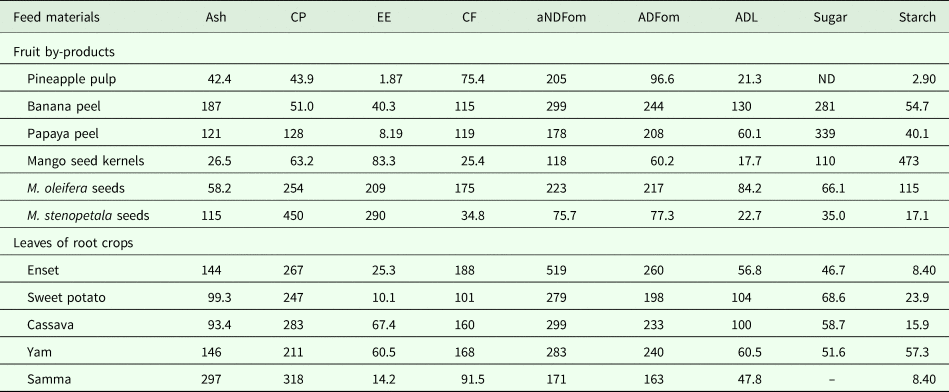
Papaya peel had the highest CP concentration while the pineapple pulp the lowest (Table 1). Banana peel had high concentrations of aNDFom, ADFom and ADL as compared with other fruit by-products. The highest sugar concentration was observed in both papaya and banana peel. Leaves of enset and yam contained similar ash concentrations, which were higher than those of sweet potato and cassava. All root crop leaves had high CP concentrations ranging from 211 (in yam) to 318 g/kg DM (in samma). Enset leaves had higher CF, aNDFom and ADFom concentrations than other crops. The highest and lowest sugar values were obtained from leaves of sweet potato and enset, respectively.
Component composition of some fruit by-products and leaves of root crops (g/kg DM)

CP, crude protein; EE, ether extract; CF, crude fibre; aNDFom, neutral detergent fibre on organic matter basis after amylase treatment; ADFom, acid detergent fibre on organic matter basis; ADL, acid detergent lignin; ND, not determined; sweet potato, I. batatas; samma, U. simensis; cassava, M. esculenta; yam, D. abyssinica; enset, E. ventricosum.
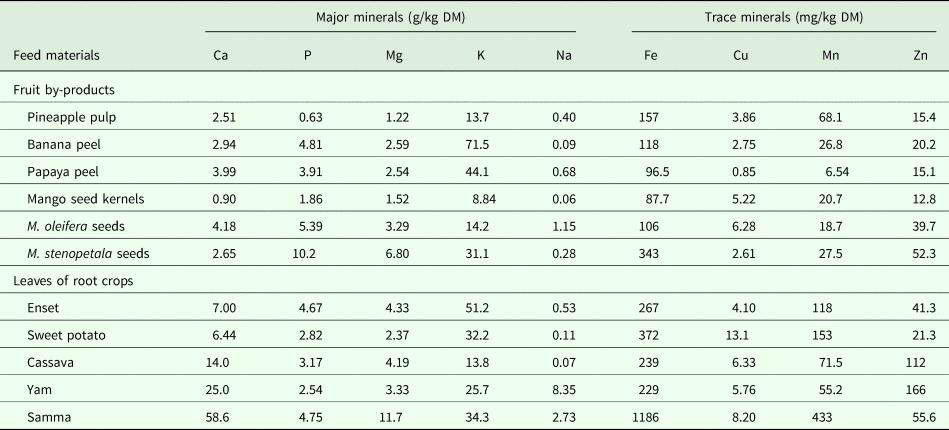
The concentration of copper (Cu) was highest in M. oleifera seeds (Table 2). Pineapple pulp had comparatively high iron (Fe) and manganese (Mn) concentrations. The concentrations of Ca, Mg, Fe and Mn were exceptionally high in samma leaves.
Mineral composition of fruit by-products and leaves of root crops
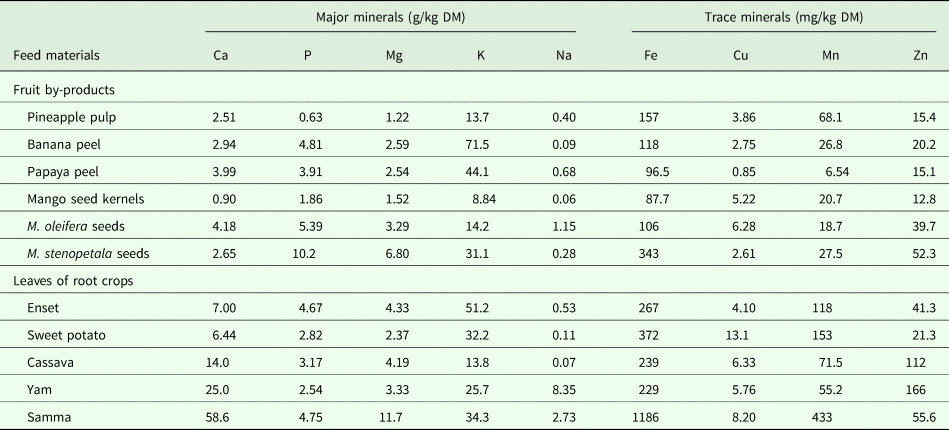
Ca, calcium; P, phosphorous; Mg, magnesium; K, potassium; Na, sodium; Fe, iron; Cu, copper; Mn, manganese; Zn, zinc; sweet potato, I. batatas; samma, U. simensis; cassava, M. esculenta; yam, D. abyssinica; enset, E. ventricosum.
As presented in Table 3, the concentrations of methionine, valine, isoleucine, leucine, lysine and arginine were highest in cassava leaves followed by enset. Samma and cassava leaves also contained higher cysteine than the other fruit by-products. Similar concentrations of valine and isoleucine were noted in samma, sweet potato and yam leaves. All leaves of root crops had comparable histidine values except for samma, which had the lowest.
Amino acid composition (g/16 g N) of leaves of some selected root crops

Arg, arginine; Val, valine; Ile, isoleucine; Leu, leucine; Met, methionine; Phe, phenylalanine; Lys, lysine; His, histidine; Thr, threonine; Cys, cysteine; Asp, aspartic acid; Ser, serine; Glu, glutamic acid; Pro, proline; Gly, glycine; Ala, alanine; Tyr, tyrosine.
Sweet potato, I. batatas; samma, U. simensis; cassava, M. esculenta; yam, D. abyssinica; enset, E. ventricosum.
Anti-nutritional factors
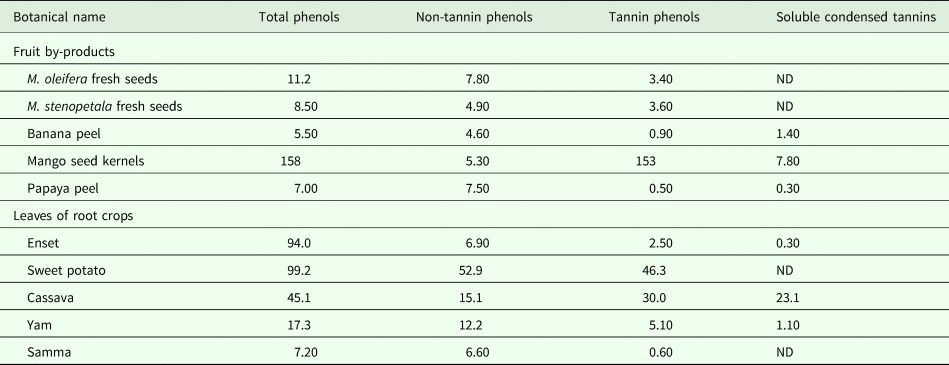
As presented in Table 4, mango seed kernels contained remarkably high concentrations of total and tannin phenols as well as soluble condensed tannins. Peel of papaya and banana had negligible amounts of condensed tannins. Among root crops, high concentrations of total and tannin phenols were observed in sweet potato leaves. Although enset leaves contained high total phenols, the concentrations of other anti-nutritional factors were comparatively lower than other root crops. Samma leaves had negligible concentrations of anti-nutritional factors compared with those of other root crops. The concentrations of soluble condensed tannins were comparatively higher in leaves of cassava than other root crops. However, no soluble condensed tannins were detected in sweet potato and samma leaves.
Concentrations of total phenols, tannin phenols and soluble condensed tannins (g/kg DM) in fruit by-products and leaves of root crops
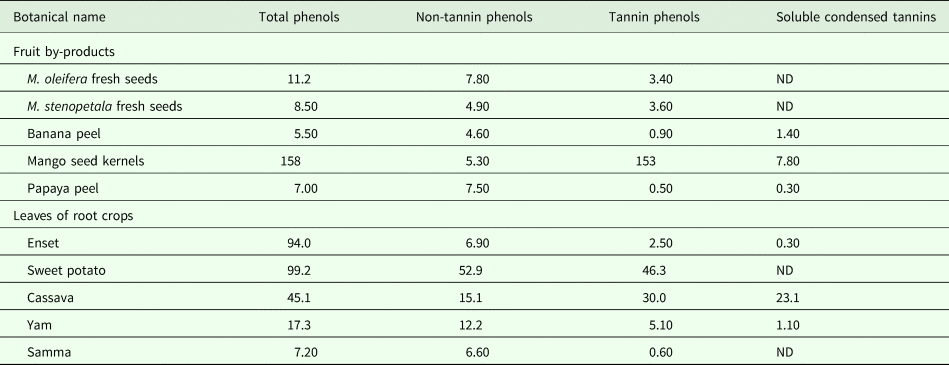
DM, dry matter; ND, not detected.
Sweet potato, I. batatas; samma, U. simensis; cassava, M. esculenta; yam, D. abyssinica; enset, E. ventricosum.
Kinetics of in vitro GP and estimated parameters
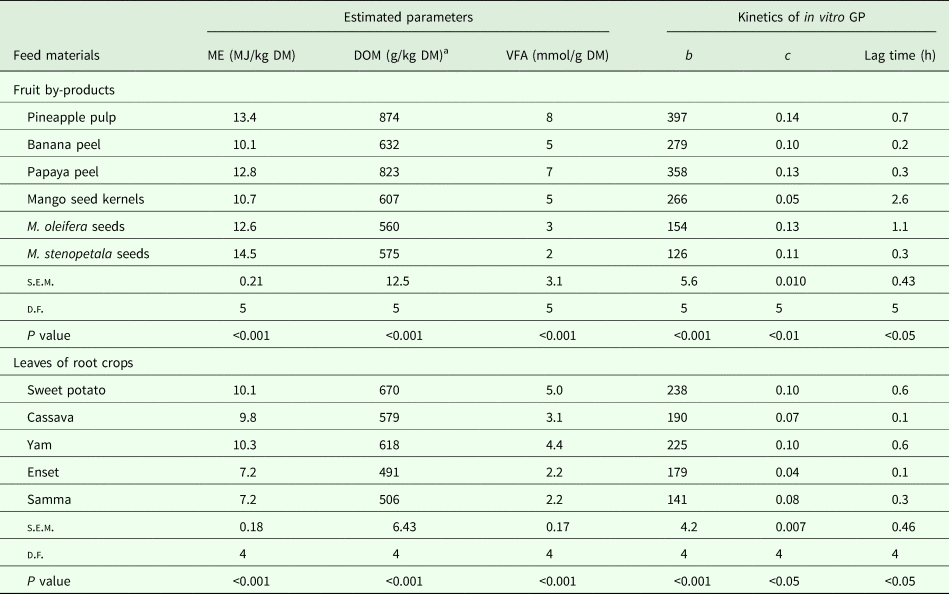
As presented in Table 5, pineapple pulp had the highest asymptotic GP (parameter b) ranging from 388 to 405 ml/g DM at 96 h sample incubation followed by papaya peel (349–367 ml/g DM) and differed (P < 0.05) from each other. The lowest asymptotic GP was obtained from seeds of M. stenopetala (122–131 ml/g DM) and M. oleifera (149–158 ml/g DM). Banana peel and mango seed kernels had comparable asymptotic GP values. Except for mango seed kernels, the fractional rate of GP (parameter c) was similar among the rest fruit by-products. The largest lag time was observed in mango seed kernels along with the lowest (P < 0.05) fractional rate of GP. The asymptotic GP was higher (P < 0.05) for sweet potato (230–246 ml/g DM) and yam (219–230 ml/g DM) leaves than those of other root crops. The fractional rate of GP did not vary between leaves of root crops except for enset, which had the lowest value along with the lowest (P < 0.05) lag time.
Estimates of ME, digestible organic matter (DOM), VFA and kinetics of in vitro GP over 96 h incubation of fruit by-products and leaves of root crops

s.e.m., standard error of the mean; d.f., degrees of freedom; b, asymptotic GP (ml/g DM); c, constant fractional rate of GP (per h) with a lag time (colonization time, h) in the onset of GP; sweet potato, I. batatas; samma, U. simensis; cassava, M. esculenta; yam, D. abyssinica; enset, E. ventricosum.
a Obtained by multiplying the coefficient of digestibility values with that of the organic matter.
Although it contained lower DOM, M. stenopetala seed had higher (P < 0.05) ME value than that of other fruit by-products. Both pineapple pulp and papaya peel had higher (P < 0.05) DOM and VFA concentrations than the other fruit by-products (Table 5). The values of VFA for banana peel and mango seed kernels were higher (P < 0.05) than those produced by both Moringa seeds. The ME, DOM and VFA values in leaves of sweet potato and yam were higher (P < 0.05) than those of other root crops. The ME value in cassava leaves was similar to those observed in sweet potato and yam. Likewise, leaves of cassava had comparable DOM value with those of yam.
CH4 production
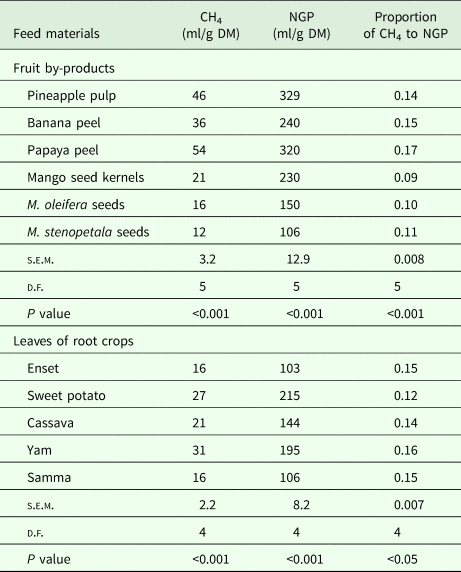
Values for absolute (ml/g DM) and proportion of CH4 to NGP and the NGP at 24 h sample incubation was higher (P < 0.05) for pineapple pulp and papaya peel than those of other fruit by-products (Table 6). The absolute CH4 and NGP values for banana peel have fallen in between. The absolute and proportion of CH4 to NGP was lowest in mango seed kernels and, seeds of M. stenopetala and M. oleifera and differed (P < 0.05) from other fruit by-products. Leaves of enset, cassava and samma produced lower (P < 0.05) absolute CH4 and NGP than those of other crops (Table 6). However, the proportion of CH4 to NGP was lower (P < 0.05) in sweet potato leaves than those of enset and yam but was similar to that of cassava leaves.
In vitro net gas and CH4 production profiles of fruit by-products and leaves of root crops incubated over 24 h

CH4, methane; NGP, net GP at 24 h of sample incubation; s.e.m., standard error of the mean; d.f., degrees of freedom; sweet potato, I. batatas; samma, U. simensis; cassava, M. esculenta; yam, D. abyssinica; enset, E. ventricosum.
Discussion
Component composition and anti-nutritional factors
Among the assessed peels, those from papaya had relatively high-CP concentrations. Although the CP concentration in banana peel was relatively low, Emaga et al. (Reference Emaga, Andrianaivo, Wathelet, Tchango and Paquot2007) noted that they have good protein quality and constitute a better fatty acid composition and hence, they recommended them as suitable feed supplements in livestock feed formulations. In the current study, peel from both banana and papaya had relatively high-sugar concentrations. Maturation of fruits in general involved increases in soluble sugar concentration and, at the same time, decreases in starch.
The ash, CP, CF, EE, NDF and ADF values of sweet potato leaves reported by Van An et al. (Reference Van An, Hong and Lindberg2004) and Antia et al. (Reference Antia, Akpan, Okon and Umoren2006) were in line with the current findings. The protein in sweet potato leaves was found to be good quality in amino acid composition, particularly arginine, methionine and glutamine, which were comparatively higher than those reported in the leaves of M. stenopetala and M. oleifera (Melesse et al., Reference Melesse, Steingass, Boguhn, Schollenberger and Rodehutscord2012). Moreover, negligible amounts of hydrolysable and condensed tannins as well as phytic acid and cyanide were reported in sweet potato leaves, while alkaloids were not detected (Antia et al., Reference Antia, Akpan, Okon and Umoren2006; Régnier et al., Reference Régnier, Bocage, Archimède, Noblet and Renaudeau2013). Animal-based experiments have indicated that goats fed on fresh chopped sweet potato (I. batatas) leaves produced more milk compared with the control group fed with fresh chopped sorghum vulgar (Khalid et al., Reference Khalid, Elamin, Amin, Tameem Eldar, Mohamed, Hassan and Mohammed2013).
Among the root crops investigated, cassava leaves had better amino acid profiles including valine, leucine, methionine, isoleucine, phenylalanine, lysine, serine, proline and tyrosine. In fact, cassava leaves had higher values in valine, isoleucine, methionine and glutamine than those reported by Melesse et al. (Reference Melesse, Steingass, Boguhn, Schollenberger and Rodehutscord2012) for M. stenopetala and M. oleifera leaves cultivated in mid and low altitudes of southern Ethiopia indicating their feeding potential in non-ruminant nutrition. Moreover, the concentration of soluble condensed tannins in cassava leaves might be considered as being moderate. Absence of alkaloids was also reported in cassava leaves (Régnier et al., Reference Régnier, Bocage, Archimède, Noblet and Renaudeau2013). However, cassava foliage contains secondary compounds such as cyanogenic glycosides (CNGs), which have potentially harmful effects on ruminants (Duncan and Milne, Reference Duncan and Milne1993). The degradation of CNGs in the rumen results in hydrogen cyanide (HCN), which is very toxic to animals. Recent studies conducted by Phonethep et al. (Reference Phonethep, Do and Preston2017) indicated that goats supplemented with sun-dried cassava foliage to a basal diet of pigeon wood foliage (Trema orientalis) responded with improved feed intake, growth rate and feed conversion efficiency. Similarly, Hue et al. (Reference Hue, Van, Ledin, Spörndly and Wredle2010) reported that cassava foliage could be used as feed for animals in wilted or sun-dried form and was used successfully as a source of protein with a high concentration of digestible nutrients; they have further reported that simple drying of cassava leaves had eliminated almost ninety percent of the HCN. According to the report of Vetter (Reference Vetter2000), the CNGs in cassava foliage decreased with maturity and thus feeding cassava leaves at earlier maturity stages would be beneficial to farm animals.
The supplementation of a wheat straw/desmodium diet with various enset fractions was found to be beneficial to maintain body weight during the dry season (Nurfeta et al., Reference Nurfeta, Tolera, Eik and Sundstøl2008). The CP value in samma leaves ranged from 251 to 263 g/kg DM (Eskedar et al., Reference Eskedar, Gulelat and Getachew2013; Bekele et al., Reference Bekele, Melesse, Beyan and Berihun2015) and was lower than observed in the current study, which might be attributed to soil type, altitude, stage of growth and season (dry or wet). No published data appear to be available in the literature to compare chemical and mineral composition of yam and samma leaves with other findings. In the current study, high concentrations of total and tannin phenols were found in mango seed kernels, which could limit their usage by ruminants through impaired feed digestibility and nutrient utilization.
Banana peel appeared to contain relatively higher potassium and could be used to supplement feed resources that are deficient in this mineral, in particular to poultry rations in smallholder farming systems. The mineral profiles of root crops indicated that samma leaves could be good sources of most minerals, particularly Ca, P, Mg and trace minerals of Fe and Mn. Bekele et al. (Reference Bekele, Melesse, Beyan and Berihun2015) reported that feeding dried samma leaf meal to broilers did not affect feed intake and recommended up to 90 g/kg inclusion in broiler diets by substituting roasted soybean meal.
Kinetics of in vitro GP and estimated parameters
The asymptotic GP (parameter b) in pineapple pulp, peel of banana and papaya, and mango seed kernels is generally large, indicating high nutrient availability for ruminal micro-organisms, while lower values observed in Moringa seeds might be due to high-fat concentration. Fatty acids are not ruminally fermented and hence produce no gas. Additionally, fats could slow down substrate fermentation, as suggested by Getachew et al. (Reference Getachew, Robinson, DePeters and Taylor2004). Moreover, the low asymptotic GP in Moringa seeds might be explained by their high-CP concentrations, which had a negative association with GP in the rumen. Seo et al. (Reference Seo, Lee, Lee, Seo and Ha2009) reported that the in vitro GP of ruminant feeds rich in CP was significantly lower than the theoretical value, indicating that the nitrogenous compounds of the feeds interfered with the acid–base reaction, increased the pH and reduced indirect GP.
The lag time for leaves of root crops in the current study was comparable with that of leaves of Moringa sp. reported by Melesse et al. (Reference Melesse, Steingass, Boguhn, Schollenberger and Rodehutscord2012). The lag time for mango seed kernels was much longer, along with lower fractional rate of GP, than observed for any of the fruit by-products used in the current experiment. This might be partly explained by the presence of high concentrations of tannin phenols and condensed tannins, which are correlated negatively with GP (Longland et al., Reference Longland, Theodorou, Sanderson, Lister, Powell and Morris1995).
Among the investigated root crops, sweet potato and yam leaves produced comparatively higher asymptotic GP, which can be elucidated by the high concentrations of sugar and starch as observed in the current study, which are related directly to enhanced GP in vitro. Conversely, samma leaves had the lowest GP value, probably because of their high-CP value due to the effects indicated above.
All fruit by-products had a high ME concentration ranging from 10.7 in mango seed kernels to 14.5 MJ/kg DM in M. stenopetala seeds, which could be a useful energy supplement to poor quality forages. Although mango seed kernels contained the highest starch, the ME value was comparably lower than that of Moringa seeds. This might be due to the presence of total phenols and tannin phenols as observed in the current study, which might have the potential to decrease the levels of ME and DOM (Menke and Steingass, Reference Menke and Steingass1988). Negesse et al. (Reference Negesse, Makkar and Becker2009) reported comparable ME (10.5 MJ/kg DM) but higher OMD values for mango peel than observed in mango seed kernels in the current study, suggesting that peel might be a suitable feed supplement if the availability of mango seed kernels is limited.
Along with its high ME, DOM and VFA values, banana peel could also be a promising feed resource to supplement poor quality forage in banana-growing regions of the country, including urban areas where most of the banana products are being consumed. Banana peel constitutes about 300 g/kg of fresh banana by weight (Wadhwa and Bakshi, Reference Wadhwa and Bakshi2013) and these could be fed to livestock as fresh green, ripe or dried. Dried ripe banana peels have been fed to growing pigs, comprising up to 200 g/kg of the diet without affecting growth performance (Rios et al., Reference Rios, Abernathy and Nicholas1975).
As the content of VFA is an indicator of the energy value of diets, its prediction from the in vitro GP might be useful under circumstances where laboratories lack gas chromatographic equipment (Blümmel et al., Reference Blümmel, Aiple, Steingass and Becker1999). In the current study, pineapple pulp and papaya peel showed the highest VFA concentrations, which suggest their potential as possible energy supplements to poor quality crop residues that are commonly available during the dry season. Prado et al. (Reference Prado, Lallo, Zeoula, Caldas Neto, Nascimento and Marques2003) reported that 600 g/kg of maize silage was successfully replaced with ensiled pineapple industrial by-products without affecting the daily weight gains of feedlot-crossbred bulls. In another study, Costa et al. (Reference Costa, Correia, Da Silva, De Medeiros and De Carvalho2007) reported that the utilization of dehydrated pineapple by-products increased the apparent digestibility of the nutrients resulting in satisfactory weight gains of goats.
CH4 production
CH4 production from ruminant livestock varies with the diet, which could be affected by factors such as DM intake, diet composition and digestibility. To estimate the effect of dietary composition and feed additives, CH4 production can be measured in vitro as a first step because large numbers of samples can be incubated and analysed at the same time. The reduction in CH4 production in mango seed kernels in the current study could be associated with the highest fractions of tannin phenols and condensed tannins, which have the potential to modify rumen fermentation to reduce CH4 production (Patra and Saxena, Reference Patra and Saxena2011). The presence of these anti-nutritional factors in mango seed kernels could also explain the observed long lag time that was needed for the onset of GP. Moreover, mango seed kernels contained the highest starch value as observed in the current study, which might also be responsible for reduced CH4 production as suggested by Hatew et al. (Reference Hatew, Cone, Pellikaan, Podesta, Bannink, Hendriks and Dijkstra2015). Moringa seeds had low CH4 production, presumably caused by their high-fat concentration as discussed above. Negesse et al. (Reference Negesse, Makkar and Becker2009) reported negligible amounts of condensed tannins in papaya, pineapple and banana peel, which might partially explain the relatively high levels of CH4 from these fruit by-products. In another study, Animut et al. (Reference Animut, Puchala, Goetsch, Patra, Sahlu, Varel and Wells2008) observed decreased CH4 emission in sheep fed a ration supplemented with different condensed tannin sources.
Phonethep et al. (Reference Phonethep, Preston and Leng2016) reported an increase of N retention by 21% when cassava foliage was fed to goats and observed that CH4 emissions, measured as the ratio of CH4 to carbon dioxide in the combined eructed gas–air mixture, were reduced by 50% in these goats. In a recent study, Phonethep et al. (Reference Phonethep, Do and Preston2017) reported that the proportion of CH4 in eructed gas was reduced when goats were supplemented with sun-dried cassava foliage to a basal diet of pigeon wood foliage (T. orientalis). According to the current study, cassava foliage contained comparatively higher soluble condensed tannins that might be responsible for reduced CH4 emission in the current findings.
Moss et al. (Reference Moss, Givens and Garnsworthy1995) reported that soluble sugars produced less CH4 than plant fibre by lowering pH and increasing rate of ruminal passage by increasing propionate production, while reducing the rumen protozoal populations. In the current study, however, papaya peel contained comparatively higher sugar concentration and yet produced the highest CH4. This observation was consistent with the in vitro study of Hindrichsen et al. (Reference Hindrichsen, Wettstein, Machmuller, Soliva, Knudsen, Madsen and Kreuzer2004), who tested eight diets where the supplements differed in their main carbohydrate source and reported that diets with high-sugar concentration enhanced CH4 production in vitro. In contrast to starch, there is a preferential production of butyrate with sugars at the expense of propionate, which provides hydrogen for methanogens other than propionate formation (Friggens et al., Reference Friggens, Oldham, Dewhurst and Horgan1998). Hindrichsen et al. (Reference Hindrichsen, Wettstein, Machmuller, Soliva, Knudsen, Madsen and Kreuzer2004) suggested that sugars are likely to have a higher CH4-producing effect than starch and fibrous carbohydrates under the condition of a high ruminal pH, i.e., with mixed diets containing a high proportion of forage. Therefore, sugars could be expected to have a CH4 increasing effect in vivo, when a sugar-rich supplement is supplied evenly over the whole day and replaces another type of supplement.
An increased fibrous concentration, particularly NDF, ADF and ADL in banana and papaya peel as well as enset leaves, resulted in higher CH4 production. This might be explained by the fact that high fibre in the feed could favour acetate production, thereby increasing hydrogen for methanogenesis (Johnson et al., Reference Johnson, Ward, Ramsey and Kornegay1996). In contrast, M. oleifera seeds contained high fibre but produced less CH4. This is consistent with the observations of Hindrichsen et al. (Reference Hindrichsen, Wettstein, Machmuller, Soliva, Knudsen, Madsen and Kreuzer2004), who reported that daily CH4 production was lowest in the diet containing a high proportion of oat hulls (which had the highest fibre concentration), as compared with those containing low fibrous carbohydrates. Such a scenario could be due to the lignification of fibre, which might have reduced nutrient availability for the rumen microbes involved in methanogenesis.
It is also worth noting that seeds of Moringa sp. had high-fat concentrations and produced the lowest CH4. Fievez et al. (Reference Fievez, Dohme, Danneels, Raes and Demeyer2003) reported a decline in CH4 emission from sheep fed with rations containing high-fat levels (fish oil and myristic acid) and suggested this may be associated with increased propionate and reduced acetate production. Similarly, Møller et al. (Reference Møller, Moset, Brask, Weisbjerg and Lund2014) reported that addition of crude fat to the diets of dairy cows reduced enteric CH4 emission considerably. Such effects might be caused by the hydrogenation of the fatty acids competing for substrate with methanogens and direct inhibition of methanogens by the fatty acids themselves, as suggested by Chaves et al. (Reference Chaves, He, Yang, Hristov, McAllister and Benchaar2008).
The current study revealed that fruit by-products of banana, pineapple, mango and papaya had high ME that make them suitable energy supplements to poor quality feed resources for ruminants. Moreover, the concentrations of CP and minerals in leaves of root crops were generally high enough to be used as alternative protein supplements to crop residues. Among the root crops, sweet potato leaves had the lowest proportion of CH4 emission with better ME and DOM values. Mango seed kernels exhibited low CH4 production, probably due to their high concentration of tannin phenols and condensed tannins. Moreover, seeds of both Moringa sp. had low CH4 production, presumably caused by their high EE concentrations.
The current authors would like to acknowledge the limitations of the current work, particularly with regard to the sample collection procedure for forage plants, and recommend that scholars in future follow proper sampling procedures by considering different stages of growth, variety of plants, agroecology and sufficient size of sample plants.
Conclusion
Fruit by-products had a high ME concentration ranging from 10.7 to 14.5 MJ/kg DM, which make them suitable energy supplements to poor quality forages and crop residues. Leaves of root crops, particularly those of samma (with 318 g/kg DM CP), cassava (with 283 g/kg DM CP and 9.76 MJ/kg DM energy), sweet potato (247 g/kg DM CP and 10.1 MJ/kg DM energy) and enset (with 267 g/kg DM CP) might also be used as alternative feed supplements to the nutrition of ruminant and monogastric animals. Samma leaves had high calcium, magnesium, iron and manganese concentrations and could be used as potential mineral supplements. The concentrations of essential amino acids in leaves of root crops were generally on a rate that would allow using them as a protein supplement in monogastric nutrition. Mango seed kernels and seeds of Moringa sp. produced comparatively low CH4 and could be used as cheap feed supplements in mitigating CH4 emission from ruminants. Leaves of sweet potato, cassava and samma have been further identified as potential candidates in reducing CH4 production. Nevertheless, the suitability of these feed materials as ruminant feed should be verified through animal-based experiments.
Acknowledgements
The authors acknowledge Southern Agricultural Research Institute, Holleta Agricultural Research Centre and Forage Seed Production Centre (Gene bank) of ILRI for allowing us to collect some feed samples used in the current study. The authors appreciate Sibylle Rupp for her excellent technical support in chemical analyses.
Financial support
The current research work was generously sponsored by Alexander von Humboldt Foundation under grant category ‘Research Fellowship for Experienced Researchers’ for which authors are grateful.
Conflict of interest
None.
Ethical standards
Not applicable.
Author ORCIDs
A. Melesse 0000-0003-4653-0587; M. Rodehutscord 0000-0003-3156-7889