Clinician confidence in the reliability of blood cultures is critical to the appropriate diagnosis and management of a bloodstream infection. Reference Klingenberg, Kornelisse, Buonocore, Maier and Stocker1 This is particularly true in the neonatal intensive care unit (NICU) setting in which non–culture-based biomarkers are not reliably predictive for bacterial sepsis. Reference Cantey and Lee2 Nonadherence to recommended practices may lead to false-negative or false-positive blood culture results that have important clinical impacts. These include delays in correct diagnosis, inappropriate antibiotic use with attendant adverse events (including potentially deleterious changes to the microbiome Reference Wong, Lui, Day and Leach3 ), prolonged hospitalization, excess diagnostic or therapeutic procedures (eg, echocardiography, specialty consultations, catheter removal, among others), and direct and indirect economic costs. Reference Doern, Carroll and Diekema4
False-positive results due to contamination Reference Doern, Carroll and Diekema4 during the blood draw itself and less commonly, false-negative culture results due to inadequate sample volume, Reference Woodford, Dhudasia and Puopolo5 occur frequently in the NICU. Both scenarios are problematic in view of the tendency toward conservative management which often follows, given the particular vulnerability of these infants. Reference Donn6 A national “standard” of <3% contamination rate 7 (developed mainly for adults, in whom rates average 0.6-12.5% Reference Doern, Carroll and Diekema4 ) has recently been changed to 1% by the US Clinical and Laboratory Standards Institute, given the clinical impacts noted here. 8 Several studies in neonatal populations demonstrate that contamination occurs at rates between 2.6% and 18%. Reference Klingenberg, Kornelisse, Buonocore, Maier and Stocker1 Improved adherence to available recommendations can lower contamination rates in the NICU Reference Allen, Cavallaro and Keir9 and therefore predictably improve antimicrobial stewardship.
Nurses draw most blood cultures in NICUs, yet no recent data are available regarding adherence to contemporary practice standards for this critical procedure, which is very frequently used in this population. Several factors associated with NICU policy development, staff training and bedside processes directly affect the reliability of a blood culture result. We surveyed NICUs participating in an antibiotic stewardship collaborative in California on unit- and nurse-level blood culture practices and conformity with available recommendations to identify areas for practice improvement.
Methods
We performed this survey as part of an antimicrobial stewardship collaborative managed by the California Perinatal Quality Care Collaborative (CPQCC) in partnership with the RAND Corporation and the Lundquist Institute at Harbor-UCLA Medical Center. CPQCC is a statewide network of >130 NICUs that work to improve the quality of clinical care through targeted and formal quality intervention projects (cpqcc.org). This stewardship project is known as the Optimizing Antibiotic Stewardship in California NICUs (OASCN, cpqcc.org/improvement/projects/OASCN). OASCN began with 31 NICUs and hosted learning sessions via a secure Zoom televideo platform link every 2 weeks from early March 2021 through February 2022. All clinical staff in participating NICUs (including physicians, nurses, pharmacists, and trainees) were invited to participate. We identified site leaders for each NICU as the administrative leads responsible for encouraging NICU staff to participate in the learning sessions and other OASCN activities. Approximately 60% of the site leaders were neonatologists; 30% were clinical nurse specialists, nurse managers, or educators; and the rest were neonatal nurse practitioners (NNPs) and pharmacists. More details on OASCN, including our use of didactics, real-time polls, feedback, a reference library, and an associated expert faculty panel, are provided in the Supplementary Material (online).
We performed a standalone web-based survey of OASCN NICUs regarding practices related to blood culturing and prevention of contamination. Implemented using a Qualtrics platform (qualtrics.com), it included 19 questions (∼10-15 minutes to fully complete) related to policy, practice, documentation, written procedures, competency requirements and laboratory practices for reporting early results and contamination data (Supplementary Material online). We developed the survey after a review of the literature and published guidelines for reducing blood culture contamination, as well as related concerns expressed by providers during prior OASCN learning sessions and a session in April 2021 focused specifically on this topic. In mid-October 2021, 6 months later, a link to the survey was sent by email to the site leaders at each of the 29 OASCN NICUs participating at that time. We asked site leaders to distribute the survey to the person most knowledgeable about blood culture practice in their NICU. Up to 5 reminders were sent to those who had not yet responded. On November 18, 2021, OASCN held a nursing office hour on this topic separate from the usual sessions. On February 3, 2022, survey results were reported back to the collaborative as were practice improvements relayed by participants. We performed descriptive analyses of survey responses for all participating NICUs and by selected characteristics of the group. We also evaluated responses in relation to available national recommendations regarding blood culture practice in the NICU setting, when applicable. This work was approved by the RAND Human Subjects Protection Committee, the Stanford Panel on Medical Human Subjects and the John F. Wolf Human Subjects Committee of The Lundquist Institute, in accordance with the Declaration of Helsinki.
Results
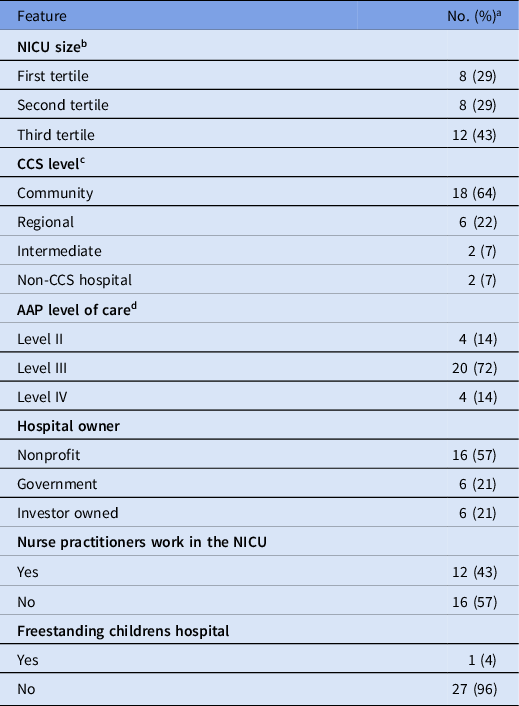
Survey responses were received from 28 of the 29 OASCN NICU site leaders. The characteristics of the responding units are detailed in Table 1. The distribution of NICU size, California Children’s Services (CCS) level, American Academy of Pediatrics (AAP) level of care, and hospital owner type were similar to that of the CPQCC overall (data not shown).
Characteristics of Participating OASCN NICUs

Note. OASCN, Optimizing Antibiotic Stewardship in California NICUs; NICU, neonatal intensive care unit; CCS, California Children’s Services; CPQCC, California Perinatal Quality Care Collaborative; AAP, American Academy of Pediatrics.
a Totals may not add to 100% due to rounding.
b Based on total admissions of all CPQCC NICUs in 2020 in which tertile 1 was ≤229 admissions, tertile 2 was 230–365 admissions, and tertile 3 was 366–1,188 admissions. In OASCN, tertile 1 was 278 admissions, tertile 2 was 279–361 admissions, and tertile 3 was 362–877 admissions.
c CCS is a state program that provides diagnostic and treatment services, medical case management, and physical and occupational therapy services to children aged < 21 years with selected medical conditions. CCS is administered as a partnership between county health departments and the California Department of Health Care Services (dhcs.ca.gov/services/ccs/Pages/default.aspx).
d The AAP levels of care are Level I, II, III, IV and commonly known as wellborn nursery, special care, NICU, and regional NICU, respectively (AAP comm fetus and newborn. Pediatrics 2012;130:587–597). This study did not include units with only level I care availability.
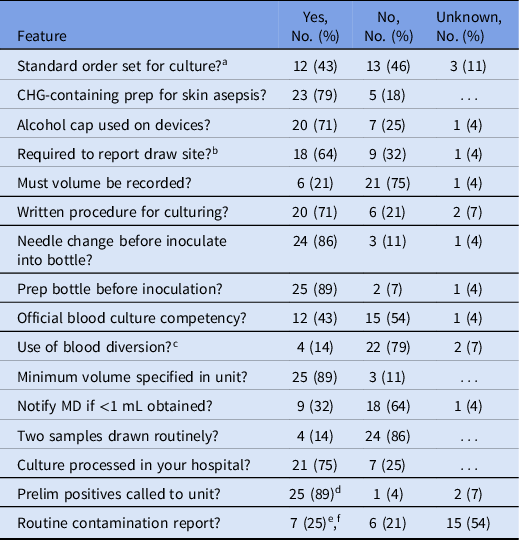
Survey responses are shown in Table 2. Notably, a large percentage of NICUs did not adhere to certain commonly accepted procedures associated with obtaining blood cultures and/or facilitate accurate interpretation of the results. These included having a standard order set (46% did not), mandating documentation of the volume obtained and site of draw (75% and 32% did not, respectively), having a nursing competency on this procedure (54% did not). Also, 64% did not require reporting to the provider if <1 mL was obtained. Furthermore, 75% of units were not aware of or did not receive a routine contamination report from the laboratory. Of the 7 laboratories that did provide such a report, 6 reported only to the department of infection prevention and control. Also, of those units that received reports, less than half had a standard process to follow up with the staff member who drew the contaminated specimen.
Responses to OASCN Nursing Survey Questions

Note. OASCN, Optimizing Antibiotic Stewardship in California NICUs; CVC, central venous catheter; EMR, electronic medical record; NICU, neonatal intensive care unit.
a Among all respondents, if a vascular device (central venous catheter, peripheral IV, arterial line) was present the nurse would draw a blood culture via venipuncture (only) in 14 survey responses, vascular device (only) in 6 responses, vascular device and venipuncture in 4 responses, and CVC or venipuncture in 4 responses.
b If reporting was required it was documented in the EMR in 13 survey responses, bottle only in 5 respondents, bottle and the EMR in 6 responses, and was unknown by 3 respondents.
c Procedure in which a small volume is “diverted” before use of a subsequent volume for blood culture.
d 23 laboratories call 24 hours and 7 days per week; 1 laboratory calls from 7:00 a.m. to 4:00 p.m. only; the other calls at an “unknown” time.
e 5 laboratories reported to infection prevention and control, 1 reported to the NICU physician, 1 reported to an unknown location.
f Among units with a contamination report, 3 (43%) followed up with the drawer.
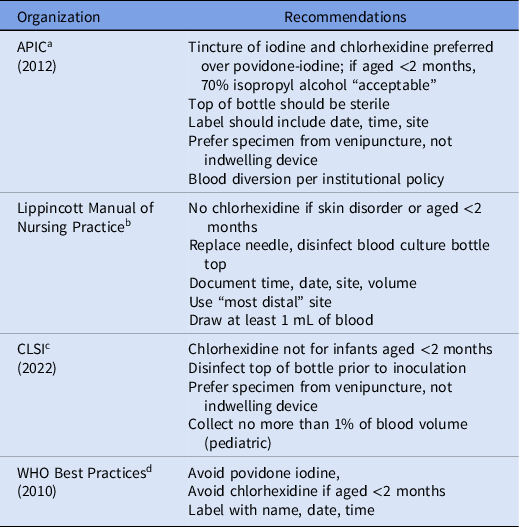
Our review of national guidelines for blood cultures in the NICU setting revealed the lack of a consistent approach for most generally accepted principles of disinfection and/or reporting (Tables 3 and 2). Nonetheless, adherence was variable for the most widely accepted recommendations in our sample. Nearly one-fifth of responders indicated that a culture would be preferentially drawn from a pre-existing vascular device only (if present) rather than via peripheral venipuncture. Approximately 11% of NICUs did not change needles prior to inoculation and 7% did not disinfect the bottle prior to injection. Nearly one-third of units were not required to document the site of the blood draw. Also, 5 sites (18%) did not use a chlorhexidine-containing product for skin asepsis, regardless of weight or gestational or chronological age.
Published Organizational Recommendations for Blood Culturing

Note. APIC, Association for Professionals in Infection Control;CLSI, Clinical Laboratory Standards Institute; WHO, World Health Organization.
b Procedures—Blood culture sample collection, assisting, neonatal (www.lww.com).
c Principles and Procedures for Blood Cultures, Second Edition. CLSI guideline M47. Clinical and Laboratory Standards Institute; 2022.
d WHO guidelines on drawing blood: best practices in phlebotomy (https://apps.who.int/iris/bitstream/handle/10665/44294/9789241599221_eng.pdf?sequence=1).
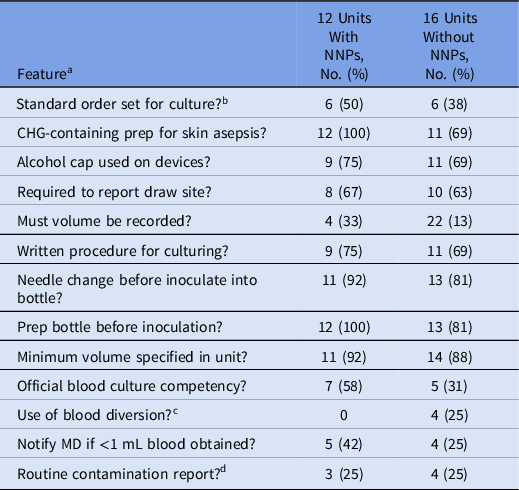
Responses to OASCN Nursing Survey Questions with Respect to Presence of Neonatal Nurse Practitioners (NNPs) in the NICU

Note. OASCN, Optimizing Antibiotic Stewardship in California NICUs; NICU, neonatal intensive care unit; CHG, chlorhexidine gluconate; MD, medical doctor.
a Of the 13 modifiable processes associated with obtaining a blood culture and prevention of contamination, NICUs with nurse practitioners more frequently adopted >50% of the practices, compared to units without (92% vs 50% of units; P < .02).
b Among units with a standard order set, 3 (50%) and 1 (17%) of units with and without NNPs designated a site of draw, respectively.
c Procedure in which a small volume is “diverted” before use of a subsequent volume inoculation.Reference Povroznik 21
d Among units with a contamination report, 1 (33%) and 2 (50%) of units with and without NNPs followed up with the drawer, respectively.
As noted in Table 4, of the 13 modifiable processes associated with obtaining a blood culture and prevention of contamination, NICUs with NNPs more frequently adopted >50% of the practices, compared to units without NNPs (92% vs 50% of units; P < .02). Nonetheless, nearly all of the other processes were also more common in units with NNPs such as having a standard order set for blood culture (6 of 12 [50%] vs 6 of 16 [38%]), having a unit blood culture competency (7 of 12 [58%] vs 5 of 16 [31%]), and a requirement to notify the provider if <1 mL of blood was obtained (5 of 12 [42%] vs 4 of 16 [25%]), among others. Subgroup analyses by other NICU characteristics were also limited by small sample sizes (data not shown).
Discussion
In our cohort, we identified nonadherence to and quantified the variability between units for several of the most recommended blood culture practices. Most of our sites did not have certain structural processes in place such as a written neonatal-specific blood culture procedure, a requirement for nurses to complete a skills competency for blood drawing, or routine laboratory-based reporting of contamination rates. These systems-based interventions present opportunities for more direct awareness of the importance of blood culture by local leadership and for those who actually draw the blood. Development of such policies should be multidisciplinary and include those directly involved with sampling and ongoing education, and the laboratory. For example, contamination reports alert units to a potential process problem, and competencies and order sets ensure standardization of the procedure itself. Despite advancing diagnostic technology, Reference Peri, Harris and Paterson10 blood culture remains the gold standard for identifying bacteremia in patients in whom sepsis is suspected. All of these factors are important for patient care such that real-time clinical interpretation of this important test is not undermined or deemed suspect in any way by perceived or real lapses in any specific process or procedure.
Our data significantly expand upon older surveys that queried only a limited range of culture practices and/or a subset of contemporaenous recommendations. In 2000, among 34 level III and IV NICUs in the United States asked about late-onset sepsis evaluations, 79% used an iodine-containing product for skin asepsis, and if present, a central venous catheter (CVC) was the preferred site for culture in >90%. Reference Rubin, Sanchez and Siegel11 In 2010, in a survey of >700 AAP Section on Perinatal Pediatrics members, 82% reported drawing <1 mL of blood, 69% use iodine-based skin asepsis, and among patients with a central line, 75% drew a routine blood culture from that line. Reference Kerur, Salvador, Arbeter and Schutzman12 In a national survey of level III–IV NICUs in 2014, only 27 (54%) of 50 used chlorhexidine prior to placing a peripheral intravenous line, and 24 (48%) of 50 used it to scrub a catheter hub prior to blood sampling. Also, 32 (64%) restricted its use by age or weight-based criteria. Reference Johnson, Bracken, Tamma, Aucott, Bearer and Milstone13 Our data confirm great variation and provide more detail on a larger group of practices known to impact blood culture reliability.
Nearly one-fifth of our surveyed NICUs reported no use of a chlorhexidine-containing product for skin asepsis, contrary to most guidelines (Table 2). Insufficient disinfection of the skin (or catheter hub or connector) site, including friction and allowing to dry, is an important source of bacterial contamination of the sample, as is poor overall technique by the individuals drawing the specimen. Reference Doern, Carroll and Diekema4 Notably, in 2012, the FDA changed its recommendation from “do not use” chlorhexidine to “use with care” in premature or infants <2 months of age. This is reflected in a 2022 Society for Healthcare Epidemiology of America White Paper in which the authors concluded that CHG-containing products were superior to iodine-based products and could be used safely on neonates of any gestation and age, with appropriate attention to using the minimum amount necessary and with removal of excess solution. Reference Muller, Bryant and Espinosa14
Sample volume is the most important factor related to identifying bacteremia in neonates. For NICU patients, it is generally recommended to obtain at least 1 mL. This finding is supported by clinical and in vitro data, Reference Lancaster, Friedman and Chiotos15,Reference Schelonka, Chai, Yoder, Hensley, Brockett and Ascher16 but opinions on the most appropriate volume vary to a degree. Reference Huber, Hetzer, Crazzolara and Orth-Höller17,Reference Sunararajan18 In one study, sample size of <1 mL most commonly occurred in ill, very low-birth-weight infants >7 days of age, Reference Woodford, Dhudasia and Puopolo5 possibly an indirect result of concerns of causing anemia and technical difficulty. When we presented our survey results to the collaborative, we learned that concerns about inadequate volume in the blood culture samples led some clinicians to doubt the veracity of a negative result, as others have reported as well. Reference Klingenberg, Kornelisse, Buonocore, Maier and Stocker1 Many of our sites drew routine cultures from indwelling catheters, if present. Due to the known technical difficulties in obtaining blood from critically ill neonates, indwelling catheter samples may be the only way to obtain an adequate sample volume. If drawn from a CVC to maximize volume, it is essential to label the bottle with the site of draw (eg, CVC or peripheral) to help clinicians differentiate CLABSI from simple bacteremia for healthcare-associated infection reporting and clinical purposes.
Certain individual components of the blood culture process minimize contamination and others maximize yield. Others have suggested that a bundled approach with several interventions further enhances the reliability of blood culture results, similar to that which has become standard for the prevention of various healthcare-associated infections. 19 These may include a combination of specific techniques for drawing the sample, skin and bottle-top disinfection prior to the draw, choice of culture site, standardized procedures with ongoing training, obtaining sufficient sample volume, and even use of a sterile process, among others. Reference Lamy, Dargere, Arendrup, Parienti and Tattevin20 Of interest, diversion of blood, during which a small volume is “diverted” before use of a subsequent volume for the blood culture and which was adopted by a small minority of units in our study, has been shown to be effective in minimizing contamination in adults. Reference Povroznik21 However, this procedure has not been recommended by any major recommending body for any age group. No such bundle has been specifically proposed or validated. We believe such a bundle would be a very useful tool for NICUs.
In our study, the presence of NNPs increases the likelihood of useful interventions around blood culturing being implemented therefore potentially facilitating antibiotic stewardship. Most NNPs work in level III and IV units, but more than one-third practice in level I and II units. Reference Snapp and Reyna22 A 2018 national survey of 171 NNPs revealed that >80% were involved in quality improvement and policy development beyond direct patient care. Reference Snapp and Reyna22 In addition, NNPs report that individual autonomy and collaboration with physicians are vital components of instituting change, Reference Parker23 which are critical to implementation of unit-level best practices. Our data were not of sufficient granularity to probe causality between the overrepresentation of NNPs among NICUs with more adherence to guidelines. It may indeed reflect initiative by the NNPs to work with their unit leadership to institute recommended blood culture processes. It may also be a spurious finding resulting from greater resources and therefore capability to institute process change. Although NNP-containing units skewed toward a higher number of patients than those without NNPs, the distributions of other characteristics were similar, such as CCS level, AAP level of care, and number of neonatologists. NNPs have been shown to provide clinically effective care. Reference Parker23 Further work to better characterize how NNPs may contribute to quality improvement regarding blood culturing is clearly needed.
This study had several limitations. Our survey methodology did not include audit of responses as reported by the site leader. For example, more than half of respondents did not know whether a laboratory contamination report was provided. However, it is highly unlikely that action items following such a report would not be known to the site leader (if the report existed) because two-thirds of the leaders were neonatologists practicing in the unit. Our work (performed within the larger OASCN collaborative stewardship goals) did not include a prospective, formal, quality-improvement program around blood culturing, but follow-up evaluations and commentary suggested benefit following our feedback sessions. Lastly, our survey sample size was relatively small and ultimately included only ∼20% of all NICUs in the State of California. The characteristics of our group are nonetheless similar to the CPQCC as a whole.
Fundamental individual components of a successful blood culturing process for neonates are well known: process standardization, chlorhexidine for asepsis in most infants, correct needle management, alcohol for bottle preparation, obtaining adequate volume, preparation of catheter hub if an indwelling catheter is used for sampling, ongoing education with competency requirements, and contamination monitoring with feedback. Reference Garcia, Spitzer, Beaudry, Beck, Diblasi and Gilleeny-Blabac24,25 Several reports of formal quality initiatives focused on NICU blood culturing have shown that such efforts can improve beside processes, reduce blood culture contamination, increase sample volumes, and minimize error in a sustainable way regardless of the level of neonatal care. Reference Allen, Cavallaro and Keir9,Reference Singh, Balegar and Angiti26,Reference Hamilton, Gillet, Smith-Collins and Davis27 No single national standard that addresses all meaningful components of blood drawing, training, and contamination reporting in the NICU is available. Such a document would be a useful tool for this vulnerable population. The practice variation we identified may, in part, reflect this reality.
Trust in the blood culture result is paramount to good clinical care, and better antimicrobial stewardship, yet this requires adherence to best practices and understanding by clinicians of its predictive value. For example, a common clinical challenge in the NICU is the ill baby presumed to have “culture-negative sepsis” leading to empiric broad-spectrum antibiotic therapy. Reference Klingenberg, Kornelisse, Buonocore, Maier and Stocker1 , If all processes designed to increase reliability of this test were implemented, and clinicians were convinced of this at the unit level, this “diagnosis” (and therapy) may be mitigated over time. Reference Cantey and Baird28 In 2017, antibiotic use in CPQCC NICUs varied regardless of the CCS level or rate of proven early- or late-onset sepsis. Reference Schulman, Benitz and Profit29 The Centers for Disease Control and Prevention (CDC) National Healthcare Safety Network now strongly encourages reporting of antimicrobial use, including for patients in NICUs. As the neonatal community continues to move to reduce antibiotic exposure, Reference Kahn, Perkins, Barrette and Godin30 strict adherence to and monitoring of best practices for obtaining a blood culture should be an important part of the process.
Supplementary material
To view supplementary material for this article, please visit https://doi.org/10.1017/ice.2023.33
Acknowledgments
For their contributions to the OASCN collaborative program that specifically supported this work, the authors thank Courtney Armstrong and the Expert Faculty Panel: William Benitz, Alice Pong, Jason Sauberan, Joseph Schulman, Victor Wong, as well as authors L. Lefrak, K.M. Zangwill, K.S.E. Payton, H.C. Lee, and M.A. Bolaris.
Financial support
This work was supported by the Agency for Healthcare Research and Quality (grant no. R18HS026168). These data have not been previously presented in any preliminary report or abstract.
Conflicts of interest
The authors report no financial conflicts of interest related to this article.