Introduction
The recent changes to junior doctors' training, following introduction of the Modernising Medical Careers changes, mean that they now spend very little time in any one specialty. This fact, combined with the advent of the ENT nurse practitioner, provides the opportunity for an alternative approach to the assessment of nasal injuries. This situation motivated the current study, which aimed to compare an experienced ENT treatment room nurse's ability to assess nasal injuries with that of a junior doctor.
The nose's prominence, anterior projection and central position on the face make it susceptible to trauma. The nasal bone is the most commonly fractured bone in the face, and the third most commonly fractured bone of the skeleton overall.Reference Rhee, Kim and Cha1, Reference Murray, Maran and Mackenzie2
The commonest causes of nasal bone fractures are road traffic accidents, sport injuries, assaults and accidental falls.Reference Rubinstein and Strong3
The initial assessment and diagnosis of nasal injuries is vital, as reduction of factures is best done within two weeks of the injury for optimum results.Reference Staffel4 In addition, missed complications such as septal haematoma and cerebrospinal fluid leak can have disastrous consequences. Undiagnosed or untreated nasal injuries account for a high percentage of septoplasty or rhinoplasty procedures performed months to years after the initial trauma.Reference Mondin, Rinaldo and Ferlito5
The increasing role of nurse practitioners in hospitals, coupled with junior doctors' reduced hours in any one specialty, prompted us to undertake the current study.
Materials and methods
This study was conducted at the Royal Alexandra Hospital, Paisley, Scotland, and consisted of two phases. The first phase involved a comparison of doctor (i.e. experienced senior house officer or specialist registrar in otolaryngology) and nurse (i.e. experienced treatment room nurse) assessment of the nasal injuries of 50 consecutive patients attending our unit between April and September 2006. In the second phase, the same ENT nurse assessed the next 50 consecutive patients with nasal injuries, alone.
Patients were initially assessed in the accident and emergency department, usually at the time of their injury. If there was a problem a few days after the injury, they were advised to make an appointment at the weekly fractured nose clinic.
Prior to commencement of the study, the treatment room nurse was formally instructed in assessment of the injured nose, and performed supervised assessments in the fractured nose clinic. The junior medical staff had been trained in assessment of the fractured nose in previous posts and were observed by their supervising consultants to check for safe practice, prior to being allowed to work independently in the fractured nose clinic.
In this clinic, patients were seen and assessed separately by both a junior doctor and the nurse. The result of the initial assessment was not revealed to the patient or the second assessor until both assessments had been completed. Results for both assessments were recorded using the same data form (Appendix 1). In the event of a disagreement, a third opinion was obtained from a senior medical staff member.
Treatment options were then discussed with the patient, and advice was given if a manipulation under anaesthesia was considered appropriate.
After this phase of the study was completed, the results were analysed. There was considerable agreement between doctor and nurse assessments. The nurse then proceeded to the second phase of the study, wherein she alone assessed and advised 50 consecutive patients with nasal injuries attending the unit between October 2006 and April 2007. Data were recorded in a similar manner to phase one.
A telephone survey was then undertaken between September and October 2007 (Appendix 2) to assess patient outcomes regarding cosmesis, nasal airway and patient satisfaction. An 80 per cent response to this survey was obtained.
During the telephone survey interview, those patients who felt that their nasal shape and/or nasal airway was significantly worse were advised to seek an ENT out-patient referral via their general practitioner.
Ethical considerations
Ethical approval was not obtained, as the study constituted an audit of practice.
Results
Key findings
The patient groups for each phase were comparable regarding age, interval from injury to assessment, and mechanism of injury. Patients' mean (median) ages were 26 years (20) and 26 years (24) for the first and second phases, respectively. Patients' intervals from injury to assessment, expressed as a mean (median), were 8.7 (8) days and 9.58 days (9), respectively. The mechanisms of injury were similar for the two groups, with assault, sporting injury and falls making up the vast majority of causes (See Figure 1).
Mechanisms of injury, comparing phase one and phase two patients.

Kappa statistics and Fisher's exact test were used to compare the doctor and nurse assessments in the first phase of the study.
First phase
We compared the results for doctor and nurse assessments regarding nasal swelling, nasal deformity and the appropriateness of manipulation under anaesthesia. Results for nasal airway and discharge were omitted from statistical analysis as there was no disagreement.
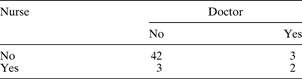
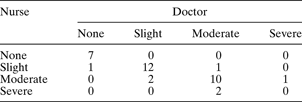
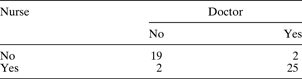
A comparison of the doctors' and nurse's assessment of nasal swelling (Table I) gave a κ value of 0.333, suggesting there was fair evidence of agreement between the two assessments (p = 0.0718). Comparison of the doctors' and nurse's assessment of nasal deformity (Table II) gave a κ value of 0.7113, suggesting substantial agreement (p < 0.0001). Finally, comparison of the doctors' and nurse's assessment of the appropriateness of manipulation under anaesthesia (Table III) gave a κ value of 0.837, suggesting almost perfect agreement (p < 0.0001).
Comparison of nasal swelling assessment: phase one
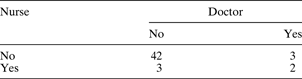
Data represent number of patients. κ = 0.33
Comparison of nasal deformity assessment: phase one
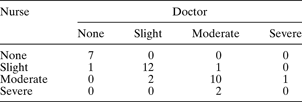
Data represent number of patients. κ = 0.7113
Comparison of advice regarding need for manipulation under anaesthesia: phase one
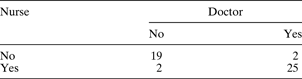
Data represent number of patients. κ = 0.837
Second phase
The incidence of patients being offered manipulation under anaesthesia was almost identical in phases one versus two, being 56 and 58 per cent, respectively.
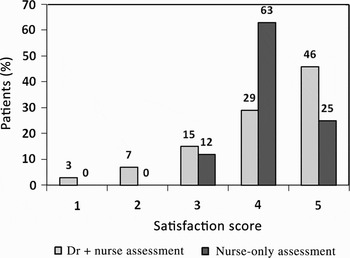
The phase one and phase two patients combined showed an 80 per cent response rate to the telephone survey. Figure 2 shows patients' overall satisfaction with their ENT clinic experience, rated on a scale of one (= poor) to five (= excellent). Overall, there was a high level of satisfaction in both the phase one and phase two patient groups. All the patients who underwent a nurse-only assessment scored this experience as three or more (i.e. average or better). There was no deterioration in overall satisfaction, comparing phase one and phase two patients.
Satisfaction scores for ENT clinic assessment, comparing phase one and phase two patients (1 = poor; 5 = excellent).

Patients were asked whether they were (or would have been) happy to be seen by a nurse only; more phase two patients reported being happy with this (93 per cent happy, 7 per cent unhappy), compared with phase one patients (63 per cent happy, 37 per cent unhappy).
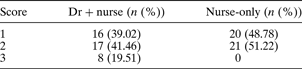
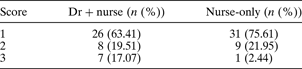
Following the introduction of nurse-only assessment, we detected no deterioration in patient outcomes for cosmesis or nasal airway. Only one phase two patient reported troublesome symptoms (nasal airway obstruction) which they wished to have addressed. Tables IV and V give patients' subjective scores for their cosmesis and nasal airway outcomes, respectively. These data indicate that there was no deterioration in the standard of care; in fact, far fewer patients gave a score of three, for both outcomes, for the nurse-only, phase two part of the study, compared with phase one.
Patients' telephone survey cosmesis scores: doctor plus nurse assessment vs nurse-only assessment
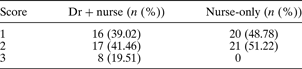
Dr = doctor
Patients' telephone survey airway scores: doctor plus nurse assessment vs nurse-only assessment
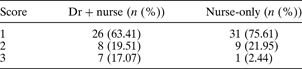
Dr = doctor
Discussion
Study strengths
Comparison of our results for doctor and nurse nasal swelling assessment indicates fair evidence of agreement. The few cases in which there was a disparity were not of clinical concern; such disparity would be of concern if there was an underlying deformity obscured by soft tissue swelling.
Comparison of the doctors' and nurse's results regarding assessment of the appropriateness of manipulation under anaesthesia showed disagreement in four cases. In two cases, the nurse would have offered manipulation under anaesthesia where the doctors would not. Clinically, this is not significant, as the patients would have been reassessed at the time of manipulation under anaesthesia and this issue would have been identified. The two patients who the nurse felt did not need manipulation under anaesthesia but the doctors did are more of a clinical concern. It is worth noting that both these cases were in the first 10 patients assessed, and that the phase two patients reported excellent outcomes. The only phase two patient who had a residual problem which they wanted addressed had been offered a manipulation under anaesthesia and had declined it. Two patients were not included in this analysis because of the doctors' uncertainty about what treatment the patient should be offered. The first had significant swelling and was provisionally booked for manipulation under anaesthesia, but this was cancelled on admission for the procedure a few days later as the deformity underlying the swelling was minor. The other patient had an old injury and was listed directly for septorhinoplasty at an interval.
Patients reported a high level of satisfaction with the service provided, especially for nurse-only assessment. Patients' responses to the question ‘would you have been happy if you had just been seen by the nurse and not by a doctor?’ were interesting; those who had undergone dual assessment were less likely to be happy with a nurse-only assessment. This difference probably occurred because the patients in the first phase had the ‘luxury’ of being seen by both a nurse and a doctor, compared with the second phase in which they were seen by a nurse only.
Study limitations
There was a drop-out rate of 20 per cent for the telephone survey. A telephone survey was thought to be the most efficient way of collecting data and addressing any concerns patients may have regarding their outcome. Nasal manipulation patients are not routinely seen for a post-operative follow-up appointment in the unit, and recalling them all to the out-patient department would have had significant resource implications (presuming they would all attend, which is not guaranteed).
The outcome endpoints with relation to airway obstruction and cosmesis were subjective rather than objective (i.e. assessment methods such as rhinomanometry or photographic measurement were not used). However, the ultimate goal was to achieve a result with which the patient was happy, and this was inevitably a subjective judgement.
• The results of this study show that assessment of nasal injuries by an experienced ENT nurse is a reasonable alternative to junior doctor assessment
• The use of an experienced nurse in this role must be subject to an ongoing audit process, as with all clinical practice
• An experienced ENT nurse used in this role not only reduces the workload of the junior doctor but can assist the junior doctor as a potential source of experience and advice
More than one junior doctor was involved in patient assessment. This was due to the short length of time junior doctors spent within the specialty, and was an inevitable compromise needed to ensure that a reasonable number of junior doctor assessments were recorded, to enable valid comparisons. The junior doctors had been trained in assessment of the fractured nose in the usual informal teaching style of the time, with a consultant teaching the examination technique and subsequently observing them for safe practice, prior to allowing them to ‘go solo’. With the advent and now widespread use of workplace-based assessment in surgical training, a validated assessment process could now be used for such teaching (e.g. mini-CEX (clinical evaluation excercise)), prior to allowing solo practice.Reference Norcini and Burch6
Clinical applications
Nasal injuries are a common condition seen by junior doctors in the treatment room. With the reduction in ENT training within medical schools, and the introduction of the Modernising Medical Careers changes, most such doctors are now foundation doctors or general practitioner trainees, who are relatively inexperienced and have little or no training in otolaryngology.
The assessment sheet used in the evaluation of nasal injuries in the 100 patients included (shown in Appendix 1) was a useful tool. It provided all the necessary information, made certain that no important history points were missed, and ensured accurate recording of information.
The incidence of post-reduction nasal deformities requiring septoplasty or septorhinoplasty have been reported to range from 14 to 50 per cent.Reference Waldron, Mitchell and Ford7 If such cases were to receive appropriate initial assessment and management, this would reduce the number of patients needing a complex septorhinoplasty as a result of nasal trauma.
Conclusions
The results of this study show that assessment of nasal injury by an experienced ENT treatment room nurse was a reasonable alternative to junior doctor assessment, with high levels of patient satisfaction and no deterioration in outcome. The use of an experienced nurse in this role must be subject to an ongoing audit process, as with all clinical practice. An experienced ENT nurse, employed in such a role, not only reduces the workload of the junior doctor but can also assist the junior doctor as a potential source of experience and advice. Following this study, the ENT nurse involved in this study now independently assesses patients with nasal injuries attending the unit.
Appendix 1. Assessment sheet used for nasal injuries
Name, date of birth, unit number:
Telephone number:
Number of days since injury; date of assessment:
Mechanism of injury:
Previous nasal injuries:
Nasal swelling? (yes/no):
Nasal deformity? (yes/no; mild/moderate/severe; bony/cartilaginous):
Nasal airway compromised/not compromised:
Clear discharge (CSF leak) present/not present:
Septal haematoma present/not present:
Would MUA be beneficial? (yes/no):
Treatment received:
Appendix 2. Telephone survey questionnaire
How would you score your assessment at the treatment room? (1 2 3 4 5):
Happy with being seen by nurse instead of Dr? (yes/no):
Any further nasal injuries? (yes/no)?
How do you feel about the shape of your nose?
– 1 Same as before the injury
– 2 Slightly worse, not causing problems
– 3 Significantly worse, would want something done
How well can you breathe through your nose now?
– 1 Same as before the injury
– 2 Slightly worse, not causing problems
– 3 Significantly worse, would want something done