Introduction
The founding fathers of the child-oriented approach to teaching, such as Dalcroze (Reference DALCROZE1921), Steiner (Stockmeyer, Reference STOCKMEYER1976), Orff (Warner, Reference WARNER1991) and Kodaly (Choksy, Reference CHOKSY1999) all stressed the importance of understanding learning content through sensory perception and hands-on activities. As a result of their work, music came to be linked to language, movement and play, and it was recognised that in children, these elements are still present as a unity. This approach is continued by, inter alia, Loane (Reference LOANE1984), Addison (Reference ADDISON1988), Burnard et al. (Reference BURNARD, KELLY, BIDDULPH, Khine and Saleh2010) and Barrett & Tafuri (Reference BARRETT, TAFURI, McPherson and Welch2012).
Research conducted by Matthews (Reference MATTHEWS2003) shows that in children musical capacities, as well as other capacities – including their visual sense – are part of a single whole:
Children, as they begin to draw and paint, make an intellectual journey which has musical, linguistic, logical and mathematical as well as aesthetic aspects. (Matthews, Reference MATTHEWS2003, p. 13)
Matthews (Reference MATTHEWS2003) and Foks-Appelman (Reference FOKS-APPELMAN2004) also stress the cognitive value of visual expression for children's intellectual and emotional development. Matthews says:
especially with drawing and painting media, children learn how to form representations, symbols and signs. This is the basis for all thinking. (Matthews, Reference MATTHEWS2003, p. 1)
Foks-Appelman (Reference FOKS-APPELMAN2004, p. 77) adds that children draw not what they see, but rather what they know.
However, the idea that this very important capacity can be used in a musical learning process is still a largely unexploited terrain. How children use visual expression – graphic and pictorial notations – to visualise external music or their own inventions, such as their vocalisations, is researched by Davidson and Scripp (Reference DAVIDSON, SCRIPP and Sloboda1988), Bjørkvold (Reference BJØRKVOLD1992), Barrett (Reference BARRETT1997, Reference BARRETT2006), Reybrouck (Reference REYBROUCK2007), Reybrouck et al. (Reference REYBROUCK, VERSCHAFFEL and LAUWERIER2009) and others.
There are very few piano methods that use visual expression as part of the learning process (De Bra, Reference DE BRA2007). Instead of starting with sheet music, Runze (Reference RUNZE1971)Footnote 1 asks children (aged 4–7) to draw in order to establish visual images that can serve as a means of relating the musical learning content they are studying to the world around them. Having been trained in the Dalcroze method, Runze stresses movement and symmetry.Footnote 2 Bewegungsfantasie (imaginative movement) is visible in children's drawings in which playing techniques and hand positions are linked to the movements or characteristics of animals. These drawings also show symmetrical aspects. Runze uses the black keys as starting point for orientation at the keyboard and the development of the child's sense of tonality. For example, a drawing of a house with three floors is used as a representation of the triad F# . Other drawings refer to the keyboard.
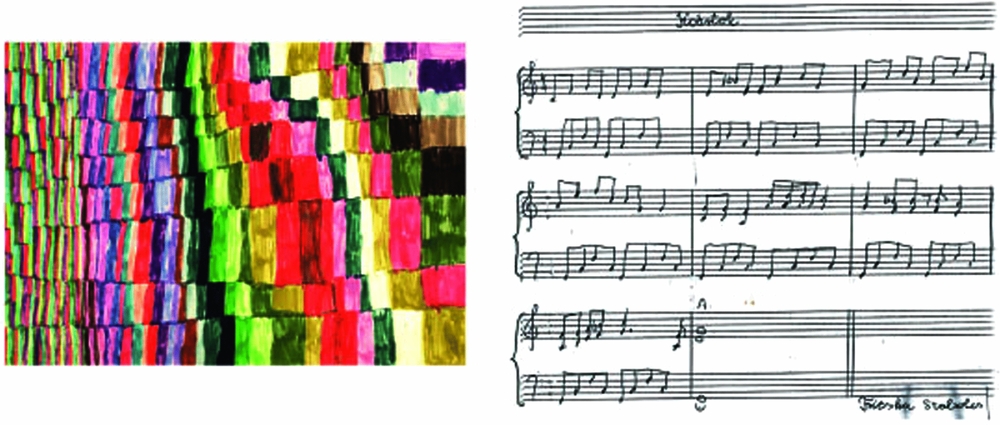
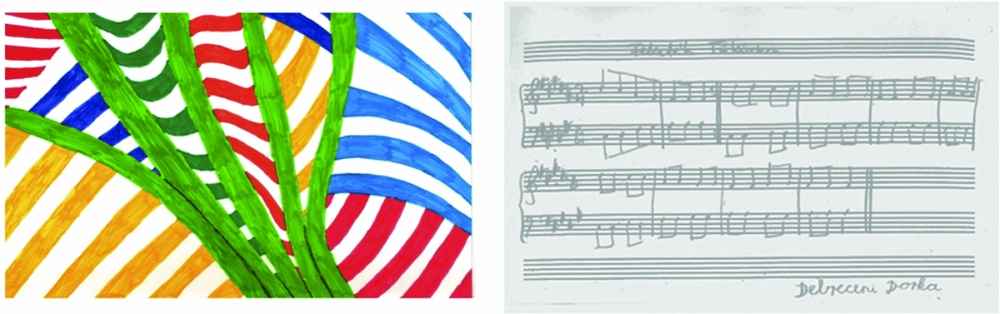
The use of visual expression with creative composition as its goal can be found in Apagyi's method (2006). Apagyi and her husband, the painter Ferenc Lantos, developed a teaching method in which the prime focus is on integrated thinking, with the transmission of knowledge from one discipline to another.Footnote 3 In their system, music and the visual arts are taught in an interrelated way. Pupils receive assignments dealing with interdisciplinary topics, ranging from elements such as dots, spots and lines to structural principles such as symmetry, inversion, variation, the golden section, etc. Pupils are required to elaborate these assignments both visually and musically in such a way that they learn to use both forms of expression – working from their specific characteristics – as a language in order to show the underlying relationships. The importance of symmetrical aspects in the Apagyi method, as with the Runze approach, can be seen in her article (Apagyi, Reference APAGYI1989) and in examples taken from her actual teaching (Figs 1 and 2).
Repetition and Variation (lateral symmetry)

Returning Motives in a Structure of Four Parts

The method I developed together with my pupils is different from the methods discussed above (Academy Muwoda of Heist-op-den-Berg, Belgium). As part of their weekly piano lessons children can draw freely – irrespective of a specific assignment – in order to convert their drawings into music, and to visualise the theoretical concepts that arise from it. Before explaining how drawings can be used as a composition plan, I will pay attention to a child's picture.
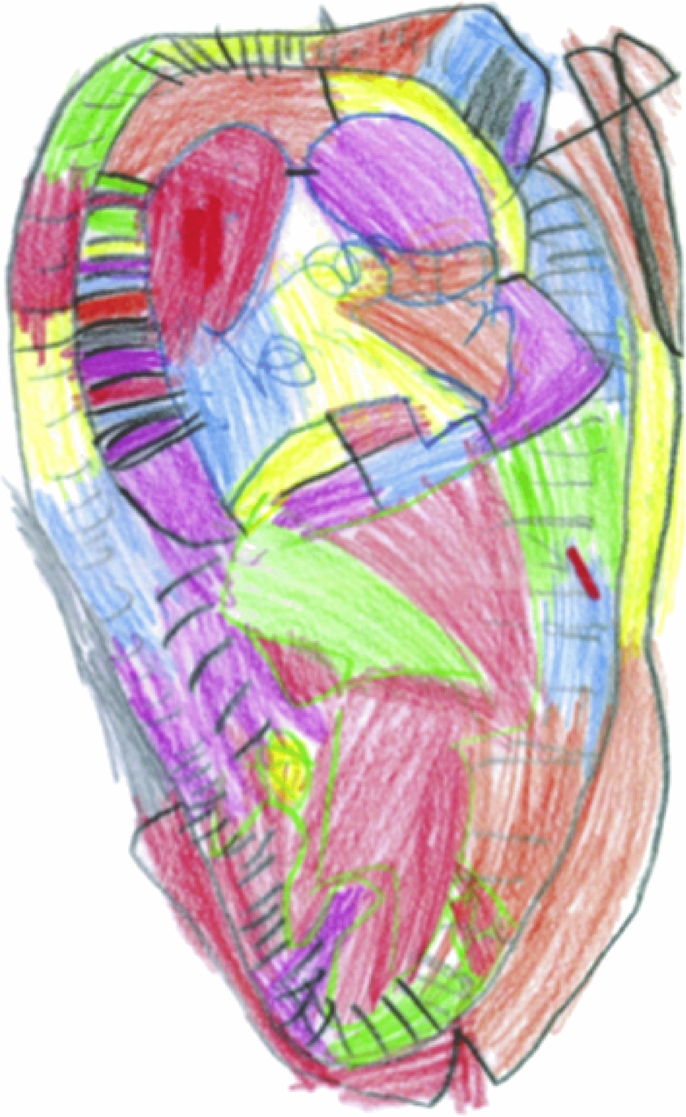
An Egg

Four-year-old Sarah gave me her drawing and said: ‘An egg.’ She has composed the egg, with rhythm in lines and colours. She has externalised her inner perception of shapes and colours, making her creation original and modern of expression. The egg is fully formed and finished. Sarah has projected her personal perception as a totality within the physical space of the paper. Her drawing is an excellent example of the natural feeling for composition that children have, as well as their capacity to formulate visual representations of an inner world. These same qualities, and the capacity to organise and impose structure, are also apparent when children work together as a group on a collaborative drawing.
Children's drawings can be viewed musically. Both the colours and lines and the story linked to the drawing contain elements that can be converted into musical parameters such as rhythm, melody, harmony and form. As they convert their drawings into music, the children co-decide as to whether their compositions will be based on the entire drawing and story or on a single aspect of it. Once the choice is made, it is important that they can construct sounds from inside out to characterise their drawn and narrated ideas. This is achieved by using the Socratic method to elicit the children's understanding of the musical parameters. Thereafter the children can experiment with the instrument in order to work out the specifics of their inwardly heard sounds. In doing so, the children find aspects of form, as well as melodic, rhythmic and harmonic fragments that can be used as building blocks for making a composition. How these building blocks are used will depend on the interaction between teacher and children. If done subtly, it will bring out the children's innate capacity to organise in an original way, and to present a totality just as in their drawings. The same process is observed when children compose as a group.
Whether the findings of Matthews (Reference MATTHEWS2003, p. 1, 13) and Foks-Appelman (Reference FOKS-APPELMAN2004, p. 77) referred to above, and the finding of Matthews (Reference MATTHEWS2003), below, are relevant in this context will be examined.
Children play with patterned sequences of actions, and repeat, vary and combine these according to how they look and feel in terms of shapes, colours, lines and movements. (Matthews, Reference MATTHEWS2003, p. 33)
Research question
How do children use their own drawings as a composition plan and how do children visualise music-theoretical concepts?
Background
In the academy of music where I teach piano, children, having been taught the basic elements of music for one year, learn to play an instrument at about the age of nine. When they attend my class, I let them draw whatever they wish to. Their drawings usually contain elements that refer to the basic learning content, such as instruments, g-clefs or notes of different values, whether or not on a stave. Together we would look at the details of the drawing, but were primarily interested in finding an interrelationship between the notes, on a stave or not. When I asked them to sing the notes, there seemed to be no relationship most of the time. Hence the notes they drew constituted a starting point from which to build musical phrases that subsequently evolved into small compositions. Pupils would then practise these pieces, and sometimes made rough notations of them. I also asked the children's opinion about the illustrations present in the piano books we used. If their response was that the drawings and the music didn't match together, I challenged them to remedy this by making their own drawings or sounds. As a consequence, the children then wanted to ‘play’ their own drawings on the piano and they challenged me, in turn, to come up with a method for doing this. So, in 1998, the children and I began to experiment with this method, resulting in the first compositions and drawings based on the relationship between both disciplines.Footnote 4 Further results were presented and explained in an initial publication (Roels, Reference ROELS2002).
Methodology and analysis
In our weekly piano lessons, we transform spontaneously drawn pictures into music. The completion of a composition happens in dialogue with the children, and can take one or more lessons. Through the dialogue, how children act and think musically gradually comes to the surface. Therefore the examples shown below will be presented in the form of a pedagogical process based on dialogue. In describing the process my role of guide, observer and narrator will become clear. The compositions are not the product of particular assignments, but rather the result of a particular learning context. For that reason, with regard to the analytical framework, I opted for this narrative, descriptive-interpretive approach (Van Manen, Reference VAN MANEN1990). Inspired by Barrett (Reference BARRETT, Sundin, McPherson and Folkestad1998 b), I suggest that in this approach, rather than using predetermined analytical models which may have inherent limitations, ‘a greater depth, openness and detail may emerge from the analysis’. I also used my own notes and audio-visual recordings which, in many cases, chart the child's entire process from his or her initial ideas to the final product. The visualisation of music-theoretical concepts was carried out by the children themselves, and in relation to their compositions. The findings will be analysed from a music-theoretical and compositional perspective, followed by a music-psychological reflection. The music-theoretical and compositional analysis will focus on the musical elements children present and how they use these elements to arrive at musical structure. Works consulted include Didden (Reference DIDDEN1979), Wuorinen (Reference WUORINEN1979), Willemze (Reference WILLEMZE1984), Gistelinck (Reference GISTELINCK1991), Ruiter (Reference RUITER1993) and OVSG (1997). The music-psychological reflection will look at aspects such as how children interact, how they use their knowledge and intuition, or how they integrate non-musical skills, etc., and this will be discussed in the conclusion-discussion.
Results
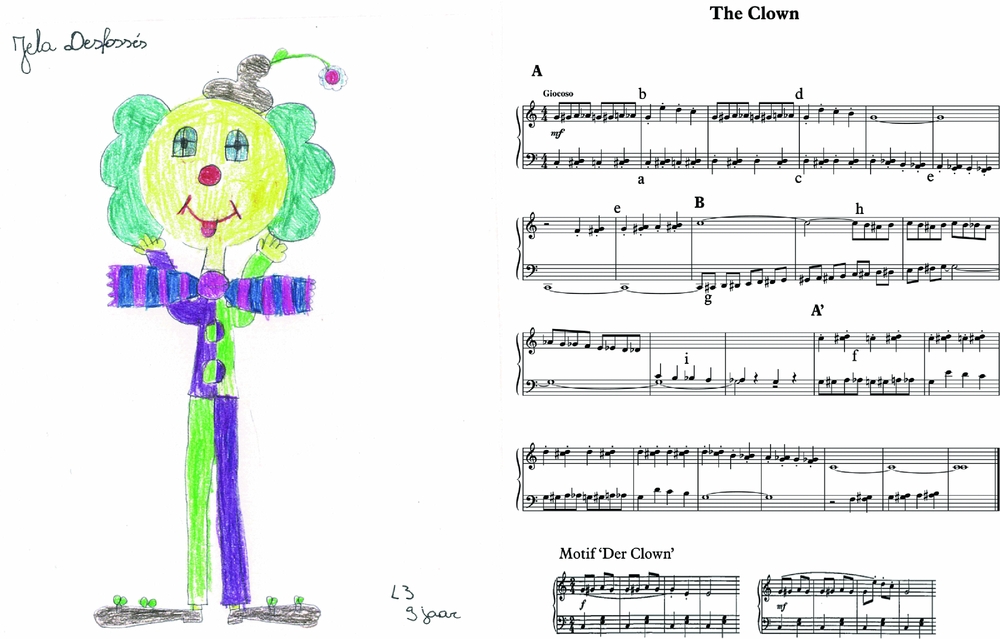
The Clown, Jela (aged 9)
Pedagogical process
Teacher: ‘Can you tell me something about the clown?’ Jela: ‘He's walking.’ Jela plays motif (a) and almost immediately goes on to play motif (b). Teacher: ‘Can you extend the phrase?’ She then plays variations (c, d). The rest of the phrase (e) comes to her spontaneously and, after a brief pause, she says: ‘Now I need to change hands, otherwise the piece will be too short’ (f). Teacher: ‘That gives you two phrases. Are you going to join them together or link them with another phrase?’ Jela: ‘Another phrase.’ Teacher: ‘And here, can you also use some chromatic notes?’ Jela begins to play an ascending chromatic scale, while keeping her right hand on the tonic (g). Teacher: ‘Are you going to do something with the right hand, too?’ After making a few changes, Jela begins to invert the opening motif (h). When the tonic and dominant come together, she lets her right hand go down while the left hand stays on the dominant. At the end of this small phrase she says: ‘The clown is slowing down and then stands still’ (i) and having agreed to join up the phrases she continues ‘and now he goes on walking until it's over’. Teacher: ‘Shall we look at the picture again?’ After a bit of searching, Jela finds a number of parallels.
Analysis
With the opening bars Jela refers to the character and motif of Der Clown (Fig. 4), a piece she had studied previously. She makes a variation on this motif. She also experiments with the chromatic notes and derives the left hand from the right. In so doing, she reduces an accompaniment from the opening motif instead of copying the stereotypical triad accompaniment from Der Clown. Then she inverts the second interval resulting in a small inversion. Having done that, she experiments with the chromatic notes a bit more and creates a descending line by playing with the structure of the keyboard and making a particular pattern in the keys. This line is then mirrored in an ascending version until it arrives at the tonic. As she thinks the piece is too short, she inverts the parts, resulting in a bigger inversion and also an AA’ form. My suggestion to expand the form and retain the chromatic character results in an ABA’ form. In B, in the mirrored patterns, Jela concentrates on the fingering of the chromatic scale, creating pedal notes. When I challenge her to move both hands, she inverts the opening motif. In augmenting the chromatic notes she makes a reference to the clown who has now stopped walking. Jela has integrated the tonic-dominant relationship of Der Clown, in an aural and spontaneous manner.
The Clown

Reflection
Jela structures the musical material into a totality as she did in her picture. In the colours of the clown's suit we observe two examples of reversibility, in major and minor form; vertical crossed or chiasmus and horizontal. We see the same in the composition. By swapping the parts from the left to the right hand she has created a bigger form of reversibility. The inversion of interval and motif provides a minor form of reversibility. The clown's head and scarf exhibit a mirrored, symmetrical colour pattern and an ABA form. The colours of his hat and shoes, and those in between, can also be interpreted as an ABA idea. In the composition the descending and ascending lines are mirrored and the form is ABA’. Intuition played a major role during our interaction. The composition came about in just 10 minutes because Jela intuitively transferred her drawn ideas whilst composing. Thus her intuition, underlying knowledge, previously acquired skills, imagination and play came together resulting in the recreation of an existing piece into a composition that makes a personal statement and contains new aspects in terms of form, musical language and performance technique.
Nocturne (♪ 1), Katrien (aged 12), Tara (aged 10) and Emma (aged 9)
Pedagogical process
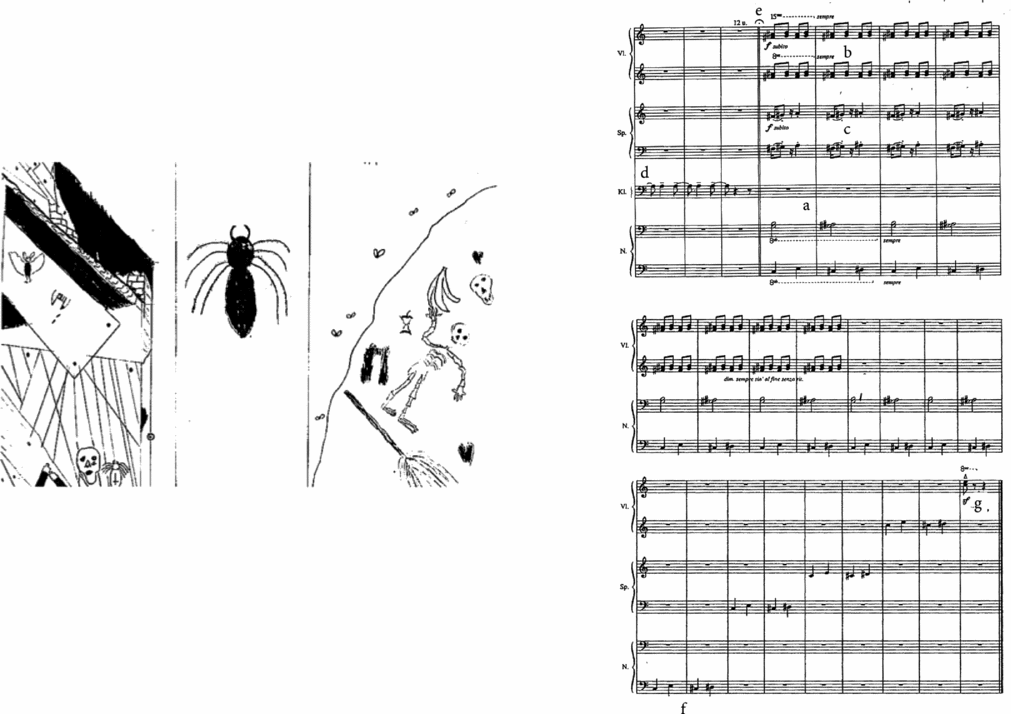
We worked from Katrien's picture and a story made up by the group: it is night . . . a nightmare. A bat approaches and disappears, the same happens with a spider and then again with the bat. The nightmare is interrupted by the chimes of a clock striking midnight and after a silence the nightmare continues powerfully, with both the bat and the spider on stage at the same time. The spider and the bat disappear one after the other, everything ebbs away and the dawn breaks.
The children choose one element each. Emma chooses the night, Tara the bat and Katrien the spider and the clock. Then we start the story. Teacher: ‘How can we evoke a nocturnal atmosphere?’ Emma experiments with the low register and creates motif (a). Teacher: ‘And what about the movements of the bat and the spider?’ As they listen to the night motif, Tara and Katrien come up with motifs (b, c) and each of them plays these with one hand. After discussing this with them, the children work on with these three motifs. Teacher: ‘How can we make the animals approach and disappear?’ Children: ‘By playing louder and softer.’ I suggest they use both hands. Teacher: ‘Emma, are you going to play the night louder and softer too?’ Emma: ‘No, because it is dark the whole time.’ Children: ‘When do the bat and the spider have to come and go?’ Teacher: ‘Try to feel it and listen carefully to the night.’ Katrien: ‘I hear the clock, but can't find it on the piano.’ Teacher: ‘Emma, will you play the night motif as a cluster? Katrien, you try to find it.’ Katrien finds the sound. Given that the clock has to pierce through the night, Emma gradually lets fade her motif. Meanwhile Katrien tries to find the right moment for the ticking to start, which gives us motif (d). Then we go on with the story (e) until only the night motif remains. When I ask them if they can let the dawn break with this motif, all three of them start to experiment. When I point out that they have six hands between them, they immediately start a ‘pass-the-parcel’ type game (f). Tara ends this on a striking major third (g) and says: ‘Now it is daylight.’ After discussing this final phrase the children made some adjustments to the beginning and chose a title.
Analysis
Using visual and motor symmetry, Emma creates a night motif, an ostinato in which she alternates intervals, and Tara and Katrien derive their motifs from hers. These are melodic cells; ostinati in which sounds are adopted, registers explored, rhythm diminished and intervals inverted and alternated. The children conceive the approach and disappearance of the animals as a transitional dynamic. Emma understands that this is in contrast with the continuous nature of the night, by using a stable dynamic. Katrien and Tara mark the point at which the animals approach and disappear, as well as the ticking of the clock, in relation to the nocturnal experience of time. This results in an asymmetrical phrasing which contrasts with the symmetry of the night motif. They manage to portray the clock in sound and rhythm in a way which complements the night motif. The silence that follows provides a general pause, and the continuation of the story gives a tutti; a climax with a synthesis of the material. With the ‘pass-the-parcel’ game the material is filtered into a coda, and a unity with the night motif is preserved. The staccato third depicts the awakening. The children then added an introduction by modifying the beginning. In the restriction of the material and the nature of the story, a minimalistic style is included.
Reflection
In this case the musical form was dictated by the story. By listening to each other, the children were able to link the night, bat and spider motifs organically. The alternation arose intuitively on different time scales – a mathematical aspect. Assimilative listening resulted in a contrasting clock motif. In this way the experience of night and day time are expressed in a complementary way. The night, which is a continuum, the mechanical ticking of the clock and the movement of the animals are also expressed visually, and complementary in dynamics. The incorporating of time resulted in an asymmetrical movement of the animals within a symmetrical movement of the night. It also resulted in a golden section ratio; the piece contains 152 beats of a crotchet and the climax, a forte tutti, we find on beat 101, at two-thirds of the way through the piece. The six-handed ‘pass-the-parcel’ game is an extension of the passing on of the animal motifs. The day motif contains the same major third as in the beginning, so that the circle of day and night is closed. A shared psychological perception, a ‘group ear’ and their capacity to organise, resulted in a composition with a unity of structure, as if it had been the work of a single composer or an ensemble picture drawn by a single hand.
The Merry Underwater World (♪ 2), Niels (aged 10)
Pedagogical process
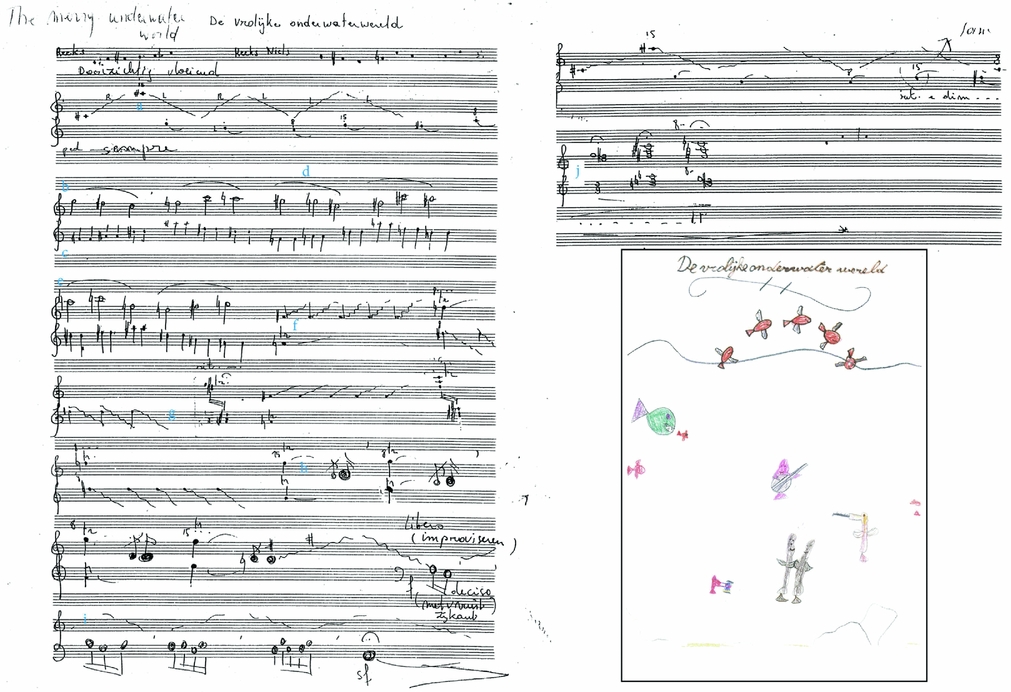
Niels explains what his picture shows: water, five leaping fish, an angry fish, two fish going hand in hand and making electricity, three fish playing instruments: a banjo, flute and xylophone.
Teacher: ‘What are we going to start with . . . the angry fish, the water . . . ?’ Niels: ‘The water . . . and there are air bubbles in it.’ Spontaneously Niels plays various glissandi and at least thirty different notes. Teacher: ‘Shall we take out some of the air bubbles?’ Niels thinks about the notes and chooses six which he spreads over the high register (a). Niels: ‘The fish with the banjo asks a question and the fish with the flute replies.’ Teacher: ‘They form a duo. Can you make question and answer with your six notes?’ To make it easier for him I arrange the notes in a series. Niels creates a short dialogue (b) and says: ‘The fish with the xylophone is also joining in.’ Teacher: ‘Now we have a trio.’ After a brief explanation of the respective roles in a trio, Niels decides to let the fish accompany the others. He carefully chooses a chord and after a few examples of triad formations he opts for an accompaniment pattern (c). Now Niels puts all the notes of the banjo and xylophone together, considers this for a moment and says: ‘Everything that is white must be black and vice versa’ (d). I follow his line of thought and ask: ‘Can you rearrange the notes in another way?’ He quickly finds a solution (e). Teacher: ‘What now?’ Niels: ‘The five fish are leaping up and down in the water’ and he plays five short glissandi. Teacher: ‘And the water?’ Niels: ‘It's rippling.’ Teacher: ‘Can we make that into a trill?’ Niels chooses a note for the trill, plays this together with the glissandi and then goes on to spontaneously invert everything (f). I suggest that he can also make a trill with all the notes (g) and by doing this he again makes another inversion. Niels: ‘Here come the fish that make electricity’ and he begins to play trills with both hands. In order to make it even more dramatic, we change the chord trills into clusters (h). Niels has quickly made the link with the angry fish and plays the clusters with his fist. Teacher: ‘Try to speak with your fist and don't forget the water’ which results in (i). Teacher: ‘It's all there, is it over now?’ Niels: ‘The water is still there and I can hear something in the distance.’ Teacher: ‘Let's have another look at the story’, and Niels goes back to the sounds of the trio and closes with motif (j). Niels keeps the right pedal pressed down during the entire piece since the story takes place under water.Footnote 5
Analysis
The story was open-ended and evolved during the interaction. A selection of six notes constitutes the basic material – which refers to the principle of serialism. By spreading out these notes, using the right pedal, Niels creates a resonating space. Constructing the trio he rearranged the notes. By experimenting with white and black keys he effects a transposition and he also puts the melody in retrograde. In doing so, Niels chooses the notes in such a way that there is an increasing degree of complementarity and resonance; except for E, he produces a full chromatic scale. The five leaping fish and the rippling water were a challenge to Niels's motor skills. Advanced motor skills were acquired in playing the trills and glissandi simultaneously – where the left and right parts are inverted – and in playing trills with both hands. Playing the cluster involved more elementary motor skills and this gives him the freedom to express electricity and the angry fish in a rhetorical way. By finishing with the water and a few final chords he ends up with a piece in ABA coda form. In the final chords Niels again plays with the principle of inversion. The ‘pedal sempre’ represents the water and ‘fermata’ extend the ripples on the surface.
Reflection
The narrative and the musical form developed together. With a lively representation of an underwater atmosphere, Niels provided an abundance of glissandi and trills. Restriction was necessary to compose. Thanks to this restriction, Niels arranged the material and did this in a systematic way. In the dialogue between the fishes with the banjo and the flute, he arranged the sounds in a complementary manner. The same happened when he played with white and black keys, and we find it again later in the right-left inversion of the parts – both chiasmi. Niels extended his way of ordering the material to different levels; aural, visual and kinetic, resulting in a synaesthesia of senses and skills. The music was built up organically in that one motif is derived from another, in an increasingly compact form; from individual notes to melody, chords, trills and clusters. This in turn meant using new performance techniquesFootnote 6 and presented technical difficulties. However, Niels was captivated by his underwater world and took it all in his stride, using his natural capabilities. His strong personal involvement in the process and his concentrated listening helped Niels to achieve a subtle balance in duration and intensity of sound. This gave ‘breath’ to the music and satisfied the child.Footnote 7
Mieze, Tara (aged 10)
Pedagogical process
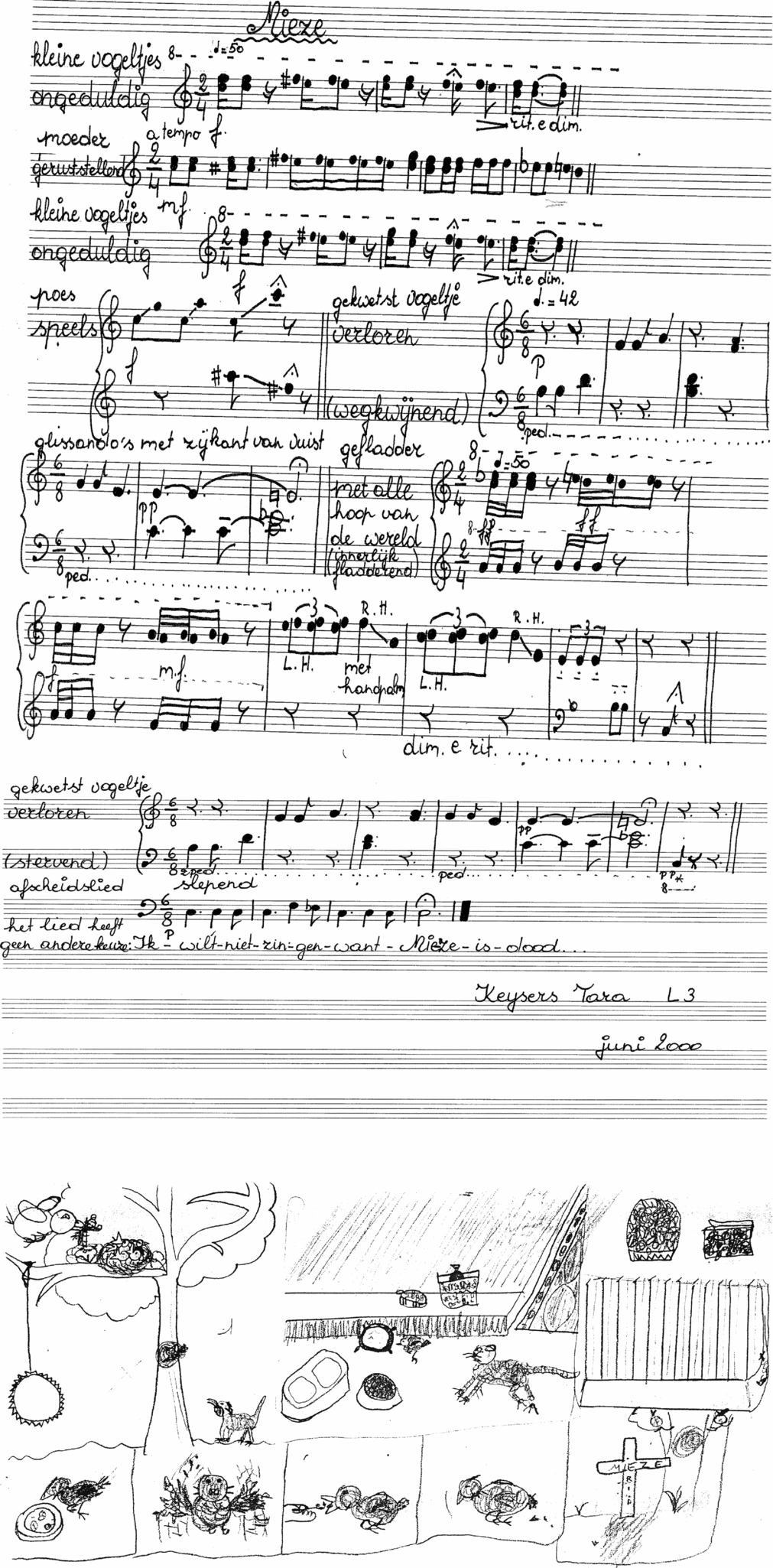
Story: Mieze is a baby bird that falls out of the nest, gets mauled by a cat, tries to survive, but ultimately dies.
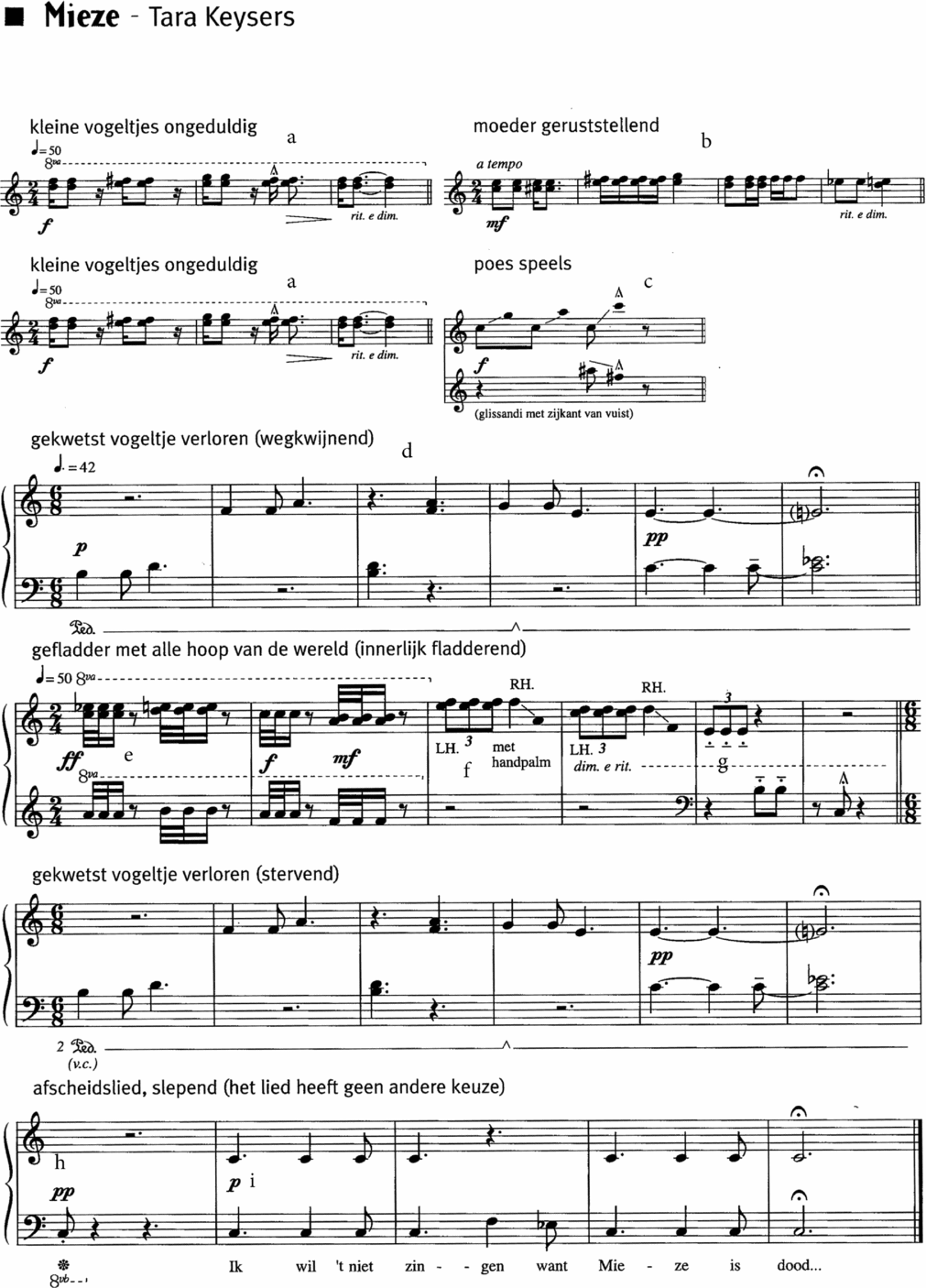
Tara: ‘The baby birds are impatient and are crying out for food.’ She creates phrase (a) in the high register. Tara: ‘The mother brings food and calms them down’ and she makes a variation of the first phrase (b). At my suggestion, she experiments with different registers. Tara: ‘Mieze falls out of the nest. The baby birds are upset’ and Tara makes them cry out again (a). Tara: ‘The cat tries to grab the baby bird, how can I represent that?’ I ask Tara to try out a few modern performance techniques and the result is motif (c). Tara: ‘The baby bird is hurt and wasting away.’ Teacher: ‘How are we going to represent this?’ Tara: ‘By something soft.’ Teacher: ‘Then we can make a sad song, an elegy’ and Tara creates phrase (d). When I ask Tara how she can make it sound more like a song, she uses the right pedal. Tara: ‘The baby bird doesn't want to die and is flapping about. Inside it still hopes to live . . . but . . . how can I show ‘flapping about’?’ Teacher: ‘Try flapping yourself.’ Tara understands, plays motif (e) and asks which rhythm this is. I help her to note it down. After a few motifs Tara says: ‘The baby bird can't take it any more’ at which point she relaxes the rhythm and lets the palm of her hand drop to represent the wings going down (f). Also, this rhythm we note down. Tara: ‘Mieze is almost dead and falls beak-first onto the ground’ and she makes motif (g). Then the sad song comes back, followed by a low note (h); ‘Now Mieze is dead’ says Tara. As a conclusion she creates a farewell song (i) and Tara writes on her manuscript ‘dragging . . . the song leaves no other option. I don't want to sing it because Mieze is dead’. ‘. . . and you can't use the pedal here’, she adds.
Analysis
Tara has expressed the hunger, the impatience and the distress of the screaming baby birds in the high register, a forte beginning, a Scotch snap, brief intervals, pauses, an accent followed by a longer note and a diminuendo, a continued resonance of the last note with diminuendo and ritenuto, the jerky melody and chromatic notes. For the mother who pacifies the baby birds and feeds them, she uses a lower register, mezzoforte, a more subtle and more tempered rhythm, and a questioning end with an ascending second. The cat's pawing of the bird is done with glissandi. The melody of the dying baby bird is build up with BØ7and ends on its solution. An additional minor third together with the use of the sustaining pedal gives a mourning effect. The flapping of the little bird's wings is expressed in a powerful rhythm in 2/4, in fortissimo. Mieze fades away again; the rhythm changes into triplets and quavers, the melody descends with glissandi, diminuendo, ritenuto and subtle accents. The baby bird falls beak-first onto the ground; C3 preceded by a pause, as an indication of its impending death. For the actual death itself Tara plays C2 in pianissimo, on the first beat and at the same time stops using the pedal. The farewell song continues softly in C minor, without pedal. The story determines the form and therefore the piece is made up of two parts with an identical internal structure: A (abac) and B (dedf). Within this symmetrical pattern we find an asymmetrical phrasing.
Reflection
Musical form is inherent to the story. The entire composition is suffused with Tara's inner perception and her identification with the animals. Figures from the verbal and body language are reflected in the melodic, rhythmic and harmonic aspects. The bird's will to live and the approaching death are expressed in ascending and descending melodic lines and in the fusion of major and minor third. ‘Almost dead’ and ‘dead’ are clearly and subtly differentiated by the time and place of the C's and the ending of the sound. The farewell song is personalised and Tara identifies with the song. With her version she refers to the archetypical character of a funeral march, such as the one in Chopin's sonata Opus 35.
Visualisation of music-theoretical concepts
The following examples illustrate the second part of my research question: how do children visualise music-theoretical concepts?
In music education children are continually confronted with theoretical concepts. To what extent they have already assimilated them becomes clear when they create and note down their own compositions, because they have to reflect on all the concepts involved. When children are allowed to interpret these concepts freely, we obtain the following results:
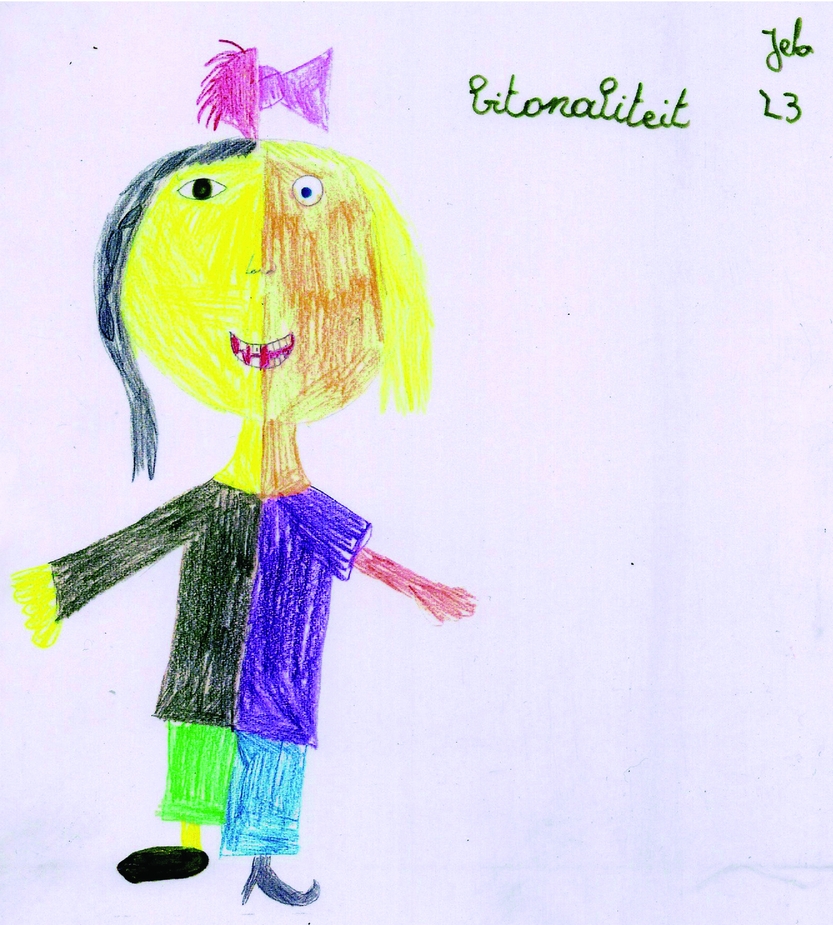
Bitonality, Jela (aged 10)
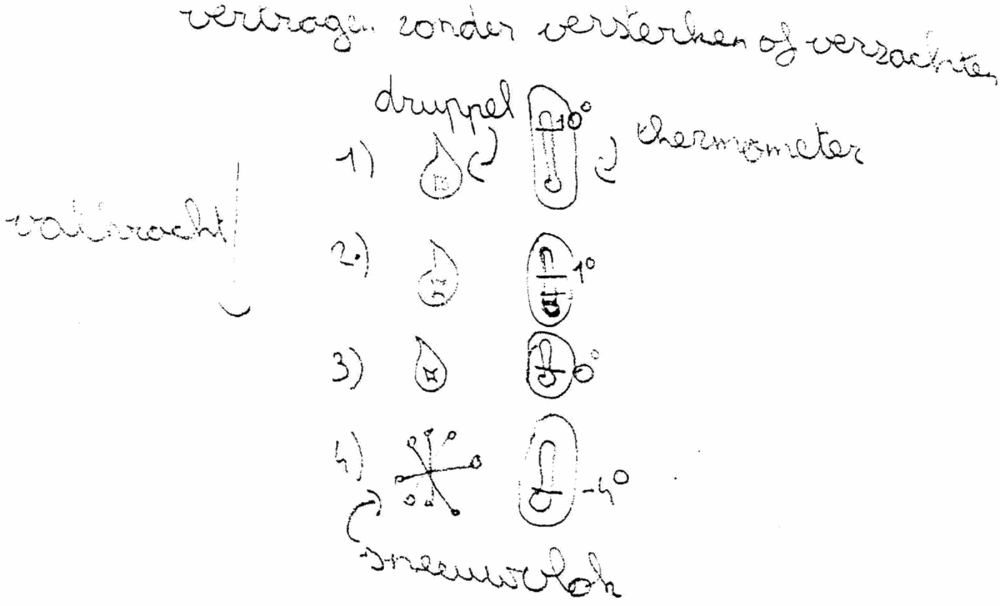
Jef has interpreted this concept as a crystallisation process; a water droplet which crystallises into a snowflake is a soundless slowing down movement.
Conclusion and discussion
This study shows that visual expression can be helpful in fostering musical thinking. This is supported by Matthews (Reference MATTHEWS2003) who recognises visual expression as a way of learning to convey meaning, and of creating signs and symbols, which is the foundation of all thought.
The compositions we have looked at show how musical structure can be imposed using visual expression. In the approach adopted by Apagyi (Reference APAGYI2006) this is done on the basis of the elaboration of concepts. The compositional strategies children use, are partly determined by the assignments themselves, in accordance with the expected result. In the method used by Roels (Reference ROELS2002) spontaneously drawn pictures are converted into music. The compositional strategies children use, are largely determined by what they themselves create and the topics (which Apagyi sets as assignments) are elicited in this case through intuition and play. In the examples we see how, as in the case of spontaneous drawing (Matthews, Reference MATTHEWS2003, p. 33), children create patterns that they repeat, vary and combine in their own way, in accordance with what they want to express. In so doing, they transcend the basic learning content (Didden, Reference DIDDEN1979; Gistelinck, Reference GISTELINCK1991; OVSG, 1997). As in the case of spontaneous drawing (Matthews, Reference MATTHEWS2003, p. 13) and depending on their creativity, logical, mathematical and aesthetic aspects surface. Children's play strategies are sometimes very similar to the compositional techniques used by adult composers, as can be found in Wuorinen (Reference WUORINEN1979) and Ruiter (Reference RUITER1993). Using drawings and stories enables children to start from an overall structure, from which they can go on to make decisions at ‘local’ level. Research conducted by Barrett (Reference BARRETT, Sundin, McPherson and Folkestad1998 a) and Mak and Jansma (Reference MAK, JANSMA, Evers, Jansma, Mak and de Vries1995) has shown that experienced composers do the same. Dalcroze (Reference DALCROZE1921), Steiner (Stockmeyer, Reference STOCKMEYER1976), Orff (Warner, Reference WARNER1991) and Kodaly (Choksy, Reference CHOKSY1999) emphasise the importance of working as a group. The example of the Nocturne (Fig. 5) shows that group composition via visual expression can be very effective.
Nocturne

The Merry Underwater World

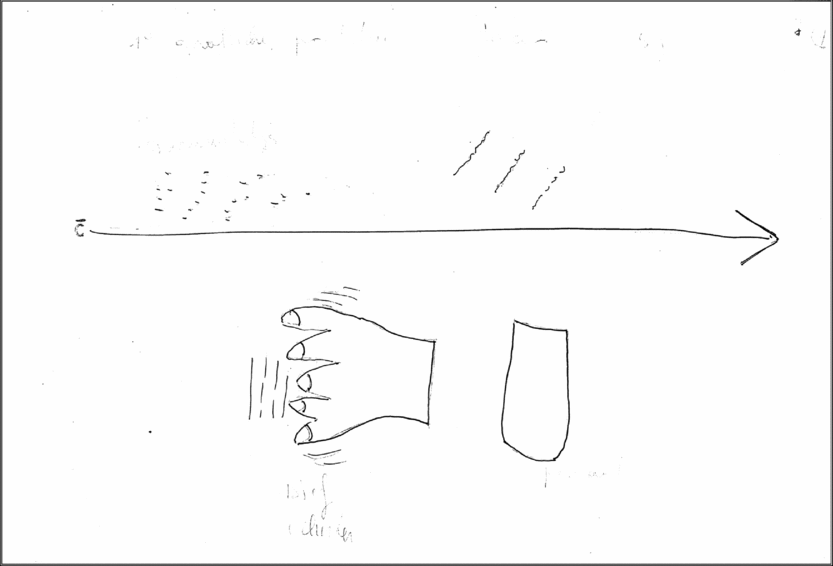
The drawings suggest various possibilities of visualisation. In the Runze (Reference RUNZE1971) method listening plays a role when different pitches are related to the floors of a house. In the Apagyi method (2006) musical concepts are illustrated by images (Fig. 1). Under the Roels approach (2002) musical concepts are freely interpreted. The crystallisation process (Fig. 9) is an example of how a hidden relationship between a musical concept and a natural phenomenon can be elucidated. This confirms that children draw what they know rather than what they see (Foks-Appelman, Reference FOKS-APPELMAN2004, p.77). Drawing terminology can be related to the development of a sense of tonality (Runze, Reference RUNZE1971), but can also be used to help children understand less accessible concepts such as bitonality (Fig. 8). Drawing parts of instruments (Runze, Reference RUNZE1971) can be of additional value if children use these pictures as notation symbols (Fig. 10).
Mieze

Mieze (manuscript Tara)

Bitonality

Jela has interpreted the combination of two tonalities as the combination of two identities.
Ritenuto without diminuendo or crescendo, Jef (aged 11)
Ritenuto

Figurative Score with Pedal Symbol, Jacob 5 years.

The findings indicate that, by using their visual capacity, children can acquire a deeper feeling and understanding of exactly what music is as a structured material and can acquire an understanding of music terminology through play.
By abstracting from their drawings, whereby unsuspected and authentic trains of thought and ways of acting influence the micro and macrostructure of their compositions,Footnote 8 children develop their own musical language. Children's emotional connection to their own work is manifested in a spontaneous, expressive performance, in which they show great concentration, and which takes them to the limits of their abilities. That intrinsic motivation helps to establish links between structure and emotion, which are the key to spontaneously expressive performance, is also researched by Sloboda (Reference SLOBODA, Evers, Jansma, Mak and de Vries1995), and Loane (Reference LOANE1984) highlights that the process of skill learning and the act of musical creation are in some sense identical.
By visualising musical concepts and representing them symbolically, in a way that elicits authentic interpretations, children learn to place musical elements in a different context. This is found in the work of adult artists such as Klee (Boulez, Reference BOULEZ1989) and Dalcroze (Reference DALCROZE1921) who transpose musical elements into visual representations and dance.
In several ongoing music projects, experiments involving the use of visual expression are taking place, however, without long-term results through a lack of methods.Footnote 9 Further research might demonstrate the importance of the researched methods above – or components of them – for possible implementation in music education, general primary education and also for the development of other skills. The importance of interdisciplinary thinking is more than once stressed such as in the work of Barrett and Veblen (Reference BARRETT, VEBLEN, McPherson and Welch2012).
I hope, that in the future, children will also get the opportunity to express themselves musically at the same level already acquired in the visual art education and that their musical creations, just as their drawings, will be valued for their originality as well as their cognitive content. That children's drawings are not only of interest to academics, is evidenced by the interest shown by painters who draw inspiration from them (Anon, 1987). In the field of music pedagogy, we still have a great deal of catching-up to do with regard to children's compositions.
I would like to finish by quoting the concluding remarks of Burnard et al. (Reference BURNARD, KELLY, BIDDULPH, Khine and Saleh2010):
By bringing the voices of children to the surface and by recognising the role of imaginative inquiry, it is possible for the teacher-researcher to create and construct knowledge that is not only new, but also has the capacity to transform teaching and learning. (Burnard et al., Reference BURNARD, KELLY, BIDDULPH, Khine and Saleh2010, p. 14)
Johanna Maria Roels teaches piano at the Academy Muwoda, Heist op den Berg, Belgium. For many years she worked at the Royal Conservatoire, Antwerp, Belgium. She was a lecturer at the initial teacher education, led an improvisation course and did research on the compositional strategies of students and children. Her work with children resulted in the developing of a method which she illustrates in her books Kinderen op vleugels (Children on Wings) (2002) and Children on Wings, Analytical Practical Workbook (forthcoming). Since 2000 Roels has introduced her method via workshops and lectures in different pedagogical contexts and on numerous national and international congresses.
Peter Van Petegem is Full Professor at the Institute for Education and Information Sciences of the University of Antwerp, where he coordinates the research group EduBROn (www.edubron.be) and the Center for Excellence in Higher Education (www.ua.ac.be/echo). His main interest is on evaluation research at micro (e.g. innovative learning environments), meso (e.g. school self evaluation) and macro level (e.g. educational policy evaluation). He publishes international peer reviewed publications in, amongst others, Educational Research, The Environmentalist, Higher Education, Computers & Education and PLOS-ONE. He is editor-in-chief of Studies in Educational Evaluation.