


The success of the Leave option in the Brexit referendum of June 2016 was probably the single most important event in European politics in the past two decades. A number of contributions have provided evidence that support for Leave was stronger in geographical areas of the United Kingdom characterized by relatively poor economic performance in recent years. In particular, the Leave vote share was higher in regions witnessing lower employment rates and real wage growth, as well as larger increases in inequality and poverty, and sharper declines in manufacturing employment (Becker, Fetzer, and Novy Reference Becker, Fetzer and Novy2016; Bell and Machin Reference Bell and Machin2016; Clarke and Whittaker Reference Clarke and Whittaker2016; Darvas Reference Darvas2016; Langella and Manning Reference Langella and Manning2016).
Building on this correlational evidence, in this article we focus on global competition as a structural driver of divergence in performance across U.K. regions. We exploit the exogenous shock of the surge of China as a leading manufacturer, and measure the vulnerability of each region to this global-scale economic transformation, which has implied a huge displacement of manufacturing activities across developed countries: a phenomenon known as the “Chinese import shock” in the international economics literature (Autor, Dorn, and Hanson Reference Autor, Dorn and Hanson2013; Bloom, Draca, and Van Reenen Reference Bloom, Draca and Van Reenen2016). We show that globalization, by means of the Chinese import shock, is a key structural determinant of the Brexit vote.
Our analysis proceeds in two steps. First, we work with official referendum results at the regional level. We find that the Leave share was systematically higher in regions that have been more exposed to the Chinese import shock, due to their historical sectoral specialization. This finding is robust to accounting for the possible endogeneity of the import shock, which we instrument using imports from China to the United States. Our result is also robust to controlling for several immigration measures, and a wide range of additional regional characteristics, which have been identified as significant correlates of referendum returns.
In the second part of the study, we perform an analysis of vote choice for individual voters. Conditional on education and other characteristics, we find that individuals living in regions more affected by the import shock were more likely to vote for Leave. The effect of imports is not restricted to a specific category of voters, but extends broadly across many segments of the population, suggesting that voters have responded to the shock in a sociotropic rather than simple pocketbook fashion. This is in line with results in the economic vote literature (Duch and Stevenson Reference Duch and Stevenson2008; Kinder and Kiewiet Reference Kinder and Kiewiet1981). Importantly, voters respond not only to the state of the economy at the national level, but also at the local level (Ansolabehere, Meredith, and Snowberg Reference Ansolabehere, Meredith and Snowberg2014).
In terms of control variables, we find no clear evidence that higher immigration is associated with more support for Leave. If anything, when working at the regional level, there is some evidence of a negative correlation, while a positive association with Leave support is only found when considering the arrival of immigrants from EU accession countries, as in Becker, Fetzer, and Novy (Reference Becker, Fetzer and Novy2016). Individual attitudes towards immigration are systematically worsened by the import shock, while they are not related in a clear way to the actual extent of immigration in a region. Overall, worsened attitudes towards immigration seem to largely reflect economic distress driven by import competition. In this sense, we find evidence of an interplay between the trade shock and immigration in affecting voting.
This article makes two main contributions. The first one is to provide a rigorous analysis of this specific political event, whose importance is undeniable, uncovering a causal driver of vote choice behind the available correlational evidence. The second contribution is to refocus the literature toward a clearer understanding of the political consequences of globalization. Almost a decade ago, Kayser (Reference Kayser2007) polemically noted that “the sheer volume of literature in this area has made it easy to overlook an important fact: very little of it addresses the effect of economic globalization on actual politics, understood more narrowly as electoral politics.” The situation has not changed much since the claim was made. Our contribution, then, attempts to reconnect the political science literature on globalization with the well-developed literature on the economic vote broadly understood.
THE BREXIT REFERENDUM
On June 23, 2016, U.K. citizens were called to express their stance as to whether the United Kingdom should “Remain a member of the European Union” or “Leave the European Union.” The Leave option prevailed by almost 4 percentage points (51.9% vs. 48.1%). A great deal of debate and investigation has followed the referendum, and a number of empirical regularities have been established. Considering individual-level factors, older, less educated, and poorer people were more likely to vote for Leave, while students and women were more in favor of Remain. Beyond individual characteristics, though, there is evidence that social and economic conditions across geographic areas also mattered. For instance, Langella and Manning (Reference Langella and Manning2016) report that a declining share of employment in agriculture, manufacturing, mining, and construction in the past three decades is associated with higher regional Leave shares. A similar correlation is found with respect to declining employment in services over the same period. Darvas (Reference Darvas2016) shows that support for Leave was stronger in regions characterized by higher income inequality and higher poverty rates.
Consistent with this evidence, Bell and Machin (Reference Bell and Machin2016) find that support for the U.K. Independence Party in the 2015 election, and, relatedly, for the Leave option in the referendum, was higher in areas of Britain witnessing poorer performance in terms of real wage growth over the past two decades. Clarke and Whittaker (Reference Clarke and Whittaker2016) also find evidence of higher Leave shares in areas with lower employment rates. Connecting different areas of work, Becker, Fetzer, and Novy (Reference Becker, Fetzer and Novy2016) provide the most comprehensive evidence of correlations between Leave votes and a large number of economic, social, and political factors, most of which are also included in our robustness checks.
Despite its prominence in the public debate, evidence concerning the role of immigration is somewhat mixed. With the exception of Langella and Manning (Reference Langella and Manning2016), most of the analysts do not find a positive association between immigration and Leave support. If anything, there is evidence to the contrary: areas characterized by higher shares of foreign-born population were more supportive of Remain. This is consistent with more immigrants settling in areas characterized by younger population and more dynamic economy. London is probably the most notable example. Besides that, there is some evidence that recent increases in the proportion of immigrants are associated with higher support for the Leave option (Clarke and Whittaker Reference Clarke and Whittaker2016; Darvas Reference Darvas2016; Langella and Manning Reference Langella and Manning2016). This pattern might be driven by communities that started from very low levels of immigration, and began facing only recently an increasingly diverse environment. Moreover, Becker, Fetzer, and Novy (Reference Becker, Fetzer and Novy2016) find evidence of higher Leave shares in areas that have witnessed larger increases in immigration from EU accession countries. In our analysis, we account for the share of immigrants in the population of the region, as well as for their recent influx, and we also employ measures of immigration disaggregated by country of origin.
THE IMPORT SHOCK
The Role of China
Over the last three decades, the world has been witnessing a sharp increase in trade between industrialized countries and emerging low-income economies. China has been the major player in this respect. Figure 1 shows the variation in the Chinese share of total manufacturing imports in the United Kingdom from the end of the 1980s until 2007. This share displays a sizable increase, from about 1% to around 8.6%, which is even more remarkable if one considers that total import flows were almost doubling in real terms at the same time. Imports from other low-income countries have also increased substantially in absolute terms, although their share has remained pretty much constant over time.Footnote 1 The growth in import pressure from China thus clearly emerges as the most relevant trade pattern over this period, and constitutes the main focus of our analysis.
Evolution of the Relative Importance of Imports from China and other Low Income Countries in the United Kingdom.

Such a strong and very rapid growth in Chinese import competition is not peculiar to the United Kingdom: a very similar tendency has also been documented for other European countries and for the United States (Autor, Dorn, and Hanson Reference Autor, Dorn and Hanson2013; Bloom, Draca, and Van Reenen Reference Bloom, Draca and Van Reenen2016). This phenomenon is in fact mainly a result of the structural transformation of China, which has become a WTO member in 2001. In a relatively short time, China has evolved from a closed, agriculture-based economy into an open economy hosting the largest manufacturing sector in the world. This structural change has entailed a dramatic supply shock for developed countries.
In a recent review paper, Autor, Dorn, and Hanson (Reference Autor, Dorn and Hanson2016) notice how “China’s rise has provided a rare opportunity for studying the impact of a large trade shock on labor markets in developed economies”. Besides the large quantitative impact of a country like China –and the well-known scarcity of natural experiments in international trade– the literature has identified at least three reasons why the surge in Chinese competition constitutes an excellent exogenous source of identification. First, the timing and the extent of China’s transformation were essentially driven by domestic idiosyncratic political factors, and were still largely unexpected at the end of the 1980s. Second, the earlier isolation of China under Mao, and the accumulated productivity gap with respect to advanced economies, allowed the government to quickly unlock huge opportunities for rapid structural catch-up. Third, unlike other emerging economies, that tend to specialize in primary commodities, China had a strong comparative advantage in manufacturing. This was concentrated especially in labor-intensive activities, given the abundance of labor associated with the decollectivization of agriculture and the mass migration of farmers to cities. Yet, Autor, Dorn, and Hanson (Reference Autor, Dorn and Hanson2016) show that idiosyncratic prowess also played a role in determining China’s specialization, leading to variation in export performance across industries otherwise similar in terms of factor content. This source of heterogeneity is important for identification.
Several studies have exploited the China shock in an attempt to understand the implications for firms and workers in the West. The evidence points to a substantial displacement of manufacturing activities both in the United States and in the EU as China’s relevance grows, especially in labor-intensive manufacturing activities (Autor, Dorn, and Hanson Reference Autor, Dorn and Hanson2013; Bernard, Jensen, and Schott Reference Bernard, Jensen and Schott2006; Bloom, Draca, and Van Reenen Reference Bloom, Draca and Van Reenen2016; Khandelwal Reference Khandelwal2010). At the individual level, the adjustment costs in terms of unemployment spells and lower earnings fall disproportionately on workers employed in import competing industries, and especially on low-skill workers (Autor et al. Reference Autor, Dorn, Hanson and Song2014). These findings resonate well with standard predictions of the Heckscher-Ohlin framework and specifically with the Stolper-Samuelson theorem, according to which low-skilled workers in Western countries should be negatively affected by the China shock. Consistently, in his seminal work, Rogowski (Reference Rogowski1989) already foresaw the possibility of a protectionist backlash due to global competition among marginalized low-skilled workers in advanced European countries.
It is undeniable that imports from China have also determined a downward pressure on prices that has benefited consumers (Auer and Fischer Reference Auer and Fischer2010; Fajgelbaum and Khandelwal Reference Fajgelbaum and Khandelwal2016). Yet, while such welfare gains from a demand perspective are diffused among the population –and somewhat difficult to assess for public opinion– the supply-side losses of firms and jobs determine clear and visible losers of globalization. Crucially for the purpose of our analysis, these losers tend to be geographically concentrated in regions that have been historically specialized in manufacturing activities then overtaken by China.
Understanding the role of labor market frictions –which prevent smooth reallocation of workers– and uncovering the localized effects of trade shocks, have been key steps forward in the most recent international trade literature. Concerning the China shock, areas that were more exposed to Chinese competition, in virtue of an overlapping industry specialization, have witnessed a decline in employment not only in the affected industries, but also in general, as other industries have not adequately absorbed laid-off workers. The speed of adjustment for local labor markets has been very slow, with observed persistence in regional decline for more than a decade, involving entire communities rather than just low-skilled workers (Autor, Dorn, and Hanson Reference Autor, Dorn and Hanson2016). The press has referred to these laggard regions as “left behind” areas of globalization. This phenomenon is at the core of our investigation: the Chinese import shock provides an exogenous source of variation in economic performance across U.K. regions; hence, it may have a causal impact on voting to the extent that citizens voice their discontent with the economic situation of their region by voting Leave. In the theory section, we describe three specific channels that might drive this effect.
Measurement
Autor, Dorn, and Hanson (Reference Autor, Dorn and Hanson2013) develop a theoretical model that links the Chinese import shock with labor-market outcomes at the regional level. Regions that are more vulnerable to the shock, due to their sectoral specialization, are predicted to face employment losses and lower wages as Chinese imports rise, as a result of productivity gains in China and falling trade costs. This effect depends on the fact that China’s demand for foreign goods does not compensate the displacement induced by its exports, a condition which is very realistic given the rising trade surplus run by China over time, especially after entering the World Trade Organization (WTO).
Based on their theoretical framework, Autor, Dorn, and Hanson (Reference Autor, Dorn and Hanson2013) derive an empirical measure of regional exposure to the Chinese import shock from a supply perspective. They show that a stronger shock leads to higher unemployment, lower labor force participation, and reduced wages across U.S. regions between 1990 and 2007. We employ the same empirical approach. In particular, we measure the trade shock at the regional level as follows:
 $$\begin{equation*}
{\rm Import Shock}_{it}\text{=}{\displaystyle \sum _{k}}\frac{L_{ik({\rm presample})}}{L_{i({\rm presample})}}*\frac{\Delta {\rm IMPChina}_{kt}}{L_{k(\rm presample)}},
\end{equation*}$$
where i indexes regions, k industries in the manufacturing sector, and t years.
ΔIMPChinakt is the change in (real) imports to the United Kingdom from China over the past n years, in industry k. This is normalized by the total number of workers in the same industry in the United Kingdom at the beginning of the sample period, L k(presample). To back out the region-specific trade shock, we take the weighted sum of the change in imports per worker across industries, where the weights capture the relative importance of each industry in a given region. Specifically, the weights are defined as the ratio of the number of workers in region i and industry k, L ik(presample), over the total number of workers in the region, L i(presample), both measured at the beginning of the sample period.
This measure has a very intuitive interpretation: for given changes in nation-level imports per worker (that is, ΔIMPChinakt / L k(presample)), the Chinese shock will be stronger in those regions in which a larger share of workers was initially employed in industries witnessing larger subsequent increases in imports from China. Intuitively, cross-regional variation may stem from two sources. In the first place, larger shocks are attributed to regions in which more workers were initially employed in the manufacturing sector. However, for a given overall share of manufacturing workers, the shock is going to be stronger for regions in which more workers were employed in industries for which Chinese imports have increased the most, for example, textiles or electronic goods.
We measure industry specialization in 1989, before the emergence of China as a global manufacturing player. We then look at import growth between 1990 and 2007, to avoid picking up the complicated ramifications of the 2008 global financial meltdown. This also reassures us that the effects our analysis isolates are manifestations of long-term processes taking place in the British and global economy, rather than simple consequences of one particular shock like the global financial crisis of 2008. Data on the composition of employment at the regional level are from the U.K. Office for National Statistics (ONS), while data on imports are from Eurostat COMEXT. Both employment and trade data are disaggregated at the NACE Rev. 1.1 subsection level.Footnote 2
Our analysis is performed at the NUTS-3 level of regional disaggregation. NUTS (the French acronym for “Nomenclature of Territorial Units for Statistics”) is the official classification of territorial units in the European Union. According to this classification, the territory of each EU country is partitioned into administrative regions at three nested levels. The NUTS-3 level is the most disaggregated one and is meant to capture, in Eurostat’s words, “small regions for specific diagnoses.”Footnote 3 We focus on a total of 167 NUTS-3 British regions, with an average population of around 370,000 inhabitants. The NUTS-3 regions of Northern Ireland are excluded due to lack of data on the explanatory variables. The results we report are robust if we perform the analysis at the NUTS-2 level of regional disaggregation.
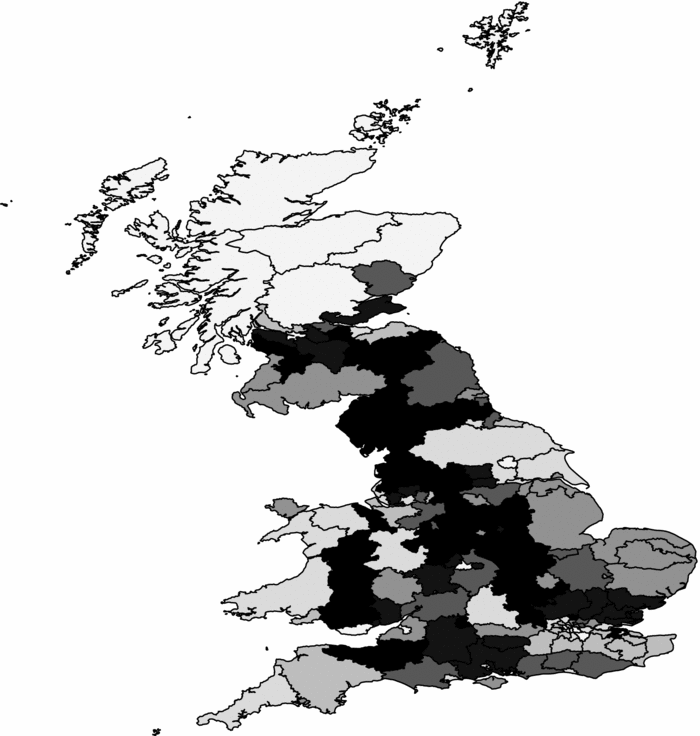
Given the cross-sectional nature of our empirical analysis, we are going to use a single value on the strength of the import shock for each NUTS-3 region. Specifically, we first compute Import Shockit considering five-year changes in imports (that is, n = 5), and then take the average between 1990 and 2007. The resulting variable is denoted by Import Shocki. Figure 2 displays the variation in the strength of the shock across regions. The variable we employ has an average value of 0.32, that is, a growth in imports from China by 320 real euros per worker, with a standard deviation of 0.14. The region with the lowest shock, perhaps not surprisingly, is Camden and City of London (0.06). The region with the largest shock is Leicester (0.75).
Strength of the Import Shock Across NUTS-3 Regions

In line with earlier findings in the literature, we find that U.K. regions witnessing larger shocks experience a decline over time in terms of GDP per capita relative to the median region. In particular, for each NUTS-3 region we compute the Change in Relative Income (CRI) between 1997 (the earliest year for which we have data) and 2015, using data on gross value added (GVA) from the ONS. We take the ratio between income per capita in each region and income per capita in the median region, in 1997 and in 2015, and we calculate CRI as the percentage difference between these two relative figures. Positive values signal an improvement in the position of a region relative to the median, while negative values reflect a relative worsening over time.
The region with the strongest loss in relative income is Thurrock (UKH32, in Essex), whose GVA per capita was above the median region in 1997, but below it in 2015. Specifically, income per capita declined from 125% to 96% of the median. This is a relatively privileged area “falling behind” sharply in the past two decades. Tellingly, Thurrock happens to also be the NUTS-3 region with the highest Leave share (72.3%). The second strongest loss in relative income took place in Torbay (UKK42, in Devon), whose income per capita declined from 91% to 75% of the median region. This is an initially relatively poor region getting even poorer. The Leave share in Torbay was also high: 63.2%.
The areas with the strongest gains, on the other hand, are Camden and City of London (UKI31) and North Lanarkshire (UKM36, in South Western Scotland). In 1997, the income per capita of Camden and London was 9.7 times the median region. By 2015, this ratio grew to 14. Notably, this region also had the lowest import shock from China, and one of the lowest Leave shares in the referendum: 25%. North Lanarkshire is instead a region showing convergence to the median over time, with a growth in income per capita from 67% to 93% of the median region. Remain prevailed in this region with 62% of the votes.
In the econometric analysis, we show that support for Leave is systematically higher in regions that are falling behind in relative terms. In turn, when we regress CRI on the Chinese import shock—instrumented using U.S. imports from China (see infra)—we find that a one-standard-deviation increase in the strength of the shock leads to a decrease in CRI by a quarter of a standard deviation. That is, the import shock is an important determinant of divergence across regions. This evidence corroborates our identification strategy.
Endogeneity
An issue with our empirical approach is the possible endogeneity of the trade shock. We tackle this issue by instrumenting import shock using the growth in imports from China to the United States (sourced from the Center for International Data at UC Davis). Specifically, the instrument is constructed as follows:
 $$\begin{eqnarray*}
&&{\rm Instrument\ for\ Shock}_{it}\\
&&\quad \text{=}{\displaystyle \sum _{k}}\frac{L_{ik({\rm presample})}}{L_{i({\rm presample})}}*\frac{\Delta {\rm IMPChina}_{{\rm USA}kt}}{L_{k({\rm prefimsample})}}
\end{eqnarray*}$$
With respect to the previous formula for import shock, here we substitute ΔIMPChinaUSAkt for ΔIMPChinakt. Also, in this case, we take the average of five-year changes in imports between 1990 and 2007 to retrieve the instrumental variable Instrument for Shock i. Motivated by earlier literature (e.g., Autor, Dorn, and Hanson Reference Autor, Dorn and Hanson2013; Bloom, Draca, and Van Reenen Reference Bloom, Draca and Van Reenen2016; Colantone, Crinò, and Ogliari Reference Colantone, Crinò and Ogliari2015), this instrument is meant to capture the variation in Chinese imports, which is due to the exogenous changes in supply conditions in China, rather than to domestic factors in the United Kingdom that could be correlated with electoral outcomes.
It is important to spend a few words on the potential sources of endogeneity. In particular, the import shock in a given region might be endogenous to Brexit votes—due to omitted variable bias—if imports to the United Kingdom at the industry level were correlated with the political leanings of regions. This might emerge if political leaders protect from foreign competition the industries that are important for their key constituencies, while allowing for more imports in industries that are more concentrated in less relevant constituencies. In this case, we would observe lower import shocks in regions where people are already more likely to support Remain, in line with the orientation of the political elites they feel close to. Conversely, stronger shocks would hit regions where people are more likely to support Leave against the incumbent elites, which are generally perceived as distant.
Concerns about this source of endogeneity are mitigated if one considers that our measure of the import shock refers to the period 1990–2007, long before the referendum. Even more importantly, trade policy is an exclusive competence of the European Union. In practice, for our purposes, this means that U.K. tariffs on Chinese goods are fixed by EU institutions, and are the same across all EU Members. Still, it might be that U.K. representatives lobby the EU for more protection of industries located in key constituencies. Our instrumental variable strategy is meant to solve this type of issue—and other potential sources of omitted variable bias—as exports from China to the United States are plausibly orthogonal to any NUTS-3 region-specific factor in Great Britain.
GLOBALIZATION AND POLITICS
The political science literature on globalization and trade openness has initially focused on macro-level policy outcomes. One first strand of literature originates with the concept of “embedded liberalism” introduced by Ruggie (Reference Ruggie1982, Reference Ruggie1994), and draws from the empirical regularity that sees trade openness being associated with more state spending (Cameron Reference Cameron1978). In this perspective, a bargain involving generous redistribution and insurance against economic shocks in exchange for support for global trade was struck after World War II in Western democracies. The second strand focuses on the constraints that mobile capital puts on the ability of national governments to raise revenues to pay for insurance and redistribution schemes (Burgoon Reference Burgoon2001; Garrett Reference Garrett1998). Rodrik (Reference Rodrik1997) combines the implications of the two perspectives to highlight a fundamental tension: globalization generates higher demand for insurance and redistribution, but also more constraints in terms of taxation; such tension could lead, potentially, to a protectionist backlash.
More recently, the focus in the literature has shifted to the direct effects that globalization might have on individual attitudes and policy preferences. This recent work provides microfoundations to the previous macro work, suggesting mechanisms that link redistribution and trade policy to political competition, public opinion, and party politics. Some contributions look at how exposure to risk deriving from global competition shapes preferences for redistribution (Rehm Reference Rehm2009; Walter Reference Walter2010), and how party platforms respond to globalization (Burgoon Reference Burgoon2012). Other studies explore how exposure to globalization risks shapes support for protectionism (Margalit Reference Margalit2012; Mayda and Rodrik Reference Mayda and Rodrik2005), whether compensation increases the support of exposed groups for open trade (Hays Reference Hays2009; HaysEhrlich, and Peinhardt Reference Hays, Ehrlich and Peinhardt2005), and how support for open trade has been evolving over time (Scheve and Slaughter Reference Scheve and Slaughter2007). When it comes to voting behavior, some have tried to explain how openness might influence accountability, especially by dampening the relationship between performance of the national economy and electoral success of incumbents (Hellwig and Samuels Reference Hellwig and Samuels2007; Kayser and Peress Reference Kayser and Peress2012); others have started looking at how globalization affects party and candidate choice (Autor et al. Reference Autor, Dorn, Hanson and Majlesi2016; Che et al. Reference Che, Lu, Pierce, Schott and Tao2016; Dippel, Gold, and Heblich Reference Dippel, Gold and Heblich2015; Jensen, Quinn, and Weymouth Reference Jensen, Quinn and Weymouth2016; Mughan, Bean, and McAllister Reference Mughan, Bean and McAllister2003).
Our article contributes to the literature in two main ways. First, we provide a rigorous analysis of the Brexit vote, a recent political event of the utmost relevance. Second, and most importantly, we improve on earlier work by exploiting a precise identification strategy at the regional level, which allows us to capture the causal impact of trade globalization on voting behavior. Previous studies have relied to a large extent on self-reported perceptions of economic conditions or on country-level measures of globalization, while we employ an objective measure of exposure to globalization, that is, the import shock from China, which varies across regions of the same country depending on their historical industrial specialization. In addition, we tackle the endogeneity issue rigorously, exploiting an instrumental variable approach that is becoming standard in international economics (see Autor, Dorn, and Hanson Reference Autor, Dorn and Hanson2013 for the seminal contribution). Therefore, our analysis identifies a causal effect of globalization on voting.
We posit that it is possible to understand the success of the Leave option in the Brexit referendum as a consequence of increasing exposure to the global economy: a shock that has created winners and losers within each country. The core of our argument is that Chinese import competition is a structural driver of divergence across social groups and regions in the United Kingdom. This globalization-induced shock may have a causal impact on voting to the extent that support for Leave reflects the dissatisfaction of communities that experience a worsening over time in their relative condition compared to richer areas of the country.
There are three main, nonmutually-exclusive mechanisms through which the import shock –with the ensuing decline of traditional manufacturing regions—might lead to higher support for Brexit. These mechanisms relate to three possible interpretations of Leave vote: (1) as a vote against incumbent political elites and the business establishment, (2) as a vote against international integration and in favor of national sovereignty, and (3) as a vote against immigration. We discuss each mechanism in what follows.
First, a vote in support of Brexit may have been to an extent interpreted as an anti-incumbent vote.Footnote 4 That is, voters may have used the referendum to “send a signal” to the elites. Supporting Leave as a response to the import shock is compatible with a bare-bones economic voting mechanism, or with “blind retrospection” (Achen and Bartels Reference Achen and Bartels2016). The import shock led to a crisis of traditional manufacturing and caused persistent economic decline in some areas. This generated pressure to vote against the option preferred by the incumbent prime minister and the leadership of mainstream parties. In this sense, choosing the Leave option in the referendum had more to do with punishing the incumbent than leaving the EU. A similar reasoning applies to voting against the business establishment, which was largely in favor of Remain.
Importantly, this mechanism does not require that people are able to identify Chinese imports as the ultimate cause of their problems. In a “blind retrospection” logic, it does not even matter whether the incumbent elites are responsible for the economic distress, or whether they could have possibly ameliorated the conditions of distressed regions. By extension, it does not matter whether Brexit might fix the problems causing the discontent. Very simply, voters were angry because of long-term economic decline and took the opportunity of the referendum to voice their disappointment.
The second mechanism linking import competition and Leave support is consistent with voters being more sophisticated than blind retrospective punishers, and relies on the idea that people do identify globalization—at least generically—as a cause for their malaise. The intuition that marginalized low-skilled workers could drive a protectionist backlash in Europe was already proposed by Rogowski in 1989. Several more recent studies show that support for open trade has been on the decline, especially among workers that are more exposed to risk deriving from global competition (Mayda and Rodrik Reference Mayda and Rodrik2005; Scheve and Slaughter Reference Scheve and Slaughter2007; Margalit Reference Margalit2012). Leave support can be linked to the nationalist and isolationist syndrome documented by these studies. In fact, for many voters in the left-behind regions, the European Union might have become the target of a general antipathy for global impersonal forces that are perceived to determine dim economic dynamics in their communities. Hence the desire to “take back control,” as in the rhetoric of Leave campaigners. Surveys carried out right after the referendum are consistent with this interpretation: many supporters of Brexit indeed mention the desire to regain national sovereignty as an important motive for their choice (Ashcroft Reference Ashcroft2016).
Voting to leave the EU in response to the Chinese import shock is certainly not fully consistent with a purely instrumental view of voting. Indeed, if anything, exiting the EU might lead to less imports from Germany and other EU partners while increasing imports from China, as the United Kingdom is already exploring the feasibility of a free-trade deal with China post-Brexit. Yet, our argument does not imply that voters were “fooled.” Rather, they chose Leave as the neo-nationalist option that most closely approximated their desire to take back control. Importantly, nothing in this argument requires voters to understand the exact causes of their economic distress, as long as they attribute it—at least partly—to the fact that the United Kingdom is influenced by external forces over which it does not exert full control. To an extent, regional exposure to Chinese imports might also be capturing trade vulnerability in more general terms, for example, related to general imports of low-skill-intensive goods. Also, in light of this, we do not read our findings as reflecting necessarily an anti-Chinese sentiment. Yet, the empirical focus on China is important for identification purposes, as looking at other sources of imports would not provide us with a clear exogenous shock comparable to the structural transformation of China.
Finally, the third mechanism linking the Chinese import shock and Leave support is related to immigration. Undoubtedly, support for Brexit was perceived by important parts of the British electorate, and, in the political and media discussions, as a vote against immigration. There is ample evidence that negative attitudes and perceptions regarding immigration were strongly and positively associated with support for Leave (Ipsos MORI 2016; Ashcroft Reference Ashcroft2016). Using individual-level data, we show that people in areas more affected by Chinese imports tend to be more concerned about and opposed to immigration. In other words, concerns with immigration might have been heightened by trajectories of economic decline as induced by the globalization shock.Footnote 5 We discuss in detail below three possible explanations for this finding: “lump-of-labour” fallacy, scapegoating, and welfare system congestion—three factors that gain relevance in depressed economic contexts.
As a concluding remark, our analysis shows that a relevant portion of variation in Leave support across regions is predicted by exposure to the Chinese import shock. We do not try to isolate the role of the three different mechanisms that might drive this effect: blind retrospection; neonationalism; and anti-immigration sentiments. Plausibly, not all voters were driven by the same considerations, and, as a matter of fact, the same individual voter might be pushed by more than one driver. Our analysis aims at capturing the overall causal effect of the import shock, which is a key structural determinant of discontent, by means of divergence in economic performance across regions.
DATA AND EMPIRICAL STRATEGY
In the first part of our empirical analysis, referendum returns, disaggregated at the regional level, are the outcome variable. Specifically, based on official results, we compute the share of Leave votes in each NUTS-3 region.
Figure 3 shows there is significant spatial heterogeneity in support for the Leave option. The Leave share goes from a minimum of 21.4 in Lambeth (Inner London) to a maximum of 72.3 in Thurrock (Essex), with a standard deviation of 10.6 percentage points. This heterogeneity is key for our identification strategy.
Vote Share of the Leave Option Across NUTS-3 Regions.

In the second part of the analysis, we employ individual-level data from Waves 8 and 9 of the British Election Study (BES). Wave 8 was carried out between May 6 and June 22 2016, just before the Brexit referendum of June 23, and has a total of 31,409 respondents. This wave of the survey reports vote intention in the referendum, plus a wealth of data including attitudes towards immigration. Wave 9 covers 30,036 respondents, and was carried out between June 4 and July 4, 2016, hence it contains some information about self-reported vote choice rather than vote intention. Using information about the place of residence of the respondent, we allocate each individual to a NUTS-3 region, with its corresponding import shock.
Empirical Specification
For the regional level analysis, our baseline specification is:
 $$\begin{eqnarray}
{\rm LeaveShare}_{i}&=&\alpha _{j(i)}+\beta _{1}{\rm Import Shock}_{i}\nonumber\\
&&+\,\beta _{2}{\rm Immigrant Share}_{i}\nonumber\\
&&+\,\beta _{3}{\rm Immigrant Arrivals}_{i}+\varepsilon _{i} .
\end{eqnarray}$$
Leave Share i is the vote share for the Leave option in NUTS-3 region i (as a percentage of valid votes). Import Shock is the strength of the Chinese import shock at the regional level, computed as explained above between 1990 and 2007.
We control for immigration through two variables, based on ONS data. Immigrant Share is the share of foreign-born residents out of the total population of the region in 2015. Immigrant Arrivals is the inflow of immigrant workers, based on registrations to National Insurance, divided by the total working-age population of the region in 2015. By including these two variables we aim to control both for the stock of immigrants, which reflects immigration dynamics in the region over the past decades, and for the most recent influx, to which voters may be particularly sensitive.
The number of new arrivals is based on registrations to National Insurance, on which most of the Brexit debate has focused. In fact, Leave campaigners (and, arguably, voters) were not concerned much with illegal immigration. The central issue was the legal right for EU citizens (in particular Eastern Europeans) to settle and work in the United Kingdom. This type of immigration is fully captured by National Insurance registrations, as registering is a prerequisite for signing an employment contract. In a series of robustness checks, we complement these immigration variables with immigration data disaggregated by country of origin and a measure of temporary foreign workers.
The specification includes fixed effects αj(i) for the NUTS-1 macro region j to which NUTS-3 region i belongs. The United Kingdom is divided into 12 NUTS-1 regions. For instance, Scotland is a NUTS-1 macroregion and Greater London is another. By including these fixed effects, we can account for any confounder that affects similarly all the NUTS-3 areas in a macroregion. This refers both to stable characteristics of broad geographic areas (for example, a different political culture in Scotland) and to recent unobserved shocks that might have affected in a similar way the different NUTS-3 areas within a NUTS-1 macroregion. From the econometric point of view, our coefficients are identified only by variation in vote shares and strength of the import shock (and other covariates) across different NUTS-3 regions located in the same NUTS-1 macroregion.
This very conservative strategy works against finding an effect of the import shock if there is relatively little variation in exposure to Chinese competition across NUTS-3 areas within the same NUTS-1 macroregion.Footnote 6 While the NUTS-1 fixed effects should account for many possible remaining confounders—and the IV strategy is also meant to take care of potential omitted variable bias—we perform several robustness checks including additional regional characteristics (mostly at the NUTS-3 level), which have been shown to correlate with Leave support.
The last term in the specification, εi, is an error term. There might be an unobserved correlation in the errors across NUTS-3 regions in the same area, hence we report standard errors accounting for clustering at the NUTS-2 level, which is the intermediate level of disaggregation between NUTS-3 and NUTS-1. We also estimate models with random intercepts at the NUTS-2 level. These allow for positive correlation between the errors for any two observations (at the NUTS-3 level) within a given NUTS-2 region.
In the second part of the empirical analysis, we estimate regressions based on individual-level data. The baseline specification for these estimations is
 $$\begin{eqnarray}
P({\rm Leave}_{\ell })&=&F(\alpha _{j(\ell )}+\beta _{1}{\rm Import Shock}_{i(\ell )}\nonumber\\
&&+\,\beta _{2}{\rm ImmigrantShare}_{i(\ell )}\nonumber\\
&&+\,\beta _{3}{\rm ImmigrantArrivals}_{i(\ell )}\nonumber\\
&&+\,{\bf L}_{\ell }\gamma ^{^{\prime }}+\varepsilon _{\ell } ),
\end{eqnarray}$$
where ℓ indexes individual respondents, and i NUTS-3 regions as before.
This specification is very similar to the one for the regional analysis. The explanatory variables at the NUTS-3 level are exactly the same, and NUTS-1 fixed effects αj(ℓ) are always included. We include a vector of individual variables, Lℓ, accounting for education and demographic characteristics. The dependent variable Leave is an indicator variable, which takes value one if individual ℓ declares to support the Leave option. The baseline model is a probit. Standard errors are clustered by NUTS-3 regions, since we have multiple respondents within each area. We also estimate hierarchical linear probability models with NUTS-3 random intercepts.
RESULTS
Regional-Level Official Referendum Results
The right panel of Figure 4 plots the Leave vote share by NUTS-3 region against the import shock. The grey line is the least-squares fit. There is a clear positive association between strength of the import shock and support for the Leave option. The left panel of Figure 4 plots the Leave vote share against the share of immigrants in the population. The solid grey line is the least-squares fit on the whole data, while the dashed grey line is the least-squares fit once Greater London is excluded. There is no clear association between immigration and Leave vote. Once the observations from the London area are excluded, the negative association between immigration and Leave share disappears. A similar picture emerges if one considers the arrival rate of immigrants in 2015 (unreported).
Import Shock, Immigration, and Leave Vote Share

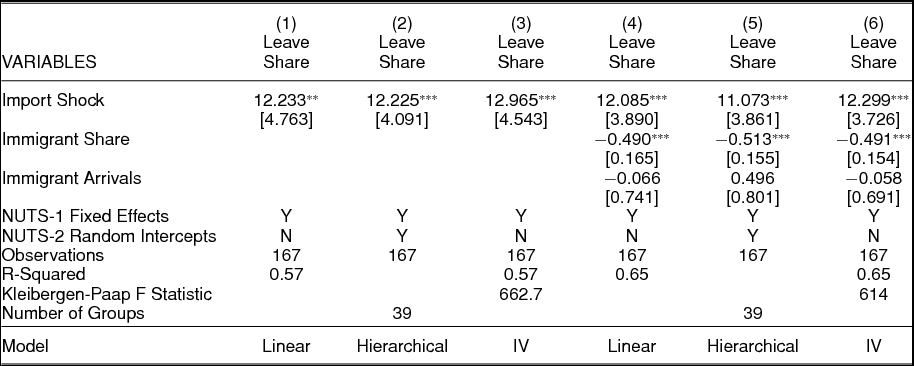
Table 1 reports the baseline estimates of Equation (1), where the dependent variable is the Leave vote share at the NUTS-3 level. In columns 1-3, we estimate a parsimonious specification, which includes only the import shock and NUTS-1 fixed effects αj(i). Specifically, the model in column 1 is OLS. The one in column 2 includes random intercepts at the NUTS-2 level, in addition to NUTS-1 fixed effects. Column 3 reports IV estimates of the model in column 1, where Chinese imports to the United Kingdom are instrumented through Chinese imports to the United States. The coefficient of the import shock is always positive, and clearly bounded away from zero. The results are basically unchanged in magnitude and significance across the three columns. The first-stage coefficient on the instrument used in column 3 is positive (0.128) and significantly different from zero (t = 25.7). The F-statistic is also very high, signaling the strength of the instrument. The IV coefficient in the second stage is pretty close to the OLS one, pointing to the absence of a clear endogeneity bias.
Regional-level Results

Standard errors clustered by NUTS-2 area in all columns except 2 and 5.
***p < 0.01, **p < 0.05, *p < 0.1
The effect of the import shock is substantively quite significant: two regions—within the same NUTS-1 macroregion—that differ by one standard deviation in strength of the import shock, are expected to differ by almost 2 percentage points in support for Leave. If we compare a region at the 10th percentile of import shock (0.15—Cardiff and Vale of Glamorgan) with a region at the 90th percentile (0.51—Gwent Valleys), both located in the same NUTS-1 macroregion (Wales), these are expected to differ by 4.5 percentage points. In fact, their actual Leave vote share differed by 16 percentage points.
What amount of variation in Leave share does the import shock explain? The R 2 of model 1 in Table 1 is not directly informative, as the model includes NUTS-1 dummies. Omitting these dummies, the R-square is 0.14: one seventh of the variation in the Leave share at the NUTS-3 level is predictable based on the import shock alone. If one were to look at the aggregates at the NUTS-2 level—that is, regressing NUTS-2 averages of the Leave share on NUTS-2 averages of the import shock—the R 2 would be 0.21. The same exercise, at the NUTS-1 level, would yield an R 2 of 0.38.
To further gauge the role of import competition, we can perform some back-of-the-envelope calculations under plausible counterfactuals. In particular, if all the regions had received the shock of a region at the first quartile (0.22 like Wirral, in Merseyside) the national vote share for Leave (omitting Northern Ireland) would have been around 48.5%, reversing the referendum outcome.Footnote 7 This conservative calculation assigns to one quarter of the regions a shock stronger than the one they experienced. Notably, among the regions in the first quartile are populous areas in Merseyside and Greater London, not to mention most areas of Scotland. Leaving all the regions below the first quartile untouched, and assigning the first quartile import shock to all the others, the predicted vote share for Leave is around 47.7%. By and large, the Chinese import shock emerges as an important determinant of Brexit.
In columns 4-6 of Table 1, we add two variables on immigration: immigrant share and immigrant arrivals. We report the results for a linear model with NUTS-1 fixed effects (column 4), NUTS-2 random intercepts, NUTS-1 fixed effects model (column 5), and an IV model with NUTS-1 fixed effects (column 6). The effect of the import shock remains positive, statistically significant, and stable in size.Footnote 8
In column 4, the share of immigrants is negatively and significantly related to support for the Leave option, consistent with earlier evidence, while the coefficient on new arrivals is negative but not statistically different from zero.Footnote 9 A one-standard-deviation increase in the share of immigrants (11.2%) is associated with lower support for Leave by about 5.5 percentage points. The results are essentially unchanged in the multilevel and IV estimations, both for the import shock and for the immigration variables.
In Section C of the Online Appendix, we augment the specification of column 4 in Table 1 with a large number of additional controls. Tables A3 to A5 report results controlling for additional immigration measures, political and social factors, and economic factors. The inclusion of these variables is motivated by the correlational evidence presented in other contributions, and most comprehensively in Becker, Fetzer, and Novy (Reference Becker, Fetzer and Novy2016). We do not consider these models as yielding the most accurate estimate of the effect of the import shock, as many of the controls are plausibly post-treatment, and the inclusion of a large number of covariates introduces collinearity issues.Footnote 10 Nonetheless, the robustness of our main result under several different specifications can assuage doubts about the importance of Chinese competition as a determinant of Brexit. In Table 2, we only report the most relevant results. We refer to the Online Appendix for a full discussion of the robustness checks.
Regional-Level Robustness

Standard errors clustered by NUTS-2 area in all columns.
***p < 0.01, **p < 0.05, *p < 0.1
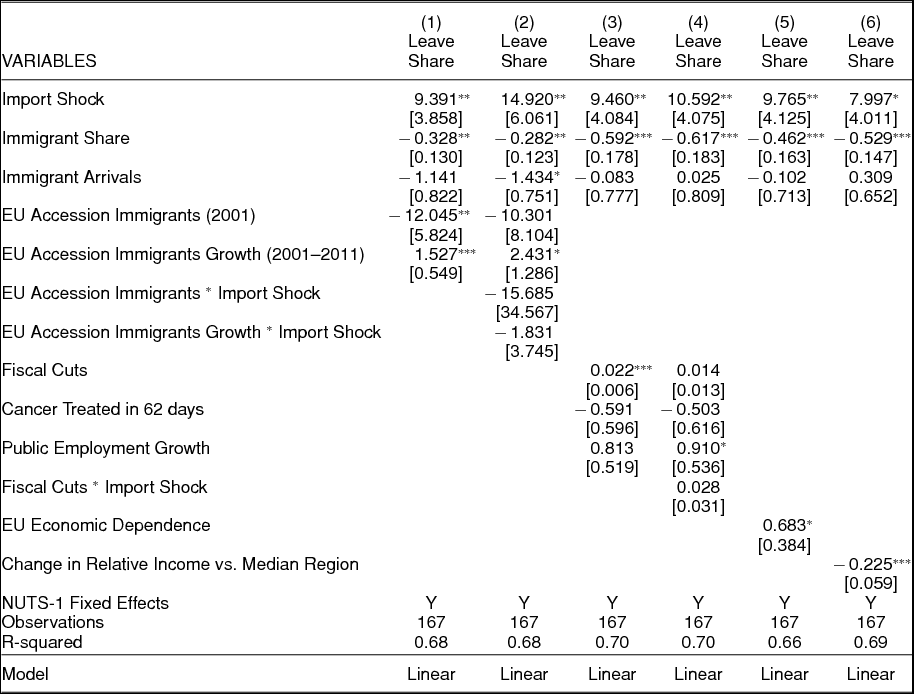
In column 1 of Table 2, we control for the initial stock of immigrants from countries that joined the European Union after 2004 (EU Accession Immigrants), and for its growth rate. Regions with a larger stock of immigrants from EU accession countries in 2001 were on average less supportive of Leave, while regions that experienced faster growth in EU accession immigrants between 2001 and 2011 were more supportive of Leave. A one-standard-deviation difference in the growth rate is associated with an increase in expected vote for Leave by around 2.5 percentage points. In column 2, we include interactions between the import shock measure and the EU accession immigration variables to provide a first exploration of the interplay between Chinese competition and immigration as complementary factors behind Brexit. Indeed, immigration might be perceived more as a problem in regions that are experiencing long-term economic decline induced by a contraction of manufacturing. None of the interactions, though, are close to statistical significance, pointing to the absence of evidence in favor of heterogeneity in the effect of the import shock as a function of immigration. Importantly, the coefficient on the import shock is always positive and statistically significant, and approximately of the same magnitude as compared to the baseline estimate of column 4 in Table 1. In light of the importance that immigration had in the referendum campaign, we further explore the interplay between Chinese imports and attitudes about immigration in the individual-level analysis.
Next, we include measures of fiscal cuts and underprovision of public services to explore how they might compound with the globalization shock in affecting the referendum outcome. We focus on three variables: Fiscal Cuts, Cancer Treated in 62 Days, and Public Employment Growth. Fiscal Cuts is the average financial loss per working adult in each region, due to reduced benefits as a consequence of fiscal cuts implemented in the United Kingdom between 2010 and 2015.Footnote 11 Data sourced from Beatty and Fothergill (Reference Beatty and Fothergill2013) at the level of local authorities are aggregated at the NUTS-3 level. Cancer Treated in 62 Days, a proxy for National Health Service (NHS) quality, is the share of suspected cancer patients treated within 62 days from the moment in which they are first seen by a doctor. We aggregate at the NUTS-3 level the NHS data for “clinical commission groups” in England and “boards” in Scotland and Wales. Public Employment Growth, an additional proxy for the provision of public services within each area, is the growth rate in public employment within each region between 2009 and 2015, computed from Business Register and Employment Survey data. We standardize and center all these variables for ease of interpretation of the interactive models.
In column 3, we include the three variables as linear controls. Only the coefficient on fiscal cuts is statistically significant, pointing to a positive—albeit small—association with the Leave vote share. The coefficient on the import shock remains positive, statistically significant, and in line with the baseline estimate. In column 4, we interact import shock and fiscal cuts. The interaction term is not statistically significant; nevertheless, there is mild evidence that the impact of the shock was stronger in areas hit harder by fiscal austerity. Notice, though, that, by construction, higher fiscal cuts are recorded in areas in which relatively more people relied on government transfers in the first place. As discussed by Becker, Fetzer, and Novy (Reference Becker, Fetzer and Novy2016), most austerity policies entailed linear cuts; regional variation in their impact is largely driven by variation in local demand for benefits. As a result, Fiscal Cuts might be itself endogenous to economic distress deriving (also) from import competition. Similar results are presented in the Online Appendix for the interactions between the import shock and the other two variables.
In column 5, we include an index of EU Economic Dependence: the share of regional value added attributable to consumption and investment demand in other EU countries. This can be interpreted as a proxy for EU economic integration of a region. Data for 2010 are sourced from Springford et al. (Reference Springford, McCann, Los and Thissen2016), who provide an interregional extension of the World Input Output Database (Timmer et al. Reference Timmer, Dietzenbacher, Los, Stehrer and Vries2015).Footnote 12 The coefficient on this variable is positive and close to statistically significant, in line with earlier findings (Becker, Fetzer, and Novy Reference Becker, Fetzer and Novy2016; Springford et al. Reference Springford, McCann, Los and Thissen2016).Footnote 13 This result points to a nonfully instrumental dimension of the Leave vote choice, as regions that stood to lose more from Brexit were more supportive of it. Importantly, the coefficient on the import shock is still positive and statistically significant.
Finally, in column 6, we include a measure capturing the most comprehensive channel through which globalization might induce spatial variation in voting behavior: an increase in inequality across regions through the creation of geographically concentrated “winners” and “losers.” In particular, we include as a regressor the Change in Relative Income (CRI) between 1997 and 2015, computed as explained earlier with respect to the median region. By doing this, we are essentially blocking an important channel for the effect of the Chinese import shock. The coefficient on CRI is negative and significant, pointing to higher support for Leave in areas falling behind in relative terms. Nevertheless, the coefficient on the import shock is still positive and, albeit smaller, in the same order of magnitude of the baseline estimate (around 8 vs. 12 in the main specification of Table 1). The effect of imports is less precisely estimated, hence the p value falls just above conventional levels of statistical significance (being equal to 0.053).
If we regress CRI on the import shock—instrumented using U.S. imports from China—we find that a one-standard-deviation increase in the strength of the shock leads to a decrease in CRI by a quarter of a standard deviation. While this is not a proper mediation analysis, it suggests that the import shock is an important determinant of heterogeneity in regional performance, which is at the core of our identification strategy. We can also use CRI as a measure of the “treatment,” and the import shock instrument as an instrument for CRI in a regression with Leave share as outcome. Such a model estimates that a decline like the one experienced by Thurrock leads, all else equal, to an increase in the Leave vote share by almost 15 percentage points; a decline like the one experienced by Torbay leads to an increase in Leave share by 10 percentage points; and a convergence to the median like that experienced by North Lanarkshire leads to a decrease in support for Leave by around 25 percentage points.
Individual-Level Data
Individual-level data allow us to investigate more in depth the patterns underlying the effect of the import shock at the regional level. We can use two sources: Wave 8 and Wave 9 of the British Election Study. Wave 8 contains self-reported vote intentions, as it was carried before the referendum. Wave 9 also contains some information on self-reported voting behavior, since some of the respondents were interviewed after the referendum. The main advantage of Wave 8 is that it also contains information on attitudes and perceptions about immigration, which we exploit in our analysis of the interplay between the import shock and immigration in the next section. In light of this, to avoid confusion deriving from using different samples in different estimations, all the results presented in this section are based on Wave 8. Nevertheless, in Section D of the Online Appendix, we replicate exactly the same tables using Wave 9 data. The results are substantially unchanged.
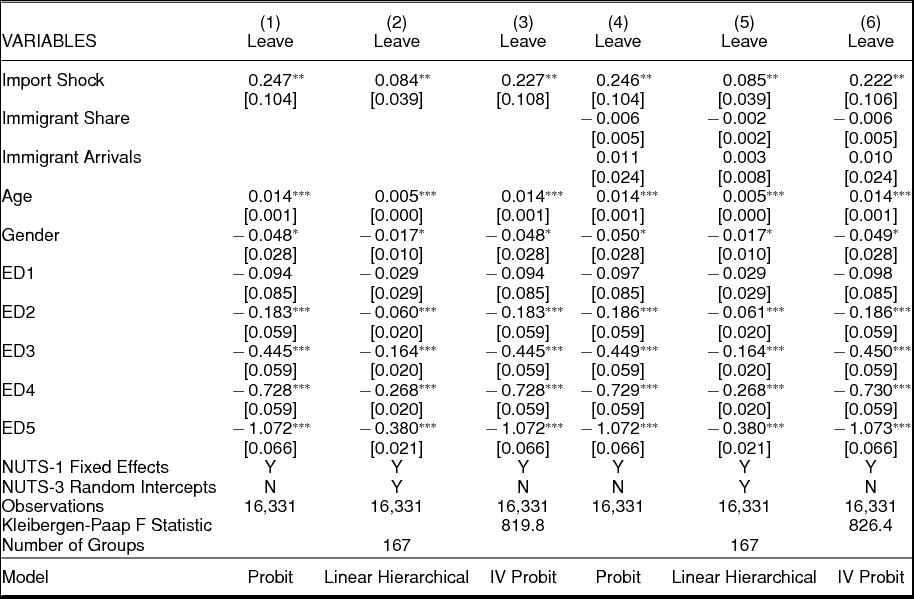
Table 3 reports the baseline estimation results of Equation (2), where the dependent variable is an indicator equal to one if the respondent declares the intention to vote for the Leave option. We proceed as in the regional-level analysis. Columns 1–3 refer to a parsimonious specification in which we only include the import shock, NUTS-1 fixed effects αj(ℓ), and those basic background covariates at the individual level that are either clearly pretreatment (Age and Gender) or plausibly pretreatment (education level). Specifically, education is controlled for through five dummies indexing increasing levels of attainment, with the control group made up by individuals with no qualifications.Footnote 14 Column 1 reports results from a probit estimation with clustered standard errors. Column 2 refers to a multilevel linear probability model, with NUTS-3 random intercepts in addition to NUTS-1 fixed effects. Column 3 shows results from an IV probit with the same specification as in column 1, where Chinese imports to the United Kingdom are instrumented using Chinese imports to the United States. In columns 4 to 6, we augment the models of columns 1 to 3, respectively, by adding the two variables on immigration.
Individual-Level Results

Standard errors clustered by NUTS-3 area in all columns except 2 and 5.
***p < 0.01, **p < 0.05, *p < 0.1
The effect of the import shock on the propensity to vote Leave in the referendum is positive and statistically significant across the board, regardless of the estimation method. Also in this case, the IV probit yields approximately the same coefficient as the plain probit, further reassuring us about the absence of a clear endogeneity bias. The individual-level evidence on import competition is fully consistent with the regional-level results in Table 1. In particular, in substantive terms, the magnitude of the effect is essentially the same. For instance, considering the linear probability model of column 5 in Table 3, the import shock coefficient of 0.085, with a standard error of 0.039, is not statistically different from 0.12, the coefficient estimated across specifications in Table 1, accounting for the different scale of the dependent variable. Specifically, the regional dependent variable is on a 0–100 scale, and the estimated coefficient is 12. Rescaling the vote share on a 0–1 scale, making it directly comparable with the individual probability of voting Leave, yields a coefficient of 0.12, with a standard error of 0.04, thus not statistically distinguishable from 0.085.
A difference between regional and individual-level results emerges on the share of immigrants, with a negative and significant coefficient in the regional analysis but not in the individual one. In Section F of the Online Appendix, we show how this difference might be driven by a correlation between sociodemographic composition of the population and incidence of immigration across regions. In particular, consistent with earlier evidence, our findings in Table 3 suggest that older, male, and less educated voters are more likely to support Leave. Once these factors are accounted for, in the individual-level analysis, the immigrants’ share loses significance. This is consistent with relatively more immigrants settling in regions with younger and more educated population (for example, London).
How big is the effect of import competition? The coefficient on the linear probability model in column 5 is 0.085. This implies that a change in the import shock from the minimum (0.06) to the maximum (0.75) would induce an increase in the probability of supporting Leave by around 6 percentage points. One gets a similar figure by computing marginal effects from the IV probit in model 6. To describe this further, let us compare two individuals of the same age, gender, and education, who live in the same NUTS-1 region but in two different NUTS-3 regions. Suppose that one NUTS-3 region gets a weak import shock (at the 10th percentile) and the other gets a strong shock (at the 90th percentile). Then, the individual living in the region facing the stronger shock is 3 percentage points more likely to support Leave than the other individual. Overall, the effect we detect is far from negligible, pointing to swings that could have been decisive in reversing the referendum outcome. Notably, our estimates are also net of average shocks at the NUTS-1 level, which are captured by the fixed effects.
The British Election Study database contains information on the political orientation of respondents. In particular, we know which party they feel closest to (that is, their party ID), as well as their left-right self-placement. These variables are post-treatment to the extent that people choose or revise their political orientation or affiliation due to the globalization shock. Nevertheless, their inclusion in the specification does not alter our probit results, that is, the coefficient on the import shock remains positive and statistically significant. Not surprisingly, we find that supporters of the UKIP and, to a lesser extent, Tory identifiers, are significantly more in favor of Leave (by almost 40 percentage points in the case of UKIP). In addition, our evidence shows that, in general, more right-wing individuals favor Leave at higher rates. We also interact the import shock with dummies for party ID. As one might expect, we find that the import shock has a particularly strong effect on Labour and Scottish National Party identifiers (two groups whose party directorates officially sided with Remain) and with nonidentified voters.Footnote 15
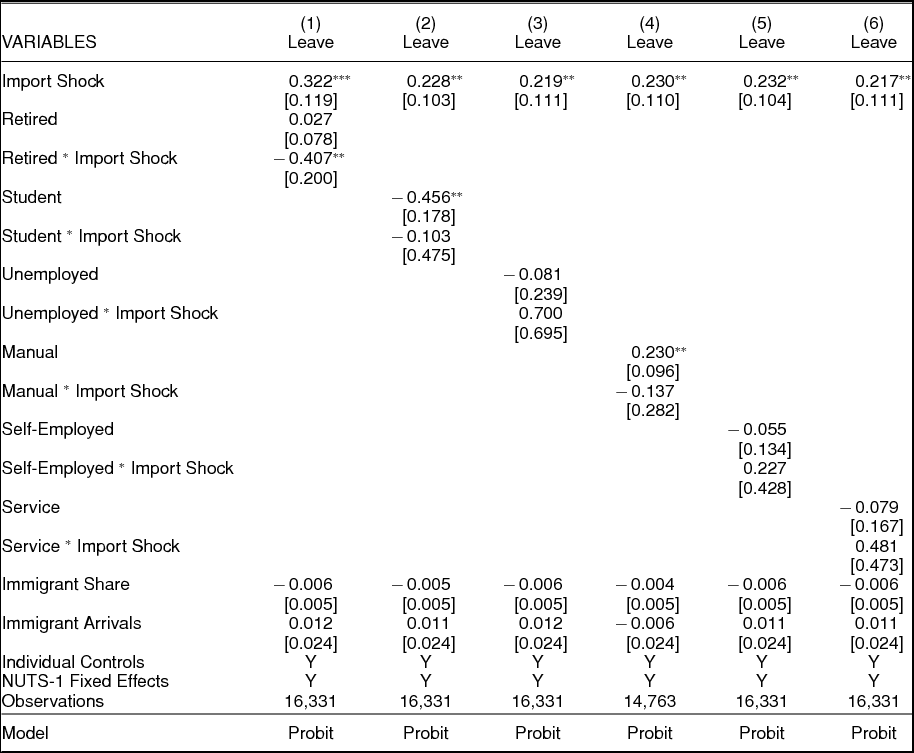
In Table 4, we investigate how the effect of the Chinese import shock varies across individuals depending on their labor market status and occupation. We do so by augmenting the probit model of column 4 in Table 3 with dummies for specific categories of people, as well as interactions of these dummies with the import shock variable. In particular, we consider six dummies indicating, respectively: retired people (column 1), students (column 2), unemployed (column 3), manual workers (column 4), self-employed (column 5), service workers (column 6).Footnote 16
Individual-Level Results with Labor Market Interactions

Standard errors clustered by NUTS-3 area.
***p < 0.01, **p < 0.05, *p < 0.1
Results in column 1 suggest that retired people are essentially sheltered from the import shock. There is also evidence that, regardless of the shock, students are less likely to vote for Leave (column 2), while manual workers are more likely to do so (column 4). Besides that, in columns 2 to 6, all the interactions between our dummies and the import shock are not statistically different from zero. At the same time, the coefficient on the linear term of the shock is still positive and significant across the board. Overall, this evidence suggests that the impact of import competition is not restricted to a specific category of voters, for example, the unemployed, who might be most directly affected by the shock. Rather, the effect is not statistically different from the average even for service workers, whose jobs are not directly affected by manufacturing imports from China.Footnote 17 By and large, this evidence is consistent with a sociotropic reaction of voters to the globalization shock, rather than a purely pocketbook one. In other words, individuals seem to respond broadly to the general economic situation of their region, regardless of their specific condition.
The Role of Immigration
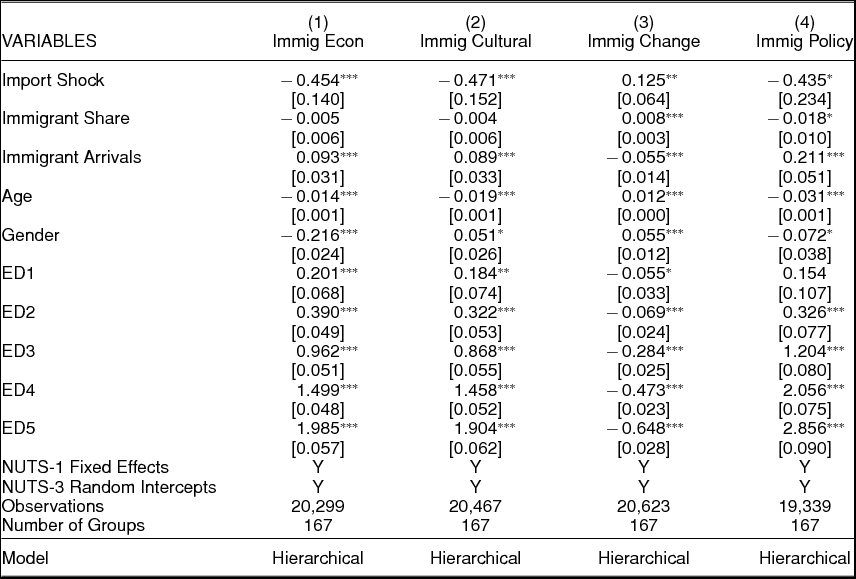
In the results shown so far, there is only weak evidence that the incidence of immigration in a region is a driver of Leave votes. This may seem surprising, given the importance of immigration as a self-reported motivation of Leave supporters (Ipsos MORI 2016; Ashcroft Reference Ashcroft2016). Wave 8 of BES allows us to investigate this issue further, since we have data on the perceptions of and attitudes towards immigration at the individual level. In particular, we employ four variables related to the belief that immigration is good for Britain’s economy (Immig Econ) and cultural life (Immig Cultural), the perception as to whether immigration is getting higher (Immig Change), and the stance as to whether more immigrants should be allowed in the United Kingdom (Immig Policy). Higher values on Immig Change denote a stronger perception of increasing immigration. For the other three variables, higher values are associated with more positive views of immigration.Footnote 18
Table 5 shows results from linear multilevel regressions where the dependent variable is, alternatively, one of the four variables capturing attitudes and perceptions on immigration.Footnote 19 On the right-hand side, the specification is the same as in column 5 of Table 3. In all the regressions, we find that individuals in NUTS-3 areas that have witnessed a stronger import shock tend to have more negative attitudes and perceptions with respect to immigration. The effect of the import shock is in itself substantively modest in size, but nonetheless far from negligible. For instance, if we compare two otherwise similar respondents residing in the same NUTS-1 macroregion, and, respectively, in a NUTS-3 region at the 10th and at the 90th percentiles of import shock, they are expected to differ by around one tenth of a standard deviation of Immig Econ.Footnote 20
Determinants of Attitudes Towards Immigration

Standard errors in brackets
***p < 0.01, **p < 0.05, *p < 0.1
In addition, the coefficients for background individual characteristics are predictive of immigration attitudes and beliefs in unsurprising directions given the extant results in the literature (e.g., Mayda Reference Mayda2006): more educated, younger, and female respondents are in general less concerned with immigration, less supportive of restrictions, and perceive smaller trends in immigration.
The stock and inflow of immigrants in the area in which the respondent resides have a somewhat counterintuitive association with attitudes and beliefs about immigration. In particular, while the stock of immigrants is significantly and positively associated with a perceived stronger trend in immigration, the inflow of immigrants is statistically significantly associated with more favorable views of immigrants, and also with a smaller perceived trend in immigration. This evidence lines with existing studies showing how attitudes about immigration are to some extent unrelated to the actual presence of immigrants (Fetzer Reference Fetzer2000; McLaren Reference McLaren2003; Sides and Citrin Reference Sides and Citrin2007).
While this piece of analysis does not aim at being a comprehensive exploration of immigration attitudes in Great Britain, our results suggest that one of the channels through which the Chinese import shock might increase Leave support is by worsening people’s concerns with immigration. This finding is consistent with earlier studies showing that anti-immigration attitudes are largely driven by perceptions of the state of the economy (e.g., Citrin et al. Reference Citrin, Green, Muste and Wong1997).
There are three main, nonmutually exclusive mechanisms that might link import shock and immigration concerns. First, increased scarcity of employment opportunities, driven by the crisis of traditional manufacturing due to globalization, might have triggered concerns about increased competition from immigrants. Evidence exists that immigration to the United Kingdom has had little effect on native employment rates or wages (Dhingra et al. Reference Dhingra, Ottaviano, Van Reenen and Wadsworth2016). Yet, workers might hold a “lump-of-labor” belief, by which the labor market is perceived as a zero-sum game: if someone wants to get a job, she needs to take it away from someone else (Kemmerling Reference Kemmerling2016). In that case, regardless of the real effects of immigration, voters would be acting with the goal of protecting their employment prospects.
Second, and relatedly, we might be observing a “scapegoating” phenomenon like the one detected by Cochrane and Nevitte (Reference Cochrane and Nevitte2014), who show how anti-immigrant sentiments are systematically associated with the combination of high unemployment and the presence of a radical right party. This would be involved in shifting blame for unemployment toward immigrants. The main proponent of Brexit was the U.K. Independence Party, which can also be uncontroversially classified as a populist anti-immigrant party.
Third, an increased reliance on existing welfare state provisions, related to the globalization shock, might spur concerns that immigration creates overcrowding and congestion for users of public services. The role of this type of concern in creating anti-immigrant attitudes is documented by Hainmueller and Hiscox (Reference Hainmueller and Hiscox2010).
We are agnostic regarding which one of the mechanisms is most important. It might even be that anti-immigration sentiments and the Brexit vote are spuriously related, being held together only by party politics and policy bundling. Golder (Reference Golder2003) shows that immigration, especially when combined with high unemployment, leads to support for populist extreme-right parties. The UKIP happens to be, at the same time, a populist anti-immigration party, and the main agitator behind the Leave campaign. It is beyond the scope of this article to empirically adjudicate among the mechanisms, or estimate their relative importance in the British electorate at the time of Brexit.
CONCLUSION
In this article, we show how globalization affected the vote for Brexit. Our findings suggest that geographically concentrated economic distress—driven by the Chinese import shock—led to an increase in Leave support. The evidence we provide leads to some considerations. First, to understand Brexit, but also analogous phenomena like support for radical right parties in Western Europe, or the success of Trump in the 2016 presidential race, it is important to allow for a central role of “globalization without compensation.” While trade liberalization is estimated to have generated net welfare gains in advanced countries, its benefits have been distributed highly unequally, leaving some social groups and, importantly, some geographic areas worse off. The inability of governments to set up effective compensation policies for the “left behind” of globalization might have led to a crisis of embedded liberalism, breeding isolationism and neonationalism.
It is questionable whether Brexit will lead to any relief for the segments of society bearing most of the adjustment costs from globalization. If anything, exiting the EU might entail even more trade integration between the United Kingdom and China, through a new free-trade agreement. Without a general shift of policy making in a more inclusive direction, Brexit might end up frustrating the expectations of many.
SUPPLEMENTARY MATERIAL
To view supplementary material for this article, please visit https://doi.org/10.1017/S0003055417000685.
Replication material can be found on Dataverse at https://doi.org/10.7910/DVN/AL1A4Q.







Comments
No Comments have been published for this article.