Introduction
Cognitive impairment is well recognized as a hallmark of severe psychiatric conditions including bipolar disorder (Balanzá-Martínez et al., Reference Balanzá-Martínez, Tabarés-Seisdedos, Selva-Vera, Martínez-Arán, Torrent, Salazar-Fraile and Gómez-Beneyto2005; Deckersbach, Savage, et al., Reference Deckersbach, Savage, Reilly-Harrington, Clark, Sachs and Rauch2004; Sánchez-Morla et al., Reference Sánchez-Morla, Barabash, Martínez-Vizcaíno, Tabarés-Seisdedos, Balanzá-Martínez, Cabranes-Díaz and Gómez2009; Van Rheenen & Rossell, Reference Van Rheenen and Rossell2013a). Growing evidence suggests that patients with BD demonstrate a compromised cognitive profile across several core domains including executive functioning and verbal learning/memory (Balanzá-Martínez et al., Reference Balanzá-Martínez, Rubio, Selva-Vera, Martinez-Aran, Sánchez-Moreno, Salazar-Fraile and Tabarés-Seisdedos2008; Bora, Yucel, & Pantelis, Reference Bora, Yucel and Pantelis2009; Ferrier, Stanton, Kelly, & Scott, Reference Ferrier, Stanton, Kelly and Scott1999; Robinson & Ferrier, Reference Robinson and Ferrier2006; Robinson et al., Reference Robinson, Thompson, Gallagher, Goswami, Young, Ferrier and Moore2006; Schulze et al., Reference Schulze, Walshe, Stahl, Hall, Kravariti, Morris and Bramon2011). Given that these impairments are evident for both diagnostic subtypes (Bipolar I and II), and in euthymic, symptomatic, and at risk groups, they may well represent trait like endophenotypic markers for the disorder (Bora et al., Reference Bora, Yucel and Pantelis2009; Solé et al., Reference Solé, Bonnin, Torrent, Balanzá-Martínez, Tabarés-Seisdedos, Popovic and Vieta2012). Verbal memory and learning impairments in particular, have been demonstrated in several BD samples on standard learning and recall index scores (Bearden et al., Reference Bearden, Glahn, Monkul, Barrett, Najt, Kaur and Soares2006; Deckersbach, Savage, et al., Reference Deckersbach, Savage, Reilly-Harrington, Clark, Sachs and Rauch2004; Gogos, Joshua, & Rossell, Reference Gogos, Joshua and Rossell2010; van Gorp, Altshuler, Theberge, & Mintz, Reference van Gorp, Altshuler, Theberge and Mintz1999). Yet, despite meta-analytic studies indicating medium to large effect size differences, few studies have attempted to define the underlying mechanisms involved in this impairment (Bora et al., Reference Bora, Yucel and Pantelis2009; Robinson et al., Reference Robinson, Thompson, Gallagher, Goswami, Young, Ferrier and Moore2006). Given that verbal memory dysfunction might reflect the outcome of genetic influences on distinct brain regions implicated in the pathophysiology of BD, greater attention toward uncovering the fundamental processes contributing to memory impairment in the disorder is certainly a crucial step toward improving knowledge of its underpinning factors.
Declarative memory encompasses various component processes enabling the encoding, consolidation, and retrieval of information. These terms describe the means by which information is transformed into memory traces and subsequently stored and reactivated at will. It is well recognized that medial temporal neural areas are involved in encoding and retrieval; however, higher order cortical regions have also been implicated in the strategic aspects of memory function (Blumenfeld & Ranganath, Reference Blumenfeld and Ranganath2007; Martin & Chao, Reference Martin and Chao2001; Miotto et al., Reference Miotto, Savage, Evans, Wilson, Martins, Iaki and Amaro2006; Squire & Zola-Morgan, Reference Squire and Zola-Morgan1991; Squire, Stark, & Clark, Reference Squire, Stark and Clark2004). In particular, verbal memory is thought to rely, in part, on the use of an organizational strategy known as semantic clustering, that is mediated by prefrontal regions of the brain (Martin & Chao, Reference Martin and Chao2001). This strategy of grouping items according to their semantic categories is believed to improve the structure of memory traces and assist in their retrieval. Its poor usage is characteristic of brain damaged individuals or patients living with disorders in which frontal lobe abnormalities, which are tied to impairments in semantic organization, are prominent (e.g., Alzheimer’s Disease or Schizophrenia; Gaines, Shapiro, Alt, & Benedict, Reference Gaines, Shapiro, Alt and Benedict2006; Rossell & David, Reference Rossell and David2006; Rossell, Rabe-Hesketh, Shapleske, & David, Reference Rossell, Rabe-Hesketh, Shapleske and David1999).
BD itself is a disorder in which abnormalities in prefrontal and temporal neural function are documented (Robinson et al., Reference Robinson, Bearden, Monkul, Tordesillas-Gutiérrez, Velligan, Frangou and Glahn2009; Strakowski et al., Reference Strakowski, Adler, Almeida, Altshuler, Blumberg, Chang and Townsend2012; Van Rheenen & Rossell, Reference Van Rheenen and Rossell2013b; Whalley et al., Reference Whalley, McKirdy, Romaniuk, Sussmann, Johnstone, Wan and Hall2009). Although these abnormalities appear to contribute to memory deficits in the disorder, the extent to which they occur as a function of prefrontally mediated strategic organizational deficits during encoding is indefinite; as is the extent to which memory impairments represent the outcome of problems occurring during information acquisition as opposed to information consolidation or retrieval phases. For example, evidence from the few studies in BD to have comprehensively examined group related differences in variables indexing the component processes of verbal declarative memory ability is mixed; using the California Verbal Learning Test (CVLT), Deckersbach, Savage, et al. (Reference Deckersbach, Savage, Reilly-Harrington, Clark, Sachs and Rauch2004) reported impaired semantic strategies during learning in BD patients, which in turn partially mediated delayed recall performance. In contrast, Bearden and colleagues (Reference Bearden, Glahn, Monkul, Barrett, Najt, Kaur and Soares2006) failed to find these semantic effects on the same measure. They did however, observe delayed recall dysfunction in the absence of a deficit in retention, which was taken as suggesting that group differences in recall were related to differences in the initial encoding process, rather than differences in the storage of information.
Here, we aim to provide further clarity regarding the nature of declarative memory impairment by reporting a comprehensive investigation of the profile of deficits in a well-characterized sample of BD patients compared to controls. Importantly, we chose to use the HVLT-R as the primary dependent measure due to recent calls from the International Society of Bipolar Disorders for its utility to be established in this cohort (Yatham et al., Reference Yatham, Torres, Malhi, Frangou, Glahn, Bearden and Chengappa2010). The HVLT-R is part of widely used consensus based measure of cognitive functioning called the MATRICS Consensus Cognitive Battery (MCCB), which was originally designed for use in schizophrenia. The battery is backed by the U.S. Federal Drug Administration as the accepted battery for use in pro-cognitive trials assessing the effectiveness of cognitive-enhancing drugs in schizophrenia and related disorders. It demonstrates excellent reliability in large multi-site trials and is likely to continue to serve as the gold standard measure for cognitive enhancement studies (Buchanan et al., Reference Buchanan, Keefe, Umbricht, Green, Laughren and Marder2011). Whereas we have provided recent evidence to suggest that the MCCB has utility in BD samples (Van Rheenen & Rossell, Reference Van Rheenen and Rossell2013a), the applicability of the HVLT-R’s specific component process indices to BD have not yet been established. This is important to further validating the use of the HVLT-R as part of a battery for ongoing use in assessing cognitive improvement in BD.
Therefore, in addition to specifically aiming to characterize the underlying mechanisms of memory dysfunction in BD, we also aimed to further establish the HVLT-R as an appropriate measure of verbal declarative memory in the disorder (see Van Rheenen & Rossell, Reference Van Rheenen and Rossell2013a, for the original reported total recall score for this sample). On the basis of prior neurobiological evidence implicating impairment in both prefrontal and medial temporal regions of the brain in BD pathology, we hypothesized that in comparison to controls, patients with BD would demonstrate deficits in those memory component processes’ that are heavily reliant on temporal lobe capacity (i.e., recall, learning, and recognition), as well as those reliant on prefrontal executive function (semantic clustering). A further aim was to validate our findings against other executive and declarative memory test data in this cohort.
Methods
This study was approved by the Alfred Hospital and Swinburne University Human Ethics Review Boards and abided by the Declaration of Helsinki. Written informed consent was obtained from each participant before the study began.
Participants
The clinical sample comprised 49 patients (16 male, 33 female) diagnosed as having DSM-IV-TR BD (BD I n=37; BD II n=12) using the Mini International Neuropsychiatric Interview (MINI: Sheehan et al., Reference Sheehan, Lecrubier, Harnett Sheehan, Amorim, Janavs, Weiller and Dunbar1998). Patients were recruited via community support groups and general advertisements and were all out-patients. Current mood symptomology was assessed using the Young Mania Rating Scale (YMRS: Young, Biggs, Ziegler, & Meyer, Reference Young, Biggs, Ziegler and Meyer1978) and the Montgomery Asberg Depression Rating Scale (MADRS: Montgomery & Asberg, Reference Montgomery and Asberg1979): there were 18 euthymic patients (defined as those that met strict criteria for YMRS and MADRS scores ≤8) and 32 symptomatic patients (defined as those that met criteria for YMRS and MADRS scores >8). Patients with significant visual or verbal impairments, neurological disorder and/or a history of substance/alcohol abuse or dependence during the past 6 months were excluded. Thirty-one patients were taking antipsychotic medications, 15 were using antidepressants, 16 were using lithium, and 10 were using benzodiazepines (21 polytherapy, 20 monotherapy, 5 unmedicated, and 3 failing to specify).Footnote 1
A control sample of 51 healthy participants (20 male, 31 female) were recruited for comparison purposes by general advertisement and contacts of the authors. Using the MINI screen, no control participant had a current diagnosis or previous history of psychiatric illness (Axis I). An immediate family history of mood and psychiatric disorder in addition to a personal history of neurological disorder, current or previous alcohol/substance dependence or abuse, visual impairments, and current psychiatric medication use was exclusion criteria for all controls.
All participants were fluent in English, were between the ages of 18 and 65 years and had an estimated pre-morbid IQ as scored by the Wechsler Test Of Adult Reading (WTAR) of >90.
Measures and Procedure
All participants completed the Hopkins Verbal Learning Test-Revised (HVLT-R: Brandt & Benedict, Reference Brandt and Benedict2001), which is contained in the MCCB. The task comprises a list of twelve words representing three semantic categories (four words per category) that are verbally presented across three consecutive free recall learning trials (trial 1, 2, and 3), followed by a delayed free recall trial (trial 4) 20–25 min later. The task also includes a recognition trial comprising 24 words (12 target words from the original list, 6 semantically related distractor words and 6 semantically unrelated distractor words), that are presented directly following the delayed trial. The HVLT-R was scored for the following variables of interest: (a) Free recall (number of correctly recalled words on trial 1, 2, and 3); (b) Total recall (trial 1–3); (c) Learning slope (average number of newly recalled correct words over trial 1–3; Benedict, Schretlen, Groninger, & Brandt, Reference Benedict, Schretlen, Groninger and Brandt1998); (d) Cumulative word learning (reflecting the interaction between the learning slope and total recall; Foster et al., Reference Foster, Drago, Crucian, Rhodes, Shenal and Heilman2009); (e) Delayed free recall; (f) Retention percentage rate (percentage rate of trial 4 divided by the higher of trial 2 or 3); (g) Recognition discriminability (total number of true positives minus the total number of false positives) and its subcomponents—semantically related and unrelated recognition errors (range, 0–6) and hits (range, 0–12); (h) Semantic clustering ratios (trial 1–4; see Woods, Rippeth, et al., Reference Woods, Rippeth, Conover, Gongvatana, Gonzalez, Carey and Grant2005) (i) Serial clustering ratios (number of times a correctly recalled word was followed by another correctly recalled word appearing in the same list order divided by the total number of words recalled per trial 1–4); (j) Retrieval Index (Recognition discriminability minus delayed free recall score; see Woods, Scott, et al., 2005b); (k) Response Bias (Br - the probability of saying yes to a word when in an uncertain state; Snodgrass & Corwin, Reference Snodgrass and Corwin1988); (l) Total Intrusion Errors (number of words recalled that were not on the HVLT-R list); and (m) Total Perseveration Errors (number of repetitions during the same recall trial).
To validate findings on the HVLT-R against other executive functioning and episodic memory data in the BD group, we analyzed the HVLT-R scores against scores from two additional neurocognitive tests from the MCCB; the total score from the Neuropsychological Assessment Battery: Mazes (White & Stern, Reference White and Stern2003) was used as a measure of prefrontally mediated executive functioning, and the total recall score (trial 1–3) of the Brief Visuospatial Memory Test-Revised (BVMT-R: Benedict, Reference Benedict2007) was used as a measure of visuospatial declarative memory.
Statistical Analysis
Demographic and clinical group differences were assessed via independent samples t tests or χ2 tests. Separate multivariate analyses of variance (MANOVA) were conducted to examine: (1) differences in recall across the three learning trials and the delayed recall trial and (2) differences in strategic organization across the four trials (semantic and serial clustering). Significant omnibus effects were followed up by univariate ANOVAs to determine group differences on specific variables. A series of independent t tests were used to examine potential differences between BD and control participants on the learning slope, retention rate, recognition discriminability index, and its subcomponents, retrieval index and for response bias and total errors (both intrusion and perseverations). Cohen’s d was calculated as a measure of effect sizes of the group comparisons, and bivariate correlations were used to assess the relationship between scores on the HVLT-R and scores on the Mazes and BVMT-R in the BD group.
To better understand the effects of diagnostic status on the variables of interest, all analyses were rerun in the patient group in an exploratory manner, comparing those diagnosed with BD I versus BD II. We also considered the effect of mood by comparing euthymic patients to those that were symptomatic. Bivariate correlations were also conducted to examine the relationship between the variables of interest and current mood severity as rated on the YMRS and MADRS.
All t tests, univariate ANOVAs, and correlations were conservatively corrected for multiple testing with an alpha set at .01.
Results
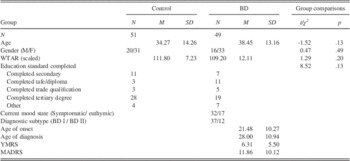
There was no significant difference in age, gender, education level completed, or pre-morbid IQ (as scored by the WTAR) between the two groups (Table 1).
Demographic and clinical characteristics of the sample

Note. ^ Group comparisons all independent samples t-tests except gender and education which was chi-squared.
M/F=Male / Female, WTAR=Wechsler Test of Adult Intelligence, YMRS=Young Mania Rating Scale, MADRS=Montgomery Asberg Depression Rating Scale.
Group Comparisons
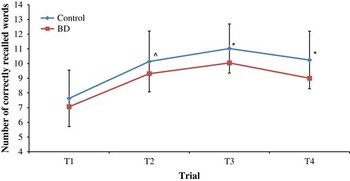
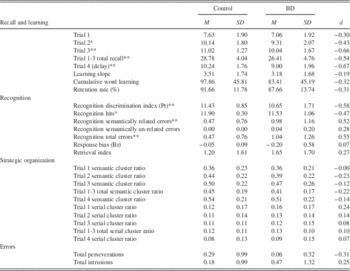
Figure 1 displays the number of words recalled across trials 1–4 in the BD and control groups. Table 2 displays the descriptive statistics for the remaining variables of interest. Results of the initial MANOVA analysis revealed a significant omnibus difference in total recall across the three learning trials and the delayed recall trial (F(4,95)=3.37; p=.01), with patients performing worse than controls overall. Follow-up ANOVAs indicated that this was largely driven by impairment in the BD group on the third and fourth trials; impaired performance on the second trial was also apparent in the BD group, although this did not survive correction for multiple testing. There were no significant omnibus effects evident when strategic organization between groups was assessed (semantic clustering: F(4,95)=.54; p=.70; serial clustering F(4,95)=.25; p=.91).
Word recall differences on trials 1-4 HVLT-R; Note: ^ trend at p<.05 (uncorrected for multiple testing); *p<.01 (corrected for multiple testing).

Descriptive statistics on the variables of interest

^Trend at p<.05(uncorrected for multiple testing); **p<.01(corrected for multiple testing).
d=Cohen’s d.
Independent t tests revealed that patients had lower scores on the recognition discrimination index (t(69.83)=2.86; p <.01), with a trend for less recognition hits (t(55.34)=2.36; p <.02) and more semantically related (t(82.01)=-2.60; p ≤.01), but not unrelated (t(48.00)=-1.46; p=.15) errors being made on the recognition trial. There were no significant differences in response bias (t(50.11)=1.79; p ≤.08), learning slope (t(98)=.95; p=.34) or cumulative word learning score (t(98)=1.59; p=.12), nor were there differences in the retention percentage (t(98)=1.57; p=.12), retrieval index (t(98)=-1.39; p=.17), total perseverations (t(60.60)=-1.60; p=.11) or intrusions (t(88.99)=-1.25; p <.22).
HVLT-R Correlations with Executive and Episodic Memory Measures
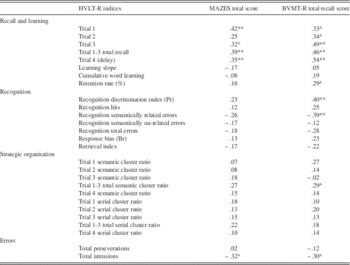
Trial 1, total recall and delayed recall scores on the HVLT-R were significantly associated with scores on the Mazes. Total recall and delayed recall scores were also associated with the total recall score on the BVMT-R, as were scores on trial 3, recognition discriminability and semantically related recognition errors (Table 3).
Correlations between HVLT-R, Mazes, and BVMT-R scores in the BD group

Note. Numerical values represent Pearson’s r correlations; ^trend at p<.05(uncorrected for multiple testing); **p<.01(corrected for multiple testing).
d=Cohen’s d; HVLT-R=Hopkins Verbal Learning Test-Revised; Mazes=Neuropsychological Assessment Battery: Mazes; BVMT-R=Brief Visuospatial Memory Test-Revised
Subgroup Comparisons
There were no between group effects on any of the variables of interest for patients diagnosed as having BD I versus BD II (all ps >.05), nor were there any between group main effects or interactions on any of the tasks for patients classified as euthymic or symptomatic (all ps >.05). Further bivariate correlations supported this, indicating no associations between current depression or mania severity and any of the variables of interest.
Discussion
Verbal memory impairment is a well-recognized feature of BD, although the underlying contributing mechanisms are not well established. This study aimed to further clarify its nature while examining the utility of a measure used to assess it; the HVLT-R, in a cohort of DSM-IV-TR diagnosed BD patients compared to controls. In partial support of our hypotheses we found that patients with BD had greater difficulty in learning the HVLT-R word list compared to their control counterparts. They also demonstrated impairment in the number of words they were able to recall after a 20- to 25-min interval. However, there were no differences between the groups in terms of their slopes of learning, or the proportion of information retained after a long delay. There was also no group difference evident on the cumulative word learning index that takes into account the interaction between the total number of words recalled and the average number of newly recalled correct words across the learning trials (i.e., the slope). Thus, it appears that the verbal memory impairment seen in this cohort of BD patients is primarily reflective of a reduced capacity to encode words on each trial, rather than in the curve of learning across them. Intact retention and retrieval index scores of BD patients in the presence of deficient recognition discriminability compared to controls provides further support that verbal memory impairment in BD is attributable to an encoding, relative to a consolidation or retrieval problem. Indeed, patients with BD exhibit deficits in their encoding capacity on other tests of memory (e.g., visuospatial memory: Deckersbach, McMurrich, et al., Reference Deckersbach, McMurrich, Ogutha, Savage, Sachs and Rauch2004), and the pattern of findings seen in the current study is supportive of past research using a comparative memory measure (Bearden et al., Reference Bearden, Glahn, Monkul, Barrett, Najt, Kaur and Soares2006; van Gorp et al., Reference van Gorp, Altshuler, Theberge and Mintz1999).
It should be noted that the impairment we are reporting in learning and recall is of the magnitude of one word during trial 2 and trial 3, thus two words over the task. In delayed recall the magnitude is between one and two words. This deficit falls into the moderate effect size range. The magnitude of this deficit is thus not as substantial as those with diagnoses of schizophrenia and schizoaffective disorder (Martinez-Aran et al., Reference Martinez-Aran, Vieta, Torrent, Sanchez-Moreno, Goikolea, Salamero and Ayuso-Mateos2007; Schretlen et al., Reference Schretlen, Cascella, Meyer, Kingery, Testa, Munro and Pearlson2007), but would still have a reasonable impact on everyday functioning. For example, mild memory impairments might worsen performance in complex daily activities, especially under tasks requiring greater cognitive processing. That is, when this memory impairment is coupled with other known deficits in executive and attentional function in BD, their combination is likely to significantly interfere with appropriate decision making, thinking under pressure and interacting with others.
Contrary to expectations, we did not observe differences in the organizational strategies used on the HVLT-R between patients and controls, which suggests that attention deficits are unlikely to account for the observed memory dysfunction. The comparable performance in organizational processing in the current study thus contradicts the findings of Deckersbach, Savage, and colleagues (Reference Deckersbach, Savage, Reilly-Harrington, Clark, Sachs and Rauch2004). However, these authors found that semantic organizational processing only partially mediated group differences in long delayed free recall in a path analysis. This suggests that other factors besides disparities in strategic processing were accountable for the deficit. Rather, our results support that of Bearden et al. (Reference Bearden, Glahn, Monkul, Barrett, Najt, Kaur and Soares2006), who in a larger sample observed recall deficits in the absence of those related to organizational strategizing. They also accord with the fact that in the current study, the recognition performance of BD patients partially reflected their tendency to make more false positive errors to semantically related distractor words, but not to semantically unrelated distractor words. This pattern of findings suggests that this BD cohort had a level of semantic over-activation which actually conferred greater susceptibility to them misremembering false items that were meaningfully related to the original memory stimuli (see Elvevåg, Fisher, Weickert, Weinberger, & Goldberg, Reference Elvevåg, Fisher, Weickert, Weinberger and Goldberg2004, for an explanation of this argument).
Taken together, our results indicate that memory consolidation and retrieval processes remain intact in BD. However, difficulties in the encoding of information may largely account for the verbal memory impairments consistently observed in the disorder. At first glance, the encoding deficit in this study does not appear to reflect a function of a qualitatively different pattern of strategic information organization in patients compared to controls. However, given the limited length of the HVLT-R word list, it is possible that more subtle organizational deficits were not adequately tapped by this measure. Furthermore, the learning slope and retention rates between groups did not differ, and the HVLT-R total and delayed recall scores were related to scores on both another measure of declarative memory and a measure of executive function. These data collectively suggest that although semantic clustering as assessed by the HVLT-R may appear preserved, the observed encoding impairments might still partially represent a prefrontally mediated executive abnormality. This is indeed a possibility given that the visuospatial declarative memory measure found to correlate with the HVLT-R here, also partially relies on prefrontal executive function. However this hypothesis is speculative and further research incorporating an additional memory measure that better isolates temporal-lobe capacity, is thus certainly needed to support the parsing of memory from executive component processes on the HVLT-R in BD.
Importantly, neither current mood status nor diagnostic subtype had any influence on the findings. This supports a large body of research indicating that memory impairment is a stable trait like feature of BD (Bearden et al., Reference Bearden, Glahn, Monkul, Barrett, Najt, Kaur and Soares2006; Bora et al., Reference Bora, Yucel and Pantelis2009; Deckersbach, Savage, et al., Reference Deckersbach, Savage, Reilly-Harrington, Clark, Sachs and Rauch2004; Robinson et al., Reference Robinson, Thompson, Gallagher, Goswami, Young, Ferrier and Moore2006). However, as the sizes of some of our subgroups were relatively small, and thus the subsequent exploratory analyses were underpowered, caution is warranted when interpreting these results. Similarly, it should be noted that although dichotomously coded medication effects were not evident when comparing patients on and off classes of psychotropic medication, it was not possible to partial out all their effects. Thus, we cannot completely discount that medication may have had an influence on memory performance.
Given that the pattern of findings presented here largely replicates previous results suggestive of encoding impairments elicited on a more frequently used measure of verbal memory for BD (the CVLT), it appears that the HVLT-R has utility in characterizing the component processes involved in memory dysfunction in the disorder. Indeed, our results indicate that this measure is sufficient for separating acquisition as opposed to information consolidation or retrieval impairments. It appears that these impairments can be elicited using this shorter, more easily administered measure of memory function. These findings are important given that the HVLT-R is a part of the MCCB; a recognized consensus based battery commonly used in schizophrenia cohorts, but with increasing use in BD as well. In the case that pro-cognitive clinical trials using the MCCB carry forward from schizophrenia samples, our findings suggest that the moderately effect-sized, significant encoding deficit observed here using the HVLT-R, may be sensitive enough to respond to medications designed to enhance verbal memory performance in BD.
The continued use of the HVLT-R in both BD and schizophrenia samples is also important in enabling the integration of data across these disorders, which will be useful for determining potential overlapping genetic variants with which performance on it may be associated (August, Kiwanuka, McMahon, & Gold, Reference August, Kiwanuka, McMahon and Gold2012; Burdick et al., Reference Burdick, Goldberg, Cornblatt, Keefe, Gopin, DeRosse and Malhotra2011; Tan & Rossell, Reference Tan and Rossell2014; Van Rheenen & Rossell, Reference Van Rheenen and Rossell2013a). However, it should be noted that our pattern of findings does also suggest that subtle organizational deficits may not be adequately tapped by the HVLT-R. The learning trial effect sizes observed here are also smaller than those found in other large scale meta-analyses of cognitive functioning in the disorder (Arts, Jabben, Krabbendam, & van Os, Reference Arts, Jabben, Krabbendam and van Os2008; Bora et al., Reference Bora, Yucel and Pantelis2009). This suggests that a more commonly used verbal memory measure such as the CVLT, may have better acuity in eliciting subtle group differences. Thus, while the HVLT-R may be sufficient for pro-cognitive clinical trials and for the purpose of integrating data across samples and diagnoses, it may not be particularly valuable as an exploratory tool for determining the underlying executive versus memory specific mechanisms of verbal declarative memory impairment. In light of these advantages and disadvantages, it may be useful for researchers using the MCCB in cognitive enhancing trials of BD, to consider augmenting it with an additional, more sensitive verbal learning measure.
In summary, our findings suggest that observable verbal memory impairment in BD is attributable to deficient encoding processes during the acquisition phase of learning, such that patients with BD learn less initially. This deficit is apparent independent of mood status or diagnostic subtype, which supports growing suggestion that it represents a trait-like feature likely to be underpinned by genetic influences that confer vulnerability to BD itself. Future research examining performance on the HVLT-R component process indices will certainly be important to establish whether these results hold in other BD cohorts.
Acknowledgments
The authors thank the Australian Rotary Health/Bipolar Expedition, Helen McPherson Smith Trust, and an Australian Postgraduate Award for financial support of this research. The authors declare no conflicts of interest.