Background
Heart transplant remains a treatment option for children with end-stage, refractory heart failure. The Registry of the International Society for Heart and Lung Transplantation regularly reports on many important clinical outcomes, including survival, complications, morbidities, and functional status in children following heart transplant.Reference Benden, Edwards and Kucheryavaya 1 These endpoints are quite relevant and give great guidance and insight to clinicians and families alike. However, few studies have reported on quality of life following heart transplant in children.Reference LaRosa, Baluarte and Meyers 2 , Reference Anthony, Pollock and Ng 3 Only recently have institutions begun to examine and report this critical issue. One such multi-centre study showed that paediatric heart transplant recipients are at risk for impairment in psychosocial quality of life.Reference Uzark, Griffin and Rodriguez 4
Evaluating quality of life in these patients is of utmost importance because increasing longevity and improving quality of life are the two reasons patients undergo heart transplant in the first place. Continued improvement in both of these areas benefits the patients and their families. Thus, a better understanding of quality of life in children who have undergone heart transplant, and the factors that affect it, will help to advance the field.
The purpose of this study was to demonstrate how quality of life correlates to age and activity levels, as well as body mass index in children following paediatric heart transplant. In addition, this study sought to evaluate quality of life in this population compared with previously reported quality of life in children with congenital heart disease.Reference Uzark, Jones, Slusher, Limbers, Burwinkel and Varni 5
Methods
This was a cross-sectional study design. A total of 14 consecutive patients who had previously undergone heart transplant had their health-related quality of life evaluated at a routine follow-up visit using two separate quality of life surveys. The study was approved by the Institutional Review Board at our institution.
Informed consent and assent was obtained in all patients before enrolment. Each patient completed the PedsQLTM 4.0 Generic Core Scales survey. This is a 23-item survey that assesses Physical Functioning (eight items), Emotional Functioning (five items), Social Functioning (five items), and School Functioning (five items). In addition, there is a Total Scale Score (23 items), Physical Health Summary Score (eight items), and Psychosocial Health Summary Score (15 items).
All patients were also given the PedsQLTM Cardiac Module, which is a disease-specific health-related quality of life survey with 23–27 items – depending on the patient’s age. The PedsQLTM Cardiac Module comprises the following six dimensions: heart problems and treatment, treatment, perceived physical appearance, treatment anxiety, cognitive problems and communication. The reliability and validity of the PedsQLTM 4.0 Generic Core Scales and the PedsQLTM Cardiac Module have been previously demonstrated and reported.Reference Varni, Burwinkle, Seid and Skarr 6 – Reference Uzark, Jones, Burwinkle and Varni 8 Patients completed the respective age-appropriate version of each survey and surveys were scored according to protocol provided by survey producers.
Patients wore an Omron HJ-150 pedometer for 7 days. They were asked to maintain their normal daily activity and only look at their pedometer when they recorded their steps each night. Pedometer readings were recorded for the 7-day period and an average daily step count was calculated for each patient. Age at the time of the patient’s heart transplant, as well as age and body mass index at the time of completing the quality of life survey, was recorded.
SPSS18 (SPSS Inc. Released 2009. PASW Statistics for Windows, Version 18.0. Chicago: SPSS Inc.) was used to perform statistical analysis. Descriptive statistics were generated for demographic and clinical variables and reported as means with standard deviations for continuous variables. Pearson correlation coefficients were calculated for age at heart transplant, age at time of quality of life survey administration, and body mass index compared with quality of life score in all quality of life categories. In addition, mean quality of life scores from all quality of life categories were compared between the 14 paediatric heart transplant patients and those previously reported for children with varying degrees of congenital heart disease.Reference Anthony, Pollock and Ng 3 A p-value<0.05 was considered statistically significant.
Results
All 14 patients had normal ejection fraction by most recent echocardiogram and had no signs of acute rejection. Furthermore, left ventricular end-diastolic pressures were all normal and no signs of graft coronary artery vasculopathy by angiography on most recent cardiac catheterisations. Patients were all on a calcineurin inhibitor and an antiproliferative agent, with 10 patients being on low-dose steroids, median dose 0.6 mg/kg/day (range 0.01–0.23 mg/kg/day). The age at assessment was 13.1±1.9 years and patients were 7.1±5.7 years post heart transplant, with heart transplant occurring on average at 5 years of age (range 0.5–17 years). Body mass index was 23.7±9.5 (61±30th percentile). The patients were fairly active with average daily step counts of 8078±2232. Gender was evenly distributed (7 male, 7 female). Reason for cardiac transplant was: idiopathic dilated cardiomyopathy in seven (50%), restrictive cardiomyopathy in one (7%), congenital heart disease in six (43%), with four of six being single-ventricle physiology who underwent palliation in some form earlier.
Quality of life compared with age, activity level, and body mass index
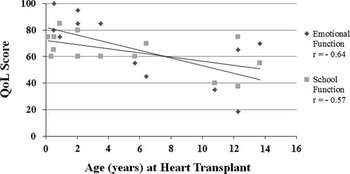
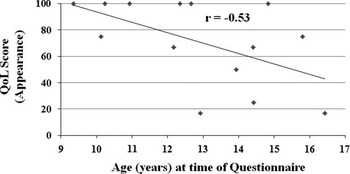
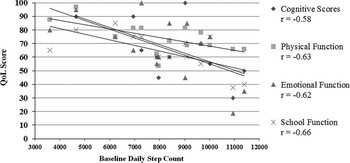
There was a negative correlation between age at first heart transplant and emotional function (r=−0.64; p<0.05) [linear regression demonstrates y (QoLscore)=−2.9×(age in years)+82.0] and school function (r=−0.57; p<0.05) [linear regression demonstrates y (QoLscore)=−1.6×(age in years)+72.0] (Fig 1). There was a negative correlation between patient’s age at assessment and perceived physical appearance (r=−0.53; p< 0.05) (Fig 2). Daily steps negatively correlated with cognitive function (r=−0.58; p<0.05), physical function (r=−0.63; p<0.05), emotional function (r=−0.62; p<0.05), and school function (r=−0.66; p<0.01) (Fig 3). There were no significant correlations between quality of life and body mass index.
Age at transplant versus quality of life score. Negative correlation between age (years) at first heart transplant and quality of life scores in emotional and school function.

Age at Assessment versus quality of life score: negative correlation between age (years) at time of quality of life assessment and quality of life score in perceived physical appearance.

Daily step count versus quality of life score: negative correlation between average daily step count and quality of life score in cognitive, physical, emotional and school function.

Quality of life in heart transplant patients versus congenital heart disease patients
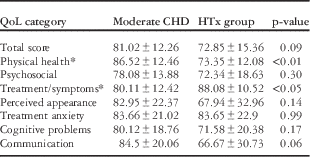
Heart transplant patients reported better scores for treatment and symptoms 88.1±10.5 versus 80.1±12.4 when compared with the moderate congenital heart disease group (p<0.05). However, the heart transplant patients reported lower scores for physical health 73.4±12.1 versus 86.5±12.5 when compared with the moderate congenital heart disease group. Although there were some trends towards lower values in other quality of life categories in the heart transplant group compared with the moderate congenital heart disease, none of the others reached statistical significance (Table 1).
Moderate congenital heart disease versus heart transplantation quality of life scores: average quality of life scores in various categories (column 1) in the moderate congenital heart disease group (column 2) and the heart transplantation group (column 3).

CHD=congenital heart disease; HTx=heart transplant; QoL=quality of life.
* Asterisks identify those with statistically significantly different means between groups
Discussion
Our findings are similar to those reported previously by Uzark et al, in that paediatric heart transplant recipients seem to have quality of life that is on par with patients who have moderate congenital heart disease. We also demonstrated that age at heart transplant and increasing age following heart transplant are risk factors for low quality of life in emotional and school function, as well as perceived physical appearance. This finding is not a complete surprise, as we know that as children age they become more aware of their physical appearance and emotions. The adolescent population would be particularly vulnerable. Certainly, there are steps that could be employed to address such deficiencies. Perhaps when low quality of life in school function is identified, additional resources should be sought, including individual learning plans, tutors, and subject-specific help. Similarly, it is not unexpected that paediatric heart transplant recipients may have difficulty with emotional function and perceived physical appearance. Parents and caregivers should be made aware of this in order to offer additional emotional support to these children.
Previous studies have identified being transplanted for congenital heart disease to be a risk factor for psychological morbity.Reference Wray and Radley-Smith 9 Other studies have shown an increased prevalence of psychological disorders in this population, which does improve compared with their pre-heart transplant state, but persists to a greater degree than the normal population.Reference Serrano-Ikkos, Lask, Whitehead, Rees and Graham 10 – Reference Todaro, Fennell, Sears, Rodrigue and Roche 12 Qualitative studies have pointed out themes that adolescents view physical appearance as an issue, but this same population of transplanted congenital heart disease patients is quite pleased in their physical improvements that result from receiving a heart transplant.Reference Green, Meaux, Huett and Ainley 13
Even though we report risk factors and try to quantify and compare quality of life in paediatric heart transplant recipients, the fact remains that quality of life is an individual characteristic that is quite dynamic. For this reason, we may to need to revamp our mindset on how we approach this issue in heart transplant recipients. It is conceivable to regularly evaluate quality of life in these patients at routine visits with objective quality of life measures. As clinicians, we are likely inadequate at identifying many of these problems with a series of inconsistent questions asked at various times during routine follow-up visits. Therefore, one or more objective quality of life surveys administered at consistent intervals may serve as a great adjunct to the clinician’s line of questioning and evaluation. The goal of such a strategy should be to identify times when a patient is struggling with an area of life that would benefit from a practical intervention. After an intervention, the transplant team could re-evaluate with quality of life measures and subjective questions to determine whether an improvement was achieved.
When patients, families, and medical providers agree to proceed with a heart transplant, the universal goal is to extend the quantity of life, but improvement in the quality of life is also essential. Advances in the field have addressed the former issue and as a result life expectancy has significantly improved over the last decade in these patients.Reference Benden, Edwards and Kucheryavaya 1 Continued efforts need to be made to address the latter, so as to maximise the quality in the newly extended life of these patients.
Study limitations
This study was limited by its cross-sectional study design. Quality of life is a dynamic process and it cannot be fully assessed with regard to risk factors unless serial evaluations are completed. Furthermore, parental/guardian quality of life surveys were not administered and this is another important element to the overall health-related quality of life of the family and patient. The study population consisted of a small sample size at a single centre, and thus it has limited generalisability. This study did not account for pre-transplant and post-transplant confounders that may have contributed to the findings. Although body mass index is of particular interest, especially in this population, the small sample size with relative heterogeneity likely explains why no correlation was observed. In addition other supportive objective data such as exercise stress testing data were not obtained at the same time. Such data could have enhanced understanding of the other findings.
Conclusions
Paediatric heart transplant recipients reported similar quality of life as patients with moderate congenital heart disease. Heart transplant patients report minimal problems with treatment and symptoms, but lower physical health compared with the moderate congenital heart disease populations. Patients receiving a heart transplant at an older age may require additional emotional and educational support compared with those transplanted at a younger age, and as these children age they are at increased risk for needing additional support in these areas as well. Heart transplant patients with higher baseline activity levels may be more aware of their physical, emotional, and cognitive limitations than less active heart transplant patients.
We feel that routine quality of life assessments in children who have undergone heart transplant are necessary to monitor for quality of life deficiencies, and to intervene and improve on these deficiencies when possible. Further studies should focus on identifying additional risk factors and developing practical interventions that can improve impaired quality of life in children following heart transplant.
Acknowledgements
The authors acknowledge Midwest Cabernet Festival for donating the pedometers that were used for this study.
Financial Support
This research received no specific grant from any funding agency, commercial or not-for-profit sectors.
Conflicts of Interest
None.
Author Contributions
John J. Parent performed statistical analysis and main drafter of manuscript. Approved final version of manuscript. Lauren Sterrett performed patient recruitment, data acquisition, and statistical analysis. Assisted in manuscript drafting and revision and approved final version. Randall Caldwell, Robert Darragh, Marcus Schamberger, Debbie Murphy, and Eric Ebenroth helped in development of protocol and study design and also assisted in manuscript drafting and revision and approved final version.