Introduction
Cholesteatomas are one of the most important and controversial pathological conditions encountered during middle-ear surgery. Based on otoscopic appearances, they can be classified as attic cholesteatomas (developing from the Shrapnell membrane) or tensa cholesteatomas (originating in the pars tensa). Tensa cholesteatomas are further subdivided into sinus cholesteatoma (developing from posterosuperior retraction and spreading toward the stapes and the tympanic sinus) or tensa retraction cholesteatoma (involving retraction of the entire pars tensa, and extending into the hypotympanum, tubal orifice and posterior tympanum).Reference Uzun, Cayé-Thomasen, Andersen and Tos1
Important aims of pars tensa cholesteatoma surgery are: complete cholesteatoma removal, with no residual disease; restoration of normal ear anatomy, in order to prevent recurrence; and improvement in quality of life (i.e. good hearing and no cavity problems). The ideal technique would allow the surgeon to achieve all these aims.Reference Uzun, Yagiz, Tas, Adali, Koten and Karasalihoglu2
Cartilage grafting has been used for eardrum reconstruction for decades, at various different otological centres. The number of reports on clinical outcomes has increased in the last five to 10 years.Reference Cayé-Thomasen, Andersen, Uzun and Hansen3 Cartilage confers increased stiffness to the reconstructed drum, and may be modified and shaped more readily depending upon the surgeon's requirements. Thus, post-operative retraction or perforation can be avoided, and satisfactory functional hearing results ensured.Reference Dornhoffer4
The present study aimed to compare the anatomical and audiological outcomes of ring-shaped modified cartilage-perichondrium graft tympanoplasty with those of tympanoplasty using a Mercedes-Benz symbol shaped cartilage-perichondrium composite plate, after one-stage surgery, in patients with pars tensa cholesteatoma.Reference Mansour, Askar and Albirmawy5–Reference Spielmann and Mills8
Patients and methods
Patients
The study comprised a prospective, double-arm study of 60 ears in 60 patients operated upon for middle-ear pars tensa cholesteatoma at the otolaryngology department of Tanta University Hospital, Egypt, over a three-year period (2005 to 2008).
The purpose, principles and potential complications of surgery were explained to the patients, or their parents, and accepted by them.
The patients were divided into two surgical groups. Thirty ears were grafted with a ring-shaped modified cartilage-perichondrium graft, while the other 30 ears were grafted with a cartilage-perichondrium composite plate fashioned in the shape of the Mercedes-Benz symbol. The choice between ring or ‘Mercedes-Benz’ technique was made at random.
Indications for surgery included sinus or tensa retraction cholesteatoma not extending to the attic, antrum or mastoid process.
The following patients were excluded from the study: any cases of previous ear surgery (except for tympanostomy), sensorineural hearing impairment, or intracranial or extracranial complications, and any patients who were not followed up for at least two years.
Surgical technique
All operations were performed by the same surgeon, under general anaesthesia.
A piece of tragal cartilage larger than the final graft size was harvested, with the perichondrium left attached to one side. The graft was trimmed to the required circular shape and size (9–12 mm diameter) and kept hydrated in saline, prior to being fashioned into a ring or Mercedes-Benz shape.
The mastoid cortex was exposed via a postauricular incision, the tympanomeatal flap raised and reflected anteriorly, the middle ear inspected, the cholesteatoma identified and the ossicular chain visualised. Because of radiological evidence of opacification of mastoid air cells, all patients underwent an intact canal wall mastoidectomy. Using a small cutting burr, the bone of the ear canal was widened from lateral to medial, until the pinkish colour of the mastoid air cell mucosa was encountered. Posterosuperomedial bone removal allowed early identification of the chorda tympani nerve, which was sectioned at its junction with the facial nerve, followed by posteroinferior drilling to identify the anterior surface of the vertical segment of the facial nerve canal.
The cholesteatoma was then removed using a minimally invasive technique. Care was taken not to miss any remnants draped over the stapedial tendon, pyramidal process, promontory, handle of the malleus, tubal orifice or jugular bulb. Because only sinus and tensa retraction types of tensa cholesteatoma were present in this series, there was no need for an atticotomy or canal wall down mastoidectomy. Complete removal of the cholesteatoma required near-total or total resection of the tympanic membrane, giving the appearance of a near-total or total perforation.
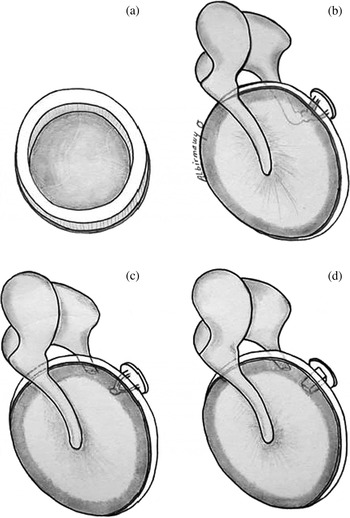
In the ring group, the cartilage-perichondrium segment was fashioned into a ring shape by dissecting out a central disc of cartilage (5–7 mm in diameter), leaving a peripheral circular cartilaginous rim (2–3 mm in width) with an overstretched perichondrial sheet (Figure 1a).
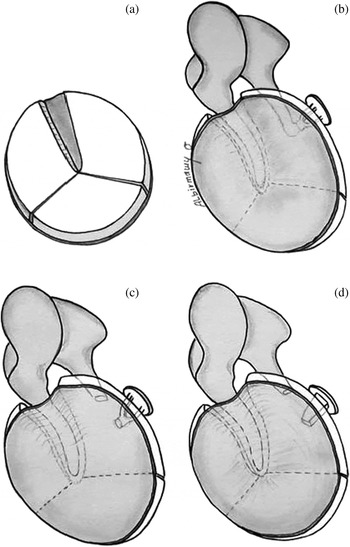
In the Mercedes group, a channel was created by removing a strip of cartilage from the superior edge of the graft, which extended inferiorly to its centre, in order to accommodate the malleus handle. Two radial incisions were then made from the inferior end of this channel (giving a shape similar to the Mercedes-Benz car symbol), conferring adequate malleability and an almost conical contour (Figure 2a).
After graft shaping, each type of graft was inserted as an underlay with the perichondrium facing laterally; the graft fitted under the handle of the malleus in the ring group and over the handle in the Mercedes group. The graft was trimmed peripherally to size so that it fitted snugly within the tympanic bony annulus anteroinferiorly and filled the drilled annulus posterosuperiorly, in order to avoid the development of post-operative retraction pockets.
In patients with an intact ossicular chain, a type I tympanoplasty was performed (Figures 1b and 2b).
Diagram showing (a) ring graft, (b) ring graft in type I tympanoplasty, (c) ring graft in type II tympanoplasty and (d) ring graft in type III tympanoplasty.

Diagram showing (a) ‘Mercedes-Benz’ graft, (b) Mercedes-Benz graft in type I tympanoplasty, (c) Mercedes-Benz graft in type II tympanoplasty, and (d) Mercedes-Benz graft in type III tympanoplasty.

In ears with a defective long process of the incus but an intact stapes superstructure, a type II tympanoplasty was performed. Care was taken to allow the peripheral cartilaginous rim of the ring graft and the posterosuperior plate of the Mercedes-Benz graft to rest upon the head of the stapes and the remnants of the long process of the incus, as much as possible, to compensate for the defect (Figures 1c and 2c).
Patients with a defective stapedial superstructure underwent type III tympanoplasty, using a cartilaginous columella between the footplate and the applied graft (Figures 1d and 2d).
Post-operative care and outcome assessment
After surgery, patients were seen every three months for at least two years. Routine follow up consisted of otomicroscopic examination and audiometric evaluation.
A successful anatomical outcome was defined as an intact, dry tympanic membrane without retraction pockets, and without residual or recurrent cholesteatoma. Any post-operative middle-ear effusion was noted.
Hearing was evaluated before and after surgery, with respect to absolute hearing (testing the pure tone average (PTA)), speech reception threshold and air–bone gap. For absolute hearing and air–bone gap, mean thresholds were calculated at 500, 1000 and 2000 Hz.
Outcomes were assessed pre-operatively and one and two years post-operatively.
Statistical analysis
Data were analysed using the Statistical Package for the Social Sciences version 11.0 software program (SPSS Inc, Chicago, Illinois, USA). Summary statistics were calculated for all variables; means, standard deviations and 95 per cent confidence intervals were used for quantitative variables, and frequency distributions were used for categorical items. The Student t-test was used to compare hearing data which was normally distributed, while the chi-square test was used to compare categorical data (e.g. the number of cases with post-operative tympanic membrane retraction). A p value of less than 0.05 was considered statistically significant.
Results
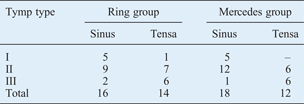
The median age at operation was 15 years in the ring group (range, nine to 23 years) and 14 years in the Mercedes group (range, 10–22 years); this difference was not statistically significant. There was no statistically significant difference between the two groups regarding the incidence of sinus and tensa retraction cholesteatoma and the frequency of different types of tympanoplasty (p > 0.05 for both; Table I).
Surgical groups' cholesteatoma and tympanoplasty types
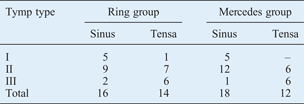
Data represent patient numbers. Tymp = tympanoplasty; sinus = sinus cholesteatoma; tensa = tensa retraction cholesteatoma
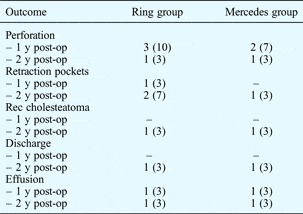
A summary of post-operative anatomical outcomes is shown in Table II.
Surgical groups' anatomical outcomes

Data represent patient numbers (percentages). Y = years; post-op = post-operative; rec = recurrent
In the first post-operative year, a small central neodrum perforation developed in three ring group ears and two Mercedes group ears. These perforations healed with conservative measures, except for two cases (one in each group) which persisted for more than two years, eventually requiring myringoplasty with temporalis fascia grafting.
A mild degree of posterosuperior retraction was observed in one ring group patient during the first post-operative year, and in this patient and an additional ring group patient during the second post-operative year. In the Mercedes group, only one patient developed a similar retraction, during the second post-operative year. At the end of the study period, none of these pockets had progressed, and no surgical treatment was required.
There was no evidence of residual cholesteatoma within the follow-up period. However, near to the end of the second year, one patient in each group experienced recurrent otorrhoea with evidence of recurrent cholesteatoma involving the attic and mastoid antrum. Both cases occurred in ears operated upon for tensa retraction cholesteatoma, and were managed subsequently using revision tympanoplasty and canal wall down mastoidectomy.
Four cases (two in each group) had a middle-ear effusion within the first and second year post-operatively. All of these patients were managed conservatively, and none required ventilation tube insertion.
Based on the statistical analysis, there was no significant difference between the anatomical outcomes of the two surgical groups.
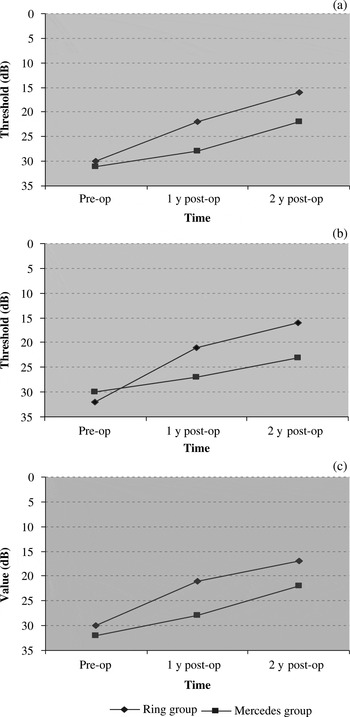
Overall, patients' hearing improved significantly in each group, throughout the post-operative follow-up period (Table III; Figure 3).
Progressive results for (a) mean pure tone average, (b) mean speech reception threshold and (c) mean air–bone gap, in cholesteatoma ears reconstructed with ring or ‘Mercedes-Benz’ graft.

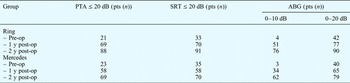
Surgical groups' hearing results

PTA = pure tone average; pts = patients; SRT = speech reception threshold; ABG = air–bone gap; pre-op = pre-operative; y = year; post-op = post-operative
In the ring group, 21 per cent of ears had a pre-operative PTA of 0 to 20 dB. After surgery, a PTA of 20 dB or better was recorded in 69 and 88 per cent of ears in the first and second post-operative years, respectively (Table III).
In the Mercedes group, 23 per cent of ears had a pre-operative PTA of 20 dB or better. After surgery, first-year post-operative hearing results were generally good, while second-year results were even better, with 69 per cent of ears having a PTA of 0 to 20 dB (Table III).
The number of patients with post-operative PTA, speech reception threshold and air–bone gap values of 20 dB or less was significantly greater in the ring group compared with the Mercedes group (p < 0.05).
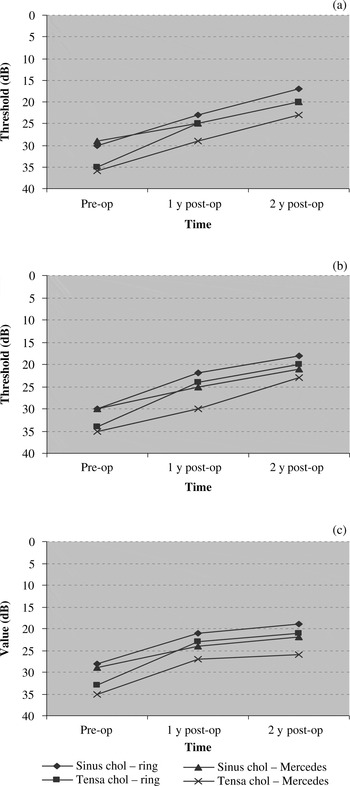
The mean PTA, speech reception threshold and air–bone gap values were slightly better in the sinus cholesteatoma group (i.e. both graft types combined) than the tensa retraction cholesteatoma group, both pre- and post-operatively, although this difference was not statistically significant (p > 0.05) (Figure 4).
Progressive results for (a) mean pure tone average, (b) mean speech reception threshold, and (c) mean air–bone gap, in ears operated upon for sinus or tensa retraction cholesteatoma and reconstructed with either ring or ‘Mercedes-Benz’ graft.

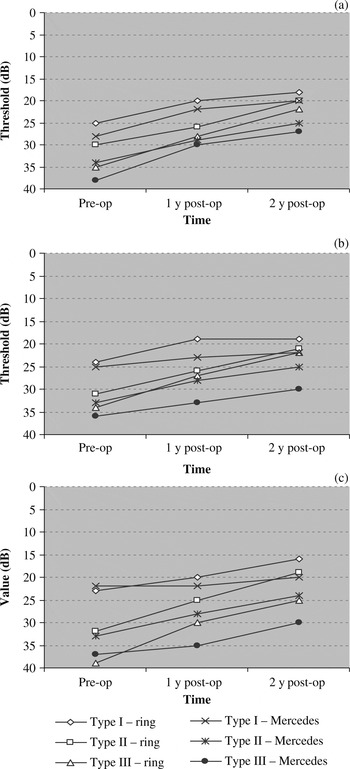
The best results were obtained in ears with an intact ossicular chain. However, no statistically significant difference was found between the post-operative results of patients undergoing type I, II and III tympanoplasties (p > 0.05) (Figure 5).
Progressive results for (a) mean pure tone average, (b) mean speech reception threshold, and (c) mean air–bone gap, in cholesteatoma ears undergoing surgery with type I, II, or III tympanoplasty, with reconstruction of the eardrum using ring or Mercedes-Benz graft.

Discussion
Studies of tympanic membrane reconstruction after pars tensa cholesteatoma surgery have found that cartilage with perichondrium may be a superior graft material, compared with other graft materials, as regards prevention of neodrum retraction and perforation. Some cartilage grafting techniques give better long term hearing results than others.Reference Uzun, Cayé-Thomasen, Andersen and Tos1, Reference Cayé-Thomasen, Andersen, Uzun and Hansen3, Reference Dornhoffer4, Reference Anderson, Cayé-Thomasen and Tos9 However, the opacity of cartilage impedes the detection of cholesteatoma recurrence or regrowth, necessitating strict follow up over long periods.Reference Dornhoffer4
To the author's best knowledge, there is little published information comparing different types of cartilage tympanoplasty.Reference Spielmann and Mills8 Thus, clinical researchers face challenging questions regarding the best grafting source, thickness, shape and surgical technique for different types of middle-ear pathology. The present study compared the anatomical and audiological outcomes of ring and Mercedes-Benz cartilage-perichondrium grafts used during pars tensa cholesteatoma surgery, in an attempt to address these questions. Patients in the two graft groups were comparable in terms of age at operation, frequency and location of cholesteatoma, type of surgery used in addition to tympanoplasty, and type of tympanoplasty. As the thickness and shape of the external ear cartilage vary at different anatomical sites, the cartilage-perichondrium grafts used in the current series were harvested only from the tragus, in both groups. Cartilage from this site is ideal because it is thin, flat and available in sufficient quantities to permit reconstruction of the entire tympanic membrane.Reference Dornhoffer10 Thus, the main study variable was graft shape.
Analysis of post-operative anatomical outcomes indicated that the Mercedes-Benz graft shape may be better at preventing neodrum retraction; however, this difference was not statistically significant. It may be the case that cartilage plates are more resistant to negative middle-ear pressure, compared with cartilage rings.
In the current series, residual cholesteatoma was not detected behind the neodrum in any patient. Furthermore, recurrent cholesteatoma (which may be related to the graft material)Reference Cayé-Thomasen, Andersen, Uzun and Hansen3 occurred in both the ring and Mercedes groups (i.e. one case in each group), in ears operated upon for tensa retraction cholesteatoma. This implies that cholesteatoma recurrence may be unaffected by graft shape. However, this result may be affected by a type two error (i.e. patient numbers too small).
According to Dornhoffer,Reference Dornhoffer10 impedance tympanometry is unreliable after cartilage tympanoplasty, and usually yields a low-volume, type B tympanogram owing to the noncompliant nature of the graft, despite normal hearing. Thus, in the current study it was thought necessary to check air and bone conduction, using post-operative audiography, in order to determine whether an effusion was present. If an effusion is suspected, based on observation and conductive hearing loss, then steroids are given, the Valsalva manoeuvre is encouraged, and the ear is examined frequently. In the current study, cases of post-operative middle-ear effusion in the Mercedes group did not require confirmatory myringotomy, as these patients' evident conductive deafness responded well to conservative treatment. In such cases, monitoring of conductive deafness may confirm resolution of suspected post-operative middle-ear effusion. However, in the ring group, the relative transparency and free mobility of the graft's central perichondrial sheet enabled simple, early clinical diagnosis of middle-ear effusion, and also facilitated audiological confirmation.
When fashioning the cartilage-perichondrial graft, it is essential to enable the graft to bend and conform to the conical contour of the natural tympanic membrane. In the case of Mercedes-Benz grafts, this was achieved by creating three separate but connected cartilaginous plates, forming a shape similar to the Mercedes-Benz car symbol; in the case of ring grafts, it was achieved using a circular cartilaginous ring with overstretched sheet of perichondrium, a tissue which is tough but malleable. Precise peripheral shaping of the cartilage prevented the graft from folding in the centre and enabled it to fit snugly in the desired position, giving a water-tight contact between the applied graft and the surrounding tissue, both anteroinferiorly, at the bony annulus, and posterosuperiorly, where recurrent cholesteatoma most frequently occurs. Likewise, in the Mercedes group, placing the entire graft in an underlay fashion, with the handle of the malleus filling in the groove medial to the perichondrium, prevented medial displacement of the cartilage graft, avoided contact with the promontory, and allowed for a larger middle-ear space. However, in the ring group, the graft's cartilage-free central perichondrial sheet allowed the laterally placed handle of the malleus to indent further into the perichondrium without touching the bulge of the promontory, creating much more middle-ear space.
Hearing improved significantly in both groups, compared with pre-operative values, but this increase was significantly greater in the ring group (p = 0.01).
However, the best and most stable hearing results were obtained in ears with an intact ossicular chain. This is in keeping with the results of other authors,Reference Siddiq and East11, Reference Stankovic12 who have found that the status of the ossicles, and their reconstruction, and the type of surgical technique are important factors for post-operative hearing restoration. Incus transposition and various biocompatible implants are frequently used for reconstructing ossicular discontinuities. Good, stable long term results have been reported.
In the current series, the peripheral cartilaginous rim of the ring graft, and the posterosuperior cartilaginous plate of the Mercedes-Benz graft, successfully closed the anatomical defect between the eroded long process of the incus and the stapes superstructure. Furthermore, in cases of absent stapes superstructure, the superfluous graft cartilage (i.e. the dissected central cartilaginous disc of the ring graft, or the dissected vertical cartilaginous strip of the Mercedes-Benz graft) was modified for use as a columella between the footplate of the stapes and the opposing, cartilaginous part of the applied graft. Audiological results verified that both techniques resulted in a successful ossiculoplasty, without the need for incus transposition or a biocompatible implant.
• This study of cholesteatoma patients found no significant difference in anatomical outcomes for tympanoplasty with ring vs ‘Mercedes-Benz’ cartilage-perichondrium grafts
• However, Mercedes-Benz grafting tended to give better prevention against neodrum retraction
• Ring grafting produced better audiological outcomes than Mercedes-Benz grafting
• In both groups, an intact ossicular chain and sinus cholesteatoma were associated with better hearing outcomes
The superiority of hearing results in the ring group may be explained by the following. (1) Removal of the central cartilaginous disc of the ring graft may have created a larger middle-ear space between the neodrum and the bulge of the promontory. (2) The malleability of the central perichondrial sheet, positioned under the handle of the malleus, may have given the neodrum a more conical contour, approximating more closely the shape of the natural tympanic membrane. (3) Finally, from a mechanical point of view, while neither graft shape was a compact structure, the ring graft was as durable as, but more flexible than, the Mercedes-Benz graft, due to stretching of the central perichondrial sheet over the medially placed peripheral cartilaginous rim, which in turn fitted snugly within the bony tympanic sulcus and simulated the natural fibrous tympanic annulus.
Conclusion
Comparison of ring and Mercedes-Benz cartilage-perichondrium grafting for tympanic membrane reconstruction after pars tensa cholesteatoma surgery indicated that the Mercedes-Benz technique may be superior in preventing neodrum retraction. Although the opacity of the cartilaginous plates of the Mercedes-Benz graft may compromise early detection of middle-ear effusion and cholesteatoma recurrence or regrowth, its flexible design allows it to bulge outward, facilitating diagnosis of any underlying lesion. However, patients reconstructed with Mercedes-Benz grafts must be followed up more closely than ring graft patients, and for a longer period.
Hearing improved significantly in both groups, but this improvement was greater in the ring graft group. This may be due to the more physiological design of the ring graft, which has the advantages of cartilage, a rigid material, and of perichondrium, a soft and relatively transparent tissue, but without their disadvantages.
Study over a longer term follow-up period is recommended to enable further and more detailed comparison of both grafting techniques.