

To feed without teaching is the father's fault; to teach, without severity, is the teacher's laziness(養不教,父之過;教不嚴,師之惰)
Three Character Classic《三字經》Introduction
‘Build to last’ is a common aspiration among family businesses, both in China and worldwide (Laakkonen, Kansikas, & Valtonen, Reference Laakkonen, Kansikas and Valtonen2011). Unfortunately, the adage ‘from shirtsleeves to shirtsleeves in three generations’ across different cultures indicates that successful succession within families is a universal challenge (Handler, Reference Handler1990; Morris, Williams, & Nel, Reference Morris, Williams and Nel1996). To ensure the transgenerational success of businesses, the family needs to have next-generation entrepreneurs to continue the family business legacy (Zellweger, Nason, & Nordqvist, Reference Zellweger, Nason and Nordqvist2012; Zellweger, Nason, Nordqvist, & Brush, Reference Zellweger, Nason, Nordqvist and Brush2013). However, family business successors often grapple with identity ambiguity during the role transition from child to entrepreneur (Cannella, Jones, & Withers, Reference Cannella, Jones and Withers2015). This is particularly pronounced in Chinese family firms that are deeply rooted in Confucian family traditions and moral principles (Fang, Singh, Kim, Marler, & Chrisman, Reference Fang, Singh, Kim, Marler and Chrisman2021; Liu, Qian, & Au, Reference Liu, Qian and Au2023) such as filial piety (Yan & Sorenson, Reference Yan and Sorenson2006; Zhu & Zhou, Reference Zhu and Zhou2022: 347). As a result, successors in Chinese family businesses experience unique family dynamics resulting in paradoxical parent behaviors (Huang, Chen, Xu, Lu, & Tam, Reference Huang, Chen, Xu, Lu and Tam2020) where following parents' paths and establishing ‘who I am’ become salient. This amplifies the identity tensions experienced by successors (Ibarra, Snook, & Guillen Ramo, Reference Ibarra, Snook, Guillen Ramo, Nohria and Khurana2010), thus endangering the successful continuity of entrepreneurship across generations (Zellweger et al., Reference Zellweger, Nason, Nordqvist and Brush2013).
Evidence from social psychology indicates that entrepreneurial parents play a significant role in shaping the identity of their children (Hoffmann, Junge, & Malchow-Møller, Reference Hoffmann, Junge and Malchow-Møller2015). Studies in entrepreneurship (Laspita, Breugst, Heblich, & Patzelt, Reference Laspita, Breugst, Heblich and Patzelt2012) and family businesses (Pittino, Visintin, & Lauto, Reference Pittino, Visintin and Lauto2018) further highlight that entrepreneurial parents have a substantial impact on their children's tendencies toward and abilities in entrepreneurship. In China, parents are widely regarded as the primary educators of children, and their behaviors have profound impacts on the next generations within family businesses (Li & Piezunka, Reference Li and Piezunka2020; Zhu & Zhou, Reference Zhu and Zhou2022). This influence is often characterized by a paradoxical blend of restrained and far-reaching parental love (Zhu & Kang, Reference Zhu and Kang2022) alongside a desire to control (Huang et al., Reference Huang, Chen, Xu, Lu and Tam2020). However, despite the considerable research done from the Chinese family business parents' perspective, less is known about their influence as both parents and entrepreneurs on entrepreneurial behaviors from the successors' perspective (Chlosta, Patzelt, Klein, & Dormann, Reference Chlosta, Patzelt, Klein and Dormann2012).
Our research aims to bridge this theoretical gap by establishing a connection from an identity perspective (Down, Reference Down2006), asking how successors' perceptions of their entrepreneurial parents' mentoring strategies influence the formation of their entrepreneurial identity. Following Hoang and Gimeno (Reference Hoang and Gimeno2010), we define entrepreneurial identity (hereafter, EI) as a set of meanings assigned to entrepreneurship, including a clear understanding of entrepreneurship, cognitive and emotional identification with the entrepreneurial role, and an affirmative evaluation of this role identity. Through an exploration of the life narratives of successors, we recognize their profound and enduring impacts on cognitive adjustment and the transformation of EI through a narrative-based and dynamic process (Radu-Lefebvre, Lefebvre, Crosina, & Hytti, Reference Radu-Lefebvre, Lefebvre, Crosina and Hytti2021). In so doing, we view the transformation of successors' EI as a journey of self-concept adjustment, encapsulated in the notion of becoming entrepreneurial successors (for more detailed elucidation of the ‘becoming’ philosophy in family business, see Ge, Hamilton, and Haag (Reference Ge, Hamilton and Haag2023)).
We conducted multiple case study research (Eisenhardt, Reference Eisenhardt1989; Yin, Reference Yin1994) on nine Chinese family firms, encompassing small, medium, and large enterprises, collecting data through interviews, observations, and documents. Our study revealed that successors experience a transition from an ambiguous identity to a clear EI. Through their involvement in the family business and early exposure to family dynamics, successors gain an initial understanding of entrepreneurship. Along this journey, they perceive four distinct mentoring strategies from their parents that facilitate their EI transitions: laying foundations, painting bright futures, relating experiences, and leading by examples. The intricate and paradoxical family dynamics within the Chinese cultural context, characterized by deep respect for parents alongside a pursuit of individuality, underscore the nuanced transformation of their EI.
Our study sheds light on the nuances of parental mentoring within Chinese family businesses, contrasting with prevailing Western family business paradigms (Barney & Zhang, Reference Barney and Zhang2009). In so doing, we make two contributions. Firstly, our findings highlight perceived parental mentoring as a pivotal catalyst for the identity transformation of successors, enhancing our current understanding of the intergenerational continuity of entrepreneurial endeavors in family businesses (Jaskiewicz, Combs, & Rau, Reference Jaskiewicz, Combs and Rau2015; Zellweger et al., Reference Zellweger, Nason, Nordqvist and Brush2013). Secondly, our study advances the knowledge of parental influence in family business research in the unique Chinese context. Based on family embeddedness view (Aldrich & Cliff, Reference Aldrich and Cliff2003; Aldrich, Alvarez, Brumana, Campopiano, & Minola, Reference Aldrich, Alvarez, Brumana, Campopiano and Minola2023) and refocusing on family dynamics in Chinese family businesses (Ge et al., Reference Ge, Hamilton and Haag2023; Li & Piezunka, Reference Li and Piezunka2020; Zhu & Zhou, Reference Zhu and Zhou2022), we extend the discussion on the particular paradoxical parental behaviors (Li & Piezunka, Reference Li and Piezunka2020; Zhu & Zhou, Reference Zhu and Zhou2022), and transcending the conventional wisdom of focusing on mere knowledge and skill transfer (St-Jean & Audet, Reference St-Jean and Audet2012) to successor EI development.
Theoretical Background
Parental Influence and Family Dynamics in Family Businesses
The intersection of family business studies and entrepreneurship literature increasingly emphasizes the significance of family dynamics (Aldrich, Brumana, Campopiano, & Minola, Reference Aldrich, Brumana, Campopiano and Minola2021; Jaskiewicz, Combs, Shanine, & Kacmar, Reference Jaskiewicz, Combs, Shanine and Kacmar2017). Parents in entrepreneurial families play a crucial role in parent–child interactions, acting dual roles as parents and entrepreneurs (McMullen & Warnick, Reference McMullen and Warnick2015) and so introducing inherent tensions into family dynamics (Combs, Shanine, Burrows, Allen, & Pounds, Reference Combs, Shanine, Burrows, Allen and Pounds2020). These tensions create a paradox of empowering (support) and dominating (control) behaviors toward their descendant successors (Huang et al., Reference Huang, Chen, Xu, Lu and Tam2020), posing a dilemma for intrafamily succession (McMullen & Warnick, Reference McMullen and Warnick2015).
Existing research aimed at enhancing our comprehension of the intricate behaviors and interactions between parents and children in family businesses can primarily be classified into two categories: power and emotion. Adopting the power logic, some studies view parent–child relationships as a combination of domination and empowerment (Huang et al., Reference Huang, Chen, Xu, Lu and Tam2020). In this vein, parental support is instrumental and filled with coercive control. Scholars argue that under authoritarian parenting, the founder role takes precedence over the parental role (McMullen & Warnick, Reference McMullen and Warnick2015), grooming the child as an investment to ensure a successor and maintain control over family dynasties, thus providing instrumental assistance (Garcia, Sharma, De Massis, Wright, & Scholes, Reference Garcia, Sharma, De Massis, Wright and Scholes2019) to secure business continuity. In terms of emotional logic, other studies suggest that parent–child relationships are maintained by emotional bonds, where parental support and care are seen as spontaneous and selfless acts. Although paternalism involves coercion and intervention, parental support is a form of self-sacrificing altruism (Zhu & Kang, Reference Zhu and Kang2022). Thus, strategic planning and innovative strategies are viewed as parental foresight and love (Zhu & Kang, Reference Zhu and Kang2022), with a nurturing approach focusing on children's needs.
Some other studies focus on contextual factors, categorizing parental style and leadership. For example, McMullen and Warnick (Reference McMullen and Warnick2015) identify four types of parenting style in family businesses, suggesting that authoritative parents can foster the emotional commitment of successors. Garcia et al. (Reference Garcia, Sharma, De Massis, Wright and Scholes2019) categorize perceived parental behaviors into support and control, examining their effects on family business commitment and self-efficacy, influencing next-generation engagement. In the Chinese context, guided by Confucian values, parental support embodies an unconditional loyalty involving social obligations (Erdener & Shapiro, Reference Erdener and Shapiro2005). Altruistic parental support is widespread during succession (Zhu & Kang, Reference Zhu and Kang2022). Additionally, Chinese parents tend to be introverted and conservative in emotional expression (Bond, Reference Bond1998), conveying support through subtle actions (Fang & Faure, Reference Fang and Faure2011), and prioritizing action-based support over emotional expression (Wang, Pomerantz, & Chen, Reference Wang, Pomerantz and Chen2007).
Although existing research suggests a potential theoretical connection between perceived parental behaviors and next-generation engagement in family business (Garcia et al., Reference Garcia, Sharma, De Massis, Wright and Scholes2019), there is a theoretical gap and lack of empirical evidence on which types of parental behavior support children's entrepreneurial behaviors, from the perception of successors. One of the most controversial and interesting questions is how parental support in patriarchal family organizations affects successors' development in transgenerational entrepreneurship. As noted by Garcia et al. (Reference Garcia, Sharma, De Massis, Wright and Scholes2019: 15), ‘next-generation members appraise how they are treated by their parents, and this in turn shapes their beliefs about their competence and their attitudes’. Adopting this viewpoint, we specifically focus on the perceptions and perspectives of the next generation and their entrepreneurial activities.
Identity Transformation and Mentoring Functions
Identity refers to the meaning of a particular entity, be it as an individual, group, or organization, that is internalized as part of the self-concept (Miscenko & Day, Reference Miscenko and Day2016); throughout the entrepreneurial process, it plays a crucial role in understanding how individuals form and develop self-concept (Mmbaga, Mathias, Williams, & Cardon, Reference Mmbaga, Mathias, Williams and Cardon2020). Specifically, identity influences entrepreneurs in their pursuit of entrepreneurial activities that provide significant self-meaning (Radu-Lefebvre et al., Reference Radu-Lefebvre, Lefebvre, Crosina and Hytti2021). EI, which encompasses attitudes, beliefs, traits, and subjective evaluations of behavior, can represent a dynamic collection of meanings assigned to entrepreneurship (Hoang & Gimeno, Reference Hoang and Gimeno2010).
In advancing the identity dynamics in entrepreneurship studies (Leitch & Harrison, Reference Leitch and Harrison2016), scholars have shifted focus from personality traits to identity-based theories to better understand entrepreneurs and their behaviors (Mmbaga et al., Reference Mmbaga, Mathias, Williams and Cardon2020). Entrepreneurship scholars have mainly understood EI as ‘property’, a set of psychological resources or stable attributes focusing on its outcomes for ventures and entrepreneurs, and/or as ‘process’, a dynamic emergence that requires ongoing attention to its antecedents and constructing process (Radu-Lefebvre et al., Reference Radu-Lefebvre, Lefebvre, Crosina and Hytti2021). Our research aligns with the latter approach, EI as a process, considering it a process of becoming and a product of interactions and context. In this vein, EI emerges from the complex interweaving of events, circumstances, and interactions with others over time (Hamilton, Reference Hamilton2014).
For successors in family businesses, transitioning from being the children of entrepreneurs to independent entrepreneurs requires undergoing an EI transformation. This will be a challenging process, as it normally requires a role transition (Ibarra et al., Reference Ibarra, Snook, Guillen Ramo, Nohria and Khurana2010) through integrating new behaviors, skills, attitudes, and patterns of interaction into their self-concept (Ashforth, Reference Ashforth2012). During this process, they may lack a clear role identity or experience multiple incompatible definitions of themselves. Previous research has found that people in role transition often feel ‘between’ identities, describing their states as ‘in a vacuum’ or ‘neither here nor there’ (Ebaugh, Reference Ebaugh1988; Settles, Reference Settles2004). If the EI transition process is not implemented smoothly, it may lead to the inability to form a new identity and thus to adapt to the new role, resulting in failure of the continuation of family business entrepreneurship. Therefore, successors must develop a clear EI during the transition into their new roles.
Successful self-changes are often instigated, motivated, or supported by others, as a change in self-concept relies on enlisting other people's support to lend social reality to the desired changes (Ibarra et al., Reference Ibarra, Snook, Guillen Ramo, Nohria and Khurana2010). Guiding figures can help individuals endure ambiguity and stay committed to their desired self-concept changes by providing support and encouragement throughout the transition process (Levinson, Reference Levinson1979; Strauss, Reference Strauss1977). Mentoring, a developmental relationship between an experienced mentor and a less experienced mentee (Kram, Reference Kram1985), emerges as a valuable source of support for entrepreneurial growth and development. As an important source of entrepreneurial support, mentors not only help novice entrepreneurs learn, grow, and improve entrepreneurial skills (Radu-Lefebvre & Redien-Collot, Reference Radu-Lefebvre and Redien-Collot2013; St-Jean & Audet, Reference St-Jean and Audet2012; Sullivan, Reference Sullivan2000) but also act as practical community groups that guide newcomers by facilitating their entry into institutional norms and practice communities (Wenger, Reference Wenger1999), inspiring them to learn how to become entrepreneurs and contributing to the construction of EI through conversations (Rigg & O'Dwyer, Reference Rigg and O'Dwyer2012; Yitshaki, Reference Yitshaki2020).
Specifically, research shows that parents act as role models (Andersson & Hammarstedt, Reference Andersson and Hammarstedt2010; Soleimanof, Morris, & Jang, Reference Soleimanof, Morris and Jang2021), confirming the feasibility of parents serving as mentors in providing entrepreneurial support. Despite the recognized impact of mentoring on identity change, this insight remains underexplored in family business research, particularly in the Chinese context. At the same time, although the role model effect of parents is acknowledged (Andersson & Hammarstedt, Reference Andersson and Hammarstedt2010; Soleimanof et al., Reference Soleimanof, Morris and Jang2021), the specific mechanisms of how mentoring influences EI transformation in Chinese family businesses remain uncharted. In addition, the Chinese collectivist culture, with its pronounced emphasis on group harmony, interdependence, and conformity (Chen, Reference Chen2000), may accelerate successors' experience of identity ambiguity, but this has not been investigated in the Chinese family business context. Adopting a narrative identity perspective (Ibarra & Barbulescu, Reference Ibarra and Barbulescu2010), we specifically focus on successors' narrated life stories, looking at how they perceive their parents' influence and trying to uncover how much these perceptions work in their identity transitions.
Methods
Given the exploratory nature of the research, we conducted an inductive multi-case study (Eisenhardt & Graebner, Reference Eisenhardt and Graebner2007), a method particularly apt for investigating ‘how’ and ‘why’ questions (Yin, Reference Yin1994). By treating each case as a series of experiments that can confirm, deny, or elaborate on emerging insights (Yin, Reference Yin1994), the multi-case study methodology is expected to yield more generalizable, robust, and concise theories.
We carefully selected nine family-owned or family-managed Chinese firms. Initially, we obtained a list of family businesses recommended by local associations and experts, granting us the chance to interview 12 successors from local family firms. Following guidelines for purposive theoretical sampling (Eisenhardt, Reference Eisenhardt1989) and for adequate comparability, we selected nine family businesses that have factors associated with favorable succession and effective parental mentoring: (1) a clear willingness for intrafamily succession (Chua, Chrisman, & Sharma, Reference Chua, Chrisman and Sharma1999); (2) a single identified successor (McMullen & Warnick, Reference McMullen and Warnick2015)Footnote 1; (3) positive intergenerational relationships; (4) explicit reference to the mentoring of immediate family membersFootnote 2; (5) difference between prior work experience and the current family business (which allows ambiguity, see Table 1, Column 10); and (6) clear entrepreneurial activities (allowing us to make inferential links to EI; see Table 1, Row 11). Our selected family businesses are in the south of the Yangtze River region in China, one of the most entrepreneurial hubs for Chinese private enterprises. The prevalence of family-owned businesses in this area provides an array of samples allowing broader generalizations and a more comprehensive understanding of the dynamics involved in the succession process.
Cases description

Notes: aCompanies E and F are listed companies. The CEO and top management team of Company E has been a family member for three consecutive generations, lasting 28 years. The company was restructured from a township enterprise, and after going public, the company engaged in national security-related business, so most of the ownership and shares were nationalized, but the family still has management authority and has a significant impact on strategic decisions.
The nine companies are predominantly from traditional industries, with a focus on manufacturing sectors like textiles, chemical fibers, and machinery. Many of these companies have either undergone or are currently experiencing transitions, aligning well with our study on transgenerational entrepreneurship. Established between China's reform and opening-up period and the onset of the financial crisis (1978–2008), these family businesses benefited from the era's policy advantages, facilitating our examination of entrepreneurial spirit. For a comprehensive analysis, we incorporated businesses of varying sizes (large, medium, and small) based on annual revenue. This diversity allows us to compare differences and identify potential common succession paths and family dynamics. Likewise, we selected successors from different generations, ages, and succession stages to uncover commonalities in parental mentoring and identity transformation amidst these variations.
Additionally, before our primary qualitative research, we interviewed two seasoned experts renowned for their advisory and consultancy work with family businesses in both China and Western countries. Their insights shed light on the distinctive dynamics of Chinese family enterprises, emphasizing the different stages of entrepreneurial development and variations across historical and economic periods. Particularly noteworthy were our conversations highlighting the transitional phase from the founder to the second generation in China, characterized by identity ambiguity and the profound influence of China's unique cultural background. This recognition consolidated our decision to delve into EI within the specific Chinese context. By incorporating the perspectives of these family business experts, we deepened our understanding of the importance and relevance of our sample selection in exploring the impact of the Chinese context on parental mentoring and EI in family businesses (see Table 1 for details of selected cases).
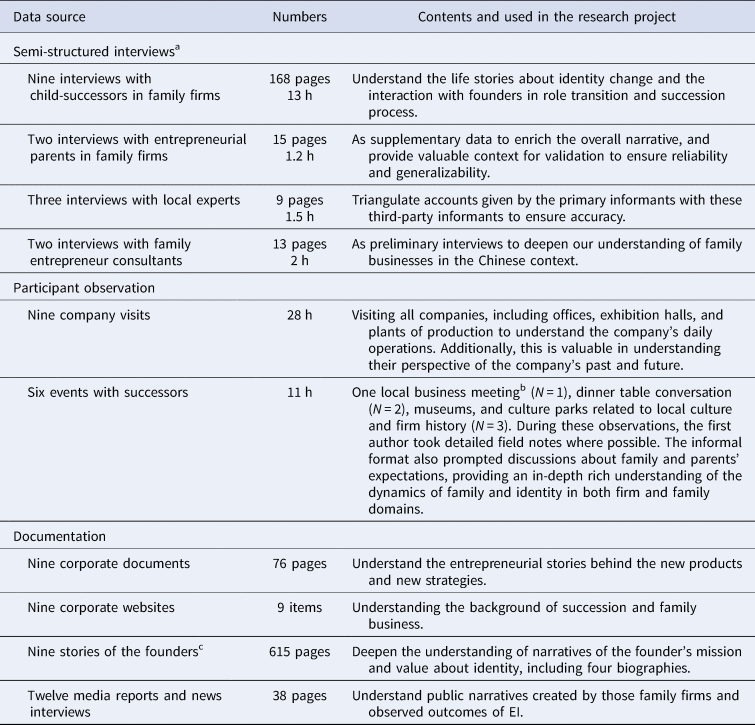
In addition, we collected and triangulated multiple sources of data (Yin, Reference Yin1994), including semi-structured interviews, participant observations, and documents. (See details on data sources and their uses in the research in Table 2.)
Data sources

Notes: aAverage duration of interviews: successors (86 min), entrepreneurial parents (35 min), and experts (40 min) (Interviews conducted between August 2022 and November 2023). bThe meeting was organized by the local business association, and the theme was ‘Passing the entrepreneur's baton’. The participants included the children of local entrepreneurs, and our interviewees had all participated in the activity of this association. cWe did not obtain biographies of the founders of all nine companies, but these stories could also be described in the magazine published by the local chamber of Commerce, and we supplemented this missing information by reading the magazines.
Semi-Structured Interviews
We collected 16 semi-structured interviews, including with successors, incumbents, local business association experts, and family business consultants. Interviews serve as a common tool for retrospective sense-making (Lieblich, Tuval-Mashiach, & Zilber, Reference Lieblich, Tuval-Mashiach and Zilber1998). Entrepreneurs draw upon narratives to inform their entrepreneurial actions (Gartner, Reference Gartner1993). Therefore, interviews form the essential foundation of EI, synthesizing personal experiences to construct a cohesive and unified sense of self by intertwining the past, present, and future (McAdams, Reference McAdams2001). This narrative framework encompasses temporal dimensions and often prompts narrators to craft a seamless self within their narratives, resulting in a linear perception of their life and career choices. Through this process, individuals reshape their past, gain insight into the present, and anticipate the future. Consequently, individual life stories acquire a discernible structure (Rae, Reference Rae2005). In this vein, our research centered on the life story narratives of successors, with an interview outline (see Supplementary Appendix Table S1), and complemented by parents' insights for contextual understanding. By focusing on the successors' perspective, we delve into their perceived developmental journey, specific challenges, and opportunities in depth. All the interviews were recorded and transcribed.
Participant Observations
In addition to the interviews, we conducted 15 participant observations encompassing all cases, including company visits and social events. These observations were triangulated with the interviews, the personal values of successors and their understanding of EI.
Documents
We also collected 691 pages of documents from various sources, including company websites, annual reports, news reports, and biographical stories of the founders. This amalgamation of diverse data sources enabled us to track the evolution of successors' identities over time and triangulate with the primary data (Yin, Reference Yin1994).
Data Analysis
Following the interpretive tradition and Gioia, Corley, and Hamilton's (Reference Gioia, Corley and Hamilton2013) data analysis methodology, which is particularly relevant for studying constructivism in the context of identity-related subjects, we initiated our data analysis by crafting case histories integrating interviews, observations, and archival data. Employing a cross-case approach, we aimed to identify shared patterns and structures across the cases under scrutiny.
To ensure transparency in our research methodology, we provide a detailed account of our coding scheme and procedure. Three coders collaborated on the analysis, employing thematic analysis. Discrepancies among coders were addressed through a systematic process. We started by evaluating paired case combinations to identify patterns of similarity and difference. Then, we established initial relationships between these guiding behaviors that might explain variations in outcomes over time (De Massis & Kotlar, Reference De Massis and Kotlar2014). We iteratively navigated between data, literature, and theory until reaching a point of theoretical saturation, where we were able to generate theoretical insights from our empirical cases (Eisenhardt, Reference Eisenhardt2021). Following the approach outlined by Corley and Gioia (Reference Corley and Gioia2004), we analyzed the cases by identifying primary categories, secondary themes, and aggregated dimensions. This approach facilitated a shift from interpreting and describing data to constructing theoretical frameworks. The data analysis unfolded in two phases, ensuring alignment between the research questions and the data, while iteratively comparing and grouping identified concepts and themes (Grodal, Anteby, & Holm, Reference Grodal, Anteby and Holm2021).
Stage 1: Analyzing the dynamic process of identity transformation
We began our analysis by categorizing primary interview data, focusing on how identity dynamics intersect with family dynamics. A timeline was constructed, delineating various stages of the growth process. Initially, we employed open coding to identify general information nodes within the data, attributing their characteristics to reveal first-order themes. Through this process, broad themes such as childhood separations and perceptions of the family firm were identified. Subsequently, we proceeded to axial coding to establish a clear understanding of the first-order codes. These initial themes were abstracted into first-order concepts, differentiating between the realms of family and business, thereby establishing our second-order themes. Additionally, interviewees' feelings and perspectives were documented, and keywords were extracted from transcripts to formulate labels pertaining to identity status. Combining these second-order themes, we developed a more abstract aggregate dimension (identity ambiguity) to encapsulate their initial states of identity. Then, we scrutinized significant shifts in participants' perceptions and feelings during role transitions. Axial coding further clustered related codes to unveil recurring cognitive attentiveness and behavioral devotion (second-order themes). These significant transitions were synthesized as observed alterations in identity (aggregate dimension), reflecting the outcome of EI formation intertwined with the narrative progression.
Stage 2: Identifying perceived parental mentoring strategies
Our focus centered on statements regarding parental influence to understand identity transformation. We meticulously encoded these narratives, identifying specific perceived parental behaviors as first-order concepts, such as introducing successors to professional business networks, and then categorized these based on their functions (second-order themes). This approach allowed us to illuminate the special meaning of parental behaviors for the interviewees. Upon delving deeper into the interview texts, supplemented by data from documents and observations, we identified more indirect mentoring incidents like sharing entrepreneurial stories and past experiences. Additionally, we found that some incidents were recalled by the interviewees in a more subtle form, with long-term preparation and groundwork being laid early in the successors' lives, gradually becoming perceptible and comprehensible during their succession journey. Through further comparison, we identified several different types of perceived parental mentoring and combined them into strategies of mentoring as second-order themes. After axial coding, we further abstracted these codes into the final aggregation dimension as perceived parental mentoring strategies.
In addition, we intentionally selected family firms of diverse sizes, with operating revenues ranging from 60 million to 5 billion. Interestingly, upon analyzing groups of small, medium, and large businesses, we found that successors' responses showed no discernible differences in the perceived mentoring received from their entrepreneurial parents across all the family firms in our samples. In other words, our findings are generalizable across varying sizes of Chinese family firms. Furthermore, through comparative analysis of different generations, ages, and succession stages, our conclusions can be extrapolated to various contexts, thereby supporting the robustness of our study's insights into perceived parental mentoring and identity transition within Chinese family businesses.
Findings
Upon comparing the succession narratives and life stories of the nine successors, a common thread emerged: they each experienced varying degrees of self-doubt, particularly in their formative years. This inner confusion, revolving around the fundamental question of ‘who am I?’, intensified as they assumed new roles within the family business. The mentoring provided by their parents, spanning both the family and business spheres, was pivotal in shaping the perceptions and actions of these novice successors as they delved deeper into the family enterprise. Their narratives also revealed a clearer, emerging identity as entrepreneurial successors, evident in their cognition and behaviors.
To explore the link between perceived parental mentoring and successors' EI development, we first delineate changes in the identity labels of successors during their role transitions. Then, we explore how perceived parental mentoring influences this evolution. Our investigation revealed a three-stage process in the identity transformation of successors: (1) initial phase: identity ambiguity, marked by confusion, anxiety, and a sense of disconnection from the family business; (2) middle phase: perceived parental mentoring strategies facilitating identity transformation, where successors perceive specific parental mentoring strategies that facilitate their identity transformation; and (3) final phase: observed identity change, where successors exhibit cognitive and behavioral changes, indicating a clarified EI.
Identity Ambiguity
Entering the family business signifies the beginning of a crucial stage for successors, initiating a multifaceted journey of role transition and shifts. Many interviewees expressed grappling with anxiety amid this transition period (see Supplementary Appendix Table S2). Initially, successors engaging in family firms often found themselves lacking a clear understanding of the need to redefine their identity and assume responsibility for the family business. This lack of clear self-definition and the resulting uncertainty fostered unease in the business realm, sparking doubts about their path ahead. We coded this status as ‘identity ambiguity’.
Our interviewees expressed feelings of drifting and wavering during the early stages of succession. They used terms like ‘deserter’, ‘loser’, ‘misfit’, or ‘screw’, expressing feelings of bewilderment, anxiety, and a diminished sense of self-worth. This experience is closely related to the unique socioeconomic context of China, shaped by significant changes following the 1978 reform and opening-up policy. For many successors, their formative years coincided with their parents' entrepreneurial phase during China's shift from a planned to a market-driven economy. This period brought about frequent changes in family dynamics and the broader economic climate, creating a perceptual gap between family life and business for the successors. As Successor (B) articulated, ‘I was sent to a boarding school at six, because my mother was too busy to take care of me … I used to learn and work in new media … I felt like it had nothing to do with my family's business, and I couldn't figure out how to use my knowledge and skills to help them. I felt like I was caught between two different worlds'.
Through our analysis, a clear pattern emerged, highlighting the close connection between identity-related challenges and parental influence. This connection is particularly evident in the formative years of successors, which we labeled ‘undergoing changes in family dynamics and feeling lost in time’. Interviewees attributed their sense of ambiguity to factors like separation from parents, a lack of guidance during their formative years, and unexpected and unprepared succession after graduation (refer to Figure 1). Upon entering the family business, successors faced the challenge of redefining their identities and assuming new responsibilities without prior immersion in the business, leading to feelings of drifting and anxiety. Moreover, our observations revealed that successors often engaged in self-doubt and self-questioning, frequently asking themselves, ‘Am I cut out for this'? Successor (D), for example, was seen to spend hours alone in his office poring over documents, only to emerge with a look of exhaustion and uncertainty. Interestingly, successors noted a shift in parental behavior once they joined the family business. Previously distant parents began to provide more focused mentoring and support. While this belated mentoring is beneficial, it also highlighted the earlier absence of such support and the resulting identity ambiguity. Interviewees described this phase as a period of rapid adjustment, often tinged with a sense of being overwhelmed.
Data structure

Another aspect of identity ambiguity is coded ‘undergoing changes in career perspectives and feeling out of place’, involving discrepancies between individuals and their surroundings, divergent career interests, and cognitive disparities with older generations during the transition. The substantial development gap between urban and rural areas in China poses challenges for traditional enterprises, especially manufacturing factories located far from cities. These factories often operate with outdated production facilities and struggle to attract young talent due to their remote location and unappealing environment. The workforce skews toward older employees, with a noticeable absence of younger individuals. This leads to a sense of disconnect for successors, who grapple with a feeling of being ‘unable to fit in’. Moreover, successors themselves grew up in relatively privileged circumstances, facing a cultural and educational gap compared with their predecessors, hindering effective communication. This disparity in background brings a sense of bewilderment, complicating their adjustment to their new role. The participation observation data further enriched this understanding. In another instance, during a visit to Company (C) – a manufacturing factory located in a rural area – the successor was seen interacting with the workers. Despite her efforts to engage and connect, there was a palpable sense of distance and formality in her interactions. Her actions, language, and even the way she carried herself seemed to create a barrier between her and the workers, who were more accustomed to the straightforward communication style of the older generation of the family business. As articulated by Successor (C): ‘I found it hard to fit in with the factory setting and didn't know how to communicate with the workers. I felt like I didn't belong there at all’.
Perceived Parental Mentoring Strategies
Through the successors' narratives, we found the significant impact of entrepreneurial parents in family businesses. We found that these parents exert considerable influence in shaping their children's early experiences during succession. To delve deeper into their mentorship roles, we identified four distinct types of perceived parental mentoring: laying foundations, painting bright futures, relating experiences, and leading by examples. Our analysis demonstrated a consistent perception of these parental mentoring styles among successors across diverse family businesses, regardless of size, industry, or age (Table 3).
The mechanisms of linking perceived mentoring strategies to entrepreneurial identity

Laying foundations
Successors perceive that, via laying foundations, their parents provide them with essential business resources and practical training to develop their capabilities. These foundational elements encompass social networks, professional expertise, and thoughtful integration plans. As a result of these activities, the successors feel both trusted and deeply supported by their parents.
Successors often kickstart their participation in the family business by being introduced to professional networks within local business communities. For instance, Successor (F) recounted how his father took deliberate steps to integrate him early on during the succession process. ‘My father made a determined effort to bring me into his professional circles like his trusted partners and clients early on (the initial stage in succession)’, he explained, ‘which helped me start to establish my own network within the industry’. Successors praised these early exposures, recognizing them as valuable opportunities to access vital relationships and industry insights that would otherwise take years to develop independently. Similarly, Successor (B) shared, ‘When I first returned to [hometown] … my mother proactively helped me get involved in some government-organized social activities … [So] I gradually integrated into the local business community’. This highlights the perceived importance of parental support in navigating the complex social fabric of Chinese business communities, where guanxi plays a critical role in business success. Such efforts are viewed as essential for establishing a reliable support network.
Additionally, successors highly praised the professional knowledge learned from their parents and commended their parents' meticulous attention to sharing with them specific expertise in certain areas to handle responsibilities and make well-informed decisions. Successor (D) emphasized the support of a professional team provided by his father when assigned a task, stating, ‘My parents ensured I had a solid understanding of our company's finances and budgeting processes. They guided me through the ins and outs of managing cash flow, analyzing financial statements and making informed investment decisions’. Another example is Successor (F), who underscored the training received from his parents in client relations: ‘I shadowed my parents in client meetings for years. I learned how to build trust, understand client requirements, and effectively convey our value proposition. This training has proven invaluable in maintaining strong client relationships while overseeing key accounts’.
Lastly, successors expressed gratitude for their parents' thoughtful and strategic integration plans, allowing them to assimilate into the family businesses in ways that suited them best. Throughout this process, they felt their individual needs were understood, valued, and properly mentored by their parents. For example, Successor (A) highlighted the significance of a structured rotation work plan that exposed him to diverse departments like finance, manufacturing, and sales: ‘It was an invaluable experience that prepared me to eventually take on a leadership role’. In the Chinese business context, where respect for hierarchical knowledge and experience is deeply ingrained, such training is viewed as a crucial step in preparing successors to establish their position within the company and family structure. Successor (E), meanwhile, emphasized the timely financial support provided by his parents during challenging periods. ‘My parents … provided me with financial assistance during my most difficult time … Without [this], I would not have been able to get through this’.
By laying this foundational groundwork, successors are equipped with essential resources such as teams, finances, expertise, skills, and networks to navigate the intricacies of the family business effectively. The laying foundations strategy serves as a vital precursor to the successor's development of an EI, equipping them with the necessary tools and external support to assume increased duties competently and ultimately lead the family enterprise. As a result, the mentoring strategy of laying foundations plays a crucial role in shaping successors' EI by fostering their self-development. Successor (H) recalled a drastic shift from studying law to the catering business, a journey that demanded significant adaptation and confidence-building. She recalled, ‘Father was very patient in teaching me’. Initially plagued by self-doubt, she gradually evolved through ongoing guidance, social interactions, and business challenges, ultimately gaining the confidence to ‘believe that I could surpass my parents and excel’.
In summary, our research indicates that the perceived mentoring strategy of laying foundations contributes to the enhancement of successors' EI, enabling them to present themselves professionally. This approach helps successors develop competencies, obtain legitimacy, and build robust professional networks, which are crucial to overcoming identity ambiguity. We therefore propose the following:
Proposition 1: The perceived mentoring strategy of laying foundations will empower successors in their professional self-development through social interactions, external validations, and competence-building endeavours.
Painting bright futures
The second perceived mentoring strategy we identified is painting bright futures, which cultivates confidence and ingrains a forward-looking vision in successors by highlighting the possibilities and prospects within their family business.
This approach instills successors with confidence in their future roles and the overall prospects of the business, particularly in the face of unexpected challenges, and even bolsters their contribution to the broader picture, the industry. In China, most family enterprises are anchored in traditional manufacturing and are currently encountering severe hurdles. Successors perceive their parents' emphasis on the industry potential as a source of confidence in their taking over the family business. In so doing, successors perceived that they also contributed to something with a longer-term vision, bigger than the family business. Successor (A) shared, ‘As he [father] said, our industry holds promising opportunities … Although the internet is very powerful nowadays, our manufacturing sector remains vital … our company's commitment to innovation and excellence represents the emerging trend of China's manufacturing future’. This perspective enables successors to view their work as part of a vibrant and essential sector. These reassurances help successors view their involvement as a continuation of a vital industry with enduring importance, despite current challenges. Successors also acknowledge their parents' deliberate cultivation of strategic foresight and a forward-looking vision. Successor (C) reflected: ‘A decade ago, my father had the idea of building an industrial IoT system … this project is very important because it directly relates to the transformation and development of our headquarters towards intelligent manufacturing’. This long-term perspective helps successors understand the strategic importance of their role and the broader impact of their contributions.
Increasing pressures on traditional industries signify the need for strategic foresight and innovation. Successors appreciated their parents' encouragement in fostering innovation and exploring new avenues, empowering them with autonomy and nurturing their entrepreneurial spirits. Company (B) achieved four-fold growth through cross-border e-commerce during the pandemic, credited by Successor (B) to her mother's forward-thinking approach and meticulous planning, highlighting the importance of innovation and strategic foresight in achieving business success. In another case, Successor (C) recalled, ‘My father granted me a lot of autonomy to experiment … he would say, ‘Discuss it with my daughter and let her decide. Just have her sign off on it. I'm too old to do this’. Successors perceive their parents' trust and efforts in trying to empower them. Successor (E) echoed this sentiment, stating: ‘My father [always said to me that] “Young people should just go ahead and do it if they have an idea, find opportunities, and dare to try: innovation is our company's DNA and drives our legacy forward”’. This encouragement to innovate is crucial in keeping successors motivated. Similarly, Successor (D) noted: ‘My parents often tasked me with brainstorming ideas for new products, services, or market expansions. They encouraged me to think beyond the status quo and to uncover opportunities that could propel the business towards progress’.
Lastly, successors cherished the emotional support and recognition from their parents, which boosted their confidence and morale. Successor (A) recounted a poignant moment: ‘At that time, the first batch of products in the workshop was pre-production, and my father stood at the edge of the production line watching … When the first product was tested and declared acceptable, my father turned to me, smiled, and gave me a reassuring pat on the shoulder. He saw the energy in me, and he instilled confidence in me’. This moment of recognition and encouragement is perceived as a powerful validation of their abilities. Successor (C) also noted the emotional backing from older generations, saying: ‘On occasions like large-scale public gatherings, even my grandparents [founders] would bring chairs to listen to our speeches and praise us for doing a good job, with a sense of glory on their faces … Knowing that they believe in me and my vision for the company gave me the confidence to take bold steps and push the boundaries of what we could achieve’.
The mentoring strategy of painting bright futures projects successors into a future-oriented vision, emphasizing growth, development, and the exploration of new possibilities. This approach centeres on cultivating a future-focused EI by aligning the successors' evolving self-perception with the family enterprise's ambitious goals, enabling them to envision their potential selves and pursue innovative pathways that resonate with their emerging aspirations. For instance, Successor (G) recalled his father's critical role in dispelling his reluctance to join the family business by recounting his own entrepreneurial journey: ‘My father started his business at 20 and dedicated 40 years of hard work to elevate the company to its current stature’. Painting a bright future involves strategic encouragement and creating avenues for successors to recognize their role within the family business centered on long-term visions.
In essence, the perceived mentoring strategy of painting bright futures emphasizes the importance of envisioning and pursuing future possibilities, empowering successors with the motivation and support to explore and define their potential selves. This perceived mentoring strategy cultivates an EI grounded in confidence, aspiration, innovation, and a shared vision for the future. We therefore propose the following:
Proposition 2: The perceived mentoring strategy of painting bright futures will enable successors to develop aspirations and awaken their potential selves through a focus on future-oriented visions, innovation, and the receipt of emotional support.
Relating experiences
The third perceived mentoring strategy we identified is relating experiences, where parents pass on to successors the entrepreneurial journeys, family traditions, and local heritage and culture legacies abstracted from their past experiences. Subsequently, successors assimilate and internalize these elements and gradually shape their perception of their role and personal development within the family business. This strategy holds significant importance in connecting successors to their role within the family business, often drawing from local history, family legacy, and cultural heritage.
Parents often pass down their entrepreneurial experiences to successors. Successor (A) reflected, ‘My parents frequently discussed their early days in business – the challenges they faced, the mistakes they made, and the strategies that eventually led to their success’. Through this, successors find themselves deeply involved in their parents' entrepreneurial ventures when they step into the family business. They recall following their parents' lead and witnessing the business's inception. This immersion allows them to understand the business's growth directly, both operationally and strategically. Successor (F) recounted, ‘Our company started from a parts factory, just like my dad did. He suggested I start my journey there. So, when I did … I retraced his steps, gained experience, and lived through his entrepreneurial process’. This demonstrates how engaging in different aspects of the business helps successors absorb the entrepreneurial journey and develop a comprehensive understanding of the enterprise.
Successors also viewed exposure to family memories and traditions as essential to grasp the values and legacy of the family business. They gain a profound understanding of the emotional bedrock of these businesses through the firsthand experiences of their predecessors. These stories often emphasize the sacrifices, values, and principles that have steered the business across generations. Successor (C) shared, ‘Initially, I lacked insight into the company and my grandfather's and father's roles. However, delving into their past interviews, videos, and writings deeply moved me. I realized the significance of their endeavors, which deepened my empathy and understanding. They dedicated themselves to building a reputable brand’. These experiences illustrate how personal and emotional narratives can profoundly influence successors' comprehension of and reverence for their family's entrepreneurial heritage. Echoing this sentiment, Successor (G) explained, ‘My father instilled in me our family tradition of prioritizing humility as our guiding ethos in all dealings … This principle stems from our core family values’.
This approach allowed successors to be deeply rooted in their family businesses, with strong ties to their local heritage nurtured by their parents' efforts to instil a connection to local history and cultural legacy. Successor (B) reflected, ‘She [my mother] always reminded us that no matter where we go, our roots are here … Our company carries nostalgia and has a strong foundation in sericulture, a treasure left by our ancestors’. Successor (B) initially had a distant relationship with the family enterprise until her mother, the founder, intentionally reintroduced her to the family's entrepreneurial heritage. ‘It was only when the cultural park was established that the essence of this family business took hold in my heart … I believe everything my mother undertook has effectively constructed a bridge between the past and the present, between me and the company, and between me and this land, providing me with a genuine sense of belonging to explore who I am, who we are, and to truly comprehend myself and the company's history’, recounted Successor (B), illustrating how these shared experiences nurture an emotional tie to her entrepreneurial identity development. At the same time, this emphasis on roots can also instil a sense of belonging. Successor (F) similarly expressed, ‘As residents [of the town], China's number one silk town … The threads on the production line continuously weave the blueprint of an industrialist like my father’. This deep-rooted connection fuels successors' determination to uphold family traditions and contribute to their EI development.
In conclusion, the parental mentoring strategy of relating experiences enables successors to connect the dots between the past and the present, merging their self-identity with the family's entrepreneurial heritage. This approach not only ensures a sense of continuity but also cultivates a profound respect for the entrepreneurial paths of previous generations, thereby establishing a sturdy foundation for a cohesive EI. Therefore, we propose the following:
Proposition 3: The perceived mentoring strategy of relating experiences will allow successors a cohesive EI by connecting them to their entrepreneurial journey, family traditions, and cultural legacy.
Leading by examples
The fourth perceived mentoring strategy we identified is leading by examples, where successors perceive their parents as guiding them by embodying moral values. Successors perceived their parents as setting high expectations for them, which served as both pressure and motivation for their leadership development. Successor (D) recalled: ‘My father set high standards, requiring me to only sit on the front third of the chair during meetings, symbolizing responsibility and commitment’. This expectation of exemplary behavior illustrates how parental figures embed leadership values in personal examples. Similarly, Successor (H) shared his father's advice on being a ‘catering person’. He stated, ‘My father always emphasized that you have to learn to be a person who can squat or stand. Not a person who bows at 90 degrees, but a person who bows at 45 degrees [to show respect to customers and humility]. He has lived by this principle throughout his career … He has always taught me that love of work is the most important thing for our work’.
Successors perceive that their parents inspire them by emphasizing the broader societal impact and responsibilities associated with entrepreneurship. As successors come to understand the significant societal value embedded in their parents' entrepreneurial journeys, they develop a strong respect for their endeavors. For instance, Successor (C) shared how her father changed her mindset with a simple yet profound question in a call whilst she was abroad, prompting her to consider ‘whether I had ever thought about my own value and contribution to the society. Under his questioning and reminders, I painfully reflected and resolutely decided to return to the family business again to begin a deeper exploration of myself and my inner world’. This illustrates how parental influence shapes successors' view of entrepreneurship as a means of meaningful societal contribution. Similarly, Successor (D) emphasized the impact of parental guidance on successors' actions and emotional intelligence: ‘He [father] often says that the next generation of entrepreneurs shoulders the mission of the new era and should take industrial development and the strengthening of the real economy as our own responsibility’.
Successors not only observe their parents' behaviors but also see them actively embodying the family's core values and moral principles. They perceive their parents using their actions and decision-making to pass down the moral and ethical foundations that have driven the family enterprise's success for generations. Successor (A) noted: ‘My dad was always the first one in the office and the last one to leave. He set the tone for the entire company with his tireless work ethic and his unwavering commitment to the business. It's an incredible motivation for me. After returning to the family business, I got up early every day to go to the factory with him’. This is echoed by Successor (E): ‘Seeing my parents pour their hearts and souls into this business, day in and day out, made me want to be a part of it more than anything. I knew that if I could emulate even a fraction of their dedication and leadership, I'd be well on my way to carrying on the family tradition’. Through observing their parents' dedication, successors are inspired and develop a strong passion for their family businesses.
Through this strategy, successors see their parents as modeling the mindset, values, and practices they believe are essential for leading them into future success as business leaders. They felt deeply impacted by entrepreneurial parents' embodying and acting on their values and standards. This approach helps successors deeply internalize these values, fostering personal growth and shaping EI in a meaningful and lasting way. As a result, this perceived strategy nurtures the internal aspects of successors' identities, helping them align their personal values and motivations with their roles in the family business. We therefore propose the following:
Proposition 4: The perceived mentoring strategy of leading by examples can help successors establish role models for their life ideals, fuelling a passionate embrace of entrepreneurial initiatives and a deeper commitment to the entrepreneur identity.
Observed Identity Change
The EI transformation process is a multifaceted and enduring journey encompassing shifts in thinking, attitudes, and behaviors. Our research revealed that perceived parental mentoring strategies catalyzed a profound change in how successors viewed themselves. They transitioned from a state of uncertainty and ambiguity about their identity to a newfound clarity of purpose and direction. This transformation was evident in their articulation of goals, their unwavering commitment to pursuing family entrepreneurship, and their overall understanding of EI.
Following the perceived mentoring, successors actively embraced their roles as entrepreneurs and eagerly shared their experiences with others. They adopted labels such as ‘young entrepreneur’ to define themselves, linking these identity markers to positive sentiments such as feeling ‘valuable’, ‘meaningful’, and ‘no longer confused’. For instance, as Successor (E) stated, ‘The company was founded based on communication-related businesses and witnessed the development and take-off of the industry. Today, new technologies are bringing about a new industrial revolution, and the new acceleration engine is in the hands of our generation. I have gradually clarified my goal: the best inheritance is innovation’. While this may sound like a common statement, it was particularly notable in our study due to prior uncertainty regarding their identity. For example, Successor (I) explained: ‘With my parents' help and guidance, I've learned to approach business with a more practical mindset. Instead of chasing unrealistic goals, I've learned to focus on my strengths and work hard towards achieving my objectives more pragmatically … I feel more confident in myself and my abilities now … I have a better sense of who I am’. This clearly shows how perceived parental mentoring enables successors to find their path and develop a more coherent EI. To assess the effectiveness and credibility of this identity clarification, we scrutinized tangible indicators like cognitive focus and behavioral dedication.
Cognitive attentiveness refers to the successors' commitment to upholding their role identity and aligning their expressions with the clarified EI. This is evident in their language and thought patterns as they reflect on their family's entrepreneurial legacy and their future aspirations. During the interviews, they articulated a clear sense of purpose within the family business, sharing a well-defined mission, vision, and future strategies (for more examples, refer to Supplementary Appendix Table S2). For example, Successor (B) stated: ‘Our company embodies the regional and silk culture, along with rich historical and brand stories deeply rooted in people's hearts. This requires generation after generation of people to inherit and innovate. I think this is my mission and a unique opportunity. Just like a group of people spend their whole lives spinning one thread of silk, I am committed to doing the same’.
Behavioral devotion, on the other hand, involves specific actions that demonstrate the successors' devotion to family entrepreneurship. These actions can range from engaging in entrepreneurial communities, acknowledging parental entrepreneurial achievements, adhering to family business traditions, and pursuing entrepreneurial titles and honors, to taking the lead in social responsibility efforts to enhance the family business's reputation (see Supplementary Appendix Table S2). For instance, Successor (G) strongly adhered to the family business tradition: ‘Starting from a modest processing plant, my grandfather has been steadfast in the industry. Building upon his foundation, my father expanded operations and ventured into international markets. I continue to tread the same path in the industry, maintaining unwavering fidelity to our legacy’. These observable signs of deep loyalty show their commitment to aligning their actions with their clarified EI, a theme also observed in our participant observation. In our participant observation, Successor (B) demonstrated a remarkable transformation in her engagement with the local business association. She became an active member, taking on the role of class leader within the group of second-generation entrepreneurs. Her active participation was evident as she shared her experiences and insights with fellow successors, offering guidance and mentorship to those who were navigating similar challenges. This active involvement and leadership role were clear indicators of her embracing and living her EI within her career.
To consolidate our findings further, we validated the stability and reliability of EI through cross-referencing interview data collected a year earlier. This process entailed meticulous scrutiny of parental narratives in biographies and media reports, follow-up interviews with entrepreneurial parents, and revisits with selected successors. This comprehensive approach guarantees the congruence between the successor's identity narrative and actuality, validating the authenticity, and stability of the clarified EI.
Discussion
Our research explains successors' perception of their parents' mentoring that facilitates their transition into a clarified EI. By delving into the co-evolution of family dynamics and successor EI building in family businesses, we extend the literature on transgenerational entrepreneurship in family businesses. Our study extends the existing theories of identity construction that emphasize the role of social interactions and role modeling in identity formation (Stryker & Burke, Reference Stryker and Burke2000), providing a fresh perspective on how these mechanisms operate within a familial entrepreneurship setting. While scholars have probed parental behaviors shaping family business inheritance (Garcia et al., Reference Garcia, Sharma, De Massis, Wright and Scholes2019; McMullen & Warnick, Reference McMullen and Warnick2015; Zhu & Zhou, Reference Zhu and Zhou2022), the existing transgenerational entrepreneurship literature (Zellweger et al., Reference Zellweger, Nason and Nordqvist2012) lacks an explanation for the varying success in cultivating entrepreneurs within families (Ge & Feranita, Reference Ge, Feranita, Howorth and D. Cruz2024). According to the family embeddedness perspective (Aldrich & Cliff, Reference Aldrich and Cliff2003), parental influence extends beyond the family domain into the business realm, impacting intergenerational entrepreneurial activities over time and space (Jaskiewicz et al., Reference Jaskiewicz, Combs and Rau2015). Research emphasizes the strong impact of parental behavior on shaping children's mindsets, attitudes, and behaviors (Garcia et al., Reference Garcia, Sharma, De Massis, Wright and Scholes2019; Marques, Bikfalvi, & Busquet, Reference Marques, Bikfalvi and Busquet2022; Shanine, Madison, Combs, & Eddleston, Reference Shanine, Madison, Combs and Eddleston2022). Despite attention to the impact of a business family background on entrepreneurship (Criaco, Sieger, Wennberg, Chirico, & Minola, Reference Criaco, Sieger, Wennberg, Chirico and Minola2017), the underlying mechanisms remain elusive. Our study, grounded in parental mentoring and identity perspectives, reveals how and why mentoring can shed light on the formation and continuation of EI within family businesses, fostering the intergenerational transmission of entrepreneurship. As a result, our findings offer a holistic view of family dynamics and parental mentoring within the Chinese context.
Successor EI
This research enhances our understanding of the factors driving transgenerational succession and entrepreneurship in family businesses from an identity perspective (Bettinelli, Lissana, Bergamaschi, & De Massis, Reference Bettinelli, Lissana, Bergamaschi and De Massis2022). Having competent successors is crucial for the transgenerational continuity and entrepreneurial activities of family enterprises. Existing literature from the next-generation perspective primarily focuses on their willingness, commitments (Dawson, Sharma, Irving, Marcus, & Chirico, Reference Dawson, Sharma, Irving, Marcus and Chirico2015), and abilities (Richards, Kammerlander, & Zellweger, Reference Richards, Kammerlander and Zellweger2019), as well as their preparedness (Venter, Boshoff, & Maas, Reference Venter, Boshoff and Maas2005). Our research contributes to the ongoing discourse on identity (Canovi, Succi, Labaki, & Calabrò, Reference Canovi, Succi, Labaki and Calabrò2023) by recognizing the significance of EI in the continuity and transformation of family businesses (Bagherian, Soleimanof, & Feyzbakhsh, Reference Bagherian, Soleimanof and Feyzbakhsh2024), as well as considering its dynamic nature (Hytti, Reference Hytti2005). We demonstrate that successors' EI evolves in response to perceived parental mentoring and active identity work, aligning with the narrative identity approach that posits identity as a story individuals tell about themselves over time (Ricoeur, Reference Ricoeur2012). Based on our findings, parental support might initially be subtle or even perceived as controlling, but as successors mature and take on more responsibilities, they begin to appreciate and integrate these influences into their EI. This dynamic balance is achieved through the creation of coherent narratives that reconcile past experiences with present realities and future aspirations.
Our study highlights that successors' subjective interpretation of parental mentoring for identity formation represents a process of subjective identity formation (Garcia et al., Reference Garcia, Sharma, De Massis, Wright and Scholes2019), a facet often overlooked in the current literature (Zhu & Zhou, Reference Zhu and Zhou2022). Ge et al. (Reference Ge, Hamilton and Haag2023) found that successors are often engaged in the family business through being involved in everyday family lives (socializing), which can enable next generations to become successors. We go deeper, revealing the potential of parental influence on successors in family businesses through a rigorous understanding of successors' perceptions. From a narrative identity perspective, parental influences and stories from the past serve as materials for successors to construct their identities. Based on our findings, successors perceive parental mentoring as a dynamic plot within a continuous narrative, using it to rationalize essential components for shaping their identities. How they choose and assemble these materials depends on their own perceptions and judgments. When they enter their family business and experience more interaction with their parents, their perceived parental mentoring becomes more intensive, and they internalize and rationalize their parents' beliefs and behaviors, which form part of their identity. For example, one of the interviewees reflected: ‘What's important is not your experiences, but your feelings about those experiences … My dad was very fierce, he hit me and scolded me, but in fact [I feel that] he was spurring me on’.
Additionally, our research has advanced the understanding of knowledge in the domain of transgenerational entrepreneurship in family businesses. Prior studies have emphasized the crucial roles of family communication (Bagherian et al., Reference Bagherian, Soleimanof and Feyzbakhsh2024), knowledge transfer (Capolupo, Messeni Petruzzelli, & Ardito, Reference Capolupo, Messeni Petruzzelli and Ardito2023; Ge & Campopiano, Reference Ge and Campopiano2022), role identity (Canovi et al., Reference Canovi, Succi, Labaki and Calabrò2023), and social capital (Iturrioz-Landart, Aragón-Amonarriz, & Cabrera-Suárez, Reference Iturrioz-Landart, Aragón-Amonarriz and Cabrera-Suárez2022) in the context of transgenerational entrepreneurship. While scholars have noted that EI is important, a dynamic perspective has been lacking, especially in conceptualizing EI as a constructive process. Adopting the narrative identity perspective to study the life stories of successors, we conceptualized transgenerational entrepreneurship as a process of intergenerational transmission of EI. This allowed us to uncover the dynamic interplay between the individual's identity construction and the evolving family dynamics. Our research has implications for the ongoing discourse on the role of EI in the continuity and transformation of family businesses (Bagherian et al., Reference Bagherian, Soleimanof and Feyzbakhsh2024), and it prompts further investigation into the mechanisms by which successors build their EI within family businesses.
Perceived Mentoring Strategies
Based on our research findings, we further analyzed and expanded four distinctive mentoring strategies, unpacking the black box of how successors perceive their parental influence and its relationship with entrepreneurial activities. We proposed a theoretical model that integrates these strategies with identity transformation (Figure 2), highlighting the uniqueness of parental mentoring in a family business.
Theoretical framework

Previous studies suggest that nurturing by parents can inspire entrepreneurial aspirations in their children (Lindquist, Sol, & Praag, Reference Lindquist, Sol and Praag2015); these studies have identified various factors linked to the parental influence on children's entrepreneurial intentions, such as parental entrepreneurial success (Criaco et al., Reference Criaco, Sieger, Wennberg, Chirico and Minola2017), financial support (Sieger & Minola, Reference Sieger and Minola2017), knowledge transfer (Capolupo et al., Reference Capolupo, Messeni Petruzzelli and Ardito2023), social capital (Iturrioz-Landart et al., Reference Iturrioz-Landart, Aragón-Amonarriz and Cabrera-Suárez2022), and role modeling (Soleimanof et al., Reference Soleimanof, Morris and Jang2021). However, our understanding of how socialization processes within the family – particularly interactions with entrepreneurial parents in family businesses – contribute to the development of successors' EI remains limited. Therefore, this research extends existing theories of identity formation that underscore the importance of social interactions and role modeling in shaping identity (Stryker & Burke, Reference Stryker and Burke2000), offering a fresh perspective on how the perceived parental mentoring strategies – laying foundations, painting bright futures, relating experiences, and leading by examples – lead to successors' EI transition.
Additionally, the existing literature on the parental influence in family businesses is often compartmentalized along clear spatial and temporal boundaries, predominantly adopting a parental perspective. Spatially, research has traditionally divided the influence of parents on children into the business realm and the family domain (Ge & Feranita, Reference Ge, Feranita, Howorth and D. Cruz2024), with an emphasis on business succession at the expense of family dynamics (Zhu & Zhou, Reference Zhu and Zhou2022). From a temporality perspective, studies have concentrated on specific periods of parent–child interaction, such as formative years, succession preparation, and co-governance periods, without offering a dynamic, long-term perspective (Shanine et al., Reference Shanine, Madison, Combs and Eddleston2022). Our study adopts an integrated perspective that transcends the spatial and temporal dichotomies, providing a more nuanced understanding of EI formation within entrepreneurial families. The framework (Figure 2) intertwines family dynamics (Garcia et al., Reference Garcia, Sharma, De Massis, Wright and Scholes2019) and identity dynamics (Leitch & Harrison, Reference Leitch and Harrison2016) in family businesses, emphasizing the internal logic and theoretical mechanisms of perceived mentoring strategies across time and space.
Our findings underscore that the EI of successors is not static; it evolves with ages and their time in business, with deepening perceptions of parental mentoring. This evolution propels a convergence between the initially distinct spheres of family and business. The integration observed in our findings is mirrored in our research perspective, which transitions from the fragmented views of prior studies to a comprehensive model. This holistic perspective is characterized by several key aspects: prioritizing the successors' viewpoint alongside that of founders and parents; considering the developmental trajectory of successors and the ebb and flow of family dynamics as part of an integrated lifecycle; and highlighting the interplay between the family and business domains, with a particular focus on the pivotal role of familial influence. By examining these strategies through the lenses of temporal continuity and spatial coherence, we contribute a holistic view that recognizes the complex identity construction of successors in family businesses.
Chinese Family Business
Our study contributes to the discussion on family dynamics (Aldrich & Cliff, Reference Aldrich and Cliff2003; Aldrich et al., Reference Aldrich, Alvarez, Brumana, Campopiano and Minola2023; Ge & Campopiano, Reference Ge and Campopiano2022) by presenting an alternative view of the complex interplay between family and work roles in family businesses (Li & Piezunka, Reference Li and Piezunka2020; Zhu & Zhou, Reference Zhu and Zhou2022). We bridge different perspectives on family dynamics and parenting, shedding light on the underlying mechanisms and relational patterns in parent–child dynamics. Grounded in the Chinese cultural context, this study enriches our understanding of entrepreneurial parents' intricate impact on their children's EI. Building on the premise of the ‘entrepreneur and parent wearing two hats’, as articulated by McMullen and Warnick (Reference McMullen and Warnick2015: 1380), our study reveals that the often-blurred boundaries between the family and business roles of entrepreneurial parents may be even more pronounced in China. This is further complicated by Confucian values, in which kinship is considered to be at the core of social relationships, external ties extending from within the family (Hwang, Reference Hwang1999). Confucian principles emphasize connection, continuity, social harmony, and deep respect for tradition, especially for elders and ancestors (Gupta & Levenburg, Reference Gupta and Levenburg2010). Parents (as family business incumbents) manifest unique cultural attributes in their interaction with their successors, embodying a ‘paradoxical behavior’ (Huang et al., Reference Huang, Chen, Xu, Lu and Tam2020) that balances support and control. As a result, Chinese parents often demonstrate their care through means such as protection and mentoring (Wang, Reference Wang2005). Our study demonstrates that successors' perceptions of parental influences are linked to these contextual considerations. In particular, we found that, due to the complex family dynamics, Chinese successors hold strong expectations and respect for their parents with the pervasive influence of Confucian culture (Yan & Sorenson, Reference Yan and Sorenson2006), viewing parental mentoring as a blend of nurturing and discipline, which positively influences their EI development.
This research responds effectively to calls in entrepreneurship studies for a deeper exploration of cultural variations. Family businesses in Asia have particular behaviors, due to their unique social, cultural, and historical background, which are much less explored (Ge & Feranita, Reference Ge, Feranita, Howorth and D. Cruz2024). Our research reveals the interplay between evolving Chinese family dynamics and entrepreneurial activities (Luo, Lewin, Wu, & Li, Reference Luo, Lewin, Wu and Li2019). The next generations acknowledge that their entrepreneurial parents exert substantial influence on them throughout their lives. Nevertheless, the extent of the impact varies over time. While this influence may be relatively limited during their formative years, parents provide more intensive mentoring once successors enter the family business. We found that this phenomenon may be shaped by contemporary socioeconomic changes in China and its unique historical-cultural foundations. For example, private enterprises historically held low status in China and faced discrimination (Li et al., Reference Li, Chen, Chua, Kirkman, Rynes-Weller and Gomez-Mejia2015), which put immense pressure on entrepreneurs during the founding stage. As a result, the successors felt there was a lack of communication about their parents' entrepreneurial journey at home. This explained the estrangement of the parent–child relationship during the period of family business establishment (Dunn, Reference Dunn1999). Nowadays, as China's economy transforms and family business transition becomes critical, entrepreneurial parents pay more attention to their successors. This demonstrates how entrepreneurial parent–child ties are shaped by both the stage of family business succession and evolving socioeconomic conditions (Ma & Luo, Reference Ma and Luo2022). A contemporary example is the aftermath of the COVID-19 pandemic, which has brought about a transformation in China's economic terrain, intensifying the pressures the successors face. At this critical time, successors acknowledge the importance of their parents' efforts to accentuate industry potential and encourage innovation as essential for navigating the challenges. As Successor (H) noted in her father's biography, ‘After the implementation of the Eight Regulations by the Chinese government, our high-end catering industry suffered a severe blow, and post-epidemic, whether it is in catering, hospitality, or traditional manufacturing, all have experienced a cold winter … We had to shut down seven restaurants in 2021 …’.
We contribute specifically by revealing that certain cultural factors deeply rooted in Chinese culture, such as reverence for tradition (manifested in the veneration of ancestors and paternal figures) (Zhu & Kang, Reference Zhu and Kang2022), can influence and guide EI development. However, due to the prevalent authoritarian and controlling tendencies among Chinese parents, paternalistic management is common in Chinese family enterprises (Mussolino & Calabrò, Reference Mussolino and Calabrò2014), which often leads to increased pressure on children, compelling them to carve out their own distinct identities, thereby creating potential conflicts and tensions. In patriarchal family organizations, this paradox manifests as parents exert pressure on their children to emulate them (Huang et al., Reference Huang, Chen, Xu, Lu and Tam2020) and become qualified successors, intervening in their decisions (Chua et al., Reference Chua, Chrisman and Sharma1999) while providing support to nurture them, such as introducing them to social networks (Dou & Li, Reference Dou and Li2013), arranging trusted executives to assist them, and pre-succession training in key positions (Zhao, Carney, Zhang, & Zhu, Reference Zhao, Carney, Zhang and Zhu2020). Our research exemplifies a new comparative lens for comprehending the intricate and paradoxical interplay between successors' EI development and their parents' underlying desire to control and support. We show that these factors influence successors' intentional emulation of their parents' entrepreneurial behaviors and mindsets, showing how their interpretations of their parents' mentoring strategies, combined with the complex cultural background, support their EI development. For example, we found that leading by examples is deeply rooted in the Chinese concept of self-cultivation (修身) and self-improvement, highlighting the importance of nurturing personal qualities.
Limitations and Future Research Directions
Our study of parental mentoring within Chinese family businesses and its impact on the transformation of EI of successors has certain limitations that merit consideration. Firstly, the generalizability of our parental mentoring framework beyond our particular context may be constrained. It is imperative for future research to evaluate the transferability of this model to other mentoring relationships empirically. Therefore, future studies can scrutinize our conceptual framework in Western contexts and conduct cross-cultural comparisons.
Secondly, the cases we have selected represent successful instances in which successors in family businesses underwent parental mentoring, leading to a successful transition in their EI. However, we acknowledge that parental entrepreneurial mentoring may also yield negative effects, as indicated in prior research (St-Jean & Tremblay, Reference St-Jean and Tremblay2020). Future research should strive to define the boundary conditions under which entrepreneurial mentoring functions, considering both favorable and unfavorable results.
Lastly, our case selection focused on favorable succession factors and positive relationships, intentionally omitting cases with multiple successors and conflicts. It is important to note that this selection may not encompass all possible contexts. Additionally, our analysis primarily adopts a unilateral perspective, focusing on the viewpoint of successors. Future research should aim to incorporate both successors' and incumbents' viewpoints, utilizing quantitative methods to analyze parental mentoring in family business. By adopting a comprehensive approach, we can gain a deeper comprehension of the influence of mentoring on successors.
Conclusion
This exploratory multiple case study delves into how successors in Chinese family businesses perceive the influence of their entrepreneurial parents' mentoring on their EI. Our findings reveal that four perceived mentoring strategies facilitate the formation of successors' clarified EI. By highlighting the parental role in shaping EI, this study aids in fostering smooth generational transitions and transgenerational entrepreneurship within family businesses.
Supplementary material
The supplementary material for this article can be found at https://doi.org/ 10.1017/mor.2024.50
Data availability statement
The authors confirm that the data supporting the findings of this study are available within its supplementary materials. Further details are available from the authors upon request.
Acknowledgements
We are deeply thankful to our handling guest editor (Dr. Hanqing ‘Chevy’ Fang) and the two anonymous reviewers for their valuable suggestions. Furthermore, we would like to express our utmost gratitude to Dr. Bin Liu and the other participants for their insightful comments at the MOR Special Issue Workshop held at Xiamen University. Additionally, we would like to acknowledge Prof. Alfredo De Massis, for his thoughtful comments and suggestions during an online workshop, as well as Prof. Ling Chen, Prof. Jianan Zhu, and Xiaoyi Ji, for their invaluable advice regarding the data sampling issue in this study and their assistance in establishing connections with the family firms and local business associations. We express our gratitude to Weiwei Xu, Anqi Ai, and Jingyi Zhuang for their exceptional efforts in organizing and transcribing the interview data.
Lastly, we extend our gratitude to the Tong Academy, a distinguished community organization representing the next generation of family businesses in China. Their unwavering support has been a cornerstone of our research, providing both inspiration and a solid base for our scholarly pursuits.
Funding statement
This study is financially supported by grants from the National Natural Science Foundation of China (Nos.: 72072159; 71672173) and the Zhejiang Research Base of China United Front Theory Research Association.
Ganlin Mia Li (ganlinli@zju.edu.cn) is a PhD candidate of family business and entrepreneurship at Zhejiang University Management School, China. Her research focuses on the family dynamics and identity formation of the next generation from entrepreneurial families. She is also the co-founder and academic director of Tong Academy, a community for Next-gens of Chinese family businesses.
Bingbing Ge (b.ge1@lancaster.ac.uk) is an assistant professor of entrepreneurship and strategy at Lancaster University Management School, UK. Her research focuses on the influence of family dynamics on family business behaviours and how family businesses' use of history influences their strategies. She has published in journals like Entrepreneurship Theory and Practice and Business History.
Junsheng Dou (jsdou@zju.edu.cn) is a full professor of family business and entrepreneurship at Zhejiang University Management School and a researcher at the Zhejiang Research Base of China United Front Theory Research Association. His research interests are in family business succession, transgenerational entrepreneurship, and temporal orientation. His work has been published in leading academic management journals in China and appeared in several international academic journals such as Entrepreneurship Theory and Practice, among other outlets.