Introduction
Experience of discrimination (EOD) has been associated with a variety of outcomes, including greater risk of premature death, hypertension, respiratory illness, low self-esteem and life satisfaction, suicidal tendencies, psychological stress, anger and psychosis, and more work-limiting long-term illness and disability (Karlsen, Reference Karlsen2007; Williams & Mohammed, Reference Williams and Mohammed2009; Paradies et al. Reference Paradies, Ben, Denson, Elias, Priest and Pieterse2015). In addition, according to a meta-analytic review on perceived discrimination (PD) and health (Pascoe & Smart Richman, Reference Pascoe and Smart Richman2009), there is also substantial evidence of the harmful effects of PD in a range of mental health outcomes including depression, psychological distress and anxiety.
Trust and communication are seen as fundamental features of good relationships with any health care staff. A systematic review on extent and measurement of health care provider racism (Ben et al. Reference Ben, Cormack, Harris and Paradies2017) reported that those experiencing racism had approximately 2 to 3 times the odds of reporting reduced trust in health care and service providers. They also reported less satisfaction with the health services and quality of care and felt communication and their relationship with service providers were compromised.
The Travellers of Ireland are a distinct and indigenous ethnic group with a long tradition of nomadism on the island of Ireland (The Equality Authority, 2006). Travellers exhibit many of the characteristics seen in hard-to-reach, indigenous and ethnic minority communities across the globe including socio-economic deprivation, hazardous environmental conditions, marginalisation and discrimination (Walter & Saggers Reference Walter, Saggers, Carson, Dunbar, Chenhall and Bailie2007; Gracey & King Reference Gracey and King2009; King et al. Reference King, Smith and Gracey2009; Cemlyn et al. Reference Cemlyn, Greenfields, Burnett, Matthews and Whitwell2009).
The All Ireland Traveller Health Study (AITHS; Abdalla et al. Reference Abdalla, Quirke, Fitzpatrick, Daly and Kelleher2010) reported that Travellers suffer premature mortality, with a standardised mortality rate (SMR) of 3.48 (95% CI 298–397). In the United Kingdom, a range of studies found that inequalities in health were higher for Travellers and Gypsies when comparing their health status to that of other ethnic minority groups or White socially deprived groups (Smart & Titterton, Reference Smart and Titterton2003; Matthews, Reference Matthews2008; Peters et al. Reference Peters, Parry, Cleemput, Moore, Cooper and Walters2009).
Like many minority groups, Travellers have a history of social disadvantage and exclusion, and efforts to evaluate health parameters in this population were traditionally limited because of the difficulties in accessing this hard-to-reach population. These difficulties include their nomadism and mobility and a history of mistrust of so-called ‘settled’ people, particularly authority figures (Helleiner, Reference Helleiner2000). Such population characteristics may also limit their ability to access and make appropriate use of public services such as the health services, and previous studies have described a population who will preferentially use acute hospital services and who do not prioritise preventive services (Quirke & Fay, Reference Quirke and Fay2001).
Travellers also, in social capital terms, have strong bonds of kinship and family ties, religiosity and community mutual support but have difficulty in gaining employment, completing second and higher level education and experience friction with the majority population at many levels of engagement, including access to health and social services (Kelleher & Quirke Reference Kelleher, Quirke, Tourangeau, Edwards, Johnston, Wolter and Bates2014 ).
Stereotypes about Travellers and their way of life are commonplace in society, including in the communication media and a widely held pre-conviction that many Travellers engage in criminality and are overly dependent on state benefits and supports (Helleiner, Reference Helleiner2000). A more subtle form of pre-conviction is that adopted by often well-meaning individuals, particularly service providers, who believe Travellers and others should be treated in a neutral, clinical manner without exceptional consideration. This position institutionalises the interaction between the Travellers and the service providers where no account is taken of the difficulty the Traveller has in navigating a strange and potentially hostile environment (Moore et al. Reference Moore, Turner, Nic Charthaigh, Quirke, Hamid and Kelleher2010 ). In recent years, the Traveller community has become plagued by problems with illicit substance abuse and high rates of mental ill health, including risk of suicide (Walker, Reference Walker2008; O Shea, Reference O Shea2011; Van Hout & Hearne, Reference Van Hout and Hearne2017).
The concepts of racism and of so-called institutional racism to describe this interaction are often used by Traveller activists to make the case for addressing this society-wide problem, but in turn this position creates further hostility in the general population by those impatient with the apparent unwillingness of Travellers to accept the norms of the wider society in which they live (Pavee Point, 2008). What is clear is that Travellers are exposed to risk of discrimination, Mac Greil found that there was an increase in the level of discrimination against Travellers between 1996 and 2010 (Mac Greil, Reference Mac Gréil1996 & Reference Mac Gréil2010).
The Equal Status Acts (Government of Ireland, 2016) state that direct racial discrimination occurs when a person receives less-favourable treatment or a less-favourable outcome than another person in the same situation would have received on the grounds of their ‘race’. In Irish equality legislation, the ‘race’ ground is described as ‘race, colour, nationality, or ethnic or national origins’.
PD, is defined as the perception of differential and negative treatment because of one’s membership in a particular demographic group, also known as ‘Fear of Racism’. PD is associated with a host of negative mental and physical health outcomes (Pascoe & Smart Richman, Reference Pascoe and Smart Richman2009).
Institutional discrimination refers to the continued (conscious or unconscious) use of unfair policies or procedures by large-scale enterprises with no consideration as to how this may disadvantage certain ethnic groups (Macpherson, Reference Macpherson1999).
EOD in this study is explored in relation to experience and quality of health services. Evidence suggests that there is an underutilisation of health services by ethnic minorities (Sorkin et al. Reference Sorkin, Ngo-Metzger and De Alba2010).
This study aims to identify factors associated with discrimination among Irish Travellers and explore how discrimination impacts on their experience and quality of health services, including mental health services.
Methods
This analysis employs data collected as part of the AITHS 2007–2011, the methodology for which has been described previously (All Ireland Traveller Health Study Team, 2010).
Surveys
Briefly, this was a government-commissioned study which comprised an initial census survey of all self-identifying Travellers of the island of Ireland, and this included: (a) family census and (b) an adult health status study (HSS) or (c) an adult health services utilisation (HSU) study or (d) child health study and then a series of related sub-studies including a vital statistics report, a qualitative consultation study with Travellers, a service providers survey and a one-year follow-up study of infants born in the target period (Hamid et al. Reference Hamid, Daly, Fitzpatrick and Kelleher2011; Staines et al. Reference Staines, Sweeney, Nic Charthaigh, Staines, Quirke and Kelleher2010). For the purpose of the current study, only data from the census survey a, b and c were used.
Data collection
The survey for the census interview contained validated questions from relevant comparative national and international quantitative instruments. To overcome literacy challenges, a specially designed oral–visual questionnaire was developed. Peer researchers from the Traveller community were trained in association with Traveller organisations to administer the computer-assisted interview and all data files uploaded directly to the coordinating centre on completion of interview, minimising transcription error.
Recruitment
This first part of the survey was with a respondent on behalf of the household, where data were collected on family demographics and social and living conditions. To maximise the level of information obtained, the second part of the interview was then conducted on the health status of any five, nine-year or 14-year-old child, if one of that exact age was residing there. If not, at random another adult member of the household was selected to either give a health status [health status study (HSS)] interview or one on HSU. For more detail, specific questions selected from the interviews for this paper can be found in the Supplementary file.
Data analysis
In relation to ever-reported EOD and PD, the variables were collected on a Likert scale and were then categorised dichotomously into never and rarely versus sometimes, often and very often, for reporting purposes as in the paper by Krieger et al. (Reference Krieger, Smith, Naishadham, Hartman and Barbeau2005). Family EOD was asked of all those respondents completing the census household interview (n = 6450), and this was related to the responses of those completing the HSU (n = 1576) interview. PD was asked of those completing the HSS (n = 1547) interview.
At univariate level, a wide variety of predictors were considered, including age and sex of respondent, education, employment, literacy, ownership and length of stay in accommodation, General Medical Services medical card status, if they considered their living conditions safe and healthy, their mode of transport, frequency of travel and importance of Traveller culture and nomadism. Multivariate models were then conducted which were adjusted for age and sex and included all variables significant at the 10% level in the univariate analysis. For the multivariate-adjusted logistic regression analysis, we used stepwise backward likelihood ratio method to investigate which factors were associated with EOD or PD.
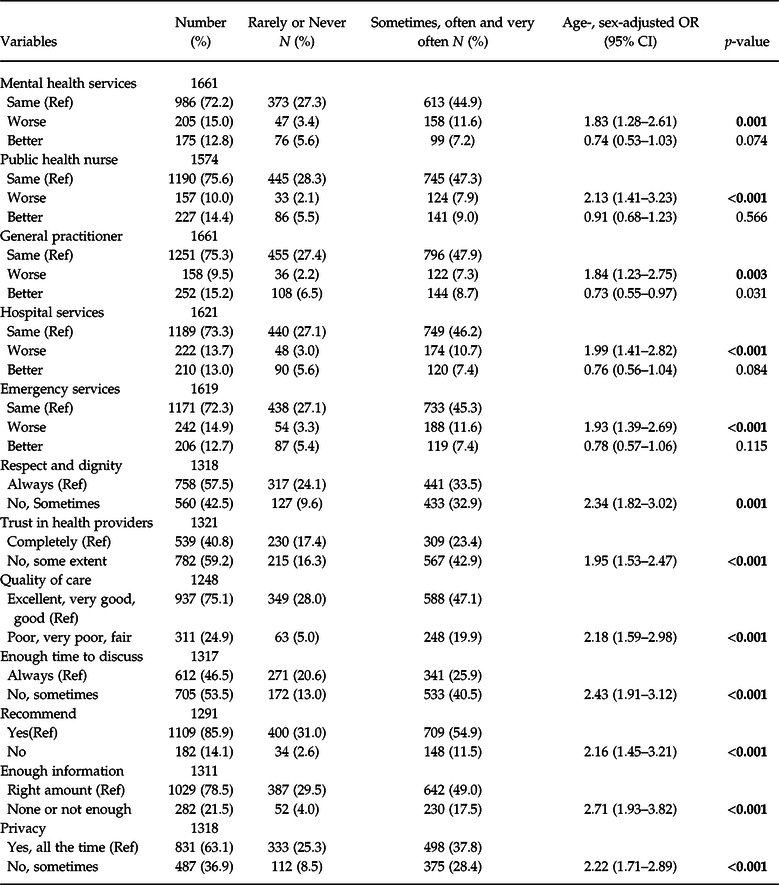
For the HSU interview (n = 1576), data were collected on reported usage of health services associated with EOD. Travellers were asked if they had the same, worse or better opportunities to access Mental Health Services, Public Health Nurses, General Practioners, Hospitals and Emergency services as everyone else. This question was derived from an Irish national survey of HSU, INSIGHT (Boilson et al. Reference Boilson, Craven, Drummond, Fitz-Simon, Staines and Kelleher2007). These data were analysed in relation to their EOD using age- and sex-adjusted logistic analysis.
The quality of Travellers’ recent health care experiences, at time of measurement, was also analysed in relation to EOD. These data items were derived from those developed and validated by the Picker Institute (Jenkinson et al. Reference Jenkinson, Coulter and Bruster2002). These included measures of the appropriateness of the health information and education provided, emotional support (‘confidence and trust in the health service provider’), respect for patient preferences (‘treated with respect and dignity’) and an overall impression of service quality (measured on a Likert scale). These data were analysed using multivariate age- and sex-adjusted logistic analysis. All analyses were conducted using IBM SPSS Statistics for Windows, Version 24.0 (IBM Corp., 2016, Armonk, NY, USA).
Results
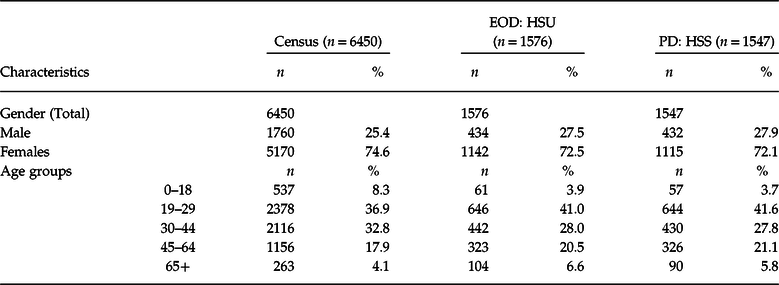
In Table 1, is descriptive and shows the characteristics of the Travellers selected in Census and the sub-studies, we give a breakdown of the age group and sex of the respondents in the Census, HSS and HSU studies. There are data on 6450 families in the census household interview, and three-quarters of these (74.6%) were with female respondents. Experience or PD was reported by 53% to 65% of all study respondents.
Characteristics of the study samples from the Census, HSU and HSSs AITHS (2010)

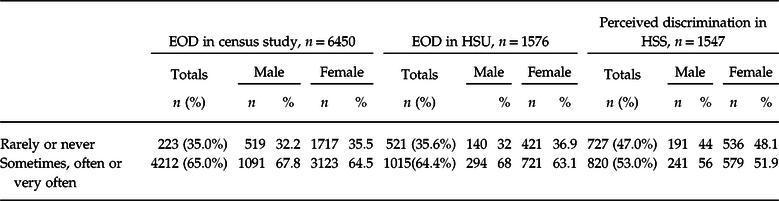
In Table 2, we summarise discrimination encounters as reported by principal respondents, across three studies: (a) EOD on the census survey and b) in the HSU survey and (c) PD in the HSS survey.
Comparative data on the EOD in the AITHS Census, HSU and perceived discrimination in the HSS

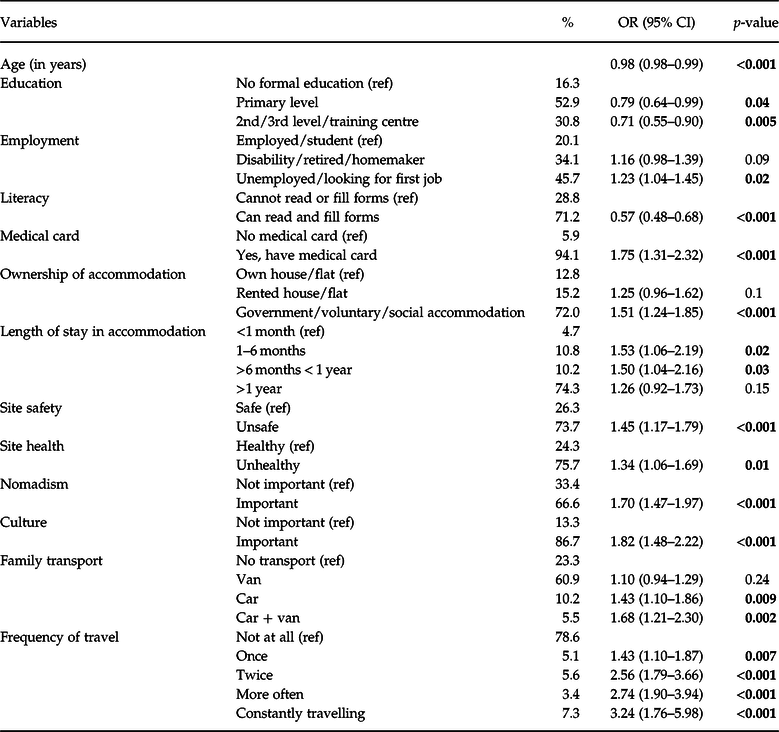
In the final model the factors associated with reduced odds of experiencing discrimination were higher education (OR 0.71, 95% CI 0.55–0.90) and no literacy (OR 0.57, 95% CI 0.48–0.68). Some of the factors associated with increased odds of experiencing discrimination that were statistically significant were having a medical card, feeling that Traveller culture was very important, perception of their site as very unsafe and constant travelling. For these and other significant findings on factors associated with EOD, see Table 3.
Factors associated with experience of discrimination. Final multivariate-adjusted logistic regression, using backward stepwise likelihood ratio method (n = 4574)

The bold values are to significance at p < 0.05.
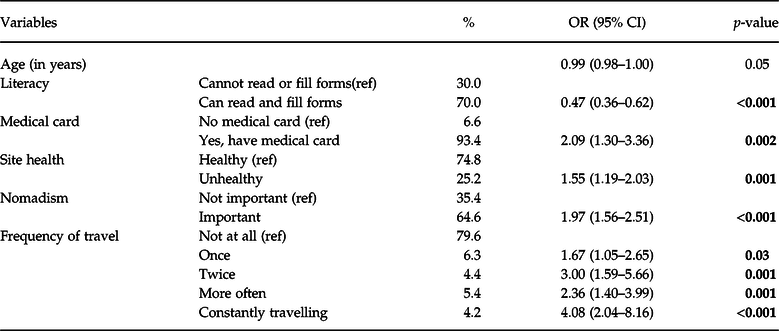
In the final model, the factors associated with PD have some overlap with EOD in that those who have no literacy have less than half the odds of perceiving discrimination (OR 0.47, 95% CI 0.36–0.62). Similiarly, Travellers with higher risk of perceiving discrimination were those who had medical cards and constantly travelled. For these and other significant findings on factors associated with PD, see Table 4.
Factors associated with perceived discrimination. Final multivariate-adjusted logistic regression, using backward stepwise likelihood ratio method (N = 1386)

The bold values are to significance at p < 0.05.
Overall, the final adjusted odds of reporting EOD for Travellers who felt they had worse opportunity to accessing mental health services were 1.83 times those of everyone else (non-Travellers). For the other types of health services, the odds of reporting EOD ranged from 1.84 for Travellers who thought they had a worse opportunity to accessing general practitioner (GP) services to 2.13 to accessing public health nurse services. In all cases, odds of reporting EOD were significantly higher in those reporting a worse opportunity in accessing health services, these factors each remained significant after adjustment for age and sex.
In relation to access to mental health services, 72.2% of Travellers reported they had the same experience, 15% reported worse experience and 12.8% reported better access than everyone else. There is a similar range across other services with 12.7% reporting better access to emergency service to 15.2% experiencing better access to GP services.
Overall, the odds of reporting EOD ranged from 1.95 times greater odds of having little or no trust in their health service providers to 2.71 times greater odds of not getting any or not enough information on their medical condition. These factors each remained significant after adjustment for age and sex.
The percentage of Travellers reporting positive experience of engagement with the health services ranged from 46.5% who felt they had been allowed enough time to discuss their medical condition to 85.9% who would recommend the service to another family member. More details on the associations between EOD and accessing health services and the quality of that experience can be found in Table 5.
Health service variables associated with EOD, multivariate-adjusted logistic regression

The bold values are to significance at p < 0.05.
Discussion
This analysis of the AITHS confirms high levels of reported EOD and PD in that community related to their service experience. Travellers’ EOD has an impact on the quality of their engagement with all health services and health care providers, including mental health services. Overall, the odds of reporting EOD for Travellers who felt they had a worse opportunity to access mental health services were almost twice that of other respondents.
Our findings on Travellers’ experience of EOD in relation to engagement with health services and on levels of satisfaction with care and trust are consistent with findings in research with other ethnic minorities (Dovidio et al. Reference Dovidio, Penner, Albrecht, Norton, Gaertner and Shelton2008; Pascoe & Smart Richman, Reference Pascoe and Smart Richman2009; Harris et al. Reference Harris, Cormack, Tobias, Yeh, Talamaivao and Minster2012). In a systematic review on racism and HSU (Ben et al. Reference Ben, Cormack, Harris and Paradies2017), very strong negative associations were found between experience of racism and patient satisfaction levels with health services; including low levels of health care trust and communication. A number of the studies included also indicated that racism was associated with delaying/not getting health care and lack of treatment uptake. The level of complete trust by Travellers in health professionals was only half that of the trust level reported by the general population (McGorrian et al. Reference McGorrian, Frazer, Daly, Moore, Turner and Sweeney2012).
In the final models, EOD and PD were significantly associated with socio-demographic, socio-cultural and living conditions. These findings illustrate that Travellers report very high levels of EOD, and these are significantly associated with socio-demographic, socio-cultural and living conditions.
International studies suggest simply feeling vulnerable to experiences of racism may be associated with poorer health experience (Karlsen, Reference Karlsen2007). Both Smedley et al. Reference Smedley, Stith and Nelson2002 and Perez et al. Reference Perez, Sribney and Rodriguez2009 noted that discrimination can affect the pattern of use of health services by ethnic minorities; firstly, it can increase the level of mistrust which in turn decreases use of services, and secondly, discrimination could lead to stressors which increase the need for services. Forty percent of Travellers have experienced discrimination in accessing health services, compared to 17% of Black Americans and 14% of Latino Americans (All Ireland Traveller Health Study Team, 2010).
Evidence from studies on PD and health care found that PD was significantly associated with reports of not having enough time with physicians and caused to have more than twice the odds of reporting fair or poor quality of care (Benjamins & Middleton, Reference Benjamins and Middleton2019).
In qualitative studies and reports relating to Black, Minority and Ethnic (BME) communities and their experience with health services, they recounted negative experiences about treatment received and articulated a general sense of not being understood and catered for by the system. Health service encounters may be difficult because of Traveller-specific cultural issues, including communication, poor literacy and trust and engagement with health care providers (Van Cleemput et al. Reference Van Cleemput, Parry, Thomas, Peters and Cooper2007; Cemlyn et al. Reference Cemlyn, Greenfields, Burnett, Matthews and Whitwell2009; Moore et al. Reference Moore, Turner, Nic Charthaigh, Quirke, Hamid and Kelleher2010).
Some of the challenges impacting on Travellers engagement with health services are due to institutional discrimination, where services are designed for the majority population and without intent, they discriminate against people who live at the margins of society. On top of this, the range of medical needs that Travellers have is affected by poverty, unemployment, low literacy levels and basic accommodation further complicated by addiction and experiences of bereavement, and they are linked with discrimination and mental health. Service providers do not always understand the complexity of these needs, which leads to communication difficulties, low expectations and lack of trust (Marrone et al. Reference Marrone2007; Van Cleemput et al. Reference Van Cleemput, Parry, Thomas, Peters and Cooper2007; AITHS team, 2010).
In Mc Gorrian’s study (McGorrian et al. Reference McGorrian, Hamid, Fitzpatrick, Daly, Malone and Kelleher2013), on Frequent Mental Distress (FMD) in Irish Travellers, the FMD rate was 2 and a half times that reported by the general population and was more prevalent in those who reported that their quality of life was impaired by physical health, by those who were recently bereaved of a friend or family member and by those who had greater EODs.
The AITHS (Abdalla et al. Reference Abdalla, Quirke, Fitzpatrick, Daly and Kelleher2010), reported that the Traveller male suicide rate was statistically significant, with an SMR over sixfold greater than the general population. The Traveller female suicide SMR was similarly elevated. In a Traveller community national survey (O’Mahony, Reference O’Mahony2017), nine out of ten Travellers agreed that mental health problems are common among the community and eight out of ten of the community have been affected by suicide. According to the AITHS, 11% of Traveller deaths are estimated to be by suicide (Abdalla et al. Reference Abdalla, Quirke, Fitzpatrick, Daly and Kelleher2010). Evidence from a number of studies (Goward et al. Reference Goward, Repper, Appleton and Hagan2006; McGorrian et al. Reference McGorrian, Hamid, Fitzpatrick, Daly, Malone and Kelleher2013) shows that Gypsies and Travellers have greatly raised rates of depression and anxiety. These are the two factors most highly associated with suicide, with relative risks greatly higher than in the general population (Harris & Barraclough, Reference Harris and Barraclough1997). A range of factors may contribute to this, including the stresses caused by accommodation problems, unemployment, bereavement and racism and discrimination by services and the wider public.
Gee et al. (Reference Gee2002) identified 62 studies on Asian Americans’ experience and found that discrimination was associated with poorer mental health. In the systematic review and meta analyses of racism and health (Paradies et al. Reference Paradies, Ben, Denson, Elias, Priest and Pieterse2015), results indicated a twofold range in the strength of association between racism and poor mental health, including suicidal ideation, planning and attempts and for post-traumatic disorders and depression. According to Wallace et al. Reference Wallace, Nazroo and Becares2016, cumulative exposure to racial discrimination has incremental long-term effects on the mental health of ethnic minorities in the UK and suggests that studies that only examine discrimination at one point in time may underestimate the impact of racism on health.
The Equality and Human Rights Commission (EHRC, 2016) review concluded that the life chances of Gypsies and Travellers had declined since the Commission’s previous review in 2010. The contributory factors are complex and often inter-related but may include deprivation, social exclusion and discrimination. Since 2010, there have also been a range of reports that reinforce the key findings in the AITHS, including Census 2016 (CSO, 2017), and the Economic and Social Research Institute report on the social profile of Travellers (Watson et al. Reference Watson, Kenny and McGinnity2017). The most recent analysis on discrimination in Ireland found that Travellers are 22 times more likely to experience discrimination in accessing private services, and 10 times more likely in seeking work (McGinnity et al. Reference McGinnity, Grotti, Kenny and Russell2017).
The National Intercultural Health Strategy (The HSE, 2008) suggested three other major barriers that can hinder access to health care for people from BME communities: (1) understanding the pathways of negotiating the health system, (2) accessing a range of services (usually GP) and (3) the service user’s experience of racism and discrimination.
Health providers have limited time to engage and to be cognisant of the low levels of education and literacy in the Traveller community. The AITHS found that 30% of Travellers had difficulties with reading and filling out forms. Service providers also report that Travellers have difficulty with literacy and medication prescription issues (All Ireland Traveller Health Study Team 2010). Health education materials need to be developed which are Traveller and Literacy proofed, information on signposting can also assist with addressing appropriate access. Models of good practice have been developed that train community health workers who act as ‘link workers’ between the community and the health services (Pavee Point 2006; Cheng et al. Reference Cheng2007).
Initiatives like Lived Lives: A Pavee Perspective (Malone et al. Reference Malone, McGuinness, Cleary, Jefferies, Owens and Kelleher2017) is a model of community engagement which facilitated Travellers in exploring the stigma and challenges they experience around suicide and its aftermath in their community. Travellers and health service providers were invited to a mediated exhibition, which facilitated dialogue and mutual understandings of the mental health challenges faced by Travellers.
The development of cultural competence among health professionals is central to measures to improve ethnic minorities’ access to health services (Goward et al. Reference Goward, Repper, Appleton and Hagan2006; Treise & Shepherd, Reference Treise and Shepherd2006; Dudgeon et al. Reference Dudgeon, Milroy and Walker2014; Shepherd et al. Reference Shepherd, Willis-Esqueda, Newton, Sivasubramaniam and Paradies2019). The most cited definition of cultural competency is by Cross et al. (Reference Cross, Bazron, Dennis and Isaacs1989) ‘a set of congruent behaviours, attitudes, and policies that come together in a system, agency or among professionals and enables that system, agency or those professionals to work effectively in cross-cultural situations’. In the UK, there are models of cultural competence for staff working with Travellers, along with position papers and guidance on mental health services and BME communities that have been produced by a range of institutions (Department of Health UK 2005; Francis, Reference Francis2013). The Joint Commissioning Panel for Mental Health Guidance in (2018) suggested developing a more appropriate and responsive service, increasing community engagement with service providers and provision of better quality information on the ethnic profile of local populations and service. The Royal College of Psychiatrists, UK (RCP UK, 2018), has issued a position statement on racism and mental health responding to their concern on the disproportionate impact Racism is having on the mental health of BME communities. They want to raise awareness of these issues and provide leadership in implementing preventive interventions and actions.
The study has clear limitations in that it is based on self-report and is cross-sectional in design so the directionality of the relationship cannot be interpreted with certainty or the impact of cumulative exposure to discrimination over time. Nonetheless, a broad range of responses was given to the questions and there is objective evidence that Travellers experience discrimination from other data sources. Further research is essential to understand more about barriers to care as part of building culturally competent models of care including mental health care for Travellers (McLoughlin et al. Reference McLoughlin, Gould and Malone2015).
Conclusions
In conclusion, this analysis shows the importance of exposure to discrimination to the wellbeing of Travellers, and this should be a relevant consideration to health care providers in planning services. Irish Travellers experience very high levels of discrimination which are associated with social and environmental conditions. These levels of discrimination impact in turn on their perception and experience of the health services. These findings have important implications for public policy and particularly the necessity to develop culturally competent services to address individual and institutional levels of discrimination. Education, information and training are required to reduce discrimination and increase existing supports to meet the mental health needs of Travellers.
Conflict of interest
BQ has no conflicts of interest to disclose. MH has no conflicts of interests to disclose. PF has no conflicts of interests to disclose. SM has no conflicts of interest to disclose. KM has no conflicts of interest to disclose. CK has no conflicts of interest to disclose.
Ethical Standards
The authors assert that all procedures contributing to this work comply with the ethical standards of the relevant national and institutional committee on human experimentation with the Helsinki Declaration of 1975, as revised in 2008. Ethical approval for AITHS in the Republic of Ireland was obtained from the University College Dublin Human Research Ethics Committee, and all participants provided a written informed consent.
Financial Support
This study is based on the AITHS which was commissioned and funded by the Department of Health and Children, Dublin, Ireland (grant number, V0350) and the Health Services Executive, Dublin, Ireland (grant number, V030 A).
Acknowledgments
The authors wish to acknowledge the important role of the Traveller peer researchers, study coordinators and the Travellers who participated in the study. We would also like to acknowledge the support of the stakeholders on the AITHS Steering Group who made the AITHS possible. Apart from the authors listed, the AITHS study team members were Safa Abdalla, Fran Cronin, Leslie Daly, Anne Drummond, Kate Frazier, Noor Aman Hamid, Claire Kelly, Catherine McGorrian, Ronnie Moore, Sinead Murnane, Roisin Nic Charthaigh, Deirdre O’Mahony, Brid O’Shea, Anthony Staines, David Staines, Mary Rose Sweeney, Jill Turner and Aileen Ward. The views expressed in this study are the authors’ own and do not necessarily reflect the views and position of the Department of Health and the Health Service Executive.