Introduction
Help-seeking behaviour has long been observed to differ between men and women (Addis and Mahalik, Reference Addis and Mahalik2003; Galdas et al., Reference Galdas, Cheater and Marshall2005). This is particularly apparent in relation to mental health problems, where those who seek help from mental health professionals such as doctors and trained mental health professionals are much more likely to be female than male (Alonso et al., Reference Alonso, Angermeyer, Bernert, Bruffaerts, Brugha, Bryson, de Girolamo, de Graaf, Demyttenaere, Gasquet, Haro, Katz, Kessler, Kovess, Lepine, Ormel, Polidori, Russo, Vilagut, Alamansa, Arbabzadeh-Bouchez, Autonell, Bernal, Buist-Bouwman, Codony, Domingo-Salvany, Ferrer, Joo, Martinez-Alonso, Matschinger, Mazzi, Morgan, Morosini, Palacin, Romera, Taub and Vollebergh2004; Wang et al., Reference Wang, Aguilar-Gaxiola, Alonso, Angermeyer, Borges, Bromet, Bruffaerts, de Girolamo, de Graaf, Gureje, Haro, Karam, Kessler, Kovess, Lane, Lee, Levinson, Ono, Petukhova, Posada-Villa, Seedat and Wells2007). Across a number of European countries, females have about twice the odds of seeing a mental health professional compared with males (Alonso et al., Reference Alonso, Angermeyer, Bernert, Bruffaerts, Brugha, Bryson, de Girolamo, de Graaf, Demyttenaere, Gasquet, Haro, Katz, Kessler, Kovess, Lepine, Ormel, Polidori, Russo, Vilagut, Alamansa, Arbabzadeh-Bouchez, Autonell, Bernal, Buist-Bouwman, Codony, Domingo-Salvany, Ferrer, Joo, Martinez-Alonso, Matschinger, Mazzi, Morgan, Morosini, Palacin, Romera, Taub and Vollebergh2004; Kovess-Masfety et al., Reference Kovess-Masfety, Boyd, van de Velde, de Graaf, Vilagut, Haro, Florescu, O'Neill, Weinberg and Alonso2014). In Australia, females receive mental health services at around 1.5 times the rate of males (AIHW, 2017). While higher help-seeking among females plausibly coheres with the higher reported prevalence of common mental health issues among women (Whiteford et al., Reference Whiteford, Ferrari, Degenhardt, Feiginm and Vos2015), it is less congruent with the fact that men are more likely to die by suicide (Windfuhr and Kapur, Reference Windfuhr and Kapur2011). It is possible then that men are not seeking help for mental health symptoms that they experience. To encourage treatment-seeking when needed and reduce mental distress among males, it is important to understand what contributes to the help-seeking gender disparity.
There has been some research into the factors influencing male health service access for mental health problems (Addis and Mahalik, Reference Addis and Mahalik2003; Galdas et al., Reference Galdas, Cheater and Marshall2005). Researchers in the area have highlighted role-socialisation and ‘traditional masculine behaviour’ as factors that may inhibit help-seeking among males when they need it (Addis and Mahalik, Reference Addis and Mahalik2003; Mansfield et al., Reference Mansfield, Addis and Mahalik2003; Galdas et al., Reference Galdas, Cheater and Marshall2005; Seidler et al., Reference Seidler, Dawes, Rice, Oliffe and Dhillon2016). Perceived stigma around mental health, such as personal stigma or that perceived from external influences such as family, workplace or community, may also contribute to a lack of health service uptake for mental health problems among men (Addis and Mahalik, Reference Addis and Mahalik2003). Aside from these individual factors, researchers have identified a number of employment-related influences on treatment-seeking, such as employment status (Honkonen et al., Reference Honkonen, Virtanen, Ahola, Kivimaki, Pirkola, Isometsa, Aromaa and Lonnqvist2007; Ahs et al., Reference Ahs, Burell and Westerling2012).
Within the employed population, research on mental health service use appears to have been confined to specific occupational groups. For example, a study conducted in the Australian Defence Force reported that men and women experienced similar rates of mental health issues, but that women were still more likely to seek treatment for mental health-related issues (McFarlane et al., Reference McFarlane, Hodson, Van Hooff and Davies2010). Another study of Australian mine workers found that females were more than three times as likely to have sought professional help for mental health issues within a 12-month period than males (Tynan et al., Reference Tynan, Considine, Rich, Skehan, Wiggers, Lewin, James, Inder, Baker, Kay-Lambkin, Perkins and Kelly2016).
While these findings are important, studies within the employed population have lacked an understanding of the influence of the gendered environment on help-seeking for mental health problems. The relational theory of gender argues that gender (and gendered behaviours) operates through institutions and at a societal level, as well as at the intrapersonal and interpersonal functions (Connell, Reference Connell2012; Hammarström et al., Reference Hammarström, Johansson, Annandale, Ahlgren, Aléx, Christianson, Elwér, Eriksson, Fjellman-Wiklund, Gilenstam, Gustafsson, Harryson, Lehti, Stenberg and Verdonk2014). Work is recognised as one of the key places in which gendered behaviours are displayed (Connell, Reference Connell2012). This is not only evident in differences in the selection of males and females into different occupations (Preston, Reference Preston1999) (e.g. females are more likely to be nurses, while men are more likely to be employed in construction), but also in the fact that suicide rates vary in different occupations, with male-dominated occupations tending to have higher rates of suicide than female-dominated occupations (Milner et al., Reference Milner, Spittal, Pirkis and LaMontagne2013). Thus, according to the relational theory of gender (Connell, Reference Connell2012; Hammarström et al., Reference Hammarström, Johansson, Annandale, Ahlgren, Aléx, Christianson, Elwér, Eriksson, Fjellman-Wiklund, Gilenstam, Gustafsson, Harryson, Lehti, Stenberg and Verdonk2014), mutually reinforcing scripts at the interpersonal, intrapersonal and institutional level may impact on gendered behaviours about help-seeking. At the same time, it is important to note that expression of gender are open to change over time, and may vary depending on the setting and group under study (Connell and Messerschmidt, Reference Connell and Messerschmidt2005).
Understanding the nature of help-seeking behaviour in the context of the gender composition of an occupation is critical in tailoring the delivery of mental health services and in the design of workplace-based mental health initiatives. Knowledge about the working contexts in which males and females are more or less likely to seek help for mental health problems could assist in identifying settings and groups that are particularly at risk of poorer outcomes. The aim of the current study is to examine whether help-seeking from professional sources (e.g. mental health professional such as a psychiatrist or psychologist) for mental health problems is related to the gender composition of a person's occupation. In particular, we are interested in differences in male-dominated occupations.
Methods
Data source
The Household, Income and Labour Dynamics in Australia (HILDA) survey is a longitudinal, nationally representative study of Australian households established in 2001. It collects detailed information annually from over 13 000 individuals within over 7000 households (Wilkins, Reference Wilkins2013). The response rate for wave 1 was 66% (Wilkins, Reference Wilkins2013). The survey covers a range of dimensions including social, demographic, health and economic conditions using a combination of face-to-face interviews with trained interviewers and a self-completion questionnaire.
The initial wave of the survey began with a large national probability sample of Australian households occupying private dwellings (Wilkins, Reference Wilkins2013). Interviews were sought in later waves with all persons in sample households who turned 15 years of age. Additional persons have been added to the sample as a result of changes in household composition. Inclusion of these new households is the main way in which the HILDA survey maintains sample representativeness. A top-up sample of 2000 people was added to the cohort in 2011 to allow better representation of the Australian population using the same methodology as the original sample (i.e. a three-stage area-based design) (Watson, Reference Watson2011). The response rates for the HILDA survey are above 90% for respondents who have continued in the survey and above 70% for new respondents being invited into the study (Wilkins, Reference Wilkins2013). As desribed below, our variables of interest were collected only in a limited number of these waves. Because of this, we assess outcomes in 2013 with exposures and confounders measured in the year prior (2012) or earlier. This study received ethical approval from the Department of Social Services (DSS).
Outcome variable
The main outcome was a binary variable representing help-seeking from a mental health provider in the past 12 months. This was ascertained using the stem question: ‘During the last 12 months, have you seen any of these types of health care providers about your health?’ The participant was then presented with a large print show card displaying a number of health professionals [e.g. a hospital doctor, a specialist doctor (excluding in outpatients or casualty of a hospital), a mental health professional such as a psychiatrist or psychologist]. In this study, we are particularly interested in people who have nominated that they have sought help from a mental health professional. These data were collected in 2009 and 2013. For the purposes of this study, we are interested in measuring this as an outcome in 2013.
Exposure variable
Our main exposure represented an occupational gender ratio variable. This variable describes the extent to which an occupation could be described as male-dominated or non-male-dominated based on the 2006 census population-level statistics from the Australian Bureau of Statistics (ABS) (ABS, 2006). We used the Australian and New Zealand Standard Classification of Occupations (ANZSCO) two-digit occupation (ANZSCO, 2009) to create a ratio of the male-to-female population in each of the occupations included in ANZSCO two. If the gender ratio of an ANZSCO occupation was comprised of <1.50 males to 1 female, then the occupation was classified as male-dominated (see Supplementary Table S1). Examples of male-dominated occupations included: construction trades workers (61.74 males to 1 female), road and rail drivers (15 males to 1 female) and protective service workers (4.53 males to 1 female). Female-dominated occupations were those where there were 0.5 (or less) males to 1 female, while gender-neutral occupations were those remaining occupations.
Descriptive analysis indicated that the prevalence of help-seeking from professional sources was similar in female-dominated and gender-neutral occupations (8.19 and 7.68%, respectively). Hence, these were grouped together. The prevalence of help-seeking from professional sources in male-dominated occupations was 4.64%. Based on this difference, a binary-level measure was created: gender-neutral and female-dominated occupations (the reference ‘0’) and male-dominated (exposed ‘1’).
Confounders and covariates
We considered variables that could plausibly be considered as prior common causes of both: (a) being employed in a male-dominated occupation, and (b) help-seeking for a mental health problem. All of these were measured in 2012, apart from help-seeking which was measured in 2009, as described below. Confounders included: age (18–24, 25–29, 30–34, 35–44, 45–54 and 55–64 years), education (less than year 12 (high school), year 12, diploma or certificate, bachelor degree or higher), household structure (couple without children, couple with children, lone parent with children, lone person and other) and weekly household income (equivalised). We also adjusted for baseline mental health [Mental Health Inventory (MHI-5) a subscale from the Short Form-36 (SF-36)] and past help-seeking for mental health problems (measured in 2009). Other variables such as psychosocial job stressors, employment arrangements and work/family conflict were seen as possible mediators of the relationship between employment in a job of a certain gender composition and help-seeking, and were thus excluded. For example, working full or part time is an outcome of working in a non-male- or male-dominated occupation rather than a cause.
Statistical analysis
The positivity assumption requires the need for adequate exposure variability within specific strata of interest (Petersen et al., Reference Petersen, Porter, Gruber, Wang and van der Laan2012). The gendered selection into male- and female-dominated occupations risks violating this assumption, and as a consequence, all analyses were conducted separately for males and females.
Logistic regression model
We conducted a logistic regression with mental health help-seeking (from professional sources) as the outcome and employment in a male- v. non-male-dominated occupation as the key exposure. First, we conducted an unadjusted logistic model, with coefficients transformed into odds ratio. Second, we conducted an adjusted multivariate logistic regression model, which also included the confounders described above. Third, we used a propensity score approach. This allowed us to create matched sets of treated and untreated subjects who shared a similar value of a propensity score, representing the probability of being in either a male- or non-male-dominated occupation, conditional on observed baseline covariates (Austin, Reference Austin2011). This matched sample was used to conduct a logistic regression model (using the same exposure and outcomes as mentioned above), adjusting for the propensity score. We discuss this approach in greater depth below. All analyses were conducted separately for males and females.
Propensity score approach
Stata (version 13) was used to conduct the propensity score analysis using pscore (Becker and Ichino, Reference Becker and Ichino2002) and psmatch2 commands (Leuven and Sianesi, Reference Leuven and Sianesi2003). We first estimated the propensity for each individual to be in male-dominated occupation using a binary logistic model with the occupational gender ratio variable (0 = non-male-dominated, 1 = male-dominated) as the dependent variable. These were constructed separately for males and females for the reasons explained above.
Covariates in the model were selected based on an assessment of their likelihood as confounders of the relationship between exposure and outcome and are detailed above. We used nearest neighbour matching with replacement, which matches each person in a male-dominated occupation with individuals who are not in a male-dominated occupation who have similar propensity scores, within a caliper of 0.005 (using 1:1 matches per observation). This enabled us to establish a matched sample of people who were balanced on all observed confounders apart from the exposure (being in a male- v. non-male-dominated occupation). Diagnostics included assessing whether matching on propensity score reduced the overall imbalance in potential confounders, based on the standardised difference between persons who were and were not in a male-dominated occupation (aiming for below a 10% reduction in imbalance). The standardised difference was calculated as follows: if  $\bar P_{\exp} $ and
 $\bar P_{{\rm un}}$ represented the prevalence of confounders observed in the exposed and unexposed groups, the percentage standardised difference is:
 $$100 \times \displaystyle{{{\bar p}_{\exp} - {\bar p}_{{\rm un}}} \over {{\rm S}{\rm D}_{{\rm pool}}}},$$
where
 $${\rm S}{\rm D}_{{\rm pool}} = \sqrt {\displaystyle{{{\bar p}_{\exp} \left( {1 - {\bar p}_{\exp}} \right) + {\bar p}_{{\rm un}}\left( {1 - {\bar p}_{{\rm un}}} \right)} \over 2}}. $$
We also assessed the degree of overlap to ensure that we were comparing outcomes between exposed and unexposed subjects whose distribution of confounders was similar. As explained above, we then used the matched sample and propensity scores in logistic regression, adjusting for the propensity score. Robust standard errors were calculated.
Analytic sample
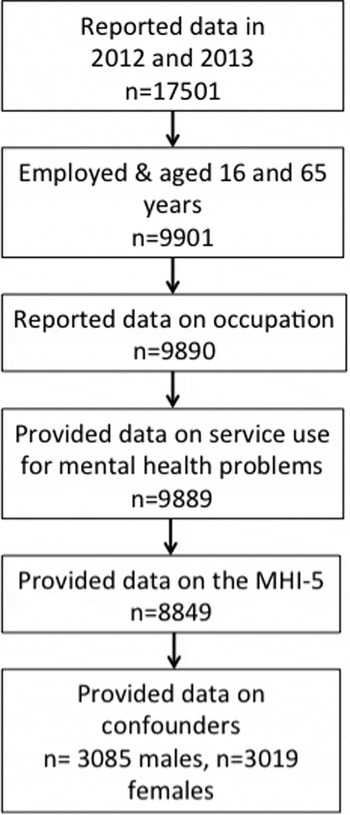
The process for establishing the analytic sample can be seen in Fig. 1.
Analytic sample.

Results
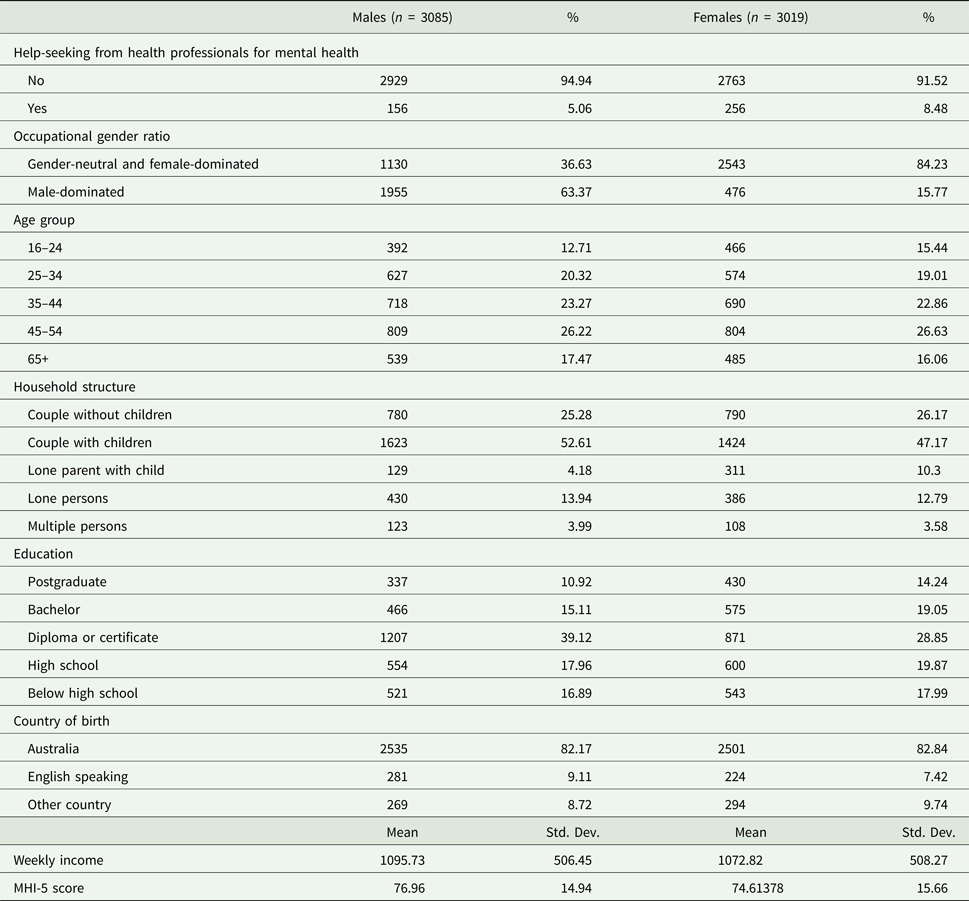
A description of the sample included in the multivariate logistic regression models can be seen in Table 1. Females were more likely to have sought help from mental health professionals than males (8.48 and 5.06%, respectively). Over 60% of males were employed in male-dominated occupations, compared with almost 16% of females. The majority of the sample were part of a couple with children, had post-high school education and were born in Australia.
Summary statistics for males and females in the analytic sample

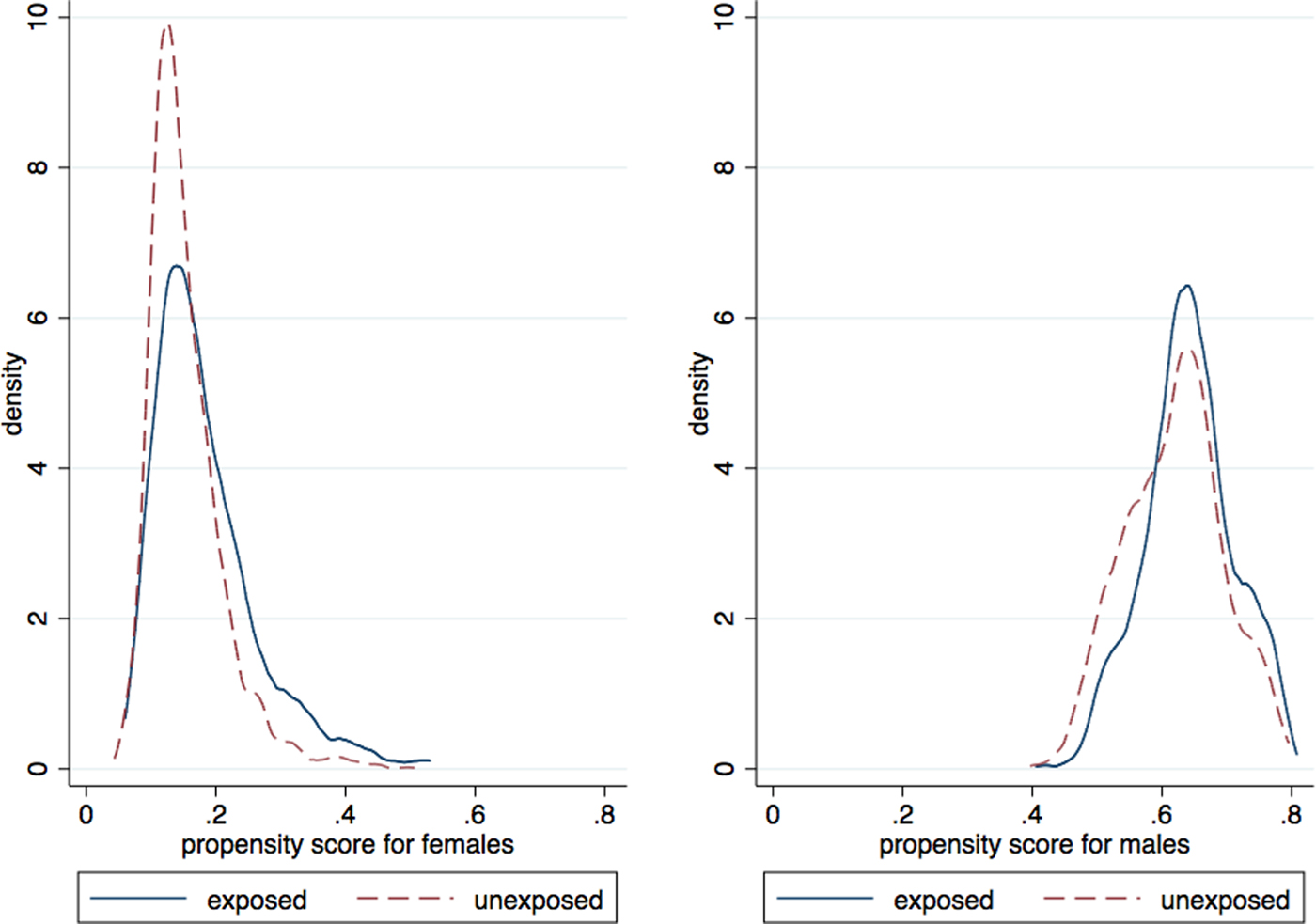
Figure 2 demonstrates propensity score histogram by treatment status (exposed and unexposed). Results for the reduction in standardised differences can be seen in Supplementary Tables S2a and b. This shows that there is a reduction in bias in confounders in the matched sample compared with the unmatched sample.
Propensity score histogram by treatment status and gender.
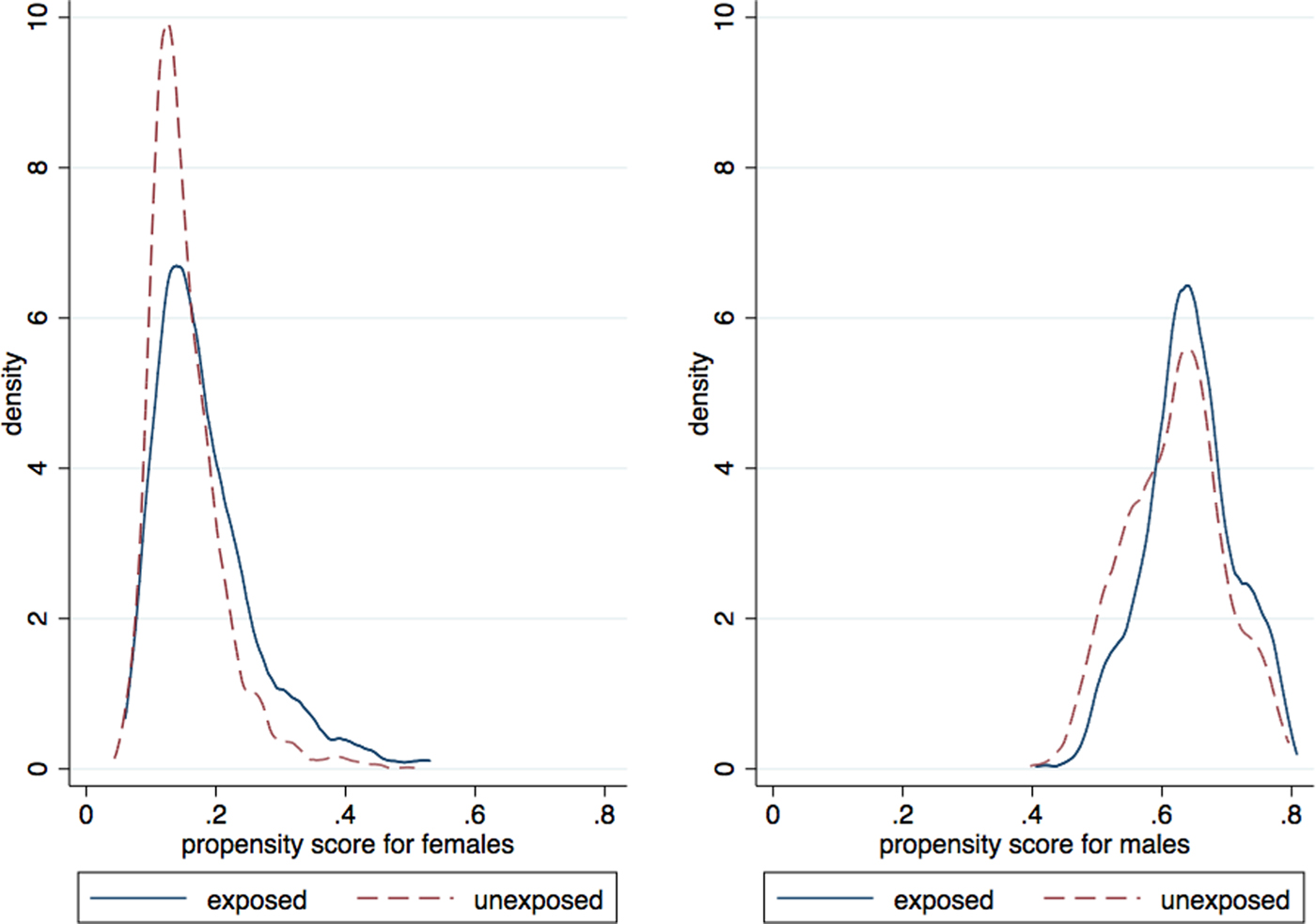
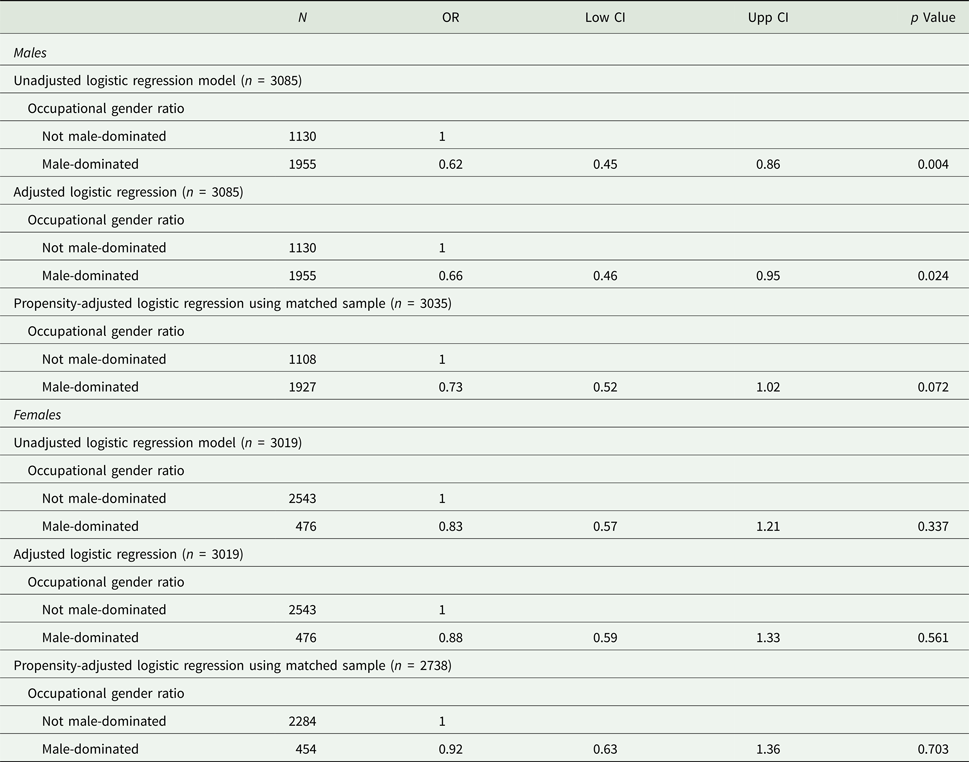
Table 2 shows the unadjusted, adjusted and propensity score-matched logistic regression. For males working in male-dominated occupations, the odds of help-seeking was 0.66 (95% CI 0.46–0.95) in the adjusted model when compared with males employed in more gender-neutral occupations. In the propensity-matched sample, the odds reduced to 0.73 (95% CI 0.52–1.02). There was no significant relationship between help-seeking and the occupational gender ratio for females.
Occupational gender ratio and help-seeking from health professionals for mental health, logistic regression model, sample prior to and following propensity score matching with caliper (0.005), by gender

Adjusted models include confounders age, household structure, education, country of birth, income and MHI-5 measured in 2012; past help-seeking for mental health problems (2009); outcome (help-seeking for mental health problems) measured in 2013.
Discussion
The results of this paper indicate that being in male-dominated occupation is associated with a lack of help-seeking from professional sources for mental health problems among males but not females. It is important to note that the size of the effect was similar across all analytical approaches, but fell just outside statistical significance in the propensity score model.
The limitations of this paper include the fact that we were not able to assess help-seeking from other non-designated mental health providers, such as general practitioners. General practitioners are the most commonly sought providers for mental health problems in Australia (approximately 55% of persons who sought help for mental health saw a general practitioner) (AIHW, 2016). This is likely due to the fact that they are often the first professional contacted to provide referrals to more specialist mental health services, such as psychologists or psychiatrists. Thus, our outcome represented a relatively specific aspect of the mental health system. We note that the prevalence of help-seeking from mental health professionals is similar to that reported in the general population when not counting general practitioners (AIHW, 2016). It is also important to note that the current paper does not assess broader forms of help-seeking, including from non-professionals, self-help, friend and family. It may also be subject to recall bias, as males (and females) may misreport the extent to which they have sought help from professional sources. Nor are we able to comment on individual attitudinal predictors of help-seeking.
Other limitations relate to the classification of occupational gender ratio, which was based on broad occupational categories. Hence, there may be a number of different effects within specific three- or four-digit occupations (e.g. male nurses, female fire fighters) that we are not detecting at the aggregate level. We also did not have data on non-binary aspects of gender, recognising that gender is a complex construct not confined to male/female classifications only. We also did not take into account possible differences by the presence of a mental disorder (acknowledging the fact that you do not have to have a mental disorder to see professional help). The strengths of this paper are its large sample size and the fact that we were able to use a robust methodological approach to identify the independent effects of being in a male-dominated occupation on help-seeking. Our key exposure (the occupational gender ratio) was objective and independent of our outcome, being drawn from the census data.
This is the first study that we are aware of to examine the association between occupational gender ratio and help-seeking behaviour for mental health problems. Various researchers in this area of gender and health service access have noted that, by and large, past research has been sex-comparative (Wenger, Reference Wenger2011), that is, comparing differences in access to health services among men v. women. While this is useful, it is unable to provide context or explanation for differences in help-seeking. In this paper, we attempt to advance understandings of help-seeking by examining the role of occupational context. In doing this, we build on the existing literature regarding socialisation and normative masculine behaviour (Möller-Leimkühler, Reference Möller-Leimkühler2002; Addis and Mahalik, Reference Addis and Mahalik2003; Mansfield et al., Reference Mansfield, Addis and Mahalik2003; Galdas et al., Reference Galdas, Cheater and Marshall2005; Seidler et al., Reference Seidler, Dawes, Rice, Oliffe and Dhillon2016) to suggest that help-seeking is a gendered behaviour connected to the occupational context of the employed population. This provides potentially valuable information for policy makers interested in male health. As noted above, our results suggest that male help-seeking is more influenced by occupational context than is female help-seeking. We speculate that occupation has a particular influence on male help-seeking because of the salience of work in men's lives (McDowll, Reference McDowll2003). In Australia (and in many other countries around the world), a greater proportion of men work full time compared with women, who are more likely to be working part time (ABS, 2017). There are numerous factors that explain why men spend a substantially greater proportion of their lives at work compared with women, including those relating to child rearing and cultural expectations of men as the primary breadwinners within families (Craig and Mullan, Reference Craig and Mullan2010; Baxter, Reference Baxter2012). Considering this, it is understandable that occupation has an influence on male behaviours. At the same time, we have to acknowledge that there is a need for further research on the dynamics by which female help-seeking behaviours may be influenced by contextual factors.
There are at least two connected ways in which male-dominated jobs may be related to men's service access for mental health problems. For one, males at risk of poor help-seeking behaviours may select into certain occupational groups. This might be connected to education or socialisation processes, but we would note that more research is needed to unpack this area of research. Accompanying this, environmental influences in male-dominated occupations may reinforce negative attitudes towards help-seeking, resulting in a lower overall likelihood of a male attending mental health services. A recent paper we conducted (Milner et al., Reference Milner, Kavanagh, King and Currier2018a) demonstrates that men in male-dominated occupations are more likely to adhere to traditional masculine norms regarding emotional control and self-reliance. These aspects of masculinity are thought to be associated with poorer help-seeking (Galdas et al., Reference Galdas, Cheater and Marshall2005). Thus, males in male-dominated jobs may view help-seeking from mental health professionals as incompatible with masculine normative behaviours. Furthermore, men in male-dominated occupations may have working contexts that are less conducive to help-seeking, as previous research we have conducted suggests that men are likely to experience high job demands (Reference Milner, King, LaMontagne, Bentley and KavanaghMilner 2018b) and long working hours (Milner et al., Reference Milner, Smith and LaMontagne2015). Thus, it may be more difficult for men to take time off work to attend health services. While these are clearly plausible reasons for the differences in help-seeking, there is a clear need for more research to identify the specific aspects of male-dominated occupations that exert a negative influence on help-seeking.
In conclusion, this study has highlighted the potential role of male-dominated occupations on help-seeking for mental health problems. There is a need for greater understanding of the complex occupational factors that might inhibit male help-seeking for mental health problems. We have suggested several above, including the influence of occupational gender norms, but there is a need for further studies to identify modifiable risk and protective factors in male-dominated jobs. Our findings also suggest that there is a need for workplace programmes addressing the barriers for help-seeking in male-dominated occupations. There are already programmes that exist in male-dominated occupations (e.g. Mates in Construction) (Gullestrup et al., Reference Gullestrup, Lequertier and Martin2011). At this stage, it is unknown whether this (and other programmes) are increasing help-seeking from professional sources. This would be a valuable area of future study.
Supplementary material
The supplementary material for this article can be found at https://doi.org/10.1017/S2045796018000367.
Acknowledgements
This paper uses unit record data from the Household, Income and Labour Dynamics in Australia (HILDA) survey. The HILDA project was initiated and is funded by the AustralianGovernment Department of Social Services (DSS) and is managed by the Melbourne Institute of Applied Economic and Social Research Melbourne Institute. The findings and views reported in this paper, however, are those of the author and should not be attributed to either DSS or the Melbourne Institute. The data used in this paper were extracted using the Add-On Package PanelWhiz for Stata. PanelWhiz (http://www.PanelWhiz.eu) was written by Dr John P. Haisken-DeNew (john@PanelWhiz.eu).
Availability of data and materials
Data are available on application to the Department of Social Services.
Author contributions
The article and design was conceived by AM, who also conducted analysis. TK and AS checked results and all authors contributed to the interpretation of results. AM drafted the manuscript with feedback from all authors. All authors contributed to the final draft of the manuscript.
Financial support
AM was supported by a Victorian Health and Medical Research Fellowship. TK was supported by an NHMRC Partnership Project (APP1134499). No financial disclosures were reported by the authors of this paper.
Conflict of interest
None.
Ethical standards
The authors assert that all procedures contributing to this work comply with the ethical standards of the relevant national and institutional committees on human experimentation and with the Helsinki Declaration of 1975, as revised in 2008. The authors assert that all procedures contributing to this work comply with the ethical standards of the relevant national and institutional guides on the care and use of laboratory animals.