Edward Wolff has spent more than 40 years acquiring an unchallenged expertise on the distribution of wealth and its concentration at the very top of the American wealth pyramid. His list of published research reports cited in the bibliography to his latest book runs to 69 items (pp. 818, 820–22, 824, 828, 830–34). Wolff not only has an intimate familiarity with the historical data, he generated much of that statistical information himself. He spills all that knowledge out in this mammoth sprawling tome of 880 pages, 105 graphs, and 142 tables.
This is not a book for a casual audience. Wolff published for that market with Top Heavy in 1996 and updated it in 2002 in only 116 pages. The new book is not an economic history of wealth; the main chapters are devoted to a technical description of how the historical statistics are made without much attention to context, consequences, or controversy. His description is dense, detailed, and difficult; the stuff for determined researchers. His voice is sober and dispassionate as he patiently describes in precise detail the raw data, the adjustments he makes, and the degree of confidence he has in the final results. The result is quite valuable. Knowledge of how the historical statistics are made is essential to bringing clarity to academic and political debates about wealth concentration and the changing fortunes of the middle class. Learning how the facts are manufactured may increase respect for them and their makers; but if it does not, we are at least able to express our dissatisfaction in an intelligent manner.
Wealth is a broad and complex topic. The breadth of coverage in this book is extraordinary. Just to list the subtopics treated would exhaust more pages than this Journal allows for a book review. Suffice it to say that whatever the question about wealth in America, the reader will find quantitative evidence and pointers to other literature in Wolff's new book. The first 16 pages and the last 84 pages offer a brief summary of his findings. I recommend that any reader begin by reviewing those passages and only then dive selectively into the vast belly of this work.
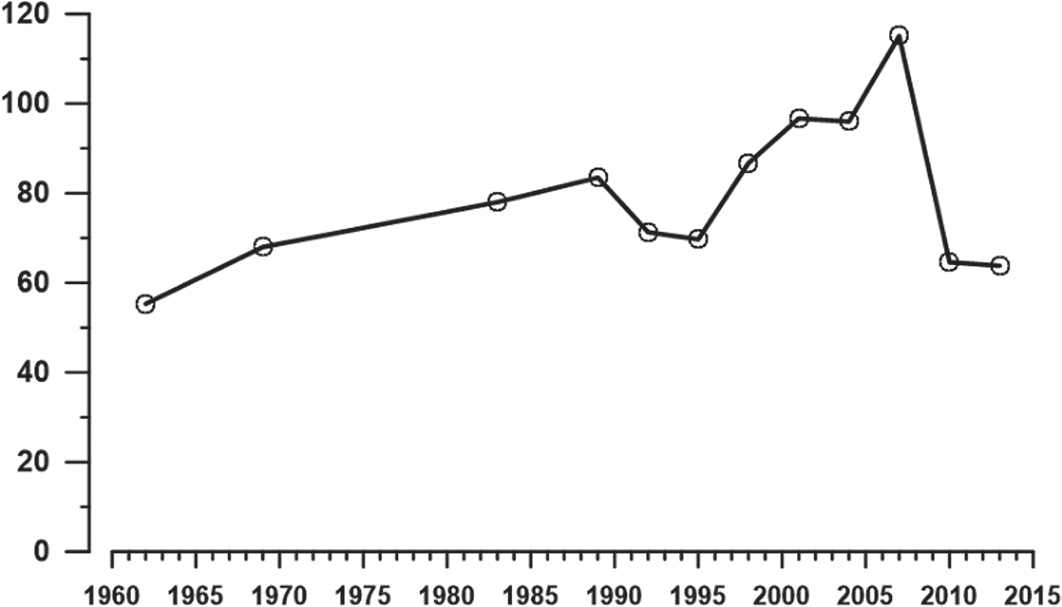
On page 679 Wolff asserts that “the thesis of this book” is the “rise and fall of the middle class.” The “middle class” is defined in purely statistical terms, and arbitrarily, as the 60 percent of American households occupying the middle three quintiles of the wealth distribution, “P2080” in Wolff's notation (p. 6). The primary index of the ascendency and decline of this class is the long-term trend in median household wealth. The median, of course, cleaves Wolff's middle class right down the middle of the third quintile. On this measure he has data based on the Federal Reserve's Survey of Consumer Finances for the period spanning 1962 to 2013 (pp. 45–47). The trend he reports is pictured in Figure 1.
Median Household Wealth, 1962–2013 Net Worth in Thousands of 2013 Dollars

The “rise of the middle class” is charted by the increase in median wealth between 1962 and 2007, an impressive improvement interrupted only by a setback in the 1990s. After those gains, the middle class lost ground, according to Wolff's measure, with a precipitous drop in wealth recorded over the years of the Great Recession from 2009 to 2013. “This collapse in median wealth,” says Wolff, “is a principle factor leading to the general malaise of the middle class” (p. 679).
A great deal, of course, hinges on the definitions. Household wealth as defined by Wolff includes the value of households' real estate measured at current prices. The housing boom saw house prices rise and the housing crisis in 2008–2010 saw them plummet. These swings in real estate markets account for more than 100 percent of the middle class's gain in marketable net worth before 2008; more than 100 percent since the contributions of saving and wealth transfers were negative or trivial over those years. The capital losses that followed explain the collapse (Chapter 5, Table 5.1 panel C.4, p. 188). Yet, for most households these capital gains and losses were unrealized “paper gains” and “paper losses.” It is worth remembering that the flow of services from the stock of housing remained largely unchanged throughout the boom and bust.
Wolff's real marketable net wealth is defined as assets less liabilities including mortgage debt. And mortgage debt soared during the housing boom preceding the crash. That financing, enabled by lax mortgage regulation, increased leverage and hence risk (the debt-income ratio more than doubled between 1983 and 2007). Many were caught on the downside of that that risk when the recession appeared. Despite that calamity, I suspect that a majority of households felt secure in their capacity to service their debt. Those homeowners might consider gross wealth a better measure of social status and retirement security than net wealth.
Wolff excludes nonmarketable wealth, such as the present value of future social security benefits and defined benefit plans, from his measure of marketable net wealth. Yet these assets provide a significant degree of long-term financial security and current wellbeing. Wolff recognizes this and presents estimates of “augmented wealth” for 1983 to 2013 that include defined benefit pensions and social security wealth for households nearing the age of retirement (age 47–64) (Table 8.8, panel C, pp. 356–57). Defined benefit wealth and social security wealth “played the role of ‘equalizers,’” pulling up the median and reducing inequality. Wolff includes defined contribution pensions in the marketable wealth series where it operated as a disequalizer lowering the median and increasing inequality. Over the decades defined contribution retirement plans have gradually replaced defined benefit plans weakening the force of the equalizers (p. 364). The median values for augmented wealth rise between 1989 and 2001 and fall between 2007 and 2010, winding up in 2013 slightly lower than in 1983. Even including the present value of future pension does not reverse the conclusion that there have been no gains for the median household in retirement security over the last 30 years.
Wolff cites his wealth statistics in real terms, calculating real wealth by deflating the nominal values by the consumer price index (CPI-U-RS in this case). Yet, it is not obvious that that adjustment is the best method for comparing wealth levels across time. Samuel Williamson has suggested four other plausible deflators for wealth including the value of a middle class consumer bundle; any one of the four would reduce the rate of increase of real median wealth.
Finally, I note that other (perhaps more commonsensible) meanings might be given to the ideas of a rising or falling middle class. For example, Wolff's statistics indicate that the percentage share of wealth held by the middle class (P2080), exhibits a steady decline throughout the entire second half of the twentieth century. The share fell from 19.7 percent in 1962 to 12.2 percent in 2013 (Table 2.2, p. 56). Since the P2080 definition is arbitrary, I note that the proportion of households deemed to be middle class by social or cultural historians (or by journalists and politicians) is unlikely to have been as Table 60 percent for 50 years as Wolff presumes.
These caveats do not discredit or distract from the value of Wolff's statistics. I find his numbers an important concrete starting point for framing the debate on the “general malaise” concerning wealth in the twenty-first century. The trends in median wealth are undoubtedly of economic and political concern. I perceive another factor generating the recent disquiet, not to mention outrage, about the recent trends in the distribution of wealth. That would be the growing disparity between the wealth of the middle class, the “average Joe” in the politician's phrase, and the wealth of those at the tiptop of the heap, the ultra-wealthy. Wolff has a good deal to report on this topic as well.
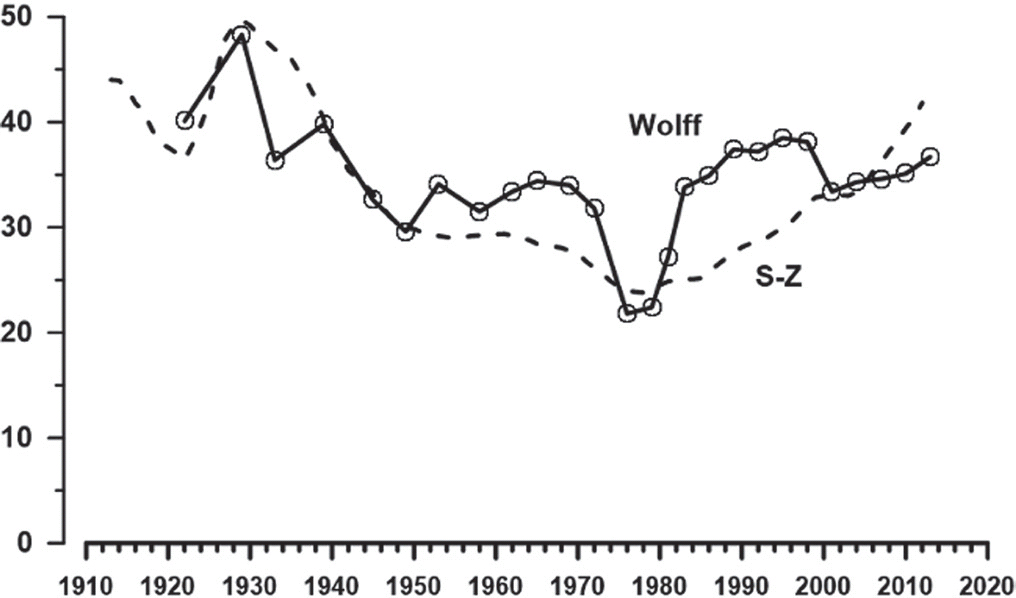
Ever since the Occupy Wall Street demonstrations, it has been conventional to measure the concentration of wealth by the percentage of total net worth held by the top 1 percent of households. Wolff's preferred series of this measure is graphed in Figure 2 for 1922 to 2013 with a solid line connecting the scattered observations. Except for 1976 and 1979, a quarter or more of total wealth was held by the top 1 percent throughout the last century. Despite some bouncing around, a general decline in concentration is evident following 1929 until the nadir in the 1970s. Afterwards there was a rise in inequality until 1995, a drop between 1998 and 2001, and then a gradual increase to the end of his series in 2013.Footnote 1 Wolff's data are based on estate tax returns for the years before 1962 and on the Survey of Consumer Finance thereafter.
Percentage of total net worth held by the top 1 percent of households Wolff's Series (1922–2013) Compared with Saez and Zucman (1913–2012), Smoothed

Wolff's picture contrasts with that offered by Thomas Piketty in his well-known and provocative analysis of recent trends in inequality. Despite referencing the same estate tax and survey data that Wolff relies on, Piketty misses the big improvements in the late 1970s and then the reversal in the 1980s evident in Wolff's series. Piketty charts a steady gradual increase in inequality from 1970 on, thus missing Wolff's drop that coincided with the millennium year (Piketty Reference Piketty2014, Figure 10.5). There are serious problems with Piketty's numbers that I have pointed out elsewhere. A better contrast with Wolff is provided by capitalizing the income flows from wealth reported on income tax returns. This alternative to the estate tax and survey data has been offered by Emmanuel Saez and Gabriel Zucman (Reference Saez and Zucman2016). A smoothed version of their data is overlaid on Wolff's in Figure 2. It is noteworthy that Saez and Zucman show a steady, but rapid, increase in the percent of total wealth held by the top 1 percent from 1978 on. I have argued that the capitalized income series of Saez and Zucman is probably superior (Sutch Reference Sutch2017, pp. 597–99).
The trends in the wellbeing of the middle class and the rise in inequality are the two major topics treated by Wolff and the ones likely to attract the most attention. My brief review does not do justice to the careful discussion of the data and the complexity of the adjustments necessary to pull together a coherent view of the history of wealth over the last century. But there are other topics covered by Wolff. Just to give one example, there is an entire chapter (Chapter 6) testing the life cycle hypothesis of saving. The conclusion: The theory's predictions are consistent with the data for the middle class, but “the top wealth classes likely form a distinct social class in the sense that their motivation for wealth accumulation is for political and economic power and social status” (pp. 260–61).
Anyone reviewing Wolff's evidence on the deteriorating trend in middle class wealth and the associated decline in precautionary reserves and retirement security or the evidence of chronic acute inequality should be frightened for the social and political stability of the United States. Wolff is concerned. “The pronounced rise in wealth inequality since the early 1980s and particularly over the Great Recession creates some urgency in policy remedies. … The time is ripe for the introduction of a personal tax on wealth holdings” (pp. 644 and 647). After considering the pros (mostly accepted by Wolff) and the cons (rejected or minimized), Wolff proposes a modest but progressive annual personal tax on wealth (including the value of homes and self-employment businesses) (p. 648). He would leave the current estate tax with its yawning loopholes unchanged. “Given the history of estate taxes in the United States and the vested interest of the wealthy in maintaining the current system (not to speak of the estate planners and lawyers who profit from the system), it may be easier from a political standpoint to institute a new wealth tax than to revamp the existing estate tax regime” (p. 646).
The reader might disagree with Wolff's quantitative measures, but will be very clear about how Wolff generated the data. His clear descriptions will provide a firm basis of developing alternative approaches. Another reader might take issue with the policy recommendations, but will be thankful for Wolff's willingness to join the ensuing debate.