From the Beijing Olympics to the 60th National Day parade, 2008–09 witnessed a series of Chinese patriotic and nationalist spectacles that have again raised the issue of China's global intentions. Is China a status quo power seeking to integrate itself peacefully into the extant international system? Or is it a revisionist power seeking to overturn the global order?
On 10 March 2008, the 59th anniversary of the 1959 Tibetan uprising, hundreds of Buddhist monks began a series of protests in Lhasa and other Tibetan cities that were met with state repression. Sympathetic towards the plight of the monks, the Western media roundly condemned the PRC government. The Olympic torch relay then became an occasion for major protests and counter protests. In London and Paris on 6 and 7 April, pro-Tibetan protestors were “roughed up” by Chinese security personnel; Chinese observers, for their part, were horrified by the failure of the host countries to protect the torch bearers.
Many Chinese were particularly upset with France, perhaps because of the image of a pro-Tibetan protestor seeking to grab the Olympic torch from wheelchair-bound Chinese para-Olympian Jin Jing during the Paris torch relay, or perhaps because French President Nikolas Sarkozy had met the Dali Lama and was threatening to spurn the opening ceremonies of the Beijing Olympics. In April, nationalist protestors gathered outside Carrefour supermarkets in over a dozen Chinese cities, waving banners and shouting slogans about opposing Tibetan independence and boycotting French goods. Over 10,000 protestors converged on one Carrefour in Hefei. In Qingdao, one man held up a sign comparing the events of 2008 to the events of almost 150 years earlier:
对家乐福说 NO!!! (Dui Jialefu shuo NO!!! Say NO to Carrefour!!!)
对法国帝国主义说 NO!!! (Dui Faguo diguozhuyi shuo NO!!! Say NO to French Imperialism!!!)
强烈抗议 1860 年英法侵略中国 (Qianglie kangyi 1860 nian YingFa qinlüe Zhonggguo. Strongly protest the 1860 Anglo-French invasion of China)
强烈抗议 2008 年诋毁我国奥运Footnote 1 (Qianglie kangyi 2008 nian dihui woguo Aoyun. Strongly protest the 2008 slander of our Olympics)
Protestors in Xi'an demanded a boycott of “Carre-f***!” in even more impassioned terms.
Although discourse about “our Olympics” (woguo Aoyun 我国奥运) was frequently quite nationalistic, the summer Olympics themselves seemed to exhibit a more positive inward looking patriotism than the hostile anti-foreign nationalism of the spring. The Chinese displayed an understandable patriotic pride in a spectacular opening ceremony, China's impressive gold medal tally and the hosting of a memorable Games.
The 1 October 2009 National Day parade in Tiananmen Square was a spectacle of even greater scale than the opening ceremonies of the Beijing Olympics. While dancers and spaceships evoked a patriotic pride in China's traditional culture and recent technological accomplishments, there were also plenty of more nationalistic themes. An impressive display of military armaments bespoke China's ability to dominate its neighbours, and Mao's nationalistic declaration of 1949 that “China has stood up” was invoked both visually in the parade and highlighted in Hu Jintao's keynote address.Footnote 2
These events raise a number of questions. What is the nature of Chinese national identity? Love of or attachment to country – patriotism (aiguozhuyi 爱国主义) – and the belief in the superiority of one's country over other countries – nationalism (minzuzhuyi 民族主义) – are both conceptually and normatively distinct.Footnote 3 But are they empirically distinct? In other words, are Chinese who are more patriotic also likely to be more nationalistic? Or do they vary independently, such that a Chinese who is highly patriotic is just as likely not to be nationalistic as to be highly nationalistic? And there is the issue of the comparative context of Chinese nationalism.Footnote 4 Can the structure of Chinese national identity be usefully compared to that of other countries, such as American national identity? For instance, are Chinese and American patriotisms and nationalisms similar in terms of their positions in the broader structures of Chinese and American national identity? Do they have similar implications for foreign policy attitudes?
Our Qingdao protestor raises the related issue of the role of historical beliefs in Chinese structures of national identity. Ten years ago John Fitzgerald argued that the desire many Chinese express for dignity has its origins in feelings of humiliation stemming from China's early modern encounter with Western and Japanese imperialisms.Footnote 5 William Callahan later argued that “humiliation has been an integral part of the construction of Chinese nationalism.”Footnote 6 Peter Gries maintained that evolving Chinese histories of their “Century of Humiliation” and Chinese national identities in the present are mutually constituted: “Chinese visions of the ‘Century’ have shaped their sense of self, and these changes to Chinese identity have altered their views of the ‘Century’.”Footnote 7 Most recently, in a 2009 issue of The China Quarterly, Geremie Barmé argued that the “aggrieved nationalism” of China today has its origins in “state-supervised mythologies” of “dynastic greatness” and victimization at the hands of Western colonialism.Footnote 8 In studies of international relations, scholars like John Garver, Andrew Nathan, Bob Ross and Deng Yong have similarly argued for the importance of dignity and humiliation as drivers of Chinese foreign policies.Footnote 9 Are these scholars right? Do Chinese beliefs about their past encounters with Western imperialism have any relevance for understanding Chinese national identity today?
And what are the consequences of Chinese national identity? Do Chinese who are more patriotic or nationalistic perceive other countries like the United States differently from those Chinese who are less patriotic or nationalistic? For instance, are they likely to perceive differing levels of US threat to China? If so, what kinds of threat? Military threat, or the humiliation threat to Chinese national self-esteem so often discussed among popular Chinese nationalists?
Neil Diamant dismisses the urban youth who have been at the forefront of the last decade of popular nationalist protests in China as inconsequential “caffè latte” nationalists who take to the streets or cyberspace to protest one day but then apply for US visas the next.Footnote 10 Is he right that popular Chinese nationalism today is largely inconsequential? Or do variations in Chinese nationalism have an impact on the Chinese people's US policy preferences?
Although there is a substantial qualitative literature addressing many of these questions, there is remarkably little quantitative research on the structures and consequences of Chinese national identity. Allen Carlson has lamented the lack of rigorous measurement in studies of Chinese national identity.Footnote 11 We agree. In this article, therefore, we present and analyse the results of three original surveys conducted in China and the United States in 2009. Utilizing the survey data, we seek both to understand the structure of Chinese national identity in a comparative context and to explore some of the potential consequences of such a structure. Specifically, we are interested in whether variations in Chinese patriotism, nationalism and nationalist historical beliefs have an impact on perceptions of US threats and even US policy preferences.
Participants and Procedures
In the spring and summer of 2009, 720 Chinese and American University students completed surveys: 161 Peking and Renmin University undergraduate students filled out a three-page hardcopy survey in February; 202 Zhongshan University undergraduate students completed a two-page hardcopy survey in Guangzhou in April; and finally, 357 undergraduate students at the University of Oklahoma took an online survey in August. All three surveys began with the explanation that the survey was about the relationship between personality and international relations, and that the data collected would be kept confidential. The ethical standards of the American Political Science and American Psychological Associations (APSA and APA) were strictly followed during data collection and analysis.
The Beijing sample included slightly more women (N = 89) than men (N = 69), and more students from the “masses” (qunzhong 群众) (N = 95) than CCP members (dang yuan 党员) (N = 61). As a result of a clerical error, age was not requested, but a survey of the same classes the previous semester revealed a median age of 20. Some 44 students claimed to have grown up in the countryside, while 114 claimed an urban upbringing. Students listed 36 different provinces or major cities as their birthplaces, with Beijing, Liaoning, Jiangxi, Shandong, Zhejiang and Hunan leading the way.
The Guangzhou sample included slightly more women (N = 76) than men (N = 74) (52 did not report their gender), and many more students from the “masses” (N = 139) than CCP members (N = 38) (25 did not report their political status). The mean age was 20.44 (SD = .95). Of these students, 90 claimed to have grown up in the countryside while 96 claimed an urban upbringing (16 did not report). As to birthplace, 47 per cent reported being from Guangzhou and no other province or city surpassed 5 per cent of the total sample.
The University of Oklahoma sample was well balanced, with slightly more men (N = 184) than women (N = 173), and more Republicans (N = 163) than Democrats (N = 100) and Independents (N = 94). Ages ranged from 17 to 60 with a mean age of 21.21 (SD = 5.24). In terms of ethnicity, the sample was 75.9 per cent white, 5.9 per cent African-American, 4.5 per cent non-Chinese Asian-American, 4.5 per cent Latino/a, 6.4 per cent Native American and 2.8 per cent “other.”
All three of these student samples were younger, more urban, better educated and more knowledgeable about the outside world than the broader Chinese and American mass publics. We therefore make no claims about the absolute levels of opinion revealed in our surveys. Our interest, instead, lies primarily in comparing different latent variables in relation to each other. To provide more effective tests of such relationships, we opted to increase the number of questions about each, sacrificing a small degree of external validity for greater internal validity.
Measures
Unless otherwise noted, the questions that composed the following scales were on seven-point Likert scales, ranging from 1 (“strongly disagree”) to 7 (“strongly agree”). All three samples responded to the national identity items. The Americans were not asked the Chinese nationalist history, US threat perception and US policy preferences items.
National identities
Ten items were utilized to tap four distinct types of national identities discussed in the academic literature on patriotism and nationalism. The major advantage to adapting pre-existing scales from the extant literature is that they have been tested in a variety of samples and contexts, lending greater support to their use as valid indicators of their respective constructs. It also allows us to compare our findings with those of other scholars. However, by utilizing pre-existing scales, we adopt the definitions advanced by particular scholars that may not always travel well. For instance, the construct “internationalism” measured by Kosterman and Feshbach below is quite different from the idea of proletarian “internationalism” (guojizhuyi 国际主义) in the Chinese context. So it is important not to equate references to “internationalism” in this paper with the Chinese guojizhuyi. Higher values on the scales described below indicate greater levels of patriotism, blind patriotism, nationalism or internationalism. The Chinese language versions of these national identity items are listed in the note to Table 1.
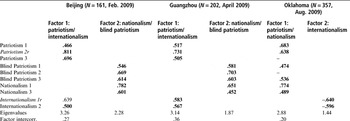
Structures of National Identity: Exploratory Factor Analysis of Beijing, Guangzhou and Oklahoma Samples

Notes: Factor coefficients above are shown only if > 0.35. Reverse coded items below denoted with an “r” and italicized. American versions are in English; Chinese versions are in Chinese.
Patriotism
1. “I'm glad to be American.” Wo hen gaoxing ziji shi Zhongguoren 我很高兴自己是中国人°
2r. “I often regret that I am American.” Wo jingchang yihang ziji shi Zhongguoren 我经常遗憾自己是中国人°
3. “Being American is an important reflection of who I am.” Zuowei Zhongguorendui wode ziwo rentong hen zhongyao 作为中国人对我的自我认同很重要.
Blind Patriotism
1. “American foreign policies are almost always morally correct.” Zhongguo de waijiao zhengce jiben shang dou shi zhengyi de 中国的外交政策基本上都是正义的°
2. “America is virtually always right.” Zhongguo de zhengce jihu dou shi zhengque de 中国的决策几乎都是正确的°
3. “I support my country whether its policies are right or wrong.” Wulun woguo de zhengce dui cuo yu fo, wo dou yuyi zhichi 无论我国的政策对错与否, 我都予以支持°
Nationalism
1. “America/China is the best country in the world” Zhongguo shi shijie shang zui hao de guojia 中国是世界上最好的国家°
3. “In view of America's history and democracy, it is only natural that the US leads the world.” Jianyu Zhongguo juyou youjiu de lishi, guanghui de wenming, Zhongguo ziran yinggai lingao dongYa 鉴于中国具有悠久的历史,光辉的文明,中国自然应该领导东亚°
Internationalism
1r. “The alleviation of poverty in very poor countries like Haiti is their problem, not ours.” Zhuru Haidi zheyang de pinqiong guojia suo mian lian de wentiyinggaio you tamen ziji jiejue, yu women wu guan 诸如海地这样的贫穷国家所面临的问题应该由他们自己解决,与我们无关°
2. “Our children should be taught to support the welfare of all of humanity.” Women yinggai jiaoyu women de zisun houdai bu jinwei Zhongguo er weiquan renlei de fuzhi zuo gongxian 我们应该教育我们的子孙后代不仅为中国而为全人类的福祉做贡献°
Three items adapted from Rita Luhtanen and Jennifer Crocker's collective self-esteem (CSE) scale were used to tap the love of one's own country (patriotism).Footnote 12 They were “I'm glad to be Chinese/American,” “I often regret that I am Chinese/American” (reverse coded), and “Being Chinese/American is an important reflection of who I am.”
Robert Shatz, Ervin Staub, and Howard Levine distinguished “blind” from “constructive” patriotism, arguing that the former represents an unquestioning allegiance and intolerance of criticism.Footnote 13 We adapted three items to assess blind patriotism: “China/America is virtually always right,” “Chinese/American foreign policies are almost always morally correct,” and “I support my country whether its policies are right or wrong.”
Kosterman and Feshbach argue that nationalism goes beyond a love of one's own country (patriotism) to a belief in the superiority of one's own country over others.Footnote 14 We adapted two items: “China/America is the best country in the world,” and “In view of China's lengthy history and glorious civilization/America's history and democracy, it is only natural that China lead East Asia/the US lead the world.”
Kosterman and Feshbach further distinguished nationalism from internationalism, which they treated as a humanist concern for “global welfare” or the wellbeing of peoples from all nations.Footnote 15 As noted above, this definition is distinct from the meaning of the Chinese guojizhuyi. We adapted two items: “The alleviation of poverty in very poor countries like Haiti is their problem, not ours” (reverse coded), and “Our children should be taught to support the welfare of all of humanity.”
Chinese nationalist history
Beliefs about the nature of China's past encounters with the outside world may affect the nature of Chinese national identity, as well as perceptions of external threat in the present. We therefore included four items tapping beliefs about two distinct Chinese historical encounters with the outside world of relevance to Chinese views of the US today: the “Century of Humiliation” and the Korean War. The two “Century” items were taken directly from the series preface to the multi-volume “Never Forget the National Humiliation” (Wu wang guo chi 毋忘国耻) history book series: “China's early modern encounter with Western imperial powers was a history of humiliation in which the motherland was subjected to the insult of being beaten because we were backwards” (Zhongguo jindai yu xifang diguozhuyi lieqiangde lishi jiu shi zuguo meng shou jichidaru luohuoaida de cantongshi 中国近代与西方帝国主义列强的历史就是祖国蒙受奇耻大辱落后挨打的惨痛史) and “China's early modern encounter with Western imperial powers was a heroic struggle by the Chinese people against imperialism” (Zhongguo jindai yu xifang diguozhuyi lieqiangde lishi jiu shi Zhongguo renmin bugan qufu yu diguozhuyi ji qi fushu de yingxiong douzheng shi 中国近代与西方帝国主义列强的历史就是中国人民不甘屈服于帝国主义及其附属的英雄斗争史).Footnote 16 Note that these two items highlight humiliation and heroism respectively. The two Korean War items were “China won the War to Resist America and Aid Korea” (Zhongguo zai kangMeiyuanChao zhong desheng le 中国在抗美援朝中得胜了) and “The War to Resist America and Aid Korea was a heroic moment in Chinese history” (Kang Mei yuan Chao shi Zhongguo lishi shang de yingxiong shike 抗美援朝是中国历史上的英雄时刻).
Perception of the threat that the US poses to China was tapped with four items, composed of two possible subscales. Two addressed military threat: “A growing American military is bad for China” (Meiguo jundui de fazhan dui Zhongguo wu yi 美国军队的发展对中国无益) and “The recent increase in US defence spending undermines Chinese security” (Zuijin Meigguo guofang kaizhi de zengzhang weixie Zhongguo anquan 最近美国国防开支的增长威胁中国安全). Two addressed humiliation threat: “American criticisms of Chinese ‘human rights’ are really just attempts to humiliate China” (Meiguo zhengfu piping Zhongguo “renquan wenti” shiji shang shi zai xiuru Zhongguo 美国政府批评中国 “人权问题” 实际上是在羞辱中国) and “American support of Taiwan and Tibet is really about insulting the Chinese people” (Meiguo zhichi Taiwan he Xizang shi zai xiuru Zhongguo renmin 美国支持台湾和西藏是在羞辱中国人民).
Three items were developed to tap respondents' preferred policies towards the US. They were “The Chinese government should adopt tougher foreign policies towards the US” (Zhongguo zhengfu yinggai dui Meigguo caiqu geng qiangying de waijiao zhengce 中国政府应该对美国采取更强硬的外交政策), “The best way to deal with the US is to build up our military and seek to contain US influence throughout the world” (Yingdui Meiguo de zuihao fangshi shi zengqiang woguo de junbei; xiaoruo Meigguo zai shijie fanwei de yingxiang 应对美国的最好方式是增强我国的军备, 削弱美国在世界范围的影响), and “If the US threatens China, we should use military force against them” (Ruguo Meiguo weixie Zhongguo, women yinggai yong junshi liliang dui Meigguo jinxing fanji 如果美国威胁中国, 我们应该用军事力量对美国进行反击).
Structures of Chinese and American National Identity
To compare the structures of Chinese and American national identities, we first conducted exploratory factor analysis (EFA) on our Chinese and American samples. EFA is a statistical technique that is used to discover the latent dimensions or unobserved variables (“factors”) that undergird a larger number of observed variables (such as our survey items). Principal axis factoring (PAF), a type of EFA, with Promax rotation was conducted on all three samples.Footnote 17Table 1 displays the results, and includes all factor loadings greater than |0.35|, the conventional minimum. The numbers in the table represent how strongly each item correlates with the factor and is generally used in factor analytic research to “name” factors. The higher the number, the greater the loading on to the factor.
PAF on the Beijing sample produced two factors with Eigenvalues greater than 1 (3.26 and 2.28 respectively). Eigenvalues represent the amount of variance in the original set of variables accounted for by a factor.Footnote 18 Both factors were clearly interpretable with items exhibiting low cross loadings (see the first two columns of Table 1). All three patriotism and the first two internationalism items loaded on factor one, labelled “patriotism/internationalism.” All three blind patriotism and the two nationalism items loaded on the second factor, labelled “nationalism/blind patriotism.” The two factors intercorrelated at just r = .27, indicating that these two dimensions of Chinese national identity were largely independent of one another.
Replication is a fundamental principle of the scientific method. We therefore ran the same PAF on our Guangzhou data as well. Three factors emerged with Eigenvalues greater than 1, but the third was just 1.01, and the scree plot revealed a clear break after the second factor. We therefore re-ran the PAF as a two factor solution, and found that all the blind patriotism and nationalism items loaded cleanly on the first factor with an Eigenvalue of 3.14, and all the patriotism and internationalism items loaded cleanly on the second factor with an Eigenvalue of 1.87 (see the third and fourth columns of Table 1). The two factors only intercorrelated at r = .36, again suggesting factor independence. The Guangzhou data thus replicated the factor structure of the Beijing data, providing powerful evidence that patriotism and nationalism in China are not just conceptually and normatively but also empirically distinct.
PAF on the University of Oklahoma sample produced two factors with Eigenvalues greater than 1 (2.88 and 1.44 respectively). As the last two columns in Table 1 reveal, both factors were clearly interpretable. All six patriotism, blind patriotism and nationalism items loaded strongly on to the first factor, labelled “patriotism/nationalism.” The two internationalism items loaded on the second factor, labelled “internationalism.” The two factors intercorrelated at just r = .20 and the internationalism items both loaded negatively. In short, while patriotism, blind patriotism and nationalism are conceptually distinct, our data suggest that empirically American patriotism and nationalism go together.
The differing structures of American and Chinese national identities revealed in Table 1 are truly striking. Whereas patriotism – love of country – and nationalism – belief in the superiority of one's country over other countries – go together in the American sample, they do not in the Chinese sample. Instead, patriotism in China was associated with internationalism, and should thus be understood as more benign than American patriotism. In other words, the more patriotic Americans are, the more nationalistic they also tend to be. In China, however, patriotism and nationalism do not necessarily go together, such that a highly patriotic Chinese may or may not be high on nationalism.
Descriptive Statistics: Chinese National Identities and Attitudes towards America
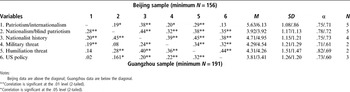
To explore the consequences of Chinese patriotism and nationalism we first constructed scales for each by averaging the five items that loaded together. We then repeated the process for the history, threat and policy variables. The scale alphas and Ns are reported in the last two columns of Table 2, which reports the descriptive statistics for the Beijing and Guangzhou samples. The Cronbach's alphas ranged from fair (α = .71) to good (α = .82) for the Beijing sample. Cronbach's alphas range from 0 to 1, with higher scores indicating greater internal reliability (consistency) of the measure. Alphas tend to be higher for longer scales, so our alphas of .71 and .73 for scales of just two and three items are actually quite good.
Descriptive Statistics: Correlations, Significance Levels, Means, Standard Deviations, and Scale Alphas and Ns

Notes: Beijing data are above the diagonal; Guangzhou data are below the diagonal.
**Correlation is significant at the .01 level (2-tailed).
*Correlation is significant at the .05 level (2-tailed).
Of particular note were our pairs of “Century of Humiliation” and Korean War items, which cohered into a single internally reliable four-item scale. Recall that, following the official PRC historiography, our two Century survey items treated the period as both “heroic” (yingxiong 英雄) and “humiliating” (qichidaru 奇耻大辱). While these items may appear contradictory, they were not, intercorrelating strongly and positively, r = .47 and r = .44 for the Beijing and Guangzhou student samples respectively. Cross-cultural psychologists have demonstrated that Chinese are more likely than Americans to engage in dialectical thinking, simultaneously embracing seemingly contradictory positions.Footnote 19 Along with an educational system that inculcates this view, a facility with dialectical thinking may help explain the consistency of our Chinese university students in responding to statements about the Century as both heroic and humiliating.
The means and standard deviations for all six of our scales are also listed in Table 2. Both samples reported much higher levels of patriotism/internationalism than nationalism/blind patriotism.Footnote 20 Given a scale midpoint of four, we can say that overall, both samples were very patriotic but quite balanced in terms of nationalism. The means for nationalist historical beliefs, military threat and humiliation threat were just above the scale midpoint, while US policy preferences were just below.
Did demographic characteristics have any impact on our six variables? We ran a series of multiple analyses of variance (MANOVA) to find out. Neither gender nor rural/urban upbringing had statistically significant impacts on any of the variables in either the Beijing or Guangzhou samples. Political status did have a pair of small but statistically significant impacts, however. Among the Beijing students, members of the “masses” (M = 4.18, SD = 1.35) preferred a slightly tougher US policy than did Party members (M = 3.65, SD = 1.28), F(1,154) = 6.00, p = .015. Perhaps Party members were more likely to defer to their government's US policy. The effect size of the difference, ηp2 = .038, was small.Footnote 21 Finally, among the Guangzhou students, the masses (M = 5.04, SD = .1.27) held slightly more nationalistic historical beliefs than did Party members (M = 4.64, SD = 1.28), F(1,173) = 2.85, p = .09. The effect size for the mean difference was very small, ηp2 = .016, however. Given the small size of our samples, further research is needed to see if the national identities and foreign policy orientations of student CCP members differ significantly from their non-Party classmates.
Finally, Table 2 also reports the zero-order correlations and significance levels among our six scales. For the Beijing sample, with the exception of the lack of a relationship between patriotism and US policy, all the correlations were statistically significant and positive. And apart from the relationships between patriotism and nationalism, and patriotism and military threat, which correlated at just p < .05, the remaining correlations were highly significant (p < .01) and substantial in size, ranging from r = .29 to r = .44. The pattern of zero-order correlations among the variables in the Guangzhou sample was comparable.
Structural Equation Models
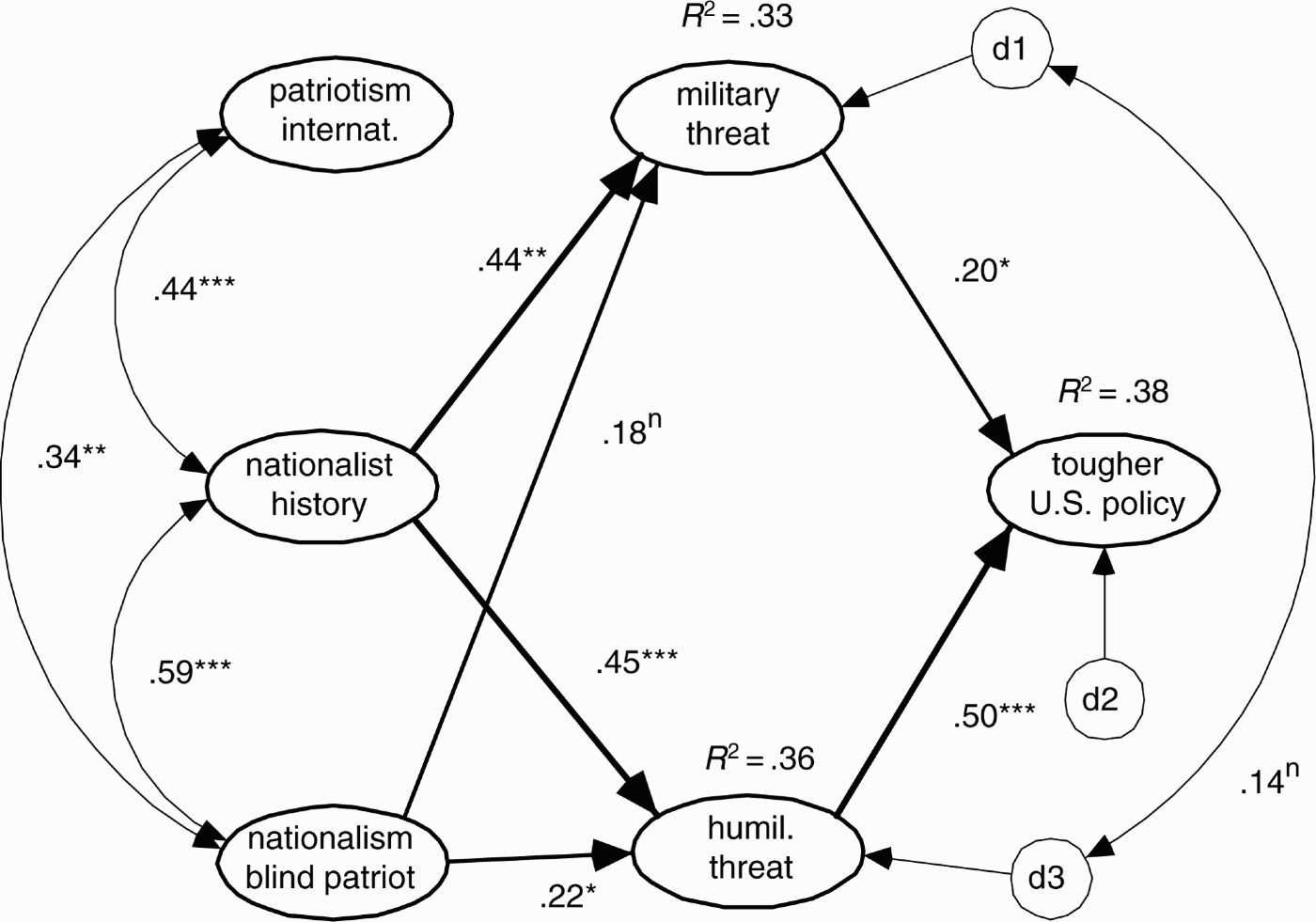
We decided to use structural equation modelling (SEM) to give a better understanding of the precise relationships among our six variables. SEM has a number of advantages over multiple regression, such as the ability to model both prediction and measurement error, mediated relationships among variables, and the ability to evaluate the global fit of a model containing those mediated relationships. Using the Beijing data as a model development sample, we first used AMOS 17.0 with full information maximum likelihood estimation to test a measurement model whereby all six of the latent variables in the model were allowed to co-vary. We then tested a (near) fully saturated structural model in which patriotism, nationalism and nationalist historical beliefs were treated as co-varying exogenous variables predicting US military and humiliation threat, which in turn predicted policy preferences. After removing statistically non-significant paths, the model displayed in Figure 1 emerged as the best fit to the Beijing data.
Final Beijing Structural Equation Model

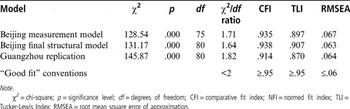
Table 3 lists the model fit statistics for all of the models in this study.Footnote 22 The figures reported in the first two rows reveal that our fit indicators were just above or below the “close fit” conventions, indicating that our final model shown in Figure 1 was a reasonable fit to the Beijing data.
Fitness statistics

Note. χ2 = chi-square; p = significance level; df = degrees of freedom; CFI = comparative fit index; NFI = normed fit index; TLI = Tucker-Lewis Index; RMSEA = root mean square error of approximation.
The most striking aspect of our final Beijing SEM is that when controlling for nationalism and nationalist history, patriotism/internationalism had no impact on perceptions of US military or humiliation threat or US policy preferences. Nationalism, by contrast, did affect US policy preferences, with its effects being mediated through perceptions of both US military and humiliation threats. From a foreign policy perspective, therefore, Chinese patriotism appears decidedly benign, while Chinese nationalism appears potentially malign in its consequences, heightening threat perception.
It is also notable that nationalist historical beliefs covaried strongly with both patriotism (r = .37) and nationalism (r = .44), providing strong support for the argument that beliefs about the national past and national identities in the present are mutually constituted. Furthermore, nationalist historical beliefs were the strongest predictor of both perceptions of US military (β = .44) and humiliation (β = .45) threat.
Finally, Figure 1 reveals that perceptions of humiliation threat (β = .50) had a much greater impact on US policy preferences than did perceptions of military threat (β = .20). Together, these two forms of threat perception accounted for a remarkable 38 per cent of the variance in US policy preferences. Those interested in the determinants of China's US policy, therefore, would be wise to consider not just the objective balance of military power, but also the subjective realm of identity, affect and threat perception.
As noted above, replication is fundamental to the scientific method. We therefore ran our final Beijing structural model again using the Guangzhou data. The fit statistics for this Guangzhou replication sample are reported on the third row of Table 3. While not quite as good as the fit statistics for the Beijing development sample, we consider them to be a reasonable replication of our final model. Furthermore, the pattern of path coefficients in the Guangzhou model largely replicated that of the model based on the Beijing sample. The primary difference was that the partial coefficient for the path from nationalist history to military threat reduced from .44 to .25, and the path from military threat to US policy reduced from .20 to .08. As a result, the overall variance in US policy preferences explained decreased from 38 to 28 per cent. However, the path coefficients from nationalist history and nationalism to humiliation threat, and from humiliation threat to US policy remained largely unchanged from those of the Beijing sample. Thus the basic overall finding that the path from nationalist history and nationalism to US policy preferences was much stronger via humiliation threat than military threat was only reinforced.
Conclusions: Patriotism, Nationalism and China's US Policy
While further research with independent samples is needed both to replicate and to expand upon the findings presented above, a few tentative conclusions are in order.
First, patriotism and nationalism in China are empirically distinct. They are not in the US. American analysts would be wise, therefore, not to project American assumptions about the nature and consequences of expressions of national identity on to the Chinese. For instance, following the “9-11” terrorist attacks of 2001, Americans displayed US flags in vast numbers, an act that might be interpreted as a patriotic display of loyalty to one's country. And yet that flag display occurred at a time when Americans also overwhelmingly supported an invasion of Afghanistan, an act that might be better interpreted as a consequence of a nationalist desire to dominate. Indeed, recent experimental work has shown that exposure to the US flag increases American nationalism but not patriotism.Footnote 23
How then should Americans understand the flag-waving displays of Chinese in the streets of Paris, San Francisco and Canberra during the Olympic torch relay of spring 2008? Was it a benign expression of patriotic loyalty to China, or a malign expression of a desire to dominate over China's foreign critics, from CNN to free Tibet activists? Further research is needed to answer such questions, but the research presented here makes it clear that expressions of Chinese patriotism and nationalism should not be assumed to have the same meaning or consequences as expressions of American patriotism/nationalism. The structures of Chinese and American national identities clearly differ, probably as a result of the differing historical contexts within which they emerged.
Second, nationalist historical beliefs are integral to the structure of Chinese national identity. Historical beliefs covaried with patriotism and nationalism, suggesting that histories of the national past and national identities in the present are mutually constituted. Nationalist historical beliefs, furthermore, powerfully predicted perceptions of US threats, which then powerfully affected US policy preferences. These quantitative findings support the qualitative scholarship of Fitzgerald, Callahan, Gries and Barmé cited above which has argued that the “Century of Humiliation” is central to Chinese nationalism today. They are also consistent with research that has found that beliefs about the past affect perceptions of mutual threat among the north-east Asian nations of China, Japan and Korea.Footnote 24 This research points to the importance of reconciling histories to the confidence building so central to China's future relations with the US and many of its other neighbours, such as Japan and Korea.Footnote 25 The historical content of the Patriotic Education Campaign of the early 1990s,Footnote 26 initiated to shore up the Chinese Communist Party's legitimacy following Tiananmen, probably contributed to an “aggrieved nationalism” among China's youth, as Barmé has suggested. That popular nationalism, furthermore, may increasingly pressurize China's Ministry of Foreign Affairs to pursue tougher foreign policies than it might otherwise prefer. Histories of the past, in short, are clearly relevant to many of China's thorny bilateral relationships today.Footnote 27
Third, the US threat has distinct military and humiliation dimensions. Garver, Nathan, Ross, Deng Yong and others are right to focus on dignity, humiliation and desires for recognition as important determinants of Chinese foreign policy behaviour.Footnote 28 Indeed, perceived humiliation threat had a much stronger impact on US policy preferences than did perceived military threat. A narrow focus on the objective or even perceived balance of military power, therefore, appears insufficient to a complete understanding of how Chinese feel and think about America today.
Finally, nationalism but not patriotism clearly has an impact on Chinese foreign policy preferences. Diamant is therefore misguided to dismiss China's young netizens (wangmin 网民) and street demonstrators as mere “caffè latte” nationalists. This study has shown that individual differences in “trait” or enduring levels of nationalism affect both perceptions of US threat and preferred US policies. It is thus likely that temporary or “state” levels of nationalism would have similar consequences. Therefore, when events like the 1999 Belgrade bombing or the 2001 Hainan Island plane collision incidents temporarily inflame anti-American nationalist sentiments, Chinese perceptions of US threat are likely to increase, along with desires for tougher US policies. During such crises, therefore, inflamed nationalism can have very serious consequences, even if temporary levels of “state” nationalism dissipate later, as Diamant rightly notes. In short, variations in Chinese nationalism, whether between individuals or across time, appear to be related to variations in both threat perception and foreign policy preferences, so warrant further research.