Introduction
The frequency of dementia will rise dramatically over the next twenty years due to increased longevity. In the UK, two-thirds of people with dementia live at home, receiving most of their care from family carers (Knapp et al., Reference Knapp2007). These carers experience high levels of anxiety and depression (Mahoney et al., Reference Mahoney, Regan, Katona and Livingston2005; Cooper et al., Reference Cooper, Katona, Orrell and Livingston2006), which increase with the amount of care provided, the degree of behavioral problems of the care recipient, and their coping responses and social support (Cooper et al., Reference Cooper, Balamurali and Livingston2007).
Carers’ motivations and reasons for caring have received little attention in the literature. A person may be motivated to provide care by: affection, closeness, compassion, gratitude and desire to reciprocate past caring or help; or by feelings of duty, responsibility or guilt (Walker, Reference Walker1990). Social norms can influence who takes on the role of carer, with spouses most likely to provide care in Western cultures, followed by adult children. Where there is more than one adult child, there is often an expectation that a daughter will provide the care (Quinn et al., Reference Quinn, Clare and Woods2010).
Quinn et al. (Reference Quinn, Clare and Woods2010) reported that motivations for caring varied between carers of different ethnicities, with Greek carers more likely to report being motivated by religion, and Korean carers by filial responsibilities, than their American counterparts. The kin relationship also determined motivation with daughters more likely than daughter-in-laws to report affection. In one study, dementia family caregivers who cited fewer personal reasons and more external pressures motivating them to give care reported more mental health problems (Romero-Morena et al., Reference Romero-Morena, Marques-Gonzalez, Losada and Lopez2010).
To our knowledge, no study has explored the impact of the carers’ reasons for caring on the person receiving care. We postulate that carers’ reasons for providing care may be associated with their willingness to continue this role in adversity and thus the likelihood of the person with dementia entering 24-hour care. We have previously reported high rates of carer abusive behaviors towards care recipients, and that these behaviors are related to carer burden (Cooper et al., Reference Cooper, Selwood, Blanchard, Walker, Blizard and Livingston2010). Reasons for caring could also potentially influence carers’ resilience in managing difficulties encountered and thus their levels of abusive behavior towards the care recipient. In the first such study in a representative sample from secondary care, we report the reasons given by family dementia carers for providing care. In this longitudinal study, we investigated our hypothesis that carers who reported a positive rather than negative motivation for providing care would report less abusive behavior towards the care recipient during the following year and that the care recipient would be less likely to have been admitted to 24-hour care in this time.
Methods
This is part of a larger longitudinal study investigating the mental health of carers and abusive behavior, which has been reported in detail elsewhere (Cooper et al., Reference Cooper, Selwood, Blanchard, Walker, Blizard and Livingston2009; Reference Cooper, Selwood, Blanchard, Walker, Blizard and Livingston2010).
Setting and participants
We recruited consecutive family or friend carers of people with a clinical diagnosis of dementia, who were living at home and had been referred to Community Mental Health Teams covering London and Essex (UK). They included inner city, suburban and rural areas. We defined a carer as providing care for ≥4 hours/week. Interviews took place at a time and place convenient to the carer, usually their home.
Data collection
The study received Research Ethics Committee approval. Participants gave written informed consent. The information sheet specified that “we respect confidentiality but cannot keep it a secret if anyone is being seriously harmed.” Care recipients were asked for consent to access their medical notes, but were not interviewed. Where the care recipient lacked capacity to consent (as judged from their psychiatric and carer's reports), we asked carers whether they thought that the care recipient would have agreed when they had capacity. Three experienced psychiatrists carried out interviews with the carers between January 2007 and April 2008.
CC contacted the participants one year after they had participated unless the CR was known to have died. Participants were asked whether they were still in regular contact with the person they were caring for a year ago, and, if so, were asked to complete a follow-up interview. Four participants asked to complete the questionnaire as an interview, two face-to-face and two by telephone; the remainder replied by post. The questionnaire was resent once if no response had been received within a month of the first mailing.
Measures
At baseline, we collected sociodemographic data on: carer and care recipient age, sex, marital status and relationship to the care recipient (child, other). We only included carers who were not the spouse or partner of the care recipient in this analysis, because it is unusual for someone in this role not to be the primary carer.
We asked carers if there were other people who provided regular, unpaid care to the care recipient. We asked who provided the most care to the care recipient. Unless the carer told us they did not provide most care, we proceeded to ask them the reasons that they were the main carer, and recorded their responses verbatim.
Carers also completed the following validated measures:
• The Hospital Anxiety and Depression Scale (HADS) (Zigmond and Snaith, Reference Zigmond and Snaith1983; Bjelland et al., Reference Bjelland, Dahl, Haug and Neckelmann2002) – an instrument that has previously been used for carers of people with dementia. It does not include somatic items (which can be misleading in older subjects) and has been validated throughout the age range and in all settings to identify clinically significant anxiety and depression (Bjelland et al., Reference Bjelland, Dahl, Haug and Neckelmann2002). It assesses how the person has been feeling within the past week. It consists of two seven-item subscales, each score 0–3, which generate scores for generalized anxiety and depression (0–21). We used the anxiety subscale in our analysis, as dementia carers report particularly high levels of anxiety (Cooper et al., Reference Cooper, Balamurali and Livingston2007).
• The Zarit Burden scale (Zarit et al., Reference Zarit, Reever and Bachpeterson1980) – a measure of carer burden based on a 22-item self-report questionnaire. It is the most consistently used measure of carer burden, with a high internal consistency and construct validity (Hebert et al., Reference Hebert, Bravo and Preville2000). “Carer burden” may be divided into the physical, psychological, social, and financial demands of caring for someone, or into “subjective” and “objective” burden, with subjective burden referring to the emotional consequences of caregiving.
• The Relationship Rewards Scale – a measure of how rewarding the carer's relationship was with the care recipient before both the onset of memory problems and in the last three months, using a four-item measure of relationship rewards for which reliability in dementia carers is reported (Williamson and Shaffer, Reference Williamson and Shaffer2001). We created a scale by coding positive reasons as 3, neutral as 2 and negative as 1.
Two further measures were used to obtain information about the care recipients from the carers:
• the Bristol Activities of Daily Living (ADL) inventory, which is widely used to assess ADL scores in people with dementia by proxy caregiver reports and has demonstrated adequate psychometric properties (Bucks et al., Reference Bucks, Ashworth, Wilcock and Siegfried1996); and
• the Neuropsychiatric Inventory (NPI), which measure neuropsychiatric symptoms, and for which good validity and reliability are also reported (Cummings et al., Reference Cummings, Mega, Gray, Rosenberg-Thompson, Carusi and Gornbein1994). The NPI assess ten behavioral disturbances occurring in dementia patients: delusions, hallucinations, dysphoria, anxiety, agitation/aggression, euphoria, disinhibition, irritability/lability, apathy, and aberrant motor activity.
We obtained the most recent Mini-Mental State Examination (MMSE) score, diagnosis and medications from the care recipient's medical notes. The MMSE is the most widely used measure of cognitive impairment in people with dementia, and psychometric properties have been reported (Folstein et al., Reference Folstein, Folstein and McHugh1975).
Follow-up interview after one year
After one year, the carers were asked whether the person they cared for was now living in 24-hour care, and to complete the HADS again. They also completed the Modified Conflict Tactics Scale (MCTS) (Beach et al., Reference Beach, Schulz, Williamson, Miller, Weiner and Lance2005), which asks how often in the last three months they had acted in each of five psychologically and five physically abusive ways towards the care recipient, on a Likert scale from 0 to 4 (0 = never; 4 = all the time). We used the total abuse score in our analyses. The psychological abuse items asked were whether they had: screamed or shouted at the care recipient, used a harsh tone of voice, insulted them, sworn at them or called them names; threatened to send them to a care home, to stop taking care of or abandon, or to use physical force on them. The physical abuse items were: whether they had been afraid they might hit or hurt them, whether they had withheld food, hit or slapped, shaken or handled them roughly in other ways. Adequate psychometric properties have been reported (Cooper et al., Reference Cooper, Manela, Katona and Livingston2008).
Data analysis
We analyzed data using SPSS version 17.0. We used two-tailed tests and p < 0.05 to denote statistical significance in all analyses. Our main effect of interest was the carers’ reasons for providing most of the care. Carers could give as many reasons as they wanted and most gave more than one. CC read and reread the codes and identified the following main themes of response:
• (Positive) the carer gave an explanation in terms of their relationship being close, or the carer having particular attributes that meant they were the right person to be the carer.
• (Negative) the carer gave an explanation about the unwillingness of others to help, of others not having a good relationship with the CR, or lacking particular attributes needed to be a good carer.
• (Neutral) Those that did not give reasons that were positive or negative (as described above), including those who said they were the carer because they lived close, were a woman, or others were unwell or unable to care for other reasons.
We rated the whole answer given by the carer, and many of the responses that we rated as positive or negative also included neutral reasons. For example, we rated a response by a carer as negative who said there were two other people who might have taken on this role but one was male (and so they thought this would be less appropriate as the care recipient was female), while the other had a difficult relationship with the care recipient and did not want to provide care. A second carer gave an answer that we rated as positive, which discussed reasons they took the role including living the closest, work flexibility and having a closer relationship with the CR. CC and AC independently coded each carer's response into one of the three categories. The intraclass correlation coefficient for inter-rater reliability was 0.82 (0.74–0.88). We then discussed those on which we did not agree and came to a decision about each. We were blind to the main outcome measures during this process.
To assess concurrent validity of our classification system, we compared our ratings with carers’ scores on the Relationship Rewards Scale, using the whole sample for whom we had available data (n = 125; this included some spouses who answered these questions but were excluded from the subsequent analysis). There was a significant correlation between this scale and past and recent relationship rewards (Spearman −0.18, p = 0.05, and r = −0.18, p = 0.05, respectively).
We reported frequencies for the responses given to explain reasons for caring. We explored the univariate relationship between our categories of reasons for caring and the sociodemographic, carer and care recipient characteristics studied, using ANOVA and χ2 tests as appropriate. We replaced missing values (n = 4) for MMSE with the series mean. We conducted a Cox regression to explore the relationship of reasons for caring right up to admission of the care recipient to a care home. We controlled for sociodemographic and illness characteristics of the care recipient in step one, and carer burden and anxiety in step two. Finally, we undertook a linear regression with carer abusive behavior as the dependent variable. Owing to the small sample size, we reduced the number of independent variables by including only those that approached significance (p ≤ 0.1) in their relationship on univariate analysis with abusive behavior or reasons for caring. We entered variables in the same order as in our Cox regression. In a retrospective power calculation (using http://www.danielsoper.com/statcalc/calc09.aspx), based on the R2 of 0.312 for our linear regression with carer abusive behavior score as the dependent variable and 12 independent variables including negative (versus positive or neutral) reasons for providing care, the power to detect a true difference is 99% at a 1% level of significance.
Results
Of the 220/319 (69%) eligible carers who participated in the original study, 99 refused or could not be contacted. There were no differences between participants and non-participants in care recipient or carer gender (χ2 = 1.3, p = 0.26; χ2 = 0.0, p = 1.00); whether they lived together (χ2 = 2.2, p = 0.14); or the relationship (partner, child or other) between them (χ2 = 2.7, p = 0.26).
Of the 220 carers interviewed in the CARD study, 72 (32.7%) were the partner or spouse of the care recipient and were not asked questions about why they provided most care; a further seven told us that they were not the person providing most care so the question was not applicable. Of the remaining carers, 111/138 (80.4%) answered our question about why they provided most care, so were included in subsequent analyses. We obtained data for 100% of these carers on whether and on what date in the following year their care recipient entered a care home. A year later, 63 (57%) completed our measure of abusive behavior. Among those carers who did not complete the follow-up, in 16 cases this was because the care recipient had died, in three cases because the carer no longer saw the care recipient very often, while one carer refused to do so and the remaining 28 carers were lost to follow-up. In order to determine whether the sample who were included in this analysis were representative of family carers of people referred to secondary care, we compared among all carers eligible to take part in the study (n = 318) those for whom we had information about whether the care recipient had entered 24 hour care (n = 111; our baseline sample) with those for whom we did not have such information, and those carers who completed the abuse measure (n = 63; our follow-up sample) with carers who did not. Carers included in our baseline and follow-up samples were significantly more likely to be looking after a female care recipient than those not included (84.7% vs 62.3%; χ2 = 17.3, p < 0.001 and 90.5% vs 65.1%; χ2 = 15.5, p < 0.001). There were no significant differences in carer gender between those included and not included in the baseline and follow-up samples (χ2 = 0.35, p = 0.55 and χ2 = 2.0, p = 0.16). Among all carers who took part in the CARD study (n = 220), we also compared those who were and who were not included in the baseline and follow-up samples in this analysis. There were no differences in carer burden (t = 1.4, p = 0.15 and t = 1.4, p = 0.17 respectively). Those who were included in our baseline analysis were on average caring for people who had lower MMSE scores, but this was not true of those who were included in our follow-up sample compared to those who were not (17.2 vs 19.5; t = 2.5, p = 0.013 and t = 0.86, p = 0.39).
Characteristics of the sample
The mean age of the carers was 55.6 years (SD 10.8; range 24–84); 36 (32.4%) were male; 65 (58.6%) were married, 23 (20.7%) were single and the remainder were separated, divorced or widowed. Ninety-one (82.0%) were adult children caring for a parent, while the remainder were caring for another relative or friend. Mean burden score was 31.1 (SD 16.0, range 2–69), HADS anxiety score was 6.9 (SD 4.0, range 0–18); and abusive behavior score was 1.7 (SD 2.1, range 0–10). The mean age of the care recipients was 83.1 years (SD 8.0; range 58–99), and 94 (84.7%) were male; 86 (77.5%) were widowed, 15 (13.5%) were divorced or separated and 10 (9.0%) were married. Their mean MMSE score was 17.2 (SD 7,2, range 0–28), the Bristol ADL scale score was 20.5 (SD 13.4, range 0–54) and the NPI score was 21.1 (SD 16.5; range 0–75). The median time since receiving a diagnosis was one month (interquartile range 0–2 months). Twenty-three care recipients (20.7%) entered a care home in the year following the baseline interview.
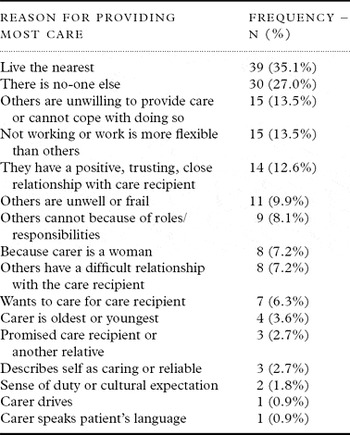
Reasons for providing most care (Table 1)
The reasons for providing care that were mentioned by carers most frequently were living nearest and there being no-one else to take on the caring role. Other reasons commonly mentioned were that others were unwilling to provide care or could not cope with doing so; that the carer interviewed had the most flexible work situation or was not working, or that they had a positive, trusting or close relationship with the care recipient.
Reasons given by family carers for providing care

CR = care recipient
When we rated their whole response according to our classification system (see Data analysis section above), 19 (17.1%) carers gave a response we classified as positive, 22 (19.8%) a response we classified as negative and 70 (63.1%) gave a reason we classified as neutral. Each response was classified into one of these three categories.
Relationship of reason for caring to main outcomes
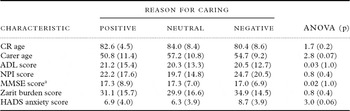
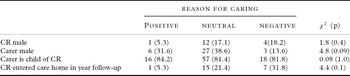
Univariate analyses (Table 2)
Reasons for caring were not significantly associated with any of the characteristics studied at baseline, although the relationship between carers giving a “negative” reason for caring and scoring higher on the HADS anxiety subscale approached significance. Carer abusive behaviour score was not associated with MMSE (Spearman r = −0.12, p = 0.31), NPI (r = 0.0, p = 1.0) or Bristol ADL score (r = 0.0, p = 1.0), nor with carer age (r = 0.051, p = 0.61) or CR age (r = 0.24, p = 0.06). It was associated with Zarit burden (r = 0.38, p = 0.002) and HADS anxiety score (r = 0.36, p = 0.004). There was no association of abuse score with carer gender (Mann-Whitney U 343.5, p = 0.45), CR gender (MWU 117.5, p = 0.19) or entering a care home (MWU 286.0, p = 0.33).
Relationship of continuous baseline measures with reason for caring

a n = 107; for all other variables, n = 111
CR = care recipient; ADL = activities of daily living; NPI = Neuropsychiatric Inventory; MMSE = Mini-Mental State Examination; HADS = Hospital Anxiety and Depression Scale
Relationship of categorical measures with reason for caring

CR = care recipient
Multivariate analyses
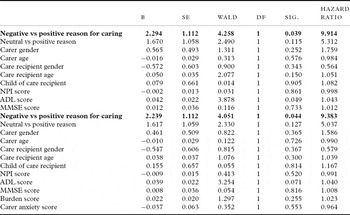
Predictors of the care recipient entering 24-hour care (Table 3). Giving a “negative” rather than a “positive” reason for caring predicted the care recipient entering a care home in the subsequent year, after controlling for sociodemographic and care recipient morbidity characteristics (hazard ratio 9.9, p = 0.039), and remained so after adding carer anxiety and burden at baseline to the equation (9.4, p = 0.044).
Cox regression with admission to 24-hour care over year follow-up period as dependent variable

NPI = Neuropsychiatric Inventory; ADL = activities of daily living; MMSE = Mini-Mental State Examination
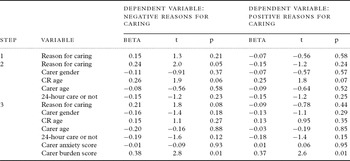
Predictors of carer abusive behavior (Table 4). Giving a “negative” reason for caring was the only characteristic studied that predicted the carer scoring higher for abusive behavior towards the care recipient a year later, after controlling for sociodemographic characteristics (t = 2.0, p = 0.05). The strength of this association was reduced and no longer significant after controlling for carer anxiety and burden scores at baseline (t = 1.8, p = 0.08). In this final step of our regression, only carer burden score (t = 2.8, p = 0.01) predicted carer abusive behavior a year later; R2 for the model was 0.24. Giving a “positive” reason for caring did not predict carer abusive behavior score a year later (t = 0.6, p = 0.6); R2 for the model was 0.20.
Linear regressions with abuse score at one year as dependent variable, with “negative” and “positive reasons for caring as independent variables

CR = care recipient
Carer anxiety score at one year was not predicted by giving a “positive” (t = 1.1, p = 0.27) or negative reason (t = -0.56, p = 0.58).
Discussion
Most of the family and friend carers we interviewed gave practical reasons to explain why they were the main carer; for example, that they lived nearest or were the only person available to do so. Around one in six explained that they were the main carer because they had a close relationship with the care recipient, were the person most suited to caring or they wanted to do it, reasons we classified as “positive”. A further one in five told us that they became the main carer for reasons we classified as “negative”; for example, that others were unwilling to help, were not suited to being a carer or did not have a good relationship with the care recipient.
This is the first survey that sought to recruit a representative sample of family carers of people with dementia referred to secondary care to explore the reasons for caring. Those who gave a negative reason tended to be more anxious at baseline, and when everything else was taken into account, cared for someone who was admitted to a care home in the following year and reported more abusive behaviour towards the care recipient a year later, suggesting that motivations for caring influence the well-being of the care recipient, and possibly also the carer. It is interesting that having a negative reason for providing care no longer predicted acting abusively towards the care recipient after controlling for carer burden, suggesting that carer burden may mediate this relationship.
Wancata et al. (Reference Wancata, Musalek, Alexandrowicz and Krautgartner2003) have highlighted the economic impact of the expected increase in the number of people with dementia in Europe, as the ratio of people with dementia to employed people will increase considerably. Our study adds to knowledge about the considerable social impact. It is unsurprising that those who are less willing to take on the role of carer, perhaps because they have fewer practical or emotional resources to do so, may be more likely to act abusively under stress and to provide care at home for less time. Romero-Morena et al. (Reference Romero-Morena, Marques-Gonzalez, Losada and Lopez2010) similarly found that those dementia carers who reported few intrinsic motives and more extrinsic motives were at particular risk for negative caregiving outcomes. We suggest that health professionals should question how the primary carer came to be in this role, to gain a broader understanding of the needs of the person with dementia and their family. Reasons for caring did not predict carer anxiety a year later, nor was there a significant association with burden score at baseline. This may be due to lack of power to detect a true difference. An earlier study did find an association between carer mental health and reasons for caring in a cross-sectional study (Romero-Morena et al., Reference Romero-Morena, Marques-Gonzalez, Losada and Lopez2010).
We used a new and thus not previously validated scale, although we found evidence of reliability and validity. We asked carers an open question and did not prompt them, so some of the carers may have not recalled all of their reasons at the time of the interview. We did not ask carers who were the spouse or partner of the care recipient and co-resident with them their reasons for caring, as in our clinical experience the decision processes regarding who will provide most care are different in this situation as the partner naturally assumes this role. Thus, we cannot comment on the motivations for caring of this group from this study. While the CARD study was designed to be representative of family carers of people with dementia who had been referred to secondary care, we found that the sub-sample we analyzed in this paper, which excluded spousal carers, differed systematically from those originally recruited to the CARD study. Those included in our analyses were more likely to be caring for men and for people who had greater levels of cognitive impairment. This reflects the differences between spousal and non-spousal carers in the CARD study: compared with other carers, those caring for a spouse or partner were more likely to be caring for a male (54.9% compared with 22.1% of those caring for a parent and 12.5% of those caring for a friend or other relative) and for people who had higher MMSE scores (20.3 vs 17.4; t = 2.9, p = 0.004). This probably relates to the higher life expectancy of women, who are thus more likely to survive to provide care in later life, and earlier presentation of people with dementia who are co-resident with a partner because the partner notices the memory problem early and encourages them to seek help. We think that our baseline sample is likely to be representative of non-spousal carers, as relatively few people (n = 37) were excluded for reasons other than being a spouse or partner. Although the response rate to the initial survey was 69%, which is comparable to most surveys that seek to be representative, we only had data on 57% of those interviewed at baseline for carer abusive behavior and anxiety a year later, so we cannot be confident that this subpopulation (our follow-up sample) was representative of non-spousal family carers of people referred to secondary care. Carers who were acting abusively may have been less likely to take part. It is likely that for some of the carers who reported abusive behavior, this reflected an abusive relationship with the care recipient that preceded the onset of dementia. We cannot infer from this study that the abusive behavior reported followed the decision to become the primary carer. Information on the severity of cognitive and neuropsychiatric symptoms of the person with dementia was only collected at baseline, so we cannot rule out the possibility that the care recipients looked after by carers with negative reasons for providing care at baseline deteriorated faster or developed more behavioral problems, although there were no differences between the groups on these indices at baseline.
Conclusions
While most family carers gave practical reasons for being the main carer, one in six related it to the high quality of their relationship with the care recipient, their willingness to take on or suitability for the carer role, and one in five to the negative relationship of other potential carers with the care recipient, their unwillingness or lack of suitability for the role. Carers who gave a negative explanation tended to be more anxious at baseline, reported more abusive behavior towards the care recipient a year later, and were more likely to be caring for someone admitted to a care home in the following year. We therefore found preliminary evidence that carers’ reasons for caring can have an impact on the well-being of the care recipient. It may be helpful for clinical interventions that are designed to reduce admissions to institutions to target this group of carers who feel pressurized into caring. Future intervention studies exploring family carer and care recipient outcomes in dementia should consider asking carers about the reasons they are the designated main carer as it may affect the response.
Conflict of interest
None.
Description of authors' roles
CC and GL designed the CARD study; CC planned and conducted the analysis for this paper; AC and CC independently rated the carers' reasons and prepared the first draft; all authors revised the content critically for important intellectual content and approved the final version.
Acknowledgments
The CARD study was funded by a postdoctoral training fellowship award to CC. We would like to thank Amber Selwood and Colm Owens for conducting some of the interviews, Martin Blanchard who co-supervised the CARD study, and the carers and patients who took part.