Introduction
Because standard English lacks a true a gender-neutral singular pronoun, there has long been debate over how to refer to generic persons whose genders are unknown, or those who reject binary male or female identities. Singular (or epicene) ‘they’ has a long history as a pronoun to refer to individuals of unknown gender (Balhorn, Reference Balhorn2004), and has also been adopted as a personal pronoun by those who identify as neither male nor female. Borthen (Reference Borthen2010) argues based on a corpus study of Norwegian that, crosslinguistically, plural pronouns allow for vague reference, and that their lexical features (e.g., number, person) need not match their interpretation in context, which makes these pronouns prime candidates to be used in gender-neutral contexts. Chen and Wu (Reference Chen and Wu2011) contend that this is true for both singular and plural pronouns, but Borthen (Reference Borthen2011) disputes this, arguing that the data show that for definite plural pronouns, but not singular, the antecedent need not be activated in the speaker's or addressee's mind, and thus can be inferred.
Over time, modern English usage guides have taken different approaches to this situation, reflecting changing attitudes about gender. Some guides (e.g., Strunk & White, Reference Strunk and White1972) prescribed the use of ‘he’ for generic persons, on the grounds that ‘they’ is plural, and therefore cannot refer to a singular entity. This was criticized as sexist, due to the assumption of male as default. Listeners tend to interpret the referent of ‘he’ as male, even in gender-neutral contexts (Moulton, Robinson & Elias, Reference Moulton, Robinson and Elias1978), and women who hear such gender-exclusive language report feeling ostracized (Stout & Dasgupta, Reference Stout and Dasgupta2011). Lee and Collins (Reference Lee and Collins2010) linked societal attitudes about gender equality to their representation in language textbooks.
Change in style recommendations continues to this day, with different sources offering conflicting advice. For example, Strunk and White (Reference Strunk and White2000) no longer recommend generic ‘he’. Other guides have relaxed rules to allow for more gender neutral phrasing. Workarounds for generic referents include singular ‘they’, ‘one’ (often viewed as formal or stilted, especially in speech), and the phrase ‘he or she’, which, in addition to being awkward, still assumes a gender binary, excluding individuals with non-binary genders. The American Psychological Association (2009) still recommends ‘he or she’ over singular ‘they’, stating ‘a pronoun must agree in number (i.e., singular or plural) with the noun it replaces’ (p. 79), but elsewhere lists ‘using plural nouns or plural pronouns’ (p. 74) in place of gendered pronouns as a strategy to reduce gender bias in the case of generic uses. In regard to non–gender conforming individuals, the APA recommends respecting preferred identities and pronouns, but cautions that ‘if gender identity or gender expression is ambiguous or variable, it may be best to avoid pronouns’ (p. 74). The Associated Press recently revised its stylebook to allow greater use of singular ‘they’ for generic and specific usage, but it still eschews alternatives like ‘ze’ and ‘xe’ (Associated Press, 2017).
Such novel coinages also have a long history (with an equally long history of complaints from language mavens), but none has gained widespread acceptance (Barron, Reference Barron2010). The motivating factor for the invention of these terms has been to create a gender neutral third-person singular pronoun (either for generic referents, specific referents, or both) which satisfies prescriptivists’ criticisms of singular ‘they’ while avoiding the dehumanizing connotations of ‘it’, which is typically used only for inanimate objects or animals. Often, these are explicit innovations, but some have arisen spontaneously, such as ‘yo’, attested at a Baltimore school (Stotko & Troyer, Reference Stotko and Troyer2007).
The fact that grammatical objections are raised against extending the scope of existing pronouns (however common or old those usages may be) while new coinages are also met with resistance raises a conundrum. Those who wish to use more gender-neutral language, or who embrace non-binary identities and prefer to be referred to as such, may well wonder whether these linguistic prescriptions are driven solely by grammatical puritanism, or whether sexism and transphobia also contribute.
Sarrasin, Gabriel and Gygax (Reference Sarrasin, Gabriel and Gygax2012) used the Language Use Questionnaire (Prentice, Reference Prentice1994) and the Recognition of Sexist Language subscale of the Attitudes toward Sexist/Nonsexist Language Questionnaire (Parks & Roberton, Reference Parks and Roberton2000). These instruments explicitly measure respondents’ attitudes about language reforms and recognition of sexism in language. These instruments also focus on a particular subset of sexist/gendered language, such as generic ‘he’ and terms such as ‘mankind’, and do not include assessment of the acceptability of items like singular ‘they’.
Sendén, Bäck and Lindqvist (Reference Sendén, Bäck and Lindqvist2015) examined attitudes toward the introduction of a gender neutral personal pronoun (‘hen’) alongside gendered pronouns in Swedish, before and after its official introduction to Swedish dictionaries. The pronoun was initially met with a high degree of resistance, but over the course of four years, attitudes have changed rapidly. Change in attitude preceded behavioral change (speakers report more positive attitudes toward ‘hen’ over time, even if they don't yet use the word), suggesting that exposure over time and official endorsement from language authorities could influence public acceptance of gender-neutral language reforms.
Sarrasin et al. (Reference Sarrasin, Gabriel and Gygax2012) compared English (UK), French, and German speakers’ attitudes toward gender-neutral language in relation to their degree of hostile (i.e., denigrating), benevolent (i.e., chivalric), and modern sexism (Glick & Fiske, Reference Glick and Fiske1996) (i.e., downplaying the existence of inequalities) (Swim et al., Reference Swim, Aikin, Hall and Hunter1995). Sarrasin et al. found that modern and hostile sexism were correlated with negative attitudes toward gender-neutral language in all three languages, and that benevolent sexism was related to more positive attitudes about such language in French. British English speakers were found to have the most positive attitudes toward gender-neutral language, but the consequences of gender-neutrality have different consequences within each language due to the fact that grammatical gender is encoded to a greater degree in French and German than it is in English.
Personality may also contribute to prejudice, including sexism (Ekehammar & Akrami, Reference Ekehammar and Akrami2007). Boland and Queen (Reference Boland and Queen2016) found that personality traits, specifically Agreeability and Extraversion, affected how subjects responded to written grammatical errors. These findings suggest that those with different personality traits may be more or less prone to making attributions about others based on their language, and more or less resistant to making changes in their own language use in response to reforms or criticisms.
We wanted to extend these findings to a context in which subjects are focused on the general linguistic acceptability of sentences (rather than explicitly evaluating sexism) and to a wider range of gender-neutral forms. The aim of this paper is to clarify whether English speakers’ attitudes about gender roles influence the degree to which they accept gender-neutral third person pronoun usage. To do this, we measured English speakers’ grammaticality judgments of sentences containing a range of gender-neutral and gender-atypical forms using an online survey. As gender-neutral options, we included singular ‘they/them’ and the novel pronoun set ‘ze/zir’. ‘Ze/zir’ is among the most widely used novel gender-neutral pronouns, although it is one in a long list of current and historical pronouns which have been created to fill the gap in the English pronoun system (Barron, Reference Barron2010). We also assessed respondents’ attitudes toward gender roles. If objection to non-standard English pronouns is pure pedantry, we should expect to observe little difference between those holding more conservative, binary attitudes about gender and those with more egalitarian views.
Method
Sentences
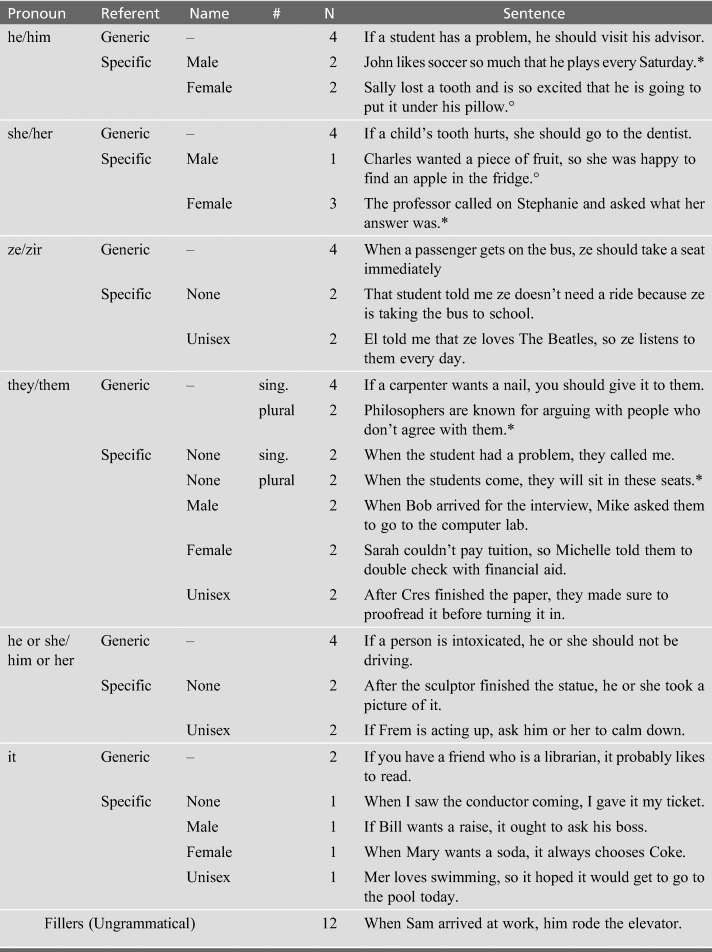
Fifty-four sentences (summarized in Table 1) were created using the pronouns ‘she/her’, ‘he/him’, ‘ze/zir’, ‘they/them’, and ‘it’, or the phrase ‘he or she’ to refer to human antecedents who were either generic/hypothetical (e.g., ‘a student’) or specific (e.g., ‘the teacher’). When the antecedent was specific, it could either be unnamed, have a name that is stereotypically male or female, or an invented name chosen to appear gender-neutral. Generic vs. specific ‘they/them’ were analyzed separately because prior research suggests that generic ‘they/them’ is already in widespread use by English speakers, and therefore is likely to be rated differently than singular specific ‘they/them’. For the sake of brevity, we did not include novel pronouns other than ‘ze/zir’, nor constructions like ‘one’. Of course, all sentences were potentially ambiguous, as pronouns could be interpreted to refer to someone not named in the sentence. If respondents interpreted the sentences this way, we would expect all sentence types to be rated as equally grammatical.
Examples of sentence types rated by respondents
* indicates these sentence types are included in the Control (Grammatical) condition
° indicates these sentence types were included in the Misgender condition
A coding error lead to the imbalance in name genders within the specific she/her condition

Filler sentences (12) containing gendered pronouns which are clearly ungrammatical on the basis of case were also created; these are the Filler (Ungrammatical) sentences, which are not grammatical in any variety of English we are aware of. Another control set of Predictably Grammatical/Inoffensive sentences was created by grouping the sentences containing ‘he/him’ or ‘she/her’ referring to a specific person who was either unnamed (e.g., ‘the student’), or whose name matched the gender of the pronoun (e.g., ‘she/Mary’, ‘him/John’), along with sentences containing ‘they/them’ referring to a plural antecedent; these sentences are the Control (Grammatical) sentences. Another combined category, Gender Mismatches, was created from those sentences containing a gendered name and the opposite gendered pronoun.
Respondents rated sentences on two qualities, each on a five-point scale (Not at all, A little, Somewhat, Fairly, Very). The first was grammaticality – ‘How grammatical do you find the sentence (is it “correct English” or not)?’; the second was offensiveness – ‘How offended or bothered are you by the sentence, stylistically or aesthetically (is this a ‘problematic’ way to talk)?’ The sentences were presented in randomized order (different for each participant).
Personality
Personality was assessed using a 44-item version of the Big Five Inventory (BFI) (John & Srivastava, Reference John and Srivastava1999). The BFI measures five dimensions: Conscientiousness, Agreeableness, Neuroticism, Openness, and Extraversion. Respondents rated on a five-point scale (Strongly disagree, Disagree a little, Neither agree nor disagree, Agree a little, Strongly agree) the degree to which a statement (e.g., ‘I am someone who worries a lot’) describes them. Aggregate scores for each dimension were calculated for each respondent, with 1 indicating a low score for that dimension, and 5 indicating a high score.
Gender Role Attitudes
Attitudes about gender and gender roles were assessed using the Gender Role Attitude Scale (GRAS) (García–Cueto et al., Reference García–Cueto, Rodríguez–Díaz, Bringas–Molleda, López–Cepero, Paíno–Quesada and Rodríguez–Franco2015). The 20 items in the GRAS are adapted from several instruments, and were selected due to their association with sexist attitudes and behaviors in dating relationships. Respondents indicated on a 5-point scale (Strongly disagree, Disagree a little, Neither agree nor disagree, Agree a little, Strongly agree) the degree to which they endorsed statements about men and women (e.g., ‘I think it is worse to see a man cry than a woman’), families (e.g., ‘The husband is responsible for the family so the wife must obey him’), and employment (e.g., ‘Only some kinds of job are equally appropriate for men and women’). In accordance with the identification by García–Cueto et al. (Reference García–Cueto, Rodríguez–Díaz, Bringas–Molleda, López–Cepero, Paíno–Quesada and Rodríguez–Franco2015) of a bipolar factor, sexist vs. transcendent attitudes, a total GRAS score was calculated for each respondent, with 1 indicating less transcendent/more sexist attitudes, and 5 indicating more transcendent/less sexist attitudes.
Demographics
Respondents indicated their age, native language, gender (female, male, or free response), education level, and which pronouns they prefer that others use to refer to them, personally.
Deployment
The study was deployed using Qualtrics software over a period of two months. The survey began with Sentence Ratings, followed by the BFI, GRAS, and demographic questions. The study was advertised via email and flyers at the institution where the study was conducted, and via social media posts directed at the general public. Some respondents were recruited via a university subject pool, and received course credit in return for their participation. All study procedures were approved by the university Human Subjects Review Board.
Results
Response profile
In total, 104 respondents (of 215 who began) completed all questions. Only complete responses by native English speakers (96) were analyzed. The response came primarily from the United States, with one response from Canada and one from the UK. The median time spent on the survey was 15.8 minutes.
Respondents ranged in age from 16 to 72 years (mean = 31.9, SD = 15.3). Reported genders included 63 women, 31 men, one genderfluid (gender which shifts over the lifetime), and one non-binary (neither man nor woman, often meaning somewhere in between). Sixty-two respondents (including one man) reported that they preferred the pronouns ‘she/her’ to refer to themselves; 28 preferred ‘he/him’ and two preferred ‘they/them’ (including the genderfluid respondent). Four respondents preferred something else, which included one without any preference, one who preferred ‘anything except ‘they’’ (the non-binary respondent), and two who gave anomalous responses (‘kim’ and ‘Mr’). Education levels included 14 with no college experience, 39 with some college, 23 with bachelor's degrees, and 20 with graduate degrees.
Sentence ratings
A one-way analysis of variance was conducted to examine whether grammaticality ratings differed by condition (11 sentence types). There was a significant effect of condition on grammaticality rating, F(11, 84) = 41.90, p < .001.
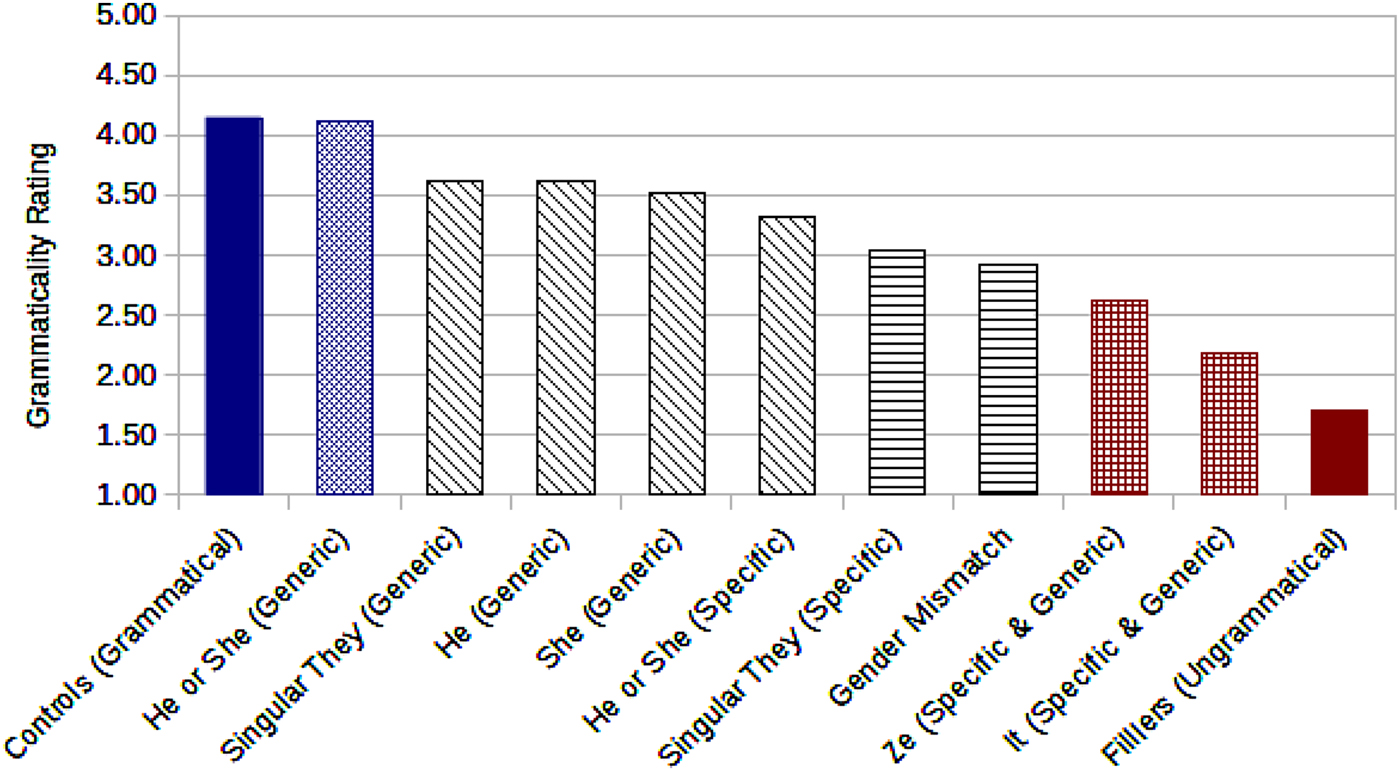
Figure 1 summarizes the grammaticality ratings for each sentence type, ordered from most to least grammatical. Of note is that sentences using ‘he or she/him or her’ to refer to generic persons were rated as grammatical as the uncontroversially-grammatical control sentences, and that sentences using ‘he/him’, ‘she/her’, or ‘they/them’ to refer to a generic person were rated as less grammatical than controls (for ‘they/them’ versus controls, Welch's paired two-sample t[95] = 4.59, p < .001), but were not significantly different from one another. Use of ‘they/them’ to refer to a specific person was rated near the midpoint of 3, which was significantly less grammatical than generic singular ‘they’, t(95) = 4.80, p < .001. Singular, specific ‘they’ was rated similarly to sentences with a gender mismatch (i.e., where a pronoun did not match the expected gender of the referents name, such as ‘she’ for ‘John’). ‘Ze/zir’ and ‘it’ were rated as less grammatical (for ‘ze/zir’ vs. misgenderings, t[95] = 2.36, p = .02), but still more grammatical than ungrammatical fillers (for ‘it’ vs. fillers, t[95] = 6.52, p < .001).
Average grammaticality ratings for conditions of interest on a scale of 1–5 (colours/hatching are for ease of differentiation only)

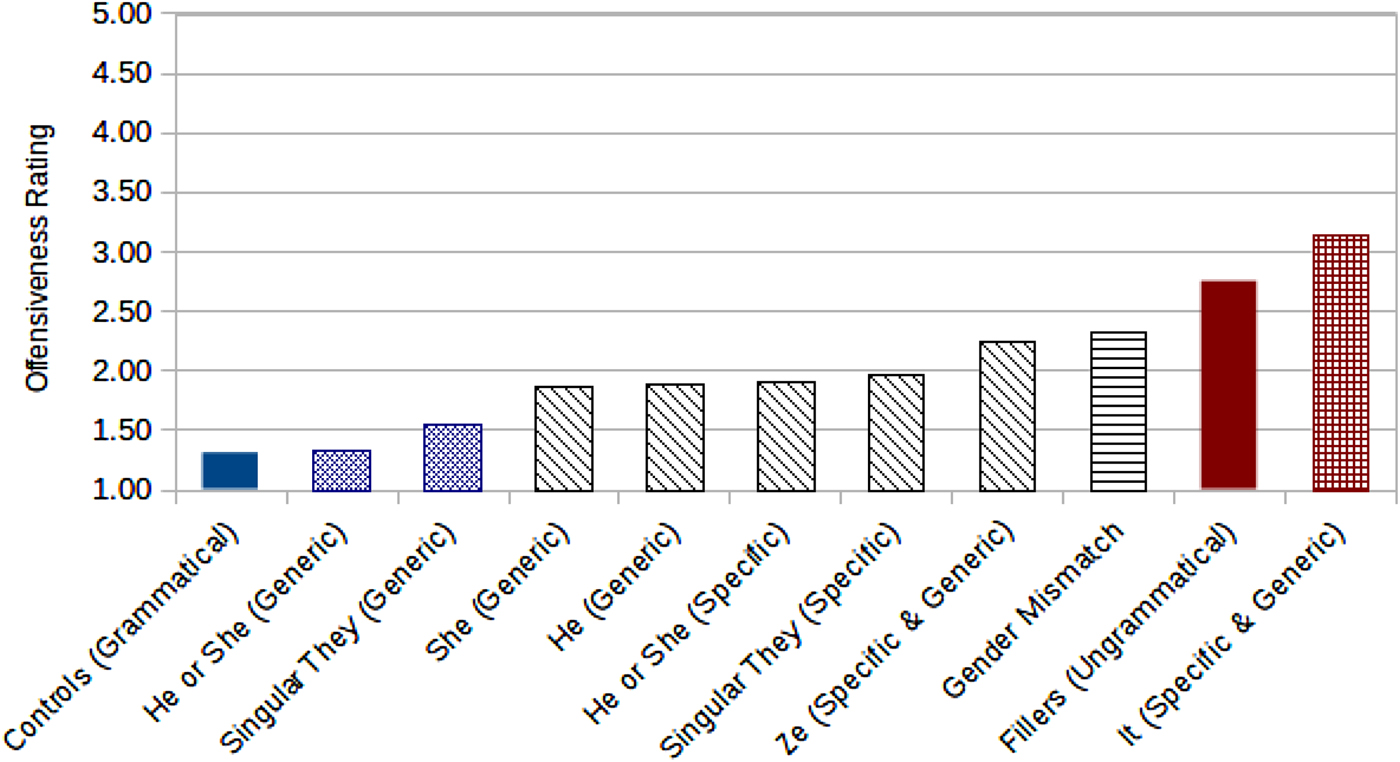
Another one-way analysis of variance was conducted to examine whether offensiveness ratings differed by condition (11 sentence types). There was a significant effect of condition on offensiveness ratings, F(11, 84) = 26.63, p < .001.
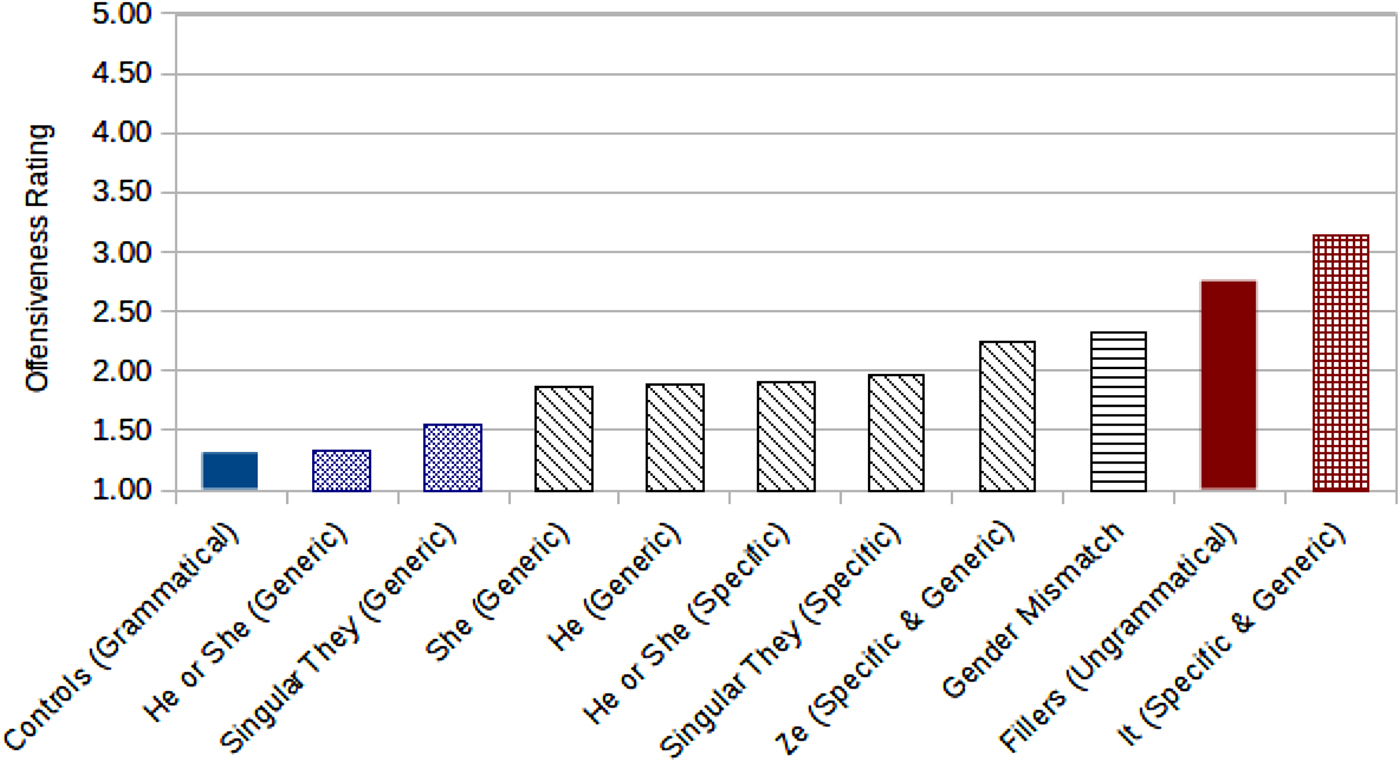
Figure 2 summarizes offensiveness ratings for each sentence type, ordered from least to most offensive. Control sentences, generic ‘he or she/him or her’, and generic ‘they/them’ were the least problematic sentence types for respondents. Single-gender generic pronouns were considered more offensive than generic ‘they/them’ (for ‘she/her’, t[95] = 2.90, p = 0.004). Less-standard uses of pronouns (specific ‘he or she/him or her’, specific ‘they/them’, name-pronoun mismatches, ‘ze/zir’) were rated similarly; gender mismatches were the most bothersome of these, but still less so than ungrammatical sentences with no unconventional aspects of gender, t(95) = 3.68, p-value < .001, while ‘it’ was regarded as considerably more offensive than ungrammatical fillers, t(95) = 3.85, p < .001.
Average offensiveness ratings for conditions of interest on a scale of 1–5 (colors/hatching are for ease of differentiation only)
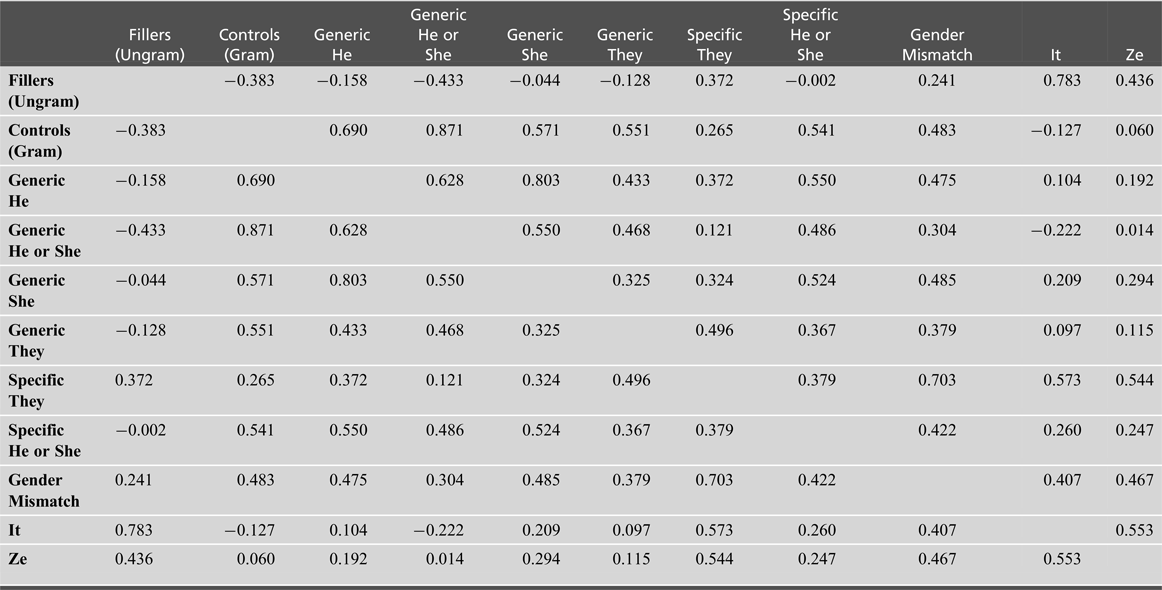
Although some sentence types had a similar average grammaticality rating, different respondents may have treated them differently. For that reason, correlations between ratings for different sentence types were examined. Correlation coefficients between grammaticality ratings for all sentence types are summarized in Table 2. Higher correlation values indicate that if one sentence type is rated as more grammatical, the other sentence type is rated highly as well; negative correlation values indicate that if respondents rate one sentence type highly, they respond oppositely to the other sentence type.
Correlation coefficients (Pearson's r) for grammaticality ratings of sentence types of interest
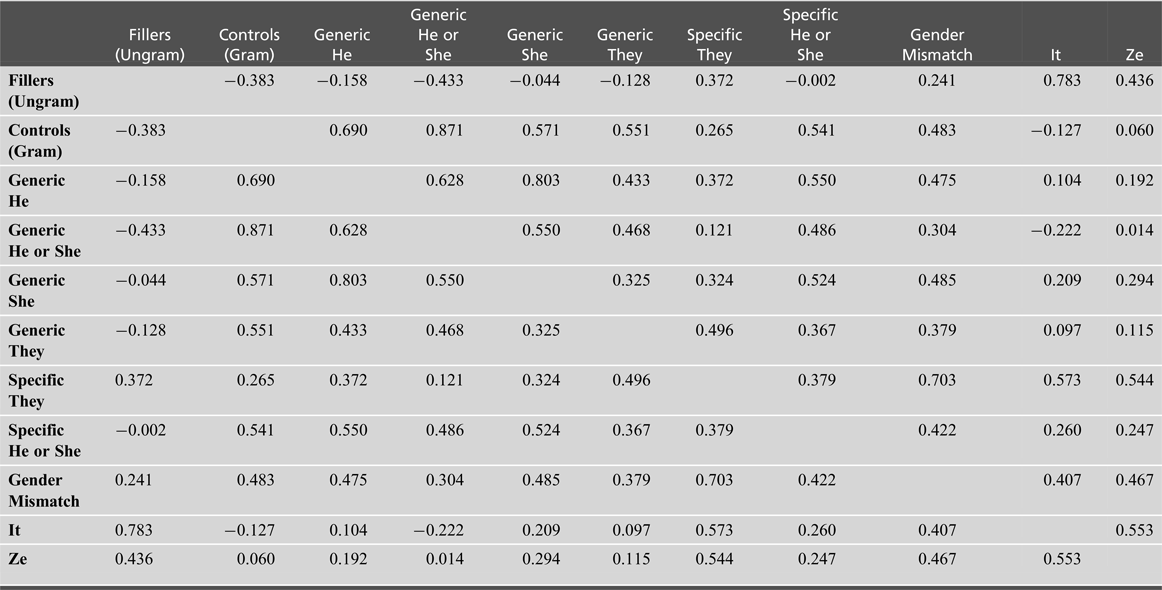
Ratings for generic uses of ‘he/him’, ‘she/her’, ‘he or she/him or her’, and ‘they/them’ are each positively correlated, but the strongest correlation was that between grammaticality ratings for generic ‘he/him’ and ‘she/her’, r = 0.80, t(94) = 13.06, p < 001. If a respondent rated sentences using generic ‘he/him’ as grammatical, they tended to rate generic ‘she/her’ highly as well.
Ratings of pronoun uses which are non-standard (in a prescriptivist sense) on the basis of gender (generic singular ‘they/them’, specific singular ‘they/them’, ‘it’, ‘ze’, and mismatches between name and pronoun gender) are also all positively correlated, but differ in strength. The strongest correlation between these sentence types is that between specific ‘they/them’ and gender mismatches, r = 0.70, t(94) = 9.59, p < .001. Of note is that ratings for generic and specific ‘they/them’ are moderately correlated, r = 0.50, t(94) = 5.53, p < .001; however, ratings for specific ‘they/them’ are more strongly correlated with those for ‘it’ (r = 0.57, t[94] = 6.78, p < .001) and ‘ze/zir’ (r = 0.54, t[94] = 6.28, p < .001). Ratings for ‘ze/zir’ and ‘it’ are also moderately correlated, r = 0.55, t(94) = 6.44, p < .001.
Because respondents were given little specific instruction on how to rate sentences for offensiveness, correlations between grammaticality and offensiveness ratings were examined for control sentences to determine whether participants simply rated less grammatical sentences as more offensive (or vice versa). There was a low degree of correlation between grammaticality and offensiveness rating for ungrammatical filler sentences, r = −.08, t(94) = −0.82, p = .412 and a moderate correlation between grammaticality and offensiveness ratings for grammatical/inoffensive controls, r = −0.53, t(94) = −5.99, p < .001. This latter effect likely stems from the fact that there was a high degree of consensus that these sentences are grammatical and inoffensive. There is a similar degree of consensus for the low grammaticality for the ungrammatical fillers, but the offensiveness ratings for these sentences appear to have a bimodal distribution, with respondents diverging as to whether they considered them offensive. The negative direction of these correlations suggests that, to a degree, subjects slightly conflated the two, because as sentences became more grammatical, they became less offensive.
Names
Ratings for singular specific ‘they/them’ were examined on the basis of the assumed gender of the referent by comparing ratings for sentences in which ‘they/them’ referred to someone with a stereotypically female, male, or novel ambiguous name (e.g., ‘Sally’, ‘Bob’, or ‘Frem’), or no name (e.g., ‘the student’). For both grammaticality and offensiveness, sentences containing singular specific ‘they/them’ were rated as significantly more acceptable when referring to a referent with no known name, compared to those with female names (grammaticality, t[95] = 3.41, p < 0.001; offensiveness, t[95] = −3.44, p < .001). Sentences with singular specific ‘they/them’ were rated as least acceptable when referring to someone with a stereotypically male name (there were no significant deviations from this pattern within male and female respondents).
Considering cases of ‘misgendering’ (e.g., referring to a stereotypically male name with female pronoun, or to a female name with a male pronoun), a gender mismatch referring to a female name was considered significantly less grammatical (t[95] = 3.64, p < .001) and more offensive (t[95] = 4.86, p < .001) than a gender mismatch involving a referent with a male name.
Personality and gender role attitudes
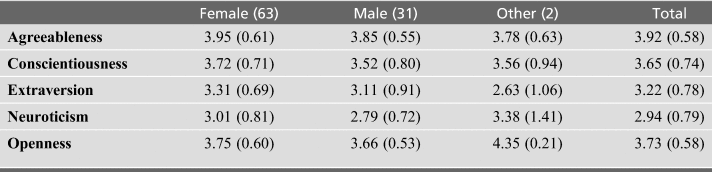
Scores on each of the five personality dimensions are summarized in Table 3. There were no significant differences between males and females on any dimension. Female respondents had an average total GRAS score of 4.27 (SD = 0.58) on a 1–5 scale, which was significantly higher than that of males, who averaged 3.82 (SD = 0.70), t(51.033) = −3.08, p = 0.003; the two respondents of other genders scored an average of 4.58 (SD = 0.25).
Mean (SD) scores on each of the five dimensions of the Big Five personality inventory by gender

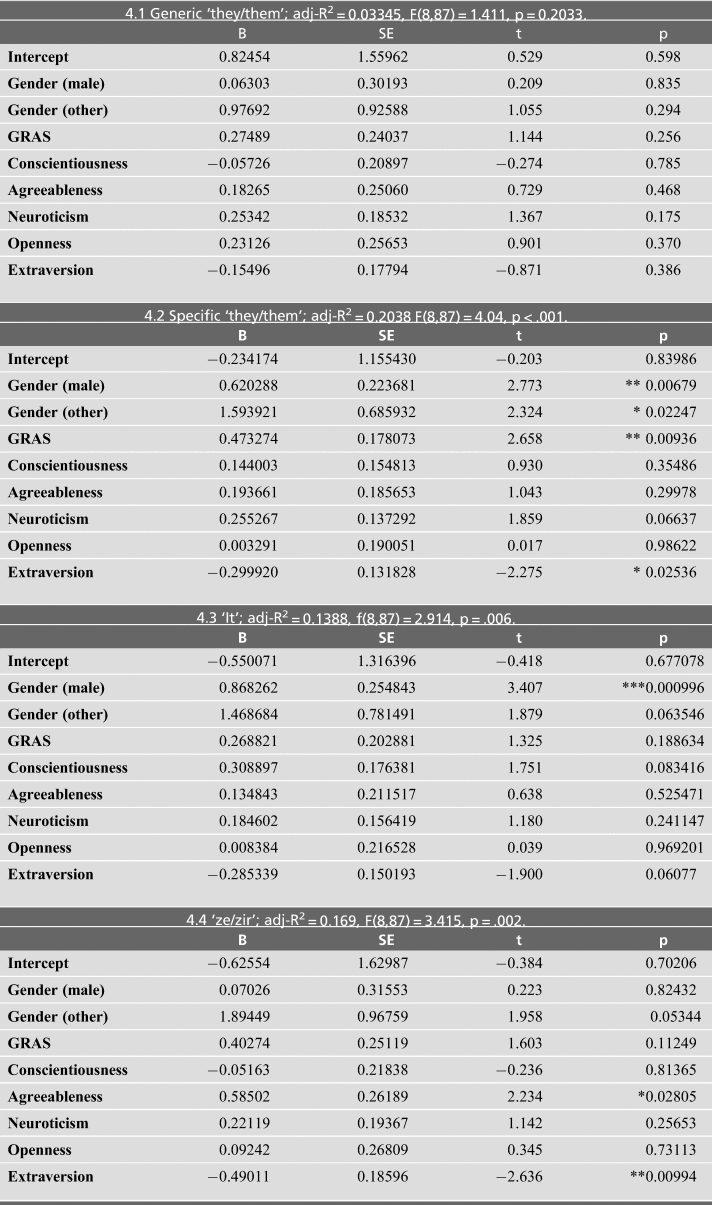
The effects of personality dimensions and gender role attitudes on grammaticality ratings were examined for a subset of sentence types: generic ‘they/them’, specific ‘they/them’, ‘it’, and ‘ze/zir’. For each sentence type, grammaticality ratings were regressed on gender (males versus others), GRAS score, and scores for each personality dimension. Regression coefficients are summarized in Table 4. Of note is that while generic singular ‘they/them’ was not predicted by any of the gender or personality variables, specific use of singular ‘they/them’ was. Males and those with more transcendent GRAS scores rated sentences with specific singular ‘they/them’ as more grammatical, and those who were more extraverted rated them as less grammatical. Extraversion trended negative for all sentence types examined, and was a significant predictor of lower ratings for sentences containing specific ‘they/them’ and ‘ze/zir’. Men rated sentences with ‘it’ as more grammatical than female respondents, but neither GRAS scores nor personality factors contributed. Neither respondent gender nor GRAS score contributed to grammaticality ratings for ‘ze/zir’, but agreeableness predicted more grammatical ratings.
Regression analyses showing contributions of gender, gender role attitudes, and personality dimensions to grammaticality ratings of sentence types of interest; * = p < .05, ** = p < .01

Discussion
The results of respondents’ sentence ratings indicate that different types of gender-neutral phrasings and non-standard uses of gendered pronouns are treated differently by English speakers, and that different speakers react in different ways to the same types of sentences. Interpretive caution is necessary, because respondents did not indicate the bases on which they made their ratings; however, the pattern of ratings, both on their own and in correlation with personality and gender role attitudes, suggest that listeners’ motivations may be complex.
As noted above, many sentences were ambiguous, in that multiple referents could be chosen for each pronoun. For example, in the sentence ‘if a carpenter wants a nail, you should give it to them’, ‘them’ can be interpreted to refer to ‘a carpenter’ or to some other individual or group not named in the sentence. This could lead respondents to choose this external reference when the internal reference seems ungrammatical or is dispreferred. However, if respondents do make such choices, this should minimize any differences in grammaticality between sentence types because we have no a priori reason to assume that readers are more likely to choose an external reference for some sentence types than others (e.g., if the potential antecedent for ‘they’ is specific or generic). The fact that significant differences between sentence types were observed despite the availability of other readings strongly suggests that readers interpret the reference internally, and sometimes rate such a reference as ungrammatical.
The sentence ratings for offensiveness suggest that respondents are able to at least partially separate their ratings of grammaticality from their personal feelings about the sentences. Although the rank ordering is similar for the two ratings, overall ratings for offensiveness were low; only one sentence type (‘it’ to refer to a person) were rated greater than 3 (the midpoint of the scale) while grammaticality ratings spanned a larger portion of the scale.
The most grammatical gender-neutral phrasing (in the sense of including both men and women) was the use of ‘he or she/him or her’ to refer to a generic individual. This was rated as more grammatical than singular ‘they/them’, which is ‘more’ gender-neutral than ‘he or she/him or her’ in the sense that it does not entail a gender binary, and thus encompasses individuals who are neither male nor female. It is notable that singular ‘they/them’ was rated as highly grammatical when it referred to a generic or hypothetical referent – as grammatical as using ‘he/him’ or ‘she/her’ to refer to a hypothetical person. Singular ‘they/them’ used as a reference for a specific person was considered significantly less grammatical than the generic usage, especially when the referent's name strongly suggests a binary gender.
Thus, it appears as though ‘they/them’ has gained widespread acceptance, potentially as a strategy to avoid using a gendered word or phrase when not enough information is available about the referent. ‘They/them’ has not, however, gained the same level of acceptance when used to avoid assigning gender to a specific person (although the slightly higher ratings for referents with no names or ambiguous names suggest that this may be occuring for some respondents). A similar split occurs with the phrase ‘he or she/him or her’, which was rated as less grammatical when used for a particular person (though still more grammatical than ‘they/them’). A speculative explanation for this difference is that use of ‘he or she/him or her’ for a specific referent may indicate uncertainty about the gender of the referent on the part of the speaker, whereas ‘they/them’ can indicate uncertainty as well as the certainty that the referent has a non-binary gender.
This split suggests that disagreement over singular ‘they/them’ likely has less to do with number (the supposed sticking point for grammatical purists) and more to do with gender in actual usage. English speakers seem to be fairly comfortable using an ostensibly plural pronoun (and the third person plural is not gendered in English, as it is in some languages) to refer to a singular referent in some cases, but when discussing a specific – as opposed to hypothetical – person, respondents seem to have a stronger expectation that the person has a gender which should be encoded in the sentence; and furthermore, that this gender is either male or female (or that those are the only genders for which the language provides a means of encoding, and thus one of them must be chosen). Unknown gender and non-binary gender are not treated the same way grammatically by respondents.
This may be related to the vagueness of reference investigated by Borthen (Reference Borthen2010). When the potential antecedent is a generic person (e.g., ‘a student’), the representation of that entity in the speaker or hearer's mind may be vague (lacking specification for gender), and thus there is no conflict with the genderless ‘they’; when the potential antecedent is specific (e.g., ‘John’, or even ‘the student’), a conflict arises between the genderless ‘they’ and the marked or assumed gender of the antecedent (at least for some individuals). Thus, the vagueness of both the reference and the referent may play a role. This hypothesis warrants further investigation in a more controlled context. It is corroborated by the influence (or lack thereof) of personality and gender role attitudes on grammaticality ratings. Generic use of singular ‘they/them’ was not rated differently based on respondent personality or gender role attitudes, while specific ‘they/them’ was. Higher extraversion was also associated with lower grammaticality ratings for specific ‘they/them’. This is somewhat reversed from Boland and Queen (Reference Boland and Queen2016), who found that extroverts were more tolerant of grammatical and spelling errors in potential housemates, although the stimuli and the tasks are not directly comparable. It is possible that in this study greater extraversion leads respondents to be more socially aware of the subjects of the sentences, including their gender, and to be more sensitive to grammatical mismatches involving gender. The GRAS does not specifically address attitudes toward transgenderism or non-binary genders, but a more transcendent GRAS score indicates less endorsement of strict differences between characteristics and social roles by gender, and it is reasonable to hypothesize that those with more transcendent attitudes about gender are more aware or more accepting of genders other than male and female, and that this is reflected in their grammaticality judgments. It is telling that the strongest correlation with ratings for specific ‘they/them’ is with sentences containing a mismatch between the referent's name and pronoun: those who are more willing to refer to a person using the word ‘they’ are also more willing to accept a pronoun that does not match the apparent gender of the referent, which could indicate a greater degree of flexibility surrounding gender generally. Thus, there may be individual differences, related to gender ideology, which affect how speakers/listeners compute pronoun reference, which certainly warrant further investigation.
Extraversion also contributed to lower ratings for ‘ze/zir’, while agreeableness had the opposite effect. The effect of extraversion may be driven by the same failure to assign gender as hypothesized above, and the effect of agreeableness may simply reflect a greater willingness to accept an unfamiliar word, or to interpret it as a typo, rather than a grammatical error. Gender role attitudes did not influence ratings for ‘ze/zir’, and ratings for ‘it’ were not affected by personality nor gender role attitudes. Further research is needed to clarify the contribution of personality, and to detemine whether it is related more to attitudes about gender or language. Respondent gender played also a role in ratings for ‘it’ and specific ‘they’, with men rating these sentences as more grammatical than women in both cases. Given the similarities in personality and gender role attitudes between the women and men, it is difficult to explain this difference, other than to speculate that men may be less aware of or less sensitive to the gendered content or connotations of the sentences, and thus more accepting of deviations from the norm.
The gender-neutral constructions examined here appear to have three different statuses: first, those which are largely acceptable to everyone, independent of personality or gender role attitudes (generic ‘they/them’, ‘he or she/him or her’); second, those which are largely rejected by everyone, regardless of gender role attitudes (‘it’, ‘ze/zir’), though possibly for different reasons (e.g., offensive connotations in the case of ‘it’, unfamiliarity in the case of ‘ze/zir’); and third, specific singular ‘they/them’ seems to occupy a middle ground, in which there is the greatest degree of disagreement over what is and is not grammatical, and in which individual attitudes play the greatest role.
This situation may be due to the different status of each type of pronoun (i.e., established norm, grammatical repurposing, or novel coinage), or it could be a snapshot of a process of change in English. Sarrasin, et al. (Reference Sarrasin, Gabriel and Gygax2012) relate some of their hypotheses and differences between their linguistic groups to the relative progress or recency of the introduction of gender-neutral language reforms in English, French, and German, and it has been claimed that the grammatical status of gender in languages and explicit language reforms can influence thoughts or behavior regarding gender (Prentice, Reference Prentice1994; Boroditsky, Schmidt & Phillips, Reference Boroditsky, Schmidt, Phillips, Gentner and Goldin-Meadow2003; Prewitt–Freilino, Caswell & Laakso, Reference Prewitt–Freilino, Caswell and Laakso2012). Further developmental and diachronic work in this area would be particularly valuable to establish to what degree and in what direction gendered attitudes and language beget or influence on another.
Conclusions
English speakers rated the grammaticality of sentences containing various gender-neutral phrasings and non-standard uses of gendered pronouns. The results indicate that singular ‘they’ is largely acceptable when referring to a hypothetical person of unknown gender, consistent with its long usage history. Use of ‘they’ to refer to specific individuals of unknown or non-binary gender is considered less grammatical, but its acceptability is dependent on the listener's personality and gender role attitudes. Alternatives such as ‘ze/zir’ were less acceptable, even among those with more transcendent attitudes about gender, possibly due to a lack of awareness of invented pronoun systems.
Those who advocate greater use of gender-neutral and non-binary language should note that resistance to personal pronouns other than ‘he/him’ and ‘she/her' appear to be driven not simply by grammatical prescriptivism, but also by more conservative and binary gender role attitudes. Given the divergence between generic and specific use of singular ‘they’, greater acceptance of such language is not driven just by a greater willingness to ignore grammatical conventions. Future research in this area should focus on clarifying the relationship between presciptivist attitudes, personality, and gender ideology, as well as the degree to which speakers attribute their grammatical judgements to these factors. Greater awareness of these factors may inform the strategies adopted by those wishing to influence linguistic style in public and scholarly venues.
 EVAN BRADLEY is Assistant Professor of Psychology at Penn State University, Brandywine. He earned his undergraduate degree in Cognitive Science from Northwestern University and a doctoral degree in Linguistics from the University of Delaware. His lab investigates speech and music perception (and the relationship between the two), and the psychological and social factors relevant to language learning, use, and variation. Email: evan.d.bradley@psu.edu