Introduction
Lithium ion batteries are currently the most widely used means of storing energy. However, several factors affect their performance. Research conducted over the last half-decade has indicated that performance decay occurs mainly because of the formation and repair of a solid electrolyte interface (SEI) on the electrode surface; thus, the SEI consumes lithium ions, free electrons, and other chemicals in the cell.[Reference Zhang1, Reference Verma, Maire and Novak2] It has been found that changes in the thickness and composition of the SEI during numerous charging and discharging cycles affect the coulombic efficiency of the battery. In addition, the moisture content of the battery damages the SEI, leading to performance decay. To compensate for this ominous irreversible reaction and realize SEI-facilitated battery operation with an improved cycle life, several approaches have been proposed, such as scavenging the water content,[Reference Yamane, Inoue, Fujita and Sano3] using electrolyte additives,[Reference Wang, Cheng, Wu, Chu, Cheng and Yang4, Reference Wang, Lo, Cheng, Chen, Hwang and Wu5] depositing electrode coatings,[Reference Lee, Wang, Cheng, Li and Lin6, Reference Chang, Wu and Wu7] adopting new formation processes,[Reference Wang, Yu, Hsiao, Tsai, Hwang, Wang and Wan8, Reference Wang, Wang, Yu, Hsiao and Tsai9] using different electrode materials,[Reference Li, Qu, He and Yu10] and performing electrolyte optimization studies.[Reference Wang, Shieh, Cheng and Yang11]
Here we present a simple approach to significantly improve battery performance. Our discovery subverts most of the traditional notions that H2O cannot be used as an additive for high-power lithium ion batteries. In addition, our approach drastically reduces the degree of difficulty encountered in battery fabrication, thus potentially reducing the cost of the power source in future applications, such as electric vehicles (EVs).
Experimental
All reagents used were obtained from normal commercial suppliers as either Analar or General Purpose Reagents (GPR) grade materials and used as received. A graphite anode comprising 93 wt% mesocarbon microbeads (MCMB-2528), 3 wt% KS4 as a conductive additive, and 4 wt% polyvinylidene fluoride (PVDF) as a binder was used. Lithium hexafluorophoshate (1.1 M) dissolved in ethyl carbonate:propyl carbonate:diethyl carbonate (3:2:5 by volume) mixed solvents was used as an electrolyte. N,N′-1,4-phenylenedimaleimide [0.1 wt% (MI)], completely dissolved in the multi-carbonate-based liquid electrolyte at room temperature, was used as the primary organic, small molecular weight additive.
Advanced commercial lithium ion batteries (ALB, EXA Co., Taichung, Taiwan) having an aluminum-plastic-laminated film exterior and dimensions of 5.0 × 37 × 59 mm were used in this work. Lithium cobalt oxide was used as the cathode, and a separator (Celgard 2320) was placed between the cathode and the anode. In this research, only the storage conditions of the batteries were changed. The unassembled batteries were divided into two groups: A and B. Group A batteries were stored in an extremely dry room (relative humidity <2%; dew point = −35 °C) for 1 week, while group B batteries were subjected to a normal atmospheric environment (relative humidity = 60–65%; dew point = 15 °C) for 1 week, which enabled the batteries to absorb a large amount of moisture.
The button-type lithium ion batteries were assembled by filling each of them with a predetermined amount of the electrolyte. Cycling tests were conducted on a Maccor battery tester series 4000. The batteries were power tested using a standard drain rate after charging with a constant current (0.2C) to a voltage of 4.2 V and then discharged at rates of 0.5C, 1C, and 3C at 2.75 V. The cycle ability of the batteries was measured in a 0.1C/0.1C cycle in the voltage range 2.75–4.2 V. Measurements were carried out at both room temperature and 55 °C for simulating real EV operation.
Results and discussion
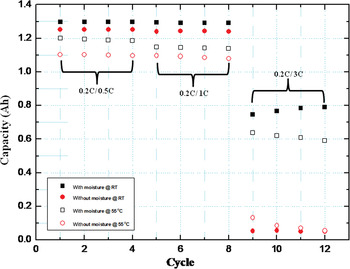
Because lithium ions readily accept free electrons from H2O to form compounds that degrade battery operation, lithium ion batteries are fabricated in an extremely dry environment, i.e., almost without any moisture content (<20 ppm). The non-ionic conductors thus formed, such as Li2O, Li2CO3, and LiF, not only consume a large number of lithium single ions but also have a large resistance, thus causing internal ohmic polarization of the battery. In addition, the H2 and O2 generated from the moisture can cause safety problems such as battery expansion resulting from the electrolysis of the moisture. Figure 1 shows that, at 55 °C, the capacity of the batteries with moisture is better than that of the batteries without moisture. This indicates that MI together with moisture serves as a “binary additive” that prevents damage to the battery. The battery without moisture ( ) shows a capacity of 1251 mAh. On the other hand, the battery with high moisture content (■) shows a higher capacity, i.e., 1299 mAh at the same 0.5C discharge rate. At room temperature, the capacity of the batteries with high moisture content shows improvements of approximately 3.8%, 4.3%, and 394% for the 0.5, 1.0, and 3.0C discharge rates, respectively, compared with batteries without the introduced moisture content. Thus, our innovative technique reduces the dependence on anhydrous conditions during the fabrication of lithium ion batteries. Furthermore, these batteries offer an economic and cost-effective means of energy storage.
Battery performance of C-rate test at charge current 0.2C and discharge currents 0.5C, 1C, and 3C. Nominal capacity 1300 mAh, constant current voltage 4.2 V, cut-off voltage 2.75 V.

Lithium ion batteries are widely used to power EVs. However, at high temperatures the decomposition of lithium salts results in the formation of hydrofluorine as a reactive byproduct that damages the crystal phase of the cathode material and the SEI on the anode's surface. This imposes severe limitations with respect to high-temperature applications of the battery. Figure 1 shows a similar result, i.e., the capacity of the battery without moisture ( ) reduces to 1100 mAh at the 0.5C discharge rate. However, at 55 °C, the battery with the novel H2O/MI binary additive (□) shows a high capacity of 1199 mAh, i.e., a significant improvement of 9% as compared with the previous result. The battery with the high moisture content does not fail at this temperature even when subjected to the high-power tests with 1C and 3C discharge rates; instead the capacity improves by 4.6% and 174% at the 1C and 3C discharge rates, respectively. Interestingly, with these discharge rates, at 55 °C, the moisture-free batteries show a dramatic performance decay.
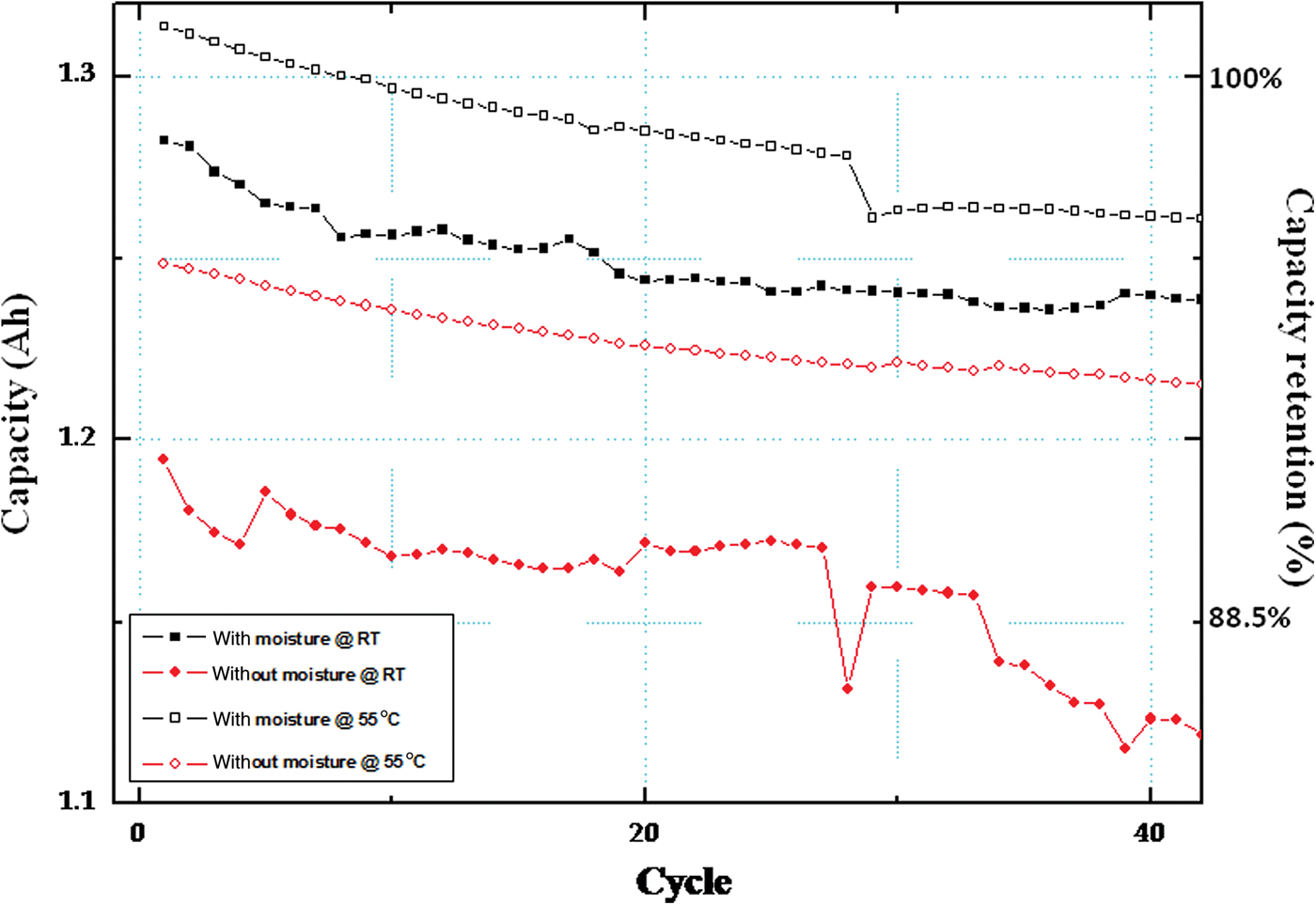
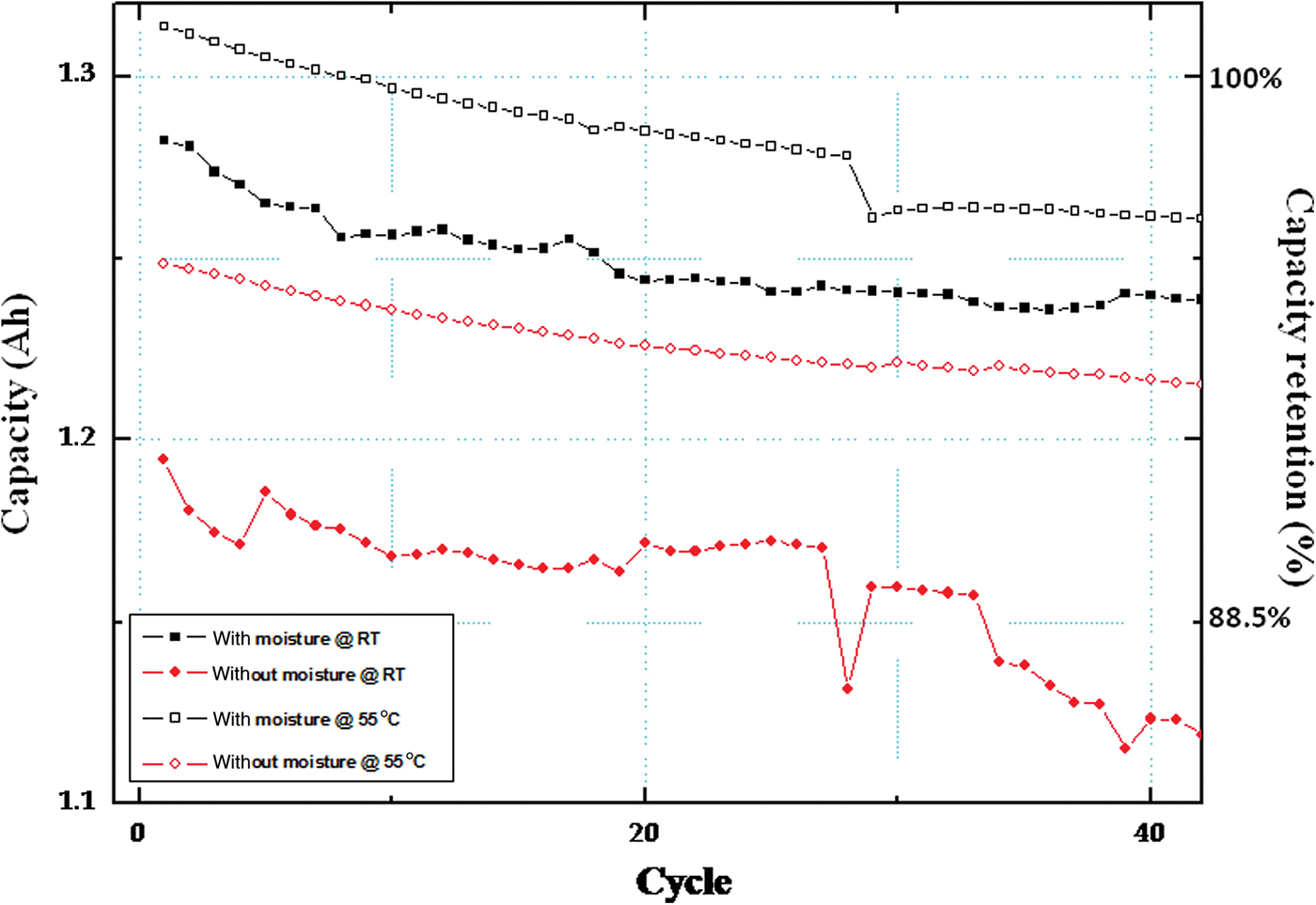
Figure 2 shows that the moisture significantly influences the battery's performance in the 0.1C/0.1C cycle. In this test, the capacity of the batteries with the H2O/MI binary additive shows an improvement of 7.4% and 5.2% when compared with batteries without moisture. This capacity is maintained at both room temperature and 55 °C (respective capacity retentions 98.4% and 94.9%), even after 40 cycles, while the capacity retentions for batteries without moisture, under the same conditions, are only 96.7% and 87.4%.
Battery performance of cycle test at charge current 0.1C and discharge current 0.1C. Nominal capacity 1300 mAh, constant current voltage 4.2 V, cut-off voltage 2.75 V.
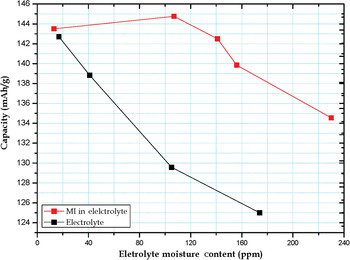
To quantify the moisture content that influences battery performance and the capacity comparison without moisture addition, several amounts of H2O have been prepared with the electrolyte by Karl–Fisher quantification. Figure 3 shows that the battery with MI enables slight improvement of capacity (143.5 mAh/g) compared with the battery without MI (142.3 mAh/g) under 10 ppm H2O content (the original moisture content of fresh electrolyte), which indicates the ionic transfer improvement of SEI on the MCMB by using MI. However, the increment of H2O dramatically eradicates battery performance while H2O was added from 10 to 170 ppm, indicating that the lithium ions were consumed by moisture and formed several inorganic compounds such as Li2O, Li2CO3, and LiF. Those ominous substances thereby damage MCMB surface and restrict the ionic transfer route while the electrochemical intercalation reaction takes place. On the contrary, the binary additive system H2O/MI shows excellent battery performance with an optimum moisture content (100–110 ppm) and enables 144.9 mAh/g compared with the battery without MI. Even the performances of batteries with a higher content of moisture (120–240 ppm) are still better than the batteries with MI. This illustrates and confirms our previous results, that the binary additive system H2O/MI certainly provides unique and useful SEI formation on the anode.
Capacity comparison with different amounts of H2O at charge current 0.1C and discharge current 0.1C.

Summary
A breakthrough additive technology has been proposed and evaluated to improve the performance of lithium ion batteries at high temperatures. The capacities and cycle lives of batteries with the new binary additive, H2O/MI, were measured. Our results show that H2O/MI is an ideal additive for the SEI as it confers excellent electrochemical stability, minimizes the irreversibility of the lithium intercalation–deintercalation process, and enhances the reversibility of the electrochemical reaction in the battery containing moisture. Thus, batteries containing this additive package offer significant performance advantages when compared with ordinary batteries. This research demonstrates that the H2O/MI binary additive can potentially be used to develop the next generation of lithium ion batteries with high moisture content, especially for operating at high temperature and high power.
Acknowledgments
The authors are grateful for financial support from the National Science Council of Taiwan, R.O.C, under grants NSC 100-2628-E-011-018-MY2 and NSC 100-3113-E-011-002.