Cognitive-behavioural therapy (CBT) for depression is among the most widely used and studied treatments for depression. Despite its demonstrated efficacy overall (Cuijpers et al., Reference Cuijpers, Berking, Andersson, Quigley, Kleiboer and Dobson2013), clinical trials demonstrate that over one-third of depressed patients do not respond to CBT (Leichsenring, Reference Leichsenring2001; DeRubeis et al., Reference DeRubeis, Hollon, Amsterdam, Shelton, Young, Salomon, O'Reardon, Lovett, Gladis, Brown and Gallop2005b; Dimidjian et al., Reference Dimidjian, Hollon, Dobson, Schmaling, Kohlenberg, Addis, Gallop, McGlinchey, Markley, Gollan and Atkins2006). According to the cognitive model of depression, negatively biased cognition contributes to the onset and maintenance of depression (Beck et al., Reference Beck, Rush, Shaw and Emery1979; Clark et al., Reference Clark, Beck and Alford1999). CBT is thought to improve depression symptoms by producing adaptive change in cognition. The hypothesized model of change, wherein CBT interventions produce changes in cognition, which in turn ameliorate depression symptoms, is termed the cognitive mediation model of CBT.
Evidence for the cognitive mediation model of CBT
Mediation models seek to explain how an effective treatment leads to symptom improvement (Kraemer et al., Reference Kraemer, Wilson, Fairburn and Agras2002; MacKinnon et al., Reference MacKinnon, Fairchild and Fritz2007). A variable that mediates treatment outcome is intermediate in the causal path from the treatment to the outcome (MacKinnon, Reference MacKinnon2008). A mediator of treatment suggests a possible mechanism of action, which may then be targeted in the development of more potent and/or efficient treatments (Kraemer et al., Reference Kraemer, Wilson, Fairburn and Agras2002). Demonstration of statistical mediation of treatment outcome requires a significant indirect effect of treatment condition on the outcome, where the indirect effect is the product of: (a) the effect of treatment condition on the mediator (‘a’ path) and; (b) the effect of the mediator on the outcome, controlling for the effect of treatment condition on the outcome (‘b’ path; Baron and Kenny Reference Baron and Kenny1986; MacKinnon et al., Reference MacKinnon, Fairchild and Fritz2007).
Mediation specifies a temporal order, such that change in the mediator follows the initiation of treatment and precedes change in the outcome. The full temporal ordering of variables cannot be specified in cross-sectional designs and prospective designs with only two measurement points, and must instead be assumed (Cole and Maxwell, Reference Cole and Maxwell2003). Maxwell and Cole (Reference Maxwell and Cole2007) demonstrated that temporal assumptions are often erroneous and cross-sectional tests of longitudinal mediation processes produce substantially biased parameter estimates. Longitudinal mediation analysis with three or more measurement points allow tests of the effects of treatment condition on change in the mediator at a later time point (‘a’ path) and of change in the mediator on change in the outcome at a later time point (‘b’ path; Cole and Maxwell, Reference Cole and Maxwell2003; MacKinnon, Reference MacKinnon2008). The indirect, or mediated, effect in longitudinal analysis is similarly given by the product ‘ab’; however, given that the mediator and outcome are measured at repeated time points, there can be more than one ‘a’ path and ‘b’ path, and thus more than one indirect effect (‘ab’) evaluated for significance.
Empirical support exists for individual components of the cognitive mediation model of CBT. CBT leads to increased use of cognitive restructuring and other CBT skills, as well as decreased negative automatic thoughts and dysfunctional attitudes (see Garratt et al., Reference Garratt, Ingram, Rand and Sawalani2007; Lorenzo-Luaces et al., Reference Lorenzo-Luaces, German and DeRubeis2015; Oei and Free, Reference Oei and Free1995, for reviews). CBT thus has a demonstrated effect on the mediator (i.e. cognition), which is one component of the model. Some researchers have argued that a fundamental assumption of the cognitive mediation model is that cognitive change is specific to CBT, and CBT should, therefore, have a greater effect on cognition than other treatments that presumably work via alternative mechanisms (Whisman, Reference Whisman1993; Garratt et al., Reference Garratt, Ingram, Rand and Sawalani2007). In general, this specificity hypothesis has not been supported. The magnitude of cognitive change is similar across CBT and other psychotherapies for depression (Oei and Free, Reference Oei and Free1995; Garratt et al., Reference Garratt, Ingram, Rand and Sawalani2007; Lorenzo-Luaces et al., Reference Lorenzo-Luaces, German and DeRubeis2015). Garratt et al. (Reference Garratt, Ingram, Rand and Sawalani2007) argued that cognition is likely directly or indirectly targeted by other psychotherapies, and the specificity hypothesis may be best evaluated by contrasting CBT and pharmacotherapy, as cognitive change may occur in pharmacotherapy but is not thought to be the mechanism of symptom improvement. Comparisons of CBT and pharmacotherapy have yielded mixed evidence, with some studies reporting greater cognitive change in CBT (e.g. Ma and Teasdale, Reference Ma and Teasdale2004; Fresco et al., Reference Fresco, Segal, Buis and Kennedy2007; Dozois et al., Reference Dozois, Bieling, Patelis-Siotis, Hoar, Chudzik, McCabe and Westra2009) and others reporting no differences between treatments (DeRubeis et al., Reference DeRubeis, Evans, Hollon, Garvey, Grove and Tuason1990; Quilty et al., Reference Quilty, McBride and Bagby2008, Reference Quilty, Dozois, Lobo, Ravindran and Bagby2014; Fournier et al., Reference Fournier, DeRubeis, Hollon, Gallop, Shelton and Amsterdam2013).
There is also evidence for the second component of the model, namely the association between the mediator (i.e. cognition) and outcome, although mostly in the form of concurrent associations. Several studies have found that cognitive change and symptom change co-vary over the course of CBT for depression (Oei and Free, Reference Oei and Free1995; Garratt et al., Reference Garratt, Ingram, Rand and Sawalani2007; Lorenzo-Luaces et al., Reference Lorenzo-Luaces, German and DeRubeis2015). However, it is necessary to establish the temporal precedence of cognitive change to rule out the possibilities that change in depression symptoms precedes change in cognition or that changes occur simultaneously. A few studies have distinguished concurrent and temporal relationships between cognitive and symptom change, and have found strong evidence for concurrent but not temporal relationships (Warmerdam et al., Reference Warmerdam, van Straten, Jongsma, Twisk and Cuijpers2010; Vittengl et al., Reference Vittengl, Clark, Thase and Jarrett2014; Lemmens et al., Reference Lemmens, Galindo-Garre, Arntz, Peeters, Hollon, DeRubeis and Huibers2017; but see DeRubeis et al., Reference DeRubeis, Evans, Hollon, Garvey, Grove and Tuason1990).
Psychotherapy research has only recently begun to incorporate advances in statistical mediation research, including longitudinal designs and analyses (Lemmens et al., Reference Lemmens, Müller, Arntz and Huibers2016). The few studies that have evaluated temporal order have found null or weak evidence for the cognitive mediation model of CBT for depression (Vittengl et al., Reference Vittengl, Clark, Thase and Jarrett2014; Lemmens et al., Reference Lemmens, Galindo-Garre, Arntz, Peeters, Hollon, DeRubeis and Huibers2017). Using latent difference score models, Lemmens et al. (Reference Lemmens, Galindo-Garre, Arntz, Peeters, Hollon, DeRubeis and Huibers2017) did not observe indirect effects of cognitive v. interpersonal therapy on change in depression symptoms via changes in any of the examined mediators (dysfunctional attitudes, interpersonal problems, rumination, self-esteem and therapeutic alliance). Vittengl et al. (Reference Vittengl, Clark, Thase and Jarrett2014) evaluated temporal relationships between change in cognitive variables (dysfunctional attitudes, attributions for negative events, hopelessness and positive coping) and change in depression symptoms during cognitive therapy in a large sample of outpatients with recurrent major depressive disorder (MDD). Structural equation models (SEMs) provided weak evidence for cross-lagged relations in which cognitive change precedes symptom change and vice versa.
The current study
The current study incorporated contemporary recommendations for research on mediation models of psychotherapy (Lorenzo-Luaces et al., Reference Lorenzo-Luaces, German and DeRubeis2015; Lemmens et al., Reference Lemmens, Müller, Arntz and Huibers2016) to evaluate the cognitive mediation model of CBT for depression. Pharmacotherapy was used as a comparison treatment to test the specificity of cognitive change and mediation to CBT. Longitudinal SEM was used to evaluate reciprocal relationships between multiple candidate cognitive mediators and depression symptoms (MacKinnon, Reference MacKinnon2008). Dysfunctional attitudes, cognitive distortions and negative automatic thoughts were selected as the candidate mediators based on their relevance to cognitive theory and the CBT protocol for depression (Beck et al., Reference Beck, Rush, Shaw and Emery1979) and use in previous cognitive mediation research (e.g. DeRubeis et al., Reference DeRubeis, Evans, Hollon, Garvey, Grove and Tuason1990; Quilty et al., Reference Quilty, McBride and Bagby2008; Vittengl et al., Reference Vittengl, Clark, Thase and Jarrett2014; Lemmens et al., Reference Lemmens, Galindo-Garre, Arntz, Peeters, Hollon, DeRubeis and Huibers2017). The following hypotheses were made based on the cognitive mediation model: (1) CBT would lead to greater change in the cognitive variables than pharmacotherapy; (2) the cognitive variables would predict depression symptoms at subsequent time points; and (3) there would be a significant indirect (i.e. mediated) effect of treatment condition on depression symptoms via change in the cognitive variables (i.e. a significant mediated effect). The data for this study are from a randomized controlled trial (RCT) of CBT v. pharmacotherapy for adult depression (Quilty et al., Reference Quilty, Dozois, Lobo, Ravindran and Bagby2014)Footnote †Footnote 1.
Methods
Participants
The sample consisted of 104 participants with a primary diagnosis of MDD (53% female; mean age = 33.61 years, s.d. = 9.97). Eligibility was based on the diagnostic criteria from the Diagnostic and Statistical Manual of Mental Disorders – Fourth Edition (DSM-IV; APA, 1994) and determined with the Structured Clinical Interview for DSM-IV (SCID-IV; First et al., Reference First, Spitzer, Gibbon and Williams1995). Participants were required to be between 18 and 65 years inclusive, fluent in English and capable of giving informed consent. Exclusion criteria included a diagnosis of bipolar disorder, psychotic disorder, substance dependence or organic brain syndrome; current treatment with antidepressant medications (ADMs); or electroconvulsive therapy in the past 6 months.
Participants were randomized to a CBT (n = 54) or antidepressant (ADM) condition (n = 50). Forty-nine participants in CBT and 43 participants in ADM completed at least 8 weeks of treatment. Participants self-identified according to the following Statistics Canada ethno-racial groupings: Caucasian (69.2%), South Asian (15.4%), Black (5.5%), Visible Minority (3.3%), Chinese (2.2%), Latin American (2.2%), Arab/West Indian (1.1%) and Aboriginal (1.1%).
Measures
Depression symptoms
The primary outcome was depression symptoms as measured by the Hamilton Depression Rating Scale (HAM-D; Hamilton, Reference Hamilton1960). The HAM-D is a 17-item semi-structured interview that assesses depression symptom severity over the past week. The HAM-D was selected as the primary outcome because it is interviewer-administered and consists of less cognitive content than commonly used self-report measures including the Beck Depression Inventory – Second Edition (BDI-II; Beck et al., Reference Beck, Steer and Brown1996). These properties are preferable in assessing relationships between depression symptoms and cognitive content (see immediately below) because shared variance due to assessment method and overlapping item content is minimized. Cronbach's α values for the HAM-D in the present sample were 0.69 at week 0, 0.77 at week 4, 0.83 at week 8 and 0.86 at week 16.
Cognitive content
The Dysfunctional Attitudes Scale (DAS; Weissman and Beck, Reference Weissman and Beck1978) consists of 40 items that measure depressotypic attitudinal statements. Respondents rate their agreement with each statement. The DAS showed high internal consistency in the present sample at each assessment point (Cronbach's α = 0.92–0.94).
The Cognitive Distortions Scale (CDS; Covin et al., Reference Covin, Dozois, Ogniewicz and Seeds2011) consists of 20 items that measure 10 cognitive errors that were initially described by Burns (Reference Burns1980) and are commonly discussed in CBT protocols. Respondents indicate how frequently they make each type of error in interpersonal and achievement situations. The CDS showed high internal consistency in the present sample at each assessment point (Cronbach's α = 0.91–0.96).
The Automatic Thoughts Questionnaire–Negative (ATQ-N; Hollon and Kendall, Reference Hollon and Kendall1980) consists of 30 items that measure negative automatic thoughts. Respondents indicate the frequency of negative automatic thoughts during the past week. The ATQ-N showed high internal consistency in the present sample at each assessment point (Cronbach's α = 0.96–0.98).
Procedure
Participants were randomly assigned to 16 weekly sessions of CBT administered according to the protocol outlined by Beck et al. (Reference Beck, Rush, Shaw and Emery1979) or 16 weeks of ADM according to Canadian Network for Mood and Anxiety Treatment (CANMAT) guidelines (Lam et al., Reference Lam, Kennedy, Grigoriadis, McIntyre, Milev, Ramasubbu, Parikh, Patten and Ravindran2009). CBT was provided by nine study clinicians, including three licensed clinical psychologists and six doctoral-level trainees. ADM was provided by four psychiatrists. Depression symptoms and cognitive content were measured at week 0 (pre-treatment), week 4, week 8 and week 16 (post-treatment). Additional details about the original RCT are reported in Quilty et al. (Reference Quilty, Dozois, Lobo, Ravindran and Bagby2014).
Statistical analyses
All models were tested using maximum likelihood estimation in Mplus Version 8.1 (Muthén and Muthén, Reference Muthén and Muthén1998–2017). Bootstrapping with 5000 samples was used to compute standard errors. Model fit was evaluated using the model χ2 test, with non-significant χ2 values indicating good model fit, the Comparative Fit Index (CFI), with values ⩾0.95 indicating close model fit, the Root Mean Square Error of Approximation (RMSEA), with values ⩾0.10 indicating poor model fit, and the Standardized Root Mean Square Residual (SRMR), with values ⩽0.08 indicating acceptable fit. The Akaike Information Criterion (AIC) was used to compare alternative models, with lower values indicating better fit.
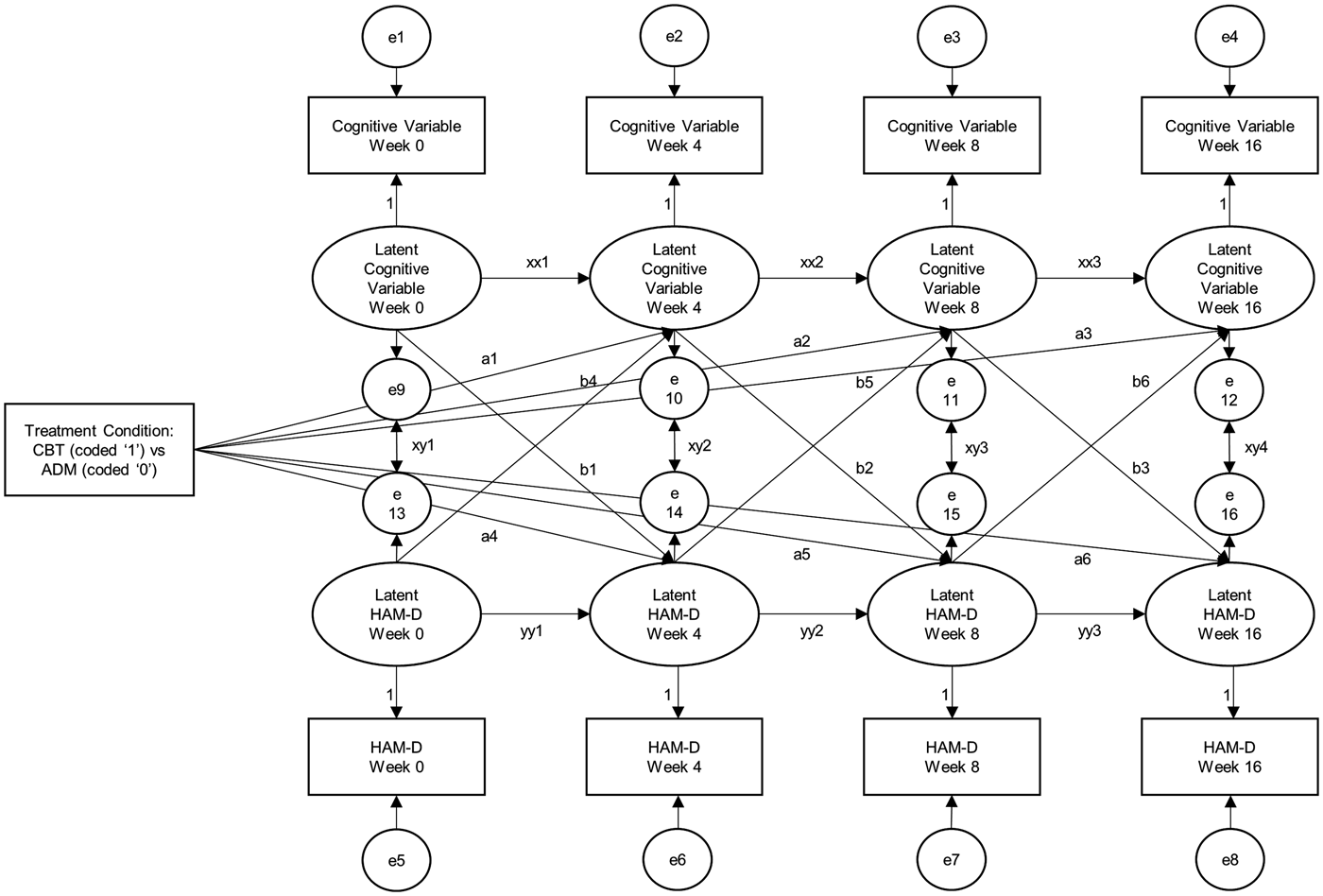
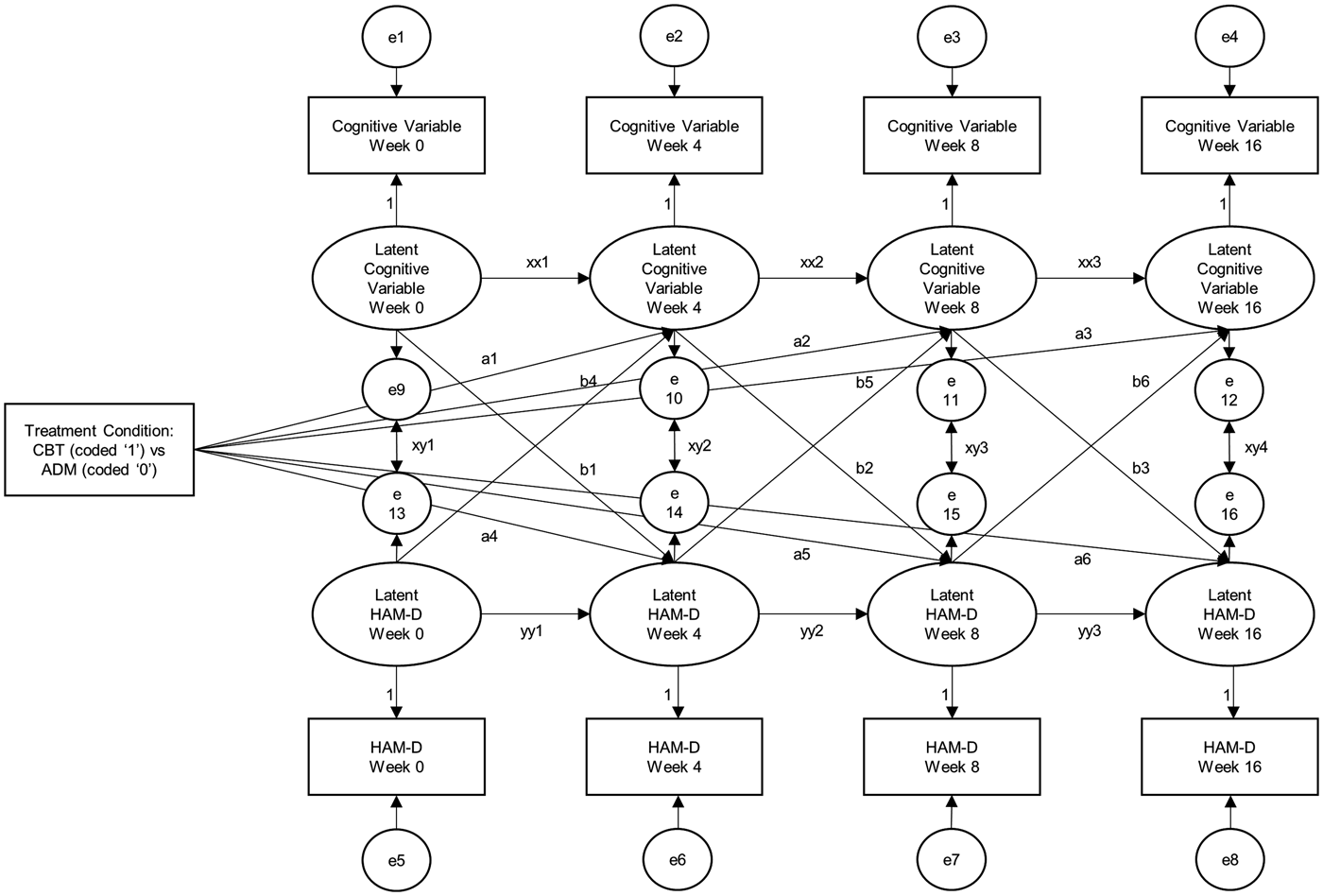
Four-wave (week 0, week 4, week 8, week 16) cross-lagged SEMs were estimated to evaluate the longitudinal relationships between treatment condition (dummy-coded 1 for the CBT condition and 0 for the ADM condition), the cognitive variables (DAS, CDS and ATQ-N) and depression symptoms as measured by the HAM-D (Cole and Maxwell, Reference Cole and Maxwell2003; MacKinnon, Reference MacKinnon2008). An advantage of cross-lagged panel models is that all of the effects relevant to mediation (i.e. ‘a’ paths, ‘b’ paths and ‘ab’ product term) are modelled and tested simultaneously. For each cognitive variable, a model including all cross-lagged paths between the cognitive variable and depression symptoms was specified (Fig. 1; MacKinnon, Reference MacKinnon2008Footnote 2). Although testing the cognitive mediation hypothesis (i.e. mediation of treatment condition on depression symptoms via change in the cognitive variables) was of primary interest, a model that included all cross-lagged paths between the cognitive variable and depression symptoms was more conceptually plausible than assuming paths from depression symptoms to the cognitive variable are zero, given effects of depressed mood on cognition (e.g. Miranda and Persons, Reference Miranda and Persons1988; Fresco et al., Reference Fresco, Heimberg, Abramowitz and Bertram2006). Autoregressive relations between the same variable at adjacent waves were included, as well as covariances or residual covariances among the variables within each measurement wave. Measurement error was corrected for in the models by using latent variables with single indicators for each variable, and fixing the variance of the indicator variables to a, where a = (1 − reliability) × variance for each variable (see Fig. 1; Muthén and Muthén, Reference Muthén and Muthén1998–2017). Reliability was estimated using each variable's Cronbach's α value.
Cross-lagged panel model of concurrent and longitudinal relationships between treatment condition, the cognitive variable and depression symptoms as measured by the Hamilton Depression Rating Scale (HAM-D), correcting for measurement error.
The assumption of equivalence of cross-lagged relationships between each cognitive variable and depression symptoms across the ADM and CBT groups was tested in two-group models. To provide an additional test of the significance of the cross-lagged paths between the cognitive variables and depression symptoms, the fit indices of cross-lagged models were compared with those of models that included only autoregressive relations between the same variables at adjacent measurement waves and covariances or residual covariances between variables within the same measurement wave.
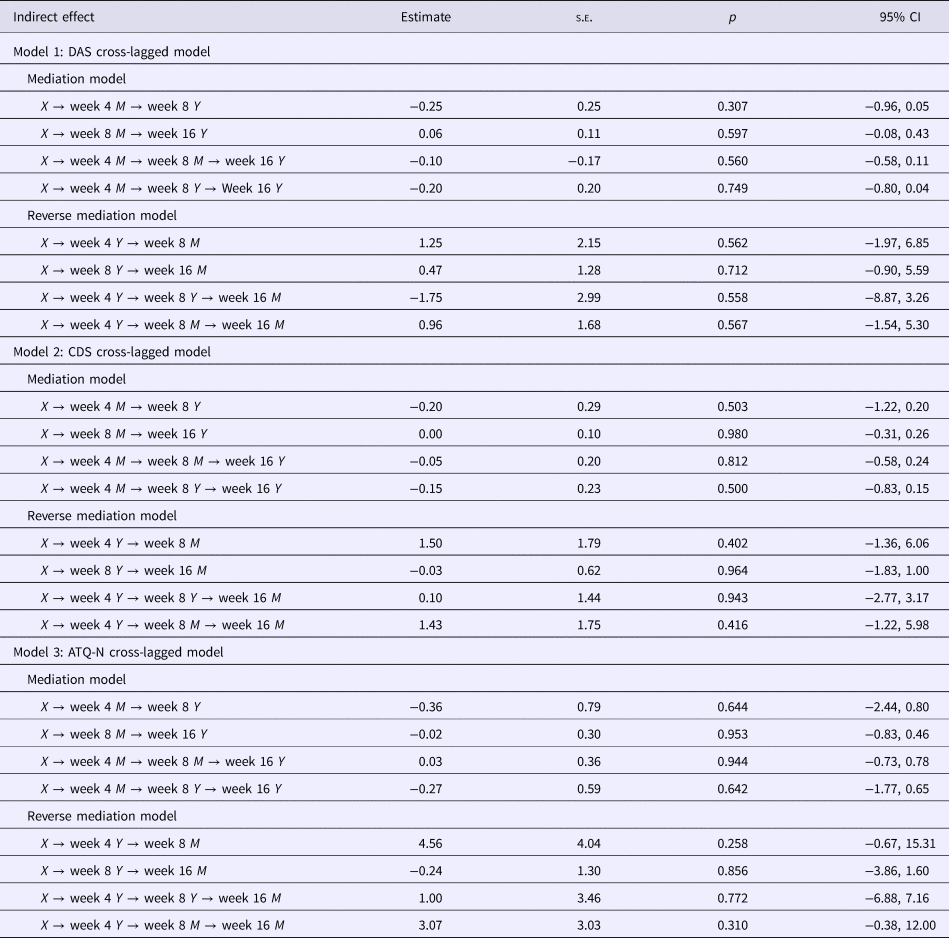
Indirect (i.e. mediated) effects and their standard errors and bias-corrected bootstrap 95% confidence intervals (CIs) were computed for all longitudinal indirect effects between the treatment condition, the cognitive variable and depression symptoms. Thus, eight indirect effects were tested for each model. Four reflected the cognitive mediation model, with the cognitive variable (M) mediating the effect of treatment condition (X) on depression symptoms (Y): (1) X → week 4 M → week 8 Y; (2) X → week 8 M → week 16 Y; (3) X → week 4 M → week 8 M → week 16 Y; and (4) X → week 4 M → week 8 Y → week 16 Y. The other four indirect effects were the same as above but reflected the reverse mediation model, with depression symptoms mediating the effect of treatment condition on the cognitive variable. Note that each of the indirect effects represents an ‘ab’ product term, wherein the ‘a’ path is the effect of X on M and the ‘b’ path is the effect of M on Y, controlling for the effect of X on Y.
Results
Descriptive statistics
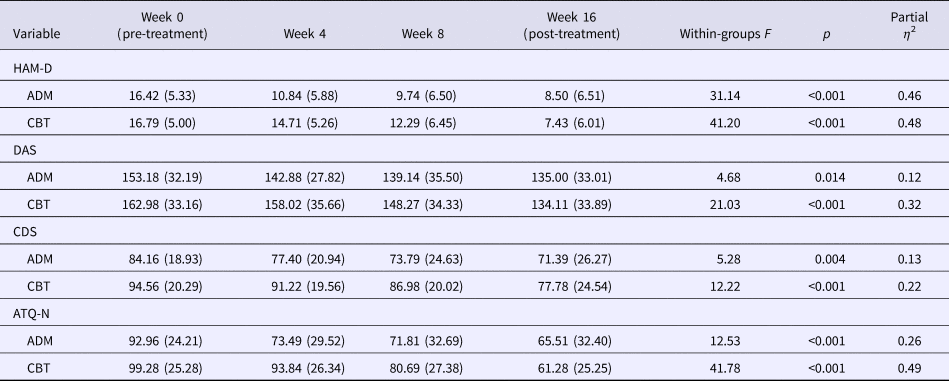
Table 1 presents the mean scores on the DAS, CDS, ATQ-N and HAM-D for the ADM and CBT conditions at each measurement wave. Participants in both conditions showed significant decreases on each of the cognitive variables and depression symptoms over the treatment period. Bivariate correlations between the raw study measures are reported in the online Supplementary Appendix.
Mean scores on the cognitive variables and HAM-D at each wave of measurement in the ADM and CBT groups
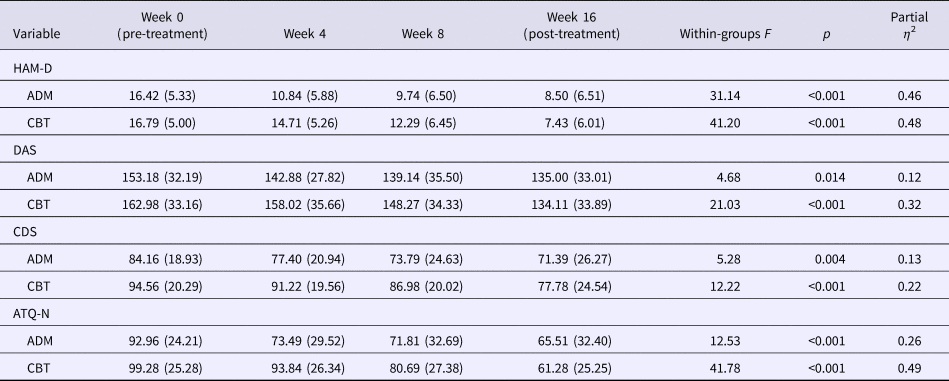
HAM-D, Hamilton Depression Rating Scale; DAS, Dysfunctional Attitudes Scale; CDS, Cognitive Distortions Scale; ATQ-N, Automatic Thoughts Questionnaire – Negative.
Standard deviations are in parentheses.
At week 0, data were missing for n = 1 (1 × CBT) for the HAM-D. At week 4, data were missing for n = 10 (7 × ADM, 3 × CBT) for the HAM-D, and n = 11 (7 × ADM, 4 × CBT) for the DAS, CDS, and ATQ-N. At week 8, data were missing for n = 13 (8 × ADM, 5 × CBT) for the HAM-D, DAS, CDS, and ATQ-N. At week 16, data were missing for n = 20 (12 × ADM, 8 × CBT) for the HAM-D and DAS, n = 21 (12 × ADM, 9 × CBT) for the CDS, and n = 21 (13 × ADM, 8 × CBT) for the ATQ-N.
Longitudinal models
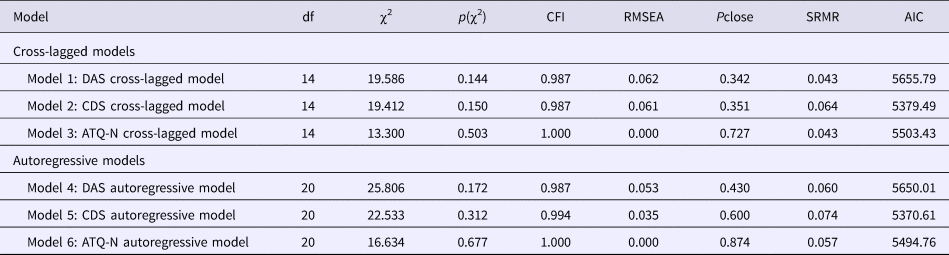
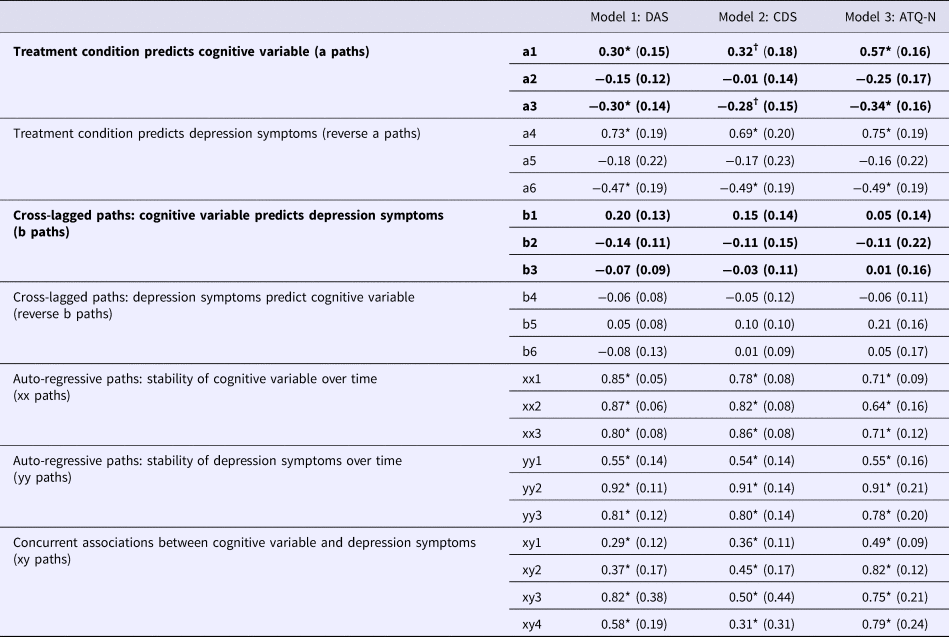
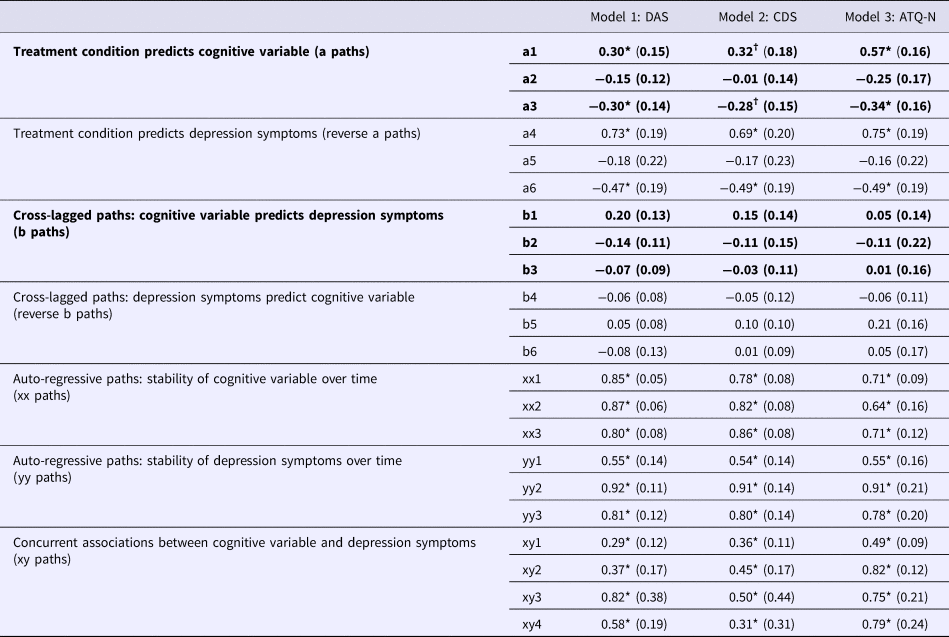
The fit indices for the DAS, CDS and ATQ-N cross-lagged models indicated good fit to the data (Table 2). Standardized parameter estimates and standard errors from the three models are displayed in Table 3Footnote 3. There was a moderate to high stability of the cognitive variables (β = 0.64–0.87) and depression symptoms (β = 0.54–0.92), across measurement waves, as well as significant correlations between the cognitive variables and depression symptoms within each measurement wave (r = 0.29–0.82)Footnote 4. Wald tests within two-group models indicated no significant difference in the magnitude of the cross-lagged paths across the ADM and CBT conditions, for all three models, all p > 0.05. Thus, the assumption of equivalence of the cross-lagged paths across the CBT and ADM conditions was met, which justifies the use of the cross-lagged models that included participants in both treatment conditions and modelled treatment condition as a two-level predictor variable (as depicted in Fig. 1).
Model fit indices for the longitudinal mediation and autoregressive models involving the DAS, CDS and ATQ-N
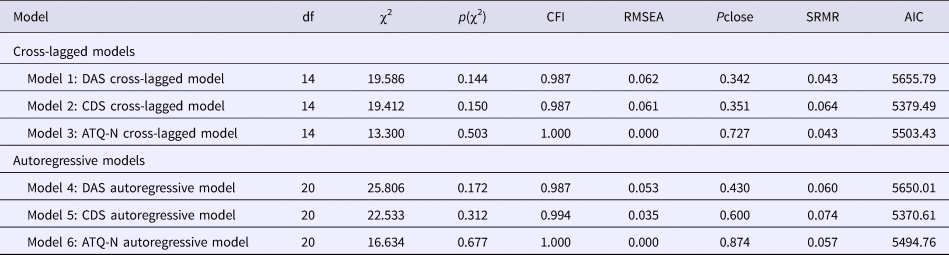
DAS, Dysfunctional Attitudes Scale; CDS, Cognitive Distortions Scale; ATQ-N, Automatic Thoughts Questionnaire – Negative.
Models are corrected for measurement error.
Standardized parameter estimates (with standard errors in parentheses) for the cross-lagged structural equation models involving the DAS, CDS and ATQ-N
DAS, Dysfunctional Attitudes Scale; CDS, Cognitive Distortions Scale; ATQ-N, Automatic Thoughts Questionnaire – Negative.
*p < 0.05; †p < 0.10. Bold type indicates paths predicted by the cognitive mediation model. Models are corrected for measurement error. Standardized parameter estimates are reported. STDXY estimates are reported for parameter estimates with continuous covariates (all effects except a1–a6) and STDY estimates are reported for parameter estimates with binary covariates (a1–a6; Muthén and Muthén, Reference Muthén and Muthén1998–2017). The standardized coefficient for STDXY standardization is interpreted as the change in y standard deviation units for a standard deviation change in x. The standardized coefficient for STDY standardization is interpreted as the change in y standard deviation units for the CBT relative to ADM condition.
Hypothesis 1: CBT would lead to greater change in the cognitive variables than pharmacotherapy
Treatment condition was a significant predictor of cognition at week 4 for the DAS and ATQ-N, and a marginally significant predictor of the CDS at week 4 (Table 3; a1 paths). However, the direction of this effect was opposite to hypothesis, as participants in the ADM condition reported lower maladaptive cognition (Table 3, a1 paths). At week 16, the direction of the effect reversed, and participants in the CBT condition had lower levels of maladaptive cognition, although this effect was only marginally significant for the CDS model again (Table 3; a3 paths). Similarly, participants in the ADM condition had significantly lower depression symptoms at week 4 (Table 3; a4 paths), but higher symptoms at week 16 (Table 3; a6 paths), relative to participants in the CBT condition.
Hypothesis 2: the cognitive variables would predict depression symptoms at subsequent time points
The cognitive variables did not significantly predict depression symptoms at subsequent time points, as the cross-lagged paths from the cognitive variable to depression symptoms were non-significant in the three models (Table 3; b1, b2, b3 paths). The reverse b paths in all three models (i.e. prediction of subsequent maladaptive cognition by depression symptoms) were also non-significant (Table 3; b4, b5, b6 paths). In addition, autoregressive models that eliminated the cross-lagged paths did not result in a significant increase in model misfit for each model (see Table 2), providing additional evidence for the lack of longitudinal relationships between the cognitive variables and depression symptoms.
Hypothesis 3: there would be a significant indirect effect of treatment condition on depression symptoms via change in the cognitive variables (i.e. a significant mediated effect)
All longitudinal indirect (i.e. mediated) effects of treatment condition on depression symptoms via cognition, and on cognition via depression symptoms, were non-significant for all three models (Table 4).
Longitudinal indirect (i.e. mediated) effects for the cross-lagged structural equation models involving the DAS, CDS and ATQ-N
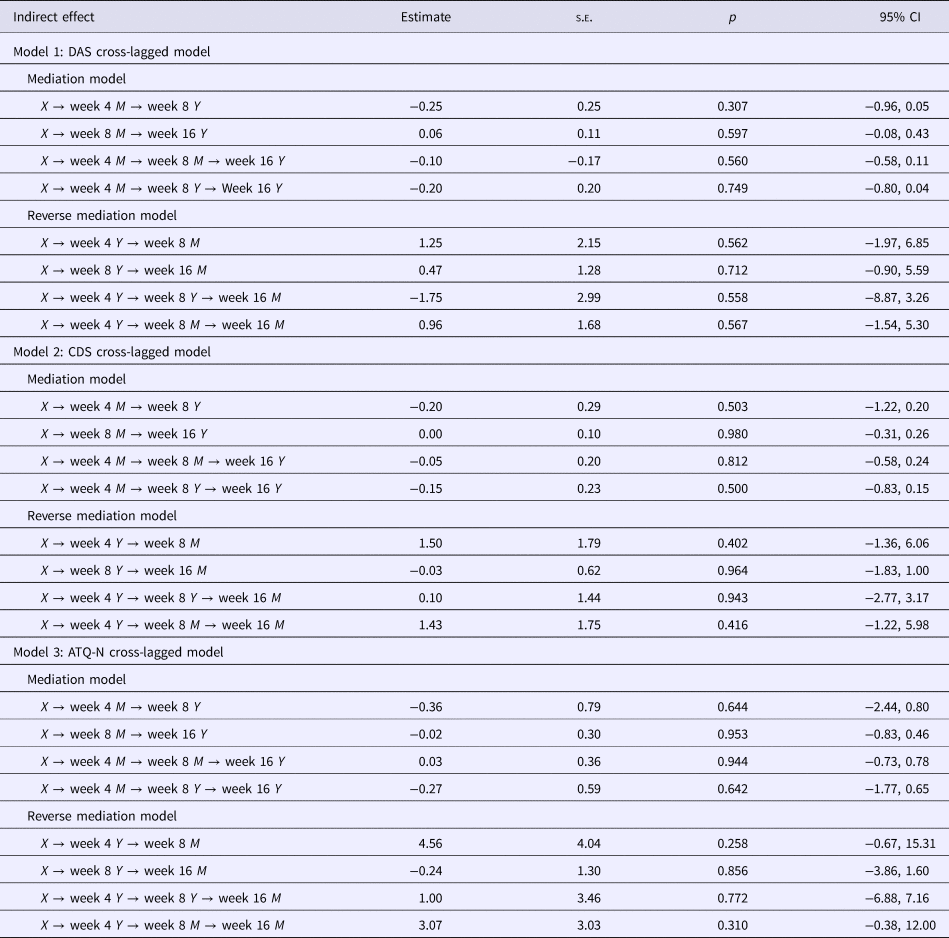
DAS, Dysfunctional Attitudes Scale; CDS, Cognitive Distortions Scale; ATQ-N, Automatic Thoughts Questionnaire – Negative; X, treatment condition; M, the candidate cognitive mediator (DAS, CDS, or ATQ-N); Y, depression symptoms (Hamilton Depression Rating Scale; HAM-D).
Discussion
This study evaluated the cognitive mediation model of CBT for depression in the context of an RCT of CBT v. ADM. SEM was used to evaluate concurrent and longitudinal associations between depression symptoms and three forms of maladaptive cognition relevant to cognitive models of depression aetiology and treatment (Beck et al., Reference Beck, Rush, Shaw and Emery1979), namely dysfunctional attitudes, cognitive distortions and negative automatic thoughts. There were significant concurrent, but not longitudinal, relationships between cognition and depression symptoms. Longitudinal indirect (i.e. mediated) effects were non-significant, such that the cognitive variables did not mediate the effect of treatment on depression symptoms and depression symptoms did not mediate the effect of treatment on cognition.
Effect of treatment condition on cognition and depression symptoms
Participants in both the CBT and ADM conditions demonstrated a significant reduction in depression symptoms and maladaptive cognition over the 16 weeks of treatment. Mixed support was found for the hypothesis that CBT would lead to greater change in the cognitive variables than pharmacotherapy. Change in cognition occurred earlier in the ADM condition than the CBT condition, as indicated by group differences at week 4. By the end of treatment, the pattern shifted and levels of maladaptive cognition were lower in the CBT condition. However, these effects were small, and they were only marginally significant for the CDS model. This pattern of findings parallels that observed for depression symptoms.
ADM thus appears to produce changes in depression-relevant cognition, at a near-comparable level to CBT. Although this finding contradicts the specificity hypothesis, it is consistent with prior studies that have not found differences in cognitive change in CBT v. pharmacotherapy (DeRubeis et al., Reference DeRubeis, Evans, Hollon, Garvey, Grove and Tuason1990; Quilty et al., Reference Quilty, McBride and Bagby2008, Reference Quilty, Dozois, Lobo, Ravindran and Bagby2014; Fournier et al., Reference Fournier, DeRubeis, Hollon, Gallop, Shelton and Amsterdam2013). It is possible that cognitive change occurred in the ADM condition subsequent to reductions in depression symptoms produced via a biochemical mechanism. In support of this notion, robust concurrent relationships between cognitive and symptom change were observed. A potential explanation for the lack of longitudinal relationship observed is that the majority of change in both depression symptoms and cognition occurred in the first 4 weeks of treatment in the ADM condition, and any temporal relations during this period would be unobserved.
Garratt et al. (Reference Garratt, Ingram, Rand and Sawalani2007) argued that although pharmacotherapy may lead to reductions in maladaptive cognition, these reductions may be more superficial and unstable than the cognitive change produced by CBT. They referred to studies by Segal et al. (Reference Segal, Gemar and Williams1999, Reference Segal, Kennedy, Gemar, Hood, Pedersen and Buis2006) that found that dysfunctional attitudes decreased similarly in depressed patients treated with CBT and pharmacotherapy, but patients treated with pharmacotherapy had greater negative cognition in response to induced negative mood than patients treated with CBT. This cognitive reactivity to depressed mood, in turn, was associated with a higher rate of relapse. It would be valuable to replicate this finding in future studies that include a post-treatment mood induction and/or follow-up period.
Association between change in cognition and change in depression symptoms
Evidence for concurrent but not longitudinal associations between cognitive and symptom change is consistent with prior research (e.g. Warmerdam et al., Reference Warmerdam, van Straten, Jongsma, Twisk and Cuijpers2010; Vittengl et al., Reference Vittengl, Clark, Thase and Jarrett2014; Lemmens et al., Reference Lemmens, Galindo-Garre, Arntz, Peeters, Hollon, DeRubeis and Huibers2017). Several explanations for the lack of longitudinal relationships are possible. As argued by others (Burns and Spangler, Reference Burns and Spangler2001; Vittengl et al., Reference Vittengl, Clark, Thase and Jarrett2014), some unknown mechanism may have caused simultaneous change in both cognition and depression symptoms. Depression-relevant constructs such as low self-esteem, hopelessness and cognitive networks or schemas have been proposed as candidates (Burns and Spangler, Reference Burns and Spangler2001), but extant evidence does not support their role as mediators or temporal predictors of symptom change (Quilty et al., Reference Quilty, Dozois, Lobo, Ravindran and Bagby2014; Vittengl et al., Reference Vittengl, Clark, Thase and Jarrett2014; Lemmens et al., Reference Lemmens, Galindo-Garre, Arntz, Peeters, Hollon, DeRubeis and Huibers2017). One might also posit the therapeutic alliance, therapist empathy or homework compliance (‘common factors’, cf. Rosenzweig, Reference Rosenzweig1936) as common causes of cognitive and symptom change. However, although common treatment factors have been shown to predict outcome (Castonguay et al., Reference Castonguay, Goldfried, Wiser, Raue and Hayes1996), these variables have not been found to mediate outcome in CBT (Burns and Spangler, Reference Burns and Spangler2001; Lemmens et al., Reference Lemmens, Galindo-Garre, Arntz, Peeters, Hollon, DeRubeis and Huibers2017), and the mechanisms by which they may relate to outcome are unclear (DeRubeis et al., Reference DeRubeis, Brotman and Gibbons2005a).
It is possible that the timing of measurement precluded detection of cognitive mediation of symptom outcome. If the dynamics of cognitive and symptom change occur on a more rapid scale than the timing of measurement, then mediation will not be observed. Variables were assessed earlier in treatment and at shorter intervals in the present study than previously (e.g. Vittengl et al., Reference Vittengl, Clark, Thase and Jarrett2014; Lemmens et al., Reference Lemmens, Galindo-Garre, Arntz, Peeters, Hollon, DeRubeis and Huibers2017), but even more frequent measurement (e.g. weekly) may be required. Another compelling possibility is that the timing of change in cognition and symptoms, and the temporal relationship between these variables, varies across individuals. For some individuals, treatment-related change in cognition and symptoms may occur quickly and/or be tightly coupled in time, whereas for others changes may occur slowly and/or be further related in time. Measurement approaches that allow for between-subject variability in the temporal dynamics of cognitive and symptom change and mediation of change (i.e. ecological momentary assessment) may therefore be preferable. In RCTs comparing psychotherapies, hypothesized cognitive mediators may also be assessed on a session-by-session basis via independent ratings of session audiotapes.
ADM was selected as a comparison treatment in this study to provide a stringent test of the specificity of cognitive change and mediation to CBT. Given that one component of the test of mediation is the effect of treatment condition on the mediator, it will be more difficult to detect mediation in an RCT if both treatment conditions produce similar effects on the hypothesized mediator. Future studies of cognitive mediation in CBT may include both an appropriate comparison treatment to test specificity, as well as a control condition that is expected to have a weaker effect on cognition than CBT (e.g. supportive therapy) to provide a more powerful overall test of mediation. It should be noted that the similar effects of the treatment conditions on cognition do not account for the lack of longitudinal relationships between cognition and depression symptoms observed in this study, as discussed above.
Study limitations and conclusions
A limitation of this study was the sample size, which, although relatively large for a psychotherapy trial, was modest for mediation analysis. A larger sample would enhance the precision and reliability of the findings, as well as the power of the study to detect small effects (such as the effect of treatment condition on the CDS, which was only marginally significant at week 4 and week 16). Another notable limitation is the lack of a follow-up assessment, which precluded evaluation of the stability of cognitive and symptom change following ADM and CBT. It would be particularly interesting to evaluate whether cognitive change over treatment differentially predicts relapse to depression for participants treated with ADM v. CBT, and/or whether cognitive reactivity to depressed mood differs between the conditions at post-treatment and is predictive of relapse. The candidate cognitive mediators examined in this study were selected because they are central constructs in cognitive theory of depression and targeted in CBT protocols (Beck et al., Reference Beck, Rush, Shaw and Emery1979). The selected measures of these constructs have established psychometric properties and have been used in previous investigations of cognitive mediation, which allowed for comparison with extant findings (e.g. DeRubeis et al., Reference DeRubeis, Evans, Hollon, Garvey, Grove and Tuason1990; Quilty et al., Reference Quilty, McBride and Bagby2008; Vittengl et al., Reference Vittengl, Clark, Thase and Jarrett2014; Lemmens et al., Reference Lemmens, Galindo-Garre, Arntz, Peeters, Hollon, DeRubeis and Huibers2017). Future research may evaluate other cognitive constructs (e.g. rumination, self-esteem, attributions) and/or alternative measures that may have greater utility or specificity as mediators of CBT outcome. It is also possible that the relationship between CBT and change in cognition is itself mediated by treatment variables such as homework completion. Future studies that assess treatment variables, cognition and depression symptoms at multiple time points would be able to test these complex relationships. Finally, the internal consistency of the HAM-D was lower at week 0 compared with later assessment points; however, unreliability was corrected for in the SEMs which improves the accuracy of parameter estimates (e.g. Goldsmith et al., Reference Goldsmith, Chalder, White, Sharpe and Pickles2018).
To conclude, the present study investigated the cognitive mediation model of CBT using a longitudinal mediation analysis. Both CBT and ADM produced significant reductions in maladaptive cognition and depression symptoms. There was robust evidence for concurrent but not the hypothesized longitudinal relationships between cognitive and symptom change. Future research on mediators of psychotherapy outcome may benefit from using measurement approaches that allow for more frequent assessment and between-subject variability in the temporal dynamics of change.
Supplementary material
The supplementary material for this article can be found at https://doi.org/10.1017/S0033291718003653.
Financial support
This research was supported by a New Investigator Fellowship from the Ontario Mental Health Foundation awarded to L.C.Q., and a Postdoctoral Fellowship from the Centre for Addiction and Mental Health awarded to L.Q.
Conflict of interest
None.
Ethical standards
The authors assert that all procedures contributing to this work comply with the ethical standards of the relevant national and institutional committees on human experimentation and with the Helsinki Declaration of 1975, as revised in 2008.