INTRODUCTION
Prosody plays a pivotal role in human communication. Languages such as English incorporate lexical stress as a part of their prosodic system. Lexical stress refers to the contrast between strong and weak syllables within polysyllabic words (e.g. compare a strong–weak pattern such as ‘INcense’ versus a weak–strong pattern like ‘inCENSE’). In English, lexical stress is important for intelligibility (Field, Reference Field2005; Klopfenstein, Reference Klopfenstein2009). There is no way of avoiding it – over 90% of English words contain more than one syllable and thus exhibit lexical stress (Arciuli, Monaghan & Seva, Reference Arciuli, Monaghan and Seva2010). Incorrect production of lexical stress can be related to a number of factors including sensory impairment (inability to hear and thus learn the contrast between strong and weak syllables) and articulatory motor impairment (inability to control vocal and articulatory movements that produce a contrast between strong and weak syllables). Difficulties with stress production impede children's communication in a range of special populations including those affected by apraxia of speech (e.g. Ballard, Robin, McCabe & McDonald, Reference Ballard, Robin, McCabe and McDonald2010), autism (e.g. Arciuli, Reference Arciuli, Arciuli and Brock2014), hearing impairment (e.g. Frank, Bergman & Tobin, Reference Frank, Bergman and Tobin1987), and in those learning English as a second language (e.g. Chakraborty & Goffman, Reference Chakraborty and Goffman2011). Furthermore, impaired production of lexical stress can lead to negative perceptions about the speaker and can undermine social acceptance of the speaker (Paul, Shriberg, McSweeny, Cicchetti, Klin & Volkmar, Reference Paul, Shriberg, McSweeny, Cicchetti, Klin and Volkmar2005; Shriberg & Widder, Reference Shriberg and Widder1990). It is important to investigate the developmental trajectory of the production of lexical stress in order to better understand normal speech development and to guide appropriate goals for speech-impaired children who require intervention.
One way to examine the production of lexical stress is to measure the relative amount of change or contrast across adjacent syllables within single words – hereafter referred to as stress contrastivity. In the current study, we used acoustic analyses to explore the effects of age on stress contrastivity in English in typically developing eight- to eleven-year-old children and healthy adults. Our aim was to build on the earlier study by Ballard, Djaja, Arciuli, James and van Doorn (Reference Ballard, Djaja, Arciuli, James and van Doorn2012), who investigated stress contrastivity in typically developing three- to seven-year-olds and healthy adults. That study showed that, even when word productions are judged by a listener as being correct, there are fine-grained acoustic differences in the amount of stress contrastivity produced by children versus adults for words beginning with a weak syllable. It was reported that children were adult-like in the amount of stress contrastivity they produced for words beginning with a strong syllable. In the current study we wanted to further explore this developmental trajectory by ascertaining whether eight- to eleven-year-olds exhibit adult-like stress contrastivity.
Children's production of lexical stress
Previous studies have examined the production of lexical stress in typically developing children; however, much of it reports on syllable truncation/preservation, and stress shift (where the emphasis has been shifted from the expected syllable to a different syllable), rather than the degree of stress contrastivity per se (e.g. Jarmulowicz, Reference Jarmulowicz2002; Kehoe, Reference Kehoe2001; Roy & Chiat, Reference Roy and Chiat2004). The contrast between strong versus weak syllables emerges in infancy during babbling (Davis, MacNeilage, Matyear & Powell, Reference Davis, MacNeilage, Matyear and Powell2000) and around two to three years of age typically developing children can use duration, intensity, and fundamental frequency (f 0 ) to contrast strong and weak syllables within words and nonwords, even though they do not necessarily exhibit adult-like production of lexical stress (Kehoe, Stoel-Gammon & Buder, Reference Kehoe, Stoel-Gammon and Buder1995; Pollock, Brammer & Hageman, Reference Pollock, Brammer and Hageman1993; Schwartz, Petinou, Goffman, Lazowski & Cartusciello, Reference Schwartz, Petinou, Goffman, Lazowski and Cartusciello1996). Most of what we know about children's production of stress contrastivity comes from studies of English (but see DePaolis, Vihman & Kunnari, Reference DePaolis, Vihman and Kunnari2008, for a study of lexical stress in English, Finnish, French, and Welsh at 10–18 months of age, and Arciuli & Colombo, Reference Arciuli and Colombo2016, for a study of lexical stress in Italian at three to five years of age).
When examining children's production of lexical stress, researchers have often relied on judgements by listeners in order to determine whether productions are correct or not. However, it is very difficult to obtain precise measurements of the amount of stress contrastivity produced across adjacent syllables via listening. For this, quantitative acoustic measurements of duration, intensity, and f 0 are required. A previous acoustic study by Shriberg, Campbell, Karlsson, Brown, McSweeny, and Nadler (Reference Shriberg, Campbell, Karlsson, Brown, McSweeny and Nadler2003) reported an acoustic measure called the lexical stress ratio that was used to examine contrastivity. The lexical stress ratio provides a single weighted composite score that takes into account the duration, intensity, and f 0 of vowels in adjacent syllables derived from a principal components analysis. The target words used in its formulation were bisyllabic words beginning with a strong syllable. The children in that study had a speech delay or were suspected of having apraxia of speech. Word productions were elicited during an imitation task.
An alternative acoustic measure of stress contrastivity is the Pairwise Variability Index (PVI: Low, Grabe & Nolan, Reference Low, Grabe and Nolan2000). The PVI is one of the so called ‘rhythm metrics’ that has been used to examine variability in vowel duration across successive syllables of read sentences in order to understand the rhythmic patterning of different languages (e.g. Grabe & Low, Reference Grabe, Low, Warner and Gussenhoven2002). The PVI is useful beyond this original purpose. In addition to the analysis of vowel duration, it can be applied to analysis of the intensity and f 0 of vowels across adjacent syllables. One reason to use the PVI to measure stress contrastivity, rather than the lexical stress ratio, is that the PVI provides separate scores for each of the key suprasegmental variables.
The literature contains references to both the raw PVI and the normalized PVI (different equations are used to derive these values; Nolan & Asu, Reference Nolan and Asu2009). The raw PVI simply considers relative duration, intensity, or f 0 across adjacent vowels or syllables. The advantage of using the normalized PVI is that it ‘neutralizes’ individual differences in speech production, which may relate to speech rate, f 0 differences with gender and age, and so on. In deriving the normalized PVI, the pairwise difference between adjacent syllables is divided by the average value of the pair – making it more appropriate for use across different speakers than the raw PVI and far more useful than raw data for individual syllables. This is because speakers can vary in terms of speech rate (which is reflected in duration), how loudly they speak (which is reflected in intensity), and in terms of the pitch of their voice (which is reflected in f 0 ). These kinds of individual differences can affect both the raw PVI and raw data from individual syllables; however, the normalized PVI neutralizes these individual differences. A positive normalized PVI indicates greater emphasis on the first syllable in a pair (consistent with a strong–weak pattern of lexical stress), while a negative normalized PVI indicates greater emphasis on the second syllable (consistent with a weak–strong pattern). The absolute value of the normalized PVI indicates the amount of stress contrastivity. The larger the absolute value of the normalized PVI, be it positive or negative, the greater the level of stress contrastivity.
Our recent acoustic study used the normalized PVI to measure stress contrastivity, in terms of vowel duration, intensity, and f 0 in children's word productions during a picture-naming task (Ballard et al., Reference Ballard, Djaja, Arciuli, James and van Doorn2012). That study included 73 children aged three to seven years years and 24 adults. The target words had either a strong–weak pattern across the initial two syllables (hereafter SW) or a weak–strong pattern across the initial two syllables (hereafter WS). The SW words were caterpillar and butterfly and the WS words were potato and tomato. Productions that were judged by an adult listener as being correct were subjected to acoustic analysis using the normalized PVI in order to reveal whether the magnitude of stress contrastivity differed in children versus adults.
As expected, the results revealed that duration and intensity consistently marked lexical stress in terms of the direction of the mean normalized PVIs. That is, mean normalized PVIs for duration and intensity in every age group were positive for SW words (indicating greater emphasis on the first syllable) and negative for WS words (indicating greater emphasis on the second syllable). By contrast, mean normalized PVIs for f 0 oscillated between positive and negative values for both SW and WS words across the various age groups without a clear pattern (i.e. for SW words the seven-year-olds had a negative mean PVI for f 0 while the three-, four-, five-, and six-year-olds, as well as the adults, had a positive mean PVI; for WS words the four- and five-year-olds had a negative mean PVI for f 0 but every other child group, as well as the adults, had a positive mean PVI). These results were expected. That is, while seminal studies had identified f 0 as a robust marker of lexical stress (Lieberman, Reference Lieberman1960), subsequent studies have challenged this view (e.g. Kochanski, Grabe, Coleman & Rosner, Reference Kochanski, Grabe, Coleman and Rosner2005). They also noted that elicitation context likely plays a role when examining contrastivity in terms of f 0 . Thus, reliable effects concerning f 0 may be more likely to arise in elicitation contexts that are tightly controlled for pitch contour, such as a carrier sentence with target words placed in a constant location. By contrast, reliable effects concerning duration and intensity are expected in the production of single words.
The key finding from the Ballard et al. (Reference Ballard, Djaja, Arciuli, James and van Doorn2012) study was that adult-like amounts of contrastivity in the production of words beginning with a SW pattern appear to be achieved in early childhood; however, adult-like mastery of contrastivity in the production of words beginning with a WS pattern continues beyond seven years. Specifically, each normalized PVI served as a dependent variable and ANOVAs were conducted with age as a non-repeated factor with 6 levels: three-, four-, five-, six-, seven-year-old children, and adults. For the PVIs for SW words the ANOVAs revealed no statistically significant main effects of age. For WS words the ANOVAs showed statistically significant main effects of age in terms of the PVI for f 0 and the PVI for intensity. Planned comparisons revealed that children, as a group, exhibited a smaller amount of contrast across adjacent syllables than adults in terms of f 0 and a larger amount of contrast in terms of intensity. For WS words there was a marginally significant main effect of age in terms of the normalized PVI for vowel duration.
We hypothesized that the different trajectories observed for SW and WS words may reflect factors relating to familiarity with certain stress patterns in English and/or maturational constraints of the speech motor system. In English, SW is the dominant pattern of lexical stress for all words and the dominant pattern for the grammatical class of nouns (Arciuli & Cupples, Reference Arciuli and Cupples2004, Reference Arciuli and Cupples2006). Thus, English-speaking children have less exposure to words beginning with a WS pattern and are less practised when it comes to producing this pattern. In addition, there may be increased physiological demands associated with producing words beginning with a WS pattern. For example, controlling production of brief vowels in word-initial weak syllables may be physiologically more challenging (e.g. Allen & Hawkins, Reference Allen, Hawkins, Yeni-Komshian, Kavanagh and Ferguson1980, but see Vihman, DePaolis & Davis, Reference Vihman, DePaolis and Davis1998). See also DePaolis et al. (Reference DePaolis, Vihman and Kunnari2008), who provide thorough discussion of maturational constraints on children's speech production.
Previous research has indicated that speech motor development continues into late childhood and perhaps even into early adolescence (Lee, Potamianos & Narayanan, Reference Lee, Potamianos and Narayanan1999; Singh & Singh, Reference Singh and Singh2008; Smith, Reference Smith2006). However, the majority of these previous studies focused on segmental rather than suprasegmental aspects of speech production.
The current study
There remain some gaps in our understanding of the developmental trajectory of children's production of lexical stress. Here, we followed the methodology used by Ballard et al. (Reference Ballard, Djaja, Arciuli, James and van Doorn2012) in our study of stress contrastivity in children aged three to seven years. We sought to address the following question: Is it possible that even when eight- to eleven-year-old children's word productions are judged by an adult listener as being correct there might be fine-grained acoustic differences in the amount of stress contrastivity they produce when compared with adults? We utilized normalized PVIs to examine stress contrastivity in terms of vowel duration, intensity, and f 0 across adjacent vowels within the initial two syllables of polysyllabic words in child versus adult productions.
We had two hypotheses. First, in line with previous research, we hypothesized that duration and intensity would mark lexical stress in isolated word productions. That is, we expected that mean normalized PVIs for duration and intensity in every age group would be positive for SW words (indicating greater emphasis on the first syllable) and negative for WS words (indicating greater emphasis on the second syllable). As observed in previous research, we hypothesized that mean normalized PVIs for f 0 would be less reliable in marking the direction of stress contrast in this picture-naming task. Note that hypotheses relating to whether normalized PVIs are positive or negative (i.e. which syllable exhibits greater emphasis) are a different matter from hypotheses relating to the absolute value of the normalized PVIs (measuring the amount of stress contrastivity).
Second, as seen in our recent study of younger children aged three to seven, we expected that the absolute value of our normalized PVIs would reveal that eight- to eleven-year-olds exhibit adult-like amounts of contrastivity in their production of SW words. We hypothesised that by eight to eleven years of age children would demonstrate the same amount of contrastivity for WS words as adults; however, we were open to the possibility that this aspect of speech production might not yet be adult-like.
METHOD
Stimuli, elicitation task, acoustic measurements, and data analysis methods were identical to Ballard et al. (Reference Ballard, Djaja, Arciuli, James and van Doorn2012).
Participants
Seventy-seven Australian English speaking children participated. All were typically developing by teacher report and living in the Sydney metropolitan area (recruited via participating schools and after-school-care programmes). There were 4 age groupings: eight years of age (N = 24; note one child was almost eight at 7·92 years of age), nine years of age (N = 18), ten years of age (N = 20), and eleven years of age (N = 15; note two children were aged 12·33 and 12·67). The seven- and twelve-year-olds were tested because they were in the same school grades as their peers who were being tested. Details regarding the sex and mean ages of children is provided in Table 1.
Number of females and males, and corresponding mean age in years (SD in parentheses), for each of the four age categories of children

Adult data had been collected previously by Ballard et al. (Reference Ballard, Djaja, Arciuli, James and van Doorn2012) – 24 adults from the student population at the University of Sydney aged twenty to thirty years. All procedures were approved by the Human Research Ethics Committee at the University of Sydney and written informed consent was obtained from adults and from parents of child participants.
Stimuli
Word productions were elicited using objects in the context of a picture-naming task. The two SW words (butterfly, caterpillar) and two WS words (tomato, potato) were originally selected based on similarity of phonological structure over the first two syllables (i.e. CVCV), ease of identifying vowel offsets and onsets for reliable acoustic measurement of syllable and vowel durations, pictureability, and familiarity to children as young as three years of age. Due to being restricted to an existing database of child speech recordings in the study by Ballard et al. (Reference Ballard, Djaja, Arciuli, James and van Doorn2012), the SW words had lax vowels in the strong syllable and WS words had tense vowels in the strong syllable. This precludes comparison of stress contrastivity between SW and WS words and so, as in Ballard et al., we focused our analyses on the effect of age in the current study and analyzed SW words separately from WS words.
Children were shown a cartoon or photograph of each item and were asked to name it. They performed this picture-naming task twice. Four lists of random orderings of the target stimuli were used in order to counteract order effects. Children wore a headset microphone at 10 cm mouth–microphone distance and speech was recorded to a hand-held digital speech recorder (44 kHz sampling rate, 16 bit).
Acoustic measurements
An independent adult (not one of the authors) listened to each of the word productions and judged whether it was correct in terms of segmental and suprasegmental information (i.e. whether it had the correct phonemes and correct stress pattern). Acoustic analysis of correct productions was then undertaken using PRAAT software (Version 5.2.0.1; Boersma & Weenink, Reference Boersma and Weenink2010). Waveforms and wide-band spectrograms with a 300 Hz bandwidth were generated for each sound file. Three acoustic measurements were made for the first two syllables of each of the target words: (1) vowel duration (ms) was measured from onset to offset for the first and second vowels, as well as (2) peak vocal intensity (dB) and (3) peak f 0 (Hz). These measurements were then used in the calculations for normalized PVI values for duration, intensity, and f 0 for each target word. The normalized PVI for each acoustic measure represents the difference between the first two vowels of each stimulus divided by their average (i.e. normalizing for individual speech rate, vocal intensity, or f 0 , respectively): normalized PVI_a = 100 × {(a1 − a2)/[(a1 + a2)/2]} where a1 and a2 are measures of duration, peak intensity, or peak f0 of the first and second vowels, respectively.
Data analysis
Normalized PVI values were averaged across the two productions of the same word, and across the two words within each stress condition, to create six grand PVI values for each child: PVI_duration_SW, PVI_intensity_SW, and PVI_ f 0 _SW (words: butterfly, caterpillar) and PVI_duration_WS, PVI_intensity_WS, and PVI_ f 0 _WS (words: tomato, potato).
All statistical tests were conduced using SPSS. In analyzing the child data, each of these PVI variables was treated as a dependent variable in an ANOVA where the age of the children was a non-repeated measure with 4 levels (eight years, nine years, ten years, eleven years). Planned contrasts using Helmert and reverse-Helmert contrasts (which compare the mean for each age level to the mean for pooled data from all subsequent or prior levels, respectively) were conducted if a significant main effect of age was observed. We also conducted linear regression analyses using age in years (to two decimal places) as a continuous variable in order to ascertain whether age was a significant predictor for any of our six PVI outcome variables.
In analyzing our child data alongside the adult data collected by Ballard et al. (Reference Ballard, Djaja, Arciuli, James and van Doorn2012) we conducted additional ANOVAs where age was a non-repeated measure with 5 levels (eight years, nine years, ten years, eleven years, adults). Again, planned contrasts using Helmert and reverse-Helmert contrasts were conducted if a significant main effect of age was observed. We did not collect age in terms of months and years for adults and so did not conduct regression analyses with age as a continuous variable.
RESULTS
Children's word productions had to be correct on both trials (recall that children were asked to name each picture twice) in order to be included in the subsequent acoustic analyses. Of the possible 308 pairs of word productions, 20 (6·5%) were excluded from acoustic analysis due to errors in children's productions. This left 288 pairs of productions for acoustic analysis – 576 individual word productions in total. The fact that the vast majority of productions were judged to be correct is not surprising, because the target words were highly familiar.
A very small proportion of individual vowel measurements were not obtained. Most of these empty cells resulted from inability to calculate f 0 due to poor vocal quality (e.g. glottal fry). Inter-rater reliability was completed for vowel measurements on 5% of the data and was found to be acceptable (duration: r = ·94, mean difference = 2·3 ms, SD = 21·9; intensity: r = ·97, mean difference = ·2 dBSPL, SD = 2·0; f 0 : r = ·82, mean difference = 2·5 Hz, SD = 9·9). Intra-rater reliability was similar with all correlation values greater than ·90.
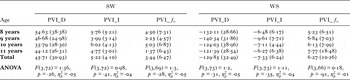
Table 2 displays the mean normalized PVI values for the SW and WS stimuli for each of our four age groups. The first point to note is that the PVIs for both duration and intensity for the SW words were positive (indicating greater emphasis on the first syllable), while the corresponding PVIs for the WS words were negative (indicating greater emphasis on the second syllable). The PVIs for f 0 for both SW and WS words were positive.
Mean normalized Pairwise Variability Index (PVI) for SW words and WS words (SD in parentheses) for each of the four age categories of children. Results of ANOVAs exploring age differences for each PVI as a dependent variable are also displayed.

notes: SW = strong–weak pattern (butterfly, caterpillar), WS = weak–strong (potato, tomato); D = duration; I = intensity; f 0 = fundamental frequency.
To explore effects of age in the child data we conducted a series of ANOVAs as well as a series of linear regression analyses. The ANOVAs revealed that there was no statistically significant main effect of age for any of the PVI dependent variables (see ANOVA results at bottom of Table 2). Similarly, regression analyses showed that age was not a significant predictor for any of the PVI outcome variables.
The normalized PVIs for the adult data reported by Ballard et al. (Reference Ballard, Djaja, Arciuli, James and van Doorn2012) are shown in Table 3. When we included this adult data as a fifth level in the ANOVAs, we found a single statistically significant main effect of age. This result concerned PVI_intensity for WS words (F(4,96) = 3·40, p = ·01,
 $\eta _p ^2 $
= ·12). Planned contrasts revealed that the only statistically significant difference was between adults and the entire group of children (p = ·002; 95% CI for difference: 1·76 and 7·24). With a mean of –2·9 dBSPL and SD of 5·1 the adult PVI for intensity of WS words indicated a smaller amount of contrastivity than that exhibited by children aged eight to eleven years, who had an overall mean of –7·3 dBSPL and SD of 6·2.
Mean normalized Pairwise Variability Index (PVI) for SW words and WS words (SD in parentheses) for adults (data from Ballard et al., Reference Ballard, Djaja, Arciuli, James and van Doorn2012)

notes: SW = strong–weak pattern (butterfly, caterpillar), WS = weak–strong (potato, tomato); D = duration; I = intensity; f 0 = fundamental frequency. Ballard et al. reported values to one decimal place.
DISCUSSION
Here we extended our recent acoustic study of stress contrastivity in the word productions of typically developing three- to seven-year-old children and healthy adults reported by Ballard et al. (Reference Ballard, Djaja, Arciuli, James and van Doorn2012). We had two hypotheses. First, in line with previous research, we hypothesized that duration and intensity would consistently mark lexical stress in word productions. Readers are reminded that it is the positivity or negativity of the normalized PVI, rather than the absolute value of the PVI, that is informative in this regard. Our results provided support for this hypothesis. That is, the mean normalized PVIs for duration and intensity in every age group were positive for SW words (indicating greater emphasis on the first syllable) and negative for WS words (indicating greater emphasis on the second syllable).
Second, as in our previous study of younger children, we hypothesized that eight- to eleven-year-olds would exhibit adult-like amounts of contrastivity for SW words. While we hypothesized that the amount of contrastivity produced for WS words might be adult-like in these older children, unlike the younger children reported by Ballard et al. (Reference Ballard, Djaja, Arciuli, James and van Doorn2012), we were open to the possibility that productions may not yet be entirely adult-like. Ballard et al. reported that, for words beginning with a WS pattern, children exhibited a smaller amount of contrast than adults in terms of f 0 and a larger amount of contrast in terms of intensity (both of which were statistically significant effects), with a marginally significant main effect of age for vowel duration. In the current study we were especially interested in finding out whether eight- to eleven-year-old children show adult-like amounts of stress contrastivity when producing words beginning with a WS pattern.
We compared the child data collected in the current study with the original adult data collected for the previous study by Ballard et al. (Reference Ballard, Djaja, Arciuli, James and van Doorn2012). Our hypothesis regarding SW words was confirmed. Our ANOVAs revealed no statistically significant main effect of age for any of the normalized PVIs. Thus, eight- to eleven-year-olds were adult-like in their production of SW words. Our ANOVAs for WS words showed that there was no statistically significant main effect of age concerning the normalized PVIs for vowel duration and f 0 . That is, eight- to eleven-year-old children exhibited adult-like amounts of contrastivity in terms of vowel duration and f 0 . However, there was a statistically significant main effect of age in terms of the normalized PVI for intensity with planned contrasts revealing that children, as a single group, exhibited a greater amount of contrastivity across adjacent syllables than adults. Thus, our results show that while older children aged eight to eleven are closer to adult-like stress contrastivity than the three- to seven-year-olds reported by Ballard et al. (in that we found no statistically significant main effect of age in terms of the PVIs for duration and f 0 in the current study), these older children still lack an adult-like amount of stress contrastivity in terms of intensity.
It is not clear why children exhibit greater stress contrastivity in terms of intensity for WS productions at eight to eleven years of age, by comparison with adults. It is possible that adults have shifted to marking lexical stress primarily via contrastivity in vowel duration across adjacent syllables, with less emphasis on contrastivity in intensity. Children, however, may still be learning the relative importance of contrast in terms of duration versus intensity. The fact that this finding is related to WS words only is intriguing. As mentioned earlier, WS may present challenges for children because the pattern is less common in English than the SW pattern.
Future directions
An obvious direction for future research is to examine stress contrastivity in children who are older than those reported in the current study. It is important to ascertain the age at which children's production of stress contrastivity becomes adult-like, as this will guide understanding of normal development as well as developing appropriate goals for speech-impaired children requiring intervention. It would also be valuable to move beyond the small set of stimuli used in the study by Ballard et al. (Reference Ballard, Djaja, Arciuli, James and van Doorn2012) and in the current study. The main impediment to this kind of large-scale study is the lack of automated methods of acoustic analyses. In the current study we obtained six acoustic measurements for each of 576 word productions – a total of 3456 datapoints that were obtained manually – in order to calculate normalized PVIs for our child participants. This total does include the datapoints for adult participants from Ballard et al.
It has been noted that elicitation context may play a role in relation to how f 0 is used to mark lexical stress (e.g. via the shape of the pitch contour that is associated with different speaking contexts). There has been some research on how children integrate lexical stress and other types of prosody in phrasal utterances (e.g. Goffman, Heisler & Chakraborty, Reference Goffman, Heisler and Chakraborty2006; Shport & Redford, Reference Shport and Redford2014). Additional research that manipulates elicitation context and utilizes acoustic measurements of stress contrastivity such as the normalized PVI would be valuable. Also, future research should investigate the relationship between perception and production of speech throughout childhood, given protracted developmental trajectories in both domains (e.g. Hazan & Barrett, Reference Hazan and Barrett2000; Nittrouer, Reference Nittrouer1996). In particular, investigating the link between perception and production of acoustic cues to lexical stress as children develop, and how the relative weighting of these cues may change over time, is a worthy endeavour.
The findings reported here, along with those reported by Ballard et al. (Reference Ballard, Djaja, Arciuli, James and van Doorn2012), present challenges for models of speech production. The planning and production of speech output that incorporates variations in duration, amplitude, and f 0 that are related to lexical stress is a highly complex process. The Directions Into Velocities of Articulators (DIVA) model of motor speech production has been successful in the modelling of individual speech sounds, coarticulatory effects in varying phonetic contexts, and the effects of speech rate on production (Bohland & Guenther, Reference Bohland and Guenther2006; Guenther, Reference Guenther1995; Guenther & Vladusich, Reference Guenther and Vladusich2012). However, little is known about how models of speech production, such as DIVA, could be modified to accommodate a protracted developmental trajectory for stress contrastivity.
CONCLUSION
We have made great strides in understanding the production of individual sounds, but our understanding of the production of prosody is much less comprehensive. Here we have focused on one aspect of prosody – lexical stress. The key finding of the current study is that while eight- to eleven-year-old children are adult-like in some aspects of the production of stress contrastivity, when it comes to words beginning with a weak syllable, they use a significantly greater amount of contrastivity than adults do in terms of relative change in vowel intensity across adjacent syllables.