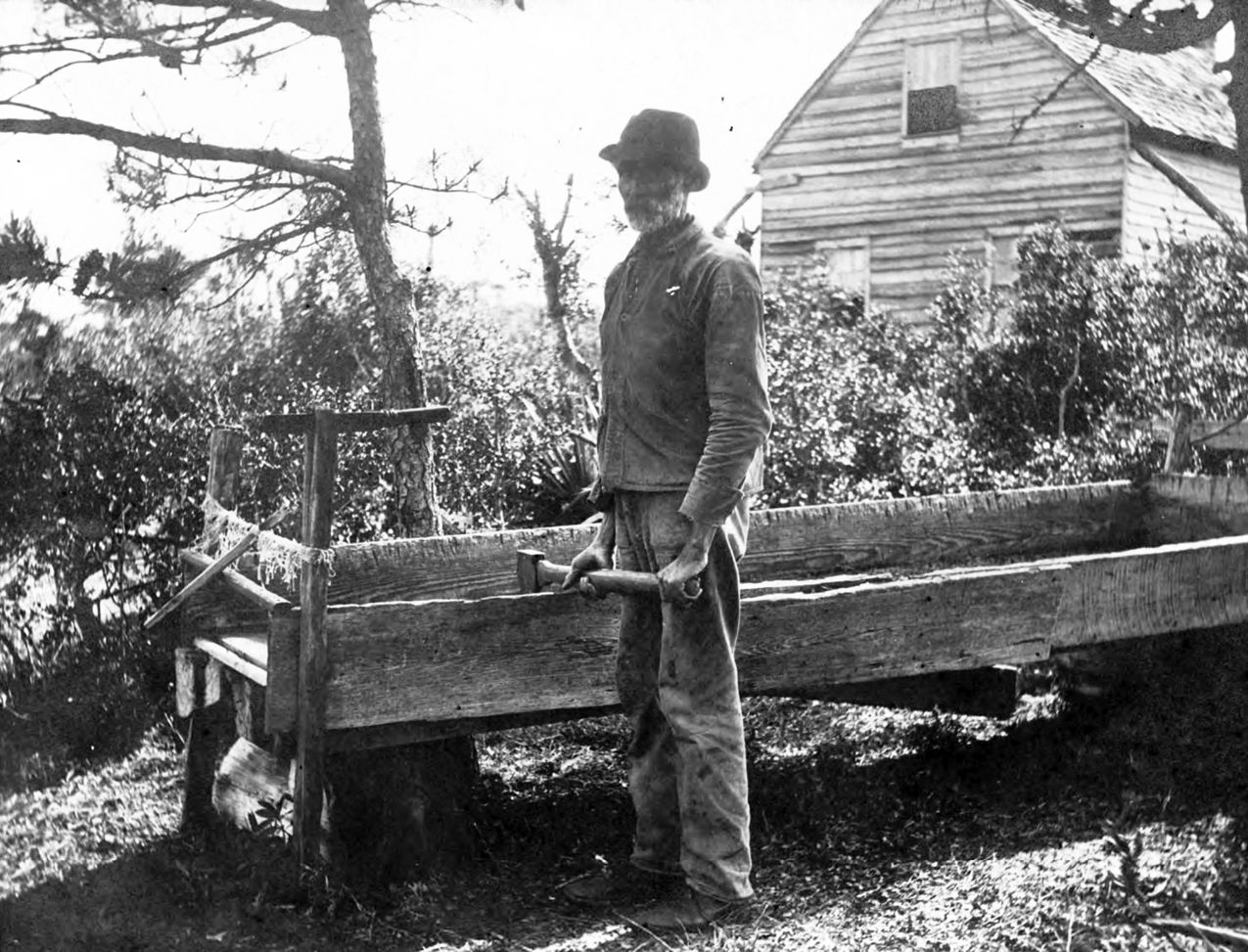
In spite of his advanced years, “Old Man” Scarborough was still able to work the wooden machinery to chop, crush, roast, and cure the leaves of the yaupon holly when North Carolina naturalist H. H. Brimley interviewed him in 1905.Footnote 1 Scarborough, Brimley explained, was the Black owner of the only remaining “yaupon factory,” located on the remote Outer Banks island of Hatteras, North Carolina (see figure 1). The last practitioner of what had once been a thriving industry all along the North Carolina coast, Scarborough extolled the properties of yaupon tea to his visitor, who enjoyed a cup later that evening instead of coffee or black tea. Half a century earlier, during the U.S. Civil War (1861–1865), Walter Lenoir wrote to his mother of the workaround for wartime scarcity that he and his company had found at Camp Lee, South Carolina: “We have been out of coffee for some time, but are doing very well without it, & have all become so fond of Yeopon tea that we will continue to use it.”Footnote 2 These happy experiences with the yaupon holly were just two of many encounters with the sole caffeinated beverage native to North America: yaupon, sometimes called “cassina.” Not only was it well known in the North American South; yaupon was once so popular in Europe that throughout the eighteenth century it was traded in Paris and London, and it was common enough that French visitors to Mississippi recognized the drink as something they had already consumed. This presents a puzzle: why did yaupon never become the caffeinated drink of choice in the United States?
Scarborough stands next to yaupon processing equipment, Hatteras, North Carolina, 1905. Photo by H. H. Brimley. Brimley Photograph Collection, North Carolina Digital Collections.

North American readers today who turn to plant products originally from Asia or east Africa for their daily liquid effervescence may be surprised to learn that this holly shrub, now used in the Southeast mostly as yard décor, has for over at least a millennium been used to make a stimulant tea. The earliest European writing on yaupon comes from Spanish explorer Álvar Núñez Cabeza de Vaca, who shipwrecked on the populous coast of Texas in 1528. His ethnographic account of the Indigenous communities included descriptions of cookery techniques, smoking, and a notable drinking ceremony: “They drink there another thing that they make from the leaves of trees like that of the holly oak…. And that which they have drunk, they throw up, which they do very easily and without any shame.”Footnote 3 Chronicles of southeastern Indigenous communities, including the Creek and Cherokee, regularly describe the “Black Drink” ceremony that he observed. The contexts for the beverage continue to today, though many of these ceremonies have been closed to non-Native publics and participants. Efforts at commercializing yaupon date to at least the late seventeenth century and reveal a series of fits and starts, failures and reboots, that have coincided with scientific and medical interventions to identify and describe the plant's pharmacology. Since Cabeza de Vaca's brush with the beverage, yaupon has iterated between ceremony, medicine, and caffeinated tea, as inhabitants of North America—Indigenous, settler colonial, and Black—have wielded the leaf's properties for different, culturally situated purposes.
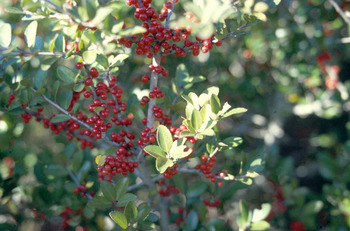
Ilex vomitoria. U.S. National Herbarium, Department of Botany, National Museum of Natural History, Smithsonian Institution, by permission from G. A. Cooper.

European expansion into the Western Hemisphere famously began as a pursuit of exotic consumables, many with desirable psychoactive properties. John Locke, a physician as well as a philosopher, writing in 1671 on behalf of the Lords Proprietors who oversaw the colonial settlement of Carolina, requested that “Samples of Casini” be brought back to England as a potential commodity in the colonies.Footnote 4 Today, a number of small companies in Florida, Georgia, and Texas have arisen to market organic, ethically harvested yaupon to a new generation of drinkers, signaling a “rediscovery” of the tea. In 2018 they formed the American Yaupon Association (tagline: “Discover Yaupon: the American Native Superfood”).Footnote 5 And yet, though yaupon has much in common with more successful caffeinated drinks, it has never become a global commodity, and we must ask why. Data regarding its cultivation, pricing, and early trade suggest that, economically, it fared well enough regarding the production end of the commodity chain. The barriers have been on the other end, in the realm of consumption. I will argue that to explain yaupon's poor showing, we cannot understand it merely as a commodifiable beverage: its ceremonial and medicinal identities are forces to be reckoned with, the knowledge structures that people have built up around it matter, and the identities of its consumers and producers have powerfully inflected whether, and how, people have adopted it.
The story of how the drink has moved between ceremony, medicine, and a caffeinated tea reveals contests between regimes of knowledge, the political economy of colonialisms, and the complex intersections of identity and food. Elsewhere I have argued that cuisine, as cultural production, can reveal social status and priorities glossed as race.Footnote 6 Here I will reverse the lens and interpolate North American settler and imperial history through how yaupon was treated in text. I will trace narratives, recipes, and medical descriptions of yaupon from contact to the present, along with material and archeological records, to examine the differences between settler and extractive colonial encounters with indigenous psychoactive substances, and thus indigeneity. That is, I explore how the French and British postures toward yaupon in writings for primarily European publics via European imprints differed from one another and from how white, Euro-descended settlers wrote about it in the United States. But I also read the complex of sources to discern how non-settler colonial groups—the original Indigenous inhabitants of North America and Black communities, free and enslaved—wielded the powerful drink.
Caffeinated beverages and other non-European food substances influenced a shift in European medicine because they did not fit into the humoral medicine schematics proposed by Galen.Footnote 7 By the mid-nineteenth century, most of the major stimulant drinks were scientifically well-studied and very popular in the North Atlantic world, but interesting differences emerged because some of the plants were first scientifically described in Europe, and others in the New World. A key area of research on the history of medicine traces how plant knowledges have moved from the colonial periphery to the North Atlantic core.Footnote 8 Other important and contestatory work in this realm has focused on not just knowledge, but ignorance. Londa Schiebinger writes of the “nontransfer of important bodies of knowledge from the New World into Europe” as she traces why awareness of the abortifacient uses of West Indian plants did not make it to Europe even as the plants themselves did, which she explores as “agnotology”—“the study of culturally induced ignorances.”Footnote 9 With yaupon, there are at least two “ignorances” to be managed. The first is the ignorance of the pharmacological effect of the plant in its very environs, as communities that in the past would have known of its stimulant use have, over just a few generations, lost that knowledge, even though the buzz from caffeine is licit and highly desirable. The second is the insistent transmission of erroneous knowledge as science professionals have reiterated the inaccurate report that yaupon causes vomiting.
To see how yaupon was configured as ceremony-medicine-caffeinated tea, I first turn to Indigenous uses of yaupon and early European encounters with it, as well as the basic aspects of the plant, placing the drink in the context of Ilex (holly) use in the Americas. I then describe how yaupon fits among other caffeinated beverages that were entering the orbit of the North Atlantic world at the same time, as their desirable psychoactive properties became a means by which Western medicine itself was developed, via a struggle over acceptable knowledge practices. I will conclude by describing yaupon consumption and production among non-Indigenous communities as well as multiple attempts to commercialize the drink. By asking how yaupon has been positioned via the marginalization of its producers and consumers, I argue that indigeneity, anti-Blackness, and anti-Southern cosmopolitanism have all played central roles in how yaupon has been understood, and help explain why a popular caffeinated product waned even at a time when stimulants increased in use and when “proletarian hunger-killers” were on the rise.Footnote 10 The yaupon commodity chain serves as a foil for the rise of both the capitalist world system of commodities and hegemonic systems of Western science and biomedicine. The failures and errors associated with Ilex vomitoria expose ways in which these systems are leaky, unable to neatly contain even those objects in their grasp.Footnote 11 The question of why yaupon never became the caffeinated brew of choice in North America may never be definitively answered, but pursuing it elucidates how plants and human communities form one another.
ILEX IN THE AMERICAS
Of the more than four hundred species of hollies distributed across the world, three found in the Americas are known to possess caffeine and they have been used continually from before European contact to the present: yerba mate (Ilex paraguariensis) and guayusa (Ilex guayusa) in South America, and yaupon (Ilex vomitoria) in North America.Footnote 12 The name “yaupon” comes from a Catawba word for “small tree”; and “cassina” from the Timucuan caçina (assi in Creek/Muskogee is “leaf”); both carry meanings similar to the original Guaraní name for yerba mate, “ca'a miri” (“small leaf”). A large evergreen shrub capable of growing into a small tree, yaupon is naturally found in the sandy soils along the North American coast from Virginia Beach to Texas. Unlike yerba mate, yaupon cultivates easily, as attested by its current distribution in the hilly inlands of the Carolinas, Georgia, and Texas. The eighteenth-century writer James Adair noted that “the Indians transplant [it] and are extremely fond of it.”Footnote 13 A discontiguous population exists in Chiapas in Mexico, where the tree is known as either tza'los te' or sakil winik te' in Tzeltal (a Mayan language), perhaps indicating wider precolonial consumption of the plant.Footnote 14
Not only is the physical distribution of the plant a noteworthy indication of human intentionality, but there are remarkable similarities in how yerba mate, guayusa, and yaupon are prepared and used by Indigenous communities across great geographical distances. All three caffeinated hollies are first dried before being boiled or steeped. The leaves and the tender shoots are used for yerba mate and yaupon, while only the leaves are prepared for guayusa tea. Yaupon has a pleasantly floral, honeyed flavor with strong leafy overtones that mellow as it is roasted. Cabeza de Vaca's account of yaupon includes the detail that his Native hosts toasted the leaves over a fire, a method still in use today for both yaupon and yerba mate and a means of preserving the leaves. Compared to black tea or coffee, the Ilex drinks have slightly less caffeine per gram, but this can be adjusted by the proportion of water to product used and the method of extraction. Tea, for example, has more caffeine per gram than does coffee, but the average cup of coffee contains more caffeine than tea due to the different extraction methods, because proportionally less water is used to brew it, and because coffee is typically more finely ground. Yaupon also possesses theobromine (an alkaloid that draws its name from chocolate and is also found in yerba mate and guayusa) and theophylline (which is found in both tea and the Ilex drinks).Footnote 15 These and other properties make yaupon desirable.
Archaeologists have recently measured the residual presence of all three alkaloids in drinking vessels and have determined that yaupon, and possibly Black Drink ceremonialism, were present in the pre-Columbian city of Cahokia (ca. 1040–1350) located in what is now southwest Illinois. This is hundreds of miles outside of yaupon's growing range, indicating a lively trade in the leaf.Footnote 16 The historical record corroborates this: John Brickell, an Irish physician who composed a Natural History of North Carolina (1737), wrote that Indigenous inhabitants of the coast of North Carolina “frequently carry it [yaupon] to the Westward Indians, who give Deer Skins, and other Necessaries they want for.”Footnote 17 In 1763, British botanist Mark Catesby also wrote of trade in yaupon throughout the southeast, and included an important comparison to yerba mate: “The Indians on the sea-coast supply those of the mountains therewith and carry on a considerable trade with it in Florida; just as the Spaniards do with their South-Sea tea from Paraguay to Buenos Aires.”Footnote 18 Yerba mate has been a leading agricultural commodity in South America since the early seventeenth century,Footnote 19 and yaupon regularly attracted comparison to its southern counterpart, especially in terms of its commercial potential. Jessica Cattelino has argued that money, or the lack thereof, was a crucial intellectual justification for dispossession of North American Native groups.Footnote 20 Although the understanding of Natives as having no real economy was a vital stereotype, there is repeated mention of yaupon trade, evincing a kind of economic value that European settlers would have recognized, leading them to consider yaupon's potential as an export commodity for Europe's newly developing caffeine fix.
The Black Drink ceremony (so named in English because of the color of the liquid) immediately caught the attention of explorers, missionaries, and military alike, who described the cultural context for yaupon drinking.Footnote 21 Black Drink was taken during council meetings and before important events, and notably during the annual Green Corn harvest celebration—the busk—which featured prominently in American literature, including Thoreau's Walden. Women first heated water in which to boil the leaves. By pouring the drink from one container to another, preparers frothed the liquid, from which comes its other name, “White Drink.”Footnote 22 The male leader of the ceremony, a position of high prestige and honor, would then sing a series of notes before partaking of the drink and then passing it around. Frothing or foaming seems to have been an important part of preparing sacred beverages throughout much of Indigenous America, including chocolate in Mesoamerica.Footnote 23
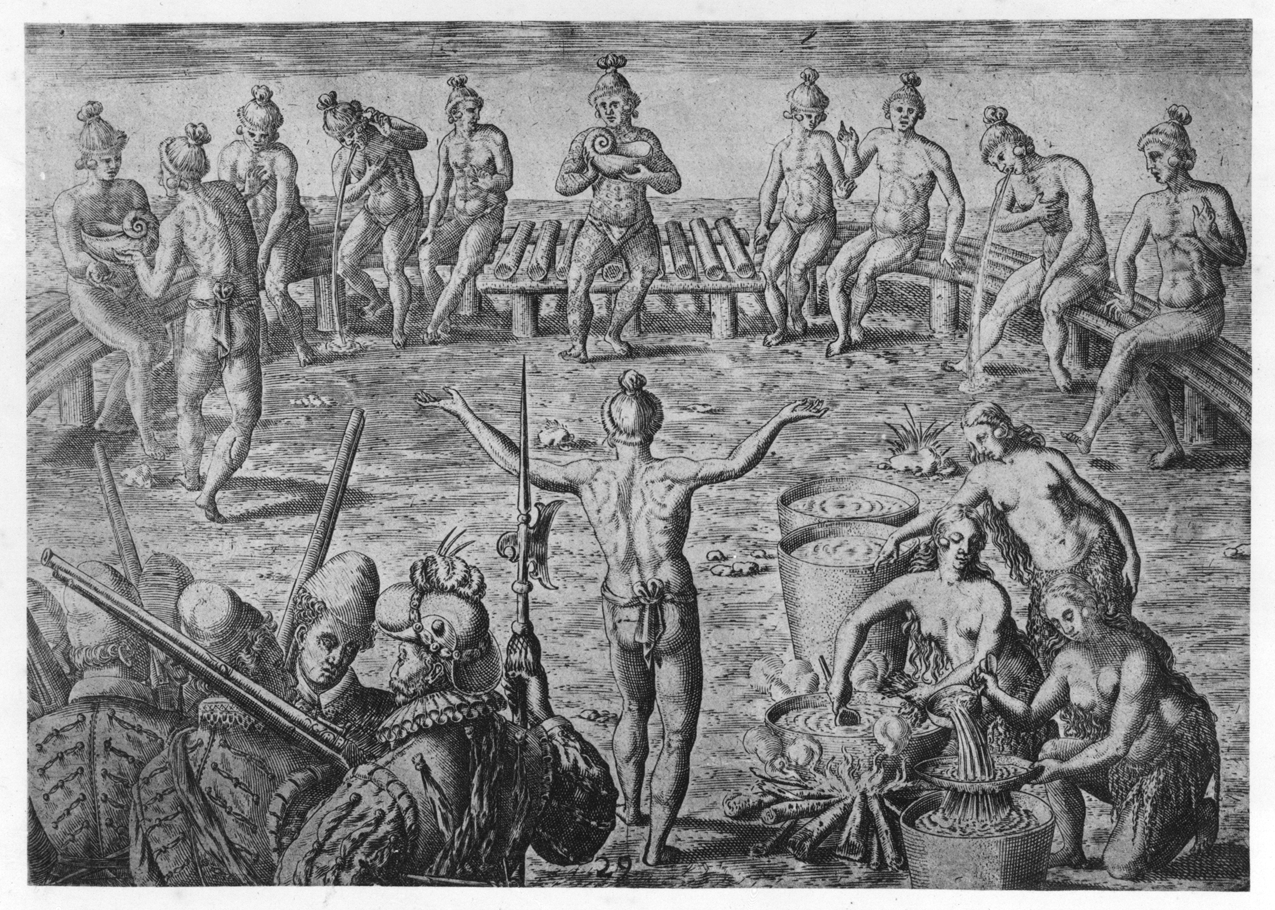
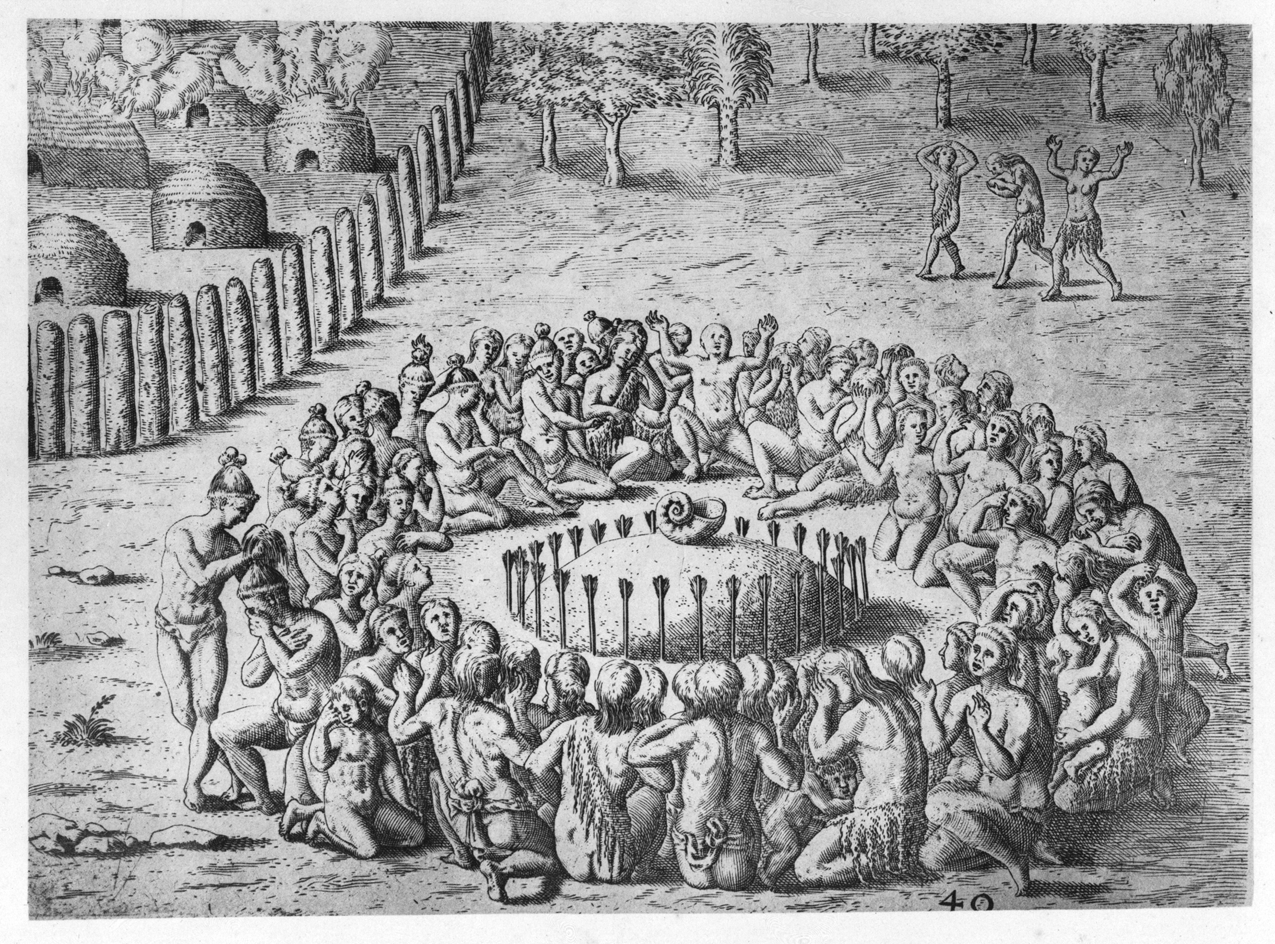
According to most early writers, women prepared yaupon as a decoction, boiling the leaves in water for a set length of time rather than employing the steeping or percolation common in coffee and tea preparation. Most, though not all records assert that only certain adult men were allowed to drink it. Cabeza de Vaca noted that his male hosts drank it in gourds; in sixteenth-century Florida, French colonist Jacques Le Moyne depicted the Timucua tribe using seashells to consume the decoction as well as the public regurgitation (see figures 3 and 4). The colonial- and early national-era writers analyzed for this article were all men, and they describe Black Drink ceremonialism as a gendered ceremony with women as preparers and men as singers and consumers. They give no indication as to whether there might have been a context for female consumption. However, Florida historian John Hann, based on his reading of Spanish Florida mission records, maintains that women of a chiefly class were permitted to drink yaupon.Footnote 24
Jacques Le Moyne (published in 1591 by Theodore de Bry) depicts the Timucua tribe in Florida in their Black Drink ceremony, using a nautilus shell for the beverage, circa 1564. French observers are in the lower left. Plate XXIX. Image credit: P. K. Yonge Library of Florida History, Special and Area Studies Collections, George A. Smathers Libraries, University of Florida, Gainesville.

Jacques Le Moyne (published 1591 by Theodore de Bry), “The Burial of the Timucua chief.” Plate XL. Image credit: P. K. Yonge Library of Florida History, Special and Area Studies Collections, George A. Smathers Libraries, University of Florida, Gainesville.

But it was not the preparation that served as the focus of much colonial writing. Instead, the focus was on what happened after imbibing: ceremony participants easily and regularly regurgitated the Black Drink. The association with ritualized vomiting captured the imagination of English-speaking writers, in particular, though earlier Spanish explorers recorded it as well.Footnote 25 So strong is the rhetorical link between yaupon and regurgitation that even now the U.S. Department of Agriculture Natural Resources Conservation Service's Plant Guides on yaupon contradict each other: one asserts that its primary medical use is to induce emesis; the other emphasizes “modern findings of no emetic compounds.”Footnote 26 In fact, yaupon is no more emetic than are coffee or tea. Repeated scientific studies have tested its chemical components and found no known emetics, and its users report no emesis or even an urge to regurgitate.Footnote 27 Moreover, the historical record of yaupon's use belies its emetic reputation: malnourished and hungry Civil War Confederate soldiers simply would not have regularly drunk an emetic.
Charles Hudson, in his extensive work on Black Drink ceremonialism, asserted that the vomiting associated with the beverage was learned, and more recent ethnographic research on guayusa usage supports this.Footnote 28 Achuar men in the Peruvian and Ecuadorian Amazon regularly drink guayusa in the pre-dawn morning, socializing and debating community life, after which they regurgitate the drink.Footnote 29 Among the Achuar, at-will vomiting is a learned skill, taught to prepubescent boys via the use of a feather or a finger. Blood samples from Achuar men having partaken in the wayus ceremony show that vomiting helps modulate caffeine intake, allowing participants to drink guayusa for extended periods of time. While Hudson's assessment that regurgitation was learned may be right, it was also a result of deliberate mixture. Spanish chroniclers noted that the Asao mixed salt water with yaupon to make it emetic in late sixteenth-century Florida and today Indigenous communities in the Southeast mix sweet gum with yaupon for that purpose.Footnote 30 Vomiting, like frothing, seems to have been understood as purifying.Footnote 31 Interestingly, Spanish writers tended to omit mention of emesis and instead connected yaupon to the traditional ball game played by North Florida's Indigenous inhabitants.
Public ritualized regurgitation disrupted anglophone notions of gentility and were instrumental and instrumentalized to depict Native Americans as savage. Early nineteenth-century Methodist missionary William Capers writes of the Creek chiefs that “none drink without spitting or puking when they have done … they drink and puke with equal readiness—perhaps with equal ease … they seem to drink to puke; and puke to drink again.”Footnote 32 Regurgitation as cultural practice was configured as cultural inferiority: “A general emesis might be a bond of misery among a council of Indians, but would hardly suit the average sipper of Bohea [Chinese tea].”Footnote 33 Coffee was popularized in Europe in the early seventeenth century as part of an institution, the coffeehouse, with its practices of public fellowship. Tea drinking soon followed as a new product featured in a London coffeehouse, and was soon associated with the highly ritualized East Asian tea ceremony. Their lesson for yaupon is that the manner of imbibing affects the reception of a product. Settler colonial writings on an Indigenous stimulant, because of proximity, made it harder to disentangle the beverage from its local method of consumption and from the social hierarchies that relegated Indigenous groups as culturally inferior.
A politics of disgust and revulsion accompanied what literature scholar Ed White calls the “colonial tradition of ‘national literature,’” by which he means imperial (pre-U.S. independence) writing on the Indigenous nations, especially through “that favored genre of colonization, the ethnography, the detailed description of the manners and customs of Indians.”Footnote 34 There is an extensive literature on how settlers have used ecological practices, from planting Old World crops in the New World to enacting conservation legislation on contested territory, as ways to legitimate their claims to nativeness (and thus land) and disavow the foundational and ongoing violence in settler colonialism.Footnote 35 It was in part through how settler ethnographic writing depicted the culinary in North American Native communities that settler communities distinguished themselves as civilized and worthy inhabitants of the land. By treating Indigenous yaupon consumption as disgusting, settler literature obviated the troubling questions of value in Black Drink ceremonialism. Yet, the need to portray Native consumption as inferior was at odds with the impulse to commodify yaupon.
Settler colonial writing betrays a longstanding fascination with the imagined grotesque in Indigenous consumption. Native communities “ate wrong” by eating what Rebecca Earle calls “un-food”—frogs, spiders, insects, reptiles, et cetera.Footnote 36 Earle makes a careful and compelling argument, tracing how food was central to how bodies were imagined, especially under humoral medicine, and thus how a kind of race-thinking about Indigenous, European, and African bodies emerged. Interestingly, though European settlers for the most part rejected Indigenous proteins, they embraced fruits and vegetables. Because of yaupon's strong association with Indigenous spirituality and with a specific ceremony, it was treated differently from other culinary goods like corn, beans, squash, buffalo, or turkey, all of which were also spiritually inflected. Those were inserted into familiar European food categories such as grains, vegetables, and meats. Here the experience of tobacco and chocolate might be more instructive since these products created new consumption categories in Europe, which Marcy Norton argues included the transmission of Amerindian cultural practices and priorities surrounding the substances to Europe.Footnote 37 Regurgitation, too, was seen as disordered eating and framed yaupon as a kind of un-food, which situated Indigenous practitioners as having a disordered relationship with nature.
Nonetheless, politicians and writers around the time of Independence recognized and appreciated the importance of the Black Drink. In a 1775 speech to the “Beloved Men, Head Men & Warriors of the Cherokee Nation” on the eve of war, one of the “Beloved Men of South Carolina,” Justice William H. Drayton, appealed to the Black Drink when trying to convince the federation to ally with the revolutionaries instead of the British: “And in particular they ordered, that if we drink Tea, we must pay so much money to the Great King.—I must tell you, this Tea is somewhat like your black drink—But as we know that this order is contrary to our agreement; and also, as we know the evil consequences of our paying this money, so your Brothers the white people in America have resolved that they will not pay it.”Footnote 38 Drayton's usage of the term “beloved” is notable and likely arises from Cherokee practices around the word. “Beloved Woman” Nancy Ward (1738–1822), a Cherokee political leader and heroine in later accounts of U.S. history because she advocated conviviality between the Cherokee and European settlers, was a noted preparer of the Black Drink ceremony.Footnote 39 According to Pennsylvania naturalist William Bartram, who visited the Cherokee Nation in 1776, the Cherokee called yaupon the “beloved tree.”Footnote 40 Ward died just a few years before Andrew Jackson ordered the Cherokee removed to west of the Mississippi along the Trail of Tears.
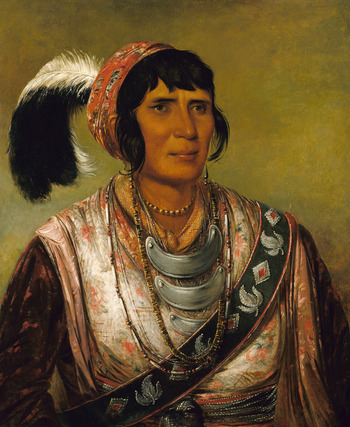
In one 1789 post-Revolutionary War encounter between the Creek and the emissary Commissioners for Indian Affairs in Southern Department of the newly founded U.S. Government, Creek Chief Alexander McGillivray invited U.S. government representatives to meet at the Black Drink ceremony before transacting business.Footnote 41 The famous Seminole warrior Osceola's name also comes from the drink. Non-anglicized it is “Asi Yahola,” literally “Black Drink Singer” (recall that “assi” is the name for yaupon in Creek/Muscogee), presumably because of his involvement in the ceremony as one who sang a series of notes before taking from the cup and passing it around (see figure 5). Even after the forced removals onto reservations and into the boarding schools, contexts for the Black Drink ceremonialism continued.Footnote 42 Today, utensils for Black Drink consumption continue to be crafted and yaupon is still prepared for ceremony, though many of these ceremonies have been closed to the public.Footnote 43 The Department of the Interior's 1883 Code of Indian Offenses, known as the “Religious Crimes Code,” banned “old heathenish” dancing, ceremony, and other sacred practices deemed “a great hindrance to the civilization of the Indians.” It gave Bureau of Indian Affairs agents authority to imprison and punish violators, which facilitated the suppression of the Ghost Dance and the massacre of more than three hundred Lakota by the U.S. 7th Cavalry at Wounded Knee in 1890.Footnote 44 Many Native spiritual practices subsequently went underground as a matter of survival. And while we cannot presume that present-day Ilex practices are the same now as they were precontact, similarities over vast expanses of terrain and linguistic differences point to Indigenous cultural resilience in the face of genocide.
George Catlin, Os-ce-o-lá, The Black Drink, a Warrior of Great Distinction, 1838, oil on canvas. Smithsonian American Art Museum, Gift of Mrs. Joseph Harrison, Jr., 1985.66.301.

There is, of course, a fundamental problem in reading colonizer texts to understand Indigenous practices. Instead of claiming to represent, for example, Creek practices around the Black Drink, these texts instead reveal the priorities of European colonizers and their descendants. What the texts do allow us to conclude is that Black Drink ceremonialism was central to how settlers interacted with and imagined Indian nations in southern North America. In these texts we also hear Indigenous individuals extending welcome and attempting to explain the significance of the Black Drink to settler publics. As a British government emissary to the Cherokee between 1761–1762, Henry Timberlake tasted the Black Drink during a ceremony overseen by Nancy Ward, and found it surprisingly pleasant, “having a strong taste of sassafras,” though he writes with disdain of the ceremony as full of “dreadful howling, yelling, and hallowing.”Footnote 45 Misrecognition of Indigenous ceremony and hospitality because of an overlay of cultural superiority was a hallmark of European colonialism and, at least in Timberlake's case, the honor being bestowed by the invitation to participate was experienced with ambivalence at best.Footnote 46
Indigeneity presented an existential problem for settlers, especially because of the fundamental challenge Indigenous groups posed to European claims to land.Footnote 47 The early yaupon documents show Europeans grappling to understand the value held within and transferred via the Black Drink ceremony, even as they highlight the existence of intentional cultivation and trade in the leaf. The underlying questions of value and of how to gauge the importance of ceremony are set amid a broader perception of Indigenous spiritual practice as morally and culturally inferior. Just like a supposed lack of real economy served to justify European dispossession of Native property and wealth, so too was the supposed disordered diet of Indigenous groups central to constructing a cultural hierarchy. Focusing on that aspect of yaupon which seemed so utterly other effectively suppressed nuanced understandings of the leaf and the ceremony and the destabilizing challenge posed by the obvious Indigenous economic networks constructed around it.
MEDICINE AND THE UNFORTUNATE VOMITORIA
European expansion coincided with the robust development of science and medicine as respected regimes of knowledge in the North Atlantic world, so much so that the late eighteenth and nineteenth centuries saw the coalescing of the scientific expedition as a central mode of imperial governance. Science as a way of thinking and biomedicine as an application of knowledge came into being in part as a result of the practice of naming and describing the flora and fauna Europeans encountered in imperial journeys. The psychoactive properties of stimulating drinks lent them particular importance to eighteenth-century researchers: coffee, tea, and yaupon were being carefully tended in British and French botanical gardens by the start of that century (though not yerba mate, a sign of imperial boundaries among stimulants). Carl Linnaeus himself scientifically described coffee, giving it the binomial name Coffee arabica in his 1753 Species Plantarum botanical masterwork. There he also gave tea the name Thea sinensis, which is frequently used today to describe the plant, though the standard nomenclature of Camellia sinensis is more common.
Linnaeus also listed yaupon as a variant of Ilex cassine, which now denotes the dahoon holly, a plant with a similar range.Footnote 48 Because all of the world's major caffeinated drinks, including yaupon, came into European orbit at about the same time, they caught the attention of European scientists, merchants, and the drinking public alike, as all three groups contended with the distinctive psychoactive properties of the stimulating drinks. The same twists and turns that marked the process of identifying tea and coffee extended to yaupon, but conspiracy and corporate sabotage may have come into play. Because North America's southern coast was for centuries divided between French, Spanish, and British rule, imperial divisions arose within the different scientific treatments of yaupon and its biomedical study. Though the Spanish and French chroniclers wrote about yaupon first, William Aiton, head botanist at the Royal Botanic Gardens at Kew, recognized yaupon and dahoon holly as entirely different species, and in 1789 he gave the former its unfortunate scientific name, Ilex vomitoria.Footnote 49
The choice of the term is curious, not only because the leaf had been marketed to a British public for decades under the moniker “Carolina Tea,” but because yaupon had been cultivated in Britain since 1700, as Aiton himself noted, and was cultivated at Kew Gardens under his care at that very time.Footnote 50 Though some may see in Aiton's word choice the influence of British imperial writing, which prioritized the ritualized regurgitation of the Black Drink ceremony, University of Florida applied ecologist Francis Putz portrays the move as a kind of economic sabotage. Putz claims that Aiton was “secretly in the employ of Ceylon tea merchants” who feared competition from Carolina Tea and deliberately gave it a name designed to invoke disgust.Footnote 51 After all, yaupon was at the time consumed on both sides of the English Channel—if he had been curious, Aiton could have verified the emetic properties of the drink. Whether or not Aiton was secretly employed by conflicting tea interests, his proximity to the Royal Society (botanist Daniel Solander, who worked with him on the cataloging project, was a fellow) meant that he had regular contact with the East India Company, which turned to the society for advice on the latest scientific developments. Despite Aiton's official description, many writers misapplied Ilex cassine to denote yaupon throughout the nineteenth century, perhaps as an attempt to distinguish yaupon from its emetic reputation,Footnote 52 and scientists debated the plant's correct scientific name well into the twentieth century.Footnote 53
Carolina Tea, or “cassiny,” likely first came to the attention of an anglophone public not as a tea replacement but because of its supposed curative properties. In 1695, London physician John Peachey published the paper “Some Observations made upon the HERB Cassiny, Imported from CAROLINA: SHEWING Its Admirable VIRTUES in Curing the SMALL POX,” which claimed yaupon could cure the disease.Footnote 54 It would be two decades before Lady Mary Wortley Montagu famously had her daughter inoculated for smallpox using a technique she had witnessed in the Ottoman Empire, popularizing vaccination in the North Atlantic world, so combatting the disease was a priority for medical researchers. Peachey described multiple successful interventions in which a tincture of yaupon cured smallpox.Footnote 55 He recounted anecdotes of other physicians using the same technique and mentioned earlier writers, describing how yaupon “promotes genuine easie sweats, and mild friendly transpirations, preserving the Mind serene and the Body active and lively a long while after, without any other Nourishment, and none but Persons of great Quality are permitted to use this Noble Beverage, which they drink as we do Tea in Carolina.”Footnote 56 Later researchers found yaupon had no such attributes, and Peachey was clearly describing the bodily effects of caffeine: mental focus, increased sweating and blood flow, hunger suppression, and increased wakefulness. If he is correct that other physicians were using yaupon at the time, then many in England would have recognized its similarity to tea.
Though Peachy does not mention emesis, Mark Catesby's Hortus Britanno-Americanus, a 1763 English-language account of North American plants easily adaptable to “the soil and climate of England,” details yaupon and the various methods through which both Indigenous groups and colonists consumed it. Catesby's book would have alarmed English tea merchants worried that yaupon could displace tea. He states that the emesis was due to Indigenous ritualized consumption practices and was not necessarily a property of the plant per se. Catesby writes, “American Indians … drink large quantities, both for health and pleasure, without sugar or other mixture; they drink it down and disgorge it with ease, repeating it very often, and swallowing many quarts: they say it restores lost appetite, strengthens the stomach, and confirms their health, giving them agility, and courage in war,” but he also notes that “in [North Carolina] it is as much in use amongst the White People as among the Indians; and especially among those who inhabit the sea-coasts.”Footnote 57 He speculates that yerba mate and yaupon might be the same species growing on opposite sides of the equator. And even after yaupon and yerba were definitively classified as different species, their botanical similarities continued to impress scientific writers, especially in light of the notable commercial differences between the two.
English authors like Catesby and Peachey saw in yaupon a medically useful plant that could be transplanted to Europe for extensive use. But the British Empire was not the only one with extensive holdings on North America's southern coast. Whereas the English-language ethnographic and scientific literature of the eighteenth and nineteenth centuries prominently featured the Black Drink ceremony's ritualized emesis, the French writings did not. In them, yaupon was associated with excitement and preparations for war, likely because one of the first French written source on the beverage was the sixteenth-century account of Dominique de Gourgues’ 1568 expedition for the “recapture of Florida” from the Spanish. It describes Gourgues’ Indigenous allies taking the drink (without mention of emesis) before setting out for the fateful battle.Footnote 58 French Huguenot explorer René Laudonnière, in his extensive account of three voyages to North America, described Timucuan use of “cassena” (incorporating the Spanish nomenclature of caçina) in northern Florida several times, and never mentioned any ritualized emesis in ceremony. He clearly implied that he himself had tasted the drink multiple times.Footnote 59
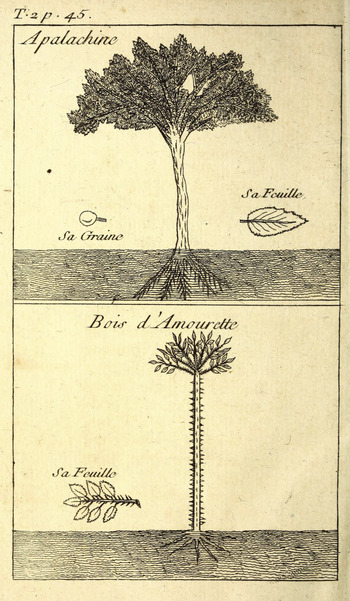
By the early eighteenth century, yaupon was known as “apalachine” in French literature, because, “This plant is abundant in Mississippi from which it derives its name from the Apalache, an Indian nation which makes great use of it.”Footnote 60 “Mississippi” here referred to the region from the mouth of the river eastward through the Florida panhandle and, presumably, “Apalache” referred to the Apalachee inhabitants of the peninsula's panhandle. In a 1733 medical dictionary, French physician Nicolas Lemery described apalachine's use for combating “gout and nephritic syndrome” and its beneficial effect on urine, but said nothing of emesis.Footnote 61 Le Page du Pratz’ 1758 natural and cultural history of Louisiana described a hunt followed by “the drink of war: it is made of a quantity of apalachine leaves boiled in enough water to be cooked despite their hardness” and, again, does not refer to regurgitation (see figure 6).Footnote 62 Lamarck himself wrote of the ability of apalachine (which he also called “cassine de la Caroline”) to cure gout and nephritic syndrome and its use in war, but, again, emesis is not mentioned.Footnote 63 An interesting exception to the trend is the 1775 Dictionnaire reigne universal, which says the drink “has the property of making them vomit”—but, curiously, the author solely called the plant “cassine” (more common at that time in the anglophone world) rather than the standard “apalachine.”Footnote 64
Antoine-Simon Le Page du Pratz (1758), Histoire de la Louisiane: contenant la découverte de ce vaste pays, sa description géographique, un voyage dans les terres, l'histoire naturelle, les murs, coûtumes & religion des naturels, avec leur… (Paris: Chez de Bure), “Apalachine,” p. 45. Image credit: Biodiversity Heritage Library, https://www.biodiversitylibrary.org/item/159012#page/84/mode/1up.

The associations between apalachine, war, gout, and diuresis, but not emesis, were lodged in the French scientific literature for more than a century. By the mid-nineteenth century, French writers knew that apalachine had the “same” energizing effects as tea.Footnote 65 French medical dictionaries began to regularly incorporate the British focus on emesis only in the 1860s, decades after the 1803 Louisiana Purchase and later annexations transferred control of yaupon territory from French to U.S. hands, and French writers had lost direct access to yaupon-producing lands. Le règne végétal (1865) gives the description of “apalachina” (note the spelling difference from previous usage) as that “which is produced from Ilex vomitoria aiton … a little dose is purgative and even emetic,” but also adds “one attribute of the leaves is to calm hunger.”Footnote 66 That is, once Aiton's scientific designation of vomitoria entered French usage, so too did the emetic associations.
Misconstrued ethnographic observation became biomedical property for yaupon, even in the face of contrary material evidence—non-Indigenous users of yaupon did not regurgitate after consumption. Even in the United States the cultural priorities of observers shaped biomedical findings and the dominant scientific narrative, though scientific experiment or direct ethnographic inquiry would have disproven the association. Southern scientists tried to correct the mistake by writing to pharmaceutical publications, but their expertise was not taken as being as authoritative as that of northern writers who had no contact with yaupon.Footnote 67 For example, in 1833, Pennsylvania physician Robert Eglesfeld Griffith wrote that Ilex vomitoria and Ilex dahoon (i.e., I. cassine) “are possessed of strongly marked emetic qualities, and form the principal ingredient of the black drink of the southern Indians, used before commencing their religious rites and great councils.”Footnote 68 The error persisted into the late twentieth century; the authors of Common Poisonous Plants and Mushrooms of North America noted that “yaupon can be made into a mild tea, but if drunk in a concentrated brew can cause hallucinations and vomiting.”Footnote 69 Schiebinger's portrayal of “culturally induced ignorance” within plant science is helpful here because this persistent belief that yaupon was emetic calls into question the very status of Western science. The error was not accidental, but rather a result of a belief that the travel writings of anglophones could substitute for scientific experimentation, especially when the voices of dissent (white Southern, Indigenous, and Black communities) were marginalized.
Confusion about the scientific name led to multiple discoveries of caffeine in yaupon in 1872, and then again in 1885.Footnote 70 For the sake of comparison, Friedlieb Ferdinand Runge discovered caffeine in coffee in 1819 in Germany, theine was identified in tea in 1822 in France, and only a few years later French scientists confirmed that theine and caffeine were chemically identical. In 1843, caffeine was identified in yerba mate in Britain.Footnote 71 Not only was yaupon a latecomer, but it was studied in the United States rather than in Europe, and within the United States there was more accurate scientific work on and biomedical knowledge of yaupon in the South.Footnote 72 Though British, French, and even U.S. medical writings labelled Ilex vomitoria as emetic, popular writing in the U.S. South remained more nuanced. The popular coastal North Carolinian newspaper New Berne Daily Times wrote, “The emetic effects were more probably due … to the large quantities of the very strong and bitter decoction than to any peculiar active emetic principle contained in the Yaupon.”Footnote 73 In the end, because Ilex vomitoria was neither a great purgative nor an emetic, nor a cure for smallpox, and because other sources existed for its most important properties (caffeine), yaupon's importance in medicine receded.
COMMODIFICATION: A PATRIOTIC TEA, A SOUTHERN DRINK, A BLACK DRINK
Yaupon was consumed in the North American South long before Walter Lenoir wrote to his mother of the privations experienced during the Civil War. But the plant also circulated around the circum-North Atlantic. Multiple attempts at commercializing yaupon had to contend with caffeinated competition, as well as with intersections of identity and usage. In a 1722 letter, Pierre Francois Xavier de Charlevoix wrote of yaupon's presence in Paris: “Cassine, otherwise called Apalachine, grows here [Biloxi] every where in abundance: it is a very small shrub, the leaves of which, infused like those of tea, are a good solvent and an excellent sudorific, but its main quality is in being diuretic. The Spaniards make great use of it over all Florida: it is even their ordinary drink. It began to be in some repute at Paris when I left it….”Footnote 74 Half a century later, Thomas Skinner announced his intention to auction a 1775 shipment of “the Leafe and Good-will of the CAROLINA TEA” at Deptford-Bridge in London.Footnote 75 Both before and after U.S. independence, northern ports along the east coast of North America, like New York and Halifax, regularly received bundles of yaupon from sailors hailing from or having stopped at ports in North Carolina.Footnote 76
Provenance was key to yaupon's branding and the plant was tightly identified with geography, including through the names “Carolina Tea” or “apalachine.” Yet, yaupon did not become a global caffeinated commodity like coffee or tea, or even a regional one like yerba mate. Information we have about the scale of early cultivation and production, as well as pricing, suggests that yaupon possessed many of the qualities necessary to succeed on the market. When John Locke specifically asked for yaupon samples as part of his 1671 inquiry into the “healthynesse, richnesse & other Propertys of ye soyle” and the “usefull Productions of ye Countrey,” tea had been on the English market for less than twenty years.Footnote 77 Coffee had been introduced to England only a few years before that, in the 1630s. Europe was only commencing its caffeine habit and countries had not yet developed firm preferences for a particular product.
We have seen that writings of early European visitors to and settlers in Carolina show that Native communities on the seacoasts cultivated yaupon for their own use and for an extensive precolonial trade in the leaf. Indeed, Indigenous yaupon practices influenced those of settlers. Southern writers asserted that prior to the U.S. Civil War “nearly every plantation and farm ha[d] what is termed a yopon nursery.”Footnote 78 Late eighteenth- and prewar nineteenth-century wills and deeds from coastal Currituck county in North Carolina, for example, show that plantation forced labor camps had “yopon,” “yewpon,” and “yeopon” nurseries that could be acres in size.Footnote 79 In all likelihood, the European settlers and Africans and their descendants who planted these yaupon nurseries learned the cultivation technique from the original Indigenous inhabitants of the land. So, even though seventeenth-century yaupon production was not oriented toward the international market as was Chinese tea, Carolina's Indigenous and non-Indigenous residents knew how to grow and harvest it in large quantities.
In addition to closer proximity to Western European markets (and thus lower transportation costs), yaupon also enjoyed a price advantage compared to coffee and tea for the North Atlantic market. Nineteenth-century yaupon prices ranged from $.50 to $1.00 a bushel, or $.05 to $.10 a pound in the United States; a pound of tea at the time cost 54 pence in Britain and anywhere from $.50 to $1.25 in the United States.Footnote 80 But price differentials could have been even greater. As a result of significant redesigns of export centers in Southeast Asia and improved shipping techniques, tea prices had dropped from 614 pence per pound in 1690 to 54 pence per pound in 1850 in Britain, a decline of 91 percent, suggesting that yaupon pricing would have been even more competitive before the nineteenth century.Footnote 81 One might wonder if yaupon's problem was not its price compared to tea but rather that it earned less than other crops that could be grown on the same land. Yet, early nineteenth-century cotton prices ranged between $.10 and $.135 per pound; that is, within the range of yaupon prices. While we still have no firm numbers on yaupon's yield-per-acre to compare it with the South's premiere crops of tobacco, rice, and cotton, its yield is probably similar to tea given their physical similarities (i.e., both can be harvested annually and grown as either a smaller plant or a large shrub).Footnote 82 The key to the commodification puzzle, then, is not to be found strictly in the production or circulation links of the commodity chain.
Instead, consumer identity had a critical role to play. During the outcry against the 1767 Townshend Acts and the 1773 Tea Act prior to the U.S. Revolution, yaupon was marked as an “American” beverage consumed as a manner of protest against the East India Company and British attempts to tax tea consumption. As a later U.S. history book for schoolchildren recounted, “The Americans were not contending for a little money, but for a principle, and they refused to receive the tea. They began to drink tea made of sassafras-roots, sage, raspberry-leaves, yaupon, and other American plants.”Footnote 83 But once the conflict faded, so too did the motivation to drink yaupon as a manner of defiance and a newly forged patriotism. Trade in yaupon appears to have subsided at this time, and the southern plant became a solidly southern drink: “Almost all the southern coasters who frequent the port of New-York, are in the constant use of Yapon-tea made from this vegetable,” wrote the New York-based Medical Repository in 1806.Footnote 84 Through its geographical association with the U.S. South, yaupon moved from being a cultural stand-in for things (and people) indigenous to things (and people) southern.
U.S. settler ethnographies of Indigenous communities during the first half of the nineteenth century, many of them by missionaries, focused on yaupon as ceremony or on the plant's medical and scientific importance. But the U.S. Civil War remapped race, region, and cuisine in important ways. Francis Porcher's 1863 Medical Botany of the Confederate States catalogued plants that might be useful in the Confederacy and was particularly attentive to those that substituted for products previously accessed from the North or abroad. Porcher wrote of yaupon using the South Carolinian nomenclature: “The inhabitants of North Carolina purify brackish water by boiling in it Cassina leaves. In North and South Carolina much use is made of the leaves of cassina for making tea.”Footnote 85 Rumors of yaupon usage during the Civil War made their way to the Union. A letter to the editor of Scientific American asserted, “Messrs. Editors: In consequence of the scarcity of tea at the South, the Southerners are said to be reviving the use of the Yopon or Yaupon (Ilex Cassine), of which the North Carolina Indians made their ‘black drink,’ and which has been more or less used ever since in that region, though mainly by the poorer classes.”Footnote 86 In her manuscript memoirs after the war, Texan Lillie Barr Munroe recalled the day-to-day hardships experienced during the war, writing, “and one of the clearest memories I have of them is that mother had no tea, we gathered the leaves of Upon [yaupon] shrub … they made a substitute, but only a substitute.”Footnote 87 Writing shortly after the war, North Carolina geologist Henry E. Colton advocated for yaupon to be commercialized and even urged that “if the people there will not enter this new field, let Northern capital and enterprise occupy it,” a surprising statement made so soon following hostilities.Footnote 88
Yaupon became, for both the North and the South, a hallmark of wartime suffering in the South, which may help explain why it was treated as a second-rate substitute to be abandoned once opportunity arose. Northern cosmopolitan disdain toward white Southerners, with attendant stereotypes around intelligence, violence, and domesticity, attached to yaupon drinking after the war. One writer in Pennsylvania insisted upon the veracity of an exchange between an unidentified Southern man and his wife over the size of a yaupon gourd in which she served the drink: “‘Is that the gourd you gave me my yaupon in to-night?’ ‘Yes, honey.’ Up sprang the invalid and gave his wife striking proofs of his vitality. ‘It's a two quart gourd,’ he shouted, ‘and you skeered a fellow to death. One quart is my allowance, and you know it. I thought when I couldn't go my gourd of yaupon that I myself was a goner.’”Footnote 89 The husband, having been served yaupon in a two-quart gourd (which, apparently, he could not distinguish in size from a one-quart gourd), thought his inability to finish the drink was a sign of illness, and when the mistake was discovered he beat his wife in anger. The account was part of a yaupon-skeptical article entitled “Spurious Substitutes,” which argued against yaupon presumably in reaction to attempts to encourage consumption and commercialization of the Southern leaf. Notably, denigrating humor about domestic violence and white Southern ignorance form the backbone of this sketch, part of what James Cobb describes as “an already well-established tendency among northern whites to see the South as a primitive and exotic land distinctly apart from the rest of America.”Footnote 90 The link between yaupon and Southernness transferred the negative valences of the latter to the former.
Even within the South, yaupon suffered from strong geographical association. As early as the eighteenth century, yaupon consumption among white settlers was a marked characteristic of the Carolina seacoasts, and this continued for centuries.Footnote 91 North Carolina's Outer Banks are steeped in historical lore about their isolation from the mainland even though they were the first sites of incursion. Here, the Roanoke Colony vanished and most likely relocated to the island of Hatteras and intermarried with the Indigenous community on the island.Footnote 92 Centuries of distance resulted in linguistic and cultural distinctives (notably, the Hoi Toider dialect of American English), including the use of yaupon. In the late nineteenth and early twentieth centuries, yaupon consumption was both a feature of the Outer Banks and part of derogatory stereotypes of island inhabitants as “hillbillies.”Footnote 93 The term “choppers”—from “yaupon-choppers,” as part of processing the leaf—was an insult used against islanders by North Carolina mainlanders, and children in Avon on Hatteras Island were taunted with phrases like “Kinnakeeter, yaupon eater.”Footnote 94
But perhaps most importantly for Northern and Southern whites, yaupon was slated as a Black drink. In 1864, the New York-based Farmer's Club featured a small update on yaupon with the detail: “The leaves of these shrubs have been in use by the aborigines of that district from time immemorial, and the Ilex cassine or Yaupon, constitutes the tea in universal use there among the negroes, which has given currency to the common negro adage, ‘Fried hominy, possum fat, and Yaupon tea is too good.’”Footnote 95 The association of “possum fat” with yaupon is illuminating. Nicholas Proctor makes a case that there were (and remain) “racially ordered preferences” when it came to cuisine from the perspective of whites in the United States and the perceived inferiority of the consumption of racial minorities and particularly Black communities. Opossum as Black game and a Black meal is a repeated trope which appears in both Twelve Years a Slave and Frederick Douglass’ Narrative.Footnote 96 Proctor writes that in the mid-1840s, “English naturalist Charles Lyell wrote that although he considered raccoon and opossum meat ‘too coarse and greasy for the palate of a white man … the negroes relish them much.’”Footnote 97 Moreover, opossum and raccoon hunting were nocturnal activities and thus would not interfere with daytime duties.Footnote 98 If possum and yaupon were parallels, as the dubiously “common negro adage” implies, then the very Black taste for yaupon may have dissuaded a white public from consuming it.
This strong association continued into the Reconstruction and Jim Crow periods. A Hatteras Democratic leader complained to a local Democratic congressman in 1898 that “the backbone of the Republican Party here are ‘Yeopon-choppers.’”Footnote 99 Perhaps “chopper” as an insult for Outer Banks residents carried racial undertones. By the time Brimley visited Scarborough's yaupon factory the art of processing the leaf was fading, though Scarborough's entire family, which Brimley noted was the sole Black family in the community, worked with him.Footnote 100 Even in 1923, Nature Magazine featured an article on yaupon processing and use among Black communities on South Carolina's Sea Islands with photographs of young women stripping leaves from twigs and adult men operating ovens and machinery to dry and chop the leaves.Footnote 101 Important details from both pieces suggest a strong cultural continuity between island forms of preparing yaupon and Indigenous techniques. An 1806 article about the Creek and the 1905 account of Scarborough describe the same process: after being chopped with a hatchet, the yaupon is placed into a barrel and covered with hot stones to sweat and toast the leaves before they are laid out to fully dry.Footnote 102
Although Brimley mentions yaupon's supposed emetic and purgative qualities, Scarborough commended the drink to him for the “smooth and easy way in which the drinking of his tea would remove fevers from the system with a guarantee of no bad after-effects.”Footnote 103 But even the praise from Scarborough fit into a pre-structured dismissal of Black medical knowledge in the South, which Sharla Fett argues was shaped both by “social relations of slavery and the cultural heritage of African herbal practitioners.”Footnote 104 Black knowledge of plant medicine grew from day-to-day laboring practices under slavery and from contact with Indigenous groups. The documents analyzed for this article that describe southern Indigenous life frequently mention individuals of African descent (free and enslaved) living with the Creek, Cherokee, and Seminole.Footnote 105 Even into the twentieth century, writers asserted that “Cassina or Black Drink is still prepared (1924) by the natives and negroes along the coast wherever the source-plant is abundant.”Footnote 106 The structures of slavery meant that Black communities frequently managed their own medical wellbeing clandestinely, and herbalism was a crucial part of everyday health-maintenance for African-descended communities despite disparagement by white advocates of biomedicine.Footnote 107 While familiarity with yaupon's pharmacological prowess has faded from the medical mainstream, knowledge around use of the plant is still retained in Black coastal communities in the South. A recent master's thesis, “Our Grandmothers’ Ways: Complementary and Alternative Medicine Use by the Gullah-Geechee in McIntosh County, Georgia,” records about yaupon, “Herbal Medicine Prevents the Onset of Colon Cancer.”Footnote 108
Reading between the lines of these texts suggests that Africans and their descendants on the Carolina-Georgia coasts and probably farther inland adopted yaupon processing from Indigenous groups that lived on those same shores. While Indigenous usage of the plant attracted much attention from white settlers, there are surprisingly few descriptions of Black practices in the archival record aside from the mentions above. And yet, perhaps it is possible to link what we know about the psychoactive properties of yaupon with what we know about familiarity with yaupon in Black communities, the popularity of yaupon in the South before and immediately after the Civil War, and the physical preponderance of yaupon even today in the Carolinas and Georgia far from the coast. Yaupon remains a popular decorative shrub in the South; recall that plantations and farms often possessed yaupon nurseries. Might one reason for yaupon's material prevalence be that Africans and their descendants intentionally planted it specifically for its psychoactive properties? After all, the caffeine-bearing kola nut had been widely used, cultivated, and traded across West Africa from at least the thirteenth century C.E.Footnote 109 Sidney Mintz argued for the importance of caffeine products added to sugar in the florescence of industrial factories in the North Atlantic—a combination he dubbed “proletarian hunger killers,” inexpensive combinations that suppressed hunger in workers and gave them the boost to labor extra hours at extremely low wages.Footnote 110 Yaupon, as a caffeine-bearing leaf, could have served as a hunger killer for enslaved communities.
Neither the documents studied for this article nor a preliminary ethnographic survey of adult and elderly African Americans in North CarolinaFootnote 111 have yielded precise evidence for this argument. And yet, multiple pieces of the puzzle are in place and the story of yaupon has been one of forgotten knowledge. The textual silences are easily explained by social structures of racially ordered preferences in consumption in the United States as well as the tendency of white writers to dismiss Black herbal knowledge. Perhaps, too, the loss of the specific context for yaupon consumption with the end of chattel slavery and (again, perhaps) a negative association between yaupon consumption and the hardships of enslavement contributed to its decline.
Whatever the reasons for yaupon's post-Civil War ebb, the long twentieth and the twenty-first centuries have seen repeated attempts to popularize the beverage for consumption, but only recently with success. The question with which I opened this article puzzled many—why had yaupon not taken in the United States?—has puzzled many before me.Footnote 112 Chicago physician Edwin Hale wrote an 1891 booklet on the history of yaupon for the U.S. Department of Agriculture with an aim to resuscitate its use and “inquire into its possible economic value.”Footnote 113 Hale compared the leaf to tea and yerba mate, but then reflected, “The use of the shrub above mentioned has been almost abandoned by our native Indians and by the white people who once partially adopted it as a beverage.” The booklet caught the attention of agricultural experts.Footnote 114 Hale never mentions Black use, and though he follows botanical, chemical, and physiological analyses of yaupon with an admirable historical recompilation of its use among Indigenous groups from Cabeza de Vaca onward, he never makes a connection between the genocide of Indigenous communities and its effects on ceremony. Hale speculated that intermarriage between Europeans and natives in South America accounted for the extended use of yerba mate in that region, in contrast with the lack of intermixing of Indigenous groups with the French and English who settled in southern North America.Footnote 115
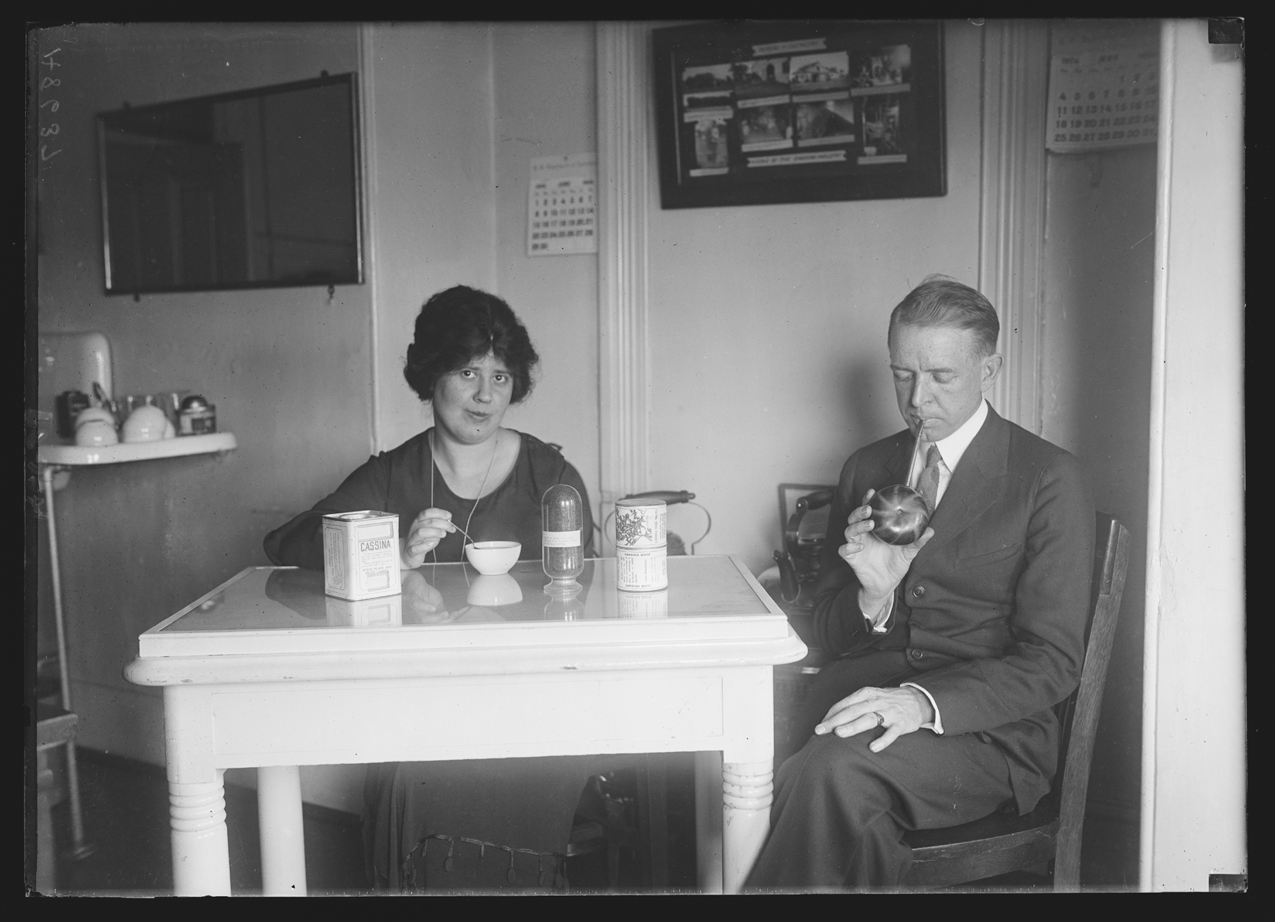
Hale's was not the only Department of Agriculture report on yaupon. The U.S. Bureau of Chemistry (part of the Department of Agriculture and a direct antecedent to the Food and Drug Administration) prepared a circular in 1922 to advocate for the production of beverages from yaupon, and even tested soft drinks made from the plant at the Charleston County Fair (see also figure 7). The bureau's explicit mission was applied research—combining scientific inquiry with economic aims. The writers enthusiastically stated: “It was found during these experiments that these products can be produced very cheaply in comparison with commercial tea because of the fact (1) that unlike tea, all the leaves on the plant contain the active principle, caffeine, (2) that unlike tea, all the leaves can be removed from the pruned branches with live steam, (3) that the number of steps in the process of production can be substantially reduced, and (4) that in the preparation of cassina a very small amount of hand labor is necessary.”Footnote 116
A yaupon tasting of “cassina mate,” prepared by the U.S. Department of Agriculture, “Drinking Cassina, a South American drink, made in Department of Agriculture,” Harris and Ewing, photographer, July 1924, Library of Congress Prints and Photographs Division Washington, D.C., control number 2016887376. Note the erroneous attribution of cassina to South America.

Yaupon might have definite advantages over imported tea, but just at that time Coca Cola was on its ascent and the newly public company was capitalizing on Prohibition plus a sophisticated advertising scheme that extended to the shape of its bottle and even the modern image of Santa Claus. Charles Fairbanks, in the edited volume Black Drink: A Native American Tea, directly attributes the rise of Coca Cola to the “cultural integration” of the ten-minute break (first invented by Stonewall Jackson to keep Confederate troops refreshed) and an exuberance of soda fountain recipes for a public keen on carbonated drinks.Footnote 117 Whatever cultural space there might have been for a new (old) caffeinated beverage was filled by ice-cold soft drinks.
For most of the twentieth century yaupon was treated as a mere curiosity associated with the Carolina and Georgia islands, but more recently new companies have emerged seeking to do what Hale and others had recommended: put yaupon on the U.S. stage. They are located within the growing range of Ilex vomitoria in the United States: Yaupon Brothers in Central Florida, CatSpring and Lost Pines in Texas, and Asi Tea in Georgia. The difference in brand names signals the lack of standardization of the plant's nomenclature, which is still very regionally dependent. That none of these companies prominently feature the scientific name reveals an enduring ambivalence about Ilex vomitoria. The newly formed American Yaupon Association highlights permaculture, an emergent eco-agricultural model that balances “profitability and environmental stewardship.”Footnote 118 Permaculture, which prioritizes sustainability through mixed-method cultivation, is but one of several agricultural/food movements that have arisen in response to climate change and resource scarcity. They seek to mitigate the impacts of the Anthropocene, operating within the constraints of capitalism but also working to transform it.
The business models of the new yaupon companies directly address both the labor excesses and the land impacts of extensive and intensive caffeine commodity production. This approach has been a distinguishing mark of elite coffee and tea products and it now predominates in most yaupon manufacturing.Footnote 119 Much of the yaupon sold by U.S.-based companies is organic—it is a popular hedge partly because it is endemic and requires no fertilizers, herbicides, or pesticides and little to no watering—and is foraged or grown in small plots (even in Central Florida's backyards). CatSpring offers employment to people in workforce transition, the formerly incarcerated, and sex-trafficking survivors, indicating that social and ecological responsibility are core to its messaging and mission.Footnote 120 The anxiety about indigeneity has disappeared and all the companies conspicuously mention yaupon's Native past. It has proved a marketing boon and there seems to have been a blunting or even transfer of indigeneity: “native” has shifted from describing Indigenous peoples to describing the plant. The new yaupon endeavors redeem the mistakes of coffee, tea, and chocolate production, and consumption also has a transformative effect on drinkers by committing them ethically to proper relationships with the land and with other people.
CONCLUSION
Yaupon found, lost, and found again raises important questions about colonialisms, plant knowledge, and plant use. Within North America, and particularly after the formation of the United States, different groups, sharing more or less the same space, conceptualized the agentive nature of the plant differently. I have shorthanded this here as ceremony versus medicine versus tea, but the differences go deeper. For the Timucua, Creek, Cherokee, and other Indigenous groups yaupon seems to be both a beloved plant and an actor with spiritual-social power. For Black communities, yaupon is potent and, per Fett's larger description of plant knowledge among African-descended populations, fits into a cosmology of spiritually active physical substances.Footnote 121 Neither of these perspectives, writ large, coincides with the impersonal, a-personal treatment of plants characteristic of modern Western approaches. Yaupon reveals the botanical roots of modern medicine, including the struggles between the transfer of plant knowledge and the development of scientific institutions to handle that knowledge. I argue that yaupon is more than a drink—it is a way to “think” “America,” and has been since the sixteenth century.
In becoming a kind of un-food, yaupon resisted commodification even though it came into European awareness at the same time that European and North American settler colonial markets were developing a robust caffeine habit, showing that capitalist incentives are not necessarily the most powerful forces acting on an object. Instead, the complex of plant and human communities highlighted through competing knowledge priorities, discussed in this article, structured the possibilities of yaupon in the past. These texts present a case of overlapping transmission methods: orality versus writing. Both Indigenous and Black communities frequently transmitted information orally and materially, whereas the European/settler preference was for writing. This led to a challenge of knowledge conservation. The better-preserved practice also featured in a social power dynamic as imperial and hegemonic, politically invested in silencing, erasing, or appropriating the knowledges and even the physical presence of marginalized communities. The uses that must be approached obliquely are those of Indigenous and Black groups, communities that seem to have incorporated yaupon more deliberately and extensively. But writing and even literacy itself are problematic here; Europeans rejected the pre- and early contact writings of Mesoamerica as such and instead relegated them as “paintings,” or they destroyed precolonial codexes as “demonic.”Footnote 122 Teaching an enslaved individual to read was illegal in the Southern states of the United States. For this article I have, therefore, assembled a kind of yaupon archive that incorporates archeological and material plant evidence as signals of human intentionality. In addition to taking the documents at face value, because of their place within an imperial project I have read them against the grain in order to better understand subaltern uses of yaupon. Similarly, that yaupon is commonly used as yard décor—its place in southeastern landscaping—raises the question of how to ethnographically read cultural landscapes.
Making judgments concerning the “disordered” eating practices and un-food of Indigenous groups and racially ordering eating preferences vis-à-vis Black communities were parallel and proximate moves for white settlers and their descendants. The coffeehouse and the tea ceremony could be domesticated and resignified with markers of European cultural respectability in part because the Middle East and East Asia were so geographically distant; that yaupon grows in North America and was used by marginalized groups meant that the broader associations attached to those communities could not be so easily divorced from it. It remains to be seen whether, in the face of ongoing climate and ecological crises, these very qualities that contributed to yaupon's decline will contribute to a new ascent. The newest makers of commercial yaupon have positioned the plant as a solution to systemic problems in caffeine commodity chains, from production to consumption. Yaupon—as Indigenous, as ritual rediscovered, and requiring no pesticides or fertilizers—may yet find new life as the stimulating drink that remedies the maladies of the Anthropocene.