The outbreak of the Great War in Europe inspired a remarkable humanitarian response in the neutral United States. From 1914 to 1917, Americans across the country involved themselves on behalf of every conceivable humanitarian cause, and hardly a week passed without some fundraising event to alleviate the war's unprecedented suffering. Even residents of small towns in Iowa or Indiana—far away from the Eastern seaboard and traditionally less interested in European affairs—baked cakes, collected old garments, and knitted socks to mitigate the distress of people whom they had never met, living in places they might have been unable to locate on a map. The fate of war sufferers moved even otherwise staunch isolationists. No doubt, war relief work meaningfully involved millions of Americans in the European conflict long before the United States ever joined it officially.Footnote 1
America's “humanitarian awakening” (Irwin) in the era of the Great War has drawn wide scholarly attention in recent years.Footnote 2 Historians have analyzed American relief for Belgium and France, reevaluated the role of the American Red Cross in American foreign relations, explored American humanitarian “exceptionalism” in the Near East, and sketched the YMCA's P.O.W work across Europe.Footnote 3 Collectively, their studies have emphasized the Great War's impact on launching Americans on an increasingly global, and not just humanitarian, role. But despite a “veritable explosion” (Little) of research on this subject, notable omissions remain. Perhaps most notable of all, America's pervasive humanitarian campaigns have rarely been systematically investigated as to their impact on American sentiments and attitudes toward the belligerents during the period of neutrality.Footnote 4 In particular, the predominant focus on large relief organizations like the American Red Cross and on the experience of American volunteers overseas has detracted from investigating the domestic networks, agendas, and repercussions of this humanitarian campaign. The thousands of local fundraising committees, the knitting circles, and bazaars all over the United States, that is, the very ways by which the “average American” involved him- and herself in relief work, have found comparatively scant attention.Footnote 5 This has had two results: for one, this omission has left us with a relatively benign image of American humanitarianism, strangely detached from the heated public debates that otherwise characterized American neutrality. Despite the fact that the partisan nature of humanitarian activism forms the starting point of much recent research,Footnote 6 the predominant attention to large, neutralist organizations and the near exclusive focus on one “side” of American humanitarian engagement (namely that on behalf of France and Belgium) have served to downplay the deeply partisan and divisive history of American humanitarian pursuits. Partly as a consequence, we still do not know enough about how U.S. humanitarian aid engaged Americans in the larger, political questions of a faraway war. Although historians have stressed that wartime humanitarian involvement informed U.S. notions of its global role, just how such involvement expressed, let alone shaped divergent American attitudes toward the war and its belligerent parties is much less clear.
But it is precisely with regard to the question of American attitudes toward the war that studying relief work proves particularly illuminating. Indeed, just how Americans made up their mind on the European conflict and just how they moved from peace to war continues to puzzle historians.Footnote 7 To be sure, the attitudes of American leaders and the development of published opinion are well-researched. Scholars have left no doubt that a confluence of factors, including strong cultural affinities for the Allies, a general disdain for undemocratic government in Prussia, the events of the July crisis, and the brutal German invasion of neutral Belgium led to a generally pro-Allied sentiment among Americans. Especially the upper and upper-middle classes in the East, including much of the nationally syndicated press and the universities, were quite outspoken about their pro-Allied sympathiesFootnote 8 and the sinking of the British liner Lusitania by a German submarine in May 1915 with 120 American civilians on board broadened American suspicion of and hostility to Germany.Footnote 9 Still, many Americans of Jewish, Irish, and German descent (for different reasons) failed to share this pro-Allied sentiment, and all the way up to April 1917, Americans engaged in a heated and divisive debate not only about the appropriate U.S. response to the war but about the respective merit of each warring party's cause.Footnote 10
This essay reflects on American sentiments in light of their war relief work from 1914 to 1917. If relief work truly did meaningfully involve Americans in the European war, then how, if at all, did if affect their attitudes toward it? Tracing some of the “humanitarian narratives” employed in the relief campaigns for the Central Powers, the Allies, and neutral Belgium, humanitarian involvement, it will be argued, not only expressed prevalent ethnic, cultural. and political affinities, but shaped American attitudes toward the different belligerents. Contrary to contemporary claims, humanitarian pursuits were never even remotely impartial, but drew Americans onto the different sides of the war like few other endeavors. Indeed, the article argues that relief work must be taken serious as a force of “cultural mobilization” (Horne), which affected American “visions of the war and its outcome.” By involving Americans actively on the different sides of the European war, it helped forge discrete moral and emotional alliances across the Atlantic. In trying to understand the complicated and acrimonious process by which Americans moved from peace to war, their relief work thus deserves attention.
THE BEGINNINGS OF AMERICAN WAR RELIEF AND THE MYTH OF IMPARTIAL HUMANITARIANISM
War relief constituted one of America's most immediate responses to the European conflict, with ethnic groups often leading the way. As early as August 5, 1914, the German Society of Pennsylvania, one of the oldest ethnic associations of the United States, initiated nationwide collections for Germany's wounded, widowed, and orphaned.Footnote 11 During the coming months, American relief quickened and expanded in step with the widening scope of destruction, displacement, and devastation across the Atlantic. The fall of 1914 gave rise to relief campaigns on behalf of Jewish, Serbian, Russian, Armenian, Irish, Polish, and many other groups of war sufferers. But it was the suffering in France and Belgium that attracted most prominent American attention. To alleviate the distress of French combatants, American students volunteered as ambulance drivers, while their elite colleges assembled and dispatched entire medical units for that purpose. At the same time, a mushrooming number of American institutions in France and fundraising committees back home began to care for the French injured, widowed, and orphaned until by 1917, no less than twenty national relief organizations—and a vast number of local committees—devoted themselves to various aspects of aiding French war sufferers.Footnote 12 Still, it was neutral Belgium, occupied by the advancing German army during August 1914, which soon emerged as America's primary humanitarian project.Footnote 13 Established by a small group of American businessmen in October 1914, the Commission for Relief in Belgium grew from a makeshift emergency organization into the largest humanitarian NGO the world had ever seen. Under its energetic director Herbert Hoover, the Commission enlisted hundreds of millions of dollars in global charity and public funds to feed a Belgian population, which was cut off from food supplies by the German occupation and the British sea blockade. It was President Woodrow Wilson who noted once that “nothing that the American people had had the privilege of doing during the war has more deeply enlisted their interest and sympathy than the relief of the suffering of the stricken population of Belgium.”Footnote 14 While the net sums of American charity are very difficult to estimate, they far exceeded any previous expense for international humanitarian causes. By late 1914, Americans were firmly and generously committed to mitigate at least some of the unprecedented suffering across the Atlantic.Footnote 15
Many discrete factors played into this quick mobilization of America's charitable resources. Certainly, the widely circulated images of shelled-out buildings, terrible disfigurements, and droves of fleeing civilians elicited particular compassion and concern in a time still little accustomed to the large-scale destruction of industrial warfare.Footnote 16 Strong cultural and ethnic ties to Europe as well as religious convictions and charitable traditions strengthened the imperative to act overseas, while America's sophisticated landscape of charitable and philanthropic institutions, invigorated by decades of progressive reform, was readily redirected to that task.Footnote 17 For the many young, well-educated Americans who volunteered as relief workers, overseas humanitarian involvement also promised a chance to prove themselves in a world event and partake in the cultural prestige associated with some of the warring countries, especially France.Footnote 18 But war relief work to many also appeared a particularly suitable form of U.S. involvement in the European conflict. Not only did it dovetail with America's exceptionalist self-interpretations to be countering Europe's orgy of destruction with constructive humanitarian work,Footnote 19 but the widely proclaimed “nonpolitical” and “neutral” nature of such work allowed Americans to involve themselves overseas while still heeding President Wilson's call to be “impartial in thought as well as in action.”Footnote 20 As Charles H. Wacker, president of the newly founded German and Austro-Hungarian Relief Association of Chicago, explained his decision to substitute the 1914 “German day” with a relief bazaar:
We are American citizens first. We sympathize with President Wilson in his effort to uphold an absolute neutrality. For fear that a large gathering of Germans might result in a demonstration, which could cause him embarrassment, we have changed our plans. We are confining ourselves to the collections of funds for the wounded. Our purpose is purely humanitarian.Footnote 21
At a time when many Americans sought to avoid blatant partisanship, the allegedly nonpolitical, “purely humanitarian” character of war relief suggested it as an especially appropriate and American means of overseas engagement.
*
Potent in theory, the impartiality of American relief work never existed in practice. Quite the contrary, hardly any other social activity so strongly reflected America's emotional ties, cultural affinities, and moral convictions during the period of neutrality. While there were a few organizations, most notably the American Red Cross, which at least aspired to disinterested, impartial service,Footnote 22 the vast majority of American voluntary organizations felt neither the need nor the desire to follow their example. The direction of their operations was determined not so much by proven human need, as by ethnic, religious, and cultural sympathy.
This was true for all sides of U.S. humanitarian engagement. For many ethnic groups, their donations were first and foremost a discrete expression of solidarity with their homeland. German Americans, for example, frequently understood their aid as a distinct contribution to the German war effort, and they portrayed themselves as fighting alongside German welfare organizations on a sort of transnational humanitarian home front.Footnote 23 It was not unusual, for example, for organizers to characterize their large-scale relief bazaars as “a phenomenal parade of all that is and feels German, and all that is kin to the German spirit.”Footnote 24 But American aid to France amounted to no less a conspicuous taking of sides. While the number of Americans of French descent was small, members of the Francophile upper classes like heiress Anne Morgan, former Harvard President Charles W. Eliot, or former President Theodore Roosevelt, enthusiastically aided the French, whom they identified as the “victim of [German] ‘frightfulness’” and as fighting for the cause of civilization.Footnote 25 Organizing a War Relief Clearing House for France and her Allies in November 1914, the U.S. ambassador to Paris, Myron T. Herrick, for example, intentionally bypassed the seemingly all too neutralist American Red Cross: what Herrick and other benefactors desired was not an evenhanded administration of relief, but a forceful partisan expression of support for “the Heroes of France and Her Allies” (as the name of one relief organization went).Footnote 26 Even Belgian charity—despite its main organizers’ consistent emphasis on neutralityFootnote 27—was widely considered an expression of sympathy not only for occupied, formerly neutral Belgium but for the Allies. In late 1914, Robert Underwood Johnson, long-time editor of influential Century Magazine, assured the English author Sir Edmund Gosse:
You at least do not need to be told that America is heart and soul in sympathy with your country in this war … everybody speaks out … on the right side. … Our time will come to be of use—and it will be more effective than by battleships. Everybody I know is occupied with relief measures, and the women and girls are all knitting. All sort of sales and benefits for the Allies are on. There are over five or six funds, chiefly for Belgians and French. Nothing is talked about except the war.Footnote 28
For the most part then, at least those Americans, elite and ethnic, most involved in fundraising efforts were not at all interested in a balanced benevolence to all war sufferers, but desired to aid solely certain causes.
Such a broad statement, to be sure, hides important nuances. Although many relief groups looked quite monolithic from the outside, their motivations and degree of belligerence often varied widely. Within the German American community, for example, there were well-known philanthropists like Arthur von Briesen, whose involvement was basically a continuation of their prewar social work just as there were outright propagandists, like German American publicist George Sylvester Viereck, whose use of charity was combative rather than compassionate, offering them but another platform for their pro-German message.Footnote 29 Between these two extremes stood a large number of Americans who coupled honest concern for war sufferers with an array of personal, ideological, and professional ambitions. Ethnic leaders, for example, often looked upon charity as a way to rekindle waning ethnic identities, while “Anglo-American” elites promoted all-American charity as a conduit for the “melting pot” (which was literally the name of the jewelry-donation booth at one Allied bazaar). Conversely, pacifists like Jane Addams used relief work to spotlight the horrors of war, while others, like heiress Anne Morgan, drew upon it to advocate preparedness.Footnote 30
If fundraisers thus imbued their wartime charity with widely different agendas, there is no doubt that American humanitarian engagement by and large—and precise numbers are difficult to obtain—played out in favor of the (Western) Allies. One (very conservative) 1916 estimate held that roughly six million dollars in public charity had been raised for the Central Powers while about twenty million dollars had been raised for the Western Allies and Belgium.Footnote 31 While this preference also reflected the comparatively greater distress among French and Belgian civilians in war zones and the notable fact that the British blockade complicated the provision of aid to the Central Powers,Footnote 32 it was also a clear expression of wartime sympathy and cultural preference. This was particularly striking among American elites. Of the several hundred Harvard students volunteering in Europe, almost all went to France and only one to Germany.Footnote 33 In short, the more than two hundred voluntary relief organizations founded after August 1914 speak as powerfully to America's humanitarian consciousness as they do to its different emotional and cultural affinities. Put bluntly, much of American relief work was animated as strongly by pro-German or pro-Allied sentiment as it was by compassion.
These humanitarian preferences, I would argue, tell us much about the very different understandings Americans entertained about the European conflict. In this regard, it is good to acknowledge that compassion for a “distant other” is a highly subjective and selective process, depending not solely (or predominantly) on demonstrable human need, but on whether the recipient is perceived as deserving.Footnote 34 Since one of the most influential factors in determining deservingness is the perceived “innocence” of the recipient for his dismal situation,Footnote 35 American relief campaigns actually expressed discrete moral judgments about a key question of the Great War: the responsibility of the belligerents in starting it. Indeed, the different “humanitarian narratives” told by American relief groups were all built on the innocence of their respective recipients. German American charity arose from feelings of ethnic solidarity just as it reflected the conviction that Germany was not ultimately responsible for the war but had been forced into a preemptive strike by an encirclement of ill-meaning enemies.Footnote 36 In the same vein, many an “Anglo-American's” aid to France expressed discrete cultural affinities as well as the assumption that France was innocently fighting a war imposed on it by the Central Powers. As a consequence, initial considerations among the founders of the American Relief Clearing House in Paris to aid the war sufferers of all sides were almost immediately dismissed, because one “could not place victims and aggressors on the same plane.”Footnote 37 In this way, America's allegedly “purely humanitarian” work reflected key assumptions about the war that were anything but nonpolitical. Rather, humanitarian engagement speaks clearly to American sentiments concerning one of the most fundamental questions of the Great War.
CULTURAL MOBILIZATIONS
But relief campaigns did not just express prevalent opinions and sentiments on the war, they actively shaped and perpetuated them. Indeed, American relief campaigns are best understood as a force of “cultural mobilization” (Horne) on behalf of the different sides of the war, a term that historians have fruitfully employed to understand the emergence of “war cultures” during the Great War. As John Horne has noted,
one might define “war cultures” (and they are better thought of in the plural) as the visions developed by a wartime society of the conflict and of its outcome. Such visions are closely related to the mobilization of cultural and political values behind the war effort, not only “from above,” by the state or the social and political elites, but also “from below” by much of civil society. The political and cultural mobilization and “self-mobilization” of societies for war thus play a central role in the creation of “war cultures.” The most familiar aspect of war cultures is their organization, which has long been part of the study of the world wars—recruitment, propaganda, the press, censorship, schools, intellectuals and so on.Footnote 38
Though war relief work is not commonly considered one of these factors, it had arguably at least a similar, if not even more profound, mobilizing effect. While this is not to claim that American society developed anything akin to a full-fledged “war culture” before 1917, there is no doubt that many Americans had even before 1917 become intellectually and emotionally deeply involved in the war and had indeed developed rather clear visions “of the conflict and of its outcome.” Taking into account the significant numbers of bazaar participants, relief organizers, and individual donors, war relief seems to have been a notable factor in this development. Indeed, in their appeals for public charity, relief organizations constructed powerful “humanitarian narratives,” which not only sought to arouse American sympathy for an otherwise distant other but helped shape notions of heroism and victimhood in the European war at large.
If we look to explain the particularly potent mobilizing function of relief work, a number of factors warrant consideration. There was first and foremost the very substantial and highly emotive publicity associated with relief efforts. In the case of Belgium, for example, an official press department in New York issued daily press communications, secured free advertising space, and enlisted American authors to write on the need of Belgium, while 4,000 (!) local and regional committees took the reality of Belgian destitution directly into homes and market squares across the country.Footnote 39 But it was not just the scope, but the nature of publicity that set relief work apart. In order to mobilize American empathy, relief publicity was structured around affective, picture-heavy “humanitarian narratives’” that differed notably from other press coverage. Firsthand observations of America's well-educated volunteers, human-interest stories on the war's many personal tragedies, and emotive imagery of childhood suffering more widely and powerfully related a faraway European war than any dry and fact-heavy newspaper article ever could. Perhaps most importantly, organized charity's need for constant publicity secured topics such as the situation in occupied Belgium a continued presence in the news, from which it would otherwise have disappeared.Footnote 40 Certainly, the German breach of Belgian neutrality, which scholars have characterized as a “defining act of the war,”Footnote 41 could not have been kept as effectively in front of the American public had it not been for the extensive Belgian relief campaign.
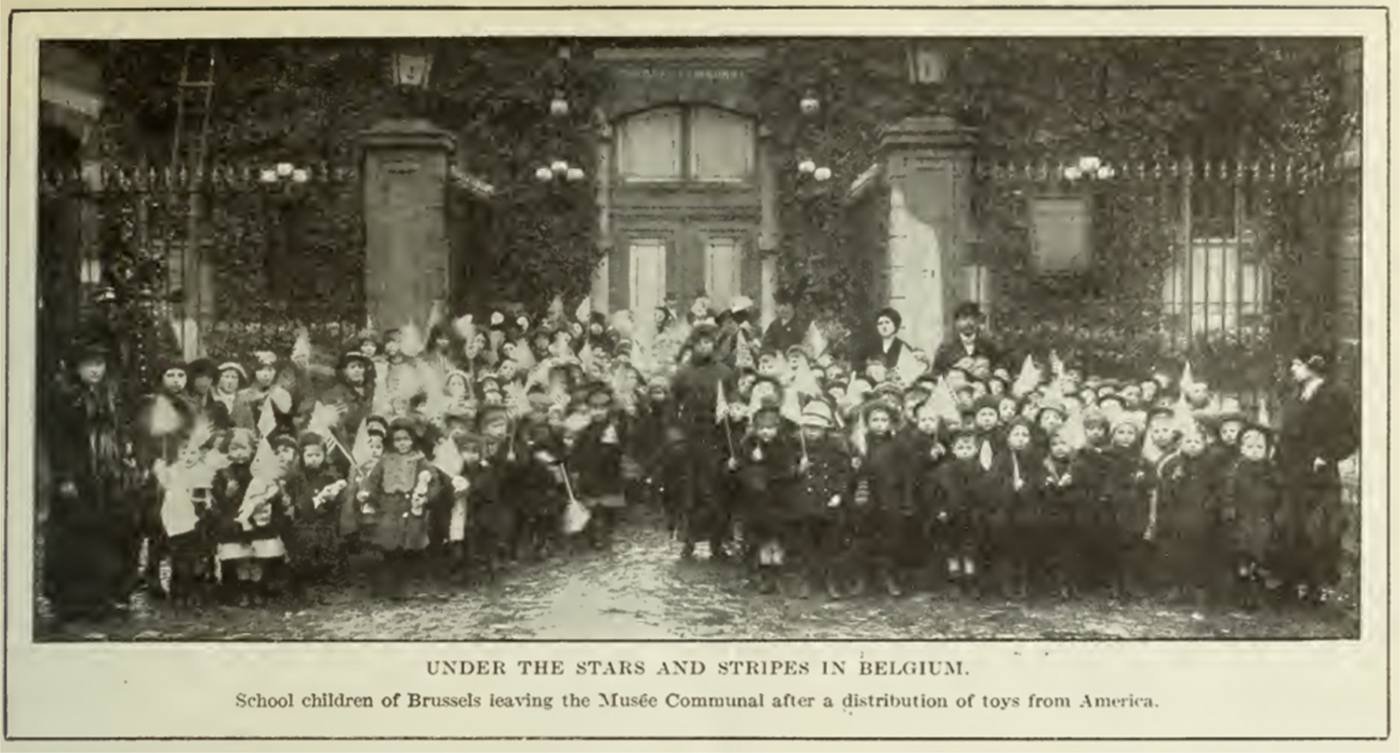
Moreover, unlike other forms of cultural mobilization, relief work offered unparalleled opportunities for voluntary action and personal participation. Rather than passively reading a newspaper article on a distant battle, tens of thousands of Americans, especially American women, collected, baked, and knitted for a multitude of humanitarian causes. For many of them, it seems, such charitable work was not only elevating and personally meaningful, but also allowed them to forge sentimental bonds across the Atlantic. The “fatherless children of France,” for example, thanked their American “godparents” with heartwarming letters of their life in wartime France and Belgian women sent back the Commission for Relief in Belgium's empty flour sacks—beautifully laced and embroidered—to convey their gratitude to American benefactors.Footnote 42 Such widely publicized European expressions of gratitude arguably did more than “just” connect thousands of Americans to a humanitarian cause overseas; they helped forge “emotional communities” between benefactors and war sufferersFootnote 43 (Image 1). No one was more keenly aware of the geopolitical significance of these developments than the pioneer of public opinion and propaganda research, Harold Lasswell. Growing up in a midwestern town during the Great War, Lasswell would later recognize that, “one of the most subtle and effective forms of indirect propaganda is the encouragement of everything which draws the neutral into some form of de facto co-operation with the belligerentFootnote 44 […] if the neutral power can be drawn into some form of non-military participation with a belligerent his sympathies are likely to crystallize about the object of his assistance. This is the inner significance of the tremendous campaign to secure aid for Belgian widows and orphans in America.”Footnote 45 It seems no exaggeration to say that it was partly through their relief work that many Americans began to locate themselves strongly on one of the war's sides, investing themselves heavily in Belgium's (or France's or, indeed, Germany's) fate.
“Under the Stars and Stripes in Belgium,” Literary Digest, Mar. 6, 1915, 461.
Frequent expressions of gratitude were crucial to the success of relief campaigns. Here: Belgian schoolchildren wave American flags after receiving toys from the United States.

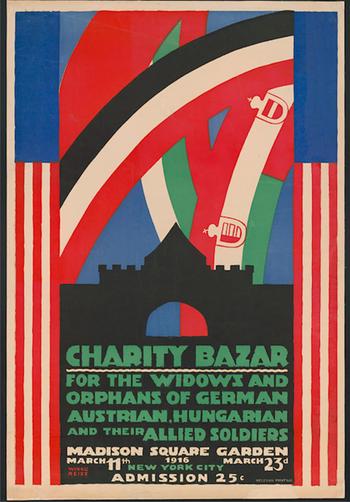
Finally, humanitarian pursuits offered a unique space for a large number of Americans (and not just those actively involved in fundraising efforts) to partake in and behold of events that moved the world. Whereas many Americans might have considered mass rallies in support of either warring party distasteful, relief bazaars—often no less partisan in character—drew wide popular attention and enthusiasm. Especially the very large-scale bazaars held in Chicago, Boston, Philadelphia, and New York in 1916 have to be taken serious as events that—like few others—mediated an otherwise distant war to Americans from all walks of life.Footnote 46 To comprehend their potential impact, we have to consider for a moment the setup and social world of these bazaars. Indeed, it is important to underline the impressive scope of these bazaars, which—with up to a million visitors—had very little in common with a provincial “bake sale”; quite the contrary, they amounted to extraordinarily large fairs, exhibiting the war from the side of either the Central Powers or the Allies (Image 2). Alongside the usual vaudeville entertainments such bazaars featured a wide array of nationally specific cultural artifacts, customs, and foods (such as French cabaret or a German Biergarten) inviting Americans to express and renew their cultural affinities with Europe. At the same time, however, they provided access to a world at war. Much like the war exhibits held in European capitals at the time, bazaars familiarized American civilians with a (sanitized) image of battlefront reality, offering a wide array of eyewitness talks, photographic exhibitions, the screening of war movies, and much more. The 1916 Allied Bazaar in Chicago, for example, featured a popular “trench making” event, where furloughed Canadian soldiers dug an “authentic” stretch of battlefield trenches under the expert guidance of, as the bazaar booklet noted, “Captain Norman G. Thwaites […who] has not only served in them in France, but constructed them there.”Footnote 47
Winold Reiss. Charity bazar for the widows and orphans of German, Austrian, Hungarian and their Allied soldiers. (Poster). New York: Hegeman Print, 1916. Library of Congress Prints and Photographs Division; The 1916 New York Bazaar for the Central Powers featured the reproduction of a medieval town in Madison Square Garden.

Belying their ever-present claims to neutrality, such events strongly showcased the war from the side of the Central Powers or the Allies respectively. Not only did they sell every conceivable kind of war memorabilia (including signed photographs of General Joffre or German spiky helmets), but they also offered exceedingly popular exhibitions of weaponry and battlefield trophies, often sponsored by the warring nations themselves. To supply the 1916 Allied Bazaar in Chicago, for example, the French government shipped 150 crates of material—weighing 100 tons and valued at $900,000—to the exhibition grounds, among them big guns; zeppelin wreckage; and, as the bazaar organizers advertised, “the battered and broken motor of the machine in which Pegoud, the most daring of all French airmen, was riding, when a German bullet pierced his heart.”Footnote 48 While the British sea blockade disabled similar imports from the Central Powers, German Americans still managed to exhibit a life-size reproduction of the Krupp canon “Big Bertha” as well as a German submarine during the 1916 Philadelphia bazaar. Perhaps most importantly, these bazaars broadened the opportunity for personal participation beyond the comparatively narrow set of fundraisers. At German American bazaars, so-called war nailings (adopted from Austrian and German practices) gave visitors the chance to involve themselves physically in the German war effort by purchasing and then driving a nail into a large wooden structure—a practice often likened to maiming the enemy—until by collective effort it had been transformed into an iron one.Footnote 49
Clearly then, the American supporters of either side used these spectacles in America's urban centers to impress and (subtly) involve the casual visitor with their party's unique culture, heroism, military prowess, and likely victory. Not surprisingly, European governments recognized such bazaars as both charity and propaganda events and, given the chance, enthusiastically embraced the opportunity to stage their own war exhibitions.Footnote 50 While it is difficult to ascertain the overall impact that such fundraising events had on the average visitors, evidence suggests that at least some Americans left them feeling more connected to either side's fate, more convinced of its heroic conduct and more certain of its ultimate victory.Footnote 51 On the conclusion of the 350-booth, 16-day Allied Bazaar in June 1916, the New York Evening Post characteristically—and probably correctly—remarked that “by no other token has it been granted to New York to enter so vividly into the spirit of France and its Allies.”Footnote 52 More than other aspects of cultural mobilization, relief work thus facilitated tangible transatlantic connections of flour sacks, letters, and knitwear; and intangible ones of admiration, compassion, and gratitude. To Americans, their humanitarian pursuits offered a unique, seemingly apolitical space where they could relatively inconspicuously gaze upon, experience, and support the European war efforts; it was not the least through relief work that the war's suffering and heroism became concrete and personally meaningful to many Americans.
DIVISIVE HUMANITARIAN NARRATIVES
From what has been said so far, it should be clear that these humanitarian events perpetuated not only very different versions of the war's origins and its likely outcome, but that they were also deeply divisive. While there was in theory nothing controversial about Americans aiding all sides of the conflict, in practice, the widely perpetuated humanitarian narratives mobilized Americans not only for a certain cause, but also against another. Perhaps the very strongest indication is the fact that—as far as the public fundraising campaigns were concerned—there was from the beginning nearly no overlap between those aiding, say, Belgium and those aiding, say, Austria-Hungary (not even to speak of those aiding France or Germany). By 1915, at the very latest, one can identify two, more or less, irreconcilable “relief camps,” which were built on diametrically opposed understandings of the meaning of the European war.
Ironically, this divisive character of relief work is nowhere clearer than with regard to the most self-consciously “neutral” of all American relief endeavors, the aid for Belgium. Although Hoover's Commission for Relief in Belgium carefully abstained from any criticism of the German government (whose consent it needed to administer relief), Belgian relief efforts aroused not only broad public support for “brave little Belgium,: but it clearly shaped American sentiments against Germany.Footnote 53 While the official Commission adhered to a policy of “strictest neutrality,”Footnote 54 the thousands of local and regional Belgian relief committees across the United States powerfully perpetuated America's initial outrage over the German invasion. In order to mobilize American empathy, they not only frequently exaggerated Belgian suffering but also drew liberally on the propaganda images associated with the German “rape of Belgium,” that is, the real and alleged atrocities committed by the German army.Footnote 55 One theater play sponsored by the Belgian Women's War Relief Committee in San Francisco (a committee with such illustrious sponsors as David Starr Jordan, founding president of Stanford University) vividly featured the whole range of German atrocities, including rape, wanton destruction, and excessive cruelty, conveying an especially gruesome reality of German occupation.Footnote 56 But even the more restrained (and much more common) appeals to American pity relied on these stories at least in part. Even the most cautious of them portrayed a deeply depressed Belgian population, unjustly ground under the heel of German militarism.Footnote 57 Indeed, given the pervasive American outrage over the breach of Belgian neutrality in 1914, it required no particularly reproachful representation of the German occupation for most Americans to be convinced that Belgian need resulted first and foremost from an illegal and, many believed, excessively cruel German invasion.Footnote 58 As understandable and in many respects correct as this emphasis was, it is still notable that by contrast the British sea blockade—a key element in Belgian distress—found hardly any critical mention. By their very nature then, the humanitarian narratives constructed around “poor little Belgium” helped define not only the war's victims; they almost invariably defined its “villains” as well. When a German submarine sank the British liner Lusitania on May 7, 1915, the Chicago Tribune thus characteristically remarked that, “to the slaughter of innocents in Belgium and Poland has been added the slaughter of the innocents on the Lusitania.”Footnote 59
Even after the sinking of the Lusitania, however, this prevalent narrative of German disregard for civilian life went never entirely unchallenged. It was not the least through their own relief work that German Americans, in particular, disputed the legitimacy of such depictions. In the summer of 1915, they initiated a wide-ranging relief effort on behalf of East Prussia, which had been devastated by several advances of the Russian army during the fall and winter of 1914.Footnote 60 The humanitarian narratives they constructed around East Prussia strongly highlighted the innocent victimhood of the population, the heroism of the liberating German army, and the unparalleled brutality of the Russian invaders. There is little doubt that shortly after the Lusitania, the Russian “rape of East Prussia” provided German Americans with both, a comforting counternarrative to America's dominant public discourse on Germans as perpetrators as well as a crucial reorganizing space for a disarrayed and cautious ethnic group. Importantly, too, they actively used the East Prussian campaign to publicly challenge what they deemed a strongly exaggerated Belgian case.Footnote 61 Indeed, many German Americans—while admitting that Germany had violated Belgium's legal neutrality—believed that Belgium had never been truly neutral in the first place (but secretly aligned with France) and that the conduct of the German army had been neither especially harsh, nor unprovoked, making Belgian distress only a deplorable consequence of its own unlawful actions.Footnote 62 For them, the truly innocent victims of an unprecedented breach of humanity were not Belgians, but East Prussians.
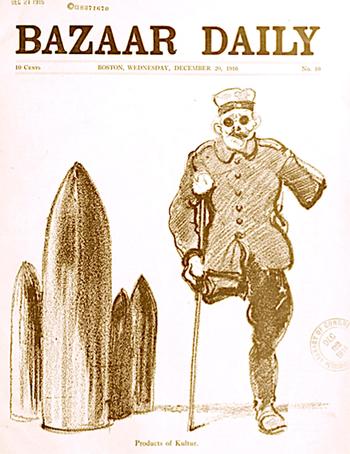
The fact that German American efforts to advertise East Prussian suffering found no sympathetic hearing with Anglo-Americans attests to the increasing polarization of American public debate, even and especially, with regard to humanitarian narratives. Many of those, who readily pitied faraway Serbia, France, or Belgium, found East Prussian distress, if they knew about it at all, but an unfortunate consequence of a war, which Germany had brought upon herself.Footnote 63 Just like many German Americans never—not even after 1917—accepted the legitimacy of Belgian victimhood, many Anglo-Americans had by 1915 become accustomed to see Germans as the war's perpetrators, not as its victims. As a consequence, the two “relief camps”—at least as far as their vocal proponents were concerned—grew ever more irreconcilable as the period of neutrality drew on. The large bazaars of 1916, for example, were no longer just held on behalf of France and Germany, but on behalf of the Allies and the Central Powers. And just as fundraising events ever more clearly reproduced the war's military-political fault lines, so, too, did they ever more clearly perpetuate its irreconcilable sentiments (Image 3). As one organizer of the 1916 Boston Allied Bazaar proclaimed, “in giving to the cause of the Allies our support, moral and economic, we are aiding the highest forces and hopes of mankind, and we are opposing in our strength the [German] militarism that has made a covenant with death and a league with hell.”Footnote 64 In the end, and all noble abstractions aside, American humanitarianism forged no common ground. On the contrary, it drew Americans on the different sides of the European war like few other public undertakings. Wittingly or not, American relief campaigns played a discrete role in the formation and sustenance of America's very different moral and emotional alliances during the period of neutrality.
Cover: “Product of Kultur,” Boston [Allied] Bazaar Daily, Dec. 20, 1916; to raise empathy and funds, war relief publicity often tapped into the language and imagery of the propaganda war, in this case an ironic comment on Germany's alleged “Kultur.”

CONCLUSIONS
This article broadens our understanding of the neutrality period in America in a number of ways. First, it emphasizes that, contrary to contemporary claims, relief work was never even remotely impartial. Quite the contrary, few other social activities so strongly reflected America's emotional ties, moral convictions, and cultural affinities during the period of neutrality. What is more, America's relief campaigns constructed humanitarian narratives that underlined the heroic suffering of one side while dehumanizing the other. In this way they further eroded many an American's already precarious commitment to “remain impartial in thought as well as in action.” This is not to doubt that American relief ameliorated bitter suffering; nor is to suggest—as some would after the warFootnote 65—that America's humanitarian intervention was a prelude to its military intervention. If there was one thing that united many members of the different “relief camps,” it was the idea that war relief could be an American alternative to military engagement.Footnote 66 And yet, by creating, maintaining, and popularizing certain narratives about the war, these humanitarian campaigns—alongside other factors, to be sure—help explain how many Americans came to identify the Allied cause as just and deserving of U.S. support. While this is not to claim that American society at large was “culturally mobilized” before 1917, humanitarian involvement reflected, shaped, and deepened central ideological assumptions about the victims and perpetrators of the European conflict. It was particularly the emotive and participatory nature of organized charity that made it so influential. More than just passively reading a newspaper, humanitarian work helped forge moral and emotional alliances across the Atlantic.
Still, up to 1917, these alliances remained much more discordant and more ambiguous than is usually suggested by students of Allied relief organizations. As this article suggests, American relief work aided all sides of the European war and as a consequence was a diverse and divisive undertaking. Throughout the period of neutrality, a considerable number of Americans rejected even apparently commonplace notions like the legitimacy of Belgian victimhood and as late as December 1916, hundreds of thousands of (not only ethnic German) Americans attended large-scale bazaars, which celebrated the heroic suffering of the Central Powers. The study serves as yet another a reminder that before Americans were mobilized for a common war effort, there were in fact very different American mobilizations.
It was only with the American entry in the war that these other humanitarian narratives were cut short and even forcefully suppressed. Though German Americans immediately stopped aiding the Central Powers, their earlier charitable efforts became the subject of strong suspicions. By contrast, the humanitarian narratives concerning Belgium and France now entered official U.S. war rhetoric. Trying to mobilize a reluctant public for war, American propagandists drew heavily on the imagery and techniques pioneered in Belgian and Allied fundraising campaigns.Footnote 67 In this respect, then, America's earlier humanitarian mobilization on behalf of France and Belgium presaged American home front mobilization after 1917.