Introduction
Approximately 25% of adults over the age of 18 years in the United States are currently serving as informal caregivers at any given time (Anderson et al., Reference Anderson, Edwards, Pearson, Talley, McGuire and Andersen2013). In this role, spouses or partners, family members, or friends provide “unpaid care, out of love, respect, or friendship, to assist with simple and occasional tasks and/or full-time care needs” (Centers for Disease Control and Prevention, 2016a). Approximately 10% of caregivers report caring for a person with cancer (Trivedi et al., Reference Trivedi, Beaver, Bouldin, Eugenio, Zeliadt, Nelson, Rosland, Szarka and Piette2014) and 37% of cancer survivors (Centers for Disease Control and Prevention, 2016b) report having an informal caregiver (de Moor et al., Reference de Moor, Dowling, Ekwueme, Guy, Rodriguez, Virgo, Han, Kent, Li, Litzelman, McNeel, Liu and Yabroff2016). With more than 15 million cancer survivors currently (Centers for Disease Control and Prevention and National Cancer Institute, n.d.) and a projected 20 million by 2026 in the United States (US) (Bluethmann, Mariotto & Rowland, Reference Bluethmann, Mariotto and Rowland2016), informal caregiving for cancer survivors may likely increase.
Quality of life (QOL) consists of a range of domains to measure an individual's overall health. Common dimensions of health used to measure QOL are physical, psychological, social, and spiritual components (Post, Reference Post2014). The demands of informal cancer caregiving can affect caregivers’ overall quality of life (QOL) and are associated with higher rates of poor physical (Grant et al., Reference Grant, Sun, Fujinami, Sidhu, Otis-Green, Juarez, Klein and Ferrell2013; Harden et al., Reference Harden, Sanda, Wei, Yarandi, Hembroff, Hardy and Northouse2013; Kim, van Ryn et al., Reference Kim, van Ryn, Jensen, Griffin, Potosky and Rowland2015; Kim, Wellisch & Spillers, Reference Kim, Wellisch and Spillers2008) and mental health (Harden et al., Reference Harden, Sanda, Wei, Yarandi, Hembroff, Hardy and Northouse2013; Kim, van Ryn, et al., Reference Kim, van Ryn, Jensen, Griffin, Potosky and Rowland2015; Langer, Brown & Syrjala, Reference Langer, Brown and Syrjala2009; Lichtenthal et al., Reference Lichtenthal, Nilsson, Kissane, Breitbart, Kacel, Jones and Prigerson2011; Kim, Kashy et al., Reference Kim, Kashy, Wellisch, Spillers, Kaw and Smith2008), psychological distress (Kim, Bake & Spillers, Reference Kim, Baker and Spillers2007; Kim et al., Reference Kim, Wellisch, Spillers and Crammer2007; Kim and Spillers, Reference Kim and Spillers2010), and feelings of life dissatisfaction (Kim, Schulz & Carver, Reference Kim, Schulz and Carver2007; Kim, Carver, Deci & Kasser, Reference Kim, Carver, Deci and Kasser2008), compared with non-caregivers (Anderson et al., Reference Anderson, Edwards, Pearson, Talley, McGuire and Andersen2013). In addition, studies have shown that informal cancer caregivers may be responsible for performing technical tasks usually rendered by medical/nursing professionals (e.g., injections, tube feeding, etc.) (Teschendorf et al., Reference Teschendorf, Schwartz, Ferrans, O'Mara, Novotny and Sloan2007), which can result in increased emotional stress and physical strain (AARP & National Alliance for Caregiving, 2015). Caregivers often felt unprepared to perform these tasks (Teschendorf et al., Reference Teschendorf, Schwartz, Ferrans, O'Mara, Novotny and Sloan2007) and identified education, communication, and resource needs to promote QOL (Tamayo, Broxson, Munsell & Cohen, Reference Tamayo, Broxson, Munsell and Cohen2010). The volume of caregiving responsibilities and length of time caring for a cancer survivor has also been associated with caregiver QOL (AARP & National Alliance for Caregiving, 2015; Given BA, Given CW & Sherwood, Reference Given, Given and Sherwood2012). For example, hours spent caregiving were negatively correlated with mental and psychological well-being (Ross, Mosher, Ronis-Tobin, Hermele & Ostroff, Reference Ross, Mosher, Ronis-Tobin, Hermele and Ostroff2010). Additionally, social support (Kim, Schulz & Carver, Reference Kim, Schulz and Carver2007; Milbury, Badr, Fossela, Pisters & Carmack, Reference Milbury, Badr, Fossella, Pisters and Carmack2013; Siefert, Williams, Dowd, Chappel-Aiken & McCorkle, Reference Siefert, Williams, Dowd, Chappel-Aiken and McCorkle2008; Spillers, Wellisch, Kim, Matthews & Baker, Reference Spillers, Wellisch, Kim, Matthews and Baker2008) and the interpersonal relationship between caregiver and cancer survivor (Kershaw et al., Reference Kershaw, Mood, Newth, Ronis, Sanda, Vaishampayan and Northouse2008; Kim, Kashy et al. Reference Kim, Kashy, Wellisch, Spillers, Kaw and Smith2008; Porter, Keefe, Garst, McBride & Baucom, Reference Porter, Keefe, Garst, McBride J and Baucom2008) can impact caregivers’ QOL. Studies have demonstrated that lack of social support is related to difficulties in maintaining good physical and mental health (Mazanec, Daly, Douglas & Lipson, Reference Mazanec, Daly, Douglas and Lipson2011; Milbury et al., Reference Milbury, Badr, Fossella, Pisters and Carmack2013; Pawl, Lee, Clark & Sherwood, Reference Pawl, Lee, Clark and Sherwood2013).
To better understand the impact of caregiving, it is important to identify the caregiving recipient's phase of survivorship, which includes acute, middle to long-term, and end of life/bereavement (Kim and Given, Reference Kim and Given2008). For this purpose, we conducted a systematic review of the published literature to examine cancer caregiver QOL in which we characterized each study according to the phase of cancer survivorship to better understand caregiver concerns related to physical health, psychological distress, spirituality, and social support throughout the cancer experience. Findings from this review can help identify research gaps and highlight opportunities for interventions to improve cancer caregiver QOL across the cancer experience.
Methods
Search strategy
Our systematic literature review of PubMed/Medline articles examined research on QOL among informal cancer caregivers to improve their psychosocial health outcomes. The Preferred Reporting Items for Systematic Reviews and Meta-Analyses (PRISMA) guidelines were used to design and perform the literature review (Moher, Liberati, Tetzlaff & Altman, Reference Moher, Liberati, Tetzlaff and Altman2009). The search was limited to English language studies, published between January 1, 2007 and December 31, 2017, with adult caregivers of cancer patients (≥18 years) in the United States. Search terms used included “cancer” OR “carcinoma” AND “caregiver” OR “carer” AND “quality of life” which were previously utilized in a literature review (Kim and Given, Reference Kim and Given2008).
Eligibility criteria
Studies met the following inclusion criteria: (1) a sample size over 50, (2) studies conducted in the US, (3) results on informal cancer caregiver's QOL, and (4) report on data from a quantitative study published in peer reviewed journals. Studies that had sample size of <50, not specific to informal cancer caregivers, reported on the evaluation of assessment tools exclusively, literature reviews, or conducted outside of the US were excluded. Articles were also excluded if the results described only patients’ QOL. We also excluded studies of caregivers of pediatric cancer survivors due to unique burden placed on caregivers (usually the parents of pediatric cancer survivors), which increases their decision making responsibility compared with caregivers for adult cancer survivors (Jones and Barbara, Reference Jones2012). Additionally, case reports, commentaries, and studies where only clustered analyses with both patients and caregivers were reported were also excluded. Finally, qualitative and intervention studies were excluded from this review because the differences in study design make it difficult to compare the findings.
Data extraction
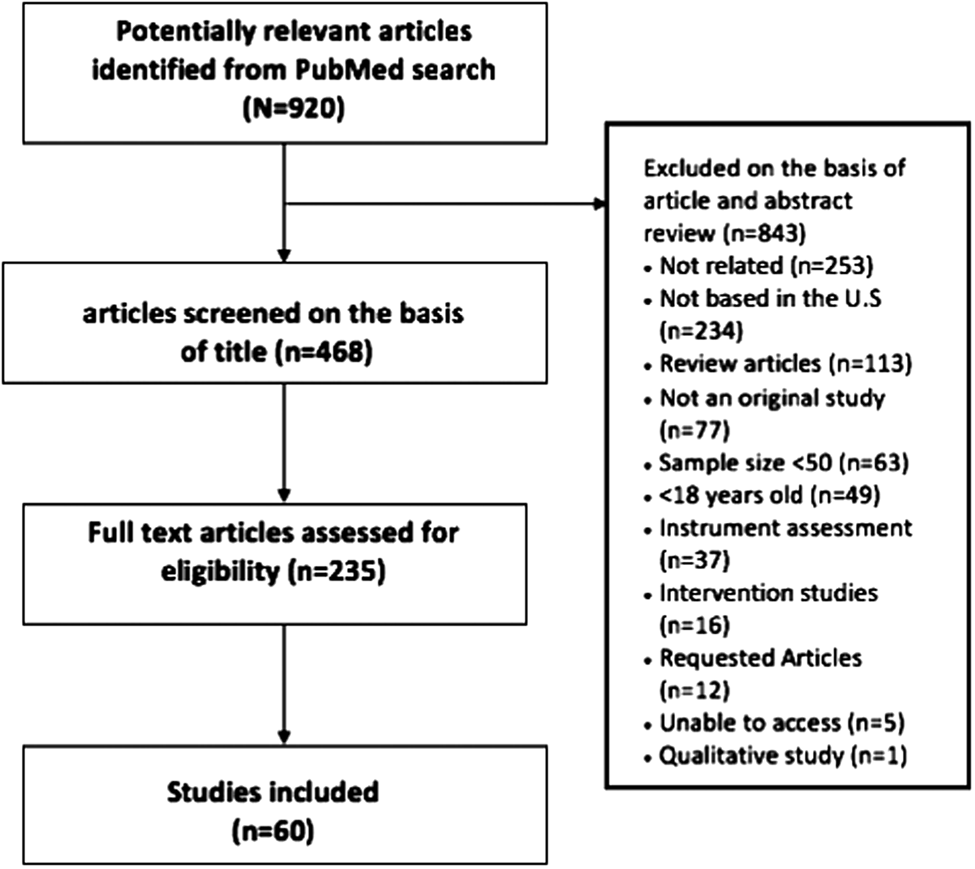
A total of 920 articles were identified, 685 of which did not meet study criteria on the basis of a title and abstract review. Two researchers reviewed titles and abstracts for all articles and classified abstracts as “relevant (R),” “needs more information (NMI),” or “not relevant (NR).” A full text paper review was conducted for 235 articles that were classified as “R” and “NMI.” From this review, 60 articles were determined to be relevant. To reduce reviewer bias, the reviewers tested for quality assurance and accuracy (reliability rate >75%). Figure 1 provides a flowchart of the article selection process with reasons for study exclusion.
PRISMA flowchart of studies selection process.

Data synthesis
For each study, the following information was abstracted: PubMed ID, title, author(s), year of publication, sample size, study population characteristics (age, type of cancer, gender, and relationship to cancer survivor), study design, measures used for outcomes of interest, and significant findings. All studies were categorized according to the caregiving recipient's phase of survivorship (acute, middle to long-term, end of life/bereavement). Studies were classified in the “acute survivorship phase” when caregiving occurred from the point of diagnosis through the end of active treatment. Studies in the “middle to long-term phase” described outcomes related to post-treatment caregiving for survivors who were not on active treatment and/or had no evidence of disease (NED). The “end of life/bereavement phase” included studies reporting outcomes for caregivers of survivors who were experiencing metastatic or recurrent disease, at the end of life, in hospice care, or passed away due to cancer related illness. Studies were classified as “cross-listed” when findings were described across multiple phases (i.e., middle to long-term and bereavement phases). Additionally, studies that looked at post-diagnostic cancer caregiving without stratifying findings by acute, middle to long-term, or end of life/bereavement phases were identified as cross-listed.
Results
Study characteristics
Among 60 relevant research articles, 38% (n = 23) described caregiving QOL characteristics during the acute phase, 7% (n = 4) during the middle to long-term phase, 12% (n = 7) were during the bereavement phase, and 43% (n = 26) across multiple phases of the survivorship trajectory (cross-listed). The majority of studies reported findings for non-Hispanic white, middle-income females with at least a high school education. Studies largely examined overall physical and mental health, psychological distress, spirituality and social support, with some studies reporting on multiple dimensions of psychosocial health. The sample sizes ranged from 54 (Siefert et al., Reference Siefert, Williams, Dowd, Chappel-Aiken and McCorkle2008) to 1,666 (Kim, Kashy, Spillers & Evans, Reference Kim, Kashy, Spillers and Evans2010) caregivers in studies examining outcomes among caregivers only. In studies examining convergence/divergence among caregiver and patient dyads, studies ranged from 56 (Cooke, Grant, Eldredge, Maziarz & Nai, Reference Cooke, Grant, Eldredge, Maziarz and Nail2011) to 1820 dyads (Litzelman, Green & Yabroff, Reference Litzelman, Green and Yabroff2016). While most studies described spousal/significant other/partner caregiver-survivor relationships (N = 54), other relationship types included adult children, parents, other family members (nieces, nephews, and grandchildren), and unrelated friends. About half of the articles used a cross-sectional study design (N = 32) and a third of the articles used a longitudinal study design (N = 23) to assess caregiving QOL from the point of patient diagnosis through eight years post-diagnosis. Forty-five studies provided data on mean caregiver age, which ranged from 37 to 68 years. The majority of findings described caregivers who were female, with the exception of two studies (Mezue, Draper, Watson & Mathew, Reference Mezue, Draper, Watson and Mathew2011; Siefert et al., Reference Siefert, Williams, Dowd, Chappel-Aiken and McCorkle2008). Nationally representative findings on caregivers’ QOL were largely collected as a part of Cancer Care Outcomes Research and Surveillance and the Medical Expenditure Panel Survey datasets.
Measures used to assess concepts of QOL
All included studies used self-reported measures to assess differing concepts of QOL. Thirty-eight unique measures were identified (Table 1), including three developed or adapted for their respective studies to measure HRQOL (Prosser et al., Reference Prosser, Lamarand, Gebremariam and Wittenberg2015), psychological distress (Litzelman, Kent & Rowland, Reference Litzelman, Kent and Rowland2016; Parvataneni et al., Reference Parvataneni, Polley, Freeman, Lamborn, Prados, Butowski, Liu, Clarke, Page, Rabbitt, Fedoroff, Clow, Hsieh, Kivett, Deboer and Chang2011), and spirituality (Garrido and Prigerson, Reference Garrido and Prigerson2014). Twenty-eight studies used the 12- and 36-item Medical Outcomes Study Index Short-Form (MOS-SF) to assess the physical and mental health of caregivers. The most widely used assessments of psychological distress included: the Profile Mood State (POMS; 15 studies), the Center for Epidemiologic Studies depression scale (CES-D; 13 studies), and the Pearlin Stress Scale (PSS; 7 studies). The Functional Assessment of Chronic Illness Therapy-Spiritual Well-Being scale (FACIT-Sp) was the most widely used scale to measure spiritual well-being as a domain of quality of life (10 studies). Caregivers’ perception of social support was assessed using the Interpersonal Support Evaluation List (ISEL) (Boehmer, Tripodis, Bazzi, Winter & Clark, Reference Boehmer, Tripodis, Bazzi, Winter and Clark2016; Kim, Schulz & Carver, Reference Kim, Schulz and Carver2007; Kim, Shaffer, Carver & Cannady, Reference Kim, Shaffer, Carver and Cannady2014; Pawl et al., Reference Pawl, Lee, Clark and Sherwood2013; Sumner, Wellisch, Kim & Spillers, Reference Sumner, Wellisch, Kim and Spillers2015; Wright et al., Reference Wright, Keating, Balboni, Matulonis, Block and Prigerson2010), Caregiver Reaction Assessment (CRA) (Adams, Mosher, Cannady, Lucette & Kim, Reference Adams, Mosher, Cannady, Lucette and Kim2014; Gaugler et al., Reference Gaugler, Given, Linder, Kataria, Tucker and Regine2008; Mazanec et al., Reference Mazanec, Daly, Douglas and Lipson2011; Milbury et al., Reference Milbury, Badr, Fossella, Pisters and Carmack2013; Siefert et al., Reference Siefert, Williams, Dowd, Chappel-Aiken and McCorkle2008; Spillers et al., Reference Spillers, Wellisch, Kim, Matthews and Baker2008; Washington, Pike, Demiris & Oliver, Reference Washington, Pike, Demiris and Oliver2015), the Personal Resources Questionnaire (PRQ) (Kershaw et al., Reference Kershaw, Mood, Newth, Ronis, Sanda, Vaishampayan and Northouse2008; Northouse et al., Reference Northouse, Mood, Montie, Sandler, Forman, Hussain, Pienta, Smith, Sanda and Kershaw2007), the Multidimensional Scale of Perceived Social Support (MSPSS) (Boehmer et al., Reference Boehmer, Tripodis, Bazzi, Winter and Clark2016), the Medical Outcomes Social Support Survey (MOS-SS) (Mazanec et al., Reference Mazanec, Daly, Douglas and Lipson2011), and the Linear Analog Self-Assessment (LASA) (Shahi et al.. Reference Shahi, Lapid, Kung, Atherton, Sloan, Clark and Rummans2014).
Study characteristics by acute, middle to long-term, bereavement, and cross-listed

HRQOL, physical and mental health; HSW, heterosexual women; SMW, sexual minority women; FCR, former caregivers-remission; FCB, former caregivers-bereaved; CC, current caregivers; HC, husband cancer; WC, wife cancer.
a Sample size for cancer caregivers with valid/completed data (*indicates sample size includes patient-caregiver as dyads).
b Protective buffering—a form of social support in which one dyad member attempts to minimize the stress of the situation for the other.
Major findings
Overall, study findings identified poor cancer caregiver QOL across all phases of survivorship for physical and mental health, psychological distress, social support and spirituality (Table 2). Perceived physical and mental health were the most frequently examined QOL characteristics across all survivorship phases. Across the included studies, depression (Litzelman, Green & Yabroff, Reference Litzelman, Green and Yabroff2016; Weaver, Rowland, Augustson & Atienza, Reference Weaver, Rowland, Augustson and Atienza2011; Winters-Stone, Lyons, Bennett & Beer Reference Winters-Stone, Lyons, Bennett and Beer2014; Wright et al., Reference Wright, Zhang, Ray, Mack, Trice, Balboni, Mitchell, Jackson, Block, Maciejewski and Prigerson2008; Wright et al., Reference Wright, Keating, Balboni, Matulonis, Block and Prigerson2010), anxiety (Pawl et al., Reference Pawl, Lee, Clark and Sherwood2013; Deatrick et al., Reference Deatrick, Hobbie, Ogle, Fisher, Barakat, Hardie, Reilly, Li and Ginsberg2014; Washington et al., Reference Washington, Pike, Demiris and Oliver2015; Kim, Carver, Spillers, Love-Ghaffari & Kaw, Reference Kim, Carver, Spillers, Love-Ghaffari and Kaw2012), grief (Lichtenthal et al., Reference Lichtenthal, Nilsson, Kissane, Breitbart, Kacel, Jones and Prigerson2011; Wright et al., Reference Wright, Keating, Balboni, Matulonis, Block and Prigerson2010), and overall distress (Kim & Spillers, Reference Kim and Spillers2010; Spillers et al., Reference Spillers, Wellisch, Kim, Matthews and Baker2008; Northouse et al., Reference Northouse, Mood, Montie, Sandler, Forman, Hussain, Pienta, Smith, Sanda and Kershaw2007; Wright et al., Reference Wright, Zhang, Ray, Mack, Trice, Balboni, Mitchell, Jackson, Block, Maciejewski and Prigerson2008) were components of caregiver psychological functioning that impacted overall QOL. Some studies also reported the negative effects of suicidal ideation on overall QOL (Lichtenthal et al., Reference Lichtenthal, Nilsson, Kissane, Breitbart, Kacel, Jones and Prigerson2011; Abbott, Prigerson & Maciejewski, Reference Abbott, Prigerson and Maciejewski2014). The most common measures of psychological distress were depression (23 articles; 38%), anxiety (10 articles; 17%), and mood state (e.g., anxiety, depression, hostility) (6 articles; 10%). The role of social support and spirituality in relation to physical and mental health was only examined in the acute, bereavement, and cross-listed phases. Spirituality and religion were described as protective factors or buffers that mediate or moderate the relationship between life stressors and QOL (Culliford, Reference Culliford2002; Miller & Thoresen, Reference Miller and Thoresen2003).
Methodological and significant findings overview of included studies

N = 60 studies.
FCR, former caregivers-remission; FCB, former caregivers-bereaved; CC, current caregivers.
a Based on bivariate and multivariate analyses in the final model; results not listed were nonsignificant.
b ACS's Hope Lodge house (free stay if patient is undergoing outpatient cancer treatment at least three times weekly and reside greater than 40 miles away from cancer treatment facility).
c Protective buffering—a form of social support in which one dyad member attempts to minimize the stress of the situation for the other.
Acute phase (diagnosis through active treatment)
Most acute phase studies reported poor caregiver QOL, including physical and mental health constructs. Factors associated with poor caregiver physical health included low education attainment (Shaffer et al., Reference Shaffer, Jacobs, Nipp, Carr, Jackson, Park, Pirl, El-Jawahri, Gallagher, Greer and Temel2017), having any comorbidities (Pawl et al., Reference Pawl, Lee, Clark and Sherwood2013; Kim, van Ryn, et al., Reference Kim, van Ryn, Jensen, Griffin, Potosky and Rowland2015), being female (Siefert et al., Reference Siefert, Williams, Dowd, Chappel-Aiken and McCorkle2008), reported history of depressive symptoms (Kim, van Ryn et al., Reference Kim, van Ryn, Jensen, Griffin, Potosky and Rowland2015), caring for a female patient (Kim, van Ryn et al., Reference Kim, van Ryn, Jensen, Griffin, Potosky and Rowland2015), and caring for patients with low reported social well-being (Shaffer et al., Reference Shaffer, Jacobs, Nipp, Carr, Jackson, Park, Pirl, El-Jawahri, Gallagher, Greer and Temel2017). Partner effects were also found to impact caregivers’ mental and physical health. Among lung and colorectal cancer patient-caregiver dyads, where one or both members reported being current smokers, smoking was associated with poorer caregiver mental and physical health (Weaver et al., Reference Weaver, Rowland, Augustson and Atienza2011). Caregivers experienced increased depressive symptoms and poorer mental health if they were the patients’ spouse (Shaffer et al., Reference Shaffer, Jacobs, Nipp, Carr, Jackson, Park, Pirl, El-Jawahri, Gallagher, Greer and Temel2017), cared for a male patient that demonstrated depressive symptoms (Kim, van Ryn, et al., Reference Kim, van Ryn, Jensen, Griffin, Potosky and Rowland2015), or cared for patients with self-reported poor QOL. Concealing concerns about the patient's cancer diagnosis, was negatively associated with relationship satisfaction (Hagedoorn et al., Reference Hagedoorn, Kuijer, Buunk, DeJong, Wobbes and Sanderman2000) and the mental health for both patients and caregivers (Langer, Brown & Syrjala, Reference Langer, Brown and Syrjala2009).
Factors that were positively associated with higher overall QOL among caregivers included predictability pertaining to caregiver routine (Cooke et al., Reference Cooke, Grant, Eldredge, Maziarz and Nail2011), caregiver sleep quality (Pawl et al., Reference Pawl, Lee, Clark and Sherwood2013), and working full- or part-time (Siefert et al., Reference Siefert, Williams, Dowd, Chappel-Aiken and McCorkle2008). Caregiver and/or patient self-efficacy or perceived ability to manage the illness was also related to better caregiver physical health (Kershaw et al., Reference Kershaw, Ellis, Yoon, Schafenacker, Katapodi and Northouse2015). Compared with younger cancer patients, caring for an older patient was associated with higher levels of mental and emotional well-being (Shahi et al., Reference Shahi, Lapid, Kung, Atherton, Sloan, Clark and Rummans2014).
Psychological distress
Depression was found to negatively impact caregiver mental and physical health and overall QOL (Kim, van Ryn et al., Reference Kim, van Ryn, Jensen, Griffin, Potosky and Rowland2015). Studies found that depression impacted caregivers’ functional status and QOL (Fletcher et al., Reference Fletcher, Paul, Dodd, Schumacher, West, Cooper, Lee, Aouizerat, Swift, Wara and Miaskowski2008) and was positively correlated with anxiety (Pawl et al., Reference Pawl, Lee, Clark and Sherwood2013). Higher depression scores in caregivers of survivors being seen in clinical treatment settings were associated with family disagreement about treatment recommendations from doctors and discussions regarding transitioning from active cancer treatment to hospice care (Zhang, Zyzanski & Siminoff, Reference Zhang, Zyzanski and Siminoff2010). Among spousal cancer caregivers, those who were high in avoidant attachment (less sensitive and responsive to their partner's needs) reported higher levels of caregiver strain, anger, and depression, while those who were high in anxious attachment (tendency to engage in over-involved and controlling forms of caregiving) reported higher levels of anxiety (Porter, Keefe, Davis, Scipio & Garst, Reference Porter, Keefe, Davis, Rumble, Scipio and Garst2012). Among those with advanced cancer, patients’ physical health had a direct effect on caregiver depression with caregivers reporting higher levels of depression concomitant with the decline in patients’ physical health (Douglas & Daly, Reference Douglas and Daly2013).
A sub-set of the studies (N = 9) examined caregivers’ anxiety (Fletcher et al., Reference Fletcher, Paul, Dodd, Schumacher, West, Cooper, Lee, Aouizerat, Swift, Wara and Miaskowski2008; Mezue et al., Reference Mezue, Draper, Watson and Mathew2011; Pawl et al., Reference Pawl, Lee, Clark and Sherwood2013; Porter et al., Reference Porter, Keefe, Davis, Rumble, Scipio and Garst2012; Weaver et al., Reference Weaver, Rowland, Augustson and Atienza2011) and mood state (anxiety, depression, hostility) (Douglas & Daly, Reference Douglas and Daly2013; Gaugler et al., Reference Gaugler, Given, Linder, Kataria, Tucker and Regine2008; Porter et al., Reference Porter, Keefe, Davis, Rumble, Scipio and Garst2012; Shahi et al., Reference Shahi, Lapid, Kung, Atherton, Sloan, Clark and Rummans2014) in the acute phase. Among caregivers of head and neck cancer survivors, the patient mood state influenced caregivers’ overall QOL (Shahi et al., Reference Shahi, Lapid, Kung, Atherton, Sloan, Clark and Rummans2014). Colorectal and lung cancer caregivers who smoked or were in mismatched dyads (where either cancer patient or caregiver smoked) reported greater anxiety (Weaver et al., Reference Weaver, Rowland, Augustson and Atienza2011). Caregiving burden (i.e., lack of family support, financial strain, schedule disruptions, and health problems) was positively associated with distress (Milbury et al., Reference Milbury, Badr, Fossella, Pisters and Carmack2013). Better relationship quality, family function, and caring for a female patient was associated with less stress (Litzelman, Kent & Rowland, Reference Litzelman, Kent and Rowland2016).
Social support
Perceived social support was related to caregivers’ and cancer survivor's QOL. Caregivers that reported high levels of social support were caring for older patients (>65 years) (Shahi et al., Reference Shahi, Lapid, Kung, Atherton, Sloan, Clark and Rummans2014) and patients treated in clinical (vs. community settings) (Sumner et al., Reference Sumner, Wellisch, Kim and Spillers2015). Lower levels of caregiver social support were associated with lower levels of spirituality (Adams et al., Reference Adams, Mosher, Cannady, Lucette and Kim2014), increased fatigue and lack of sleep (Pawl et al., Reference Pawl, Lee, Clark and Sherwood2013), and distress between spouses (Milbury et al., Reference Milbury, Badr, Fossella, Pisters and Carmack2013). Differences by race/ethnicity were noted in one study, where African-American and Hispanic caregivers reported an increased QOL burden related to a lack of family support and the impact that caregiving had on their finances (Siefert et al., Reference Siefert, Williams, Dowd, Chappel-Aiken and McCorkle2008).
Social well-being, including the overall perception of relationship quality, was a less explored domain of QOL. Caregivers responsible for a spouse or partner reported worse mental health (Shaffer et al., Reference Shaffer, Jacobs, Nipp, Carr, Jackson, Park, Pirl, El-Jawahri, Gallagher, Greer and Temel2017), and relationship quality than those who cared for other family members (not spouse/partner) or friends reported better family functioning (Litzelman, Kent & Rowland, Reference Litzelman, Kent and Rowland2016). Spousal caregivers high in avoidant attachment characteristics reported significantly lower levels of marital quality (Porter et al., Reference Porter, Keefe, Davis, Rumble, Scipio and Garst2012). Regardless of the gender of the caregiver, the type of relationship between caregiver and the care recipient, and other elements of the caregiving relationship, caring for a female patient was also associated with better relationship quality but worse family functioning (Litzelman, Kent & Rowland, Reference Litzelman, Kent and Rowland2016).
Spirituality
Patient spiritual well-being mediated the relationship between patient physical health and caregiver depression (Douglas & Daly, Reference Douglas and Daly2013). Findings from this study suggest that a low level of spiritual well-being in patients may be a risk factor for depression among caregivers. Higher levels of spirituality were also positively correlated with sleep quality and negatively with anxiety among caregivers (Pawl et al., Reference Pawl, Lee, Clark and Sherwood2013). Caregivers of older cancer patients who reported higher QOL reported higher levels of spiritual well-being (Shahi et al., Reference Shahi, Lapid, Kung, Atherton, Sloan, Clark and Rummans2014).
Middle to long-term phase (post-treatment care)
Among the middle to long-term phase survivorship studies, caregivers’ QOL was related to survivor health (Deatrick et al., Reference Deatrick, Hobbie, Ogle, Fisher, Barakat, Hardie, Reilly, Li and Ginsberg2014) and caregiver perceptions of stress, threat, and benefit associated with caregiving (Harden et al., Reference Harden, Sanda, Wei, Yarandi, Hembroff, Hardy and Northouse2013). No studies were identified that examined social support and spirituality. One study identified a positive reciprocal relationship with higher survivor QOL equating to better caregiver QOL (Deatrick et al., Reference Deatrick, Hobbie, Ogle, Fisher, Barakat, Hardie, Reilly, Li and Ginsberg2014). Perceived stressfulness and lack of perceived benefit associated with caregiving were found to negatively affect caregivers’ QOL over time and impact intimacy between spousal caregivers and prostate cancer survivors (Harden et al., Reference Harden, Sanda, Wei, Yarandi, Hembroff, Hardy and Northouse2013).
Psychological distress
Middle to long-term phase studies examined depression, anxiety, and stress related to QOL. Studies examining prostate cancer caregivers found that patient symptom severity was correlated with caregiver depression (Winters-Stone et al., Reference Winters-Stone, Lyons, Bennett and Beer2014) and perceived caregiver stress was also a predictor for caregivers overall QOL and mental health (Harden et al., Reference Harden, Sanda, Wei, Yarandi, Hembroff, Hardy and Northouse2013). Among caregivers of brain cancer survivors, better caregiver health, including both lower psychological distress and higher QOL, was associated with fewer perceived caregiver demands and better family functioning (Deatrick et al., Reference Deatrick, Hobbie, Ogle, Fisher, Barakat, Hardie, Reilly, Li and Ginsberg2014). Additionally, among caregivers of head and neck cancer survivors, increased time spent caregiving was also associated with worse psychological well-being (Ross et al., Reference Ross, Mosher, Ronis-Tobin, Hermele and Ostroff2010).
End of life/bereavement phase
Bereavement phase studies reported that good caregiver mental and physical health was associated with several patient characteristics and outcomes including: high patient QOL (Wright et al., Reference Wright, Zhang, Ray, Mack, Trice, Balboni, Mitchell, Jackson, Block, Maciejewski and Prigerson2008), strong patient relationship with doctors (Trevino et al., Reference Trevino, Maciejewski, Epstein and Prigerson2015), and better patient quality end-of-life experience (caregivers or clinicians assessed patients QOL in week before death) (Garrido and Prigerson, Reference Garrido and Prigerson2014). A patient's death in a hospital (versus home) (Garrido and Prigerson, Reference Garrido and Prigerson2014), presence of prolonged grief disorder (Lichtenthal et al., Reference Lichtenthal, Nilsson, Kissane, Breitbart, Kacel, Jones and Prigerson2011), and caring for a patient who received any aggressive care (Wright et al., Reference Wright, Zhang, Ray, Mack, Trice, Balboni, Mitchell, Jackson, Block, Maciejewski and Prigerson2008) were associated with poor caregiver QOL outcomes. Among informal hospice caregivers, cancer caregivers were more likely to co-reside (live in the same house) with the patient and this resulted in better overall QOL compared with co-residing non-cancer caregivers (Washington et al., Reference Washington, Pike, Demiris and Oliver2015). Similarly, caregivers reported better mental health outcomes when they perceived that their loved ones with cancer experienced less pain upon death and had a completed “do not resuscitate” (DNR) order (Garrido and Prigerson, Reference Garrido and Prigerson2014).
Psychological distress
The majority of the studies classified in the bereavement phase examined QOL outcomes related to psychological distress including depression (Garrido and Prigerson, Reference Garrido and Prigerson2014; Lichtenthal et al., Reference Lichtenthal, Nilsson, Kissane, Breitbart, Kacel, Jones and Prigerson2011; Wright et al., Reference Wright, Zhang, Ray, Mack, Trice, Balboni, Mitchell, Jackson, Block, Maciejewski and Prigerson2008; Wright et al., Reference Wright, Keating, Balboni, Matulonis, Block and Prigerson2010), grief (Lichtenthal et al., Reference Lichtenthal, Nilsson, Kissane, Breitbart, Kacel, Jones and Prigerson2011, Wright et al., Reference Wright, Keating, Balboni, Matulonis, Block and Prigerson2010), anxiety (Washington et al., Reference Washington, Pike, Demiris and Oliver2015), overall distress (Wright et al., Reference Wright, Zhang, Ray, Mack, Trice, Balboni, Mitchell, Jackson, Block, Maciejewski and Prigerson2008), and suicidal ideation (Abbott, Prigerson & Maciejewski, Reference Abbott, Prigerson and Maciejewski2014; Lichtenthal et al., Reference Lichtenthal, Nilsson, Kissane, Breitbart, Kacel, Jones and Prigerson2011). Some of the risk factors for poor QOL among caregivers in this phase included married caregivers negative perception of patients’ QOL and impact on spousal relationship (Abbott et al., Reference Abbott, Prigerson and Maciejewski2014), quality of death (Garrido & Prigerson, Reference Garrido and Prigerson2014), patient receiving aggressive care at the end of life (Wright et al., Reference Wright, Zhang, Ray, Mack, Trice, Balboni, Mitchell, Jackson, Block, Maciejewski and Prigerson2008), location of death (hospital vs. home hospice), and pre-existing self-reported psychiatric morbidities among caregivers (Wright et al., Reference Wright, Keating, Balboni, Matulonis, Block and Prigerson2010). The presence of prolonged grief disorder (Lichtenthal et al., Reference Lichtenthal, Nilsson, Kissane, Breitbart, Kacel, Jones and Prigerson2011) and caregivers’ negative perception of patients’ QOL at end of life (Abbott et al., Reference Abbott, Prigerson and Maciejewski2014) was associated with suicidal thoughts or gestures among bereaved caregivers. Bereaved caregivers of patients who died in a hospital ICU were more likely to experience a heightened risk for prolonged grief disorder, compared with home hospice deaths (Wright et al., Reference Wright, Keating, Balboni, Matulonis, Block and Prigerson2010).
Social support and spirituality
Three studies examined caregivers’ social support (Washington et al., Reference Washington, Pike, Demiris and Oliver2015, Wright et al., Reference Wright, Keating, Balboni, Matulonis, Block and Prigerson2010) and religious coping style (Garrido & Prigerson, Reference Garrido and Prigerson2014, Wright et al., Reference Wright, Keating, Balboni, Matulonis, Block and Prigerson2010). There was no significant difference in levels of support among bereaved cancer and non-cancer caregivers (Washington et al., Reference Washington, Pike, Demiris and Oliver2015) and caregivers who cared for a patient who died at home versus at the hospital (Wright et al., Reference Wright, Keating, Balboni, Matulonis, Block and Prigerson2010). These studies also found no association between social support and religious coping style with caregiver physical or mental health.
Cross-listed studies (multiple phases or studies lacking phase distinction)
Among studies which examined caregiving across multiple phases of the survivorship experience, age (Kim, Wellisch & Spillers, Reference Kim, Wellisch and Spillers2008; Kim et al., Reference Kim, Kashy, Spillers and Evans2010; Kim & Spillers Reference Kim and Spillers2010; Spillers et al., Reference Spillers, Wellisch, Kim, Matthews and Baker2008; Shaffer et al., Reference Shaffer, Jacobs, Nipp, Carr, Jackson, Park, Pirl, El-Jawahri, Gallagher, Greer and Temel2017), gender (Kim, Baker & Spillers, Reference Kim, Baker and Spillers2007; Kim & Spillers, Reference Kim and Spillers2010; Kim, Spillers & Hall, Reference Kim, Spillers and Hall2012; Kim, Carver & Cannady, Reference Kim, Carver, Shaffer, Gansler and Cannady2015; Litzelman, Green & Yabroff, Reference Litzelman, Green and Yabroff2016; Spillers et al., Reference Spillers, Wellisch, Kim, Matthews and Baker2008), duration of caregiving responsibilities (Ross et al., Reference Ross, Mosher, Ronis-Tobin, Hermele and Ostroff2010), and caregiver guilt (Spillers et al., Reference Spillers, Wellisch, Kim, Matthews and Baker2008) were predictors of physical and mental health. Older caregivers reported better mental health (Kim, van Ryn et al., Reference Kim, van Ryn, Jensen, Griffin, Potosky and Rowland2015; Shahi et al., Reference Shahi, Lapid, Kung, Atherton, Sloan, Clark and Rummans2014; Shaffer et al., Reference Shaffer, Jacobs, Nipp, Carr, Jackson, Park, Pirl, El-Jawahri, Gallagher, Greer and Temel2017) but worse physical health (Kim & Spillers, Reference Kim and Spillers2010; Kim, Spillers & Hall, Reference Kim, Spillers and Hall2012; Kim et al., Reference Kim, Carver, Spillers, Crammer and Zhou2011; Kim, Wellisch & Spillers, Reference Kim, Wellisch and Spillers2008; Kim, Carver, Spillers, Crammer & Zhou, Reference Kim, Carver, Spillers, Crammer and Zhou2011, Kershaw et al., Reference Kershaw, Mood, Newth, Ronis, Sanda, Vaishampayan and Northouse2008; Shaffer et al., Reference Shaffer, Jacobs, Nipp, Carr, Jackson, Park, Pirl, El-Jawahri, Gallagher, Greer and Temel2017). Male caregivers reported lower levels of psychological distress and better mental functioning (Kim, Baker & Spillers, Reference Kim, Baker and Spillers2007), whereas female gender was associated with poorer mental health for caregivers (Colgrove, Kim & Thompson, Reference Colgrove, Kim and Thompson2007). Other factors associated with QOL included unmet psychosocial needs (resulting in poorer mental health) and unmet financial needs (resulting in poorer mental and physical health) (Kim et al., Reference Kim, Kashy, Spillers and Evans2010). Across phases, caregivers’ perceived ability to cope with caregiving demands and responsibilities was also correlated with better mental health (Mezue et al., Reference Mezue, Draper, Watson and Mathew2011) and physical health (Kershaw et al., Reference Kershaw, Mood, Newth, Ronis, Sanda, Vaishampayan and Northouse2008; Kershaw et al., Reference Kershaw, Ellis, Yoon, Schafenacker, Katapodi and Northouse2015). Studies also found a reciprocal relationship between patients and spouses’ mental health across multiple phases, and spousal caregivers had better mental health when they used less avoidant coping strategies (e.g., denial, self-distraction, and behavioral disengagement) (Kershaw et al., Reference Kershaw, Mood, Newth, Ronis, Sanda, Vaishampayan and Northouse2008; Kershaw et al., Reference Kershaw, Ellis, Yoon, Schafenacker, Katapodi and Northouse2015).
Negative appraisal of caregiving was associated with worse mental health outcomes among spouses of prostate cancer survivors across several phases (Harden et al., Reference Harden, Sanda, Wei, Yarandi, Hembroff, Hardy and Northouse2013; Kershaw et al., Reference Kershaw, Mood, Newth, Ronis, Sanda, Vaishampayan and Northouse2008). Caregiver-patient dyads coping with advanced stages of prostate cancer who had clinical evidence of metastatic disease at diagnosis or experienced a progression of the disease during treatment had poorer physical, emotional, functional, and total QOL compared with newly diagnosed earlier stage dyads (Northouse et al., Reference Northouse, Mood, Montie, Sandler, Forman, Hussain, Pienta, Smith, Sanda and Kershaw2007). Long-term caregivers, at 5-years post-diagnosis, reported poorer mental health than caregivers of survivors who had gone into remission and bereaved caregivers (Kim, Spillers & Hall, Reference Kim, Spillers and Hall2012).
Numerous studies demonstrated that caregiver-patient dyads may be particularly vulnerable to QOL spillover effects (Litzelman, Green & Yabroff, Reference Litzelman, Green and Yabroff2016; Prosser et al., Reference Prosser, Lamarand, Gebremariam and Wittenberg2015) in which the patient's health condition can have implications on the caregiver health outcomes (Kim et al., Reference Kim, Carver, Spillers, Love-Ghaffari and Kaw2012; Kim et al., Reference Kim, Carver, Spillers, Crammer and Zhou2011; Kim, Kashy et al., Reference Kim, Kashy, Wellisch, Spillers, Kaw and Smith2008; Litzelman, Green & Yabroff, Reference Litzelman, Green and Yabroff2016; Prosser et al., Reference Prosser, Lamarand, Gebremariam and Wittenberg2015). For example, some studies found that greater patient psychological distress was related to poorer caregiver physical health (Kim, Kashy et al., Reference Kim, Kashy, Wellisch, Spillers, Kaw and Smith2008; Kim, Wellisch & Spillers, Reference Kim, Wellisch and Spillers2008). Better patient physical and mental health was also associated with better caregiver physical and mental health, while worse depressed mood among patients was associated with worse physical health among caregivers (Litzelman, Green & Yabroff, Reference Litzelman, Green and Yabroff2016). However, there were some differences by gender in one study. Patient psychological distress was associated with poorer mental health for wife caregivers of prostate cancer survivors but better physical health for husbands of breast cancer survivors (Kim, Kashy et al., Reference Kim, Kashy, Wellisch, Spillers, Kaw and Smith2008).
Psychological distress
Approximately one-third of cross-listed studies examined overall caregivers’ psychological distress. Higher levels of distress and resultant lower QOL were associated with younger age (Kim & Spillers, Reference Kim and Spillers2010; Kim, Spillers & Hall, Reference Kim, Spillers and Hall2012; Kim, Wellisch, Spillers & Crammer, Reference Kim, Wellisch, Spillers and Crammer2007; Spillers et al., Reference Spillers, Wellisch, Kim, Matthews and Baker2008), female gender (Kim & Spillers Reference Kim and Spillers2010; Spillers et al., Reference Spillers, Wellisch, Kim, Matthews and Baker2008), lower income (Kim & Spillers, Reference Kim and Spillers2010; Kim, Spillers & Hall, Reference Kim, Spillers and Hall2012; Kim, Wellisch, Spillers & Crammer, Reference Kim, Wellisch, Spillers and Crammer2007), greater levels of stress (Kim, Baker & Spillers, Reference Kim, Baker and Spillers2007; Kim, Spillers, and Hall Reference Kim, Spillers and Hall2012; Fujinami et al., Reference Fujinami, Sun, Zachariah, Uman, Grant and Ferrell2015), inadequate self-care (Fujinami et al., Reference Fujinami, Sun, Zachariah, Uman, Grant and Ferrell2015), lower levels of caregiving self-esteem (the extent to which caregiving imparts individual self-esteem) (Milbury et al., Reference Milbury, Badr, Fossella, Pisters and Carmack2013; Kim, Baker & Spillers, Reference Kim, Baker and Spillers2007), and lower levels of spirituality (Kim, Wellisch, Spillers & Crammer, Reference Kim, Wellisch, Spillers and Crammer2007). Caregivers with higher levels of psychological distress had poorer physical health (Colgrove, Reference Colgrove, Kim and Thompson2007; Kim, Kashy et al., Reference Kim, Kashy, Wellisch, Spillers, Kaw and Smith2008; Kim, Baker & Spillers, Reference Kim, Baker and Spillers2007), sub-optimal mental health (Kim, Kashy et al., Reference Kim, Kashy, Wellisch, Spillers, Kaw and Smith2008; Kim, Spillers & Hall, Reference Kim, Spillers and Hall2012; Kim, Wellisch & Spillers, Reference Kim, Wellisch and Spillers2008), more depressive symptoms (Kim, Shaffer, Carver & Cannady, Reference Kim, Shaffer, Carver and Cannady2014; Kim, Schulz & Carver, Reference Kim, Schulz and Carver2007), and greater physical impairments (Kim, Carver, et al., Reference Kim, Carver, Shaffer, Gansler and Cannady2015). Adult children caregivers reported higher levels of psychological distress and lower levels of mental function compared to spousal caregivers, however, daughters reported the highest level of caregiving stress compared to sons and spouses (Kim, Baker & Spillers, Reference Kim, Baker and Spillers2007). Factors associated with other psychological distress outcomes such as depression and anxiety included lower levels of education (Kim, Schulz & Carver, Reference Kim, Schulz and Carver2007), lower income (Kim, Schulz & Carver, Reference Kim, Schulz and Carver2007), greater caregiving stress (Kim et al., Reference Kim, Shaffer, Carver and Cannady2014; Kim, Schulz & Carver, Reference Kim, Schulz and Carver2007), poorer care recipient mental function (Kim, Schulz & Carver, Reference Kim, Schulz and Carver2007), cancer severity (Kim et al., Reference Kim, Carver, Spillers, Love-Ghaffari and Kaw2012), limited social support (Kim et al., Reference Kim, Shaffer, Carver and Cannady2014; Kim, Schulz & Carver, Reference Kim, Schulz and Carver2007), and lack of religious coping (Kim, Schulz & Carver, Reference Kim, Schulz and Carver2007). Caregivers and/or patients with high self-efficacy for managing illness symptoms had lower reported levels of mood disturbance (e.g., anxiety, depression, hostility) (Porter et al., Reference Porter, Keefe, Garst, McBride J and Baucom2008). Bereaved caregivers and long-term caregivers reported higher levels of psychological distress (Kim, Spillers & Hall, Reference Kim, Spillers and Hall2012) and elevated depressive symptoms (Kim et al., Reference Kim, Shaffer, Carver and Cannady2014). Spousal caregivers attachment style impacted their psychological adjustment as it was found that anxiously attached caregivers had introjected motives (i.e., feeling guilty or ashamed if they did not provide care) and more depression, which was stronger for wives than for husbands (Kim, Carver, Deci & Kasser, Reference Kim, Carver, Deci and Kasser2008). Female and younger caregivers were more likely to report higher levels of psychological distress (Spillers et al., Reference Spillers, Wellisch, Kim, Matthews and Baker2008).
Social support
In the cross-listed studies, lack of social support was related to caregiving stress (Kim et al., Reference Kim, Shaffer, Carver and Cannady2014; Kim, Schulz & Carver, Reference Kim, Schulz and Carver2007) and elevated depression or depressive symptoms (Kim et al., Reference Kim, Shaffer, Carver and Cannady2014; Kim, Schulz & Carver, Reference Kim, Schulz and Carver2007; Spillers et al., Reference Spillers, Wellisch, Kim, Matthews and Baker2008). Lack of social support was also related to caregiver difficulties in managing the effects of cancer (Northouse et al., Reference Northouse, Mood, Montie, Sandler, Forman, Hussain, Pienta, Smith, Sanda and Kershaw2007). Caregivers with greater social support were more likely to report greater benefit finding in caregiving (e.g., personal growth or positive changes from the challenges of dealing with cancer in a loved one) and life satisfaction (Kim, Schulz & Carver, Reference Kim, Schulz and Carver2007) and decreased fear of recurrence, or worry about cancer recurrence (Boehmer et al., Reference Boehmer, Tripodis, Bazzi, Winter and Clark2016). Compared to male caregivers, females caregivers placed a higher importance on obtaining support to deal with their anxiety and stress (Parvataneni et al., Reference Parvataneni, Polley, Freeman, Lamborn, Prados, Butowski, Liu, Clarke, Page, Rabbitt, Fedoroff, Clow, Hsieh, Kivett, Deboer and Chang2011). Furthermore, male caregivers had fewer health problems when they had lower perceived burden due to a perception of higher family support (Mazanec et al., Reference Mazanec, Daly, Douglas and Lipson2011). Different sources of social support were found among caregiver-patient dyads in one study of breast cancer survivors based on their sexual orientation, where sexual minority caregivers (women report being lesbian, bisexual, or have a preference for a female partner) reported greater support from significant others and friends than heterosexual caregivers (Boehmer et al., Reference Boehmer, Tripodis, Bazzi, Winter and Clark2016).
Spirituality
In cross-listed studies, there was a positive reciprocal relationship with higher levels of spiritual well-being among survivors or caregivers equating to better physical health (Kim et al., Reference Kim, Carver, Spillers, Crammer and Zhou2011) and mental health (Colgrove, Reference Colgrove, Kim and Thompson2007; Kim et al., Reference Kim, Wellisch, Spillers and Crammer2007) of their caregivers or survivors (Douglas & Daly, Reference Douglas and Daly2013). Factors associated with higher levels of spirituality include older age (Kim, Spillers & Hall, Reference Kim, Spillers and Hall2012), female gender, caring for patient with better mental functioning (Kim & Spillers, Reference Kim and Spillers2010), and caring for a survivor with a non-gender specific type of cancer (Kim, Wellisch, Spillers & Crammer, Reference Kim, Wellisch, Spillers and Crammer2007). Overall, spirituality was positively associated with mental health (Colgrove, Reference Colgrove, Kim and Thompson2007; Kim, Carver & Cannady, Reference Kim, Carver, Shaffer, Gansler and Cannady2015; Kim et al., Reference Kim, Carver, Spillers, Crammer and Zhou2011; Kim & Spillers, Reference Kim and Spillers2010). High levels of spirituality buffered the adverse impact of caregiving stress on the caregivers’ mental health but had the opposite effect on physical functioning (Colgrove, Reference Colgrove, Kim and Thompson2007). Family members who used spirituality to cope with the stress were more likely to report greater benefit finding life satisfaction (Kim, Schulz & Carver, Reference Kim, Schulz and Carver2007). Whereas, poor spiritual adjustment, which was measured by the degree to which caregivers reported finding meaning/peace and faith, was related to higher levels of caregiving stress (Kim, Baker & Spillers, Reference Kim, Baker and Spillers2007). However, among highly spiritual female caregivers, higher levels of stress were related to lower psychological distress, which supports the stress-buffering hypothesis of spirituality (Kim, Wellisch, Spillers & Crammer, Reference Kim, Wellisch, Spillers and Crammer2007). Other studies found that higher levels of faith were related to poorer physical health (Kim et al., Reference Kim, Carver, Spillers, Crammer and Zhou2011) and that caregiving stress was associated with poorer physical functioning among caregivers with a high level of spirituality (Colgrove, Reference Colgrove, Kim and Thompson2007). Differences by caregiver relationship to patient were noted, where adult children caregiver reported the lowest spiritual adjustment (Kim, Baker & Spillers, Reference Kim, Baker and Spillers2007). Caregivers of survivors who had gone into remission had higher levels of spirituality and bereavement, and long-term caregivers had more difficulties with spiritual adjustment (Kim, Spillers & Hall, Reference Kim, Spillers and Hall2012).
Discussion
Overall, studies suggest that multiple variables impact caregiver QOL. Time spent caregiving, age, gender, relationship to caregiving recipient, and social support were predictors of caregiver well-being and QOL. Findings suggest that the longer a caregiver provides care, the more likely he or she would report poor health (Grant et al., Reference Grant, Sun, Fujinami, Sidhu, Otis-Green, Juarez, Klein and Ferrell2013; Harden et al., Reference Harden, Sanda, Wei, Yarandi, Hembroff, Hardy and Northouse2013; Garrido & Prigerson, Reference Garrido and Prigerson2014).
The literature documents that prolonged caregiving can increase caregiver stress and impact caregivers’ behavioral health, a factor that has been associated with a decrease in overall QOL (Beesley, Price & Webb Reference Beesley, Price and Webb2011; Mazanec et al., Reference Mazanec, Daly, Douglas and Lipson2011). Across the different cancer survivorship phases, there were some similarities in which age and gender were predictors of caregivers’ health outcomes. This association may be a result of the way that caregivers may internalize their roles and responsibilities. For instance, adult children caring for their parents are more likely to experience caregiver guilt compared to spousal caregivers (Spillers et al., Reference Spillers, Wellisch, Kim, Matthews and Baker2008). Caregiver guilt was measured by feelings of inadequacy with regard to the care they are providing, which was negatively associated with psychological distress, mental/social functioning, and physical functioning. Additionally, younger caregivers experience poorer psychosocial adjustment compared to older caregivers (Spillers et al., Reference Spillers, Wellisch, Kim, Matthews and Baker2008). Although most caregivers experience stress, female caregivers report greater levels of stress (Kim, Baker & Spillers, Reference Kim, Baker and Spillers2007; Kim & Spillers, Reference Kim and Spillers2010) and isolation as they perceived a lack of social support (Northouse et al., Reference Northouse, Mood, Montie, Sandler, Forman, Hussain, Pienta, Smith, Sanda and Kershaw2007). Lack of perceived social support can exacerbate perceived caregiving burden and compromise health status. Studies revealed that there are various actor (effect of individuals’ predictor variables on their own outcomes) and partner affects (effects of each person's predictor variables on his/her partners’ outcomes) for both physical and mental health of caregivers (Kershaw et al., Reference Kershaw, Mood, Newth, Ronis, Sanda, Vaishampayan and Northouse2008; Kershaw et al., Reference Kershaw, Ellis, Yoon, Schafenacker, Katapodi and Northouse2015; Kim, Kashy et al., Reference Kim, Kashy, Wellisch, Spillers, Kaw and Smith2008; Litzelman, Green & Yabroff, Reference Litzelman, Green and Yabroff2016; Morgan, Small, Donova, Overcash & McMillan, Reference Morgan, Small, Donovan, Overcash and McMillan2011; Porter et al., Reference Porter, Keefe, Garst, McBride J and Baucom2008). For example, better patient physical and mental health was associated with better caregiver physical and mental health (Litzelman, Green & Yabroff, Reference Litzelman, Green and Yabroff2016). This relationship was also found for adverse outcomes among patients and caregivers. Greater patient psychological distress was related to poorer caregiver physical health (Kim, Kashy et al., Reference Kim, Kashy, Wellisch, Spillers, Kaw and Smith2008; Kim, Wellisch & Spillers, Reference Kim, Wellisch and Spillers2008), and worse depressed mood among patients was also associated with worse physical health among caregivers (Litzelman, Green & Yabroff, Reference Litzelman, Green and Yabroff2016).
Given the demands of informal caregiving, it is important to examine caregivers’ needs across the phases of cancer survivorship. The majority of the studies focused on the acute phase from diagnosis to the end of active treatment. We found that few studies have addressed the QOL of caregivers in the middle to long-term and end of life/bereavement phases – periods that may put caregivers at increased risk for poor outcomes due to the duration or demands of caregiving and/or the grief process. Only three articles examined the QOL and psychosocial health outcomes of interest in the middle to long-term phase. Similarly, only seven articles examined caregiver QOL in the end of life/bereavement phase. Despite substantive literature across each phase, there were some notable differences in caregivers QOL. Distant characteristics that were associated with caregiver physical and mental health included patients’ longer-term side effects in the middle to long-term phase and end-of-life experience in the bereavement phase. One distinct finding was that grief and suicidal ideation were only examined and found relevant to caregivers’ experiences in the bereavement phase.
Research gaps
Studies examined the overall QOL of caregivers but did not routinely explore physical functioning and the health status of caregivers. There were limited exploration of factors affecting QOL, including fatigue, sleep quality, and sexual functioning. Studies found that caregiver fatigue was prevalent and long-lasting, particularly among women. Few studies examined sexual functioning and spouse/partner intimacy or relationship quality. Important psychosocial factors such as financial and work-related concerns were largely missing from the reviewed studies. There was limited research on the impact of caregiving on personal and household finances or the impact of caregiving on work performance, attendance, or productivity. Finally, there was a dearth of studies exploring the role and impact of social support and spirituality on caregivers in the middle to long-term phases and the bereavement phase.
Clinical implications
Our findings have implications for future intervention development to improve caregiver QOL and reduce psychosocial distress. Similar to recommended distress screening for cancer survivors (American College of Surgeons, 2015), healthcare providers could conduct distress screening of caregivers in order to identify concerns with grief and suicidal ideation and provide referrals when indicated. The examination of coping mechanisms and strategies such as social support and spirituality may prove beneficial in improving caregiver QOL. Further, researchers might explore the delivery of interventions and determine the effectiveness of web-based, clinic-based, and home-based interventions. Utilization of respite care (American Cancer Society, 2016), which provides temporary outside help for the primary caregiver in earlier phases of recipient care, might be one way to help caregivers find the balance between providing care and also caring for themselves. Respite services can help reduce stress for caregivers as well as help caregivers identify self-care techniques to improve their own quality of life. Interventions across the cancer experience and for various caregiving relationships (e.g., spouse, adult child, friend, etc.) are limited.
Limitations
The majority of existing studies reported findings for non-Hispanic white middle class participants with at least a high school education. As a result, findings of this review may not be generalizable to other socio-demographic groups (e.g., other racial or ethnic groups, those with lower educational attainment, those with lower or higher income). There were only two studies in this review that discussed differences in caregivers perception of adequate social support by their reported racial or sexual minority status. Limitations to the articles reviewed included various methodological recruitment approaches (i.e. community centers, academic health centers), study designs (i.e. cross-sectional and longitudinal), and psychometric instruments, which make comparisons across studies difficult. Finally, this review utilized only one database to identify studies for inclusion.
Strengths
This review focused on caregivers of cancer patients and explored research studies across the phases of cancer survivorship. To our knowledge, this review is the first to describe caregivers’ experience by phase of cancer survivorship. This is a novel approach to examining literature on caregiving QOL and serves as useful framework to better understand changes in the needs of cancer caregivers. This review also attempted to identify the various measures and recruitment strategies used in existing research. This systematic review shows that there are clear gaps in the existing literature. In addition to the research gaps above, the impact of cancer caregiving in diverse patient and caregiver samples could be examined. The studies included in this review emphasize the need to understand mechanisms to improve the mental and physical health of cancer caregivers and decrease the psychological distress that caregivers experience while caring for cancer survivors.
Conclusion
Informal caregiving is a demanding role that can compromise the health status of caregivers across the survivorship experience. Given the likely increasing number of informal caregivers and the increased risk of poor psychosocial and physical health outcomes among caregivers (across all phases), it is important for more work to be done in this area. Initiatives may include targeted messaging, surveillance, and interventions to improve caregivers’ QOL and reduce caregiving burden. Recently, Hoffman and Zucker (Reference Hoffman and Zucker2016) called for increased attention to caregiver health. A coordinated public health approach may be a helpful response to address the needs of caregivers. Healthcare providers and other medical staff are uniquely positioned to provide referrals and treatment for supportive care when indicated. Other groups, such as employers, may be able to provide early support and assistance to employees that are caring for loved ones with cancer. Finally, as more Americans become informal caregivers, additional data may be necessary. Surveillance of national and regional trends in caregiver health, capacity and availability of services, as well as comprehensive data about the implementation of effective programs are potentially a few ways to respond to this emerging health care need.
Acknowledgments
All authors have read and approved the manuscript. The findings and conclusions in this manuscript are those of the authors and do not necessarily represent the official position of the Centers for Disease Control and Prevention (CDC) or Oak Ridge Institute for Science and Education (ORISE). Ms. Ochoa's role as an author of this manuscript was initially supported by her appointment to the Research Participation Program at the CDC administered by the ORISE through an interagency agreement between the US Department of Energy and the CDC. Ms. Ochoa is currently affiliated with the University of Southern California.