

Introduction
In keeping with the United States’ longstanding, if not always stable, practice of federalism (Keyssar Reference Keyssar2000), the American states have considerable discretion in overseeing elections. Such latitude has led to a patchwork of voting and election laws across the states, particularly with the gradual dismantling of the federal Voting Rights Act of 1965 (VRA). For some observers, such fragmented innovation is beneficial, as states may “serve as a laboratory; and try novel social and economic experiments without risk to the rest of the country,” as Justice Louis D. Brandeis penned in his 1932 dissent in New State Ice Co. v. Liebman. Footnote 1
Voting and election experimentation have flourished across American states in recent decades. Much of this experimentation was initially driven by the urgency following the 2000 presidential election debacle in Florida and across the nation, which prompted a federal response through the 2002 Help America Vote Act (HAVA), providing funding to revamp election systems. Many states, acting as Brandeisian laboratories of democracy, expanded opportunities to vote, enhanced election security, and increased administrative transparency. However, other states subsequently moved to restrict the franchise, leading to what some scholars characterize as the implementation of necessary election-integrity measures (Von Spakovsky Reference Von Spakovsky2012), while others argue that it is evidence of democratic backsliding (Grumbach Reference Grumbach2022). Against this backdrop, state politics and policy scholars have spent the last 30 years examining questions at the heart of electoral democracy: the structure of state policy ecosystems, public support for election policies, and demographic biases in election access and turnout. A growing strand of this work asks whether election policies can cause harms at three levels: individual harms that prevent or invalidate eligible citizens’ votes, electoral harms that can overturn rightful winners, and systemic harms that erode trust in democratic legitimacy itself (Morse et al. Reference Morse, Herron, Meredith, Smith and Martinez2025).
With this in mind, this essay reviews three interrelated election policy subfields that have become sufficiently developed in recent years: election policy diffusion, public opinion toward election policies, and the effects of election policies on political behavior. While there are numerous other facets of elections not covered directly here such as administration (Ritter, Coll, and Tolbert Reference Ritter, Coll and Tolbert2024), alternative election systems (Donovan and Tolbert Reference Donovan and Tolbert2024), balloting (Engstrom and Roberts Reference Engstrom and Roberts2020), budgeting and costs (Lamb Reference Lamb2021; Mohr et al. Reference Mohr, Pope, Kropf and Shepherd2019), redistricting (McKee, Shino, and Smith Reference McKee, Shino and Smith2022), and security and integrity (Coll Reference Coll2024, etc.), we focus on these topics for two reasons. First, they have received considerable public and scholarly attention and, with it, sufficient evidence to support a systematic review. Second, they represent an interrelated research agenda. Election policy diffusion captures the spread of election policies throughout the states, public opinion toward election policies focuses on support for different election rules and regulations, and the effects of election policies on political behavior address issues of voter registration and turnout. In doing so, this review essay covers the configuration of state election systems, how citizens view that system, and how that system affects their participation. Yet despite these connections, the three literatures have developed largely in parallel, with diffusion scholarship rarely incorporating public attitudes, opinion research seldom examining behavioral consequences, and turnout studies typically treating policy environments as given. This essay reviews what each subfield has established on its own and identifies where their intersections reveal underexplored questions.
Thankfully, the American states provide fertile terrain for generating theory and testing competing hypotheses about voting and elections. As Chris Mooney, founder of State Politics & Policy Quarterly, wrote a quarter century ago, the American states are “arguably, the world’s most advantageous venue in which to test general propositions about political behavior and policymaking… one would be hard pressed to design a better system of polities for conducting political research,” as “the states represent fifty units of analysis with broadly similar political structures, cultures, and populations, but with significant variation across a range of social, policy, and institutional characteristics important to many political theories” (Mooney Reference Mooney2001). When SPPQ launched in 2001, studies of American electoral institutions were rare in general journals. The controversial 2000 election spurred political scientists to study electoral politics in American states, generating a now-wide-encompassing literature. In the remainder of this essay, we review this work as it pertains to state election policy diffusion, public opinion, and political behavior.
Diffusion of state election policies
The basic steps of voting in the US are seemingly simple: establishing eligibility to register to vote, registering to vote ahead of the election, and casting a ballot on Election Day (Hale and Brown Reference Hale and Brown2020). However, the Elections Clause of the US ConstitutionFootnote 2 gives the US states wide discretion in designating the “Times, Places, and Manner” of holding elections.Footnote 3 This has resulted in myriad election policies. Though far from an exhaustive list, some of the most commonly discussed and studied policies include felon disenfranchisement, same/Election Day registration, early (in-person) voting, voter identification (ID) requirements, and universal voting by mail.Footnote 4
Felon disenfranchisement bars those convicted of serious crimes from voting, with states varying from disenfranchising during incarceration to including post-sentencing requirements or indefinite disenfranchisement. Same/Election Day registration allows individuals to register and vote on the same day, with registration periods differing by state. Early voting policies let registered voters vote prior to Election Day, with voting periods varying across states. Voter ID requirements mandate physical identification or the use of provisional ballots, ranging from lenient requirements (utility bills) to stringent ones (government-issued photo ID). Vote-by-mail (VBM) allows voters to cast their ballot by mail, with expansiveness ranging from excuse-only absentee voting to universal all-mail systems.
Election policies can be delineated along several characteristics, such as whether they increase turnout or restrict access, whether they shore up election security or reduce it, whether policies are technological or traditional, whether they affect voter registration or voter turnout, the “push and pull” between integrity and access, and so on. Following other scholars (e.g., Bowler and Donovan Reference Bowler and Donovan2018; Coll, Tolbert, and Ritter Reference Coll, Tolbert and Ritter2022; Jansa, Motta, and Herrick Reference Jansa, Motta and Herrick2022; Pomante, Schraufnagel, and Li Reference Pomante, Schraufnagel and Li2023; Rigby and Springer Reference Rigby and Springer2011), we conceptualize election policies along an axis of whether they help or hinder voter turnout and, secondly, which stage of the voting process they affect. Policies that are expected to make voting easier, like same-day registration and mail voting, are often called convenience or permissive policies. Those that are expected to make voting more difficult, such as voter ID requirements, are called inconvenient or restrictive policies. Further, some policies affect voter eligibility (e.g., felon disenfranchisement), others affect registration (e.g., same/Election Day registration), and some affect voting (e.g., early voting).
With this smorgasbord of election policies eligible for adoption, each state has used its discretion to implement a distinct set of election rules and regulations. The result is a 50-piece patchwork nation of election policy ecosystems. This patchwork nation is well-reflected in Figure 1, which displays the Cost of Voting Index (COVI) values for 2024 (Pomante, Schraufnagel, and Li Reference Pomante, Schraufnagel and Li2023).Footnote 5 The index classifies the states based on how hard or easy it is to vote in that state (darker states are more difficult). US states differ drastically in their election access. Some states – e.g., California, Colorado, Oregon, and Washington – make registration and voting easy, such as through same/Election Day registration and mail voting. Other states, such as Alabama, South Carolina, Tennessee, and Texas, make registration and voting more difficult by having more lengthy registration deadlines and providing less access to alternative means of voting (e.g., mail/absentee). Beyond single-state trends, there are also regional trends. Western and New England states tend to be more permissive, Southern states tend to be more restrictive, and Midwestern states often fall somewhere in between.
The costs of voting in the American states, 2024.
Note: COVI (Pomante, Schraufnagel, and Li Reference Pomante, Schraufnagel and Li2023), plot by authors. SD, standard deviation. Darker shades represent more restrictive states.

Figure 1. Long description
A map of the United States categorized by C O V I Score using six grayscale shades. A legend in the Southeast corner defines the scale from lightest to darkest: less than minus 2 S D, minus 2 S D, minus 1 S D, plus 1 S D, plus 2 S D, and greater than plus 2 S D.
* The West and Pacific Northwest, including Oregon, Washington, and California, are primarily light gray, indicating lower costs (minus 2 S D or less).
* The Mountain West and Great Plains show moderate costs, with states like Idaho and Wyoming in mid-gray shades.
* The South and Southeast contain the highest concentration of dark shades, indicating the highest voting costs. Texas, Mississippi, and Tennessee are shaded in the darkest gray (greater than plus 2 S D).
* The Midwest shows a mix of restrictive and accessible states, with Wisconsin and Indiana appearing darker than neighboring Illinois and Michigan.
* The Northeast is generally lighter, though New Hampshire stands out as significantly darker than its neighbors.
Why do some states adopt certain policies while others do not? These questions are important for understanding the determinants of election access across the United States. The election policy diffusion literature offers explanations that can be grouped into pragmatism, government partisanship/ideology, and election engineering.
Election policy diffusion may be pragmatic, adopted to assist voters or buttressing election security. For example, Biggers and Hanmer (Reference Biggers and Hanmer2015) provide a view that election policy adoption is a constituency service wherein officials adopt policies to address their constituency’s needs, finding that states with older populations are slightly more likely to adopt no-excuse absentee voting to provide greater access for their less mobile older citizens. Officials may also adopt reforms to ensure election security and increase voter confidence. For example, Bentele and O’Brien (Reference Bentele and O’Brien2013, 1102) find that states with greater fraud rates are more likely to pass voter ID requirements. However, the effects of pragmatism, both for assisting specific voters or protecting against voter fraud, tend to be small (Bentele and O’Brien Reference Bentele and O’Brien2013; Biggers and Hanmer Reference Biggers and Hanmer2015), particularly when compared to government partisanship and ideology.
A second explanation for election policy diffusion is government partisanship and ideology, which weigh as the largest influences as states pursue partisan or ideological goals. For example, Republican/conservative-led states tend to adopt restrictive reforms, while Democrat/liberal-led states favor permissive policies. Democrats are more likely to adopt early voting (Biggers and Hanmer Reference Biggers and Hanmer2015), same-day registration (Caron Reference Caron2022), online voter registration (Hicks, McKee, and Smith Reference Hicks, McKee and Smith2016a), and automatic voter registration (Smith, Hill, and Ancheva Reference Smith, Hill and Ancheva2023), while Republicans more often adopt voter ID requirements (Biggers and Hanmer Reference Biggers and Hanmer2017; Hicks et al. Reference Hicks, McKee, Sellers and Smith2015; Hicks, McKee, and Smith Reference Hicks, McKee and Smith2016b) and roll back permissive policies (Herron and Smith Reference Herron and Smith2013; Reference Herron and Smith2022). Some research suggests this pattern holds for composite access measures (e.g., Smith, Hill, and Ancheva Reference Smith, Hill and Ancheva2023), though LaCombe, Tolbert, and Harper (Reference LaCombe, Tolbert and Harper2025) surprisingly find little partisan effects using updated data on 19 policies modeled through latent diffusion network analysis.
Relatedly, the third set of theories falls under election engineering, or using policies to engineer the desired electorate. That is, strategic political motivation rather than pragmatism or partisan/ideologically principled decision-making may motivate policy adoption (Hicks et al. Reference Hicks, McKee, Sellers and Smith2015). Two prominent examples are competition and racial demographics effects. The competition hypothesis suggests that competition leads elites to adopt policies they believe will increase their political fortunes. For example, Republicans are more likely to adopt voter ID requirements when facing competitive environments (Bentele and O’Brien Reference Bentele and O’Brien2013; Hicks et al. Reference Hicks, McKee, Sellers and Smith2015), potentially to suppress Democratic-leaning voters or maintain political control. At the same time, Democrats may be more likely to adopt permissive policies like same-day registration (Caron Reference Caron2022) for the purposes of increasing turnout among their partisan supporters. And though the current Democratic strategy emphasizes increasing participation, both parties have engaged in targeted demobilization historically (Keyssar Reference Keyssar2000; Piven, Minnite, and Groarke Reference Piven, Minnite and Groarke2009).
Additionally, state legislators may adopt voting and election policies to thwart minority turnout, either for political reasons (e.g., perceived competition or alignments) or racial ones (e.g., maintaining the racial status quo). For example, prior research finds that more diverse or less White states are more likely to adopt ID requirements (Bentele and O’Brien Reference Bentele and O’Brien2013), with effects potentially more pronounced under Republican control (Biggers and Hanmer Reference Biggers and Hanmer2017). However, other research finds that the relationship between racial demographics and voter ID adoption is spurious (Aistrup et al. Reference Aistrup, Breaux, Morris and Travis2022), or that Republican governments in states with larger non-White populations may actually be less likely to adopt voter ID requirements (Rocha and Matsubayashi Reference Rocha and Matsubayashi2014). Given that the adoption of policies is driven substantially by partisan strategy and racial demographics, how do citizens perceive the policies that these processes produce? With this in mind, we now turn to examine public support for election policies.
Public support for election policies
Considering the heterogeneous structure of state electoral ecosystems and the motivations behind their configuration, how do citizens view election policies? Though early support for many election policies was low among the American public, support for several election policies has grown over the past several years (Bowler and Donovan Reference Bowler and Donovan2018). A recent study using data from the Cooperative Election Study finds 75% of Americans supporting early and no-excuse absentee voting, 70% in favor of voter ID requirements, 66% in favor of felon re-enfranchisement, 62% backing automatic voter registration, and 56% in favor of Election Day registration (Coll, Tolbert, and Ritter Reference Coll, Tolbert and Ritter2022). One of the only policies routinely studied that fails to garner majority support is all-mail voting, with roughly 42% of Americans in support.
Who supports these various election reforms? Prior scholarship suggests that women, non-White, more educated, electoral losers, Democrats, more politically interested, more liberal, and those with lower fraud beliefs show greater support for convenience election policies (e.g., Election Day registration and mail voting) and less support for restrictive policies (e.g., voter IDs) compared to their respective counterparts. However, political factors (e.g., voting for the winner, partisanship, ideology, fraud beliefs) tend to be larger determinants than other considerations (Bowler and Donovan Reference Bowler and Donovan2018). Why do individuals support various electoral reforms? Scholars have found significant evidence for several driving factors behind election policy support. These include electoral fortunes and partisan self-interest, race and racial attitudes, perceptions of election integrity, personal need and experience, one’s own personal and political values, and elite signaling.
Numerous studies reveal that citizens interpret electoral rules through the lens of partisan interest and electoral fortunes (Biggers Reference Biggers2019; Wilson and Brewer Reference Wilson and Brewer2013). For example, individuals are more supportive of reforms framed as aiding their party’s political fortunes or hurting the out-party’s electoral chances (Biggers Reference Biggers2019; Kane Reference Kane2017; McCarthy Reference McCarthy2019). Worryingly, Biggers and Bowler (Reference Biggers and Bowler2022) find that framing reforms as favorable to one’s party increases support, even for policies the respondent previously deemed unfair – highlighting that partisan self-interest can override fairness considerations. Thus, it is no surprise that evidence consistently indicates those affiliated with the losing or out-of-power party tend to support institutional reforms (e.g., Coll, Tolbert, and Ritter Reference Coll, Tolbert and Ritter2022), as they see these reforms as a chance to level the playing field or get ahead. With that said, winning and losing are not the only drivers of election policy support.
Race and racial attitudes also influence election policy support. Non-White Americans generally support permissive policies more than Whites (Bowler and Donovan Reference Bowler and Donovan2018). Racial attitudes also influence support: Wilson and Brewer (Reference Wilson and Brewer2013) show that Whites high in racial resentment express stronger voter ID support; Coll, Juelich, and LaCombe (Reference Coll, Juelich and LaCombe2026) show that Whites feeling politically threatened by Black power support felon disenfranchisement more; Banks and Hicks (Reference Banks and Hicks2016) link implicit racism and fear to increased restrictive voting law support among Whites. That said, Americans generally oppose reforms framed as hurting specific racial groups (Wilson and Brewer Reference Wilson and Brewer2016). Further, most work has focused on Americans generally or Whites specifically, but Freeder and Shino (Reference Freeder and Shino2024) find that Black respondents favor felon re-enfranchisement while not differing from Whites on voter ID laws, and Biggers (Reference Biggers2021) find that emphasizing voter ID suppression of Black voters decreases Black voter ID support, though this is not uncovered by Wilson and Brewer (Reference Wilson and Brewer2016).
Support for election policies may also stem from perceptions of election legitimacy. Though American elections are largely fraud-free (Goel et al. Reference Goel, Meredith, Morse, Rothschild and Shirani-Mehr2020), many Americans still doubt election legitimacy, with beliefs in election malfeasance tied to support for election policies. Gronke et al. (Reference Gronke, Hicks, McKee, Stewart and Dunham2019) find perceptions of voter ID requirements are shaped, in part, by beliefs in voter fraud, and Kane (Reference Kane2017) finds beliefs in voter fraud shape support for voter IDs among Republicans (but not Democrats). Relatedly, other work suggests that belief in conspiracy theories drives support for voter ID requirements (Edelson et al. Reference Edelson, Alduncin, Krewson, Sieja and Uscinski2017), as conspiratorial thinking correlates with beliefs about fraud and support for anti-fraud policies.
Election policy support is shaped by personal need and experience. Bowler and Donovan (Reference Bowler and Donovan2018) find that politically disadvantaged groups (e.g., younger, poorer, nonvoters, and the disabled) are more supportive of convenience election policies, reflecting congruence between the voting barriers they face and their preferred reforms. This was evident in 2020, when individuals typically opposed to mail voting supported it to avoid in-person voting risks (Kousser et al. Reference Kousser, Hill, Lockhart, Merolla and Romero2021). Additionally, experience with policies increases support – while many Americans initially oppose all-mail voting, support grows with familiarity, potentially explaining the rising support in states that have recently adopted the policy (Clinton et al. Reference Clinton, Lapinski, Lentz and Pettigrew2022).
Personal and political values also matter. Virgin (Reference Virgin2023) shows that core values, egalitarianism, moral tolerance, self-reliance, and economic individualism independently influence reform preferences and can temper partisan motivations. Similarly, Wilson and Brewer (Reference Wilson and Brewer2016) find that framing voter IDs as harming specific groups decreases support (also see Kane and Wilson Reference Kane and Wilson2021). Numerous studies also find that liberals are more supportive of permissive policies than conservatives (Bowler and Donovan Reference Bowler and Donovan2018), reflecting broader ideological divisions over election access (Wang Reference Wang2012).
Last, previous work argues that an additional influence on election policy support is elite signaling. Elites have considerable ability to influence public opinion on complex, low-visibility topics like elections. Most individuals are unaware of their state’s election policies (e.g., Stewart, Ansolabehere, and Persily Reference Stewart, Ansolabehere and Persily2016, 1481–2) and have little understanding of their participatory or legitimacy effects (Kane and Wilson Reference Kane and Wilson2021). As such, masses turn to elites for political interpretation. For example, perceptions of election integrity shape policy support (Gronke et al. Reference Gronke, Hicks, McKee, Stewart and Dunham2019), but citizens lack objective information to form accurate integrity perceptions. Instead, they take cues from elites, with those cues structuring both integrity beliefs and subsequent policy preferences (Kane Reference Kane2017). Notably, the same partisan elites who strategically adopt election policies also attempt to shape citizen perception through policy framing, rendering public opinion on election reform endogenous to the policy diffusion process itself. Further, one’s perception of election policies is likely also shaped by the effects that policy has on participation (Bowler and Donovan Reference Bowler and Donovan2018), which we now turn to.
Participatory effects of state election policies
The 50 US states have complex and ever-changing electoral systems, with citizens forming their opinions of these systems through several channels. But to what extent do election policies affect political participation? The scholarly literature on whether laws expanding or contracting voting ability affect turnout is decidedly mixed. Though several studies find election policies influence turnout in expected ways (Hanmer Reference Hanmer2009; Leighley and Nagler Reference Leighley and Nagler2013; Ritter and Tolbert Reference Ritter and Tolbert2020), the effects of election policies on participation tend to be substantively small (Hanmer Reference Hanmer2009; Leighley and Nagler Reference Leighley and Nagler2013; Ritter and Tolbert Reference Ritter and Tolbert2020). Additionally, considerable research finds election laws designed to reduce or increase voting costs often have minimal, negligible, or inconsistent turnout effects (Berinsky Reference Berinsky2005; Grimmer and Hersh Reference Grimmer and Hersh2024; Kropf Reference Kropf2012). The relationship between voting laws and turnout is mediated by factors that can amplify or diminish anticipated effects (Stein and Vonnahme Reference Stein and Vonnahme2012; Walker, Herron, and Smith Reference Walker, Herron and Smith2019). Grimmer and Hersh (Reference Grimmer and Hersh2024) summarize the paradox: election reforms intended to drive or retrench turnout typically have minor effects because they target small voter segments. Rigby and Springer (Reference Rigby and Springer2011) highlight that reform effects need matching to specific demographics requiring those effects.
So how might election policy changes alter voting costs, and are those costs or benefits distributed proportionally across the electorate? It is difficult to answer this question definitively, though scholars have spent considerable time addressing it (Erikson and Minnite Reference Erikson and Minnite2009; Grimmer et al. Reference Grimmer, Hersh, Meredith, Mummolo and Nall2018). Some voters may adapt more easily than others when voting policies change, obviating reformers’ intentions (Berinsky Reference Berinsky2005) or prompting countermobilization by parties, candidates, interest groups, and election administrators (Burden and Neiheisel Reference Burden and Neiheisel2013; Burden et al. Reference Burden, Canon, Mayer and Moynihan2014). However, precisely identifying the causal mechanisms determining reform effects on turnout is challenging, particularly given actual law changes in states over time (McDonald et al. Reference McDonald, Mucci, Shino and Smith2024), which can cloud efforts to identify causal effects (Biggers Reference Biggers2021; Biggers and Smith Reference Biggers and Smith2020; Grimmer and Hersh Reference Grimmer and Hersh2024; Valentino and Neuner Reference Valentino and Neuner2017). Due to causal identification issues, it is difficult to precisely measure individual, electoral, or systemic harms arising from voting rule changes (Morse et al. Reference Morse, Herron, Meredith, Smith and Martinez2025).
Voter registration requirements
In every state except North Dakota, registering to vote precedes voting. “People vote because they have registered,” Erikson (Reference Erikson1981, 274) writes; not registering in time or not updating registration can disenfranchise otherwise eligible citizens. Since 2013, there have been nearly 400 million new and renewed voter registrations nationwide (see Election Administration and Voting Survey [EAVS] by the Election Assistance Commission [EAC]). Despite federal protections under the VRA and National Voter Registration Act (NVRA), laws regulating how and when individuals can register vary greatly, most notably regarding the systemic disenfranchisement of individuals with felony convictions (e.g., Behrens, Uggen, and Manza Reference Behrens, Uggen and Manza2003).
In a highly mobile society where voters frequently change residences, the ability of voters to have their voter registration records updated when they move is critical to ensuring the opportunity to cast a valid ballot. If a discrepancy exists between their current residence and the address on file, without provisions such as Election Day (or same-day) registration or portable registration, voters will be asked to cast a provisional ballot, which may go uncounted (Merivaki and Smith Reference Merivaki and Smith2016; Reference Merivaki and Smith2020). The possibility of being disenfranchised because of outdated registration information is a real concern for millions of eligible citizens who want to vote in every election.
Given the barrier of registration among a highly mobile society, scholars have found that policies that reduce the costs to re-register can have positive turnout effects (Hanmer Reference Hanmer2009; McDonald Reference McDonald2008). By nearly eliminating the registration deadline, Election Day registration (EDR) greatly reduces the costs of voter registration, particularly for those with higher residential mobility (e.g., younger voters, renters, and low-income populations). Unsurprisingly, several studies find that EDR can increase turnout, including among specific demographic groups (Hanmer Reference Hanmer2009; Leighley and Nagler Reference Leighley and Nagler2013; Ritter and Tolbert Reference Ritter and Tolbert2020). Similarly, portable registration allows voters who move within the state to take their registration with them, with prior work finding that portable registration can increase turnout (McDonald Reference McDonald2008).
Most recently, several states have moved to regulate outreach efforts by third-party groups that assist in registering eligible citizens, receiving considerably less scholarly attention (Merivaki Reference Merivaki2019; Merivaki and Smith Reference Merivaki, Smith, Brown, Hale and King2019). Wang (Reference Wang2012, Reference Hicks, McKee and Smith63) writes that “the concept of third-party voter registration drives” has long been bipartisan, with “partisan politics led to a push for voter inclusion and the registration of more eligible voters.” Drawing on a representative survey of over 3,000 registered Florida voters, Shino, Smith, and Temoney (Reference Shino, Smith and Temoney2023) find that Black and Hispanic voters were more likely to register with third-party entities than White voters, and Herron and Smith (Reference Herron and Smith2013), using difference-in-difference models to analyze individual-level Florida data, find that new restrictions on third-party registration organizations decreased Black registrations.
Voter identification requirements
Voter identification requirements, particularly strict photo ID laws that came on the heels of the law implemented in Indiana in 2005, ostensibly to prevent voter fraud, have been vigorously criticized by voting rights activists because of their potential to disenfranchise voters lacking adequate photo identification to vote in person. Research evaluating the impact on voter turnout of these photo ID laws is mixed. Several studies have found minimal impact on turnout (Grimmer et al. Reference Grimmer, Hersh, Meredith, Mummolo and Nall2018; Grimmer and Yoder Reference Grimmer and Yoder2021; Harden and Campos Reference Harden and Campos2023; Primo, Jacobsmeier, and Milyo Reference Primo, Jacobsmeier and Milyo2007). Using a difference-in-differences approach to determine if voter ID law adoption negatively impacts turnout over a 10 year span, Cantoni and Pons (Reference Cantoni and Pons2021) conduct the most rigorous effort, finding effectively no impact of voter ID laws on turnout.
Other scholars, though, have identified repressive effects on turnout in states that have adopted strict voter ID laws (Hajnal, Lajevardi, and Nielson Reference Hajnal, Lajevardi and Nielson2017; Henninger, Meredith, and Morse Reference Henninger, Meredith and Morse2021). More significantly, there is evidence that the effects of strict voter ID laws differ substantially across racial and ethnic groups (Barreto et al. Reference Barreto, Nuño, Sanchez and Walker2019; Fraga and Miller Reference Fraga and Miller2022). Further, the attention placed on the adoption of strict voter ID laws may activate counter-mobilization efforts, mitigating any direct effects that may disadvantage traditionally underrepresented groups (Valentino and Neuner Reference Valentino and Neuner2017).
Convenience voting
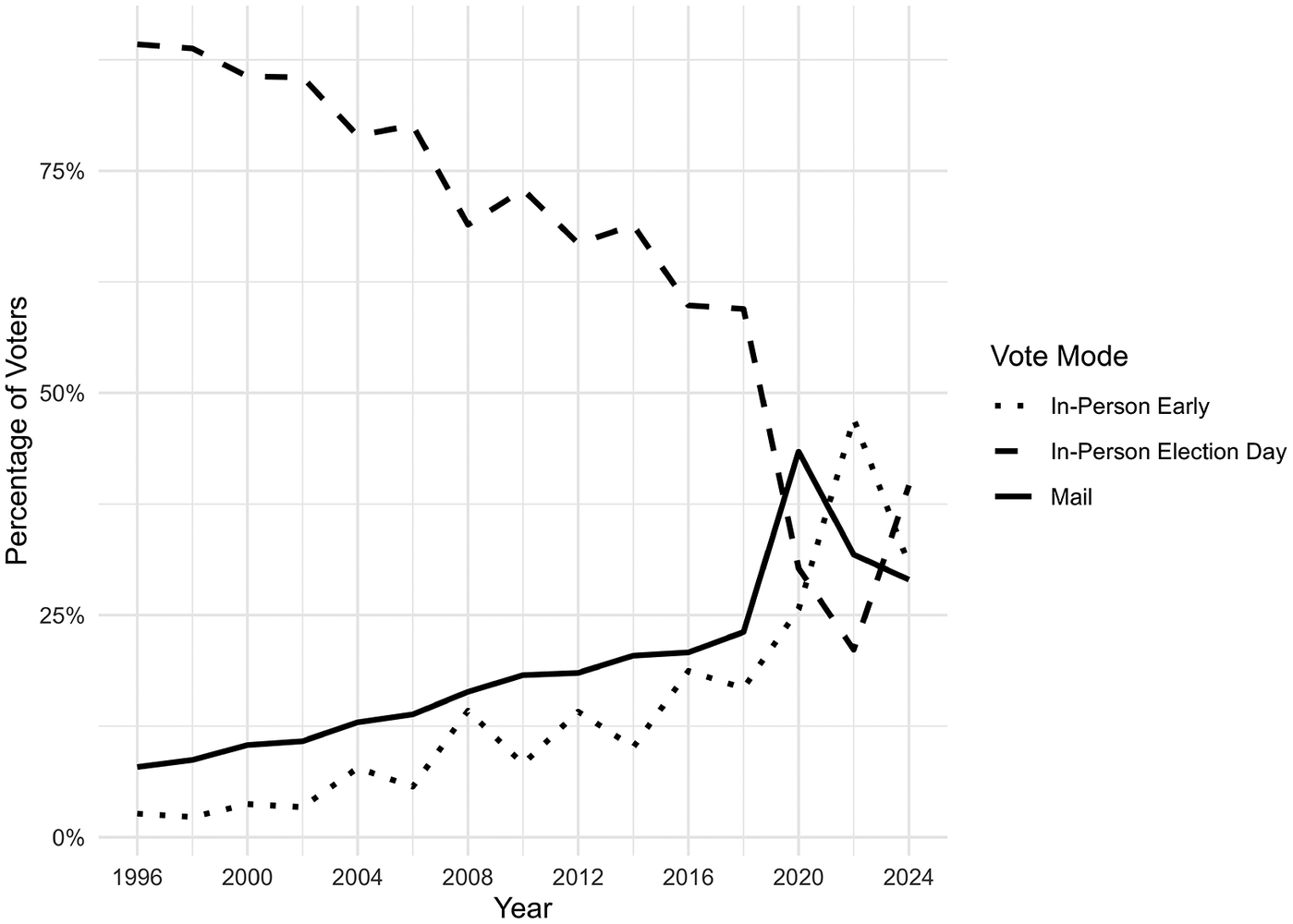
Over the past three decades, the American states have experienced a “quiet revolution” when it comes to convenience voting, most notably the adoption of early in-person, no-excuse vote-by-mail (VBM), and all-mail voting (Gronke Reference Gronke and Streb2012). Figure 2 shows the dramatic decline since the mid-1990s in in-person voting at precincts on Election Day, and the concomitant rise in early in-person and mail voting. While the adoption and expansion of convenience voting have reshaped how and when voters cast their ballots, the jury is still out as to whether it has drastically altered overall turnout levels as rational choice theory might predict.
Reported voting method, 1996–2024.
Note: Data drawn from Current Population Surveys, November Supplements, US Census Bureau.

Figure 2. Long description
The x-axis represents the Year from 1996 to 2024 in four-year increments. The y-axis represents the Percentage of Voters from 0 percent to 75 percent and above. Three distinct lines represent the Vote Mode.
* In-Person Election Day (dashed line): Starts at nearly 90 percent in 1996 and shows a steady, linear decrease over time. It drops sharply between 2018 and 2020 to approximately 30 percent, before fluctuating slightly toward 2024.
* Mail (solid line): Starts below 10 percent in 1996 and shows a gradual, steady increase until 2018. In 2020, it spikes significantly to over 40 percent, becoming the most popular method that year, before declining slightly to around 30 percent by 2024.
* In-Person Early (dotted line): Starts near 0 percent in 1996 and shows a slow upward trend with minor fluctuations. It spikes to nearly 50 percent in 2022 before settling around 40 percent in 2024.
By 2024, the three methods converge significantly compared to the wide gap seen in 1996.
Early in-person voting
Early in-person voting intends to reduce voting costs by extending the voting period and increasing convenient voting locations. The expansion of early in-person voting (Biggers and Hanmer Reference Biggers and Hanmer2015), one of the most prevalent election law reforms adopted across the states, originated in Texas in 1992 and has since been adopted by nearly all states by 2025. Rational choice theory suggests early voting opportunities should lower the costs of voting, as it is more flexible than Election Day voting, which can have higher transportation, time, and information costs. Early voting, proponents claim, should lower those costs, particularly for registered voters with a historically low propensity to turn out (e.g., younger, poorer, and non-White voters).
Identifying a causal effect on turnout from the expansion or contraction of early in-person voting rules is fraught with difficulties, as election officials do not randomly assign voters to greater or fewer voting days (or hours or locations). Since random assignment is not feasible, scholars have turned to identification strategies leveraging geographic border variation to exploit as-if natural experiments mimicking random treatment assignment across early voting and polling location changes (Clinton et al. Reference Clinton, Eubank, Fresh and Shepherd2021; Kaplan and Yuan Reference Kaplan and Yuan2020; Tomkins et al. Reference Tomkins, Yao, Gaebler, Konitzer, Rothschild, Meredith and Goel2023; Walker, Herron, and Smith Reference Walker, Herron and Smith2019). This work finds early voting may affect voter turnout, but the effects are largely conditional on local- and individual-level conditions.
As important as identifying overall turnout impacts is whether expanding voting days has differential effects on which voters turn out. Does expanding or contracting available days (and hours and locations) more strongly affect low-propensity voters who may face higher participation costs? Initial studies relying on survey or observational data were mixed on whether early in-person voting mobilized historically underrepresented groups (Berinsky Reference Berinsky2005; Primo, Jacobsmeier, and Milyo Reference Primo, Jacobsmeier and Milyo2007; Stein Reference Stein1998). With few exceptions (Burden et al. Reference Burden, Canon, Mayer and Moynihan2014; Clinton et al. Reference Clinton, Eubank, Fresh and Shepherd2021), more recent studies leveraging election administration data over time, and focusing both on the adoption and contraction of early voting, have found that the expansion of early in-person rules may not appreciably boost overall turnout, but they do affect which voters turn out in an election (Bitzer, Dukes, and Cooper Reference Bitzer, Dukes and Cooper2023; Herron and Smith Reference Herron and Smith2014; Reference Herron and Smith2022).
As with Election Day voting, which in some states includes Election Day vote centers (Manion et al. Reference Manion, Kimball, Anthony, Udani and Pritchard2023; Stein and Vonnahme Reference Stein and Vonnahme2008), planning, resources, and successful execution of early in-person voting reforms can ease the burdens placed on all voters (Fullmer Reference Fullmer2015). This is particularly true for eligible voters who want to eschew voting on Election Day or casting a mail ballot, either out of convenience or necessity. But overcrowded or insufficient polling locations can create long lines, negatively impacting the contemporaneous voter experience (Amos, Smith, and Ste Claire Reference Amos, Smith and Ste Claire2017; Chen et al. Reference Chen, Haggag, Pope and Rohla2022; Herron and Smith Reference Herron and Smith2015; Reference Herron and Smith2016; Stein et al. Reference Stein, Mann, Stewart, Birenbaum, Fung, Greenberg, Kawsar, Alberda, Michael Alvarez and Atkeson2020). More concerning is that long lines at the polls may contribute to downstream issues, such as lower turnout in subsequent elections (Cottrell, Herron, and Smith Reference Cottrell, Herron and Smith2020; Pettigrew Reference Pettigrew2021).
Voting by mail
Over four decades, nearly every American state has drastically relaxed laws governing who may cast vote-by-mail (VBM) ballots. VBM intends to reduce participation costs by allowing voters to avoid Election Day lines, work absences, and logistical challenges. VBM differs across states including excuse-required VBM, no-excuse VBM, mailing VBM applications to all voters, and universal VBM. California led with the first no-excuse absentee voting law in 1978, followed by Oregon and Washington, sparking non-precinct place voting reforms (Fortier Reference Fortier2006). Motivations ranged from improving access and convenience to reducing Election Day administrative burdens and achieving budgetary savings (Lamb Reference Lamb2021; McDonald Reference McDonald2022).
Early research on mail voting ironically suggested that expanding voting opportunities might exacerbate existing socioeconomic biases. Mail voting was largely used by regular voters substituting absentee ballots for traditional Election Day voting. Mail voters were disproportionately older, more White, better-educated, and higher-income (Berinsky, Burns, and Traugott Reference Berinsky, Burns and Traugott2001; Karp and Banducci Reference Karp and Banducci2001). Excuse-required mail voting often targeted voters facing mobility limitations, disabilities, or location barriers, but typically comprised a small fraction of ballots cast, except among voters over 65. Although early partisan polarization emerged in mail voting support during COVID-19’s initial months (Lockhart et al. Reference Lockhart, Hill, Merolla, Romero and Kousser2020), VBM use expanded greatly in the 2020 election (McDonald Reference McDonald2022; Shino and Smith Reference Shino and Smith2021), and demographic gaps in VBM use have narrowed as access expanded (Yoder et al. Reference Yoder, Handan-Nader, Myers, Nowacki, Thompson, Wu, Yorgason and Hall2021). Indeed, stated Republican opposition to mail voting is not supported by actual behavior (Shino, Smith, and Uribe Reference Shino, Smith and Uribe2022). Recent evidence shows that VBM voters are more knowledgeable (Shino and Smith Reference Shino and Smith2022) and more likely to support candidates reflecting their preferences (Wolak and Stapleton Reference Wolak and Stapleton2025), suggesting that concerns over mail voting may reflect elite-driven skepticism rather than any deficiency inherent to the mode itself (Berlinski et al. Reference Berlinski, Doyle, Guess, Levy, Lyons, Montgomery, Nyhan and Reifler2023).
Studies examining VBM policy liberalization effects have found inconsistent turnout results. Leighley and Nagler (Reference Leighley and Nagler2013) found that states adopting no-excuse and universal VBM generally had higher turnout rates, confirmed by McDonald et al. (Reference McDonald, Mucci, Shino and Smith2024) using 2012–2020 Current Population Survey (CPS) and Cooperative Election Study (CES) data. Case studies leveraging the before-and-after adoption of universal mail ballots found consistent turnout gains (Gerber, Huber, and Hill Reference Gerber, Huber and Hill2013; Thompson et al. Reference Thompson, Wu, Yoder and Hall2020). Hopkins et al. (Reference Hopkins, Meredith, Chainani, Olin and Tse2021) showed that simply reminding voters they could apply for mail voting prior to Philadelphia’s 2020 primary bumped turnout by nearly half a percentage point. However, using individual- and aggregate-level data, some argue that allowing individuals to vote in the days and weeks prior to Election Day may demobilize voters because it “turns a large-scale social activity that once took place on a single election day into a weeks-long process that diffuses public visibility” (Burden et al. Reference Burden, Canon, Mayer and Moynihan2014, 107, 97). Others found that no-excuse absentee voting does not noticeably affect overall participation (Yoder et al. Reference Yoder, Handan-Nader, Myers, Nowacki, Thompson, Wu, Yorgason and Hall2021).
Finally, several scholars have noted the potential peril of mail voting: ballot rejection. Hundreds of thousands of VBM ballots are rejected in every general election, according to EAC data. This occurs principally due to signatures on return envelopes not matching voters’ signatures on file or envelopes arriving after state deadlines. Studies using individual-level VBM ballot returns consistently find that non-White voters have higher rejection rates than White voters for signature issues (Baringer, Herron, and Smith Reference Baringer, Herron and Smith2020; Shino, Suttmann-Lea, and Smith Reference Shino, Suttmann-Lea and Smith2022). VBM rejection is often compounded by late returns; younger and inexperienced voters are much more likely to have ballots rejected for “lateness” (Cottrell, Herron, and Smith Reference Cottrell, Herron and Smith2021; Herron and Smith Reference Herron and Smith2021).
Limitations and recommendations
Research on state election policies has matured into a comprehensive agenda spanning policy diffusion, public opinion, political behavior, and beyond. However, each of these three subfields discussed here faces specific limitations, and each has developed with insufficient attention to interdependencies across subfields. Below, we highlight several existing limitations and suggest future avenues of research.
The study of election policy diffusion has grown in recent decades as scholars examine why states have the election policy configuration that they do. However, a limitation to our understanding of election policy diffusion is that most election policy diffusion research hyper-focuses on voter ID. Future scholarship should continue to examine other election policies,Footnote 6 as our understanding of non-voter ID election policy diffusion is still comparatively limited in both breadth and depth. This entails not only examining new policies that have not been thoroughly examined (e.g., voter registration restrictions, youth pre-registration laws, and mental competency requirements), but also re-examining previously examined laws through more rigorous methodological approaches, such as incorporating the latent election policy diffusion network (LaCombe, Tolbert, and Harper Reference LaCombe, Tolbert and Harper2025), and by comparing and contrasting competing explanations (e.g., pragmatism versus political motivations).
Research on the public opinion dimensions of election policies has expanded considerably, yet notable gaps persist. First, the literature remains predominantly observational and cross-sectional (Bowler and Donovan Reference Bowler and Donovan2018; Coll, Tolbert, and Ritter Reference Coll, Tolbert and Ritter2022), capturing attitudes at a single point rather than tracing how opinions form and evolve as policies are debated, adopted, and experienced. Panel designs that follow respondents through a state’s adoption of a new policy would help researchers separate the effect of policy exposure from pre-existing attitudes. Second, many works that have examined the effects of elite rhetoric or framing either do not measure rhetoric and framing or do so indirectly (Gronke et al. Reference Gronke, Hicks, McKee, Stewart and Dunham2019). While the experimental literature has begun to tackle this question more directly in recent years (Biggers Reference Biggers2019), less systematic attention has been paid to related questions such as causal mechanisms, whether sustained exposure to competing frames produces opinion polarization or convergence, and what moderates these rhetoric and framing effects. Future research should more thoroughly examine the role of elite rhetoric and issue framing, including its mechanisms and moderators. Third, while recent work has expanded attention beyond White Americans to include Black and Latino voters (Freeder and Shino Reference Freeder and Shino2024), Asian American and Native American opinion on election policies remains largely unexamined, despite the differential burdens these populations face under prevailing registration and identification requirements. Future studies should employ targeted oversamples to assess whether the partisan and racial signaling models developed within Black-White opinion dynamics generalize to a multiracial electorate.
The study of election policies and voting behavior has advanced substantially, yet important frontiers remain. First, the causal mechanisms linking policy changes to turnout remain inadequately specified. The literature identifies both direct cost channels (e.g., lacking required identification) and indirect channels (e.g., countermobilization, deterrence through perceived administrative complexity, or eligible voters who erroneously believe themselves ineligible); yet existing research designs seldom adjudicate among them (DeCrescenzo and Mayer Reference DeCrescenzo and Mayer2019). Second, the growing reliance on voter file data, while an improvement over self-reports, introduces its own challenges. Because most states do not record race or party affiliation in their voter registration files, researchers depend on commercial vendors who predict these attributes using models based on surnames, neighborhood demographics, and other proxies. These predictions are least accurate for the populations most affected by restrictive policies (Igielnik et al. Reference Igielnik, Keeter, Kennedy and Spahn2018), including Asian American, Latino, and multiracial voters, meaning measurement error may be correlated with the outcomes under study.
Additionally, each subfield can learn from the others, and more should be done to incorporate work across these topics. For example, most studies of election policy diffusion have wholly ignored almost any role for citizen opinions (e.g., support for election policies), instead focusing on elites or contextual (e.g., racial) factors. Yet, prior work finds that public policy opinions influence policy diffusion (Pacheco Reference Pacheco2012), and a similar framework should be applied to election policy diffusion. Additionally, the study of the participatory impacts of election policy can do more to incorporate insights from election policy diffusion and ecosystem configuration, such as by examining temporal dynamics (e.g., whether reforms affect turnout only in the initial election cycle or whether effects persist and compound over successive elections [Giammo and Brox Reference Giammo and Brox2010]). Similarly, most studies estimate the effect of a single policy change in isolation, but voters navigate entire policy ecosystems – a state that adopts strict voter ID may simultaneously contract early voting days and curtail third-party registration activities. Understanding the joint and interactive effects of bundled reforms on public opinion and participation necessitates research designs that model policy configurations rather than isolated treatments (Jansa, Motta, and Herrick Reference Jansa, Motta and Herrick2022; Pomante, Schraufnagel, and Li Reference Pomante, Schraufnagel and Li2023).
Finally, an issue that spans the three research areas is the measurement of election policies, specifically the use of indices. There has been a rise in the creation and use of composite measures of state election policy ecosystems and related concepts. These indices have some advantages over individual measures as they provide a more holistic measure of state-level phenomena. However, various composite indices of state election ecosystems do not seem to correlate very well (Flavin and Shufeldt Reference Flavin and Shufeldt2019), and changes in what is included within indices over time limit comparability across election cycles (Pomante, Schraufnagel, and Li Reference Pomante, Schraufnagel and Li2023). Thus, while these measures might provide insights that are not discoverable using individual indicators, they come with their own limitations. Future scholarship should systematically assess construct validity across indices – for instance, by examining whether indices that disagree on state rankings nonetheless produce convergent findings when used as predictors of turnout or voter confidence – and should consider developing modular, transparent indices with publicly available codebooks that allow researchers to examine the sensitivity of their findings to the inclusion or exclusion of specific component policies.
In sum, research on the American states as laboratories of electoral democracies – once a niche subfield – is at the vanguard of research on policy diffusion, public opinion, and political behavior. Voting and election studies focusing on the American states have grown tremendously in recent years, and we look forward to new approaches that build on the past 25 years of research, much of it published in State Politics & Policy Quarterly.
Data availability statement
Replication materials are available on SPPQ Dataverse at https://doi.org/10.7910/DVN/NZ4C5R (Coll, Shino, and Smith Reference Coll, Juelich and LaCombe2026).
Funding statement
The authors received no financial support for the research, authorship, and/or publication of this article.
Competing interests
The authors declared no potential competing interests with respect to the research, authorship, and/or publication of this article.
Author biographies
Joseph A. Coll is Assistant Professor of Political Science at Texas Tech University. His work examines electoral access, integrity, and backsliding in the United States.
Enrijeta Shino is Assistant Professor of Political Science at the University of Alabama. Her research broadly examines elections, voting behavior, and public opinion across and within the American states.
Daniel A. Smith is Professor and former Chair of Political Science at the University of Florida. His research broadly examines how political institutions affect political behavior across and within the American states.



 Open access

