Introduction
Social and health-care support originating from family members, friends or neighbours remains a pivotal aspect of the nexus of support for older individuals, contributing about 70–80 per cent of all care in Canada or the United States of America (USA) (Fast et al., Reference Fast, Duncan, Dunlop, Eales, Keating, Lero and Yoshino2011; US Department of Health and Human Services, 2018). Indeed, almost half of family care-givers provide care to their parents or parents-in-law for health-related needs, and this has been on the rise (Sinha, Reference Sinha2015). For instance, it has been documented that there has been a 20 per cent rise between 2007 and 2012 in the number of Canadian care-givers over the age of 45 providing care to a family member or friend with chronic illnesses or a long-term disability in the previous 12 months (Sinha, Reference Sinha2015).
Family members or friends may be expected to be more involved in care-giving activities for the ageing population in the future due to several demographic and socio-cultural trends. Care-giving demands may become intensified, given that the proportion of older adults in Canada will increase from the current level of 17 per cent to approximately 25 per cent by 2036, due to the ageing of baby-boomers coupled with rising life expectancy, similar to the USA and other developed countries (Wister, Reference Wister2005; United Nations, 2015; Statistics Canada, 2018a). Also, older adults prefer to remain living in the community for as long as possible to maximise their independence (Sabia, Reference Sabia2008). Both North American and European countries promote home- and community-based services for older adults, in order to support ageing in place and to replace or delay higher-cost long-term care options (Levine et al., Reference Levine, Halper, Peist and Gould2010; Ilinca et al., Reference Ilinca, Leichsenring and Rodrigues2015). Family care-givers often assume some care-giving roles under a complementary model of care, or assume this role fully in some cases, particularly when community services and care-giver support programmes are underdeveloped. Additionally, researchers from several countries (e.g. Canada, Spain and the USA) have projected increasing demand for care among the older population (Martin et al., Reference Martin, Freedman, Schoeni and Andreski2010; Wister and Speechley, Reference Wister and Speechley2015; Spijker et al., Reference Spijker, Devolder and Zuerasin press). These studies point to longer life expectancy, more mobility-related difficulties and increases in the prevalence of multimorbidity that create dependency at the end of life. However, declining fertility and increasing female labour force participation may lead to a shrinking pool of potential family care-givers (Spijker et al., Reference Spijker, Devolder and Zuerasin press). For instance, in the USA, the care-giver support ratio (the number of potential care-givers aged 45–64 years for older adults aged 80 and older) was 7 to 1 in 2010, and this number will decline sharply to 4 to 1 by 2030 and 3 to 1 by 2050, at which point baby-boomers will be in their older ages (Redfoot et al., Reference Redfoot, Feinberg and Houser2013). A similar situation is projected in Canada based on increasing senior dependency ratios (number of seniors to every 100 adults aged 20–64) (Statistics Canada, 2016). While it remains equivocal whether there will be a significant rise in family care burden in the future, recent evidence suggests at least a modest upward trend.
Geographic proximity is one contextual factor in family care-giving, and distance care-giving to ageing people is common in modern society. In the USA, there were more than seven million family care-givers (about 15% of all care-givers) providing care to family members who live at least one hour away (Cagle and Munn, Reference Cagle and Munn2012). In Canada, Vézina and Turcotte (Reference Vézina and Turcotte2010) estimated that about 22 per cent of family care-givers aged 45 years and older provided health-related support to a parent living more than one hour away. However, a gap still remains in the literature pertaining to the impact of geographic distance between family care-givers and their care receivers on the health and wellbeing of family care-givers. This is particularly relevant given high levels of physical mobility in families coupled with smaller family sizes that can reduce the availability of instrumental support (Dewit et al., Reference Dewit, Wister and Burch1988; Degeneffe and Burcham, Reference Degeneffe and Burcham2008). It is contended that geographic distance acts both as a significant objective and as a subjective time-related factor that shapes the context and experience of care-giving, and may be positively associated with social isolation.
Family care-giving is associated with both positive and negative care-giving outcomes. On one hand, substantive evidence supports the healthy care-giver hypothesis, which asserts that being a family care-giver helps maintain physical health and cognitive functions (Fredman et al., Reference Fredman, Lyons, Cauley, Hochberg and Applebaum2015; Roth et al., Reference Roth, Fredman and Haley2015). Also, different positive aspects of care-giving (e.g. feeling of accomplishment, generativity, meaning in life) have been identified in the literature (Carbonneau et al., Reference Carbonneau, Caron and Desrosiers2010). On the other hand, care-giving responsibility, especially more intensive levels, is associated with increased care-giver burden and stress, and compromises health status and wellbeing (Pinquart and Sörensen, Reference Pinquart and Sörensen2003; Fredman et al., Reference Fredman, Doros, Ensrud, Hochberg and Cauley2009). One significant deleterious outcome is social isolation (Li et al., Reference Li, Wister and Mitchell2020), given that the proportion of family care-givers experiencing social isolation has been estimated to range from 20 to 85 per cent, due to varying measurement of social isolation and different populations under study (Larson et al., Reference Larson, Franzén-Dahlin, Billing, Murray and Wredling2005; Leggett et al., Reference Leggett, Zarit, Taylor and Galvin2011). As care-giving progresses over time and care-giving demands become more intense, family care-givers may need to reduce contact with other family members or friends, give up social, health-promoting and leisure activities, or sacrifice employment and career (Burton et al., Reference Burton, Haley and Small2006; Bass et al., Reference Bass, Judge, Snow, Wilson, Looman, McCarthy and Kunik2012; Eales et al., Reference Eales, Keating, Donalds and Fast2015; Li et al., Reference Li, Wister and Mitchell2020).
Social isolation is a reflection of an individual's social relationship, social network or connection (Newall and Menec, Reference Newall and Menec2017). Individuals experiencing social isolation report a lack of relationships and interaction with other family members, peers or community organisations; loss of attachment; and/or limited social support (De Jong Gierveld and van Tilburg, Reference De Jong Gierveld and van Tilburg2006). Indeed, the study of social isolation is important, since it has been linked to lower wellbeing and a higher risk of multimorbidity and mortality (The National Seniors Council, 2017; Wister et al., Reference Wister, Cosco, Mitchell, Menec and Fyffe2019; Wister, Reference Wister2019). In the case of family care-giving, the restriction of social contacts can truncate support system networks necessary for maintaining wellbeing during family care-giving periods. Therefore, the purpose of this study is to examine the relationship between geographic distance and social isolation among family care-givers.
Social isolation among family care-givers: an ecological perspective
Researchers have studied the health and wellbeing of individuals from an ecological perspective, since it provides an overarching framework to understand people's development or change within micro-, meso- and macro-level spheres of influence (Bronfenbrenner, Reference Bronfenbrenner, Husen and Postlethwaite1994; McDonald et al., Reference McDonald, Poertner and Pierpont1999). In one family care-giving study, Tebb and Jivanjee (Reference Tebb and Jivanjee2000) proposed an Ecological Model of Caregiver Isolation (EMCI) in which they identified a set of biophysical, psycho-emotional, social and economic factors, at both the environmental and individual levels, that can lead to social isolation of family care-givers. Aligned with prior ecological theoretical applications (Bronfenbrenner, Reference Bronfenbrenner, Husen and Postlethwaite1994; Grzywacz and Marks, Reference Grzywacz and Marks2000), the EMCI facilitates an understanding of social isolation among family care-givers within multi-level environmental spheres (Tebb and Jivanjee, Reference Tebb and Jivanjee2000). Social isolation is structured with several layers and interactions of systems from the most proximal settings (e.g. family, friends) to societal, cultural and physical contexts (i.e. microsystems, mesosystems, exosystems and macrosystems). This model situates social isolation and care-giving contexts within a complex set of social systems that help to connect a large number of key predictors found in the literature.
Empirical evidence, albeit sparse, provides initial support of the EMCI. Biophysical factors, such as better health conditions of care receivers (Greenwood et al., Reference Greenwood, Pound, Smith and Brearley2019), psycho-emotional factors, including the self-efficacy in managing care-giving responsibilities among family care-givers (Andrén and Elmståhl, Reference Andrén and Elmståhl2008) and social factors related to the availability of community or professional services for care receivers (Robison et al., Reference Robison, Fortinsky, Kleppinger, Shugrue and Porter2009) have been negatively correlated with care-giver social isolation (CSI). Finally, when it comes to economic factors, it has been shown that loss of income due to employment adjustment and increased out-of-pocket expenses among family care-givers (Hanly et al., Reference Hanly, Céilleachair, Skally, O'Leary, Kapur, Fitzpatrick and Sharp2013) creates financial strain, which increases the risk of social isolation. As indicated by Tebb and Jivanjee (Reference Tebb and Jivanjee2000), the lack of financial resources and poverty may prevent family care-givers from socialising with other individuals, or using respite services or medical support, all of which potentially exacerbate isolation.
However, the geographical distance as a separate socio-environmental contextual factor of care-giving is still in its infancy. To this end, geographic proximity represents more than spatial distance or travel time separating family care-giver and care receiver physically; it evokes subjective and affective reactions to physical distance (Gillespie and van der Lippe, Reference Gillespie and van der Lippe2015).
Geographic distance and social isolation among family care-givers
According to the 2016 Census, around 76 per cent of ageing Canadians live independently, either with their spouse or partner (50%) or alone (26%) (Statistics Canada, 2018b). This living arrangement is also common in other developed countries (e.g. the USA) (United Nations, 2017; Lee and Edmonston, Reference Lee and Edmonston2019). As a result, providing care from a distance becomes more prevalent; and one study estimates that distance care-givers contribute about one-third of all family care-giving situations (Benefield, Reference Benefield2005). However, currently a consensus on the definition of distance care-giving or long-distance care-giving is lacking. Li et al. (Reference Li, Mao, Chi and Lou2019) summarised three methods to identify distance care-giving used in previous studies, including a travel time method, a spatial method or self-identification. For the purpose of this study, family care-givers who do not live with the care receivers in the same household or building are viewed as distance care-givers, and those who need to travel one hour by car are deemed to be long-distance care-givers (Cagle and Munn, Reference Cagle and Munn2012).
The need to travel to provide care to ageing family members or friends adds additional layers of complexity to care-giving obligations. Long-distance care-givers need to deal with more difficult care-giving situations due to having to navigate travel distances and/or public transportation challenges. They also tend to face greater separation from care receivers, and potential conflict with other family members (Douglas et al., Reference Douglas, Mazanec, Lipson and Leuchtag2016). They may need to spend more time communicating with their care receivers, more frequent trips to provide care and experience more uncertainty about monitoring other care (Edwards, Reference Edwards2014).
Some quantitative studies have supported an association between crude measures of geographic distance and adverse health and wellbeing outcomes among family care-givers. Based on their study of employed family care-givers in Canada, Duxbury et al. (Reference Duxbury, Higgins and Schroeder2009) reported that geographic distance (living in the same home, living nearby and living elsewhere) was a significant predictor of physical strain, financial strain and role overload, and those who were living nearby or with care receivers were in a better situation than the other two groups. Additionally, a recent study conducted in China by Li et al. (Reference Li, Mao, Chi and Lou2019) found that long-distance care-givers of older parents (defined as more than 30 minutes travel time) reported significantly more depressive symptoms than co-resident care-givers.
Therefore, distance care-givers need to manage more complex care-giving situations, and to deal with potential care-giver burden and adverse wellbeing caused by long distance. This situation tends to restrict a care-giver's ability and willingness to socialise with others or to attend social activities. Thus, the current study hypothesises that:
• Greater geographic distance between family care-givers and care receivers will be associated with higher levels of CSI.
Care-giving intensity
While physical distance is hypothesised to increase social isolation, some studies have confirmed that, compared to living apart, family care-givers residing with their care receivers tend to experience more restriction in work and other social activities. For example, Robison et al. (Reference Robison, Fortinsky, Kleppinger, Shugrue and Porter2009) found that co-residence was associated with increased social isolation when socio-economic factors were statistically controlled. A similar finding was also reported by Bass et al. (Reference Bass, Judge, Snow, Wilson, Looman, McCarthy and Kunik2012), who revealed decreased engagement in a variety of non-care-giving activities among family care-givers living with their care receivers.
This apparent paradox can be explicated by considering two factors: (a) care-giving intensity and (b) the level of granulation of the physical distance measure, especially when a simple dichotomous measure such as co-residence or not is used. When family care-givers live with care receivers, they are more likely to be the primary care-givers, undertake more care-giving tasks, spend more time in care-giving, and consequently experience more care-giving burden and adverse health outcomes (Lilly et al., Reference Lilly, Laporte and Coyte2010). Furthermore, they are more likely to experience restrictions in social activities and/or interaction with others due to exhaustion, tiredness or simply lack of time. Family members living at a distance are less likely to be the primary or solo care-givers compared to co-resident care-givers (Watari et al., Reference Watari, Wetherell, Gatz, Delaney, Ladd and Cherry2006), but the amount of separation appears to be relevant.
The findings yielded from studies focusing on the binary condition (co-residence or not) between family care-giver and care receiver appear to be in contrast to the findings based on multiple levels of geographic distance. A dichotomous category of living arrangement (co-residence or not) likely overlooks the nuances of different levels of geographical proximity. In one study, it was found that long-distance care-givers provide the same types of assistance compared to other care-givers living closer to care recipients, suggesting that they may stay longer due to travel barriers (Vézina and Turcotte, Reference Vézina and Turcotte2010). Thus, it is understandable that studies have shown that long-distance care-givers may experience significantly worse health and wellbeing than those living within a short distance (Chou et al., Reference Chou, Yeung and Chi2001; Li et al., Reference Li, Mao, Chi and Lou2019).
Additionally, Himes et al. (Reference Himes, Jordan and Farkas1996) discovered that geographic distance was not important in the care-giving decision when intensive care was needed for short periods. Further, Joseph and Hallman (Reference Joseph and Hallman1998) found that the impact of travel time on care-giving intensity among long-distance care-givers was only substantial among family care-givers providing support to healthy older adults. This implies that the relationship between geographic distance and family care-giving is likely more complicated when care-giving context and intensity, as well as a more complete range of physical distances, are considered.
In sum, most of the care-giving studies including living arrangement or geographic distance tend to focus on only one end of the distance spectrum (i.e. co-residence or long distance), and the results are equivocal. Therefore, it is imperative to examine more granulated levels of geographic separation, while also taking care-giving intensity into account, as well as key covariates. This leads to the second hypothesis:
• There is expected to be an interaction effect between geographic distance and care-giving intensity in affecting social isolation among family care-givers, such that combinations of greater distance and intensity significantly magnify social isolation.
Methods
This study is a secondary data analysis based on the sample selected from the Public Use Microdata File of 2012 Canada General Social Survey (GSS, Cycle 26): Caregiving and Care Receiving (Statistics Canada, 2017). GSS is a Canada nation-wide survey, and Cycle 26 (GSS 26) collected data from 23,093 individuals aged 15 years and older regarding their experience of providing care to family/friends or receiving care from others due to health, disability or ageing-related reasons. Related to care-giving, the survey covers the types and amount of care provided, the various impacts on the life of care-givers, as well as their socio-demographic background, health and wellbeing, employment situation, etc. A total of 2,881 participants were identified as family care-givers to ageing people, and were included in data analysis based on the following criteria: (a) the main care receiver of participants was aged 65 years and over who resided in a private home, (b) participants were still providing care when the survey was conducted, and (c) the survey was completed with a non-proxy interview.
Measurements
Social isolation
In the GSS 26, there are eight items inquiring whether participants spend less time with significant people or on socio-cultural activities due to care-giving responsibilities based on a dichotomous response set (yes = 1, no = 0). This study developed a CSI scale (Cronbach's α = 0.84) based on five items, including spend less time with ‘other family members’, ‘friends’, ‘social activities or hobbies’, ‘volunteering for an organisation’ and ‘participating in political, social or cultural groups’. The three excluded items include ‘spouse or partner’, ‘children’ and ‘relaxing or taking care of yourself’. These items were excluded for one of two reasons. First, if they were only relevant for a sub-group of the sample and therefore had significant missing values (41% for spouse/partner and 31% for children, respectively). Second, if they did not pertain to a social context. The CSI scale ranges from 0 to 5, with a higher number indicating more restriction in social contact and participation, and therefore indicating greater social isolation associated with care-giving duties. In the regression analyses and analysis of covariance (ANCOVA), a standardised score of CSI was used. The concept of social isolation is deemed to be multifaceted; thus, the use of scales is a preferred measurement strategy (Wister et al., Reference Wister, Cosco, Mitchell, Menec and Fyffe2019).
Geographic distance
This study applies a travel time method based on a set of ordinal responses. The geographic distance between family care-giver and care receiver was initially measured in GSS 26 at seven levels, ranging from ‘in the same household’ to ‘more than three hours by car’. These were grouped into four levels of distance: co-residence (in the same household/building), short distance (within 30 minutes by car), moderate distance (between 30 and 60 minutes by car) and long distance (more than one hour by car). Combining distances of more than one hour of travel time as long distance is consistent with previous care-giving research (Cagle and Munn, Reference Cagle and Munn2012).
Care-giving intensity
Care-giving intensity is represented by four main factors widely used in the care-giving literature, including: the primary care-giver status, care-giving tasks related to activities of daily living (ADLs) and instrumental activities of daily living (IADLs), and frequency of care-giving (Lilly et al., Reference Lilly, Laporte and Coyte2010; Jacobs et al., Reference Jacobs, Laporte, Van Houtven and Coyte2014; Rosso et al., Reference Rosso, Lee, Stefanick, Kroenke, Coker, Woods and Kritchevsky2015). The primary care-giver status was measured using a dichotomy (yes = 1, no = 0). In GSS 26, participants were asked to indicate whether they provided help in seven different activities, and among them one item was related to ADLs and another six items were related to IADLs. The question regarding ADLs is ‘During the past 12 months, have you helped your primary care receiver with personal care?’; and the six IADLs were similar to a previous study (Fredman et al., Reference Fredman, Doros, Ensrud, Hochberg and Cauley2009), including ‘transportation to do shopping or errands, or to get to medical appointments, or social events’, ‘meal preparation, meal clean-up, house cleaning, laundry or sewing’, ‘house maintenance or outdoor work’, ‘medical treatments or procedures’, ‘scheduling or co-ordinating care-related tasks’, and ‘banking, bill paying or managing their finances’ (Cronbach's α = 0.54). Care-giving in IADLs was further categorised into three levels, including one or two tasks, three or four tasks, and five or six tasks, consistent with a previous study (El Masry et al., Reference El Masry, Mullan and Hackett2013). Frequency of care-giving is an aggregated variable based on how often participants provided seven ADL- and IADL-related tasks, originally measured on a four-point scale from ‘daily’ to ‘less than once per month’ (Cronbach's α = 0.72). The scale was reverse-coded and summed up, and a higher number indicated higher levels of frequency of providing care. The score was further categorised into four levels based on the quartiles, including minimum, low, moderate and high level of care-giving frequency.
Care-giver characteristics
Ten socio-economic and health-related care-giver characteristics were drawn from the research literature and included based on available data (Pinquart and Sörensen, Reference Pinquart and Sörensen2003; Robison et al., Reference Robison, Fortinsky, Kleppinger, Shugrue and Porter2009). Gender of participants was measured traditionally as female and male, and age was grouped into three categories, including 15–44 years old, 45–64 years old, and 65 years and older. Marital status was recoded from six different categories (e.g. married, divorced, etc.) into two groups, including not married and married/common-law. This study also included a set of socio-economic status indicators, including highest education attainment (lower than high school, high school, college diploma or equivalent, university degree), employment status (not employed/retired, employed) and personal annual income (Can $30,000 and less, 30,001–60,000, more than 60,000). Data analysis also controlled for several additional relevant care-giver characteristics, which have been confirmed as social determinants of care-giving outcomes (Neufeld et al., Reference Neufeld, Harrison, Stewart, Hughes and Spitzer2002; Hebert et al., Reference Hebert, Dang and Schulz2007), including religion (no religion, Christian, other), living area (rural/small population centre, urban population centre), country of birth (outside Canada, Canada) and self-rated general health (poor/fair, good to excellent).
Care receiver characteristics
The current study incorporated five available variables capturing several important care receiver characteristics, including age, gender, health condition, whether using professional service and care-giver–receiver relationship. In GSS 26, age of care receivers was originally measured as ‘65–69 years’, ‘70–75 years’ to ‘100 years and over’, and this study grouped them into two categories, including 65–79 years and 80 years and older. Gender was measured as female and male, and health condition was indicated as mild, moderate, severe or ageing/frailty. Professional service utilisation was indicated by ‘yes’ and ‘no’. The care-giver–receiver relationship was recoded from 27 categories (e.g. spouse/partner, daughter, sister, etc.) into four categories, including spouse/partner, parents, other family members or others.
Analytic approach
Missing cases were examined statistically, indicating that the missing pattern was random (Little's MCAR test, p > 0.05). All of the variables had limited proportions of missing values, except ‘personal annual income’, which contained approximately 12.7 per cent missing. Thus, missing values were omitted for all variables except income. For the income variable, the missing values were grouped into ‘not stated’ and included as a separate category. In addition, the variation inflation factor and tolerance from the multicollinearity test met the recommendation for further regression analyses (Hair et al., Reference Hair, Black, Babin and Anderson2014). Also, sampling weight was applied in the descriptive analyses, and standardised weight was used for the bivariate and multivariate analyses. The data analysis used SPSS version 25.
Descriptive analysis was conducted to present background information, and bivariate analysis was performed to compare the differences among four levels of geographic distance. In addition, linear regression was carried out to examine the association between CSI and geographic distance, including other independent variables. Three blocks of variables (care-giver characteristics, care-giving factors and geographic distance) were incorporated into the regression models hierarchically. Finally, a two-way ANCOVA was applied to examine the interaction effect between geographic distance and care-giving intensity indicators in relating to the CSI measure. Selected variables related to family care-givers and care receivers were statistically controlled in the ANCOVA. The first group of all nominal or categorical variables was selected as the reference group in both regression analyses and ANCOVA. Since geographic distance or co-residence status is typically related to the relationship between care-giver and receiver, we conducted supplementary analyses with and without the care-giver–receiver relationship variable. The results were replicated; therefore, we report only findings based on inclusion of the care-giver–receiver relationship.
Results
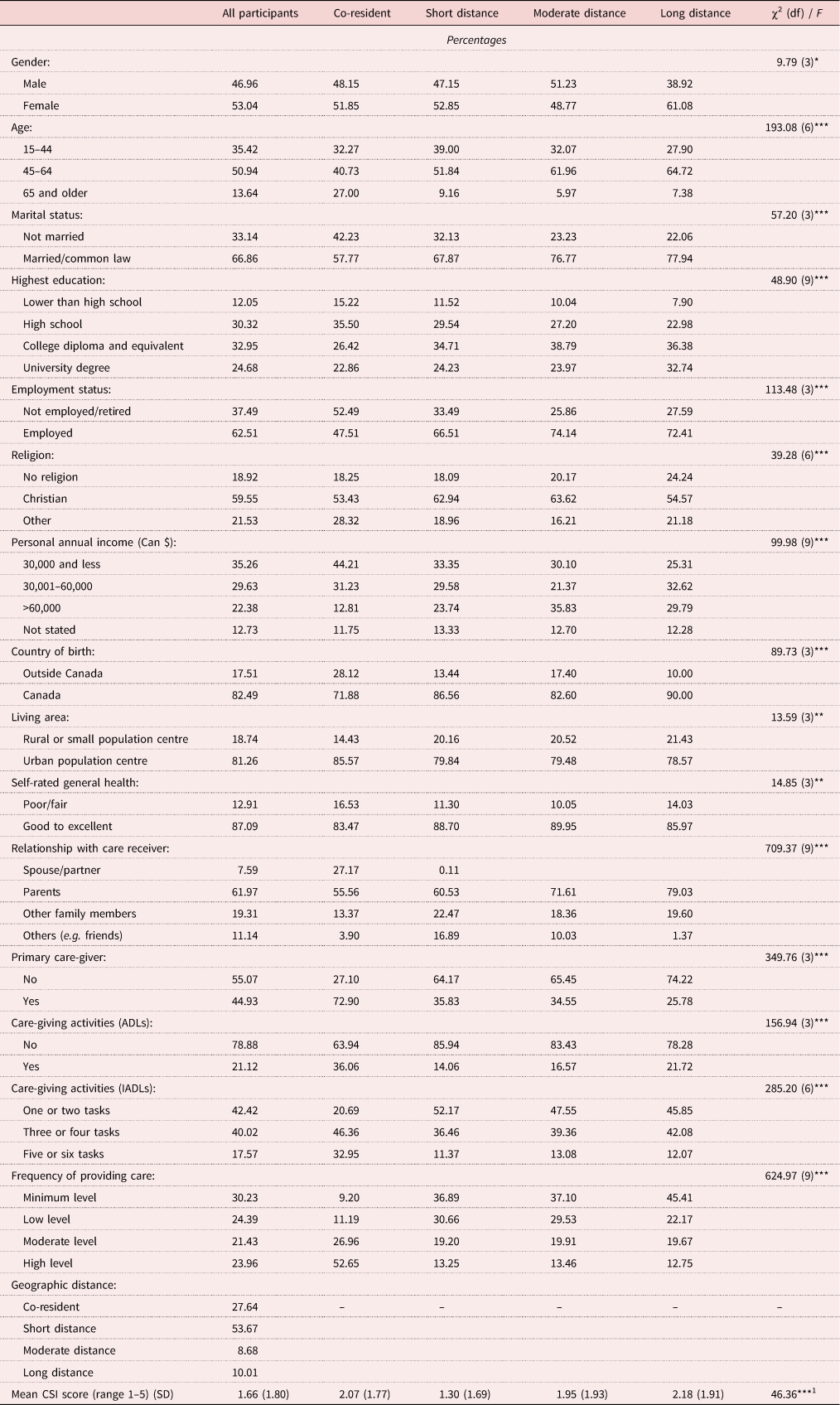
As shown in Table 1, the majority of family care-givers were female (53%), aged between 45 and 64 years old (51%), in a married/common-law relationship (67%) and provided care to parents (62%) at the time of the survey. Most of the family care-givers lived with (28%) or a short distance from (54%) their main care receivers. About 10 per cent of family care-givers needed to travel more than one hour to provide support. Family care-givers reported an average score of 1.66 (standard deviation (SD) = 1.80) on the CSI scale, which ranged from 0 to 5. Close to half of the family care-givers (45%) believed that they were the primary care-givers, and about 21 per cent of them provided support in ADLs and 42 per cent of them provided help with one or two IADLs. Among all the family care-givers, more than half (55%) provided care at minimum to low frequency.
Comparison among family care-givers with different geographic distances

Notes: N = 2,881; weighted N = 2,322,723. df: degrees of freedom. ADLs: activities of daily living. IADLs: instrumental activities of daily living. CSI: care-giver social isolation. SD: standard deviation. 1. Short-distance care-givers reported significantly lower CSI than the other three groups, and no difference exists among the other three groups.
Significance levels: * p < 0.05, ** p < 0.01, *** p < 0.001.
Group means (and chi-square statistics) among the four levels of geographic distance are also illustrated in Table 1 for the dependent and independent variables, as well as the selected care-giver characteristics. The short-distance care-givers reported the lowest CSI score (mean = 1.30, SD = 1.69) among all care-givers with four levels of distance, and no statistically significant difference existed among co-resident, moderate-distance and long-distance care-givers (mean = 2.07, SD = 1.77; mean = 1.95, SD = 1.93; and mean = 2.18, SD = 1.91, respectively). Although a smaller proportion of long-distance care-givers (26%) identified themselves as the primary care-givers compared to short- or moderate-distance care-givers (36 and 35%, respectively), a higher proportion of long-distance care-givers provided care in ADLs (22% versus 14 and 17%, respectively), and the proportions providing care in five or six IADLs or a moderate to high level of care-giving frequency were similar.
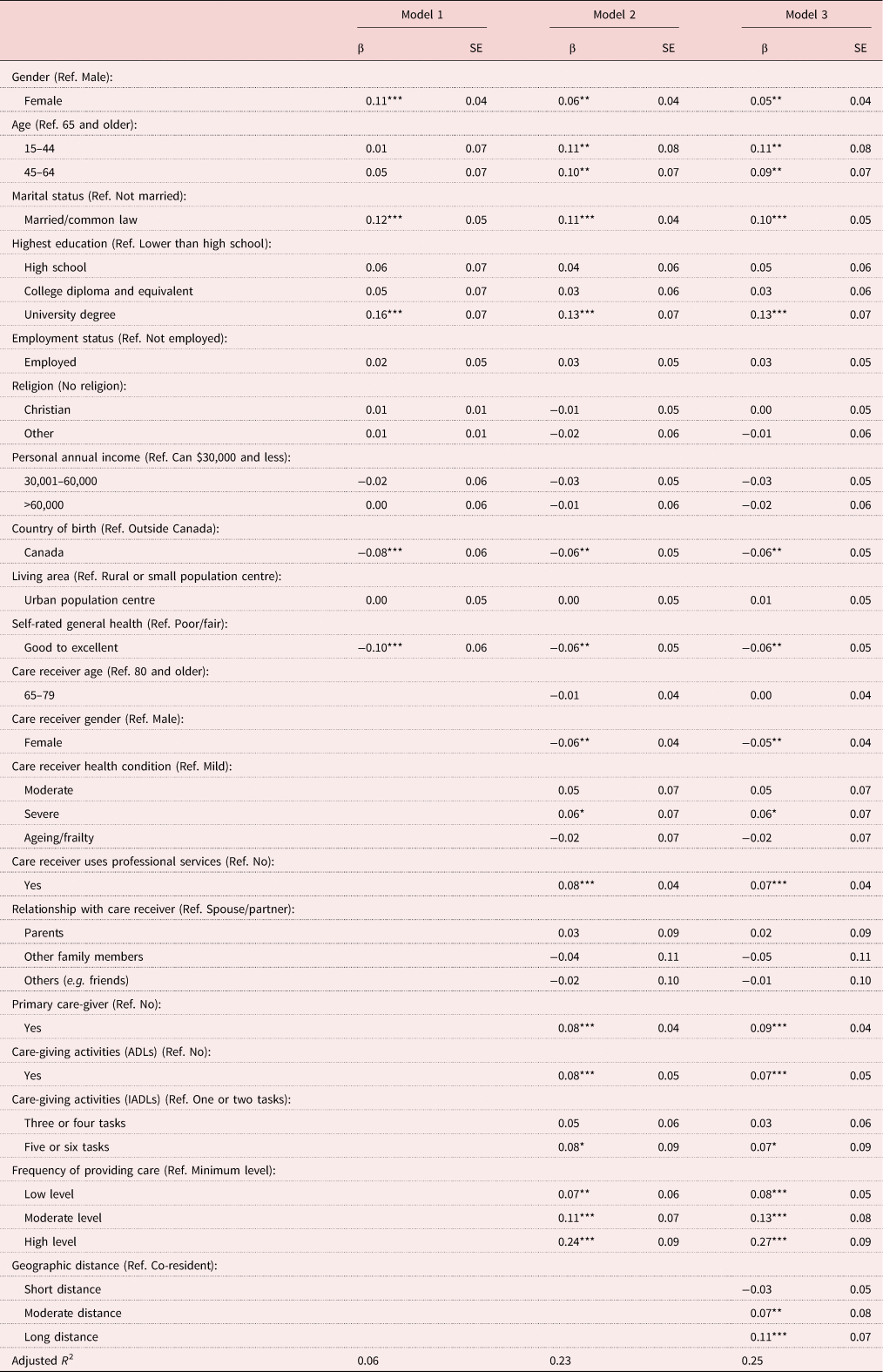
Results from the linear regression analysis are reported in Table 2, including the coefficient of determination (adjusted R 2) for each model, standardised coefficient beta (β), their standard error (SE) and the significance levels (p) for independent variables. Only the full model (Model 3, R 2 = 0.25, p < 0.001) is discussed below wherein all variables are included in the model, and associations were fully adjusted. Six of the ten family care-giver characteristics (female, younger age, married/common law, university degree compared to lower than high school education, born outside Canada and poorer self-rated health) and three care receiver characteristics (male, severe compared to mild health condition and currently using professional service) were statistically associated with higher CSI (for detailed information, see Table 2).
Linear regression for care-giver social isolation

Notes: N = 2,881; weighted N = 2,322,723. β: standardised beta. SE: coefficient standard error. Ref.: reference group. ADLs: activities of daily living. IADLs: instrumental activities of daily living. Adjusted R 2: adjusted coefficient of determination.
Significance levels: * p < 0.05, ** p < 0.01, *** p < 0.001.
All four of the care-giving intensity indicators were shown to have weak to moderate positive statistically significant associations with CSI. The primary care-givers reported higher CSI (β = 0.09, p < 0.001), as did the family care-givers providing support in ADLs (β = 0.07, p < 0.001). Furthermore, family care-givers providing care in five or six IADLs resulted in a higher CSI score compared to those who engaged in only one or two IADLs (β = 0.07, p < 0.05). Also, comparing with the minimum level of care-giving frequency, all care-givers in the other three levels tended to report higher CSI (low level: β = 0.08, p < 0.001; moderate level: β = 0.13, p < 0.001; and high level: β = 0.27, p < 0.001). Finally, when all other variables were statistically controlled, the geographic distance measure was significantly positively associated with the CSI score, where the moderate-distance care-givers (β = 0.07, p < 0.01) and long-distance care-givers (β = 0.11, p < 0.001) tended to report higher levels of CSI than co-resident care-givers. Thus, Hypothesis 1 is supported by this study.
Interaction effects between geographic distance and care-giving intensity
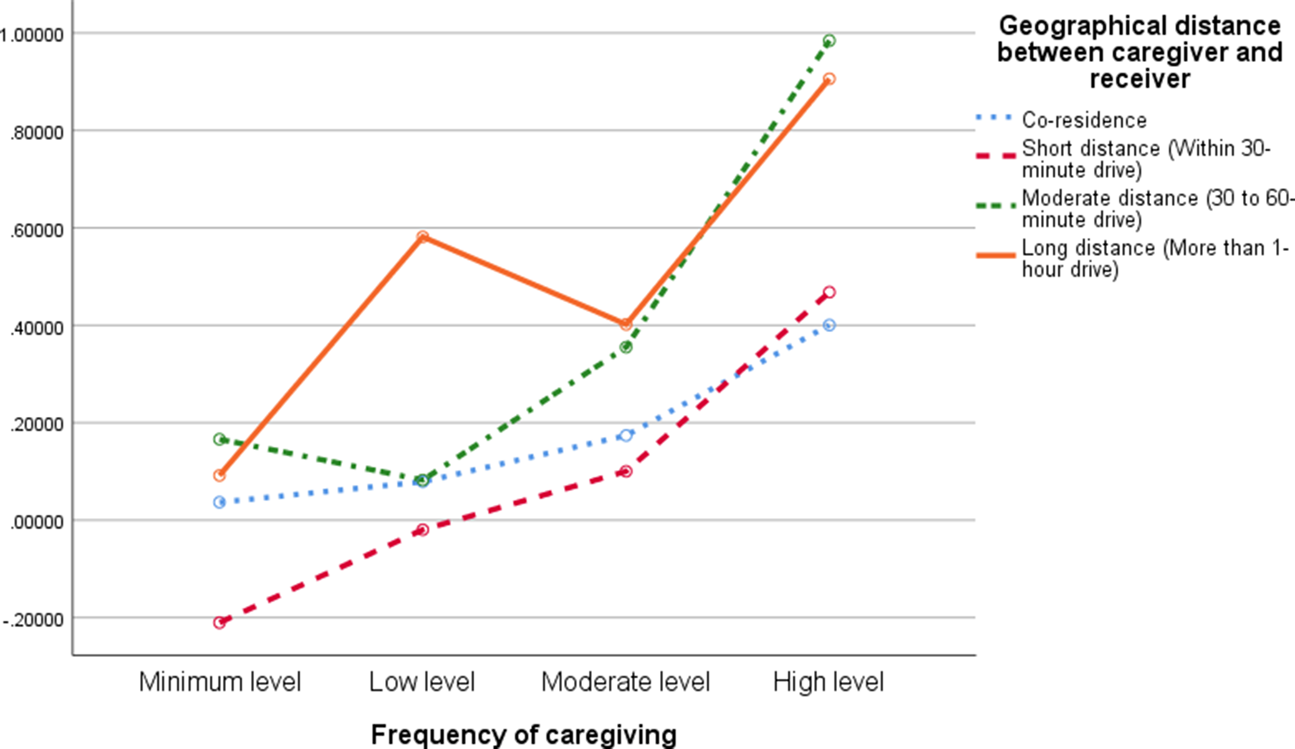
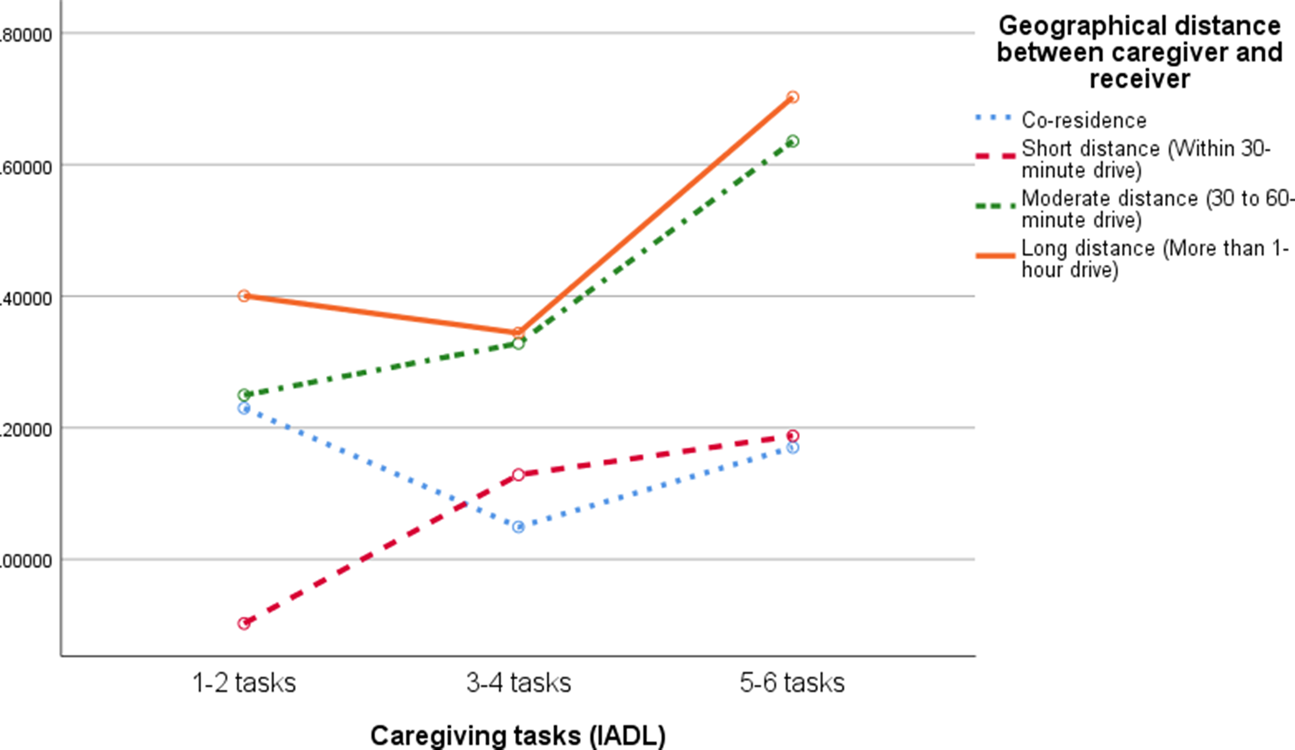
Based on the ANCOVA, statistically significant interaction effects were identified between geographic distance and frequency of care-giving (F 9, 2,395 = 2.02, p < 0.05) and the amount of IADL tasks involved (F 6, 2,398 = 3.20, p < 0.01). However, the interaction effects between geographic distance and primary care-giver status (F 3, 2,402 = 1.94, p > 0.05) and the interaction with involvement in ADLs (F 3, 2,402 = 1.19, p > 0.05) were not supported. The statistically significant interactions are plotted in Figures 1 and 2 using post hoc pairwise comparisons. Detailed results from the ANCOVA are available in the online supplementary materials. For geographic distance and frequency of care-giving, when family care-givers provided care with minimum frequency, short-distance care-givers reported lower CSI (adjusted mean (AM) = −0.21) than both moderate- and long-distance care-givers (AM = 0.17 and 0.09, respectively). When it comes to low frequency of care-giving, long-distance care-givers reported higher CSI (AM = 0.58) than the other three groups (AM = 0.08, −0.02 and 0.08 for co-resident, short-distance and moderate-distance care-givers, respectively). When moderately frequent care-giving was needed, long-distance care-givers reported higher CSI (AM = 0.40) than short-distance care-givers (AM = 0.10). Finally, at the high-level frequent care-giving, both long- and moderate-distance care-givers reported higher CSI (AM = 0.91 and 0.98, respectively) than for co-resident and short-distance care-givers (AM = 0.40 and 0.47, respectively).
Interaction effect between geographic distance and care-giving intensity (frequency of care-giving) in relation to care-giver social isolation.

Interaction effect between geographic distance and care-giving intensity (care-giving tasks – instrumental activities of daily living (IADL)) in relation to care-giver social isolation.

The second interaction effect between geographic distance and care-giving in IADLs is elaborated in Figure 2 and reveals further specification of these relationships. For family care-givers who are only involved in one or two IADLs, short-distance care-givers reported lower CSI (AM = −0.10) than other family care-givers (AM = 0.23, 0.25 and 0.40 for co-resident, moderate-distance and long-distance care-givers, respectively). For those reporting medium amounts (three or four IADLs) of care-giving tasks performed, the CSI score among co-resident care-givers (AM = 0.05) was lower than that of moderate (AM = 0.33) and long-distance care-givers (AM = 0.34), with similar results for short-distance care-givers (AM = 0.13). When family care-givers were supporting five or six IADLs, both moderate- and long-distance care-givers had higher CSI scores (AM = 064 and 0.70, respectively) than co-resident care-givers (AM = 0.17) and short-distance care-givers (AM = 0.19).
Therefore, Hypothesis 2 is partially supported, in that CSI is specified based on combinations of geographic distance and care-giving intensity connected to the frequency with which they provided care and the number of IADL-related tasks performed.
Discussion
Our results support the importance of geographic distance as a primary predictor of CSI when there is granulation in the measure to reveal the nuanced associations. In addition, the relationship between CSI and geographic distance is better explained by incorporating varying levels of care-giving intensity.
Interestingly, family care-givers living more than 30 minutes away (moderate and long distance) tended to experience higher levels of social isolation than co-resident care-givers. This finding is in contrast to previous research suggesting that family care-givers co-residing with their care receivers undertake more restrictions in non-care-giving activities when compared to those who are living elsewhere (e.g. Bass et al., Reference Bass, Judge, Snow, Wilson, Looman, McCarthy and Kunik2012). One possible explanation is that both the amount of travelling time needed to provide help (at least a one-hour round trip) and the physical exhaustion following travelling restrict the interaction of family care-givers with others at the individual and/or societal level. Also, family care-givers may engage in tasks that they can manage at a distance, including financial management, health-care arrangements and emotional support (Schulz and Eden, Reference Schulz and Eden2016). Providing help in these activities can also be time and energy-consuming, particularly when extensive communication is needed (Watari et al., Reference Watari, Wetherell, Gatz, Delaney, Ladd and Cherry2006). Family care-givers at a distance from care receivers also experience distress or even depression due to subjective care-giver burden (Li et al., Reference Li, Mao, Chi and Lou2019), which can reduce social connection.
Furthermore, distance care-giving has been identified as having a deleterious impact on employment, which can translate into increased isolation. Koerin and Harrigan (Reference Koerin and Harrigan2003) found that about 61 per cent of employed family care-givers in their sample reported at least one problem, such as leaving work early or having to take a leave of absence, a finding substantiated in a report on missing workdays due to long-distance care-giving responsibilities (MetLife, 2004). In addition, long-distance care-givers tend to have higher out-of-pocket expenses than family care-givers living nearby, a factor that restricts social life (Hanly et al., Reference Hanly, Céilleachair, Skally, O'Leary, Kapur, Fitzpatrick and Sharp2013).
Our study findings are consistent with other research that has supported associations between care-giving intensity and adverse care-giving outcomes, including social isolation (Fredman et al., Reference Fredman, Doros, Ensrud, Hochberg and Cauley2009; Jacobs et al., Reference Jacobs, Laporte, Van Houtven and Coyte2014; Li et al., Reference Li, Wister and Mitchell2020). First, greater care-giving intensity in terms of assuming primary responsibility, more care-giving tasks and higher frequency restrict the social life of family care-givers. Further, the relationship between CSI and the geographic distance is better addressed when taking care-giving intensity into account. This is consistent with the EMCI in that personal and environmental factors exert both additive and interactive effects on individuals (Grzywacz and Marks, Reference Grzywacz and Marks2000). In our analysis, before care-giving intensity was included in the model, long-distance, moderate-distance and co-resident care-givers reported a similar level of social isolation, but greater than short-distance care-givers. These findings parallel those of Chou et al. (Reference Chou, Yeung and Chi2001), who found that a threshold of approximately 20 minutes of travelling time might be an optimal distance between the care-giver and receiver. This suggests a potential ‘sweet spot’ in balancing distance and social isolation thresholds. Co-resident care-giving takes more of a toll on the primary care-giver, and long-distance care-giving typically requires extra effort in travelling and managing care remotely. Therefore, a short physical distance (in this study, within 30 minutes by car) may be an ideal distance for family care-givers to provide needed care, and to mitigate being overwhelmed by care-giving needs. Researchers have revealed that some family care-givers decide to relocate themselves or their care receivers in order to provide the necessary support (Cicirelli, Reference Cicirelli2000; Williams et al., Reference Williams, Sethi, Duggleby, Ploeg, Markle-Reid, Peacock and Ghosh2016). The ‘sweet spot’ in providing care, identified in our study and others (e.g. Chou et al., Reference Chou, Yeung and Chi2001), might function as a reference for family care-givers in making these challenging decisions. Indeed, we found that after care-giving intensity was taken into account, limited disparity existed between co-resident and short-distance care-givers regarding social isolation, while moderate- and long-distance care-givers still experienced greater social isolation than short-distance care-givers at almost all levels of care-giving intensity. Another novel finding in this research is that both moderate- and long-distance care-givers reported greater social isolation than co-resident care-givers only under conditions in which participants undertook higher-intensity care-giving (highest care-giving frequency, or more than three IADL tasks). However, when the care-giving intensity is manageable (minimum frequency, or one or two IADL tasks), the disparity in social isolation between co-resident and long- or moderate-distance care-givers is not evident.
These findings, related to geographic distance and care-giving intensity, help to contextualise previous studies in a number of important ways (Robison et al., Reference Robison, Fortinsky, Kleppinger, Shugrue and Porter2009; Bass et al., Reference Bass, Judge, Snow, Wilson, Looman, McCarthy and Kunik2012). First, when family care-givers at different distances need to assume similar care-giving responsibilities, the time cost or subjective burden associated with longer distance separation may be of greater salience, resulting in higher levels of social isolation. Indeed, co-resident care-givers tend to be the primary care-givers who are assuming more responsibility, whereas the frequency of care-giving may decrease as the distance increases (Watari et al., Reference Watari, Wetherell, Gatz, Delaney, Ladd and Cherry2006). However, a considerable proportion of distance care-givers also identify themselves as primary care-givers. For instance, Harrigan and Koerin (Reference Harrigan and Koerin2007) pointed out in their study that about 32 per cent of long-distance care-givers were primary care-givers, or shared half care-giving responsibility with someone else. In our research, the combination of long physical distance and highly intensive care-giving tends to amplify the negative impact of care-giving on CSI among this group of distance care-givers who are also the primary care-givers. Second, when distance care-givers undertake manageable care-giving responsibility (e.g. one or two tasks), they may prefer to perform selected specialised tasks that they can perform at a distance, such as financial management. Meanwhile, other family members living with or closer to care receivers may have a greater responsibility for providing daily tasks, such as meal preparation or house maintenance. This division of care-giving tasks is common among siblings caring for ageing parents (Roff et al., Reference Roff, Martin, Jennings, Parker and Harmon2007). There may also be a proclivity for distance care-givers to reduce travelling time and frequency in order to provide care under circumstances of low-intensity care.
The results from this study also support additional dimensions of the EMCI (Tebb and Jivanjee, Reference Tebb and Jivanjee2000). We demonstrate that CSI is related to the social-economic characteristics of family care-givers, reflecting the individual-level demographic factors (age and marriage), socio-economic factors (education), psycho-emotional factors (immigration status) and biophysical factors (self-rated general health). Younger age is positively related to social isolation, which is consistent with previous studies that more limitations in social activities have been observed among young family care-givers (Charles et al., Reference Charles, Stainton and Marshall2012), which can lead them to be at higher risk of social isolation. A potential reason is that senior spousal care-givers may only need to support their spouse, and also may have been aided by formal services and/or other family members living elsewhere (Spijker and Zueras, Reference Spijker and Zueras2020); whereas younger family care-givers are more likely to support more than one individual (Ysseldyk et al., Reference Ysseldyk, Kuran, Powell and Villeneuve2019). In our sample, married family care-givers experienced greater social isolation. This finding resonates with previous evidence that married family care-givers tend to assume more care-giving responsibilities and undertake a higher care-giving burden (Lukhmana et al., Reference Lukhmana, Bhasin, Chhabra and Bhatia2015). Finally, family care-givers with university-level education report more social isolation compared to those who did not finish high school. This finding is unexpected, since higher educational attainment usually serves as a protective function against adverse health and wellbeing outcomes (McPherson et al., Reference McPherson, Smith-Lovin and Brashears2006). However, in the distance care-giving context, there might exist a higher expectation on family care-givers with higher education to travel for care-giving, considering they have more financial and/or social resources. As a result, this group of care-givers might need to sacrifice social contact or activities due to care-giving responsibilities.
Several additional covariates of CSI were also supported. Family care-givers born outside Canada had a higher probability of experiencing social isolation than Canadian-born care-givers. Immigration status is a widely studied condition in family care-giving, and its association with social isolation may be attributable to limited social networks and/or social support, as well as inadequate knowledge and under-utilisation of formal services and supports (such as respite care) to ameliorate care-giving responsibilities (Kalich et al., Reference Kalich, Heinemann and Ghahari2016). Also, as expected, family care-givers reporting better self-rated general health are associated with a lower level of social isolation. The mutual impact between family care-giving and the general health of family care-givers is well-documented (De Frias et al., Reference De Frias, Tuokko and Rosenberg2005; Ho et al., Reference Ho, Chan, Woo, Chong and Sham2009), and findings from this study further provide evidence that better general health facilitates family care-givers’ capability in simultaneously managing care-giving tasks and maintaining social connections. In addition, family care-givers reported a higher level of social isolation if their care receivers were using professional services. Although speculative, perhaps care receivers who use professional services might experience intensified levels of burden. Some studies have also found that older adults who are living alone or are on a low income tend to rely on professional services (e.g. home care) (Kempen and Suurmeijer, Reference Kempen and Suurmeijer1991), which are indicators of greater burden.
Implications
This study provides empirical evidence that may be instrumental in protecting family care-givers against social isolation, particularly for distance care-givers. Researchers have already realised the importance of reducing CSI to maintain their wellbeing, and various supportive programmes are available, including support groups and psycho-education programmes (Schulz and Eden, Reference Schulz and Eden2016). However, distance care-givers encounter substantially different challenges and barriers compared to family care-givers living with or close to care receivers. Therefore, intervention programmes designed for distance care-givers and co-resident care-givers should address different dimensions of care-giving burden.
Overall, considering the current and anticipated increasing prevalence of distance care-giving, more services and programmes need to be delivered, especially in less-urban environments that tend to have fewer resources. For instance, employers could allow for more flexibility for workers who provide distance care, and tax benefits for care-givers could include a travel component based on distance. Proximity of respite care, peer support groups and transportation support for care-givers may also address CSI (Cvitkovich and Wister, Reference Cvitkovich and Wister2001). Also, home visit programmes, and in-home care or adult day programmes for older adults, have been recommended to support care receivers (Watari et al., Reference Watari, Wetherell, Gatz, Delaney, Ladd and Cherry2006). However, sometimes the care-giver need is undermined. A British Columbia-based study reported that care-givers find it hard to access respite or adult day programmes, unless care-giver burnout is reported or care-givers become patients (Lilly et al., 2011). Also, although the coverage of long-term care service in Canada is quite broad, the system varies among different provinces and the assistance requests are made by local health authorities on a case-by-case basis. In addition, the co-ordination across different care settings (home, long-term care facilities, hospital) is limited in Canada (Taylor and Quesnel-Vallée, Reference Taylor and Quesnel-Vallée2017). Therefore, family care-givers actually face structural barriers to access and manage the needed medical or social services to support their ageing family members or friends. This increases further the possibility of social isolation among family care-givers, since they might struggle with both care-giving responsibility and care management. Since 2003, various care-giver strategies have been developed at provincial and national levels to support care-givers (Lilly et al., 2011), and a recent agreement between provincial and federal government was issued to improve access to health care and supportive services at home and in the community, within which increasing support for care-givers is one key action (Government of Canada, 2018).
In addition, previous care-giving studies have not fully examined aspects of social isolation as central components of the health and wellbeing of family care-givers. Future studies on care-giving need to include social isolation along with other health and wellbeing outcomes, and to explore how it is affected by care-giver characteristics (e.g. gender and ethnicity) and care-giving contexts. Also, some literature suggests that family care-givers try to maintain social contact, or actively seek resources and social network support, to help manage care-giving responsibility (Carpentier and Ducharme, Reference Carpentier and Ducharme2005; Roth, Reference Roth2020). Recognising that harnessing social support to assist in care-giving does not necessarily equate to reductions in social isolation outside the care-giving situation suggests other avenues of research. Therefore, future studies need to examine further patterns of social network support and social isolation among family care-givers over time, and also compare the potential differences between care-givers and non-care-givers in terms of other key covariates and contexts.
Limitations
In this study, the CSI score was calculated based on a set of GSS 26 questions related to the impact of family care-giving on personal and family life, which taps into a specific context. However, the way in which the questions were asked is consistent with the conceptualisation of social isolation (De Jong Gierveld and van Tilburg, Reference De Jong Gierveld and van Tilburg2006). This CSI scale had high reliability and resulted in strong associations, but further confirmatory research is needed. Due to the nature of secondary data analysis of the study, we were restricted to available measures in the GSS 26. For example, care-giving tasks related to ADLs is only one question containing all the relevant activities, whereas several questions were asked for each ADL in other studies (e.g. Fredman et al., Reference Fredman, Doros, Ensrud, Hochberg and Cauley2009). Also, findings from this study should be interpreted with caution due to the cross-sectional nature of GSS 26. One limitation of the CSI scale is the retrospective nature of questions, rather than measuring multiple times during certain periods. Therefore, this prevents the comparison of the CSI of participants before and after being family care-givers. Also, due to the nature of survey questions related to CSI, it is hard to tell whether participants chose to reduce social contact as a coping strategy or if it was an inadvertent consequence of care-giving responsibility. Another issue worth clarification is that this study excluded the items related to time spent with ‘spouse or partner’ or ‘children’ when calculating the CSI score. Previous studies have suggested that married couples tend to reduce social contact with friends or community members and to spend more time with their spouse/partner or children (Kalmijn, Reference Kalmijn2003; Sarkisian and Gerstel, Reference Sarkisian and Gerstel2008). Therefore, results should be interpreted with caution when applying the findings from this study.
Although only a few studies (Burton et al., Reference Burton, Haley and Small2006; Poon et al., Reference Poon, Harvey, Mackinnon and Joubert2017) have used longitudinal data to establish the causal relationship between family care-giving and social isolation, our research is consistent with this literature with respect to the association between care-giving and social isolation (Li et al., Reference Li, Wister and Mitchell2020). More work to explore social isolation among family care-givers is urged based on a longitudinal study design, such as the Canadian Longitudinal Study on Aging or the US Health and Retirement Study. Furthermore, the data in GSS 26 were collected in 2012, and since then, some social changes have happened, such as multi-generational households have become more common since the Great Recession (Fry and Passel, Reference Fry and Passel2014).
Conclusion
In summary, this study highlights the importance of geographic distance in understanding social isolation among family care-givers. The findings also clearly demonstrate a noteworthy interaction between geographic distance and care-giving intensity, revealing the complexity and nuances of family care-giving. Future research is needed in order to further shed light on social isolation among family care-givers situated in varying and diverse social, economic and geographical contexts.
Supplementary material
The supplementary material for this article can be found at https://doi.org/10.1017/S0144686X2100060X.
Author contributions
LL was the main writer of manuscript and AW made a substantial contribution to the conception and design of the study, and critical revision of the manuscript.
Financial support
This research received no specific grant from any funding agency, commercial or not-for-profit sectors.
Conflict of interest
The authors declare no conflicts of interest.